

- Industry Size (2026)
- USD 50.3 Mn
- Forecast (2036)
- USD 86.7 Mn
- CAGR (2026 to 2036)
- 5.6%
Aircraft Cargo Door Seal Upgrade Kits Market Size, Market Forecast and Outlook By FMI
The aircraft cargo door seal market size 2025 reached USD 47.6 million with the industry spending estimated to surpass USD 50.3 million in 2026, expanding at a CAGR of 5.6% over the forecast period. This persistent upward trajectory drives the aircraft cargo door seal forecast 2036 carrying the total opportunity to USD 86.7 million, as the severe operational penalty of cargo door depressurization incidents forces airlines to preemptively schedule a cargo door seal replacement for aircraft rather than wait for standard heavy maintenance checks.
Maintenance directors face a specific structural decision: continue relying on piecemeal rework to pass localized leak tests, or invest in comprehensive elastomeric upgrades that rebuild the entire seal bed. The stakes for delaying this transition involve unscheduled aircraft on ground (AOG) events, where degraded factory seals undergo compression set and fail to maintain cabin pressure differentials during critical freight routing. Operators attempting to defer these upgrades often introduce aerospace adhesives sealants as a stopgap measure, which inadvertently damages retainer tracks and inflates the final repair bill. According to FMI's estimates, this tension pushes procurement teams toward full replacement assemblies that guarantee pressure integrity.
Summary of Aircraft Cargo Door Seal Upgrade Kits Market
- Aircraft Cargo Door Seal Upgrade Kits Market Definition
- This landscape tracks the supply of certified elastomeric assemblies and retainer hardware required to maintain cabin pressure integrity at cargo access points. It functions as a critical compliance category within aviation maintenance, driven by the physical degradation of rubber compounds under continuous thermal and pressure cycling.
- Demand Drivers in the Market
- Stringent dispatch reliability requirements force airline operations managers to replace aging seals before pressure leak rates trigger automatic flight restrictions.
- The aggressive utilization of passenger-to-freighter conversions compels maintenance planners to install highly durable freighter cargo door seal kits engineered for lower cycle frequencies.
- Advancements in elastomer science push engineering directors to specify fluorosilicone upgrades that resist hydraulic fluid contamination better than legacy materials.
- Key Segments Analyzed in the FMI Report
- Narrow-Body Commercial Aircraft: Narrow-body commercial aircraft are expected to garner 58.0% share in 2026, because short-haul routing accumulates pressure cycles faster than long-haul operations.
- Full Seal Replacement Kits: When evaluating aircraft cargo door seal retrofit kits, full seal replacement kits are anticipated to hold 46.0% share in 2026, as operators prefer guaranteed pressure integrity over the risk of localized patching.
- Silicone Elastomer: Silicone elastomer is poised to capture 41.0% share in 2026, maintaining its position due to baseline OEM specification and predictable thermal performance.
- Lower-Deck Forward Cargo Door: This segment accounts for 37.0% share in 2026, owing to its proximity to ground service equipment routing which increases physical damage rates.
- OEM / Service Bulletin Channel: OEM / service bulletin channel is estimated to record 44.0% share in 2026, driven by operators avoiding certification risk during lease-return compliance checks.
- India: 7.0% CAGR, reflecting the intense utilization of older narrow-body fleets to support regional logistics networks.
- Analyst Opinion at FMI
- Nikhil Kaitwade, Principal Analyst, Aerospace & Automotive, at FMI, opines, "The general consensus is that seal replacement schedules are dictated purely by OEM maintenance planning documents. However, the actual trigger is often ground damage. Ground support personnel strike the lower-deck door jambs with belt loaders constantly. Maintenance crews log this as 'premature seal failure’, as operators frequently use these upgrade kits to fix impact damage and address natural elastomer compression set simultaneously.”
- Strategic Implications / Executive Takeaways
- Part 145 repair station directors must secure reliable PMA channels to avoid extended lead times from OEM suppliers during peak heavy maintenance seasons.
- Engineering departments should evaluate hybrid composite sealing assemblies to reduce the recurring labor costs associated with frequent retainer clip failures.
- Asset managers face strict lease-return conditions that require complete seal replacement documentation to satisfy the next operator's airworthiness standards.
- Methodology
- Research relies on baseline fleet data crossed with specific maintenance intervals. FMI validates these replacement frequencies by interviewing base maintenance directors and analyzing the volume of structural parts moving through global distribution networks.
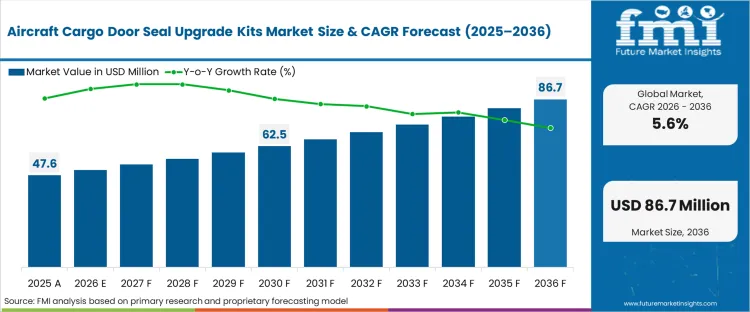
Before growth becomes self-reinforcing, airlines must integrate predictive maintenance algorithms tracking door pressure leak rates into their standard operational software. Maintenance crews currently replace seals on a fixed flight-cycle interval, but the shift to continuous condition monitoring fundamentally changes how procurement schedules aircraft seals inventory. Once this analytical gate is crossed, fleets move away from reactive procurement and establish recurring upgrade programs that stabilize vendor demand.
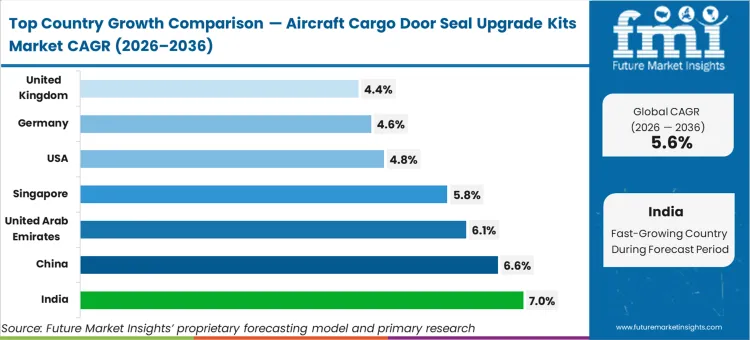
India's market is expected to expand at 7.0%, followed closely by China at 6.6% and the United Arab Emirates at 6.1%. Singapore tracks at 5.8%, while the United States records a 4.8% growth rate. Germany and the United Kingdom are estimated to post growth of 4.6% and 4.4% respectively. The structural divergence across this range stems from the varying intensity of regional e-commerce logistics, where high-frequency utilization of older converted narrow-body freighters accelerates pressure cycle accumulation and demands accelerated replacement schedules.
Aircraft Cargo Door Seal Upgrade Kits Market Definition
The aircraft cargo door seal market encompasses engineered elastomeric systems, retainers, and associated hardware designed specifically to restore or improve the pressure-retaining capabilities of aircraft cargo access points. This sector explicitly covers post-factory replacement assemblies used to mitigate compression set, chemical degradation, and mechanical wear on cargo doors. It operates as a highly regulated subset of the aviation maintenance industry, requiring distinct airworthiness certification for every component.
Aircraft Cargo Door Seal Upgrade Kits Market Inclusions
The scope covers primary and secondary elastomeric pressure seals, as well as aerodynamic weather seals. It also includes the composite retainer clips, specialized fasteners, and structural preparation materials required for cargo door installations. The analysis evaluates kits distributed through OEM service bulletins, Parts Manufacturer Approval (PMA) channels, and Supplemental Type Certificate (STC) modifiers. Analysis captures materials used alongside aerospace fasteners when performing documented installations of approved aircraft cargo door seal replacement kits on lower-deck, main-deck, and bulk cargo doors across commercial and dedicated freighter platforms.
Aircraft Cargo Door Seal Upgrade Kits Market Exclusions
Passenger door seals, flight deck window seals, and landing gear seals fall outside this analysis, as their wear patterns and replacement cycles do not correlate with cargo loading operations. Routine liquid sealants applied outside of a documented door seal upgrade procedure are excluded. The analysis also omits raw elastomer materials sold in bulk to manufacturers, focusing strictly on pre-formed, part-numbered kits engineered for direct installation by maintenance facilities.
Aircraft Cargo Door Seal Upgrade Kits Market Research Methodology
- Primary Research: FMI conducted interviews with airline Director of Maintenance (DOM) personnel, chief inspectors at Part 145 repair stations, and procurement heads for major cargo conversion specialists.
- Desk Research: Analysts aggregated data from FAA Special Airworthiness Information Bulletins, EASA Airworthiness Directives, and public OEM service bulletin compliance timelines.
- Market-Sizing and Forecasting: The baseline anchors to the active global commercial fleet age profile, multiplied by documented door seal replacement frequencies across major narrow-body and wide-body platforms.
- Data Validation and Update Cycle: Forecasts were triangulated against global cargo capacity utilization rates and the annual throughput of passenger-to-freighter conversion facilities.
Segmental Analysis
Aircraft Cargo Door Seal Upgrade Kits Market Analysis by Aircraft Type
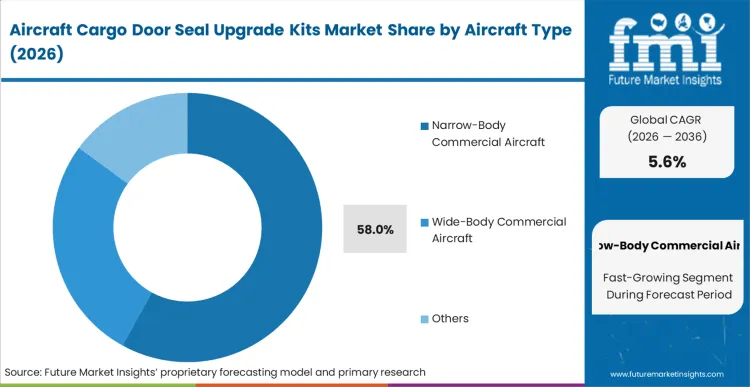
Airlines that attempt to stretch seal replacement intervals on high-cycle airframes inevitably encounter cabin altitude warnings, resulting in immediate groundings and severe commercial penalties. Narrow-body platforms also dominate the passenger-to-freighter conversion pipeline, meaning older airframes, which regularly dictate the need for a 757 freighter cargo door seal upgrade, are being pushed into cargo roles where door utilization increases significantly. The reason narrow-body commercial aircraft hold 58.0% of this sector comes down to a single structural reality, they simply fly more often. A narrow-body platform operating regional hub-and-spoke routes accumulates pressure cycles rapidly, forcing the cargo door elastomers to expand and contract multiple times per day. As per FMI's projection, this frequency compresses the natural lifespan of the seal material, compelling maintenance planning departments to stock an A320 cargo door seal replacement kit at higher volumes than wide-body equivalents.
- Baseline Expectations: Narrow-body operators expect aftermarket seals to perfectly match OEM compression specifications without requiring localized retainer track modifications. Failure to meet this baseline forces crews to reject the PMA part entirely.
- Edge Condition Degradation: When these aircraft are deployed in extreme cold-weather operations, standard silicone formulations stiffen, creating microscopic leak paths during initial climb before the cabin pressurizes fully.
- Airworthiness Determination: Quality control inspectors rely on strict pull-tests and pressure decay measurements during C-checks; if a seal fails this specification, the aircraft cannot return to revenue service.
Aircraft Cargo Door Seal Upgrade Kits Market Analysis by Kit Type
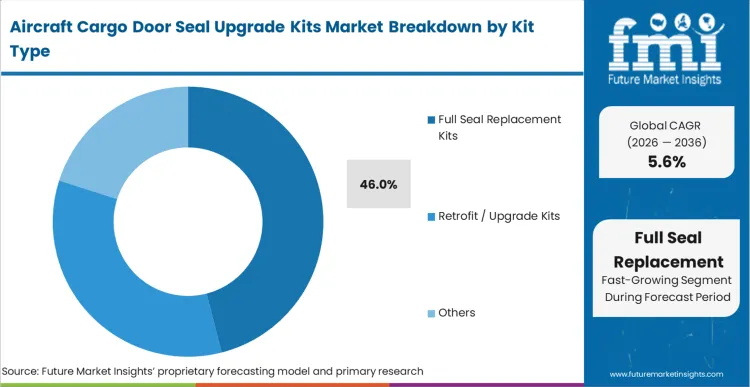
To mitigate the risk of a cargo door seal failure aircraft scenario, full seal replacement kits are anticipated to account for 46.0% of the value in 2026. Maintenance directors face a distinct choice during heavy checks: replace specific damaged sections of a seal, or order full seal replacement kits. This preference stems from the inherent risk of splicing new elastomers into old ones; differential curing rates often create weak points at the junction, leading to secondary pressure leaks. FMI analysts opine that airlines running tight schedules cannot absorb the risk of a spliced seal failing a week after the aircraft leaves the hangar. The comprehensive kit provides all matched extrusions, corners, and retainers necessary to rebuild the entire pressure boundary in a single maintenance event. Base maintenance facilities streamline their workflows by specifying complete kits, eliminating the labor hours wasted measuring and cutting raw stock.
- Triggering Condition: The decision to procure a full kit is typically triggered when visual inspections reveal compression set exceeding OEM limits across more than a quarter of the door perimeter.
- Validation Phase: Engineering teams validate the purchase by comparing the labor cost of repeated localized patching against the single-event installation time of a pre-molded, ready-to-install kit.
- Renewal Catalyst: Operators establish recurring purchasing agreements for these full kits once they calculate the total reduction in unscheduled maintenance events across their fleet.
Aircraft Cargo Door Seal Upgrade Kits Market Analysis by Material
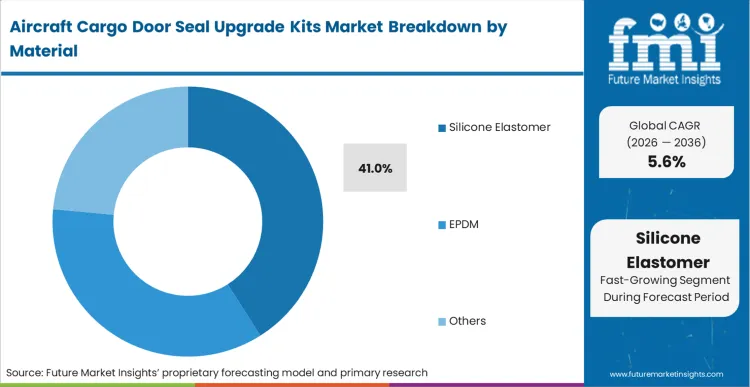
According to FMI's estimates, procurement directors prioritize silicone because it maintains its memory and rebound characteristics after thousands of compression cycles, unlike legacy materials that permanently flatten. It also resists degradation from aerospace maintenance chemical applications used routinely during cargo bay cleaning. While fluorosilicone offers better hydraulic fluid resistance, standard silicone remains widely available through competitive aircraft cargo door seal PMA alternatives, driving down unit prices for baseline economic choices. Older synthetic rubbers failed to withstand the aggressive chemical environment inside a modern cargo hold, giving way to advanced silicone elastomers. Capturing 41.0% share in 2026, silicone elastomer provides the precise thermal stability required to transition from a freezing high-altitude environment to a scorching tarmac in a matter of hours.
- Material Procurement: Cost savings originate at the procurement phase, as standard silicone extrusions are heavily stocked in distribution channels, shielding operators from OEM delays.
- Operational Reality: Hidden costs emerge on the hangar floor if the silicone is not properly cured; improper installation requires the seal to be ripped out and the entire aircraft refurbishing process restarted.
- Lifecycle Metrics: Total lifecycle analysis proves that while high-grade silicone commands a premium over basic rubber, its extended mean time between removals (MTBR) delivers a superior return on investment.
Aircraft Cargo Door Seal Upgrade Kits Market Analysis by Door Position
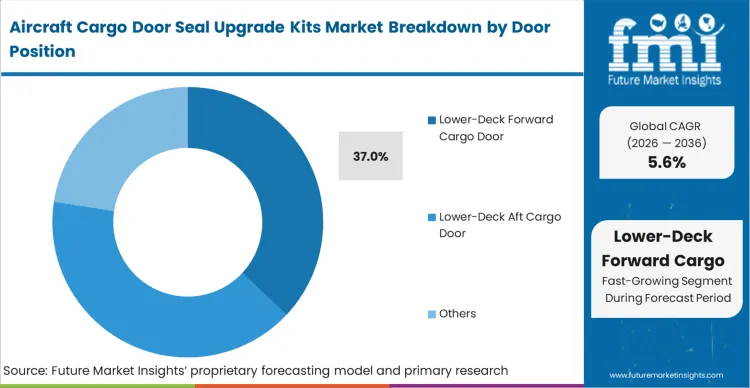
The forward lower deck is typically the most heavily utilized access point, receiving continuous traffic from baggage handlers and loading equipment. Based on FMI's assessment, the high incidence of mechanical strikes to the seal bed surrounding this door mandates frequent installations of a lower deck cargo door seal kit to restore the elastomeric boundary. A failure on the lower-deck forward cargo door disrupts ground operations instantaneously, creating cascading delays across the entire flight network. This door position dominates the landscape with a 37.0% share in 2026. Meanwhile, converted airframes demand specialized main deck cargo door seal upgrade assemblies. Operators who neglect the forward seal perimeter inevitably face immediate AOG conditions when ground crews report torn rubber during pre-flight walk-arounds.
- Containment Failure: Lower-deck door seals prevent the critical failure of depressurization, ensuring the aircraft can maintain safe cabin altitudes during cruise.
- Residual Exposure: Even with a perfect seal upgrade, operators face the residual risk of baggage loader strikes, which can tear the most advanced elastomer immediately after installation.
- Operational Discipline: To capture the full benefit of the upgrade, ramp managers must enforce strict clearance zones for aircraft ground support equipment to protect the newly installed seal tracks.
Aircraft Cargo Door Seal Upgrade Kits Market Analysis by Sales Channel
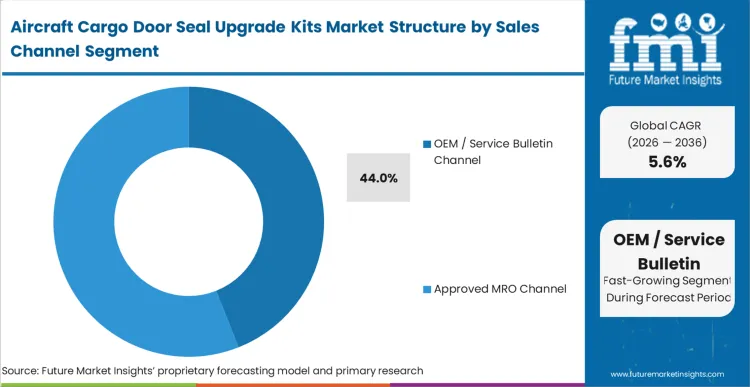
Asset managers and airline procurement teams are constantly pulling against each other over the OEM / service bulletin channel. Holding 44.0% share in 2026, the OEM channel provides unimpeachable airworthiness documentation, which lessors demand, but it often carries extended lead times that frustrate airline operators. In FMI's view, when teams compare OEM and aftermarket cargo door seal kits for aircraft, airlines default to the OEM channel primarily during lease-return events. The commercial aircraft MRO sector relies heavily on OEM kits to ensure complete structural compatibility. While aircraft cargo door seal kit suppliers offering PMA parts provide cost advantages, the risk of a lessor rejecting a cargo door modification pushes major carriers back toward authorized aircraft cargo door seal kit manufacturers.
- Production Base: OEM service arms maintain this channel dominance because they possess the original design data and can pre-certify their upgrade kits globally without friction.
- Supply Bottlenecks: Airlines must plan their heavy maintenance schedules around OEM supply constraints, as customized extruded seals for legacy aircraft are often produced in limited batch runs.
- Future Landscape: Heading toward 2036, the supply landscape will see PMA manufacturers capturing more share as they reverse-engineer complex retainers, though OEMs will maintain their grip on newly introduced airframes.
Aircraft Cargo Door Seal Upgrade Kits Market Drivers, Restraints, and Opportunities
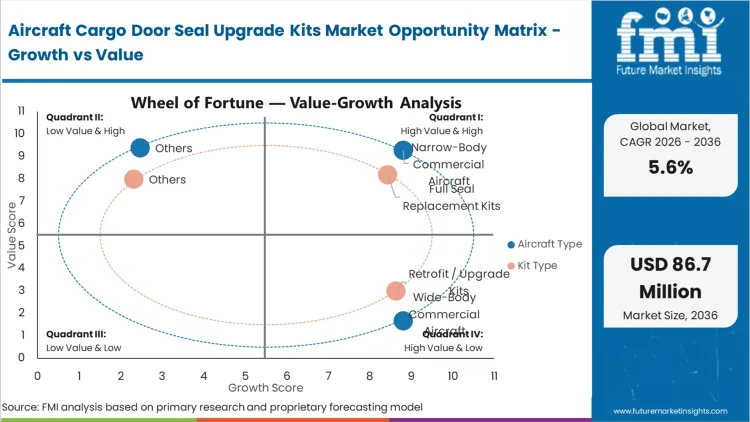
Facing zero-tolerance cabin pressure mandates, Part 145 repair station directors are aggressively tearing up reactive maintenance playbooks. When fleet utilization hits the redline, the financial blowback from a single unscheduled grounding caused by an aircraft cargo door seal failure dwarfs the upfront investment of a full upgrade kit. Carriers simply cannot risk dispatching aircraft on borderline aviation test equipment pressure readings anymore. Instead, they are locking in advanced elastomeric systems designed to physically guarantee dispatch reliability from one maintenance interval to the next.
Pulling a freighter off the flight line just to prep an aircraft cargo door seal bed creates a severe operational bottleneck that effectively kills the business case for ad-hoc replacements. Tearing out cured sealants, scraping the retainer tracks bare, and waiting for fresh adhesives to set burns through an entire revenue shift. You cannot cheat this friction with cheaper parts because the delay is baked directly into the fundamental limitations of aerospace adhesive chemistry. Even as manufacturers push rapid-cure hybrid assemblies to the market, these experimental fixes still struggle to survive the brutal thermal cycling requirements of high-altitude operations.
Opportunities in the Aircraft Cargo Door Seal Upgrade Kits Market
- Conversion Integration: The explosive growth in passenger-to-freighter modifications creates a distinct window for kit manufacturers. STC conversion specialists can capture significant margin by bundling proprietary seal upgrade systems directly into the initial air cargo conversion blueprint.
- Predictive Provisioning: As digital twin technology matures, MRO providers can use pressure decay data to forecast seal failures. Procurement teams can then pre-position seal kits at specific outstations before a hard failure occurs.
- Hybrid Material Qualification: Advancements in fluorosilicone bonding allow material science firms to engineer seals that resist both physical tearing and hydraulic fluid degradation. Engineering directors who specify these advanced seals immediately reduce their unscheduled maintenance rates.
Regional Analysis
The geographic trajectory of the aircraft cargo door seal upgrade kits market is heavily dictated by the regional concentration of passenger-to-freighter conversion hubs, strict regulatory oversight regimes, and the operational tempo of local e-commerce logistics networks. This creates stark structural divergences in how different regions procure and deploy elastomeric sealing systems with the industry being segmented into North America, Europe, Asia Pacific, the Middle East, and other regions across 40 plus countries.
.webp "Top Country Growth Comparison Aircraft Cargo Door Seal Upgrade Kits Market Cagr (2026 2036)")
| Country | CAGR (2026 to 2036) |
|---|---|
| India | 7.0% |
| China | 6.6% |
| United Arab Emirates | 6.1% |
| Singapore | 5.8% |
| United States | 4.8% |
| Germany | 4.6% |
| United Kingdom | 4.4% |
Source: Future Market Insights (FMI) analysis, based on proprietary forecasting model and primary research
North America Aircraft Cargo Door Seal Upgrade Kits Market Analysis
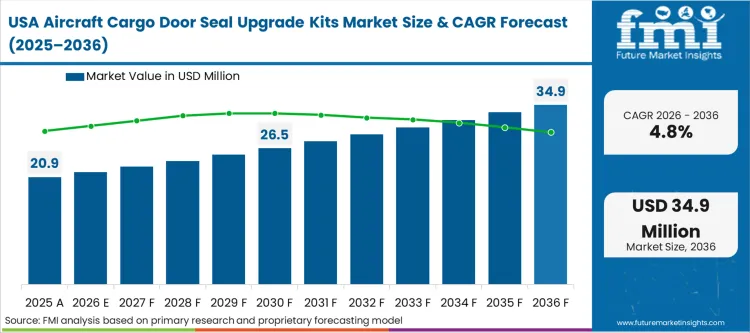
Driven by strict lease-return conditions and predictive maintenance frameworks, heavy maintenance facilities across North America prioritize proactive component replacement over waiting for visible elastomer degradation. Legacy passenger jets stripped and rebuilt for high-cycle freight operations further accelerate the deployment of specialized sealing systems, thanks to the heavy presence of major cargo conversion houses. According to FMI's estimates, this operational reality forces operators to execute complete door overhauls instead of localized patching, which sustains massive baseline demand for comprehensive upgrade kits driven by the region's intense concentration of mature overnight express fleets.
- United States: Expanding at a steady CAGR of 4.8%, the United States aircraft cargo door seal kits market thrives on the continuous investment required to restore pressure boundaries on an aging domestic narrow-body freighter fleet. By treating door seals as highly consumable components, local fleet managers proactively structure their aviation asset management contracts to embed recurring upgrade cycles. The STC providers as a result are capable of securing necessary airworthiness approvals for these legacy platforms are successfully capturing locked-in, long-term revenue streams.
FMI's report includes analysis of the Canadian and Mexican markets. The integration of cross-border logistics networks requires operators in these countries to align their maintenance standards with strict FAA dispatch requirements for cargo door pressure maintenance.
Asia Pacific Aircraft Cargo Door Seal Upgrade Kits Market Analysis
Procurement patterns throughout the Asia Pacific are heavily dictated by a massive influx of older, leased airframes that demand immediate airworthiness upgrades upon importation. In FMI's view, the region experiences much higher seal replacement frequencies than mature Western markets due to infrastructure constraints in rapidly expanding logistics hubs, which force ground crews into aggressive operations that frequently cause mechanical seal damage. To manage this escalating structural repair volume, regional MRO facilities are rapidly expanding their capabilities, generating sustained demand for OEM-approved elastomeric assemblies.
- India: Severe operational pressure to minimize AOG time forces maintenance directors in this nation to specify ready-to-install, complete seal kits over complex field patching. Fueled by a rapidly expanding regional e-commerce logistics network that relies exclusively on intensely utilized, older narrow-body freighters, FMI estimates the India aircraft cargo door seal retrofit market to expand at a robust CAGR of 7.0%. This accelerated operational tempo is actively positioning Indian MROs as the dominant regional consumers of advanced aftermarket elastomeric components.
- China: To combat the extreme weather conditions characteristic of northern transit hubs, engineering teams prioritize advanced fluorosilicone upgrades that guarantee extended durability. Carriers are functionally forced to maintain pristine elastomeric conditions across their expanding wide-body freighter fleets due to exceptionally stringent domestic airworthiness directives regarding cabin pressurization. Pushing the China aircraft cargo door seal upgrade kits market to expand at a CAGR of 6.6%, this rapid transition toward predictive maintenance software will fundamentally alter provisioning models by 2036.
- Singapore: A steady CAGR of 5.8% is expected in the Singapore aircraft cargo door seal kits market over the forecast period, reflecting the critical need for facility managers to maintain immediate access to global air transport MRO supply chains to execute rapid cargo door overhauls. By absorbing the most complex structural repair requirements from surrounding nations, this country operates as the undisputed premier MRO hub for the Asia-Pacific region. Ultimately, the on-the-ground reality shows that local engineering facilities are dictating the baseline seal material specifications for the broader Southeast Asian freighter fleet.
FMI's report includes analysis of the Japanese and South Korean markets. These countries focus heavily on wide-body international freight operations, shifting their procurement preferences toward highly specialized main-deck cargo door assemblies.
Europe Aircraft Cargo Door Seal Upgrade Kits Market Analysis
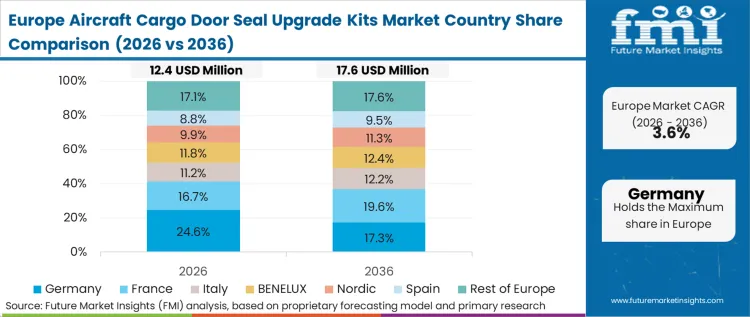
The regional landscape is distinctly defined by an aggressive push toward environmentally sustainable maintenance chemicals, forcing operators to qualify novel elastomeric materials capable of resisting these new cleaning agents. As per FMI's projection, independent MROs striving to break the OEM pricing monopoly have fostered a remarkably strong preference for PMA parts, provided they meet strict compliance thresholds. Because EASA enforces rigorous oversight where even minor deviations in cabin pressure decay rates trigger immediate flight restrictions, airlines have entirely eliminated temporary patching strategies in favor of comprehensively certified upgrade kits.
- Germany: Refusing to allow minor component wear to ground critical freight routes, procurement directors deeply integrate seal upgrade intervals into their long-term capacity planning. This environment is structured around the nation's massive concentration of global logistics integrators who demand absolute dispatch reliability from every air asset. Germany aircraft cargo door seal replacement market to a CAGR of 4.6% over the forecast period is propelled is as a result propelled by institutionalizing this proactive maintenance approach, local operators consistently outperform surrounding regional competitors in on-time delivery metrics.
- United Kingdom: Domestic engineering departments frequently beta-test advanced hybrid composite retainers to aggressively reduce the intensive labor hours tied to cargo door overhauls. Forecasting a CAGR of 4.4%, demand in the UK benefits from a specialized aerospace manufacturing base that empowers local operators to collaborate directly with material science firms on custom seal designs. As a result, whenever a novel PMA seal establishes superior durability within this testing ecosystem, it rapidly secures EASA approval and scales into broad European adoption.
FMI's report includes analysis of the French and Italian markets. The strong presence of OEM manufacturing facilities in these countries heavily influences local operators to remain within the established service bulletin supply channels.
Middle East Aircraft Cargo Door Seal Upgrade Kits Market Analysis
The Middle Eastern aviation sector navigates extreme environmental constraints, predominantly defined by blistering tarmac heat and rapid thermal cycling during high-altitude cruise. As per FMI's projection, the transformation of regional logistics networks into interconnected global transshipment megahubs requires the continuous, uninterrupted utilization of freighter assets. This immense operational intensity forces regional procurement directors to source highly specialized, thermally stable elastomeric materials to avert catastrophic pressurization failures across their expanding cargo operations.
- United Arab Emirates: Operating as the definitive global transshipment megahub inevitably exposes domestic freighter fleets to brutal thermal cycling, rapidly transitioning from freezing cruise altitudes to scorching desert tarmac temperatures. The UAE aircraft cargo door seal kit demand heavily relies on maintenance planners deploying specialized elastomeric seals and advanced aircraft fairings capable of surviving these drastic shifts without sacrificing elasticity, advancing the sector at a projected CAGR of 6.1%. Procurement teams attempting to bypass these strict thermal requirements routinely suffer severe cargo disruptions resulting from sudden in-flight seal ruptures.
FMI's report includes analysis of the Saudi Arabian and Qatari markets. Fleet managers across these expanding Gulf aviation hubs heavily prioritize comprehensive elastomeric upgrade kits to sustain dispatch reliability across their rapidly growing international freight networks.
Competitive Aligners for Market Players
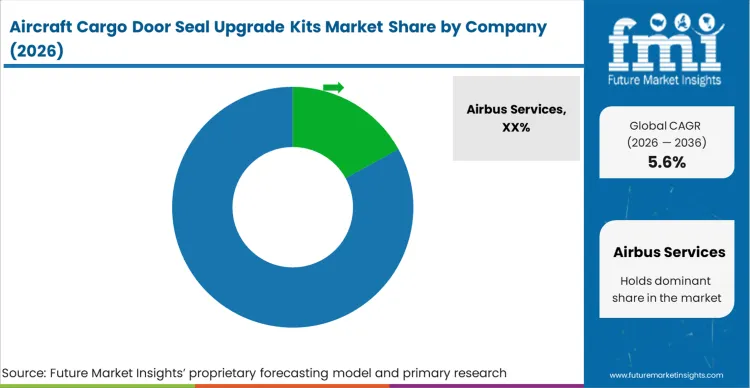
Survival in the aircraft cargo door seal upgrade kits market is dictated by who controls the airworthiness certification pathways. For challengers, the true barrier to entry is the grueling, capital-intensive process of proving to the FAA or EASA that a new extrusion can survive 10,000 extreme pressurization cycles without failure. At the top of this hierarchy sit original equipment manufacturers and top-tier integrators. Airbus Services, for instance, wields absolute authority over its proprietary door architecture, locking in early-lifecycle aftermarket revenue by issuing unimpeachable service bulletin kits that lessors demand. Similarly, aerospace heavyweights like Parker Hannifin leverage their deep integration into an aircraft's broader hydraulic and pneumatic frameworks to bundle highly engineered elastomeric seals directly into critical system upgrades, effectively boxing out lower-tier suppliers who cannot offer comprehensive cargo door pressure maintenance solutions.
Away from the immediate glare of original equipment monopolies, a ruthless material science arms race defines the aftermarket tier. Companies such as Trelleborg Sealing Solutions and Freudenberg Sealing Technologies maintain a massive structural moat built on proprietary silicone and fluorosilicone blends that have already survived thousands of hours of high-altitude freezing and aggressive aviation fluid exposure. They are actively joined by Hutchinson and Kirkhill (TransDigm Group), who relentlessly defend their share by expanding their vast portfolios of Parts Manufacturer Approvals (PMAs). For these incumbents, the strategy is simple, embed their scientifically validated elastomers so deeply into the baseline aircraft cargo door seal retrofit kits that airline engineering directors simply cannot justify the operational risk of switching to an unproven, lower-cost alternative.
True structural disruption heading into 2036 bypasses legacy fleet maintenance entirely, rooting itself instead within the aggressive passenger-to-freighter (P2F) conversion pipeline. Engineering powerhouses like Precision Aircraft Solutions are actively rewriting the procurement rules by designing entirely new main-deck cargo doors for legacy passenger jets. When these conversion specialists secure a Supplemental Type Certificate (STC), they instantly dictate the precise elastomeric specifications required for that specific modified platform. This dynamic empowers nimble aircraft cargo door seal kit manufacturers to bypass traditional OEM chokepoints by partnering directly with conversion houses from the blueprint stage, capturing highly lucrative, locked-in revenue streams as the global express freighter fleet rapidly expands.
Key Players in Aircraft Cargo Door Seal Upgrade Kits Market
- Airbus Services
- Trelleborg Sealing Solutions
- Hutchinson
- Freudenberg Sealing Technologies
- Kirkhill (TransDigm Group)
- Parker Hannifin
- Precision Aircraft Solutions
Scope of the Report
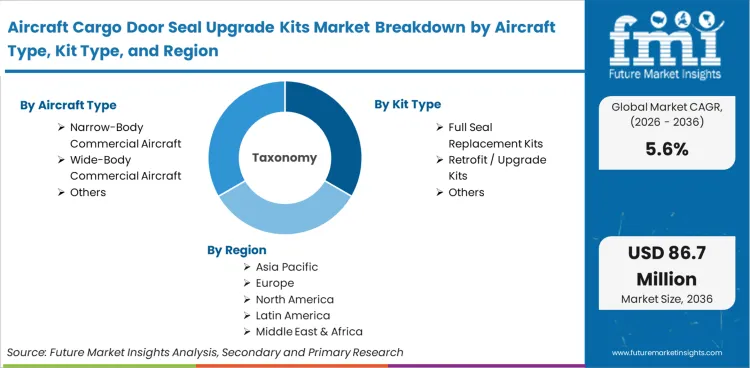
| Metric | Value |
|---|---|
| Quantitative Units | USD 50.3 million to USD 86.7 million, at a CAGR of 5.6% |
| Market Definition | This market tracks the supply of certified elastomeric assemblies and retainer hardware required to maintain cabin pressure integrity at cargo access points. It functions as a critical compliance category within aviation maintenance. |
| Aircraft Type Segmentation | Narrow-body commercial aircraft, Wide-body commercial aircraft, Converted freighters, Factory-built freighters, Regional / special-mission cargo aircraft |
| Kit Type Segmentation | Full seal replacement kits, Retrofit / upgrade kits, Inspection and rework kits, Hardware-and-retainer kits, Placard / compliance kits |
| Material Segmentation | Silicone elastomer, EPDM, Fluorosilicone, Fabric-reinforced rubber, Hybrid composite sealing assemblies |
| Door Position Segmentation | Lower-deck forward cargo door, Lower-deck aft cargo door, Main-deck cargo door, Bulk / access cargo door, Multi-door bundled kits |
| Sales Channel Segmentation | OEM / service bulletin channel, Approved MRO channel, STC / conversion specialist channel, PMA / aftermarket distributor channel |
| Regions Covered | North America, Europe, Asia Pacific |
| Countries Covered | United States, China, India, Germany, United Kingdom, Singapore, United Arab Emirates, and 40 plus countries |
| Key Companies Profiled | Airbus Services, Trelleborg Sealing Solutions, Hutchinson, Freudenberg Sealing Technologies, Kirkhill (TransDigm Group), Parker Hannifin, Precision Aircraft Solutions |
| Forecast Period | 2026 to 2036 |
| Approach | FMI conducted primary interviews with airline DOM personnel and repair station inspectors. The baseline anchors to active fleet age profiles and documented replacement frequencies. Forecasts were validated against cargo capacity utilization and conversion rates. |
Source: Future Market Insights (FMI) analysis, based on proprietary forecasting model and primary research
Segments
Aircraft Type:
- Narrow-body commercial aircraft
- Wide-body commercial aircraft
- Converted freighters
- Factory-built freighters
- Regional / special-mission cargo aircraft
Kit Type:
- Full seal replacement kits
- Retrofit / upgrade kits
- Inspection and rework kits
- Hardware-and-retainer kits
- Placard / compliance kits
Material:
- Silicone elastomer
- EPDM
- Fluorosilicone
- Fabric-reinforced rubber
- Hybrid composite sealing assemblies
Door Position:
- Lower-deck forward cargo door
- Lower-deck aft cargo door
- Main-deck cargo door
- Bulk / access cargo door
- Multi-door bundled kits
Sales Channel:
- OEM / service bulletin channel
- Approved MRO channel
- STC / conversion specialist channel
- PMA / aftermarket distributor channel
Regions:
- North America
- United States
- Asia Pacific
- China
- India
- Singapore
- Europe
- Germany
- United Kingdom
- Middle-East
- United Arab Emirates
Bibliography
- Airbus. (2024, July). Correct Cargo Door Seal Installation for Safe Operation. Safety First.
- Civil Aviation Administration of China. (2025, January 10). China's civil aviation sector soars in 2024, eyes faster international flight recovery in 2025. The State Council of the People’s Republic of China.
- Federal Aviation Administration. (2024). FAA Aerospace Forecast Fiscal Years 2024-2044. USA Department of Transportation.
- Federal Aviation Administration. (2025, February 21). Special Airworthiness Information Bulletin: Main Deck Cargo Door, SAIB 2025-02. USA Department of Transportation.
- International Air Transport Association. (2025, January 29). Global Air Cargo Demand Achieves Record Growth in 2024. IATA.
This bibliography is provided for reader reference. The full FMI report contains the complete reference list with primary source documentation.
This Report Addresses
- Market intelligence to support strategic decision making across primary and secondary elastomeric pressure seals
- Market size estimation and 10-year revenue forecasts from 2026 to 2036, supported by baseline fleet data crossed with specific maintenance intervals
- Growth opportunity mapping across full seal replacement kits with emphasis on predictive maintenance algorithms tracking door pressure leak rates
- Segment and regional revenue forecasts covering narrow-body commercial aircraft across stringent EASA operational environments
- Competition strategy assessment including PMA validation, elastomer science capabilities, and OEM service bulletin integration
- Capability development tracking including continuous condition monitoring, advanced fluorosilicone blending, and rapid-cure hybrid assemblies
- Market access analysis covering FAA Special Airworthiness Information Bulletins and rigid lease-return compliance conditions
- The report is delivered in standard formats like PDF, Excel, and PPT, also including an interactive dashboard tailored for executive strategy, capacity planning, and operational benchmarking.
Frequently Asked Questions
How large is the Aircraft Cargo Door Seal Upgrade Kits Market in 2026?
The valuation is USD 50.3 million in 2026, establishing a baseline for an industry driven by the physical aging of active freighter fleets and the immediate operational penalties of cabin pressure faults.
What will it be valued at by 2036?
It is projected to reach USD 86.7 million by 2036, reflecting the compounding effect of older passenger aircraft entering the cargo conversion pipeline where higher utilization rates rapidly degrade OEM door seals.
What is the aircraft cargo door seal CAGR?
A CAGR of 5.6% is expected over the forecast period as maintenance facilities increasingly execute comprehensive seal restorations during heavy C-checks instead of relying on ad-hoc patching.
Which Aircraft Type segment leads?
Narrow-body commercial aircraft command the landscape because their short-haul, high-frequency routing accumulates pressure cycles significantly faster than wide-body platforms, accelerating elastomer compression set and forcing tighter replacement intervals.
Which Kit Type segment leads?
Full seal replacement kits dominate demand because engineering directors prefer comprehensive packages that eliminate the weak points created by splicing new rubber into legacy seals, thereby guaranteeing pressure integrity.
Which Material segment leads?
Silicone elastomer remains the industry standard by providing the necessary thermal stability to endure high-altitude freezing and tarmac heat while offering a highly competitive price point through established PMA channels.
Why are aircraft cargo door seals upgraded?
Stringent dispatch reliability metrics compel operators to upgrade because an aircraft cannot fly with a leaking seal, and the daily revenue lost from an AOG event vastly outweighs the cost of a pre-formed elastomeric upgrade kit.
What is the primary restraint?
The sheer labor downtime required to prepare the seal bed drags on adoption, as removing old adhesives and allowing new retainers to cure keeps a highly profitable freighter out of service.
Which country grows fastest?
India expands fastest at 7.0% because it relies heavily on older, intensely utilized narrow-body freighters to power its regional e-commerce logistics, demanding more frequent seal overhauls than mature markets.
What regulations are increasing aircraft cargo door seal replacement demand?
FAA Special Airworthiness Information Bulletins and EASA Airworthiness Directives remove discretion from maintenance planners, forcing operators to immediately route their procurement toward certified upgrade kits when specific designs are flagged for accelerated wear.
How often should aircraft cargo door seals be replaced?
Engineering teams increasingly track microscopic pressure decay rates digitally to replace seals exactly when the elastomer begins to fail.
How do lessors influence the OEM versus PMA purchasing decision?
Because asset managers strictly enforce lease-return conditions and often reject third-party PMA parts to protect the aircraft's global resale value, airlines are functionally forced to purchase OEM service bulletin kits despite longer lead times.
Why do wide-body commercial aircraft require fewer seal replacements?
Wide-body platforms operate long-haul international routes and undergo far fewer pressurization cycles per week, meaning their elastomeric seals experience less frequent expansion and contraction, extending their operational lifespan.
What makes fluorosilicone different from standard silicone?
While standard silicone degrades when exposed to aviation hydraulic fluids, fluorosilicone incorporates specialized chemical resistance that prevents the seal from swelling or dissolving when hydraulic lines weep near the lower-deck cargo doors.
How do cargo conversion houses impact this demand?
Conversion specialists drive massive demand for these upgrade kits as they secure STC approvals for proprietary door designs required when passenger jets are cut open and fitted with entirely new main-deck cargo doors.
What role do parts distributors play in seal availability?
Aftermarket distributors bridge the critical gap between slow-moving OEM production batches and the urgent, overnight needs of a grounded air cargo carrier by stocking rapid-cure kits for immediate AOG response.
Why are lower-deck forward doors prioritized for seal replacements?
Situated directly in the primary path of ground service equipment, the lower-deck forward door experiences a high rate of physical strikes from belt loaders that tear the seal tracks long before natural elastomer compression set occurs.
Can poor cargo door seals affect fire suppression?
A compromised pressure boundary allows excess oxygen to feed a cargo hold fire and dilute Halon fire suppression systems, which is why regulatory inspectors mandate perfect seal integrity to ensure extinguishing agents remain effective.
What is the residual risk of using aerospace adhesives sealants for localized repair?
Because liquid sealants lack the structural memory of pre-formed extrusions, localized patches often blow out under intense cabin pressure, grounding the aircraft and requiring expensive, labor-intensive removal of the hardened adhesive.
How do European EASA regulations differ from other regions regarding pressure seals?
Because EASA maintains extraordinarily low tolerances for cabin altitude deviations and prohibits temporary dispatch deviations allowed elsewhere, European operators are forced into immediate seal replacements using strictly validated PMA or OEM parts.
What limits the adoption of hybrid composite sealing assemblies?
While hybrid retainers reduce installation time, risk-averse engineering directors delay adopting them until extensive destructive testing proves they will not shatter under extreme low-temperature fatigue, as they lack the decades of flight heritage standard extrusions possess.
Preview the report firsthand - request a free sample
Get SampleGet the brochure for pricing and purchase details.
Get PDFTable of Content
- Executive Summary
- Global Market Outlook
- Demand-side Trends
- Supply-side Trends
- Technology Roadmap Analysis
- Analysis and Recommendations
- Market Overview
- Market Coverage / Taxonomy
- Market Definition / Scope / Limitations
- Research Methodology
- Chapter Orientation
- Analytical Lens and Working Hypotheses
- Market Structure, Signals, and Trend Drivers
- Benchmarking and Cross-market Comparability
- Market Sizing, Forecasting, and Opportunity Mapping
- Research Design and Evidence Framework
- Desk Research Programme (Secondary Evidence)
- Company Annual and Sustainability Reports
- Peer-reviewed Journals and Academic Literature
- Corporate Websites, Product Literature, and Technical Notes
- Earnings Decks and Investor Briefings
- Statutory Filings and Regulatory Disclosures
- Technical White Papers and Standards Notes
- Trade Journals, Industry Magazines, and Analyst Briefs
- Conference Proceedings, Webinars, and Seminar Materials
- Government Statistics Portals and Public Data Releases
- Press Releases and Reputable Media Coverage
- Specialist Newsletters and Curated Briefings
- Sector Databases and Reference Repositories
- FMI Internal Proprietary Databases and Historical Market Datasets
- Subscription Datasets and Paid Sources
- Social Channels, Communities, and Digital Listening Inputs
- Additional Desk Sources
- Expert Input and Fieldwork (Primary Evidence)
- Primary Modes
- Qualitative Interviews and Expert Elicitation
- Quantitative Surveys and Structured Data Capture
- Blended Approach
- Why Primary Evidence is Used
- Field Techniques
- Interviews
- Surveys
- Focus Groups
- Observational and In-context Research
- Social and Community Interactions
- Stakeholder Universe Engaged
- C-suite Leaders
- Board Members
- Presidents and Vice Presidents
- R&D and Innovation Heads
- Technical Specialists
- Domain Subject-matter Experts
- Scientists
- Physicians and Other Healthcare Professionals
- Governance, Ethics, and Data Stewardship
- Research Ethics
- Data Integrity and Handling
- Primary Modes
- Tooling, Models, and Reference Databases
- Desk Research Programme (Secondary Evidence)
- Data Engineering and Model Build
- Data Acquisition and Ingestion
- Cleaning, Normalisation, and Verification
- Synthesis, Triangulation, and Analysis
- Quality Assurance and Audit Trail
- Market Background
- Market Dynamics
- Drivers
- Restraints
- Opportunity
- Trends
- Scenario Forecast
- Demand in Optimistic Scenario
- Demand in Likely Scenario
- Demand in Conservative Scenario
- Opportunity Map Analysis
- Product Life Cycle Analysis
- Supply Chain Analysis
- Investment Feasibility Matrix
- Value Chain Analysis
- PESTLE and Porter’s Analysis
- Regulatory Landscape
- Regional Parent Market Outlook
- Production and Consumption Statistics
- Import and Export Statistics
- Market Dynamics
- Global Market Analysis 2021 to 2025 and Forecast, 2026 to 2036
- Historical Market Size Value (USD Million) Analysis, 2021 to 2025
- Current and Future Market Size Value (USD Million) Projections, 2026 to 2036
- Y-o-Y Growth Trend Analysis
- Absolute $ Opportunity Analysis
- Global Market Pricing Analysis 2021 to 2025 and Forecast 2026 to 2036
- Global Market Analysis 2021 to 2025 and Forecast 2026 to 2036, By Aircraft Type
- Introduction / Key Findings
- Historical Market Size Value (USD Million) Analysis By Aircraft Type , 2021 to 2025
- Current and Future Market Size Value (USD Million) Analysis and Forecast By Aircraft Type , 2026 to 2036
- Narrow-Body Commercial Aircraft
- Wide-Body Commercial Aircraft
- Others
- Narrow-Body Commercial Aircraft
- Y-o-Y Growth Trend Analysis By Aircraft Type , 2021 to 2025
- Absolute $ Opportunity Analysis By Aircraft Type , 2026 to 2036
- Global Market Analysis 2021 to 2025 and Forecast 2026 to 2036, By Kit Type
- Introduction / Key Findings
- Historical Market Size Value (USD Million) Analysis By Kit Type, 2021 to 2025
- Current and Future Market Size Value (USD Million) Analysis and Forecast By Kit Type, 2026 to 2036
- Full Seal Replacement Kits
- Retrofit / Upgrade Kits
- Others
- Full Seal Replacement Kits
- Y-o-Y Growth Trend Analysis By Kit Type, 2021 to 2025
- Absolute $ Opportunity Analysis By Kit Type, 2026 to 2036
- Global Market Analysis 2021 to 2025 and Forecast 2026 to 2036, By Material
- Introduction / Key Findings
- Historical Market Size Value (USD Million) Analysis By Material, 2021 to 2025
- Current and Future Market Size Value (USD Million) Analysis and Forecast By Material, 2026 to 2036
- Silicone Elastomer
- EPDM
- Others
- Silicone Elastomer
- Y-o-Y Growth Trend Analysis By Material, 2021 to 2025
- Absolute $ Opportunity Analysis By Material, 2026 to 2036
- Global Market Analysis 2021 to 2025 and Forecast 2026 to 2036, By Door Position
- Introduction / Key Findings
- Historical Market Size Value (USD Million) Analysis By Door Position, 2021 to 2025
- Current and Future Market Size Value (USD Million) Analysis and Forecast By Door Position, 2026 to 2036
- Lower-Deck Forward Cargo Door
- Lower-Deck Aft Cargo Door
- Others
- Lower-Deck Forward Cargo Door
- Y-o-Y Growth Trend Analysis By Door Position, 2021 to 2025
- Absolute $ Opportunity Analysis By Door Position, 2026 to 2036
- Global Market Analysis 2021 to 2025 and Forecast 2026 to 2036, By Sales Channel
- Introduction / Key Findings
- Historical Market Size Value (USD Million) Analysis By Sales Channel, 2021 to 2025
- Current and Future Market Size Value (USD Million) Analysis and Forecast By Sales Channel, 2026 to 2036
- OEM / Service Bulletin Channel
- Approved MRO Channel
- OEM / Service Bulletin Channel
- Y-o-Y Growth Trend Analysis By Sales Channel, 2021 to 2025
- Absolute $ Opportunity Analysis By Sales Channel, 2026 to 2036
- Global Market Analysis 2021 to 2025 and Forecast 2026 to 2036, By Region
- Introduction
- Historical Market Size Value (USD Million) Analysis By Region, 2021 to 2025
- Current Market Size Value (USD Million) Analysis and Forecast By Region, 2026 to 2036
- North America
- Latin America
- Western Europe
- Eastern Europe
- East Asia
- South Asia and Pacific
- Middle East & Africa
- Market Attractiveness Analysis By Region
- North America Market Analysis 2021 to 2025 and Forecast 2026 to 2036, By Country
- Historical Market Size Value (USD Million) Trend Analysis By Market Taxonomy, 2021 to 2025
- Market Size Value (USD Million) Forecast By Market Taxonomy, 2026 to 2036
- By Country
- USA
- Canada
- Mexico
- By Aircraft Type
- By Kit Type
- By Material
- By Door Position
- By Sales Channel
- By Country
- Market Attractiveness Analysis
- By Country
- By Aircraft Type
- By Kit Type
- By Material
- By Door Position
- By Sales Channel
- Key Takeaways
- Latin America Market Analysis 2021 to 2025 and Forecast 2026 to 2036, By Country
- Historical Market Size Value (USD Million) Trend Analysis By Market Taxonomy, 2021 to 2025
- Market Size Value (USD Million) Forecast By Market Taxonomy, 2026 to 2036
- By Country
- Brazil
- Chile
- Rest of Latin America
- By Aircraft Type
- By Kit Type
- By Material
- By Door Position
- By Sales Channel
- By Country
- Market Attractiveness Analysis
- By Country
- By Aircraft Type
- By Kit Type
- By Material
- By Door Position
- By Sales Channel
- Key Takeaways
- Western Europe Market Analysis 2021 to 2025 and Forecast 2026 to 2036, By Country
- Historical Market Size Value (USD Million) Trend Analysis By Market Taxonomy, 2021 to 2025
- Market Size Value (USD Million) Forecast By Market Taxonomy, 2026 to 2036
- By Country
- Germany
- UK
- Italy
- Spain
- France
- Nordic
- BENELUX
- Rest of Western Europe
- By Aircraft Type
- By Kit Type
- By Material
- By Door Position
- By Sales Channel
- By Country
- Market Attractiveness Analysis
- By Country
- By Aircraft Type
- By Kit Type
- By Material
- By Door Position
- By Sales Channel
- Key Takeaways
- Eastern Europe Market Analysis 2021 to 2025 and Forecast 2026 to 2036, By Country
- Historical Market Size Value (USD Million) Trend Analysis By Market Taxonomy, 2021 to 2025
- Market Size Value (USD Million) Forecast By Market Taxonomy, 2026 to 2036
- By Country
- Russia
- Poland
- Hungary
- Balkan & Baltic
- Rest of Eastern Europe
- By Aircraft Type
- By Kit Type
- By Material
- By Door Position
- By Sales Channel
- By Country
- Market Attractiveness Analysis
- By Country
- By Aircraft Type
- By Kit Type
- By Material
- By Door Position
- By Sales Channel
- Key Takeaways
- East Asia Market Analysis 2021 to 2025 and Forecast 2026 to 2036, By Country
- Historical Market Size Value (USD Million) Trend Analysis By Market Taxonomy, 2021 to 2025
- Market Size Value (USD Million) Forecast By Market Taxonomy, 2026 to 2036
- By Country
- China
- Japan
- South Korea
- By Aircraft Type
- By Kit Type
- By Material
- By Door Position
- By Sales Channel
- By Country
- Market Attractiveness Analysis
- By Country
- By Aircraft Type
- By Kit Type
- By Material
- By Door Position
- By Sales Channel
- Key Takeaways
- South Asia and Pacific Market Analysis 2021 to 2025 and Forecast 2026 to 2036, By Country
- Historical Market Size Value (USD Million) Trend Analysis By Market Taxonomy, 2021 to 2025
- Market Size Value (USD Million) Forecast By Market Taxonomy, 2026 to 2036
- By Country
- India
- ASEAN
- Australia & New Zealand
- Rest of South Asia and Pacific
- By Aircraft Type
- By Kit Type
- By Material
- By Door Position
- By Sales Channel
- By Country
- Market Attractiveness Analysis
- By Country
- By Aircraft Type
- By Kit Type
- By Material
- By Door Position
- By Sales Channel
- Key Takeaways
- Middle East & Africa Market Analysis 2021 to 2025 and Forecast 2026 to 2036, By Country
- Historical Market Size Value (USD Million) Trend Analysis By Market Taxonomy, 2021 to 2025
- Market Size Value (USD Million) Forecast By Market Taxonomy, 2026 to 2036
- By Country
- Kingdom of Saudi Arabia
- Other GCC Countries
- Turkiye
- South Africa
- Other African Union
- Rest of Middle East & Africa
- By Aircraft Type
- By Kit Type
- By Material
- By Door Position
- By Sales Channel
- By Country
- Market Attractiveness Analysis
- By Country
- By Aircraft Type
- By Kit Type
- By Material
- By Door Position
- By Sales Channel
- Key Takeaways
- Key Countries Market Analysis
- USA
- Pricing Analysis
- Market Share Analysis, 2025
- By Aircraft Type
- By Kit Type
- By Material
- By Door Position
- By Sales Channel
- Canada
- Pricing Analysis
- Market Share Analysis, 2025
- By Aircraft Type
- By Kit Type
- By Material
- By Door Position
- By Sales Channel
- Mexico
- Pricing Analysis
- Market Share Analysis, 2025
- By Aircraft Type
- By Kit Type
- By Material
- By Door Position
- By Sales Channel
- Brazil
- Pricing Analysis
- Market Share Analysis, 2025
- By Aircraft Type
- By Kit Type
- By Material
- By Door Position
- By Sales Channel
- Chile
- Pricing Analysis
- Market Share Analysis, 2025
- By Aircraft Type
- By Kit Type
- By Material
- By Door Position
- By Sales Channel
- Germany
- Pricing Analysis
- Market Share Analysis, 2025
- By Aircraft Type
- By Kit Type
- By Material
- By Door Position
- By Sales Channel
- UK
- Pricing Analysis
- Market Share Analysis, 2025
- By Aircraft Type
- By Kit Type
- By Material
- By Door Position
- By Sales Channel
- Italy
- Pricing Analysis
- Market Share Analysis, 2025
- By Aircraft Type
- By Kit Type
- By Material
- By Door Position
- By Sales Channel
- Spain
- Pricing Analysis
- Market Share Analysis, 2025
- By Aircraft Type
- By Kit Type
- By Material
- By Door Position
- By Sales Channel
- France
- Pricing Analysis
- Market Share Analysis, 2025
- By Aircraft Type
- By Kit Type
- By Material
- By Door Position
- By Sales Channel
- India
- Pricing Analysis
- Market Share Analysis, 2025
- By Aircraft Type
- By Kit Type
- By Material
- By Door Position
- By Sales Channel
- ASEAN
- Pricing Analysis
- Market Share Analysis, 2025
- By Aircraft Type
- By Kit Type
- By Material
- By Door Position
- By Sales Channel
- Australia & New Zealand
- Pricing Analysis
- Market Share Analysis, 2025
- By Aircraft Type
- By Kit Type
- By Material
- By Door Position
- By Sales Channel
- China
- Pricing Analysis
- Market Share Analysis, 2025
- By Aircraft Type
- By Kit Type
- By Material
- By Door Position
- By Sales Channel
- Japan
- Pricing Analysis
- Market Share Analysis, 2025
- By Aircraft Type
- By Kit Type
- By Material
- By Door Position
- By Sales Channel
- South Korea
- Pricing Analysis
- Market Share Analysis, 2025
- By Aircraft Type
- By Kit Type
- By Material
- By Door Position
- By Sales Channel
- Russia
- Pricing Analysis
- Market Share Analysis, 2025
- By Aircraft Type
- By Kit Type
- By Material
- By Door Position
- By Sales Channel
- Poland
- Pricing Analysis
- Market Share Analysis, 2025
- By Aircraft Type
- By Kit Type
- By Material
- By Door Position
- By Sales Channel
- Hungary
- Pricing Analysis
- Market Share Analysis, 2025
- By Aircraft Type
- By Kit Type
- By Material
- By Door Position
- By Sales Channel
- Kingdom of Saudi Arabia
- Pricing Analysis
- Market Share Analysis, 2025
- By Aircraft Type
- By Kit Type
- By Material
- By Door Position
- By Sales Channel
- Turkiye
- Pricing Analysis
- Market Share Analysis, 2025
- By Aircraft Type
- By Kit Type
- By Material
- By Door Position
- By Sales Channel
- South Africa
- Pricing Analysis
- Market Share Analysis, 2025
- By Aircraft Type
- By Kit Type
- By Material
- By Door Position
- By Sales Channel
- USA
- Market Structure Analysis
- Competition Dashboard
- Competition Benchmarking
- Market Share Analysis of Top Players
- By Regional
- By Aircraft Type
- By Kit Type
- By Material
- By Door Position
- By Sales Channel
- Competition Analysis
- Competition Deep Dive
- Airbus Services
- Overview
- Product Portfolio
- Profitability by Market Segments (Product/Age /Sales Channel/Region)
- Sales Footprint
- Strategy Overview
- Marketing Strategy
- Product Strategy
- Channel Strategy
- Trelleborg Sealing Solutions
- Hutchinson
- Freudenberg Sealing Technologies
- Kirkhill (TransDigm Group)
- Parker Hannifin
- Precision Aircraft Solutions
- Airbus Services
- Competition Deep Dive
- Assumptions & Acronyms Used


