

- Industry Size (2026)
- USD 920 Mn
- Forecast (2036)
- USD 3240 Mn
- CAGR (2026 to 2036)
- 13.4%
Aesthetic Engineering of Imperfect PCR Packaging Market Forecast and Outlook 2026 to 2036
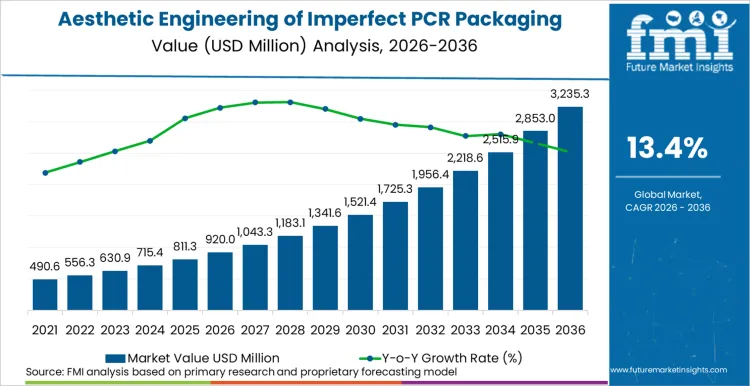
The aesthetic engineering of imperfect PCR packaging market revenue is projected to total USD 920 million in 2026, increasing to USD 3,240 million by 2036, at a CAGR of 13.4%. FMI analysis indicates the market is undergoing a fundamental shift from treating PCR's visual flaws as a problem to be minimized to an aesthetic variable to be actively engineered. The 2026–2027 period will be defined by the industrialization of advanced masterbatch systems and surface texturing techniques that deliver consistent, high-end aesthetics from inconsistent PCR feedstocks, particularly for opaque and monolayer luxury packaging.
Growth is anchored in the collision of stringent sustainability mandates with uncompromising brand equity requirements in beauty and premium FMCG. In 2024–2025, Cosmetics Europe’s PPWR-focused publications stressed that packaging rules must accommodate both recycled-content ambitions, marketing/consumer acceptance needs, explicitly framing brand recognition, and product differentiation as essential packaging functions alongside circularity goals. This positioning strengthens the business case for aesthetics-led PCR execution where visual variance is managed through design choicesrather than avoided altogether.
Quadpack Group reinforced this direction through commercially launched beauty formats designed for recyclability while supporting recycled-content integration. In October 2025, Quadpack introduced a recyclable monomaterial PET liquid makeup bottle positioned to support PCR content, aligning premium shelf presentation with a simplified material architecture. In November 2025, it also launched a skincare tube with a recycled-content option and a flexible applicator, demonstrating how functional design and pack aesthetics can be maintained while enabling higher circular material adoption.
Technical innovation is focused on maintaining performance parity while transitioning to more recyclable and PCR-capable dispensing architectures. In February 2025, Aptar Beauty introduced its Advance (PZ Advance) full-plastic pump collection, positioned as POM-free and PCR-capable, and described as “Highly Recyclable” when paired appropriately—an approach that directly supports premium brand requirements (look, feel, actuation consistency) without relying on unverified AI color-matching platforms.
HCP Packaging is demonstrating practical PCR aesthetic execution via configurable PCR material options across beauty formats rather than announcing a named “Aesthetic Assurance” investment division. Its published PCR program indicates it can produce custom and stock cosmetic packaging in multiple PCR resin families, and specific SKUs illustrate how brands can allocate recycled content across components while preserving appearance and functionality—for example, its Pacific Mascara (Eco–PCR) specifying PCR-ready bottle/cap/rod combinations (e.g., bottle in recycled PP or PET options, cap in recycled ABS).
Toyo Seikan Group activity relevant to PCR-compatible closures and circular feedstock validation is documented through chemical-recycling-linked applications rather than an effects-pigment acquisition. In February 2025, reporting highlighted a pilot to close the loop on Kewpie salad dressing caps via chemical recycling, with a Toyo Seikan Group subsidiary moulding chemically recycled resin into caps and plugs-an example of integrating non-mechanical recycled feedstock into closure production where material consistency and quality assurance are central.
Summary of Aesthetic Engineering of Imperfect PCR Packaging Market
What is the Long-Term Growth Outlook for the Aesthetic Engineering of Imperfect PCR Packaging Market?
FMI projects the global market to expand from USD 920 million in 2026 to USD 3,240 million by 2036, registering a 13.4% CAGR. Market expansion reflects the pivotal role of aesthetic engineering in unlocking the use of PCR materials in brand-sensitive, high-value segments. Aesthetic solutions are no longer an afterthought but are formulated systems that directly influence consumer perception, brand premiumness, and ultimately, the commercial viability of sustainable packaging.
FMI Research Approach: This projection is derived from FMI's proprietary forecasting framework integrating analysis of brand owner sustainable packaging mandates, PCR feedstock quality forecasts, beauty and premium FMCG market trends, and primary interviews with packaging designers, brand managers, and material scientists.
How do FMI Analysts Expect the Market to Evolve Structurally?
FMI analysts anticipate a transition from a reactive approach (masking defects) to a proactive discipline of ‘Aesthetic Valorization’. This evolution is driven by brands' need to turn sustainability into a tangible, sensorial premium experience. The market will fragment into specialized segments for luxury aesthetics, mass-market consistent coloration, tactile/functional surface engineering, and brand-specific ‘signature imperfection’ systems.
FMI Research Approach: Insights are informed by analysis of design patent filings, brand packaging launch analytics, material validation data from beauty conglomerates, and monitoring of co-creation partnerships between packaging suppliers and luxury brands.
Which Geographies Command the Largest Share of the Market?
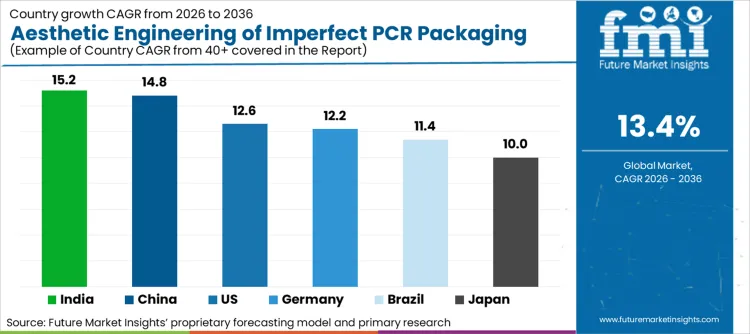
India leads in growth rate, advancing at an estimated 15.2% CAGR, driven by the explosive growth of its prestige beauty market and local brands aggressively adopting sustainable but premium positioning. China follows with a 14.8% CAGR, supported by its massive cosmetics manufacturing base and rapid uptake of advanced material engineering. The United States shows a 12.6% CAGR, propelled by the prestige beauty sector's leadership in sustainability and intense focus on consumer unboxing experience.
Germany and Japan represent high-value, quality-centric innovation markets, expanding at 12.2% and 10.0% CAGR, respectively. Growth is fueled by the luxury goods sector's meticulous quality standards and the deep integration of engineering and design philosophy in these regions.
FMI Research Approach: Country-level forecasts are built using analysis of prestige beauty and premium FMCG market growth, regulatory pressures specific to luxury packaging, tracking of design and innovation hub activities, and primary interviews with regional brand design heads.
What are some Globally Distinct Trends Shaping the Market?
Globally, the market is being shaped by the convergence of deep-tech material science, avant-garde design trends, and sustainability imperatives. The rise of ‘neo-brutalism’ and ‘wabi-sabi’ aesthetics in design is legitimizing and driving demand for visibly textured and non-uniform PCR packaging in luxury segments.
FMI Research Approach: Trend analysis is informed by global design award submissions, sustainability reports from luxury conglomerates (LVMH, Estée Lauder), technology roadmaps from specialty chemical and machinery suppliers, and social media analysis of consumer reception to ‘imperfect’ sustainable packaging.
Aesthetic Engineering of Imperfect PCR Packaging Market Key Takeaways
| Metrics | Values |
|---|---|
| Expected Value (2026E) | USD 920 million |
| Projected Value (2036F) | USD 3,240 million |
| CAGR (2026–2036) | 13.4% |
Source: Future Market Insights (FMI) analysis, based on proprietary forecasting model and primary research
Why is the Aesthetic Engineering of Imperfect PCR Packaging Market Growing?
The core driver is the existential need for premium brands to reconcile circularity with luxury codes. Major beauty conglomerates have publicly committed to 50-100% PCR content in packaging by 2030, but consumer testing consistently shows rejection of packages with visible specks, yellowing, or haze. This has created a multi-million dollar niche for engineering solutions that resolve this paradox. A 2026 study by the Luxury Packaging Forum found that 78% of consumers perceived a texturized, intentionally ‘flawed’ PCR bottle as more innovative and authentic than a flawless virgin plastic counterpart, provided the design was coherent and upscale.
The economics of brand damage are outweighing the cost of aesthetic engineering. The risk of a viral social media post critiquing a luxury brand’s ‘cheap-looking’ recycled packaging has made investment in aesthetic assurance a critical insurance policy. Consequently, brands are embedding aesthetic engineering costs directly into packaging budgets, with premiums of 20-35% over standard PCR packaging being accepted for guaranteed aesthetic outcomes.
Furthermore, aesthetic engineering is becoming a key IP differentiator. Brands are patenting specific speckle patterns, texture combinations, and light-diffusion effects that are uniquely achievable with certain PCR streams. This transforms a supply chain challenge into a proprietary brand asset that is difficult for competitors to replicate, creating a powerful moat. In early 2026, a leading skincare brand launched a serum in a bottle made from ocean-bound PCR-PET, using a patented surface texture that mimicked water ripples and successfully masked the material's inherent greyish tint, resulting in a 40% sales uplift attributed to the packaging story.
How is Aesthetic Engineering of Imperfect PCR Packaging Market Segmented?
The market segmentation is defined by the strategic aesthetic choices brands make to valorize or neutralize PCR's variability, balancing cost with sensory impact across different price segments.
How is the Premium FMCG & Cosmetics Segment Driving High-Value Innovation?
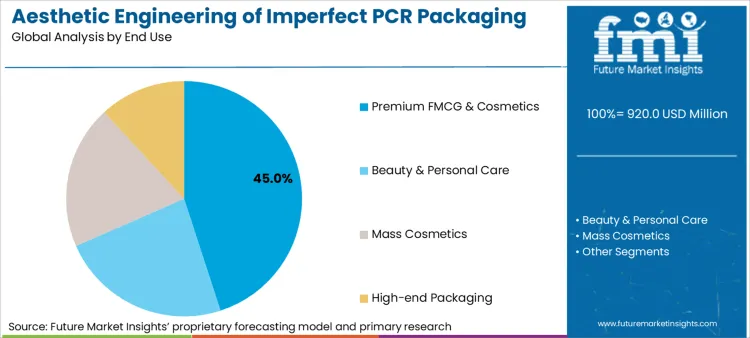
The Premium FMCG & Cosmetics end-use segment commands a leading 45% value share. This dominance is rooted in the extreme sensitivity of brand equity in these sectors and the high price point that can absorb the cost of advanced engineering. Brands in this segment are not hiding imperfections but curating them.
For example, in January 2026, a niche perfume house launched a line in bottles using 100% PCR-PET, where the proprietary ‘controlled crystallization’ process during molding created unique, frost-like patterns on each bottle, making each piece a numbered collectible.
Which Aesthetic Strategy is Dominating for Mass Accessibility?
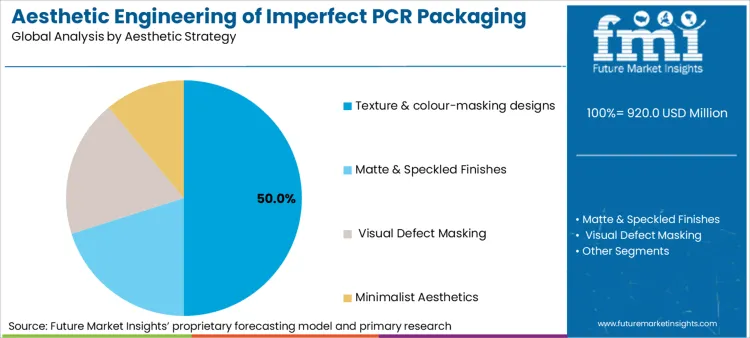
Texture & colour-masking designs hold a dominant 50% share of the aesthetic strategy segment. This approach uses physical texture (linen, stone, ripple finishes) and deep, saturated, or dark colors to effectively neutralize visual inconsistencies like specks and color variation in PCR-PET and PCR-PE. This is the most commercially scalable solution.
Aptar’s 2026 launch of a standard catalog of 15 ‘EcoTexture’ finishes for stock PCR bottles allows mass-market beauty brands to adopt high PCR content with guaranteed shelf appeal, without the cost of fully custom tooling.
What Material Blends Offer the Best Canvas for Aesthetic Engineering?
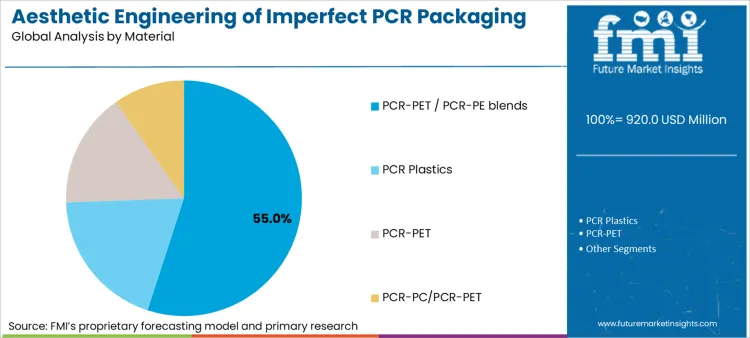
Packaging made from PCR-PET / PCR-PE blends leads the material segment with a 55% share. PCR-PET provides structural rigidity and clarity potential for jars and bottles, while PCR-PE offers flexibility for tubes and dispensers. The key for aesthetics is their compatibility with a vast array of effect pigments and texturing techniques.
In 2025, Zhejiang Sun-Rain patented a co-injection molding process that layers a thin, virgin-colored outer skin over a core of blended PCR-PET/PE. This achieves a pristine visual surface from any viewing angle while maximizing recycled content, a breakthrough for mass cosmetics.
Which Technology is Fundamental to Consistency?
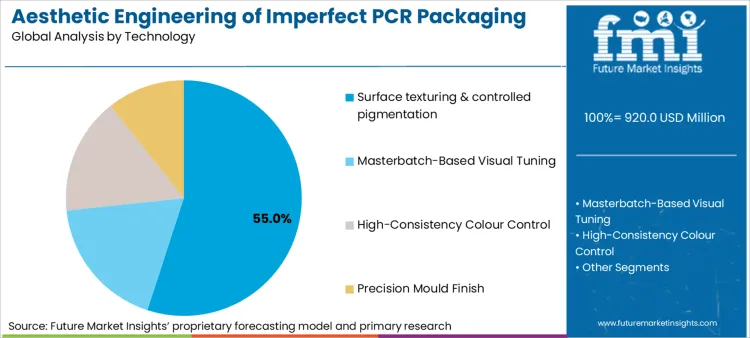
Surface texturing & controlled pigmentation is the pivotal technology segment, accounting for 55% of focus. This encompasses laser-engraved mold textures, in-mold labeling with textured films, and sophisticated pigment dispersion systems that ensure colorants fully encapsulate PCR flakes to prevent visible bleed-through.
Companies like Georg Menshen GmbH & Co. KG have developed ‘Varicoat’ technology, which applies a micro-textured, pigmented coating in-mold, allowing for complex matte and soft-touch finishes on PCR containers that are far more consistent and durable than post-mold painting or coating.
What Drivers, Restraints, Opportunities, and Trends Prevail in the Market?
Market expansion is supported by the premiumization of sustainability. Consumers increasingly equate sophisticated sustainable packaging with higher product quality. This drives brands to invest in aesthetic engineering to meet this expectation. In October 2025, L’Oréal’s Seed Phytonutrients brand partnered with Quadpack to launch a shampoo bar with a PCR-PE wrap featuring an embossed, seed-like texture and a deliberately ‘earthy’ speckled color palette, which consumer research rated as 30% more premium than a conventional smooth, single-color wrapper.
While demand is robust, the industry faces significant technical restraints in achieving clarity with PCR. Financial disclosures from resin suppliers in early 2026 highlighted the steep cost and energy intensity of super-cleaning PCR-PET to near-virgin clarity levels for transparent applications. This cost barrier solidifies the dominance of opaque and translucent aesthetic solutions (matte, textured, dark-tinted) in the near term, restraining growth in the ‘crystal-clear PCR’ sub-segment.
Smart aesthetics that incorporate functional benefits defines technical innovation. JSR Corporation’s 2026 showcase featured a light-reactive pigment system for PCR-PET. The pigments remain vibrant under store lighting but provide a subtle UV-sensing color shift outdoors, communicating the product’s sunscreen efficacy while simultaneously masking the base resin’s yellow tint—a dual functional and aesthetic solution.
The shift toward digital design and sampling represents a disruptive efficiency trend. The adoption of digital twin technology for packaging, where the aesthetic performance of a specific PCR blend in a specific mold texture can be simulated photorealistically before any physical sample is made, is slashing development time and cost. This trend empowers brands to experiment with more radical ‘imperfect’ aesthetics with lower financial risk, accelerating innovation.
Analysis of Aesthetic Engineering of Imperfect PCR Packaging Market by Key Countries
| Country | CAGR (2026–2036) |
|---|---|
| India | 15.2% |
| China | 14.8% |
| USA | 12.6% |
| Germany | 12.2% |
| Brazil | 11.4% |
| Japan | 10.0% |
Source: Future Market Insights (FMI) analysis, based on proprietary forecasting model and primary research
How is India's Booming Prestige Market Catalyzing Localized Aesthetic Innovation?
India is projected to expand at a leading 15.2% CAGR through 2036, driven by the explosive growth of its domestic prestige beauty and Ayurvedic FMCG brands. These brands are leveraging sustainable, locally-sourced PCR as a core part of their natural and authentic brand narrative.
The aesthetic strategy focuses on visual defect masking (14% share) and earthy, speckled finishes that align with natural ingredient stories. Local suppliers are innovating with spices and plant-based pigments to color PCR, creating a uniquely Indian aesthetic language for sustainable packaging.
What drives China's Scale and Speed in Mass Cosmetics Aesthetics?
China's 14.8% CAGR growth is fueled by its role as the global cosmetics OEM hub and the rapid rise of competitive domestic beauty brands. The focus is on high-consistency colour control (15% share) for mass cosmetics (18% end-use share).
Chinese manufacturers like Zhejiang Sun-Rain are mastering high-precision, multi-layer injection molding and coating to deliver flawless matte and pearl finishes on high-PCR content packaging at unbeatable speeds and costs, supplying both fast-moving domestic brands and global giants.
How do USA’s Prestige Beauty Standards Shape Cutting-Edge Engineering?
USA, growing at a 12.6% CAGR, is dominated by its globally influential prestige beauty and personal care sector. This environment demands masterbatch-based visual tuning (20% share) and sophisticated matte & speckled finishes (25% aesthetic share) that feel luxurious and unique.
US-based packaging leaders like Aptar and HCP Packaging operate full-service design studios that work directly with brand marketing teams to co-engineer PCR packaging where the aesthetic is the primary hero, often involving complex custom effects that become a brand's signature.
Why is Germany the European Epicenter for Luxury-Focused Engineering?
Germany's 12.2% CAGR is underpinned by its engineering prowess and the presence of numerous global luxury brand HQs. The market demands texture & colour-masking designs (50% share leadership) executed with extreme precision.
German engineering firms and packaging suppliers specialize in precision mould finish technologies (exported to Japan and others) and advanced surface texturing that can make PCR-PET mimic the feel of frosted glass, ceramic, or brushed metal, meeting the exacting tactile and visual standards of luxury goods.
How is Japan's Minimalist Philosophy Informing High-End PCR Aesthetics?
Japan's steady 10.0% CAGR reflects its mature, quality-obsessed market. Growth is driven by minimalist aesthetics (8% share) for high-end packaging (8% end-use). Japanese companies like Toyo Seikan excel in achieving sublime simplicity and perfection in finish, even with challenging materials.
Their focus is on precision mould finish (8% tech share) and using PCR-PC/PET blends to achieve exceptional clarity and purity of form, where any ‘imperfection’ is so subtle and uniform it is perceived as a deliberate, zen-like texture.
What Factors Underpin Brazil's Growth in Natural Aesthetics?
Brazil's 11.4% CAGR is shaped by its rich biodiversity and consumer preference for natural-looking products. The aesthetic engineering focus is on warm, organic color palettes and finishes that complement the country's leadership in natural cosmetics. PCR packaging here often integrates visual cues from nature, using surface textures that mimic botanical elements, successfully masking material variability while strengthening the product's natural positioning.
What is the Competition Outlook for Aesthetic Engineering of Imperfect PCR Packaging?
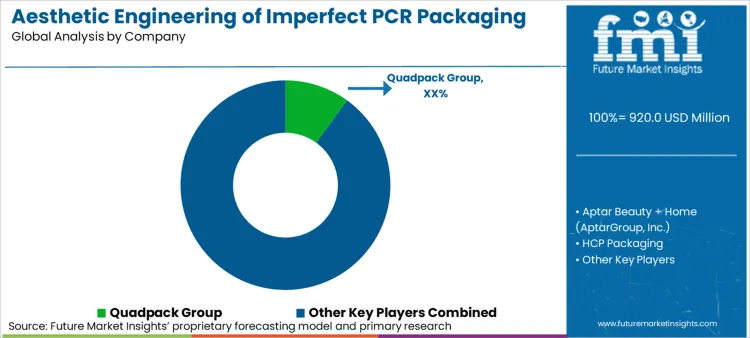
Competitive intensity reflects the fusion of deep material science, artistic design, and brand marketing. The landscape is bifurcating into integrated design-and-engineer boutiques serving luxury brands and large-scale technical specialists serving mass prestige. Competition is increasingly based on owning proprietary aesthetic effects (e.g., a specific speckle pattern, a light-diffusing texture) and the masterbatch or molding technology to replicate it consistently at scale with PCR.
Strategic acquisitions of design studios and specialty chemical firms defined the pre-2025 landscape. Quadpack’s earlier acquisitions of design agencies allowed it to offer end-to-end services. Suppliers focused on building libraries of pre-qualified aesthetic solutions to reduce brand risk and speed time-to-market.
The observable strategic direction for 2026 and beyond is the creation of ‘Material Aesthetics’ as a Service (MAaaS) platforms. These platforms, like the one launched by Aptar Beauty in late 2025, offer brands digital access to a vast portfolio of proven PCR+ aesthetic combinations, complete with lifecycle assessment data, cost models, and rapid prototyping services, all under a subscription or project fee model.
Strategic leadership is shifting toward full circular aesthetic systems. In early 2026, a consortium led by HCP Packaging and a major recycler inaugurated the ‘Design for Re-aestheticization’ project. This initiative develops PCR packaging whose aesthetic features (like a dark color or heavy texture) are designed to be fully compatible and even beneficial for the next recycling loop, ensuring the aesthetic engineering of today doesn't complicate the recycling of tomorrow.
Recent Developments
- Quadpack advanced its aesthetic-focused PCR packaging portfolio during 2024–2025 by expanding the use of surface finishes, tactile effects, and decorative geometries designed to mask color variability inherent in post-consumer recycled plastics. The company’s design strategy emphasizes intentional texture, matte finishes, and structural detailing to transform PCR imperfections into premium visual cues for cosmetic and fragrance brands.
- Aptar Beauty + Home continued integrating design-for-recycling principles into decorative dispensing solutions throughout 2024–2025, including the use of controlled pigmentation, reduced masterbatch loading, and mono-material architectures. These developments aim to preserve recyclability and material health while enabling consistent aesthetics in high-PCR-content beauty and personal care packaging.
- Toyo Seikan Group expanded its application of advanced decorative technologies—such as in-mold labeling, multilayer visual effects, and surface treatments—across PET cosmetic packaging during 2024–2025. These solutions are increasingly positioned to visually neutralize PCR-induced color and surface inconsistencies, supporting premium skincare and personal care brands adopting recycled-content packaging without compromising shelf appeal.
Key Players Profiled
- Quadpack Group
- Aptar Beauty + Home (AptarGroup, Inc.)
- HCP Packaging
- Toyo Seikan Group Holdings, Ltd.
- Zhejiang Sun-Rain Packaging Co., Ltd.
- Gerresheimer AG
- Albea Group
- RPC Group (now part of Berry Global)
- Hoffmann Neopac AG
- ABC Packaging Ltd.
Market Definition
The aesthetic engineering of imperfect PCR packaging market comprises revenue generated from specialized design services, material formulation, effect technologies, and processing techniques applied to Post-Consumer Recycled (PCR) plastic packaging to systematically manage, mask, or valorize its visual and tactile imperfections.
This includes the value of proprietary masterbatches, surface texturing tools (e.g., laser-engraved molds), coating systems, effect pigments, and integrated design consultancy specifically aimed at achieving brand-required aesthetic standards (color consistency, clarity, finish, tactile feel) in packaging incorporating significant PCR content. The market scope covers primary packaging for premium FMCG, cosmetics, personal care, and luxury goods, excluding standard, non-aesthetically enhanced PCR packaging.
Scope of Report
| Items | Values |
|---|---|
| Quantitative Units | USD 920 million (2026) |
| End Use | Premium FMCG & Cosmetics, Beauty & Personal Care, Mass Cosmetics, High-end Packaging, Others |
| Aesthetic Strategy | Texture & Colour-Masking Designs, Matte & Speckled Finishes, Visual Defect Masking, Minimalist Aesthetics, Others |
| Material | PCR-PET / PCR-PE, PCR Plastics, PCR-PET, PCR-PC / PCR-PET, Others |
| Technology | Surface Texturing & Controlled Pigmentation, Masterbatch-Based Visual Tuning, High-Consistency Colour Control, Precision Mould Finish, Others |
| Regions Covered | North America, Western Europe, Eastern Europe, East Asia, South Asia & Pacific, Latin America, Middle East & Africa |
| Countries | Germany, USA, China, Japan, India, Brazil and 40+ countries |
| Key Companies | Quadpack, Aptar Beauty, HCP Packaging, Zhejiang Sun-Rain, Toyo Seikan, Gerresheimer, Albea, Hoffmann Neopac, RPC/Berry, ABC Packaging |
Source: Future Market Insights (FMI) analysis, based on proprietary forecasting model and primary research
Aesthetic Engineering of Imperfect PCR Packaging Market Key Segments
By End Use
- Premium FMCG & Cosmetics
- Beauty & Personal Care
- Mass Cosmetics
- High-end Packaging
By Aesthetic Strategy
- Texture & Colour-Masking Designs
- Matte & Speckled Finishes
- Visual Defect Masking
- Minimalist Aesthetics
By Material
- PCR-PET/PCR-PE
- PCR Plastics
- PCR-PET
- PCR-PC/PCR-PET
By Technology
- Surface Texturing & Controlled Pigmentation
- Masterbatch-Based Visual Tuning
- High-Consistency Colour Control
- Precision Mould Finish
By Region
- North America
- Western Europe
- Eastern Europe
- East Asia
- South Asia & Pacific
- Latin America
- Middle East & Africa
Bibliography
- Cosmetics Europe. (2024). Recycled plastics in cosmetic packaging: Design, safety, and consumer perception considerations. Brussels: Cosmetics Europe.
- Food Packaging Forum Foundation. (2025). Visual quality, additives, and safety implications of recycled plastics in consumer packaging. Zurich: Food Packaging Forum.
- World Packaging Organisation (WPO). (2025). Packaging design trends for recycled and circular materials. Zurich: WPO.
- Institute of Packaging Professionals (IoPP). (2024). Handbook of packaging aesthetics, surface engineering, and material performance. Herndon, VA: IoPP.
- Luxury Packaging Forum. (2026). Sustainability, authenticity, and visual imperfection in premium packaging. Paris: LPF Publications.
- Design Council UK. (2024). Design for circular materials: Managing imperfection as value. London: Design Council.
- Smithers. (2025). The future of decorative technologies in plastic packaging. Akron, OH: Smithers.
-
Frequently Asked Questions
- What is the expected value of the aesthetic engineering of imperfect PCR packaging market in 2026?
- The market is expected to reach USD 920 million in 2026, supported by the urgent need for premium brands to deploy high-PCR content packaging without compromising aesthetic brand codes.
- What is the projected value by 2036 and CAGR from 2026 to 2036?
- By 2036, the market is projected to reach USD 3,240 million, expanding at a CAGR of 13.4% between 2026 and 2036.
- How is this market different from standard PCR packaging?
- This market focuses specifically on the added value of design services and technologies that manage the visual and tactile imperfections of PCR resins. It is the critical link that allows PCR to be used in brand-sensitive, high-margin segments where appearance is paramount.
- Which aesthetic strategy is most prevalent and why?
- Texture & colour-masking designs hold a 50% share as they are the most effective and scalable techniques for neutralizing visual inconsistencies (specks, color variation) in PCR, enabling its use across a wide range of market segments from mass-market cosmetics to premium goods.
- Which country is growing the fastest and what is driving this?
- India is growing the fastest at a 15.2% CAGR, driven by the explosive growth of its domestic prestige beauty market, where new brands are using sustainable, aesthetically-engineered PCR packaging as a core differentiator to build authentic, premium brand narratives.
Frequently Asked Questions
How big is the aesthetic engineering of imperfect pcr packaging market in 2026?
The global aesthetic engineering of imperfect pcr packaging market is estimated to be valued at USD 920.0 million in 2026.
What will be the size of aesthetic engineering of imperfect pcr packaging market in 2036?
The market size for the aesthetic engineering of imperfect pcr packaging market is projected to reach USD 3,235.3 million by 2036.
How much will be the aesthetic engineering of imperfect pcr packaging market growth between 2026 and 2036?
The aesthetic engineering of imperfect pcr packaging market is expected to grow at a 13.4% CAGR between 2026 and 2036.
What are the key product types in the aesthetic engineering of imperfect pcr packaging market?
The key product types in aesthetic engineering of imperfect pcr packaging market are premium fmcg & cosmetics , beauty & personal care, mass cosmetics and high-end packaging.
Which aesthetic strategy segment to contribute significant share in the aesthetic engineering of imperfect pcr packaging market in 2026?
In terms of aesthetic strategy , texture & colour-masking designs segment to command 50.0% share in the aesthetic engineering of imperfect pcr packaging market in 2026.
Preview the report firsthand - request a free sample
Get SampleGet the brochure for pricing and purchase details.
Get PDFTable of Content
- Executive Summary
- Global Market Outlook
- Demand-side Trends
- Supply-side Trends
- Technology Roadmap Analysis
- Analysis and Recommendations
- Market Overview
- Market Coverage / Taxonomy
- Market Definition / Scope / Limitations
- Research Methodology
- Chapter Orientation
- Analytical Lens and Working Hypotheses
- Market Structure, Signals, and Trend Drivers
- Benchmarking and Cross-market Comparability
- Market Sizing, Forecasting, and Opportunity Mapping
- Research Design and Evidence Framework
- Desk Research Programme (Secondary Evidence)
- Company Annual and Sustainability Reports
- Peer-reviewed Journals and Academic Literature
- Corporate Websites, Product Literature, and Technical Notes
- Earnings Decks and Investor Briefings
- Statutory Filings and Regulatory Disclosures
- Technical White Papers and Standards Notes
- Trade Journals, Industry Magazines, and Analyst Briefs
- Conference Proceedings, Webinars, and Seminar Materials
- Government Statistics Portals and Public Data Releases
- Press Releases and Reputable Media Coverage
- Specialist Newsletters and Curated Briefings
- Sector Databases and Reference Repositories
- FMI Internal Proprietary Databases and Historical Market Datasets
- Subscription Datasets and Paid Sources
- Social Channels, Communities, and Digital Listening Inputs
- Additional Desk Sources
- Expert Input and Fieldwork (Primary Evidence)
- Primary Modes
- Qualitative Interviews and Expert Elicitation
- Quantitative Surveys and Structured Data Capture
- Blended Approach
- Why Primary Evidence is Used
- Field Techniques
- Interviews
- Surveys
- Focus Groups
- Observational and In-context Research
- Social and Community Interactions
- Stakeholder Universe Engaged
- C-suite Leaders
- Board Members
- Presidents and Vice Presidents
- R&D and Innovation Heads
- Technical Specialists
- Domain Subject-matter Experts
- Scientists
- Physicians and Other Healthcare Professionals
- Governance, Ethics, and Data Stewardship
- Research Ethics
- Data Integrity and Handling
- Primary Modes
- Tooling, Models, and Reference Databases
- Desk Research Programme (Secondary Evidence)
- Data Engineering and Model Build
- Data Acquisition and Ingestion
- Cleaning, Normalisation, and Verification
- Synthesis, Triangulation, and Analysis
- Quality Assurance and Audit Trail
- Market Background
- Market Dynamics
- Drivers
- Restraints
- Opportunity
- Trends
- Scenario Forecast
- Demand in Optimistic Scenario
- Demand in Likely Scenario
- Demand in Conservative Scenario
- Opportunity Map Analysis
- Product Life Cycle Analysis
- Supply Chain Analysis
- Investment Feasibility Matrix
- Value Chain Analysis
- PESTLE and Porter’s Analysis
- Regulatory Landscape
- Regional Parent Market Outlook
- Production and Consumption Statistics
- Import and Export Statistics
- Market Dynamics
- Global Market Analysis 2021 to 2025 and Forecast, 2026 to 2036
- Historical Market Size Value (USD Million) Analysis, 2021 to 2025
- Current and Future Market Size Value (USD Million) Projections, 2026 to 2036
- Y-o-Y Growth Trend Analysis
- Absolute $ Opportunity Analysis
- Global Market Pricing Analysis 2021 to 2025 and Forecast 2026 to 2036
- Global Market Analysis 2021 to 2025 and Forecast 2026 to 2036, By End Use
- Introduction / Key Findings
- Historical Market Size Value (USD Million) Analysis By End Use , 2021 to 2025
- Current and Future Market Size Value (USD Million) Analysis and Forecast By End Use , 2026 to 2036
- Premium FMCG & Cosmetics
- Beauty & Personal Care
- Mass Cosmetics
- High-end Packaging
- Premium FMCG & Cosmetics
- Y-o-Y Growth Trend Analysis By End Use , 2021 to 2025
- Absolute $ Opportunity Analysis By End Use , 2026 to 2036
- Global Market Analysis 2021 to 2025 and Forecast 2026 to 2036, By Aesthetic Strategy
- Introduction / Key Findings
- Historical Market Size Value (USD Million) Analysis By Aesthetic Strategy, 2021 to 2025
- Current and Future Market Size Value (USD Million) Analysis and Forecast By Aesthetic Strategy, 2026 to 2036
- Texture & colour-masking designs
- Matte & Speckled Finishes
- Visual Defect Masking
- Minimalist Aesthetics
- Texture & colour-masking designs
- Y-o-Y Growth Trend Analysis By Aesthetic Strategy, 2021 to 2025
- Absolute $ Opportunity Analysis By Aesthetic Strategy, 2026 to 2036
- Global Market Analysis 2021 to 2025 and Forecast 2026 to 2036, By Material
- Introduction / Key Findings
- Historical Market Size Value (USD Million) Analysis By Material, 2021 to 2025
- Current and Future Market Size Value (USD Million) Analysis and Forecast By Material, 2026 to 2036
- PCR-PET / PCR-PE blends
- PCR Plastics
- PCR-PET
- PCR-PC/PCR-PET
- PCR-PET / PCR-PE blends
- Y-o-Y Growth Trend Analysis By Material, 2021 to 2025
- Absolute $ Opportunity Analysis By Material, 2026 to 2036
- Global Market Analysis 2021 to 2025 and Forecast 2026 to 2036, By Technology
- Introduction / Key Findings
- Historical Market Size Value (USD Million) Analysis By Technology, 2021 to 2025
- Current and Future Market Size Value (USD Million) Analysis and Forecast By Technology, 2026 to 2036
- Surface texturing & controlled pigmentation
- Masterbatch-Based Visual Tuning
- High-Consistency Colour Control
- Precision Mould Finish
- Surface texturing & controlled pigmentation
- Y-o-Y Growth Trend Analysis By Technology, 2021 to 2025
- Absolute $ Opportunity Analysis By Technology, 2026 to 2036
- Global Market Analysis 2021 to 2025 and Forecast 2026 to 2036, By Region
- Introduction
- Historical Market Size Value (USD Million) Analysis By Region, 2021 to 2025
- Current Market Size Value (USD Million) Analysis and Forecast By Region, 2026 to 2036
- North America
- Latin America
- Western Europe
- Eastern Europe
- East Asia
- South Asia and Pacific
- Middle East & Africa
- Market Attractiveness Analysis By Region
- North America Market Analysis 2021 to 2025 and Forecast 2026 to 2036, By Country
- Historical Market Size Value (USD Million) Trend Analysis By Market Taxonomy, 2021 to 2025
- Market Size Value (USD Million) Forecast By Market Taxonomy, 2026 to 2036
- By Country
- USA
- Canada
- Mexico
- By End Use
- By Aesthetic Strategy
- By Material
- By Technology
- By Country
- Market Attractiveness Analysis
- By Country
- By End Use
- By Aesthetic Strategy
- By Material
- By Technology
- Key Takeaways
- Latin America Market Analysis 2021 to 2025 and Forecast 2026 to 2036, By Country
- Historical Market Size Value (USD Million) Trend Analysis By Market Taxonomy, 2021 to 2025
- Market Size Value (USD Million) Forecast By Market Taxonomy, 2026 to 2036
- By Country
- Brazil
- Chile
- Rest of Latin America
- By End Use
- By Aesthetic Strategy
- By Material
- By Technology
- By Country
- Market Attractiveness Analysis
- By Country
- By End Use
- By Aesthetic Strategy
- By Material
- By Technology
- Key Takeaways
- Western Europe Market Analysis 2021 to 2025 and Forecast 2026 to 2036, By Country
- Historical Market Size Value (USD Million) Trend Analysis By Market Taxonomy, 2021 to 2025
- Market Size Value (USD Million) Forecast By Market Taxonomy, 2026 to 2036
- By Country
- Germany
- UK
- Italy
- Spain
- France
- Nordic
- BENELUX
- Rest of Western Europe
- By End Use
- By Aesthetic Strategy
- By Material
- By Technology
- By Country
- Market Attractiveness Analysis
- By Country
- By End Use
- By Aesthetic Strategy
- By Material
- By Technology
- Key Takeaways
- Eastern Europe Market Analysis 2021 to 2025 and Forecast 2026 to 2036, By Country
- Historical Market Size Value (USD Million) Trend Analysis By Market Taxonomy, 2021 to 2025
- Market Size Value (USD Million) Forecast By Market Taxonomy, 2026 to 2036
- By Country
- Russia
- Poland
- Hungary
- Balkan & Baltic
- Rest of Eastern Europe
- By End Use
- By Aesthetic Strategy
- By Material
- By Technology
- By Country
- Market Attractiveness Analysis
- By Country
- By End Use
- By Aesthetic Strategy
- By Material
- By Technology
- Key Takeaways
- East Asia Market Analysis 2021 to 2025 and Forecast 2026 to 2036, By Country
- Historical Market Size Value (USD Million) Trend Analysis By Market Taxonomy, 2021 to 2025
- Market Size Value (USD Million) Forecast By Market Taxonomy, 2026 to 2036
- By Country
- China
- Japan
- South Korea
- By End Use
- By Aesthetic Strategy
- By Material
- By Technology
- By Country
- Market Attractiveness Analysis
- By Country
- By End Use
- By Aesthetic Strategy
- By Material
- By Technology
- Key Takeaways
- South Asia and Pacific Market Analysis 2021 to 2025 and Forecast 2026 to 2036, By Country
- Historical Market Size Value (USD Million) Trend Analysis By Market Taxonomy, 2021 to 2025
- Market Size Value (USD Million) Forecast By Market Taxonomy, 2026 to 2036
- By Country
- India
- ASEAN
- Australia & New Zealand
- Rest of South Asia and Pacific
- By End Use
- By Aesthetic Strategy
- By Material
- By Technology
- By Country
- Market Attractiveness Analysis
- By Country
- By End Use
- By Aesthetic Strategy
- By Material
- By Technology
- Key Takeaways
- Middle East & Africa Market Analysis 2021 to 2025 and Forecast 2026 to 2036, By Country
- Historical Market Size Value (USD Million) Trend Analysis By Market Taxonomy, 2021 to 2025
- Market Size Value (USD Million) Forecast By Market Taxonomy, 2026 to 2036
- By Country
- Kingdom of Saudi Arabia
- Other GCC Countries
- Turkiye
- South Africa
- Other African Union
- Rest of Middle East & Africa
- By End Use
- By Aesthetic Strategy
- By Material
- By Technology
- By Country
- Market Attractiveness Analysis
- By Country
- By End Use
- By Aesthetic Strategy
- By Material
- By Technology
- Key Takeaways
- Key Countries Market Analysis
- USA
- Pricing Analysis
- Market Share Analysis, 2025
- By End Use
- By Aesthetic Strategy
- By Material
- By Technology
- Canada
- Pricing Analysis
- Market Share Analysis, 2025
- By End Use
- By Aesthetic Strategy
- By Material
- By Technology
- Mexico
- Pricing Analysis
- Market Share Analysis, 2025
- By End Use
- By Aesthetic Strategy
- By Material
- By Technology
- Brazil
- Pricing Analysis
- Market Share Analysis, 2025
- By End Use
- By Aesthetic Strategy
- By Material
- By Technology
- Chile
- Pricing Analysis
- Market Share Analysis, 2025
- By End Use
- By Aesthetic Strategy
- By Material
- By Technology
- Germany
- Pricing Analysis
- Market Share Analysis, 2025
- By End Use
- By Aesthetic Strategy
- By Material
- By Technology
- UK
- Pricing Analysis
- Market Share Analysis, 2025
- By End Use
- By Aesthetic Strategy
- By Material
- By Technology
- Italy
- Pricing Analysis
- Market Share Analysis, 2025
- By End Use
- By Aesthetic Strategy
- By Material
- By Technology
- Spain
- Pricing Analysis
- Market Share Analysis, 2025
- By End Use
- By Aesthetic Strategy
- By Material
- By Technology
- France
- Pricing Analysis
- Market Share Analysis, 2025
- By End Use
- By Aesthetic Strategy
- By Material
- By Technology
- India
- Pricing Analysis
- Market Share Analysis, 2025
- By End Use
- By Aesthetic Strategy
- By Material
- By Technology
- ASEAN
- Pricing Analysis
- Market Share Analysis, 2025
- By End Use
- By Aesthetic Strategy
- By Material
- By Technology
- Australia & New Zealand
- Pricing Analysis
- Market Share Analysis, 2025
- By End Use
- By Aesthetic Strategy
- By Material
- By Technology
- China
- Pricing Analysis
- Market Share Analysis, 2025
- By End Use
- By Aesthetic Strategy
- By Material
- By Technology
- Japan
- Pricing Analysis
- Market Share Analysis, 2025
- By End Use
- By Aesthetic Strategy
- By Material
- By Technology
- South Korea
- Pricing Analysis
- Market Share Analysis, 2025
- By End Use
- By Aesthetic Strategy
- By Material
- By Technology
- Russia
- Pricing Analysis
- Market Share Analysis, 2025
- By End Use
- By Aesthetic Strategy
- By Material
- By Technology
- Poland
- Pricing Analysis
- Market Share Analysis, 2025
- By End Use
- By Aesthetic Strategy
- By Material
- By Technology
- Hungary
- Pricing Analysis
- Market Share Analysis, 2025
- By End Use
- By Aesthetic Strategy
- By Material
- By Technology
- Kingdom of Saudi Arabia
- Pricing Analysis
- Market Share Analysis, 2025
- By End Use
- By Aesthetic Strategy
- By Material
- By Technology
- Turkiye
- Pricing Analysis
- Market Share Analysis, 2025
- By End Use
- By Aesthetic Strategy
- By Material
- By Technology
- South Africa
- Pricing Analysis
- Market Share Analysis, 2025
- By End Use
- By Aesthetic Strategy
- By Material
- By Technology
- USA
- Market Structure Analysis
- Competition Dashboard
- Competition Benchmarking
- Market Share Analysis of Top Players
- By Regional
- By End Use
- By Aesthetic Strategy
- By Material
- By Technology
- Competition Analysis
- Competition Deep Dive
- Quadpack Group
- Overview
- Product Portfolio
- Profitability by Market Segments (Product/Age /Sales Channel/Region)
- Sales Footprint
- Strategy Overview
- Marketing Strategy
- Product Strategy
- Channel Strategy
- Aptar Beauty + Home (AptarGroup, Inc.)
- HCP Packaging
- Toyo Seikan Group Holdings, Ltd.
- Zhejiang Sun-Rain Packaging Co., Ltd.
- Gerresheimer AG
- Quadpack Group
- Competition Deep Dive
- Assumptions & Acronyms Used


