

- Market Size (2026)
- USD 388 Mn
- Forecast (2036)
- USD 610 Mn
- CAGR (2026 to 2036)
- 4.6%
Forestry Vehicle Brake and Retarder Systems Market Size, Market Forecast and Outlook By FMI
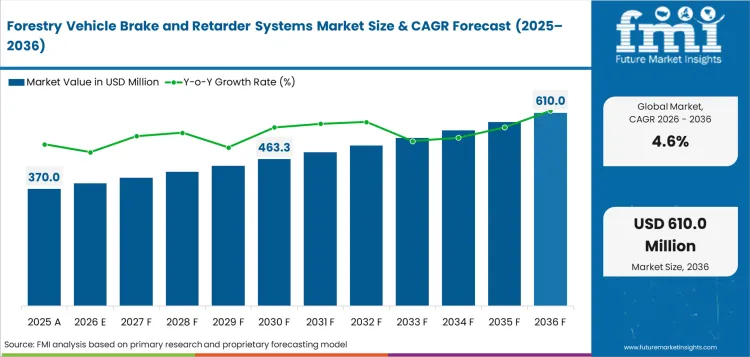
The forestry vehicle brake and retarder systems market crossed a valuation of USD 370 million in 2025 and is estimated at USD 388 million in 2026. Demand is projected to expand at a CAGR of 4.6% from 2026 to 2036, taking the market to USD 610 million by 2036. OEM fitment is projected to lead with a 67.0% sales channel share, and hydraulic actuation is poised to lead the actuation type segment with a 55.0% share.
Key Takeaways, Market Size and Forecast
- The forestry vehicle brake and retarder systems market was valued at USD 370 million in 2025.
- By 2036, the forestry vehicle brake and retarder systems market is projected to reach USD 610 million.
- From 2026 to 2036, the market is projected to expand at a CAGR of 4.6%.
- The market is projected to create an incremental opportunity of USD 222 million between 2026 and 2036.
- In 2026, OEM fitment is expected to account for 67.0% of sales channel demand.
- China at 6.2% and Brazil at 5.8% are two faster growing country markets.
Summary of the Forestry Vehicle Brake and Retarder Systems Market
- Demand and Growth Drivers
- Steeper forest roads raise demand for retarder systems as loaded vehicles need controlled descent and lower service brake wear.
- Heavy payload movement boosts wet disc brake use as sealed friction packs protect braking performance in mud and debris.
- OEM brake package specification increases as forestry machines need axle-level integration and reliable service access through off highway vehicles brake systems.
- Product and Segment View
- Wet disc brakes are projected to lead the brake type segment with 41.0% share in 2026, reflecting their use in sealed heavy-duty axle systems.
- Hydraulic actuation is projected to dominate actuation type demand with 55.0% share in 2026, due to strong fit with forestry vehicle hydraulic circuits.
- OEM fitment is expected to account for high-value sales channel demand as brake systems are specified during vehicle platform design through electro-hydraulic brake actuation units.
- Geography and Competitive Outlook
- China is projected to record a CAGR of 6.2% through 2036 as mechanized forestry equipment renewal expands.
- Brazil is projected to expand at 5.8% CAGR by 2036 as planted timber operations need heavier harvest and transport equipment.
- Companies combining axle integration depth with severe-duty brake expertise are strengthening their market position through the forecast period.
- Analyst Opinion
- Nikhil Kaitwade, Principal Consultant for the Automotive domain at FMI, says, “Forestry braking is becoming a safety system tied to axle design and terrain exposure. Forestry OEMs need sealed brake packs with retarder cooling strength. Wet disc expertise and hydraulic control reduce harvesting interruptions while heat load shapes replacement planning decisions.”
- Forestry Vehicle Brake and Retarder Systems Market Value Analysis
- Forestry vehicle brake and retarder system demand is shifting from standalone replacement parts toward complete brake and retarder packages.
- Heavier forwarders and log trucks lead to a higher need for braking systems suited to slopes and soft forest terrain.
- Wet multi-disc brake use is increasing across off-highway drivetrains as sealed designs suit muddy operating conditions.
- Heat control and contamination protection are becoming central buying criteria for forestry vehicle braking systems.
- Reliable brake and retarder packages help forestry operators maintain stopping control and reduce downtime at remote work sites.
Forestry brake systems must manage heat exposure and mud during downhill timber movement. Holding-load pressure raises braking stress during loaded forest transport on slopes. The Allison-Dana transaction points to a stronger role for complete drivetrain packages, since brake and retarder matching is easier when axles and motion systems are planned together. ZF’s MULTITRAC axle information supports wet multi-disc brakes for heavy-duty axles, with lower braking losses and better efficiency.
Sealed brake designs suit forestry operators working through muddy cycles and repeated braking tasks. Carlisle’s 1100 Series Brake Valve adds a practical equipment signal for forestry braking applications. The valve offers pressure control up to 3500 psi or 240 bar for demanding service use. Company literature states use of forestry equipment and supports its relevance for this market. Suppliers with proven wet disc packages and hydraulic valve control are better placed for OEM fitment and service replacement demand.
Forestry Vehicle Brake and Retarder Systems Market Definition
The forestry vehicle brake and retarder systems market includes brake assemblies and auxiliary speed-control systems used in forestry vehicles. These systems favor stopping, parking, downhill control, and heat management across harvest and log transport operations. Scope includes wet disc brakes, dry disc brakes, drum brakes, retarders, actuators, valves, friction parts, and related control units. Passenger vehicle brakes and general industrial holding brakes are outside the scope.
Forestry Vehicle Brake and Retarder Systems Market Inclusions
Market scope covers commercially traded forestry brake and retarder systems used across forwarders, harvesters, skidders, feller bunchers, and log trucks. Product coverage includes wet disc brakes, hydraulic retarders, parking brakes, actuator valves, friction packs, and service rebuild kits. Revenue scope covers 2026 to 2036 across OEM fitment, aftermarket replacement, retrofit kits, and rebuild channels. The market connects closely with construction equipment axle brake components since forestry vehicles operate under similar axle load and braking stress conditions.
Key stakeholders include forestry equipment manufacturers, brake system suppliers, axle integrators, hydraulic component providers, service workshops, fleet operators, parts distributors, and safety regulators. Demand intersects with hydrostatic transmission as braking performance and drivetrain control are specified together in heavy off-highway platforms.
Forestry Vehicle Brake and Retarder Systems Market Exclusions
Scope does not include passenger vehicle brakes, rail retarders, marine braking systems, factory press brakes, or non-forestry industrial clutch assemblies.
Forestry Vehicle Brake and Retarder Systems Market Research Methodology
- Primary Research: FMI analysts talked to forestry equipment manufacturers, brake suppliers, axle integrators, service rebuild firms, and distributor networks in important markets.
- Desk Research: Combined data from forestry output references, company product portfolios, forestry equipment, commercial vehicle retarder, and severe-duty drivetrain requirements.
- Market sizing and forecasting: Estimates are based on vehicle-level brake package use across forestry vehicle types and sales channels from the bottom up.
- Data validation: Cross-checked every three months against retarder and pto couplings, brake system, forestry equipment demand, supplier coverage, and aftermarket replacement patterns.
Why is the Forestry Vehicle Brake and Retarder Systems Market Growing?
- Forestry fleets are using stronger brake packages to reduce wear during loaded downhill movement.
- Retarder systems are becoming important as payload weight and slope exposure raise heat stress on service brakes.
- Manufacturers are specifying integrated brake assemblies to align axles and vehicle control systems.
Forestry vehicles work under braking conditions unlike most off-highway machines. FAO reported in December 2025 global wood and paper product exports reached USD 486 billion in 2024. This trade base keeps forestry equipment utilization important for brake and retarder suppliers. Loaded downhill movement increases heat exposure and raises the need for auxiliary slowing systems. Suppliers with sealed brake packs and retarder cooling depth can protect vehicle uptime.
Off-highway drivetrain suppliers are treating forestry as part of a larger severe-duty equipment platform base. Allison Transmission announced in June 2025 an agreement to acquire Dana’s off-highway business for about USD 2.7 billion. The portfolio covers off-highway applications including forestry equipment and related drivetrain systems. This type of consolidation raises the importance of integrated brake and axle capability. Suppliers with complete drivetrain compatibility can compete better for OEM platform programs.
Market Segmentation Analysis
- Wet disc brakes are forecast to hold 41.0% of brake type sales in 2026 as sealed designs suit muddy forestry work.
- Hydraulic retarders are expected to represent 38.0% of retarder type use during 2026 as loaded downhill routes raise brake heat stress.
- Forwarders are projected to account for 32.0% of vehicle-based adoption in 2026 as timber movement increases frequent braking cycles.
- Hydraulic actuation is forecast to hold 55.0% of actuation type share for 2026 as forestry machines rely on hydraulic systems.
- OEM fitment is expected to account for 67.0% of sales channel demand in 2026 with deeper brake integration through automotive brake system & components.
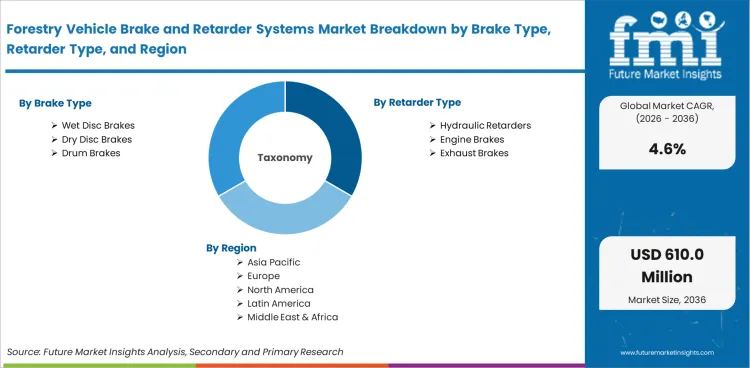
The market for forestry vehicle brake and retarder systems is divided into groups based on brake type, retarder type, vehicle type, actuation type, sales channel, and region. Under brake type, the market includes wet disc brakes, dry disc brakes, drum brakes, parking brakes, and caliper brakes. By retarder type, the market covers hydraulic retarders, electromagnetic retarders, engine brakes, exhaust brakes, and regenerative retarders. By vehicle type, the market includes forwarders, harvesters, skidders, feller bunchers, and log trucks. Based on actuation type, it includes hydraulic actuation, pneumatic actuation, electro-hydraulic actuation, and mechanical actuation. By sales channel, the market is segmented into OEM fitment, aftermarket, retrofit kits, and service rebuilds.
Insights into Forestry Vehicle Brake and Retarder Systems Market by Brake Type
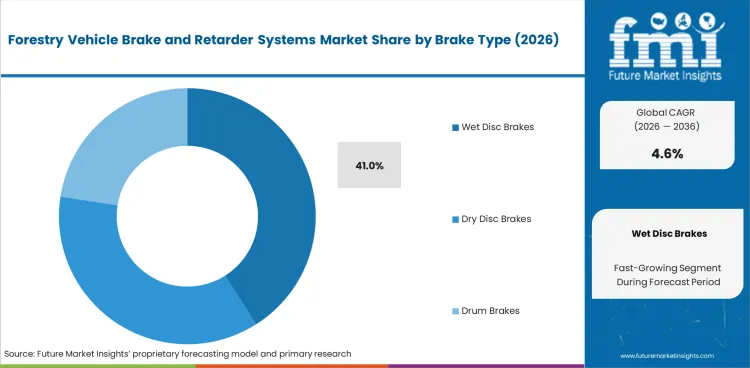
- In 2026, wet disc brakes are expected to contribute 41.0% of the brake type segment. Sealed designs help protect friction surfaces during work across mud and wood debris.
- Dry disc and drum brake options address lighter forestry vehicles and selected service needs. Their use improves in fleets seeking simpler maintenance and lower replacement cost.
Insights into Forestry Vehicle Brake and Retarder Systems Market by Retarder Type
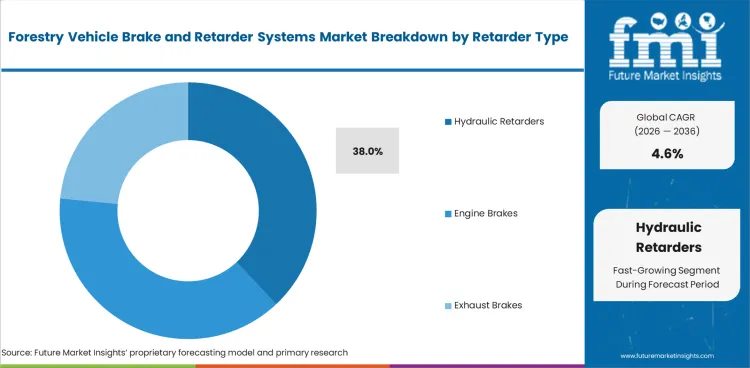
- Hydraulic retarders are projected to account for 38.0% of the retarder type segment in 2026. Loaded downhill travel creates higher heat stress, making controlled speed reduction important for brake life.
- Electromagnetic and engine brake options serve selected vehicle platforms. Their value improves in applications needing auxiliary braking without frequent service brake use.
Insights into Forestry Vehicle Brake and Retarder Systems Market by Vehicle Type
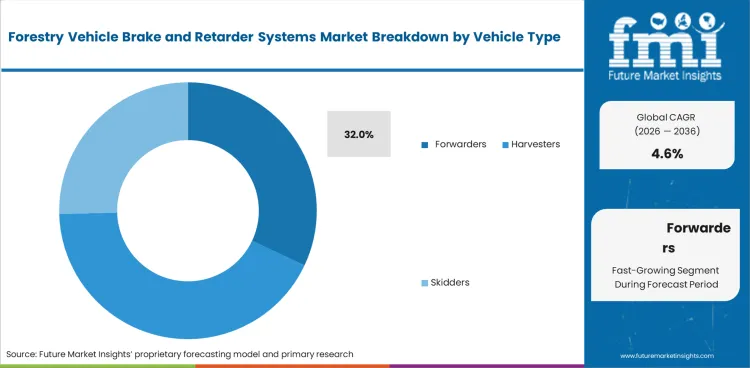
- Forwarders are expected to account for 32.0% share in 2026. Timber transport from stump areas to roadside points raises repeated braking across uneven ground and soft terrain.
- Harvesters and skidders enhance different braking needs across cutting and pulling work. Forwarders carry higher braking intensity as loaded travel occurs throughout each operating cycle.
Insights into Forestry Vehicle Brake and Retarder Systems Market by Actuation Type
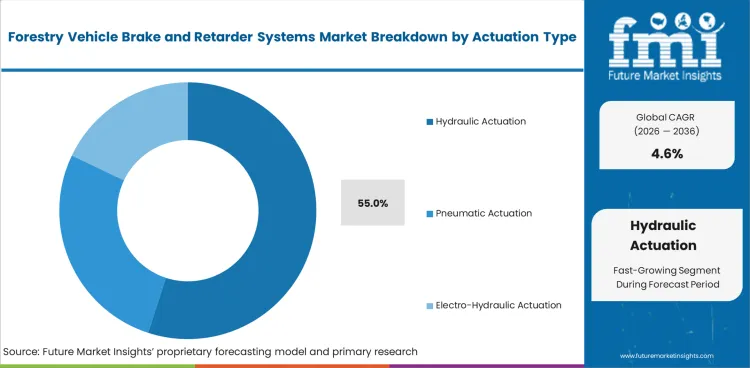
- Hydraulic actuation is expected to represent 55.0% share in 2026. Forestry machines already use hydraulic circuits for steering and work functions, improving brake system integration.
- Pneumatic and mechanical actuation options address selected vehicle platforms. Their use is stronger in simpler machines and log transport formats requiring easier service access.
Insights into Forestry Vehicle Brake and Retarder Systems Market by Sales Channel
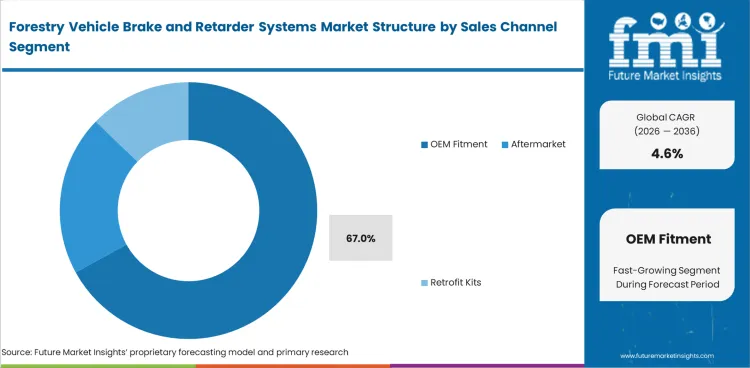
- OEM fitment is projected to hold 67.0% share in 2026. Machine builders prefer factory-level brake specification for axle matching and vehicle safety performance.
- Aftermarket and service rebuild demand favors fleets operating older forestry vehicles. Replacement value improves as friction plates and actuator parts reach wear limits.
Forestry Vehicle Brake and Retarder Systems Market Drivers, Restraints, and Opportunities
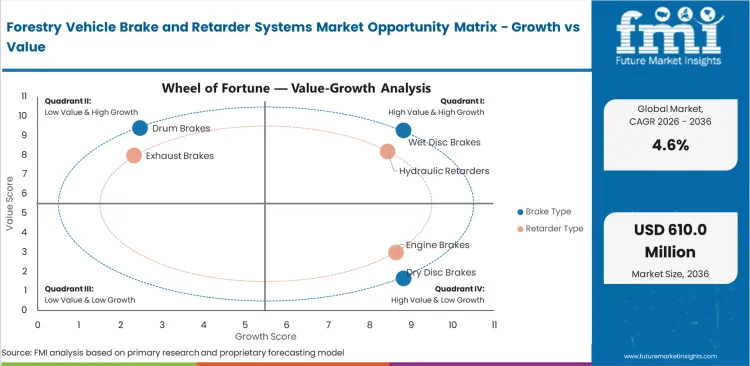
- Loaded descent control is creating demand for retarders across heavy forestry vehicle programs.
- Mud and debris exposure increases demand for sealed wet brake systems across forwarders and skidders.
- High system cost increases pricing pressure for smaller operators using older forestry vehicle fleets.
- Electrified forestry vehicles improve opportunity for control software and machine control system integration.
Forestry vehicle brake and retarder systems keep growing as heavy machines need dependable stopping control on slopes and muddy forest roads. High system cost can slow advanced retarder use as remote logging areas make servicing harder for operators. Growth continues through sealed wet disc brakes and OEM-fitted hydraulic packages for heavy-duty forestry vehicles.
Technician Labor Is Raising Installed System Pricing
Installed prices for forestry vehicle brake and retarder systems are rising due to higher service labor content. Replacements are rarely simple part swaps because off-road braking systems need detailed inspection and careful calibration. Technicians must perform heat damage checks and complete retarder integration work in harsh duty vehicle conditions.
In the May 2025 Occupational Employment and Wage Statistics release, the USA Bureau of Labor Statistics reported 235,820 heavy vehicle and mobile equipment service technicians and mechanics, with a mean hourly wage of USD 32.43 and mean annual wage of USD 67,450. This labor base directly affects dealer and field service quotations for forestry fleets. The impact is more significant when emergency repairs occur at logging sites instead of workshops. Suppliers are more likely to preserve service margins through labor-rate pass-throughs and bundled maintenance pricing.
Steel Scrap Rebound Is Lifting Brake Hardware Costs
Forestry vehicle brake and retarder system pricing is increasing due to higher ferrous input costs. These costs are especially significant for drums and discs used in heavy duty braking applications. Steel and cast components are central to durability in housings and mounting assemblies. Retarder casings rely on these materials, which further contributes to overall pricing pressure.
In February 2026, the USA Geological Survey reported that No. 1 heavy melting steel scrap averaged USD 319.00 per ton in 2025, up from USD 314.85 per ton in 2024, while first-11-month 2025 prices ranged from USD 366.26 per ton in March to USD 303.46 per ton in November. For forestry fleets operating skidders and forwarders this trend lifts selective price increases on replacement brake assemblies.
This approach is preferred over broad discounting in most heavy duty equipment segments. The situation is more pronounced where suppliers hold limited inventory of terrain-rated parts.
Analysis of Forestry Vehicle Brake and Retarder Systems Market By Key Countries
.webp "Top Country Growth Comparison Forestry Vehicle Brake And Retarder Systems Market Cagr (2026 2036)")
| Country | CAGR |
|---|---|
| China | 6.2% |
| Brazil | 5.8% |
| Sweden | 4.9% |
| Finland | 4.6% |
| Canada | 4.0% |
Source: Future Market Insights, 2026.
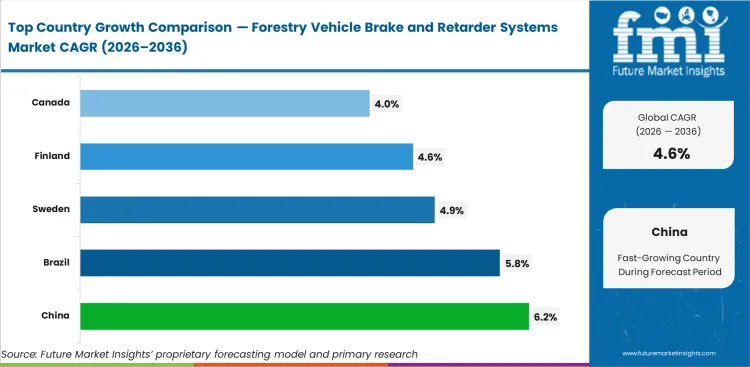
Forestry Vehicle Brake and Retarder Systems Market CAGR Analysis By Country
- China records the leading country outlook at 6.2% CAGR through 2036, helped by plantation forestry programs and faster equipment replacement.
- Brazil is projected at 5.8% CAGR, as large planted timber zones require heavier machines for harvesting and log movement.
- Sweden’s 4.9% CAGR through 2036 comes from cut-to-length forestry practices and steady forwarder use across managed forest areas.
- Finland at 4.6% CAGR shows stable machinery replacement, while Canada’s 4.0% CAGR is shaped by mature service networks and long operating cycles.
Demand for forestry vehicle brake and retarder systems is projected to rise at 4.6% CAGR from 2026 to 2036. Country-level analysis covers the major markets contributing to this forecast, with the key markets listed below.
Demand Outlook for Forestry Vehicle Brake and Retarder Systems Market in China
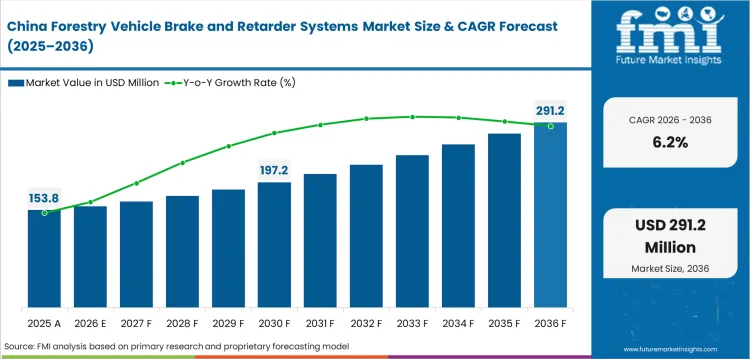
China’s forestry vehicle brake and retarder systems industry is projected to record a CAGR of 6.2% through 2036. Managed plantation activity and domestic equipment renewal improve demand for China forestry vehicle brake and retarder systems. Local equipment makers need reliable braking packages for heavy vehicles moving across uneven ground. Suppliers with brake integration and retarder calibration expertise can gain from platform renewal programs.
- Plantation forestry activity supports demand for forwarder and log transport braking systems.
- Domestic equipment manufacturing helps localize brake package selection and service replacement demand.
- Hilly timber zones increase demand for retarder systems with stronger heat management.
Sales Analysis of Forestry Vehicle Brake and Retarder Systems Market in Brazil
The forestry vehicle brake and retarder systems sector in Brazil is expected to expand at a CAGR of 5.8% during the assessment period. The planted timber base in the country increases demand for Brazil forestry vehicle brake and retarder systems. Brake suppliers benefit from forestry operators seeking reliable parts for heavy vehicle cycles. Service networks near eucalyptus and pine belts are important for replacement parts.
- Eucalyptus plantation zones raise demand for heavy-duty brake systems across forwarders and log trucks.
- Large timber transport distances increase use of retarder systems across loaded downhill roads.
- Local service workshops boost replacement demand for friction plates and hydraulic brake valves.
Demand Outlook for Forestry Vehicle Brake and Retarder Systems Market in Sweden
The Sweden forestry vehicle brake and retarder systems industry is forecast to grow at a CAGR of 4.9% by 2036. Cut-to-length harvesting practice favors demand for Sweden forestry vehicle brake and retarder systems. Forwarders and harvesters need brake systems suited to repeated use across wet forest terrain. Suppliers with sealed brake designs and fast parts access can serve mature fleets.
- Cut-to-length harvesting increases brake system use across forwarders and harvesters.
- Boreal forest terrain raises demand for brake parts with mud and water protection.
- Mature equipment fleets lift steady demand for aftermarket brake rebuilds.
Opportunity Analysis of Forestry Vehicle Brake and Retarder Systems Market in Finland
The forestry vehicle brake and retarder systems segment in Finland is expected to advance at 4.6% CAGR through 2036. In April 2025, Natural Resources Institute Finland reported 74.7 million cubic metres of stemwood harvested in 2024. This harvesting level gives brake suppliers a strong indicator of forestry machine workload across Finland. Established harvesting activity enhances demand for service brakes and parking brakes across forwarders and harvesters. Suppliers with winter-ready seals and hydraulic response expertise can serve replacement needs across mature forestry fleets.
- Cold climate operation increases demand for seals and actuation systems suited to low-temperature forestry work.
- Mechanized harvesting fleets support OEM fitment demand for integrated brake assemblies across Finnish forestry operations.
- Rural dealer coverage helps sustain replacement demand for brake parts across dispersed harvesting regions.
Future Outlook for Forestry Vehicle Brake and Retarder Systems Market in Canada
The Canada forestry vehicle brake and retarder systems industry is expected to post 4.0% CAGR through 2036. Statistics Canada stated in December 2025 that Canada produced 47,895,000 cubic metres of softwood lumber in 2024. The B.C. Interior region accounted for 13,967,000 cubic metres of production in the same year. This production base lifts demand for Canada forestry vehicle brake and retarder systems across timber movement and mill-linked logistics. Suppliers with aftermarket access and severe-duty friction parts can enhance remote fleet uptime.
- British Columbia logging areas create demand for strong retarder systems across steep road networks.
- Quebec and Ontario forestry operations improve brake replacement demand across mixed fleet types.
- Remote repair conditions increase value for durable wet disc brakes and reliable service kits.
Competitive Landscape and Strategic Positioning
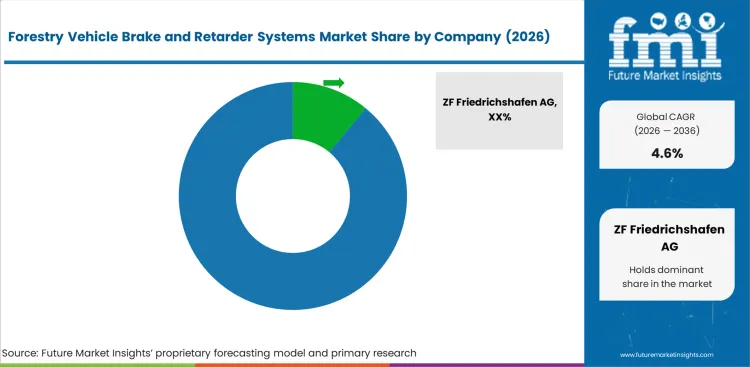
Competition in forestry braking favors suppliers pairing stopping control with field-ready replacement coverage across demanding logging sites. Large drivetrain companies compete on axle matching and brake system integration for new forestry platforms. Specialist providers compete on severe-duty friction parts and actuation components used in service replacement.
- ZF Friedrichshafen AG holds a strong position through off-highway axle systems and wet multi-disc brake capability for severe forestry duty.
- Allison Transmission and Bosch Rexroth focus on drivetrain integration and hydraulic control strength across mobile machinery platforms.
- Specialist providers focus on friction parts and actuation components built for forestry service replacement needs.
ZF Friedrichshafen AG benefits from integrated axle systems and wet multi-disc braking depth. Allison Transmission strengthens its off-highway drivetrain reach through the Dana off-highway business acquisition. Bosch Rexroth brings hydraulic control capability for mobile machinery platforms. Carlisle Brake & Friction and Knott Brake serve replacement demand through severe-duty friction parts and brake actuation components.
High equipment cost and difficult field service create barriers across remote forestry operations. Competitive priorities focus on heat control and sealed friction protection during long harvesting seasons. Forestry equipment manufacturers favor suppliers with dependable brake performance and faster service access through Automotive Brake Friction Products alignment. Suppliers combining drivetrain breadth with brake service depth are best placed to reduce manufacturer coordination work and improve operator uptime.
Key Companies in the Forestry Vehicle Brake and Retarder Systems Market
Key global companies leading the forestry vehicle brake and retarder systems market include:
- ZF Friedrichshafen AG, Allison Transmission, and Bosch Rexroth have strong integration infrastructure for off-highway brake and drivetrain systems.
- Voith GmbH & Co. KGaA, and Carlisle Brake & Friction serve manufacturers through retarder expertise and severe-duty friction coverage.
- Knott Brake Company holds a specialist position across brake actuation, mechanical brake systems, and service replacement demand.
Competitive Benchmarking: Forestry Vehicle Brake and Retarder Systems Market
| Company | Axle Integration Depth | Retarder Control Strength | Forestry Service Fit | Geographic Footprint |
|---|---|---|---|---|
| ZF Friedrichshafen AG | High | High | Strong | Global presence across Europe, North America, South America, Asia-Pacific, India, Middle East, Australia, and Africa. |
| Allison Transmission | High | High | Strong | Global sales and service network with coverage across North America, Europe, South America, Asia-Pacific, and other international markets. |
| Voith GmbH & Co. KGaA | Medium | High | Moderate | Worldwide presence across Africa, Asia-Pacific, Europe, Middle East, North America, Central America, and South America. |
| Carlisle Brake & Friction | Medium | Medium | Strong | Manufacturing and service footprint across the United States, India, China, Japan, Italy, and the United Kingdom. |
| Knott Brake Company | Medium | Medium | Strong | Global footprint through the Knott Group, with operations across Europe and North America plus international sales coverage. |
Source: Future Market Insights, 2026.
Key Developments in Forestry Vehicle Brake and Retarder Systems Market
- In March 2026, ZF announced five new braking and control product adaptations for off-highway vehicle manufacturers, covering mechanical, hydraulic, electro-hydraulic, and electronic braking interfaces. The release includes a new pedal modulating valve family for large multiple-disc brakes, a pressure-limiting electro-hydraulic brake valve, a hydraulic in-line brake adjuster, and an electronic brake pedal.
- In April 2025, Tigercat released the L857 feller buncher and LH857 harvester on a new steep-slope carrier platform designed for demanding logging terrain. The L857 specifications list final-drive piston motors with brake valves, a planetary gearbox with brake, friction-disc track brakes, and friction-disc swing brakes. This development is highly relevant to the market because steep-slope forestry machines require integrated braking and holding systems for traction control, machine stability, and operator safety.
Key Players in the Forestry Vehicle Brake and Retarder Systems Market
Major Global Players:
- ZF Friedrichshafen AG
- Allison Transmission
- Voith GmbH & Co. KGaA
Specialist Players:
- Carlisle Brake & Friction
- Knott Brake Company
Report Scope and Coverage
| Parameter | Details |
|---|---|
| Quantitative Units | USD 388 million to USD 610 million, at a CAGR of 4.6% |
| Market Definition | The forestry vehicle brake and retarder systems market encompasses braking and speed-control systems used to stop, hold, and control forestry vehicles during harvest and transport work. |
| Regions Covered | North America, Latin America, Europe, East Asia, South Asia and Pacific, Middle East and Africa |
| Countries Covered | USA, UK, Germany, China, India, Japan, South Korea, Brazil, Sweden, Finland, Canada, and 30 plus countries |
| Key Companies Profiled | ZF Friedrichshafen AG, Allison Transmission, Voith GmbH & Co. KGaA, Carlisle Brake & Friction, Knott Brake Company |
| Forecast Period | 2026 to 2036 |
| Approach | Hybrid bottom-up and top-down methodology starting with brake package demand and verified forestry vehicle use patterns. |
Forestry Vehicle Brake and Retarder Systems Market by Segments
Forestry Vehicle Brake and Retarder Systems Market Segmented by Brake Type:
- Wet Disc Brakes
- Dry Disc Brakes
- Drum Brakes
- Parking Brakes
- Caliper Brakes
Forestry Vehicle Brake and Retarder Systems Market Segmented by Retarder Type:
- Hydraulic Retarders
- Electromagnetic Retarders
- Engine Brakes
- Exhaust Brakes
- Regenerative Retarders
Forestry Vehicle Brake and Retarder Systems Market Segmented by Vehicle Type:
- Forwarders
- Harvesters
- Skidders
- Feller Bunchers
- Log Trucks
Forestry Vehicle Brake and Retarder Systems Market Segmented by Actuation Type:
- Hydraulic Actuation
- Pneumatic Actuation
- Electro-Hydraulic Actuation
- Mechanical Actuation
Forestry Vehicle Brake and Retarder Systems Market Segmented by Sales Channel:
- OEM Fitment
- Aftermarket
- Retrofit Kits
- Service Rebuilds
Forestry Vehicle Brake and Retarder Systems Market by Region:
- North America
- USA
- Canada
- Mexico
- Latin America
- Brazil
- Chile
- Rest of Latin America
- Europe
- Germany
- UK
- Italy
- Spain
- France
- Rest of Europe
- East Asia
- China
- Japan
- South Korea
- South Asia and Pacific
- India
- ASEAN
- Australia & New Zealand
- Rest of South Asia and Pacific
- Middle East and Africa
- Saudi Arabia
- Other GCC Countries
- South Africa
- Rest of Middle East and Africa
Research Sources and Bibliography
- Allison Transmission. (2025, June 11). Allison Transmission announces acquisition of Dana’s off-highway business, strengthening its global powertrain capabilities. Allison Transmission.
- Dana Incorporated. (2026, January 2). Dana Incorporated completes sale of off-highway business. Dana Incorporated.
- Food and Agriculture Organization of the United Nations. (2025, December). Global forest products trade and production show signs of recovery in 2024. FAO.
- Food and Agriculture Organization of the United Nations. (2025, December). Forestry production and trade 2025 update. FAO.
- ZF Friedrichshafen AG. (2026). MULTITRAC rigid axles. ZF Group.
- Carlisle Brake & Friction. (2025). 1100 Series Brake Valve. Carlisle Brake & Friction.
- USA Geological Survey. (2026, February). Iron and steel scrap. In Mineral commodity summaries 2026. USA Department of the Interior, USA Geological Survey. Mineral Commodity Summaries 2026
- USA Bureau of Labor Statistics. (2026, May 15). Table 1. National employment and wage data from the Occupational Employment and Wage Statistics survey by occupation, May 2025. USA Department of Labor. Occupational Employment and Wage Statistics (OEWS) Tables : USA Bureau of Labor Statistics
- Natural Resources Institute Finland. (2025, April 24). Total roundwood removals and drain by region 2024.
- Statistics Canada. (2025, December 12). A look at Canada’s lumber industry in 2024.
- Tigercat Industries. (2025, April 14). New steep slope carriers. Tigercat. Tigercat releases L857 and LH857 carriers | Tigercat News
- ZF Friedrichshafen AG. (2026, March 3). EASE - Braking Technology from ZF. ZF Press Center. The Future of Construction - Intelligent System Solutions by ZF - ZF
This bibliography is provided for reader reference and is not exhaustive. The full report contains the complete reference list and detailed citations.
This Report Answers
- What is the current and future size of the forestry vehicle brake and retarder systems market?
- How fast is the forestry vehicle brake and retarder systems market expected to expand between 2026 and 2036?
- Which brake type is expected to lead the market by 2026?
- Which actuation type segment is expected to account for the leading demand by 2026?
- What factors are driving demand for forestry vehicle brake and retarder systems globally?
- How are loaded forestry routes influencing adoption of retarder systems?
- Why is OEM fitment the main sales channel for brake systems?
- How are wet disc brakes creating demand for specialized forestry validation?
- Which countries are projected to record faster expansion through 2036?
- What is driving market expansion in China and Brazil?
- Who are the key companies active in the forestry vehicle brake and retarder systems market?
- How does FMI estimate and validate the market forecast?
Frequently Asked Questions
What is the global market demand for Forestry Vehicle Brake and Retarder Systems in 2026?
In 2026, the global market for forestry vehicle brake and retarder systems is estimated at USD 388 million.
How big will the market for Forestry Vehicle Brake and Retarder Systems be in 2036?
By 2036, the market for forestry vehicle brake and retarder systems is projected to reach USD 610 million.
How much is demand for Forestry Vehicle Brake and Retarder Systems expected to expand between 2026 and 2036?
Between 2026 and 2036, demand for forestry vehicle brake and retarder systems is projected to expand at a CAGR of 4.6%.
Which brake type segment is likely to be the leading seller globally by 2026?
Wet disc brakes will contribute 41.0% of the brake type segment in 2026.
What is causing demand to rise in China?
The China forestry vehicle brake and retarder systems market is projected to record 6.2% CAGR through 2036, supported by plantation forestry and equipment renewal.
What is causing demand to rise in Brazil?
The Brazil forestry vehicle brake and retarder systems market is projected to expand at 5.8% CAGR through 2036, supported by planted timber operations and heavy vehicle use.
What does this report mean by Forestry Vehicle Brake and Retarder Systems Market definition?
The forestry vehicle brake and retarder systems market includes braking and speed-control systems used in forestry vehicles before, during, and after harvest movement.
How does FMI make the Forestry Vehicle Brake and Retarder Systems forecast and check it?
Forecasting models use a hybrid bottom-up and top-down approach, starting with brake package demand and checking it against forestry vehicle use patterns.
Preview the report firsthand - request a free sample
Get SampleGet the brochure for pricing and purchase details.
Get PDFTable of Content
- Executive Summary
- Global Market Outlook
- Demand-side Trends
- Supply-side Trends
- Technology Roadmap Analysis
- Analysis and Recommendations
- Market Overview
- Market Coverage / Taxonomy
- Market Definition / Scope / Limitations
- Research Methodology
- Chapter Orientation
- Analytical Lens and Working Hypotheses
- Market Structure, Signals, and Trend Drivers
- Benchmarking and Cross-market Comparability
- Market Sizing, Forecasting, and Opportunity Mapping
- Research Design and Evidence Framework
- Desk Research Programme (Secondary Evidence)
- Company Annual and Sustainability Reports
- Peer-reviewed Journals and Academic Literature
- Corporate Websites, Product Literature, and Technical Notes
- Earnings Decks and Investor Briefings
- Statutory Filings and Regulatory Disclosures
- Technical White Papers and Standards Notes
- Trade Journals, Industry Magazines, and Analyst Briefs
- Conference Proceedings, Webinars, and Seminar Materials
- Government Statistics Portals and Public Data Releases
- Press Releases and Reputable Media Coverage
- Specialist Newsletters and Curated Briefings
- Sector Databases and Reference Repositories
- FMI Internal Proprietary Databases and Historical Market Datasets
- Subscription Datasets and Paid Sources
- Social Channels, Communities, and Digital Listening Inputs
- Additional Desk Sources
- Expert Input and Fieldwork (Primary Evidence)
- Primary Modes
- Qualitative Interviews and Expert Elicitation
- Quantitative Surveys and Structured Data Capture
- Blended Approach
- Why Primary Evidence is Used
- Field Techniques
- Interviews
- Surveys
- Focus Groups
- Observational and In-context Research
- Social and Community Interactions
- Stakeholder Universe Engaged
- C-suite Leaders
- Board Members
- Presidents and Vice Presidents
- R&D and Innovation Heads
- Technical Specialists
- Domain Subject-matter Experts
- Scientists
- Physicians and Other Healthcare Professionals
- Governance, Ethics, and Data Stewardship
- Research Ethics
- Data Integrity and Handling
- Primary Modes
- Tooling, Models, and Reference Databases
- Desk Research Programme (Secondary Evidence)
- Data Engineering and Model Build
- Data Acquisition and Ingestion
- Cleaning, Normalisation, and Verification
- Synthesis, Triangulation, and Analysis
- Quality Assurance and Audit Trail
- Market Background
- Market Dynamics
- Drivers
- Restraints
- Opportunity
- Trends
- Scenario Forecast
- Demand in Optimistic Scenario
- Demand in Likely Scenario
- Demand in Conservative Scenario
- Opportunity Map Analysis
- Product Life Cycle Analysis
- Supply Chain Analysis
- Investment Feasibility Matrix
- Value Chain Analysis
- PESTLE and Porter’s Analysis
- Regulatory Landscape
- Regional Parent Market Outlook
- Production and Consumption Statistics
- Import and Export Statistics
- Market Dynamics
- Global Market Analysis 2021 to 2025 and Forecast, 2026 to 2036
- Historical Market Size Value (USD Million) Analysis, 2021 to 2025
- Current and Future Market Size Value (USD Million) Projections, 2026 to 2036
- Y-o-Y Growth Trend Analysis
- Absolute $ Opportunity Analysis
- Global Market Pricing Analysis 2021 to 2025 and Forecast 2026 to 2036
- Global Market Analysis 2021 to 2025 and Forecast 2026 to 2036, By Brake Type
- Introduction / Key Findings
- Historical Market Size Value (USD Million) Analysis By Brake Type , 2021 to 2025
- Current and Future Market Size Value (USD Million) Analysis and Forecast By Brake Type , 2026 to 2036
- Wet Disc Brakes
- Dry Disc Brakes
- Drum Brakes
- Wet Disc Brakes
- Y-o-Y Growth Trend Analysis By Brake Type , 2021 to 2025
- Absolute $ Opportunity Analysis By Brake Type , 2026 to 2036
- Global Market Analysis 2021 to 2025 and Forecast 2026 to 2036, By Retarder Type
- Introduction / Key Findings
- Historical Market Size Value (USD Million) Analysis By Retarder Type, 2021 to 2025
- Current and Future Market Size Value (USD Million) Analysis and Forecast By Retarder Type, 2026 to 2036
- Hydraulic Retarders
- Engine Brakes
- Exhaust Brakes
- Hydraulic Retarders
- Y-o-Y Growth Trend Analysis By Retarder Type, 2021 to 2025
- Absolute $ Opportunity Analysis By Retarder Type, 2026 to 2036
- Global Market Analysis 2021 to 2025 and Forecast 2026 to 2036, By Vehicle Type
- Introduction / Key Findings
- Historical Market Size Value (USD Million) Analysis By Vehicle Type, 2021 to 2025
- Current and Future Market Size Value (USD Million) Analysis and Forecast By Vehicle Type, 2026 to 2036
- Forwarders
- Harvesters
- Skidders
- Forwarders
- Y-o-Y Growth Trend Analysis By Vehicle Type, 2021 to 2025
- Absolute $ Opportunity Analysis By Vehicle Type, 2026 to 2036
- Global Market Analysis 2021 to 2025 and Forecast 2026 to 2036, By Actuation Type
- Introduction / Key Findings
- Historical Market Size Value (USD Million) Analysis By Actuation Type, 2021 to 2025
- Current and Future Market Size Value (USD Million) Analysis and Forecast By Actuation Type, 2026 to 2036
- Hydraulic Actuation
- Pneumatic Actuation
- Electro-Hydraulic Actuation
- Hydraulic Actuation
- Y-o-Y Growth Trend Analysis By Actuation Type, 2021 to 2025
- Absolute $ Opportunity Analysis By Actuation Type, 2026 to 2036
- Global Market Analysis 2021 to 2025 and Forecast 2026 to 2036, By Sales Channel
- Introduction / Key Findings
- Historical Market Size Value (USD Million) Analysis By Sales Channel, 2021 to 2025
- Current and Future Market Size Value (USD Million) Analysis and Forecast By Sales Channel, 2026 to 2036
- OEM Fitment
- Aftermarket
- Retrofit Kits
- OEM Fitment
- Y-o-Y Growth Trend Analysis By Sales Channel, 2021 to 2025
- Absolute $ Opportunity Analysis By Sales Channel, 2026 to 2036
- Global Market Analysis 2021 to 2025 and Forecast 2026 to 2036, By Region
- Introduction
- Historical Market Size Value (USD Million) Analysis By Region, 2021 to 2025
- Current Market Size Value (USD Million) Analysis and Forecast By Region, 2026 to 2036
- North America
- Latin America
- Western Europe
- Eastern Europe
- East Asia
- South Asia and Pacific
- Middle East & Africa
- Market Attractiveness Analysis By Region
- North America Market Analysis 2021 to 2025 and Forecast 2026 to 2036, By Country
- Historical Market Size Value (USD Million) Trend Analysis By Market Taxonomy, 2021 to 2025
- Market Size Value (USD Million) Forecast By Market Taxonomy, 2026 to 2036
- By Country
- USA
- Canada
- Mexico
- By Brake Type
- By Retarder Type
- By Vehicle Type
- By Actuation Type
- By Sales Channel
- By Country
- Market Attractiveness Analysis
- By Country
- By Brake Type
- By Retarder Type
- By Vehicle Type
- By Actuation Type
- By Sales Channel
- Key Takeaways
- Latin America Market Analysis 2021 to 2025 and Forecast 2026 to 2036, By Country
- Historical Market Size Value (USD Million) Trend Analysis By Market Taxonomy, 2021 to 2025
- Market Size Value (USD Million) Forecast By Market Taxonomy, 2026 to 2036
- By Country
- Brazil
- Chile
- Rest of Latin America
- By Brake Type
- By Retarder Type
- By Vehicle Type
- By Actuation Type
- By Sales Channel
- By Country
- Market Attractiveness Analysis
- By Country
- By Brake Type
- By Retarder Type
- By Vehicle Type
- By Actuation Type
- By Sales Channel
- Key Takeaways
- Western Europe Market Analysis 2021 to 2025 and Forecast 2026 to 2036, By Country
- Historical Market Size Value (USD Million) Trend Analysis By Market Taxonomy, 2021 to 2025
- Market Size Value (USD Million) Forecast By Market Taxonomy, 2026 to 2036
- By Country
- Germany
- UK
- Italy
- Spain
- France
- Nordic
- BENELUX
- Rest of Western Europe
- By Brake Type
- By Retarder Type
- By Vehicle Type
- By Actuation Type
- By Sales Channel
- By Country
- Market Attractiveness Analysis
- By Country
- By Brake Type
- By Retarder Type
- By Vehicle Type
- By Actuation Type
- By Sales Channel
- Key Takeaways
- Eastern Europe Market Analysis 2021 to 2025 and Forecast 2026 to 2036, By Country
- Historical Market Size Value (USD Million) Trend Analysis By Market Taxonomy, 2021 to 2025
- Market Size Value (USD Million) Forecast By Market Taxonomy, 2026 to 2036
- By Country
- Russia
- Poland
- Hungary
- Balkan & Baltic
- Rest of Eastern Europe
- By Brake Type
- By Retarder Type
- By Vehicle Type
- By Actuation Type
- By Sales Channel
- By Country
- Market Attractiveness Analysis
- By Country
- By Brake Type
- By Retarder Type
- By Vehicle Type
- By Actuation Type
- By Sales Channel
- Key Takeaways
- East Asia Market Analysis 2021 to 2025 and Forecast 2026 to 2036, By Country
- Historical Market Size Value (USD Million) Trend Analysis By Market Taxonomy, 2021 to 2025
- Market Size Value (USD Million) Forecast By Market Taxonomy, 2026 to 2036
- By Country
- China
- Japan
- South Korea
- By Brake Type
- By Retarder Type
- By Vehicle Type
- By Actuation Type
- By Sales Channel
- By Country
- Market Attractiveness Analysis
- By Country
- By Brake Type
- By Retarder Type
- By Vehicle Type
- By Actuation Type
- By Sales Channel
- Key Takeaways
- South Asia and Pacific Market Analysis 2021 to 2025 and Forecast 2026 to 2036, By Country
- Historical Market Size Value (USD Million) Trend Analysis By Market Taxonomy, 2021 to 2025
- Market Size Value (USD Million) Forecast By Market Taxonomy, 2026 to 2036
- By Country
- India
- ASEAN
- Australia & New Zealand
- Rest of South Asia and Pacific
- By Brake Type
- By Retarder Type
- By Vehicle Type
- By Actuation Type
- By Sales Channel
- By Country
- Market Attractiveness Analysis
- By Country
- By Brake Type
- By Retarder Type
- By Vehicle Type
- By Actuation Type
- By Sales Channel
- Key Takeaways
- Middle East & Africa Market Analysis 2021 to 2025 and Forecast 2026 to 2036, By Country
- Historical Market Size Value (USD Million) Trend Analysis By Market Taxonomy, 2021 to 2025
- Market Size Value (USD Million) Forecast By Market Taxonomy, 2026 to 2036
- By Country
- Kingdom of Saudi Arabia
- Other GCC Countries
- Turkiye
- South Africa
- Other African Union
- Rest of Middle East & Africa
- By Brake Type
- By Retarder Type
- By Vehicle Type
- By Actuation Type
- By Sales Channel
- By Country
- Market Attractiveness Analysis
- By Country
- By Brake Type
- By Retarder Type
- By Vehicle Type
- By Actuation Type
- By Sales Channel
- Key Takeaways
- Key Countries Market Analysis
- USA
- Pricing Analysis
- Market Share Analysis, 2025
- By Brake Type
- By Retarder Type
- By Vehicle Type
- By Actuation Type
- By Sales Channel
- Canada
- Pricing Analysis
- Market Share Analysis, 2025
- By Brake Type
- By Retarder Type
- By Vehicle Type
- By Actuation Type
- By Sales Channel
- Mexico
- Pricing Analysis
- Market Share Analysis, 2025
- By Brake Type
- By Retarder Type
- By Vehicle Type
- By Actuation Type
- By Sales Channel
- Brazil
- Pricing Analysis
- Market Share Analysis, 2025
- By Brake Type
- By Retarder Type
- By Vehicle Type
- By Actuation Type
- By Sales Channel
- Chile
- Pricing Analysis
- Market Share Analysis, 2025
- By Brake Type
- By Retarder Type
- By Vehicle Type
- By Actuation Type
- By Sales Channel
- Germany
- Pricing Analysis
- Market Share Analysis, 2025
- By Brake Type
- By Retarder Type
- By Vehicle Type
- By Actuation Type
- By Sales Channel
- UK
- Pricing Analysis
- Market Share Analysis, 2025
- By Brake Type
- By Retarder Type
- By Vehicle Type
- By Actuation Type
- By Sales Channel
- Italy
- Pricing Analysis
- Market Share Analysis, 2025
- By Brake Type
- By Retarder Type
- By Vehicle Type
- By Actuation Type
- By Sales Channel
- Spain
- Pricing Analysis
- Market Share Analysis, 2025
- By Brake Type
- By Retarder Type
- By Vehicle Type
- By Actuation Type
- By Sales Channel
- France
- Pricing Analysis
- Market Share Analysis, 2025
- By Brake Type
- By Retarder Type
- By Vehicle Type
- By Actuation Type
- By Sales Channel
- India
- Pricing Analysis
- Market Share Analysis, 2025
- By Brake Type
- By Retarder Type
- By Vehicle Type
- By Actuation Type
- By Sales Channel
- ASEAN
- Pricing Analysis
- Market Share Analysis, 2025
- By Brake Type
- By Retarder Type
- By Vehicle Type
- By Actuation Type
- By Sales Channel
- Australia & New Zealand
- Pricing Analysis
- Market Share Analysis, 2025
- By Brake Type
- By Retarder Type
- By Vehicle Type
- By Actuation Type
- By Sales Channel
- China
- Pricing Analysis
- Market Share Analysis, 2025
- By Brake Type
- By Retarder Type
- By Vehicle Type
- By Actuation Type
- By Sales Channel
- Japan
- Pricing Analysis
- Market Share Analysis, 2025
- By Brake Type
- By Retarder Type
- By Vehicle Type
- By Actuation Type
- By Sales Channel
- South Korea
- Pricing Analysis
- Market Share Analysis, 2025
- By Brake Type
- By Retarder Type
- By Vehicle Type
- By Actuation Type
- By Sales Channel
- Russia
- Pricing Analysis
- Market Share Analysis, 2025
- By Brake Type
- By Retarder Type
- By Vehicle Type
- By Actuation Type
- By Sales Channel
- Poland
- Pricing Analysis
- Market Share Analysis, 2025
- By Brake Type
- By Retarder Type
- By Vehicle Type
- By Actuation Type
- By Sales Channel
- Hungary
- Pricing Analysis
- Market Share Analysis, 2025
- By Brake Type
- By Retarder Type
- By Vehicle Type
- By Actuation Type
- By Sales Channel
- Kingdom of Saudi Arabia
- Pricing Analysis
- Market Share Analysis, 2025
- By Brake Type
- By Retarder Type
- By Vehicle Type
- By Actuation Type
- By Sales Channel
- Turkiye
- Pricing Analysis
- Market Share Analysis, 2025
- By Brake Type
- By Retarder Type
- By Vehicle Type
- By Actuation Type
- By Sales Channel
- South Africa
- Pricing Analysis
- Market Share Analysis, 2025
- By Brake Type
- By Retarder Type
- By Vehicle Type
- By Actuation Type
- By Sales Channel
- USA
- Market Structure Analysis
- Competition Dashboard
- Competition Benchmarking
- Market Share Analysis of Top Players
- By Regional
- By Brake Type
- By Retarder Type
- By Vehicle Type
- By Actuation Type
- By Sales Channel
- Competition Analysis
- Competition Deep Dive
- ZF Friedrichshafen AG
- Overview
- Product Portfolio
- Profitability by Market Segments (Product/Age /Sales Channel/Region)
- Sales Footprint
- Strategy Overview
- Marketing Strategy
- Product Strategy
- Channel Strategy
- Allison Transmission
- Voith GmbH & Co. KGaA
- Carlisle Brake & Friction
- Knott Brake Company
- ZF Friedrichshafen AG
- Competition Deep Dive
- Assumptions & Acronyms Used


