

- Market Size (2026)
- USD 15.2 Bn
- Forecast (2036)
- USD 38.9 Bn
- CAGR (2026 to 2036)
- 9.8%
Multi-Display Cockpit Systems for Premium Vehicles Market Size, Forecast, and Outlook By FMI
Summary of the Multi-Display Cockpit Systems for Premium Vehicles Market
- Demand and Growth Drivers
- Premium EV platforms increase screen count since flat floors and zonal electronics give designers more cabin freedom.
- Digital clusters and passenger screens are specified together as automakers make cabin software part of brand identity.
- ADAS graphics and navigation overlays raise the value of screen response time inside premium vehicle programs.
- Product and Segment View
- OEM integrated systems are projected to represent 96.0% share in 2026 as factory validation controlling screen layout and data links.
- TFT-LCD is forecast to account for 56.0% share in 2026 as automakers manage display cost across larger screen areas.
- Cockpit domain integration is projected to capture 49.0% share in 2026 since processors combine display control and infotainment.
- Geography and Competitive Outlook
- China is projected to record 12.4% CAGR by 2036 as local premium EV brands using cockpit screens to separate trim levels.
- India is expected to expand at 11.7% CAGR by 2036 as premium SUVs and electric cars raising display content.
- Continental, Visteon and HARMAN hold established positions based on cockpit controller depth and OEM software integration.
- Analyst Opinion
- Nikhil Kaitwade, Principal Consultant for Automotive, FMI, observes: "Premium vehicle buyers have moved beyond measuring cockpit sophistication by screen inches or resolution. The real differentiator is coordinated orchestration, how displays and real-time driver information function as a unified, intelligent system. Automakers are selecting partners who can deliver advanced hardware like OLED and panoramic displays, with over-the-air-ready integration with cockpit domain controllers. By 2036, market leadership will favor suppliers that can design the cockpit as an integrated digital environment.”
- Multi-Display Cockpit Systems for Premium Vehicles Market Value Analysis
- Multi-display cockpits are expanding from flagship-only features into planned architecture for premium SUVs and electric sedans.
- Premium brands are using automotive display design to separate cabins through sharper graphics and wider screen surfaces.
- Cockpit suppliers are linking automotive electronics with display control as zonal vehicle architectures reduce separate hardware boxes.
- Demand is supported by premium vehicle cabins in which navigation, entertainment and safety prompts need a coordinated visual path.
Key Takeaways, Market Size, and Forecast
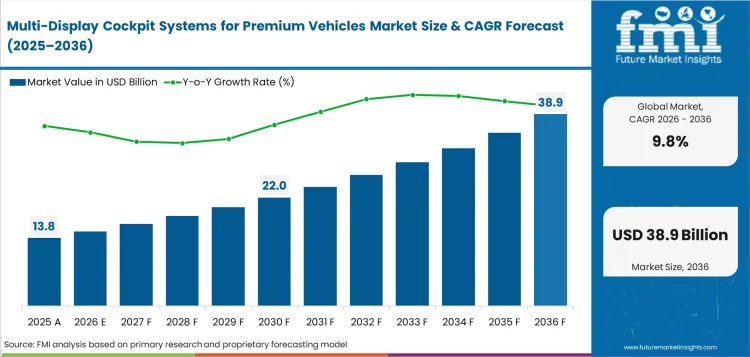
- The multi-display cockpit systems for premium vehicles industry was valued at USD 13.8 billion in 2025 across luxury passenger car programs.
- Market is projected to reach USD 38.9 billion by 2036 as premium OEMs move toward wider digital cockpit surfaces.
- The industry is expected to expand at 9.8% CAGR from 2026 to 2036 across integrated cockpit and display-control packages.
- Sector revenue is projected to create an incremental opportunity of USD 23.7 billion between 2026 and 2036.
- OEM integrated systems are forecast to account for 96.0% share in 2026 as cockpit electronics need vehicle-level validation.
- TFT-LCD is expected to hold 56.0% share in 2026 as premium brands balance durability with panel cost.
- China is projected to record 12.4% CAGR by 2036 as premium electric vehicles adopt wider connected cockpit screens.
Premium vehicle cabins are entering a phase where market growth is shaped by the balance between expanding digital surfaces and safeguarding driver attention. OEM actions over the past two years indicate that multi‑display layouts are becoming a platform‑level decision rather than a model‑specific upgrade. BMW’s Panoramic iDrive rollout from late 2025 illustrates how standardized panoramic architectures can lock in long‑term supplier relationships across entire premium lineups, while Audi’s Q6 e‑tron display configuration reflects rising baseline expectations for screen size and layout in electric premium models. At the supplier level, advances such as Visteon’s January 2026 cockpit compute platform signal a shift toward centralized, AI‑ready processing that supports multiple displays from a single compute backbone. Together, these developments point to a market outlook in which premium OEMs increasingly source cockpit systems as integrated, reinforcing sustained demand for scalable multi‑display cockpit solutions across the forecast period.
Multi-Display Cockpit Systems for Premium Vehicles Market Definition
Multi-display cockpit systems for premium vehicles are integrated display and control packages used in high-end passenger cars. Scope covers digital instrument clusters and central information screens. Passenger displays, rear-seat entertainment displays and head-up display interfaces complete the screen scope. Revenue includes displays and cover glass. Touch layers, display controllers and integration software are counted if sold into premium vehicle programs. Consumer tablets, basic radio screens and standalone aftermarket infotainment units sold without vehicle-grade integration are outside revenue scope.
Multi-Display Cockpit Systems for Premium Vehicles Market Inclusions
Market scope covers display packages used across premium sedans, luxury SUVs and electric performance vehicles. Covered technologies include TFT-LCD and OLED panels. MiniLED and MicroLED panels complete the technology scope. System scope includes digital instrument clusters and central screens. Passenger displays and head-up display interfaces complete the screen-position scope. Integration scope covers domain controllers and touch controls. Voice interface links and software update support complete the integration scope. Main participants include premium vehicle OEMs and Tier 1 cockpit suppliers. Panel makers, semiconductor firms and validation service providers complete the value chain.
Multi-Display Cockpit Systems for Premium Vehicles Market Exclusions
Study scope excludes economy-car single screens, basic analog clusters and consumer electronics sold without automotive validation. Generic tablets mounted in vehicles are excluded unless supplied as a certified vehicle display package. Software-only infotainment services are excluded unless bundled with a revenue-bearing display or cockpit controller. Aerospace cockpit displays, motorcycle dashboards and commercial vehicle-only screens remain outside the premium passenger vehicle scope.
Multi-Display Cockpit Systems for Premium Vehicles Market Research Methodology
- Primary Research: FMI analysts reviewed premium OEM cockpit programs, Tier 1 display suppliers and panel makers. Interviews focused on screen count, cockpit domain control and warranty risk.
- Desk Research: Desk review used vehicle production data, EV sales evidence and official supplier product launches from 2024 onward.
- Market Sizing and Forecasting: Forecast work combined premium vehicle production, estimated display content per vehicle and average cockpit package pricing.
- Data Validation: Segment shares were checked against platform fitment, display technology cost and OEM program timing across premium vehicle brands.
Why is the Multi-Display Cockpit Systems for Premium Vehicles Market Growing?
- Premium electric vehicles are expanding display area as cockpit software becomes part of model positioning and daily ownership experience.
- ADAS and driver monitoring systems are lifting the value of screens that show alerts without adding driver distraction.
- Cockpit domain controllers are making multi-screen layouts easier to package across premium vehicle platforms.
Premium cockpit content is expanding as electric vehicles give vehicle makers more freedom to redesign dashboard surfaces. International Energy Agency’s Global EV Outlook 2025, published in May 2025, stated that global electric car sales exceeded 17 million in 2024 and reached over 20.0% of new car sales. Each EV platform gives designers more room to combine clusters, center displays and passenger screens into one software-defined cabin. Such packaging supports wider use of automotive display units in premium programs as screens become part of brand experience and driver information flow.
Safety assessment is giving cockpit display design a clearer role in premium vehicle development. Euro NCAP announced in November 2025 that its 2026 assessment structure will use four safety stages with each stage scored out of 100 points. Driver engagement and assisted driving information need clear visual output inside premium cabins without pushing excess attention away from the road. Multi-display systems gain value once warnings, navigation and driver state cues are managed through one validated interface linked with next-gen digital cockpit solutions.
Market Segmentation Analysis
- Dual-screen configurations are expected to represent 46.0% share in 2026 since instrument clusters and center displays remain the main premium cockpit pair.
- TFT-LCD is projected to capture 56.0% share in 2026 as automakers balance wider screen areas with proven automotive durability.
- Premium SUVs are forecast to hold 43.0% share in 2026 given larger cabins and stronger uptake of digital comfort features.
- Central information displays are expected to account for 34.0% share in 2026 as navigation and media control sitting near the cabin center.
- Cockpit domain integration is projected to hold 49.0% share in 2026 as processors merge display control with infotainment workloads.
- OEM integrated systems are forecast to make up 96.0% share in 2026 as dashboard design and software validation being set before launch.
The market is segmented by display architecture and display technology. Screen position, vehicle type and integration type complete the scope. Display architecture segmentation includes panoramic display, pillar-to-pillar display and multi-screen cluster. Curved display completes the architecture view. Display technology scope covers OLED display, LCD display and mini-LED display. MicroLED display completes the technology scope. Screen position includes, center information display and passenger display. Rear-seat display completes the screen position view.
Vehicle type includes luxury sedans and premium SUVs. Electric premium vehicles and sports cars complete the vehicle scope. Integration type covers OEM embedded systems, cockpit domain controller integration and software-defined cockpit integration. Retrofit premium upgrades complete the integration view. Buyers often start with dashboard packaging and brand interface requirements. Buyers then evaluate panel technology and validation route.
Insights into Multi-Display Cockpit Systems for Premium Vehicles Market by Display Configuration
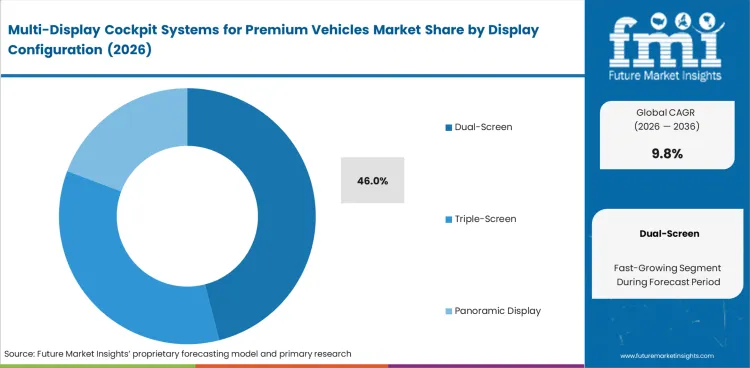
- Dual-screen configurations are expected to account for 46.0% share in 2026 as premium OEMs keeping the cluster-and-center-screen layout familiar while adding higher resolution and cleaner graphics within the same cabin package.
- Panoramic display systems are gaining specification interest in luxury EVs because brands use dashboard width and passenger zones to create clearer digital cabin identity.
Insights into Multi-Display Cockpit Systems for Premium Vehicles Market by Display Technology
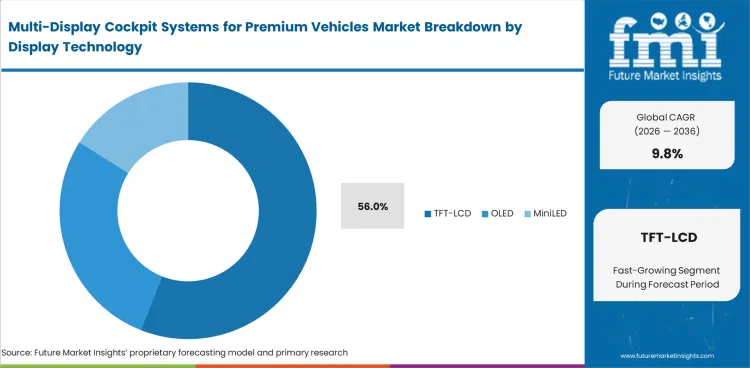
- TFT-LCD is projected to hold 56.0% share in 2026, since premium vehicle makers use mature panels to control cost across larger dashboards without raising warranty exposure.
- OLED adoption is rising in flagship cabins as better contrast and curved surfaces support premium visual identity.
Insights into Multi-Display Cockpit Systems for Premium Vehicles Market by Vehicle Class
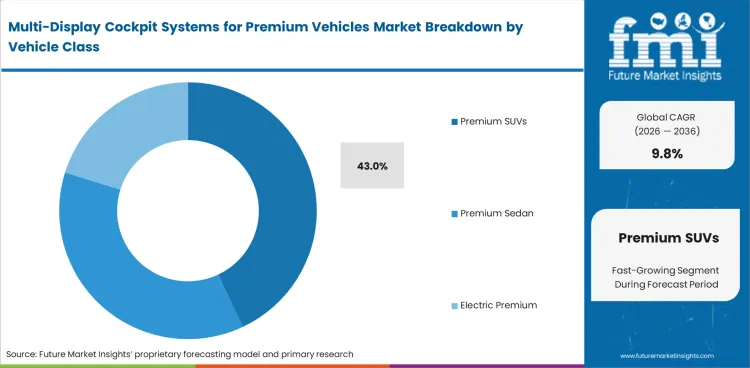
- Premium SUVs are forecast to account for 43.0% share in 2026 because larger cabins support central displays and rear entertainment without packaging pressure.
- Electric premium vehicles raise display content per unit as flat-floor layouts and software-defined cabins support wider screen placement across the dashboard.
Insights into Multi-Display Cockpit Systems for Premium Vehicles Market by Screen Position
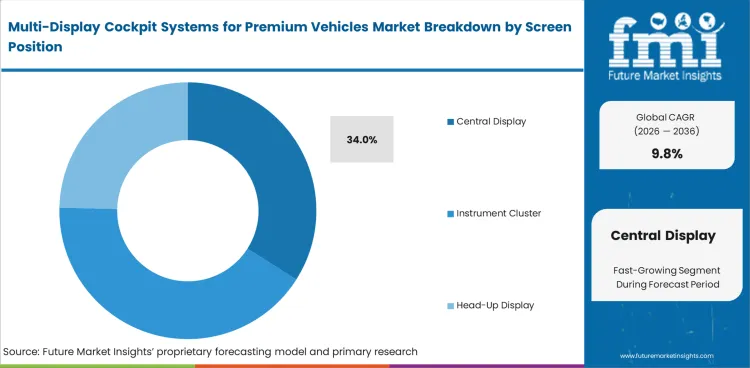
- Central information displays are expected to account for 34.0% share in 2026 as navigation and vehicle settings requiring a shared screen visible to front occupants.
- Passenger displays are move from novelty into premium trim planning as automakers separating entertainment content from driver-focused information zones.
Insights into Multi-Display Cockpit Systems for Premium Vehicles Market by System Integration
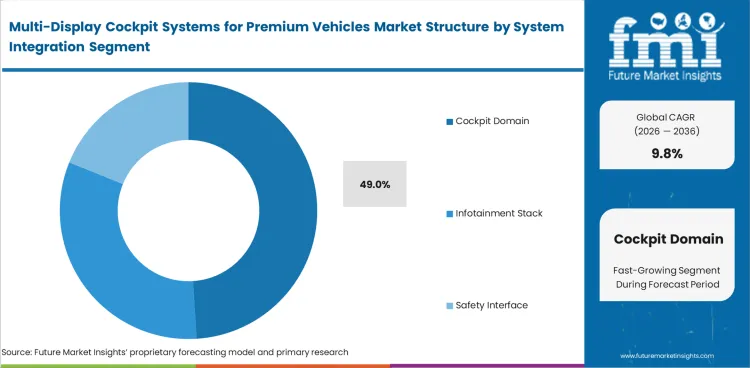
- Cockpit domain integration is projected to capture 49.0% share in 2026 as premium OEMs combining instrument graphics and infotainment controls under one computing layer.
- Software validation is becoming important since infotainment system UX and latency test platforms for connected test vehicles measure screen response before production sign-off.
Insights into Multi-Display Cockpit Systems for Premium Vehicles Market by Sales Channel
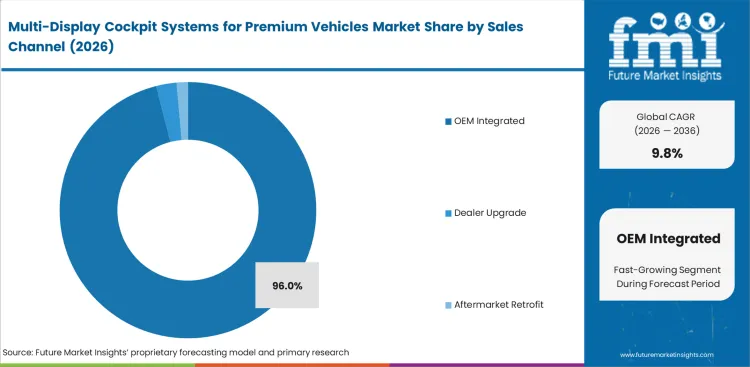
- OEM integrated systems are projected to hold 96.0% share in 2026, reflected by display shape with design and software behavior needing factory-level validation before vehicles launch.
- Dealer upgrades remain small but useful for rear-seat screens and trim-linked options without changing the primary dashboard electronics.
Multi-Display Cockpit Systems for Premium Vehicles Market Drivers, Restraints, and Opportunities
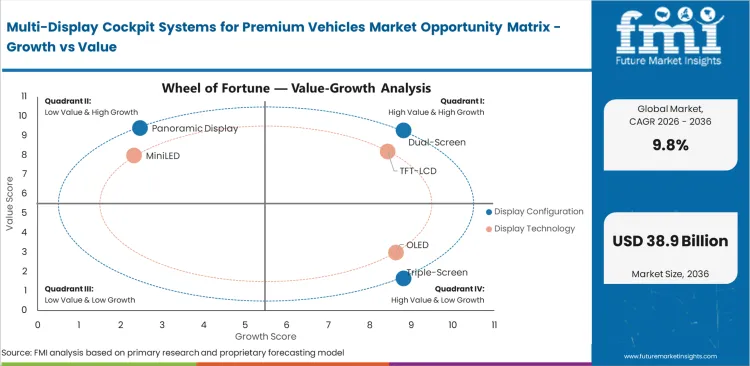
- Premium EV cockpit redesign is lifting screen count as new platforms allow wider dashboard surfaces.
- Heat and repair cost can slow adoption of very large displays in harsh cabin conditions.
- Cockpit domain controllers open a route for suppliers that can combine graphics and safety alerts.
Premium cockpit systems are rising in value as displays carry more vehicle functions in luxury EV programs. BMW Group stated in January 2025, Panoramic iDrive would enter all new BMW models from late 2025. These rollout plans make multi-display design a platform decision instead of a single-model feature. Suppliers need to combine automotive touch screen control systems with display processors and cybersecurity support. Repair cost remains a limit because wide glass surfaces can raise insurance and service exposure.
Passenger-side content creates a second growth route in premium vehicles with entertainment and comfort features. Mercedes-Benz showed its MBUX Hyperscreen with matrix backlight and zone dimming in April 2026. These systems divide information across driver and passenger zones while keeping a unified dashboard look. Wider adoption depends on display power use and reduced reflection. Validated touch response decides whether the feature reaches production. Suppliers with experience in automotive control panel design should protect margins as screen-based controls replace separate switches.
Display Attribute and Claim Preference Analysis
Display preference in premium vehicles is moving from raw screen size toward clarity and safe content separation. LG Display stated in January 2026, its 51-inch OLED pillar-to-pillar panel spans from the driver’s seat to the front passenger seat. These layouts create buyer appeal only if the display stays readable and does not overload the driver. Premium OEMs are expected to evaluate brightness and reflectance together. Software partitioning will decide whether driver and passenger content stays separated during real driving use.
Premium Vehicle Demand Analysis
Premium vehicle demand is following electrification and software-based cabin design in Europe. ACEA reported in January 2026, EU battery-electric cars reached 1,880,370 registrations in 2025 and captured 17.4% market share. Battery-electric premium models often carry richer screen packages as brands use cabin software to support higher vehicle pricing. This fitment supports higher cockpit value per vehicle across European premium EV programs. Screen suppliers gain most from programs combining luxury trim with higher-volume SUV platforms.
Regional Analysis
.webp "Top Country Growth Comparison Multi Display Cockpit Systems For Premium Vehicles Market Cagr (2026 2036)")
| Country | CAGR 2026 to 2036 |
|---|---|
| China | 12.4% |
| India | 11.7% |
| United States | 9.6% |
| Germany | 8.8% |
| United Kingdom | 8.2% |
| Japan | 7.9% |
| South Korea | 7.6% |
Source: Future Market Insights analysis, 2026.
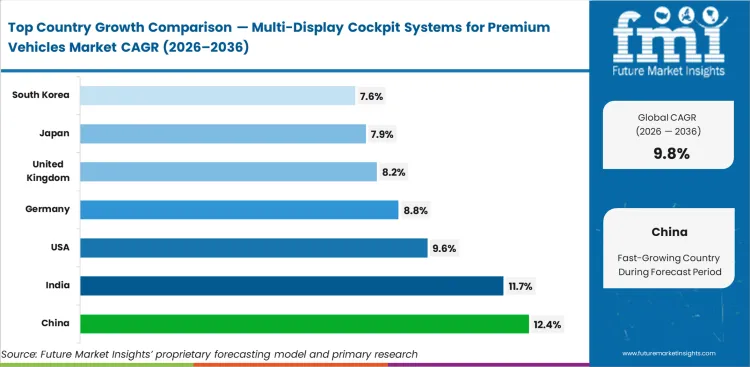
Analysis of Multi-Display Cockpit Systems for Premium Vehicles Market by Key Countries
- China is projected to record 12.4% CAGR by 2036 as premium electric vehicle brands use cockpit screens for trim separation.
- India is expected to expand at 11.7% CAGR by 2036 as premium SUVs and connected cabins gain more buyer attention.
- United States is forecast to grow at 9.6% CAGR by 2036 as luxury EVs and premium utility vehicles carry richer display packages.
- Germany is expected to advance at 8.8% CAGR by 2036 as premium OEM engineering keeps cockpit validation standards high.
- United Kingdom is projected to rise at 8.2% CAGR by 2036 through premium EV uptake and a clear luxury-brand mix.
- Japan is forecast at 7.9% CAGR by 2036 as luxury models prioritize reliable interfaces over aggressive screen proliferation.
- South Korea is expected to post 7.6% CAGR by 2036 as display manufacturing depth supports premium cockpit sourcing.
Country performance differs by premium vehicle mix and electric platform rollout. Local display supply depth gives some countries a clearer supplier route. China and India are forecast above the global pace as premium EV models and SUV upgrades expand quickly. United States and Germany track close to the global line because of mature premium buying and strict validation needs. Japan and South Korea remain important because of quality expectations and display technology depth.
Demand Outlook for Multi-Display Cockpit Systems for Premium Vehicles in China
China remains the main volume anchor for premium digital cockpits. CAAM data released in January 2026 showed China produced 34.531 million vehicles in 2025 and sold 34.40 million units. Local premium EV brands use screen surfaces to separate cabin experience from imported luxury models. Domestic panel makers and software suppliers shorten cockpit development cycles. The sector in China is projected to record a 12.4% CAGR by 2036, led by higher premium EV display content.
- Domestic premium EV brands use passenger displays and central screens to make cabin software visible during showroom comparison.
- Local panel supply gives OEMs faster sampling of curved and wide displays for high-trim electric vehicles.
- Connected cockpit software updates support recurring feature packages as premium buyers expect interfaces to improve after purchase.
Sales Analysis of Multi-Display Cockpit Systems for Premium Vehicles in India
India offers a faster premium cockpit opportunity as passenger vehicle volumes improve. The industry in India is expected to expand at 11.7% CAGR by 2036 as premium utility vehicles gaining richer interiors. SIAM reported in April 2026, passenger vehicle sales reached 46.43 lakh units in FY 2025-26 and grew 7.9%. Premium SUVs carry more screens than compact hatchbacks and give suppliers a higher content route. Local assembly may reduce display package cost for 10-inch to 15-inch systems.
- Premium SUVs create a stronger fit for central displays and rear-seat entertainment than lower-priced passenger cars.
- Local infotainment engineering improves response testing for voice and connected services across higher trims.
- Electric premium launches give suppliers a route to combine digital clusters and large central screens in one package.
Demand Analysis of Multi-Display Cockpit Systems for Premium Vehicles in United States
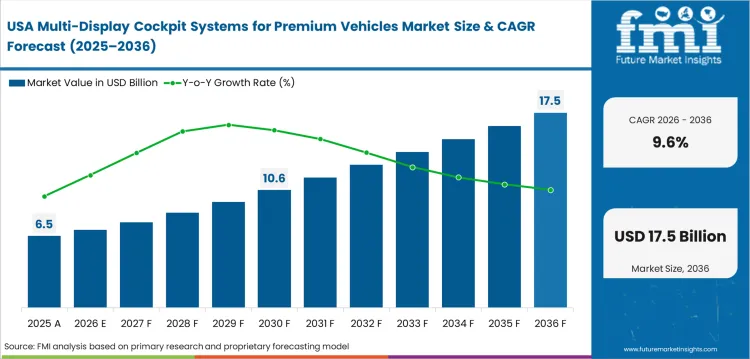
The market in the United States is forecast to grow at 9.6% CAGR by 2036 as automotive display units integrate into higher-trim vehicles. Demand is further influenced by premium utility vehicles and electric models with richer digital cabins across higher trims. Argonne National Laboratory data updated in 2026 showed about 1.5 million plug-in electric vehicles were sold in the United States in 2025. Premium EV buyers expect native navigation graphics and screen-based comfort controls. These features require higher-capacity display processors and panel quality.
- Premium pickup and SUV cabins support wider displays as buyers expect technology value alongside towing and comfort features.
- Charging route graphics make central displays more valuable in electric vehicles that serve daily and long-trip use.
- Broader North America head-up display demand gives cockpit suppliers another premium interface tied to safety cues.
Opportunity Analysis of Multi-Display Cockpit Systems for Premium Vehicles in Germany
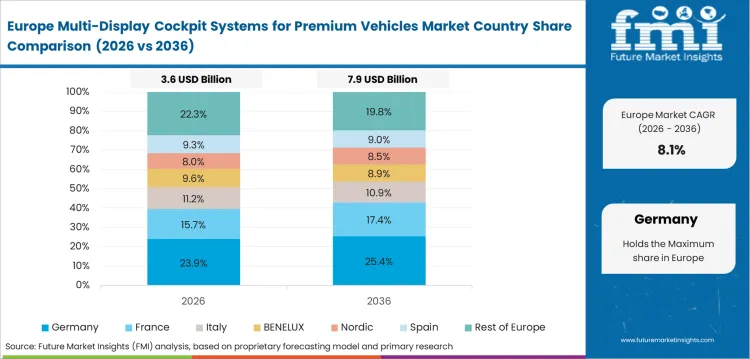
Sales in Germany are expected to advance at 8.8% CAGR by 2036 as premium platforms adopting coordinated display surfaces. Germany carries strong premium value per vehicle because of domestic luxury brands and deep supplier engineering. European Alternative Fuels Observatory reported in March 2026, Germany had 2.034 million battery-electric passenger cars on the road as of 1 January 2026. Luxury EV growth raises display content as new platforms use software-centered cabins. German OEMs prioritize durability and low distraction in cockpit design across premium vehicle programs.
- German premium OEMs prefer validated cockpit systems aligning display graphics with driver assistance features.
- Supplier engineering depth supports early testing of curved screens and cockpit domain controllers before vehicle launch.
- Battery-electric premium fleets raise interest in energy screens and passenger comfort controls.
Future Outlook for Multi-Display Cockpit Systems for Premium Vehicles in United Kingdom
The sector in United Kingdom reflects premium brand density and stricter zero-emission transition pressure across passenger cars. SMMT reported in February 2026 that the new car market reached 144,127 units in January 2026 and grew 3.4%. Premium EV launches use wide screens and stronger infotainment features to justify higher transaction prices. Dealer ordering patterns keep factory-fit cockpit packages relevant. Demand in United Kingdom is projected to rise at 8.2% CAGR by 2036 since premium EV buyers closely compare cabin software.
- Premium brand concentration supports cockpit packages with passenger displays and better rear-seat entertainment options.
- Zero-emission vehicle policy pressure keeps electric models visible in premium showrooms and raises digital cabin content.
- Fleet and company-car buyers value navigation clarity as route planning and cabin controls move onto central screens.
Demand Outlook for Multi-Display Cockpit Systems for Premium Vehicles in Japan
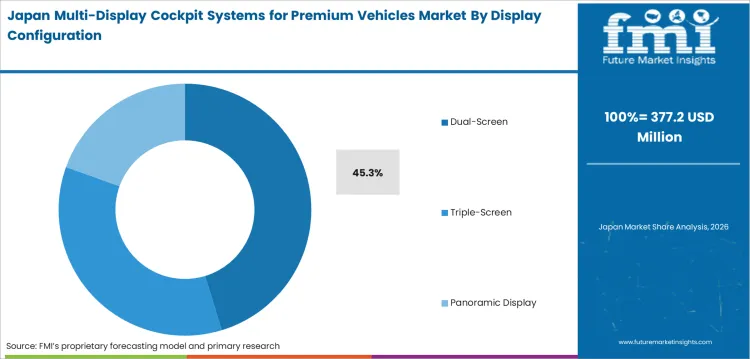
The sector in Japan is forecast at 7.9% CAGR by 2036 as premium models adding displays at a measured pace. Japan is a quality-focused premium cockpit opportunity with measured uptake of very wide displays. United States International Trade Administration reported in November 2025, 4.42 million new passenger vehicles were sold in Japan during 2024. Buyers in the country value reliability and clean interface behavior over excess screen count. Local electronics suppliers give OEMs strong access to HUDs and cockpit controllers.
- Luxury sedans and high-end minivans create demand for rear displays and simple passenger comfort interfaces.
- Domestic electronics suppliers support durability testing for screen modules used across hot and cold cabin conditions.
- Driver assistance features increase the need for clear cluster graphics and head-up display messages in premium trims.
In-depth Analysis of Multi-Display Cockpit Systems for Premium Vehicles in South Korea
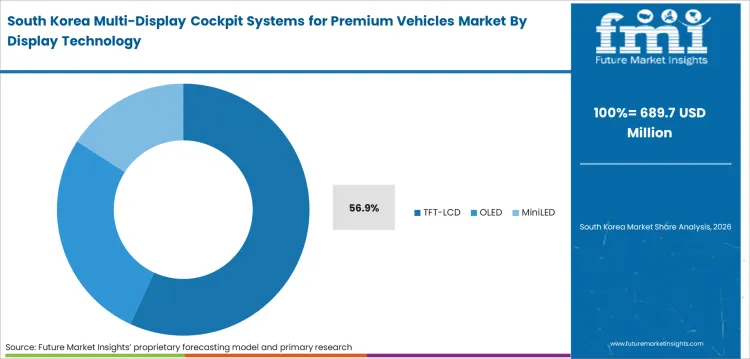
South Korea adds value through display manufacturing depth and premium EV exports across global vehicle programs. Local vehicle production supports cockpit suppliers serving premium EV exports. Domestic panel know-how supports OLED, MiniLED and advanced cockpit screen sourcing. Premium EV interiors provide a route for wider dashboard and passenger displays. The industry in South Korea is expected to post 7.6% CAGR by 2036 as local display technology supports OEM cockpit programs.
- Korean display suppliers give vehicle makers access to curved panels and advanced backlighting for premium interiors.
- Premium EV exports strengthen demand for cockpit systems meeting global software and warranty expectations.
- Automotive electronics suppliers support display controllers and touch interfaces required for multi-screen cabin layouts.
Competitive Landscape and Strategic Positioning
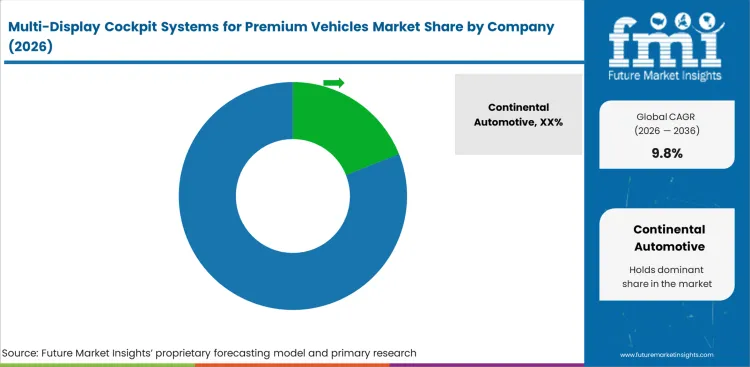
- Competition is concentrated among cockpit electronics suppliers and display panel makers, and software platform integrators now influence OEM supplier selection.
- Continental, Visteon and HARMAN hold established positions through cockpit controller programs and long-standing OEM relationships.
- Panel specialists compete on brightness and curved display readiness for premium dashboard packaging.
Premium cockpit competition is shaped by suppliers connecting displays with vehicle electronics and OEM launch needs. Vehicle makers judge suppliers on validation depth and integration risk. Visteon and Qualcomm introduced a high-performance AI-based cockpit system in April 2025 with cockpit hardware and multimodal AI capability. HARMAN introduced its latest Ready portfolio in January 2025 with Ready Display powered by Samsung Neo QLED. Supplier selection is moving toward partners that combining display control with processing power and driver awareness features within one cockpit program.
Panel companies are drawing more attention as premium dashboard surfaces expand across luxury models. AUO debuted Smart Cockpit 2025 in January 2025 with Micro LED display HMI solutions. LG Display showed Tandem WOLED and a 51-inch pillar-to-pillar automotive display in January 2026. Valeo secured a July 2025 order for a panoramic head-up display from a Chinese OEM. Competitive advantage is expected to stay with suppliers pairing optical performance with cockpit integration. Companies linking display hardware with HUD-ready windshield integration are better placed to win premium cockpit programs.
Key Companies in the Multi-Display Cockpit Systems for Premium Vehicles Market
Competition spans Tier 1 cockpit integrators and automotive display makers. Software-centered in-cabin technology suppliers complete the field.
- Cockpit System Integrators: Continental and Visteon compete through cockpit domain control and driver information systems. Bosch strengthens the same group through OEM software integration. Their strength is stronger in programs needing graphics and ADAS cues to work through one validated cockpit path.
- Display Panel Specialists: LG Display and AUO compete through OLED and MiniLED panels. BOE Varitronix strengthens the same group through MicroLED and curved automotive panels. Their value rises as premium brands use wider displays and passenger-zone screens to make cabin design more distinctive.
- In-Cabin Platform Suppliers: HARMAN and Panasonic Automotive Systems compete based on connected cockpit platforms and compute partnerships. Valeo strengthens the group through head-up display capability. Their position improves as OEMs seek in-vehicle connectivity and software update support in premium vehicle programs.
Competitive Benchmarking: Multi-Display Cockpit Systems for Premium Vehicles Market
| Company | Multi-Screen Integration Depth | Cockpit Domain Control | Automotive Display Readiness | Geographic Footprint |
|---|---|---|---|---|
| Continental Automotive | High | High | Strong | Global |
| Visteon Corporation | High | High | Strong | Global |
| HARMAN Automotive | High | High | Strong | Global |
| Bosch Mobility | Strong | High | Moderate | Global |
| Panasonic Automotive Systems | Strong | High | Moderate | Japan and North America |
| LG Display | High | Medium | High | South Korea and global |
| AUO Corporation | High | Medium | High | Taiwan and global |
| BOE Varitronix | Strong | Medium | High | China and global |
| Valeo | Moderate | Strong | Strong | Europe and China |
Source: Future Market Insights competitive analysis based on public product portfolios and company activity in 2026.
Key Developments in Multi-Display Cockpit Systems for Premium Vehicles Market
- In January 2025, BMW Group introduced Panoramic iDrive with Panoramic Vision for all new BMW models from late 2025.
- In April 2025, Visteon and Qualcomm introduced a high-performance AI-based cockpit system using the Snapdragon Cockpit Elite Platform.
- In January 2026, LG Display unveiled a 51-inch OLED-based pillar-to-pillar automotive display for larger cockpit screen layouts.
Key Players in the Multi-Display Cockpit Systems for Premium Vehicles Market
Cockpit System Integrators
- Continental Automotive
- Visteon Corporation
- Bosch Mobility
- HARMAN Automotive
Display Panel Specialists
- LG Display
- AUO Corporation
- BOE Varitronix
- Tianma Microelectronics
Mobility Electronics and HUD Suppliers
- Panasonic Automotive Systems
- Valeo
- DENSO Corporation
- Samsung Display
Report Scope and Coverage
| Parameter | Details |
|---|---|
| Quantitative Units | USD 15.2 billion in 2026 to USD 38.9 billion in 2036 at a CAGR of 9.8% |
| Market Definition | Integrated multi-screen cockpit systems for premium passenger vehicles covering displays, controllers, touch layers and cockpit software interfaces. |
| By Display Configuration | Dual-screen, triple-screen, panoramic display, rear-seat display |
| By Display Technology | TFT-LCD, OLED, MiniLED, MicroLED |
| By Vehicle Class | Premium SUV, premium sedan, electric premium, luxury sports |
| By Screen Position | Instrument cluster, central display, passenger display, head-up display, rear entertainment |
| By System Integration | Cockpit domain, infotainment stack, safety interface, voice interface |
| By Sales Channel | OEM integrated, dealer upgrade, aftermarket retrofit |
| Regions Covered | North America, Latin America, Western Europe, Eastern Europe, East Asia, South Asia and Pacific, Middle East and Africa |
| Countries Covered | China, India, United States, Germany, United Kingdom, Japan and South Korea |
| Key Companies Profiled | Continental, Visteon, Bosch, HARMAN, Panasonic Automotive Systems, LG Display, AUO, BOE Varitronix and Valeo |
| Forecast Period | 2026 to 2036 |
| Approach | Hybrid top-down and bottom-up analysis using premium vehicle production, cockpit content value and supplier activity |
Source: Future Market Insights, 2026.
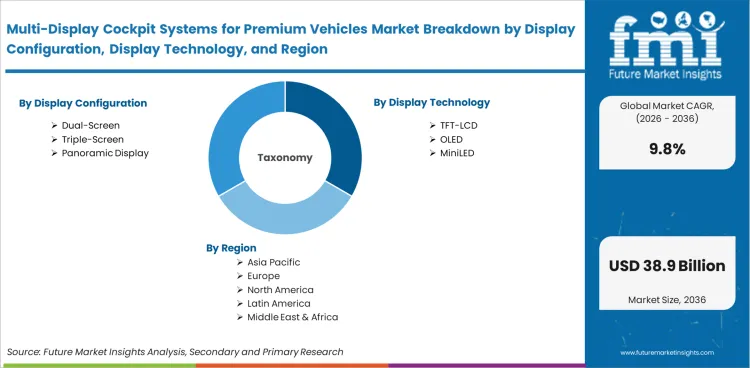
Multi-Display Cockpit Systems for Premium Vehicles Market Breakdown by Display Configuration, Display Technology, Vehicle Class, Screen Position, System Integration, Sales Channel, and Region
Multi-Display Cockpit Systems for Premium Vehicles Market Segmented by Display Configuration
- Dual-Screen
- Triple-Screen
- Panoramic Display
- Rear-Seat Display
Multi-Display Cockpit Systems for Premium Vehicles Market Segmented by Display Technology
- TFT-LCD
- OLED
- MiniLED
- MicroLED
Multi-Display Cockpit Systems for Premium Vehicles Market Segmented by Vehicle Class
- Premium SUV
- Premium Sedan
- Electric Premium
- Luxury Sports
Multi-Display Cockpit Systems for Premium Vehicles Market Segmented by Screen Position
- Instrument Cluster
- Central Display
- Passenger Display
- Head-Up Display
- Rear Entertainment
Multi-Display Cockpit Systems for Premium Vehicles Market Segmented by System Integration
- Cockpit Domain
- Infotainment Stack
- Safety Interface
- Voice Interface
Multi-Display Cockpit Systems for Premium Vehicles Market Segmented by Sales Channel
- OEM Integrated
- Dealer Upgrade
- Aftermarket Retrofit
Multi-Display Cockpit Systems for Premium Vehicles Market by Region
- North America
- United States
- Canada
- Mexico
- Latin America
- Brazil
- Chile
- Rest of Latin America
- Western Europe
- Germany
- United Kingdom
- Italy
- Spain
- France
- Nordics
- BENELUX
- Rest of Western Europe
- Eastern Europe
- Russia
- Poland
- Hungary
- Balkan and Baltic
- Rest of Eastern Europe
- East Asia
- China
- Japan
- South Korea
- South Asia and Pacific
- India
- ASEAN
- Australia and New Zealand
- Rest of South Asia and Pacific
- Middle East and Africa
- Kingdom of Saudi Arabia
- Other GCC Countries
- Turkiye
- South Africa
- Other African Union
- Rest of Middle East and Africa
Research Sources and Bibliography
- ACEA. (2026, January 27). New car registrations: +1.8% in 2025; battery-electric 17.4% market share.
- Argonne National Laboratory. (2026, March). Light duty electric drive vehicles monthly sales updates.
- AUO Corporation. (2025, January 8). AUO booth highlights at CES 2025.
- BMW Group. (2025, January 7). New BMW Panoramic iDrive revolutionizes vehicle operation.
- European Alternative Fuels Observatory. (2026, March 2). Germany’s BEV fleet surpasses 2 million units: Major milestone in electrification.
- Euro NCAP. (2025, November 26). Euro NCAP announces 2026 protocol changes to tackle modern driving risks.
- HARMAN International. (2025, January 6). HARMAN redefines in-cabin experiences, turning cars into intelligent, empathetic companions.
- International Energy Agency. (2025, May 14). Global EV Outlook 2025.
- Korea Automobile and Mobility Association. (2026, March 31). Automobile statistics: January 2026.
- LG Display. (2026, January 5). LG Display to unveil strategic OLED lineup built on best-in-class technology at CES 2026.
- Mercedes-Benz Group. (2026, April 24). Mercedes-Benz reinforces China’s strategic key role at Auto China 2026.
- Panasonic Automotive Systems. (2025, January 7). Panasonic Automotive Systems and Qualcomm expand collaboration to transform in-vehicle experiences with Snapdragon Cockpit Elite Platform.
- Society of Indian Automobile Manufacturers. (2026, April 14). Auto industry performance of Q4 (Jan-March 2026) & FY 2025-26.
- Society of Motor Manufacturers and Traders. (2026, February 5). New car market starts year with growth but EV share falls.
- United States International Trade Administration. (2025, November 20). Japan automotive.
- Valeo. (2025, July 17). A major Chinese OEM selects Valeo’s innovative panoramic head-up display for its new model.
- Visteon Corporation. (2025, April 24). Visteon and Qualcomm redefine next-generation AI-based intelligent cockpit experience.
Bibliography is provided for reader reference and uses primary and official sources. Regulatory, official trade body and official company publications are included.
This Report Answers
- What is the forecast value of the multi-display cockpit systems for premium vehicles market by 2036?
- Which sales channel is expected to hold a strong share in 2026?
- Which countries are forecast to grow faster than the global pace by 2036?
- Which display technology is projected to account for a leading share in 2026?
- Which suppliers are active in premium vehicle multi-display cockpit systems?
- How do EV platforms influence cockpit display design in premium vehicles?
- What role do cockpit domain controllers play in system integration?
Frequently Asked Questions
How big is the multi-display cockpit systems for premium vehicles market in 2026?
Industry revenue is expected to reach USD 15.2 billion in 2026 and advance to USD 38.9 billion by 2036.
What is the projected CAGR for the multi-display cockpit systems for premium vehicles market?
Sector is forecast to expand at 9.8% CAGR from 2026 to 2036 as premium EV cabins add richer displays.
Which segment holds a strong share in the multi-display cockpit systems for premium vehicles market?
OEM integrated systems are projected to hold 96.0% share in 2026 because of factory validation and cockpit integration needs.
Which country shows stronger growth in the multi-display cockpit systems for premium vehicles market?
China is projected to record 12.4% CAGR by 2036 as premium EV brands use wider connected cockpit screens.
Which companies compete in the multi-display cockpit systems for premium vehicles market?
Continental and Visteon are active suppliers. HARMAN and Bosch are active suppliers too. Panasonic Automotive Systems, LG Display and AUO compete with BOE Varitronix and Valeo.
Why are multi-display cockpit systems important for premium vehicles?
Readable and coordinated screens support navigation, driver alerts and passenger content while helping premium brands separate cabin experience.
Preview the report firsthand - request a free sample
Get SampleGet the brochure for pricing and purchase details.
Get PDFTable of Content
- Key Takeaways
- Market Size and CAGR
- Top Growth Driver
- Fastest Growing Segment
- Leading Region
- Key Companies
- Emerging Opportunities
- Executive Summary
- Global Market Outlook
- Demand-side Trends
- Supply-side Trends
- Technology Roadmap Analysis
- Analysis and Recommendations
- Analyst Perspective (What is happening? Why now? What should investors know?)
- Key Questions Answered
- How large is the market?
- What is the CAGR?
- What are key trends?
- Which region dominates?
- Who are the leaders?
- Market Overview
- Market Coverage / Taxonomy
- Market Definition / Scope / Limitations
- Research Methodology
- Chapter Orientation
- Analytical Lens and Working Hypotheses
- Market Structure, Signals, and Trend Drivers
- Benchmarking and Cross-market Comparability
- Market Sizing, Forecasting, and Opportunity Mapping
- Research Design and Evidence Framework
- Desk Research Programme (Secondary Evidence)
- Expert Input and Fieldwork (Primary Evidence)
- Tooling, Models, and Reference Databases
- Data Engineering and Model Build
- Quality Assurance and Audit Trail
- Market Background
- Market Dynamics (Drivers, Restraints, Opportunity, Trends)
- Scenario Forecast (Optimistic, Likely, Conservative)
- Impact Analysis
- AI Impact
- Sustainability Impact
- Regulatory Impact
- Technology Impact
- Consumer / Buyer Analysis
- Purchase Drivers
- Adoption Barriers
- Buyer Journey
- Opportunity Map Analysis
- Product Life Cycle Analysis
- Supply Chain Analysis
- Investment Feasibility Matrix
- Value Chain Analysis
- PESTLE and Porter's Analysis
- Regulatory Landscape
- Regional Parent Market Outlook
- Production and Consumption Statistics
- Import and Export Statistics
- Global Market Analysis and Forecast, 2021 to 2036
- Historical Market Size Value (USD Billion) & Volume (Unit) Analysis, 2021 to 2025
- Current and Future Market Size Value (USD Billion) & Volume (Unit) Projections, 2026 to 2036
- Y-o-Y Growth Trend Analysis
- Absolute $ Opportunity Analysis
- Global Market Pricing Analysis, 2021 to 2036
- Global Market Analysis and Forecast, By Display Configuration, 2021 to 2036
- Introduction / Key Findings
- Historical Market Size Value (USD Billion) & Volume (Unit) Analysis By Display Configuration, 2021 to 2025
- Current and Future Market Size Value (USD Billion) & Volume (Unit) Analysis and Forecast By Display Configuration, 2026 to 2036
- Dual-Screen
- Triple-Screen
- Panoramic Display
- Rear-Seat Display
- Dual-Screen
- Y-o-Y Growth Trend Analysis By Display Configuration, 2021 to 2025
- Absolute $ Opportunity Analysis By Display Configuration, 2026 to 2036
- Global Market Analysis and Forecast, By Display Technology, 2021 to 2036
- Introduction / Key Findings
- Historical Market Size Value (USD Billion) & Volume (Unit) Analysis By Display Technology, 2021 to 2025
- Current and Future Market Size Value (USD Billion) & Volume (Unit) Analysis and Forecast By Display Technology, 2026 to 2036
- TFT-LCD
- OLED
- MiniLED
- MicroLED
- TFT-LCD
- Y-o-Y Growth Trend Analysis By Display Technology, 2021 to 2025
- Absolute $ Opportunity Analysis By Display Technology, 2026 to 2036
- Global Market Analysis and Forecast, By Vehicle Class, 2021 to 2036
- Introduction / Key Findings
- Historical Market Size Value (USD Billion) & Volume (Unit) Analysis By Vehicle Class, 2021 to 2025
- Current and Future Market Size Value (USD Billion) & Volume (Unit) Analysis and Forecast By Vehicle Class, 2026 to 2036
- Premium SUV
- Premium Sedan
- Electric Premium
- Luxury Sports
- Premium SUV
- Y-o-Y Growth Trend Analysis By Vehicle Class, 2021 to 2025
- Absolute $ Opportunity Analysis By Vehicle Class, 2026 to 2036
- Global Market Analysis and Forecast, By Screen Position, 2021 to 2036
- Introduction / Key Findings
- Historical Market Size Value (USD Billion) & Volume (Unit) Analysis By Screen Position, 2021 to 2025
- Current and Future Market Size Value (USD Billion) & Volume (Unit) Analysis and Forecast By Screen Position, 2026 to 2036
- Instrument Cluster
- Central Display
- Passenger Display
- Head-Up Display
- Rear Entertainment
- Instrument Cluster
- Y-o-Y Growth Trend Analysis By Screen Position, 2021 to 2025
- Absolute $ Opportunity Analysis By Screen Position, 2026 to 2036
- Global Market Analysis and Forecast, By System Integration, 2021 to 2036
- Introduction / Key Findings
- Historical Market Size Value (USD Billion) & Volume (Unit) Analysis By System Integration, 2021 to 2025
- Current and Future Market Size Value (USD Billion) & Volume (Unit) Analysis and Forecast By System Integration, 2026 to 2036
- Cockpit Domain
- Infotainment Stack
- Safety Interface
- Voice Interface
- Cockpit Domain
- Y-o-Y Growth Trend Analysis By System Integration, 2021 to 2025
- Absolute $ Opportunity Analysis By System Integration, 2026 to 2036
- Global Market Analysis and Forecast, By Sales Channel
- Introduction / Key Findings
- Historical Market Size Value (USD Billion) & Volume (Unit) Analysis By Sales Channel, 2021 to 2025
- Current and Future Market Size Value (USD Billion) & Volume (Unit) Analysis and Forecast By Sales Channel, 2026 to 2036
- OEM Integrated
- Dealer Upgrade
- Aftermarket Retrofit
- OEM Integrated
- Y-o-Y Growth Trend Analysis By Sales Channel, 2021 to 2025
- Absolute $ Opportunity Analysis By Sales Channel, 2026 to 2036
- Global Market Analysis and Forecast, By Region, 2021 to 2036
- Introduction
- Historical Market Size Value (USD Billion) & Volume (Unit) Analysis By Region, 2021 to 2025
- Current Market Size Value (USD Billion) & Volume (Unit) Analysis and Forecast By Region, 2026 to 2036
- North America
- Latin America
- Western Europe
- Eastern Europe
- East Asia
- South Asia and Pacific
- Middle East & Africa
- Market Attractiveness Analysis By Region
- North America Market Analysis and Forecast, By Country, 2021 to 2036
- Historical Market Size Value (USD Billion) & Volume (Unit) Trend Analysis By Market Taxonomy, 2021 to 2025
- Market Size Value (USD Billion) & Volume (Unit) Forecast By Market Taxonomy, 2026 to 2036
- By Country
- USA
- Canada
- Mexico
- By Display Configuration
- By Display Technology
- By Vehicle Class
- By Screen Position
- By System Integration
- By Sales Channel
- By Country
- Market Attractiveness Analysis
- By Country
- By Display Configuration
- By Display Technology
- By Vehicle Class
- By Screen Position
- By System Integration
- By Sales Channel
- Key Takeaways
- Latin America Market Analysis and Forecast, By Country
- Historical Market Size Value (USD Billion) & Volume (Unit) Trend Analysis By Market Taxonomy, 2021 to 2025
- Market Size Value (USD Billion) & Volume (Unit) Forecast By Market Taxonomy, 2026 to 2036
- By Country
- Brazil
- Chile
- Rest of Latin America
- By Display Configuration
- By Display Technology
- By Vehicle Class
- By Screen Position
- By System Integration
- By Sales Channel
- By Country
- Market Attractiveness Analysis
- By Country
- By Display Configuration
- By Display Technology
- By Vehicle Class
- By Screen Position
- By System Integration
- By Sales Channel
- Key Takeaways
- Western Europe Market Analysis and Forecast, By Country
- Historical Market Size Value (USD Billion) & Volume (Unit) Trend Analysis By Market Taxonomy, 2021 to 2025
- Market Size Value (USD Billion) & Volume (Unit) Forecast By Market Taxonomy, 2026 to 2036
- By Country
- Germany
- UK
- Italy
- Spain
- France
- Nordic
- BENELUX
- Rest of Western Europe
- By Display Configuration
- By Display Technology
- By Vehicle Class
- By Screen Position
- By System Integration
- By Sales Channel
- By Country
- Market Attractiveness Analysis
- By Country
- By Display Configuration
- By Display Technology
- By Vehicle Class
- By Screen Position
- By System Integration
- By Sales Channel
- Key Takeaways
- Eastern Europe Market Analysis and Forecast, By Country
- Historical Market Size Value (USD Billion) & Volume (Unit) Trend Analysis By Market Taxonomy, 2021 to 2025
- Market Size Value (USD Billion) & Volume (Unit) Forecast By Market Taxonomy, 2026 to 2036
- By Country
- Russia
- Poland
- Hungary
- Balkan & Baltic
- Rest of Eastern Europe
- By Display Configuration
- By Display Technology
- By Vehicle Class
- By Screen Position
- By System Integration
- By Sales Channel
- By Country
- Market Attractiveness Analysis
- By Country
- By Display Configuration
- By Display Technology
- By Vehicle Class
- By Screen Position
- By System Integration
- By Sales Channel
- Key Takeaways
- East Asia Market Analysis and Forecast, By Country
- Historical Market Size Value (USD Billion) & Volume (Unit) Trend Analysis By Market Taxonomy, 2021 to 2025
- Market Size Value (USD Billion) & Volume (Unit) Forecast By Market Taxonomy, 2026 to 2036
- By Country
- China
- Japan
- South Korea
- By Display Configuration
- By Display Technology
- By Vehicle Class
- By Screen Position
- By System Integration
- By Sales Channel
- By Country
- Market Attractiveness Analysis
- By Country
- By Display Configuration
- By Display Technology
- By Vehicle Class
- By Screen Position
- By System Integration
- By Sales Channel
- Key Takeaways
- South Asia and Pacific Market Analysis and Forecast, By Country
- Historical Market Size Value (USD Billion) & Volume (Unit) Trend Analysis By Market Taxonomy, 2021 to 2025
- Market Size Value (USD Billion) & Volume (Unit) Forecast By Market Taxonomy, 2026 to 2036
- By Country
- India
- ASEAN
- Australia & New Zealand
- Rest of South Asia and Pacific
- By Display Configuration
- By Display Technology
- By Vehicle Class
- By Screen Position
- By System Integration
- By Sales Channel
- By Country
- Market Attractiveness Analysis
- By Country
- By Display Configuration
- By Display Technology
- By Vehicle Class
- By Screen Position
- By System Integration
- By Sales Channel
- Key Takeaways
- Middle East & Africa Market Analysis and Forecast, By Country
- Historical Market Size Value (USD Billion) & Volume (Unit) Trend Analysis By Market Taxonomy, 2021 to 2025
- Market Size Value (USD Billion) & Volume (Unit) Forecast By Market Taxonomy, 2026 to 2036
- By Country
- Kingdom of Saudi Arabia
- Other GCC Countries
- Türkiye
- South Africa
- Other African Union
- Rest of Middle East & Africa
- By Display Configuration
- By Display Technology
- By Vehicle Class
- By Screen Position
- By System Integration
- By Sales Channel
- By Country
- Market Attractiveness Analysis
- By Country
- By Display Configuration
- By Display Technology
- By Vehicle Class
- By Screen Position
- By System Integration
- By Sales Channel
- Key Takeaways
- Key Countries Market Analysis
- USA
- Pricing Analysis
- Market Share Analysis, 2025
- By Display Configuration
- By Display Technology
- By Vehicle Class
- By Screen Position
- By System Integration
- By Sales Channel
- Canada
- Pricing Analysis
- Market Share Analysis, 2025
- By Display Configuration
- By Display Technology
- By Vehicle Class
- By Screen Position
- By System Integration
- By Sales Channel
- Mexico
- Pricing Analysis
- Market Share Analysis, 2025
- By Display Configuration
- By Display Technology
- By Vehicle Class
- By Screen Position
- By System Integration
- By Sales Channel
- Brazil
- Pricing Analysis
- Market Share Analysis, 2025
- By Display Configuration
- By Display Technology
- By Vehicle Class
- By Screen Position
- By System Integration
- By Sales Channel
- Chile
- Pricing Analysis
- Market Share Analysis, 2025
- By Display Configuration
- By Display Technology
- By Vehicle Class
- By Screen Position
- By System Integration
- By Sales Channel
- Germany
- Pricing Analysis
- Market Share Analysis, 2025
- By Display Configuration
- By Display Technology
- By Vehicle Class
- By Screen Position
- By System Integration
- By Sales Channel
- UK
- Pricing Analysis
- Market Share Analysis, 2025
- By Display Configuration
- By Display Technology
- By Vehicle Class
- By Screen Position
- By System Integration
- By Sales Channel
- Italy
- Pricing Analysis
- Market Share Analysis, 2025
- By Display Configuration
- By Display Technology
- By Vehicle Class
- By Screen Position
- By System Integration
- By Sales Channel
- Spain
- Pricing Analysis
- Market Share Analysis, 2025
- By Display Configuration
- By Display Technology
- By Vehicle Class
- By Screen Position
- By System Integration
- By Sales Channel
- France
- Pricing Analysis
- Market Share Analysis, 2025
- By Display Configuration
- By Display Technology
- By Vehicle Class
- By Screen Position
- By System Integration
- By Sales Channel
- India
- Pricing Analysis
- Market Share Analysis, 2025
- By Display Configuration
- By Display Technology
- By Vehicle Class
- By Screen Position
- By System Integration
- By Sales Channel
- ASEAN
- Pricing Analysis
- Market Share Analysis, 2025
- By Display Configuration
- By Display Technology
- By Vehicle Class
- By Screen Position
- By System Integration
- By Sales Channel
- Australia & New Zealand
- Pricing Analysis
- Market Share Analysis, 2025
- By Display Configuration
- By Display Technology
- By Vehicle Class
- By Screen Position
- By System Integration
- By Sales Channel
- China
- Pricing Analysis
- Market Share Analysis, 2025
- By Display Configuration
- By Display Technology
- By Vehicle Class
- By Screen Position
- By System Integration
- By Sales Channel
- Japan
- Pricing Analysis
- Market Share Analysis, 2025
- By Display Configuration
- By Display Technology
- By Vehicle Class
- By Screen Position
- By System Integration
- By Sales Channel
- South Korea
- Pricing Analysis
- Market Share Analysis, 2025
- By Display Configuration
- By Display Technology
- By Vehicle Class
- By Screen Position
- By System Integration
- By Sales Channel
- Russia
- Pricing Analysis
- Market Share Analysis, 2025
- By Display Configuration
- By Display Technology
- By Vehicle Class
- By Screen Position
- By System Integration
- By Sales Channel
- Poland
- Pricing Analysis
- Market Share Analysis, 2025
- By Display Configuration
- By Display Technology
- By Vehicle Class
- By Screen Position
- By System Integration
- By Sales Channel
- Hungary
- Pricing Analysis
- Market Share Analysis, 2025
- By Display Configuration
- By Display Technology
- By Vehicle Class
- By Screen Position
- By System Integration
- By Sales Channel
- Kingdom of Saudi Arabia
- Pricing Analysis
- Market Share Analysis, 2025
- By Display Configuration
- By Display Technology
- By Vehicle Class
- By Screen Position
- By System Integration
- By Sales Channel
- Türkiye
- Pricing Analysis
- Market Share Analysis, 2025
- By Display Configuration
- By Display Technology
- By Vehicle Class
- By Screen Position
- By System Integration
- By Sales Channel
- South Africa
- Pricing Analysis
- Market Share Analysis, 2025
- By Display Configuration
- By Display Technology
- By Vehicle Class
- By Screen Position
- By System Integration
- By Sales Channel
- USA
- Market Structure Analysis
- Competition Dashboard
- Competition Benchmarking
- Market Share Analysis of Top Players
- By Regional
- By Display Configuration
- By Display Technology
- By Vehicle Class
- By Screen Position
- By System Integration
- By Sales Channel
- Emerging Startups
- Innovation Benchmarking
- Competition Analysis
- Competition Deep Dive
- Continental Automotive
- Overview
- Product Portfolio
- Profitability by Market Segments (Product/Region/Sales Channel)
- Sales Footprint
- Strategy Overview
- Marketing Strategy
- Product Strategy
- Channel Strategy
- Visteon Corporation
- Bosch Mobility
- HARMAN Automotive
- LG Display
- AUO Corporation
- BOE Varitronix
- Tianma Microelectronics
- Panasonic Automotive Systems
- Valeo
- DENSO Corporation
- Samsung Display
- Continental Automotive
- Case Studies
- Success Stories
- Recent Developments
- Competition Deep Dive
- Assumptions & Acronyms Used


