

- Market Size (2026)
- USD 41.3 Mn
- Forecast (2036)
- USD 70.5 Mn
- CAGR (2026 to 2036)
- 5.5%
Cockpit Windshield Anti-Icing and Defogging Layer Technologies Market Size, Market Forecast and Outlook By FMI
Summary of the Cockpit Windshield Anti-Icing and Defogging Layer Technologies Market
- Product and Segment View
- Transparent conductive films and multilayer transparent conductors support current material and stack design trends.
- Dual-function systems hold a larger demand base because one build handles fog control and ice prevention.
- Commercial aircraft is the biggest platform base due to larger active fleets and broader window replacement volume.
- Demand and Growth Drivers
- New-aircraft production across aircraft windows, windshields, and adjacent heated windshield systems supports market growth.
- Demand for replacements is driven by long-service fleets and window overhaul activity.
- Geography and Competitive Outlook
- China and India post faster growth due to fleet expansion and aerospace capacity growth.
- United States and Europe hold a larger installed base due to OEM presence and overhaul access.
- Supplier ranking depends on certified cockpit-window capability and aftermarket support.
- Analyst Opinion
- Nikhil Kaitwade, Principal Analyst states, “Demand is expected to rise at a measured pace because cockpit view protection is a certified function, while supplier rank depends on layer performance, repair practicality, and program access.”
- Cockpit Windshield Anti-Icing and Defogging Layer Technologies Market Value Analysis
- The cockpit windshield anti-icing and defogging layer technologies market is moving from a narrow transparency coating niche into a clearer certified cockpit visibility category.
- Adoption depends on the need for conductive and anti-fogging layers that can maintain pilot visibility under icing and rapid temperature shifts.
- The market benefits from demand for dual-function systems that combine ice prevention and fog control within one integrated windshield build.
- Demand is supported by the need for certified layer technologies that balance optical clarity and heating consistency over long service periods.
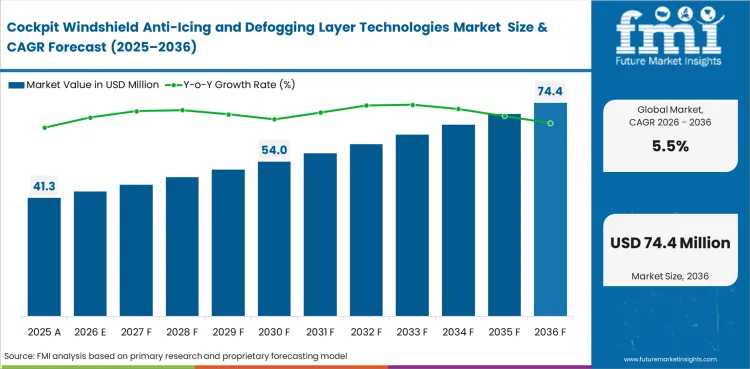
Key Takeaways, Market Size, and Forecast
- The market was valued at USD 39.10 million in 2025.
- Market size is projected at USD 70.50 million by 2036.
- Market growth is set at a 5.5% CAGR for 2026 to 2036.
- Incremental opportunity between 2026 and 2036 is estimated at USD 29.20 million.
- OEM line-fit is expected to account for 63.0% share in 2026.
- China at 6.4% and India at 6.2%, are expected to record faster growth among the key countries covered in this study.
Cockpit Windshield Anti-Icing and Defogging Layer Technologies Market Definition
Cockpit windshield anti-icing and defogging layer technologies are conductive and functional layers added inside cockpit windshields. These layers help reduce ice formation, control internal fogging, and maintain pilot visibility. The market includes conductive oxide layers, multifunctional film stacks, and related heating-control layouts. These are used in certified cockpit transparency systems across civil, military, and advanced aircraft applications.
Cockpit Windshield Anti-Icing and Defogging Layer Technologies Market Inclusions
Market scope includes transparent conductive layers, anti-fog coatings and multilayer heater stacks. It also includes busbar-linked heating layouts, zonal heating architectures, and related functional layer technologies. Scope also includes OEM line-fit and replacement demand linked to cockpit windshields.
Cockpit Windshield Anti-Icing and Defogging Layer Technologies Market Exclusions
Scope of the market does not include full windshield assemblies, structural frames, and seals. It also excludes wiper hardware, cabin windows, and passenger smart glass. Standalone cleaning fluids, rain-repellent maintenance consumables, and non-embedded visibility products are also excluded.
Cockpit Windshield Anti-Icing and Defogging Layer Technologies Market Research Methodology
- Primary Research: Review of cockpit transparency capability pages, repair-service disclosures, and supplier product materials.
- Desk Research: Review of regulatory cockpit-view rules, fleet outlooks, supplier capability pages, and technical papers on anti-icing and anti-fogging materials.
- Market sizing and forecasting: Bottom-up narrowing from cockpit windshield demand inside the aircraft transparency value chain.
- Data validation: Segment shares, country growth rates, and company position cross-checked against public supplier disclosures, regulatory text, and recent technical literature.
Why is the Cockpit Windshield Anti-Icing and Defogging Layer Technologies Market Growing?
- Certified cockpit-view protection rules are creating structured demand for anti-icing and defogging layers that can preserve pilot visibility under icing and rapid temperature-shift conditions.
- OEM line-fit leads with 63.0% share because conductive paths and heating layouts are easier to validate during original-build certification. Retrofit programs usually involve more validation limits.
- China leads growth with 6.4%. Fleet expansion and local aerospace manufacturing are increasing demand for qualified cockpit-window layer technologies.
The market for cockpit windshield anti-icing and defogging layer technologies is growing steadily, supported by cockpit-view safety rules and replacement demand linked to long-service fleets. Conductive and anti-fogging layer technologies help maintain visibility and improve heating consistency in operating conditions that require more than standard glazing.
Commercial aircraft is the biggest aircraft platform segment. Airline fleets create broader demand because active-service aircraft need repeated windshield replacement and approved repairs across long operating cycles. OEM line-fit stays the leading fitment type because most conductive and multifunctional layer systems are easier to qualify when they are built into certified windshield programs from the start.
Replacement and overhaul activity are structural growth drivers. Cockpit windshields face abrasion and thermal cycling across regular operations. That raises demand for multilayer stacks and dual-function systems that can reduce aircraft downtime while keeping pilot-view performance inside certified limits.
Market Segmentation Analysis
The ITO segment is estimated to account for 34.0% share in 2026, supported by established use in transparent conductive layers and easier acceptance in certified cockpit glazing programs.
The multilayer stacks segment is estimated to account for 41.0% share in 2026, because one windshield build can combine heating, anti-fogging, and optical-control functions.
The dual-function systems segment is estimated to account for 52.0% share in 2026, driven by combined fog control and ice prevention in one layer system.
The zonal heating segment is estimated to account for 37.0% share in 2026, due to targeted heat control across critical viewing areas and better power use.
The commercial aircraft segment is estimated to account for 38.0% share in 2026, owing to larger active fleets and repeated windshield replacement demand.
The OEM line-fit segment is estimated to account for 63.0% share in 2026, supported by original-build certification workflows and easier integration of conductive paths inside new windshield designs.
The OEMs segment is estimated to account for 58.0% share in 2026, because windshield design approval, material selection, and system integration are handled at the original equipment stage.
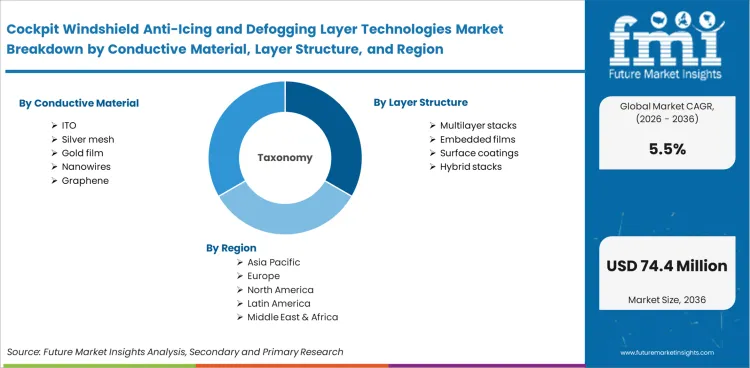
The market is divided into conductive material, layer structure, function mode, heating control, aircraft platform, fitment type, and end user. Conductive material includes ITO, silver mesh, gold film, nanowires, and graphene. Layer structure includes multilayer stacks, embedded films, surface coatings, and hybrid stacks. Function mode includes anti-icing, defogging, and dual-function. Heating control includes zonal heating, uniform heating, sensor-linked, and pulse control. Aircraft platform includes commercial aircraft, business jets, regional aircraft, military aircraft, helicopters, and general aviation. Fitment type includes OEM line-fit, retrofit, and replacement. End user includes OEMs, MROs, operators, and defense depots.
Insights into the ITO Segment
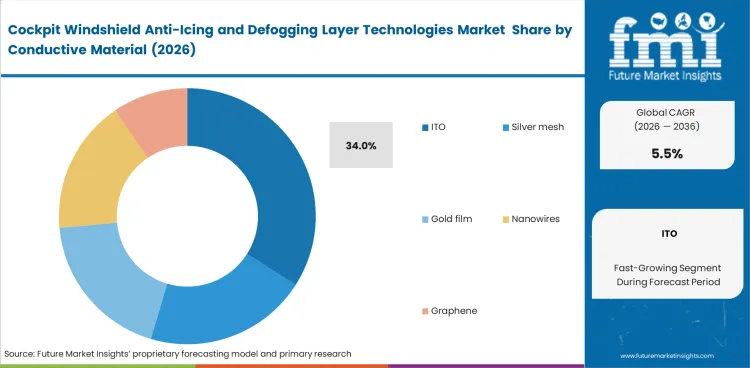
- In 2026, ITO is expected to contribute 34.0% of total market share because of its long use in transparent conductive applications and easier acceptance in certified cockpit glazing programs.
- Silver mesh and graphene continue to attract engineering interest. Most certified aircraft programs still use established conductive materials.
Insights into the Multilayer Stacks Segment
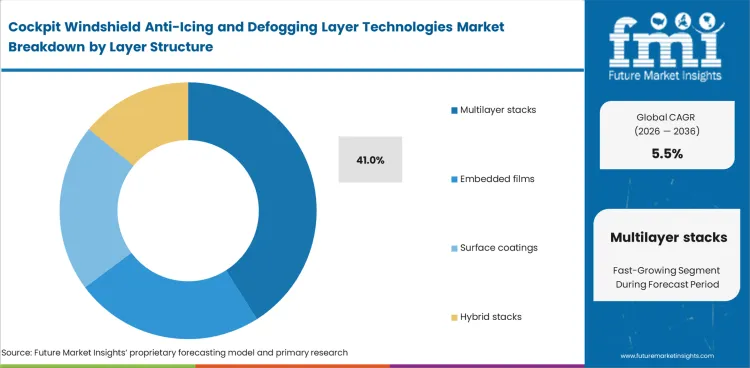
- Multilayer stacks are likely to hold 41.0% share in 2026 because heating and anti-fogging can be combined in one windshield build.
- This market includes embedded films and surface coatings. Multilayer designs suit programs requiring several functions inside one certified part.
Insights into the Dual-function Systems Segment
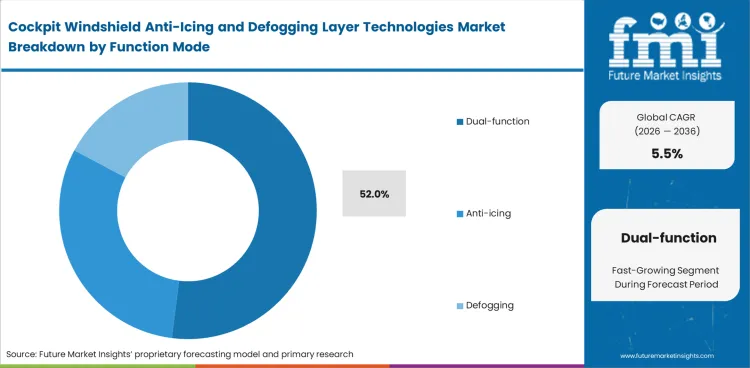
- Dual-function systems are anticipated to capture 52.0% of the market in 2026, driven by combined fog control and ice prevention in one integrated build.
- Anti-icing-only and defogging-only systems are used in fewer aircraft applications. Combined systems hold a wider volume base in larger cockpit-window programs.
Insights into the Zonal Heating Segment
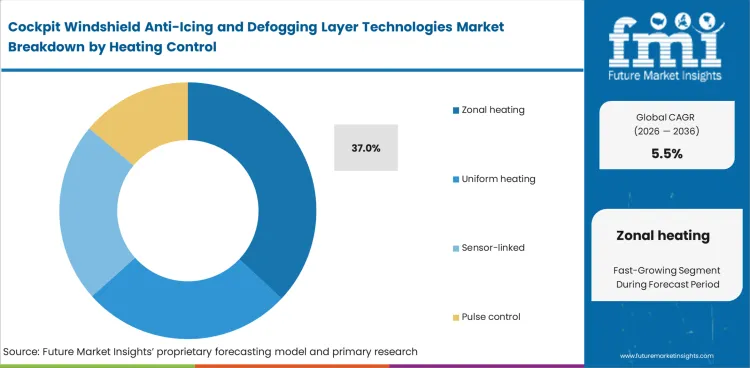
- Zonal heating is set to represent 37.0% of market share in 2026 due to targeted heat delivery across pilot-view areas and better power control inside the windshield layout.
- Uniform heating and pulse control hold strong demand. Zonal layouts suit designs that need heat in critical visibility areas.
Insights into the Commercial Aircraft Segment
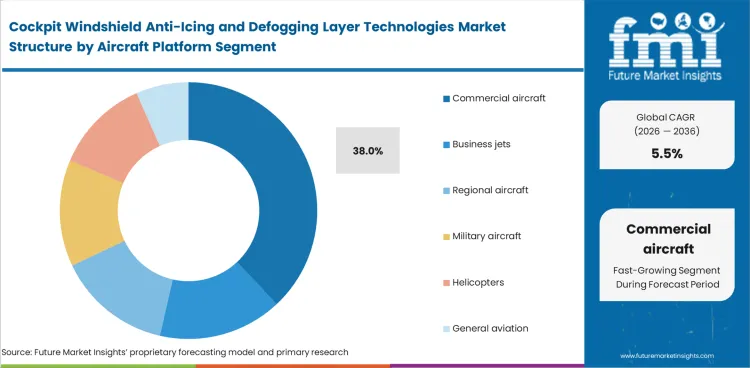
- Commercial aircraft is expected to account for 38.0% share in 2026 because of larger fleet size and repeated windshield replacement cycles across airline service.
- Business jets and military aircraft create demand as well. Commercial fleets generate higher replacement volume and broader installed base.
Insights into the OEM Line-fit Segment
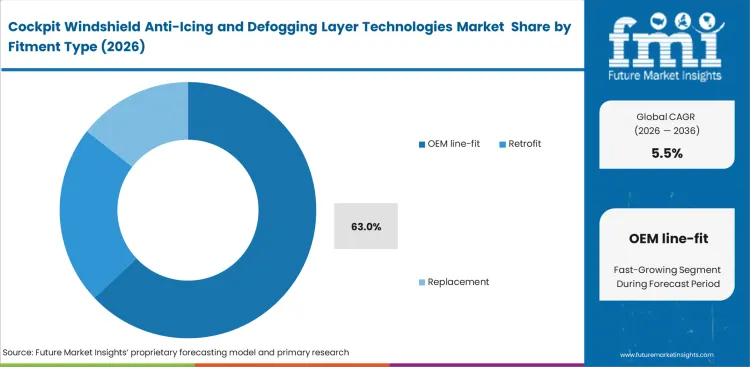
- OEM line-fit is expected to hold 63.0% share in 2026 because original-build validation allows easier control of heating zones and conductive paths during certification.
- Retrofit and replacement demand keep value in legacy fleets. Field adoption faces stricter compatibility and approval screening.
Insights into the OEMs Segment
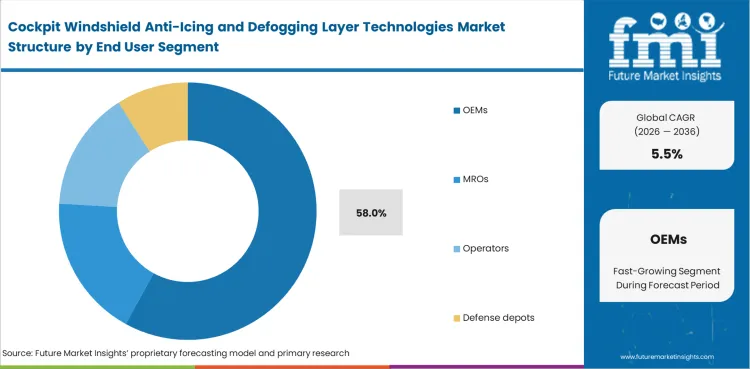
- In 2026, OEMs are expected to contribute 58.0% of total market share because windshield design approval and early-stage integration of functional layers are handled at the original equipment stage.
- MROs and defense depots influence demand through replacement and sustainment activity. OEM participation carries more weight during first-fit selection and program approval.
Cockpit Windshield Anti-Icing and Defogging Layer Technologies Market Drivers, Restraints, and Opportunities
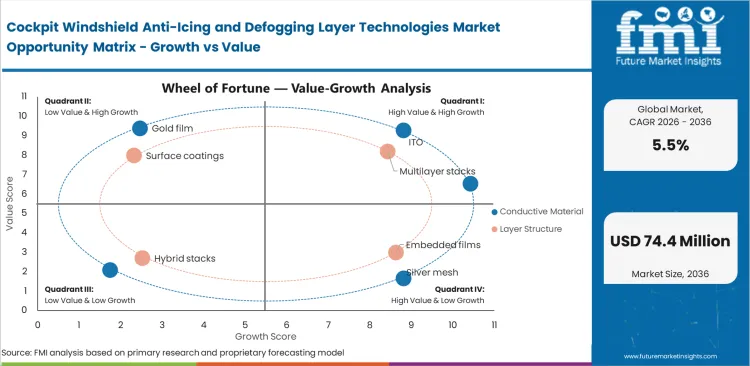
- Cockpit-view safety rules and aircraft production programs are creating a structured need for conductive and anti-fogging layer technologies inside certified windshield systems.
- Long qualification cycles and tight optical tolerance under harsh operating conditions make adoption harder for newer materials. Growth stays concentrated in certified programs and approved replacement channels.
- Demand for better visibility control and easier replacement support is increasing interest in multilayer stacks and dual-function systems that combine anti-icing and defogging in one build.
The market for cockpit windshield anti-icing and defogging layer technologies keeps growing because of cockpit-view protection rules and replacement demand across active fleets. Difficult certification and thermal-cycling pressure slow wider adoption. Growth opportunities are opening in integrated layer stacks, replacement programs tied to repair work, and more durable anti-fogging technologies.
Certified cockpit visibility and integrated layer demand
Demand shows that aircraft transparency systems are moving toward integrated conductive layers that support anti-icing and defogging within one certified windshield structure. These layers help maintain visibility during climb and descent. They avoid bulky add-on systems. OEM line-fit demand stays strong because conductive paths and heating control are easier to validate during original-build certification.
Qualification burden and durability constraints
Adoption is limited by long aerospace approval cycles and the need to maintain optical clarity and heating consistency inside the same windshield. Repeated fogging and thermal cycling can reduce service life even when first-use performance looks strong. That makes it harder for new materials to move quickly into certified cockpit-window programs. Supplier selection stays focused on proven technologies with established repair and overhaul support.
Analysis of Cockpit Windshield Anti-Icing and Defogging Layer Technologies Market By Key Countries
.webp "Top Country Growth Comparison Cockpit Windshield Anti Icing And Defogging Layer Technologies Market Cagr (2026 2036)")
| Country | CAGR |
|---|---|
| China | 6.4% |
| India | 6.2% |
| United States | 5.1% |
| France | 4.9% |
| Germany | 4.8% |
| United Kingdom | 4.7% |
| Japan | 4.6% |
Source: FMI analysis based on primary research and proprietary forecasting model
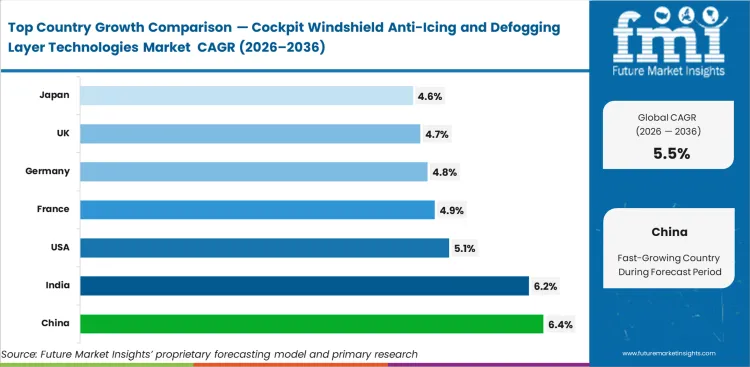
Cockpit Windshield Anti-Icing and Defogging Layer Technologies Market Cagr Analysis By Country
- Demand for cockpit windshield anti-icing and defogging layer technologies in China is anticipated to rise at a CAGR of 6.4% through 2036, supported by fleet expansion and local aerospace manufacturing growth.
- Sales of cockpit windshield anti-icing and defogging layer technologies in India are expected to increase at a CAGR of 6.2% during the forecast period, driven by airline expansion and MRO capacity build-up.
- The cockpit windshield anti-icing and defogging layer technologies market in the United States is poised to expand at a CAGR of 5.1% through 2036, due to OEM concentration and defense-aircraft activity.
- France is set to record a CAGR of 4.9% in cockpit windshield anti-icing and defogging layer technologies during the assessment period, supported by Airbus program depth and certified aerospace engineering capacity.
- Cockpit windshield anti-icing and defogging layer technologies adoption in Germany is likely to advance at a CAGR of 4.8% by 2036, supported by precision manufacturing and sustained aircraft-system participation.
- United Kingdom is projected to witness 4.7% CAGR in the cockpit windshield anti-icing and defogging layer technologies market through 2036.
- Japan is likely to post a CAGR of 4.6% in cockpit windshield anti-icing and defogging layer technologies by 2036.
The country mix shows a balanced spread across mature aerospace hubs and faster-growth aviation markets.
Demand Outlook for Cockpit Windshield Anti-Icing and Defogging Layer Technologies in China
China is expected to record one of the fastest growth rates in the market because fleet expansion and local aerospace manufacturing are increasing. Demand for cockpit windshield anti-icing and defogging layer technologies in China is anticipated to rise at a CAGR of 6.4% through 2036 because aircraft production and maintenance capability are growing. Supplier access improves in programs requiring qualified conductive layers and approved windshield support.
- Fleet growth expands cockpit-window demand.
- Local aerospace activity widens sourcing scope.
- Maintenance growth supports replacement demand.
Future Outlook for Cockpit Windshield Anti-Icing and Defogging Layer Technologies in India
India is expected to record high growth in the market because the installed base is smaller and airline expansion is increasing. Sales of cockpit windshield anti-icing and defogging layer technologies in India are expected to increase at a CAGR of 6.2% during the forecast period, driven by airline expansion and MRO development. Approved suppliers can expand across OEM and replacement demand.
- Airline expansion supports new-window demand.
- MRO growth improves service access.
- Qualified supply can gain from new programs.
Opportunity Analysis of Cockpit Windshield Anti-Icing and Defogging Layer Technologies in the United States
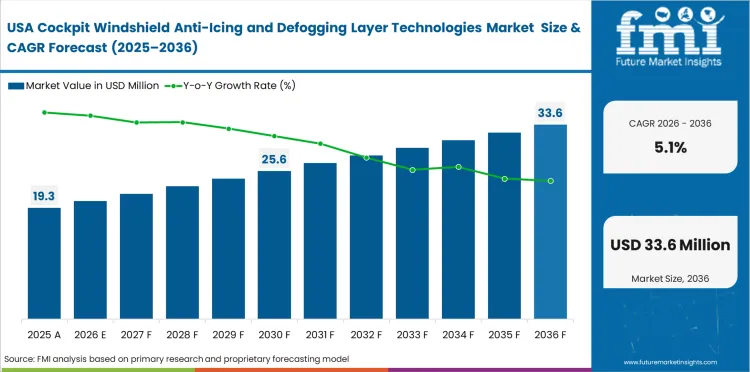
The United States market growth is supported by strong OEM presence and a large active fleet. The cockpit windshield anti-icing and defogging layer technologies market in the United States is expected to expand at a CAGR of 5.1% through 2036 because of strong production capability and replacement demand. Approved repair and overhaul support improves supplier position in this market.
- Large active fleets support repeated window replacement.
- Defense work broadens demand.
- In-country overhaul capacity reduces service delay.
In-depth Analysis of Cockpit Windshield Anti-Icing and Defogging Layer Technologies in France
France growth is driven by Airbus programs and well-established aerospace engineering capability. France is set to record a CAGR of 4.9% in cockpit windshield anti-icing and defogging layer technologies during the assessment period because aircraft-system manufacturing and qualification depth are strong. High-spec cockpit glazing programs support a premium mix.
- Airbus programs support stable component demand.
- Qualification depth favors proven supply.
- Premium glazing applications keep unit value high.
Sales Analysis of Cockpit Windshield Anti-Icing and Defogging Layer Technologies in Germany
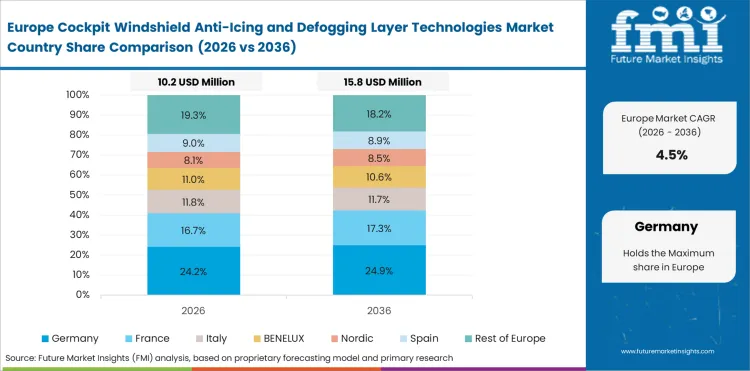
Germany gains support from precision manufacturing across aircraft systems. Cockpit windshield anti-icing and defogging layer technologies adoption in Germany is likely to advance at a CAGR of 4.8% by 2036 because of engineering capability and program participation. Long-life window systems and process control gain more weight in supplier selection.
- Precision manufacturing supports high-spec production.
- Aircraft-system participation sustains demand.
- Durability targets favor controlled processing.
Demand Outlook for Cockpit Windshield Anti-Icing and Defogging Layer Technologies in the United Kingdom
Product demand in the United Kingdom is rising because of defense aircraft activity and long-standing transparency expertise. The United Kingdom is projected to grow at a CAGR of 4.7% in the cockpit windshield anti-icing and defogging layer technologies market through 2036 because cockpit-window technologies hold a direct role in certified transparency programs and sustainment work. Approved manufacturing and repair depth improve supplier position.
- Defense programs support cockpit-window work.
- Transparency expertise supports technical participation.
- Sustainment activity keeps replacement demand steady.
Future Outlook for Cockpit Windshield Anti-Icing and Defogging Layer Technologies in Japan
Japan is expected to grow steadily in this market because of advanced materials processing and high-quality manufacturing. Japan is likely to post a CAGR of 4.6% in cockpit windshield anti-icing and defogging layer technologies by 2036, driven by quality-sensitive aerospace production. Local fleet scale is smaller than China and the United States, keeping volume expansion moderate.
- Advanced processing supports quality-sensitive parts.
- Select aerospace participation supports niche demand.
- Smaller fleet base caps wider volume growth.
Competitive Landscape and Strategic Positioning
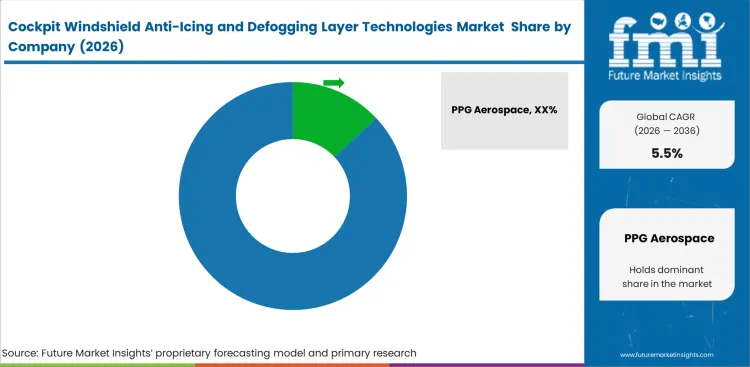
- Competition is shaped by certified cockpit-window capability, conductive-layer integration, and repair support.
- Large suppliers gain advantage from program history, test capability, and multi-platform supply access.
- New entrants face a higher barrier because optical clarity, heating consistency, structural fit, and service life must work together inside a certified part.
PPG Aerospace and Saint-Gobain Sully form the largest capability group due to broad transparency expertise and OEM access. Functional films and aircraft external camera fairing systems reflect a wider aerospace move toward multifunctional exterior and optical components.
Lee Aerospace and Mecaplex hold a meaningful position in specialist glazing and replacement supply. Adjacent visibility and glazing work across bio-based aircraft coatings and automotive front windshield systems reflects broader material work in films and transparent structures.
Key Companies in the Cockpit Windshield Anti-Icing and Defogging Layer Technologies Market
Key global companies leading the Cockpit Windshield Anti-Icing and Defogging Layer Technologies market include:
- Broad OEM and transparency leaders: PPG Aerospace, GKN Aerospace, Saint-Gobain Sully
- Transparency manufacturing and repair specialists: The NORDAM Group, Lee Aerospace, Mecaplex
- Specialist aerospace transparencies suppliers: Llamas Plastics
Competitive Benchmarking: Cockpit Windshield Anti-Icing and Defogging Layer Technologies
| Company | Cockpit Window Capability | Conductive / Functional Layer Depth | Aftermarket Support | Geographic Footprint |
|---|---|---|---|---|
| PPG Aerospace | High | High | Strong | Global |
| GKN Aerospace | High | Medium | Strong | Global |
| Saint-Gobain Sully | High | Medium | Strong | Global |
| The NORDAM Group | High | Medium | Strong | North America |
| Lee Aerospace | Medium | Medium | Strong | North America |
| Mecaplex | Medium | Medium | Medium | Europe |
| Llamas Plastics | Medium | Low | Medium | North America |
Source: Future Market Insights competitive analysis, 2026. Ratings reflect relative positioning based on cockpit window capability, conductive or functional layer depth, aftermarket support, and stated market reach.
Key Developments in Cockpit Windshield Anti-Icing and Defogging Layer Technologies
- In July 2025, GKN Aerospace secures multi-year follow-on contract with BAE Systems for Typhoon transparencies. This is a transparency supply and sustainment development tied directly to cockpit-window systems in military aircraft.
- In May 2025, PPG invested USD 380 million to build new USa manufacturing facility in Shelby, N.C. for aerospace coatings and sealants. This is an aerospace manufacturing expansion that strengthens supply capability for aircraft surface and sealing systems used alongside transparency assemblies and cockpit-window programs.
Key Players in the Cockpit Windshield Anti-Icing and Defogging Layer Technologies:
Major Global Players:
- PPG Aerospace
- GKN Aerospace
- Saint-Gobain Sully
- The NORDAM Group
Emerging Players/Startups
- Lee Aerospace
- Mecaplex
- Llamas Plastics
Report Scope and Coverage
| Parameter | Details |
|---|---|
| Quantitative Units | USD 41.3 million to USD 70.5 million, at a CAGR of 5.5% |
| Market Definition | The cockpit windshield anti-icing and defogging layer technologies market encompasses functional conductive and anti-fogging layer technologies integrated into aircraft cockpit windshields for ice prevention and visibility control. |
| Regions Covered | North America, Europe, Asia Pacific, Rest of World |
| Countries Covered | China, India, United States, France, Germany, United Kingdom, Japan |
| Key Companies Profiled | PPG Aerospace, GKN Aerospace, Saint-Gobain Sully, The NORDAM Group, Lee Aerospace, Mecaplex, Llamas Plastics |
| Forecast Period | 2026 to 2036 |
| Approach | Primary research, desk research, segment modeling, and proprietary forecasting |
Cockpit Windshield Anti-Icing and Defogging Layer Technologies Market by Segments
Cockpit Windshield Anti-Icing and Defogging Layer Technologies Market Segmented by Conductive Material:
- ITO
- Silver mesh
- Gold film
- Nanowires
- Graphene
Cockpit Windshield Anti-Icing and Defogging Layer Technologies Market Segmented by Layer Structure:
- Multilayer stacks
- Embedded films
- Surface coatings
- Hybrid stacks
Cockpit Windshield Anti-Icing and Defogging Layer Technologies Market Segmented by Function Mode:
- Anti-icing
- Defogging
- Dual-function
Cockpit Windshield Anti-Icing and Defogging Layer Technologies Market Segmented by Heating Control:
- Zonal heating
- Uniform heating
- Sensor-linked
- Pulse control
Cockpit Windshield Anti-Icing and Defogging Layer Technologies Market Segmented by Aircraft Platform:
- Commercial aircraft
- Business jets
- Regional aircraft
- Military aircraft
- Helicopters
- General aviation
Cockpit Windshield Anti-Icing and Defogging Layer Technologies Market Segmented by Fitment Type:
- OEM line-fit
- Retrofit
- Replacement
Cockpit Windshield Anti-Icing and Defogging Layer Technologies Market Segmented by End User:
- OEMs
- MROs
- Operators
- Defense depots
Bibliography
- Shen, C., Liang, Y., Wei, B., Zhang, C., & Zhao, T. (2025). Research on the formation characteristics of fog and frost on optical windows of unsealed equipment compartments in aircrafts. Energies, 18(2), Article 437.
- Gao, H., Zhou, Y., Ma, J., Jin, H., Bao, J., & Wen, D. (2025). Recent advancements in electro-thermal anti-/de-icing materials. RSC Advances.
- GKN Aerospace. (2025, July 10). GKN Aerospace secures multi-year follow-on contract with BAE Systems for Typhoon transparencies.
- Chun Shen, Yuanyuan Liang, Bo Wei, Chengchun Zhang, and Tian Zhao. (2025, January). Research on the Formation Characteristics of Fog and Frost on Optical Windows of Unsealed Equipment Compartments in Aircrafts.
- Omotayo Sanni, Jianwei Ren, and Tien Chien Jen. (2024, December). An overview of antifogging nanocoatings: Recent developments and application.
- Hui Gao, Yuqin Zhou, Jieyin Ma, Haichuan Jin, Jiayi Bao, and Dongsheng Wen. (2025, May). Recent advancements in electro-thermal anti-/de-icing materials.
This Report Answers
- How large is the cockpit windshield anti-icing and defogging layer technologies market in 2025?
- How large can the market become by 2036?
- Which function mode leads the market in 2026?
- Why does OEM line-fit hold the top fitment share?
- Which aircraft platform contributes the largest demand base?
- Why does ITO lead conductive material demand?
- Which countries post faster-than-global growth?
- Which factors slow wider use of new layer materials?
- Why does repair and overhaul support carry more weight in this market?
- Which companies hold the strongest cockpit-window capability?
- How do certification rules shape supplier selection?
- Which opportunity pocket offers better value: new programs or replacement work?
Frequently Asked Questions
What is driving this market?
Certified cockpit-view protection and steady aircraft demand support anti-icing and defogging layer demand.
Which segment leads by function mode?
Dual-function systems lead because one design handles both fogging and icing exposure.
Why is OEM line-fit ahead of retrofit?
Original certification makes validation of conductive layers and heating layouts easier at build stage.
Which aircraft platform creates the most demand?
Commercial aircraft lead because fleet size and replacement frequency are wider than in other classes.
Why do OEMs still favor established conductive materials?
Qualification depth and service familiarity often carry more weight than novelty in cockpit-window systems.
What is the main restraint in this market?
Long validation cycles and tight optical-performance tolerance slow adoption of new materials.
Why does the aftermarket matter here?
Cockpit windows face abrasion and thermal cycling, so repair speed and replacement economics affect supplier choice.
Which country is expected to grow fastest?
China is projected to post the fastest CAGR among key countries covered in this study.
Are anti-fog coatings enough on their own?
In some designs, yes. In many certified programs, integrated heating and multifunctional layer stacks still hold wider use.
What do OEMs screen first?
Visibility performance, durability, and service support usually rank ahead of quoted material price.
Preview the report firsthand - request a free sample
Get SampleGet the brochure for pricing and purchase details.
Get PDFTable of Content
- Executive Summary
- Global Market Outlook
- Demand-side Trends
- Supply-side Trends
- Technology Roadmap Analysis
- Analysis and Recommendations
- Market Overview
- Market Coverage / Taxonomy
- Market Definition / Scope / Limitations
- Research Methodology
- Chapter Orientation
- Analytical Lens and Working Hypotheses
- Market Structure, Signals, and Trend Drivers
- Benchmarking and Cross-market Comparability
- Market Sizing, Forecasting, and Opportunity Mapping
- Research Design and Evidence Framework
- Desk Research Programme (Secondary Evidence)
- Company Annual and Sustainability Reports
- Peer-reviewed Journals and Academic Literature
- Corporate Websites, Product Literature, and Technical Notes
- Earnings Decks and Investor Briefings
- Statutory Filings and Regulatory Disclosures
- Technical White Papers and Standards Notes
- Trade Journals, Industry Magazines, and Analyst Briefs
- Conference Proceedings, Webinars, and Seminar Materials
- Government Statistics Portals and Public Data Releases
- Press Releases and Reputable Media Coverage
- Specialist Newsletters and Curated Briefings
- Sector Databases and Reference Repositories
- FMI Internal Proprietary Databases and Historical Market Datasets
- Subscription Datasets and Paid Sources
- Social Channels, Communities, and Digital Listening Inputs
- Additional Desk Sources
- Expert Input and Fieldwork (Primary Evidence)
- Primary Modes
- Qualitative Interviews and Expert Elicitation
- Quantitative Surveys and Structured Data Capture
- Blended Approach
- Why Primary Evidence is Used
- Field Techniques
- Interviews
- Surveys
- Focus Groups
- Observational and In-context Research
- Social and Community Interactions
- Stakeholder Universe Engaged
- C-suite Leaders
- Board Members
- Presidents and Vice Presidents
- R&D and Innovation Heads
- Technical Specialists
- Domain Subject-matter Experts
- Scientists
- Physicians and Other Healthcare Professionals
- Governance, Ethics, and Data Stewardship
- Research Ethics
- Data Integrity and Handling
- Primary Modes
- Tooling, Models, and Reference Databases
- Desk Research Programme (Secondary Evidence)
- Data Engineering and Model Build
- Data Acquisition and Ingestion
- Cleaning, Normalisation, and Verification
- Synthesis, Triangulation, and Analysis
- Quality Assurance and Audit Trail
- Market Background
- Market Dynamics
- Drivers
- Restraints
- Opportunity
- Trends
- Scenario Forecast
- Demand in Optimistic Scenario
- Demand in Likely Scenario
- Demand in Conservative Scenario
- Opportunity Map Analysis
- Product Life Cycle Analysis
- Supply Chain Analysis
- Investment Feasibility Matrix
- Value Chain Analysis
- PESTLE and Porter’s Analysis
- Regulatory Landscape
- Regional Parent Market Outlook
- Production and Consumption Statistics
- Import and Export Statistics
- Market Dynamics
- Global Market Analysis 2021 to 2025 and Forecast, 2026 to 2036
- Historical Market Size Value (USD Million) Analysis, 2021 to 2025
- Current and Future Market Size Value (USD Million) Projections, 2026 to 2036
- Y-o-Y Growth Trend Analysis
- Absolute $ Opportunity Analysis
- Global Market Pricing Analysis 2021 to 2025 and Forecast 2026 to 2036
- Global Market Analysis 2021 to 2025 and Forecast 2026 to 2036, By Conductive Material
- Introduction / Key Findings
- Historical Market Size Value (USD Million) Analysis By Conductive Material , 2021 to 2025
- Current and Future Market Size Value (USD Million) Analysis and Forecast By Conductive Material , 2026 to 2036
- ITO
- Silver mesh
- Gold film
- Nanowires
- Graphene
- ITO
- Y-o-Y Growth Trend Analysis By Conductive Material , 2021 to 2025
- Absolute $ Opportunity Analysis By Conductive Material , 2026 to 2036
- Global Market Analysis 2021 to 2025 and Forecast 2026 to 2036, By Layer Structure
- Introduction / Key Findings
- Historical Market Size Value (USD Million) Analysis By Layer Structure, 2021 to 2025
- Current and Future Market Size Value (USD Million) Analysis and Forecast By Layer Structure, 2026 to 2036
- Multilayer stacks
- Embedded films
- Surface coatings
- Hybrid stacks
- Multilayer stacks
- Y-o-Y Growth Trend Analysis By Layer Structure, 2021 to 2025
- Absolute $ Opportunity Analysis By Layer Structure, 2026 to 2036
- Global Market Analysis 2021 to 2025 and Forecast 2026 to 2036, By Function Mode
- Introduction / Key Findings
- Historical Market Size Value (USD Million) Analysis By Function Mode, 2021 to 2025
- Current and Future Market Size Value (USD Million) Analysis and Forecast By Function Mode, 2026 to 2036
- Dual-function
- Anti-icing
- Defogging
- Dual-function
- Y-o-Y Growth Trend Analysis By Function Mode, 2021 to 2025
- Absolute $ Opportunity Analysis By Function Mode, 2026 to 2036
- Global Market Analysis 2021 to 2025 and Forecast 2026 to 2036, By Heating Control
- Introduction / Key Findings
- Historical Market Size Value (USD Million) Analysis By Heating Control, 2021 to 2025
- Current and Future Market Size Value (USD Million) Analysis and Forecast By Heating Control, 2026 to 2036
- Zonal heating
- Uniform heating
- Sensor-linked
- Pulse control
- Zonal heating
- Y-o-Y Growth Trend Analysis By Heating Control, 2021 to 2025
- Absolute $ Opportunity Analysis By Heating Control, 2026 to 2036
- Global Market Analysis 2021 to 2025 and Forecast 2026 to 2036, By Aircraft Platform
- Introduction / Key Findings
- Historical Market Size Value (USD Million) Analysis By Aircraft Platform, 2021 to 2025
- Current and Future Market Size Value (USD Million) Analysis and Forecast By Aircraft Platform, 2026 to 2036
- Commercial aircraft
- Business jets
- Regional aircraft
- Military aircraft
- Helicopters
- General aviation
- Commercial aircraft
- Y-o-Y Growth Trend Analysis By Aircraft Platform, 2021 to 2025
- Absolute $ Opportunity Analysis By Aircraft Platform, 2026 to 2036
- Global Market Analysis 2021 to 2025 and Forecast 2026 to 2036, By Fitment Type
- Introduction / Key Findings
- Historical Market Size Value (USD Million) Analysis By Fitment Type, 2021 to 2025
- Current and Future Market Size Value (USD Million) Analysis and Forecast By Fitment Type, 2026 to 2036
- OEM line-fit
- Retrofit
- Replacement
- OEM line-fit
- Y-o-Y Growth Trend Analysis By Fitment Type, 2021 to 2025
- Absolute $ Opportunity Analysis By Fitment Type, 2026 to 2036
- Global Market Analysis 2021 to 2025 and Forecast 2026 to 2036, By End User
- Introduction / Key Findings
- Historical Market Size Value (USD Million) Analysis By End User, 2021 to 2025
- Current and Future Market Size Value (USD Million) Analysis and Forecast By End User, 2026 to 2036
- OEMs
- MROs
- Operators
- Defense depots
- OEMs
- Y-o-Y Growth Trend Analysis By End User, 2021 to 2025
- Absolute $ Opportunity Analysis By End User, 2026 to 2036
- Global Market Analysis 2021 to 2025 and Forecast 2026 to 2036, By Region
- Introduction
- Historical Market Size Value (USD Million) Analysis By Region, 2021 to 2025
- Current Market Size Value (USD Million) Analysis and Forecast By Region, 2026 to 2036
- North America
- Latin America
- Western Europe
- Eastern Europe
- East Asia
- South Asia and Pacific
- Middle East & Africa
- Market Attractiveness Analysis By Region
- North America Market Analysis 2021 to 2025 and Forecast 2026 to 2036, By Country
- Historical Market Size Value (USD Million) Trend Analysis By Market Taxonomy, 2021 to 2025
- Market Size Value (USD Million) Forecast By Market Taxonomy, 2026 to 2036
- By Country
- USA
- Canada
- Mexico
- By Conductive Material
- By Layer Structure
- By Function Mode
- By Heating Control
- By Aircraft Platform
- By Fitment Type
- By End User
- By Country
- Market Attractiveness Analysis
- By Country
- By Conductive Material
- By Layer Structure
- By Function Mode
- By Heating Control
- By Aircraft Platform
- By Fitment Type
- By End User
- Key Takeaways
- Latin America Market Analysis 2021 to 2025 and Forecast 2026 to 2036, By Country
- Historical Market Size Value (USD Million) Trend Analysis By Market Taxonomy, 2021 to 2025
- Market Size Value (USD Million) Forecast By Market Taxonomy, 2026 to 2036
- By Country
- Brazil
- Chile
- Rest of Latin America
- By Conductive Material
- By Layer Structure
- By Function Mode
- By Heating Control
- By Aircraft Platform
- By Fitment Type
- By End User
- By Country
- Market Attractiveness Analysis
- By Country
- By Conductive Material
- By Layer Structure
- By Function Mode
- By Heating Control
- By Aircraft Platform
- By Fitment Type
- By End User
- Key Takeaways
- Western Europe Market Analysis 2021 to 2025 and Forecast 2026 to 2036, By Country
- Historical Market Size Value (USD Million) Trend Analysis By Market Taxonomy, 2021 to 2025
- Market Size Value (USD Million) Forecast By Market Taxonomy, 2026 to 2036
- By Country
- Germany
- UK
- Italy
- Spain
- France
- Nordic
- BENELUX
- Rest of Western Europe
- By Conductive Material
- By Layer Structure
- By Function Mode
- By Heating Control
- By Aircraft Platform
- By Fitment Type
- By End User
- By Country
- Market Attractiveness Analysis
- By Country
- By Conductive Material
- By Layer Structure
- By Function Mode
- By Heating Control
- By Aircraft Platform
- By Fitment Type
- By End User
- Key Takeaways
- Eastern Europe Market Analysis 2021 to 2025 and Forecast 2026 to 2036, By Country
- Historical Market Size Value (USD Million) Trend Analysis By Market Taxonomy, 2021 to 2025
- Market Size Value (USD Million) Forecast By Market Taxonomy, 2026 to 2036
- By Country
- Russia
- Poland
- Hungary
- Balkan & Baltic
- Rest of Eastern Europe
- By Conductive Material
- By Layer Structure
- By Function Mode
- By Heating Control
- By Aircraft Platform
- By Fitment Type
- By End User
- By Country
- Market Attractiveness Analysis
- By Country
- By Conductive Material
- By Layer Structure
- By Function Mode
- By Heating Control
- By Aircraft Platform
- By Fitment Type
- By End User
- Key Takeaways
- East Asia Market Analysis 2021 to 2025 and Forecast 2026 to 2036, By Country
- Historical Market Size Value (USD Million) Trend Analysis By Market Taxonomy, 2021 to 2025
- Market Size Value (USD Million) Forecast By Market Taxonomy, 2026 to 2036
- By Country
- China
- Japan
- South Korea
- By Conductive Material
- By Layer Structure
- By Function Mode
- By Heating Control
- By Aircraft Platform
- By Fitment Type
- By End User
- By Country
- Market Attractiveness Analysis
- By Country
- By Conductive Material
- By Layer Structure
- By Function Mode
- By Heating Control
- By Aircraft Platform
- By Fitment Type
- By End User
- Key Takeaways
- South Asia and Pacific Market Analysis 2021 to 2025 and Forecast 2026 to 2036, By Country
- Historical Market Size Value (USD Million) Trend Analysis By Market Taxonomy, 2021 to 2025
- Market Size Value (USD Million) Forecast By Market Taxonomy, 2026 to 2036
- By Country
- India
- ASEAN
- Australia & New Zealand
- Rest of South Asia and Pacific
- By Conductive Material
- By Layer Structure
- By Function Mode
- By Heating Control
- By Aircraft Platform
- By Fitment Type
- By End User
- By Country
- Market Attractiveness Analysis
- By Country
- By Conductive Material
- By Layer Structure
- By Function Mode
- By Heating Control
- By Aircraft Platform
- By Fitment Type
- By End User
- Key Takeaways
- Middle East & Africa Market Analysis 2021 to 2025 and Forecast 2026 to 2036, By Country
- Historical Market Size Value (USD Million) Trend Analysis By Market Taxonomy, 2021 to 2025
- Market Size Value (USD Million) Forecast By Market Taxonomy, 2026 to 2036
- By Country
- Kingdom of Saudi Arabia
- Other GCC Countries
- Turkiye
- South Africa
- Other African Union
- Rest of Middle East & Africa
- By Conductive Material
- By Layer Structure
- By Function Mode
- By Heating Control
- By Aircraft Platform
- By Fitment Type
- By End User
- By Country
- Market Attractiveness Analysis
- By Country
- By Conductive Material
- By Layer Structure
- By Function Mode
- By Heating Control
- By Aircraft Platform
- By Fitment Type
- By End User
- Key Takeaways
- Key Countries Market Analysis
- USA
- Pricing Analysis
- Market Share Analysis, 2025
- By Conductive Material
- By Layer Structure
- By Function Mode
- By Heating Control
- By Aircraft Platform
- By Fitment Type
- By End User
- Canada
- Pricing Analysis
- Market Share Analysis, 2025
- By Conductive Material
- By Layer Structure
- By Function Mode
- By Heating Control
- By Aircraft Platform
- By Fitment Type
- By End User
- Mexico
- Pricing Analysis
- Market Share Analysis, 2025
- By Conductive Material
- By Layer Structure
- By Function Mode
- By Heating Control
- By Aircraft Platform
- By Fitment Type
- By End User
- Brazil
- Pricing Analysis
- Market Share Analysis, 2025
- By Conductive Material
- By Layer Structure
- By Function Mode
- By Heating Control
- By Aircraft Platform
- By Fitment Type
- By End User
- Chile
- Pricing Analysis
- Market Share Analysis, 2025
- By Conductive Material
- By Layer Structure
- By Function Mode
- By Heating Control
- By Aircraft Platform
- By Fitment Type
- By End User
- Germany
- Pricing Analysis
- Market Share Analysis, 2025
- By Conductive Material
- By Layer Structure
- By Function Mode
- By Heating Control
- By Aircraft Platform
- By Fitment Type
- By End User
- UK
- Pricing Analysis
- Market Share Analysis, 2025
- By Conductive Material
- By Layer Structure
- By Function Mode
- By Heating Control
- By Aircraft Platform
- By Fitment Type
- By End User
- Italy
- Pricing Analysis
- Market Share Analysis, 2025
- By Conductive Material
- By Layer Structure
- By Function Mode
- By Heating Control
- By Aircraft Platform
- By Fitment Type
- By End User
- Spain
- Pricing Analysis
- Market Share Analysis, 2025
- By Conductive Material
- By Layer Structure
- By Function Mode
- By Heating Control
- By Aircraft Platform
- By Fitment Type
- By End User
- France
- Pricing Analysis
- Market Share Analysis, 2025
- By Conductive Material
- By Layer Structure
- By Function Mode
- By Heating Control
- By Aircraft Platform
- By Fitment Type
- By End User
- India
- Pricing Analysis
- Market Share Analysis, 2025
- By Conductive Material
- By Layer Structure
- By Function Mode
- By Heating Control
- By Aircraft Platform
- By Fitment Type
- By End User
- ASEAN
- Pricing Analysis
- Market Share Analysis, 2025
- By Conductive Material
- By Layer Structure
- By Function Mode
- By Heating Control
- By Aircraft Platform
- By Fitment Type
- By End User
- Australia & New Zealand
- Pricing Analysis
- Market Share Analysis, 2025
- By Conductive Material
- By Layer Structure
- By Function Mode
- By Heating Control
- By Aircraft Platform
- By Fitment Type
- By End User
- China
- Pricing Analysis
- Market Share Analysis, 2025
- By Conductive Material
- By Layer Structure
- By Function Mode
- By Heating Control
- By Aircraft Platform
- By Fitment Type
- By End User
- Japan
- Pricing Analysis
- Market Share Analysis, 2025
- By Conductive Material
- By Layer Structure
- By Function Mode
- By Heating Control
- By Aircraft Platform
- By Fitment Type
- By End User
- South Korea
- Pricing Analysis
- Market Share Analysis, 2025
- By Conductive Material
- By Layer Structure
- By Function Mode
- By Heating Control
- By Aircraft Platform
- By Fitment Type
- By End User
- Russia
- Pricing Analysis
- Market Share Analysis, 2025
- By Conductive Material
- By Layer Structure
- By Function Mode
- By Heating Control
- By Aircraft Platform
- By Fitment Type
- By End User
- Poland
- Pricing Analysis
- Market Share Analysis, 2025
- By Conductive Material
- By Layer Structure
- By Function Mode
- By Heating Control
- By Aircraft Platform
- By Fitment Type
- By End User
- Hungary
- Pricing Analysis
- Market Share Analysis, 2025
- By Conductive Material
- By Layer Structure
- By Function Mode
- By Heating Control
- By Aircraft Platform
- By Fitment Type
- By End User
- Kingdom of Saudi Arabia
- Pricing Analysis
- Market Share Analysis, 2025
- By Conductive Material
- By Layer Structure
- By Function Mode
- By Heating Control
- By Aircraft Platform
- By Fitment Type
- By End User
- Turkiye
- Pricing Analysis
- Market Share Analysis, 2025
- By Conductive Material
- By Layer Structure
- By Function Mode
- By Heating Control
- By Aircraft Platform
- By Fitment Type
- By End User
- South Africa
- Pricing Analysis
- Market Share Analysis, 2025
- By Conductive Material
- By Layer Structure
- By Function Mode
- By Heating Control
- By Aircraft Platform
- By Fitment Type
- By End User
- USA
- Market Structure Analysis
- Competition Dashboard
- Competition Benchmarking
- Market Share Analysis of Top Players
- By Regional
- By Conductive Material
- By Layer Structure
- By Function Mode
- By Heating Control
- By Aircraft Platform
- By Fitment Type
- By End User
- Competition Analysis
- Competition Deep Dive
- PPG Aerospace
- Overview
- Product Portfolio
- Profitability by Market Segments (Product/Age /Sales Channel/Region)
- Sales Footprint
- Strategy Overview
- Marketing Strategy
- Product Strategy
- Channel Strategy
- GKN Aerospace
- Saint-Gobain Sully
- The NORDAM Group
- Lee Aerospace
- Mecaplex
- Llamas Plastics
- PPG Aerospace
- Competition Deep Dive
- Assumptions & Acronyms Used


