

- Market Size (2026)
- USD 2.40 Bn
- Forecast (2036)
- USD 5.42 Bn
- CAGR (2026 to 2036)
- 8.5%
Low-Glare High-Brightness Displays for Commercial Vehicles Market Size, Forecast, and Outlook By FMI
Summary of the Low-Glare High-Brightness Displays for Commercial Vehicles Market
- Demand and Growth Drivers
- Fleet operators are adding brighter screens as camera-monitor systems and blind-zone alerts create more visual workload for drivers.
- OEMs are choosing optical bonding as sunlight readability can decide whether a display supports safe driving in daytime routes.
- Commercial vehicle electrification raises cabin electronics value as digital clusters and energy management screens replace analog panels.
- Product and Segment View
- OEM fitment is anticipated to represent 82.0% share in 2026 since factory integration sets display size and controller architecture.
- Optical bonding is projected to account for 64.0% share in 2026, led by high-brightness modules requiring reflection control.
- TFT-LCD is expected to hold 58.0% share in 2026 as it gives proven automotive reliability at lower panel cost.
- Geography and Competitive Outlook
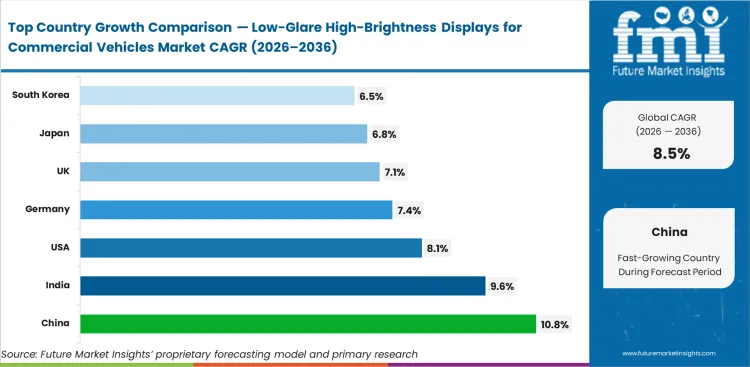
- China is projected to record 10.8% CAGR by 2036, as commercial vehicle production and smart cockpit sourcing expand together.
- India is expected to expand at 9.6% CAGR by 2036 as higher commercial vehicle sales raise OEM display content.
- Continental Automotive and Visteon hold established positions through cockpit integration and display controller depth.
- Analyst Opinion
- Nikhil Kaitwade, Principal Analyst for Automotive and Transportation at FMI, observes, "As per our analysts, fleet buyers are moving away from basic screen count and toward display usefulness under sunlight. Commercial vehicles create harder display conditions than passenger cars as cabins face long duty cycles and higher cabin wear. OEMs will favor suppliers able to combine optical bonding and camera feed integration in one validated cockpit path. Retrofit opportunity exists in regulated urban freight zones, while factory fitment is likely to stay the main revenue channel by 2036."
- Low-Glare High-Brightness Displays for Commercial Vehicles Market Value Analysis
- Low-glare high-brightness displays are shifting from basic dashboard screens into visibility-critical cockpit systems for commercial vehicles.
- Vehicle makers are expected to raise use of sunlight-readable displays as digital clusters and camera views enter truck and bus cabins.
- Anti-reflective cover glass is preferred since drivers need clearer screen visibility during daytime routes and long operating shifts.
- Demand is supported by commercial vehicle uptime needs because poor display readability can slow driver response and raise cabin safety concerns.
Key Takeaways, Market Size, and Forecast
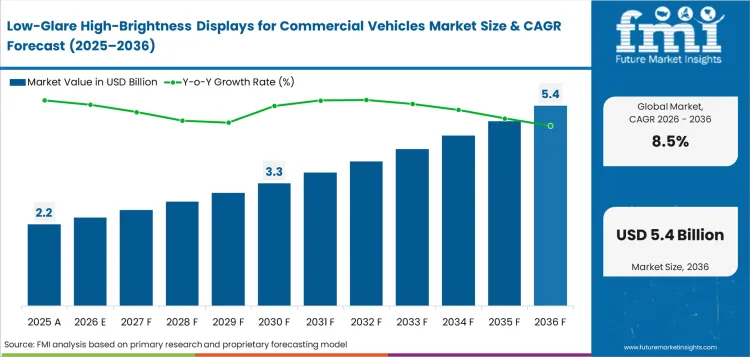
- Low-glare high-brightness displays for commercial vehicles industry was valued at USD 2.21 billion in 2025.
- Market revenue is projected to reach USD 5.42 billion by 2036 as commercial fleets add brighter screens for camera feeds and digital clusters.
- Industry is expected to expand at 8.5% CAGR from 2026 to 2036 across OEM and retrofit display channels.
- Sector is projected to create an incremental opportunity of USD 3.02 billion between 2026 and 2036.
- OEM fitment is projected to account for 82.0% share in 2026 since display modules are specified during vehicle cockpit design.
- Optical bonding is expected to hold 64.0% share in 2026 as it reduces internal reflections and improves outdoor readability.
- China at 10.8% CAGR is forecast to outpace other listed countries by 2036.
Low-glare high-brightness displays for commercial vehicles remain important as truck and bus cabins need readable screens under sunlight and long driving shifts. OICA reported in April 2026 that global vehicle production rose from 92.7 million units in 2024 to 96.4 million units in 2025. Higher vehicle output gives display suppliers a wider cockpit fitment pool across trucks and buses. Continental reported in January 2024 that its 10-inch Crystal Center Display used microLED technology for higher brightness and contrast. Visteon reported in January 2026 that smartphone projection is enabled on displays under seven inches for light commercial vehicles and entry cars. Display readability carries driver-visibility and uptime implications for commercial vehicle makers.
Low-Glare High-Brightness Displays for Commercial Vehicles Market Definition
Low-glare high-brightness displays for commercial vehicles are rugged cockpit screens designed for readable driver information under daylight, night and mixed-reflection conditions. Scope covers instrument clusters, center displays, camera-monitor screens, rear-view monitors, head-up display modules and external information surfaces used in trucks, buses, vans and vocational vehicles. Manual gauges, consumer tablets and generic infotainment displays sold without automotive-grade sunlight readability or glare-control design are outside revenue scope.
Low-Glare High-Brightness Displays for Commercial Vehicles Market Inclusions
Market scope covers display modules categorized by technology including TFT-LCD, OLED, MicroLED and ePaper. Screen scope covers driver clusters, center stacks, rear-view monitors, head-up display modules and external message displays. Visibility treatment covers optical bonding, anti-reflective coatings, matte cover glass and local dimming systems. Sales scope covers OEM fitment, retrofit kits and aftermarket replacement across trucks, vans, buses and vocational vehicles. Key stakeholders include display panel makers, cockpit electronics suppliers, commercial vehicle OEMs, body builders, camera-monitor suppliers, fleet retrofit installers and vehicle service networks. Related automotive display units are used as a benchmark for screen sizing and cockpit packaging trends.
Low-Glare High-Brightness Displays for Commercial Vehicles Market Exclusions
Study scope excludes consumer mobile devices, passenger-car-only entertainment screens, non-automotive industrial displays and display glass sold without integrated vehicle-grade electronics. Basic replacement bezels and generic aftermarket tablets are excluded unless sold as certified commercial vehicle display assemblies. Software-only cockpit interfaces are excluded unless bundled with a revenue-bearing display module or controller package. Passenger-only cabin media such as automotive metaverse in-car entertainment is outside the core driver display scope.
Low-Glare High-Brightness Displays for Commercial Vehicles Market Research Methodology
- Primary Research: FMI analysts reviewed cockpit electronics suppliers, panel makers and fleet retrofit installers. Interviews focused on sunlight readability and warranty risk.
- Desk Research: Desk review used commercial vehicle sales data, safety regulation updates and official supplier product launches from 2024 onward.
- Market Sizing and Forecasting: Forecast work combined commercial vehicle production volume, estimated screen content and average module pricing by fitment route.
- Data Validation: Segment shares were checked against display placement, glare-control treatment cost and OEM versus retrofit purchase timing.
Why is the Low-Glare High-Brightness Displays for Commercial Vehicles Market Growing?
- Commercial fleets need brighter automotive displays as camera feeds and safety alerts move into daily truck and van operation.
- Urban truck visibility rules are raising interest in automotive cameras that depend on readable monitors inside the cab.
- Safety ratings are moving driver monitoring systems into vehicle design as vision alerts and driver monitoring become part of truck assessment.
Commercial vehicle screens carry more value as safety information moves from mirrors and gauges into digital instrument clusters. Euro NCAP reported in April 2026 that five of seven regional distribution trucks achieved five-star ratings with testing covering vision and driver monitoring. Safety scoring now places screen-based alerts closer to the automotive active safety system chain. Clear camera feeds and warnings are part of the vehicle selection process. Suppliers able to prove daylight readability should gain better access to OEM truck programs.
Regulatory pressure is strongest in city freight routes combining blind-zone risk with tight delivery schedules. Transport for London strengthened its Direct Vision Standard from October 2024 for heavy goods vehicles with lower visibility ratings. Camera-monitor screens and moving-off information systems need displays staying readable through reflected daylight. DVS requirements turn glare-control coatings and optical bonding from optional finish choices into functional safety inputs. Glare-control upgrades improve the outlook for digital cockpit solutions used in commercial vehicle safety systems.
Market Segmentation Analysis
- In 2026, TFT‑LCD is expected to represent 58.0% share, reflecting commercial vehicle programs’ preference for display technologies able to balance durability with cost control.
- Driver clusters are likely to capture 39.0% share in 2026, as critical alerts and speed information continue to be positioned within the driver’s immediate field of view.
- Heavy trucks are projected to hold a 44.0% share in 2026, as extended operating hours influence influencing demand for clear and easily readable in‑cabin displays.
- Optical bonding is projected to lead with a 64.0% share in 2026, supported by its ability to reduce internal reflections and enhance display contrast through reduced air gaps.
- Displays sized between seven and twelve inches are expected to account for 52.0% share in 2026, aligning with the compact form factors used in instrument clusters and rear‑view monitoring systems.
- OEM installations are forecast to represent about 82.0% share in 2026, as dashboard layouts and safety electronics are largely defined during the vehicle design phase.
The industry is segmented by display technology and vehicle type as the main demand measures for low-glare high-brightness display purchase behavior. Brightness class, display location and sales channel complete the scope by showing visibility needs and fitment routes. Display technology segmentation includes LCD displays, OLED displays and microLED displays with LCD displays leading because of cost stability and wider use in truck instrument clusters. Vehicle type scope covers trucks, buses and light commercial vehicles with trucks leading because of higher cabin screen use and longer route exposure.
Brightness class includes 700 to 1,000 nits, 1,001 to 1,500 nits and above 1,500 nits with 1,001 to 1,500 nits holding the strongest use case because of balanced daylight readability and power draw. Display location segmentation covers instrument clusters, center information displays and camera monitor displays with instrument clusters leading as speed and warning visibility remain core driver needs. Sales channel covers OEM fitment, aftermarket replacement and fleet retrofit programs with OEM fitment favored as screen design becomes part of cockpit architecture.
Insights into Low-Glare High-Brightness Displays for Commercial Vehicles Market by Display Type
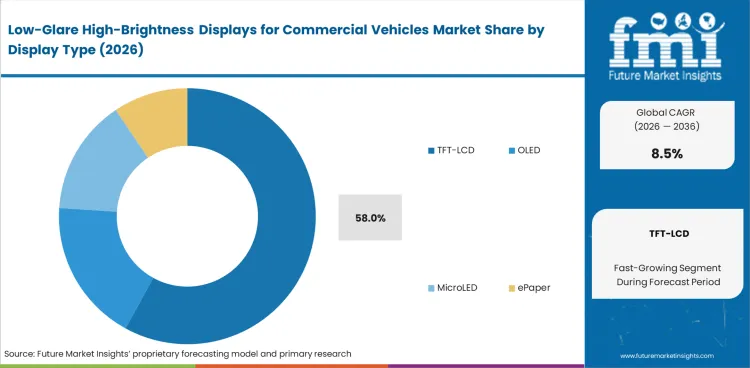
- TFT-LCD is expected to account for 58.0% share in 2026, led by truck and van OEMs requiring a proven display platform able to tolerate heat and long service intervals without pushing cockpit cost too high.
- Panel makers keep TFT-LCD important through MiniLED backlights and local dimming, improving contrast while preserving the supply chain familiarity needed for commercial vehicle programs.
Insights into Low-Glare High-Brightness Displays for Commercial Vehicles Market by Screen Position
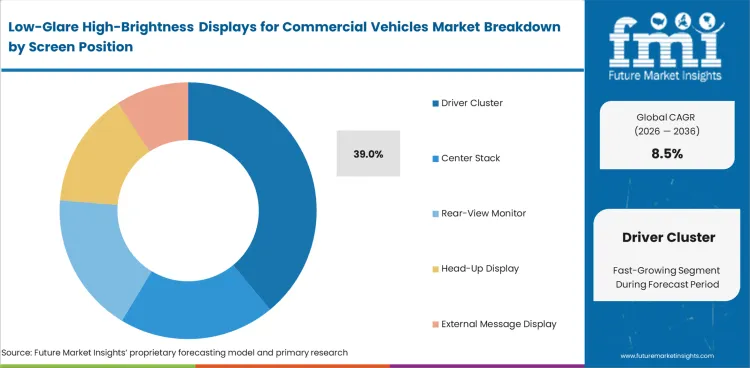
- Driver clusters are projected to account for 39.0% share in 2026 due to speed data and energy-use cues needing a primary screen position that drivers already monitor during every route.
- Cluster displays gain specification priority over passenger entertainment screens as safety alerts and route information carry more operational value for fleet owners.
Insights into Low-Glare High-Brightness Displays for Commercial Vehicles Market by Vehicle Type
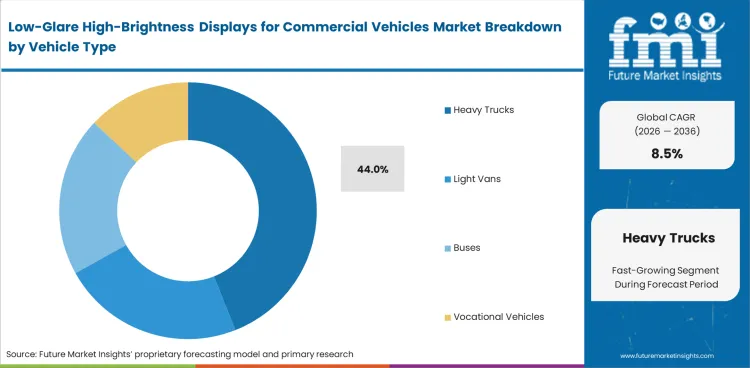
- Heavy trucks are anticipated to hold 44.0% share in 2026, supported by long-haul and urban distribution vehicles using larger cabs with clearer need for mirror-replacement displays and safety warnings.
- Fleet operators in freight lanes value high-brightness screens since drivers face changing sunlight angles and nighttime glare during extended shifts.
Insights into Low-Glare High-Brightness Displays for Commercial Vehicles Market by Visibility Treatment
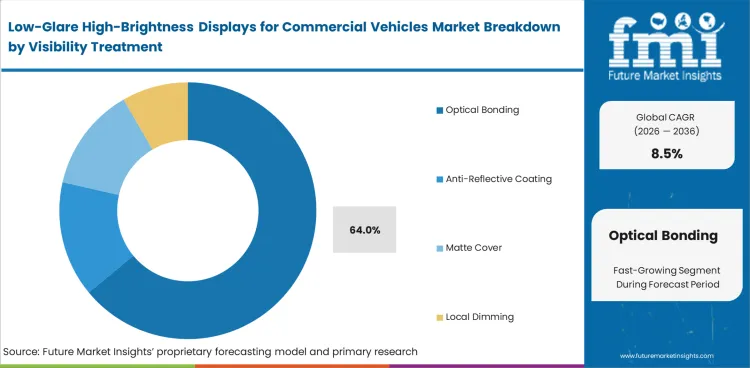
- Optical bonding is forecast to account for 64.0% share in 2026, as bonding the cover glass to the display reduces internal reflections and protects readability in bright daylight.
- Commercial buyers accept higher module cost once a bonded screen lowers field complaints tied to washed-out rear-view camera images.
Insights into Low-Glare High-Brightness Displays for Commercial Vehicles Market by Display Size
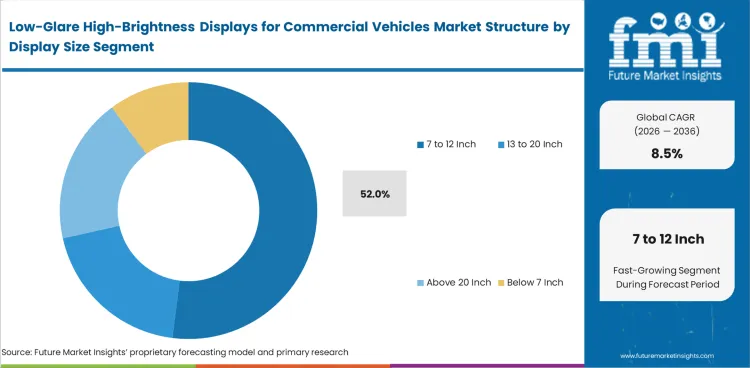
- Seven-to-twelve-inch displays are expected to account for 52.0% share in 2026 since clusters and camera monitors fit this size band without forcing full dashboard redesign.
- Fleet retrofit teams prefer this size band as it aligns with common mounting points and keeps replacement labor lower than wide cockpit panels.
Insights into Low-Glare High-Brightness Displays for Commercial Vehicles Market by Sales Channel
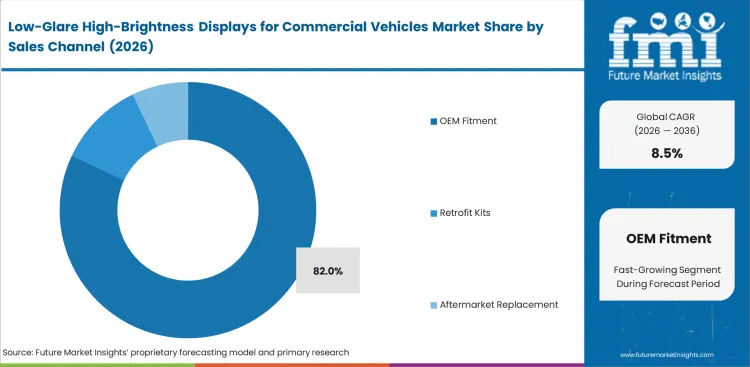
- OEM fitment is projected to hold 82.0% share in 2026 as display modules need validation with vehicle power supply and dashboard thermal limits before vehicle launch.
- Aftermarket kits serve urban compliance and replacement demand. Factory fitment carries more value as screens are tied to warranty and vehicle electronics.
Low-Glare High-Brightness Displays for Commercial Vehicles Market Drivers, Restraints, and Opportunities
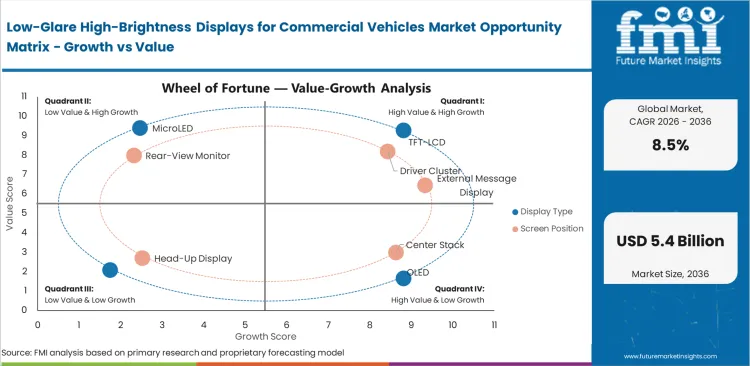
- Driver visibility rules are raising screen value as camera-monitor systems need readable images in bright daylight.
- Heat and power limits can restrain use due to high-brightness displays raising dashboard thermal load during long routes.
- Optical bonding opens opportunity led by fleets seeking lower reflection without redesigning the full dashboard layout.
Safety regulation and rating pressure are expected to shape the market over the forecast period as truck cabins move from mirrors to automotive camera systems. UNECE Regulation No. 46 states that high-luminance monitor glare must be avoided through dimmable monitor luminance in night driving and makes brightness control a safety requirement for camera-monitor screens. Transport for London now requires zero, one or two star rated HGVs to fit Progressive Safe System conditions before receiving a new permit. Fleets using camera-monitor screens and moving-off information systems need displays able to stay readable under reflected daylight. High-brightness modules can face power and heat limits inside the cab, so suppliers need better thermal design with automotive display modules. Optical bonding and anti-reflective coatings create a clearer opening as they reduce washout without forcing full dashboard redesign. Display suppliers with proven glare control should gain better access to head-up display and low-haze windshield defogging coatings systems used in driver visibility packages.
Display Attribute and Claim Preference Analysis
Display attribute preference is expected to shift from screen size toward verified readability under safety-critical driving conditions. Euro NCAP reported in April 2026 that five of seven regional distribution trucks achieved five-star ratings and every tested model met the CitySafe threshold. Truck safety assessment now gives more weight to vision support and driver monitoring. Screen-based assessment strengthens the case for displays showing camera feeds and warnings without washout in daylight. Suppliers with proven glare control and dimming performance should gain better access to OEM display programs.
Regional and Fleet Demand Analysis
Regional demand is expected to follow commercial vehicle production depth and the pace of cockpit electronics adoption. OICA reported in April 2026 that global automobile production rose from 92.7 million units in 2024 to 96.4 million units in 2025. Trucks and buses form part of the vehicle output pool. Higher production gives display suppliers a wider fitment route across new commercial vehicle platforms. Asia is likely to remain a larger volume region. Europe may show better safety-led specification pressure through truck visibility rules and rating systems.
Regional Analysis
.webp "Top Country Growth Comparison Low Glare High Brightness Displays For Commercial Vehicles Market Cagr (2026 2036)")
| Country | CAGR 2026 to 2036 |
|---|---|
| China | 10.8% |
| India | 9.6% |
| United States | 8.1% |
| Germany | 7.4% |
| United Kingdom | 7.1% |
| Japan | 6.8% |
| South Korea | 6.5% |
Source: Future Market Insights analysis, 2026.
Analysis of Low-Glare High-Brightness Displays for Commercial Vehicles Market by Key Countries
- China is projected to record 10.8% CAGR by 2036, led by parallel growth in commercial vehicle production and strengthening local display panel supply.
- India is expected to expand at 9.6% CAGR by 2036, as fleet replacement cycles accelerate and domestic commercial vehicle sales rise.
- United States is forecast to grow at 8.1% CAGR by 2036 due to pickup‑based work fleets and medium‑duty trucks adopting richer cockpit display systems.
- Germany is expected to advance at 7.4% CAGR by 2036 since truck safety regulations and premium OEM programs emphasize readable in‑cabin displays.
- United Kingdom is forecast at 7.1% CAGR by 2036 as visibility mandates in urban areas support camera-monitor systems.
- Japan is expected to record a 6.8% CAGR through 2036 which reflects fleet screen replacement for reliability and mirror-monitor compatibility.
- South Korea at 6.5% CAGR over the forecast period is owing to electronics manufacturing support for cockpit display sourcing.
Country performance differs by commercial vehicle production, safety regulation and local display supply. China and India are expected to grow faster than the global pace as vehicle volume and cockpit electronics sourcing rise together. United States and Germany track closer to the global average due to mature fleet buying and higher validation requirements. United Kingdom, Japan and South Korea are forecast below the global pace but remain important due to safety rules, OEM quality needs and panel technology depth.
Demand Outlook for Low-Glare High-Brightness Displays for Commercial Vehicles in China
China remains the volume anchor for commercial vehicle cockpit displays. China Association of Automobile Manufacturers data released in January 2026 showed 2025 commercial vehicle production of 4.261 million units and sales of 4.296 million units. The volume gives local OEMs room to standardize digital clusters across trucks and buses. Domestic panel makers such as BOE and Tianma give vehicle makers shorter sourcing routes for high-brightness screens. The sector in China is projected to record a 10.8% CAGR by 2036 as commercial vehicle output and display supply deepen together.
- Guangdong panel supply supports faster screen sampling for truck OEMs needing anti-reflective cockpit modules with local engineering support.
- China VI emission vehicle replacement keeps fleet buyers focused on newer cabs that can absorb digital clusters and camera-monitor screens.
- Port logistics operators in coastal provinces need sunlight-readable displays as drivers move between open yards and shaded loading docks.
Sales Analysis of Low-Glare High-Brightness Displays for Commercial Vehicles in India
Industry sales in India are expected to expand at 9.6% CAGR by 2036, led by commercial vehicle sales and cabin electronics content rising together. India provides a volume-based route for displays as truck and bus sales recover. SIAM data released in April 2026 showed commercial vehicle sales reached 10.80 lakh units in FY 2025-26 and grew 12.6% from FY 2024-25. New commercial fleets require clearer clusters as driver information shifts into electronic panels. Local assembly gives display suppliers a cost route for 7-to-12-inch modules.
- Maharashtra and Tamil Nadu freight corridors support higher screen replacement as long daily routes create tougher cabin readability conditions.
- Bharat NCAP awareness raises interest in visible safety information as OEMs add richer warnings across vehicle categories.
- Domestic body builders serving school buses and staff transport vehicles need durable displays for camera feeds and route information.
Demand Analysis of Low-Glare High-Brightness Displays for Commercial Vehicles in United States
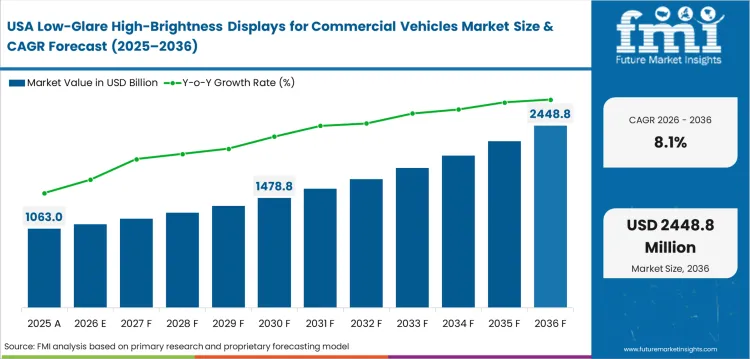
United States demand is shaped by work trucks and delivery vehicles carrying more digital information. OICA sales data for 2025 listed United States commercial vehicle sales at 13,946,387 units. The large light-truck and work-vehicle pool gives display suppliers a wide fitment channel. Fleet buyers compare screen brightness with camera visibility as rear-view and side-view systems expand. Sector demand in the United States is forecast to grow at 8.1% CAGR by 2036, as fleet replacement supports higher cockpit display content. Class 4 category gives suppliers another medium-duty route for validated screen modules.
- Federal Motor Carrier Safety Administration inspection pressure keeps fleet managers focused on cab equipment reliability and driver warnings.
- Texas vocational trucks face high cabin heat, raising demand for thermal-stable displays and durable optical bonding.
- California delivery fleets need readable camera feeds as urban routes combine sunlight glare with frequent curbside stops. North America head-up display adoption gives cockpit suppliers an adjacent optics route.
Opportunity Analysis of Low-Glare High-Brightness Displays for Commercial Vehicles in Germany
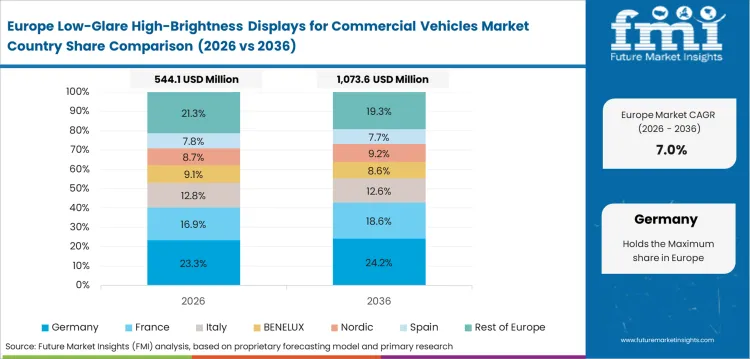
German industry revenue is expected to advance at 7.4% CAGR by 2036 due to safety-led truck platforms sustaining high display quality requirements. Germany carries strong value per vehicle as premium truck platforms use more validated cockpit electronics. VDIK reported in January 2026, 350,122 new commercial vehicles were registered in Germany during 2025. Lower vehicle volume than China or the United States is balanced by stricter quality expectations and higher electronics content. German OEMs focus on reliable screens that support camera views and driver assistance prompts.
- German logistics operators value long warranty coverage as digital clusters become part of scheduled vehicle service planning.
- Bavaria and Baden-Wuerttemberg supplier clusters support engineering links between display modules and cockpit control units.
- Federal road safety attention favors readable driver information as trucks move through dense motorway and urban delivery routes.
Future Outlook for Low-Glare High-Brightness Displays for Commercial Vehicles in United Kingdom
United Kingdom demand is shaped by safety compliance in urban freight. Transport for London confirmed in October 2024, Direct Vision Standard requirements were strengthened for heavy goods vehicles operating in most of Greater London. Fleet operators using older HGVs need clear in-cab information from camera systems and moving-off alerts. Retrofit installers can convert 2024 compliance into display replacement demand. United Kingdom adoption is projected to rise at 7.1% CAGR by 2036 as visibility rules support monitor upgrades.
- Greater London freight operators need camera-monitor displays that remain readable in day routes under the Progressive Safe System framework.
- Birmingham and Manchester clean-air freight planning supports newer commercial vehicles with richer cabin electronics and clearer driver information.
- SMMT data for 2025 recorded 315,422 light commercial registrations, which gives display suppliers a broad van fitment channel.
Demand Outlook for Low-Glare High-Brightness Displays for Commercial Vehicles in Japan
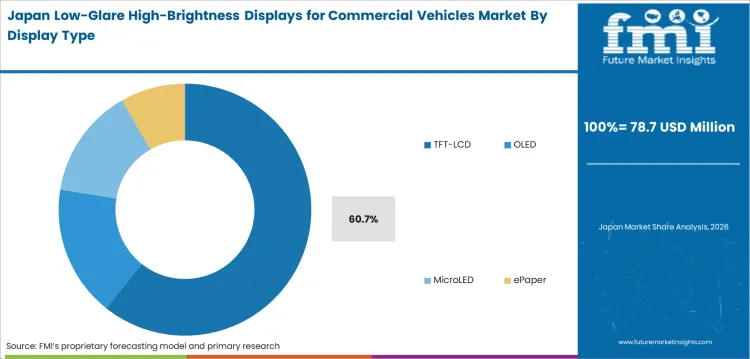
Japan is forecast at 6.8% CAGR by 2036 as replacement cycles and mirror-monitor compatibility sustaining a steady display demand. Japan has a mature commercial vehicle environment favoring reliability over rapid screen expansion. OICA sales data for 2025 listed Japan commercial vehicle sales at 729,397 units. Buyers in this market tend to replace vehicle electronics for durability and service support. Local cockpit suppliers and display engineering depth support high-quality clusters for trucks and buses.
- Japanese truck makers emphasize long service life, raising the value of thermally stable panels over low-cost screens.
- Kei-truck and light commercial fleets create a compact display opportunity around smaller clusters and rear-view monitor screens.
- Tokyo logistics fleets need compact displays as dense urban routes make mirror-monitor visibility and driver warnings more valuable.
In-depth Analysis of Low-Glare High-Brightness Displays for Commercial Vehicles in South Korea
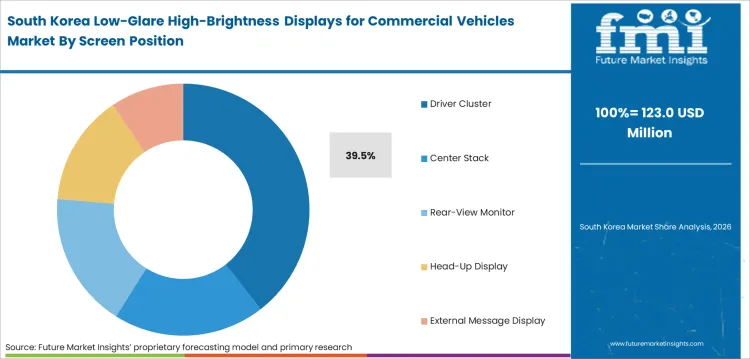
South Korea adds value through electronics supply strength and high-spec vehicle interiors. OICA production data for 2025 placed South Korea among the established vehicle-producing countries and its display supply chain supports automotive screen exports. Local OLED and advanced panel expertise gives cockpit suppliers access to brighter display options. Commercial vehicle display adoption grows more slowly and remains aligned to truck replacement and bus electronics. South Korea is expected to post 6.5% CAGR by 2036 as domestic electronics depth supports cockpit display sourcing.
- Gyeonggi electronics suppliers support fast sampling of display modules for OEM cockpit validation and commercial vehicle programs.
- Seoul bus operations create a visible use case for driver information screens and passenger-facing route displays.
- Ulsan vehicle manufacturing capability supports local integration of high-brightness panels into commercial vehicle cockpit modules.
Competitive Landscape and Strategic Positioning
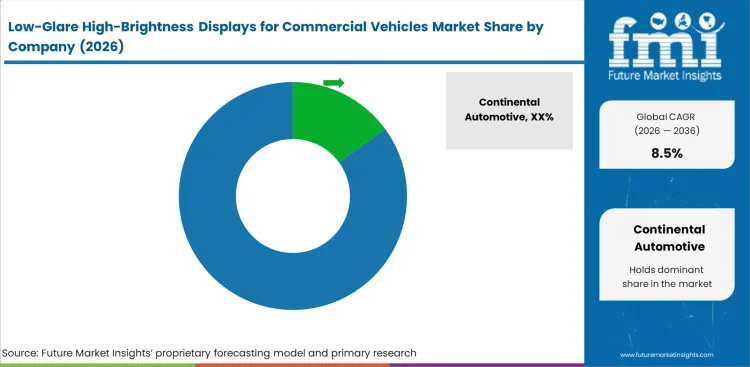
- Competition is moderately concentrated among cockpit electronics suppliers and panel makers with automotive-grade validation capability.
- Continental Automotive and Visteon hold established positions based on cockpit integration and display controller design.
- Panel specialists compete on brightness and automotive reliability instead of screen size alone.
Competition in this market is shaped by cockpit electronics suppliers and display panel makers serving commercial vehicle OEMs. Suppliers compete on validated automotive performance and display readability. Control-system integration shapes OEM selection as screens connect with camera systems, driver monitoring and safety controllers. Continental presented its Invisible Biometrics Sensing Display in November 2024 with camera and laser projector functions installed behind a dashboard display. Visteon introduced an AI-based cockpit system with Qualcomm Technologies in April 2025 and later partnered with FUTURUS for HUD systems. Supplier differentiation depends on cockpit integration and proven optical performance. Companies with display hardware and software controls should win more OEM programs as electronic shift-by-wire selector modules and other cabin electronics become software-managed.
Panel makers matter more as brightness and reflectance control become part of the buying decision. LG Display showed Tandem WOLED with 4,500 nit peak brightness and 0.3% reflection rate at CES 2026. AUO showed high-brightness and high-contrast smart cockpit displays at CES 2025. BOE showed smart cockpit products with wooden display and direct-display RGB in-vehicle lighting during CES 2025. Commercial vehicle buyers will not pay for brightness alone. Suppliers must combine glare control with low power use and rugged mounting support to protect margins in hard-duty cabins. Competitive strength will favor companies able to link display quality with cockpit electronics capability. Panel specialists will stay important. Suppliers with validated OEM relationships and integrated cabin systems are better placed to win.
Key Companies in the Low-Glare High-Brightness Displays for Commercial Vehicles Market
Competition spans cockpit electronics suppliers, automotive display panel makers and vehicle systems integrators with validated commercial vehicle programs.
- Cockpit System Integrators: Continental Automotive, Visteon and DENSO compete through dashboard integration, driver information systems and OEM program access.
- Display Panel Specialists: LG Display, AUO and BOE Varitronix compete through high-brightness panels, optical treatments and automotive-grade display portfolios.
- Mobility Electronics Suppliers: Panasonic Automotive Systems competes through cockpit platforms and software-defined vehicle partnerships with semiconductor firms. Suppliers with wired interface knowledge can support stable data links between display modules and cockpit controllers in commercial vehicles.
Competitive Benchmarking: Low-Glare High-Brightness Displays for Commercial Vehicles Market
| Company | Sunlight Readability Engineering | Cockpit Integration Depth | Commercial Vehicle Fit | Geographic Footprint |
|---|---|---|---|---|
| Continental Automotive | High | High | Strong | Global |
| Visteon Corporation | High | High | Strong | Global |
| DENSO Corporation | Strong | High | Strong | Japan and global |
| Panasonic Automotive Systems | Strong | High | Moderate | Japan and North America |
| BOE Varitronix | High | Strong | Strong | China and global |
| AUO Corporation | High | Strong | Moderate | Taiwan and global |
| LG Display | High | Medium | Moderate | South Korea and global |
Source: Future Market Insights competitive analysis based on public product portfolios and company activity in 2026.
Key Developments in Low-Glare High-Brightness Displays for Commercial Vehicles Market
- In January 2025, AUO showed Smart Cockpit 2025 with high-brightness and high-contrast display effects for smart mobility applications.
- In September 2025, Visteon and FUTURUS partnered to co-develop advanced HUD systems for global automakers.
- In January 2026, LG Display presented Tandem WOLED technology with 4,500 nits peak brightness and 0.3% reflectance.
Key Players in the Low-Glare High-Brightness Displays for Commercial Vehicles Market
Cockpit System Integrators
- Continental Automotive
- Visteon Corporation
- DENSO Corporation
- Panasonic Automotive Systems
Display Panel Specialists
- BOE Varitronix
- AUO Corporation
- LG Display
Technology and Retrofit Participants
- Tianma Microelectronics
- Innolux and CarUX
- Commercial vehicle display retrofit installers
- Camera-monitor system suppliers
Report Scope and Coverage
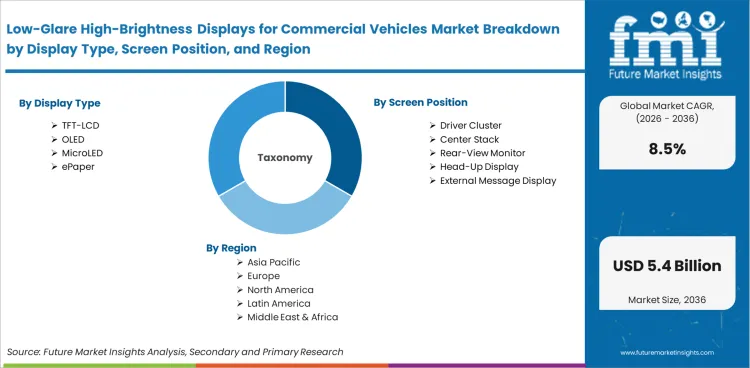
| Parameter | Details |
|---|---|
| Quantitative Units | USD 2.40 billion in 2026 to USD 5.42 billion in 2036 at a CAGR of 8.5% |
| Market Definition | Rugged commercial vehicle displays designed for high brightness, low glare and readable driver information under daylight and night conditions. |
| By Display Type | TFT-LCD, OLED, MicroLED, ePaper |
| By Screen Position | Driver cluster, center stack, rear-view monitor, head-up display, external message display |
| By Vehicle Type | Heavy trucks, light vans, buses, vocational vehicles |
| By Visibility Treatment | Optical bonding, anti-reflective coating, matte cover, local dimming |
| By Display Size | Below 7 inches, 7 to 12 inches, 13 to 20 inches, above 20 inches |
| By Sales Channel | OEM fitment, retrofit kits, aftermarket replacement |
| Regions Covered | North America, Latin America, Europe, East Asia, South Asia and Pacific, Middle East and Africa |
| Countries Covered | China, India, United States, Germany, United Kingdom, Japan, South Korea and 30+ countries |
| Key Companies Profiled | Continental Automotive, Visteon, DENSO, Panasonic Automotive Systems, BOE Varitronix, AUO, LG Display |
| Forecast Period | 2026 to 2036 |
| Approach | Hybrid bottom-up and top-down methodology using commercial vehicle volume, display content, fitment route and supplier activity checks |
Source: Future Market Insights, 2026.
Low-Glare High-Brightness Displays for Commercial Vehicles Market Breakdown by Display Type, Screen Position, Vehicle Type, Visibility Treatment, Display Size, Sales Channel, and Region
Low-Glare High-Brightness Displays for Commercial Vehicles Market Segmented by Display Type
- TFT-LCD
- OLED
- MicroLED
- ePaper
Low-Glare High-Brightness Displays for Commercial Vehicles Market Segmented by Screen Position
- Driver Cluster
- Center Stack
- Rear-View Monitor
- Head-Up Display
- External Message Display
Low-Glare High-Brightness Displays for Commercial Vehicles Market Segmented by Vehicle Type
- Heavy Trucks
- Light Vans
- Buses
- Vocational Vehicles
Low-Glare High-Brightness Displays for Commercial Vehicles Market Segmented by Visibility Treatment
- Optical Bonding
- Anti-Reflective Coating
- Matte Cover
- Local Dimming
Low-Glare High-Brightness Displays for Commercial Vehicles Market Segmented by Display Size
- Below 7 Inch
- 7 to 12 Inch
- 13 to 20 Inch
- Above 20 Inch
Low-Glare High-Brightness Displays for Commercial Vehicles Market Segmented by Sales Channel
- OEM Fitment
- Retrofit Kits
- Aftermarket Replacement
Low-Glare High-Brightness Displays for Commercial Vehicles Market by Region
- North America
- United States
- Canada
- Mexico
- Latin America
- Brazil
- Chile
- Rest of Latin America
- Western Europe
- Germany
- UK
- Italy
- Spain
- France
- Nordic
- BENELUX
- Rest of Western Europe
- Eastern Europe
- Poland
- Hungary
- Balkan and Baltic
- Rest of Eastern Europe
- East Asia
- China
- Japan
- South Korea
- South Asia and Pacific
- India
- ASEAN
- Australia and New Zealand
- Rest of South Asia and Pacific
- Middle East and Africa
- Kingdom of Saudi Arabia
- Other GCC Countries
- Turkiye
- South Africa
- Rest of Middle East and Africa
Research Sources and Bibliography
- AUO Corporation. (2025, January 8). AUO booth highlights at CES 2025.
- BOE Technology Group. (2025, January 8). BOE shines at CES 2025 with cutting-edge technologies, leveraging the “HERO” Initiative to unlock a smarter future across diverse scenarios.
- Continental AG. (2024, November 20). Transparent tech: Invisible Biometrics Sensing Display monitors passengers’ vital parameters.
- Euro NCAP. (2026, April 22). Driving change: Euro NCAP elevates safety standards for European trucks.
- European Automobile Manufacturers’ Association. (2026, January 29). New commercial vehicle registrations: Vans -8.8%, trucks -6.2%, buses +7.5% in 2025.
- International Organization of Motor Vehicle Manufacturers. (2026, April 23). Auto industry growth shifted east in 2025 amid global repositioning.
- LG Display. (2026, January 5). LG Display to unveil strategic OLED lineup built on best-in-class technology at CES 2026.
- Panasonic Holdings Corporation. (2025, January 7). Panasonic Automotive Systems and Qualcomm expand collaboration to transform in-vehicle experiences with Snapdragon Cockpit Elite Platform.
- Society of Indian Automobile Manufacturers. (2026, April 14). Auto industry performance of Q4 (Jan-March 2026) & FY 2025-26.
- Society of Motor Manufacturers and Traders. (2026, January 6). Van market shrinks in 2025 despite EV growth.
- Transport for London. (2024, October 28). World-leading Direct Vision Standard for HGVs strengthened in the capital, helping to reduce road danger and save lives.
- United Nations Economic Commission for Europe. (2024, February). UN Regulation No. 46: Devices for indirect vision.
- Verband der Internationalen Kraftfahrzeughersteller. (2026, January 6). New registrations: Strong finish to 2025: Significant increase in BEVs among international registrations.
- Visteon Corporation. (2025, April 24). Visteon and Qualcomm redefine next-generation AI-based intelligent cockpit experience.
- Visteon Corporation. (2025, September 18). Visteon and FUTURUS partner to advance next-gen head-up display technology.
Bibliography is provided for reader reference and uses primary government, regulatory, official trade body, or official company publications.
This Report Answers
- What is the forecast value of the Low-Glare High-Brightness Displays for Commercial Vehicles Market by 2036?
- Which visibility treatment is expected to hold a strong share in 2026?
- Which countries are forecast to grow faster than the global pace by 2036?
- Which display type is projected to account for a leading share in 2026?
- Which suppliers are active in commercial vehicle cockpit displays and high-brightness panels?
- What role do safety rules and camera-monitor systems play in display demand?
- How do OEM fitment and retrofit channels differ in value creation?
Frequently Asked Questions
How big is the low-glare high-brightness displays for commercial vehicles market in 2026?
Industry revenue is expected to reach USD 2.40 billion in 2026 and advance to USD 5.42 billion by 2036.
What is the projected CAGR for the low-glare high-brightness displays for commercial vehicles market?
Sector is forecast to expand at 8.5% CAGR from 2026 to 2036 as fleets add clearer safety displays.
Which segment holds a strong share in the low-glare high-brightness displays for commercial vehicles market?
OEM fitment is projected to hold 82.0% share in 2026 due to factory validation and cockpit integration needs.
Which country shows faster growth in the low-glare high-brightness displays for commercial vehicles market?
China is projected to record 10.8% CAGR by 2036 as vehicle output and display supply expand together.
Which companies compete in the low-glare high-brightness displays for commercial vehicles market?
Continental Automotive, Visteon, DENSO, Panasonic Automotive Systems, BOE Varitronix, AUO and LG Display are active suppliers.
Why are low-glare high-brightness displays important for commercial vehicles?
Readable screens support camera feeds, driver warnings and route data under sunlight and night glare during long duty cycles.
Preview the report firsthand - request a free sample
Get SampleGet the brochure for pricing and purchase details.
Get PDFTable of Content
- Key Takeaways
- Market Size and CAGR
- Top Growth Driver
- Fastest Growing Segment
- Leading Region
- Key Companies
- Emerging Opportunities
- Executive Summary
- Global Market Outlook
- Demand-side Trends
- Supply-side Trends
- Technology Roadmap Analysis
- Analysis and Recommendations
- Analyst Perspective (What is happening? Why now? What should investors know?)
- Key Questions Answered
- How large is the market?
- What is the CAGR?
- What are key trends?
- Which region dominates?
- Who are the leaders?
- Market Overview
- Market Coverage / Taxonomy
- Market Definition / Scope / Limitations
- Research Methodology
- Chapter Orientation
- Analytical Lens and Working Hypotheses
- Market Structure, Signals, and Trend Drivers
- Benchmarking and Cross-market Comparability
- Market Sizing, Forecasting, and Opportunity Mapping
- Research Design and Evidence Framework
- Desk Research Programme (Secondary Evidence)
- Expert Input and Fieldwork (Primary Evidence)
- Tooling, Models, and Reference Databases
- Data Engineering and Model Build
- Quality Assurance and Audit Trail
- Market Background
- Market Dynamics (Drivers, Restraints, Opportunity, Trends)
- Scenario Forecast (Optimistic, Likely, Conservative)
- Impact Analysis
- AI Impact
- Sustainability Impact
- Regulatory Impact
- Technology Impact
- Consumer / Buyer Analysis
- Purchase Drivers
- Adoption Barriers
- Buyer Journey
- Opportunity Map Analysis
- Product Life Cycle Analysis
- Supply Chain Analysis
- Investment Feasibility Matrix
- Value Chain Analysis
- PESTLE and Porter's Analysis
- Regulatory Landscape
- Regional Parent Market Outlook
- Production and Consumption Statistics
- Import and Export Statistics
- Global Market Analysis and Forecast, 2021 to 2036
- Historical Market Size Value (USD Billion) & Volume (Unit) Analysis, 2021 to 2025
- Current and Future Market Size Value (USD Billion) & Volume (Unit) Projections, 2026 to 2036
- Y-o-Y Growth Trend Analysis
- Absolute $ Opportunity Analysis
- Global Market Pricing Analysis, 2021 to 2036
- Global Market Analysis and Forecast, By Display Type, 2021 to 2036
- Introduction / Key Findings
- Historical Market Size Value (USD Billion) & Volume (Unit) Analysis By Display Type, 2021 to 2025
- Current and Future Market Size Value (USD Billion) & Volume (Unit) Analysis and Forecast By Display Type, 2026 to 2036
- TFT-LCD
- OLED
- MicroLED
- ePaper
- TFT-LCD
- Y-o-Y Growth Trend Analysis By Display Type, 2021 to 2025
- Absolute $ Opportunity Analysis By Display Type, 2026 to 2036
- Global Market Analysis and Forecast, By Screen Position, 2021 to 2036
- Introduction / Key Findings
- Historical Market Size Value (USD Billion) & Volume (Unit) Analysis By Screen Position, 2021 to 2025
- Current and Future Market Size Value (USD Billion) & Volume (Unit) Analysis and Forecast By Screen Position, 2026 to 2036
- Driver Cluster
- Center Stack
- Rear-View Monitor
- Head-Up Display
- External Message Display
- Driver Cluster
- Y-o-Y Growth Trend Analysis By Screen Position, 2021 to 2025
- Absolute $ Opportunity Analysis By Screen Position, 2026 to 2036
- Global Market Analysis and Forecast, By Vehicle Type, 2021 to 2036
- Introduction / Key Findings
- Historical Market Size Value (USD Billion) & Volume (Unit) Analysis By Vehicle Type, 2021 to 2025
- Current and Future Market Size Value (USD Billion) & Volume (Unit) Analysis and Forecast By Vehicle Type, 2026 to 2036
- Heavy Trucks
- Light Vans
- Buses
- Vocational Vehicles
- Heavy Trucks
- Y-o-Y Growth Trend Analysis By Vehicle Type, 2021 to 2025
- Absolute $ Opportunity Analysis By Vehicle Type, 2026 to 2036
- Global Market Analysis and Forecast, By Visibility Treatment, 2021 to 2036
- Introduction / Key Findings
- Historical Market Size Value (USD Billion) & Volume (Unit) Analysis By Visibility Treatment, 2021 to 2025
- Current and Future Market Size Value (USD Billion) & Volume (Unit) Analysis and Forecast By Visibility Treatment, 2026 to 2036
- Optical Bonding
- Anti-Reflective Coating
- Matte Cover
- Local Dimming
- Optical Bonding
- Y-o-Y Growth Trend Analysis By Visibility Treatment, 2021 to 2025
- Absolute $ Opportunity Analysis By Visibility Treatment, 2026 to 2036
- Global Market Analysis and Forecast, By Display Size, 2021 to 2036
- Introduction / Key Findings
- Historical Market Size Value (USD Billion) & Volume (Unit) Analysis By Display Size, 2021 to 2025
- Current and Future Market Size Value (USD Billion) & Volume (Unit) Analysis and Forecast By Display Size, 2026 to 2036
- Below 7 Inch
- 7 to 12 Inch
- 13 to 20 Inch
- Above 20 Inch
- Below 7 Inch
- Y-o-Y Growth Trend Analysis By Display Size, 2021 to 2025
- Absolute $ Opportunity Analysis By Display Size, 2026 to 2036
- Global Market Analysis and Forecast, By Sales Channel
- Introduction / Key Findings
- Historical Market Size Value (USD Billion) & Volume (Unit) Analysis By Sales Channel, 2021 to 2025
- Current and Future Market Size Value (USD Billion) & Volume (Unit) Analysis and Forecast By Sales Channel, 2026 to 2036
- OEM Fitment
- Retrofit Kits
- Aftermarket Replacement
- OEM Fitment
- Y-o-Y Growth Trend Analysis By Sales Channel, 2021 to 2025
- Absolute $ Opportunity Analysis By Sales Channel, 2026 to 2036
- Global Market Analysis and Forecast, By Region, 2021 to 2036
- Introduction
- Historical Market Size Value (USD Billion) & Volume (Unit) Analysis By Region, 2021 to 2025
- Current Market Size Value (USD Billion) & Volume (Unit) Analysis and Forecast By Region, 2026 to 2036
- North America
- Latin America
- Western Europe
- Eastern Europe
- East Asia
- South Asia and Pacific
- Middle East & Africa
- Market Attractiveness Analysis By Region
- North America Market Analysis and Forecast, By Country, 2021 to 2036
- Historical Market Size Value (USD Billion) & Volume (Unit) Trend Analysis By Market Taxonomy, 2021 to 2025
- Market Size Value (USD Billion) & Volume (Unit) Forecast By Market Taxonomy, 2026 to 2036
- By Country
- USA
- Canada
- Mexico
- By Display Type
- By Screen Position
- By Vehicle Type
- By Visibility Treatment
- By Display Size
- By Sales Channel
- By Country
- Market Attractiveness Analysis
- By Country
- By Display Type
- By Screen Position
- By Vehicle Type
- By Visibility Treatment
- By Display Size
- By Sales Channel
- Key Takeaways
- Latin America Market Analysis and Forecast, By Country
- Historical Market Size Value (USD Billion) & Volume (Unit) Trend Analysis By Market Taxonomy, 2021 to 2025
- Market Size Value (USD Billion) & Volume (Unit) Forecast By Market Taxonomy, 2026 to 2036
- By Country
- Brazil
- Chile
- Rest of Latin America
- By Display Type
- By Screen Position
- By Vehicle Type
- By Visibility Treatment
- By Display Size
- By Sales Channel
- By Country
- Market Attractiveness Analysis
- By Country
- By Display Type
- By Screen Position
- By Vehicle Type
- By Visibility Treatment
- By Display Size
- By Sales Channel
- Key Takeaways
- Western Europe Market Analysis and Forecast, By Country
- Historical Market Size Value (USD Billion) & Volume (Unit) Trend Analysis By Market Taxonomy, 2021 to 2025
- Market Size Value (USD Billion) & Volume (Unit) Forecast By Market Taxonomy, 2026 to 2036
- By Country
- Germany
- UK
- Italy
- Spain
- France
- Nordic
- BENELUX
- Rest of Western Europe
- By Display Type
- By Screen Position
- By Vehicle Type
- By Visibility Treatment
- By Display Size
- By Sales Channel
- By Country
- Market Attractiveness Analysis
- By Country
- By Display Type
- By Screen Position
- By Vehicle Type
- By Visibility Treatment
- By Display Size
- By Sales Channel
- Key Takeaways
- Eastern Europe Market Analysis and Forecast, By Country
- Historical Market Size Value (USD Billion) & Volume (Unit) Trend Analysis By Market Taxonomy, 2021 to 2025
- Market Size Value (USD Billion) & Volume (Unit) Forecast By Market Taxonomy, 2026 to 2036
- By Country
- Russia
- Poland
- Hungary
- Balkan & Baltic
- Rest of Eastern Europe
- By Display Type
- By Screen Position
- By Vehicle Type
- By Visibility Treatment
- By Display Size
- By Sales Channel
- By Country
- Market Attractiveness Analysis
- By Country
- By Display Type
- By Screen Position
- By Vehicle Type
- By Visibility Treatment
- By Display Size
- By Sales Channel
- Key Takeaways
- East Asia Market Analysis and Forecast, By Country
- Historical Market Size Value (USD Billion) & Volume (Unit) Trend Analysis By Market Taxonomy, 2021 to 2025
- Market Size Value (USD Billion) & Volume (Unit) Forecast By Market Taxonomy, 2026 to 2036
- By Country
- China
- Japan
- South Korea
- By Display Type
- By Screen Position
- By Vehicle Type
- By Visibility Treatment
- By Display Size
- By Sales Channel
- By Country
- Market Attractiveness Analysis
- By Country
- By Display Type
- By Screen Position
- By Vehicle Type
- By Visibility Treatment
- By Display Size
- By Sales Channel
- Key Takeaways
- South Asia and Pacific Market Analysis and Forecast, By Country
- Historical Market Size Value (USD Billion) & Volume (Unit) Trend Analysis By Market Taxonomy, 2021 to 2025
- Market Size Value (USD Billion) & Volume (Unit) Forecast By Market Taxonomy, 2026 to 2036
- By Country
- India
- ASEAN
- Australia & New Zealand
- Rest of South Asia and Pacific
- By Display Type
- By Screen Position
- By Vehicle Type
- By Visibility Treatment
- By Display Size
- By Sales Channel
- By Country
- Market Attractiveness Analysis
- By Country
- By Display Type
- By Screen Position
- By Vehicle Type
- By Visibility Treatment
- By Display Size
- By Sales Channel
- Key Takeaways
- Middle East & Africa Market Analysis and Forecast, By Country
- Historical Market Size Value (USD Billion) & Volume (Unit) Trend Analysis By Market Taxonomy, 2021 to 2025
- Market Size Value (USD Billion) & Volume (Unit) Forecast By Market Taxonomy, 2026 to 2036
- By Country
- Kingdom of Saudi Arabia
- Other GCC Countries
- Türkiye
- South Africa
- Other African Union
- Rest of Middle East & Africa
- By Display Type
- By Screen Position
- By Vehicle Type
- By Visibility Treatment
- By Display Size
- By Sales Channel
- By Country
- Market Attractiveness Analysis
- By Country
- By Display Type
- By Screen Position
- By Vehicle Type
- By Visibility Treatment
- By Display Size
- By Sales Channel
- Key Takeaways
- Key Countries Market Analysis
- USA
- Pricing Analysis
- Market Share Analysis, 2025
- By Display Type
- By Screen Position
- By Vehicle Type
- By Visibility Treatment
- By Display Size
- By Sales Channel
- Canada
- Pricing Analysis
- Market Share Analysis, 2025
- By Display Type
- By Screen Position
- By Vehicle Type
- By Visibility Treatment
- By Display Size
- By Sales Channel
- Mexico
- Pricing Analysis
- Market Share Analysis, 2025
- By Display Type
- By Screen Position
- By Vehicle Type
- By Visibility Treatment
- By Display Size
- By Sales Channel
- Brazil
- Pricing Analysis
- Market Share Analysis, 2025
- By Display Type
- By Screen Position
- By Vehicle Type
- By Visibility Treatment
- By Display Size
- By Sales Channel
- Chile
- Pricing Analysis
- Market Share Analysis, 2025
- By Display Type
- By Screen Position
- By Vehicle Type
- By Visibility Treatment
- By Display Size
- By Sales Channel
- Germany
- Pricing Analysis
- Market Share Analysis, 2025
- By Display Type
- By Screen Position
- By Vehicle Type
- By Visibility Treatment
- By Display Size
- By Sales Channel
- UK
- Pricing Analysis
- Market Share Analysis, 2025
- By Display Type
- By Screen Position
- By Vehicle Type
- By Visibility Treatment
- By Display Size
- By Sales Channel
- Italy
- Pricing Analysis
- Market Share Analysis, 2025
- By Display Type
- By Screen Position
- By Vehicle Type
- By Visibility Treatment
- By Display Size
- By Sales Channel
- Spain
- Pricing Analysis
- Market Share Analysis, 2025
- By Display Type
- By Screen Position
- By Vehicle Type
- By Visibility Treatment
- By Display Size
- By Sales Channel
- France
- Pricing Analysis
- Market Share Analysis, 2025
- By Display Type
- By Screen Position
- By Vehicle Type
- By Visibility Treatment
- By Display Size
- By Sales Channel
- India
- Pricing Analysis
- Market Share Analysis, 2025
- By Display Type
- By Screen Position
- By Vehicle Type
- By Visibility Treatment
- By Display Size
- By Sales Channel
- ASEAN
- Pricing Analysis
- Market Share Analysis, 2025
- By Display Type
- By Screen Position
- By Vehicle Type
- By Visibility Treatment
- By Display Size
- By Sales Channel
- Australia & New Zealand
- Pricing Analysis
- Market Share Analysis, 2025
- By Display Type
- By Screen Position
- By Vehicle Type
- By Visibility Treatment
- By Display Size
- By Sales Channel
- China
- Pricing Analysis
- Market Share Analysis, 2025
- By Display Type
- By Screen Position
- By Vehicle Type
- By Visibility Treatment
- By Display Size
- By Sales Channel
- Japan
- Pricing Analysis
- Market Share Analysis, 2025
- By Display Type
- By Screen Position
- By Vehicle Type
- By Visibility Treatment
- By Display Size
- By Sales Channel
- South Korea
- Pricing Analysis
- Market Share Analysis, 2025
- By Display Type
- By Screen Position
- By Vehicle Type
- By Visibility Treatment
- By Display Size
- By Sales Channel
- Russia
- Pricing Analysis
- Market Share Analysis, 2025
- By Display Type
- By Screen Position
- By Vehicle Type
- By Visibility Treatment
- By Display Size
- By Sales Channel
- Poland
- Pricing Analysis
- Market Share Analysis, 2025
- By Display Type
- By Screen Position
- By Vehicle Type
- By Visibility Treatment
- By Display Size
- By Sales Channel
- Hungary
- Pricing Analysis
- Market Share Analysis, 2025
- By Display Type
- By Screen Position
- By Vehicle Type
- By Visibility Treatment
- By Display Size
- By Sales Channel
- Kingdom of Saudi Arabia
- Pricing Analysis
- Market Share Analysis, 2025
- By Display Type
- By Screen Position
- By Vehicle Type
- By Visibility Treatment
- By Display Size
- By Sales Channel
- Türkiye
- Pricing Analysis
- Market Share Analysis, 2025
- By Display Type
- By Screen Position
- By Vehicle Type
- By Visibility Treatment
- By Display Size
- By Sales Channel
- South Africa
- Pricing Analysis
- Market Share Analysis, 2025
- By Display Type
- By Screen Position
- By Vehicle Type
- By Visibility Treatment
- By Display Size
- By Sales Channel
- USA
- Market Structure Analysis
- Competition Dashboard
- Competition Benchmarking
- Market Share Analysis of Top Players
- By Regional
- By Display Type
- By Screen Position
- By Vehicle Type
- By Visibility Treatment
- By Display Size
- By Sales Channel
- Emerging Startups
- Innovation Benchmarking
- Competition Analysis
- Competition Deep Dive
- Continental Automotive
- Overview
- Product Portfolio
- Profitability by Market Segments (Product/Region/Sales Channel)
- Sales Footprint
- Strategy Overview
- Marketing Strategy
- Product Strategy
- Channel Strategy
- Visteon Corporation
- DENSO Corporation
- Panasonic Automotive Systems
- BOE Varitronix
- AUO Corporation
- LG Display
- Tianma Microelectronics
- Innolux and CarUX
- Commercial vehicle display retrofit installers
- Camera-monitor system suppliers
- Continental Automotive
- Case Studies
- Success Stories
- Recent Developments
- Competition Deep Dive
- Assumptions & Acronyms Used


