

- Market Size (2026)
- USD 60.0 Mn
- Forecast (2036)
- USD 170.0 Mn
- CAGR (2026 to 2036)
- 10.9%
Europe Recycled Plastics for Exterior Body Parts and Bumpers in Automotive Industry Size, Market Forecast and Outlook by FMI
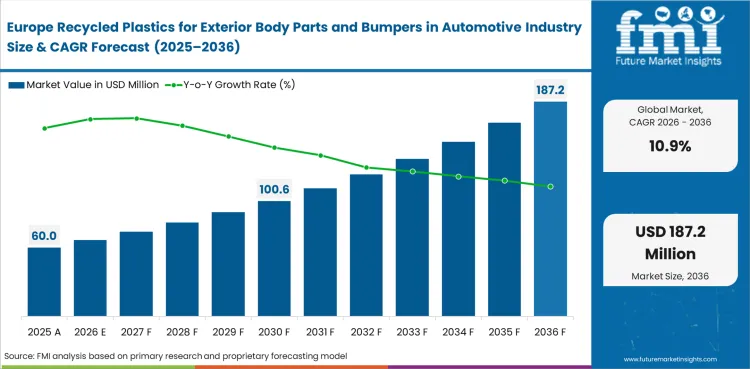
Europe recycled plastics for exterior body parts and bumpers in automotive industry generated USD 50.0 million in 2025 and is forecast to reach USD 60.0 million in 2026. FMI estimates the total industry value to climb to USD 170.0 million by 2036 at a 10.9% CAGR.
Summary of Europe Recycled Plastics for Exterior Body Parts and Bumpers in Automotive Industry
- The Europe recycled plastics for exterior body parts and bumpers in automotive industry is forecast to reach USD 170.0 million by 2036.
- The market is expected to grow at a CAGR of 10.9% from 2026 to 2036.
- Value of this market was estimated at USD 50.0 million in 2025.
- Market valuation is expected to reach USD 60.0 million in 2026.
- Polypropylene is projected to contribute 48.0% share in 2026 by polymer type.
- Bumpers are likely to hold 34.0% share in 2026 by part type.
- Post-industrial feedstock is expected to lead source type with 41.0% share in 2026.
- Passenger cars are anticipated to account for 57.0% share in 2026 by vehicle type.
- Up to 15% recycled content is expected to secure 44.0% share in 2026 because early qualification programs favor lower formulation change.
- Spain is projected to record the fastest country growth at 13.2% CAGR through 2036.
Key Takeaways, Market Size, and Forecast
- Europe Recycled Plastics for Exterior Body Parts and Bumpers in Automotive Industry is projected to rise from USD 60.0 million in 2026 to USD 170.0 million by 2036, at a CAGR of 10.9%.
- The industry was valued at USD 50.0 million in 2025.
- By 2036, the industry is expected to reach USD 170.0 million.
- The forecast period indicates a 10.9% CAGR from 2026 to 2036.
- The industry is projected to generate an incremental opportunity of USD 110.0 million.
- In 2026, Polypropylene is expected to account for 48.0% of the polymer type segment.
- Spain (13.2%) and Germany (12.4%) are two of the fastest growing markets.
Incremental opportunity across the forecast period is projected at USD 110.0 million. EU recycled‑content policy and bumper‑grade compound qualification are the main drivers of demand. These factors explain why bumpers are the first exterior parts reviewed when recycled plastics move from laboratory testing to vehicle sourcing decisions. The broader automotive plastics trend also supports this shift as lightweight materials remain a priority across vehicle platforms.
Adoption is slower in exterior parts than in hidden interior components. Paint finish and surface appearance leave little margin for odor or color variation. Automakers therefore start with low recycled‑content blends. This allows testing without major material redesign. Compound quality and lot‑to‑lot consistency remain central to exterior approval which reinforces the role of automotive‑grade plastic compounding.
Europe Recycled Plastics for Exterior Body Parts and Bumpers in Automotive Industry Key Takeaways
| Parameter | Details |
|---|---|
| Market Value (2026) | USD 60.0 million |
| Forecast Value (2036) | USD 170.0 million |
| CAGR (2026 to 2036) | 10.9% |
| Estimated Market Value (2025) | USD 50.0 million |
| Incremental Opportunity | USD 110.0 million |
| Leading Polymer Type | Polypropylene (48.0% of polymer type segment) |
| Leading Part Type | Bumpers (34.0% of part type segment) |
| Leading Source Type | Post-Industrial (41.0% of source type segment) |
| Leading Vehicle Type | Passenger Cars (57.0% of vehicle type segment) |
| Key Companies | Borealis, Veolia, MOCOM, LyondellBasell, OPmobility |
Source: Future Market Insights, 2026
Exterior recycled plastics face stricter checks than standard recycled resin. Surface quality and paint behavior decide whether a material is accepted in a vehicle program. Lower recycled‑content blends are adopted first because they require fewer material changes and lower approval risk.
Country demand is shaped by vehicle production and material testing capability. Spain is expected to grow at 13.2% CAGR as faster program rollout supports adoption. Germany follows with 12.4% CAGR, supported by strong OEM and supplier qualification activity. Slovakia is projected at 12.0% CAGR and Czechia at 11.7% CAGR, driven by concentrated vehicle manufacturing. Poland is forecast to reach 11.5% CAGR as compounding and assembly capacity expand together. France is expected to grow at 10.8% CAGR, while Italy records 10.1% CAGR with steady but slower exterior adoption.
PCR‑ready automotive PP compound points to a clear move toward materials designed for faster approval in exterior parts. OEM compliance grade PCR automotive material shows the same trend from a regulatory and sourcing perspective. Compounders that secure clean feedstock and achieve early approvals with exterior module suppliers have the strongest path to repeat vehicle program volumes.
Europe Recycled Plastics for Exterior Body Parts and Bumpers in Automotive Industry Definition
Recycled plastics for exterior body parts and bumpers in EU automotive industry covers recycled thermoplastic compounds used in exterior body parts and bumper systems for passenger vehicles and light commercial vehicles in the EU. Material scope includes recycled PP and TPO grades. Recycled ABS and PC/ABS blends are included where exterior qualification is relevant. Functional focus centers on visible parts that need paint finish and texture control. Impact retention and lot consistency are part of the same approval set.
Europe Recycled Plastics for Exterior Body Parts and Bumpers in Automotive Industry Inclusions
Included products cover bumper fascias and grilles. Claddings and wheel-arch trims are part of scope. Sill trims and spoilers are included where recycled compounds enter new vehicle production. Segment structure covers polymer type and source type. Part type and process type are assessed. Vehicle type and recycled-content band are included together with finish type. Revenue sizing covers 2025 through 2036 in USD million.
Europe Recycled Plastics for Exterior Body Parts and Bumpers in Automotive Industry Exclusions
Scope excludes interior-only plastics and general recycling services. Scrap collection outside automotive qualification programs and non-EU vehicle applications are outside this study.
Europe Recycled Plastics for Exterior Body Parts and Bumpers in Automotive Industry Research Methodology
- Primary Research: FMI analysts conducted interviews with automotive compounders and exterior module suppliers across the EU.
- Desk Research: Data collection aggregated EU policy papers and vehicle production statistics. Technical papers on bumper recyclability and compound qualification were reviewed.
- Market Sizing and Forecasting: Baseline values derive from a bottom-up aggregation of exterior plastic demand by part family. Recycled-content penetration and compound pricing were applied to project demand through 2036.
- Data Validation and Update Cycle: Forecast models were checked against vehicle production references and public policy direction on a periodic review cycle.
Why Is the Europe Recycled Plastics for Exterior Body Parts and Bumpers in Automotive Industry Growing?
- EU circularity rules are moving recycled-content PP grades from pilot work into program review for new vehicles.
- Bumpers account for 34.0% share in 2026 by part type and give recyclers the clearest large-volume entry point.
- Up to 15% recycled content leads with 44.0% share in 2026 because early qualification programs favor limited formulation change.
Bumper programs influence the demand for recycled plastics for exterior body parts and bumpers in automotive industry. Front and rear fascias use large amounts of plastic in each vehicle. They are also close to PP‑based materials that are already widely used across Europe. This makes bumpers easier for exterior suppliers to test with recycled resin. Fewer design changes are needed compared with complex multi‑material parts.
Regulatory pressure adds momentum to the market. EU policy is pushing automakers to increase recycled plastic use in new vehicles. It is also increasing the share sourced from end‑of‑life vehicles. Exterior parts respond more slowly than hidden components because painted surfaces show even small defects. Issues such as odor and gloss variation can delay programs even when mechanical results are acceptable. Approval processes therefore favor low inclusion rates before moving to higher recycled content. Advanced automotive materials provides broader context on this material transition. Market progress depends more on disciplined approvals than on total recycling capacity.
Exterior system suppliers prefer materials that can run on existing tools and paint lines with minimal disruption. Automotive exterior trim parts shows the wider demand base for visible parts that follow similar appearance standards. Growth builds through step‑by‑step qualification rather than sudden volume release.
Segmental Analysis
Key Facts About Segments
- Polypropylene is expected to account for 48.0% share in 2026 by polymer type. Existing bumper resin systems keep PP closest to commercial use.
- Post-Industrial feedstock is projected to contribute 41.0% share in 2026 by source type. Cleaner scrap gives compounders tighter quality control.
- Bumpers are likely to hold 34.0% share in 2026 by part type. Large polymer mass and easier dismantling improve recovery economics.
- Injection Molding is set to make up 62.0% share in 2026 by process type. Most bumper fascias and exterior trims move through molded formats.
- Passenger Cars are anticipated to represent 57.0% share in 2026 by vehicle type. Vehicle volume and trim variety create the biggest addressable base.
- Up to 15% recycled content is likely to secure 44.0% share in 2026. Lower inclusion rates reduce approval risk in visible parts.
- Painted Parts are forecast to hold 46.0% share in 2026 by finish type. Paint finish programs expose cosmetic defects faster than textured black parts.
FMI segments this market across polymer type and source type. Part type and process type form the next layer. Finish type shows how cosmetic exposure changes approval speed. Polypropylene leads the structure because recycled bumper work starts from resin families that automakers and compounders already know. Market size for that segment is expected to center on 48.0% share in 2026. Automotive interior plastic components offers a useful adjacent view because visible versus hidden plastic use follows a very different approval pace.
Europe Recycled Plastics for Exterior Body Parts and Bumpers in Automotive Industry Analysis by Polymer Type
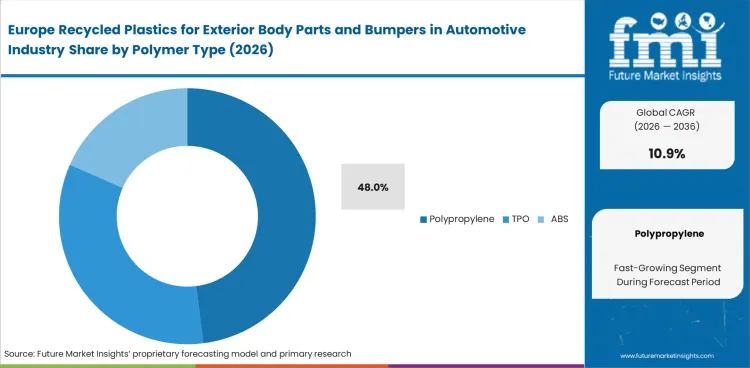
Polypropylene is projected to represent 48.0% share in 2026 by polymer type because most bumper systems in Europe already use PP-based resin families. Recycled PP can enter those programs with less reformulation work than many higher-cost alternatives. Exterior module suppliers value that familiarity because it lowers tool risk and shortens the first round of validation. Automotive bumper programs support that logic because plastic bumpers dominate the wider bumper material base. Early demand concentrates where resin choice cuts both cost risk and approval time.
- Resin familiarity keeps PP close to current bumper material practice.
- Impact balance helps recycled PP fit exterior use better than many rigid alternatives.
- Qualification work moves faster when paint and molding behavior are already well understood.
Europe Recycled Plastics for Exterior Body Parts and Bumpers in Automotive Industry Analysis by Source Type
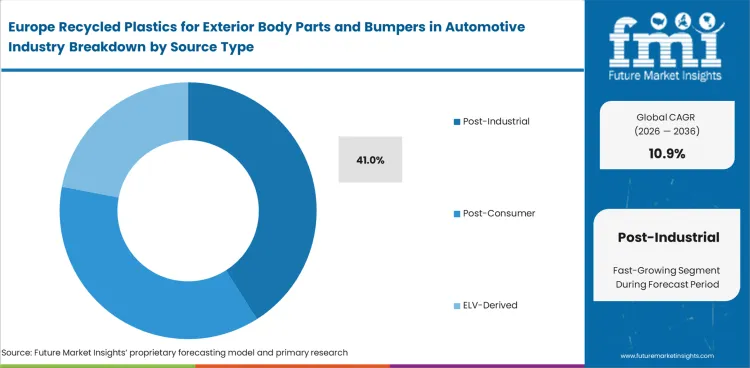
Cleaner scrap gives compounders better control over contamination and shade variation, which is why post-industrial feedstock leads this segment. Exterior-grade programs need that control because visible parts leave little room for inconsistency after paint application. FMI estimates place post-industrial feedstock at 41.0% share in 2026 by source type. ELV-derived streams can expand later as sorting quality improves and approval confidence becomes wider. Near-term demand favors supply that enters paint lines and molding tools with fewer quality surprises.
- Cleaner feed supports tighter lot consistency.
- Lower contamination risk reduces rejection during compounding and painting.
- Shorter sorting routes improve cost control for early-volume programs.
Europe Recycled Plastics for Exterior Body Parts and Bumpers in Automotive Industry Analysis by Part Type
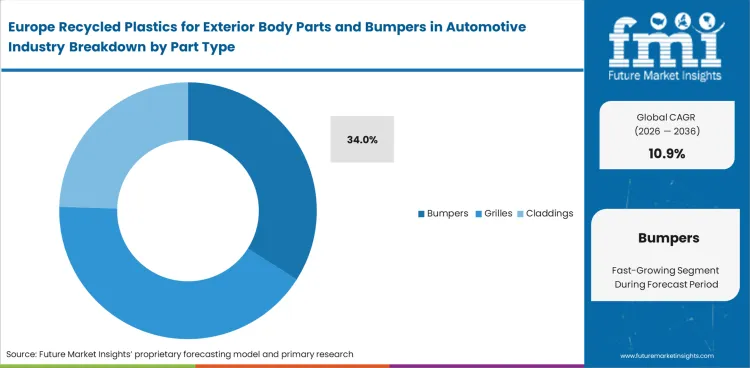
Recovery economics often begin with parts that carry high plastic mass and a known dismantling route. Bumpers are likely to make up 34.0% share in 2026 by part type because they meet both conditions in many EU recycling pilots and dismantling programs. Bumper streams give compounders and recyclers a more workable starting point for volume recovery. Grilles and claddings follow later because material mixes and visible detailing can complicate the use of recycled compounds. Commercial volume begins with the part family that combines scale and easier material tracing.
- Large plastic mass improves value recovery per vehicle.
- Known PP and TPO use simplifies material matching.
- Removal familiarity supports cleaner scrap generation at dismantling points.
Europe Recycled Plastics for Exterior Body Parts and Bumpers in Automotive Industry Analysis by Process Type
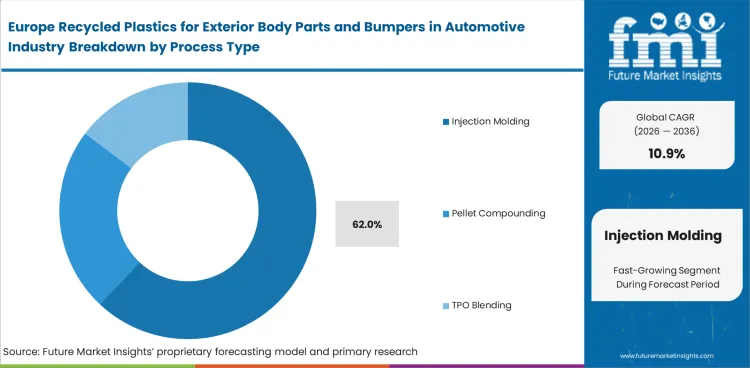
Bumper fascias and many exterior trims already depend on molded production routes across the EU automotive chain. Recycled compounds fit more easily when the process route stays close to current operating practice. Molders can focus on flow behavior and finish response before they face a broader process redesign. Injection molding is projected to hold 62.0% share in 2026 by process type. Compounded pellet quality adds the upstream view because pellet consistency directly affects molded part stability.
- Molded geometry suits bumper fascias and trim shells.
- Current tool fleets reduce transition cost for approved recycled grades.
- Process familiarity limits change inside established exterior programs.
Europe Recycled Plastics for Exterior Body Parts and Bumpers in Automotive Industry Analysis by Vehicle Type
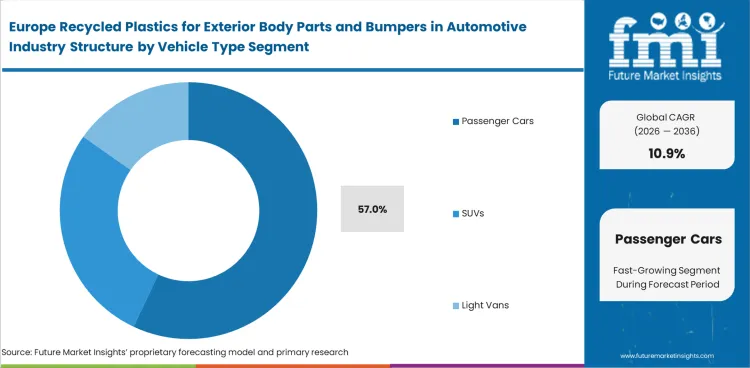
Passenger Cars are anticipated to represent 57.0% share in 2026 by vehicle type. That combination creates more opportunities for low-content recycled blends to enter visible parts one program at a time. Light vans and trucks can add demand later where fleet operators accept narrower part ranges and simpler finish requirements. Passenger vehicle scale gives compound suppliers the clearest route to recurring volume.
- Higher platform count broadens qualification opportunities.
- Painted bumper demand is deeper in passenger vehicles.
- Vehicle styling cycles create repeated material review windows.
Europe Recycled Plastics for Exterior Body Parts and Bumpers in Automotive Industry Analysis by Recycled Content Band
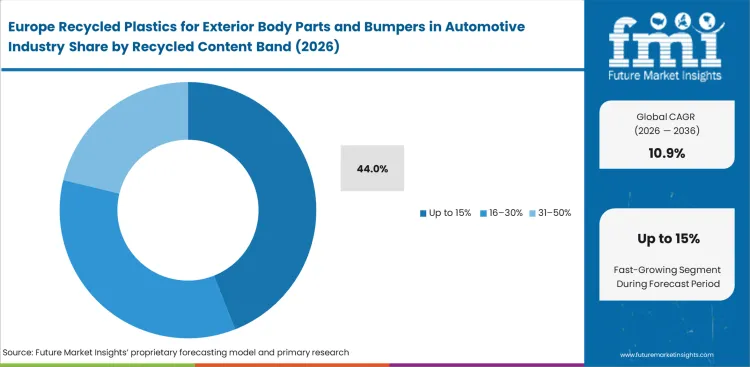
Early approval work favors modest inclusion rates because they reduce risk in paint finish and impact performance. Automakers can test these blends without a full change in resin behavior or surface response. Up to 15% recycled content is expected to secure 44.0% share in 2026 by recycled-content band, which reflects the practical need for manageable first-step adoption. Higher bands can expand later once stable feedstock and broader validation data become available. Commercial entry starts with manageable inclusion instead of maximum inclusion.
- Lower inclusion rates fit cautious approval programs.
- Surface quality is easier to control at modest recycled levels.
- Program engineers can compare results against current virgin-heavy grades more easily.
Europe Recycled Plastics for Exterior Body Parts and Bumpers in Automotive Industry Analysis by Finish Type
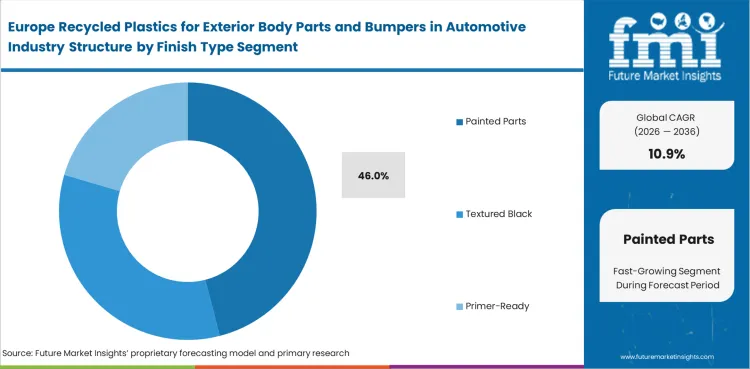
Painted Parts are forecast to hold 46.0% share in 2026 by finish type. Painted bumper fascias and related exterior parts draw close attention because cosmetic defects become visible after coating. That challenge slows recycled-content adoption in one sense and makes approval work more valuable in another. A compound that passes paint appearance checks can enter a larger share of exterior programs than a grade used only in textured black parts. Automotive bioplastic shows how adjacent circular-material programs face a similar approval test in vehicle exteriors.
- Paint finish exposes color drift and surface marks quickly.
- Primer and coating behavior influence approval speed.
- Passing visible-part checks expands program access across more exterior applications.
Bumpers Remain the Most Practical Entry Point
For buyers assessing where circular plastics can enter exterior automotive parts with the least difficulty, bumpers remain the most practical starting point. According to the European Commission Joint Research Centre (November 2025), plastics account for around 14 to 18% of total vehicle weight, and polypropylene is among the most widely used polymers in vehicles. Plastic use is concentrated in a limited set of applications that include bumpers, dashboards, headliners, seats, carpets, and headlight covers. This matters because bumper systems already come under the largest and most established polymer streams used in vehicle manufacturing.
Policy Design Could Reshape Material Economics
Policy frameworks are expected to play a major role in shaping future recycled‑plastic demand. Under the proposed End‑of‑Life Vehicles Regulation, the European Commission (December 2025) confirmed plans to require up to 25% recycled plastic content in new vehicles once the targets are fully phased in. However, EU policymakers also highlight that achievable target levels depend on the availability of suitable recycled plastic feedstock. The Council of the European Union (June 2025) notes that flexibility mechanisms may be needed if supply constraints or price pressure emerge. While phased or combined targets can reduce compliance risk, they also make future demand less predictable.
Regional Analysis
Country demand in this market follows vehicle assembly depth and compound qualification capability. Growth rates differ because exterior recycled-content programs move faster where assembly plants and material conversion sit close together.
Key Facts About Country
- Spain records 13.2% CAGR through 2036 with fast program rollout from a smaller base.
- Germany posts 12.4% CAGR with a broader OEM and Tier 1 approval base.
- Slovakia reaches 12.0% CAGR as assembly concentration supports volume growth.
- Czechia is projected at 11.7% CAGR with strong vehicle manufacturing links.
- Poland is expected to expand at 11.5% CAGR as compounding and assembly both widen.
- France is estimated at 10.8% CAGR with a steady closed-loop materials push.
- Italy is likely to post 10.1% CAGR as compounding strength feeds gradual exterior adoption.
.webp "Top Country Growth Comparison Europe Recycled Plastics For Exterior Body Parts And Bumpers In Automotive Industry Cagr (2026 2036)")
Future Outlook for Europe Recycled Plastics for Exterior Body Parts and Bumpers in Automotive Industry in Spain
Vehicle assembly in Spain gives this industry a responsive demand base. FMI projects market demand in the country to rise at a 13.2% CAGR over the forecast years as more exterior programs review recycled compounds for visible parts. Growth comes from a lower starting point and a broad manufacturing footprint that can test new grades without waiting for a full platform reset. Exterior programs in Spain benefit when compound supply and assembly demand sit close enough for quick validation loops. Approval work often begins with bumpers and then widens into nearby trims once finish quality holds. Faster movement from pilot to program review gives Spain the strongest forecast pace in this market.
- Assembly depth improves the speed of program trials.
- Bumper systems create the easiest early route for recycled PP compounds.
- A smaller base makes each approved program more visible in forecast growth.
Forecast Analysis of Europe Recycled Plastics for Exterior Body Parts and Bumpers in Automotive Industry in Germany
Germany carries one of the largest decision pools for exterior material qualification in Europe. Demand in Germany is expected to grow at a 12.4% CAGR from 2026 to 2036 as OEM engineering groups and Tier 1 exterior suppliers widen recycled-content reviews across visible parts. Growth does not move as fast as Spain because the starting base is larger and approval discipline is tighter. That discipline matters in a positive way because once a grade passes German validation it can support wider EU sourcing discussions. Adjacent vehicle-material work gives extra context for this approval pattern. Germany anchors value as much as it anchors demand growth.
- OEM review depth raises the value of approved grades.
- Larger installed programs slow percentage growth from a higher base.
- Successful validation in Germany can influence wider EU sourcing decisions.
Opportunity Analysis of Europe Recycled Plastics for Exterior Body Parts and Bumpers in Automotive Industry in Slovakia
Demand in Germany is expected to grow at a 12.4% CAGR from 2026 to 2036. Germany carries one of the largest decision pools for exterior material qualification in Europe. OEM engineering groups and Tier 1 exterior suppliers in the country are widening recycled-content reviews across visible parts. Growth moves below Spain because the starting base is larger and approval discipline is tighter. That discipline works in Germany’s favor because a grade that clears local validation can support wider EU sourcing discussions. Adjacent vehicle-material work gives extra context for this approval pattern and helps Germany anchor value alongside demand growth.
- High vehicle output per plant supports focused volume growth.
- Fewer approval points can shorten route-to-volume after qualification.
- Program concentration favors repeat demand once one resin family is accepted.
In-depth Analysis of Europe Recycled Plastics for Exterior Body Parts and Bumpers in Automotive Industry in Czechia
Czechia enters this forecast with a strong manufacturing base for vehicle parts and final assembly. Exterior plastic sourcing can build on a well-established automotive supplier network across the country. Recycled-content use is likely to expand first in programs that avoid a heavy redesign burden. That pattern supports bumpers and nearby trims over parts with more complex material mixes. Country growth is driven by the practical fit between compound supply and vehicle production, with demand for this sector anticipated to rise at a 11.7% CAGR over the assessment period. Quality discipline will decide how much of that potential turns into repeat business.
- Supplier density supports faster communication between compounders and part makers.
- Programs with familiar PP systems move first.
- Repeat orders depend on stable lot quality and paint response.
Sales Analysis of Europe Recycled Plastics for Exterior Body Parts and Bumpers in Automotive Industry in Poland
Poland brings growth from both vehicle assembly and a broader plastics conversion base. Demand is expected to increase at a 11.5% CAGR during the forecast period as recycled-content use moves from niche testing into selected exterior programs. Country growth benefits from practical compounding capacity and a wide industrial base that can supply nearby automotive plants. Lower-content blends are likely to carry the first wave of orders because they reduce quality risk in visible parts. Poland can add scale quickly once approved grades move into recurring bumper programs. That timing keeps the country near the front of the EU growth range.
- Compounding capacity supports domestic material availability.
- Lower-content blends fit early exterior programs more easily.
- Bumper approvals can translate into wider trim demand after first success.
Future Outlook for Europe Recycled Plastics for Exterior Body Parts and Bumpers in Automotive Industry in France
Closed-loop material work enables France to have a steady position in this industry. Exterior-grade recycled compounds are entering more visible-part reviews across local automotive programs as qualification work expands. France is projected to post a 10.8% CAGR from 2026 to 2036, though growth stays below the leading countries because program expansion starts from a firmer base and visible-part approval takes time. Country demand benefits from an active circular-material policy tone and from technical work around automotive recyclate quality. The wider vehicle-plastics category gives context for that transition. France is likely to hold a durable role in qualified recycled compounds even without the fastest forecast pace.
- Circular-material focus supports program continuity.
- A firmer starting base lowers the percentage growth rate.
- Technical validation strength improves long-term position in qualified grades.
In-depth Analysis of Europe Recycled Plastics for Exterior Body Parts and Bumpers in Automotive Industry in Italy
Italy combines automotive compounding capability with gradual exterior program uptake. Country demand is likely to post a 10.1% CAGR by 2036 as recycled-content plastics enter more bumper and trim evaluations across the vehicle chain. Growth pace stays below the front group because program adoption is spread across a wider converter mix and because visible-part checks move carefully. Compounding strength matters here because local material expertise supports tailored grades for OEM and Tier 1 review. Italy can add value through formulation work even when the percentage growth runs lower than Spain or Germany.
- Compounding strength supports customized exterior-grade formulations.
- Adoption spreads across a wider mix of programs and converters.
- Value contribution can stay strong even with a lower CAGR than the lead countries.
Competitive Landscape of Europe Recycled Plastics for Exterior Body Parts and Bumpers in Automotive Industry
- Share concentration is moderate at the top. Borealis is estimated to hold the highest share as per FMI analysis.
- Competition centers on feedstock purity and exterior-grade compounding quality.
- Application approval matters as much as resin supply because visible parts reject color drift quickly.
Competitive Aligners
Borealis and Veolia stand close to the front because both can connect recycled-material supply with automotive-grade compound work. Borealis brings strong compound credibility for vehicle programs. Veolia adds strength where recycled feedstock quality and circular material routing matter. MOCOM joins this front group through a clear automotive compound focus. Early advantage in this market comes from stable resin quality and a clear route into visible-part validation.
LyondellBasell compete through compound know-how and broad automotive relationships. No stakeholder prevails solely on the basis of feedstock volume. Exterior parts demand repeatable shade and molding behavior before they reward scale. Crash structure and bumper fasteners show that bumper sourcing decisions are closely linked to other exterior parts around the bumper system.
OPmobility matters from the application side because exterior module knowledge can speed up the link between approved compounds and live part programs. Material suppliers and exterior system specialists influence each other more directly here than in many broader resin markets. Competitive edge comes from approval speed and lot stability. It comes from exterior-program access and not from headline recycling claims. Market structure favors companies that can translate recycled resin into approved bumper and trim supply with limited disruption at the plant level.
Major Industry Players
- Borealis (Austria) and Veolia (France) hold leading positions based on recycled-material access and automotive-grade formulation capability.
- MOCOM (Germany) and LyondellBasell (Netherlands) carry strong regional positions through compound specialization and OEM-facing material support.
- OPmobility (France) extends its range through exterior application proximity.
Competitive Benchmarking: Europe Recycled Plastics for Exterior Body Parts and Bumpers in Automotive Industry
| Company | Feedstock Access | Automotive Compounding | Exterior Program Proximity | Geographic Footprint |
|---|---|---|---|---|
| Borealis | High | High | Medium | Europe |
| Veolia | High | Medium | Low | Europe |
| MOCOM | Medium | High | Medium | Europe |
| LyondellBasell | Medium | High | Medium | Europe and Global |
| OPmobility | Low | Low | High | Europe and Global |
Source: Future Market Insights competitive analysis, 2026. Ratings reflect relative positioning based on feedstock access and automotive compound capability. Exterior program proximity captures closeness to visible-part validation work.
Key Developments
- In August 2025, PEUGEOT announced the new 308 and 308 SW, stating that the models integrate 31% green materials, use more than 30 polymer components, and include recycled plastics in bumpers and storage boxes. The vehicles are also assembled at Mulhouse in France, which keeps the development directly relevant to EU automotive production.
- In January 2026, OPmobility said its Exterior & Lighting business is advancing a closed-loop “bumper-to-bumper” recycled polypropylene initiative for external, visible parts. The program recovers end-of-life bumpers that are 10 to 20 years old, has entered its third validation phase, and is planned for customer presentation from 2026.
- In March 2026, BMW Group announced that the new BMW i3 uses 30% recycled plastic in its front bumper trim. The company also reduced the number of bumper materials from 15 to 7 and increased the share of recyclable plastic in the bumper system from about 46% to 85%, strengthening end-of-life recovery potential.
Key Players in the Europe Recycled Plastics for Exterior Body Parts and Bumpers in Automotive Industry
Major Companies
- Borealis
- Veolia
- MOCOM
- LyondellBasell
Specialized Companies
- OPmobility
Scope of the Report
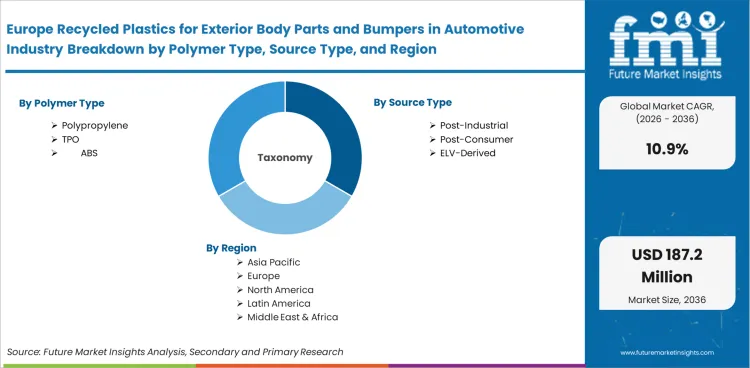
| Metric | Value |
|---|---|
| Quantitative Units | USD 50.0 million to USD 170.0 million at a 10.9% CAGR |
| Market Definition | Recycled thermoplastic compounds used in new EU automotive exterior body parts and bumpers. |
| Segmentation | Polymer Type / Source Type / Part Type / Process Type / Vehicle Type / Recycled Content Band / Finish Type |
| Regions Covered | Europe |
| Countries Covered | Spain, Germany, Slovakia, Czechia, Poland, France, Italy |
| Key Companies Profiled | Borealis, Veolia, MOCOM, LyondellBasell, OPmobility |
| Forecast Period | 2026 to 2036 |
| Approach | Bottom-up model using exterior plastic demand, recycled-content penetration, compound pricing, and policy validation |
Europe Recycled Plastics for Exterior Body Parts and Bumpers in Automotive Industry by Segments
Europe Recycled Plastics for Exterior Body Parts and Bumpers in Automotive Industry Segmented by Polymer Type:
- Polypropylene
- TPO
- ABS
- PC/ABS
- PA Blends
- PE
Europe Recycled Plastics for Exterior Body Parts and Bumpers in Automotive Industry Classified by Source Type:
- Post-Industrial
- Post-Consumer
- ELV-Derived
- Hybrid Feedstock
- Certified Scrap
Europe Recycled Plastics for Exterior Body Parts and Bumpers in Automotive Industry Analyzed by Part Type:
- Bumpers
- Grilles
- Claddings
- Sill Trims
- Wheel Arches
- Spoilers
- Tailgate Trims
Europe Recycled Plastics for Exterior Body Parts and Bumpers in Automotive Industry Classified by Process Type:
- Injection Molding
- Pellet Compounding
- TPO Blending
- Twin-Screw Extrusion
- Surface Finishing
Europe Recycled Plastics for Exterior Body Parts and Bumpers in Automotive Industry Classified by Vehicle Type:
- Passenger Cars
- SUVs
- Light Vans
- Trucks
- Buses
Europe Recycled Plastics for Exterior Body Parts and Bumpers in Automotive Industry Classified by Recycled Content Band:
- Up to 15%
- 16-30%
- 31-50%
- Above 50%
Europe Recycled Plastics for Exterior Body Parts and Bumpers in Automotive Industry Classified by Finish Type:
- Painted Parts
- Textured Black
- Primer-Ready
- Color-Through
- Matte Finish
Europe Recycled Plastics for Exterior Body Parts and Bumpers in Automotive Industry by Region and Country:
- Western Europe
- Germany
- France
- Netherlands
- Belgium
- Austria
- Switzerland
- Luxembourg
- Northern Europe
- Denmark
- Sweden
- Norway
- Finland
- Ireland
- Iceland
- Southern Europe
- Italy
- Spain
- Portugal
- Greece
- Malta
- Cyprus
- Eastern Europe
- Poland
- Czech Republic
- Hungary
- Romania
- Slovakia
- Bulgaria
- Croatia
- Slovenia
- Estonia
- Latvia
- Lithuania
Bibliography
- Broeren, M., Bergsma, G., & van de Pol, J. (2024, June 30). Biobased plastics in vehicles: Including biobased in a circular plastic obligation for vehicles. CE Delft.
- Peugeot. (2025, August 26). New PEUGEOT 308 & PEUGEOT 308 SW - Serious about driving. Stellantis Media.
- OPmobility. (2026, January). VIBES by OPmobility - January 2026.
- BMW Group. (2026, March 16). The new BMW i3: Second Neue Klasse model continues holistic approach to sustainability. BMW PressClub Global.
- European Automobile Manufacturers’ Association. (2025, September). Pocket Guide 2025 to 2026.
- Baldassarre, B. et al. (2025, May 15). Increasing plastic circularity in the automotive sector. Resources Conservation and Recycling.
- Juan, R. et al. (2024, December). Enhancing the recyclability of ELV plastic bumpers. Polymer Degradation and Stability.
- Gall, M. et al. (2024, July 1). Comparing end-of-life vehicle and packaging-based post-consumer recyclates for automotive applications. Polymers.
- EuRIC. (2025, May). Enhancing plastics circularity in vehicles.
- USA Department of Energy. (2025, September 25). Recycling disassembled automotive plastic components for new vehicle components.
This bibliography is provided for reader reference.
This Report Addresses
- Market sizing and revenue forecasting from 2025 to 2036.
- Segment analysis across seven commercial dimensions.
- Country growth comparison across seven EU industries.
- Policy review for recycled plastics in new vehicles.
- Competitive assessment of compounders and recyclers.
- Program-level implications for exterior part qualification.
- Supply view from scrap quality to approved compounds.
- Data delivery in a publish-ready preview format.
Frequently Asked Questions
What is the size of the Europe recycled plastics for exterior body parts and bumpers in automotive industry?
FMI estimates place the market at USD 60.0 million in 2026 and USD 170.0 million by 2036.
What growth rate is expected for EU automotive recycled plastics used in bumpers and exterior body parts?
Demand is forecast to expand at a 11.0% CAGR from 2026 to 2036.
Why do lower-content blends lead early demand in recycled bumper plastics?
Lower-content blends reduce reformulation work and make approval easier for painted exterior automotive parts.
Which material category leads demand in recycled exterior automotive parts?
Polypropylene is expected to lead because bumper systems and many exterior trims already use PP-based resin families.
Which part category creates the strongest demand for recycled plastics in exterior applications?
Bumpers lead because they carry large plastic volumes and fit more practical recovery routes in the EU vehicle base.
Which countries offer the strongest growth outlook for recycled PP compounds in exterior vehicle programs?
Spain and Germany lead the growth outlook, while Slovakia and Czechia add strong mid-tier expansion through 2036.
What is the main barrier for wider use of recycled plastics in painted bumper applications?
Surface finish and paint response decide acceptance because visible parts face tighter approval standards than hidden components.
Who captures the clearest commercial opportunity in this space?
Compounders and exterior module suppliers with clean feedstock access and stable approval routes hold the clearest repeat-volume opportunity.
What is included in scope for recycled exterior body parts in the EU automotive sector?
Scope covers recycled plastics used in bumpers, grilles, claddings, sill trims, wheel arch parts, spoilers, and related exterior modules.
Preview the report firsthand - request a free sample
Get SampleGet the brochure for pricing and purchase details.
Get PDFTable of Content
- Executive Summary
- Global Market Outlook
- Demand-side Trends
- Supply-side Trends
- Technology Roadmap Analysis
- Analysis and Recommendations
- Market Overview
- Market Coverage / Taxonomy
- Market Definition / Scope / Limitations
- Research Methodology
- Chapter Orientation
- Analytical Lens and Working Hypotheses
- Market Structure, Signals, and Trend Drivers
- Benchmarking and Cross-market Comparability
- Market Sizing, Forecasting, and Opportunity Mapping
- Research Design and Evidence Framework
- Desk Research Programme (Secondary Evidence)
- Company Annual and Sustainability Reports
- Peer-reviewed Journals and Academic Literature
- Corporate Websites, Product Literature, and Technical Notes
- Earnings Decks and Investor Briefings
- Statutory Filings and Regulatory Disclosures
- Technical White Papers and Standards Notes
- Trade Journals, Industry Magazines, and Analyst Briefs
- Conference Proceedings, Webinars, and Seminar Materials
- Government Statistics Portals and Public Data Releases
- Press Releases and Reputable Media Coverage
- Specialist Newsletters and Curated Briefings
- Sector Databases and Reference Repositories
- FMI Internal Proprietary Databases and Historical Market Datasets
- Subscription Datasets and Paid Sources
- Social Channels, Communities, and Digital Listening Inputs
- Additional Desk Sources
- Expert Input and Fieldwork (Primary Evidence)
- Primary Modes
- Qualitative Interviews and Expert Elicitation
- Quantitative Surveys and Structured Data Capture
- Blended Approach
- Why Primary Evidence is Used
- Field Techniques
- Interviews
- Surveys
- Focus Groups
- Observational and In-context Research
- Social and Community Interactions
- Stakeholder Universe Engaged
- C-suite Leaders
- Board Members
- Presidents and Vice Presidents
- R&D and Innovation Heads
- Technical Specialists
- Domain Subject-matter Experts
- Scientists
- Physicians and Other Healthcare Professionals
- Governance, Ethics, and Data Stewardship
- Research Ethics
- Data Integrity and Handling
- Primary Modes
- Tooling, Models, and Reference Databases
- Desk Research Programme (Secondary Evidence)
- Data Engineering and Model Build
- Data Acquisition and Ingestion
- Cleaning, Normalisation, and Verification
- Synthesis, Triangulation, and Analysis
- Quality Assurance and Audit Trail
- Market Background
- Market Dynamics
- Drivers
- Restraints
- Opportunity
- Trends
- Scenario Forecast
- Demand in Optimistic Scenario
- Demand in Likely Scenario
- Demand in Conservative Scenario
- Opportunity Map Analysis
- Product Life Cycle Analysis
- Supply Chain Analysis
- Investment Feasibility Matrix
- Value Chain Analysis
- PESTLE and Porter’s Analysis
- Regulatory Landscape
- Regional Parent Market Outlook
- Production and Consumption Statistics
- Import and Export Statistics
- Market Dynamics
- Global Market Analysis 2021 to 2025 and Forecast, 2026 to 2036
- Historical Market Size Value (USD Million) Analysis, 2021 to 2025
- Current and Future Market Size Value (USD Million) Projections, 2026 to 2036
- Y-o-Y Growth Trend Analysis
- Absolute $ Opportunity Analysis
- Global Market Pricing Analysis 2021 to 2025 and Forecast 2026 to 2036
- Global Market Analysis 2021 to 2025 and Forecast 2026 to 2036, By Polymer Type
- Introduction / Key Findings
- Historical Market Size Value (USD Million) Analysis By Polymer Type , 2021 to 2025
- Current and Future Market Size Value (USD Million) Analysis and Forecast By Polymer Type , 2026 to 2036
- Polypropylene
- TPO
- ABS
- Polypropylene
- Y-o-Y Growth Trend Analysis By Polymer Type , 2021 to 2025
- Absolute $ Opportunity Analysis By Polymer Type , 2026 to 2036
- Global Market Analysis 2021 to 2025 and Forecast 2026 to 2036, By Source Type
- Introduction / Key Findings
- Historical Market Size Value (USD Million) Analysis By Source Type, 2021 to 2025
- Current and Future Market Size Value (USD Million) Analysis and Forecast By Source Type, 2026 to 2036
- Post-Industrial
- Post-Consumer
- ELV-Derived
- Post-Industrial
- Y-o-Y Growth Trend Analysis By Source Type, 2021 to 2025
- Absolute $ Opportunity Analysis By Source Type, 2026 to 2036
- Global Market Analysis 2021 to 2025 and Forecast 2026 to 2036, By Part Type
- Introduction / Key Findings
- Historical Market Size Value (USD Million) Analysis By Part Type, 2021 to 2025
- Current and Future Market Size Value (USD Million) Analysis and Forecast By Part Type, 2026 to 2036
- Bumpers
- Grilles
- Claddings
- Bumpers
- Y-o-Y Growth Trend Analysis By Part Type, 2021 to 2025
- Absolute $ Opportunity Analysis By Part Type, 2026 to 2036
- Global Market Analysis 2021 to 2025 and Forecast 2026 to 2036, By Process Type
- Introduction / Key Findings
- Historical Market Size Value (USD Million) Analysis By Process Type, 2021 to 2025
- Current and Future Market Size Value (USD Million) Analysis and Forecast By Process Type, 2026 to 2036
- Injection Molding
- Pellet Compounding
- TPO Blending
- Injection Molding
- Y-o-Y Growth Trend Analysis By Process Type, 2021 to 2025
- Absolute $ Opportunity Analysis By Process Type, 2026 to 2036
- Global Market Analysis 2021 to 2025 and Forecast 2026 to 2036, By Vehicle Type
- Introduction / Key Findings
- Historical Market Size Value (USD Million) Analysis By Vehicle Type, 2021 to 2025
- Current and Future Market Size Value (USD Million) Analysis and Forecast By Vehicle Type, 2026 to 2036
- Passenger Cars
- SUVs
- Light Vans
- Y-o-Y Growth Trend Analysis By Vehicle Type, 2021 to 2025
- Absolute $ Opportunity Analysis By Vehicle Type, 2026 to 2036
- Passenger Cars
- Global Market Analysis 2021 to 2025 and Forecast 2026 to 2036, By Recycled Content Band
- Introduction / Key Findings
- Historical Market Size Value (USD Million) Analysis By Recycled Content Band, 2021 to 2025
- Current and Future Market Size Value (USD Million) Analysis and Forecast By Recycled Content Band, 2026 to 2036
- Up to 15%
- 16–30%
- 31–50%
- Up to 15%
- Y-o-Y Growth Trend Analysis By Recycled Content Band, 2021 to 2025
- Absolute $ Opportunity Analysis By Recycled Content Band, 2026 to 2036
- Global Market Analysis 2021 to 2025 and Forecast 2026 to 2036, By Finish Type
- Introduction / Key Findings
- Historical Market Size Value (USD Million) Analysis By Finish Type, 2021 to 2025
- Current and Future Market Size Value (USD Million) Analysis and Forecast By Finish Type, 2026 to 2036
- Painted Parts
- Textured Black
- Primer-Ready
- Painted Parts
- Y-o-Y Growth Trend Analysis By Finish Type, 2021 to 2025
- Absolute $ Opportunity Analysis By Finish Type, 2026 to 2036
- Global Market Analysis 2021 to 2025 and Forecast 2026 to 2036, By Region
- Introduction
- Historical Market Size Value (USD Million) Analysis By Region, 2021 to 2025
- Current Market Size Value (USD Million) Analysis and Forecast By Region, 2026 to 2036
- North America
- Latin America
- Western Europe
- Eastern Europe
- East Asia
- South Asia and Pacific
- Middle East & Africa
- Market Attractiveness Analysis By Region
- North America Market Analysis 2021 to 2025 and Forecast 2026 to 2036, By Country
- Historical Market Size Value (USD Million) Trend Analysis By Market Taxonomy, 2021 to 2025
- Market Size Value (USD Million) Forecast By Market Taxonomy, 2026 to 2036
- By Country
- USA
- Canada
- Mexico
- By Polymer Type
- By Source Type
- By Part Type
- By Process Type
- By Vehicle Type
- By Recycled Content Band
- By Finish Type
- By Country
- Market Attractiveness Analysis
- By Country
- By Polymer Type
- By Source Type
- By Part Type
- By Process Type
- By Vehicle Type
- By Recycled Content Band
- By Finish Type
- Key Takeaways
- Latin America Market Analysis 2021 to 2025 and Forecast 2026 to 2036, By Country
- Historical Market Size Value (USD Million) Trend Analysis By Market Taxonomy, 2021 to 2025
- Market Size Value (USD Million) Forecast By Market Taxonomy, 2026 to 2036
- By Country
- Brazil
- Chile
- Rest of Latin America
- By Polymer Type
- By Source Type
- By Part Type
- By Process Type
- By Vehicle Type
- By Recycled Content Band
- By Finish Type
- By Country
- Market Attractiveness Analysis
- By Country
- By Polymer Type
- By Source Type
- By Part Type
- By Process Type
- By Vehicle Type
- By Recycled Content Band
- By Finish Type
- Key Takeaways
- Western Europe Market Analysis 2021 to 2025 and Forecast 2026 to 2036, By Country
- Historical Market Size Value (USD Million) Trend Analysis By Market Taxonomy, 2021 to 2025
- Market Size Value (USD Million) Forecast By Market Taxonomy, 2026 to 2036
- By Country
- Germany
- UK
- Italy
- Spain
- France
- Nordic
- BENELUX
- Rest of Western Europe
- By Polymer Type
- By Source Type
- By Part Type
- By Process Type
- By Vehicle Type
- By Recycled Content Band
- By Finish Type
- By Country
- Market Attractiveness Analysis
- By Country
- By Polymer Type
- By Source Type
- By Part Type
- By Process Type
- By Vehicle Type
- By Recycled Content Band
- By Finish Type
- Key Takeaways
- Eastern Europe Market Analysis 2021 to 2025 and Forecast 2026 to 2036, By Country
- Historical Market Size Value (USD Million) Trend Analysis By Market Taxonomy, 2021 to 2025
- Market Size Value (USD Million) Forecast By Market Taxonomy, 2026 to 2036
- By Country
- Russia
- Poland
- Hungary
- Balkan & Baltic
- Rest of Eastern Europe
- By Polymer Type
- By Source Type
- By Part Type
- By Process Type
- By Vehicle Type
- By Recycled Content Band
- By Finish Type
- By Country
- Market Attractiveness Analysis
- By Country
- By Polymer Type
- By Source Type
- By Part Type
- By Process Type
- By Vehicle Type
- By Recycled Content Band
- By Finish Type
- Key Takeaways
- East Asia Market Analysis 2021 to 2025 and Forecast 2026 to 2036, By Country
- Historical Market Size Value (USD Million) Trend Analysis By Market Taxonomy, 2021 to 2025
- Market Size Value (USD Million) Forecast By Market Taxonomy, 2026 to 2036
- By Country
- China
- Japan
- South Korea
- By Polymer Type
- By Source Type
- By Part Type
- By Process Type
- By Vehicle Type
- By Recycled Content Band
- By Finish Type
- By Country
- Market Attractiveness Analysis
- By Country
- By Polymer Type
- By Source Type
- By Part Type
- By Process Type
- By Vehicle Type
- By Recycled Content Band
- By Finish Type
- Key Takeaways
- South Asia and Pacific Market Analysis 2021 to 2025 and Forecast 2026 to 2036, By Country
- Historical Market Size Value (USD Million) Trend Analysis By Market Taxonomy, 2021 to 2025
- Market Size Value (USD Million) Forecast By Market Taxonomy, 2026 to 2036
- By Country
- India
- ASEAN
- Australia & New Zealand
- Rest of South Asia and Pacific
- By Polymer Type
- By Source Type
- By Part Type
- By Process Type
- By Vehicle Type
- By Recycled Content Band
- By Finish Type
- By Country
- Market Attractiveness Analysis
- By Country
- By Polymer Type
- By Source Type
- By Part Type
- By Process Type
- By Vehicle Type
- By Recycled Content Band
- By Finish Type
- Key Takeaways
- Middle East & Africa Market Analysis 2021 to 2025 and Forecast 2026 to 2036, By Country
- Historical Market Size Value (USD Million) Trend Analysis By Market Taxonomy, 2021 to 2025
- Market Size Value (USD Million) Forecast By Market Taxonomy, 2026 to 2036
- By Country
- Kingdom of Saudi Arabia
- Other GCC Countries
- Turkiye
- South Africa
- Other African Union
- Rest of Middle East & Africa
- By Polymer Type
- By Source Type
- By Part Type
- By Process Type
- By Vehicle Type
- By Recycled Content Band
- By Finish Type
- By Country
- Market Attractiveness Analysis
- By Country
- By Polymer Type
- By Source Type
- By Part Type
- By Process Type
- By Vehicle Type
- By Recycled Content Band
- By Finish Type
- Key Takeaways
- Key Countries Market Analysis
- USA
- Pricing Analysis
- Market Share Analysis, 2025
- By Polymer Type
- By Source Type
- By Part Type
- By Process Type
- By Vehicle Type
- By Recycled Content Band
- By Finish Type
- Canada
- Pricing Analysis
- Market Share Analysis, 2025
- By Polymer Type
- By Source Type
- By Part Type
- By Process Type
- By Vehicle Type
- By Recycled Content Band
- By Finish Type
- Mexico
- Pricing Analysis
- Market Share Analysis, 2025
- By Polymer Type
- By Source Type
- By Part Type
- By Process Type
- By Vehicle Type
- By Recycled Content Band
- By Finish Type
- Brazil
- Pricing Analysis
- Market Share Analysis, 2025
- By Polymer Type
- By Source Type
- By Part Type
- By Process Type
- By Vehicle Type
- By Recycled Content Band
- By Finish Type
- Chile
- Pricing Analysis
- Market Share Analysis, 2025
- By Polymer Type
- By Source Type
- By Part Type
- By Process Type
- By Vehicle Type
- By Recycled Content Band
- By Finish Type
- Germany
- Pricing Analysis
- Market Share Analysis, 2025
- By Polymer Type
- By Source Type
- By Part Type
- By Process Type
- By Vehicle Type
- By Recycled Content Band
- By Finish Type
- UK
- Pricing Analysis
- Market Share Analysis, 2025
- By Polymer Type
- By Source Type
- By Part Type
- By Process Type
- By Vehicle Type
- By Recycled Content Band
- By Finish Type
- Italy
- Pricing Analysis
- Market Share Analysis, 2025
- By Polymer Type
- By Source Type
- By Part Type
- By Process Type
- By Vehicle Type
- By Recycled Content Band
- By Finish Type
- Spain
- Pricing Analysis
- Market Share Analysis, 2025
- By Polymer Type
- By Source Type
- By Part Type
- By Process Type
- By Vehicle Type
- By Recycled Content Band
- By Finish Type
- France
- Pricing Analysis
- Market Share Analysis, 2025
- By Polymer Type
- By Source Type
- By Part Type
- By Process Type
- By Vehicle Type
- By Recycled Content Band
- By Finish Type
- India
- Pricing Analysis
- Market Share Analysis, 2025
- By Polymer Type
- By Source Type
- By Part Type
- By Process Type
- By Vehicle Type
- By Recycled Content Band
- By Finish Type
- ASEAN
- Pricing Analysis
- Market Share Analysis, 2025
- By Polymer Type
- By Source Type
- By Part Type
- By Process Type
- By Vehicle Type
- By Recycled Content Band
- By Finish Type
- Australia & New Zealand
- Pricing Analysis
- Market Share Analysis, 2025
- By Polymer Type
- By Source Type
- By Part Type
- By Process Type
- By Vehicle Type
- By Recycled Content Band
- By Finish Type
- China
- Pricing Analysis
- Market Share Analysis, 2025
- By Polymer Type
- By Source Type
- By Part Type
- By Process Type
- By Vehicle Type
- By Recycled Content Band
- By Finish Type
- Japan
- Pricing Analysis
- Market Share Analysis, 2025
- By Polymer Type
- By Source Type
- By Part Type
- By Process Type
- By Vehicle Type
- By Recycled Content Band
- By Finish Type
- South Korea
- Pricing Analysis
- Market Share Analysis, 2025
- By Polymer Type
- By Source Type
- By Part Type
- By Process Type
- By Vehicle Type
- By Recycled Content Band
- By Finish Type
- Russia
- Pricing Analysis
- Market Share Analysis, 2025
- By Polymer Type
- By Source Type
- By Part Type
- By Process Type
- By Vehicle Type
- By Recycled Content Band
- By Finish Type
- Poland
- Pricing Analysis
- Market Share Analysis, 2025
- By Polymer Type
- By Source Type
- By Part Type
- By Process Type
- By Vehicle Type
- By Recycled Content Band
- By Finish Type
- Hungary
- Pricing Analysis
- Market Share Analysis, 2025
- By Polymer Type
- By Source Type
- By Part Type
- By Process Type
- By Vehicle Type
- By Recycled Content Band
- By Finish Type
- Kingdom of Saudi Arabia
- Pricing Analysis
- Market Share Analysis, 2025
- By Polymer Type
- By Source Type
- By Part Type
- By Process Type
- By Vehicle Type
- By Recycled Content Band
- By Finish Type
- Turkiye
- Pricing Analysis
- Market Share Analysis, 2025
- By Polymer Type
- By Source Type
- By Part Type
- By Process Type
- By Vehicle Type
- By Recycled Content Band
- By Finish Type
- South Africa
- Pricing Analysis
- Market Share Analysis, 2025
- By Polymer Type
- By Source Type
- By Part Type
- By Process Type
- By Vehicle Type
- By Recycled Content Band
- By Finish Type
- USA
- Market Structure Analysis
- Competition Dashboard
- Competition Benchmarking
- Market Share Analysis of Top Players
- By Regional
- By Polymer Type
- By Source Type
- By Part Type
- By Process Type
- By Vehicle Type
- By Recycled Content Band
- By Finish Type
- Competition Analysis
- Competition Deep Dive
- Competition Deep Dive
- Assumptions & Acronyms Used


