

- Market Size (2026)
- USD 58.6 Mn
- Forecast (2036)
- USD 209.8 Mn
- CAGR (2026 to 2036)
- 13.6%
Low-Temperature Flow Improver Additives for 3D Printing Resins Market Size, Market Forecast and Outlook By FMI
Summary of the Low-Temperature Flow Improver Additives for 3D Printing Resins Market
- Demand and Growth Drivers
- Dental labs and engineering service bureaus use resin printers longer during cooler months. This raises interest in stable low-viscosity vat behavior.
- Formulators add low-temperature flow aids to reduce failed starts in SLA and DLP resin systems with LCD printers.
- Resin makers prefer additives able to improve pour behavior without hurting cure depth or final part strength.
- Product and Segment View
- Acrylate UV photopolymer resins are anticipated to represent 46.0% of resin type in 2026 as SLA and LCD users depend on lower-viscosity blends.
- DLP printing is projected to hold 41.0% of printer process demand in 2026 because production users require fast layer curing with stable resin refill.
- Direct technical supply is expected to secure 43.0% of channel demand in 2026, led by buyers requiring printer-grade test support before approval.
- Geography and Competitive Outlook
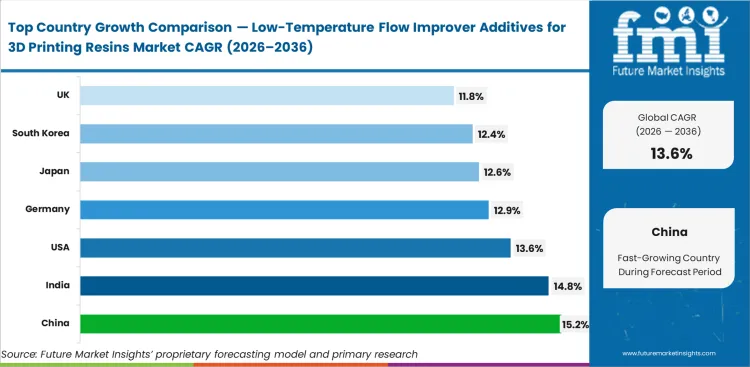
- China is projected to record 15.2% CAGR by 2036, as Guangdong printer clusters and local resin brands raising low-temperature formulation needs.
- India is expected to expand at 14.8% CAGR by 2036, because of Bengaluru and Hyderabad dental labs adopting chairside resin printing.
- Arkema and Evonik compete depending on photopolymer chemistry with Henkel and 3D Systems influencing printer-specific resin validation.
- Analyst Opinion
- Nikhil Kaitwade, Principal Analyst for Industrial Automation and Equipment at FMI, opines, “Low-temperature flow improvers are integrating from simple handling aids into resin approval inputs. Buyers compare viscosity stability and cure response before selecting an additive package for part accuracy. Best suppliers are expected to help resin brands avoid winter VAT failures without forcing longer exposure times. Demand is likely to follow dental labs and engineering bureaus with production users working across mixed indoor temperatures by 2036.”
- Low-Temperature Flow Improver Additives for 3D Printing Resins Market Value Analysis
- The low-temperature flow improver additives for 3D printing resins sector has become a more defined resin performance input.
- Resin formulators are using flow improvers to maintain print consistency in colder storage and processing conditions.
- Printer material suppliers are expected to gain from additives supporting smoother dispensing and better layer formation.
- Demand is projected to rise as industrial users require resin systems with stable viscosity and fewer print defects.
Key Takeaways
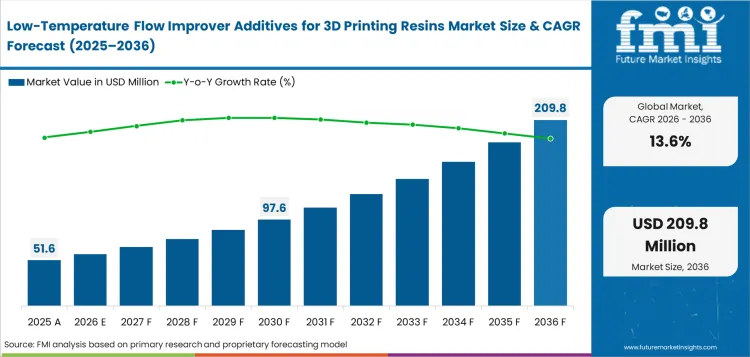
- The low-temperature flow improver additives for 3D printing resins market value stood at USD 51.6 million in 2025.
- Industry value is projected to reach USD 209.8 million by 2036 as resin users shift toward faster vat start-up under cooler shop conditions.
- The sector is expected to expand at 13.6% CAGR from 2026 to 2036 across dental and engineering resin systems with small-batch production.
- Liquid blends are expected to account for 52.0% share in 2026 as resin makers need easy dosing with limited mix time.
- China at 15.2% CAGR and India at 14.8% CAGR are expected to record the fastest pace through 2036.
Low-Temperature Flow Improver Additives for 3D Printing Resins Market Definition
The sector covers additive packages used to improve flow behavior in photopolymer and hybrid resin systems under lower operating temperatures. Included products cover reactive diluents, methacrylate flow aids, acrylate modifiers, dispersing aids, surfactant blends, and liquid additive masterblends. The scope includes additives used in SLA, DLP, LCD, material jetting, and ceramic-filled resin printing. Finished resin printers, finished printed parts, and non-resin filament additives remain outside this study.
Low-Temperature Flow Improver Additives for 3D Printing Resins Market Inclusions
The study includes additives sold into resin formulation, vat handling, filler wetting, and printer-specific flow control. Market scope covers products used with flow improver additives, 3D printing materials, and additive manufacturing materials. Revenue scope covers 2026 to 2036 across global commercial sales into resin makers, printer OEMs, service bureaus, and dental labs. Main buyers include resin producers, printer makers, materials distributors, application labs, and contract part producers.
Market scope covers all commercially traded low-temperature flow improver additive products classified by chemistry type, including acrylate flow aids and silicone-based modifiers. The scope covers resin type, including photopolymer resins and engineering resins. Application coverage includes SLA resins and DLP resins. End users include industrial printing firms, dental labs, prototyping service providers, electronics makers, and medical device firms. Revenue scope covers 2026 to 2036. The key participants include additive producers, resin formulators, 3D printer material suppliers, service bureaus, equipment makers, distributors, testing labs, and regulatory bodies.
Low-Temperature Flow Improver Additives for 3D Printing Resins Market Exclusions
The study excludes PCR filaments, metal powders, general paint rheology agents, finished photopolymer resins without flow-improver claims, and printer hardware sales.
Low-Temperature Flow Improver Additives for 3D Printing Resins Market Research Methodology
- Primary Research: FMI analysts reviewed resin formulators and printer application teams using low-viscosity additive packages. Interviews focused on vat refill speed and cold-start print quality.
- Desk Research: The desk review used NIST vat photopolymerization work and ISO additive manufacturing guidance with official company launches after January 2024.
- Market Sizing and Forecasting: Forecast work combined photopolymer resin consumption with additive dose bands and printer process adoption curves.
- Data Validation: Segment shares were checked against resin type use and printer process needs before channel behavior review.
Why is the Low-Temperature Flow Improver Additives for 3D Printing Resins Market Growing?
- Vat photopolymerization uses liquid photopolymer resin cured by ultraviolet light, so resin flow stability affecting layer formation during SLA and DLP printing.
- NIST describes vat photopolymerization as a process built around liquid resin curing, creating a need for controlled resin movement inside the vat.
- ISO/ASTM 52927:2024 identifies quality characteristics for AM feedstock and parts, strengthening the case for stable resin behavior during testing.
- Evonik launched INFINAM FR 4100L in February 2024 as a room-temperature pourable DLP resin. The launch shows supplier focus on easier liquid handling.
Low-temperature handling has become a practical resin approval point for industrial 3D printing users. Resin can print well in a warm lab. The same resin can slow during cooler shifts. Flow improvers support smoother refill between layers. They help filled resin systems move more evenly through the vat. Suppliers with viscosity data and printer setting support can gain earlier approval in production accounts.
Material producers are using formulation control to protect part accuracy without changing the core cure system. NIST research on photopolymer complexes replaced solvent with reactive diluents in printable resins. This source supports the function of resin formulation tools in improving processing behavior. Resin makers that present viscosity data and post-cure proof should hold a stronger position by 2036.
Market Segmentation Analysis
- Acrylate UV photopolymer resins are expected to lead resin type demand with 46.0% share in 2026.
- Methacrylate diluents are estimated to lead additive chemistry demand with 38.0% share in 2026.
- DLP printing is expected to lead printer process demand with 41.0% share in 2026.
- Liquid blends are projected to lead additive form demand with 52.0% share in 2026.
The low-temperature flow improver additives for 3D printing resins market is segmented by resin type into acrylate UV photopolymers, epoxy acrylates, urethane acrylates, dental biocompatible resins, ceramic-filled resins, and hybrid resins. By additive chemistry, demand is divided into methacrylate diluents, acrylate modifiers, surfactant blends, dispersing aids, oligomer blends, and silicone-free aids. Based on printer process, demand is segmented into SLA, DLP, LCD, material jetting, ceramic vat printing, and continuous printing.
By end use, demand is split into dental labs, medical devices, engineering bureaus, electronics, education labs, and consumer products. Based on additive form, demand is classified into liquid blends, reactive concentrates, dispersant packages, resin premixes, and custom blends. By sales channel, demand is segmented into direct technical supply, resin maker partnerships, distributors, printer OEM bundles, and online B2B channels.
Low-Temperature Flow Improver Additives for 3D Printing Resins Market Analysis by Resin Type
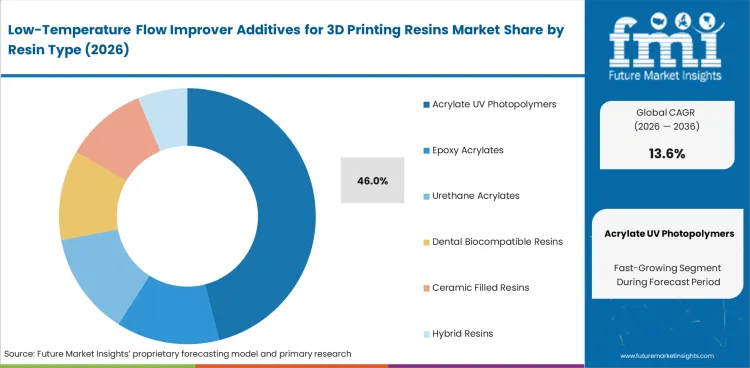
- Acrylate UV photopolymer resins are expected to account for 46.0% share in 2026 because low-viscosity base systems dominate SLA and LCD resin adoption.
- Resin makers prefer acrylate UV photopolymer systems since UV curable resin and formulated product suppliers align with cure speed and flow behavior together.
Insights into Urethane Acrylate Resins Segment
- Urethane acrylate resins gain use in tough parts requiring better bending strength after cold-room printing and post-cure treatment.
- UV curable urethane acrylate oligomers help formulators balance flexibility with print detail in engineering resin grades.
Low-Temperature Flow Improver Additives for 3D Printing Resins Market Analysis by Additive Chemistry
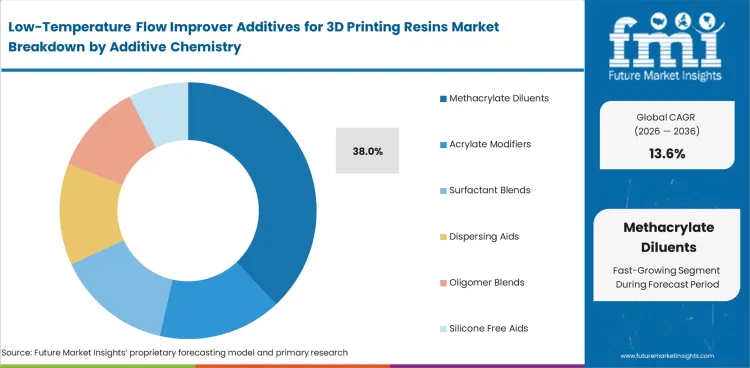
- Methacrylate diluents are projected to represent 38.0% share in 2026, as reactive low-viscosity molecules improving flow without creating solvent loss.
- Acrylate oligomers remain important since resin makers need flow aids able to protect cure response and final part strength.
Insights into Surfactant Blends Segment
- Surfactant blends gain use in ceramic-filled and pigmented resins needing cleaner filler wetting at lower vat temperatures.
- Isobornyl acrylate is assessed in specialty formulations seeking lower shrinkage and better handling during vat printing.
Low-Temperature Flow Improver Additives for 3D Printing Resins Market Analysis by Printer Process
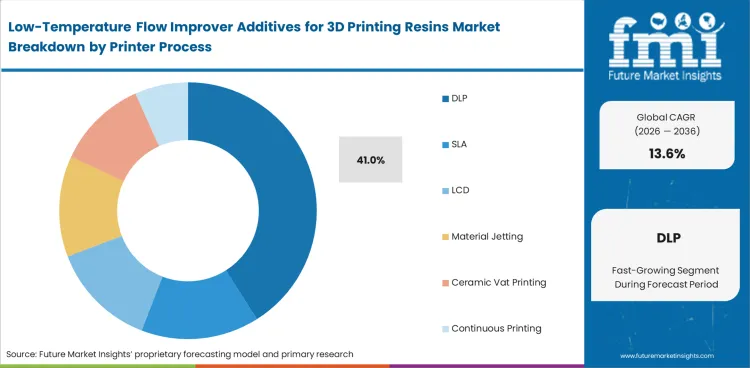
- DLP printing is predicted to account for 41.0% share in 2026, because production users requiring quick resin leveling after each projected layer.
- Printer owners compare additive packages with 3D printing systems using cure-depth checks and failed-build tracking before approval.
Insights into LCD Printing Segment
- LCD printing gains share in desktop and dental labs needing stable pour behavior with low-cost resin vats.
- Low-temperature flow aids help LCD users maintain early-layer detail during winter shifts in smaller workshops.
Low-Temperature Flow Improver Additives for 3D Printing Resins Market Analysis by End Use
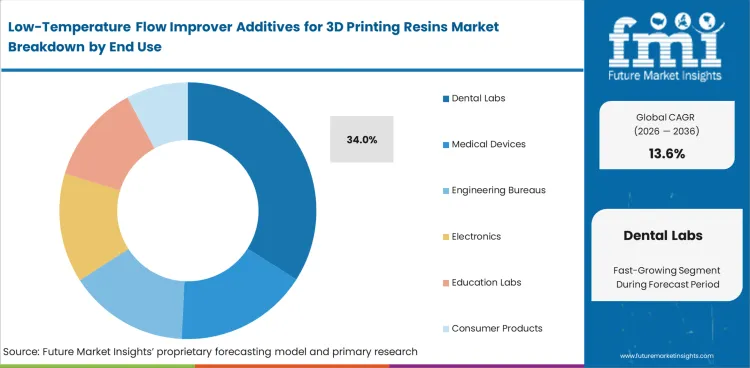
- Dental labs are anticipated to hold 34.0% share in 2026, driven by aligner models and guide prints demand clean layers under varied room temperatures.
- Dental 3D printing material buyers value additive packages able to reduce remakes without changing approved printer settings.
Insights into Medical Devices Segment
- Medical device users qualify resin additives slowly since biocompatibility files and sterilization proof affect each material change.
- 3D printed medical devices create steady need for documented resin behavior in controlled production settings.
Low-Temperature Flow Improver Additives for 3D Printing Resins Market Analysis by Additive Form
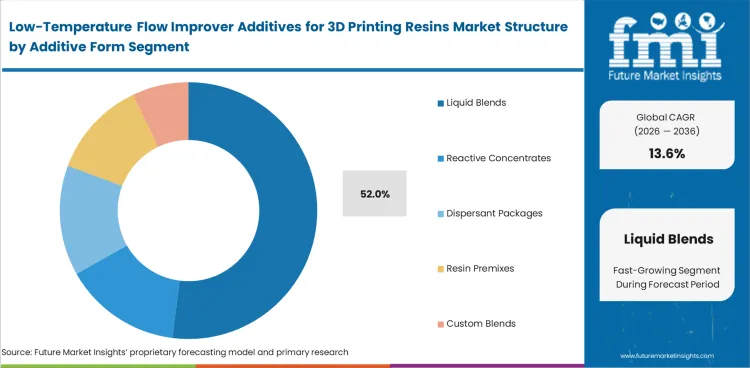
- Liquid blends are projected to make up 52.0% share in 2026, led by pumpable additives shortening mixing time for resin producers.
- Waterborne UV curable resin development shows how liquid format choices affect handling speed and material consistency.
Insights into Reactive Concentrates Segment
- Reactive concentrates serve resin producers requiring flow improvement with fewer non-reactive residues after curing.
- Concentrates gain attention in custom grades for electronics and engineering parts depending on clean surface finish.
Low-Temperature Flow Improver Additives for 3D Printing Resins Market Analysis by Sales Channel
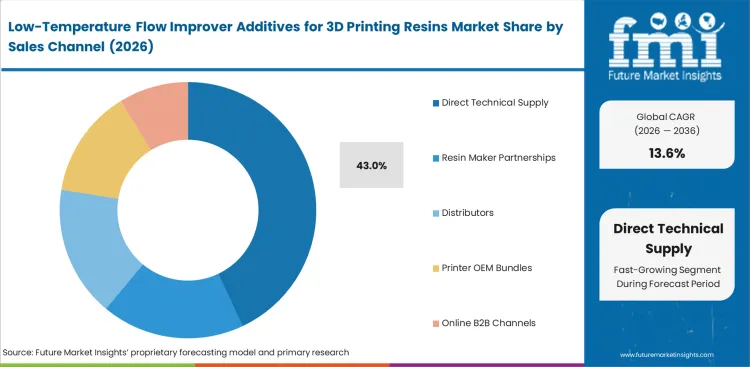
- Direct technical supply is expected to secure 43.0% share in 2026 due to large resin brands requiring viscosity data and printer setting support.
- Suppliers serving UV curable coatings are likely to adapt lab test methods for resin additive qualification.
Insights into Resin Maker Partnerships Segment
- Resin maker partnerships are needed for printer-specific settings since each vat system responds differently to additive dose changes.
- Partnership supply influences small resin brands access additive knowledge base without building a full rheology lab.
Low-Temperature Flow Improver Additives for 3D Printing Resins Market Drivers, Restraints, and Opportunities
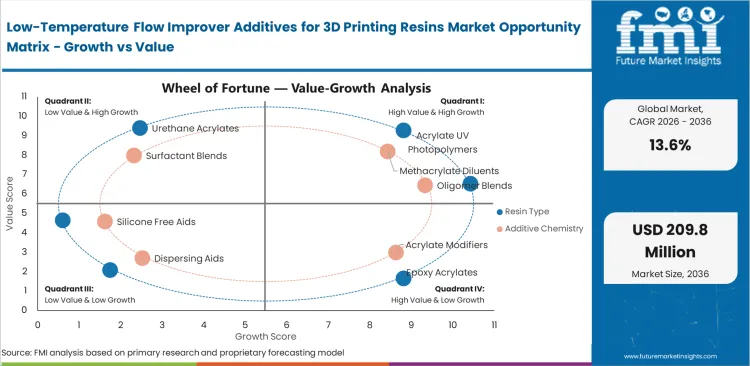
- Cold-start resin handling is expected to favor additives able to lower viscosity without reducing cure depth in SLA and DLP printers.
- Printer-specific qualification will slow supplier switching since each additive dose needs exposure and lift-speed checks before post-cure review.
- Filled resin systems are expected to create stronger prospects as ceramic and dental materials need better particle wetting at lower temperature.
Cold-room print reliability is anticipated to integrate flow improvers into resin formulation planning by 2036. NIST describes vat photopolymerization as a process built on liquid photopolymer resin cured with ultraviolet light. Slow resin refill can affect early layer quality and surface finish during SLA and DLP printing. Formulators will prefer low-dose additives able to improve flow without changing cure response. Higher-value uptake is expected in dental and engineering grades using filled resin systems.
Qualification work is expected to limit faster adoption in lower-price resin accounts. ISO/ASTM 52927:2024 identifies feedstock and part quality characteristics for additive manufacturing testing. Resin brands must check viscosity and exposure window before reviewing mechanical properties after any additive change. Supplier advantage will shift toward companies able to provide printer-specific data with simple processing guidance. Lower-risk approval packages should protect margins in technical resin accounts by 2036.
Application-wise Equipment Deployment Analysis
Low-temperature flow improver additives for 3D printing resins are expected to gain higher use in discrete manufacturing along with packaging development and maintenance support applications. ASTM International reported global additive manufacturing revenue of USD 24.2 billion in 2025, with 10.9% annual expansion and materials holding 20% of total revenue. Equipment deployment is therefore shifting toward higher resin use rather than printer purchases alone. Vat photopolymerization users in prototype cells and utility maintenance will prefer additives able to keep resin flow stable under cooler storage or operating conditions.
Technology Adoption and Automation Penetration Analysis
Technology adoption for low-temperature flow improver additives in 3D printing resins is expected to concentrate around printer-fleet software and resin tracking. Sensor-led maintenance are likely to create a separate qualification route. Formlabs confirmed on 24 March 2025, dashboard now includes former fleet control tools. Core functions include group queues and cloud slicing. Bulk firmware updates add a separate fleet-control function. Dashboard tracks real-time monitoring and maintenance needs across multiple printers. Resin flow improver suppliers gain a clearer route into automated SLA cells as unattended queues require stable refill behavior and repeatable viscosity under cooler room conditions.
Regional Analysis
.webp "Top Country Growth Comparison Low Temperature Flow Improver Additives For 3d Printing Resins Market Cagr (2026 2036)")
| Country | CAGR 2026 to 2036 |
|---|---|
| China | 15.2% |
| India | 14.8% |
| United States | 13.6% |
| Germany | 12.9% |
| Japan | 12.6% |
| South Korea | 12.4% |
| United Kingdom | 11.8% |
Source: Future Market Insights analysis based on primary research and public source checks in 2026.
Analysis of Low-Temperature Flow Improver Additives for 3D Printing Resins Market by Key Countries
- China is expected to record fastest pace at 15.2% CAGR by 2036 as local resin blending and industrial AM use increase additive trials.
- India is projected to follow at 14.8% CAGR by 2036 due to medical printing and domestic resin mixing creating larger prospect for additive adoption.
- United States demand is projected at 13.6% CAGR by 2036 since defense AM programs and dental printing workflows depend on stable resin flow.
- Germany is expected to advance at 12.9% CAGR by 2036, led by printer-material validation and specialty chemical supply depth shape resin additive selection.
- Japan at 12.6% CAGR, South Korea at 12.4% CAGR, and United Kingdom at 11.8% CAGR expand by 2036 through precision manufacturing demand and slower qualification cycles.
Country pace varies with resin blending depth and industrial AM readiness. China leads as printer hardware clusters and local photopolymer resin producers create faster trial cycles. India follows from a smaller base as medical and prototyping service activity lifts resin consumption. United States demand advances through dental labs and defense-linked AM programs. Germany and Japan grow through stricter material validation in precision production. South Korea and United Kingdom maintain steadier adoption as electronics and service bureau users refine resin qualification.
Demand Outlook for Low-Temperature Flow Improver Additives for 3D Printing Resins in China
Demand for low-temperature flow improver additives for 3D printing resins in China is projected to rise at 15.2% CAGR by 2036 as domestic printer hardware clusters and resin blending activity increase additive trials. Local resin makers need flow improvers helping SLA and DLP materials remain easier to pour during cooler production conditions. China leads country outlook through faster sampling cycles and wider industrial AM use.
- Printer hardware clusters influence additive use as resin brands need smoother liquid handling across SLA and DLP systems.
- Dental and engineering resin producers add flow improvers to reduce viscosity drift during storage and vat refill.
- Local resin blending capacity creates faster trial access for additive producers serving printer brands and service bureaus.
Industry Analysis of Low-Temperature Flow Improver Additives for 3D Printing Resins in India
India is expected to expand at 14.8% CAGR by 2036, as medical printing and domestic material mixing lift additive use from a smaller base. Local service bureaus need resins performing reliably across varied room temperatures and smaller batch workflows. India follows China as lower installed AM maturity leaves more room for additive-led formulation gains.
- Medical and dental labs raise interest in resin additives improving pourability and filled resin behavior during daily printing work.
- Prototyping service providers require stable photopolymer resins reducing refill delays across short production jobs.
- Domestic material mixers can gain share by offering smaller trial packs with viscosity data and exposure setting guidance.
Future Outlook for Low-Temperature Flow Improver Additives for 3D Printing Resins in United States
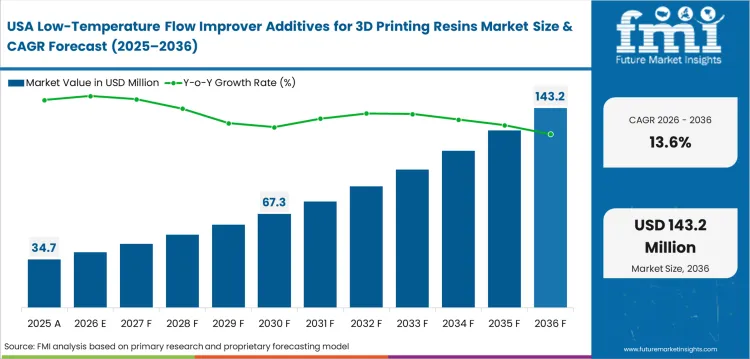
Sales of low-temperature flow improver additives for 3D printing resins in United States are projected to increase at 13.6% CAGR by 2036 because of defense AM programs and dental workflows sustaining stable liquid resin performance. Established resin brands require additives balancing low-temperature handling with cure-depth control. United States demand remains firm through high-value printer use in medical and aerospace accounts. Engineering service accounts add steady qualification work.
- Dental labs use filled and specialty resins requiring smoother particle movement across repeated vat refill cycles.
- Defense and aerospace AM users raise qualification needs for resin systems with repeatable exposure windows and post-cure strength.
- Formulation data gains value as resin buyers prefer additive grades backed by printer-specific test results.
Industry Outlook for Low-Temperature Flow Improver Additives for 3D Printing Resins in Germany
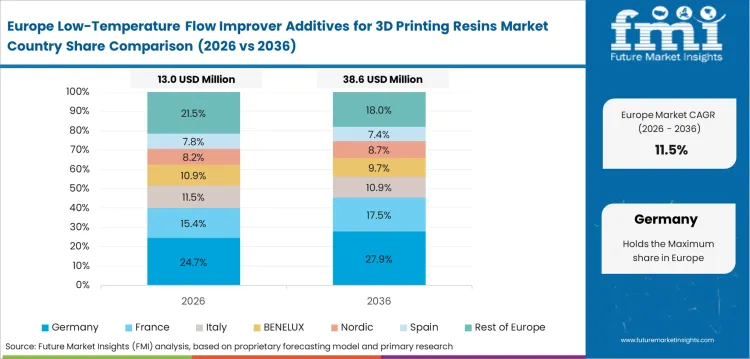
Low-temperature flow improver additive demand in Germany is projected to record 12.9% CAGR by 2036 since printer-material validation and specialty chemical supply depth guide additive selection. German resin users focus on predictable cure response and documented viscosity behavior before approving formulation changes. Adoption pace remains measured as industrial users review part quality before wider resin changes.
- Engineering service bureaus need resin systems maintaining cleaner layer formation during cooler production shifts.
- Specialty chemical suppliers can serve resin makers through flow-control grades developed near photopolymer formulation labs.
- Printer-material validation maintains strict approval timelines as users compare viscosity and post-cure performance before scale-up.
Demand Outlook for Low-Temperature Flow Improver Additives for 3D Printing Resins in Japan
Japan is expected to reach 12.6% CAGR by 2036 as precision manufacturing and medical device prototyping maintain steady resin additive adoption. Japanese users emphasize resin repeatability and stable part dimensions across smaller production batches. Country outlook stays steady as qualification discipline remains stronger than trial speed.
- Precision part makers need additives preserving print detail during low-temperature resin handling.
- Medical device prototyping users favor resins with stable cure behavior and lower viscosity variation during production checks.
- Local material buyers prefer suppliers able to provide clean documentation for viscosity control and post-cure review.
Industry Outlook for Low-Temperature Flow Improver Additives for 3D Printing Resins in South Korea
Demand in South Korea is expected to advance at 12.4% CAGR by 2036 as electronics prototyping and dental printing increase need for stable photopolymer resin flow. Local users value resin additives helping filled materials move evenly through vats during fine-feature printing. South Korea grows through selective adoption in high-precision accounts rather than broad low-cost resin use.
- Electronics prototyping firms require flow-controlled resins for small parts needing fine surface finish and stable dimensions.
- Dental printing users add interest in low-viscosity resin systems suitable for repeated daily production cycles.
- Local material suppliers gain better account access by pairing additive samples with printer setting guidance.
Demand Outlook for Low-Temperature Flow Improver Additives for 3D Printing Resins in United Kingdom
Industry demand in United Kingdom is forecast to expand at 11.8% CAGR by 2036, driven by service bureaus and healthcare users continuing resin process refinement. Local adoption remains slower than China and India as buyer qualification tends to favor proven resin systems. United Kingdom still offers steady demand for additives improving cold-room handling and filled resin movement.
- Service bureaus need reliable resin flow across short print jobs and varied workshop temperature conditions.
- Healthcare printing users favor additives able to improve handling without changing cure depth or post-cure strength.
- Regional distributors can serve smaller print firms needing standard additive grades and faster technical guidance.
Competitive Positioning and Strategic Supplier Strength
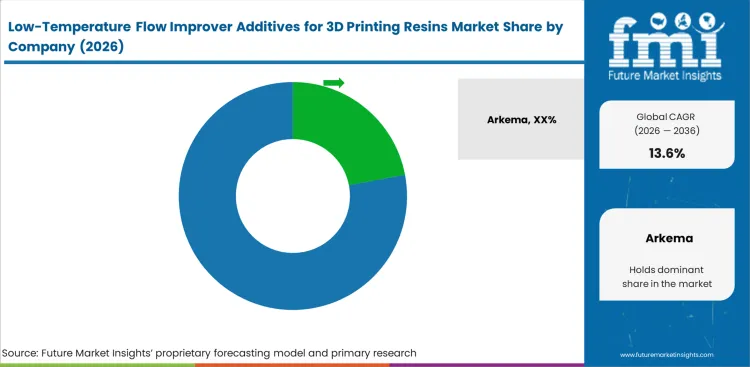
- Arkema and Henkel can gain formulation trials by linking additive dosage with viscosity targets. Post-cure checks across DLP platforms remain the approval test.
- Evonik can defend premium accounts by pairing room-temperature handling claims with flame-retardant resin data for electronics and aerospace users.
- 3D Systems and Formlabs influence buyer benchmarks. Stratasys shapes validation expectations as printer platforms turn resin changes into workflow decisions.
Competition in low-temperature flow improver additives for 3D printing resins centers on printer validation and acrylate supply access. Arkema brings N3xtDimension liquid resins and Sartomer building blocks. Its portfolio covers oligomers and additives for UV-curable 3D printing. Evonik adds INFINAM resin data through INFINAM FR 4100L. The DLP resin was launched in February 2024 with room-temperature pourability and flame-retardant cured performance. Henkel’s Loctite AM platform raises buyer expectations for workflow validation.
Printer-linked firms influence additive approval paths as resin buyers often follow platform settings before allowing formula change. 3D Systems lists dental and industrial resin choices across SLA material families. The platform gives additive suppliers a clearer proof route for high-detail parts. Formlabs offers more than 10 dental resins and states resin settings are calculated around material properties and curing settings. Viscosity change becomes a validation issue instead of a simple additive swap. Stratasys Origin One materials are developed and validated for Origin One, so flow improver vendors need platform-level proof before scale use.
Companies in Low-Temperature Flow Improver Additives for 3D Printing Resins Market
Competition spans photopolymer resin formulators and printer-material platform owners serving SLA and DLP resin systems.
- Resin and oligomer formulators: Arkema competes through N3xtDimension liquid resins along with Sartomer oligomers and additives for UV-curable 3D printing. Evonik adds INFINAM photopolymer resin knowledge base through INFINAM FR 4100L, a DLP resin launched in February 2024 with room-temperature pourability. Henkel competes through Loctite photopolymer materials designed for DLP and LCD platforms used in industrial applications.
- Additive chemistry suppliers: BYK serves flow-control and wetting needs based on additives for radiation-curable systems, including viscosity and wetting behavior support. Allnex competes through UV-curable resins and additives used in energy-cured formulations.
- Printer-platform validators: 3D Systems, Formlabs, and Stratasys shape material qualification paths depending on platform-linked resin families and validated material settings. 3D Systems lists material families, Formlabs offers dental resin systems, and Stratasys provides Origin One materials developed and validated for Origin One.
Competitive Benchmarking: Low-Temperature Flow Improver Additives for 3D Printing Resins Market
| Company | Resin Flow Control Depth | SLA DLP Validation Access | Additive Chemistry Range | Footprint |
|---|---|---|---|---|
| Arkema | High | Large | High | Global |
| Evonik | High | Moderate | Large | Global |
| Henkel | High | High | Moderate | Global |
| BYK | Large | Moderate | High | Global |
| allnex | Large | Moderate | High | Global |
| 3D Systems | Moderate | High | Moderate | Global |
| Formlabs | Moderate | High | Moderate | Global |
| Stratasys | Moderate | High | Large | Global |
Source: Future Market Insights competitive analysis based on public product portfolios and company activity in 2026.
Key Developments in the Low-Temperature Flow Improver Additives for 3D Printing Resins Market
- • In February 2024, Evonik launched INFINAM FR 4100L for DLP printing and described it as pourable at room temperature.
- • In November 2025, Arkema and Axtra3D partnered to qualify N3xtDimension flame-retardant and water-soluble resins on Axtra3D’s Lumia X1 Hi-Speed SLA printer.
- • In December 2025, Formlabs reported 2025 material updates including tough resins and custom color resin for direct color part printing.
Key Players in the Low-Temperature Flow Improver Additives for 3D Printing Resins Market
Resin and oligomer formulators
- • Arkema
- • Evonik Industries AG
- • Henkel AG & Co. KGaA
- • allnex
Additive chemistry suppliers
- • BYK-Chemie GmbH
- • Sartomer
- • BASF SE
- • Nagase & Co., Ltd.
Printer-platform validators
- • 3D Systems Corporation
- • Formlabs Inc.
- • Stratasys Ltd.
Report Scope and Coverage
| Item | Value |
|---|---|
| Market value in 2025 | USD 51.6 million |
| Market value in 2026 | USD 58.6 million |
| Market value in 2036 | USD 209.8 million |
| CAGR from 2026 to 2036 | 13.6% |
| Quantitative units | USD million |
| Market definition | Additives used to improve resin flow behavior under lower operating temperatures in SLA, DLP, LCD, material jetting, and ceramic-filled resin printing |
| By resin type | Acrylate UV photopolymers, epoxy acrylates, urethane acrylates, dental biocompatible resins, ceramic-filled resins, hybrid resins |
| By additive chemistry | Methacrylate diluents, acrylate modifiers, surfactant blends, dispersing aids, oligomer blends, silicone-free aids |
| By printer process | SLA, DLP, LCD, material jetting, ceramic vat printing, continuous printing |
| By end use | Dental labs, medical devices, engineering bureaus, electronics, education labs, consumer products |
| By additive form | Liquid blends, reactive concentrates, dispersant packages, resin premixes, custom blends |
| By sales channel | Direct technical supply, resin maker partnerships, distributors, printer OEM bundles, online B2B channels |
| Regions covered | North America, Latin America, Europe, East Asia, South Asia and Pacific, Middle East and Africa |
| Countries covered | China, India, United States, Germany, Japan, South Korea, United Kingdom |
| Key companies profiled | Arkema, Evonik Industries, Henkel, BYK, allnex, BASF, Nagase, 3D Systems, Formlabs, Stratasys, Photocentric |
| Forecast period | 2026 to 2036 |
| Approach | FMI analysis based on resin additive use, vat photopolymerization process needs, company activity, and public source checks |
Source: Future Market Insights analysis, 2026.
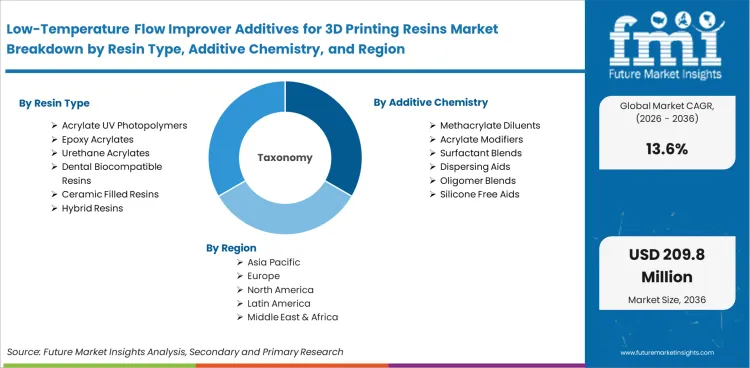
Low-Temperature Flow Improver Additives for 3D Printing Resins Market Breakdown By Resin Type, Additive Chemistry, Printer Process, End Use, Additive Form, Sales Channel, and Region
Low-Temperature Flow Improver Additives for 3D Printing Resins Market Segmented by Resin Type
- Acrylate UV Photopolymers
- Epoxy Acrylates
- Urethane Acrylates
- Dental Biocompatible Resins
- Ceramic Filled Resins
- Hybrid Resins
Low-Temperature Flow Improver Additives for 3D Printing Resins Market Segmented by Additive Chemistry
- Methacrylate Diluents
- Acrylate Modifiers
- Surfactant Blends
- Dispersing Aids
- Oligomer Blends
- Silicone Free Aids
Low-Temperature Flow Improver Additives for 3D Printing Resins Market Segmented by Printer Process
- SLA
- DLP
- LCD
- Material Jetting
- Ceramic Vat Printing
- Continuous Printing
Low-Temperature Flow Improver Additives for 3D Printing Resins Market Segmented by End Use
- Dental Labs
- Medical Devices
- Engineering Bureaus
- Electronics
- Education Labs
- Consumer Products
Low-Temperature Flow Improver Additives for 3D Printing Resins Market Segmented by Additive Form
- Liquid Blends
- Reactive Concentrates
- Dispersant Packages
- Resin Premixes
- Custom Blends
Low-Temperature Flow Improver Additives for 3D Printing Resins Market Segmented by Sales Channel
- Direct Technical Supply
- Resin Maker Partnerships
- Distributors
- Printer OEM Bundles
- Online B2B Channels
Low-Temperature Flow Improver Additives for 3D Printing Resins Market by Region
- North America
- United States
- Canada
- Mexico
- Latin America
- Brazil
- Chile
- Western Europe
- Germany
- United Kingdom
- Italy
- France
- Eastern Europe
- Poland
- East Asia
- China
- Japan
- South Korea
- South Asia and Pacific
- India
- ASEAN
- Australia and New Zealand
- Middle East and Africa
- Kingdom of Saudi Arabia
- South Africa
Research Sources and Bibliography
- 3D Systems. (2025, April 7). 3D Systems transforming manufacturing with application-specific solutions at RAPID + TCT 2025.
- Arkema. (2025, November 5). Arkema at Formnext 2025: Accelerating sustainable innovation in additive manufacturing.
- ASTM International. (2026, February 17). New Wohlers Report 2026 values additive manufacturing market at $24.2B.
- Caplins, B. W., Kolibaba, T. J., Arp, U., Miller, C. C., Zong, Y., Poster, D. L., Higgins, C. I., & Killgore, J. P. (2024). Influence of spectral bandwidth on the working curve in vat photopolymerization. Additive Manufacturing, 85, 104172.
- Evonik. (2024, February 8). Evonik’s new INFINAM® FR 4100L 3D printing resin designed for manufacturing tough, ductile, flame-retardant parts.
- Formlabs. (2025, November 13). Formlabs unveils next-generation SLA materials that rival traditional thermoplastics.
- Formlabs. (2025, December 11). Formlabs year in review: 2025 highlights.
- Henkel. (2025, November 10). Loctite presents new medical colors and certified industrial resin at Formnext 2025.
- International Organization for Standardization. (2024). ISO/ASTM 52927:2024: Additive manufacturing: General principles: Main characteristics and corresponding test methods.
- Kolibaba, T. J., Caplins, B. W., Higgins, C. I., Mansfield, E., Miller, S. L., Chandler, C., & Killgore, J. P. (2024). Tailoring properties of 3D-printable polyelectrolyte photopolymer complexes with reactive diluents. ACS Applied Polymer Materials, 6(12), 6957–6965.
- National Institute of Standards and Technology. (2024, October 31). Additive manufacturing technologies.
- National Institute of Standards and Technology. (2024, November 15). Vat photopolymerization.
- Wohlers Associates. (2026, February 17). Wohlers Report 2026. Wohlers Platform.
The bibliography is provided for reader reference and direct source checking.
This Report Answers
- How large the low-temperature flow improver additives for 3D printing resins sector is in 2026 and how far it can rise by 2036?
- Which resin type and additive form hold the largest projected share positions in 2026?
- Why liquid blends and acrylate UV photopolymer resins hold the clearest lead in current additive structure?
- Why China and India lead the country growth set through 2036?
- How direct technical supply shapes access for large resin brands and printer OEMs?
- Which supplier capabilities help companies defend position in resin additive qualification?
- What public standards and company material launches support the forecast method used in this study?
Frequently Asked Questions
How large is the low-temperature flow improver additives for 3d printing resins market in 2026?
The low-temperature flow improver additives for 3d printing resins market is projected to reach USD 51.6 million in 2026.
What will the low-temperature flow improver additives for 3d printing resins market be worth by 2036?
The low-temperature flow improver additives for 3d printing resins market is forecast to reach USD 184.7 million by 2036.
What is the expected low-temperature flow improver additives for 3d printing resins market CAGR?
The low-temperature flow improver additives for 3d printing resins market is expected to expand at 13.6% CAGR from 2026 to 2036.
Which additive form leads the low-temperature flow improver additives for 3d printing resins market?
Liquid blends are projected to account for 52.0% share in 2026 as resin makers need easier dosing and faster mixing.
Which countries grow fastest in the low-temperature flow improver additives for 3d printing resins market?
China at 15.2% CAGR and India at 14.8% CAGR are expected to grow fastest by 2036.
Which companies shape the low-temperature flow improver additives for 3d printing resins market?
Arkema and Evonik Industries lead chemistry depth. Henkel Loctite and 3D Systems shape printer-linked resin qualification with Formlabs.
Preview the report firsthand - request a free sample
Get SampleGet the brochure for pricing and purchase details.
Get PDFTable of Content
- Executive Summary
- Global Market Outlook
- Demand-side Trends
- Supply-side Trends
- Technology Roadmap Analysis
- Analysis and Recommendations
- Market Overview
- Market Coverage / Taxonomy
- Market Definition / Scope / Limitations
- Research Methodology
- Chapter Orientation
- Analytical Lens and Working Hypotheses
- Market Structure, Signals, and Trend Drivers
- Benchmarking and Cross-market Comparability
- Market Sizing, Forecasting, and Opportunity Mapping
- Research Design and Evidence Framework
- Desk Research Programme (Secondary Evidence)
- Company Annual and Sustainability Reports
- Peer-reviewed Journals and Academic Literature
- Corporate Websites, Product Literature, and Technical Notes
- Earnings Decks and Investor Briefings
- Statutory Filings and Regulatory Disclosures
- Technical White Papers and Standards Notes
- Trade Journals, Industry Magazines, and Analyst Briefs
- Conference Proceedings, Webinars, and Seminar Materials
- Government Statistics Portals and Public Data Releases
- Press Releases and Reputable Media Coverage
- Specialist Newsletters and Curated Briefings
- Sector Databases and Reference Repositories
- FMI Internal Proprietary Databases and Historical Market Datasets
- Subscription Datasets and Paid Sources
- Social Channels, Communities, and Digital Listening Inputs
- Additional Desk Sources
- Expert Input and Fieldwork (Primary Evidence)
- Primary Modes
- Qualitative Interviews and Expert Elicitation
- Quantitative Surveys and Structured Data Capture
- Blended Approach
- Why Primary Evidence is Used
- Field Techniques
- Interviews
- Surveys
- Focus Groups
- Observational and In-context Research
- Social and Community Interactions
- Stakeholder Universe Engaged
- C-suite Leaders
- Board Members
- Presidents and Vice Presidents
- R&D and Innovation Heads
- Technical Specialists
- Domain Subject-matter Experts
- Scientists
- Physicians and Other Healthcare Professionals
- Governance, Ethics, and Data Stewardship
- Research Ethics
- Data Integrity and Handling
- Primary Modes
- Tooling, Models, and Reference Databases
- Desk Research Programme (Secondary Evidence)
- Data Engineering and Model Build
- Data Acquisition and Ingestion
- Cleaning, Normalisation, and Verification
- Synthesis, Triangulation, and Analysis
- Quality Assurance and Audit Trail
- Market Background
- Market Dynamics
- Drivers
- Restraints
- Opportunity
- Trends
- Scenario Forecast
- Demand in Optimistic Scenario
- Demand in Likely Scenario
- Demand in Conservative Scenario
- Opportunity Map Analysis
- Product Life Cycle Analysis
- Supply Chain Analysis
- Investment Feasibility Matrix
- Value Chain Analysis
- PESTLE and Porter’s Analysis
- Regulatory Landscape
- Regional Parent Market Outlook
- Production and Consumption Statistics
- Import and Export Statistics
- Market Dynamics
- Global Market Analysis 2021 to 2025 and Forecast, 2026 to 2036
- Historical Market Size Value (USD Million) Analysis, 2021 to 2025
- Current and Future Market Size Value (USD Million) Projections, 2026 to 2036
- Y-o-Y Growth Trend Analysis
- Absolute $ Opportunity Analysis
- Global Market Pricing Analysis 2021 to 2025 and Forecast 2026 to 2036
- Global Market Analysis 2021 to 2025 and Forecast 2026 to 2036, By Resin Type
- Introduction / Key Findings
- Historical Market Size Value (USD Million) Analysis By Resin Type , 2021 to 2025
- Current and Future Market Size Value (USD Million) Analysis and Forecast By Resin Type , 2026 to 2036
- Acrylate UV Photopolymers
- Epoxy Acrylates
- Urethane Acrylates
- Dental Biocompatible Resins
- Ceramic Filled Resins
- Hybrid Resins
- Acrylate UV Photopolymers
- Y-o-Y Growth Trend Analysis By Resin Type , 2021 to 2025
- Absolute $ Opportunity Analysis By Resin Type , 2026 to 2036
- Global Market Analysis 2021 to 2025 and Forecast 2026 to 2036, By Additive Chemistry
- Introduction / Key Findings
- Historical Market Size Value (USD Million) Analysis By Additive Chemistry, 2021 to 2025
- Current and Future Market Size Value (USD Million) Analysis and Forecast By Additive Chemistry, 2026 to 2036
- Methacrylate Diluents
- Acrylate Modifiers
- Surfactant Blends
- Dispersing Aids
- Oligomer Blends
- Silicone Free Aids
- Methacrylate Diluents
- Y-o-Y Growth Trend Analysis By Additive Chemistry, 2021 to 2025
- Absolute $ Opportunity Analysis By Additive Chemistry, 2026 to 2036
- Global Market Analysis 2021 to 2025 and Forecast 2026 to 2036, By Printer Process
- Introduction / Key Findings
- Historical Market Size Value (USD Million) Analysis By Printer Process, 2021 to 2025
- Current and Future Market Size Value (USD Million) Analysis and Forecast By Printer Process, 2026 to 2036
- DLP
- SLA
- LCD
- Material Jetting
- Ceramic Vat Printing
- Continuous Printing
- DLP
- Y-o-Y Growth Trend Analysis By Printer Process, 2021 to 2025
- Absolute $ Opportunity Analysis By Printer Process, 2026 to 2036
- Global Market Analysis 2021 to 2025 and Forecast 2026 to 2036, By End Use
- Introduction / Key Findings
- Historical Market Size Value (USD Million) Analysis By End Use, 2021 to 2025
- Current and Future Market Size Value (USD Million) Analysis and Forecast By End Use, 2026 to 2036
- Dental Labs
- Medical Devices
- Engineering Bureaus
- Electronics
- Education Labs
- Consumer Products
- Dental Labs
- Y-o-Y Growth Trend Analysis By End Use, 2021 to 2025
- Absolute $ Opportunity Analysis By End Use, 2026 to 2036
- Global Market Analysis 2021 to 2025 and Forecast 2026 to 2036, By Additive Form
- Introduction / Key Findings
- Historical Market Size Value (USD Million) Analysis By Additive Form, 2021 to 2025
- Current and Future Market Size Value (USD Million) Analysis and Forecast By Additive Form, 2026 to 2036
- Liquid Blends
- Reactive Concentrates
- Dispersant Packages
- Resin Premixes
- Custom Blends
- Liquid Blends
- Y-o-Y Growth Trend Analysis By Additive Form, 2021 to 2025
- Absolute $ Opportunity Analysis By Additive Form, 2026 to 2036
- Global Market Analysis 2021 to 2025 and Forecast 2026 to 2036, By Sales Channel
- Introduction / Key Findings
- Historical Market Size Value (USD Million) Analysis By Sales Channel, 2021 to 2025
- Current and Future Market Size Value (USD Million) Analysis and Forecast By Sales Channel, 2026 to 2036
- Direct Technical Supply
- Resin Maker Partnerships
- Distributors
- Printer OEM Bundles
- Online B2B Channels
- Direct Technical Supply
- Y-o-Y Growth Trend Analysis By Sales Channel, 2021 to 2025
- Absolute $ Opportunity Analysis By Sales Channel, 2026 to 2036
- Global Market Analysis 2021 to 2025 and Forecast 2026 to 2036, By Region
- Introduction
- Historical Market Size Value (USD Million) Analysis By Region, 2021 to 2025
- Current Market Size Value (USD Million) Analysis and Forecast By Region, 2026 to 2036
- North America
- Latin America
- Western Europe
- Eastern Europe
- East Asia
- South Asia and Pacific
- Middle East & Africa
- Market Attractiveness Analysis By Region
- North America Market Analysis 2021 to 2025 and Forecast 2026 to 2036, By Country
- Historical Market Size Value (USD Million) Trend Analysis By Market Taxonomy, 2021 to 2025
- Market Size Value (USD Million) Forecast By Market Taxonomy, 2026 to 2036
- By Country
- USA
- Canada
- Mexico
- By Resin Type
- By Additive Chemistry
- By Printer Process
- By End Use
- By Additive Form
- By Sales Channel
- By Country
- Market Attractiveness Analysis
- By Country
- By Resin Type
- By Additive Chemistry
- By Printer Process
- By End Use
- By Additive Form
- By Sales Channel
- Key Takeaways
- Latin America Market Analysis 2021 to 2025 and Forecast 2026 to 2036, By Country
- Historical Market Size Value (USD Million) Trend Analysis By Market Taxonomy, 2021 to 2025
- Market Size Value (USD Million) Forecast By Market Taxonomy, 2026 to 2036
- By Country
- Brazil
- Chile
- Rest of Latin America
- By Resin Type
- By Additive Chemistry
- By Printer Process
- By End Use
- By Additive Form
- By Sales Channel
- By Country
- Market Attractiveness Analysis
- By Country
- By Resin Type
- By Additive Chemistry
- By Printer Process
- By End Use
- By Additive Form
- By Sales Channel
- Key Takeaways
- Western Europe Market Analysis 2021 to 2025 and Forecast 2026 to 2036, By Country
- Historical Market Size Value (USD Million) Trend Analysis By Market Taxonomy, 2021 to 2025
- Market Size Value (USD Million) Forecast By Market Taxonomy, 2026 to 2036
- By Country
- Germany
- UK
- Italy
- Spain
- France
- Nordic
- BENELUX
- Rest of Western Europe
- By Resin Type
- By Additive Chemistry
- By Printer Process
- By End Use
- By Additive Form
- By Sales Channel
- By Country
- Market Attractiveness Analysis
- By Country
- By Resin Type
- By Additive Chemistry
- By Printer Process
- By End Use
- By Additive Form
- By Sales Channel
- Key Takeaways
- Eastern Europe Market Analysis 2021 to 2025 and Forecast 2026 to 2036, By Country
- Historical Market Size Value (USD Million) Trend Analysis By Market Taxonomy, 2021 to 2025
- Market Size Value (USD Million) Forecast By Market Taxonomy, 2026 to 2036
- By Country
- Russia
- Poland
- Hungary
- Balkan & Baltic
- Rest of Eastern Europe
- By Resin Type
- By Additive Chemistry
- By Printer Process
- By End Use
- By Additive Form
- By Sales Channel
- By Country
- Market Attractiveness Analysis
- By Country
- By Resin Type
- By Additive Chemistry
- By Printer Process
- By End Use
- By Additive Form
- By Sales Channel
- Key Takeaways
- East Asia Market Analysis 2021 to 2025 and Forecast 2026 to 2036, By Country
- Historical Market Size Value (USD Million) Trend Analysis By Market Taxonomy, 2021 to 2025
- Market Size Value (USD Million) Forecast By Market Taxonomy, 2026 to 2036
- By Country
- China
- Japan
- South Korea
- By Resin Type
- By Additive Chemistry
- By Printer Process
- By End Use
- By Additive Form
- By Sales Channel
- By Country
- Market Attractiveness Analysis
- By Country
- By Resin Type
- By Additive Chemistry
- By Printer Process
- By End Use
- By Additive Form
- By Sales Channel
- Key Takeaways
- South Asia and Pacific Market Analysis 2021 to 2025 and Forecast 2026 to 2036, By Country
- Historical Market Size Value (USD Million) Trend Analysis By Market Taxonomy, 2021 to 2025
- Market Size Value (USD Million) Forecast By Market Taxonomy, 2026 to 2036
- By Country
- India
- ASEAN
- Australia & New Zealand
- Rest of South Asia and Pacific
- By Resin Type
- By Additive Chemistry
- By Printer Process
- By End Use
- By Additive Form
- By Sales Channel
- By Country
- Market Attractiveness Analysis
- By Country
- By Resin Type
- By Additive Chemistry
- By Printer Process
- By End Use
- By Additive Form
- By Sales Channel
- Key Takeaways
- Middle East & Africa Market Analysis 2021 to 2025 and Forecast 2026 to 2036, By Country
- Historical Market Size Value (USD Million) Trend Analysis By Market Taxonomy, 2021 to 2025
- Market Size Value (USD Million) Forecast By Market Taxonomy, 2026 to 2036
- By Country
- Kingdom of Saudi Arabia
- Other GCC Countries
- Turkiye
- South Africa
- Other African Union
- Rest of Middle East & Africa
- By Resin Type
- By Additive Chemistry
- By Printer Process
- By End Use
- By Additive Form
- By Sales Channel
- By Country
- Market Attractiveness Analysis
- By Country
- By Resin Type
- By Additive Chemistry
- By Printer Process
- By End Use
- By Additive Form
- By Sales Channel
- Key Takeaways
- Key Countries Market Analysis
- USA
- Pricing Analysis
- Market Share Analysis, 2025
- By Resin Type
- By Additive Chemistry
- By Printer Process
- By End Use
- By Additive Form
- By Sales Channel
- Canada
- Pricing Analysis
- Market Share Analysis, 2025
- By Resin Type
- By Additive Chemistry
- By Printer Process
- By End Use
- By Additive Form
- By Sales Channel
- Mexico
- Pricing Analysis
- Market Share Analysis, 2025
- By Resin Type
- By Additive Chemistry
- By Printer Process
- By End Use
- By Additive Form
- By Sales Channel
- Brazil
- Pricing Analysis
- Market Share Analysis, 2025
- By Resin Type
- By Additive Chemistry
- By Printer Process
- By End Use
- By Additive Form
- By Sales Channel
- Chile
- Pricing Analysis
- Market Share Analysis, 2025
- By Resin Type
- By Additive Chemistry
- By Printer Process
- By End Use
- By Additive Form
- By Sales Channel
- Germany
- Pricing Analysis
- Market Share Analysis, 2025
- By Resin Type
- By Additive Chemistry
- By Printer Process
- By End Use
- By Additive Form
- By Sales Channel
- UK
- Pricing Analysis
- Market Share Analysis, 2025
- By Resin Type
- By Additive Chemistry
- By Printer Process
- By End Use
- By Additive Form
- By Sales Channel
- Italy
- Pricing Analysis
- Market Share Analysis, 2025
- By Resin Type
- By Additive Chemistry
- By Printer Process
- By End Use
- By Additive Form
- By Sales Channel
- Spain
- Pricing Analysis
- Market Share Analysis, 2025
- By Resin Type
- By Additive Chemistry
- By Printer Process
- By End Use
- By Additive Form
- By Sales Channel
- France
- Pricing Analysis
- Market Share Analysis, 2025
- By Resin Type
- By Additive Chemistry
- By Printer Process
- By End Use
- By Additive Form
- By Sales Channel
- India
- Pricing Analysis
- Market Share Analysis, 2025
- By Resin Type
- By Additive Chemistry
- By Printer Process
- By End Use
- By Additive Form
- By Sales Channel
- ASEAN
- Pricing Analysis
- Market Share Analysis, 2025
- By Resin Type
- By Additive Chemistry
- By Printer Process
- By End Use
- By Additive Form
- By Sales Channel
- Australia & New Zealand
- Pricing Analysis
- Market Share Analysis, 2025
- By Resin Type
- By Additive Chemistry
- By Printer Process
- By End Use
- By Additive Form
- By Sales Channel
- China
- Pricing Analysis
- Market Share Analysis, 2025
- By Resin Type
- By Additive Chemistry
- By Printer Process
- By End Use
- By Additive Form
- By Sales Channel
- Japan
- Pricing Analysis
- Market Share Analysis, 2025
- By Resin Type
- By Additive Chemistry
- By Printer Process
- By End Use
- By Additive Form
- By Sales Channel
- South Korea
- Pricing Analysis
- Market Share Analysis, 2025
- By Resin Type
- By Additive Chemistry
- By Printer Process
- By End Use
- By Additive Form
- By Sales Channel
- Russia
- Pricing Analysis
- Market Share Analysis, 2025
- By Resin Type
- By Additive Chemistry
- By Printer Process
- By End Use
- By Additive Form
- By Sales Channel
- Poland
- Pricing Analysis
- Market Share Analysis, 2025
- By Resin Type
- By Additive Chemistry
- By Printer Process
- By End Use
- By Additive Form
- By Sales Channel
- Hungary
- Pricing Analysis
- Market Share Analysis, 2025
- By Resin Type
- By Additive Chemistry
- By Printer Process
- By End Use
- By Additive Form
- By Sales Channel
- Kingdom of Saudi Arabia
- Pricing Analysis
- Market Share Analysis, 2025
- By Resin Type
- By Additive Chemistry
- By Printer Process
- By End Use
- By Additive Form
- By Sales Channel
- Turkiye
- Pricing Analysis
- Market Share Analysis, 2025
- By Resin Type
- By Additive Chemistry
- By Printer Process
- By End Use
- By Additive Form
- By Sales Channel
- South Africa
- Pricing Analysis
- Market Share Analysis, 2025
- By Resin Type
- By Additive Chemistry
- By Printer Process
- By End Use
- By Additive Form
- By Sales Channel
- USA
- Market Structure Analysis
- Competition Dashboard
- Competition Benchmarking
- Market Share Analysis of Top Players
- By Regional
- By Resin Type
- By Additive Chemistry
- By Printer Process
- By End Use
- By Additive Form
- By Sales Channel
- Competition Analysis
- Competition Deep Dive
- Arkema
- Overview
- Product Portfolio
- Profitability by Market Segments (Product/Age /Sales Channel/Region)
- Sales Footprint
- Strategy Overview
- Marketing Strategy
- Product Strategy
- Channel Strategy
- Evonik
- Henkel
- BYK
- allnex
- 3D Systems
- Formlabs
- Stratasys
- Arkema
- Competition Deep Dive
- Assumptions & Acronyms Used


