

- Industry Size (2026)
- USD 214 Mn
- Forecast (2036)
- USD 736 Mn
- CAGR (2026 to 2036)
- 12.8%
Flow Improver Additives for 3D Printing Resins Market Forecast and Outlook 2026 to 2036
The flow improver additives for 3D printing resins market is valued at USD 214 million in 2026 and is projected to reach USD 736 million by 2036, reflecting a CAGR of 12.8%. Initial growth from 2026 to 2031, increasing from approximately USD 123 million to USD 391 million, is driven by rising adoption of photopolymer-based 3D printing in prototyping, medical devices, and consumer products. Additives that enhance resin viscosity, flow uniformity, and curing consistency are increasingly integrated to improve print quality, reduce defects, and enable high-resolution outputs.
From 2031 to 2036, the market accelerates from roughly USD 441 million to USD 713.7 million. Expansion is reinforced by industrial adoption across automotive, aerospace, and electronics, alongside growing investment in additive manufacturing infrastructure. Continuous development of multi-functional flow improvers that enhance thermal stability, interlayer adhesion, and mechanical performance supports sustained value accumulation. Regulatory guidance on material safety and resin recyclability further boosts adoption, ensuring steady demand growth across commercial and high-performance 3D printing applications globally.
Quick Stats of the Flow Improver Additives for 3D Printing Resins Market
- Flow Improver Additives for 3D Printing Resins Market Value (2026): USD 214 million
- Flow Improver Additives for 3D Printing Resins Market Forecast Value (2036): USD 713.7 million
- Flow Improver Additives for 3D Printing Resins Market Forecast CAGR (2026-2036): 12.8%
- Leading Resin Type in the Market: Acrylate/UV photopolymer resins (46%)
- Key Growth Regions in the Market: China, Brazil, USA, Germany, UK
- Top Players in the Market: Arkema (Sartomer), Evonik Industries, BYK (ALTANA), BASF, Allnex, Lubrizol, Huntsman, Dow, Wacker Chemie, Solvay
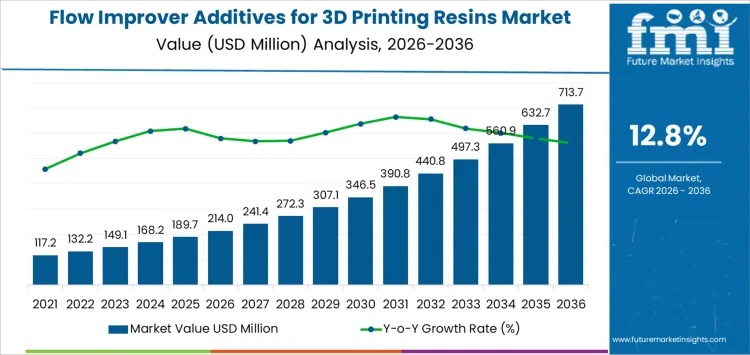
Flow Improver Additives for 3D Printing Resins Market Key Takeaways
| Metric | Value |
|---|---|
| Market Value (2026) | USD 214.0 million |
| Forecast Value (2036) | USD 736 million |
| Forecast CAGR (2026-2036) | 12.8% |
How Is Material Flow Control Shaping Demand for Additives in 3D Printing Resins?
Early demand for flow improver additives emerged from hands-on production issues rather than strategic material planning. As resin based 3D printing expanded beyond laboratories, operators faced print failures linked to uneven resin movement, slow recoating, and temperature sensitivity during processing. Many base resins were formulated for chemical performance after curing, not for stable flow during printing. Additives were introduced pragmatically to smooth dispensing, improve leveling between layers, and reduce stoppages caused by viscosity drift. Historical adoption remained fragmented and application specific.
Future demand for flow improver additives reflects a shift toward process reliability and repeatability at scale. As additive manufacturing enters regulated and serial production environments, resin flow behavior becomes a controlled parameter rather than a variable tolerated by operators. Manufacturers now specify rheological windows that must hold across temperature ranges, print speeds, and machine platforms. Flow improvers are selected to stabilize performance over long print runs and across batches. Demand growth will align with production qualification, automation, and reduced operator intervention.
What Factors Are Affecting the Demand for Flow Improver Additives for 3D Printing Resins Market in Terms of Resin Type and Additive Function?
Demand for flow improver additives in 3D printing resins is shaped by resin chemistry behavior during layer deposition and curing. Acrylate and UV photopolymer resins account for about 46% of total demand, reflecting their sensitivity to flow variation during rapid printing cycles. Epoxy, polyurethane, and silicone resins represent additional resin types with different viscosity and leveling constraints. Additive function segmentation reflects the specific processing limitations encountered during printing. Flow and leveling, rheology control, air release, and pigment wetting functions address distinct defects rather than interchangeable performance goals. Together, resin type and additive function determine where flow improvers are required to stabilize printing outcomes rather than to enhance baseline material properties.
What Drives Demand by Resin Type in the Flow Improver Additives for 3D Printing Resins Market?
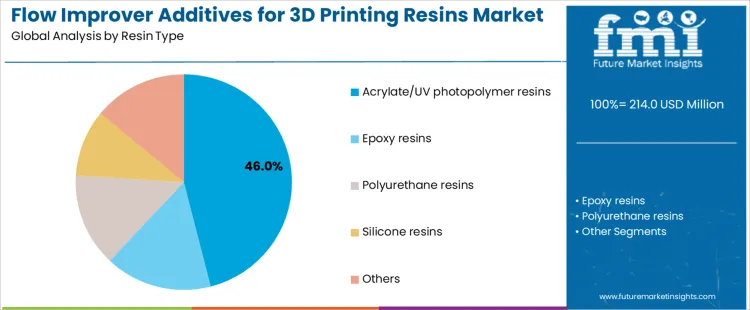
Acrylate and UV photopolymer resins lead demand with a 46% share because minor flow instability directly translates into visible print defects. These systems operate within narrow viscosity windows during recoating and curing. Epoxy resins require flow improvers to manage higher inherent viscosity and slower leveling behavior. Polyurethane resins apply flow modifiers to balance elasticity with print consistency across layers. Silicone resins use flow additives to maintain surface continuity and dispersion stability. Resin specific demand reflects tolerance limits during printing rather than total resin consumption. Once formulations are validated for a printer platform, additive usage remains fixed. This anchors demand within established resin systems rather than encouraging frequent reformulation.
Resin driven demand remains stable because printer compatibility limits formulation changes. Photopolymer systems embed flow improvers as standard components. Epoxy and polyurethane formulations adopt selectively due to processing sensitivity. Silicone resin usage remains limited to specialized applications. These patterns constrain rapid shifts across resin categories. Demand therefore aligns with printer operating constraints and formulation qualification cycles rather than expansion into new resin chemistries.
How Does Additive Function Shape Demand for Flow Improver Additives for 3D Printing Resins Market?
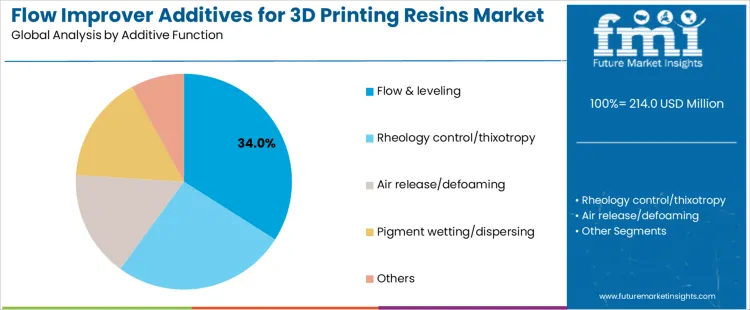
Flow and leveling functions account for about 34% of total demand because surface uniformity directly affects part acceptance. These additives address streaking, pooling, and uneven layer formation. Rheology control and thixotropy modifiers are specified where shape retention during curing is required. Air release and defoaming additives prevent voids introduced during resin handling or agitation. Pigment wetting and dispersing agents support consistent coloration and particle distribution. Each function targets a defined process failure rather than offering general performance improvement. Demand follows defect prevention priorities rather than multifunctional formulation strategies.
Functional demand remains stable because additive roles are locked once print quality targets are met. Flow and leveling additives retain priority due to immediate visual impact. Rheology modifiers support dimensional control in vertical builds. Defoaming additives remain secondary but necessary in high speed operations. Pigment wetting additives scale only with colored resin usage. Manufacturers avoid altering additive function mixes due to requalification costs. This stabilizes functional demand distribution across resin systems.
How Are Flow Improver Additives Being Applied in 3D Printing Resin Formulations?
Use emerges in additive manufacturing where consistent resin flow is critical for print quality and resolution. Manufacturers of SLA, DLP, and LCD 3D printers incorporate flow improvers to reduce viscosity variations and improve layer adhesion during curing. Dental and medical device producers adopt resins with tailored flow to ensure precise replication of fine structures. Consumer product prototyping also benefits from enhanced flow for complex geometries. These applications reflect operational and functional priorities rather than aesthetic considerations, with adoption driven by printing reliability, dimensional accuracy, and material performance.
What Operational and Material Conditions Support Adoption of Flow Improver Additives in 3D Printing?
Selection aligns with formulations requiring controlled rheology across varying temperatures and UV exposure. Resin chemists optimize additive concentration to maintain cure kinetics, prevent sedimentation, and reduce void formation. Printer operators rely on improved flow to minimize defects, stringing, or incomplete layers during high-speed or large-area prints. Compatibility with pigments, fillers, and functional additives is essential to avoid phase separation or curing interference. These conditions emerge from operational efficiency, product fidelity, and print consistency priorities within professional and industrial 3D printing workflows.
Which Practical Considerations Limit Wider Use of Flow Improver Additives?
Excessive additive levels may alter mechanical properties or surface finish. Cost per formulation may increase for specialized or high-performance resins. Chemical compatibility must be verified for multi-component or filled resins. Regulatory approval for medical, dental, or food-contact applications may restrict certain chemistries. Process optimization requires testing for each printer model and geometry. These factors result in selective deployment where print quality, dimensional accuracy, and functional reliability justify incremental material and process complexity.
What is the Demand for Flow Improver Additives for 3D Printing Resins by Country?
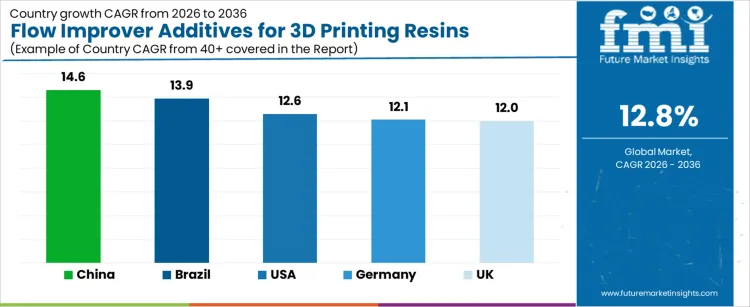
| Country | CAGR (%) |
|---|---|
| USA | 12.6% |
| Germany | 12.1% |
| China | 14.6% |
| UK | 12.0% |
| Brazil | 13.9% |
The demand for flow improver additives for 3D printing resins varies across countries, driven by additive manufacturing adoption, precision printing requirements, and industrial 3D printing expansion. China leads with a 14.6% CAGR, supported by rapid industrialization, large scale adoption of 3D printing in manufacturing, and focus on improving resin flow properties. Brazil follows at 13.9%, driven by growth in prototyping and industrial 3D printing applications. The USA grows at 12.6%, reflecting adoption across automotive, aerospace, and medical sectors. Germany records 12.1%, shaped by precision manufacturing and advanced 3D printing technologies. The UK posts 12.0%, supported by expanding industrial and research applications in additive manufacturing.
How Is Flow Improvement Driving Growth in 3D Printing Resins in the United States?
In the United States, revenue from the Flow Improver Additives for 3D Printing Resins Market is expanding at a CAGR of 12.6% through 2036, driven by adoption of chemical additives to enhance resin processability, reduce viscosity, and improve layer adhesion in additive manufacturing. Manufacturers are integrating flow improvers into photopolymer, UV-curable, and SLA resins for prototyping, tooling, and end-use parts. Demand is concentrated in industrial, medical, and consumer 3D printing applications. Domestic suppliers provide high-performance additives compatible with various resin chemistries and printing technologies. Growth in 3D printing adoption, product performance requirements, and recurring resin production cycles are sustaining predictable procurement nationwide.
- Industrial, medical, and consumer 3D printing applications drive flow improver adoption
- Additives enhance resin viscosity, processability, and layer adhesion
- Domestic suppliers provide high-performance additives compatible with multiple resin chemistries
- Recurring resin production and 3D printing cycles sustain predictable procurement
How Are Advanced Manufacturing Standards Supporting Growth in Germany?
Germany continues to record steady growth in the Flow Improver Additives Market at a CAGR of 12.1% through 2036, supported by high adoption of additive manufacturing in industrial production and prototyping. Manufacturers are integrating flow improvers into 3D printing resins to improve print quality, surface finish, and mechanical properties. Demand is concentrated in automotive, aerospace, and industrial prototyping applications. Domestic suppliers provide high-quality additives engineered for various resin types and SLA, DLP, and LCD printing technologies. Industrial standards, performance expectations, and recurring resin production are sustaining measured adoption nationwide.
- Automotive, aerospace, and industrial prototyping drive adoption of flow improver additives
- Additives improve print quality, surface finish, and mechanical properties
- Domestic suppliers provide additives compatible with SLA, DLP, and LCD resins
- Recurring resin production sustains predictable procurement
How Is Industrial and Consumer 3D Printing Expansion Accelerating Adoption in China?
In China, revenue from the Flow Improver Additives for 3D Printing Resins Market is growing at a CAGR of 14.6% through 2036, driven by expansion of industrial and consumer 3D printing adoption. Manufacturers are using flow improvers to enhance processability, reduce viscosity, and improve layer adhesion in photopolymer and UV-curable resins. Demand is strong across prototyping, industrial tooling, and consumer product applications. Domestic suppliers are scaling production of high-performance additives compatible with diverse printing technologies. High resin production volumes and structured procurement practices are sustaining rapid adoption nationwide.
- Industrial, prototyping, and consumer 3D printing applications drive flow improver adoption
- Additives improve processability, viscosity, and layer adhesion
- Domestic suppliers scale production of high-performance resin additives
- High resin volumes sustain consistent adoption
How Is Organized 3D Printing Manufacturing Supporting Growth in the United Kingdom?
In the United Kingdom, revenue from the Flow Improver Additives for 3D Printing Resins Market is expanding at a CAGR of 12.0% through 2036, supported by growth in industrial prototyping, consumer products, and tooling applications. Manufacturers are integrating flow improvers into SLA, DLP, and photopolymer resins to improve viscosity, layer adhesion, and surface quality. Demand is concentrated in industrial prototyping, product development, and educational applications. Domestic suppliers provide additives engineered for various resin chemistries and printing platforms. Recurring resin production cycles and expanding 3D printing adoption are sustaining predictable procurement nationwide.
- Industrial prototyping, consumer products, and tooling anchor demand for flow improver additives
- Additives improve viscosity, surface quality, and layer adhesion
- Domestic suppliers provide additives compatible with SLA, DLP, and photopolymer resins
- Recurring resin production sustains predictable procurement
How Is Additive Manufacturing Expansion Driving Adoption in Brazil?
Brazil is seeing strong growth in the Flow Improver Additives for 3D Printing Resins Market at a CAGR of 13.9% through 2036, supported by increasing adoption of industrial, prototyping, and consumer 3D printing. Manufacturers are using flow improvers to enhance resin processability, reduce viscosity, and improve layer adhesion for photopolymer, UV-curable, and SLA resins. Demand is concentrated across industrial prototyping, consumer products, and educational applications. Domestic suppliers are expanding production of high-performance additives compatible with multiple printing technologies. Growth in resin production, additive manufacturing adoption, and recurring printing applications are sustaining robust procurement nationwide.
- Industrial prototyping, consumer products, and educational applications drive flow improver adoption
- Additives enhance processability, viscosity, and layer adhesion
- Domestic suppliers expand production of high-performance resin additives
- Recurring 3D printing and resin production sustain procurement
Which Companies Are Shaping Competition in The Flow Improver Additives for 3D Printing Resins Market Across Photopolymer and Thermoset Systems?
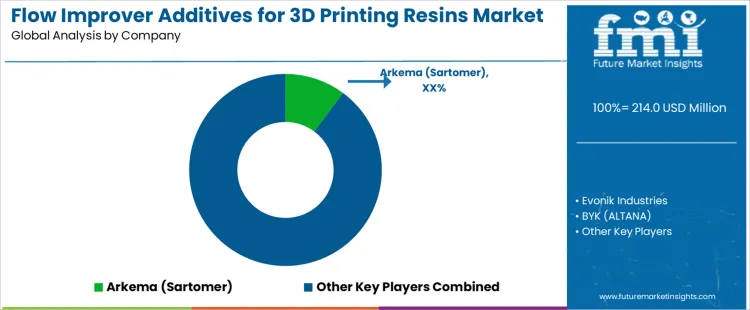
Competition in the Flow Improver Additives for 3D Printing Resins Market is shaped by specialty chemical suppliers supporting resin rheology control and print consistency. Arkema, through its Sartomer portfolio, plays a central role by supplying reactive diluents and additives aligned with photopolymer resin formulations. Evonik Industries and BYK, part of ALTANA, contribute flow control and surface modification additives used to improve leveling and reduce print defects. BASF and Allnex support the market through resin compatible additives integrated into UV curable and thermoset systems. These companies compete on formulation compatibility, viscosity stability, and predictable behavior during printing and post cure processes.
Broad based chemical suppliers and material specialists add depth to competitive structure. Lubrizol and Huntsman participate through specialty additives and resin systems adapted for additive manufacturing workflows. Dow and Solvay contribute through polymer chemistry expertise applied to flow modification and dispersion control. Wacker Chemie supports the market through silicone based and hybrid additives used to adjust flow and surface properties. Competitive positioning centers on ease of incorporation, consistency across print batches, and compatibility with different printer technologies. Customer selection reflects technical support quality, formulation flexibility, and validation across printer platforms rather than supplier scale or portfolio breadth.
Key Players in the Flow Improver Additives for 3D Printing Resins Market
- Arkema (Sartomer)
- Evonik Industries
- BYK (ALTANA)
- BASF
- Allnex
- Lubrizol
- Huntsman
- Dow
- Wacker Chemie
- Solvay
Scope of the Report
| Items | Values |
|---|---|
| Quantitative Units (2026) | USD million |
| Resin Type | Acrylate/UV photopolymer resins; Epoxy resins; Polyurethane resins; Silicone resins; Others |
| Additive Function | Flow & leveling; Rheology control/thixotropy; Air release/defoaming; Pigment wetting/dispersing; Others |
| Printing Process | SLA/DLP; Material jetting; Continuous photopolymerization; Other resin-based processes |
| End Use | Dental; Industrial tooling; Prototyping services; Medical devices; Jewelry & others |
| Region | Asia Pacific; Europe; North America; Latin America; Middle East & Africa |
| Countries Covered | China; Japan; South Korea; India; Australia & New Zealand; ASEAN; Germany; United Kingdom; France; Italy; Spain; Nordic; BENELUX; United States; Canada; Mexico; Brazil; Chile; Kingdom of Saudi Arabia; Other GCC Countries; Turkey; South Africa; Other African Union; Rest of Asia Pacific; Rest of Europe; Rest of Latin America; Rest of Middle East & Africa |
| Key Companies Profiled | Arkema (Sartomer); Evonik Industries; BYK (ALTANA); BASF; Allnex; Lubrizol; Huntsman; Dow; Wacker Chemie; Solvay |
| Additional Attributes | Dollar by sales across resin types, additive functions, printing processes, and end-use applications; Acrylate/UV photopolymer resins account for the largest demand due to flow sensitivity; Flow & leveling additives lead functional adoption for surface uniformity and layer adhesion; SLA/DLP dominates printing process usage due to high-resolution demands; Industrial tooling, dental, and medical devices anchor end-use applications; Supply of additives scales with resin production and 3D printing adoption; Domestic and regional suppliers provide high-performance flow improvers compatible with multiple printer platforms; Recurring procurement is driven by high-volume prototyping, medical, and industrial 3D printing; Demand formation reflects process reliability, dimensional accuracy, and multi-batch consistency rather than aesthetic enhancement. |
Flow Improver Additives for 3D Printing Resins Market Segmentation
Resin Type:
- Acrylate/UV photopolymer resins
- Epoxy resins
- Polyurethane resins
- Silicone resins
- Others
Additive Function:
- Flow & leveling
- Rheology control/thixotropy
- Air release/defoaming
- Pigment wetting/dispersing
- Others
Printing Process:
- SLA/DLP
- Material jetting
- Continuous photopolymerization
- Other resin-based processes
End Use:
- Dental
- Industrial tooling
- Prototyping services
- Medical devices
- Jewelry & others
Region
- Asia Pacific
- China
- Japan
- South Korea
- India
- Australia & New Zealand
- ASEAN
- Rest of Asia Pacific
- Europe
- Germany
- United Kingdom
- France
- Italy
- Spain
- Nordic
- BENELUX
- Rest of Europe
- North America
- United States
- Canada
- Mexico
- Latin America
- Brazil
- Chile
- Rest of Latin America
- Middle East & Africa
- Kingdom of Saudi Arabia
- Other GCC Countries
- Turkey
- South Africa
- Other African Union
- Rest of Middle East & Africa
Frequently Asked Questions
How big is the flow improver additives for 3D printing resins market in 2026?
The global flow improver additives for 3D printing resins market is estimated to be valued at USD 214.0 million in 2026.
What will be the size of flow improver additives for 3D printing resins market in 2036?
The market size for the flow improver additives for 3D printing resins market is projected to reach USD 713.7 million by 2036.
How much will be the flow improver additives for 3D printing resins market growth between 2026 and 2036?
The flow improver additives for 3D printing resins market is expected to grow at a 12.8% CAGR between 2026 and 2036.
What are the key product types in the flow improver additives for 3D printing resins market?
The key product types in flow improver additives for 3D printing resins market are acrylate/uv photopolymer resins, epoxy resins, polyurethane resins, silicone resins and others.
Which additive function segment to contribute significant share in the flow improver additives for 3D printing resins market in 2026?
In terms of additive function, flow & leveling segment to command 34.0% share in the flow improver additives for 3D printing resins market in 2026.
Preview the report firsthand - request a free sample
Get SampleGet the brochure for pricing and purchase details.
Get PDFTable of Content
- Executive Summary
- Global Market Outlook
- Demand-side Trends
- Supply-side Trends
- Technology Roadmap Analysis
- Analysis and Recommendations
- Market Overview
- Market Coverage / Taxonomy
- Market Definition / Scope / Limitations
- Market Background
- Market Dynamics
- Drivers
- Restraints
- Opportunity
- Trends
- Scenario Forecast
- Demand in Optimistic Scenario
- Demand in Likely Scenario
- Demand in Conservative Scenario
- Opportunity Map Analysis
- Product Life Cycle Analysis
- Supply Chain Analysis
- Investment Feasibility Matrix
- Value Chain Analysis
- PESTLE and Porter’s Analysis
- Regulatory Landscape
- Regional Parent Market Outlook
- Production and Consumption Statistics
- Import and Export Statistics
- Market Dynamics
- Global Market Analysis 2021 to 2025 and Forecast, 2026 to 2036
- Historical Market Size Value (USD Million) Analysis, 2021 to 2025
- Current and Future Market Size Value (USD Million) Projections, 2026 to 2036
- Y-o-Y Growth Trend Analysis
- Absolute $ Opportunity Analysis
- Global Market Pricing Analysis 2021 to 2025 and Forecast 2026 to 2036
- Global Market Analysis 2021 to 2025 and Forecast 2026 to 2036, By Resin Type
- Introduction / Key Findings
- Historical Market Size Value (USD Million) Analysis By Resin Type , 2021 to 2025
- Current and Future Market Size Value (USD Million) Analysis and Forecast By Resin Type , 2026 to 2036
- Acrylate/UV photopolymer resins
- Epoxy resins
- Polyurethane resins
- Silicone resins
- Others
- Y-o-Y Growth Trend Analysis By Resin Type , 2021 to 2025
- Absolute $ Opportunity Analysis By Resin Type , 2026 to 2036
- Global Market Analysis 2021 to 2025 and Forecast 2026 to 2036, By Additive Function
- Introduction / Key Findings
- Historical Market Size Value (USD Million) Analysis By Additive Function, 2021 to 2025
- Current and Future Market Size Value (USD Million) Analysis and Forecast By Additive Function, 2026 to 2036
- Flow & leveling
- Rheology control/thixotropy
- Air release/defoaming
- Pigment wetting/dispersing
- Others
- Y-o-Y Growth Trend Analysis By Additive Function, 2021 to 2025
- Absolute $ Opportunity Analysis By Additive Function, 2026 to 2036
- Global Market Analysis 2021 to 2025 and Forecast 2026 to 2036, By Printing Process
- Introduction / Key Findings
- Historical Market Size Value (USD Million) Analysis By Printing Process, 2021 to 2025
- Current and Future Market Size Value (USD Million) Analysis and Forecast By Printing Process, 2026 to 2036
- SLA/DLP
- Material jetting
- Continuous photopolymerization
- Other resin-based processes
- Y-o-Y Growth Trend Analysis By Printing Process, 2021 to 2025
- Absolute $ Opportunity Analysis By Printing Process, 2026 to 2036
- Global Market Analysis 2021 to 2025 and Forecast 2026 to 2036, By End Use
- Introduction / Key Findings
- Historical Market Size Value (USD Million) Analysis By End Use, 2021 to 2025
- Current and Future Market Size Value (USD Million) Analysis and Forecast By End Use, 2026 to 2036
- Dental
- Industrial tooling
- Prototyping services
- Medical devices
- Jewelry & others
- Y-o-Y Growth Trend Analysis By End Use, 2021 to 2025
- Absolute $ Opportunity Analysis By End Use, 2026 to 2036
- Global Market Analysis 2021 to 2025 and Forecast 2026 to 2036, By Region
- Introduction
- Historical Market Size Value (USD Million) Analysis By Region, 2021 to 2025
- Current Market Size Value (USD Million) Analysis and Forecast By Region, 2026 to 2036
- North America
- Latin America
- Western Europe
- Eastern Europe
- East Asia
- South Asia and Pacific
- Middle East & Africa
- Market Attractiveness Analysis By Region
- North America Market Analysis 2021 to 2025 and Forecast 2026 to 2036, By Country
- Historical Market Size Value (USD Million) Trend Analysis By Market Taxonomy, 2021 to 2025
- Market Size Value (USD Million) Forecast By Market Taxonomy, 2026 to 2036
- By Country
- USA
- Canada
- Mexico
- By Resin Type
- By Additive Function
- By Printing Process
- By End Use
- By Country
- Market Attractiveness Analysis
- By Country
- By Resin Type
- By Additive Function
- By Printing Process
- By End Use
- Key Takeaways
- Latin America Market Analysis 2021 to 2025 and Forecast 2026 to 2036, By Country
- Historical Market Size Value (USD Million) Trend Analysis By Market Taxonomy, 2021 to 2025
- Market Size Value (USD Million) Forecast By Market Taxonomy, 2026 to 2036
- By Country
- Brazil
- Chile
- Rest of Latin America
- By Resin Type
- By Additive Function
- By Printing Process
- By End Use
- By Country
- Market Attractiveness Analysis
- By Country
- By Resin Type
- By Additive Function
- By Printing Process
- By End Use
- Key Takeaways
- Western Europe Market Analysis 2021 to 2025 and Forecast 2026 to 2036, By Country
- Historical Market Size Value (USD Million) Trend Analysis By Market Taxonomy, 2021 to 2025
- Market Size Value (USD Million) Forecast By Market Taxonomy, 2026 to 2036
- By Country
- Germany
- UK
- Italy
- Spain
- France
- Nordic
- BENELUX
- Rest of Western Europe
- By Resin Type
- By Additive Function
- By Printing Process
- By End Use
- By Country
- Market Attractiveness Analysis
- By Country
- By Resin Type
- By Additive Function
- By Printing Process
- By End Use
- Key Takeaways
- Eastern Europe Market Analysis 2021 to 2025 and Forecast 2026 to 2036, By Country
- Historical Market Size Value (USD Million) Trend Analysis By Market Taxonomy, 2021 to 2025
- Market Size Value (USD Million) Forecast By Market Taxonomy, 2026 to 2036
- By Country
- Russia
- Poland
- Hungary
- Balkan & Baltic
- Rest of Eastern Europe
- By Resin Type
- By Additive Function
- By Printing Process
- By End Use
- By Country
- Market Attractiveness Analysis
- By Country
- By Resin Type
- By Additive Function
- By Printing Process
- By End Use
- Key Takeaways
- East Asia Market Analysis 2021 to 2025 and Forecast 2026 to 2036, By Country
- Historical Market Size Value (USD Million) Trend Analysis By Market Taxonomy, 2021 to 2025
- Market Size Value (USD Million) Forecast By Market Taxonomy, 2026 to 2036
- By Country
- China
- Japan
- South Korea
- By Resin Type
- By Additive Function
- By Printing Process
- By End Use
- By Country
- Market Attractiveness Analysis
- By Country
- By Resin Type
- By Additive Function
- By Printing Process
- By End Use
- Key Takeaways
- South Asia and Pacific Market Analysis 2021 to 2025 and Forecast 2026 to 2036, By Country
- Historical Market Size Value (USD Million) Trend Analysis By Market Taxonomy, 2021 to 2025
- Market Size Value (USD Million) Forecast By Market Taxonomy, 2026 to 2036
- By Country
- India
- ASEAN
- Australia & New Zealand
- Rest of South Asia and Pacific
- By Resin Type
- By Additive Function
- By Printing Process
- By End Use
- By Country
- Market Attractiveness Analysis
- By Country
- By Resin Type
- By Additive Function
- By Printing Process
- By End Use
- Key Takeaways
- Middle East & Africa Market Analysis 2021 to 2025 and Forecast 2026 to 2036, By Country
- Historical Market Size Value (USD Million) Trend Analysis By Market Taxonomy, 2021 to 2025
- Market Size Value (USD Million) Forecast By Market Taxonomy, 2026 to 2036
- By Country
- Kingdom of Saudi Arabia
- Other GCC Countries
- Turkiye
- South Africa
- Other African Union
- Rest of Middle East & Africa
- By Resin Type
- By Additive Function
- By Printing Process
- By End Use
- By Country
- Market Attractiveness Analysis
- By Country
- By Resin Type
- By Additive Function
- By Printing Process
- By End Use
- Key Takeaways
- Key Countries Market Analysis
- USA
- Pricing Analysis
- Market Share Analysis, 2025
- By Resin Type
- By Additive Function
- By Printing Process
- By End Use
- Canada
- Pricing Analysis
- Market Share Analysis, 2025
- By Resin Type
- By Additive Function
- By Printing Process
- By End Use
- Mexico
- Pricing Analysis
- Market Share Analysis, 2025
- By Resin Type
- By Additive Function
- By Printing Process
- By End Use
- Brazil
- Pricing Analysis
- Market Share Analysis, 2025
- By Resin Type
- By Additive Function
- By Printing Process
- By End Use
- Chile
- Pricing Analysis
- Market Share Analysis, 2025
- By Resin Type
- By Additive Function
- By Printing Process
- By End Use
- Germany
- Pricing Analysis
- Market Share Analysis, 2025
- By Resin Type
- By Additive Function
- By Printing Process
- By End Use
- UK
- Pricing Analysis
- Market Share Analysis, 2025
- By Resin Type
- By Additive Function
- By Printing Process
- By End Use
- Italy
- Pricing Analysis
- Market Share Analysis, 2025
- By Resin Type
- By Additive Function
- By Printing Process
- By End Use
- Spain
- Pricing Analysis
- Market Share Analysis, 2025
- By Resin Type
- By Additive Function
- By Printing Process
- By End Use
- France
- Pricing Analysis
- Market Share Analysis, 2025
- By Resin Type
- By Additive Function
- By Printing Process
- By End Use
- India
- Pricing Analysis
- Market Share Analysis, 2025
- By Resin Type
- By Additive Function
- By Printing Process
- By End Use
- ASEAN
- Pricing Analysis
- Market Share Analysis, 2025
- By Resin Type
- By Additive Function
- By Printing Process
- By End Use
- Australia & New Zealand
- Pricing Analysis
- Market Share Analysis, 2025
- By Resin Type
- By Additive Function
- By Printing Process
- By End Use
- China
- Pricing Analysis
- Market Share Analysis, 2025
- By Resin Type
- By Additive Function
- By Printing Process
- By End Use
- Japan
- Pricing Analysis
- Market Share Analysis, 2025
- By Resin Type
- By Additive Function
- By Printing Process
- By End Use
- South Korea
- Pricing Analysis
- Market Share Analysis, 2025
- By Resin Type
- By Additive Function
- By Printing Process
- By End Use
- Russia
- Pricing Analysis
- Market Share Analysis, 2025
- By Resin Type
- By Additive Function
- By Printing Process
- By End Use
- Poland
- Pricing Analysis
- Market Share Analysis, 2025
- By Resin Type
- By Additive Function
- By Printing Process
- By End Use
- Hungary
- Pricing Analysis
- Market Share Analysis, 2025
- By Resin Type
- By Additive Function
- By Printing Process
- By End Use
- Kingdom of Saudi Arabia
- Pricing Analysis
- Market Share Analysis, 2025
- By Resin Type
- By Additive Function
- By Printing Process
- By End Use
- Turkiye
- Pricing Analysis
- Market Share Analysis, 2025
- By Resin Type
- By Additive Function
- By Printing Process
- By End Use
- South Africa
- Pricing Analysis
- Market Share Analysis, 2025
- By Resin Type
- By Additive Function
- By Printing Process
- By End Use
- USA
- Market Structure Analysis
- Competition Dashboard
- Competition Benchmarking
- Market Share Analysis of Top Players
- By Regional
- By Resin Type
- By Additive Function
- By Printing Process
- By End Use
- Competition Analysis
- Competition Deep Dive
- Arkema (Sartomer)
- Overview
- Product Portfolio
- Profitability by Market Segments (Product/Age /Sales Channel/Region)
- Sales Footprint
- Strategy Overview
- Marketing Strategy
- Product Strategy
- Channel Strategy
- Evonik Industries
- BYK (ALTANA)
- BASF
- Allnex
- Lubrizol
- Arkema (Sartomer)
- Competition Deep Dive
- Assumptions & Acronyms Used
- Research Methodology


