

- Market Size (2026)
- USD 2.7 Bn
- Forecast (2036)
- USD 4.0 Bn
- CAGR (2026 to 2036)
- 4.0%
Low-SAPS Oil Additives for Aftertreatment-Compatible Lubricants Market Size, Market Forecast and Outlook By FMI
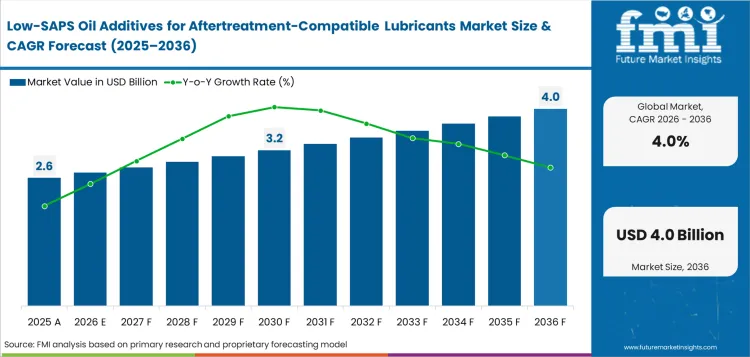
Low-SAPS oil additives for aftertreatment-compatible lubricants were valued at USD 2.6 billion in 2025 and are estimated at USD 2.7 billion in 2026. Industry value is projected to reach USD 4.0 billion by 2036 at 4.0% CAGR from 2026 to 2036. Additive packages are expected to account for 58.0% share of sales channel demand in 2026 as blenders prefer pre-balanced chemistry. Group III-compatible formulations are expected to represent 47.0% share of base oil compatibility demand in 2026 due to low-viscosity approvals.
Key Takeaways, Market Size, and Forecast
- Low-SAPS oil additives for aftertreatment-compatible lubricants stood at USD 2.6 billion in 2025.
- Industry value is projected to reach USD 4.0 billion by 2036 as emission hardware needs lower ash chemistry.
- Market value is projected to rise at 4.0% CAGR from 2026 to 2036.
- Incremental opportunity is projected at USD 1.3 billion over the forecast period.
- Additive packages are expected to account for 58.0% share of sales channel demand in 2026.
- Group III-compatible formulations are expected to hold 47.0% share of base oil compatibility demand in 2026.
- India is expected to record 5.4% CAGR by 2036 as BS VI service-fill demand supports low-SAPS oil chemistry.
Summary of the Low-SAPS Oil Additives for Aftertreatment-Compatible Lubricants Market
- Demand and Growth Drivers
- Emission rules are pushing oil brands to use additives with lower ash and phosphorus levels.
- Passenger car and heavy-duty engine oils need cleaner chemistry because modern vehicles use more sensitive aftertreatment systems.
- Hybrid engines are creating added formulation needs because frequent restarts can change how engine oil performs.
- Product and Segment View
- Detergents play an important role because they help control deposits and support engine cleanliness.
- ACEA C-grade oils are important because they are designed for vehicles fitted with particulate filters.
- Additive packages are preferred by many blenders because ready-balanced chemistry can reduce testing risk.
- Geography and Competitive Outlook
- India and China offer stronger demand conditions because modern emission standards are shaping engine oil choices.
- The United States and Europe continue to support demand through oil specification updates and strict OEM approval needs.
- Competition depends on formulation proof because oil marketers want suppliers that can support testing and reduce approval delays.
- Analyst Opinion
- Nikhil Kaitwade, Principal Analyst at FMI says, “Low-SAPS additive demand is being decided at the approval bench before the blending tank. Oil marketers want fewer trade-offs between ash control and piston cleanliness. Heavy-duty fleets need catalyst protection over longer drains. Passenger car programs need low-viscosity oils for GPF hardware and hybrid duty cycles. Suppliers with proven detergent balance and OEM approval support are better placed for high-value accounts. Regional blenders will still watch cost closely, so package design must lower test failure risk and reduce launch delay.”
- Low-SAPS Oil Additives for Aftertreatment-Compatible Lubricants Market Value Analysis
- The low-SAPS oil additives for aftertreatment-compatible lubricants market is moving from basic engine protection into a more defined emissions-support input space.
- Adoption is being driven by the need to protect DPF and GPF systems from ash buildup.
- Market value is supported by API SQ and ACEA C-grade oil programs that require cleaner additive balance.
- Demand is further supported by oil marketers that need formulations covering wear control and aftertreatment protection without higher approval risk.
Low-SAPS oil additives are becoming more important as engine oils must protect DPF, GPF and catalyst systems without weakening engine protection. In December 2024, ACEA set E8-24, E11-24 and F01-24 heavy-duty oil categories at ≤1.0% m/m sulfated ash. E8-24 also limits phosphorus to ≤0.08% m/m. This gives additive suppliers a clearer technical target for ash control, detergent balance and antiwear chemistry in aftertreatment-compatible diesel oils. Passenger-car oils are moving through a similar compliance shift. API 1509 made ILSAC GF-7A and GF-7B effective from March 31, 2025. GF-7A sets phosphorus at 0.08% maximum and sulfated ash at 0.9 maximum.
This makes low-SAPS additive validation more important for oil marketers that need API marks and OEM acceptance. Company positioning is shifting from simple low-ash claims toward aftertreatment durability and engine protection. Infineum says reduced-SAPS oils are needed to prevent poisoning or blockage in emission-reducing aftertreatment systems. Chevron Oronite says ACEA C-category oils are catalyst-compatible and C6 oils add LSPI, chain wear and turbocharger deposit protection. These points show why additive suppliers must support formulators with chemistry that protects filters, catalysts and modern gasoline engine hardware.
Low-SAPS Oil Additives for Aftertreatment-Compatible Lubricants Market Definition
Low-SAPS oil additives for aftertreatment-compatible lubricants are chemical systems used in engine oils to reduce sulfated ash and phosphorus. Sulfur control is also important because emission systems can lose performance when oil chemistry leaves harmful residues. These additives help engine oils protect diesel particulate filters and gasoline particulate filters during regular vehicle use.
Low-SAPS Oil Additives for Aftertreatment-Compatible Lubricants Market Inclusions
Market scope covers low-SAPS oil additive systems categorized by additive function, including detergents and dispersants. It also includes antioxidants, anti-wear agents, and friction modifiers used in aftertreatment-compatible engine oils. Lubricant specification covers ACEA C grades and API CK-4. API FA-4, OEM approvals, and hybrid oils complete the specification structure. Base oil compatibility includes Group III and Group II formulations. PAO and ester-compatible packages are also included where low-viscosity and high-performance oils need stronger additive balance. Vehicle type covers passenger cars and heavy trucks. Light commercial vehicles and off-highway engines are included where DPF, GPF, and catalyst protection guide lubricant selection.
Sales channel covers additive packages and additive components supplied to lubricant blenders. Blender supply and OEM programs are included where formulation support, approval testing, and service-fill requirements shape additive selection. Revenue scope covers 2026 to 2036. The key stakeholders include additive package makers, lubricant blenders, oil marketers, OEM approval teams, fleet operators, engine manufacturers, service networks, and testing laboratories.
Low-SAPS Oil Additives for Aftertreatment-Compatible Lubricants Market Exclusions
Scope excludes finished engine oils sold under retail brands. Base oil manufacturing and non-engine industrial lubricant additives are outside scope. Fuel additives and emission control hardware are excluded unless sold with lubricant additive chemistry. General oil analysis tools are excluded unless bundled into a low-SAPS formulation service.
Low-SAPS Oil Additives for Aftertreatment-Compatible Lubricants Market Research Methodology
- Primary Research: FMI analysts reviewed additive suppliers and lubricant blenders working with low-SAPS engine oils. The review focused on ash limits, additive treat rates, and approval needs for aftertreatment-compatible lubricants.
- Desk Research: Desk research used EPA emission rules, API oil classifications, and ACEA oil sequences to understand specification pressure. Supplier releases were reviewed to check how additive companies support low-SAPS formulation needs.
- Market Sizing and Forecasting: Market size was built from engine oil demand and average additive treat rates. Low-SAPS use across key regions was then checked to support the forecast.
- Data Validation: Forecasts were tested against vehicle production and emission rule timing. Supplier capacity and OEM approval activity were reviewed to confirm company relevance.
Why is the Low-SAPS Oil Additives for Aftertreatment-Compatible Lubricants Market Growing?
- Particulate filters need cleaner engine oil chemistry because ash buildup can shorten aftertreatment system life.
- API SQ and ILSAC GF-7 are guiding oil marketers to update passenger car engine oil packages.
- Heavy-duty fleets need low-SAPS oils that protect catalysts during longer service intervals.
- Hybrid engines need additive systems that can handle frequent restart cycles and lower engine temperatures.
Aftertreatment-compatible lubricants are becoming more important because engine oil must protect both the engine and emission hardware. API SQ and ILSAC GF-7 licensing began in March 2025, giving oil marketers a clear reason to update gasoline engine oil packages. Low-SAPS chemistry supports cleaner oil design because lower ash and phosphorus levels help protect catalysts and particulate filters. Additive suppliers with proven detergent balance and wear-control chemistry can support oil brands during approval work.
Diesel particulate filter care is creating another route for cleaner lubricant design. Lubrizol launched Lubrizol MF9145V Diesel Additive in June 2025 to reduce DPF regeneration frequency and lower maintenance issues. The product is used on the fuel side, but it shows the same service problem faced by low-SAPS lubricants. Fleets want fewer aftertreatment issues. Oil marketers therefore need additive packages that control ash exposure and keep engines clean.
Fuel economy needs are raising the technical pressure on engine oil additives. Evonik presented a three-step engine oil viscosity approach in March 2025 aimed at improving fuel efficiency by over 1.0% for internal combustion and hybrid engines. Lower-viscosity oils need stronger additive support because thinner oil films can raise wear risk. The shift supports demand for friction modifier additives that reduce energy loss and protect aftertreatment systems.
Market Segmentation Analysis
- Detergents are expected to hold 34.0% share of additive function demand in 2026.
- ACEA C grades are expected to lead lubricant specification demand with 38.0% share in 2026.
- Group III-compatible formulations are expected to represent 47.0% share in 2026.
- Passenger cars are expected to account for 44.0% share of vehicle type demand in 2026.
- Additive packages are expected to hold 58.0% share of sales channel demand in 2026.
The market is divided into five primary segment groups based on additive function and lubricant specification. Base oil compatibility and vehicle type add the next layer. Sales channel completes the structure. Additive function covers detergents and dispersants. Antioxidants and anti-wear agents are included. Friction modifiers complete the group. Lubricant specification covers ACEA C grades and API CK-4. API FA-4 and OEM approvals are included.
Hybrid oils complete the group. Base oil compatibility covers Group III and Group II. PAO and esters complete the base oil scope. Vehicle type covers passenger cars and heavy trucks. Light commercial vehicles and off-highway engines complete the vehicle scope. Sales channel covers additive packages and additive components. Blender supply and OEM programs complete the channel scope.
Insights into Low-SAPS Oil Additives for Aftertreatment-Compatible Lubricants by Additive Function
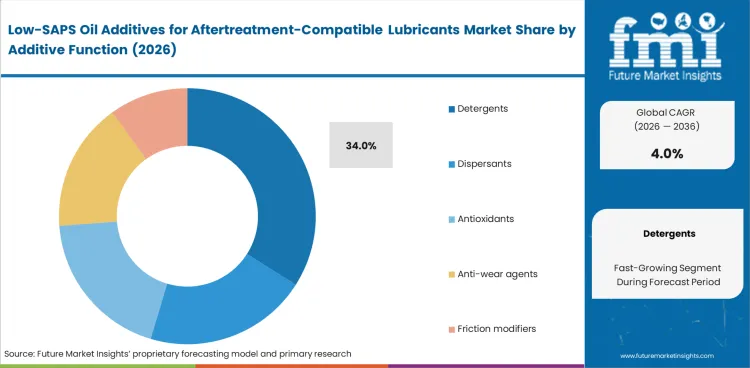
- Detergents are expected to hold 34.0% share in 2026 as low-SAPS oils still need acid control and piston cleanliness. The challenge is to control ash without weakening engine protection.
- Dispersants and friction modifier additives will support the detergent system because soot control and lower energy loss are important in modern engines. Oil marketers will prefer additive blends that protect aftertreatment systems and keep engines clean.
Insights into Low-SAPS Oil Additives for Aftertreatment-Compatible Lubricants by Lubricant Specification
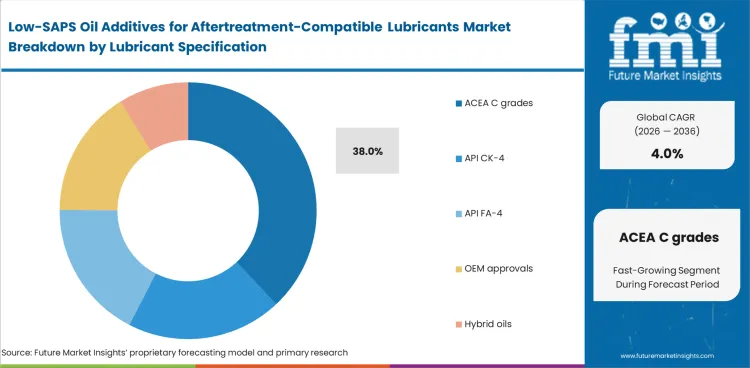
- ACEA C grades are expected to account for 38.0% share in 2026 because these grades clearly support catalyst and particulate filter protection. Oil marketers use them for vehicles that need DPF and GPF-compatible engine oils.
- API CK-4 and API FA-4 will stay important for heavy-duty diesel oils because trucks need engine protection over longer drain intervals. These specifications help blenders serve fleets that need cleaner oil chemistry with steady wear control.
Insights into Low-SAPS Oil Additives for Aftertreatment-Compatible Lubricants by Base Oil Compatibility
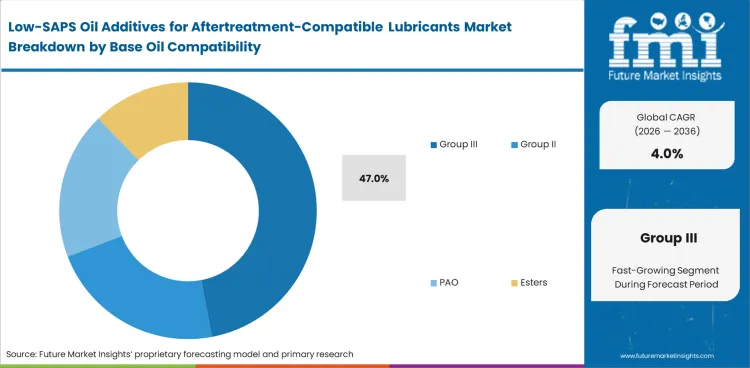
- Group III-compatible formulations are expected to represent 47.0% share in 2026 as low-viscosity engine oils need cleaner base stocks. These oils need additive packages that can hold film strength and control deposits.
- PAO and ester-compatible packages will serve higher-performance oil grades where stability is more important. These base oils need additive chemistry that works well under heat and long service use.
Insights into Low-SAPS Oil Additives for Aftertreatment-Compatible Lubricants by Vehicle Type
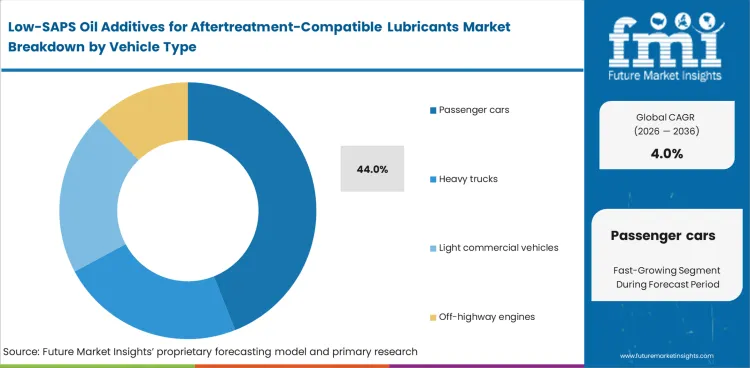
- Passenger cars are expected to account for 44.0% share in 2026 because GPF-equipped gasoline engines need lower ash oil chemistry. Hybrid cars add another need because frequent restart cycles can stress engine oil.
- Heavy trucks will remain a high-value route for low-SAPS additive packages because diesel engines need DPF protection and soot control. Fleet operators will prefer oils that support longer drains without raising aftertreatment risk.
Insights into Low-SAPS Oil Additives for Aftertreatment-Compatible Lubricants by Sales Channel
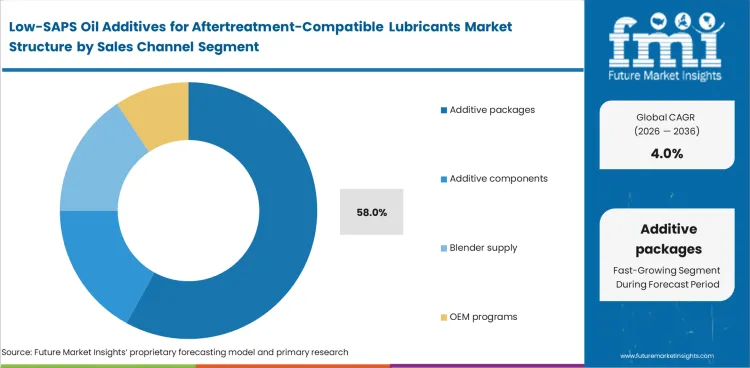
- Additive packages are expected to hold 58.0% share in 2026 because blenders want ready-balanced chemistry with lower approval risk. These packages reduce testing pressure and help oil brands launch new grades faster.
- Additive components will still matter for large formulators with their own testing labs. These companies can adjust detergents and dispersants to meet specific OEM claims within the wider lubricant additives space.
Low-SAPS Oil Additives for Aftertreatment-Compatible Lubricants Market Drivers, Restraints, and Opportunities
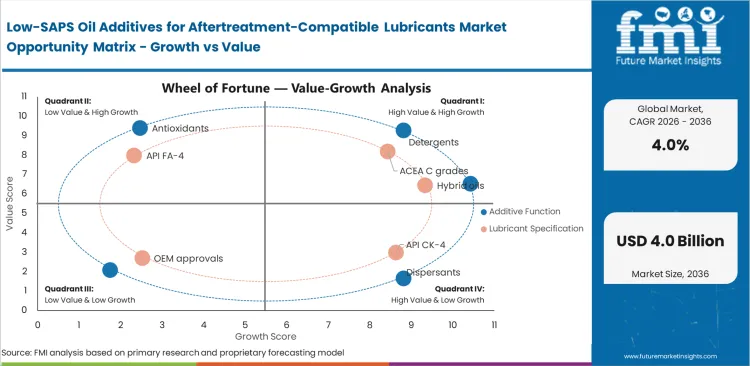
- Low-ash detergent balance is driving demand because DPF and GPF systems need cleaner engine oil chemistry.
- OEM approval cost can slow smaller blenders because each oil claim needs repeatable testing proof.
- Hybrid and hydrogen engines create new scope for packages built around cleaner operation and fuel economy.
- Regional blending support creates opportunity because oil marketers need faster technical service and stable supply.
Filter Protection Needs Are Raising Additive Intensity
Modern engines need oils that control deposits without adding excess ash. Low-SAPS additive packages help oil marketers reduce ash loading risk in DPF and GPF hardware. The lubricant additives market benefits from this need because detergent design has to carry more performance within tighter chemical limits. Better ash control supports longer aftertreatment life. It reduces service complaints tied to blocked filters.
Approval Cost Is Slowing Smaller Blenders
Low-SAPS oils are difficult to launch because every claim need testing support. Smaller blenders face higher risk when one failed test delays a new oil grade. Afton Chemical published GF-7 guidance in 2025 around the new passenger car oil cycle and formulation planning. The guidance fits this market because oil marketers need additive partners before they commit to new labels. Approval support has become a buying factor for engine oil brands.
Alternative-Fuel Engines Open Fresh Formulation Needs
Alternative-fuel engines are creating new needs for oil additive chemistry. In September 2025, Afton Chemical launched a dedicated additive for hydrogen heavy-duty engines. Hydrogen engines still need engine oil, but lubricant chemistry must manage different combustion and deposit behavior. Low-SAPS suppliers can use this shift to develop packages for cleaner engine platforms. The opportunity is tied to high-specification engine oils.
Analysis of Low-SAPS Oil Additives for Aftertreatment-Compatible Lubricants Market by Key Countries
.webp "Top Country Growth Comparison Low Saps Oil Additives For Aftertreatment Compatible Lubricants Market Cagr (2026 2036)")
| Country | CAGR |
|---|---|
| India | 5.4% |
| China | 4.9% |
| South Korea | 4.1% |
| United States | 3.9% |
| Germany | 3.6% |
| Japan | 3.5% |
| France | 3.4% |
Source: FMI analysis based on primary research and proprietary forecasting model.
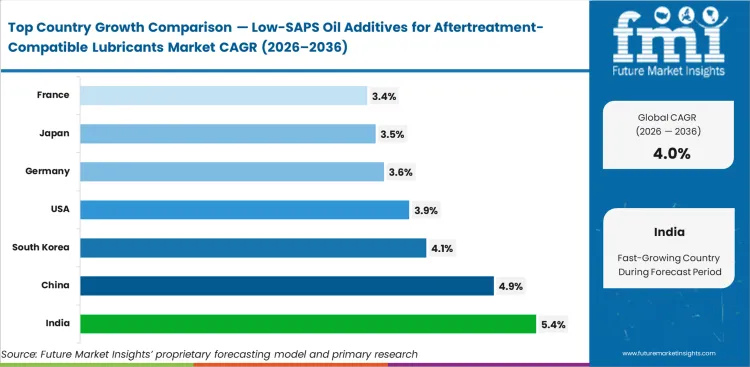
Low-SAPS Oil Additives for Aftertreatment-Compatible Lubricants Market CAGR Analysis by Country
- India is expected to record 5.4% CAGR by 2036 as BS VI service-fill demand lifts low-SAPS package use.
- Through 2036, China is forecast to register 4.9% CAGR as China VI oils expand and China VII preparation shapes fresh claims.
- South Korea is expected to rise at 4.1% CAGR by 2036 as export-focused OEMs need oils aligned with global aftertreatment rules.
- During the forecast period, United States demand is projected to advance at 3.9% CAGR with EPA 2027 rules and API SQ reformulation work.
- Due to premium OEM specifications and diesel service-fill intensity, Germany is anticipated to move ahead at 3.6% CAGR by 2036.
- By 2036, as hybrid vehicle strength supports low-viscosity aftertreatment-compatible oils, Japan is forecast to record 3.5% CAGR.
- France is expected to post 3.4% CAGR by 2036 as European C-grade oils keep DPF compatibility central to service-fill choices.
Demand Outlook for Low-SAPS Oil Additives for Aftertreatment-Compatible Lubricants in India
India is expected to record 5.4% CAGR by 2036 as BS VI service-fill demand lifts low-SAPS package use. PIB stated in June 2025 that CAQM Direction No. 88 will restrict non-Delhi LGV, MGV and HGV commercial goods vehicles entering Delhi from November 1, 2025 unless they meet BS-VI, CNG, LNG or EV norms. The same direction also covers buses entering Delhi from November 1, 2026. This supports demand for aftertreatment-compatible oils used in newer commercial fleets.
- BS VI commercial vehicles need oils that protect catalysts and particulate filters during daily service.
- Fleet operators will need low-SAPS oils that reduce ash exposure in aftertreatment systems.
- Additive suppliers can support Indian blenders with packages suited for diesel service-fill demand.
Sales Analysis of Low-SAPS Oil Additives for Aftertreatment-Compatible Lubricants in China
As China VI oils expand and China VII preparation shapes new lubricant claims, China’s market is forecast to register 4.9% CAGR through 2036. In June 2025, China’s Ministry of Ecology and Environment stated that heavy trucks account for more than three-fourths of vehicle NOx emissions in the country. The ministry also stated that more than 20 technical seminars had been held since 2025 for heavy-duty National VII standard work. These steps make low-SAPS additive design more important for diesel engine oils.
- China VI diesel fleets need DPF-compatible oils with stable detergent control.
- China VII preparation will push blenders toward cleaner ash and stronger testing proof.
- Additive suppliers with local support can help oil brands respond faster to new heavy-duty oil needs.
Demand Analysis of Low-SAPS Oil Additives for Aftertreatment-Compatible Lubricants in South Korea
South Korea is expected to rise at 4.1% CAGR by 2036 as export-focused OEMs need oils aligned with global aftertreatment rules. In January 2026, Korea’s Ministry of Trade, Industry and Resources stated that automobile exports reached USD 72.0 billion in 2025. The same release said exports rose 1.7% and reached a new record. Export strength keeps lubricant approvals important because vehicles sold in global markets need oils that match overseas service requirements.
- Export vehicle programs need engine oils that can meet international specification needs.
- Local oil marketers need additive packages that support API and ACEA approval routes.
- Hybrid and gasoline platforms can raise demand for low-SAPS oils with steady wear protection.
Opportunity Analysis of Low-SAPS Oil Additives for Aftertreatment-Compatible Lubricants in the United States
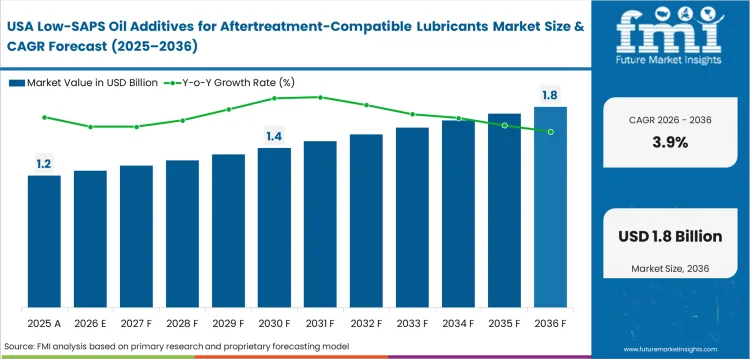
API 1509 published in February 2025 states that ILSAC GF-7A and GF-7B became effective on March 31, 2025. During the forecast period, United States demand is projected to advance at 3.9% CAGR with API SQ reformulation work. It also states that API SQ engine oils can display the API Service Symbol from the same date. GF-7A limits sulfated ash and phosphorus, which makes low-SAPS additive balance important for passenger car engine oils.
- API SQ creates a clear reformulation route for gasoline engine oil brands.
- GF-7A limits make ash control and phosphorus retention important for additive selection.
- Oil marketers need suppliers that can support testing proof for new passenger car oil claims.
Future Outlook for Low-SAPS Oil Additives for Aftertreatment-Compatible Lubricants in Germany
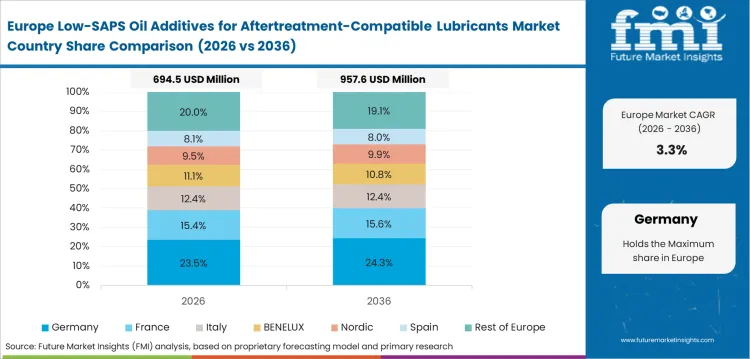
Germany is anticipated to move ahead at 3.6% CAGR by 2036 due to premium OEM specifications and diesel service-fill intensity. KBA data published after 2024 shows Germany had 13,385,662 diesel passenger cars. Diesel cars held 27.0% of the passenger car stock. This supports continued service-fill demand for diesel-compatible low-SAPS oils because DPF protection remains important in vehicle maintenance.
- Diesel passenger cars need engine oils that protect DPF systems during regular service.
- Premium OEM specifications keep oil approval work important for German service-fill channels.
- Additive suppliers need proof that low-ash chemistry can still protect engines well.
Demand Outlook for Low-SAPS Oil Additives for Aftertreatment-Compatible Lubricants in Japan
JAMA’s 2025 report states that alternative-fuel vehicles reached a little over 60.0% of new passenger car registrations in 2024. It also lists hybrid vehicle registrations at 2,005,781 units. Japan is forecast to record 3.5% CAGR by 2036. Hybrid vehicle strength supports low-viscosity aftertreatment-compatible oils. Japan’s 2030 passenger car fuel economy target requires a 32.4% improvement versus 2016, which supports cleaner and thinner engine oils.
- Hybrid engines need oils that can handle frequent restart cycles.
- Low-viscosity oils need additive packages that protect moving parts under thinner oil films.
- OEM-linked oil programs need catalyst-safe chemistry with reliable fuel economy support.
In-depth Analysis of Low-SAPS Oil Additives for Aftertreatment-Compatible Lubricants in France
The industry outlook in France points to 3.4% CAGR through 2036 as passenger cars and light commercial vehicles support service-fill demand. PFA stated on January 1, 2026 that France recorded 1,632,154 passenger car registrations in 2025. It also listed 360,504 light commercial vehicle registrations in the same year. Hybrid passenger car registrations reached 823,625 units, equal to 50.5% of passenger car registrations. These vehicle patterns support demand for aftertreatment-compatible oils.
- Passenger cars create regular service-fill demand for low-SAPS engine oils.
- Light commercial vehicles need oils that protect DPF systems during frequent daily use.
- Hybrid registrations support demand for low-viscosity oils with cleaner additive balance.
Competitive Landscape and Strategic Positioning
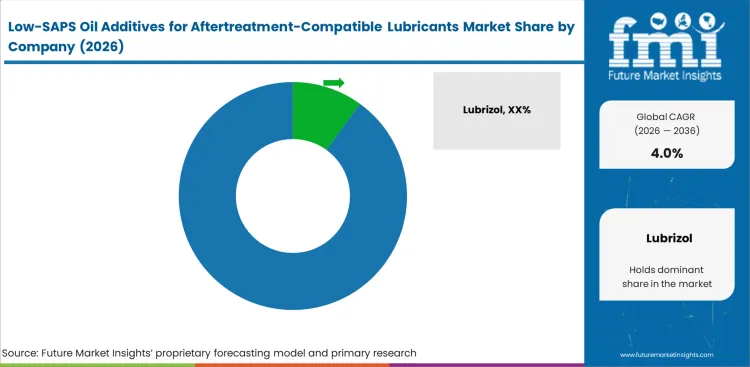
- Competition depends on how well suppliers support OEM approvals and low-ash oil formulation.
- Additive package makers gain preference when they help oil marketers reduce testing and approval risk.
- Component specialists support blenders with detergents and dispersants used in low-SAPS oil packages.
- New suppliers face entry barriers because engine testing is costly and aftertreatment compatibility must be proven.
Supplier positioning is moving toward proof-based formulation support. Afton Chemical launched a hydrogen heavy-duty engine additive in September 2025, showing how additive suppliers are preparing for cleaner engine platforms. Evonik’s March 2025 engine oil presentation focused on viscosity methods able to improve fuel efficiency by over 1.0% across internal combustion and hybrid engines. These examples are relevant for low-SAPS oils because cleaner engines still need wear protection and deposit control.
Heavy-duty lubricant performance is another competitive filter. Evonik planned a September 2025 presentation on lowering emissions and extending drain intervals with high-performance lubricant additives for heavy-duty trucks. The same buying need appears in low-SAPS oils because fleets want aftertreatment protection without shorter service intervals. Oil marketers will prefer suppliers with technical proof and local support. The lubricants market will favor suppliers that turn specification change into reliable service-fill products.
Global package suppliers hold stronger positions because low-SAPS oils need more than a single additive component. Lubrizol, Infineum, Chevron Oronite and Afton Chemical have broad engine oil package portfolios. BASF and Evonik Oil Additives support selected chemistry inputs for oil marketers. Regional partners such as Rianlon and LSR Specialty Oils add supply depth in Asia. Smaller suppliers can win selected accounts when they offer stable chemistry and fast formulation support.
Key Companies in the Low-SAPS Oil Additives for Aftertreatment-Compatible Lubricants Market
- Global additive package leaders: They include Lubrizol and Infineum. Chevron Oronite and Afton Chemical hold established engine oil additive positions. Each offers package depth and OEM approval support.
- Component and formulation specialists: They include BASF and Evonik Oil Additives. LANXESS supports selected chemistry inputs used by oil marketers building differentiated low-SAPS packages.
- Regional supply partners: Rianlon supports Infineum’s component supply plan in China and LSR Specialty Oils operates Infineum’s India blending facility for local additive supply.
Competitive Benchmarking: Low-SAPS Oil Additives for Aftertreatment-Compatible Lubricants Market
| Company | Formulation Depth | OEM Approval Support | Blending Reach | Footprint |
|---|---|---|---|---|
| Lubrizol | High | High | High | Global |
| Infineum | High | High | High | Global |
| Chevron Oronite | High | Medium | High | Global |
| Afton Chemical | High | Medium | High | Global |
| BASF | Medium | Medium | Medium | Global |
| Evonik Oil Additives | Medium | Medium | High | Global |
| LANXESS | Medium | Low | Medium | Europe and Americas |
| Rianlon Corporation | Low | Low | Medium | China and Asia-Pacific |
Source: Future Market Insights competitive analysis, 2026.
Key Developments in Low-SAPS Oil Additives for Aftertreatment-Compatible Lubricants Market
- In May 2025, Lubrizol announced that Lubrizol® CV1150 Engine Oil Solution achieved the China GB D1 specification. The GB D1 standard is China’s first national diesel engine oil specification and uses localized engine bench tests.
- In April 2026, Infineum received official approval for Infineum P6895 against Stellantis FPW9.55535/03. The additive technology supports engine oil products for internal combustion and hybrid vehicles.
Key Players in the Low-SAPS Oil Additives for Aftertreatment-Compatible Lubricants Market
Global additive package leaders
- Lubrizol
- Infineum
- Chevron Oronite
- Afton Chemical
Component and Formulation Specialists
- BASF
- Evonik Oil Additives
- LANXESS
Regional Supply Partners
- Rianlon Corporation
- LSR Specialty Oils
Report Scope and Coverage
| Parameter | Details |
|---|---|
| Quantitative Units | USD 2.7 billion to USD 4.0 billion at 4.0% CAGR |
| Market Definition | Additive systems used in engine oils to reduce sulfated ash and phosphorus for aftertreatment-compatible lubricants |
| Segments Covered | Additive function, lubricant specification, base oil compatibility, vehicle type, sales channel, and region |
| Additive Function | Detergents, dispersants, antioxidants, anti-wear agents, and friction modifiers |
| Lubricant Specification | ACEA C grades, API CK-4, API FA-4, OEM approvals, and hybrid oils |
| Base Oil Compatibility | Group III, Group II, PAO, and esters |
| Vehicle Type | Passenger cars, heavy trucks, light commercial vehicles, and off-highway engines |
| Sales Channel | Additive packages, additive components, blender supply, and OEM programs |
| Regions Covered | North America, Latin America, Western Europe, Eastern Europe, East Asia, South Asia and Pacific, Middle East and Africa |
| Countries Covered | India, China, South Korea, United States, Germany, Japan, France, and more than 30.0 countries |
| Key Companies Profiled | Lubrizol, Infineum, Chevron Oronite, Afton Chemical, BASF, Evonik Oil Additives, and LANXESS |
| Forecast Period | 2026 to 2036 |
| Approach | Hybrid bottom-up and top-down method using engine oil demand, additive treat rates, low-SAPS penetration, specification mix, and supplier activity |
Low-SAPS Oil Additives for Aftertreatment-Compatible Lubricants Market Breakdown by Additive Function, Lubricant Specification, Base Oil Compatibility, Vehicle Type, Sales Channel, and Region
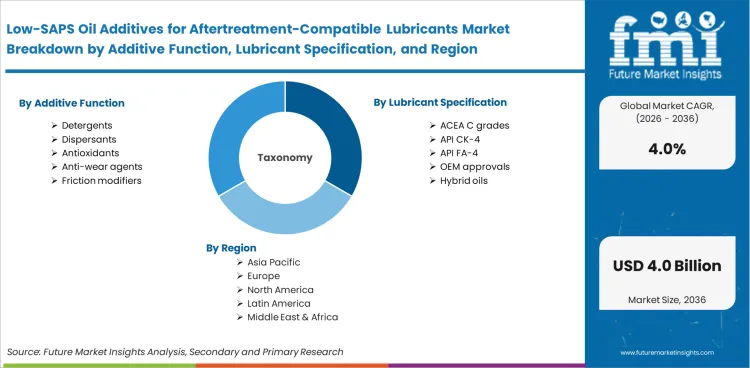
Low-SAPS Oil Additives for Aftertreatment-Compatible Lubricants Market Segmented by Additive Function
- Detergents
- Dispersants
- Antioxidants
- Anti-wear agents
- Friction modifiers
Low-SAPS Oil Additives for Aftertreatment-Compatible Lubricants Market Segmented by Lubricant Specification
- ACEA C grades
- API CK-4
- API FA-4
- OEM approvals
- Hybrid oils
Low-SAPS Oil Additives for Aftertreatment-Compatible Lubricants Market Segmented by Base Oil Compatibility
- Group III
- Group II
- PAO
- Esters
Low-SAPS Oil Additives for Aftertreatment-Compatible Lubricants Market Segmented by Vehicle Type
- Passenger cars
- Heavy trucks
- Light commercial vehicles
- Off-highway engines
Low-SAPS Oil Additives for Aftertreatment-Compatible Lubricants Market Segmented by Sales Channel
- Additive packages
- Additive components
- Blender supply
- OEM programs
Low-SAPS Oil Additives for Aftertreatment-Compatible Lubricants Market by Region
- North America
- Latin America
- Western Europe
- Eastern Europe
- East Asia
- South Asia and Pacific
- Middle East and Afr
Research Sources and Bibliography
- Lubrizol. (2025, May 29). Lubrizol® CV1150 engine oil solution successfully achieves China GB D1 specification.
- Infineum. (2026, April 30). Next generation additive technology: Infineum P6895 approved against Stellantis’ new FPW9.55535/03 specification.
- American Petroleum Institute. (2025, February). API 1509: Engine oil licensing and certification system (23rd ed.). American Petroleum Institute.
- American Petroleum Institute. (2025). API’s motor oil guide. American Petroleum Institute.
- Afton Chemical Corporation. (2025, September 15). Afton Chemical launches the world’s first commercially available dedicated additive for hydrogen heavy-duty engines. Afton Chemical.
- European Automobile Manufacturers’ Association. (2024, December 18). 2024 ACEA oil sequences for heavy-duty engines. ACEA.
- Evonik Industries AG. (2025). Lubricant Expo Europe. Evonik.
- Evonik Operations GmbH. (2025). Boost efficiency and cut emissions: Improve fuel economy in three steps with advanced engine oils. Evonik.
- Lubrizol Corporation. (2025, June 18). Lubrizol launches Lubrizol® MF9145V diesel additive to solve DPF maintenance challenges. Lubrizol.
- USA Environmental Protection Agency. (2024, March 20). Final rule: Multi-pollutant emissions standards for model years 2027 and later light-duty and medium-duty vehicles. USA Environmental Protection Agency.
- USA Environmental Protection Agency. (2024, March 29). Final rule: Greenhouse gas emissions standards for heavy-duty vehicles - Phase 3. USA Environmental Protection Agency.
- American Petroleum Institute. (2025, February). API 1509: Engine oil licensing and certification system (23rd ed.). American Petroleum Institute.
- Japan Automobile Manufacturers Association. (2025, September 26). The motor industry of Japan 2025. Japan Automobile Manufacturers Association.
- Kraftfahrt-Bundesamt. (2026). Bestand an Personenkraftwagen nach Kraftstoffarten am 1. Januar 2026. Kraftfahrt-Bundesamt.
- Ministry of Ecology and Environment of the People’s Republic of China. (2025, June 30). Response to recommendation No. 4035 of the third session of the 14th National People’s Congress. Ministry of Ecology and Environment.
- Ministry of Environment, Forest and Climate Change. (2025, June 4). CAQM issues Statutory Direction mandating the buses operating under various service regimes and entering Delhi to be on cleaner modes. Press Information Bureau.
- Ministry of Trade, Industry and Resources. (2026, January). Korea’s annual exports reach new highs in 2025. Ministry of Trade, Industry and Resources.
- Plateforme Automobile. (2026, January 1). Le marché automobile français: Décembre 2025. PFA.
This bibliography is provided for reader reference and is not exhaustive. The full report contains the complete reference list and detailed citations.
Questions Answered by the Report
- What is the 2026 value of low-SAPS oil additives for aftertreatment-compatible lubricants?
- What value is forecast for the market by 2036?
- What CAGR is expected for low-SAPS oil additives from 2026 to 2036?
- Which additive function is expected to lead in 2026?
- Which lubricant specification group has the strongest 2026 share?
- Which countries are forecast to advance faster than the global average?
- How do API SQ and ACEA C grades affect low-SAPS additive selection?
Frequently Asked Questions
What is the global market demand for low-SAPS oil additives in 2026?
In 2026, market demand is estimated at USD 2.7 billion with sales centered on aftertreatment-compatible engine oil packages.
What will the low-SAPS oil additives market be worth by 2036?
By 2036, the market is projected to reach USD 4.0 billion as emission hardware keeps low-ash lubricant chemistry important.
What CAGR is forecast for low-SAPS oil additives between 2026 and 2036?
Demand is expected to rise at 4.0% CAGR from 2026 to 2036 with steady use in passenger car and heavy truck oils.
Which additive function leads the market?
Detergents are expected to lead additive function demand with 34.0% share in 2026 due to ash control and acid neutralization needs.
Which sales channel holds the strongest share?
Additive packages are expected to hold 58.0% share in 2026 since blenders prefer pre-balanced and tested low-SAPS chemistry.
Which country is expected to advance at the fastest pace?
India is expected to record 5.4% CAGR by 2036 as BS VI service-fill demand expands across passenger and heavy-duty fleets.
Preview the report firsthand - request a free sample
Get SampleGet the brochure for pricing and purchase details.
Get PDFTable of Content
- Executive Summary
- Global Market Outlook
- Demand-side Trends
- Supply-side Trends
- Technology Roadmap Analysis
- Analysis and Recommendations
- Market Overview
- Market Coverage / Taxonomy
- Market Definition / Scope / Limitations
- Research Methodology
- Chapter Orientation
- Analytical Lens and Working Hypotheses
- Market Structure, Signals, and Trend Drivers
- Benchmarking and Cross-market Comparability
- Market Sizing, Forecasting, and Opportunity Mapping
- Research Design and Evidence Framework
- Desk Research Programme (Secondary Evidence)
- Company Annual and Sustainability Reports
- Peer-reviewed Journals and Academic Literature
- Corporate Websites, Product Literature, and Technical Notes
- Earnings Decks and Investor Briefings
- Statutory Filings and Regulatory Disclosures
- Technical White Papers and Standards Notes
- Trade Journals, Industry Magazines, and Analyst Briefs
- Conference Proceedings, Webinars, and Seminar Materials
- Government Statistics Portals and Public Data Releases
- Press Releases and Reputable Media Coverage
- Specialist Newsletters and Curated Briefings
- Sector Databases and Reference Repositories
- FMI Internal Proprietary Databases and Historical Market Datasets
- Subscription Datasets and Paid Sources
- Social Channels, Communities, and Digital Listening Inputs
- Additional Desk Sources
- Expert Input and Fieldwork (Primary Evidence)
- Primary Modes
- Qualitative Interviews and Expert Elicitation
- Quantitative Surveys and Structured Data Capture
- Blended Approach
- Why Primary Evidence is Used
- Field Techniques
- Interviews
- Surveys
- Focus Groups
- Observational and In-context Research
- Social and Community Interactions
- Stakeholder Universe Engaged
- C-suite Leaders
- Board Members
- Presidents and Vice Presidents
- R&D and Innovation Heads
- Technical Specialists
- Domain Subject-matter Experts
- Scientists
- Physicians and Other Healthcare Professionals
- Governance, Ethics, and Data Stewardship
- Research Ethics
- Data Integrity and Handling
- Primary Modes
- Tooling, Models, and Reference Databases
- Desk Research Programme (Secondary Evidence)
- Data Engineering and Model Build
- Data Acquisition and Ingestion
- Cleaning, Normalisation, and Verification
- Synthesis, Triangulation, and Analysis
- Quality Assurance and Audit Trail
- Market Background
- Market Dynamics
- Drivers
- Restraints
- Opportunity
- Trends
- Scenario Forecast
- Demand in Optimistic Scenario
- Demand in Likely Scenario
- Demand in Conservative Scenario
- Opportunity Map Analysis
- Product Life Cycle Analysis
- Supply Chain Analysis
- Investment Feasibility Matrix
- Value Chain Analysis
- PESTLE and Porter’s Analysis
- Regulatory Landscape
- Regional Parent Market Outlook
- Production and Consumption Statistics
- Import and Export Statistics
- Market Dynamics
- Global Market Analysis 2021 to 2025 and Forecast, 2026 to 2036
- Historical Market Size Value (USD Million) Analysis, 2021 to 2025
- Current and Future Market Size Value (USD Million) Projections, 2026 to 2036
- Y-o-Y Growth Trend Analysis
- Absolute $ Opportunity Analysis
- Global Market Pricing Analysis 2021 to 2025 and Forecast 2026 to 2036
- Global Market Analysis 2021 to 2025 and Forecast 2026 to 2036, By Additive Function
- Introduction / Key Findings
- Historical Market Size Value (USD Million) Analysis By Additive Function , 2021 to 2025
- Current and Future Market Size Value (USD Million) Analysis and Forecast By Additive Function , 2026 to 2036
- Detergents
- Dispersants
- Antioxidants
- Anti-wear agents
- Friction modifiers
- Detergents
- Y-o-Y Growth Trend Analysis By Additive Function , 2021 to 2025
- Absolute $ Opportunity Analysis By Additive Function , 2026 to 2036
- Global Market Analysis 2021 to 2025 and Forecast 2026 to 2036, By Lubricant Specification
- Introduction / Key Findings
- Historical Market Size Value (USD Million) Analysis By Lubricant Specification, 2021 to 2025
- Current and Future Market Size Value (USD Million) Analysis and Forecast By Lubricant Specification, 2026 to 2036
- ACEA C grades
- API CK-4
- API FA-4
- OEM approvals
- Hybrid oils
- ACEA C grades
- Y-o-Y Growth Trend Analysis By Lubricant Specification, 2021 to 2025
- Absolute $ Opportunity Analysis By Lubricant Specification, 2026 to 2036
- Global Market Analysis 2021 to 2025 and Forecast 2026 to 2036, By Base Oil Compatibility
- Introduction / Key Findings
- Historical Market Size Value (USD Million) Analysis By Base Oil Compatibility, 2021 to 2025
- Current and Future Market Size Value (USD Million) Analysis and Forecast By Base Oil Compatibility, 2026 to 2036
- Group III
- Group II
- PAO
- Esters
- Group III
- Y-o-Y Growth Trend Analysis By Base Oil Compatibility, 2021 to 2025
- Absolute $ Opportunity Analysis By Base Oil Compatibility, 2026 to 2036
- Global Market Analysis 2021 to 2025 and Forecast 2026 to 2036, By Vehicle Type
- Introduction / Key Findings
- Historical Market Size Value (USD Million) Analysis By Vehicle Type, 2021 to 2025
- Current and Future Market Size Value (USD Million) Analysis and Forecast By Vehicle Type, 2026 to 2036
- Passenger cars
- Heavy trucks
- Light commercial vehicles
- Off-highway engines
- Passenger cars
- Y-o-Y Growth Trend Analysis By Vehicle Type, 2021 to 2025
- Absolute $ Opportunity Analysis By Vehicle Type, 2026 to 2036
- Global Market Analysis 2021 to 2025 and Forecast 2026 to 2036, By Sales Channel
- Introduction / Key Findings
- Historical Market Size Value (USD Million) Analysis By Sales Channel, 2021 to 2025
- Current and Future Market Size Value (USD Million) Analysis and Forecast By Sales Channel, 2026 to 2036
- Additive packages
- Additive components
- Blender supply
- OEM programs
- Additive packages
- Y-o-Y Growth Trend Analysis By Sales Channel, 2021 to 2025
- Absolute $ Opportunity Analysis By Sales Channel, 2026 to 2036
- Global Market Analysis 2021 to 2025 and Forecast 2026 to 2036, By Region
- Introduction
- Historical Market Size Value (USD Million) Analysis By Region, 2021 to 2025
- Current Market Size Value (USD Million) Analysis and Forecast By Region, 2026 to 2036
- North America
- Latin America
- Western Europe
- Eastern Europe
- East Asia
- South Asia and Pacific
- Middle East & Africa
- Market Attractiveness Analysis By Region
- North America Market Analysis 2021 to 2025 and Forecast 2026 to 2036, By Country
- Historical Market Size Value (USD Million) Trend Analysis By Market Taxonomy, 2021 to 2025
- Market Size Value (USD Million) Forecast By Market Taxonomy, 2026 to 2036
- By Country
- USA
- Canada
- Mexico
- By Additive Function
- By Lubricant Specification
- By Base Oil Compatibility
- By Vehicle Type
- By Sales Channel
- By Country
- Market Attractiveness Analysis
- By Country
- By Additive Function
- By Lubricant Specification
- By Base Oil Compatibility
- By Vehicle Type
- By Sales Channel
- Key Takeaways
- Latin America Market Analysis 2021 to 2025 and Forecast 2026 to 2036, By Country
- Historical Market Size Value (USD Million) Trend Analysis By Market Taxonomy, 2021 to 2025
- Market Size Value (USD Million) Forecast By Market Taxonomy, 2026 to 2036
- By Country
- Brazil
- Chile
- Rest of Latin America
- By Additive Function
- By Lubricant Specification
- By Base Oil Compatibility
- By Vehicle Type
- By Sales Channel
- By Country
- Market Attractiveness Analysis
- By Country
- By Additive Function
- By Lubricant Specification
- By Base Oil Compatibility
- By Vehicle Type
- By Sales Channel
- Key Takeaways
- Western Europe Market Analysis 2021 to 2025 and Forecast 2026 to 2036, By Country
- Historical Market Size Value (USD Million) Trend Analysis By Market Taxonomy, 2021 to 2025
- Market Size Value (USD Million) Forecast By Market Taxonomy, 2026 to 2036
- By Country
- Germany
- UK
- Italy
- Spain
- France
- Nordic
- BENELUX
- Rest of Western Europe
- By Additive Function
- By Lubricant Specification
- By Base Oil Compatibility
- By Vehicle Type
- By Sales Channel
- By Country
- Market Attractiveness Analysis
- By Country
- By Additive Function
- By Lubricant Specification
- By Base Oil Compatibility
- By Vehicle Type
- By Sales Channel
- Key Takeaways
- Eastern Europe Market Analysis 2021 to 2025 and Forecast 2026 to 2036, By Country
- Historical Market Size Value (USD Million) Trend Analysis By Market Taxonomy, 2021 to 2025
- Market Size Value (USD Million) Forecast By Market Taxonomy, 2026 to 2036
- By Country
- Russia
- Poland
- Hungary
- Balkan & Baltic
- Rest of Eastern Europe
- By Additive Function
- By Lubricant Specification
- By Base Oil Compatibility
- By Vehicle Type
- By Sales Channel
- By Country
- Market Attractiveness Analysis
- By Country
- By Additive Function
- By Lubricant Specification
- By Base Oil Compatibility
- By Vehicle Type
- By Sales Channel
- Key Takeaways
- East Asia Market Analysis 2021 to 2025 and Forecast 2026 to 2036, By Country
- Historical Market Size Value (USD Million) Trend Analysis By Market Taxonomy, 2021 to 2025
- Market Size Value (USD Million) Forecast By Market Taxonomy, 2026 to 2036
- By Country
- China
- Japan
- South Korea
- By Additive Function
- By Lubricant Specification
- By Base Oil Compatibility
- By Vehicle Type
- By Sales Channel
- By Country
- Market Attractiveness Analysis
- By Country
- By Additive Function
- By Lubricant Specification
- By Base Oil Compatibility
- By Vehicle Type
- By Sales Channel
- Key Takeaways
- South Asia and Pacific Market Analysis 2021 to 2025 and Forecast 2026 to 2036, By Country
- Historical Market Size Value (USD Million) Trend Analysis By Market Taxonomy, 2021 to 2025
- Market Size Value (USD Million) Forecast By Market Taxonomy, 2026 to 2036
- By Country
- India
- ASEAN
- Australia & New Zealand
- Rest of South Asia and Pacific
- By Additive Function
- By Lubricant Specification
- By Base Oil Compatibility
- By Vehicle Type
- By Sales Channel
- By Country
- Market Attractiveness Analysis
- By Country
- By Additive Function
- By Lubricant Specification
- By Base Oil Compatibility
- By Vehicle Type
- By Sales Channel
- Key Takeaways
- Middle East & Africa Market Analysis 2021 to 2025 and Forecast 2026 to 2036, By Country
- Historical Market Size Value (USD Million) Trend Analysis By Market Taxonomy, 2021 to 2025
- Market Size Value (USD Million) Forecast By Market Taxonomy, 2026 to 2036
- By Country
- Kingdom of Saudi Arabia
- Other GCC Countries
- Turkiye
- South Africa
- Other African Union
- Rest of Middle East & Africa
- By Additive Function
- By Lubricant Specification
- By Base Oil Compatibility
- By Vehicle Type
- By Sales Channel
- By Country
- Market Attractiveness Analysis
- By Country
- By Additive Function
- By Lubricant Specification
- By Base Oil Compatibility
- By Vehicle Type
- By Sales Channel
- Key Takeaways
- Key Countries Market Analysis
- USA
- Pricing Analysis
- Market Share Analysis, 2025
- By Additive Function
- By Lubricant Specification
- By Base Oil Compatibility
- By Vehicle Type
- By Sales Channel
- Canada
- Pricing Analysis
- Market Share Analysis, 2025
- By Additive Function
- By Lubricant Specification
- By Base Oil Compatibility
- By Vehicle Type
- By Sales Channel
- Mexico
- Pricing Analysis
- Market Share Analysis, 2025
- By Additive Function
- By Lubricant Specification
- By Base Oil Compatibility
- By Vehicle Type
- By Sales Channel
- Brazil
- Pricing Analysis
- Market Share Analysis, 2025
- By Additive Function
- By Lubricant Specification
- By Base Oil Compatibility
- By Vehicle Type
- By Sales Channel
- Chile
- Pricing Analysis
- Market Share Analysis, 2025
- By Additive Function
- By Lubricant Specification
- By Base Oil Compatibility
- By Vehicle Type
- By Sales Channel
- Germany
- Pricing Analysis
- Market Share Analysis, 2025
- By Additive Function
- By Lubricant Specification
- By Base Oil Compatibility
- By Vehicle Type
- By Sales Channel
- UK
- Pricing Analysis
- Market Share Analysis, 2025
- By Additive Function
- By Lubricant Specification
- By Base Oil Compatibility
- By Vehicle Type
- By Sales Channel
- Italy
- Pricing Analysis
- Market Share Analysis, 2025
- By Additive Function
- By Lubricant Specification
- By Base Oil Compatibility
- By Vehicle Type
- By Sales Channel
- Spain
- Pricing Analysis
- Market Share Analysis, 2025
- By Additive Function
- By Lubricant Specification
- By Base Oil Compatibility
- By Vehicle Type
- By Sales Channel
- France
- Pricing Analysis
- Market Share Analysis, 2025
- By Additive Function
- By Lubricant Specification
- By Base Oil Compatibility
- By Vehicle Type
- By Sales Channel
- India
- Pricing Analysis
- Market Share Analysis, 2025
- By Additive Function
- By Lubricant Specification
- By Base Oil Compatibility
- By Vehicle Type
- By Sales Channel
- ASEAN
- Pricing Analysis
- Market Share Analysis, 2025
- By Additive Function
- By Lubricant Specification
- By Base Oil Compatibility
- By Vehicle Type
- By Sales Channel
- Australia & New Zealand
- Pricing Analysis
- Market Share Analysis, 2025
- By Additive Function
- By Lubricant Specification
- By Base Oil Compatibility
- By Vehicle Type
- By Sales Channel
- China
- Pricing Analysis
- Market Share Analysis, 2025
- By Additive Function
- By Lubricant Specification
- By Base Oil Compatibility
- By Vehicle Type
- By Sales Channel
- Japan
- Pricing Analysis
- Market Share Analysis, 2025
- By Additive Function
- By Lubricant Specification
- By Base Oil Compatibility
- By Vehicle Type
- By Sales Channel
- South Korea
- Pricing Analysis
- Market Share Analysis, 2025
- By Additive Function
- By Lubricant Specification
- By Base Oil Compatibility
- By Vehicle Type
- By Sales Channel
- Russia
- Pricing Analysis
- Market Share Analysis, 2025
- By Additive Function
- By Lubricant Specification
- By Base Oil Compatibility
- By Vehicle Type
- By Sales Channel
- Poland
- Pricing Analysis
- Market Share Analysis, 2025
- By Additive Function
- By Lubricant Specification
- By Base Oil Compatibility
- By Vehicle Type
- By Sales Channel
- Hungary
- Pricing Analysis
- Market Share Analysis, 2025
- By Additive Function
- By Lubricant Specification
- By Base Oil Compatibility
- By Vehicle Type
- By Sales Channel
- Kingdom of Saudi Arabia
- Pricing Analysis
- Market Share Analysis, 2025
- By Additive Function
- By Lubricant Specification
- By Base Oil Compatibility
- By Vehicle Type
- By Sales Channel
- Turkiye
- Pricing Analysis
- Market Share Analysis, 2025
- By Additive Function
- By Lubricant Specification
- By Base Oil Compatibility
- By Vehicle Type
- By Sales Channel
- South Africa
- Pricing Analysis
- Market Share Analysis, 2025
- By Additive Function
- By Lubricant Specification
- By Base Oil Compatibility
- By Vehicle Type
- By Sales Channel
- USA
- Market Structure Analysis
- Competition Dashboard
- Competition Benchmarking
- Market Share Analysis of Top Players
- By Regional
- By Additive Function
- By Lubricant Specification
- By Base Oil Compatibility
- By Vehicle Type
- By Sales Channel
- Competition Analysis
- Competition Deep Dive
- Lubrizol
- Overview
- Product Portfolio
- Profitability by Market Segments (Product/Age /Sales Channel/Region)
- Sales Footprint
- Strategy Overview
- Marketing Strategy
- Product Strategy
- Channel Strategy
- Infineum
- Chevron Oronite
- Afton Chemical
- BASF
- Evonik Oil Additives
- LANXESS
- Rianlon Corporation
- Lubrizol
- Competition Deep Dive
- Assumptions & Acronyms Used


