

- Market Size (2026)
- USD 1240.7 Mn
- Forecast (2036)
- USD 4137.7 Mn
- CAGR (2026 to 2036)
- 12.8%
How big is the SEI additives market in 2026?
USD 1,240.7 million in 2026 and USD 4,137.7 million by 2036 at a 12.8% CAGR.
The SEI additives industry value is forecast to grow from USD 1,099.9 million in 2025 to USD 4,137.7 million by 2036 at 12.8% CAGR as cell makers use electrolyte additives to improve first-cycle efficiency, fast-charge behavior, and long-term anode stability. Liquid electrolyte additives are forecast to represent 76.0% share in 2026 because most commercial lithium-ion cells continue to use carbonate liquid systems. Direct to cell makers is expected to secure 71.0% share in 2026, led by qualification audits, impurity controls, and supplier change-management requirements.
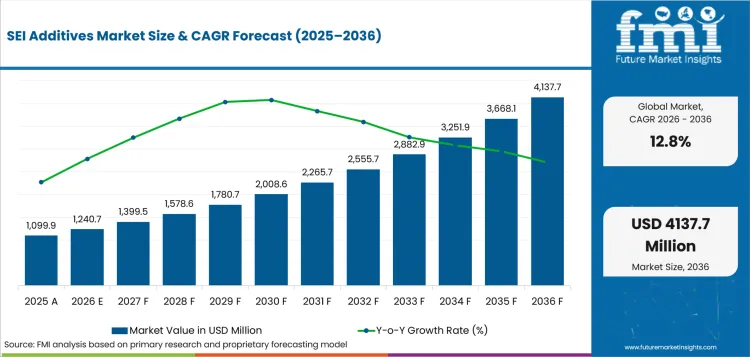
| 2026 Market Size | USD 1,240.7 million |
|---|---|
| 2036 Market Size | USD 4,137.7 million |
| Forecast CAGR (2026-2036) | 12.8% |
| Leading Form | Liquid Electrolyte Additives |
| Liquid Electrolyte Additives Share (2026) | 76.0% |
| Leading Sales Channel | Direct to Cell Makers |
| Direct to Cell Makers Share (2026) | 71.0% |
| Fastest-growing Country | China |
| China CAGR by 2036 | 14.1% |
Summary of the SEI Additives Market
- Demand and Growth Drivers
- EV battery manufacturers are using SEI additives to reduce first-cycle loss and improve formation consistency in large-format cells.
- Cell qualification teams are giving more attention to additive purity, moisture levels, and trace-metal specifications.
- Electrolyte suppliers are building deeper formulation support around fast charging, silicon-rich anodes, and LFP storage cells.
- Product and Segment View
- Liquid Electrolyte Additives are forecast to represent 76.0% share in 2026, supported by mainstream carbonate electrolyte use across commercial lithium-ion cell lines.
- Direct to Cell Makers is projected to hold 71.0% share in 2026, influenced by supplier audits and change-control documentation.
- EV Batteries are expected to secure 68.0% share in 2026, supported by warranty exposure and large-format battery production.
- Geography and Competitive Outlook
- China is projected to record 14.1% CAGR by 2036, backed by large cell output and integrated electrolyte supply chains.
- India is expected to expand at 13.9% CAGR by 2036 as local EV and cell manufacturing programs mature.
- Capchem and Tinci Materials compete through additive synthesis depth and electrolyte formulation scale.
- Mitsubishi Chemical, Enchem, Soulbrain, UBE Corporation, and Guotai Huarong focus on qualification access and regional supply support.
- Analyst Opinion
- Nikhil Kaitwade, Associate Vice President at FMI, observes, “SEI additives are moving from a chemistry line item into a cell qualification tool. Buyers are not asking only whether an additive forms a film. They are asking how it behaves after fast charge, storage, and high-temperature aging. Suppliers that connect additive purity, blending know-how, and cell-test interpretation should gain stronger repeat programs.”
The SEI additives market is expected to witness strong expansion through 2036, driven by EV battery scale, high-energy cathode use, and stricter fast-charge targets. Market expansion is further supported by cell makers treating additive packages as qualification tools rather than low-cost chemical inputs.
Battery manufacturing scale is making SEI additives more important than small recipe components. The International Energy Agency reported that electric car sales grew by 20% in 2025 to exceed 20 million units, with electric cars representing 25% of new car sales worldwide. EV battery deployment is expected to rise from around 1.2 TWh in 2025 to almost 3 TWh by 2030 under stated policy and current policy scenarios. The USA Department of Energy stated that its battery materials and recycling program had announced over USD 5.0 billion for 39 projects, covering 14 awarded projects and 25 projects selected for negotiation. These signals make additive qualification, moisture control, and trace-metal discipline central to electrolyte purchasing decisions.
Which factors support expansion in the SEI additives market?
Finished electrolyte additive revenue and validated formulation packages support market value across EV battery, electronics, and storage applications.
- Market value is supported by commercial additive revenue before finished electrolyte blending adds added formulation value.
- Supplier pricing reflects purity control and qualification data before molecule availability affects negotiation.
- Revenue improves as cell makers convert fast-charge and silicon-anode programs into validated electrolyte recipes.
- Buyer trust rises when additive suppliers document impurity thresholds, batch history, and change-control files clearly.
Why is the SEI additives market growing?
EV battery producers are using SEI additives to improve anode stability, formation yield, and long-term cell durability.
The market is growing because large EV cell programs now connect electrolyte additive selection with warranty risk and production yield. The International Energy Agency reported that nearly 22 million electric cars were produced globally in 2025, up more than 25% from the previous year. This production scale makes additive decisions commercially sensitive because small formulation changes can affect large cell batches. Film-forming additives are therefore gaining importance in graphite and silicon-anode cells. Suppliers with validated FEC, VC, DTD, LiFSI-linked, and blended additive systems can support cell makers seeking lower gas generation, controlled impedance rise, and stronger cycle-life performance.
How is the SEI additives market segmented?
The SEI additives industry is segmented by additive type, battery chemistry, application, form, and sales channel.
- Film-Forming Additives are projected to secure 54.0% share in 2026, led by their use in building stable anode interphase layers during cell formation.
- NMC is expected to hold 42.0% share in 2026 since high-energy cathode programs require additives that limit impedance growth and side reactions.
- EV Batteries are anticipated to capture 68.0% share in 2026 due to large-format cell demand and warranty-linked performance testing.
- Liquid Electrolyte Additives are forecast to represent 76.0% share in 2026, guided by the continued dominance of commercial carbonate electrolyte systems.
- Direct to Cell Makers is projected to account for 71.0% share in 2026, reflected by direct qualification and supplier audit requirements.
Why do film-forming additives dominate the SEI additives market?
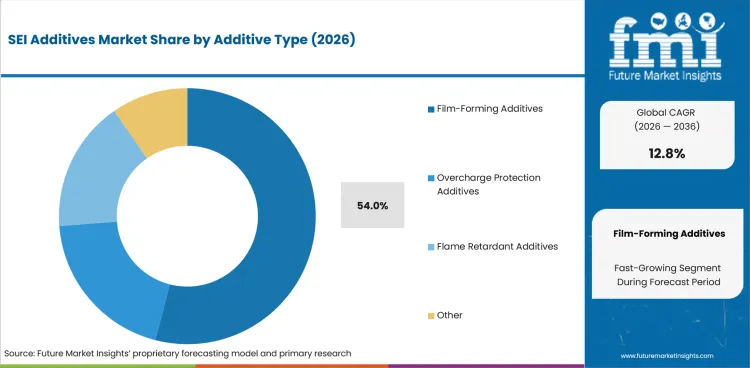
- Film-Forming Additives are projected to account for 54.0% share in 2026, influenced by their central role in forming the first protective anode layer during formation.
- Overcharge protection additives gain use in high-voltage cells because safety reviews are becoming stricter across EV and energy storage applications.
Which battery chemistry leads the SEI additives market?
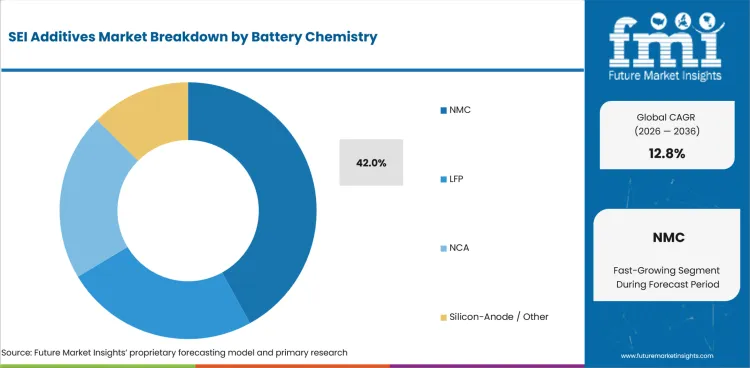
- NMC is anticipated to hold 42.0% share in 2026 through its use in high-energy EV cells that need tighter interface control.
- LFP chemistry gains value in storage and mass-market EV programs as longer cycle-life targets increase demand for stable electrolyte behavior.
Which application leads the SEI additives market?
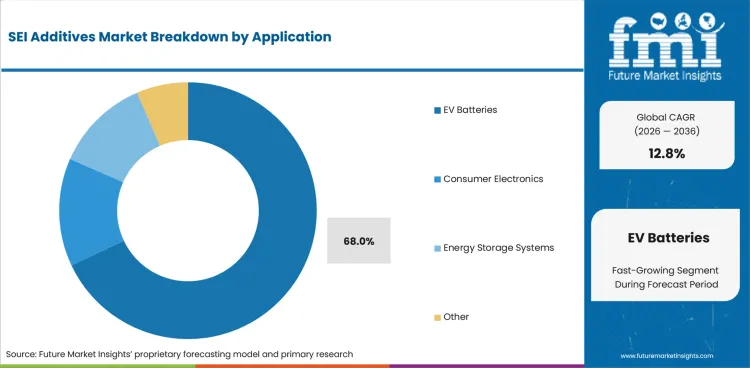
- EV Batteries are forecast to secure 68.0% share in 2026, reflected by large-format cell production and pack warranty requirements.
- Energy Storage Systems gain importance as long-duration operating windows increase the need for additives that reduce fade over repeated cycling.
Which form leads the SEI additives market?
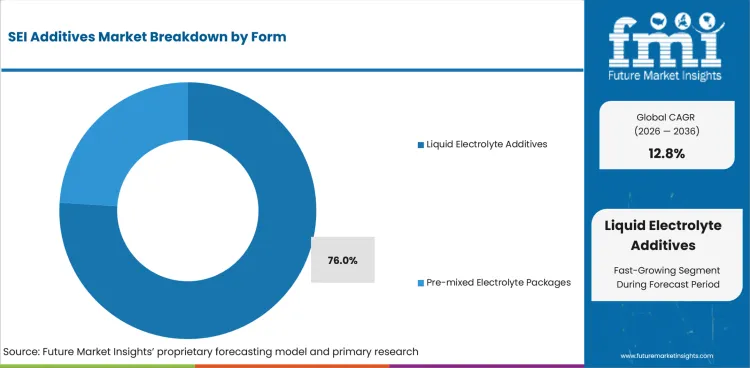
- Liquid Electrolyte Additives are expected to represent 76.0% share in 2026, shaped by broad use in carbonate-based lithium-ion electrolytes.
- Pre-mixed electrolyte packages gain adoption when cell makers want fewer handling steps and more consistent formulation control.
Which sales channel leads the SEI additives market?
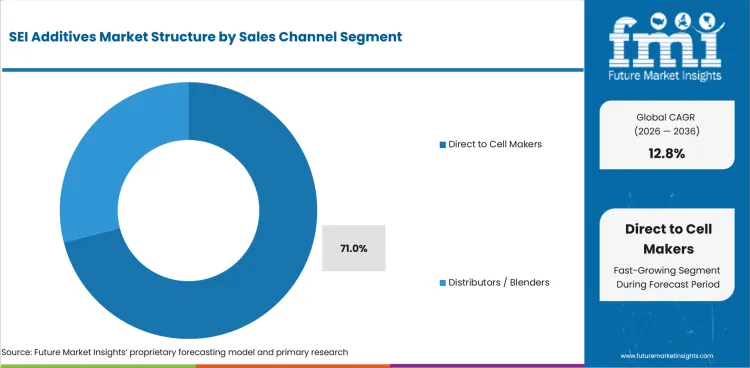
- Direct to Cell Makers is projected to account for 71.0% share in 2026, led by supplier audits, material qualification, and change-control requirements.
- Distributors and blenders remain useful for pilot programs, specialty packs, and smaller device customers that need flexible supply.
What are the driver, restraints, and opportunities in the SEI additives market?
Cell durability needs and battery localization support demand while qualification pressure and fluorinated chemistry costs limit easy supplier entry.
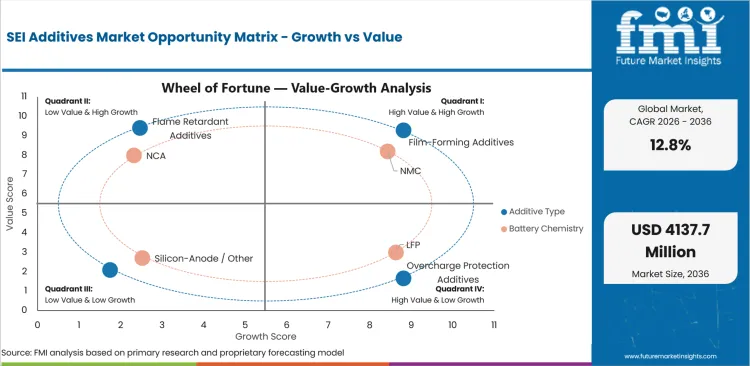
- Driver: Silicon-rich anodes and fast-charge cells need additive blends that preserve the anode interface after repeated cycling.
- Restraint: Cell makers avoid switching additives quickly because each molecule requires testing inside the final electrolyte recipe.
- Opportunity: Localized battery material programs create more openings for additive suppliers with audited quality systems.
Silicon-Anode Interface Stress
Silicon-rich anodes change the buying equation for SEI additives because expansion during charge can damage weak interphase layers. The International Energy Agency reported that electric car sales in emerging markets and developing economies outside China increased by around 80% in 2025, reaching almost 1.2 million units. Wider EV adoption beyond mature markets increases pressure to balance affordable battery design with stable cycle life. This supports stronger demand for FEC-rich and blended film-forming additive systems that reduce swelling-related interface damage.
Qualification-Locked Cell Supply
SEI additive switching remains difficult once a cell line is validated. A new additive needs formation trials, gas testing, storage checks, aging evaluation, and customer approval before broad shipment. The International Energy Agency stated that EV battery deployment expanded in China to 60% of global deployment in 2025, while the United States held around 10%. This regional imbalance can make qualification access concentrated around large Asian cell ecosystems. Suppliers without cell-test partnerships or regional technical service face slower entry into major EV battery programs.
Localized Battery Material Qualification
Battery material localization creates an opportunity for additive suppliers that can prove quality discipline near cell customers. The USA Department of Energy announced over USD 3.0 billion for 25 selected battery and battery material projects across 14 states in 2024. Local investments encourage cell makers to qualify domestic electrolyte inputs, including specialty additives, lithium salts, and formulation packages. Suppliers with application labs and batch-control documentation can convert localization policy into longer-term supply access.
Which countries are growing fastest in the SEI additives market?
China 14.1% CAGR, India 13.9% CAGR, South Korea 13.5% CAGR, United States 12.6% CAGR, Germany 12.4% CAGR, Japan 11.8% CAGR, France 11.3% CAGR, and United Kingdom 10.9% CAGR through 2036.
.webp "Top Country Growth Comparison Sei Additives Market Cagr (2026 2036)")
| Country | CAGR |
|---|---|
| China | 14.1% |
| India | 13.9% |
| South Korea | 13.5% |
| United States | 12.6% |
| Germany | 12.4% |
| Japan | 11.8% |
| France | 11.3% |
| United Kingdom | 10.9% |
Source: Future Market Insights, 2026.
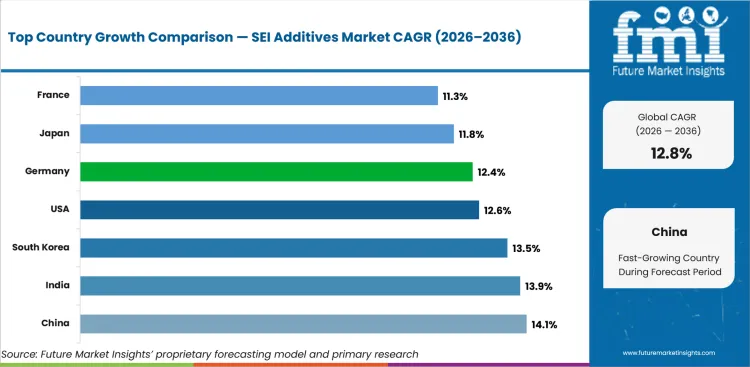
How do country-level CAGRs compare in the SEI additives market?
China leads country growth while the United Kingdom records the most measured expansion outlook among profiled markets.
- China is forecast to record 14.1% CAGR by 2036 as cell manufacturing scale supports additive and electrolyte integration.
- India is expected to expand at 13.9% CAGR from 2026 to 2036 due to EV localization and future cell manufacturing programs.
- South Korea is projected to grow at 13.5% CAGR through 2036 as export cell makers seek qualified additive suppliers.
- The United States is estimated to rise at 12.6% CAGR by 2036 through battery material localization and new cell plant qualification.
- Germany is forecast to advance at 12.4% CAGR through 2036 as automotive platforms demand European electrolyte validation.
- Japan is expected to post 11.8% CAGR over the forecast period as high-reliability battery programs sustain additive testing.
- France is projected to record 11.3% CAGR by 2036 with European battery projects and compliance-led sourcing.
- The United Kingdom is forecast to expand at 10.9% CAGR through 2036 as specialty battery supply and policy pressure guide demand.
What is the SEI additives market outlook in China?
A 14.1% CAGR through 2036 reflects cell manufacturing depth, electrolyte integration, and large EV battery demand.
Country Market Snapshot Table
| Parameter | Value |
|---|---|
| Market Size in 2025 (Value) | USD 376.9 million |
| Market Size in 2026 (Value) | USD 430.0 million |
| Market Forecast in 2036 (Value) | USD 1,608.1 million |
| CAGR (2026 to 2036) | 14.1% |
| Years Considered | 2021 to 2036 |
| Base Year | 2025 |
| Forecast Period | 2026 to 2036 |
| Units Considered | Value (USD million) |
| Leading Sub-Region | Yangtze River Delta and Pearl River Delta battery corridors |
China SEI Additives Market Outlook
China SEI additive demand is shaped by large-scale EV cell production and deep electrolyte supply integration. Domestic suppliers can package film-forming additives, lithium salts, and carbonate solvents within broader electrolyte solutions.
Local cell makers are expected to favor suppliers with fast technical response and reliable batch consistency. Export-oriented battery customers will require stronger documentation, especially around impurity control and compliance evidence.
Key Growth Drivers
- China’s EV cell output creates strong additive demand through large electrolyte blending programs. The State Council reported that NEV production reached 16.626 million units in 2025.
- Trade-in programs strengthen replacement-led EV demand. China stated that NEVs accounted for over 60% of car trade-in sales from January to August 2025.
- Domestic electrolyte suppliers can respond faster to cell-maker recipe changes through closer technical service and integrated raw material access.
- Energy storage cell exports support additives designed for LFP cycle-life stability and long operating windows.
Key Restraints
- Price pressure can reduce margins for standard film-forming additives when suppliers compete mainly on molecule availability.
- Export programs require added documentation because overseas customers review chemical safety, transport rules, and quality-system files.
- Margin discipline can remain tight as China’s equipment manufacturing value added increased 9.2% in 2025, increasing buyer expectations for scale-driven cost control across advanced inputs.
What makes China unique
China is unique because it combines the largest EV cell demand pool with local additive synthesis and electrolyte blending capacity.
Key Companies
- Capchem
- Tinci Materials
- Guotai Huarong
- Shenzhen Capchem Technology Co.Ltd.
- Guangzhou Tinci Materials Technology Co.Ltd.
- Zhangjiagang Guotai Huarong Chemical New Material Co.Ltd.
- Enchem China
Sales & Marketing Channels
- Direct cell-maker contracts
- Captive electrolyte blending
- Domestic chemical distribution
- Export electrolyte customer support
- Joint development with cell plants
- Battery material procurement teams
Country Segment Breakdown Table
| Segment | Sub-Segments |
|---|---|
| By Additive Type | Film-Forming Additives, Overcharge Protection Additives, Flame Retardant Additives, Other |
| By Battery Chemistry | NMC, LFP, NCA, Silicon-Anode / Other |
| By Application | EV Batteries, Consumer Electronics, Energy Storage Systems, Other |
| By Form | Liquid Electrolyte Additives, Pre-mixed Electrolyte Packages |
| By Sales Channel | Direct to Cell Makers, Distributors / Blenders |
| Key Sub-Regions Covered, Battery Manufacturing Corridors | Shanghai, Jiangsu, Zhejiang, Guangdong, Sichuan, Fujian |
Frequently Asked Questions
How fast is China SEI additives market growing?
Sales in China are ready to scale at 14.1% CAGR from 2026 to 2036, guided by cell manufacturing and electrolyte integration.
Who leads China SEI additives market?
Capchem, Tinci Materials, Guotai Huarong, and Enchem compete based on additive synthesis and electrolyte formulation access.
What is driving adoption in China SEI additives market?
Large EV cell output and integrated electrolyte supply are moving additive demand toward qualified domestic suppliers.
What is driving SEI additives growth in India?
A 13.9% CAGR through 2036 is supported by EV localization policy and future cell manufacturing demand.
Country Market Snapshot Table
| Parameter | Value |
|---|---|
| Market Size in 2025 (Value) | USD 57.1 million |
| Market Size in 2026 (Value) | USD 65.0 million |
| Market Forecast in 2036 (Value) | USD 238.9 million |
| CAGR (2026 to 2036) | 13.9% |
| Years Considered | 2021 to 2036 |
| Base Year | 2025 |
| Forecast Period | 2026 to 2036 |
| Units Considered | Value (USD million) |
| Leading Sub-Region | Western and southern EV manufacturing clusters |
India SEI Additives Market Outlook
India demand is moving from imported cell exposure toward localized battery input qualification. SEI additive demand remains indirect in the near term, but local EV manufacturing can increase the need for qualified electrolyte packages.
Battery buyers are expected to prioritize cost-effective film-forming additives once cell manufacturing capacity matures. Suppliers with import networks, formulation partners, and local technical documentation should gain stronger positions.
Key Growth Drivers
- EV localization rules support future additive qualification. India’s passenger EV manufacturing scheme allows approved applicants to import qualifying e-4W units at 15% customs duty for 5 years.
- Demand incentives have created a broader electric mobility base. FAME-II supported 14,35,065 electric two-wheelers as of June 2025.
- Domestic automakers are expected to increase interest in locally approved battery inputs as EV model platforms widen.
- Stationary storage projects can support LFP additive demand once local battery pack makers extend warranty expectations.
Key Restraints
- Limited domestic additive synthesis reduces near-term supplier choice and keeps buyers dependent on imported additive-containing formulations.
- Price-sensitive battery customers may delay premium additive blends until field data proves warranty benefits.
- Local advanced automotive component investment is still scaling, although India’s AAT scheme had achieved ₹20,715 crore investment by September 2024.
What makes India unique
India is unique as a localization-driven market where SEI additive demand should scale after cell manufacturing and electrolyte qualification deepen.
Key Companies
- Capchem India supply partners
- Tinci Materials export partners
- Mitsubishi Chemical regional channels
- Enchem regional partners
- UBE Corporation distributors
- Amara Raja Energy & Mobility ecosystem partners
- Exide Industries battery supply ecosystem partners
Sales & Marketing Channels
- Electrolyte importer networks
- Direct cell plant qualification
- Battery pack assembler sourcing
- Automotive OEM material approval
- Chemical distributor channels
- Energy storage integrator procurement
Country Segment Breakdown Table
| Segment | Sub-Segments |
|---|---|
| By Additive Type | Film-Forming Additives, Overcharge Protection Additives, Flame Retardant Additives, Other |
| By Battery Chemistry | NMC, LFP, NCA, Silicon-Anode / Other |
| By Application | EV Batteries, Consumer Electronics, Energy Storage Systems, Other |
| By Form | Liquid Electrolyte Additives, Pre-mixed Electrolyte Packages |
| By Sales Channel | Direct to Cell Makers, Distributors / Blenders |
| Key Sub-Regions Covered, EV Manufacturing Areas | Gujarat, Maharashtra, Tamil Nadu, Karnataka, Telangana, Delhi NCR |
Frequently Asked Questions
How fast is India SEI additives market growing?
Demand in India is expected to rise at 13.9% CAGR from 2026 to 2036 through local EV and battery programs.
Who leads India SEI additives market?
Global electrolyte suppliers and regional distributors are expected to lead until domestic additive synthesis becomes stronger.
What is driving adoption in India SEI additives market?
EV manufacturing localization and future cell qualification are moving buyers toward validated electrolyte additive packages.
How fast is the SEI additives market growing in South Korea?
A 13.5% CAGR through 2036 reflects export cell strength and stringent electrolyte qualification requirements.
Country Market Snapshot Table
| Parameter | Value |
|---|---|
| Market Size in 2025 (Value) | USD 132.2 million |
| Market Size in 2026 (Value) | USD 150.0 million |
| Market Forecast in 2036 (Value) | USD 532.2 million |
| CAGR (2026 to 2036) | 13.5% |
| Years Considered | 2021 to 2036 |
| Base Year | 2025 |
| Forecast Period | 2026 to 2036 |
| Units Considered | Value (USD million) |
| Leading Sub-Region | Chungcheong and battery export manufacturing corridors |
South Korea SEI Additives Market Outlook
South Korea demand is supported by pouch, cylindrical, and high-energy cell makers serving global EV customers. Additive suppliers must satisfy demanding validation steps before entering large production lines.
Local electrolyte specialists strengthen market access for additives that support high-energy cathodes and fast-charge performance. Supplier credibility depends on repeatable lots, close technical service, and proven aging data.
Key Growth Drivers
- Domestic EV demand reinforces the battery ecosystem. The International Energy Agency reported Korean electric car sales rose around 65% year on year in 2025 to more than 200,000 units.
- Hydrogen and zero-emission support keeps advanced vehicle supply chains active. Korea’s ministry announced KRW 576.2 billion in national funding for hydrogen vehicle deployment in 2026.
- Export cell platforms require additives that support high-temperature storage, fast charging, and long warranty windows.
- Local electrolyte suppliers can coordinate formulation testing more closely with Korean cell manufacturers.
Key Restraints
- Customer concentration gives large cell makers strong pricing power over additive and electrolyte suppliers.
- Qualification failures can lock suppliers out for long periods because Korean cell makers follow demanding validation cycles.
- Domestic clean-vehicle subsidies require careful allocation as Korea targeted 7,820 hydrogen vehicles for 2026, showing policy attention spread across multiple zero-emission pathways.
What makes South Korea unique
South Korea is unique as an export-focused cell technology hub where additive approval depends on global customer standards.
Key Companies
- Enchem
- Soulbrain
- Dongwha Electrolyte
- LG Energy Solution supplier ecosystem
- Samsung SDI supplier ecosystem
- SK On supplier ecosystem
- UBE Corporation regional channels
Sales & Marketing Channels
- Direct supply to cell makers
- Electrolyte plant procurement
- Technical joint development
- Export platform approval
- Specialty chemical distributor support
- Battery qualification teams
Country Segment Breakdown Table
| Segment | Sub-Segments |
|---|---|
| By Additive Type | Film-Forming Additives, Overcharge Protection Additives, Flame Retardant Additives, Other |
| By Battery Chemistry | NMC, LFP, NCA, Silicon-Anode / Other |
| By Application | EV Batteries, Consumer Electronics, Energy Storage Systems, Other |
| By Form | Liquid Electrolyte Additives, Pre-mixed Electrolyte Packages |
| By Sales Channel | Direct to Cell Makers, Distributors / Blenders |
| Key Sub-Regions Covered, Battery Manufacturing Areas | Chungcheong, Gyeonggi, Ulsan, Gumi, Incheon, Seoul Capital Area |
Frequently Asked Questions
How fast is South Korea SEI additives market growing?
Industry in South Korea is projected to expand at 13.5% CAGR from 2026 to 2036 through export cell qualification.
Who leads South Korea SEI additives market?
Enchem and Soulbrain lead through electrolyte manufacturing relevance and cell-maker qualification access.
What is driving adoption in South Korea SEI additives market?
Export EV cell programs and high-reliability battery testing are moving suppliers toward validated additive packages.
What is the SEI additives market outlook in the United States?
A 12.6% CAGR through 2036 is supported by domestic battery material investment and new EV cell qualification.
Country Market Snapshot Table
| Parameter | Value |
|---|---|
| Market Size in 2025 (Value) | USD 218.5 million |
| Market Size in 2026 (Value) | USD 246.0 million |
| Market Forecast in 2036 (Value) | USD 806.0 million |
| CAGR (2026 to 2036) | 12.6% |
| Years Considered | 2021 to 2036 |
| Base Year | 2025 |
| Forecast Period | 2026 to 2036 |
| Units Considered | Value (USD million) |
| Leading Sub-Region | Southeast battery belt and Midwest cell corridors |
United States SEI Additives Market Outlook
United States SEI additive demand is shaped by cell plant localization and domestic battery material programs. Cell makers prefer additive and electrolyte suppliers that can provide documentation, inventory support, and technical response near production lines.
Supplier qualification remains sensitive to policy shifts, plant utilization, and EV demand visibility. Additive suppliers with local labs and audited batch systems should secure stronger buyer confidence.
Key Growth Drivers
- Battery material grants support domestic input qualification. DOE announced over USD 3.0 billion for 25 selected projects across 14 states.
- Vehicle range targets increase battery performance stakes. EPA reported that the average new BEV range reached 292 miles in model year 2024.
- New cell plants in the Southeast and Midwest require stable electrolyte inputs before mass production.
- Direct supplier audits give qualified additive vendors a clearer route to long-term contracts.
Key Restraints
- Federal EV policy changes can slow plant utilization planning because the International Energy Agency reported new USA electric car sales in Q4 2025 were 45% lower than in Q4 2024.
- Fluorinated additive handling and environmental review raise entry costs for suppliers without clean synthesis capacity.
- Qualification timelines can delay supplier switching because battery makers require formation, storage, and aging evidence before approving new additive recipes.
What makes the United States unique
The United States is unique due to battery material localization, large cell plant pipelines, and direct qualification with EV battery manufacturers.
Key Companies
- Capchem USA
- Mitsubishi Chemical America
- Enchem America
- UBE Corporation regional channels
- Soulbrain regional channels
- Tinci Materials export channels
- Arkema battery materials channels
Sales & Marketing Channels
- Direct cell-maker qualification
- Electrolyte formulator partnerships
- Battery plant procurement teams
- Distributor support for pilot lines
- Local technical service agreements
- Automotive OEM approval teams
Country Segment Breakdown Table
| Segment | Sub-Segments |
|---|---|
| By Additive Type | Film-Forming Additives, Overcharge Protection Additives, Flame Retardant Additives, Other |
| By Battery Chemistry | NMC, LFP, NCA, Silicon-Anode / Other |
| By Application | EV Batteries, Consumer Electronics, Energy Storage Systems, Other |
| By Form | Liquid Electrolyte Additives, Pre-mixed Electrolyte Packages |
| By Sales Channel | Direct to Cell Makers, Distributors / Blenders |
| Key Sub-Regions Covered, Battery Plant Networks | Georgia, Tennessee, Michigan, Kentucky, Ohio, Louisiana |
Frequently Asked Questions
How fast is United States SEI additives market growing?
Sector in the United States is anticipated to grow at 12.6% CAGR from 2026 to 2036 reflecting battery localization.
Who leads United States SEI additives market?
Capchem USA, Mitsubishi Chemical America, Enchem America, and global electrolyte suppliers compete through local qualification access.
What is driving adoption in United States SEI additives market?
Battery material grants and new cell plants are moving additive suppliers toward audited domestic supply programs.
How is the SEI additives market performing in Germany?
A 12.4% CAGR through 2036 reflects platform-level EV battery demand and European electrolyte validation.
Country Market Snapshot Table
| Parameter | Value |
|---|---|
| Market Size in 2025 (Value) | USD 92.5 million |
| Market Size in 2026 (Value) | USD 104.0 million |
| Market Forecast in 2036 (Value) | USD 334.7 million |
| CAGR (2026 to 2036) | 12.4% |
| Years Considered | 2021 to 2036 |
| Base Year | 2025 |
| Forecast Period | 2026 to 2036 |
| Units Considered | Value (USD million) |
| Leading Sub-Region | Bavaria, Baden-Württemberg, and eastern battery corridors |
Germany SEI Additives Market Outlook
Germany SEI additive demand is linked to automotive platform validation and European battery supply security. Buyers often require full material qualification before approving additive changes for EV programs.
Suppliers serving Germany need strong safety documentation, transport files, and traceability records. Additives that support NMC performance and fast-charge durability should attract the most attention.
Key Growth Drivers
- Germany recorded a strong EV rebound as electric car sales reached 850,000 in 2025 after a 50% increase.
- European BEV registration momentum supports additive demand. ACEA reported 1,880,370 new battery-electric cars in the EU in 2025.
- OEM platform approvals favor suppliers that can provide traceable additive chemistry and audited batch files.
- German buyers value local technical service when additive blends are tested inside high-energy EV cells.
Key Restraints
- High energy and labor costs raise pressure on additive and electrolyte margins across European battery supply chains.
- Long automotive approval cycles slow supplier switching even when new additives show promising test results.
- The European Environment Agency reported that electric vans in Germany fell 33% in 2024 after the cancellation of BEV purchase support, showing policy sensitivity in commercial EV segments.
What makes Germany unique
Germany is unique as a platform approval market where additive suppliers often win through OEM and cell-maker validation discipline.
Key Companies
- Capchem European supply network
- Mitsubishi Chemical regional channels
- Enchem European network
- UBE Corporation
- Arkema
- Guotai Huarong export channels
- BASF battery material ecosystem partners
Sales & Marketing Channels
- OEM platform material approval
- Direct electrolyte supply contracts
- Technical service teams near cell plants
- Chemical distributor networks
- Battery pack integrator procurement
- Compliance-led sourcing teams
Country Segment Breakdown Table
| Segment | Sub-Segments |
|---|---|
| By Additive Type | Film-Forming Additives, Overcharge Protection Additives, Flame Retardant Additives, Other |
| By Battery Chemistry | NMC, LFP, NCA, Silicon-Anode / Other |
| By Application | EV Batteries, Consumer Electronics, Energy Storage Systems, Other |
| By Form | Liquid Electrolyte Additives, Pre-mixed Electrolyte Packages |
| By Sales Channel | Direct to Cell Makers, Distributors / Blenders |
| Key Sub-Regions Covered, Automotive Battery Areas | Bavaria, Baden-Württemberg, Saxony, Lower Saxony, North Rhine-Westphalia, Brandenburg |
Frequently Asked Questions
How fast is Germany SEI additives market growing?
Industry in Germany is expected to rise at 12.4% CAGR from 2026 to 2036 led by EV battery platform validation.
Who leads Germany SEI additives market?
Capchem, Mitsubishi Chemical, Enchem, UBE, and Arkema compete through European electrolyte and material approval routes.
What is driving adoption in Germany SEI additives market?
Automotive platform validation and European battery supply security are moving buyers toward qualified SEI additive packages.
What is the SEI additives market forecast for Japan?
A 11.8% CAGR through 2036 reflects high-reliability battery testing and advanced electrolyte formulation know-how.
Country Market Snapshot Table
| Parameter | Value |
|---|---|
| Market Size in 2025 (Value) | USD 109.1 million |
| Market Size in 2026 (Value) | USD 122.0 million |
| Market Forecast in 2036 (Value) | USD 372.2 million |
| CAGR (2026 to 2036) | 11.8% |
| Years Considered | 2021 to 2036 |
| Base Year | 2025 |
| Forecast Period | 2026 to 2036 |
| Units Considered | Value (USD million) |
| Leading Sub-Region | Kansai, Chubu, and Kanto battery material corridors |
Japan SEI Additives Market Outlook
Japan SEI additive demand is shaped by formulation discipline, conservative qualification cycles, and high-reliability battery programs. The market depends more on technical credibility than local EV sales scale.
Electrolyte suppliers in Japan are expected to focus on additive purity, storage performance, and long test histories. Solid-state research also keeps interface chemistry important for adjacent battery innovation.
Key Growth Drivers
- Japan remains a battery technology market even with cautious EV adoption. The International Energy Agency reported that Japanese electric car sales were just above 100,000 units in 2025.
- Battery policy supports domestic manufacturing depth. METI-linked transition bond material refers to a storage battery capacity goal of 150 GWh/year by 2030.
- Japanese customers place high weight on additive purity and long cycle-life evidence before wider recipe approval.
- Consumer electronics and premium automotive battery programs sustain demand for high-performance electrolyte formulations.
Key Restraints
- Conservative qualification cycles slow new additive supplier entry because buyers require extended proof before recipe changes.
- Domestic EV volume remains limited compared with China, Europe, and South Korea, reducing immediate local additive pull.
- The International Energy Agency reported that electric cars accounted for less than 3% of Japan’s car sales in 2025, keeping demand more dependent on export and premium programs.
What makes Japan unique
Japan is unique as a formulation knowledge market where additive credibility often comes from test discipline and long-term reliability.
Key Companies
- Mitsubishi Chemical Corporation
- UBE Corporation
- Idemitsu Kosan
- Panasonic Energy supplier ecosystem
- Toyota battery material ecosystem partners
- Resonac battery materials channels
- Mitsui Chemicals regional channels
Sales & Marketing Channels
- Direct cell-maker technical approval
- Formulated electrolyte supply
- Electronics battery procurement
- Joint development programs
- Specialty chemical trading houses
- Automotive battery material sourcing
Country Segment Breakdown Table
| Segment | Sub-Segments |
|---|---|
| By Additive Type | Film-Forming Additives, Overcharge Protection Additives, Flame Retardant Additives, Other |
| By Battery Chemistry | NMC, LFP, NCA, Silicon-Anode / Other |
| By Application | EV Batteries, Consumer Electronics, Energy Storage Systems, Other |
| By Form | Liquid Electrolyte Additives, Pre-mixed Electrolyte Packages |
| By Sales Channel | Direct to Cell Makers, Distributors / Blenders |
| Key Sub-Regions Covered, Battery Material Clusters | Kansai, Chubu, Kanto, Kyushu, Shikoku, Tohoku |
Frequently Asked Questions
How fast is Japan SEI additives market growing?
Demand in Japan is ready to rise at 11.8% CAGR from 2026 to 2036 through high-reliability battery programs.
Who leads Japan SEI additives market?
Mitsubishi Chemical, UBE Corporation, Idemitsu Kosan, and related battery material suppliers compete through formulation depth.
What is driving adoption in Japan SEI additives market?
Electrolyte know-how and long testing requirements are moving buyers toward stable SEI additive systems.
How is the SEI additives market performing in France?
A 11.3% CAGR through 2036 reflects European battery projects and compliance-led electrolyte sourcing.
Country Market Snapshot Table
| Parameter | Value |
|---|---|
| Market Size in 2025 (Value) | USD 56.3 million |
| Market Size in 2026 (Value) | USD 62.7 million |
| Market Forecast in 2036 (Value) | USD 182.9 million |
| CAGR (2026 to 2036) | 11.3% |
| Years Considered | 2021 to 2036 |
| Base Year | 2025 |
| Forecast Period | 2026 to 2036 |
| Units Considered | Value (USD million) |
| Leading Sub-Region | Hauts-de-France and automotive battery corridors |
France SEI Additives Market Outlook
France demand is shaped by European battery projects, compliance scrutiny, and local automotive electrification. Buyers are expected to favor additive suppliers with strong chemical documentation and European supply reliability.
Energy storage and EV battery programs create demand for additives that support LFP cycle life and NMC interface stability. Supplier selection will remain cautious where safety and transport files are incomplete.
Key Growth Drivers
- France maintained an EV battery demand base as electric cars represented around 25% of total car sales in 2025.
- European BEV registrations support regional additive demand. ACEA reported that Germany, the Netherlands, Belgium, and France together accounted for 62% of EU BEV registrations in 2025.
- French battery projects create demand for European additive and electrolyte documentation.
- Energy storage buyers add demand for additives that support long-cycle LFP performance.
Key Restraints
- Slower EV acceleration compared with Germany can limit near-term additive volume expansion.
- Local buyers may avoid unproven additive packages without European safety and transport files.
- ACEA reported that France’s overall new car market declined 5.0% in 2025, creating a cautious vehicle-demand backdrop for battery input suppliers.
What makes France unique
France is unique for its combination of regulated EV demand, battery project development, and strong chemical compliance scrutiny.
Key Companies
- Enchem France supply network
- Arkema
- Mitsubishi Chemical regional channels
- UBE Corporation
- Capchem European supply channels
- Solvay battery material ecosystem partners
- Forvia and French battery ecosystem partners
Sales & Marketing Channels
- Direct cell project procurement
- Electrolyte formulator supply
- Automotive OEM approval
- Chemical distributor networks
- Energy storage integrator sourcing
- European compliance-led procurement
Country Segment Breakdown Table
| Segment | Sub-Segments |
|---|---|
| By Additive Type | Film-Forming Additives, Overcharge Protection Additives, Flame Retardant Additives, Other |
| By Battery Chemistry | NMC, LFP, NCA, Silicon-Anode / Other |
| By Application | EV Batteries, Consumer Electronics, Energy Storage Systems, Other |
| By Form | Liquid Electrolyte Additives, Pre-mixed Electrolyte Packages |
| By Sales Channel | Direct to Cell Makers, Distributors / Blenders |
| Key Sub-Regions Covered, Battery Project Areas | Hauts-de-France, Île-de-France, Auvergne-Rhône-Alpes, Grand Est, Normandy, Occitanie |
Frequently Asked Questions
How fast is France SEI additives market growing?
France is projected to expand at 11.3% CAGR from 2026 to 2036 through European battery projects and compliance-led sourcing.
Who leads France SEI additives market?
Enchem, Arkema, Mitsubishi Chemical, UBE, and Capchem-related channels compete through European electrolyte access.
What is driving adoption in France SEI additives market?
Battery project development and EV platform qualification are moving additive demand toward documented European supply.
What is the SEI additives market outlook in the United Kingdom?
A 10.9% CAGR through 2036 reflects policy pressure, specialty electrolyte assets, and imported cell qualification.
Country Market Snapshot Table
| Parameter | Value |
|---|---|
| Market Size in 2025 (Value) | USD 55.0 million |
| Market Size in 2026 (Value) | USD 61.0 million |
| Market Forecast in 2036 (Value) | USD 171.7 million |
| CAGR (2026 to 2036) | 10.9% |
| Years Considered | 2021 to 2036 |
| Base Year | 2025 |
| Forecast Period | 2026 to 2036 |
| Units Considered | Value (USD million) |
| Leading Sub-Region | Midlands and Northeast battery supply corridors |
United Kingdom SEI Additives Market Outlook
United Kingdom SEI additive demand is tied to automotive electrification, specialty battery production, and imported cell supply. The market behaves more as a compliance and qualification center than a large additive synthesis hub.
Suppliers should benefit when they can document REACH compliance, safety handling, and electrolyte performance data. Battery programs serving specialist vehicles and storage projects can create targeted demand for validated additive blends.
Key Growth Drivers
- UK EV demand supports battery input planning. The International Energy Agency reported that electric cars accounted for over 1 in 3 new cars sold in the United Kingdom in 2025.
- Policy structure keeps ZEV planning active. The UK government stated that the VETS Order includes 4 trading schemes implementing a ZEV mandate and CO2 standard.
- Specialty pack and motorsport battery buyers value additive qualification for high-reliability use cases.
- Compliance-led procurement supports suppliers that can provide safety data and controlled chemical handling records.
Key Restraints
- Smaller domestic cell output limits additive volume compared with China, South Korea, and Germany.
- Chemical registration and storage rules increase compliance work for smaller additive suppliers.
- UK scheme updates raised the 2025 borrowing cap for cars and vans from 50% to 70%, showing that compliance flexibility can affect near-term EV demand signals.
What makes the United Kingdom unique
The United Kingdom is unique because policy pressure is strong while additive volume depends on selective battery assets and imported cells.
Key Companies
- Mitsubishi Chemical UK legacy electrolyte assets
- Green E Origin electrolyte assets
- Johnson Matthey battery materials legacy ecosystem
- Enchem regional channels
- UBE Corporation distributors
- Arkema UK channels
- Specialty battery integrator suppliers
Sales & Marketing Channels
- Direct electrolyte plant supply
- Automotive OEM material approval
- Chemical distributor networks
- Specialty pack integrators
- Compliance-led procurement teams
- Energy storage project sourcing
Country Segment Breakdown Table
| Segment | Sub-Segments |
|---|---|
| By Additive Type | Film-Forming Additives, Overcharge Protection Additives, Flame Retardant Additives, Other |
| By Battery Chemistry | NMC, LFP, NCA, Silicon-Anode / Other |
| By Application | EV Batteries, Consumer Electronics, Energy Storage Systems, Other |
| By Form | Liquid Electrolyte Additives, Pre-mixed Electrolyte Packages |
| By Sales Channel | Direct to Cell Makers, Distributors / Blenders |
| Key Sub-Regions Covered, Battery Supply Areas | Midlands, Northeast England, Oxfordshire, Wales, Scotland, Greater London |
Frequently Asked Questions
How fast is United Kingdom SEI additives market growing?
Industry in the United Kingdom is projected to increase at 10.9% CAGR from 2026 to 2036 through EV policy and specialty battery supply.
Who leads United Kingdom SEI additives market?
Mitsubishi Chemical-linked assets, Green E Origin, Enchem channels, UBE distributors, and specialist battery suppliers compete through compliance access.
What is driving adoption in United Kingdom SEI additives market?
ZEV policy pressure and specialty battery qualification are moving buyers toward documented SEI additive packages.
Who are the leading companies in the SEI additives market?
Capchem, Tinci Materials, Mitsubishi Chemical, Enchem, and Soulbrain.
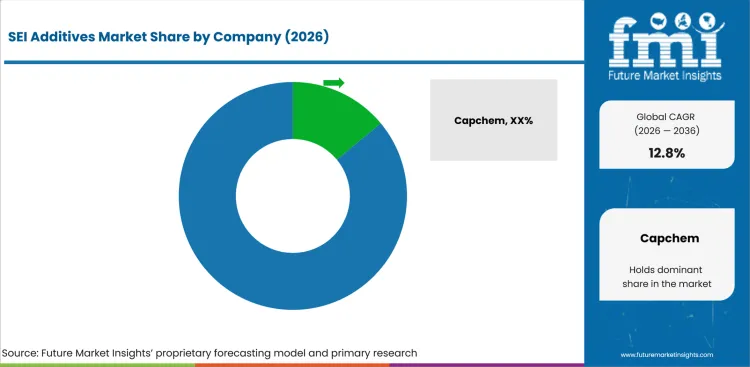
- Integrated electrolyte companies hold an advantage because they can package additive chemistry inside wider electrolyte formulations.
- Specialty chemical suppliers gain opportunities when they prove impurity control and molecule-specific performance.
- Regional electrolyte specialists gain better acceptance in countries where direct qualification and local technical service shape buying.
- Battery material suppliers with test labs support trial through formation data, aging evidence, and recipe-level guidance.
Leading suppliers compete by combining additive synthesis, electrolyte blending, and customer-side qualification support. Capchem and Tinci Materials show strong relevance through additive and lithium salt portfolios. Mitsubishi Chemical competes through formulated electrolyte experience and regional assets. Enchem and Soulbrain compete through electrolyte manufacturing access and demanding cell-maker qualification systems. UBE Corporation and Arkema remain relevant through specialty chemistry, separator, electrolyte, and battery material experience.
Manufacturing footprint is becoming a competitive separator as cell makers reduce supply-chain risk. Capchem USA disclosed plans in May 2024 for a lithium-ion battery materials plant in Ascension Parish. Mitsubishi Chemical agreed in December 2025 to transfer USA and UK electrolyte assets to Green E Origin. Idemitsu Kosan announced in February 2025 a large-scale lithium sulfide facility for solid electrolyte materials. These developments show how electrolyte and interface chemistry assets are being repositioned around EV and ESS supply chains.
Specialist suppliers can win through additive performance in silicon-rich anodes, fast-charge cells, and high-voltage chemistries. Their challenge is converting laboratory performance into stable commercial batches. Buyers require impurity data, moisture control, formation gas results, impedance trends, and aging records before expanding orders. This creates long lead times and favors suppliers with application labs near cell customers.
How do top SEI additives companies compare?
Capchem and Tinci Materials score strongest on integrated electrolyte and additive depth while Mitsubishi Chemical leads in formulated electrolyte credibility.
| Company | Relevance to Market Title | Film-Former Portfolio Depth | Electrolyte Qualification Access | Regional Supply Reach | Channel Reach | Geographic Footprint |
|---|---|---|---|---|---|---|
| Capchem | Very High | Very Strong | Very Strong | Very Strong | Very Strong | China, Europe, United States |
| Tinci Materials | Very High | Very Strong | Very Strong | Strong | Strong | China and export markets |
| Mitsubishi Chemical | Very High | Strong | Very Strong | Medium | Strong | Japan, United States, United Kingdom |
| Enchem | High | Medium | Very Strong | Very Strong | Strong | Korea, Europe, United States, China |
| Soulbrain | High | Medium | Strong | Medium | Strong | South Korea and global customers |
| UBE Corporation | High | Medium | Strong | Medium | Medium | Japan and international customers |
| Guotai Huarong | High | Medium | Strong | Medium | Medium | China and export markets |
| Arkema | Moderate to High | Low to Medium | Medium | Strong | Medium | Global specialty chemicals footprint |
Source: Future Market Insights competitive analysis, 2026.
Who are the key players in the SEI additives market?
Capchem, Tinci Materials, Mitsubishi Chemical, Enchem, and Soulbrain are listed with UBE Corporation and Guotai Huarong among other suppliers.
Key global companies leading the SEI additives market include:
- Capchem
- Tinci Materials
- Mitsubishi Chemical
- Enchem
- Soulbrain
- UBE Corporation
- Guotai Huarong
- Arkema
- Idemitsu Kosan
- Dongwha Electrolyte
Key Developments in SEI Additives Market
- In May 2024, Capchem USA disclosed plans for a lithium-ion battery materials plant in Ascension Parish. The project supports localized electrolyte, additive, solvent, and lithium salt supply.
- In December 2025, Mitsubishi Chemical Group agreed to transfer lithium-ion battery electrolyte manufacturing assets in the United States and the United Kingdom to Green E Origin. The move reshapes Western electrolyte supply access.
- In February 2025, Idemitsu Kosan announced the decision to construct a large-scale lithium sulfide production facility. The development is relevant to future solid-electrolyte and interface chemistry competition.
Key Players in the SEI Additives Market
Integrated Electrolyte and Additive Suppliers
- Capchem
- Tinci Materials
- Mitsubishi Chemical
- Guotai Huarong
Regional Electrolyte Specialists
- Enchem
- Soulbrain
- Dongwha Electrolyte
Specialty Chemistry and Battery Material Suppliers
- UBE Corporation
- Arkema
- Idemitsu Kosan
SEI Additives Market - Report Scope
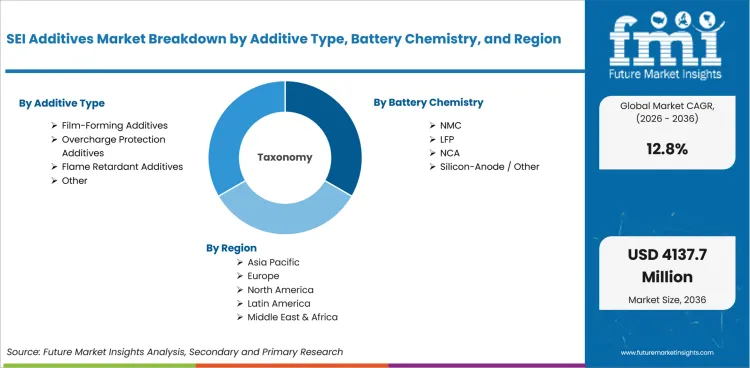
| Parameter | Details |
|---|---|
| Forecast period | 2026 to 2036 |
| Historical period | 2021 to 2025 |
| Quantitative unit | Revenue in USD million |
| By additive type | Film-forming additives, overcharge protection additives, flame retardant additives, other |
| By battery chemistry | NMC, LFP, NCA, silicon-anode / other |
| By application | EV batteries, consumer electronics, energy storage systems, other |
| By form | Liquid electrolyte additives, pre-mixed electrolyte packages |
| By sales channel | Direct to cell makers, distributors / blenders |
| Regions covered | North America, Western Europe, East Asia, South Asia and Pacific |
| Countries covered | United States, United Kingdom, Germany, France, Japan, China, South Korea, India |
| Key companies profiled | Capchem, Tinci Materials, Mitsubishi Chemical, Enchem, Soulbrain, UBE Corporation, Guotai Huarong, Arkema |
| Approach | Hybrid bottom-up and top-down approach using cell demand, additive loading, electrolyte formulation mix, pricing checks, and supplier qualification behavior |
Source: Future Market Insights, 2026.
SEI Additives Market - Scope & Definition
| Attribute | Detail |
|---|---|
| Market Definition | Specialty electrolyte ingredients used to form, stabilize, or modify the solid electrolyte interphase on battery anodes across lithium-ion and adjacent rechargeable battery systems |
| Functions Covered | SEI formation, anode passivation, first-cycle loss reduction, gas control, impedance control, overcharge protection, flame-retardant support |
| Applications Covered | EV batteries, consumer electronics batteries, energy storage systems, specialty rechargeable cells |
| End-Use Industries | Automotive, battery manufacturing, consumer electronics, energy storage, specialty chemicals |
| Grades Covered | Film-forming additives, overcharge protection additives, flame retardant additives, and other performance additive grades |
| Inclusions | Commercially traded SEI additives and additive-containing packages sold by additive type, battery chemistry, application, form, sales channel, and selected countries |
| Exclusions | Finished battery cells, EV battery packs, bulk carbonate solvents without additive function, cathode materials, anode materials, separators, binders, recycling services, and testing equipment |
SEI Additives Market - Research Methodology
| Method | Description |
|---|---|
| Primary Research | FMI analyst interviews with electrolyte formulators, cell qualification teams, battery material buyers, technical sales teams, specialty chemical distributors, and EV battery supply-chain participants |
| Desk Research | Review of official EV battery demand data, battery supply chain programs, company product disclosures, electrolyte asset updates, and technical references on interphase-forming additives |
| Market Sizing & Forecasting | Hybrid bottom-up and top-down modeling using cell production outlook, additive loading ranges, electrolyte formulation mix, regional supply concentration, and average selling prices by additive class |
| Data Validation | Cross-verification using EV battery demand, country-level battery manufacturing signals, supplier portfolios, additive synthesis capability, and qualification behavior across major cell makers |
SEI Additives Market Breakdown by Additive Type, Battery Chemistry, Application, Form, Sales Channel, and Region
SEI Additives Market Segmented by Additive Type
- Film-Forming Additives
- Overcharge Protection Additives
- Flame Retardant Additives
- Other
SEI Additives Market Segmented by Battery Chemistry
- NMC
- LFP
- NCA
- Silicon-Anode / Other
SEI Additives Market Segmented by Application
- EV Batteries
- Consumer Electronics
- Energy Storage Systems
- Other
SEI Additives Market Segmented by Form
- Liquid Electrolyte Additives
- Pre-mixed Electrolyte Packages
SEI Additives Market Segmented by Sales Channel
- Direct to Cell Makers
- Distributors / Blenders
SEI Additives Market by Region
- North America
- Western Europe
- East Asia
- South Asia and Pacific
Research Sources and Bibliography
- ACEA. (2026, January 27). New car registrations: +1.8% in 2025; battery-electric 17.4% market share.
- Capchem. (2024, May 22). Capchem USA plans to build a world-class lithium-ion battery materials plant in the USA
- European Environment Agency. (2025, July 7). New registrations of electric vans in Europe.
- European Environment Agency. (2025, November 6). New registrations of electric cars in Europe.
- Government of India, Press Information Bureau. (2024, December 19). Year End Review 2024: Ministry of Heavy Industries.
- Government of India, Press Information Bureau. (2025, June 2). Government notifies guidelines for Scheme to Promote Manufacturing of Electric Passenger Cars in India.
- Government of India, Press Information Bureau. (2025, August 26). Wheels of change: India’s electric leap for green mobility.
- Government of the People’s Republic of China. (2025, December 5). China’s ecological transition gains momentum, contributes to global green development.
- Government of the People’s Republic of China. (2026, January 14). China’s auto output, sales reach new highs in 2025.
- Government of the People’s Republic of China. (2026, January 19). National economy pushed forward with innovation-led and high-quality development in 2025.
- Government of the United Kingdom. (2025, October 17). Updates to the Vehicle Emissions Trading Schemes Order 2023.
- Government of the United Kingdom. (2025, November 1). Vehicle Emissions Trading Schemes Updates.
- Idemitsu Kosan Co., Ltd. (2025, February 27). Decision to construct a lithium sulfide production facility.
- International Energy Agency. (2025, May). Electric vehicle batteries: Global EV Outlook 2025.
- International Energy Agency. (2026, May). Electric vehicle batteries: Global EV Outlook 2026.
- International Energy Agency. (2026, May). Manufacturing and trade: Global EV Outlook 2026.
- International Energy Agency. (2026, May). Trends in electric cars: Global EV Outlook 2026.
- Japan Ministry of Economy, Trade and Industry. (2025). The Government of Japan Climate Transition Bond Framework and related battery industry capacity references.
- Mitsubishi Chemical Group. (2025, December 12). Transfer of Electrolyte Manufacturing Assets in the United States and the United Kingdom.
- Republic of Korea Ministry of Climate, Energy and Environment. (2026, January 4). Launch of Support for Hydrogen Vehicle and Hydrogen Refueling Station Deployment Programs.
- USA Department of Energy. (2024, December). MESC Fiscal Year 2024 Annual Report.
- USA Department of Energy. (2024, September 20). Biden-Harris Administration announces over $3 billion to support America's battery manufacturing sector.
- USA Environmental Protection Agency. (2026, February 20). The 2025 EPA Automotive Trends Report.
This bibliography is provided for reader reference and is not exhaustive. The full report contains the complete reference list and detailed citations.
This Report Answers
- Market size estimates for 2026 and forecasts through 2036 for the SEI additives market.
- Insights across major regional and country-level battery manufacturing markets.
- Analysis of demand drivers, additive adoption patterns, qualification behavior, and purchase decision factors.
- Evaluation of key applications and sales channels, including EV batteries and direct cell-maker procurement.
- Assessment of additive type, battery chemistry, form, and regional supply dynamics.
- Identification of opportunities across silicon-anode cells, fast charging, LFP storage, and localized electrolyte supply.
- Evaluation of supply-chain dynamics, formulation support, impurity control, and supplier qualification requirements.
- Country-level growth analysis covering the United States, United Kingdom, Germany, France, Japan, China, South Korea, and India.
- Assessment of the competitive landscape, including integrated electrolyte suppliers and specialty chemistry companies.
- Analysis of market penetration trends and emerging additive opportunities.
- Regional outlooks across North America, Western Europe, East Asia, and South Asia and Pacific.
- Delivery of market data, forecasts, and supporting analysis in PDF and Excel formats.
Frequently Asked Questions
What is the growth prospect for SEI additives?
Demand for SEI additives is expected to rise at a considerable pace as EV battery makers tighten fast-charge, cycle-life, and warranty requirements.
Which companies are expected to shape the SEI additives market?
Capchem, Tinci Materials, Mitsubishi Chemical, Enchem, Soulbrain, UBE Corporation, Guotai Huarong, and Arkema are expected to shape market competition through additive synthesis, electrolyte formulation, and qualification access.
Why are leading electrolyte companies investing in SEI additives?
Leading electrolyte companies are investing in SEI additives to improve anode stability, reduce formation risk, and support higher-performance lithium-ion batteries.
Why are direct cell-maker channels important in the SEI additives market?
Direct cell-maker channels support supplier audits, batch traceability, and recipe-level approval before additives enter large battery production programs.
Which additive formats are gaining attention in SEI additives?
Film-forming additives and additive blends are gaining attention as silicon-rich anodes and fast-charge programs require stronger interface control.
How do regulations influence SEI additive launches?
Regulations influence launches through chemical handling rules, transport documentation, environmental reviews, and customer safety requirements.
Why is impurity control important for SEI additives?
Impurity control is important because moisture, trace metals, and unstable byproducts can affect gas formation, resistance growth, and cell aging.
What role does battery chemistry play in SEI additive adoption?
NMC cells need additives for high-energy interface stability while LFP cells use additives to support long cycle life and storage reliability.
How do pre-mixed electrolyte packages support SEI additive use?
Pre-mixed packages reduce handling steps and help customers use validated additive blends with consistent formulation quality.
Preview the report firsthand - request a free sample
Get SampleGet the brochure for pricing and purchase details.
Get PDFTable of Content
- Key Takeaways
- Market Size and CAGR
- Top Growth Driver
- Fastest Growing Segment
- Leading Region
- Key Companies
- Emerging Opportunities
- Executive Summary
- Global Market Outlook
- Demand-side Trends
- Supply-side Trends
- Technology Roadmap Analysis
- Analysis and Recommendations
- Analyst Perspective (What is happening? Why now? What should investors know?)
- Key Questions Answered
- How large is the market?
- What is the CAGR?
- What are key trends?
- Which region dominates?
- Who are the leaders?
- Market Overview
- Market Coverage / Taxonomy
- Market Definition / Scope / Limitations
- Research Methodology
- Chapter Orientation
- Analytical Lens and Working Hypotheses
- Market Structure, Signals, and Trend Drivers
- Benchmarking and Cross-market Comparability
- Market Sizing, Forecasting, and Opportunity Mapping
- Research Design and Evidence Framework
- Desk Research Programme (Secondary Evidence)
- Expert Input and Fieldwork (Primary Evidence)
- Tooling, Models, and Reference Databases
- Data Engineering and Model Build
- Quality Assurance and Audit Trail
- Market Background
- Market Dynamics (Drivers, Restraints, Opportunity, Trends)
- Scenario Forecast (Optimistic, Likely, Conservative)
- Impact Analysis
- AI Impact
- Sustainability Impact
- Regulatory Impact
- Technology Impact
- Consumer / Buyer Analysis
- Purchase Drivers
- Adoption Barriers
- Buyer Journey
- Opportunity Map Analysis
- Product Life Cycle Analysis
- Supply Chain Analysis
- Investment Feasibility Matrix
- Value Chain Analysis
- PESTLE and Porter's Analysis
- Regulatory Landscape
- Regional Parent Market Outlook
- Production and Consumption Statistics
- Import and Export Statistics
- Global Market Analysis and Forecast, 2021 to 2036
- Historical Market Size Value (USD Million) Analysis, 2021 to 2025
- Current and Future Market Size Value (USD Million) Projections, 2026 to 2036
- Y-o-Y Growth Trend Analysis
- Absolute $ Opportunity Analysis
- Global Market Pricing Analysis, 2021 to 2036
- Global Market Analysis and Forecast, By Catalyst Type, 2021 to 2036
- Introduction / Key Findings
- Historical Market Size Value (USD Million) Analysis By Catalyst Type, 2021 to 2025
- Current and Future Market Size Value (USD Million) Analysis and Forecast By Catalyst Type, 2026 to 2036
- Zeolite-based
- Metal Oxide-based
- Supported Metals
- Zeolite-based
- Y-o-Y Growth Trend Analysis By Catalyst Type, 2021 to 2025
- Absolute $ Opportunity Analysis By Catalyst Type, 2026 to 2036
- Global Market Analysis and Forecast, By Feedstock, 2021 to 2036
- Introduction / Key Findings
- Historical Market Size Value (USD Million) Analysis By Feedstock, 2021 to 2025
- Current and Future Market Size Value (USD Million) Analysis and Forecast By Feedstock, 2026 to 2036
- Plastic Waste
- Biomass
- Tires / Rubber
- Plastic Waste
- Y-o-Y Growth Trend Analysis By Feedstock, 2021 to 2025
- Absolute $ Opportunity Analysis By Feedstock, 2026 to 2036
- Global Market Analysis and Forecast, By Application, 2021 to 2036
- Introduction / Key Findings
- Historical Market Size Value (USD Million) Analysis By Application, 2021 to 2025
- Current and Future Market Size Value (USD Million) Analysis and Forecast By Application, 2026 to 2036
- Fuel Upgrading
- Chemical Recycling
- Biochar / Syngas Optimization
- Fuel Upgrading
- Y-o-Y Growth Trend Analysis By Application, 2021 to 2025
- Absolute $ Opportunity Analysis By Application, 2026 to 2036
- Global Market Analysis and Forecast, By Reactor Type, 2021 to 2036
- Introduction / Key Findings
- Historical Market Size Value (USD Million) Analysis By Reactor Type, 2021 to 2025
- Current and Future Market Size Value (USD Million) Analysis and Forecast By Reactor Type, 2026 to 2036
- Fluidized-bed
- Fixed-bed
- Rotary Kiln / Other
- Fluidized-bed
- Y-o-Y Growth Trend Analysis By Reactor Type, 2021 to 2025
- Absolute $ Opportunity Analysis By Reactor Type, 2026 to 2036
- Global Market Analysis and Forecast, By Sales Mix, 2021 to 2036
- Introduction / Key Findings
- Historical Market Size Value (USD Million) Analysis By Sales Mix, 2021 to 2025
- Current and Future Market Size Value (USD Million) Analysis and Forecast By Sales Mix, 2026 to 2036
- New Plants
- Replacement / Regeneration
- New Plants
- Y-o-Y Growth Trend Analysis By Sales Mix, 2021 to 2025
- Absolute $ Opportunity Analysis By Sales Mix, 2026 to 2036
- Global Market Analysis and Forecast, By Region, 2021 to 2036
- Introduction
- Historical Market Size Value (USD Million) Analysis By Region, 2021 to 2025
- Current Market Size Value (USD Million) Analysis and Forecast By Region, 2026 to 2036
- North America
- Latin America
- Western Europe
- Eastern Europe
- East Asia
- South Asia and Pacific
- Middle East & Africa
- Market Attractiveness Analysis By Region
- North America Market Analysis and Forecast, By Country, 2021 to 2036
- Historical Market Size Value (USD Million) Trend Analysis By Market Taxonomy, 2021 to 2025
- Market Size Value (USD Million) Forecast By Market Taxonomy, 2026 to 2036
- By Country
- USA
- Canada
- Mexico
- By Catalyst Type
- By Feedstock
- By Application
- By Reactor Type
- By Sales Mix
- By Country
- Market Attractiveness Analysis
- By Country
- By Catalyst Type
- By Feedstock
- By Application
- By Reactor Type
- By Sales Mix
- Key Takeaways
- Latin America Market Analysis and Forecast, By Country
- Historical Market Size Value (USD Million) Trend Analysis By Market Taxonomy, 2021 to 2025
- Market Size Value (USD Million) Forecast By Market Taxonomy, 2026 to 2036
- By Country
- Brazil
- Chile
- Rest of Latin America
- By Catalyst Type
- By Feedstock
- By Application
- By Reactor Type
- By Sales Mix
- By Country
- Market Attractiveness Analysis
- By Country
- By Catalyst Type
- By Feedstock
- By Application
- By Reactor Type
- By Sales Mix
- Key Takeaways
- Western Europe Market Analysis and Forecast, By Country
- Historical Market Size Value (USD Million) Trend Analysis By Market Taxonomy, 2021 to 2025
- Market Size Value (USD Million) Forecast By Market Taxonomy, 2026 to 2036
- By Country
- Germany
- UK
- Italy
- Spain
- France
- Nordic
- BENELUX
- Rest of Western Europe
- By Catalyst Type
- By Feedstock
- By Application
- By Reactor Type
- By Sales Mix
- By Country
- Market Attractiveness Analysis
- By Country
- By Catalyst Type
- By Feedstock
- By Application
- By Reactor Type
- By Sales Mix
- Key Takeaways
- Eastern Europe Market Analysis and Forecast, By Country
- Historical Market Size Value (USD Million) Trend Analysis By Market Taxonomy, 2021 to 2025
- Market Size Value (USD Million) Forecast By Market Taxonomy, 2026 to 2036
- By Country
- Russia
- Poland
- Hungary
- Balkan & Baltic
- Rest of Eastern Europe
- By Catalyst Type
- By Feedstock
- By Application
- By Reactor Type
- By Sales Mix
- By Country
- Market Attractiveness Analysis
- By Country
- By Catalyst Type
- By Feedstock
- By Application
- By Reactor Type
- By Sales Mix
- Key Takeaways
- East Asia Market Analysis and Forecast, By Country
- Historical Market Size Value (USD Million) Trend Analysis By Market Taxonomy, 2021 to 2025
- Market Size Value (USD Million) Forecast By Market Taxonomy, 2026 to 2036
- By Country
- China
- Japan
- South Korea
- By Catalyst Type
- By Feedstock
- By Application
- By Reactor Type
- By Sales Mix
- By Country
- Market Attractiveness Analysis
- By Country
- By Catalyst Type
- By Feedstock
- By Application
- By Reactor Type
- By Sales Mix
- Key Takeaways
- South Asia and Pacific Market Analysis and Forecast, By Country
- Historical Market Size Value (USD Million) Trend Analysis By Market Taxonomy, 2021 to 2025
- Market Size Value (USD Million) Forecast By Market Taxonomy, 2026 to 2036
- By Country
- India
- ASEAN
- Australia & New Zealand
- Rest of South Asia and Pacific
- By Catalyst Type
- By Feedstock
- By Application
- By Reactor Type
- By Sales Mix
- By Country
- Market Attractiveness Analysis
- By Country
- By Catalyst Type
- By Feedstock
- By Application
- By Reactor Type
- By Sales Mix
- Key Takeaways
- Middle East & Africa Market Analysis and Forecast, By Country
- Historical Market Size Value (USD Million) Trend Analysis By Market Taxonomy, 2021 to 2025
- Market Size Value (USD Million) Forecast By Market Taxonomy, 2026 to 2036
- By Country
- Kingdom of Saudi Arabia
- Other GCC Countries
- Türkiye
- South Africa
- Other African Union
- Rest of Middle East & Africa
- By Catalyst Type
- By Feedstock
- By Application
- By Reactor Type
- By Sales Mix
- By Country
- Market Attractiveness Analysis
- By Country
- By Catalyst Type
- By Feedstock
- By Application
- By Reactor Type
- By Sales Mix
- Key Takeaways
- Key Countries Market Analysis
- USA
- Pricing Analysis
- Market Share Analysis, 2025
- By Catalyst Type
- By Feedstock
- By Application
- By Reactor Type
- By Sales Mix
- Canada
- Pricing Analysis
- Market Share Analysis, 2025
- By Catalyst Type
- By Feedstock
- By Application
- By Reactor Type
- By Sales Mix
- Mexico
- Pricing Analysis
- Market Share Analysis, 2025
- By Catalyst Type
- By Feedstock
- By Application
- By Reactor Type
- By Sales Mix
- Brazil
- Pricing Analysis
- Market Share Analysis, 2025
- By Catalyst Type
- By Feedstock
- By Application
- By Reactor Type
- By Sales Mix
- Chile
- Pricing Analysis
- Market Share Analysis, 2025
- By Catalyst Type
- By Feedstock
- By Application
- By Reactor Type
- By Sales Mix
- Germany
- Pricing Analysis
- Market Share Analysis, 2025
- By Catalyst Type
- By Feedstock
- By Application
- By Reactor Type
- By Sales Mix
- UK
- Pricing Analysis
- Market Share Analysis, 2025
- By Catalyst Type
- By Feedstock
- By Application
- By Reactor Type
- By Sales Mix
- Italy
- Pricing Analysis
- Market Share Analysis, 2025
- By Catalyst Type
- By Feedstock
- By Application
- By Reactor Type
- By Sales Mix
- Spain
- Pricing Analysis
- Market Share Analysis, 2025
- By Catalyst Type
- By Feedstock
- By Application
- By Reactor Type
- By Sales Mix
- France
- Pricing Analysis
- Market Share Analysis, 2025
- By Catalyst Type
- By Feedstock
- By Application
- By Reactor Type
- By Sales Mix
- India
- Pricing Analysis
- Market Share Analysis, 2025
- By Catalyst Type
- By Feedstock
- By Application
- By Reactor Type
- By Sales Mix
- ASEAN
- Pricing Analysis
- Market Share Analysis, 2025
- By Catalyst Type
- By Feedstock
- By Application
- By Reactor Type
- By Sales Mix
- Australia & New Zealand
- Pricing Analysis
- Market Share Analysis, 2025
- By Catalyst Type
- By Feedstock
- By Application
- By Reactor Type
- By Sales Mix
- China
- Pricing Analysis
- Market Share Analysis, 2025
- By Catalyst Type
- By Feedstock
- By Application
- By Reactor Type
- By Sales Mix
- Japan
- Pricing Analysis
- Market Share Analysis, 2025
- By Catalyst Type
- By Feedstock
- By Application
- By Reactor Type
- By Sales Mix
- South Korea
- Pricing Analysis
- Market Share Analysis, 2025
- By Catalyst Type
- By Feedstock
- By Application
- By Reactor Type
- By Sales Mix
- Russia
- Pricing Analysis
- Market Share Analysis, 2025
- By Catalyst Type
- By Feedstock
- By Application
- By Reactor Type
- By Sales Mix
- Poland
- Pricing Analysis
- Market Share Analysis, 2025
- By Catalyst Type
- By Feedstock
- By Application
- By Reactor Type
- By Sales Mix
- Hungary
- Pricing Analysis
- Market Share Analysis, 2025
- By Catalyst Type
- By Feedstock
- By Application
- By Reactor Type
- By Sales Mix
- Kingdom of Saudi Arabia
- Pricing Analysis
- Market Share Analysis, 2025
- By Catalyst Type
- By Feedstock
- By Application
- By Reactor Type
- By Sales Mix
- Türkiye
- Pricing Analysis
- Market Share Analysis, 2025
- By Catalyst Type
- By Feedstock
- By Application
- By Reactor Type
- By Sales Mix
- South Africa
- Pricing Analysis
- Market Share Analysis, 2025
- By Catalyst Type
- By Feedstock
- By Application
- By Reactor Type
- By Sales Mix
- USA
- Market Structure Analysis
- Competition Dashboard
- Competition Benchmarking
- Market Share Analysis of Top Players
- By Regional
- By Catalyst Type
- By Feedstock
- By Application
- By Reactor Type
- By Sales Mix
- Emerging Startups
- Innovation Benchmarking
- Competition Analysis
- Competition Deep Dive
- BASF
- Overview
- Product Portfolio
- Profitability by Market Segments (Product/Region/Sales Channel)
- Sales Footprint
- Strategy Overview
- Marketing Strategy
- Product Strategy
- Channel Strategy
- Ketjen
- Axens
- Topsoe
- Honeywell UOP
- Clariant
- Zeolyst International
- BASF
- Case Studies
- Success Stories
- Recent Developments
- Competition Deep Dive
- Assumptions & Acronyms Used


