

- Market Size (2026)
- USD 1.7 Bn
- Forecast (2036)
- USD 2.9 Bn
- CAGR (2026 to 2036)
- 5.6%
How big is Slip Additives Market in 2026?
USD 1.7 billion in 2026 and USD 2.9 billion by 2036 at a 5.6% CAGR.
Sales of slip additives are forecast to drive valuation from USD 1.7 billion in 2026 to USD 2.9 billion by 2036 at a 5.6% CAGR. Film converters purchase slip chemistry to hold coefficient of friction within narrow windows across winding and flexible packaging operations. Avient launched Hiformer Slip + Antistatic for BOPP Films in April 2026 with a stated 0.20 to 0.35 CoF range. The specified control range links additive purchasing to repeatable line behavior instead of polymer volume alone.
Country conditions alter how quickly reformulation becomes approved purchasing across packaging converters serving food-contact applications. SEMARNAT reported in September 2025 that participating firms averaged 24% post-consumer recycled content in new plastic packaging during 2024. That level raises the need to manage inherited additive histories during recycled plastic packaging formulation and converter trials. Mexico's 5.4% CAGR through 2036 reflects active material change while Germany's 4.6% pace comes from a more mature qualification environment.
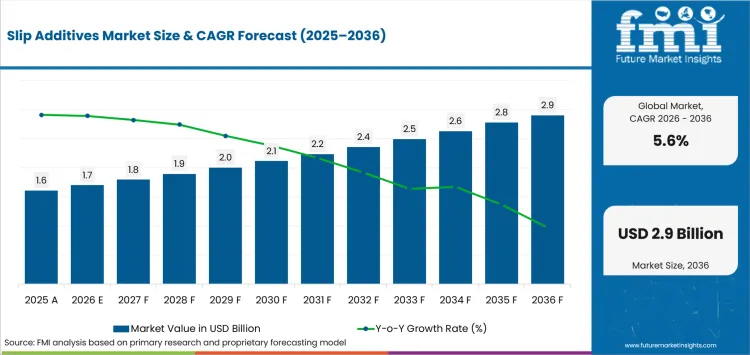
Key Takeaways of Slip Additives Market
- Flexible packaging reformulation increases slip demand as converters need predictable coefficient of friction across winding and downstream line operations.
- Oleamide is projected to hold 31.0% share in 2026 owing to rapid migration that provides early surface lubrication in polyolefin film.
- By polymer, PP films are estimated to hold 41.0% in 2026 owing to repeated friction control across high-speed BOPP conversion.
- In 2026, powder is expected to lead form with 58.0% share because compounders retain direct control over active loading.
- Qualification delays switching whenever migration changes print treatment or sealing behavior and forces new food-contact documentation across the intended application.
- Cargill, PMC Biogenix, Fine Organic Industries Limited, Avient Corporation, Ampacet Corporation, Tosaf, Clariant and LyondellBasell are some key players in the sector.
Analyst Perspective
"Slip suppliers earn stronger positions by proving stable surface behavior across the converter's complete process rather than selling on dosage price alone. Application support becomes more valuable when plastic additives interact with recycled feedstock and force tighter control of printing or sealing."
- Nikhil Kaitwade, Principal Consultant, Future Market Insights
How is the Slip Additives Market segmented?
The slip additives market is segmented by chemistry, polymer, form, application, sales channel and region.
Chemistry covers erucamide, oleamide, stearamide, silicone-based slips, wax-based slips and bio-based amides. Polymer includes PE films, PP films, PVC, engineering plastics and bioplastics. Form covers powder, pellet or masterbatch and liquid dispersion. Application includes flexible packaging films, caps and closures, cable compounds, agricultural films and injection molded parts. Sales channel covers masterbatch producers, film converters, direct resin compounders and distributors.
Why do caps and closures lead demand within the application category?
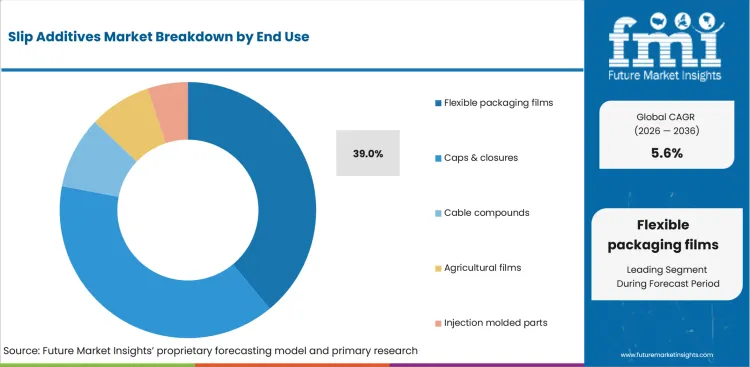
Caps and closures need predictable torque release because application and removal depend on controlled surface friction across molded food and beverage packages. Clariant received FDA approval in May 2026 for rice-bran wax used as a slip additive in rigid PVC food packaging, giving formulators a qualified alternative chemistry.
- Caps and closures are set to lead the application category with 39.0% share in 2026 due to recurring torque-control requirements across molding programs.
- Closure formulators balance friction reduction against odor, food-contact limits and release consistency before extending a validated additive package across recurring commercial molding lines.
Why does oleamide lead demand within the chemistry category?
Fast-bloom oleamide is selected among plastic additives when polyolefin converters need surface lubrication soon after extrusion without waiting for slower migration. Clariant secured EU approval in February 2026 for rice-bran wax additives in PET and PLA bioplastics, confirming that alternative slip chemistries follow separate qualification routes.
- Based on chemistry, oleamide is projected to account for 31.0% in 2026 due to rapid migration that suits production needing early friction reduction.
- Film formulators compare migration speed with print treatment, storage time and sealing behavior before replacing slower-bloom chemistries across demanding high-speed packaging lines with strict downstream seal requirements.
Why do PP films lead demand within the polymer category?
PP film converters use slip systems to reduce drag during winding and high-speed movement across downstream packaging equipment where broad moving surfaces amplify friction problems. Ampacet presented masterbatches containing slip additives for BOPP film applications at Plastindia in February 2026, confirming a commercial route built around polypropylene film processing.
- By polymer, PP films are forecast to represent 41.0% in 2026 driven by BOPP conversion that repeatedly exposes broad film surfaces to friction.
- Converters qualify dosage against film gauge, treatment requirements and downstream handling because excessive slip can weaken stack stability or complicate later surface operations.
Why do film converters lead demand within the sales channel category?
Film converters often select additive forms that fit existing extrusion equipment because line-side dosing and immediate troubleshooting shape approval decisions. Avient expanded two liquid polyolefin process-aid grades across Asia in January 2026 with global availability from Asian manufacturing, reinforcing demand for converter-ready liquid dosing routes.
- Film converters are likely to capture 38.0% share in 2026 attributable to line-side qualification decisions made closest to recurring production operations.
- Processors compare local technical response, carrier compatibility and metering behavior before approving masterbatch concentrates for recurring runs across several film structures, customer specifications and long production campaigns.
What are the drivers, restraints and opportunities in the slip additives market?
Recycled-content reformulation increases demand for controlled friction while food-contact qualification slows switching, creating room for slip systems that manage variable inherited additives.
- Driver: Recycled-content packaging requires fresh coefficient-of-friction control as inherited additives enter new film formulations.
- Restraint: Food-contact qualification slows chemistry switching when migration behavior changes material documentation or downstream surface performance.
- Opportunity: PCR-specific control systems can correct excessive inherited slip without relying on higher additions of conventional migratory amides.
Recycled Content Raises Friction-Control Work
Packaging reformulation adds demand whenever recycled resin changes the additive history entering a film line. Brazil's October 2025 Decree 12,688 sets a 22% minimum recycled-content index for plastic packaging in 2026. Converters adding PCR must retune slip packages against inherited surface-active residues, so packaging films need predictable coefficient of friction during recurring production.
Qualification Work Slows Chemistry Switching
Food-contact film programs add documentation and traceability work before a different slip system reaches routine production. Tosaf reported in January 2025 that its additive and white-masterbatch facilities gained ISO 22000 food-safety management certification. The certification is voluntary, but its monitoring and traceability requirements illustrate why converters expect clear material records before changing formulations that contact food.
PCR-Specific Control Creates a New Route
A growing opportunity lies in correcting inherited slip instead of adding more migratory amide to every recycled film. Ampacet reported in early 2026 that Slip Scavenger 1540 captures migrating slip molecules in PCR polyethylene to improve coefficient-of-friction control. The approach gives post-consumer recycled plastics converters a targeted adjustment route when incoming resin already contains high slip levels.
Which country CAGRs are profiled in the Slip Additives Market?
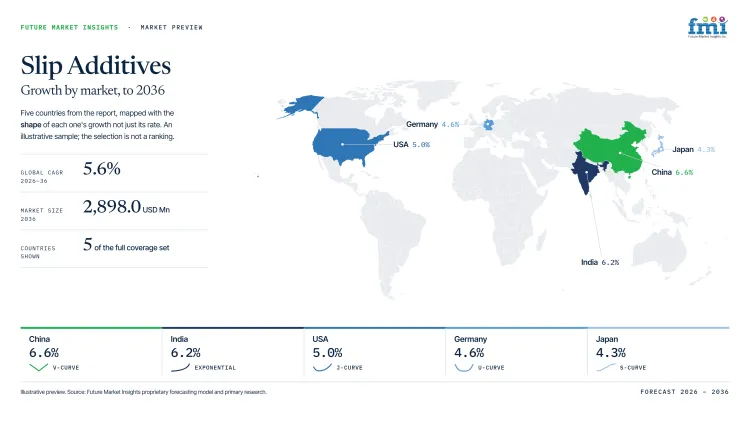
| Country | CAGR |
|---|---|
| Mexico | 5.4% |
| Brazil | 5.2% |
| USA | 5.0% |
| Germany | 4.6% |
| Japan | 4.3% |
How do country-level CAGRs compare in the Slip Additives Market?
The profiled markets span 1.1 percentage points between Mexico and Japan. Mexico, Brazil and the USA form a compact upper group shaped by recycled-content reformulation and local converter activity. Germany and Japan form a steadier pair where established specifications increase the qualification work required before changing slip chemistry locally.
- Mexico links recycled-content targets with converter trials that must manage uneven recovered-plastic quality.
- Brazil pairs mandatory recycled-content rules with a national recyclability index for plastic packaging.
- USA qualification pairs substance-specific food-contact review with local supply and production-line validation.
- Germany combines mature recycling systems with detailed performance checks across established film converters.
- Japan requires positive-list eligibility before food-contact additives enter commercial qualification programs.
Comparable CAGRs still require different qualification plans because local compliance and conversion conditions differ. The full report provides country-level CAGR analysis across North America, Latin America, Europe, East Asia, South Asia, Oceania and the Middle East and Africa.
Country-wise Analysis
- Mexican film converters are qualifying higher recycled-content packaging while local collection systems still produce uneven feedstock quality across polymer streams. SEMARNAT reported in September 2025 that plastics other than PET reached a 34% collection rate, and slip additive demand in Mexico is forecast to expand at 5.4% CAGR through 2036 as reformulation work increases. Local converting scale gives formulators accessible trial volume, but variable recycled feedstock can change inherited surface-active residues across runs and force repeated coefficient-of-friction checks before approval, which favors suppliers combining local inventory with dosing support for PE film applications across repeated high-speed packaging production and commercial qualification.
- Brazilian converters now work against national plastic-packaging recovery rules that place recycled-content decisions directly inside film and compound design. Slip additive demand in Brazil is estimated to advance at 5.2% CAGR through 2036, and SINIR recorded 590 contributions to its 2026 consultation on the plastic-packaging recyclability index that implements Decree 12,688. Domestic packaging demand gives suppliers a broad trial base, but compliance rules are still being translated into material choices across converter sites and resin streams, which makes local technical service useful for stabilizing coefficient of friction without weakening printing or sealing performance during repeated commercial runs across major packaging lines.
- United States film processors combine a large domestic converting base with supplier-specific food-contact review whenever additives enter regulated packaging structures. Slip additive demand in the USA is forecast to rise at 5.0% CAGR over the assessment period. Local manufacturing and technical laboratories shorten trial access, but authorization status remains specific to the substance and supplier while performance still requires line validation, so companies need clear regulatory records and dependable application support before a formulation moves into recurring orders.
- German film converters operate within established packaging systems where qualification teams compare additive performance against recycling and downstream processing requirements. Germany is estimated to post 4.6% CAGR over the forecast period, and the Umweltbundesamt reported in April 2025 that system-participating plastic packaging achieved a 65.5% recycling-feed rate in 2021 compared with 59.3% for non-system commercial plastic packaging. Dense converter infrastructure supports technical trials, but established specifications raise switching costs whenever migration alters printing or sealing performance, which gives locally stocked suppliers an advantage when they can document regulatory fit and reproduce coefficient-of-friction results across long production campaigns with stable local inventory.
- Japanese food-packaging processors treat material eligibility as a formal entry condition before they extend additive trials across established film or molded-packaging lines. Slip additive demand in Japan is predicted to advance at 4.3% CAGR through 2036, and the Consumer Affairs Agency states that its post-June 2025 positive list contains 840 additive entries for synthetic-resin food-contact materials. Mature technical standards give formulators clear qualification boundaries, but the listed-use framework limits rapid chemistry substitution and increases documentation work for new substances, so suppliers compete more effectively by pairing complete regulatory files with stable long-run coefficient-of-friction data rather than relying on a low initial test result.
Who are the notable companies in the Slip Additives Market?
Cargill, PMC Biogenix, Fine Organic Industries Limited, Avient Corporation, Ampacet Corporation, Tosaf, Clariant and LyondellBasell are the notable companies serving this market.
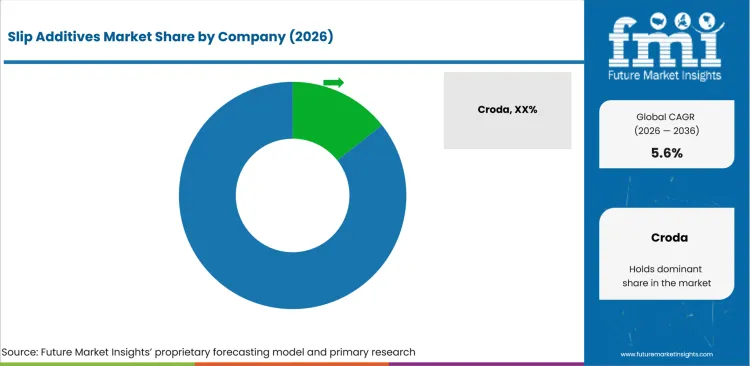
Competition divides between fatty-amide producers and masterbatch specialists that package slip performance around specific polymer-processing routes. Entry depends on migration control, regulatory documentation and converter support because a lower coefficient of friction does not complete commercial qualification by itself.
- Cargill, PMC Biogenix and Fine Organic Industries Limited compete from oleochemical and fatty-amide positions serving PE film and broader polyolefin processing.
- Avient Corporation, Ampacet Corporation, Tosaf, Clariant and LyondellBasell compete using formulated additives, masterbatches or wax-based surface-control routes for plastics processing.
Competitive Benchmarking: Slip Additives Market
| Company | Chemistry Breadth | Delivery Format Depth | Converter Support Depth | Geographic Reach |
|---|---|---|---|---|
| Cargill | High | High | High | Global |
| PMC Biogenix | High | High | High | Americas, Europe and Asia |
| Fine Organic Industries Limited | High | Medium | Medium | 110+ countries; USA site planned |
| Avient Corporation | Medium | High | High | Global |
| Ampacet Corporation | Medium | High | High | Global |
| Tosaf | Medium | High | High | Europe, Americas, Middle East and Asia |
| Clariant | Medium | Medium | High | Global |
| LyondellBasell | Medium | High | High | Global |
Key Developments in the Slip Additives Market
- In May 2026, LyondellBasell signed an agreement with Interpolimeri to expand masterbatch and custom performance color distribution into Germany and Austria.
- In April 2026, Tosaf announced a new 5,500-square-meter masterbatch site in Olkusz with 3,000 tonnes of initial annual capacity planned for second-quarter operation.
- In July 2025, Fine Organic Industries Limited acquired approximately 159.92 acres in Union County for its proposed first USA manufacturing facility and began planning.
Key Players in the Slip Additives Market
Fatty-Amide and Oleochemical Specialists
- Cargill
- PMC Biogenix
- Fine Organic Industries Limited
Formulated Additive and Masterbatch Suppliers
- Avient Corporation
- Ampacet Corporation
- Tosaf
- LyondellBasell
Wax and Specialty Additive Supplier
- Clariant
Slip Additives Market - Report Scope
| Coverage field | Report scope |
|---|---|
| Market breakdown | By chemistry, polymer, form, application, sales channel and region. |
| Quantitative Units | Revenue in USD million and CAGR in %. |
| Market Definition | Commercial slip additives used to control surface friction, torque release or related handling behavior in polymer processing and finished plastic applications. |
| Regions Covered | North America, Latin America, Europe, East Asia, South Asia and Pacific, and Middle East and Africa. |
| Countries Covered | Mexico, Brazil, USA, Germany, Japan, and 30+ countries included in the full report. |
| Key Companies Profiled | Cargill, PMC Biogenix, Fine Organic Industries Limited, Avient Corporation, Ampacet Corporation, Tosaf, Clariant, LyondellBasell. |
| Forecast Period | 2026 to 2036. |
| Approach | Primary and secondary research with market triangulation. |
Slip Additives Market - Research Methodology
| Method | Approach |
|---|---|
| Primary Research | FMI analysts gathered input from manufacturers, service providers, technology developers, distributors, end users, procurement teams, and subject-matter experts. Interviews examined purchasing decisions, product or service evaluation, adoption barriers, approval requirements, pricing considerations, and expectations for technical or commercial support. Respondents were also asked what evidence is required before a trial, pilot, or initial order develops into regular purchasing. |
| Desk Research | Desk research covered government statistics, regulatory publications, trade data, industry associations, technical literature, standards, company filings, product information, and official corporate announcements. Sources were reviewed for relevance, publication date, geographic coverage, and consistency with the defined market scope. Claims relating to performance, applications, approvals, capacity, investment, and commercial activity were retained only when supported by credible public evidence. |
| Market Sizing and Forecasting | The market model combined the baseline value with historical performance, segment structure, pricing and volume indicators, adoption levels, company participation, and country-level demand conditions. Forecast assumptions considered economic activity, investment trends, regulatory developments, technology adoption, purchasing cycles, supply availability, and barriers to wider market use. Segment and regional estimates were reconciled before the final market total was calculated. |
| Data Validation | Estimates were checked against multiple independent indicators, including public data, company activity, trade patterns, industry developments, and findings from primary interviews. Validation also tested whether products, services, applications, and company revenues fell within the defined market boundaries. Adjacent categories, unsupported claims, overlapping revenues, and activities without direct market relevance were excluded to reduce double counting and maintain consistency across segments and countries. |
Slip Additives Market by Segments
Slip Additives Market segmented by Chemistry:
- Erucamide
- Oleamide
- Stearamide
- Silicone-based slips
- Wax-based slips
- Bio-based amides
Slip Additives Market segmented by Polymer:
- PE films
- PP films
- PVC
- Engineering plastics
- Bioplastics
Slip Additives Market segmented by Form:
- Powder
- Pellet / masterbatch
- Liquid dispersion
Slip Additives Market segmented by Application:
- Flexible packaging films
- Caps & closures
- Cable compounds
- Agricultural films
- Injection molded parts
Slip Additives Market segmented by Sales Channel:
- Masterbatch producers
- Film converters
- Direct resin compounders
- Distributors
Slip Additives Market by Region:
- North America
- United States
- Canada
- Latin America
- Brazil
- Mexico
- Chile
- Rest of Latin America
- Western Europe
- Germany
- United Kingdom
- Italy
- Spain
- France
- Nordics
- Benelux
- Rest of Western Europe
- Eastern Europe
- Russia
- Poland
- Hungary
- Balkan and Baltic States
- Rest of Eastern Europe
- East Asia
- China
- Japan
- South Korea
- South Asia and Pacific
- India
- ASEAN
- Australia and New Zealand
- Rest of South Asia and Pacific
- Middle East and Africa
- Kingdom of Saudi Arabia
- Other GCC Countries
- Türkiye
- South Africa
- Other African Union Countries
- Rest of Middle East and Africa
Research Sources and Bibliography
- Avient Corporation. (2026, April 2). Avient’s New Hiformer™ Technology Reduces BOPP Film Production Complexity While Improving Film Quality for Latin American Market.
- Secretaría de Medio Ambiente y Recursos Naturales. (2025, September 4). Organismos empresariales e industriales reportan importantes avances en la gestión y aprovechamiento de plásticos.
- Clariant. (2026, February 25). Clariant achieves EU Commission approval for renewable rice bran wax additives in food-contact plastics.
- Ampacet Corporation. (2026). Ampacet Showcases Advanced Materials and Technology for Plastics at Plastindia 2026.
- Clariant. (2026, May 28). Clariant secures FDA approval for bio-based Licocare™ RBW additives in rigid PVC food-contact applications.
- Avient Corporation. (2026, January 30). Avient Expands Hiformer™ Non-PFAS Process Aid Portfolio to Asia with New Liquid Grades for Polyolefin Film Applications.
- Presidência da República, Casa Civil. (2025, October 21). Decreto nº 12.688, de 21 de outubro de 2025.
- Tosaf. (2025, January 8). Food-safe production compliance: Tosaf’s ISO 22000 certifications.
- Ampacet Corporation. (2026). Ampacet SLIP SCAVENGER 1540 Named Finalist In Plastics Recycling Awards Europe 2026.
- Sistema Nacional de Informações sobre a Gestão de Resíduos Sólidos. (2026, January 27). Consulta Pública - Índice de Reciclabilidade das Embalagens de Plástico.
- USA Food and Drug Administration. (2025, January 3). FDA Determines Authorization for 35 Food Contact Notifications Related to PFAS Are No Longer Effective.
- Umweltbundesamt. (2025, April 15). Evaluierung der Recyclingquoten des Verpackungsgesetzes.
- Consumer Affairs Agency. (2025).
- LyondellBasell. (2026, May 7). LYB expands masterbatch and custom performance color distribution with Interpolimeri.
- Tosaf. (2026, April 16). Tosaf Expands Its European Footprint with a New Masterbatch Facility in Poland.
- Fine Organic Industries Limited. (2025, July 10). Fine Organics Selects Union County, South Carolina, for Its First US Manufacturing Facility.
- Cargill. (2026). Polymer Additives Capacity Expansion.
This bibliography is provided for reader reference and is not exhaustive. The full report contains the complete reference list and detailed citations.
This Report Answers
- How large is the slip additives market in 2026 and 2036?
- Which operating conditions increase slip additive demand across polymer converting applications?
- Why does oleamide account for 31.0% of chemistry demand in 2026?
- Why do PP films represent 41.0% of polymer demand in 2026?
- How do caps and closures create recurring torque-release requirements for additive formulators?
- Why do film converters control 38.0% of sales-channel demand in 2026?
- How do country growth rates differ across Mexico, Brazil, USA, Germany and Japan?
- Which qualification barriers slow supplier switching across food-contact and recycled-content applications?
- Which companies compete across fatty-amide chemistry and converter-ready masterbatch routes?
Frequently Asked Questions
How big is the Slip Additives Market in 2026?
The slip additives market is expected to be valued at USD 1.7 billion in 2026 and reach USD 2.9 billion by 2036. Growth reflects recurring demand for controlled surface friction across film winding and downstream packaging operations.
What is the CAGR of the Slip Additives Market from 2026 to 2036?
The slip additives market is projected to grow at a CAGR of 5.6% between 2026 and 2036. Expansion is tied to film reformulation as recycled content and faster converting lines make coefficient-of-friction control more difficult.
Which chemistry segment leads the Slip Additives Market?
Oleamide is projected to account for 31.0% of chemistry demand in the slip additives market during 2026. Its leading share reflects fast migration toward polymer surfaces that need early friction reduction after extrusion.
How much value will the Slip Additives Market add between 2026 and 2036?
The slip additives market is expected to add USD 1217.4 million in value between 2026 and 2036. Incremental demand reflects additional polymer processing and reformulation work linked to recycled content plus tighter surface-performance requirements.
Which companies are active in the Slip Additives Market?
Key companies in the slip additives market include Cargill, PMC Biogenix, Fine Organic Industries Limited, Avient Corporation, Ampacet Corporation, Tosaf, Clariant and LyondellBasell. Their positions span fatty-amide chemistry, masterbatch delivery, liquid additives and wax-based friction-control routes.
Preview the report firsthand - request a free sample
Get SampleGet the brochure for pricing and purchase details.
Get PDFTable of Content
- Key Takeaways
- Market Size and CAGR
- Top Growth Driver
- Fastest Growing Segment
- Leading Region
- Key Companies
- Emerging Opportunities
- Executive Summary
- Global Market Outlook
- Demand-side Trends
- Supply-side Trends
- Technology Roadmap Analysis
- Analysis and Recommendations
- Analyst Perspective (What is happening? Why now? What should investors know?)
- Key Questions Answered
- How large is the market?
- What is the CAGR?
- What are key trends?
- Which region dominates?
- Who are the leaders?
- Market Overview
- Market Coverage / Taxonomy
- Market Definition / Scope / Limitations
- Research Methodology
- Chapter Orientation
- Analytical Lens and Working Hypotheses
- Market Structure, Signals, and Trend Drivers
- Benchmarking and Cross-market Comparability
- Market Sizing, Forecasting, and Opportunity Mapping
- Research Design and Evidence Framework
- Desk Research Programme (Secondary Evidence)
- Expert Input and Fieldwork (Primary Evidence)
- Tooling, Models, and Reference Databases
- Data Engineering and Model Build
- Quality Assurance and Audit Trail
- Market Background
- Market Dynamics (Drivers, Restraints, Opportunity, Trends)
- Scenario Forecast (Optimistic, Likely, Conservative)
- Impact Analysis
- AI Impact
- Sustainability Impact
- Regulatory Impact
- Technology Impact
- Consumer / Buyer Analysis
- Purchase Drivers
- Adoption Barriers
- Buyer Journey
- Opportunity Map Analysis
- Product Life Cycle Analysis
- Supply Chain Analysis
- Investment Feasibility Matrix
- Value Chain Analysis
- PESTLE and Porter's Analysis
- Regulatory Landscape
- Regional Parent Market Outlook
- Production and Consumption Statistics
- Import and Export Statistics
- Global Market Analysis and Forecast, 2021 to 2036
- Historical Market Size Value (USD Million) Analysis, 2021 to 2025
- Current and Future Market Size Value (USD Million) Projections, 2026 to 2036
- Y-o-Y Growth Trend Analysis
- Absolute $ Opportunity Analysis
- Global Market Pricing Analysis, 2021 to 2036
- Global Market Analysis and Forecast, By Product Type, 2021 to 2036
- Introduction / Key Findings
- Historical Market Size Value (USD Million) Analysis By Product Type, 2021 to 2025
- Current and Future Market Size Value (USD Million) Analysis and Forecast By Product Type, 2026 to 2036
- Erucamide
- Oleamide
- Stearamide
- Silicone-based slips
- Wax-based slips
- Bio-based amides
- Erucamide
- Y-o-Y Growth Trend Analysis By Product Type, 2021 to 2025
- Absolute $ Opportunity Analysis By Product Type, 2026 to 2036
- Global Market Analysis and Forecast, By Polymer Type, 2021 to 2036
- Introduction / Key Findings
- Historical Market Size Value (USD Million) Analysis By Polymer Type, 2021 to 2025
- Current and Future Market Size Value (USD Million) Analysis and Forecast By Polymer Type, 2026 to 2036
- PE films
- PP films
- PVC
- Engineering plastics
- Bioplastics
- PE films
- Y-o-Y Growth Trend Analysis By Polymer Type, 2021 to 2025
- Absolute $ Opportunity Analysis By Polymer Type, 2026 to 2036
- Global Market Analysis and Forecast, By Form, 2021 to 2036
- Introduction / Key Findings
- Historical Market Size Value (USD Million) Analysis By Form, 2021 to 2025
- Current and Future Market Size Value (USD Million) Analysis and Forecast By Form, 2026 to 2036
- Pellet or masterbatch
- Powder
- Liquid dispersion
- Pellet or masterbatch
- Y-o-Y Growth Trend Analysis By Form, 2021 to 2025
- Absolute $ Opportunity Analysis By Form, 2026 to 2036
- Global Market Analysis and Forecast, By End Use, 2021 to 2036
- Introduction / Key Findings
- Historical Market Size Value (USD Million) Analysis By End Use, 2021 to 2025
- Current and Future Market Size Value (USD Million) Analysis and Forecast By End Use, 2026 to 2036
- Flexible packaging films
- Caps & closures
- Cable compounds
- Agricultural films
- Injection molded parts
- Flexible packaging films
- Y-o-Y Growth Trend Analysis By End Use, 2021 to 2025
- Absolute $ Opportunity Analysis By End Use, 2026 to 2036
- Global Market Analysis and Forecast, By Sales Channel, 2021 to 2036
- Introduction / Key Findings
- Historical Market Size Value (USD Million) Analysis By Sales Channel, 2021 to 2025
- Current and Future Market Size Value (USD Million) Analysis and Forecast By Sales Channel, 2026 to 2036
- Masterbatch producers
- Film converters
- Direct resin compounders
- Distributors
- Masterbatch producers
- Y-o-Y Growth Trend Analysis By Sales Channel, 2021 to 2025
- Absolute $ Opportunity Analysis By Sales Channel, 2026 to 2036
- Global Market Analysis and Forecast, By Region, 2021 to 2036
- Introduction
- Historical Market Size Value (USD Million) Analysis By Region, 2021 to 2025
- Current Market Size Value (USD Million) Analysis and Forecast By Region, 2026 to 2036
- North America
- Latin America
- Western Europe
- Eastern Europe
- East Asia
- South Asia and Pacific
- Middle East & Africa
- Market Attractiveness Analysis By Region
- North America Market Analysis and Forecast, By Country, 2021 to 2036
- Historical Market Size Value (USD Million) Trend Analysis By Market Taxonomy, 2021 to 2025
- Market Size Value (USD Million) Forecast By Market Taxonomy, 2026 to 2036
- By Country
- USA
- Canada
- By Product Type
- By Polymer Type
- By Form
- By End Use
- By Sales Channel
- By Country
- Market Attractiveness Analysis
- By Country
- By Product Type
- By Polymer Type
- By Form
- By End Use
- By Sales Channel
- Key Takeaways
- Latin America Market Analysis and Forecast, By Country
- Historical Market Size Value (USD Million) Trend Analysis By Market Taxonomy, 2021 to 2025
- Market Size Value (USD Million) Forecast By Market Taxonomy, 2026 to 2036
- By Country
- Brazil
- Mexico
- Chile
- Rest of Latin America
- By Product Type
- By Polymer Type
- By Form
- By End Use
- By Sales Channel
- By Country
- Market Attractiveness Analysis
- By Country
- By Product Type
- By Polymer Type
- By Form
- By End Use
- By Sales Channel
- Key Takeaways
- Western Europe Market Analysis and Forecast, By Country
- Historical Market Size Value (USD Million) Trend Analysis By Market Taxonomy, 2021 to 2025
- Market Size Value (USD Million) Forecast By Market Taxonomy, 2026 to 2036
- By Country
- Germany
- UK
- Italy
- Spain
- France
- Nordic
- BENELUX
- Rest of Western Europe
- By Product Type
- By Polymer Type
- By Form
- By End Use
- By Sales Channel
- By Country
- Market Attractiveness Analysis
- By Country
- By Product Type
- By Polymer Type
- By Form
- By End Use
- By Sales Channel
- Key Takeaways
- Eastern Europe Market Analysis and Forecast, By Country
- Historical Market Size Value (USD Million) Trend Analysis By Market Taxonomy, 2021 to 2025
- Market Size Value (USD Million) Forecast By Market Taxonomy, 2026 to 2036
- By Country
- Russia
- Poland
- Hungary
- Balkan & Baltic
- Rest of Eastern Europe
- By Product Type
- By Polymer Type
- By Form
- By End Use
- By Sales Channel
- By Country
- Market Attractiveness Analysis
- By Country
- By Product Type
- By Polymer Type
- By Form
- By End Use
- By Sales Channel
- Key Takeaways
- East Asia Market Analysis and Forecast, By Country
- Historical Market Size Value (USD Million) Trend Analysis By Market Taxonomy, 2021 to 2025
- Market Size Value (USD Million) Forecast By Market Taxonomy, 2026 to 2036
- By Country
- China
- Japan
- South Korea
- By Product Type
- By Polymer Type
- By Form
- By End Use
- By Sales Channel
- By Country
- Market Attractiveness Analysis
- By Country
- By Product Type
- By Polymer Type
- By Form
- By End Use
- By Sales Channel
- Key Takeaways
- South Asia and Pacific Market Analysis and Forecast, By Country
- Historical Market Size Value (USD Million) Trend Analysis By Market Taxonomy, 2021 to 2025
- Market Size Value (USD Million) Forecast By Market Taxonomy, 2026 to 2036
- By Country
- India
- ASEAN
- Australia & New Zealand
- Rest of South Asia and Pacific
- By Product Type
- By Polymer Type
- By Form
- By End Use
- By Sales Channel
- By Country
- Market Attractiveness Analysis
- By Country
- By Product Type
- By Polymer Type
- By Form
- By End Use
- By Sales Channel
- Key Takeaways
- Middle East & Africa Market Analysis and Forecast, By Country
- Historical Market Size Value (USD Million) Trend Analysis By Market Taxonomy, 2021 to 2025
- Market Size Value (USD Million) Forecast By Market Taxonomy, 2026 to 2036
- By Country
- Kingdom of Saudi Arabia
- Other GCC Countries
- Türkiye
- South Africa
- Other African Union
- Rest of Middle East & Africa
- By Product Type
- By Polymer Type
- By Form
- By End Use
- By Sales Channel
- By Country
- Market Attractiveness Analysis
- By Country
- By Product Type
- By Polymer Type
- By Form
- By End Use
- By Sales Channel
- Key Takeaways
- Key Countries Market Analysis
- USA
- Pricing Analysis
- Market Share Analysis, 2025
- By Product Type
- By Polymer Type
- By Form
- By End Use
- By Sales Channel
- Canada
- Pricing Analysis
- Market Share Analysis, 2025
- By Product Type
- By Polymer Type
- By Form
- By End Use
- By Sales Channel
- Mexico
- Pricing Analysis
- Market Share Analysis, 2025
- By Product Type
- By Polymer Type
- By Form
- By End Use
- By Sales Channel
- Brazil
- Pricing Analysis
- Market Share Analysis, 2025
- By Product Type
- By Polymer Type
- By Form
- By End Use
- By Sales Channel
- Chile
- Pricing Analysis
- Market Share Analysis, 2025
- By Product Type
- By Polymer Type
- By Form
- By End Use
- By Sales Channel
- Germany
- Pricing Analysis
- Market Share Analysis, 2025
- By Product Type
- By Polymer Type
- By Form
- By End Use
- By Sales Channel
- UK
- Pricing Analysis
- Market Share Analysis, 2025
- By Product Type
- By Polymer Type
- By Form
- By End Use
- By Sales Channel
- Italy
- Pricing Analysis
- Market Share Analysis, 2025
- By Product Type
- By Polymer Type
- By Form
- By End Use
- By Sales Channel
- Spain
- Pricing Analysis
- Market Share Analysis, 2025
- By Product Type
- By Polymer Type
- By Form
- By End Use
- By Sales Channel
- France
- Pricing Analysis
- Market Share Analysis, 2025
- By Product Type
- By Polymer Type
- By Form
- By End Use
- By Sales Channel
- India
- Pricing Analysis
- Market Share Analysis, 2025
- By Product Type
- By Polymer Type
- By Form
- By End Use
- By Sales Channel
- ASEAN
- Pricing Analysis
- Market Share Analysis, 2025
- By Product Type
- By Polymer Type
- By Form
- By End Use
- By Sales Channel
- Australia & New Zealand
- Pricing Analysis
- Market Share Analysis, 2025
- By Product Type
- By Polymer Type
- By Form
- By End Use
- By Sales Channel
- China
- Pricing Analysis
- Market Share Analysis, 2025
- By Product Type
- By Polymer Type
- By Form
- By End Use
- By Sales Channel
- Japan
- Pricing Analysis
- Market Share Analysis, 2025
- By Product Type
- By Polymer Type
- By Form
- By End Use
- By Sales Channel
- South Korea
- Pricing Analysis
- Market Share Analysis, 2025
- By Product Type
- By Polymer Type
- By Form
- By End Use
- By Sales Channel
- Russia
- Pricing Analysis
- Market Share Analysis, 2025
- By Product Type
- By Polymer Type
- By Form
- By End Use
- By Sales Channel
- Poland
- Pricing Analysis
- Market Share Analysis, 2025
- By Product Type
- By Polymer Type
- By Form
- By End Use
- By Sales Channel
- Hungary
- Pricing Analysis
- Market Share Analysis, 2025
- By Product Type
- By Polymer Type
- By Form
- By End Use
- By Sales Channel
- Kingdom of Saudi Arabia
- Pricing Analysis
- Market Share Analysis, 2025
- By Product Type
- By Polymer Type
- By Form
- By End Use
- By Sales Channel
- Türkiye
- Pricing Analysis
- Market Share Analysis, 2025
- By Product Type
- By Polymer Type
- By Form
- By End Use
- By Sales Channel
- South Africa
- Pricing Analysis
- Market Share Analysis, 2025
- By Product Type
- By Polymer Type
- By Form
- By End Use
- By Sales Channel
- USA
- Market Structure Analysis
- Competition Dashboard
- Competition Benchmarking
- Market Share Analysis of Top Players
- By Regional
- By Product Type
- By Polymer Type
- By Form
- By End Use
- By Sales Channel
- Emerging Startups
- Innovation Benchmarking
- Competition Analysis
- Competition Deep Dive
- Croda
- Overview
- Product Portfolio
- Profitability by Market Segments
- Sales Footprint
- Strategy Overview
- Marketing Strategy
- Product Strategy
- Channel Strategy
- PMC Biogenix
- Fine Organics
- BASF
- Clariant
- Avient
- Ampacet
- LyondellBasell
- Honeywell
- BYK
- Croda
- Case Studies
- Success Stories
- Recent Developments
- Competition Deep Dive
- Assumptions & Acronyms Used


