

- Industry Size (2026)
- USD 166.8 Mn
- Forecast (2036)
- USD 531.9 Mn
- CAGR (2026 to 2036)
- 12.3%
Seismic-Resistant Self-Healing Concrete Additives Market Forecast and Outlook 2026 to 2036
The seismic-resistant self-healing concrete additives market is projected to reach USD 531.9 million by 2036, growing at a CAGR of 12.3% from its 2026 value of USD 166.8 million. As the market develops, production concentration will emerge as a key constraint, with a few manufacturers likely dominating supply. Regional manufacturing control will become critical, especially as geopolitical factors and local regulations influence cost and availability of raw materials. Supply chain reliability will be under increased scrutiny, as disruptions in material sourcing or production delays can significantly impact market stability. Dependencies on specialized suppliers and limited production capacity in key regions could exacerbate these challenges, making timely delivery and inventory management vital. Managing these constraints will require robust supply chain strategies, with companies needing to ensure supplier relationships and build resilience against external shocks. Flexibility in production processes and strategic geographic positioning will become crucial for maintaining competitive advantage.
Quick Stats for the Seismic-Resistant Self-Healing Concrete Additives Market:
- Seismic-Resistant Self-Healing Concrete Additives Market Value (2026): USD 166.8 million
- Seismic-Resistant Self-Healing Concrete Additives Market Forecast Value (2036): USD 531.9 million
- Seismic-Resistant Self-Healing Concrete Additives Market Global Forecast CAGR 2026 to 2036: 12.3%
- Seismic-Resistant Self-Healing Concrete Additives Market Leading Segment: Autogenous Healing Enhancement (41%)
- Key Growth Regions in Seismic-Resistant Self-Healing Concrete Additives Market: China
- Top Players in Seismic-Resistant Self-Healing Concrete Additives Market: BASF SE (Concrete Additives), Sika AG, GCP Applied Technologies, MAPEI S.p.A., Grace (W. R. Grace & Co.)
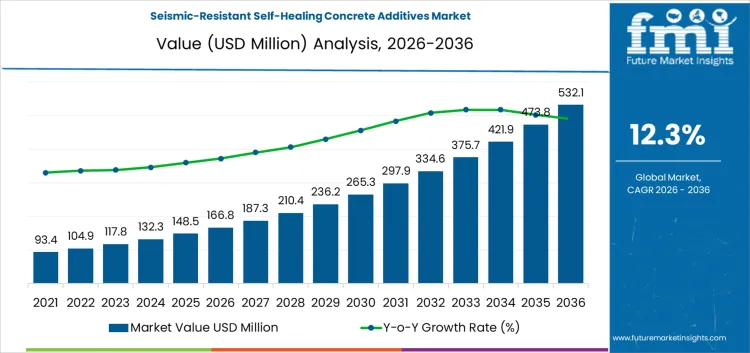
What is the Growth Forecast for the Seismic-Resistant Self-Healing Concrete Additives Market through 2036?
The seismic-resistant self-healing concrete additives market is poised for consistent growth through 2036, driven by the growing need for resilient infrastructure in seismically active areas. As construction standards evolve to prioritize safety and longevity, self-healing concrete additives are emerging as a critical solution for minimizing structural damage caused by seismic events. The market will benefit from innovations in additive technology that improve the self-healing properties of concrete, reducing the need for manual repairs and enhancing the overall durability of structures.
The market is projected to grow at a robust CAGR of 12.3%, with a total market value of USD 531.9 million by 2036. This growth reflects the rising adoption of seismic-resistant materials in construction projects, as well as an increasing focus on minimizing infrastructure maintenance costs. As global infrastructure investments increase, the demand for self-healing concrete additives is expected to rise, creating a significant dollar opportunity in the market. By 2036, these additives will play an integral role in ensuring the sustainability and safety of buildings and infrastructure worldwide.
Seismic-Resistant Self-Healing Concrete Additives Market Key Takeaways
| Metric | Value |
|---|---|
| Industry Sales Value (2026) | USD 166.8 million |
| Industry Forecast Value (2036) | USD 531.9 million |
| Industry Forecast CAGR 2026 to 2036 | 12.3% |
What Is Driving the Seismic-Resistant Self-Healing Concrete Additives Market?
Historically, the seismic-resistant self-healing concrete additives market was shaped by the limitations of traditional concrete in seismic zones and early efforts to improve structural resilience. Conventional concrete relied on passive reinforcement and design codes to manage cracks and seismic stresses, but lacked mechanisms to autonomously address microcracking and long-term degradation. Research institutions and material developers pursued self-healing additives, such as encapsulated healing agents and mineral admixtures, to improve durability and crack closure in earthquake-prone regions. Adoption in early stages was concentrated on pilot projects and infrastructure programs where long service life and maintenance reduction were priorities. Bridge decks, tunnels, and high-rise foundations in seismically active areas served as testbeds for formulations that reacted with moisture or air to precipitate healing compounds. This phase generated performance data on healing efficacy, mechanical property retention, and integration with existing mix designs, informing specifications and early case studies.
Future demand for seismic-resistant self-healing concrete additives is expected to be driven by rising infrastructure investment in earthquake-vulnerable regions, stringent building codes, and the pursuit of resilient, low-maintenance structures. Governments and agencies responsible for critical infrastructure are anticipated to include self-healing capabilities in procurement guidelines as a measure to mitigate lifecycle costs and enhance safety. Advances in additive chemistries and delivery mechanisms are likely to improve activation rates, compatibility with high-strength mixes, and performance under cyclic loading typical of seismic events. Growth will also stem from digital engineering practices that integrate material behavior into performance-based design. Barriers include higher upfront material costs, the need for standardized testing protocols, and skepticism among conservative design professionals. Long-term market expansion will depend on verified field performance, regulatory acceptance, and cost-benefit evidence that quantifies resilience gains relative to traditional concrete systems.
What are the Key Segments in the Seismic-Resistant Self-Healing Concrete Additives Market?
The Seismic-Resistant Self-Healing Concrete Additives market is divided into mechanism types and applications. The mechanisms include autogenous healing enhancement, autonomic self-healing systems, hybrid composite healing, and seismic microcrack mitigation. Autogenous healing enhancement holds the largest share, contributing significantly to the development of self-healing properties in concrete exposed to seismic stress. On the application side, high-rise buildings and infrastructure projects account for the largest segment, followed by bridges & flyovers, tunnels & underground works, and industrial flooring & foundations. The increasing focus on enhancing the resilience of structures against seismic activity is driving the demand for self-healing additives. The market is witnessing notable growth, particularly in regions with high seismic activity such as Asia Pacific, North America, and Latin America, where infrastructure development is growing in response to safety regulations and urban expansion.
What is Driving Growth in Autogenous Healing Enhancement Mechanisms?
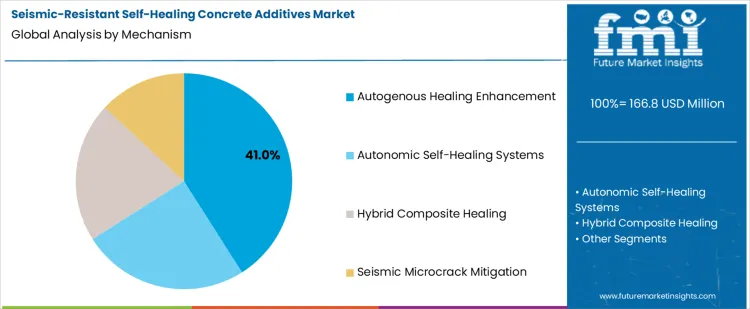
Autogenous healing enhancement mechanisms hold a significant 41% share of the Seismic-Resistant Self-Healing Concrete Additives market, primarily due to their ability to enable concrete to self-repair minor cracks without external intervention. This mechanism is particularly valuable in seismic regions, where concrete structures are vulnerable to cracking from seismic forces. The use of autogenous healing is increasingly favored for applications in high-rise buildings and infrastructure, which are critical in regions with frequent seismic activity. The primary advantage of autogenous healing is its cost-effectiveness and sustainability, as it does not require additional external resources for the healing process.
This feature aligns with the growing demand for eco-friendly and maintenance-free construction materials. The mechanism works by allowing the concrete to absorb moisture, which activates healing agents within the material, effectively closing small cracks that may form during seismic events. In markets like Japan, California, and Chile, where seismic risk is high, the adoption of autogenous healing-enhanced concrete additives is rapidly increasing. Additionally, the focus on improving building longevity and reducing long-term maintenance costs is propelling the growth of this segment. As infrastructure safety regulations become stricter, the use of autogenous healing concrete additives in seismic-resistant applications is expected to expand further.
What is Driving the Demand for High-Rise & Infrastructure Applications?
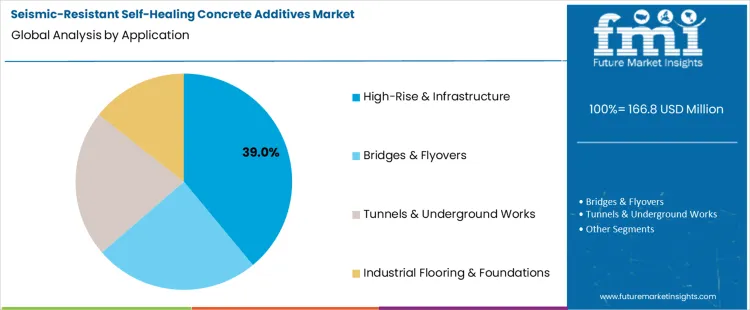
High-rise buildings and infrastructure applications represent the largest segment in the Seismic-Resistant Self-Healing Concrete Additives market, accounting for 39% of the total market share. This segment’s growth is primarily driven by the need for durable and resilient structures in urban environments that are exposed to seismic risks. In cities located in seismically active regions, there is a heightened focus on constructing buildings and infrastructure that can withstand earthquakes while minimizing damage.
The integration of self-healing concrete additives into high-rise buildings and infrastructure projects enhances the structural integrity of these projects by allowing them to repair themselves after microcracks occur during seismic events. The demand for these additives is particularly high in countries with dense populations and significant urban expansion, such as Japan, the United States, and India. As more governments enforce stricter building codes and seismic-resistant standards, the adoption of self-healing concrete is expected to increase. The durability and reduced maintenance needs of self-healing concrete make it an attractive option for long-term infrastructure development. Additionally, the increasing focus on sustainability and environmental responsibility in construction materials is contributing to the growth of this segment, with self-healing concrete offering a eco-friendlier alternative to traditional construction practices.
What are the Key Dynamics in the Seismic-Resistant Self-Healing Concrete Additives Market?
The seismic-resistant self-healing concrete additives market is emerging as a critical component in enhancing the resilience of infrastructure to natural disasters, particularly in earthquake-prone regions. This market focuses on the integration of self-healing additives that can repair cracks in concrete without human intervention, significantly improving the longevity and safety of structures. The additives, typically based on microcapsules, bacteria, or polymers, are designed to release healing agents when cracks form, promoting the restoration of structural integrity. The demand for such materials is propelled by increasing awareness of seismic risks, urbanization, and the growing need for sustainable construction practices. Regulatory pressures to improve building safety standards further contribute to market growth.
What are the Key Drivers of Growth in the Seismic-Resistant Self-Healing Concrete Additives Market?
The key drivers of growth in this market include the rising frequency of natural disasters and the growing awareness of infrastructure vulnerability to seismic activity. Governments and construction authorities are increasingly focusing on disaster resilience, resulting in stricter building codes and safety regulations, which drive the adoption of innovative solutions like self-healing concrete. Additionally, advancements in material science and nanotechnology are making the development of cost-effective self-healing concrete additives more feasible. The global push toward sustainable construction practices further supports the growth, as self-healing concrete can reduce the need for repairs and maintenance, contributing to the durability of structures. Demand for safer, long-lasting infrastructure is particularly strong in earthquake-prone regions such as Asia and North America.
What are the Key Restraints in the Seismic-Resistant Self-Healing Concrete Additives Market?
Several factors constrain the broader adoption of seismic-resistant self-healing concrete additives. The cost of producing and integrating self-healing additives into concrete can be higher compared to conventional materials, which may deter price-sensitive stakeholders from adopting the technology. There are also concerns about the long-term effectiveness of self-healing mechanisms, as some additives may have limited healing capabilities or require specific conditions for activation. Additionally, the integration of these additives into large-scale construction projects can be complex, requiring significant changes in construction methods and materials. These challenges can slow the adoption of this technology, particularly in developing regions with less developed infrastructure or less stringent building codes.
What are the Key Trends in the Seismic-Resistant Self-Healing Concrete Additives Market?
Key trends in this market include increasing innovation in self-healing materials, particularly with bio-based and nanotechnology-driven additives that enhance concrete’s ability to heal cracks autonomously. Researchers are exploring more efficient ways to incorporate bacteria or microcapsules that release healing agents into the concrete matrix, providing long-lasting and sustainable healing properties. Another significant trend is the growing emphasis on sustainability in the construction industry, which drives interest in self-healing concrete as it reduces the need for resource-intensive repairs. In addition, rising interest in earthquake preparedness and disaster resilience has led to the development of new standards for self-healing concrete in seismic applications. These developments are fostering greater market adoption and expanding the potential for seismic-resistant concrete in construction projects worldwide.
What is the Country-Wise Analysis of the Seismic-Resistant Self-Healing Concrete Additives Market?
The seismic-resistant self-healing concrete additives market is witnessing steady growth in key regions including the USA, China, Germany, Japan, and India. These additives, designed to enhance the durability and resilience of concrete structures, are gaining traction as infrastructure projects increasingly focus on safety, sustainability, and longevity. The growing awareness of the need for earthquake-resistant buildings, combined with the rise in infrastructure development, is driving demand for self-healing concrete additives. The market dynamics vary across these countries, driven by local regulatory requirements, construction activities, and technological innovations that aim to improve the performance of concrete in seismic zones.
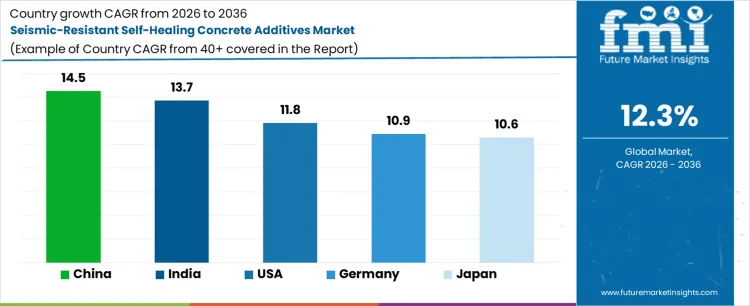
| Country | CAGR 2026 to 2036 |
|---|---|
| USA | 11.8% |
| China | 14.5% |
| Germany | 10.9% |
| Japan | 10.6% |
| India | 13.7% |
What is Driving the Growth of the Seismic-Resistant Self-Healing Concrete Additives Market in the USA?
The seismic-resistant self-healing concrete additives market in the USA is expanding at a rate of 11.8% CAGR. This growth is largely driven by the increasing demand for resilient infrastructure in areas prone to earthquakes. As the USA continues to invest in upgrading its infrastructure, self-healing concrete additives have gained attention due to their ability to extend the lifespan of structures and reduce maintenance costs. Seismic codes and building regulations in earthquake-prone regions further boost the demand for these additives, as they provide an effective solution for enhancing the safety and durability of concrete structures. The growing focus on sustainable construction methods is also contributing to the market's expansion as these additives offer long-term cost-saving benefits.
How is the Seismic-Resistant Self-Healing Concrete Additives Market Evolving in China?
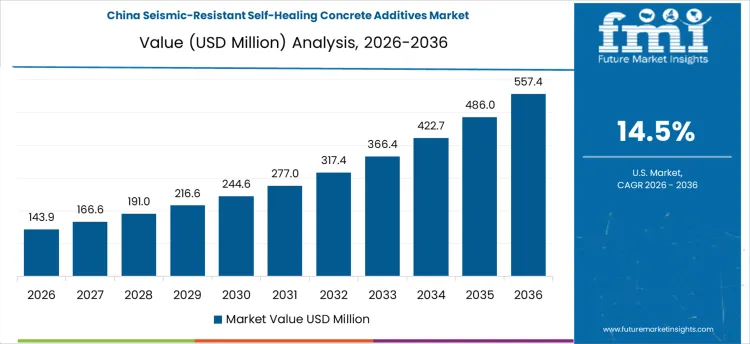
China’s seismic-resistant self-healing concrete additives market is growing rapidly with a CAGR of 14.5%. The country’s robust infrastructure development, particularly in seismic zones, is a major driver of market growth. China is undergoing significant urbanization, with large-scale construction projects such as high-rise buildings, bridges, and roads. As China faces the challenge of frequent seismic activity in certain regions, the demand for self-healing concrete additives is increasing. These additives are increasingly being integrated into new infrastructure projects to ensure the longevity and safety of buildings. Additionally, government initiatives supporting construction innovation and sustainability contribute to the growing use of advanced concrete solutions like self-healing additives in the construction industry.
What Factors are Influencing the Seismic-Resistant Self-Healing Concrete Additives Market in Germany?
In Germany, the seismic-resistant self-healing concrete additives market is growing at a CAGR of 10.9%. Germany’s construction industry is focused on enhancing the durability and sustainability of infrastructure. While the country is not as seismically active as other regions, there is a strong emphasis on improving the resilience of buildings and infrastructure, particularly in areas that are susceptible to minor seismic activity. Additionally, the German market is driven by the country's commitment to sustainable construction practices and green building technologies. Self-healing concrete additives align with these priorities by offering long-lasting solutions that reduce the need for costly repairs and maintenance, which helps to extend the life cycle of infrastructure projects.
How is the Seismic-Resistant Self-Healing Concrete Additives Market Performing in Japan?
Japan’s seismic-resistant self-healing concrete additives market is growing steadily at a CAGR of 10.6%. Japan is one of the most earthquake-prone countries in the world, and its construction industry has long focused on developing earthquake-resistant building technologies. The demand for self-healing concrete additives is increasing as part of the nation’s broader efforts to enhance the resilience of buildings and infrastructure. These additives help mitigate the effects of seismic activity by enabling concrete to repair itself, thus improving the structural integrity of buildings and reducing maintenance costs. With Japan’s commitment to innovation in construction technologies, the market for self-healing concrete additives is expected to expand as new applications and improvements in product performance emerge.
What Factors Are Contributing to the Growth of the Seismic-Resistant Self-Healing Concrete Additives Market in India?
India’s seismic-resistant self-healing concrete additives market is growing at a CAGR of 13.7%, driven by the country’s increasing infrastructure development and the need for improved earthquake resilience. India is situated in a region that is susceptible to seismic activity, particularly in the northern and eastern parts of the country. As urbanization continues and large-scale infrastructure projects are underway, the demand for self-healing concrete additives is on the rise. These additives offer a solution to reduce maintenance and improve the durability of buildings exposed to seismic activity. Additionally, government initiatives and construction industry adoption of advanced materials are helping accelerate the use of these additives in infrastructure projects, further boosting market growth in India.
What is the Competitive Landscape for the Seismic-Resistant Self-Healing Concrete Additives Market?
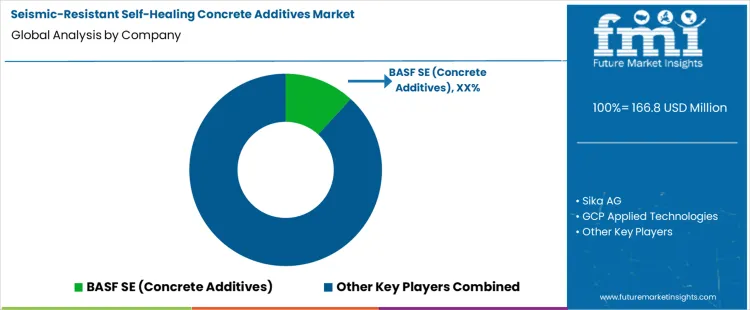
The seismic-resistant self-healing concrete additives market is witnessing strong competition, with key players focusing on enhancing product performance and expanding their market presence. BASF SE, a leading company in the concrete additives segment, drives innovation by offering advanced self-healing concrete solutions. Their focus on improving durability and reducing maintenance costs has positioned them as a market leader. Sika AG, another major player, also emphasizes enhancing the resilience of concrete, offering a range of self-healing additives designed to improve the safety and longevity of structures in seismic-prone regions. Other companies, including GCP Applied Technologies and MAPEI S.p.A., are developing similar products that address the growing demand for seismic-resistant materials. These companies aim to meet the need for advanced construction materials that can withstand the stresses of earthquakes, while also offering sustainability benefits, such as reduced repair and replacement costs.
In the competitive landscape of seismic-resistant self-healing concrete additives, companies employ several strategies to maintain their market position. Product development is key, with significant investments in research and development aimed at improving the efficacy of self-healing properties and ensuring regulatory compliance. BASF SE continues to refine its formulations to meet evolving industry standards and regional seismic requirements. Sika AG’s strategy includes expanding its global footprint, particularly in earthquake-prone regions where demand for such materials is high. GCP Applied Technologies and MAPEI S.p.A. also focus on collaborations and partnerships with construction firms and other stakeholders to enhance product visibility and adoption. W. R. Grace & Co. (Grace) is investing in innovations aimed at optimizing self-healing capacities while improving the sustainability of concrete additives. These strategies, along with a focus on reducing costs and ensuring ease of use, are helping companies secure a competitive edge in the growing market for seismic-resistant self-healing concrete additives.
Key Players of the Seismic-Resistant Self-Healing Concrete Additives Market
- BASF SE (Concrete Additives)
- Sika AG
- GCP Applied Technologies
- MAPEI S.p.A.
- Grace (W. R. Grace & Co.)
- Others
Scope of the Report
| Items | Values |
|---|---|
| Quantitative Units (2026) | USD Million |
| Additive Type | Microcapsule-Based Healing Agents, Bacterial / Biogenic Agents, Shape-Memory Polymers, Nano-Mineral Fibers & Powders, Others |
| Mechanism | Autogenous Healing Enhancement, Autonomic Self-Healing Systems, Hybrid Composite Healing, Seismic Microcrack Mitigation |
| Application | High-Rise & Infrastructure, Bridges & Flyovers, Tunnels & Underground Works, Industrial Flooring & Foundations |
| Companies | BASF SE (Concrete Additives), Sika AG, GCP Applied Technologies, MAPEI S.p.A., Grace (W. R. Grace & Co.), Others |
| Regions Covered | North America, Latin America, Western Europe, Eastern Europe, South Asia and Pacific, East Asia, Middle East & Africa |
| Countries Covered | United States, Canada, Mexico, Brazil, Argentina, Germany, France, United Kingdom, Italy, Spain, Netherlands, China, India, Japan, South Korea, ANZ, GCC Countries, South Africa |
| Additional Attributes | Dollar by sales by additive type, mechanism, application, and region. Includes market trends towards advanced self-healing properties, seismic resistance, cost-effectiveness, regulatory compliance, impact on durability and safety, market share and competitive positioning of key companies, and innovations in concrete technology. |
Seismic-Resistant Self-Healing Concrete Additives Market Segmentation
Additive Type
- Microcapsule-Based Healing Agents
- Bacterial / Biogenic Agents
- Shape-Memory Polymers
- Nano-Mineral Fibers & Powders
- Others
Mechanism
- Autogenous Healing Enhancement
- Autonomic Self-Healing Systems
- Hybrid Composite Healing
- Seismic Microcrack Mitigation
- Others
Application
- High-Rise & Infrastructure
- Bridges & Flyovers
- Tunnels & Underground Works
- Industrial Flooring & Foundations
- Others
Region
- Asia Pacific
- China
- Japan
- India
- Australia & New Zealand
- ASEAN
- Rest of Asia Pacific
- Europe
- Germany
- United Kingdom
- France
- Italy
- Spain
- Nordic
- BENELUX
- Rest of Europe
- North America
- United States
- Canada
- Mexico
- Latin America
- Brazil
- Argentina
- Rest of Latin America
- Middle East & Africa
- Kingdom of Saudi Arabia
- Other GCC Countries
- South Africa
- Rest of Middle East & Africa
Bibliography
BASF SE. (n.d.). Building sustainably with concrete. BASF.
Sika AG. (2024). Building the future, our year 2023 (Annual report magazine). Sika AG.
GCP Applied Technologies. (n.d.). Sustainability in construction. GCP Applied Technologies.
MAPEI S.p.A. (2023). Summary of the sustainability report 2023. Mapei S.p.A.
W. R. Grace & Co. (n.d.). Construction (Industry page). W. R. Grace & Co.
Frequently Asked Questions
How big is the seismic-resistant self-healing concrete additives market in 2026?
The global seismic-resistant self-healing concrete additives market is estimated to be valued at USD 166.8 million in 2026.
What will be the size of seismic-resistant self-healing concrete additives market in 2036?
The market size for the seismic-resistant self-healing concrete additives market is projected to reach USD 532.1 million by 2036.
How much will be the seismic-resistant self-healing concrete additives market growth between 2026 and 2036?
The seismic-resistant self-healing concrete additives market is expected to grow at a 12.3% CAGR between 2026 and 2036.
What are the key product types in the seismic-resistant self-healing concrete additives market?
The key product types in seismic-resistant self-healing concrete additives market are microcapsule-based healing agents, bacterial or biogenic agents, shape-memory polymers, nano-mineral fibers & powders and others.
Which mechanism segment to contribute significant share in the seismic-resistant self-healing concrete additives market in 2026?
In terms of mechanism, autogenous healing enhancement segment to command 41.0% share in the seismic-resistant self-healing concrete additives market in 2026.
Preview the report firsthand - request a free sample
Get SampleGet the brochure for pricing and purchase details.
Get PDFTable of Content
- Executive Summary
- Global Market Outlook
- Demand-side Trends
- Supply-side Trends
- Technology Roadmap Analysis
- Analysis and Recommendations
- Market Overview
- Market Coverage / Taxonomy
- Market Definition / Scope / Limitations
- Market Background
- Market Dynamics
- Drivers
- Restraints
- Opportunity
- Trends
- Scenario Forecast
- Demand in Optimistic Scenario
- Demand in Likely Scenario
- Demand in Conservative Scenario
- Opportunity Map Analysis
- Product Life Cycle Analysis
- Supply Chain Analysis
- Investment Feasibility Matrix
- Value Chain Analysis
- PESTLE and Porter’s Analysis
- Regulatory Landscape
- Regional Parent Market Outlook
- Production and Consumption Statistics
- Import and Export Statistics
- Market Dynamics
- Global Market Analysis 2021 to 2025 and Forecast, 2026 to 2036
- Historical Market Size Value (USD Million) Analysis, 2021 to 2025
- Current and Future Market Size Value (USD Million) Projections, 2026 to 2036
- Y-o-Y Growth Trend Analysis
- Absolute $ Opportunity Analysis
- Global Market Pricing Analysis 2021 to 2025 and Forecast 2026 to 2036
- Global Market Analysis 2021 to 2025 and Forecast 2026 to 2036, By Additive Type
- Introduction / Key Findings
- Historical Market Size Value (USD Million) Analysis By Additive Type , 2021 to 2025
- Current and Future Market Size Value (USD Million) Analysis and Forecast By Additive Type , 2026 to 2036
- Microcapsule-Based Healing Agents
- Bacterial or Biogenic Agents
- Shape-Memory Polymers
- Nano-Mineral Fibers & Powders
- Others
- Microcapsule-Based Healing Agents
- Y-o-Y Growth Trend Analysis By Additive Type , 2021 to 2025
- Absolute $ Opportunity Analysis By Additive Type , 2026 to 2036
- Global Market Analysis 2021 to 2025 and Forecast 2026 to 2036, By Mechanism
- Introduction / Key Findings
- Historical Market Size Value (USD Million) Analysis By Mechanism, 2021 to 2025
- Current and Future Market Size Value (USD Million) Analysis and Forecast By Mechanism, 2026 to 2036
- Autogenous Healing Enhancement
- Autonomic Self-Healing Systems
- Hybrid Composite Healing
- Seismic Microcrack Mitigation
- Autogenous Healing Enhancement
- Y-o-Y Growth Trend Analysis By Mechanism, 2021 to 2025
- Absolute $ Opportunity Analysis By Mechanism, 2026 to 2036
- Global Market Analysis 2021 to 2025 and Forecast 2026 to 2036, By Application
- Introduction / Key Findings
- Historical Market Size Value (USD Million) Analysis By Application, 2021 to 2025
- Current and Future Market Size Value (USD Million) Analysis and Forecast By Application, 2026 to 2036
- High-Rise & Infrastructure
- Bridges & Flyovers
- Tunnels & Underground Works
- Industrial Flooring & Foundations
- High-Rise & Infrastructure
- Y-o-Y Growth Trend Analysis By Application, 2021 to 2025
- Absolute $ Opportunity Analysis By Application, 2026 to 2036
- Global Market Analysis 2021 to 2025 and Forecast 2026 to 2036, By Region
- Introduction
- Historical Market Size Value (USD Million) Analysis By Region, 2021 to 2025
- Current Market Size Value (USD Million) Analysis and Forecast By Region, 2026 to 2036
- North America
- Latin America
- Western Europe
- Eastern Europe
- East Asia
- South Asia and Pacific
- Middle East & Africa
- Market Attractiveness Analysis By Region
- North America Market Analysis 2021 to 2025 and Forecast 2026 to 2036, By Country
- Historical Market Size Value (USD Million) Trend Analysis By Market Taxonomy, 2021 to 2025
- Market Size Value (USD Million) Forecast By Market Taxonomy, 2026 to 2036
- By Country
- USA
- Canada
- Mexico
- By Additive Type
- By Mechanism
- By Application
- By Country
- Market Attractiveness Analysis
- By Country
- By Additive Type
- By Mechanism
- By Application
- Key Takeaways
- Latin America Market Analysis 2021 to 2025 and Forecast 2026 to 2036, By Country
- Historical Market Size Value (USD Million) Trend Analysis By Market Taxonomy, 2021 to 2025
- Market Size Value (USD Million) Forecast By Market Taxonomy, 2026 to 2036
- By Country
- Brazil
- Chile
- Rest of Latin America
- By Additive Type
- By Mechanism
- By Application
- By Country
- Market Attractiveness Analysis
- By Country
- By Additive Type
- By Mechanism
- By Application
- Key Takeaways
- Western Europe Market Analysis 2021 to 2025 and Forecast 2026 to 2036, By Country
- Historical Market Size Value (USD Million) Trend Analysis By Market Taxonomy, 2021 to 2025
- Market Size Value (USD Million) Forecast By Market Taxonomy, 2026 to 2036
- By Country
- Germany
- UK
- Italy
- Spain
- France
- Nordic
- BENELUX
- Rest of Western Europe
- By Additive Type
- By Mechanism
- By Application
- By Country
- Market Attractiveness Analysis
- By Country
- By Additive Type
- By Mechanism
- By Application
- Key Takeaways
- Eastern Europe Market Analysis 2021 to 2025 and Forecast 2026 to 2036, By Country
- Historical Market Size Value (USD Million) Trend Analysis By Market Taxonomy, 2021 to 2025
- Market Size Value (USD Million) Forecast By Market Taxonomy, 2026 to 2036
- By Country
- Russia
- Poland
- Hungary
- Balkan & Baltic
- Rest of Eastern Europe
- By Additive Type
- By Mechanism
- By Application
- By Country
- Market Attractiveness Analysis
- By Country
- By Additive Type
- By Mechanism
- By Application
- Key Takeaways
- East Asia Market Analysis 2021 to 2025 and Forecast 2026 to 2036, By Country
- Historical Market Size Value (USD Million) Trend Analysis By Market Taxonomy, 2021 to 2025
- Market Size Value (USD Million) Forecast By Market Taxonomy, 2026 to 2036
- By Country
- China
- Japan
- South Korea
- By Additive Type
- By Mechanism
- By Application
- By Country
- Market Attractiveness Analysis
- By Country
- By Additive Type
- By Mechanism
- By Application
- Key Takeaways
- South Asia and Pacific Market Analysis 2021 to 2025 and Forecast 2026 to 2036, By Country
- Historical Market Size Value (USD Million) Trend Analysis By Market Taxonomy, 2021 to 2025
- Market Size Value (USD Million) Forecast By Market Taxonomy, 2026 to 2036
- By Country
- India
- ASEAN
- Australia & New Zealand
- Rest of South Asia and Pacific
- By Additive Type
- By Mechanism
- By Application
- By Country
- Market Attractiveness Analysis
- By Country
- By Additive Type
- By Mechanism
- By Application
- Key Takeaways
- Middle East & Africa Market Analysis 2021 to 2025 and Forecast 2026 to 2036, By Country
- Historical Market Size Value (USD Million) Trend Analysis By Market Taxonomy, 2021 to 2025
- Market Size Value (USD Million) Forecast By Market Taxonomy, 2026 to 2036
- By Country
- Kingdom of Saudi Arabia
- Other GCC Countries
- Turkiye
- South Africa
- Other African Union
- Rest of Middle East & Africa
- By Additive Type
- By Mechanism
- By Application
- By Country
- Market Attractiveness Analysis
- By Country
- By Additive Type
- By Mechanism
- By Application
- Key Takeaways
- Key Countries Market Analysis
- USA
- Pricing Analysis
- Market Share Analysis, 2025
- By Additive Type
- By Mechanism
- By Application
- Canada
- Pricing Analysis
- Market Share Analysis, 2025
- By Additive Type
- By Mechanism
- By Application
- Mexico
- Pricing Analysis
- Market Share Analysis, 2025
- By Additive Type
- By Mechanism
- By Application
- Brazil
- Pricing Analysis
- Market Share Analysis, 2025
- By Additive Type
- By Mechanism
- By Application
- Chile
- Pricing Analysis
- Market Share Analysis, 2025
- By Additive Type
- By Mechanism
- By Application
- Germany
- Pricing Analysis
- Market Share Analysis, 2025
- By Additive Type
- By Mechanism
- By Application
- UK
- Pricing Analysis
- Market Share Analysis, 2025
- By Additive Type
- By Mechanism
- By Application
- Italy
- Pricing Analysis
- Market Share Analysis, 2025
- By Additive Type
- By Mechanism
- By Application
- Spain
- Pricing Analysis
- Market Share Analysis, 2025
- By Additive Type
- By Mechanism
- By Application
- France
- Pricing Analysis
- Market Share Analysis, 2025
- By Additive Type
- By Mechanism
- By Application
- India
- Pricing Analysis
- Market Share Analysis, 2025
- By Additive Type
- By Mechanism
- By Application
- ASEAN
- Pricing Analysis
- Market Share Analysis, 2025
- By Additive Type
- By Mechanism
- By Application
- Australia & New Zealand
- Pricing Analysis
- Market Share Analysis, 2025
- By Additive Type
- By Mechanism
- By Application
- China
- Pricing Analysis
- Market Share Analysis, 2025
- By Additive Type
- By Mechanism
- By Application
- Japan
- Pricing Analysis
- Market Share Analysis, 2025
- By Additive Type
- By Mechanism
- By Application
- South Korea
- Pricing Analysis
- Market Share Analysis, 2025
- By Additive Type
- By Mechanism
- By Application
- Russia
- Pricing Analysis
- Market Share Analysis, 2025
- By Additive Type
- By Mechanism
- By Application
- Poland
- Pricing Analysis
- Market Share Analysis, 2025
- By Additive Type
- By Mechanism
- By Application
- Hungary
- Pricing Analysis
- Market Share Analysis, 2025
- By Additive Type
- By Mechanism
- By Application
- Kingdom of Saudi Arabia
- Pricing Analysis
- Market Share Analysis, 2025
- By Additive Type
- By Mechanism
- By Application
- Turkiye
- Pricing Analysis
- Market Share Analysis, 2025
- By Additive Type
- By Mechanism
- By Application
- South Africa
- Pricing Analysis
- Market Share Analysis, 2025
- By Additive Type
- By Mechanism
- By Application
- USA
- Market Structure Analysis
- Competition Dashboard
- Competition Benchmarking
- Market Share Analysis of Top Players
- By Regional
- By Additive Type
- By Mechanism
- By Application
- Competition Analysis
- Competition Deep Dive
- BASF SE (Concrete Additives)
- Overview
- Product Portfolio
- Profitability by Market Segments (Product/Age /Sales Channel/Region)
- Sales Footprint
- Strategy Overview
- Marketing Strategy
- Product Strategy
- Channel Strategy
- Sika AG
- GCP Applied Technologies
- MAPEI S.p.A.
- Grace (W. R. Grace & Co.)
- Others
- BASF SE (Concrete Additives)
- Competition Deep Dive
- Assumptions & Acronyms Used
- Research Methodology


