

- Market Size (2026)
- USD 1.7 Bn
- Forecast (2036)
- USD 2.9 Bn
- CAGR (2026 to 2036)
- 5.6%
How big is Concrete Curing Compounds Market in 2026?
USD 1.7 billion in 2026 and USD 2.9 billion by 2036 at a 5.6% CAGR.
Demand for concrete curing compounds is projected to expand at 5.6% CAGR between 2026 and 2036, increasing valuation from USD 1.7 billion in 2026 to USD 2.9 billion by 2036. Bridge rehabilitation provides a specification route for moisture-retention compounds across public construction and repair programs. The Federal Highway Administration counted 41,685 poor-condition bridges in June 2025 across the National Bridge Inventory. Transportation agencies therefore require curing systems that preserve early hydration without complicating protective treatments such as concrete corrosion inhibitors.
Project specifications connect procedures across ready-mix concrete production with application rates and permitted curing chemistry. Concrete contractors coordinate curing materials with broader construction chemicals procurement so stock and technical support can sustain timely spraying across placements. Compatibility reviews prevent residual films from delaying coatings or adhesives on interior projects with fixed handover dates.
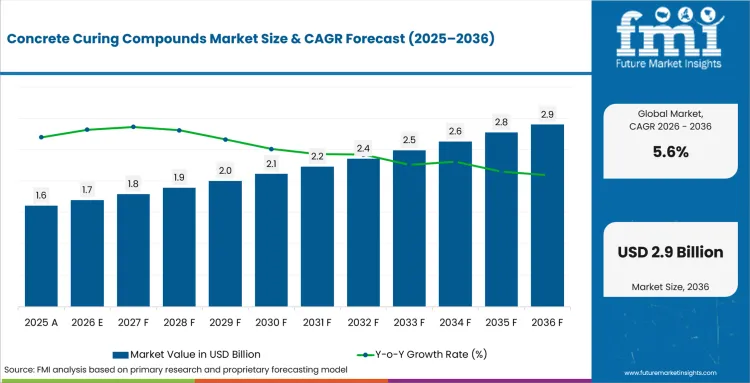
Key Takeaways of Concrete Curing Compounds Market
- Public infrastructure renewal supports specification-based demand for dependable moisture retention across pavements, bridge decks and concrete repair programs.
- Wax-based compounds are projected to represent 28.0% share in 2026 owing to practical spraying across concrete placements.
- Clear compounds are estimated to account for 34.0% share in 2026 due to visible-finish requirements and downstream coating considerations.
- Pavements are forecast to capture 31.0% share in 2026 driven by surface areas and controlled curing specifications.
- Surface contamination and inconsistent spray coverage remain material restraints as both conditions can weaken curing performance or subsequent adhesion.
- W. R. Meadows, Sika, Master Builders Solutions, Euclid Chemical, Mapei, Fosroc, Laticrete, Nox-Crete, SpecChem and Dayton Superior (acquired by White Cap in June 2024) form the profiled company set.
Analyst Perspective
"Concrete curing compounds earn repeat specifications by retaining moisture without disrupting planned coatings or floor systems. Manufacturers pairing chemistry guidance with measured coverage rates can limit rework across paving and rehabilitation programs."
- Nikhil Kaitwade, Principal Consultant, Future Market Insights
How is the Concrete Curing Compounds Market segmented?
The concrete curing compounds industry is segmented by chemistry, form, application, end use, sales channel and region.
The market is organized by chemistry, form, application, end use, sales channel and region to reflect specification routes. Chemistry covers wax-based, acrylic-based, resin-based, water-based membrane-forming and solvent-based compounds across distinct commercial formulation routes. Form covers clear, white-pigmented, dissipating and VOC-compliant low-odor products for appearance and planned finishing requirements. Applications include pavements, industrial floors, bridge decks, precast concrete and building slabs across infrastructure, commercial, industrial and residential end uses. Sales channels include construction chemical distributors, direct contractor supply and ready-mix project supply across assessed regions.
Why do wax-based compounds lead demand within the chemistry category?
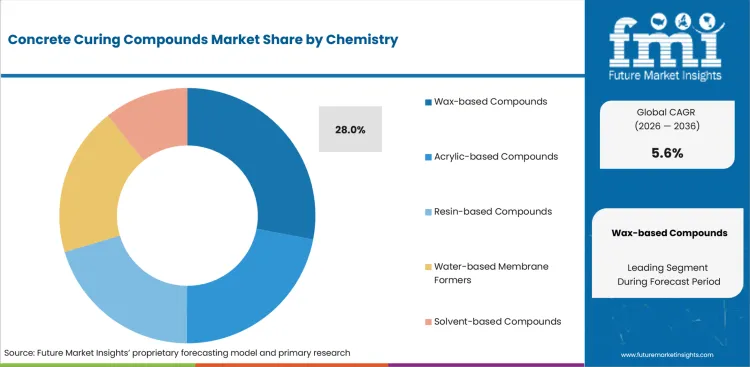
Wax-based compounds form continuous films across broad concrete surfaces and suit spray equipment on projects where concrete admixtures are specified alongside curing materials. Wisconsin DOT’s 2026 approved curing-compound list separates wax-based white-pigmented ASTM C309 materials from PAMS-based materials, showing that public agencies continue to qualify chemistry-specific curing options before field use.
- Wax-based compounds are set to lead the chemistry category with 28.0% share in 2026 due to familiar membrane performance across pavements and structural placements.
- Paving crews need predictable coverage over long pours as untreated areas lose moisture unevenly during early hydration. Clear and white formulations let applicators match visibility or solar reflectance without changing established spray procedures.
Why do clear compounds lead demand within the form category?
Clear compounds preserve the appearance of exposed concrete and let applicators inspect film coverage without adding white pigmentation. Their value increases on interior slabs that later receive concrete floor coatings.
- The form category is forecast to be led by clear compounds at 34.0% share in 2026 due to visible-finish requirements and easier application checks.
- Flooring contractors need a visible surface and predictable compatibility with planned adhesives across occupied buildings. NYC DOT’s 2025 curing-materials bulletin specifies Type 1-D clear or translucent membrane curing at 150 square feet per gallon, or the manufacturer’s higher recommended rate, for sidewalks, curbing, walks and other exposed concrete surfaces. The current specification route separates clear-compound approval from later finish selection and keeps application timing measurable.
How are pavements positioned within the application category?
Pavement placements expose large fresh surfaces to wind and heat across projects that combine cement paste with graded construction aggregates. DNIT’s November 2025 BR-222 restoration program covers 157.2 kilometers of concrete whitetopping, requiring coordinated stock and spraying support across long work fronts.
- Based on application, pavements are projected to account for 31.0% in 2026 due to extensive surface exposure and contractually defined curing procedures.
- Road contractors need dependable replenishment and calibrated spray equipment throughout continuous placements across long paving corridors. Regional stock and weather-adjusted coverage plans reduce interruptions as crews progress through exposed highway work zones.
What makes infrastructure central to the end use category?
Infrastructure owners document curing procedures across bridges and transport assets that combine cast-in-place work with precast concrete components. Project sequencing makes compound approval dependent on application rate and compatibility with planned protective treatments.
- In 2026, infrastructure is expected to lead end use with 36.0% share because transport contracts require documented curing across concrete work.
- Transport agencies favor formulations supported by project submittals and trained field teams across multistage closures. Manufacturers secure repeat specifications by matching each compound to the contractor method and planned surface treatment. Long approval cycles remain a material friction across projects with restricted testing and access windows.
What are the drivers, restraints and opportunities in the Concrete Curing Compounds Market?
Documented specifications drive demand, residual films restrain adoption and local support converts qualified trials into repeat specifications.
- Driver: Public specifications connect curing performance with application rates and verifiable moisture-retention results across projects.
- Restraint: Incompatible membranes interfere with coatings or adhesives and add removal work across finishing programs.
- Opportunity: Manufacturers can combine local inventory with contractor training and coverage guidance across concrete placements.
Public specifications separate curing compounds by chemistry and application route within formal public project approvals. MassDOT qualified its liquid membrane-forming curing-compound criteria on 9 June 2026 and requires ASTM C309 compliance plus evaluation through the AASHTO Product Evaluation & Audit Solutions Concrete Curing Compounds program before QCML listing. Manufacturers need formulation-specific submittals instead of one generic moisture-retention file across each current project approval.
Residual membranes can reduce adhesion or discolor later finishes across exposed floors and protection work. Flooring teams verify compatibility with urethane concrete sealers to avoid grinding across facilities.
Application support turns successful trials into repeat specifications by clarifying weather-adjusted coverage and spray technique. Field technicians coordinate curing compounds with repair mortar additives and document coverage for repeat orders.
Which country CAGRs are profiled in the Concrete Curing Compounds Market?
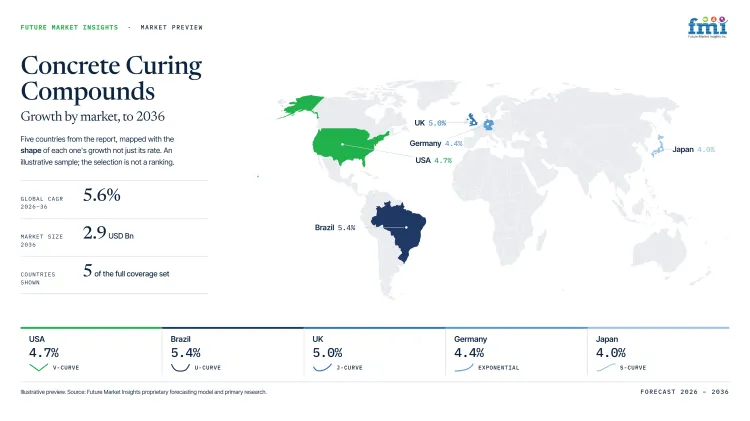
| Country | CAGR |
|---|---|
| United States | 4.7% |
| Germany | 4.4% |
| Japan | 4.0% |
| United Kingdom | 5.0% |
| Brazil | 5.4% |
How do country-level CAGRs compare in the Concrete Curing Compounds Market?
The country forecasts remain closely grouped across the concrete curing compounds market, with only 1.4 percentage points separating Brazil and Japan. The pattern suggests that growth is being driven by construction activity, durability requirements and increasing focus on extending the service life of concrete structures rather than major differences in building practices.
- Brazil benefits from infrastructure expansion and rising demand for concrete protection solutions across transportation, industrial and urban development projects.
- The United Kingdom supports market growth through continued investment in construction activities and greater emphasis on improving concrete performance and longevity.
- The United States reflects steady demand from large-scale infrastructure rehabilitation, commercial construction and residential development projects.
- Germany maintains growth through stringent construction quality standards and ongoing use of curing compounds in high-performance concrete applications.
- Japan continues to support the market through infrastructure maintenance programs and demand for durable concrete structures in dense urban environments.
Comparable CAGRs may still reflect different market conditions because construction cycles, infrastructure spending priorities, climate conditions and concrete specification standards vary across countries. The full report provides country-level CAGR analysis across North America, Latin America, Europe, East Asia, South Asia, Oceania and the Middle East and Africa.
Country-wise Analysis
- State transportation agencies approve curing compounds through project specifications that govern application timing and coverage across bridge barriers and pavement repairs under separate inspection routines. Iowa DOT revised Section 2513 in October 2025 and requires clear curing compound within thirty minutes of final finishing at no less than 200 square feet per gallon. The United States concrete curing compounds sector is projected to record 4.7% CAGR during the assessment period, supported by recurring highway rehabilitation and broad distribution networks with local stock and field guidance. Weather-sensitive spraying and separate state approval lists raise service costs across dispersed contracting districts nationwide.
- Federal bridge contracts prioritize traffic availability and phased repairs across heavily used corridors under detailed tender documentation that requires coordinated field support across several federal states during publicly funded tenders and staged traffic management. By 2036, Germany is projected to grow at 4.4% CAGR, reinforced by recurring rehabilitation and defined technical approval routes across federal projects. The Federal Ministry for Transport counted about 40,300 trunk-road bridges in May 2025 and linked their age profile with extensive modernization needs. German-language submittals and restricted closure windows raise regional coordination costs despite established construction-chemical networks and specialist application support for complex work packages.
- Road authorities use five-year bridge inspections to prioritize repairs and require consistent material qualification across national and municipal maintenance programs with separate funding approvals and contractor qualification requirements nationwide. MLIT reported in August 2025 that the first year of the third inspection cycle covered 18% of bridges and provided a visible pipeline for regional repair planning. Japan is estimated to post 4.0% CAGR over the forecast period, shaped by inspection-led rehabilitation and dependable domestic distribution networks that support controlled material trials. Municipal budget limits and long service distances constrain technical coverage beyond major cities and island regions across regional maintenance programs.
- Highway contracts across the United Kingdom use country-specific MCHW specifications that define construction requirements for trunk-road work and structured technical submittals under scheduled traffic management. The United Kingdom's concrete curing compounds outlook is anticipated to advance at 5.0% CAGR over the assessment period, supported by refurbishment activity and established technical distribution under documented road specifications. Standards for Highways republished the manual in September 2025 with updated requirements and separate national versions for current road projects. National specification differences and coating-compatibility reviews raise approval costs across occupied commercial projects and public works with fixed handover dates or restricted closure windows.
- Federal road programs are formalizing concrete pavement design and training routes across projects that require regional inventory and hot-weather application guidance under multistage contracts across distant states. DNIT published its cooperation scope with the Brazilian Portland Cement Association in July 2025 and included specification revision plus training and maintenance manuals for concrete pavement programs. In Brazil, concrete curing compound demand is predicted to advance at 5.4% CAGR through 2036, driven by pavement rehabilitation and technical knowledge transfer through established cement and road-agency networks. Interior service distances and high surface temperatures constrain specialist coverage across extended construction fronts and remote maintenance locations.
Who are the notable companies in the Concrete Curing Compounds Market?
W. R. Meadows, Sika, Master Builders Solutions, Euclid Chemical, Mapei, Fosroc, Laticrete, Nox-Crete, and SpecChem are profiled in this market.
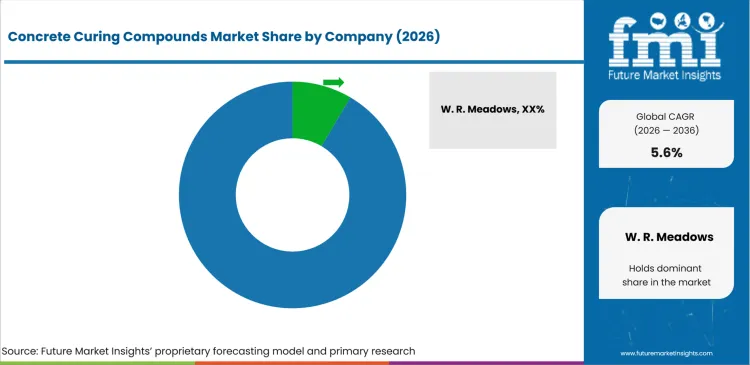
The moderately fragmented field combines global construction-chemical groups with regional specialists that compete through documented moisture retention and local application support. Shared channels for cement grinding aids expand account access, although curing compounds require separate performance proof for spray equipment and every surface finish system.
- W. R. Meadows, Euclid Chemical, SpecChem and Dayton Superior (now operating under White Cap following its June 2024 acquisition) compete through curing ranges and established North American channels.
- Sika, Master Builders Solutions, Mapei and Fosroc combine curing products with admixture expertise and international technical service networks.
- Laticrete and Nox-Crete address contractor-led applications that require focused documentation and dependable regional distribution support networks.
Competitive Benchmarking: Concrete Curing Compounds Market
| Company | Curing Chemistry Breadth | Performance Documentation | Field Support | Geographic Reach |
|---|---|---|---|---|
| W. R. Meadows | High | High | High | North America and export |
| Sika | High | High | High | Global |
| Master Builders Solutions | Medium | High | High | Global |
| Euclid Chemical | Medium | High | Medium | North America |
| Mapei | High | High | High | Global |
| Fosroc | High | High | High | Multi-region |
| SpecChem | High | High | Medium | North America |
| Dayton Superior (now a brand of White Cap, following its acquisition in June 2024) | Medium | High | Medium | North America |
Scoring basis: Chemistry breadth rates High for three verified families, Medium for two and Low for one. Documentation rates High for several current files, Medium for one and Low for one basic claim. Field support follows verified regional coverage, while geographic reach records confirmed operating territories without using company scale.
Key Developments in the Concrete Curing Compounds Market
- In June 2026, MassDOT qualified updated QCML criteria for liquid membrane-forming compounds for curing. The criteria require ASTM C309 compliance and AASHTO Product Evaluation & Audit Solutions review, making third-party evaluation central to product listing and re-qualification.
- In August 2025, NYC DOT issued Specification Bulletin SB 25-007 for curing materials, effective for projects advertised on or after 29 August 2025. The bulletin defines clear Type 1-D, white-pigmented Type 2 and bituminous Type 4 membrane curing routes with application rates tied to exposed concrete, Portland cement concrete pavements and roadway base.
- In April 2026, Wisconsin DOT updated its ASTM C309 curing-compound approval list for the 2026 calendar year. The list identifies approved wax-based white-pigmented and PAMS-based batches, reinforcing batch-level documentation and retesting requirements for state paving specifications.
Concrete Curing Compounds Market - Report Scope
| Coverage field | Report scope |
|---|---|
| Market breakdown | By chemistry, form, application, end use, sales channel and region. |
| Quantitative Units | Revenue USD billion and CAGR in %. |
| Market Definition | The market covers membrane-forming compounds sold for fresh concrete. It excludes water-curing equipment and unrelated coatings. |
| Regions Covered | North America, Latin America, Western Europe, Eastern Europe, East Asia, South Asia and Pacific and Middle East and Africa. |
| Countries Covered | United States, Germany, Japan, United Kingdom and Brazil with 20+ countries included in the full report. |
| Key Companies Profiled | W. R. Meadows, Sika, Master Builders Solutions, Euclid Chemical, Mapei, Fosroc, Laticrete, Nox-Crete, SpecChem and Dayton Superior (now a brand of White Cap). |
| Forecast Period | 2026 to 2036. |
| Approach | Primary and secondary research with market triangulation. |
Concrete Curing Compounds Market - Research Methodology
| Method | Approach |
|---|---|
| Primary Research | FMI analysts gathered input from manufacturers, service providers, technology developers, distributors, end users, procurement teams, and subject-matter experts. Interviews examined purchasing decisions, product or service evaluation, adoption barriers, approval requirements, pricing considerations, and expectations for technical or commercial support. Respondents were also asked what evidence is required before a trial, pilot, or initial order develops into regular purchasing. |
| Desk Research | Desk research covered government statistics, regulatory publications, trade data, industry associations, technical literature, standards, company filings, product information, and official corporate announcements. Sources were reviewed for relevance, publication date, geographic coverage, and consistency with the defined market scope. Claims relating to performance, applications, approvals, capacity, investment, and commercial activity were retained only when supported by credible public evidence. |
| Market Sizing and Forecasting | The market model combined the baseline value with historical performance, segment structure, pricing and volume indicators, adoption levels, company participation, and country-level demand conditions. Forecast assumptions considered economic activity, investment trends, regulatory developments, technology adoption, purchasing cycles, supply availability, and barriers to wider market use. Segment and regional estimates were reconciled before the final market total was calculated. |
| Data Validation | Estimates were checked against multiple independent indicators, including public data, company activity, trade patterns, industry developments, and findings from primary interviews. Validation also tested whether products, services, applications, and company revenues fell within the defined market boundaries. Adjacent categories, unsupported claims, overlapping revenues, and activities without direct market relevance were excluded to reduce double counting and maintain consistency across segments and countries. |
Concrete Curing Compounds Market by Segments
Concrete Curing Compounds Market segmented by Chemistry:
- Wax-based Compounds
- Acrylic-based Compounds
- Resin-based Compounds
- Water-based Membrane Formers
- Solvent-based Compounds
Concrete Curing Compounds Market segmented by Form:
- Clear Compounds
- White Pigmented Compounds
- Dissipating Compounds
- VOC-compliant Low Odor
Concrete Curing Compounds Market segmented by Application:
- Pavements
- Industrial Floors
- Bridge Decks
- Precast Concrete
- Building Slabs
Concrete Curing Compounds Market segmented by End Use:
- Infrastructure
- Commercial Construction
- Industrial Facilities
- Residential Construction
- Precast Plants
Concrete Curing Compounds Market segmented by Sales Channel:
- Construction Chemical Distributors
- Direct Contractor Supply
- Ready-mix / Project Supply
Concrete Curing Compounds Market by Region:
- North America
- United States
- Canada
- Latin America
- Brazil
- Mexico
- Argentina
- Chile
- Western Europe
- Germany
- France
- United Kingdom
- Italy
- Spain
- Benelux
- Nordics
- Eastern Europe
- Poland
- Czech Republic
- Romania
- Hungary
- East Asia
- China
- Japan
- South Korea
- South Asia and Pacific
- India
- ASEAN
- Australia and New Zealand
- Middle East and Africa
- GCC Countries
- South Africa
- Türkiye
- Israel
Research Sources and Bibliography
- Federal Highway Administration. (2025, June 15). Bridge Condition by Highway System 2025.
- Iowa Department of Transportation. (2025, October 21). Section 2513 | Revised 10/21/2025.
- Nevada Department of Transportation. (2026, June 10). Product Evaluation.
- Federal Ministry of Transport. (2025, May 6). Brückenmodernisierung.
- Ministry of Land, Infrastructure, Transport and Tourism. (2025, August 25). 橋梁等の2024年度(令和6年度)点検結果をとりまとめ~道路メンテナンス年報(3巡目1年目)の公表~.
- Standards for Highways. (2025, September). Welcome to the MCHW.
- Departamento Nacional de Infraestrutura de Transportes. (2025, November 28). DNIT inicia obras de restauração em whitetopping na BR-222/MA.
- Departamento Nacional de Infraestrutura de Transportes. (2025, July 3). ABCP.
- Massachusetts Department of Transportation. (2026, June 9). QCML Criteria for Liquid Membrane-Forming Compounds for Curing (M4.12.4.A).
- Iowa Department of Transportation. (2026, April 21). Section 4105 | Liquid Curing Compounds.
- Wisconsin Department of Transportation. (2026, April 9). ASTM C309 Curing Compounds.
- New York City Department of Design and Construction. (2025, August 22). SB 25-007 Curing Materials.
This bibliography is provided for reader reference and is not exhaustive. The full report contains the complete reference list and detailed citations.
This Report Answers
- How large is the concrete curing compounds market in 2026 and 2036?
- Which operating conditions support concrete curing compound purchasing across major projects?
- Which chemistry segment holds the largest approved share during 2026?
- How does product form influence concrete curing compound selection and compatibility?
- Which applications create recurring demand for concrete curing compounds?
- How do profiled country growth rates differ across commercial routes?
- Which companies supply curing compounds with documented technical support?
- What materially limits concrete curing compound adoption across construction projects?
- How should project teams compare curing chemistry and application options?
Frequently Asked Questions
What is driving growth in the concrete curing compounds market?
Public infrastructure rehabilitation sustains recurring specifications for moisture-retention products across pavements and bridges that require documented application performance and dependable field support.
Who are the key players in the concrete curing compounds market?
W. R. Meadows, Sika, Master Builders Solutions, Euclid Chemical, Mapei, Fosroc, SpecChem and Dayton Superior represent broad or regionally focused curing platforms.
What is a notable restraint in the concrete curing compounds market?
Incompatible residual films can disrupt planned coatings or adhesives, and uneven spraying increases surface preparation costs through inconsistent moisture control.
Why should executives track the concrete curing compounds market?
Executives should track specification changes as local approvals and technical service determine repeat purchasing across public construction programs and commercial flooring projects.
What business problem does the concrete curing compounds market address?
Curing compounds limit early moisture loss across fresh concrete surfaces that cannot receive continuous wet curing during extensive placements or constrained schedules.
What should construction decision-makers evaluate in the concrete curing compounds market?
Construction teams should compare chemistry and coverage rates alongside standards documentation plus weather exposure and compatibility with every planned downstream finish.
What limits return on investment in the concrete curing compounds market?
Poor application control wastes material and raises remediation costs, and delayed approvals or finish incompatibility extend handover schedules and contractor mobilization.
What supports long-term confidence in the concrete curing compounds market?
Verified moisture-retention performance and reliable local inventory support repeat specifications across comparable projects that need predictable application guidance and issue resolution.
Preview the report firsthand - request a free sample
Get SampleGet the brochure for pricing and purchase details.
Get PDFTable of Content
- Key Takeaways
- Market Size and CAGR
- Top Growth Driver
- Fastest Growing Segment
- Leading Region
- Key Companies
- Emerging Opportunities
- Executive Summary
- Global Market Outlook
- Demand-side Trends
- Supply-side Trends
- Technology Roadmap Analysis
- Analysis and Recommendations
- Analyst Perspective (What is happening? Why now? What should investors know?)
- Key Questions Answered
- How large is the market?
- What is the CAGR?
- What are key trends?
- Which region dominates?
- Who are the leaders?
- Market Overview
- Market Coverage / Taxonomy
- Market Definition / Scope / Limitations
- Research Methodology
- Chapter Orientation
- Analytical Lens and Working Hypotheses
- Market Structure, Signals, and Trend Drivers
- Benchmarking and Cross-market Comparability
- Market Sizing, Forecasting, and Opportunity Mapping
- Research Design and Evidence Framework
- Desk Research Programme (Secondary Evidence)
- Expert Input and Fieldwork (Primary Evidence)
- Tooling, Models, and Reference Databases
- Data Engineering and Model Build
- Quality Assurance and Audit Trail
- Market Background
- Market Dynamics (Drivers, Restraints, Opportunity, Trends)
- Scenario Forecast (Optimistic, Likely, Conservative)
- Impact Analysis
- AI Impact
- Sustainability Impact
- Regulatory Impact
- Technology Impact
- Consumer / Buyer Analysis
- Purchase Drivers
- Adoption Barriers
- Buyer Journey
- Opportunity Map Analysis
- Product Life Cycle Analysis
- Supply Chain Analysis
- Investment Feasibility Matrix
- Value Chain Analysis
- PESTLE and Porter's Analysis
- Regulatory Landscape
- Regional Parent Market Outlook
- Production and Consumption Statistics
- Import and Export Statistics
- Global Market Analysis and Forecast, 2021 to 2036
- Historical Market Size Value (USD Billion) Analysis, 2021 to 2025
- Current and Future Market Size Value (USD Billion) Projections, 2026 to 2036
- Y-o-Y Growth Trend Analysis
- Absolute $ Opportunity Analysis
- Global Market Pricing Analysis, 2021 to 2036
- Global Market Analysis and Forecast, By Chemistry, 2021 to 2036
- Introduction / Key Findings
- Historical Market Size Value (USD Billion) Analysis By Chemistry, 2021 to 2025
- Current and Future Market Size Value (USD Billion) Analysis and Forecast By Chemistry, 2026 to 2036
- Wax-based Compounds
- Acrylic-based Compounds
- Resin-based Compounds
- Water-based Membrane Formers
- Solvent-based Compounds
- Wax-based Compounds
- Y-o-Y Growth Trend Analysis By Chemistry, 2021 to 2025
- Absolute $ Opportunity Analysis By Chemistry, 2026 to 2036
- Global Market Analysis and Forecast, By Form, 2021 to 2036
- Introduction / Key Findings
- Historical Market Size Value (USD Billion) Analysis By Form, 2021 to 2025
- Current and Future Market Size Value (USD Billion) Analysis and Forecast By Form, 2026 to 2036
- Clear Compounds
- White Pigmented Compounds
- Dissipating Compounds
- VOC-compliant Low Odor
- Clear Compounds
- Y-o-Y Growth Trend Analysis By Form, 2021 to 2025
- Absolute $ Opportunity Analysis By Form, 2026 to 2036
- Global Market Analysis and Forecast, By Application, 2021 to 2036
- Introduction / Key Findings
- Historical Market Size Value (USD Billion) Analysis By Application, 2021 to 2025
- Current and Future Market Size Value (USD Billion) Analysis and Forecast By Application, 2026 to 2036
- Pavements
- Industrial Floors
- Bridge Decks
- Precast Concrete
- Building Slabs
- Pavements
- Y-o-Y Growth Trend Analysis By Application, 2021 to 2025
- Absolute $ Opportunity Analysis By Application, 2026 to 2036
- Global Market Analysis and Forecast, By End Use, 2021 to 2036
- Introduction / Key Findings
- Historical Market Size Value (USD Billion) Analysis By End Use, 2021 to 2025
- Current and Future Market Size Value (USD Billion) Analysis and Forecast By End Use, 2026 to 2036
- Infrastructure
- Commercial Construction
- Industrial Facilities
- Residential Construction
- Precast Plants
- Infrastructure
- Y-o-Y Growth Trend Analysis By End Use, 2021 to 2025
- Absolute $ Opportunity Analysis By End Use, 2026 to 2036
- Global Market Analysis and Forecast, By Sales Channel, 2021 to 2036
- Introduction / Key Findings
- Historical Market Size Value (USD Billion) Analysis By Sales Channel, 2021 to 2025
- Current and Future Market Size Value (USD Billion) Analysis and Forecast By Sales Channel, 2026 to 2036
- Construction Chemical Distributors
- Direct Contractor Supply
- Ready-mix / Project Supply
- Construction Chemical Distributors
- Y-o-Y Growth Trend Analysis By Sales Channel, 2021 to 2025
- Absolute $ Opportunity Analysis By Sales Channel, 2026 to 2036
- Global Market Analysis and Forecast, By Region, 2021 to 2036
- Introduction
- Historical Market Size Value (USD Billion) Analysis By Region, 2021 to 2025
- Current Market Size Value (USD Billion) Analysis and Forecast By Region, 2026 to 2036
- North America
- Latin America
- Western Europe
- Eastern Europe
- East Asia
- South Asia and Pacific
- Middle East & Africa
- Market Attractiveness Analysis By Region
- North America Market Analysis and Forecast, By Country, 2021 to 2036
- Historical Market Size Value (USD Billion) Trend Analysis By Market Taxonomy, 2021 to 2025
- Market Size Value (USD Billion) Forecast By Market Taxonomy, 2026 to 2036
- By Country
- USA
- Canada
- By Chemistry
- By Form
- By Application
- By End Use
- By Sales Channel
- By Country
- Market Attractiveness Analysis
- By Country
- By Chemistry
- By Form
- By Application
- By End Use
- By Sales Channel
- Key Takeaways
- Latin America Market Analysis and Forecast, By Country
- Historical Market Size Value (USD Billion) Trend Analysis By Market Taxonomy, 2021 to 2025
- Market Size Value (USD Billion) Forecast By Market Taxonomy, 2026 to 2036
- By Country
- Brazil
- Mexico
- Chile
- Rest of Latin America
- By Chemistry
- By Form
- By Application
- By End Use
- By Sales Channel
- By Country
- Market Attractiveness Analysis
- By Country
- By Chemistry
- By Form
- By Application
- By End Use
- By Sales Channel
- Key Takeaways
- Western Europe Market Analysis and Forecast, By Country
- Historical Market Size Value (USD Billion) Trend Analysis By Market Taxonomy, 2021 to 2025
- Market Size Value (USD Billion) Forecast By Market Taxonomy, 2026 to 2036
- By Country
- Germany
- UK
- Italy
- Spain
- France
- Nordic
- BENELUX
- Rest of Western Europe
- By Chemistry
- By Form
- By Application
- By End Use
- By Sales Channel
- By Country
- Market Attractiveness Analysis
- By Country
- By Chemistry
- By Form
- By Application
- By End Use
- By Sales Channel
- Key Takeaways
- Eastern Europe Market Analysis and Forecast, By Country
- Historical Market Size Value (USD Billion) Trend Analysis By Market Taxonomy, 2021 to 2025
- Market Size Value (USD Billion) Forecast By Market Taxonomy, 2026 to 2036
- By Country
- Russia
- Poland
- Hungary
- Balkan & Baltic
- Rest of Eastern Europe
- By Chemistry
- By Form
- By Application
- By End Use
- By Sales Channel
- By Country
- Market Attractiveness Analysis
- By Country
- By Chemistry
- By Form
- By Application
- By End Use
- By Sales Channel
- Key Takeaways
- East Asia Market Analysis and Forecast, By Country
- Historical Market Size Value (USD Billion) Trend Analysis By Market Taxonomy, 2021 to 2025
- Market Size Value (USD Billion) Forecast By Market Taxonomy, 2026 to 2036
- By Country
- China
- Japan
- South Korea
- By Chemistry
- By Form
- By Application
- By End Use
- By Sales Channel
- By Country
- Market Attractiveness Analysis
- By Country
- By Chemistry
- By Form
- By Application
- By End Use
- By Sales Channel
- Key Takeaways
- South Asia and Pacific Market Analysis and Forecast, By Country
- Historical Market Size Value (USD Billion) Trend Analysis By Market Taxonomy, 2021 to 2025
- Market Size Value (USD Billion) Forecast By Market Taxonomy, 2026 to 2036
- By Country
- India
- ASEAN
- Australia & New Zealand
- Rest of South Asia and Pacific
- By Chemistry
- By Form
- By Application
- By End Use
- By Sales Channel
- By Country
- Market Attractiveness Analysis
- By Country
- By Chemistry
- By Form
- By Application
- By End Use
- By Sales Channel
- Key Takeaways
- Middle East & Africa Market Analysis and Forecast, By Country
- Historical Market Size Value (USD Billion) Trend Analysis By Market Taxonomy, 2021 to 2025
- Market Size Value (USD Billion) Forecast By Market Taxonomy, 2026 to 2036
- By Country
- Kingdom of Saudi Arabia
- Other GCC Countries
- Türkiye
- South Africa
- Other African Union
- Rest of Middle East & Africa
- By Chemistry
- By Form
- By Application
- By End Use
- By Sales Channel
- By Country
- Market Attractiveness Analysis
- By Country
- By Chemistry
- By Form
- By Application
- By End Use
- By Sales Channel
- Key Takeaways
- Key Countries Market Analysis
- USA
- Pricing Analysis
- Market Share Analysis, 2025
- By Chemistry
- By Form
- By Application
- By End Use
- By Sales Channel
- Canada
- Pricing Analysis
- Market Share Analysis, 2025
- By Chemistry
- By Form
- By Application
- By End Use
- By Sales Channel
- Mexico
- Pricing Analysis
- Market Share Analysis, 2025
- By Chemistry
- By Form
- By Application
- By End Use
- By Sales Channel
- Brazil
- Pricing Analysis
- Market Share Analysis, 2025
- By Chemistry
- By Form
- By Application
- By End Use
- By Sales Channel
- Chile
- Pricing Analysis
- Market Share Analysis, 2025
- By Chemistry
- By Form
- By Application
- By End Use
- By Sales Channel
- Germany
- Pricing Analysis
- Market Share Analysis, 2025
- By Chemistry
- By Form
- By Application
- By End Use
- By Sales Channel
- UK
- Pricing Analysis
- Market Share Analysis, 2025
- By Chemistry
- By Form
- By Application
- By End Use
- By Sales Channel
- Italy
- Pricing Analysis
- Market Share Analysis, 2025
- By Chemistry
- By Form
- By Application
- By End Use
- By Sales Channel
- Spain
- Pricing Analysis
- Market Share Analysis, 2025
- By Chemistry
- By Form
- By Application
- By End Use
- By Sales Channel
- France
- Pricing Analysis
- Market Share Analysis, 2025
- By Chemistry
- By Form
- By Application
- By End Use
- By Sales Channel
- India
- Pricing Analysis
- Market Share Analysis, 2025
- By Chemistry
- By Form
- By Application
- By End Use
- By Sales Channel
- ASEAN
- Pricing Analysis
- Market Share Analysis, 2025
- By Chemistry
- By Form
- By Application
- By End Use
- By Sales Channel
- Australia & New Zealand
- Pricing Analysis
- Market Share Analysis, 2025
- By Chemistry
- By Form
- By Application
- By End Use
- By Sales Channel
- China
- Pricing Analysis
- Market Share Analysis, 2025
- By Chemistry
- By Form
- By Application
- By End Use
- By Sales Channel
- Japan
- Pricing Analysis
- Market Share Analysis, 2025
- By Chemistry
- By Form
- By Application
- By End Use
- By Sales Channel
- South Korea
- Pricing Analysis
- Market Share Analysis, 2025
- By Chemistry
- By Form
- By Application
- By End Use
- By Sales Channel
- Russia
- Pricing Analysis
- Market Share Analysis, 2025
- By Chemistry
- By Form
- By Application
- By End Use
- By Sales Channel
- Poland
- Pricing Analysis
- Market Share Analysis, 2025
- By Chemistry
- By Form
- By Application
- By End Use
- By Sales Channel
- Hungary
- Pricing Analysis
- Market Share Analysis, 2025
- By Chemistry
- By Form
- By Application
- By End Use
- By Sales Channel
- Kingdom of Saudi Arabia
- Pricing Analysis
- Market Share Analysis, 2025
- By Chemistry
- By Form
- By Application
- By End Use
- By Sales Channel
- Türkiye
- Pricing Analysis
- Market Share Analysis, 2025
- By Chemistry
- By Form
- By Application
- By End Use
- By Sales Channel
- South Africa
- Pricing Analysis
- Market Share Analysis, 2025
- By Chemistry
- By Form
- By Application
- By End Use
- By Sales Channel
- USA
- Market Structure Analysis
- Competition Dashboard
- Competition Benchmarking
- Market Share Analysis of Top Players
- By Regional
- By Chemistry
- By Form
- By Application
- By End Use
- By Sales Channel
- Emerging Startups
- Innovation Benchmarking
- Competition Analysis
- Competition Deep Dive
- W. R. Meadows
- Overview
- Product Portfolio
- Profitability by Market Segments
- Sales Footprint
- Strategy Overview
- Marketing Strategy
- Product Strategy
- Channel Strategy
- Sika
- Master Builders Solutions
- Euclid Chemical
- Mapei
- Fosroc
- Laticrete
- Nox-Crete
- SpecChem
- Dayton Superior (now a brand of White Cap)
- W. R. Meadows
- Case Studies
- Success Stories
- Recent Developments
- Competition Deep Dive
- Assumptions & Acronyms Used


