

- Market Size (2026)
- USD 3560.6 Mn
- Forecast (2036)
- USD 6198.3 Mn
- CAGR (2026 to 2036)
- 5.7%
How big is the cement grinding aids market in 2026?
USD 3,560.6 million in 2026 and USD 6,198.3 million by 2036 at a 5.7% CAGR.
The cement grinding aids industry value is forecast to grow from USD 3,368.6 million in 2025 to USD 6,198.3 million by 2036 at 5.7% CAGR as cement producers use additives to improve mill output and protect strength in lower-clinker cement. Direct sales are projected to account for 67.0% share in 2026 because large plants require technical trials before supply approval. Integrated cement plants are expected to secure 58.0% share in 2026, led by in-house laboratories managing clinker quality, additive dosage, and performance testing.
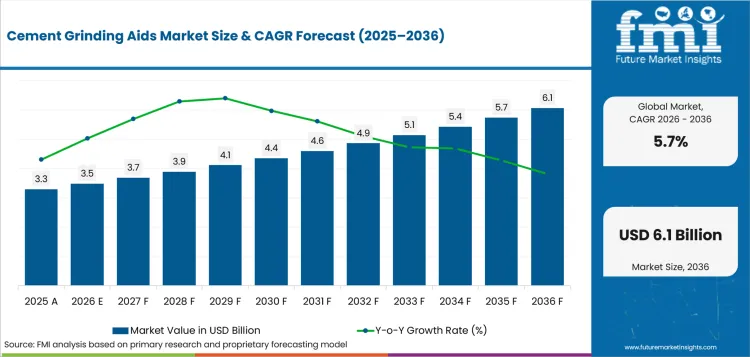
Cement Grinding Aids Market Overview: Size and Forecast
- 2026 Market Size: USD 3,560.6 million
- 2036 Market Size: USD 6,198.3 million
- Forecast CAGR: 5.7% from 2026 to 2036
- Leading Sales Channel: Direct
- Direct Share in 2026: 67.0%
- Leading End Use: Integrated Cement Plants
- Integrated Cement Plants Share in 2026: 58.0%
- Fastest-growing Country: India
- India CAGR: 6.8% by 2036
Summary of the Cement Grinding Aids Market
- Demand and Growth Drivers
- Cement producers are increasing use of grinding aids to improve mill output while protecting strength in lower-clinker cement systems.
- Plant teams are giving more attention to additives that support powder flow, pack-set control, and separator performance.
- Supplier approval is becoming more technical as buyers require mill trials, mortar tests, and downstream compatibility checks.
- Product and Segment View
- Direct sales are forecast to represent 67.0% share in 2026, led by technical contracts and plant-level approval requirements.
- Integrated cement plants are projected to hold 58.0% share in 2026, influenced by onsite laboratories controlling dosage and cement quality.
- Portland Cement is expected to secure 52.0% share in 2026, supported by broad use across general construction and ready-mix supply.
- Geography and Competitive Outlook
- India is projected to record 6.8% CAGR by 2036, backed by cement output expansion and infrastructure-led demand.
- China is expected to expand at 5.2% CAGR by 2036 through large grinding networks and regional cement capacity.
- Sika and Mapei compete through broad cement additive portfolios and strong technical service coverage.
- Saint-Gobain Construction Chemicals, CHRYSO, Fosroc, and Master Builders Solutions focus on grinding aid ranges and plant-trial support.
- Analyst Opinion
- Nikhil Kaitwade, Associate Vice President at FMI, says, “Cement grinding aids are moving into a more strategic role inside cement plants. The product is no longer bought only to lift mill output. Buyers now ask whether the additive protects strength when clinker is reduced and whether it keeps cement flow stable in silos. Cost pressure comes from electricity, carbon pricing, and the need to use more supplementary cementitious material without hurting early strength. Suppliers gain an edge when they bring laboratory testing, dosing equipment knowledge, and field support together. Clients should watch how amine blends, glycol systems, and polycarboxylate additives perform with calcined clay and limestone-rich cement. Firms that can cut grinding cost while giving plant teams predictable cement quality should hold stronger long-term accounts.”
The cement grinding aids market is expected to witness steady growth through 2036, driven by cement producers seeking higher mill efficiency, lower clinker intensity, and stable cement strength. Market expansion is further supported by additive demand from integrated cement plants and grinding units that need stronger control over powder flow, fineness, and blended cement performance.
Demand outlook is shifting toward additives that support lower-carbon binder recipes without creating mill-flow or strength instability. USGS reported 110 million tons of USA cement shipments in 2024 with an estimated value of USD 17 billion, showing the downstream scale where grinding performance affects customer supply. IEA reported that cement emissions intensity has stayed just under 0.6 tCO2 per tonne of cement, keeping pressure on producers to reduce clinker intensity. IEA also estimated that early near-zero-emission cement using carbon capture can cost 75% to 150% more than conventional production, making lower-cost grinding efficiency and supplementary cementitious material compatibility more valuable for plant buyers.
Which factors support expansion in the cement grinding aids market?
Finished grinding aid revenue and plant-trial service depth support market value across integrated cement plants and grinding units.
- Market value is supported by finished additive sales before distributor margins and plant-service costs are added.
- Supplier pricing reflects raw material chemistry and dosage requirements before cement producers compare cost per tonne.
- Revenue improves as cement plants use additives to stabilize blended cement recipes and reduce mill energy pressure.
- Buyer trust rises when suppliers document fineness response, strength retention, pack-set behavior, and downstream admixture compatibility.
Why is the cement grinding aids market growing?
Cement producers need additives that improve mill throughput and protect cement performance as clinker substitution increases.
Grinding aids are gaining value as plants try to produce more saleable cement from existing grinding lines while meeting tighter carbon and quality expectations. USGS stated that an estimated 70% to 75% of USA cement sales in 2024 went to ready-mixed concrete producers, showing why cement consistency affects the largest downstream customer group. Buyers therefore compare additives through mortar strength checks, separator response, silo flow, and concrete compatibility instead of simple drum pricing. Additives with proven field data can help producers meet cement fineness and strength targets while serving cement packaging market outlook needs across packaged and bulk channels.
How is the cement grinding aids market segmented?
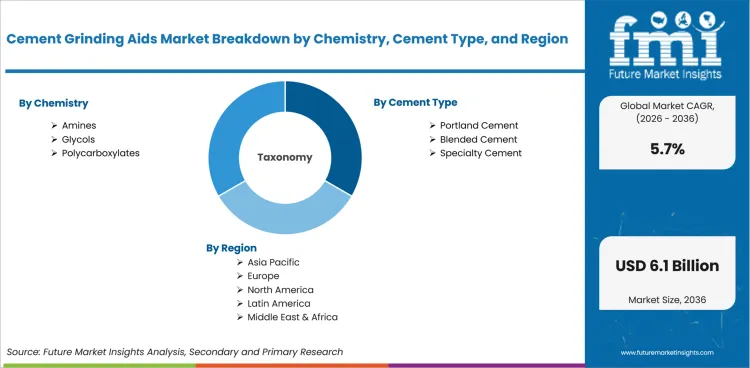
The cement grinding aids industry is segmented by chemistry, cement type, application, end use, and sales channel.
- Amines are projected to account for 46.0% of By Chemistry share in 2026, led by their proven role in dispersing particles and improving mill performance in high-volume clinker grinding.
- Portland Cement is estimated to hold 52.0% of By Cement Type share in 2026 since it remains widely used across general building, infrastructure, and ready-mix cement supply.
- Grinding Efficiency is anticipated to capture 48.0% of By Application share in 2026 due to plant focus on lower power use and higher separator productivity.
- Integrated Cement Plants are forecast to represent 58.0% of By End Use share in 2026, guided by onsite laboratories managing clinker, gypsum, additive dosage, and final cement quality.
- Direct is expected to account for 67.0% of By Sales Channel share in 2026, reflected by large cement groups requiring technical contracts, mill trials, and multi-plant supplier support.
Which chemistry leads the cement grinding aids market?
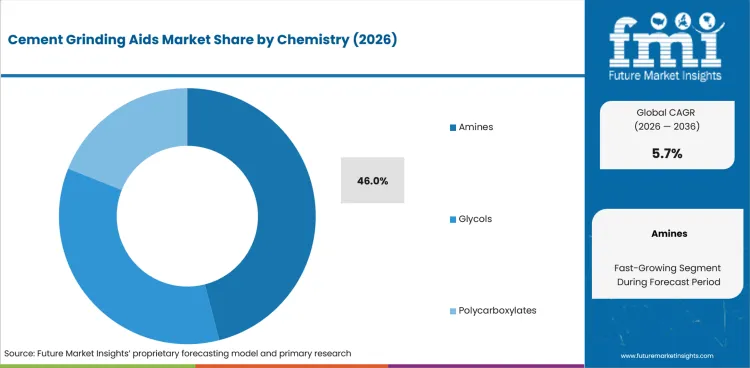
- Amines are projected to account for 46.0% share in 2026, influenced by their ability to reduce cement particle attraction during grinding and support repeatable separator performance across large mills.
- Glycols gain steady use where cement plants need reliable powder flow and balanced grinding performance across ordinary and blended cement systems.
Which cement type leads the cement grinding aids market?
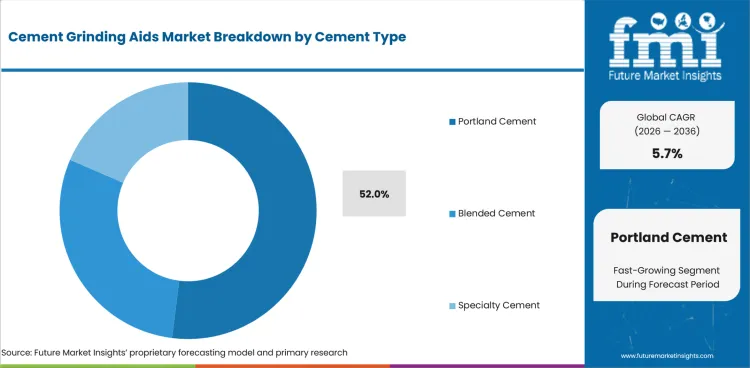
- Portland Cement is anticipated to hold 52.0% share in 2026 through its continued role in general building and infrastructure cement demand.
- Blended cement gains importance as producers reduce clinker use and need additives that protect early strength and mill response.
Which application leads the cement grinding aids market?
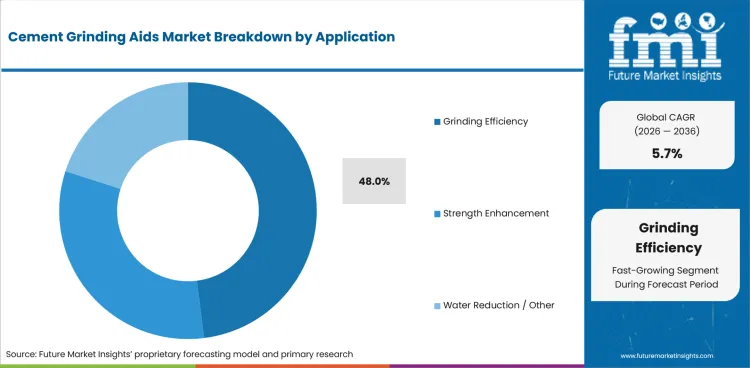
- Grinding Efficiency is forecast to secure 48.0% share in 2026, reflected by plants prioritizing lower power use and higher mill throughput.
- Strength enhancement becomes more important when limestone, slag, fly ash, or calcined clay changes hydration behavior and final cement performance.
Which end use leads the cement grinding aids market?
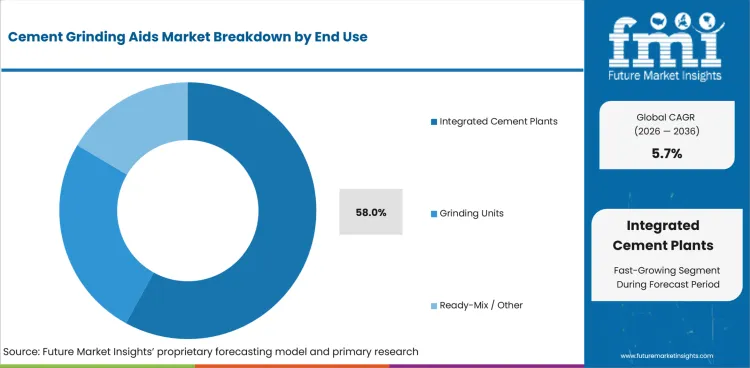
- Integrated Cement Plants are expected to represent 58.0% share in 2026, shaped by their control over kiln operations, clinker quality, grinding, and final cement testing.
- Grinding units remain important because regional cement producers require cost-effective additives and technical support for stable fineness and powder handling.
Which sales channel leads the cement grinding aids market?
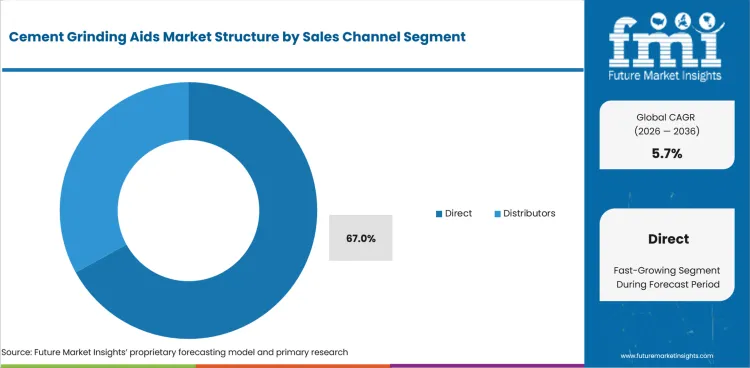
- Direct is projected to account for 67.0% share in 2026, led by large cement groups preferring technical contracts over spot buying.
- Distributors serve smaller grinding units and remote plants, while direct supplier teams win when producers need formulation changes linked to polycarboxylate ether market outlook and durability goals.
What are the driver, restraints, and opportunities in the cement grinding aids market?
Clinker substitution and energy economics support demand while compatibility risk limits uncontrolled supplier switching.
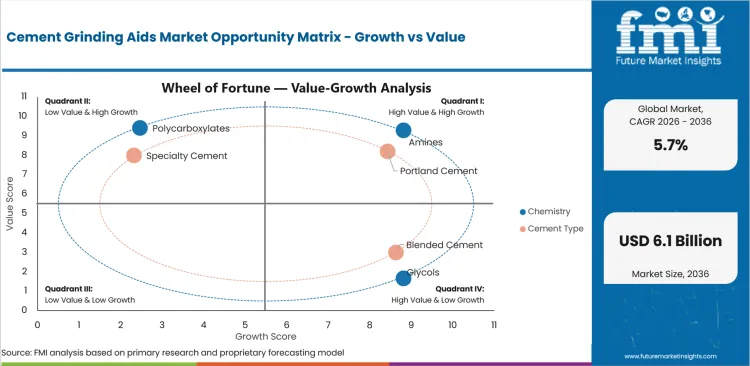
- Driver: Cement producers are using grinding aids to improve mill output and protect strength in blended cement systems.
- Restraint: Product compatibility risk can limit supplier switching when additives affect setting behavior or downstream concrete response.
- Opportunity: Calcined clay and limestone-rich cement create demand for additives designed for mixed mineral grinding.
Cement Grinding Aids Market Demand Outlook
Demand outlook is moving toward grinding aids that can support lower-clinker cement while preserving mill performance and final cement quality. GCCA introduced low-carbon cement ratings in October 2025 across seven bands from AA to F, giving buyers a clearer way to compare embodied carbon per tonne of cement product. This raises the importance of additives that support lower-carbon cement without weakening early strength or powder handling. Suppliers serving construction additives market outlook can position grinding aids as part of wider cement and concrete performance programs.
Compatibility and Approval Restraint Analysis
Compatibility risk remains the main barrier when cement producers change grinding aid suppliers. USGS reported 2025 USA cement shipments of 100 million tons, showing that mature markets still require stable additive programs even when shipment volumes soften. Poor formulation fit can affect setting time, powder flow, color, dust control, or concrete admixture response. Cement producers therefore require mortar testing, silo-flow observation, and plant trials before approving new additive supply.
SCM Performance Opportunity Analysis
Calcined clay and limestone-rich cement create opportunities for additives that support mixed mineral grinding. NITI Aayog reported in January 2026 that dry process systems can reach 3.0 to 3.4 GJ/t clinker compared with 5.9 to 6.7 GJ/t clinker for wet process systems. This reinforces why modern additive programs must align with energy-efficient plants and blended-cement recipes. Suppliers tied to specialty chemicals market outlook can support formulation reliability when cement plants vary supplementary cementitious material sources.
Which countries are growing fastest in the cement grinding aids market?
India 6.8% CAGR, China 5.2% CAGR, Germany 4.9% CAGR, United States 4.8% CAGR, France 4.7% CAGR, United Kingdom 4.5% CAGR, South Korea 4.2% CAGR, and Japan 3.9% CAGR through 2036.
.webp "Top Country Growth Comparison Cement Grinding Aids Market Cagr (2026 2036)")
| Country | CAGR |
|---|---|
| United States | 4.8% |
| United Kingdom | 4.5% |
| Germany | 4.9% |
| France | 4.7% |
| Japan | 3.9% |
| China | 5.2% |
| South Korea | 4.2% |
| India | 6.8% |
Source: Future Market Insights, 2026.
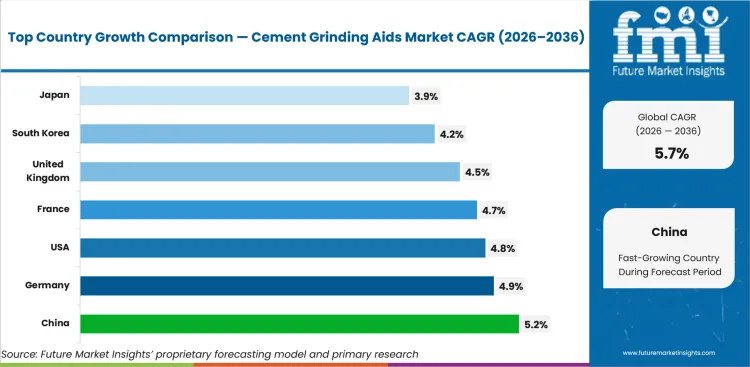
How do country-level CAGRs compare in the cement grinding aids market?
India leads country growth while Japan records the most cautious expansion outlook among profiled markets.
- India is forecast to record 6.8% CAGR by 2036 as cement output expansion raises grinding aid dosing needs.
- China is expected to expand at 5.2% CAGR from 2026 to 2036 due to large grinding networks and regional cement capacity.
- Germany is projected to grow at 4.9% CAGR through 2036 as emissions pressure supports clinker reduction and additive trials.
- The United States is estimated to rise at 4.8% CAGR by 2036 with direct technical supply supporting blended cement programs.
- France is expected to advance at 4.7% CAGR over the forecast period as public works and carbon documentation shape demand.
- The United Kingdom is forecast to grow at 4.5% CAGR through 2036 as lower output raises focus on efficiency and premium cement performance.
- South Korea is projected to post 4.2% CAGR by 2036 as grinding station operations sustain additive use.
- Japan is expected to grow at 3.9% CAGR by 2036 as mature cement demand keeps product qualification conservative.
How fast is the cement grinding aids market growing in the United States?
A 4.8% CAGR through 2036 reflects blended cement programs, direct supplier trials, and large ready-mix demand.
Country Market Snapshot Table
| Parameter | Value |
|---|---|
| Market Size in 2025 (Value) | USD 591.6 million |
| Market Size in 2026 (Value) | USD 620.0 million |
| Market Forecast in 2036 (Value) | USD 990.8 million |
| CAGR (2026 to 2036) | 4.8% |
| Years Considered | 2021 to 2036 |
| Base Year | 2025 |
| Forecast Period | 2026 to 2036 |
| Units Considered | Value (USD million) |
| Leading Sub-Region | South and Midwest integrated cement corridors |
United States Cement Grinding Aids Market Outlook
United States cement grinding aid demand is shaped by direct plant approval routes and blended cement performance requirements. Producers use additives to stabilize Portland limestone cement, protect early strength, and manage powder flow in regional cement networks.
Retailers and distributors play a smaller role than technical supplier teams because large cement groups require mill trials before approval. Additive vendors with strong laboratory support and multi-plant service coverage should gain more durable accounts.
Key Growth Drivers
- USGS estimated 2024 Portland and blended cement production at 84 million tons, supporting additive demand across high-volume cement grinding and supply routes.
- DOE selected the Mitchell Cement Plant Decarbonization Project to capture at least 95% of carbon dioxide from one of the largest USA cement plants, raising interest in process-support chemicals for low-carbon cement.
- Portland limestone cement use increases the need for additive systems that protect early strength and powder flow during broader specification adoption.
- Large integrated producers prefer direct supplier trials that combine lab testing with mill performance checks before long-term contracts are approved.
Key Restraints
- USA Census Bureau data showed April 2026 construction spending at USD 2,172.4 billion, only 0.4% above March, leaving limited short-term volume acceleration for cement additives.
- Supplier switching is slow because poor additive fit can affect setting behavior, customer acceptance, and downstream concrete performance.
- Regional cement standards require plant-specific validation, making national additive rollouts slower for suppliers without strong field support.
What makes United States unique
The United States combines large cement shipments with strict customer qualification routes across infrastructure, residential, and ready-mix channels.
Key Companies
- Sika Corporation
- GCP Applied Technologies
- Master Builders Solutions USA
- CHRYSO North America
- Mapei Corporation
- Euclid Chemical
- Cemex Admixtures
Sales & Marketing Channels
- Direct cement plant technical sales
- Regional distributor supply
- Mill trial programs
- Corporate procurement agreements
- Ready-mix technical referrals
- Sustainability specification channels
Country Segment Breakdown Table
| Segment | Sub-Segments |
|---|---|
| By Chemistry | Amines, Glycols, Polycarboxylates, Other |
| By Cement Type | Portland Cement, Blended Cement, Specialty Cement, Other |
| By Application | Grinding Efficiency, Strength Enhancement, Water Reduction / Other |
| By End Use | Integrated Cement Plants, Grinding Units, Ready-Mix / Other |
| By Sales Channel | Direct, Distributors |
| Key Sub-Regions Covered, Cement Production and Grinding Corridors | South Atlantic, Texas, California, Midwest, Rocky Mountain, Pacific Northwest |
Frequently Asked Questions
How fast is United States cement grinding aids market growing?
Sales in the United States are projected to grow at 4.8% CAGR from 2026 to 2036, guided by cement production and additive performance needs.
Who leads United States cement grinding aids market?
Sika Corporation, GCP Applied Technologies, Master Builders Solutions USA, and CHRYSO North America compete through technical service and plant-level additive programs.
What is driving adoption in United States cement grinding aids market?
Blended cement performance needs and direct supplier trial programs are moving cement producers toward better grinding aid systems.
What is the cement grinding aids market outlook in the United Kingdom?
A 4.5% CAGR through 2036 is supported by efficiency needs and lower-carbon cement specifications.
Country Market Snapshot Table
| Parameter | Value |
|---|---|
| Market Size in 2025 (Value) | USD 126.3 million |
| Market Size in 2026 (Value) | USD 132.0 million |
| Market Forecast in 2036 (Value) | USD 205.0 million |
| CAGR (2026 to 2036) | 4.5% |
| Years Considered | 2021 to 2036 |
| Base Year | 2025 |
| Forecast Period | 2026 to 2036 |
| Units Considered | Value (USD million) |
| Leading Sub-Region | Midlands and northern cement-production corridors |
United Kingdom Cement Grinding Aids Market Outlook
United Kingdom cement grinding aid demand is shaped by lower domestic production and stronger attention to efficiency at remaining plants. Producers need additives that can defend output, strength, and flow while domestic cement competes with imports.
Specification-led construction gives grinding aids a clearer value role when customers request lower-carbon cement and documented quality. Suppliers that can connect plant chemistry with contractor carbon requirements should win stronger technical preference.
Key Growth Drivers
- The Mineral Products Association reported that the United Kingdom made 7.3 million tonnes of cement in 2024, showing a concentrated domestic base where plant efficiency matters.
- ONS reported annual construction output increased by 1.8% in 2025, supporting cement demand even as plant economics stayed cautious.
- Low-carbon construction procurement increases the need for additives that support blended cement performance and consistent strength development.
- Large contractor frameworks encourage cement suppliers to document product consistency, carbon benefits, and mix performance before specification approval.
Key Restraints
- Make UK warned in June 2026 that 25% of surveyed manufacturers had moved production overseas or were considering it because of high energy costs, showing pressure on energy-intensive cement-linked supply chains.
- Import competition weakens local cement pricing power and can delay approval for premium additive programs.
- High energy costs make cement buyers sensitive to dosage economics and payback evidence during grinding aid trials.
What makes United Kingdom unique
The United Kingdom is smaller but specification-heavy, with carbon exposure and import pressure shaping grinding aid value.
Key Companies
- Sika Limited
- Mapei UK Ltd.
- Saint-Gobain Construction Chemicals UK
- Fosroc UK
- CHRYSO UK
- Master Builders Solutions UK
- Cemex UK admixtures teams
Sales & Marketing Channels
- Direct plant supply agreements
- Distributor-backed replenishment
- Contractor specification influence
- Technical service visits
- Corporate framework buying
- Carbon documentation channels
Country Segment Breakdown Table
| Segment | Sub-Segments |
|---|---|
| By Chemistry | Amines, Glycols, Polycarboxylates, Other |
| By Cement Type | Portland Cement, Blended Cement, Specialty Cement, Other |
| By Application | Grinding Efficiency, Strength Enhancement, Water Reduction / Other |
| By End Use | Integrated Cement Plants, Grinding Units, Ready-Mix / Other |
| By Sales Channel | Direct, Distributors |
| Key Sub-Regions Covered, Cement Production and Grinding Corridors | Midlands, Yorkshire, North West England, Scotland, Wales, South East England |
Frequently Asked Questions
How fast is United Kingdom cement grinding aids market growing?
Sales in the United Kingdom are projected to grow at 4.5% CAGR from 2026 to 2036, guided by efficiency needs in a smaller domestic cement base.
Who leads United Kingdom cement grinding aids market?
Sika Limited, Mapei UK Ltd., Saint-Gobain Construction Chemicals UK, and Fosroc UK compete through cement additive portfolios and field-service programs.
What is driving adoption in United Kingdom cement grinding aids market?
Lower-carbon cement specifications and mill efficiency needs are supporting grinding aid adoption across domestic cement plants.
What is driving cement grinding aids growth in Germany?
A 4.9% CAGR through 2036 reflects technical plant networks and carbon-cost pressure.
Country Market Snapshot Table
| Parameter | Value |
|---|---|
| Market Size in 2025 (Value) | USD 152.5 million |
| Market Size in 2026 (Value) | USD 160.0 million |
| Market Forecast in 2036 (Value) | USD 258.2 million |
| CAGR (2026 to 2036) | 4.9% |
| Years Considered | 2021 to 2036 |
| Base Year | 2025 |
| Forecast Period | 2026 to 2036 |
| Units Considered | Value (USD million) |
| Leading Sub-Region | North Rhine-Westphalia and southern cement clusters |
Germany Cement Grinding Aids Market Outlook
Germany demand is shaped by a technically demanding cement base and pressure to reduce clinker intensity. Producers evaluate grinding aids through energy use, setting performance, strength development, and concrete compatibility.
Direct supplier engagement remains important because German cement producers require proof before adjusting approved mill formulations. Additive suppliers with local references and field-service depth should gain stronger purchasing access.
Key Growth Drivers
- VDZ identifies the German cement industry as including 21 companies and 53 plants, giving additive suppliers a concentrated customer base for validated formulation rollouts.
- Destatis reported that 238,500 residential units were approved in Germany in 2025, up 10.8% from 2024, supporting future cement demand recovery signals.
- Emissions trading pressure pushes cement producers to reduce clinker factor and improve energy performance through validated additive systems.
- High technical standards favor grinding aids with tested compatibility across cement, concrete, and dry-mix systems.
Key Restraints
- Destatis reported that residential completions fell 18% to 206,600 units in 2025, showing how building-cycle weakness can limit cement demand despite permit recovery.
- High buyer scrutiny slows approval for suppliers without German plant references and laboratory evidence.
- Construction weakness can make cement plants postpone nonessential additive trials until demand visibility improves.
What makes Germany unique
Germany is a technical reference market where additive success depends on proof, field support, and cement-performance evidence.
Key Companies
- Sika Germany
- Mapei Germany
- Saint-Gobain Construction Chemicals Germany
- Master Builders Solutions Germany
- CHRYSO Germany
- Fosroc Europe
- MC-Bauchemie
Sales & Marketing Channels
- Direct plant technical selling
- Group-level cement procurement
- Laboratory trial support
- Distributor backup supply
- Technical seminars
- Plant audit programs
Country Segment Breakdown Table
| Segment | Sub-Segments |
|---|---|
| By Chemistry | Amines, Glycols, Polycarboxylates, Other |
| By Cement Type | Portland Cement, Blended Cement, Specialty Cement, Other |
| By Application | Grinding Efficiency, Strength Enhancement, Water Reduction / Other |
| By End Use | Integrated Cement Plants, Grinding Units, Ready-Mix / Other |
| By Sales Channel | Direct, Distributors |
| Key Sub-Regions Covered, Cement Production and Grinding Corridors | North Rhine-Westphalia, Bavaria, Baden-Württemberg, Lower Saxony, Hesse, Saxony |
Frequently Asked Questions
How fast is Germany cement grinding aids market growing?
Sales in Germany are projected to grow at 4.9% CAGR from 2026 to 2036, guided by technical cement production and carbon-cost pressure.
Who leads Germany cement grinding aids market?
Sika Germany, Mapei Germany, Saint-Gobain Construction Chemicals Germany, and Master Builders Solutions Germany compete through technical service and plant references.
What is driving adoption in Germany cement grinding aids market?
Adoption is supported by clinker reduction needs, technical cement standards, and validated additive performance across plant networks.
How is the cement grinding aids market performing in France?
A 4.7% CAGR through 2036 reflects carbon documentation and public works demand.
Country Market Snapshot Table
| Parameter | Value |
|---|---|
| Market Size in 2025 (Value) | USD 135.6 million |
| Market Size in 2026 (Value) | USD 142.0 million |
| Market Forecast in 2036 (Value) | USD 224.8 million |
| CAGR (2026 to 2036) | 4.7% |
| Years Considered | 2021 to 2036 |
| Base Year | 2025 |
| Forecast Period | 2026 to 2036 |
| Units Considered | Value (USD million) |
| Leading Sub-Region | Metropolitan France cement and public works clusters |
France Cement Grinding Aids Market Outlook
France cement grinding aid demand is influenced by producer concentration, lower-carbon cement priorities, and public works requirements. Additives gain value when they support clinker reduction without weakening strength or flowability.
French buyers place high weight on carbon performance and quality documentation. Suppliers that connect cement grinding aids with dry-mix mortar and concrete performance should strengthen approval chances.
Key Growth Drivers
- France Ciment reported 15.970 million tonnes of cement production in metropolitan France for 2024, supporting a meaningful technical additive base.
- INSEE reported that the Cost-of-Construction Index stood at 2,058 in Q4 2025 and decreased 2.37% over a year, creating some relief for project economics and cement purchasing.
- French clinker reduction targets encourage more performance-enhancer use in blended cement production.
- Major cement groups can roll out successful additive formulas across multiple French plants after technical validation.
Key Restraints
- FIEC reported that French construction activity declined by 3.9% in 2024 and expected a 2.6% volume decline in 2025, limiting near-term cement consumption momentum.
- Supplier approval can take time when formulations affect downstream mortar and concrete behavior.
- Weak housing activity can reduce cement output and delay discretionary additive upgrades.
What makes France unique
France combines national cement decarbonization targets with a concentrated producer structure that supports technical supplier partnerships.
Key Companies
- Sika France
- Mapei France
- Saint-Gobain Construction Chemicals France
- CHRYSO France
- Fosroc France
- GCP Applied Technologies Europe
- Vicat technical suppliers
Sales & Marketing Channels
- Direct cement group contracts
- Laboratory validation programs
- Distributor replenishment
- Dry-mix customer referrals
- Sustainability specification channels
- Public works procurement influence
Country Segment Breakdown Table
| Segment | Sub-Segments |
|---|---|
| By Chemistry | Amines, Glycols, Polycarboxylates, Other |
| By Cement Type | Portland Cement, Blended Cement, Specialty Cement, Other |
| By Application | Grinding Efficiency, Strength Enhancement, Water Reduction / Other |
| By End Use | Integrated Cement Plants, Grinding Units, Ready-Mix / Other |
| By Sales Channel | Direct, Distributors |
| Key Sub-Regions Covered, Cement Production and Grinding Corridors | Île-de-France, Auvergne-Rhône-Alpes, Occitanie, Provence-Alpes-Côte d’Azur, Hauts-de-France, Grand Est |
Frequently Asked Questions
How fast is France cement grinding aids market growing?
Sales in France are projected to grow at 4.7% CAGR from 2026 to 2036, guided by cement quality control and carbon documentation.
Who leads France cement grinding aids market?
Sika France, Mapei France, Saint-Gobain Construction Chemicals France, and CHRYSO France compete through technical service and cement additive portfolios.
What is driving adoption in France cement grinding aids market?
Adoption is supported by blended cement performance needs, public works specifications, and direct cement group approvals.
What is the cement grinding aids market forecast for Japan?
A 3.9% CAGR through 2036 reflects conservative qualification and quality-driven cement demand.
Country Market Snapshot Table
| Parameter | Value |
|---|---|
| Market Size in 2025 (Value) | USD 92.4 million |
| Market Size in 2026 (Value) | USD 96.0 million |
| Market Forecast in 2036 (Value) | USD 140.7 million |
| CAGR (2026 to 2036) | 3.9% |
| Years Considered | 2021 to 2036 |
| Base Year | 2025 |
| Forecast Period | 2026 to 2036 |
| Units Considered | Value (USD million) |
| Leading Sub-Region | Kyushu, Yamaguchi, and Kanto cement corridors |
Japan Cement Grinding Aids Market Outlook
Japan demand tracks a mature but quality-driven cement sector where setting reliability and strength consistency carry high importance. Cement producers use grinding aids carefully because product changes must fit strict construction performance expectations.
Supplier trust and long-term technical support are central to additive selection. Vendors with stable local service and evidence across Portland and slag cement systems should gain stronger repeat accounts.
Key Growth Drivers
- Japan Cement Association reported that the industry had 26 plants owned by 15 companies as of July 2025, with clinker production capacity of 47 million tons.
- Renewable Energy Institute noted in October 2025 that ordinary Portland cement accounts for more than 70% of Japanese domestic cement sales, keeping proven grinding aid systems relevant.
- Aging infrastructure repair supports demand for consistent cement quality and reliable strength performance.
- Compact producer networks allow proven additive systems to scale through long-term supply ties after technical validation.
Key Restraints
- Japan Cement Association highlighted high plant concentration in Kyushu with 5 plants and the Kanto district with 6 plants, making regional cement demand patterns important for supplier planning.
- Conservative approval habits slow new chemistry introduction unless plant trial evidence is strong.
- Mature construction demand limits additive volume gains compared with India or China.
What makes Japan unique
Japan is a precision-driven market where supplier trust and quality stability outweigh low-cost substitution.
Key Companies
- Sika Japan
- Mapei Japan
- Saint-Gobain Construction Chemicals Japan
- Taiheiyo Materials technical partners
- Denka construction materials teams
- Ube Mitsubishi Cement technical buyers
- Sumitomo Osaka Cement technical buyers
Sales & Marketing Channels
- Direct technical sales
- Local chemical distributors
- Plant-level trial programs
- Corporate quality approvals
- Ready-mix technical networks
- Seismic infrastructure specification channels
Country Segment Breakdown Table
| Segment | Sub-Segments |
|---|---|
| By Chemistry | Amines, Glycols, Polycarboxylates, Other |
| By Cement Type | Portland Cement, Blended Cement, Specialty Cement, Other |
| By Application | Grinding Efficiency, Strength Enhancement, Water Reduction / Other |
| By End Use | Integrated Cement Plants, Grinding Units, Ready-Mix / Other |
| By Sales Channel | Direct, Distributors |
| Key Sub-Regions Covered, Cement Production and Grinding Corridors | Kyushu, Yamaguchi, Kanto, Kansai, Chubu, Hokkaido |
Frequently Asked Questions
How fast is Japan cement grinding aids market growing?
Sales in Japan are projected to grow at 3.9% CAGR from 2026 to 2036, guided by quality-driven cement production.
Who leads Japan cement grinding aids market?
Sika Japan, Mapei Japan, Saint-Gobain Construction Chemicals Japan, and Taiheiyo Materials technical partners compete through quality-oriented cement programs.
What is driving adoption in Japan cement grinding aids market?
Adoption is supported by stable cement quality requirements, conservative plant qualification, and long-term technical supplier relationships.
How fast is the cement grinding aids market growing in China?
A 5.2% CAGR through 2036 reflects massive grinding volume and cost-focused additive demand.
Country Market Snapshot Table
| Parameter | Value |
|---|---|
| Market Size in 2025 (Value) | USD 836.5 million |
| Market Size in 2026 (Value) | USD 880.0 million |
| Market Forecast in 2036 (Value) | USD 1,461.0 million |
| CAGR (2026 to 2036) | 5.2% |
| Years Considered | 2021 to 2036 |
| Base Year | 2025 |
| Forecast Period | 2026 to 2036 |
| Units Considered | Value (USD million) |
| Leading Sub-Region | Eastern coastal provinces and inland grinding networks |
China Cement Grinding Aids Market Outlook
China is the largest volume arena for cement grinding aids because its cement base remains extensive despite property-sector pressure. Producers focus on cost per tonne, dosage efficiency, and regional supply reliability.
Domestic chemical suppliers compete strongly with global brands. Additives gain acceptance when they reduce mill cost, support blended cement, and help plants manage powder handling under intense price scrutiny.
Key Growth Drivers
- The International Trade Administration stated in September 2025 that China remained the world’s largest construction market, valued at approximately USD 4.82 trillion in 2025.
- China’s State Council reported an early 2026 investment plan of about 295 billion yuan for major projects, supporting infrastructure-led cement demand outside property cycles.
- Large cement output keeps additive dosing volumes high even during cyclical downturns.
- Domestic chemical supply enables price-competitive formulations for regional cement plants and grinding units.
Key Restraints
- China’s National Bureau of Statistics reported real estate development investment of 8,278.8 billion yuan in 2025, down 17.2% year on year, keeping property-linked cement demand under pressure.
- Cement overcapacity can push buyers toward low-price additive tenders and shorter approval windows.
- Property-sector weakness can reduce near-term cement grinding activity in several provinces.
What makes China unique
China is the largest volume market, but suppliers must prove cost savings under intense plant-level price pressure.
Key Companies
- Sika China
- Mapei China
- Saint-Gobain Construction Chemicals China
- CHRYSO China
- GCP Applied Technologies China
- Local amine and glycol formulators
- Regional admixture suppliers
Sales & Marketing Channels
- Direct group procurement
- Provincial distributor networks
- Plant trial programs
- Chemical feedstock partnerships
- Regional technical service teams
- Infrastructure contractor referrals
Country Segment Breakdown Table
| Segment | Sub-Segments |
|---|---|
| By Chemistry | Amines, Glycols, Polycarboxylates, Other |
| By Cement Type | Portland Cement, Blended Cement, Specialty Cement, Other |
| By Application | Grinding Efficiency, Strength Enhancement, Water Reduction / Other |
| By End Use | Integrated Cement Plants, Grinding Units, Ready-Mix / Other |
| By Sales Channel | Direct, Distributors |
| Key Sub-Regions Covered, Cement Production and Grinding Corridors | Eastern China, South China, Central China, Sichuan-Chongqing, North China, Western China |
Frequently Asked Questions
How fast is China cement grinding aids market growing?
Sales in China are projected to grow at 5.2% CAGR from 2026 to 2036, guided by large cement grinding networks.
Who leads China cement grinding aids market?
Sika China, Mapei China, Saint-Gobain Construction Chemicals China, and CHRYSO China compete with global and regional additive suppliers.
What is driving adoption in China cement grinding aids market?
Adoption is supported by large cement output, dosage efficiency needs, and cost-focused grinding performance programs.
What is the outlook for cement grinding aids in South Korea?
A 4.2% CAGR through 2036 reflects grinding station density and export-quality requirements.
Country Market Snapshot Table
| Parameter | Value |
|---|---|
| Market Size in 2025 (Value) | USD 82.5 million |
| Market Size in 2026 (Value) | USD 86.0 million |
| Market Forecast in 2036 (Value) | USD 129.8 million |
| CAGR (2026 to 2036) | 4.2% |
| Years Considered | 2021 to 2036 |
| Base Year | 2025 |
| Forecast Period | 2026 to 2036 |
| Units Considered | Value (USD million) |
| Leading Sub-Region | Gangwon, Chungcheong, and export-linked grinding corridors |
South Korea Cement Grinding Aids Market Outlook
South Korea demand is supported by a compact cement industry with grinding stations that need mill efficiency and powder handling support. Buyers weigh cost, reliability, and export-grade quality consistency.
Technical suppliers can gain approval when additives show stable flow, strength, and pack-set performance across domestic and export shipments. Direct relationships and trading channels both remain important.
Key Growth Drivers
- World Cement Association stated that the Korea Cement Association represents 9 member companies with 11 kiln plants and 23 grinding stations.
- Korea Cement Association data cited in December 2025 expected cement exports to rise 52% year over year to 4.5 million tonnes, increasing the value of consistent powder handling.
- Grinding station density supports steady demand for mill efficiency additives and pack-set control.
- Concentrated producer membership makes technical references important for supplier selection.
Key Restraints
- OECD data hosted by the Federal Reserve Bank of St. Louis showed Korean dwelling and residential building permits declined by 5.23% in 2025, indicating restraint from domestic building softness.
- Regional suppliers face strong price discipline from large cement buyers.
- Domestic construction softness can limit cement output and reduce additive volume growth.
What makes South Korea unique
South Korea combines compact cement capacity with export discipline, making quality consistency central to additive value.
Key Companies
- Sika Korea
- Mapei Korea
- Saint-Gobain Construction Chemicals Korea
- CHRYSO Korea
- Local chemical distributors
- SsangYong C&E technical buyers
- Hanil Cement technical buyers
Sales & Marketing Channels
- Direct cement producer supply
- Trading company channels
- Local chemical distributors
- Plant trial programs
- Export-quality technical support
- Corporate procurement contracts
Country Segment Breakdown Table
| Segment | Sub-Segments |
|---|---|
| By Chemistry | Amines, Glycols, Polycarboxylates, Other |
| By Cement Type | Portland Cement, Blended Cement, Specialty Cement, Other |
| By Application | Grinding Efficiency, Strength Enhancement, Water Reduction / Other |
| By End Use | Integrated Cement Plants, Grinding Units, Ready-Mix / Other |
| By Sales Channel | Direct, Distributors |
| Key Sub-Regions Covered, Cement Production and Grinding Corridors | Gangwon, Chungcheong, Gyeonggi, Busan-Ulsan corridor, Seoul Capital Area, Jeolla |
Frequently Asked Questions
How fast is South Korea cement grinding aids market growing?
Sales in South Korea are projected to grow at 4.2% CAGR from 2026 to 2036, guided by grinding station operations and export-quality requirements.
Who leads South Korea cement grinding aids market?
Sika Korea, Mapei Korea, Saint-Gobain Construction Chemicals Korea, and CHRYSO Korea compete through technical service and additive supply programs.
What is driving adoption in South Korea cement grinding aids market?
Mill efficiency needs, powder handling control, and export-quality cement performance are supporting grinding aid adoption.
How fast is India cement grinding aids market growing?
A 6.8% CAGR through 2036 reflects cement output expansion and blended cement intensity.
Country Market Snapshot Table
| Parameter | Value |
|---|---|
| Market Size in 2025 (Value) | USD 486.9 million |
| Market Size in 2026 (Value) | USD 520.0 million |
| Market Forecast in 2036 (Value) | USD 1,004.0 million |
| CAGR (2026 to 2036) | 6.8% |
| Years Considered | 2021 to 2036 |
| Base Year | 2025 |
| Forecast Period | 2026 to 2036 |
| Units Considered | Value (USD million) |
| Leading Sub-Region | Western, southern, and central cement production belts |
India Cement Grinding Aids Market Outlook
India is the fastest-growing selected market because cement output expansion and blended cement intensity reinforce each other. Producers use grinding aids to raise mill throughput and manage early strength when fly ash, slag, limestone, or calcined clay content changes.
Direct sales, regional distributors, and cement group procurement all matter because plant networks vary by region. Suppliers with dosing support and field laboratories should gain stronger contracts with large groups and grinding units.
Key Growth Drivers
- IBEF expects India’s cement production to reach about 490 million tonnes in FY26, up from 453 million tonnes in FY25, registering an estimated 8% to 9% year-on-year increase.
- India.gov.in stated that FY2025-26 capital expenditure of ₹11.21 lakh crore, equal to 3.1% of GDP, was earmarked in the Union Budget, supporting infrastructure-led cement consumption.
- Blended cement production increases the need for strength enhancers and grinding efficiency products across integrated plants and grinding units.
- Regional infrastructure work supports cement demand across roads, metro, housing, and industrial projects.
Key Restraints
- Cement Manufacturers’ Association states that about 99% of Indian cement plants use dry process technology, leaving less room for easy efficiency gains without plant-specific formulation tuning.
- Strong price sensitivity can limit premium additive use outside major cement groups.
- Raw material variation across regions requires formulation tuning and plant-specific trials before supplier approval.
What makes India unique
India is unique because volume growth and blended cement intensity together increase the need for grinding aid performance control.
Key Companies
- Sika India
- CHRYSO India
- Fosroc India
- Mapei India
- GCP Applied Technologies India
- Master Builders Solutions India
- ECMAS Construction Chemicals
Sales & Marketing Channels
- Direct cement group contracts
- Regional chemical distributors
- Grinding unit supply channels
- Plant trial and dosing support
- Infrastructure contractor referrals
- Dry-mix manufacturer referrals
Country Segment Breakdown Table
| Segment | Sub-Segments |
|---|---|
| By Chemistry | Amines, Glycols, Polycarboxylates, Other |
| By Cement Type | Portland Cement, Blended Cement, Specialty Cement, Other |
| By Application | Grinding Efficiency, Strength Enhancement, Water Reduction / Other |
| By End Use | Integrated Cement Plants, Grinding Units, Ready-Mix / Other |
| By Sales Channel | Direct, Distributors |
| Key Sub-Regions Covered, Cement Production and Grinding Corridors | Gujarat, Maharashtra, Rajasthan, Tamil Nadu, Andhra Pradesh, Telangana, Chhattisgarh |
Frequently Asked Questions
How fast is India cement grinding aids market growing?
Sales in India are projected to grow at 6.8% CAGR from 2026 to 2036, guided by cement output expansion and grinding capacity additions.
Who leads India cement grinding aids market?
Sika India, CHRYSO India, Fosroc India, and Mapei India compete through cement additive portfolios and plant-level technical support.
What is driving adoption in India cement grinding aids market?
Cement output expansion, blended cement use, and infrastructure demand are moving producers toward grinding aid adoption.
Who are the leading companies in the cement grinding aids market?
Sika, Mapei, Saint-Gobain Construction Chemicals, CHRYSO, GCP Applied Technologies, Fosroc, and Master Builders Solutions.
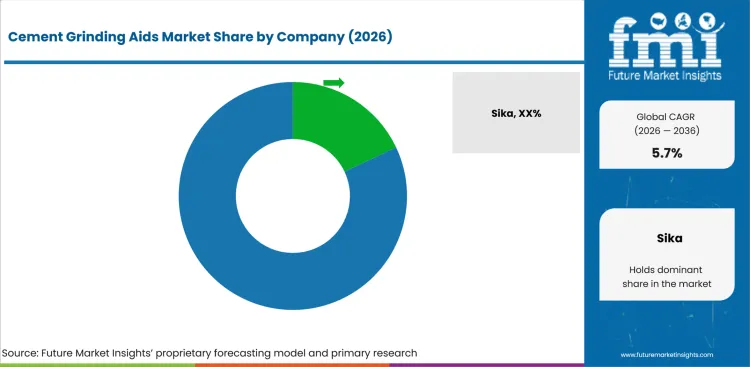
- Integrated construction chemical platforms hold an advantage through cement additive ranges, laboratory support, and multinational technical teams.
- Cement additive specialists gain account access through grinding aids, performance enhancers, and direct mill-trial service capabilities.
- Regional formulators win smaller grinding units when delivered cost, service speed, and local raw material access matter more than global reach.
- Suppliers with field evidence for clinker reduction, powder flow, and concrete compatibility should gain stronger repeat contracts.
Competition is organized around cement additive formulators, construction chemical platforms, and regional technical suppliers. Global competitors stand out through formulation breadth and plant-service depth, while regional suppliers win when response speed and delivered cost matter most. Cement producers buy proof rather than chemical volume, so suppliers must demonstrate the effect on mill output, cement fineness, and strength development. Firms serving tile adhesive market outlook and dry-mix systems can extend cement chemistry knowledge into downstream channels.
Buyer criteria are moving toward compatibility and sustainability claims backed by field evidence. Cement producers want additives that let them use less clinker while keeping cement strength stable. Field laboratories, dosing know-how, and cement chemistry support are becoming more important than basic distribution reach. Suppliers connected with dry mix mortar market outlook can support broader performance discussions beyond mill output.
Entry remains difficult for small formulators because cement producers cannot risk customer complaints from pack set, poor flow, delayed strength, or admixture incompatibility. New suppliers must fund site trials and provide rapid troubleshooting. Regional suppliers can win smaller grinding units through lower prices and fast delivery, but large integrated groups favor companies that can support multiple plants across countries and align with waterproofing chemicals market outlook and repair chemistry programs.
How do top cement grinding aids companies compare?
Sika, Mapei, and Saint-Gobain score strongest on portfolio depth while CHRYSO, GCP, Fosroc, and Master Builders Solutions compete through technical service and application breadth.
| Company | Cement Additive Portfolio Depth | Mill Trial Support Strength | SCM Compatibility Evidence | Geographic Footprint |
|---|---|---|---|---|
| Sika | High | High | Strong | Global |
| Mapei | High | High | Strong | Global |
| Saint-Gobain Construction Chemicals | High | High | Strong | Global |
| CHRYSO | High | Strong | Strong | Global |
| GCP Applied Technologies | High | Strong | Strong | Global |
| Fosroc | High | Strong | Medium | India, Middle East, Asia-Pacific |
| Master Builders Solutions | High | Medium | Medium | Global brand footprint |
| Cementaid | Medium | Medium | Moderate | Asia-Pacific and selected regions |
| ECMAS | Medium | Medium | Moderate | India |
Source: Future Market Insights competitive analysis, 2026.
Who are the key players in the cement grinding aids market?
Sika, Mapei, Saint-Gobain Construction Chemicals, CHRYSO, GCP Applied Technologies, Fosroc, and Master Builders Solutions are listed among leading suppliers.
Key global companies leading the cement grinding aids market include:
- Sika
- Mapei
- Saint-Gobain Construction Chemicals
- CHRYSO
- GCP Applied Technologies
- Fosroc
- Master Builders Solutions
- Cementaid
- ECMAS
- Cemex Admixtures
Key Developments in Cement Grinding Aids Market
- In April 2025, Mapei opened a 30,000 square metre plant in Egypt that will produce products including concrete admixtures and grinding aids for cement production.
- In February 2025, Saint-Gobain completed the acquisition of Fosroc, adding a construction chemicals platform with a strong footprint in India, the Middle East, and Asia-Pacific.
- In April 2025, Sika opened a new production facility in Ust-Kamenogorsk with production lines for mortar and concrete admixtures and a modern laboratory.
Key Players in the Cement Grinding Aids Market
Integrated Construction Chemical Platforms
- Sika
- Mapei
- Saint-Gobain Construction Chemicals
Cement Additive Specialists
- CHRYSO
- GCP Applied Technologies
- Fosroc
- Master Builders Solutions
Application and Regional Players
- Cementaid
- ECMAS
- Cemex Admixtures
Cement Grinding Aids Market - Report Scope
| Parameter | Details |
|---|---|
| Forecast period | 2026 to 2036 |
| Historical period | 2021 to 2025 |
| Quantitative unit | Revenue in USD million |
| By chemistry | Amines, glycols, polycarboxylates, other |
| By cement type | Portland cement, blended cement, specialty cement, other |
| By application | Grinding efficiency, strength enhancement, water reduction / other |
| By end use | Integrated cement plants, grinding units, ready-mix / other |
| By sales channel | Direct, distributors |
| Regions covered | North America, Latin America, Europe, East Asia, South Asia and Pacific, Middle East and Africa |
| Countries covered | United States, United Kingdom, Germany, France, Japan, China, South Korea, India |
| Key companies profiled | Sika, Mapei, Saint-Gobain Construction Chemicals, CHRYSO, GCP Applied Technologies, Fosroc, Master Builders Solutions |
| Approach | Hybrid bottom-up and top-down methodology using cement output proxies, additive dosage assumptions, pricing checks, and segment use rates |
Source: Future Market Insights, 2026.
Cement Grinding Aids Market - Scope & Definition
| Attribute | Detail |
|---|---|
| Market Definition | Chemical additives used during cement grinding to improve mill efficiency, reduce agglomeration, support cement strength, and improve powder handling. |
| Functions Covered | Mill output improvement, particle dispersion, pack-set reduction, strength support, powder-flow improvement, and additive compatibility control. |
| Applications Covered | Grinding efficiency, strength enhancement, water reduction / other performance support, and blended cement performance control. |
| End-Use Industries | Integrated cement plants, independent grinding units, ready-mix linked cement supply, dry-mix mortar producers, and construction material manufacturers. |
| Grades Covered | Amine-based, glycol-based, polycarboxylate-based, and other cement grinding aid formulations. |
| Inclusions | All commercially traded cement grinding aid products sold by chemistry, cement type, application, end use, and sales channel across selected countries. |
| Exclusions | Finished cement, clinker, supplementary cementitious materials sold alone, concrete admixtures not used during grinding, grinding mills, dosing pumps sold without chemicals, and carbon capture equipment. |
Cement Grinding Aids Market - Research Methodology
| Method | Description |
|---|---|
| Primary Research | FMI analyst interviews with cement producers, grinding unit operators, additive suppliers, distributors, procurement teams, and quality-control managers across selected markets. |
| Desk Research | Review of cement production statistics, official construction data, decarbonization documents, company product portfolios, technical additive literature, and credible trade-body sources. |
| Market Sizing & Forecasting | Hybrid bottom-up and top-down approach using cement output proxies, additive dosage assumptions, pricing checks, chemistry mix, plant type, and country-level demand signals. |
| Data Validation | Cross-verification using cement output trends, supplier portfolio evidence, additive chemistry use, end-use demand, channel behavior, and plant trial approval patterns. |
Cement Grinding Aids Market Breakdown by Chemistry, Cement Type, Application, End Use, Sales Channel, and Region
Cement Grinding Aids Market Segmented by Chemistry
- Amines
- Glycols
- Polycarboxylates
- Other
Cement Grinding Aids Market Segmented by Cement Type
- Portland Cement
- Blended Cement
- Specialty Cement
- Other
Cement Grinding Aids Market Segmented by Application
- Grinding Efficiency
- Strength Enhancement
- Water Reduction / Other
Cement Grinding Aids Market Segmented by End Use
- Integrated Cement Plants
- Grinding Units
- Ready-Mix / Other
Cement Grinding Aids Market Segmented by Sales Channel
- Direct
- Distributors
Cement Grinding Aids Market by Region
- North America
- Latin America
- Europe
- East Asia
- South Asia and Pacific
- Middle East and Africa
Research Sources and Bibliography
- USA Geological Survey. (2025, January). Cement mineral commodity summary 2025. USA Geological Survey.
- USA Geological Survey. (2026, January). Cement mineral commodity summary 2026. USA Geological Survey.
- International Energy Agency. (2025, September). Cement. International Energy Agency.
- International Energy Agency. (2025, October). Cement and concrete: Breakthrough Agenda Report 2025. International Energy Agency.
- Global Cement and Concrete Association. (2025, October 15). Global low-carbon ratings for concrete and cement. GCCA.
- Global Cement and Concrete Association. (2025, November 6). Cement and concrete industry net zero action and progress report. GCCA.
- NITI Aayog. (2026, January). Roadmap for cement sector decarbonisation. Government of India.
- USA Department of Energy. (2026, June 10). Industrial Demonstrations Program selected and awarded projects: Cement and concrete. USA Department of Energy.
- USA Census Bureau. (2026, June 1). Monthly construction spending, April 2026. USA Department of Commerce.
- Mineral Products Association. (2025, September 3). Government building plans at risk as UK cement production falls to 75-year low. Mineral Products Association.
- Office for National Statistics. (2026, February 12). Construction output in Great Britain: December 2025, new orders and construction output price indices. Office for National Statistics.
- Make UK. (2026, June). UK manufacturing energy competitiveness survey. Make UK.
- Verein Deutscher Zementwerke. (2025, July). Cement industry. VDZ.
- Federal Statistical Office of Germany. (2026, February 18). Permits for housing construction in Germany, 2025. Destatis.
- Federal Statistical Office of Germany. (2026, May 22). Residential construction completions in Germany, 2025. Destatis.
- France Ciment. (2025, July). Le ciment en chiffres 2025. France Ciment.
- Institut national de la statistique et des études économiques. (2026, March 24). Construction cost index, fourth quarter 2025. INSEE.
- European Construction Industry Federation. (2025, June). Statistical report: France construction activity. FIEC.
- Japan Cement Association. (2025, July). Japan cement association profile. Japan Cement Association.
- Renewable Energy Institute. (2025, October 16). The decarbonization pathway for Japan’s cement industry. Renewable Energy Institute.
- International Trade Administration. (2025, September 25). China: Design and construction. USA Department of Commerce.
- National Development and Reform Commission. (2025, December 31). Early 2026 investment plan for major projects. NDRC.
- National Bureau of Statistics of China. (2026, January 20). Investment in real estate development for 2025. National Bureau of Statistics of China.
- World Cement Association. (2025, May). Korea Cement Association. World Cement Association.
- Korea Cement Association. (2025, December 8). Cement exports outlook for 2025. Korea Cement Association.
- Federal Reserve Bank of St. Louis. (2026, April 15). Orders: Construction permits issued for dwellings and residential buildings for Korea. FRED.
- India Brand Equity Foundation. (2026, February). Indian cement industry analysis. IBEF.
- Government of India. (2025, February 1). Union Budget 2025-2026. National Portal of India.
- Cement Manufacturers’ Association. (2025, August). Making every drop count: A water positive industry. Cement Manufacturers’ Association.
- Mapei. (2025, April 16). Mapei opens a new plant in Egypt. Mapei.
- Fosroc. (2025, February 10). Saint-Gobain completes the acquisition of Fosroc. Fosroc.
- Sika. (2025, April 8). Sika opens a new plant in Kazakhstan. Sika.
This bibliography is provided for reader reference and is not exhaustive. The full report contains the complete reference list and detailed citations.
This Report Answers
- Market size estimates for 2026 and forecasts through 2036 for the cement grinding aids market.
- Insights across selected regional and country-level markets covering North America, Europe, East Asia, and South Asia.
- Analysis of demand drivers, mill efficiency needs, clinker reduction programs, and additive compatibility risks.
- Evaluation of key chemistry, cement type, application, end-use, and sales channel segments.
- Assessment of country-level growth trends covering the United States, United Kingdom, Germany, France, Japan, China, South Korea, and India.
- Identification of competitive positioning across integrated construction chemical platforms and cement additive specialists.
- Review of relevant source-backed statistics, company developments, and official market context supporting the analysis.
- Explanation of what is included and excluded from the cement grinding aids market scope.
Frequently Asked Questions
What is the growth prospect for cement grinding aids?
Demand for cement grinding aids is expected to rise at a steady pace as cement producers seek mill efficiency, lower clinker intensity, and stable cement quality.
Which companies are expected to shape the cement grinding aids market?
Sika, Mapei, Saint-Gobain Construction Chemicals, CHRYSO, Fosroc, GCP Applied Technologies, and Master Builders Solutions are expected to shape competition through cement additive portfolios and plant-level technical support.
Why are leading construction chemical companies investing in cement grinding aids?
Leading construction chemical companies are investing in cement grinding aids to serve cement producers that need better mill output, strength retention, and blended cement compatibility.
Why are direct sales important in the cement grinding aids market?
Direct sales are important because large cement plants usually require supplier trials, dosage checks, and technical service before approving additive contracts.
Which product chemistries are gaining attention in cement grinding aids?
Amines, glycols, and polycarboxylates are gaining attention as cement producers compare particle dispersion, grinding efficiency, and cement performance benefits.
How do regulations influence cement grinding aid adoption?
Regulations influence adoption by increasing pressure on cement producers to reduce clinker intensity and document lower-carbon cement performance.
Why is technical service important for cement grinding aids?
Technical service is important since cement plants need support with dosage control, mill response, strength testing, and downstream concrete compatibility.
What role do blended cements play in cement grinding aid demand?
Blended cements increase demand because additives help manage strength development, particle distribution, and grinding response when clinker content is reduced.
How do grinding units support cement grinding aids demand?
Grinding units support demand by using additives to improve mill throughput, control powder flow, and maintain cement quality across regional production networks.
Preview the report firsthand - request a free sample
Get SampleGet the brochure for pricing and purchase details.
Get PDFTable of Content
- Executive Summary
- Global Market Outlook
- Demand-side Trends
- Supply-side Trends
- Technology Roadmap Analysis
- Analysis and Recommendations
- Market Overview
- Market Coverage / Taxonomy
- Market Definition / Scope / Limitations
- Research Methodology
- Chapter Orientation
- Analytical Lens and Working Hypotheses
- Market Structure, Signals, and Trend Drivers
- Benchmarking and Cross-market Comparability
- Market Sizing, Forecasting, and Opportunity Mapping
- Research Design and Evidence Framework
- Desk Research Programme (Secondary Evidence)
- Company Annual and Sustainability Reports
- Peer-reviewed Journals and Academic Literature
- Corporate Websites, Product Literature, and Technical Notes
- Earnings Decks and Investor Briefings
- Statutory Filings and Regulatory Disclosures
- Technical White Papers and Standards Notes
- Trade Journals, Industry Magazines, and Analyst Briefs
- Conference Proceedings, Webinars, and Seminar Materials
- Government Statistics Portals and Public Data Releases
- Press Releases and Reputable Media Coverage
- Specialist Newsletters and Curated Briefings
- Sector Databases and Reference Repositories
- FMI Internal Proprietary Databases and Historical Market Datasets
- Subscription Datasets and Paid Sources
- Social Channels, Communities, and Digital Listening Inputs
- Additional Desk Sources
- Expert Input and Fieldwork (Primary Evidence)
- Primary Modes
- Qualitative Interviews and Expert Elicitation
- Quantitative Surveys and Structured Data Capture
- Blended Approach
- Why Primary Evidence is Used
- Field Techniques
- Interviews
- Surveys
- Focus Groups
- Observational and In-context Research
- Social and Community Interactions
- Stakeholder Universe Engaged
- C-suite Leaders
- Board Members
- Presidents and Vice Presidents
- R&D and Innovation Heads
- Technical Specialists
- Domain Subject-matter Experts
- Scientists
- Physicians and Other Healthcare Professionals
- Governance, Ethics, and Data Stewardship
- Research Ethics
- Data Integrity and Handling
- Primary Modes
- Tooling, Models, and Reference Databases
- Desk Research Programme (Secondary Evidence)
- Data Engineering and Model Build
- Data Acquisition and Ingestion
- Cleaning, Normalisation, and Verification
- Synthesis, Triangulation, and Analysis
- Quality Assurance and Audit Trail
- Market Background
- Market Dynamics
- Drivers
- Restraints
- Opportunity
- Trends
- Scenario Forecast
- Demand in Optimistic Scenario
- Demand in Likely Scenario
- Demand in Conservative Scenario
- Opportunity Map Analysis
- Product Life Cycle Analysis
- Supply Chain Analysis
- Investment Feasibility Matrix
- Value Chain Analysis
- PESTLE and Porter’s Analysis
- Regulatory Landscape
- Regional Parent Market Outlook
- Production and Consumption Statistics
- Import and Export Statistics
- Market Dynamics
- Global Market Analysis 2021 to 2025 and Forecast, 2026 to 2036
- Historical Market Size Value (USD Million) Analysis, 2021 to 2025
- Current and Future Market Size Value (USD Million) Projections, 2026 to 2036
- Y-o-Y Growth Trend Analysis
- Absolute $ Opportunity Analysis
- Global Market Pricing Analysis 2021 to 2025 and Forecast 2026 to 2036
- Global Market Analysis 2021 to 2025 and Forecast 2026 to 2036, By Chemistry
- Introduction / Key Findings
- Historical Market Size Value (USD Million) Analysis By Chemistry , 2021 to 2025
- Current and Future Market Size Value (USD Million) Analysis and Forecast By Chemistry , 2026 to 2036
- Amines
- Glycols
- Polycarboxylates
- Amines
- Y-o-Y Growth Trend Analysis By Chemistry , 2021 to 2025
- Absolute $ Opportunity Analysis By Chemistry , 2026 to 2036
- Global Market Analysis 2021 to 2025 and Forecast 2026 to 2036, By Cement Type
- Introduction / Key Findings
- Historical Market Size Value (USD Million) Analysis By Cement Type, 2021 to 2025
- Current and Future Market Size Value (USD Million) Analysis and Forecast By Cement Type, 2026 to 2036
- Portland Cement
- Blended Cement
- Specialty Cement
- Portland Cement
- Y-o-Y Growth Trend Analysis By Cement Type, 2021 to 2025
- Absolute $ Opportunity Analysis By Cement Type, 2026 to 2036
- Global Market Analysis 2021 to 2025 and Forecast 2026 to 2036, By Application
- Introduction / Key Findings
- Historical Market Size Value (USD Million) Analysis By Application, 2021 to 2025
- Current and Future Market Size Value (USD Million) Analysis and Forecast By Application, 2026 to 2036
- Grinding Efficiency
- Strength Enhancement
- Water Reduction / Other
- Grinding Efficiency
- Y-o-Y Growth Trend Analysis By Application, 2021 to 2025
- Absolute $ Opportunity Analysis By Application, 2026 to 2036
- Global Market Analysis 2021 to 2025 and Forecast 2026 to 2036, By End Use
- Introduction / Key Findings
- Historical Market Size Value (USD Million) Analysis By End Use, 2021 to 2025
- Current and Future Market Size Value (USD Million) Analysis and Forecast By End Use, 2026 to 2036
- Integrated Cement Plants
- Grinding Value (USD Million)s
- Ready-Mix / Other
- Integrated Cement Plants
- Y-o-Y Growth Trend Analysis By End Use, 2021 to 2025
- Absolute $ Opportunity Analysis By End Use, 2026 to 2036
- Global Market Analysis 2021 to 2025 and Forecast 2026 to 2036, By Sales Channel
- Introduction / Key Findings
- Historical Market Size Value (USD Million) Analysis By Sales Channel, 2021 to 2025
- Current and Future Market Size Value (USD Million) Analysis and Forecast By Sales Channel, 2026 to 2036
- Direct
- Distributors
- Direct
- Y-o-Y Growth Trend Analysis By Sales Channel, 2021 to 2025
- Absolute $ Opportunity Analysis By Sales Channel, 2026 to 2036
- Global Market Analysis 2021 to 2025 and Forecast 2026 to 2036, By Region
- Introduction
- Historical Market Size Value (USD Million) Analysis By Region, 2021 to 2025
- Current Market Size Value (USD Million) Analysis and Forecast By Region, 2026 to 2036
- North America
- Latin America
- Western Europe
- Eastern Europe
- East Asia
- South Asia and Pacific
- Middle East & Africa
- Market Attractiveness Analysis By Region
- North America Market Analysis 2021 to 2025 and Forecast 2026 to 2036, By Country
- Historical Market Size Value (USD Million) Trend Analysis By Market Taxonomy, 2021 to 2025
- Market Size Value (USD Million) Forecast By Market Taxonomy, 2026 to 2036
- By Country
- USA
- Canada
- Mexico
- By Chemistry
- By Cement Type
- By Application
- By End Use
- By Sales Channel
- By Country
- Market Attractiveness Analysis
- By Country
- By Chemistry
- By Cement Type
- By Application
- By End Use
- By Sales Channel
- Key Takeaways
- Latin America Market Analysis 2021 to 2025 and Forecast 2026 to 2036, By Country
- Historical Market Size Value (USD Million) Trend Analysis By Market Taxonomy, 2021 to 2025
- Market Size Value (USD Million) Forecast By Market Taxonomy, 2026 to 2036
- By Country
- Brazil
- Chile
- Rest of Latin America
- By Chemistry
- By Cement Type
- By Application
- By End Use
- By Sales Channel
- By Country
- Market Attractiveness Analysis
- By Country
- By Chemistry
- By Cement Type
- By Application
- By End Use
- By Sales Channel
- Key Takeaways
- Western Europe Market Analysis 2021 to 2025 and Forecast 2026 to 2036, By Country
- Historical Market Size Value (USD Million) Trend Analysis By Market Taxonomy, 2021 to 2025
- Market Size Value (USD Million) Forecast By Market Taxonomy, 2026 to 2036
- By Country
- Germany
- UK
- Italy
- Spain
- France
- Nordic
- BENELUX
- Rest of Western Europe
- By Chemistry
- By Cement Type
- By Application
- By End Use
- By Sales Channel
- By Country
- Market Attractiveness Analysis
- By Country
- By Chemistry
- By Cement Type
- By Application
- By End Use
- By Sales Channel
- Key Takeaways
- Eastern Europe Market Analysis 2021 to 2025 and Forecast 2026 to 2036, By Country
- Historical Market Size Value (USD Million) Trend Analysis By Market Taxonomy, 2021 to 2025
- Market Size Value (USD Million) Forecast By Market Taxonomy, 2026 to 2036
- By Country
- Russia
- Poland
- Hungary
- Balkan & Baltic
- Rest of Eastern Europe
- By Chemistry
- By Cement Type
- By Application
- By End Use
- By Sales Channel
- By Country
- Market Attractiveness Analysis
- By Country
- By Chemistry
- By Cement Type
- By Application
- By End Use
- By Sales Channel
- Key Takeaways
- East Asia Market Analysis 2021 to 2025 and Forecast 2026 to 2036, By Country
- Historical Market Size Value (USD Million) Trend Analysis By Market Taxonomy, 2021 to 2025
- Market Size Value (USD Million) Forecast By Market Taxonomy, 2026 to 2036
- By Country
- China
- Japan
- South Korea
- By Chemistry
- By Cement Type
- By Application
- By End Use
- By Sales Channel
- By Country
- Market Attractiveness Analysis
- By Country
- By Chemistry
- By Cement Type
- By Application
- By End Use
- By Sales Channel
- Key Takeaways
- South Asia and Pacific Market Analysis 2021 to 2025 and Forecast 2026 to 2036, By Country
- Historical Market Size Value (USD Million) Trend Analysis By Market Taxonomy, 2021 to 2025
- Market Size Value (USD Million) Forecast By Market Taxonomy, 2026 to 2036
- By Country
- India
- ASEAN
- Australia & New Zealand
- Rest of South Asia and Pacific
- By Chemistry
- By Cement Type
- By Application
- By End Use
- By Sales Channel
- By Country
- Market Attractiveness Analysis
- By Country
- By Chemistry
- By Cement Type
- By Application
- By End Use
- By Sales Channel
- Key Takeaways
- Middle East & Africa Market Analysis 2021 to 2025 and Forecast 2026 to 2036, By Country
- Historical Market Size Value (USD Million) Trend Analysis By Market Taxonomy, 2021 to 2025
- Market Size Value (USD Million) Forecast By Market Taxonomy, 2026 to 2036
- By Country
- Kingdom of Saudi Arabia
- Other GCC Countries
- Turkiye
- South Africa
- Other African Union
- Rest of Middle East & Africa
- By Chemistry
- By Cement Type
- By Application
- By End Use
- By Sales Channel
- By Country
- Market Attractiveness Analysis
- By Country
- By Chemistry
- By Cement Type
- By Application
- By End Use
- By Sales Channel
- Key Takeaways
- Key Countries Market Analysis
- USA
- Pricing Analysis
- Market Share Analysis, 2025
- By Chemistry
- By Cement Type
- By Application
- By End Use
- By Sales Channel
- Canada
- Pricing Analysis
- Market Share Analysis, 2025
- By Chemistry
- By Cement Type
- By Application
- By End Use
- By Sales Channel
- Mexico
- Pricing Analysis
- Market Share Analysis, 2025
- By Chemistry
- By Cement Type
- By Application
- By End Use
- By Sales Channel
- Brazil
- Pricing Analysis
- Market Share Analysis, 2025
- By Chemistry
- By Cement Type
- By Application
- By End Use
- By Sales Channel
- Chile
- Pricing Analysis
- Market Share Analysis, 2025
- By Chemistry
- By Cement Type
- By Application
- By End Use
- By Sales Channel
- Germany
- Pricing Analysis
- Market Share Analysis, 2025
- By Chemistry
- By Cement Type
- By Application
- By End Use
- By Sales Channel
- UK
- Pricing Analysis
- Market Share Analysis, 2025
- By Chemistry
- By Cement Type
- By Application
- By End Use
- By Sales Channel
- Italy
- Pricing Analysis
- Market Share Analysis, 2025
- By Chemistry
- By Cement Type
- By Application
- By End Use
- By Sales Channel
- Spain
- Pricing Analysis
- Market Share Analysis, 2025
- By Chemistry
- By Cement Type
- By Application
- By End Use
- By Sales Channel
- France
- Pricing Analysis
- Market Share Analysis, 2025
- By Chemistry
- By Cement Type
- By Application
- By End Use
- By Sales Channel
- India
- Pricing Analysis
- Market Share Analysis, 2025
- By Chemistry
- By Cement Type
- By Application
- By End Use
- By Sales Channel
- ASEAN
- Pricing Analysis
- Market Share Analysis, 2025
- By Chemistry
- By Cement Type
- By Application
- By End Use
- By Sales Channel
- Australia & New Zealand
- Pricing Analysis
- Market Share Analysis, 2025
- By Chemistry
- By Cement Type
- By Application
- By End Use
- By Sales Channel
- China
- Pricing Analysis
- Market Share Analysis, 2025
- By Chemistry
- By Cement Type
- By Application
- By End Use
- By Sales Channel
- Japan
- Pricing Analysis
- Market Share Analysis, 2025
- By Chemistry
- By Cement Type
- By Application
- By End Use
- By Sales Channel
- South Korea
- Pricing Analysis
- Market Share Analysis, 2025
- By Chemistry
- By Cement Type
- By Application
- By End Use
- By Sales Channel
- Russia
- Pricing Analysis
- Market Share Analysis, 2025
- By Chemistry
- By Cement Type
- By Application
- By End Use
- By Sales Channel
- Poland
- Pricing Analysis
- Market Share Analysis, 2025
- By Chemistry
- By Cement Type
- By Application
- By End Use
- By Sales Channel
- Hungary
- Pricing Analysis
- Market Share Analysis, 2025
- By Chemistry
- By Cement Type
- By Application
- By End Use
- By Sales Channel
- Kingdom of Saudi Arabia
- Pricing Analysis
- Market Share Analysis, 2025
- By Chemistry
- By Cement Type
- By Application
- By End Use
- By Sales Channel
- Turkiye
- Pricing Analysis
- Market Share Analysis, 2025
- By Chemistry
- By Cement Type
- By Application
- By End Use
- By Sales Channel
- South Africa
- Pricing Analysis
- Market Share Analysis, 2025
- By Chemistry
- By Cement Type
- By Application
- By End Use
- By Sales Channel
- USA
- Market Structure Analysis
- Competition Dashboard
- Competition Benchmarking
- Market Share Analysis of Top Players
- By Regional
- By Chemistry
- By Cement Type
- By Application
- By End Use
- By Sales Channel
- Competition Analysis
- Competition Deep Dive
- Sika
- Overview
- Product Portfolio
- Profitability by Market Segments (Product/Age /Sales Channel/Region)
- Sales Footprint
- Strategy Overview
- Marketing Strategy
- Product Strategy
- Channel Strategy
- Mapei
- Saint-Gobain Construction Chemicals
- CHRYSO
- GCP Applied Technologies
- Sika
- Competition Deep Dive
- Assumptions & Acronyms Used


