

- Market Size (2026)
- USD 720.6 Mn
- Forecast (2036)
- USD 1207.8 Mn
- CAGR (2026 to 2036)
- 5.3%
How big is Cement Spacer Chemicals Market in 2026?
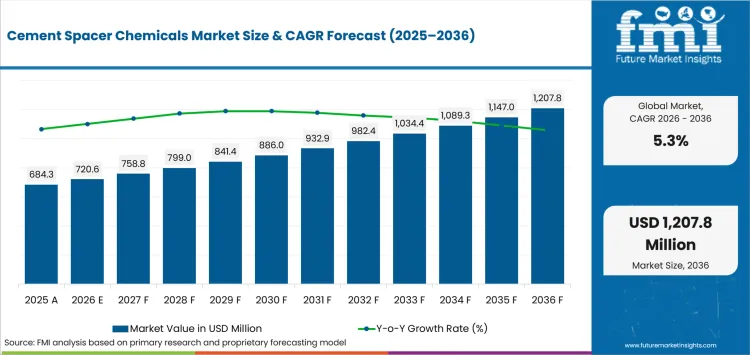
USD 720.6 million in 2026 and USD 1,207.8 million by 2036 at a 5.3% CAGR.
Demand for cement spacer chemicals is projected to expand at 5.3% CAGR between 2026 and 2036 as operators tighten fluid-displacement control before cement placement. In March 2025 SLB received an integrated contract for 18 ultra-deepwater Trion wells covering cementing plus drilling and completion fluids. The Trion scope places spacer selection inside a coordinated fluid sequence where contamination or poor wetting can weaken the planned cement barrier. Formulations earn repeat use by preserving rheology and verified mud-to-cement compatibility under the scheduled pumping program.
Country demand diverges because drilling cadence and offshore exposure change how often a spacer system must be qualified. Pemex's April 2026 first-quarter report recorded 24 development-well completions through March. Frequent development completions let Mexican cementing teams reuse qualified base chemistry between jobs. Mature markets with longer drilling gaps offer fewer such repetitions. Local stock and rapid laboratory adjustment become commercially useful if final mud density or salinity changes before pumping.
Key Takeaways of Cement Spacer Chemicals Market
- Deepwater and unconventional wells raise demand for spacer chemistry because incomplete mud displacement can force remedial cementing before completion work proceeds.
- By chemical type, surfactant spacers are estimated to hold 27.0% in 2026 because wetting reversal improves cleanup of oil-wet casing surfaces.
- Mud removal is projected to represent 31.0% of the function category in 2026 owing to its direct role before cement contacts the intended surfaces.
- Water-based mud spacers are anticipated to account for 42.0% of mud compatibility demand in 2026 due to adaptable carrier chemistry and field weighting options.
- Job-specific compatibility testing slows substitution because cheaper chemistry loses its cost advantage if actual temperature, salinity or density conditions produce unstable fluid behavior.
- Some of the key players in this market include Baker Hughes, Halliburton, SLB, Clariant, Nouryon, Weatherford International plc, National Energy Services Reunited Corp. (NESR), and Nine Energy Service, Inc.
Analyst Perspective
"Spacer chemistry earns its margin before pumping because a laboratory mismatch between drilling fluid and cement slurry can erase any unit-price saving. Stronger offers pair proven mud-removal chemistry with rapid density or wetting adjustments at the service base so field crews avoid late reformulation on high-cost wells."
- Nikhil Kaitwade, Principal Consultant, Future Market Insights
How is the Cement Spacer Chemicals Market segmented?
The cement spacer chemicals market is segmented by chemical type, function, mud compatibility, operation, sales channel and region.
Chemical type includes surfactant, viscosified, weighting-additive, dispersant and reactive spacers. Function covers mud removal, wetting reversal, rheology control, fluid separation and bond improvement. Mud compatibility includes water-based, oil-based, synthetic and high-density spacers. Operation covers primary, liner, squeeze and deepwater cementing. Sales channels comprise cementing service companies, mud service companies, specialty chemical suppliers and direct operator supply.
What makes Surfactant spacers central to the Chemical type category?
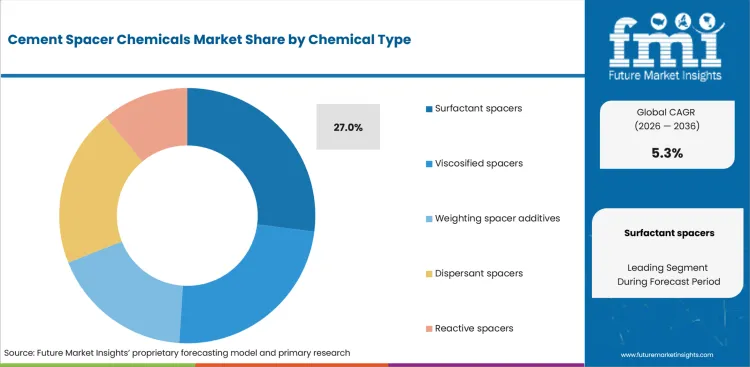
Surfactant packages change surface wetting and reduce interfacial resistance where nonaqueous drilling fluids leave casing or formation surfaces oil-wet. This chemistry relates to the wider oilfield surfactants category because both applications depend on controlled interfacial behavior under difficult brine and temperature conditions.
- By chemical type, surfactant spacers are estimated to hold 27.0% in 2026 owing to cleanup requirements before cement placement on oil-wet surfaces.
- Nouryon opened an Al Dhahran office in February 2025 that serves oilfield customers in Saudi Arabia and the Middle East. Regional access shortens the route to technical support during active drilling programs.
Why does Mud removal lead the Function category?
Mud removal determines whether the cement slurry reaches casing and formation surfaces without a continuous drilling-fluid film in the annulus. The same displacement problem shapes drilling and completion fluids because each system must preserve the planned sequence without destabilizing neighboring fluids. Halliburton and Aker BP documented 400 automated offshore cementing jobs in April 2025 using LOGIX technology.
- In 2026, mud removal is expected to lead the function category with 31.0% share because residual drilling fluid directly blocks cement contact.
- The 400-job record raises expectations for repeatable fluid delivery and controlled annular displacement before slurry placement.
What supports Primary cementing in the Operation category?
Primary cementing gives spacer chemistry a repeatable insertion point because the spacer is planned before the first long-term cement barrier is placed. High-frequency onshore programs link this segment with onshore drilling fluids used earlier in the well-construction sequence.
- Primary cementing is projected to hold 43.0% share in 2026 owing to the fluid-separation step required before the first long-term cement barrier.
- Baker Hughes launched the Hummingbird all-electric land cementing unit for onshore primary cementing operations in February 2025. Its integrated mixing and pumping design raises the value of spacer systems supplied with compatible field-mixing instructions and density targets.
Why do Cementing service companies lead the Sales channel category?
Cementing service companies control the point where laboratory qualification becomes a field program, so chemistry selection usually forms part of the broader service package. Clariant appointed Gapuma Group in July 2026 to distribute drilling and cementing additives in Nigeria, Côte d’Ivoire and Ghana. Regional access places specialty chemistry closer to West African oilfield services teams.
- Based on sales channel, cementing service companies are projected to account for 44.0% in 2026 due to their control of laboratory review and wellsite delivery.
- Regional distribution gives service companies a direct route to specialty additives without requiring a separate operator purchasing channel.
What are the drivers, restraints and opportunities in the cement spacer chemicals market?
Complex well construction raises demand for qualified displacement chemistry. Laboratory compatibility slows substitution and integrated cementing programs reward field-ready formulations.
- Driver: Deepwater and unconventional wells raise the cost of poor displacement because remedial cementing can delay expensive completion schedules.
- Restraint: Spacer chemistry must be checked against actual mud, cement, temperature, salinity and density conditions before field use.
- Opportunity: Suppliers can win repeat programs by prequalifying modular spacer packages for common mud families and local mixing routes.
Technical wells penalize poor displacement because a weak cement barrier can force remediation before completion work proceeds. USA EIA data published in March 2026 show that crude output rose 3% during 2025 even though Lower 48 rig activity fell 5%. Fewer rigs carrying more output raise the cost of execution errors on each active program, which keeps qualified oilfield chemicals in the well-construction budget.
Spacer substitution slows at the laboratory because the fluid touches both the outgoing mud and the incoming cement slurry. Nine Energy Service's March 2026 Form 10-K lists four laboratories for cement design and testing under varied pressure and temperature conditions. Each chemistry change therefore consumes testing capacity before specialty chemicals can enter a qualified field program at commercial scale.
Prequalified spacer families offer a practical route into repeat well programs handled by technical teams that also manage oilfield stimulation chemicals. In February 2026 Halliburton and Pertamina signed an MOU covering advanced cementing services and stimulation in selected Indonesian onshore fields. Shared job data let technical teams adjust density or wetting chemistry without rebuilding the full test program for every well.
Which country CAGRs are profiled in the cement spacer chemicals market?
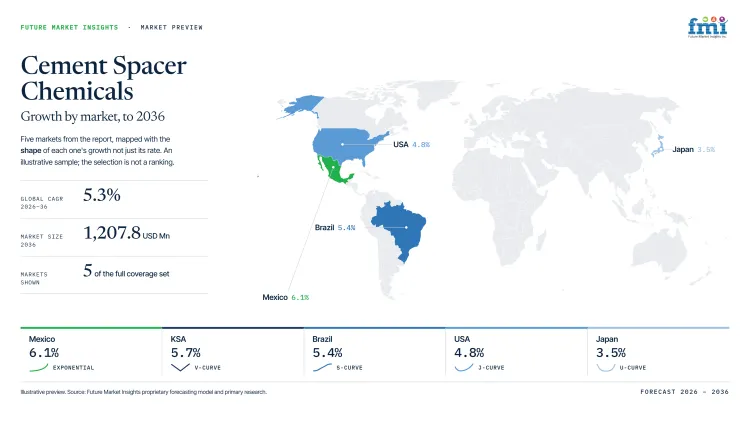
| Country | CAGR |
|---|---|
| Mexico | 6.1% |
| Kingdom of Saudi Arabia | 5.7% |
| Brazil | 5.4% |
| United States | 4.8% |
| Japan | 3.5% |
How do country-level CAGRs compare in the cement spacer chemicals market?
The forecasts span 1.3 percentage points between Mexico at 6.1% and the United States at 4.8%. Mexico, Saudi Arabia and the UAE form the upper group because their project pipelines require frequent cementing work. Brazil follows through concentrated deepwater programs. USA growth is steadier because shale operators get more output from each rig.
- Mexico mixes development wells with repairs, widening demand beyond primary cementing.
- Saudi gas programs require modular weighting choices between well intervals.
- Brazilian pre-salt wells raise remediation costs because offshore rig time is expensive.
- USA pad drilling lets qualified formulations return on several wells at one site.
- Japan’s established drilling operations let qualified formulations be reused across several wells at one site.
Comparable growth rates produce different service economics because each country fixes chemistry at different operating stages. The full report provides country-level CAGR analysis across North America, Latin America, Europe, East Asia, South Asia, Oceania and the Middle East and Africa.
Country-wise Analysis
- Pemex-led development and repair programs give Mexican cementing contractors repeated jobs, yet chemical purchases still follow project sequencing and tender awards. Mexico is projected to grow at 6.1% CAGR through 2036 owing to a steady state-led well program. Pemex's February 2025 work plan specified 2,036 liquid-hydrocarbon wells and 1,300 major repairs over the planning period. Local laboratories can reuse approved base chemistry between nearby directional drilling services programs move between scheduled wells and adjust final density after mud properties are confirmed. Import lead times remain the main constraint because a late specification change can directly miss the purchasing window for the scheduled cement job.
- Saudi unconventional gas wells expose spacer systems to long horizontal intervals where temperature and pressure changes narrow the acceptable rheology window. Aramco confirmed in February 2026 that Jafurah Phase 1 had started production and its gas program targets roughly 80% more sales-gas capacity by 2030 versus 2021. The Kingdom of Saudi Arabia is estimated to post 5.7% CAGR over the forecast period tied to continued gas development. Locally based technical teams can reproduce qualified density and wetting packages without rebuilding each formulation from the beginning. Providers with in-country laboratories therefore enter large gas campaigns with a clear response-time advantage during scheduled cementing work.
- Brazilian pre-salt cementing programs place spacer qualification early in the offshore planning cycle because fluid changes become harder after materials leave coastal service bases. Petrobras documented in January 2026 that Tupi and Iracema connected eleven wells during 2025 and now contain more than 150 drilled wells plus nine production units. Brazil is projected to record 5.4% CAGR during the forecast period attributable to continued pre-salt work. Coastal laboratories can reproduce approved spacer batches near major logistics hubs before vessel loading and offshore mobilization begin. Growth will not convert evenly because each deepwater campaign fixes chemistry earlier than a comparable onshore cementing job.
- USA shale operators run short pad cycles where cementing crews must protect placement quality without adding laboratory delays between consecutive wells. EIA data published in July 2026 put national crude production at a record 13.6 million barrels per day during 2025. The United States is anticipated to advance at 4.8% CAGR through 2036 helped by dense basin activity and repeated well cycles. Nearby laboratories can reuse qualification records and adjust spacer density quickly between consecutive pad stages and cement jobs. In this market, chemistry that shortens qualification time carries more commercial weight than a broad catalog with slower field support.
- Japan’s cementing activity is shaped by a mature cement industry, infrastructure renewal, and emerging geothermal drilling programs. Japan is projected to advance at 3.5% CAGR through 2036, supported by continued cement demand and new geothermal exploration, including preparatory work at multiple Geothermal Frontier Project sites in 2026. Local laboratories can leverage established qualification data and fine-tune spacer density, rheology, and compatibility for different cement systems and well conditions. In this market, rapid qualification, formulation reliability, and responsive technical support carry greater commercial weight than broad product portfolios, particularly as Japanese buyers emphasize quality and application-specific performance.
Who are the notable companies in the cement spacer chemicals market?
Baker Hughes, Halliburton, SLB, Clariant, Nouryon, Weatherford International plc, National Energy Services Reunited Corp. (NESR), and Nine Energy Service, Inc. are the notable companies serving this market.
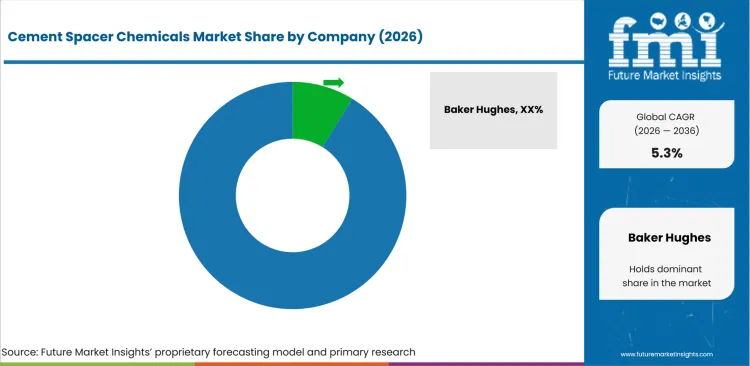
Integrated cementing companies and specialty-chemistry producers enter the spacer job at different points in the fluid sequence. Laboratory records and field execution determine entry more directly than corporate scale because each formulation must fit a defined mud and cement program. Regional chemistry teams also manage oilfield production chemicals through laboratories and distribution routes that can support adjacent spacer programs.
- Baker Hughes, Halliburton and SLB operate global cementing platforms with drilling-fluid expertise that supports integrated spacer qualification and field placement.
- Clariant and Nouryon sell specialty oilfield chemistry through regional technical teams and distribution routes serving cementing companies and local formulators.
- Weatherford International plc, NESR and Nine Energy Service, Inc. compete by pairing cementing execution with laboratory support in regional well-construction programs.
Competitive Benchmarking: Cement Spacer Chemicals Market
| Company | Spacer and cementing scope | Laboratory and formulation support | Field execution integration | Geographic Reach |
|---|---|---|---|---|
| Baker Hughes | High | High | High | Global |
| Halliburton | High | High | High | Global |
| SLB | High | High | High | Global |
| Clariant | Medium | Medium | Low | Global with regional distributors |
| Nouryon | Low | High | Low | North America, Middle East and Europe |
| Weatherford International plc | Medium | Medium | High | Global |
| National Energy Services Reunited Corp. (NESR) | Medium | High | High | Middle East, North Africa and Asia |
| Nine Energy Service, Inc. | Medium | High | High | United States and Canada |
Scoring basis: High spacer and cementing scope requires integrated cementing plus documented fluid or chemical coverage. Medium requires a direct cementing or cementing-additive route. Low identifies ingredient chemistry sold into cementing formulations without a direct cementing service line. High laboratory support requires dedicated testing or formulation infrastructure. Medium requires documented application support. Low identifies documented commercial support without a dedicated application laboratory. High field integration requires direct cementing execution in several operating environments. Medium identifies narrower regional execution and Low identifies a documented ingredient-distribution model without direct cementing execution.
Key Developments in the Cement Spacer Chemicals Market
- In July 2026, SLB disclosed a five-year Kuwait Oil Company award covering cementing and related services for conventional and unconventional scopes in Kuwait.
- In March 2026, National Energy Services Reunited Corp. (NESR) announced several multi-year cementing contracts valued at about USD 300 million in Kuwait and North Africa.
- In July 2025, Weatherford International plc disclosed new Cementation Products contracts with bp UK and Beach Energy for offshore well-construction campaigns.
Key Players in the Cement Spacer Chemicals Market
Integrated cementing and fluid-service platforms
- Baker Hughes
- Halliburton
- SLB
- Weatherford International plc
Specialty oilfield chemistry providers
- Clariant
- Nouryon
Regional cementing service providers
- National Energy Services Reunited Corp. (NESR)
- Nine Energy Service, Inc.
Cement Spacer Chemicals Market - Report Scope
| Coverage field | Report scope |
|---|---|
| Market breakdown | By chemical type, function, mud compatibility, operation, sales channel and region. |
| Quantitative Units | USD Million. |
| Market Definition | Commercial spacer chemicals and formulated spacer systems used between drilling fluid and cement during well construction. |
| Regions Covered | North America, Latin America, Europe, East Asia, South Asia and Pacific, and Middle East and Africa. |
| Countries Covered | Mexico, Kingdom of Saudi Arabia, United Arab Emirates, Brazil, United States, and 20+ countries included in the full report. |
| Key Companies Profiled | Baker Hughes, Halliburton, SLB, Clariant, Nouryon, Weatherford International plc, National Energy Services Reunited Corp. (NESR), Nine Energy Service, Inc. |
| Forecast Period | 2026 to 2036. |
| Approach | Primary and secondary research with market triangulation. |
Cement Spacer Chemicals Market - Research Methodology
| Method | Approach |
|---|---|
| Primary Research | FMI analysts gathered input from manufacturers, service providers, technology developers, distributors, end users, procurement teams, and subject-matter experts. Interviews examined purchasing decisions, product or service evaluation, adoption barriers, approval requirements, pricing considerations, and expectations for technical or commercial support. Respondents were also asked what evidence is required before a trial, pilot, or initial order develops into regular purchasing. |
| Desk Research | Desk research covered government statistics, regulatory publications, trade data, industry associations, technical literature, standards, company filings, product information, and official corporate announcements. Sources were reviewed for relevance, publication date, geographic coverage, and consistency with the defined market scope. Claims relating to performance, applications, approvals, capacity, investment, and commercial activity were retained only when supported by credible public evidence. |
| Market Sizing and Forecasting | The market model combined the baseline value with historical performance, segment structure, pricing and volume indicators, adoption levels, company participation, and country-level demand conditions. Forecast assumptions considered economic activity, investment trends, regulatory developments, technology adoption, purchasing cycles, supply availability, and barriers to wider market use. Segment and regional estimates were reconciled before the final market total was calculated. |
| Data Validation | Estimates were checked against multiple independent indicators, including public data, company activity, trade patterns, industry developments, and findings from primary interviews. Validation also tested whether products, services, applications, and company revenues fell within the defined market boundaries. Adjacent categories, unsupported claims, overlapping revenues, and activities without direct market relevance were excluded to reduce double counting and maintain consistency across segments and countries. |
Cement Spacer Chemicals Market by Segments
Cement Spacer Chemicals Market segmented by Chemical Type:
- Surfactant spacers
- Viscosified spacers
- Weighting spacer additives
- Dispersant spacers
- Reactive spacers
Cement Spacer Chemicals Market segmented by Function:
- Mud removal
- Wetting reversal
- Rheology control
- Fluid separation
- Bond improvement
Cement Spacer Chemicals Market segmented by Mud Compatibility:
- Water-based mud spacers
- Oil-based mud spacers
- Synthetic mud spacers
- High-density spacers
Cement Spacer Chemicals Market segmented by Operation:
- Primary cementing
- Liner cementing
- Squeeze cementing
- Deepwater cementing
Cement Spacer Chemicals Market segmented by Sales Channel:
- Cementing service companies
- Mud service companies
- Specialty chemical suppliers
- Direct operator supply
Cement Spacer Chemicals Market by Region:
- North America
- United States
- Canada
- Latin America
- Brazil
- Mexico
- Argentina
- Chile
- Rest of Latin America
- Western Europe
- Germany
- United Kingdom
- Italy
- Spain
- France
- Nordics
- Benelux
- Rest of Western Europe
- Eastern Europe
- Russia
- Poland
- Hungary
- Balkan and Baltic States
- Rest of Eastern Europe
- East Asia
- China
- Japan
- South Korea
- South Asia and Pacific
- India
- ASEAN
- Australia and New Zealand
- Rest of South Asia and Pacific
- Middle East and Africa
- Kingdom of Saudi Arabia
- Other GCC Countries
- Türkiye
- South Africa
- Other African Union Countries
- Rest of Middle East and Africa
Research Sources and Bibliography
- SLB. (2025, March 31). SLB awarded major drilling contract by Woodside Energy for ultra-deepwater Trion development, offshore Mexico.
- Petróleos Mexicanos. (2026, April 30). PEMEX preliminary results as of March 31, 2026.
- Nouryon. (2025, February 10). Nouryon opens new office in Al Dhahran to strengthen presence in Saudi Arabia and the Middle East.
- Halliburton. (2025, April 23). Halliburton and Aker BP achieve offshore automation milestone.
- Baker Hughes. (2025, February 4). Baker Hughes launches trio of electrification technologies for onshore, offshore operations.
- Clariant. (2026, July 29). Clariant appoints Gapuma Group as Well Service Additives distributor across West Africa.
- USA Energy Information Administration. (2026, March 31). USA crude oil production rose in 2025, setting new record.
- Nine Energy Service, Inc. (2026, March 4). Annual report on Form 10-K for fiscal year 2025.
- Halliburton. (2026, February 22). Pertamina and Halliburton sign an integrated unconventional fracturing MOU in Indonesia.
- Petróleos Mexicanos. (2025, February 12). Pemex presents its Work Plan for 2025-2030.
- Saudi Aramco. (2026, February 26). Aramco’s gas strategy builds momentum with major progress towards growth target.
- ADNOC. (2026, July 21). ADNOC Accelerates Gas Growth Strategy with $6.2 Billion FID For Umm Shaif Gas Cap.
- Petrobras. (2026, January 13). Tupi/Iracema Field Returns to Reaching Production of 1 Million Barrels per Day.
- USA Energy Information Administration. (2026, July 9). The United States produced more crude oil than any other country in 2025.
- SLB. (2026, July 24). SLB announces second-quarter 2026 results.
- National Energy Services Reunited Corp. (2026, March 16). NESR awarded $300 million in cementing contracts.
- Weatherford International plc. (2025, July 22). Weatherford announces second quarter 2025 results.
- SLB. (2026, February 3). SLB awarded integrated development contract for Mutriba field in Kuwait.
- Nine Energy Service, Inc. (2025, October 30). Nine Energy Service announces third quarter 2025 results.
- Nouryon. (2025, June 18). Nouryon launches Innovation Center for oilfield solutions in Texas, US.
- Halliburton. (2025, May 6). Halliburton expands international scope with three new projects.
- National Energy Services Reunited Corp. (2026, August 5). NESR secures $300 million in multiple services and technology contracts in Kuwait.
- Baker Hughes. (2026, May 26). Baker Hughes Extends and Expands Integrated Well Construction Contract with Petrobras.
- Halliburton Company. (2026, February 6). 2025 Form 10-K.
- SLB. (2026, June 30). SLB Awarded Seven-Year Contract Under Kuwait Oil Company's Ahmadi Innovation Valley Initiative.
- Clariant. (2025, September 8). Clariant Oil Services launches customer portal for seamless digital access.
- Weatherford International plc. (2026, April 21). Weatherford Announces First Quarter 2026 Results.
- National Energy Services Reunited Corp. (2026, March 6). Annual report on Form 10-K for fiscal year 2025.
- Nine Energy Service, Inc. (2026, August 5). Quarterly report on Form 10-Q for the period ended June 30, 2026.
- TETRA Technologies, Inc. (2026, June 29). TETRA Technologies introduces TETRA Neptune Z-Lite deepwater completions fluid.
This bibliography is provided for reader reference and is not exhaustive. The full report contains the complete reference list and detailed citations.
This Report Answers
- How large is the cement spacer chemicals market in 2026 and what value is forecast for 2036?
- Which operating conditions raise demand for spacer chemistry during well construction?
- Why do surfactant spacers account for 27.0% of the chemical type category in 2026?
- Why does mud removal represent 31.0% of the function category in 2026?
- How do water-based mud spacers achieve a 42.0% share of mud compatibility demand in 2026?
- Which five countries are projected to record the strongest profiled growth through 2036?
- What limits faster substitution between competing spacer formulations during cementing programs?
- Which eight companies are active through integrated cementing, specialty chemistry or regional service delivery?
- How do laboratory support and field execution affect competitive positioning in cement spacer chemicals?
Frequently Asked Questions
How big is the Cement Spacer Chemicals Market in 2026?
The cement spacer chemicals market is valued at USD 720.6 million in 2026 and is projected to reach USD 1,207.8 million by 2036. Growth is tied to complex well construction where fluid displacement and compatibility influence cement placement.
What is the CAGR of the Cement Spacer Chemicals Market from 2026 to 2036?
The cement spacer chemicals market is projected to grow at a CAGR of 5.3% between 2026 and 2036. Expansion is supported by deepwater, unconventional gas and high-throughput drilling programs that require job-qualified displacement chemistry.
Which chemical type leads the Cement Spacer Chemicals Market?
The surfactant spacers segment is expected to hold 27.0% of the cement spacer chemicals market in 2026, attributable to wetting reversal on oil-wet surfaces. Service companies use this chemistry to reduce residual nonaqueous fluid before field mixing and pumping begin.
Which function leads the Cement Spacer Chemicals Market?
The mud removal segment is expected to hold 31.0% of the cement spacer chemicals market by function in 2026. Its position follows the need to displace residual drilling fluid before the cement slurry contacts casing and formation surfaces.
Which companies are active in the Cement Spacer Chemicals Market?
Key companies operating in the market include Baker Hughes, Halliburton, SLB, Clariant, Nouryon, Weatherford International plc, National Energy Services Reunited Corp. (NESR), and Nine Energy Service, Inc. These companies compete by pairing chemistry with laboratory support and cementing execution in active drilling basins.
Preview the report firsthand - request a free sample
Get SampleGet the brochure for pricing and purchase details.
Get PDFTable of Content
- Key Takeaways
- Market Size and CAGR
- Top Growth Driver
- Fastest Growing Segment
- Leading Region
- Key Companies
- Emerging Opportunities
- Executive Summary
- Global Market Outlook
- Demand-side Trends
- Supply-side Trends
- Technology Roadmap Analysis
- Analysis and Recommendations
- Analyst Perspective (What is happening? Why now? What should investors know?)
- Key Questions Answered
- How large is the market?
- What is the CAGR?
- What are key trends?
- Which region dominates?
- Who are the leaders?
- Market Overview
- Market Coverage / Taxonomy
- Market Definition / Scope / Limitations
- Research Methodology
- Chapter Orientation
- Analytical Lens and Working Hypotheses
- Market Structure, Signals, and Trend Drivers
- Benchmarking and Cross-market Comparability
- Market Sizing, Forecasting, and Opportunity Mapping
- Research Design and Evidence Framework
- Desk Research Programme (Secondary Evidence)
- Expert Input and Fieldwork (Primary Evidence)
- Tooling, Models, and Reference Databases
- Data Engineering and Model Build
- Quality Assurance and Audit Trail
- Market Background
- Market Dynamics (Drivers, Restraints, Opportunity, Trends)
- Scenario Forecast (Optimistic, Likely, Conservative)
- Impact Analysis
- AI Impact
- Sustainability Impact
- Regulatory Impact
- Technology Impact
- Consumer / Buyer Analysis
- Purchase Drivers
- Adoption Barriers
- Buyer Journey
- Opportunity Map Analysis
- Product Life Cycle Analysis
- Supply Chain Analysis
- Investment Feasibility Matrix
- Value Chain Analysis
- PESTLE and Porter's Analysis
- Regulatory Landscape
- Regional Parent Market Outlook
- Production and Consumption Statistics
- Import and Export Statistics
- Global Market Analysis and Forecast, 2021 to 2036
- Historical Market Size Value (USD Million) Analysis, 2021 to 2025
- Current and Future Market Size Value (USD Million) Projections, 2026 to 2036
- Y-o-Y Growth Trend Analysis
- Absolute $ Opportunity Analysis
- Global Market Pricing Analysis, 2021 to 2036
- Global Market Analysis and Forecast, By Chemical Type, 2021 to 2036
- Introduction / Key Findings
- Historical Market Size Value (USD Million) Analysis By Chemical Type, 2021 to 2025
- Current and Future Market Size Value (USD Million) Analysis and Forecast By Chemical Type, 2026 to 2036
- Surfactant spacers
- Viscosified spacers
- Weighting spacer additives
- Dispersant spacers
- Reactive spacers
- Surfactant spacers
- Y-o-Y Growth Trend Analysis By Chemical Type, 2021 to 2025
- Absolute $ Opportunity Analysis By Chemical Type, 2026 to 2036
- Global Market Analysis and Forecast, By Function, 2021 to 2036
- Introduction / Key Findings
- Historical Market Size Value (USD Million) Analysis By Function, 2021 to 2025
- Current and Future Market Size Value (USD Million) Analysis and Forecast By Function, 2026 to 2036
- Mud removal
- Wetting reversal
- Rheology control
- Fluid separation
- Bond improvement
- Mud removal
- Y-o-Y Growth Trend Analysis By Function, 2021 to 2025
- Absolute $ Opportunity Analysis By Function, 2026 to 2036
- Global Market Analysis and Forecast, By Mud Compatibility, 2021 to 2036
- Introduction / Key Findings
- Historical Market Size Value (USD Million) Analysis By Mud Compatibility, 2021 to 2025
- Current and Future Market Size Value (USD Million) Analysis and Forecast By Mud Compatibility, 2026 to 2036
- Water-based mud spacers
- Oil-based mud spacers
- Synthetic mud spacers
- High-density spacers
- Water-based mud spacers
- Y-o-Y Growth Trend Analysis By Mud Compatibility, 2021 to 2025
- Absolute $ Opportunity Analysis By Mud Compatibility, 2026 to 2036
- Global Market Analysis and Forecast, By Operation, 2021 to 2036
- Introduction / Key Findings
- Historical Market Size Value (USD Million) Analysis By Operation, 2021 to 2025
- Current and Future Market Size Value (USD Million) Analysis and Forecast By Operation, 2026 to 2036
- Primary cementing
- Liner cementing
- Squeeze cementing
- Deepwater cementing
- Primary cementing
- Y-o-Y Growth Trend Analysis By Operation, 2021 to 2025
- Absolute $ Opportunity Analysis By Operation, 2026 to 2036
- Global Market Analysis and Forecast, By Sales Channel, 2021 to 2036
- Introduction / Key Findings
- Historical Market Size Value (USD Million) Analysis By Sales Channel, 2021 to 2025
- Current and Future Market Size Value (USD Million) Analysis and Forecast By Sales Channel, 2026 to 2036
- Cementing service companies
- Mud service companies
- Specialty chemical suppliers
- Direct operator supply
- Cementing service companies
- Y-o-Y Growth Trend Analysis By Sales Channel, 2021 to 2025
- Absolute $ Opportunity Analysis By Sales Channel, 2026 to 2036
- Global Market Analysis and Forecast, By Region, 2021 to 2036
- Introduction
- Historical Market Size Value (USD Million) Analysis By Region, 2021 to 2025
- Current Market Size Value (USD Million) Analysis and Forecast By Region, 2026 to 2036
- North America
- Latin America
- Western Europe
- Eastern Europe
- East Asia
- South Asia and Pacific
- Middle East & Africa
- Market Attractiveness Analysis By Region
- North America Market Analysis and Forecast, By Country, 2021 to 2036
- Historical Market Size Value (USD Million) Trend Analysis By Market Taxonomy, 2021 to 2025
- Market Size Value (USD Million) Forecast By Market Taxonomy, 2026 to 2036
- By Country
- USA
- Canada
- By Chemical Type
- By Function
- By Mud Compatibility
- By Operation
- By Sales Channel
- By Country
- Market Attractiveness Analysis
- By Country
- By Chemical Type
- By Function
- By Mud Compatibility
- By Operation
- By Sales Channel
- Key Takeaways
- Latin America Market Analysis and Forecast, By Country
- Historical Market Size Value (USD Million) Trend Analysis By Market Taxonomy, 2021 to 2025
- Market Size Value (USD Million) Forecast By Market Taxonomy, 2026 to 2036
- By Country
- Brazil
- Mexico
- Chile
- Rest of Latin America
- By Chemical Type
- By Function
- By Mud Compatibility
- By Operation
- By Sales Channel
- By Country
- Market Attractiveness Analysis
- By Country
- By Chemical Type
- By Function
- By Mud Compatibility
- By Operation
- By Sales Channel
- Key Takeaways
- Western Europe Market Analysis and Forecast, By Country
- Historical Market Size Value (USD Million) Trend Analysis By Market Taxonomy, 2021 to 2025
- Market Size Value (USD Million) Forecast By Market Taxonomy, 2026 to 2036
- By Country
- Germany
- UK
- Italy
- Spain
- France
- Nordic
- BENELUX
- Rest of Western Europe
- By Chemical Type
- By Function
- By Mud Compatibility
- By Operation
- By Sales Channel
- By Country
- Market Attractiveness Analysis
- By Country
- By Chemical Type
- By Function
- By Mud Compatibility
- By Operation
- By Sales Channel
- Key Takeaways
- Eastern Europe Market Analysis and Forecast, By Country
- Historical Market Size Value (USD Million) Trend Analysis By Market Taxonomy, 2021 to 2025
- Market Size Value (USD Million) Forecast By Market Taxonomy, 2026 to 2036
- By Country
- Russia
- Poland
- Hungary
- Balkan & Baltic
- Rest of Eastern Europe
- By Chemical Type
- By Function
- By Mud Compatibility
- By Operation
- By Sales Channel
- By Country
- Market Attractiveness Analysis
- By Country
- By Chemical Type
- By Function
- By Mud Compatibility
- By Operation
- By Sales Channel
- Key Takeaways
- East Asia Market Analysis and Forecast, By Country
- Historical Market Size Value (USD Million) Trend Analysis By Market Taxonomy, 2021 to 2025
- Market Size Value (USD Million) Forecast By Market Taxonomy, 2026 to 2036
- By Country
- China
- Japan
- South Korea
- By Chemical Type
- By Function
- By Mud Compatibility
- By Operation
- By Sales Channel
- By Country
- Market Attractiveness Analysis
- By Country
- By Chemical Type
- By Function
- By Mud Compatibility
- By Operation
- By Sales Channel
- Key Takeaways
- South Asia and Pacific Market Analysis and Forecast, By Country
- Historical Market Size Value (USD Million) Trend Analysis By Market Taxonomy, 2021 to 2025
- Market Size Value (USD Million) Forecast By Market Taxonomy, 2026 to 2036
- By Country
- India
- ASEAN
- Australia & New Zealand
- Rest of South Asia and Pacific
- By Chemical Type
- By Function
- By Mud Compatibility
- By Operation
- By Sales Channel
- By Country
- Market Attractiveness Analysis
- By Country
- By Chemical Type
- By Function
- By Mud Compatibility
- By Operation
- By Sales Channel
- Key Takeaways
- Middle East & Africa Market Analysis and Forecast, By Country
- Historical Market Size Value (USD Million) Trend Analysis By Market Taxonomy, 2021 to 2025
- Market Size Value (USD Million) Forecast By Market Taxonomy, 2026 to 2036
- By Country
- Kingdom of Saudi Arabia
- Other GCC Countries
- Türkiye
- South Africa
- Other African Union
- Rest of Middle East & Africa
- By Chemical Type
- By Function
- By Mud Compatibility
- By Operation
- By Sales Channel
- By Country
- Market Attractiveness Analysis
- By Country
- By Chemical Type
- By Function
- By Mud Compatibility
- By Operation
- By Sales Channel
- Key Takeaways
- Key Countries Market Analysis
- USA
- Pricing Analysis
- Market Share Analysis, 2025
- By Chemical Type
- By Function
- By Mud Compatibility
- By Operation
- By Sales Channel
- Canada
- Pricing Analysis
- Market Share Analysis, 2025
- By Chemical Type
- By Function
- By Mud Compatibility
- By Operation
- By Sales Channel
- Mexico
- Pricing Analysis
- Market Share Analysis, 2025
- By Chemical Type
- By Function
- By Mud Compatibility
- By Operation
- By Sales Channel
- Brazil
- Pricing Analysis
- Market Share Analysis, 2025
- By Chemical Type
- By Function
- By Mud Compatibility
- By Operation
- By Sales Channel
- Chile
- Pricing Analysis
- Market Share Analysis, 2025
- By Chemical Type
- By Function
- By Mud Compatibility
- By Operation
- By Sales Channel
- Germany
- Pricing Analysis
- Market Share Analysis, 2025
- By Chemical Type
- By Function
- By Mud Compatibility
- By Operation
- By Sales Channel
- UK
- Pricing Analysis
- Market Share Analysis, 2025
- By Chemical Type
- By Function
- By Mud Compatibility
- By Operation
- By Sales Channel
- Italy
- Pricing Analysis
- Market Share Analysis, 2025
- By Chemical Type
- By Function
- By Mud Compatibility
- By Operation
- By Sales Channel
- Spain
- Pricing Analysis
- Market Share Analysis, 2025
- By Chemical Type
- By Function
- By Mud Compatibility
- By Operation
- By Sales Channel
- France
- Pricing Analysis
- Market Share Analysis, 2025
- By Chemical Type
- By Function
- By Mud Compatibility
- By Operation
- By Sales Channel
- India
- Pricing Analysis
- Market Share Analysis, 2025
- By Chemical Type
- By Function
- By Mud Compatibility
- By Operation
- By Sales Channel
- ASEAN
- Pricing Analysis
- Market Share Analysis, 2025
- By Chemical Type
- By Function
- By Mud Compatibility
- By Operation
- By Sales Channel
- Australia & New Zealand
- Pricing Analysis
- Market Share Analysis, 2025
- By Chemical Type
- By Function
- By Mud Compatibility
- By Operation
- By Sales Channel
- China
- Pricing Analysis
- Market Share Analysis, 2025
- By Chemical Type
- By Function
- By Mud Compatibility
- By Operation
- By Sales Channel
- Japan
- Pricing Analysis
- Market Share Analysis, 2025
- By Chemical Type
- By Function
- By Mud Compatibility
- By Operation
- By Sales Channel
- South Korea
- Pricing Analysis
- Market Share Analysis, 2025
- By Chemical Type
- By Function
- By Mud Compatibility
- By Operation
- By Sales Channel
- Russia
- Pricing Analysis
- Market Share Analysis, 2025
- By Chemical Type
- By Function
- By Mud Compatibility
- By Operation
- By Sales Channel
- Poland
- Pricing Analysis
- Market Share Analysis, 2025
- By Chemical Type
- By Function
- By Mud Compatibility
- By Operation
- By Sales Channel
- Hungary
- Pricing Analysis
- Market Share Analysis, 2025
- By Chemical Type
- By Function
- By Mud Compatibility
- By Operation
- By Sales Channel
- Kingdom of Saudi Arabia
- Pricing Analysis
- Market Share Analysis, 2025
- By Chemical Type
- By Function
- By Mud Compatibility
- By Operation
- By Sales Channel
- Türkiye
- Pricing Analysis
- Market Share Analysis, 2025
- By Chemical Type
- By Function
- By Mud Compatibility
- By Operation
- By Sales Channel
- South Africa
- Pricing Analysis
- Market Share Analysis, 2025
- By Chemical Type
- By Function
- By Mud Compatibility
- By Operation
- By Sales Channel
- USA
- Market Structure Analysis
- Competition Dashboard
- Competition Benchmarking
- Market Share Analysis of Top Players
- By Regional
- By Chemical Type
- By Function
- By Mud Compatibility
- By Operation
- By Sales Channel
- Emerging Startups
- Innovation Benchmarking
- Competition Analysis
- Competition Deep Dive
- Baker Hughes
- Overview
- Product Portfolio
- Profitability by Market Segments
- Sales Footprint
- Strategy Overview
- Marketing Strategy
- Product Strategy
- Channel Strategy
- Halliburton
- SLB
- TETRA Technologies
- Clariant
- Innospec
- Nouryon
- Solvay
- Aubin Group
- BASF
- Baker Hughes
- Case Studies
- Success Stories
- Recent Developments
- Competition Deep Dive
- Assumptions & Acronyms Used


