

- Market Size (2026)
- USD 1.1 Bn
- Forecast (2036)
- USD 1.9 Bn
- CAGR (2026 to 2036)
- 5.2%
How big is Cement Retarder Additives Market in 2026?
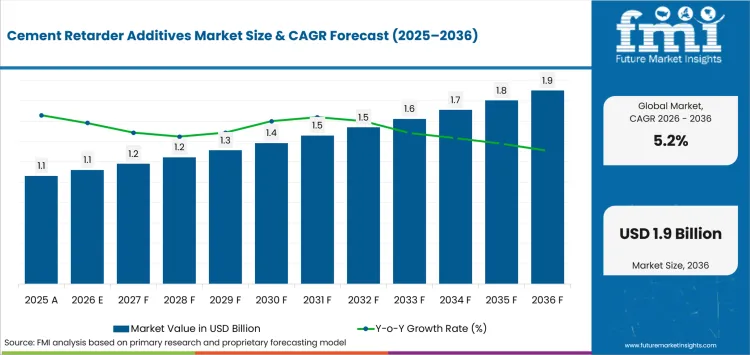
USD 1.1 billion in 2026 and USD 1.9 billion by 2036 at a 5.2% CAGR.
Cement retarder additive demand is projected to push industry valuation from USD 1.1 billion in 2026 to USD 1.9 billion by 2036 at a 5.2% CAGR as longer placement sequences make slurry timing a direct well-construction requirement. In April 2025, Halliburton reported 400 automated offshore cement jobs with Aker BP, showing how cementing teams increasingly control mixing and pumping as repeatable operating sequences. Retarders earn their place in that sequence by preserving pumpability long enough for the slurry to reach the intended annulus. Chemical selection therefore follows the planned circulation time, bottom-hole temperature and interaction with the wider additive package.
Country growth differs with drilling intensity and well architecture expanding at different rates. The USA Energy Information Administration reported in May 2025 that simultaneous Lower 48 well completions exceeded 3.0 wells per location by June 2024, more than double the 2014 level. That operating density sustains USA additive consumption despite its 4.8% CAGR trailing the Gulf forecasts. Qatar, KSA and UAE carry faster rates as large gas programs sustain technically consequential cementing work.
Key Takeaways of Cement Retarder Additives Market
- Demand for cement retarder additives follows the time required to pump and place oilwell cement until hydration closes the safe placement window.
- By chemistry, lignosulfonate retarders are estimated to hold 28.0% in 2026 owing to familiar formulation behavior in conventional slurry programs.
- Primary cementing is forecast to represent 42.0% of cementing operation demand in 2026 driven by planned placement for every new casing string.
- In 2026, low temperature is expected to account for 18.0% of the temperature category due to controlled set-time needs in shallow and cold intervals.
- Retarder substitution is constrained by cement source, mix water and additive compatibility since the complete slurry must meet the planned thickening-time window.
- Some of the key players in this market include Halliburton, SLB, Baker Hughes, Weatherford, BASF, Clariant, Riteks, and Tianjin Kelioil Engineering Material and Technology Co., Ltd.
Analyst Perspective
"Retarder selection begins with the actual cement source and bottom-hole temperature since both can change thickening behavior at the dosage-setting stage. A commercially useful formulation reproduces the approved pumping window as crews move between casing strings and local cement batches without repeating the full design cycle."
- Nikhil Kaitwade, Principal Consultant, Future Market Insights
How is the Cement Retarder Additives Market segmented?
The cement retarder additives market is segmented by chemistry, cementing operation, temperature, well type, sales channel and region.
Market taxonomy covers five operating axes plus regional analysis. Chemistry includes lignosulfonate, hydroxycarboxylic acid, phosphonate, synthetic polymer and high-temperature retarders. Cementing operations include primary, squeeze, plug, liner and remedial jobs. Temperature bands cover low, moderate, high-temperature and HPHT conditions. Well types include onshore, offshore, deepwater, HPHT and gas wells. Sales channels comprise cementing service companies, specialty chemical suppliers, direct operator supply and regional distributors.
What makes Lignosulfonate retarders central to the Chemistry category?
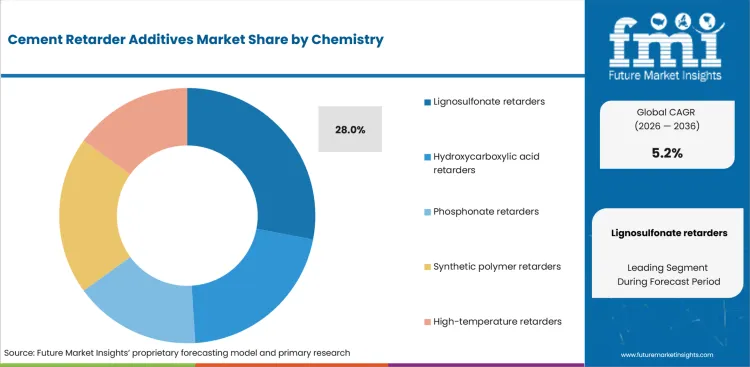
Lignosulfonate chemistry is a practical baseline for conventional slurry designs that do not require the highest thermal resistance. Cementing engineers can adjust concentration within familiar additive packages and retain a clear view of thickening time and post-placement strength.
- By chemistry, lignosulfonate retarders are estimated to hold 28.0% in 2026 owing to familiar use in conventional cement systems and manageable formulation economics.
- In August 2025, Kelioil documented its CH210L medium-temperature retarder for service up to 90°C and reported compatibility with fluid-loss additives and dispersants. The development illustrates continuing demand for controlled retarder behavior inside mixed cement-additive packages.
Why does Primary cementing lead the Cementing operation category?
Primary cementing places retarders into the initial casing program. The slurry must stay pumpable from surface mixing through displacement into the annulus. The purchase cycle repeats with each casing or liner string in a development program.
- Primary cementing is forecast to represent 42.0% of the cementing operation category in 2026 as new well construction produces repeated slurry-placement requirements.
- In March 2025, SLB received a Woodside contract covering 18 ultra-deepwater Trion wells with cementing included in the integrated scope. Multiwell programs of this kind keep retarder selection tied to planned casing sequences and field execution.
How does Low temperature shape the Temperature category?
Low-temperature cementing requires a narrower timing balance as cooler slurries hydrate more slowly and can delay strength development. Retardation still protects placement time, but excessive dosage can extend the interval required for the well to safely proceed to the next operation.
- In 2026, low temperature is expected to account for 18.0% of the temperature category since shallow and cold intervals still require controlled thickening time.
- Kelioil introduced its CH710 high-temperature polymer retarder in January 2026 with stated service capability to 204.4°C. The launch shows how chemistry families separate by thermal envelope instead of applying one retarder to every well condition.
What supports Onshore wells in the Well type category?
Onshore programs generate high job counts with shorter mobilization routes and repeated casing sequences. Basin-level inventory can therefore serve several wells without the offshore logistics required for deepwater campaigns, which raises the addressable volume for standardized cementing programs.
- Onshore wells are anticipated to capture 36.0% share in 2026 due to the larger number of repeatable jobs generated by land drilling programs.
- The USA Energy Information Administration reported in May 2025 that simultaneous Lower 48 completions rose from 1.5 wells per location in 2014 to more than 3.0 by June 2024. Higher pad intensity compresses field schedules and rewards ready local supply.
What are the drivers, restraints and opportunities in the Cement Retarder Additives Market?
Gas and complex-well development raises the need for controlled placement time as slurry qualification slows supplier changes and technically difficult wells raise the value of specialized formulations.
- Driver: Deep gas and offshore programs require cement slurries to remain pumpable through longer placement sequences under elevated downhole temperatures.
- Restraint: Each retarder change must fit the cement source, mix water and companion additives for the revised slurry to enter a field program.
- Opportunity: HPHT and offshore projects reward formulations that extend placement time without imposing excessive wait-on-cement or compatibility penalties.
Large gas programs increase retarder demand through several cement placements in each new well and defined circulation times for each placement. Aramco stated in February 2026 that Jafurah had started production and its gas strategy targets roughly 80% more sales-gas capacity by 2030 than in 2021. Development at that scale keeps cementing work active through successive well sections. Retarder suppliers gain volume from chemistry that holds the planned thickening window without forcing broader slurry redesign.
Qualification slows switching because a retarder changes the hydration profile within a multi-additive slurry and cannot be evaluated independently. Halliburton reported 400 successful LOGIX automated offshore cementing jobs with Aker BP in April 2025 under programmed remote control. Such execution discipline raises the cost of introducing a formulation that changes expected mixing or pumping behavior. A lower unit price cannot offset repeated laboratory work or field uncertainty.
Offshore gas development gives specialized retarder chemistry a clearer revenue route where placement failure carries high operational cost. ADNOC approved a 14-well drilling and integrated-services program for the Umm Shaif Gas Cap in July 2026 using three existing rigs over 18 months. Each planned well requires cementing stages that must fit offshore logistics and pressure-temperature conditions. Chemical companies can capture more value by pairing temperature-specific retarders with local stock and rapid formulation support.
Which country CAGRs are profiled in the Cement Retarder Additives Market?
| Country | CAGR |
|---|---|
| Qatar | 6.0% |
| KSA | 5.8% |
| UAE | 5.7% |
| USA | 4.8% |
| Japan | 3.5% |
How do country-level CAGRs compare in the Cement Retarder Additives Market?
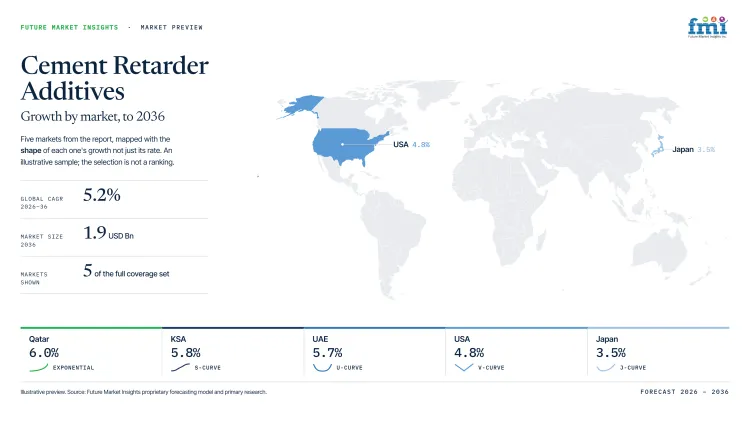
The profiled countries span 1.2 percentage points from Qatar at 6.0% CAGR to USA at 4.8%. Qatar, KSA and UAE form a narrow Gulf group between 5.7% and 6.0% under sustained gas and offshore project activity. Brazil follows at 5.3% through deepwater pre-salt activity. USA retains a substantial drilling base but converts efficiency gains into slower forecast expansion than the project-led Gulf markets.
- Qatar occupies the top position because North Field expansion keeps multiple LNG-linked upstream work packages active through the forecast period.
- KSA follows closely as Jafurah and other gas developments extend well-construction demand beyond conventional crude programs.
- UAE growth is tied to offshore gas drilling programs with local service access that shortens qualification and deployment lead times.
- USA carries large well counts alongside stronger price-cycle exposure, so efficiency gains do not translate directly into faster additive value growth.
- Japan’s mature well base and limited drilling expansion place greater emphasis on efficiency and asset optimization, keeping additive demand growth measured despite ongoing technological improvements.
The narrow upper Gulf band makes project access and technical approval more useful commercial distinctions than small CAGR gaps. Brazil offers higher technical intensity per offshore job whereas USA provides deeper repeat service demand through its installed drilling base. These growth rates indicate forecast pace and do not measure absolute market size.
Country-wise Analysis
- Qatar's North Field expansion keeps offshore drilling packages active over long development cycles and requires retarder formulations that remain stable between laboratory design and repeated field execution. Qatar is estimated to post 6.0% CAGR over the forecast period, propelled by a larger LNG-linked drilling pipeline and established offshore service infrastructure. QatarEnergy's November 2025 investor presentation showed LNG production capacity rising from 77 MTPA to 142 MTPA by 2030, an 85% increase that extends upstream planning visibility for service companies. Local technical access shortens response time during qualification but late chemistry changes carry material logistics risk once cementing materials have already mobilized offshore.
- Saudi cementing programs increasingly serve unconventional gas wells beside conventional oil activity and Jafurah requires technical coverage that can follow repeated casing sections over a long development cycle. Aramco raised its 2030 sales-gas capacity growth target to roughly 80% above 2021 levels in November 2025, confirming a larger national gas workload for service companies. Cement retarder additive demand in KSA is forecast to rise at 5.8% CAGR over the forecast period, aided by sustained well construction and deeper gas exposure. Formulations still need qualification against local cement sources and high-temperature conditions for crews to transfer an approved recipe between programs.
- Abu Dhabi's offshore gas projects place cement-additive decisions inside tightly sequenced drilling programs that cannot absorb delayed technical support without disrupting casing and pumping schedules. ADNOC stated in August 2026 that its real-time operations platform covered more than 120 drilling rigs, giving engineering teams broader operating data during active campaigns for field crews. Local service depth improves diagnosis and inventory access but every retarder change still requires slurry-level checks prior to field use on an offshore well. The UAE cement retarder additives sector is projected to record 5.7% CAGR during the assessment period, tied to project-led offshore activity and integrated service infrastructure.
- USA cementing demand is concentrated in land basins. Pad drilling rewards standardized recipes that field crews can adjust quickly between casing strings and neighboring wells. EIA reported in March 2026 that USA crude production reached a record 13.6 million barrels per day in 2025 despite 1% fewer wells being drilled. The USA is estimated to post 4.8% CAGR over the forecast period, given a mature service base and continued horizontal-well activity despite stronger price sensitivity. Additive companies therefore compete more on basin inventory and repeatable documented laboratory performance records than on exposure to absolute rig-count growth alone in major basins.
- Japan’s cementing activity is driven primarily by mature fields, offshore developments, and well-maintenance programs rather than rapid increases in drilling volumes. Operators emphasize dependable slurry formulations and well-integrity solutions to support aging infrastructure and intervention work. Japan is estimated to register a 3.5% CAGR over the forecast period, supported by stable oilfield service requirements and continued investment in existing assets. Consequently, additive suppliers compete through formulation consistency, technical expertise, and proven performance in specialized cementing applications rather than relying on rising rig counts.
Who are the notable companies in the Cement Retarder Additives Market?
Halliburton, SLB, Baker Hughes, Weatherford, BASF, Clariant, Riteks, and Tianjin Kelioil Engineering Material and Technology Co., Ltd. are the notable companies serving this market.
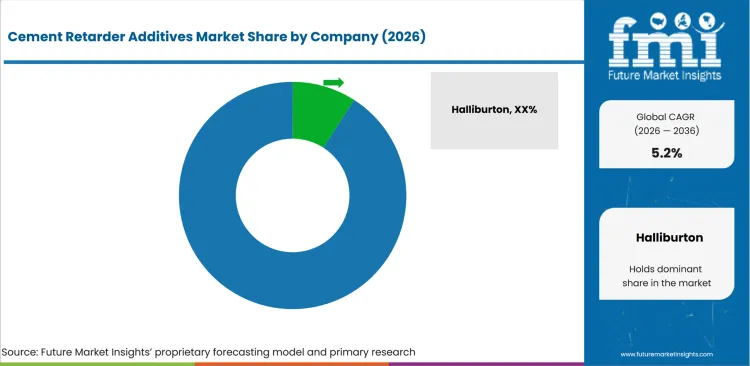
Competition separates integrated cementing service companies from specialty chemical manufacturers and formulation-focused regional producers. Entry barriers arise from slurry qualification plus temperature coverage and local technical stock instead of corporate scale alone. Integrated service groups influence additive approval through job design. Chemical specialists must fit defined retarder behavior into broader cement packages.
- Halliburton, SLB, Baker Hughes and Weatherford compete closest to field execution because cementing forms part of their wider well-construction and completion service programs.
- BASF and Clariant supply specialty chemistry into oilfield cementing routes, with their positions depending on documented product coverage and regional technical access.
- Riteks and Tianjin Kelioil Engineering Material and Technology Co., Ltd. compete through focused oilwell cement-additive portfolios and formulation support for temperature-specific jobs.
Competitive Benchmarking: Cement Retarder Additives Market
| Company | Retarder Chemistry Breadth | High-Temperature Fit | Cementing Application Support | Geographic Reach |
|---|---|---|---|---|
| Halliburton | High | High | High | Global |
| SLB | High | High | High | Global |
| Baker Hughes | High | High | High | Global |
| Weatherford | Medium | High | High | Global |
| BASF | High | High | Medium | Global |
| Clariant | Medium | Medium | Medium | Global |
| Riteks | High | High | Medium | North America with international supply |
| Tianjin Kelioil Engineering Material and Technology Co., Ltd. | High | High | Medium | China with international exports |
Scoring basis: High chemistry breadth requires at least three documented cement-additive or retarder chemistry routes, Medium requires two and Low identifies one. High temperature fit requires documented HPHT or deep-well coverage, Medium covers conventional high-temperature service and Low covers one lower thermal band. High application support requires integrated primary, remedial or offshore cementing service coverage. A Medium rating documents two application routes whereas Low identifies one verified route only.
Key Developments in the Cement Retarder Additives Market
- In April 2026, Halliburton published a patent application for a wide-range cement retarder using a biosurfactant-based formulation. The retarder is designed to control cement thickening across temperatures extending up to approximately 500°F, targeting demanding well-cementing conditions.
- In October 2025, Weatherford disclosed a three-year offshore Suriname contract to provide Cementation Products for an exploration and development campaign.
- In July 2025, Riteks introduced RiSeal Spacer MaxGuard-X for HPHT cementing conditions above 400°F, extending its chemical coverage for demanding placement programs.
Key Players in the Cement Retarder Additives Market
Integrated Cementing Service Companies
- Halliburton
- SLB
- Baker Hughes
- Weatherford
Specialty Oilfield Chemical Companies
- BASF
- Clariant
Focused Cement-Additive Producers
- Riteks
- Tianjin Kelioil Engineering Material and Technology Co., Ltd.
Cement Retarder Additives Market - Report Scope
| Coverage field | Report scope |
|---|---|
| Market breakdown | By chemistry, cementing operation, temperature, well type, sales channel and region. |
| Quantitative Units | USD Billion. |
| Market Definition | Commercial cement retarder additives used to control thickening time and placement windows in oil and gas well cementing operations. |
| Regions Covered | North America, Latin America, Western Europe, Eastern Europe, East Asia, South Asia and Pacific, Middle East and Africa. |
| Countries Covered | Qatar, KSA, UAE, Brazil, USA, and 20+ countries included in the full report. |
| Key Companies Profiled | Halliburton, SLB, Baker Hughes, Weatherford, BASF, Clariant, Riteks, Tianjin Kelioil Engineering Material and Technology Co., Ltd. |
| Forecast Period | 2026 to 2036. |
| Approach | Primary and secondary research with market triangulation. |
Cement Retarder Additives Market - Research Methodology
| Method | Approach |
|---|---|
| Primary Research | FMI analysts gathered input from manufacturers, service providers, technology developers, distributors, end users, procurement teams, and subject-matter experts. Interviews examined purchasing decisions, product or service evaluation, adoption barriers, approval requirements, pricing considerations, and expectations for technical or commercial support. Respondents were also asked what evidence is required before a trial, pilot, or initial order develops into regular purchasing. |
| Desk Research | Desk research covered government statistics, regulatory publications, trade data, industry associations, technical literature, standards, company filings, product information, and official corporate announcements. Sources were reviewed for relevance, publication date, geographic coverage, and consistency with the defined market scope. Claims relating to performance, applications, approvals, capacity, investment, and commercial activity were retained only when supported by credible public evidence. |
| Market Sizing and Forecasting | The market model combined the baseline value with historical performance, segment structure, pricing and volume indicators, adoption levels, company participation, and country-level demand conditions. Forecast assumptions considered economic activity, investment trends, regulatory developments, technology adoption, purchasing cycles, supply availability, and barriers to wider market use. Segment and regional estimates were reconciled before the final market total was calculated. |
| Data Validation | Estimates were checked against multiple independent indicators, including public data, company activity, trade patterns, industry developments, and findings from primary interviews. Validation also tested whether products, services, applications, and company revenues fell within the defined market boundaries. Adjacent categories, unsupported claims, overlapping revenues, and activities without direct market relevance were excluded to reduce double counting and maintain consistency across segments and countries. |
Cement Retarder Additives Market by Segments
Cement Retarder Additives Market segmented by Chemistry:
- Lignosulfonate retarders
- Hydroxycarboxylic acid retarders
- Phosphonate retarders
- Synthetic polymer retarders
- High-temperature retarders
Cement Retarder Additives Market segmented by Cementing Operation:
- Primary cementing
- Squeeze cementing
- Plug cementing
- Liner cementing
- Remedial cementing
Cement Retarder Additives Market segmented by Temperature:
- Low temperature
- Moderate temperature
- High temperature
- HPHT
Cement Retarder Additives Market segmented by Well Type:
- Onshore wells
- Offshore wells
- Deepwater wells
- HPHT wells
- Gas wells
Cement Retarder Additives Market segmented by Sales Channel:
- Cementing service companies
- Specialty chemical suppliers
- Direct operator supply
- Regional distributors
Cement Retarder Additives Market by Region:
- North America
- United States
- Canada
- Latin America
- Brazil
- Mexico
- Argentina
- Chile
- Western Europe
- Germany
- France
- United Kingdom
- Italy
- Spain
- Benelux
- Nordics
- Eastern Europe
- Poland
- Czech Republic
- Romania
- Hungary
- East Asia
- China
- Japan
- South Korea
- South Asia and Pacific
- India
- ASEAN
- Australia and New Zealand
- Middle East and Africa
- GCC Countries
- South Africa
- Türkiye
- Israel
Research Sources and Bibliography
- Halliburton. (2025, April 23). Halliburton and Aker BP achieve offshore automation milestone.
- USA Energy Information Administration. (2025, May 7). Well completions per location more than double in Lower 48 states as technology advances.
- Tianjin Kelioil Engineering Material and Technology Co., Ltd. (2025, August 12). The CH210L medium-temperature retarder supports efficient cementing operations in oilfields.
- SLB. (2025, March 31). SLB awarded major drilling contract by Woodside Energy for ultra-deepwater Trion development, offshore Mexico.
- Tianjin Kelioil Engineering Material and Technology Co., Ltd. (2026, January 20). New high-temperature cementing retarder CH710.
- Aramco. (2026, February 26). Aramco’s gas strategy builds momentum with major progress towards growth target.
- ADNOC. (2026, July 21). ADNOC accelerates gas growth strategy with FID for Umm Shaif Gas Cap.
- QatarEnergy. (2025, November). Investor presentation: Grow global LNG leadership.
- Aramco. (2025, November 4). Aramco announces third quarter 2025 results.
- ADNOC. (2026, August 4). ADNOC and SLB deploy AI platform across over 120 drilling rigs to strengthen upstream performance.
- Petrobras. (2026, January 16). Petrobras surpasses 2025 production targets.
- USA Energy Information Administration. (2026, March 31). USA crude oil production rose in 2025, setting new record.
- Halliburton. (2025, November 4). Halliburton launches LOGIX unit vitality to advance cementing operations.
- Riteks. (2025, July 6). Riteks MaxGuard-X: The next evolution in oilfield sealing spacer technology.
- Baker Hughes. (2025, February 4). Baker Hughes launches trio of electrification technologies for onshore, offshore operations.
- BASF. (2026, May 28). Performance Chemicals.
- Clariant. (2026, July 29). Clariant appoints Gapuma Group as Well Service Additives distributor across West Africa.
- Weatherford International plc. (2025, October 21). Weatherford Announces Third Quarter 2025 Results.
- Riteks. (2025, January 4). Riteks announces the opening of state-of-the-art powder blending facility in Houston, TX.
- Halliburton. (2026, June 17). A pioneer of lower-carbon well cementing: NeoCem E+ system proves value in the North Sea.
- SLB. (2026, February 12). SLB Awarded Multiple Offshore Drilling Contracts by Mubadala Energy for Tangkulo Deepwater Development in Indonesia.
- Weatherford International plc. (2025, July 22). Weatherford Announces Second Quarter 2025 Results.
- Halliburton. (2026, February 22). Pertamina and Halliburton sign an integrated unconventional fracturing MOU in Indonesia.
- Weatherford International plc. (2026, April 21). Weatherford Announces First Quarter 2026 Results.
- Clariant. (2025, September 8). Clariant Oil Services launches customer portal for seamless digital access.
- Tianjin Kelioil Engineering Material and Technology Co., Ltd. (2025, July 22). Kelioil: Liquid Cementing Additives Production Workshop.
- BSI Assurance UK Limited. (2025, February 26). Certificate of Registration: Occupational Health & Safety Management System - ISO 45001:2018 (Certificate OHS 804896).
This bibliography is provided for reader reference and is not exhaustive. The full report contains the complete reference list and detailed citations.
This Report Answers
- How large is the cement retarder additives market in 2026 and 2036?
- What operating conditions determine cement retarder additive selection during well construction?
- Which chemistry segment accounts for 28.0% of demand in 2026?
- Why does primary cementing account for 42.0% of cementing operation demand in 2026?
- How does temperature alter retarder dosage and qualification requirements?
- Which five countries carry the profiled growth rates through 2036?
- How do integrated cementing companies differ from specialty chemical producers?
- What limits supplier switching after a slurry program has been qualified?
- Which companies are active in cement retarder additives and related cementing chemistry?
Frequently Asked Questions
How big is the Cement Retarder Additives Market in 2026?
The cement retarder additives market is valued at USD 1.1 billion in 2026 and is projected to reach USD 1.9 billion by 2036. Growth is tied to controlled cement placement in deeper gas, offshore and complex wells.
What is the CAGR of the Cement Retarder Additives Market from 2026 to 2036?
The cement retarder additives market is projected to grow at a CAGR of 5.2% between 2026 and 2036. Expansion follows continuing well construction and the need to maintain planned thickening time under changing downhole temperatures.
Which chemistry segment leads the Cement Retarder Additives Market?
The lignosulfonate retarders segment is expected to hold 28.0% of the cement retarder additives market in 2026, attributable to familiar formulation behavior in conventional cement systems. Cost-performance balance supports repeated use in conventional jobs that do not require extreme-temperature chemistry.
Which cementing operation segment leads the Cement Retarder Additives Market?
The primary cementing segment is expected to hold 42.0% of the cement retarder additives market in 2026, driven by repeated slurry placement for new casing strings. Each new well section requires a planned pumpability window through the placement interval until cement sets.
Which countries are projected to record the highest growth in the Cement Retarder Additives Market?
Qatar is projected to grow at 6.0% CAGR, followed by KSA at 5.8% and UAE at 5.7% through 2036. Their faster pace follows large gas and offshore development programs with repeated cementing requirements.
Which companies are active in the Cement Retarder Additives Market?
Key companies operating in the cement retarder additives market include Halliburton, SLB, Baker Hughes, Weatherford, BASF, Clariant, Riteks, and Tianjin Kelioil Engineering Material and Technology Co., Ltd. Competition centers on formulation coverage, cementing support and regional supply access.
Preview the report firsthand - request a free sample
Get SampleGet the brochure for pricing and purchase details.
Get PDFTable of Content
- Key Takeaways
- Market Size and CAGR
- Top Growth Driver
- Fastest Growing Segment
- Leading Region
- Key Companies
- Emerging Opportunities
- Executive Summary
- Global Market Outlook
- Demand-side Trends
- Supply-side Trends
- Technology Roadmap Analysis
- Analysis and Recommendations
- Analyst Perspective (What is happening? Why now? What should investors know?)
- Key Questions Answered
- How large is the market?
- What is the CAGR?
- What are key trends?
- Which region dominates?
- Who are the leaders?
- Market Overview
- Market Coverage / Taxonomy
- Market Definition / Scope / Limitations
- Research Methodology
- Chapter Orientation
- Analytical Lens and Working Hypotheses
- Market Structure, Signals, and Trend Drivers
- Benchmarking and Cross-market Comparability
- Market Sizing, Forecasting, and Opportunity Mapping
- Research Design and Evidence Framework
- Desk Research Programme (Secondary Evidence)
- Expert Input and Fieldwork (Primary Evidence)
- Tooling, Models, and Reference Databases
- Data Engineering and Model Build
- Quality Assurance and Audit Trail
- Market Background
- Market Dynamics (Drivers, Restraints, Opportunity, Trends)
- Scenario Forecast (Optimistic, Likely, Conservative)
- Impact Analysis
- AI Impact
- Sustainability Impact
- Regulatory Impact
- Technology Impact
- Consumer / Buyer Analysis
- Purchase Drivers
- Adoption Barriers
- Buyer Journey
- Opportunity Map Analysis
- Product Life Cycle Analysis
- Supply Chain Analysis
- Investment Feasibility Matrix
- Value Chain Analysis
- PESTLE and Porter's Analysis
- Regulatory Landscape
- Regional Parent Market Outlook
- Production and Consumption Statistics
- Import and Export Statistics
- Global Market Analysis and Forecast, 2021 to 2036
- Historical Market Size Value (USD Billion) Analysis, 2021 to 2025
- Current and Future Market Size Value (USD Billion) Projections, 2026 to 2036
- Y-o-Y Growth Trend Analysis
- Absolute $ Opportunity Analysis
- Global Market Pricing Analysis, 2021 to 2036
- Global Market Analysis and Forecast, By Chemistry, 2021 to 2036
- Introduction / Key Findings
- Historical Market Size Value (USD Billion) Analysis By Chemistry, 2021 to 2025
- Current and Future Market Size Value (USD Billion) Analysis and Forecast By Chemistry, 2026 to 2036
- Lignosulfonate retarders
- Hydroxycarboxylic acid retarders
- Phosphonate retarders
- Synthetic polymer retarders
- High-temperature retarders
- Lignosulfonate retarders
- Y-o-Y Growth Trend Analysis By Chemistry, 2021 to 2025
- Absolute $ Opportunity Analysis By Chemistry, 2026 to 2036
- Global Market Analysis and Forecast, By Cementing Operation, 2021 to 2036
- Introduction / Key Findings
- Historical Market Size Value (USD Billion) Analysis By Cementing Operation, 2021 to 2025
- Current and Future Market Size Value (USD Billion) Analysis and Forecast By Cementing Operation, 2026 to 2036
- Primary cementing
- Squeeze cementing
- Plug cementing
- Liner cementing
- Remedial cementing
- Primary cementing
- Y-o-Y Growth Trend Analysis By Cementing Operation, 2021 to 2025
- Absolute $ Opportunity Analysis By Cementing Operation, 2026 to 2036
- Global Market Analysis and Forecast, By Temperature, 2021 to 2036
- Introduction / Key Findings
- Historical Market Size Value (USD Billion) Analysis By Temperature, 2021 to 2025
- Current and Future Market Size Value (USD Billion) Analysis and Forecast By Temperature, 2026 to 2036
- Low temperature
- Moderate temperature
- High temperature
- HPHT
- Low temperature
- Y-o-Y Growth Trend Analysis By Temperature, 2021 to 2025
- Absolute $ Opportunity Analysis By Temperature, 2026 to 2036
- Global Market Analysis and Forecast, By Well Type, 2021 to 2036
- Introduction / Key Findings
- Historical Market Size Value (USD Billion) Analysis By Well Type, 2021 to 2025
- Current and Future Market Size Value (USD Billion) Analysis and Forecast By Well Type, 2026 to 2036
- Onshore wells
- Offshore wells
- Deepwater wells
- HPHT wells
- Gas wells
- Onshore wells
- Y-o-Y Growth Trend Analysis By Well Type, 2021 to 2025
- Absolute $ Opportunity Analysis By Well Type, 2026 to 2036
- Global Market Analysis and Forecast, By Sales Channel, 2021 to 2036
- Introduction / Key Findings
- Historical Market Size Value (USD Billion) Analysis By Sales Channel, 2021 to 2025
- Current and Future Market Size Value (USD Billion) Analysis and Forecast By Sales Channel, 2026 to 2036
- Cementing service companies
- Specialty chemical suppliers
- Direct operator supply
- Regional distributors
- Cementing service companies
- Y-o-Y Growth Trend Analysis By Sales Channel, 2021 to 2025
- Absolute $ Opportunity Analysis By Sales Channel, 2026 to 2036
- Global Market Analysis and Forecast, By Region, 2021 to 2036
- Introduction
- Historical Market Size Value (USD Billion) Analysis By Region, 2021 to 2025
- Current Market Size Value (USD Billion) Analysis and Forecast By Region, 2026 to 2036
- North America
- Latin America
- Western Europe
- Eastern Europe
- East Asia
- South Asia and Pacific
- Middle East & Africa
- Market Attractiveness Analysis By Region
- North America Market Analysis and Forecast, By Country, 2021 to 2036
- Historical Market Size Value (USD Billion) Trend Analysis By Market Taxonomy, 2021 to 2025
- Market Size Value (USD Billion) Forecast By Market Taxonomy, 2026 to 2036
- By Country
- USA
- Canada
- By Chemistry
- By Cementing Operation
- By Temperature
- By Well Type
- By Sales Channel
- By Country
- Market Attractiveness Analysis
- By Country
- By Chemistry
- By Cementing Operation
- By Temperature
- By Well Type
- By Sales Channel
- Key Takeaways
- Latin America Market Analysis and Forecast, By Country
- Historical Market Size Value (USD Billion) Trend Analysis By Market Taxonomy, 2021 to 2025
- Market Size Value (USD Billion) Forecast By Market Taxonomy, 2026 to 2036
- By Country
- Brazil
- Mexico
- Chile
- Rest of Latin America
- By Chemistry
- By Cementing Operation
- By Temperature
- By Well Type
- By Sales Channel
- By Country
- Market Attractiveness Analysis
- By Country
- By Chemistry
- By Cementing Operation
- By Temperature
- By Well Type
- By Sales Channel
- Key Takeaways
- Western Europe Market Analysis and Forecast, By Country
- Historical Market Size Value (USD Billion) Trend Analysis By Market Taxonomy, 2021 to 2025
- Market Size Value (USD Billion) Forecast By Market Taxonomy, 2026 to 2036
- By Country
- Germany
- UK
- Italy
- Spain
- France
- Nordic
- BENELUX
- Rest of Western Europe
- By Chemistry
- By Cementing Operation
- By Temperature
- By Well Type
- By Sales Channel
- By Country
- Market Attractiveness Analysis
- By Country
- By Chemistry
- By Cementing Operation
- By Temperature
- By Well Type
- By Sales Channel
- Key Takeaways
- Eastern Europe Market Analysis and Forecast, By Country
- Historical Market Size Value (USD Billion) Trend Analysis By Market Taxonomy, 2021 to 2025
- Market Size Value (USD Billion) Forecast By Market Taxonomy, 2026 to 2036
- By Country
- Russia
- Poland
- Hungary
- Balkan & Baltic
- Rest of Eastern Europe
- By Chemistry
- By Cementing Operation
- By Temperature
- By Well Type
- By Sales Channel
- By Country
- Market Attractiveness Analysis
- By Country
- By Chemistry
- By Cementing Operation
- By Temperature
- By Well Type
- By Sales Channel
- Key Takeaways
- East Asia Market Analysis and Forecast, By Country
- Historical Market Size Value (USD Billion) Trend Analysis By Market Taxonomy, 2021 to 2025
- Market Size Value (USD Billion) Forecast By Market Taxonomy, 2026 to 2036
- By Country
- China
- Japan
- South Korea
- By Chemistry
- By Cementing Operation
- By Temperature
- By Well Type
- By Sales Channel
- By Country
- Market Attractiveness Analysis
- By Country
- By Chemistry
- By Cementing Operation
- By Temperature
- By Well Type
- By Sales Channel
- Key Takeaways
- South Asia and Pacific Market Analysis and Forecast, By Country
- Historical Market Size Value (USD Billion) Trend Analysis By Market Taxonomy, 2021 to 2025
- Market Size Value (USD Billion) Forecast By Market Taxonomy, 2026 to 2036
- By Country
- India
- ASEAN
- Australia & New Zealand
- Rest of South Asia and Pacific
- By Chemistry
- By Cementing Operation
- By Temperature
- By Well Type
- By Sales Channel
- By Country
- Market Attractiveness Analysis
- By Country
- By Chemistry
- By Cementing Operation
- By Temperature
- By Well Type
- By Sales Channel
- Key Takeaways
- Middle East & Africa Market Analysis and Forecast, By Country
- Historical Market Size Value (USD Billion) Trend Analysis By Market Taxonomy, 2021 to 2025
- Market Size Value (USD Billion) Forecast By Market Taxonomy, 2026 to 2036
- By Country
- Kingdom of Saudi Arabia
- Other GCC Countries
- Türkiye
- South Africa
- Other African Union
- Rest of Middle East & Africa
- By Chemistry
- By Cementing Operation
- By Temperature
- By Well Type
- By Sales Channel
- By Country
- Market Attractiveness Analysis
- By Country
- By Chemistry
- By Cementing Operation
- By Temperature
- By Well Type
- By Sales Channel
- Key Takeaways
- Key Countries Market Analysis
- USA
- Pricing Analysis
- Market Share Analysis, 2025
- By Chemistry
- By Cementing Operation
- By Temperature
- By Well Type
- By Sales Channel
- Canada
- Pricing Analysis
- Market Share Analysis, 2025
- By Chemistry
- By Cementing Operation
- By Temperature
- By Well Type
- By Sales Channel
- Mexico
- Pricing Analysis
- Market Share Analysis, 2025
- By Chemistry
- By Cementing Operation
- By Temperature
- By Well Type
- By Sales Channel
- Brazil
- Pricing Analysis
- Market Share Analysis, 2025
- By Chemistry
- By Cementing Operation
- By Temperature
- By Well Type
- By Sales Channel
- Chile
- Pricing Analysis
- Market Share Analysis, 2025
- By Chemistry
- By Cementing Operation
- By Temperature
- By Well Type
- By Sales Channel
- Germany
- Pricing Analysis
- Market Share Analysis, 2025
- By Chemistry
- By Cementing Operation
- By Temperature
- By Well Type
- By Sales Channel
- UK
- Pricing Analysis
- Market Share Analysis, 2025
- By Chemistry
- By Cementing Operation
- By Temperature
- By Well Type
- By Sales Channel
- Italy
- Pricing Analysis
- Market Share Analysis, 2025
- By Chemistry
- By Cementing Operation
- By Temperature
- By Well Type
- By Sales Channel
- Spain
- Pricing Analysis
- Market Share Analysis, 2025
- By Chemistry
- By Cementing Operation
- By Temperature
- By Well Type
- By Sales Channel
- France
- Pricing Analysis
- Market Share Analysis, 2025
- By Chemistry
- By Cementing Operation
- By Temperature
- By Well Type
- By Sales Channel
- India
- Pricing Analysis
- Market Share Analysis, 2025
- By Chemistry
- By Cementing Operation
- By Temperature
- By Well Type
- By Sales Channel
- ASEAN
- Pricing Analysis
- Market Share Analysis, 2025
- By Chemistry
- By Cementing Operation
- By Temperature
- By Well Type
- By Sales Channel
- Australia & New Zealand
- Pricing Analysis
- Market Share Analysis, 2025
- By Chemistry
- By Cementing Operation
- By Temperature
- By Well Type
- By Sales Channel
- China
- Pricing Analysis
- Market Share Analysis, 2025
- By Chemistry
- By Cementing Operation
- By Temperature
- By Well Type
- By Sales Channel
- Japan
- Pricing Analysis
- Market Share Analysis, 2025
- By Chemistry
- By Cementing Operation
- By Temperature
- By Well Type
- By Sales Channel
- South Korea
- Pricing Analysis
- Market Share Analysis, 2025
- By Chemistry
- By Cementing Operation
- By Temperature
- By Well Type
- By Sales Channel
- Russia
- Pricing Analysis
- Market Share Analysis, 2025
- By Chemistry
- By Cementing Operation
- By Temperature
- By Well Type
- By Sales Channel
- Poland
- Pricing Analysis
- Market Share Analysis, 2025
- By Chemistry
- By Cementing Operation
- By Temperature
- By Well Type
- By Sales Channel
- Hungary
- Pricing Analysis
- Market Share Analysis, 2025
- By Chemistry
- By Cementing Operation
- By Temperature
- By Well Type
- By Sales Channel
- Kingdom of Saudi Arabia
- Pricing Analysis
- Market Share Analysis, 2025
- By Chemistry
- By Cementing Operation
- By Temperature
- By Well Type
- By Sales Channel
- Türkiye
- Pricing Analysis
- Market Share Analysis, 2025
- By Chemistry
- By Cementing Operation
- By Temperature
- By Well Type
- By Sales Channel
- South Africa
- Pricing Analysis
- Market Share Analysis, 2025
- By Chemistry
- By Cementing Operation
- By Temperature
- By Well Type
- By Sales Channel
- USA
- Market Structure Analysis
- Competition Dashboard
- Competition Benchmarking
- Market Share Analysis of Top Players
- By Regional
- By Chemistry
- By Cementing Operation
- By Temperature
- By Well Type
- By Sales Channel
- Emerging Startups
- Innovation Benchmarking
- Competition Analysis
- Competition Deep Dive
- Halliburton
- Overview
- Product Portfolio
- Profitability by Market Segments
- Sales Footprint
- Strategy Overview
- Marketing Strategy
- Product Strategy
- Channel Strategy
- SLB
- Baker Hughes
- Chryso / Saint-Gobain
- Sika
- BASF
- Clariant
- Innospec
- GCP Applied Technologies / Saint-Gobain
- TETRA Technologies
- Halliburton
- Case Studies
- Success Stories
- Recent Developments
- Competition Deep Dive
- Assumptions & Acronyms Used


