

- Market Size (2026)
- USD 820.7 Mn
- Forecast (2036)
- USD 1349.6 Mn
- CAGR (2026 to 2036)
- 5.1%
How big is Cement Density Enhancers Market in 2026?
USD 820.7 million in 2026 and USD 1,349.6 million by 2036 at a 5.1% CAGR.
Sales in the cement density enhancers market is projected to expand from USD 820.7 million in 2026 to USD 1,349.6 million by 2036 at 5.1% CAGR. Complex well construction raises demand after conventional slurry cannot provide the required hydrostatic head without changing placement behavior. SLB received a July 2025 North Sea contract to construct six carbon-storage wells with cementing included in the scope. The award broadens the qualified well base that requires engineered cement barriers under demanding pressure conditions.
Country demand differs because the number of wells does not track production growth evenly between major basins. The USA Energy Information Administration documented a 2025 production record of 13.6 million barrels per day despite 5% fewer Lower 48 rigs and 1% fewer wells. That efficiency pressure keeps the USA below faster-growth KSA and UAE forecasts because service companies must extract more value from each completed well.
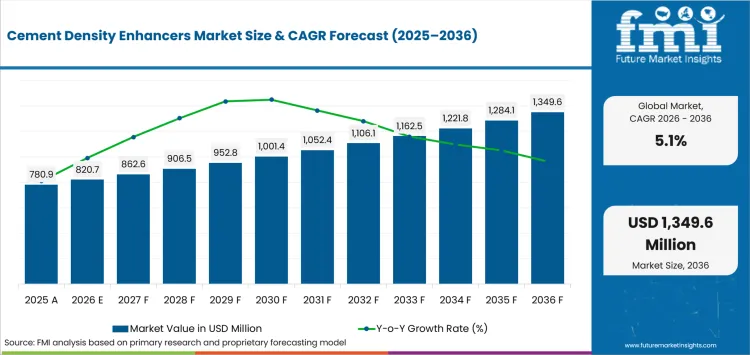
Key Takeaways of Cement Density Enhancers Market
- Demand rises as deeper and pressure-intensive wells require cement slurries that carry more hydrostatic weight without losing placement stability.
- Based on enhancer type, hematite additives are projected to account for 26.0% in 2026 due to efficient solids loading in heavyweight slurry designs.
- By cement system, standard slurry is estimated to hold 29.0% in 2026 owing to its broad qualification history for job-specific density adjustment.
- In 2026, primary cementing is expected to lead the operation category with 42.0% share because every cased well requires an initial annular barrier.
- Higher solids loading can raise viscosity and settling risk during qualification, which lengthens laboratory work before operators approve a material change.
- Some of the key players in this market include Halliburton, SLB, Baker Hughes, Weatherford, National Energy Services Reunited Corp. (NESR), Trican Well Service Ltd., Sanjel Energy Services Inc., and Clariant.
Analyst Perspective
"Density enhancers earn repeat orders after the complete slurry proves stable under the target well pressure and temperature profile. The stronger commercial position belongs to materials that raise density with controlled rheology and arrive with laboratory support for operator qualification."
- Nikhil Kaitwade, Principal Consultant, Future Market Insights
How is the Cement Density Enhancers Market segmented?
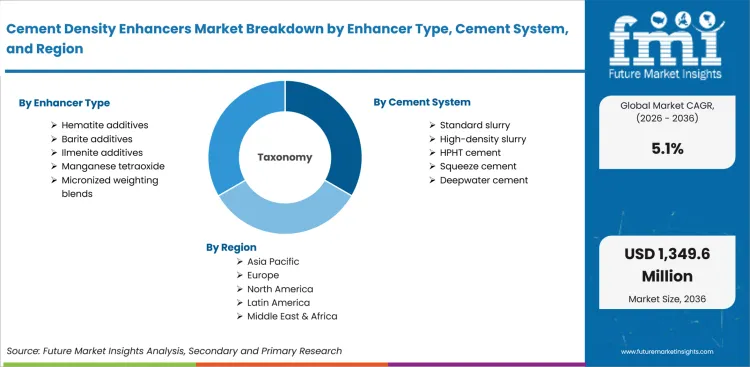
The cement density enhancers market is segmented by enhancer type, cement system, operation, well type, sales channel and region.
Enhancer types include hematite, barite, ilmenite, manganese tetraoxide and micronized weighting blends. Cement systems cover standard slurry, high-density slurry, HPHT cement, squeeze cement and deepwater cement. Operations include primary, liner, plug and remedial cementing. Well types cover onshore, offshore, HPHT, gas wells and deepwater wells. Sales channels include cementing service companies, mineral suppliers, direct operator supply and regional distributors.
Why do Hematite additives lead the Enhancer type category?
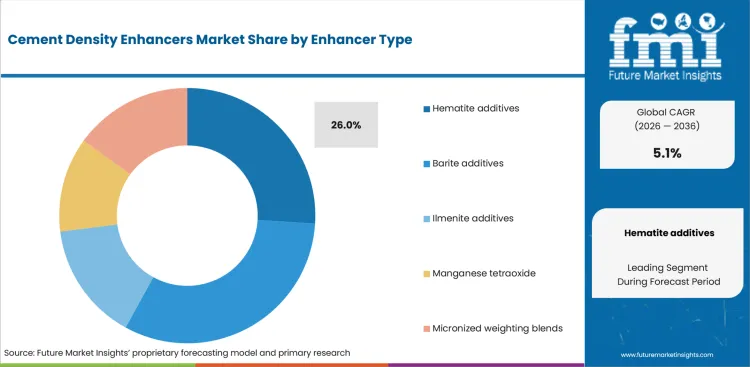
Hematite reaches heavyweight slurry targets with less added mineral volume than lower-density alternatives. Cementing laboratories therefore evaluate its dispersion behavior beside the wider oilfield chemicals package before approving a job-specific formulation.
- Based on enhancer type, hematite additives are projected to account for 26.0% in 2026 due to efficient solids loading in pressure-intensive cement designs.
- Halliburton released LOGIX unit vitality in November 2025 and said the platform monitors more than 400 cement-unit parameters. Tighter equipment visibility reduces execution uncertainty for weighted slurries after the laboratory recipe reaches the unit under demanding pressure conditions.
What supports Standard slurry within the Cement system category?
Standard slurry gives engineers a familiar starting formulation before density is raised for a specific formation window. Displacement planning with drilling and completion fluids determines whether weighted cement reaches the intended annular interval.
- By cement system, standard slurry is estimated to hold 29.0% in 2026 owing to its broad qualification history for job-specific weighting packages.
- Weatherford stated in July 2025 that Cementation Products activity increased sequentially in North America and its Middle East regional group. Active cementation programs preserve demand for base systems that crews already understand before adding a qualified weighting package.
How does Primary cementing shape demand within the Operation category?
Primary cementing places the first permanent annular barrier after casing reaches depth. Density errors can therefore affect displacement and long-term zonal isolation during the same operation before later completion work begins.
- In 2026, primary cementing is expected to lead the operation category with 42.0% share because every cased well requires an initial annular barrier.
- Halliburton and Aker BP documented 400 successful LOGIX automated cementing jobs in April 2025 on four offshore rigs. Repeated offshore execution keeps first-barrier placement commercially significant because each job must satisfy density and placement criteria before later well operations proceed.
What drives Cementing service companies within the Sales channel category?
Cementing service companies control the laboratory-to-field handoff that turns a weighting mineral into an operator-approved slurry recipe. Their selection process overlaps with oilfield production chemicals because additive compatibility and regional inventory determine whether one design can be repeated through development campaigns.
- Cementing service companies are projected to hold 45.0% share in 2026 owing to direct control over slurry design and field execution.
- SLB disclosed in July 2026 that Kuwait Oil Company awarded a cementing contract covering conventional and unconventional scopes. Contracted responsibility gives integrated cementing companies direct influence over material selection inside operator-approved programs.
What are the drivers, restraints and opportunities in the Cement Density Enhancers Market?
Complex well construction raises slurry-density requirements while qualification delays material switching and engineered particle distributions improve placement control in narrow pressure windows.
- Driver: Long unconventional and offshore well sections raise hydrostatic requirements and increase the number of cement programs needing qualified weighting solids.
- Restraint: Dense solids can change slurry flow and barrier properties, so new materials require laboratory and field qualification before routine use.
- Opportunity: Engineered particle distributions can reach higher density with better placement control for cementing programs operating inside narrow pressure windows.
Complex Well Programs Increase Density Requirements
Unconventional gas development increases the number of long cement columns that must hold pressure through repeated well construction. Aramco stated in February 2026 that Jafurah production began in December 2025 and is intended to reach two billion standard cubic feet of sales gas per day by 2030. This development sequence expands demand for qualified well casing and heavyweight cement programs used in pressure-intensive wells.
Qualification Work Slows Material Switching
A weighting material enters field service only after engineers verify how it changes slurry flow and final barrier performance. Halliburton documented in June 2026 that its NeoCem E+ system underwent long-term qualification plus yard and offshore field tests before wider North Sea use. Similar evidence burdens affect oilwell completion tools because barrier changes require proof under the intended operating conditions.
Engineered Blends Give Formulators More Control
Engineered blends gain value where higher density must be delivered without proportional increases in segregation or mixing difficulty. SLB stated in July 2026 that automated cementing had surpassed 100 remote and automated jobs after first-quarter commercialization. Closed-loop execution increases the value of consistent material behavior beside complex subsea equipment programs because density control must remain repeatable from laboratory design to field placement.
Which country CAGRs are profiled in the Cement Density Enhancers Market?
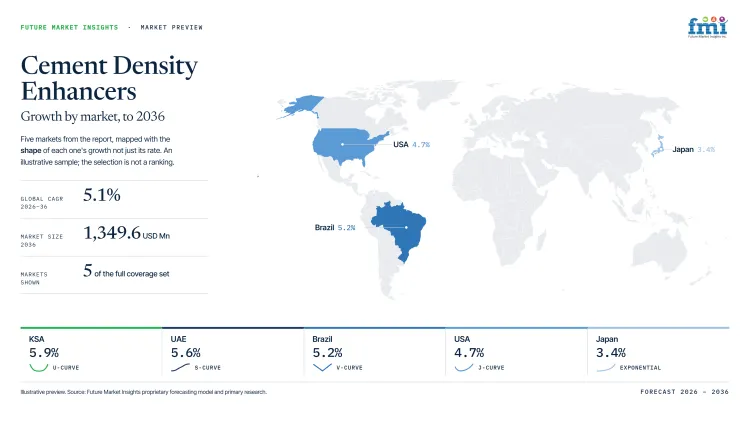
| Country | CAGR |
|---|---|
| KSA | 5.9% |
| UAE | 5.6% |
| Brazil | 5.2% |
| USA | 4.7% |
| Japan | 3.4% |
How do country-level CAGRs compare in the Cement Density Enhancers Market?
The country spread is 2.5 percentage points and separates an upper group from mature producing markets. KSA and the UAE lead through large unconventional programs whereas Brazil occupies a middle position through offshore construction. The USA and Japan post slower forecasts because productivity gains and selective project sanctioning reduce well-count expansion.
- KSA ranks first as pad programs concentrate repeated cementing work within controlled contracts.
- Integrated drilling contracts give UAE service companies influence over cement material selection.
- Brazilian offshore mobilization raises inventory planning needs before qualified materials reach projects.
- USA shale and offshore work require separate strategies for distinct operating conditions.
- Japan targets specialized cement formulations for offshore and geothermal projects near existing energy infrastructure.
Similar forecast rates conceal different qualification paths and material-entry conditions between countries. The full report provides country-level CAGR analysis across North America, Latin America, Europe, East Asia, South Asia, Oceania and the Middle East and Africa.
Country-wise Analysis
- Saudi cementing programs follow long unconventional gas campaigns that require repeat material delivery into operator-controlled service workflows and nearby laboratory support. SLB disclosed in December 2025 that Aramco awarded a five-year stimulation contract for its unconventional gas fields. KSA is projected to grow at 5.9% CAGR through 2036 because this development cadence increases pressure-intensive well construction and demand for qualified barrier materials. Regional scale supports repeated qualification of weighted cement systems beside onshore drilling fluids, but strict operator approval keeps new entrants dependent on stable mineral quality and regional inventory before commercial orders can expand beyond initial field programs.
- In Abu Dhabi's integrated drilling programs, cementing companies coordinate slurry design with the same schedules governing drilling and completion services. ADNOC Drilling documented in May 2026 that Turnwell delivered the UAE's first 10,000-foot lateral unconventional gas wells during the first quarter. Adoption of cement density enhancers in the UAE is estimated to expand at 5.6% CAGR through 2036 aided by longer gas laterals and integrated field-service capacity. Regional laboratories shorten response times, though high-utilization drilling leaves limited tolerance for density variation or delayed bulk delivery and makes nearby stock a practical condition for repeat orders during repeated unconventional campaigns.
- Long offshore fluid columns make unstable cement placement especially costly in Brazil's pre-salt developments and increase the penalty for inconsistent bulk material. Cement density enhancer sales in Brazil are forecast to expand at 5.2% CAGR by 2036 given continued Santos and Campos Basin well additions. Petrobras documented in February 2026 that 44 new offshore production wells entered service during 2025 with 22 in each basin. Deepwater scale supports higher-specification formulations, although laboratory approval and offshore mobilization keep market entry tied to local service integration and predictable bulk-material availability near the operating base for repeated pre-salt programs with long offshore mobilization cycles.
- For operators in the USA, cementing demand splits between high-volume shale programs and offshore wells with different pressure limits and service economics. EIA documented in August 2026 that wells longer than 15,000 feet represented 15% of new Permian completions during 2025. The USA is estimated to post 4.7% CAGR over the forecast period reflecting productivity gains that limit well-count growth while extending lateral length. Longer laterals sustain hydraulic fracturing and multi-pad drilling activity, yet land operators retain strict cost discipline and offshore projects require separate qualification records before a new weighting material enters routine service commercially through either sales route.
- Offshore rework costs keep Japanese cement programs focused on documented barrier performance across mature offshore, geothermal, and well-integrity projects. Japan’s established energy infrastructure and technical expertise support high-specification cementing, although limited offshore activity, smaller project counts, and lengthy qualification requirements restrict the addressable volume for new material suppliers. The Japanese cement density enhancers sector is projected to record 3.4% CAGR during the assessment period, supported by specialized well applications, geothermal development, and strict well-integrity expectations across selective energy projects near existing infrastructure.
Who are the notable companies in the Cement Density Enhancers Market?
Halliburton, SLB, Baker Hughes, Weatherford, National Energy Services Reunited Corp. (NESR), Trican Well Service Ltd., Sanjel Energy Services Inc., and Clariant are the notable companies serving this market.
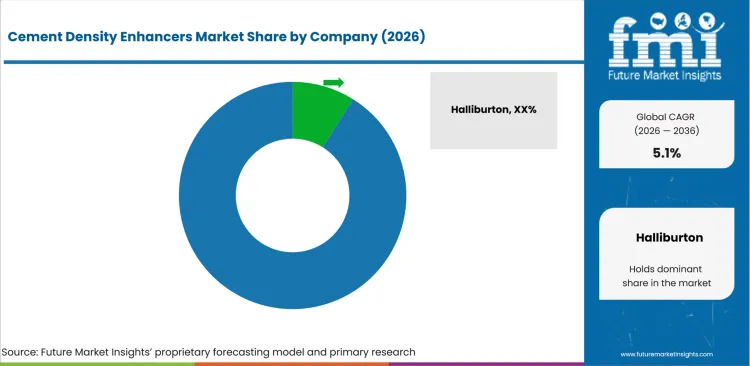
Competition is concentrated in integrated cementing services, regional pressure pumping, cementation equipment and specialty chemistry. Entry barriers rise because operators qualify the complete slurry and field delivery process instead of approving a mineral on specific gravity alone. The strongest positions therefore pair laboratory access with field execution or a documented additive route that service companies can use within existing cement programs.
- Halliburton, SLB and Baker Hughes compete through global cementing programs with digital job control and complex-well service coverage.
- NESR, Trican Well Service Ltd. and Sanjel Energy Services Inc. compete through regional cementing scale and pressure-pumping execution.
- Weatherford supplies cementation products for stage placement, whereas Clariant participates through well-service additives used by service companies and formulators.
Competitive Benchmarking: Cement Density Enhancers Market
| Company | Field Cementing Integration | Complex-Well Cementing Evidence | Cementation or Additive Control | Geographic Reach |
|---|---|---|---|---|
| Halliburton | High | High | High | Global |
| SLB | High | High | High | Global |
| Baker Hughes | High | High | High | Global |
| Weatherford | Low | Medium | High | Global |
| National Energy Services Reunited Corp. (NESR) | High | Medium | Medium | Middle East, North Africa and Asia Pacific |
| Trican Well Service Ltd. | Medium | Medium | Medium | Western Canada |
| Sanjel Energy Services Inc. | Medium | Low | Medium | Western Canada |
| Clariant | Low | Low | High | Global with West Africa distribution |
Scoring basis: Field integration is High for documented cementing delivery at scale and Medium for regional field cementing. A Low field-integration score identifies an officially documented product or additive role without pumping execution. Complex-well evidence is High for cementing in multiple offshore or unconventional programs and Medium for one documented complex-well route. A Low complex-well score identifies participation limited to cementation products or additives without direct complex-well delivery. Control is High for direct cement-system or product ownership with technical support and Medium for narrower documented control. A Low control score identifies one documented input route without broader cement-system ownership.
Key Developments in the Cement Density Enhancers Market
- In May 2026, Baker Hughes expanded its integrated Petrobras well-construction contract in the Santos Basin with cementing included in the offshore scope.
- In March 2026, National Energy Services Reunited Corp. (NESR) secured several multi-year cementing awards valued at approximately USD 300 million in Kuwait and North Africa.
- In April 2025, Weatherford disclosed a two-year Middle East contract for Stage Tool Cementing Equipment through its official first-quarter results.
Key Players in the Cement Density Enhancers Market
Global Integrated Cementing Providers
- Halliburton
- SLB
- Baker Hughes
Regional Cementing and Pressure-Pumping Providers
- National Energy Services Reunited Corp. (NESR)
- Trican Well Service Ltd.
- Sanjel Energy Services Inc.
Cementation Products and Well-Service Chemistry
- Weatherford
- Clariant
Cement Density Enhancers Market - Report Scope
| Coverage field | Report scope |
|---|---|
| Market breakdown | By enhancer type, cement system, operation, well type, sales channel and region. |
| Quantitative Units | USD Million. |
| Market Definition | Revenue includes density-enhancing minerals and engineered weighting blends sold for oil, gas, geothermal and carbon-storage well cement slurries. It excludes cementing equipment, service revenue and drilling-fluid weighting materials not sold for cement use. |
| Regions Covered | North America, Latin America, Western Europe, Eastern Europe, East Asia, South Asia and Pacific, Middle East and Africa. |
| Countries Covered | KSA, UAE, Brazil, USA, Norway, and 20+ countries included in the full report. |
| Key Companies Profiled | Halliburton, SLB, Baker Hughes, Weatherford, National Energy Services Reunited Corp. (NESR), Trican Well Service Ltd., Sanjel Energy Services Inc., Clariant. |
| Forecast Period | 2026 to 2036. |
| Approach | Primary and secondary research with market triangulation. |
Cement Density Enhancers Market - Research Methodology
| Method | Approach |
|---|---|
| Primary Research | FMI analysts gathered input from manufacturers, service providers, technology developers, distributors, end users, procurement teams, and subject-matter experts. Interviews examined purchasing decisions, product or service evaluation, adoption barriers, approval requirements, pricing considerations, and expectations for technical or commercial support. Respondents were also asked what evidence is required before a trial, pilot, or initial order develops into regular purchasing. |
| Desk Research | Desk research covered government statistics, regulatory publications, trade data, industry associations, technical literature, standards, company filings, product information, and official corporate announcements. Sources were reviewed for relevance, publication date, geographic coverage, and consistency with the defined market scope. Claims relating to performance, applications, approvals, capacity, investment, and commercial activity were retained only when supported by credible public evidence. |
| Market Sizing and Forecasting | The market model combined the baseline value with historical performance, segment structure, pricing and volume indicators, adoption levels, company participation, and country-level demand conditions. Forecast assumptions considered economic activity, investment trends, regulatory developments, technology adoption, purchasing cycles, supply availability, and barriers to wider market use. Segment and regional estimates were reconciled before the final market total was calculated. |
| Data Validation | Estimates were checked against multiple independent indicators, including public data, company activity, trade patterns, industry developments, and findings from primary interviews. Validation also tested whether products, services, applications, and company revenues fell within the defined market boundaries. Adjacent categories, unsupported claims, overlapping revenues, and activities without direct market relevance were excluded to reduce double counting and maintain consistency across segments and countries. |
Cement Density Enhancers Market by Segments
Cement Density Enhancers Market segmented by Enhancer Type:
- Hematite additives
- Barite additives
- Ilmenite additives
- Manganese tetraoxide
- Micronized weighting blends
Cement Density Enhancers Market segmented by Cement System:
- Standard slurry
- High-density slurry
- HPHT cement
- Squeeze cement
- Deepwater cement
Cement Density Enhancers Market segmented by Operation:
- Primary cementing
- Liner cementing
- Plug cementing
- Remedial cementing
Cement Density Enhancers Market segmented by Well Type:
- Onshore
- Offshore
- HPHT
- Gas wells
- Deepwater
Cement Density Enhancers Market segmented by Sales Channel:
- Cementing service companies
- Mineral suppliers
- Direct operator supply
- Regional distributors
Cement Density Enhancers Market by Region:
- North America
- United States
- Canada
- Latin America
- Brazil
- Mexico
- Argentina
- Chile
- Western Europe
- Germany
- France
- United Kingdom
- Italy
- Spain
- Benelux
- Nordics
- Eastern Europe
- Poland
- Czech Republic
- Romania
- Hungary
- East Asia
- China
- Japan
- South Korea
- South Asia and Pacific
- India
- ASEAN
- Australia and New Zealand
- Middle East and Africa
- GCC Countries
- South Africa
- Türkiye
- Israel
Research Sources and Bibliography
- SLB. (2025, July 22). SLB Awarded Carbon Storage Contract for Northern Endurance Partnership Project in UK
- USA Energy Information Administration. (2026, March 31). USA crude oil production rose in 2025, setting new record
- Halliburton. (2025, November 4). Halliburton launches LOGIX unit vitality to advance cementing operations
- Weatherford International plc. (2025, July 22). Weatherford Announces Second Quarter 2025 Results
- Halliburton. (2025, April 23). Halliburton and Aker BP achieve offshore automation milestone
- SLB. (2026, July 24). SLB Announces Second-Quarter 2026 Results
- Aramco. (2026, February 26). Aramco’s gas strategy builds momentum with major progress towards growth target
- Halliburton. (2026, June 17). A pioneer of lower-carbon well cementing: NeoCem E+ system proves value in the North Sea
- SLB. (2025, December 23). Aramco Awards SLB Long-Term Contract to Support Kingdom’s Unconventional Gas Production Growth
- ADNOC Drilling. (2026, May 11). ADNOC Drilling Delivers Best-Ever 1Q Performance, Driven by High Utilization, Integrated Services and Contracted Growth
- Agência Petrobras. (2026, February 10). Produção de petróleo e gás da Petrobras cresce 11% e alcança 3 milhões de barris em 2025
- USA Energy Information Administration. (2026, August 19). Longer wells boost Permian crude oil and natural gas production
- Norwegian Offshore Directorate. (2026, January 13). 19 companies offered ownership interests
- Baker Hughes. (2026, May 26). Baker Hughes Extends and Expands Integrated Well Construction Contract with Petrobras
- National Energy Services Reunited Corp. (2026, March 16). NESR Awarded $300 Million in Cementing Contracts
- Weatherford International plc. (2025, April 22). Weatherford Announces First Quarter 2025 Results
- Trican Well Service Ltd. (2025, February). Corporate Presentation February 2025
- STEP Energy Services Ltd. (2026, March 9). STEP and Sanjel Complete Transaction, Creating One of Canada’s Largest Oilfield Services Companies
- Clariant. (2026, July 29). Clariant appoints Gapuma Group as Well Service Additives distributor across West Africa
- Trican Well Service Ltd. (2025, August 27). Trican Announces Closing of Iron Horse Acquisition
- Halliburton. (2026, February 22). Pertamina and Halliburton sign an integrated unconventional fracturing MOU in Indonesia
- SLB. (2025, March 31). SLB Awarded Major Drilling Contract by Woodside Energy for Ultra-deepwater Trion Development, Offshore Mexico
- Baker Hughes. (2025, September 3). Taking energy forward in Oman
- Weatherford International plc. (2025, October 21). Weatherford Announces Third Quarter 2025 Results
- ProPetro Holding Corp. (2026, February 19). Form 10-K
- Reservoir Link Energy Bhd. (2025, June 30). Award on work order for the provision of annulus wash and cement assurance for PETRONAS Carigali Sdn Bhd
This Report Answers
- How large is the cement density enhancers market in 2026 and what value is projected for 2036?
- Which well-construction conditions increase demand for heavyweight cement slurries and qualified weighting solids?
- Why do hematite additives account for 26.0% of enhancer type demand during 2026?
- Why does standard slurry hold 29.0% of cement system demand during 2026?
- Why does primary cementing represent 42.0% of operation demand during 2026?
- How do country growth rates compare between KSA, UAE, Brazil, USA and Norway?
- Which companies provide integrated cementing services, cementation products or well-service additives for this market?
- Which qualification and logistics conditions can slow adoption of a new density-enhancing material?
Frequently Asked Questions
How big is the cement density enhancers market in 2026?
The cement density enhancers market is valued at USD 820.7 million in 2026 and is projected to reach USD 1,349.6 million by 2036. Growth follows complex well programs that need heavier qualified cement slurries without sacrificing placement stability.
What is the CAGR of the cement density enhancers market from 2026 to 2036?
The cement density enhancers market is projected to grow at a CAGR of 5.1% between 2026 and 2036. Expansion follows deeper unconventional and offshore wells that raise hydrostatic requirements for primary and remedial cement programs.
Which enhancer type leads the cement density enhancers market?
The hematite additives segment is expected to hold 26.0% of the cement density enhancers market in 2026, driven by high specific gravity that limits added-solids volume. Long qualification histories support continued use in pressure-intensive cement designs requiring repeatable laboratory performance.
Which operation segment leads the cement density enhancers market?
The primary cementing segment is expected to hold 42.0% of the cement density enhancers market in 2026, attributable to first-barrier placement on newly constructed cased wells. Each job requires verified density and placement behavior before later well operations proceed.
How much value will the cement density enhancers market add between 2026 and 2036?
The cement density enhancers market is expected to add USD 528.9 million in value between 2026 and 2036. The increase follows more complex well construction and wider use of qualified weighting systems in demanding cement programs.
Which countries are projected to record the highest growth in the cement density enhancers market?
KSA is projected to grow at 5.9% CAGR followed by the UAE at 5.6% and Brazil at 5.2% through 2036. Unconventional gas campaigns and deepwater construction account for the stronger growth rates in these three profiled countries.
Which companies are active in the cement density enhancers market?
Key companies operating in the cement density enhancers market include Halliburton, SLB, Baker Hughes, Weatherford, National Energy Services Reunited Corp. (NESR), Trican Well Service Ltd., Sanjel Energy Services Inc., and Clariant. Their documented roles cover field cementing, cementation products, regional services and additive chemistry.
Preview the report firsthand - request a free sample
Get SampleGet the brochure for pricing and purchase details.
Get PDFTable of Content
- Key Takeaways
- Market Size and CAGR
- Top Growth Driver
- Fastest Growing Segment
- Leading Region
- Key Companies
- Emerging Opportunities
- Executive Summary
- Global Market Outlook
- Demand-side Trends
- Supply-side Trends
- Technology Roadmap Analysis
- Analysis and Recommendations
- Analyst Perspective (What is happening? Why now? What should investors know?)
- Key Questions Answered
- How large is the market?
- What is the CAGR?
- What are key trends?
- Which region dominates?
- Who are the leaders?
- Market Overview
- Market Coverage / Taxonomy
- Market Definition / Scope / Limitations
- Research Methodology
- Chapter Orientation
- Analytical Lens and Working Hypotheses
- Market Structure, Signals, and Trend Drivers
- Benchmarking and Cross-market Comparability
- Market Sizing, Forecasting, and Opportunity Mapping
- Research Design and Evidence Framework
- Desk Research Programme (Secondary Evidence)
- Expert Input and Fieldwork (Primary Evidence)
- Tooling, Models, and Reference Databases
- Data Engineering and Model Build
- Quality Assurance and Audit Trail
- Market Background
- Market Dynamics (Drivers, Restraints, Opportunity, Trends)
- Scenario Forecast (Optimistic, Likely, Conservative)
- Impact Analysis
- AI Impact
- Sustainability Impact
- Regulatory Impact
- Technology Impact
- Consumer / Buyer Analysis
- Purchase Drivers
- Adoption Barriers
- Buyer Journey
- Opportunity Map Analysis
- Product Life Cycle Analysis
- Supply Chain Analysis
- Investment Feasibility Matrix
- Value Chain Analysis
- PESTLE and Porter's Analysis
- Regulatory Landscape
- Regional Parent Market Outlook
- Production and Consumption Statistics
- Import and Export Statistics
- Global Market Analysis and Forecast, 2021 to 2036
- Historical Market Size Value (USD Million) Analysis, 2021 to 2025
- Current and Future Market Size Value (USD Million) Projections, 2026 to 2036
- Y-o-Y Growth Trend Analysis
- Absolute $ Opportunity Analysis
- Global Market Pricing Analysis, 2021 to 2036
- Global Market Analysis and Forecast, By Enhancer Type, 2021 to 2036
- Introduction / Key Findings
- Historical Market Size Value (USD Million) Analysis By Enhancer Type, 2021 to 2025
- Current and Future Market Size Value (USD Million) Analysis and Forecast By Enhancer Type, 2026 to 2036
- Hematite additives
- Barite additives
- Ilmenite additives
- Manganese tetraoxide
- Micronized weighting blends
- Hematite additives
- Y-o-Y Growth Trend Analysis By Enhancer Type, 2021 to 2025
- Absolute $ Opportunity Analysis By Enhancer Type, 2026 to 2036
- Global Market Analysis and Forecast, By Cement System, 2021 to 2036
- Introduction / Key Findings
- Historical Market Size Value (USD Million) Analysis By Cement System, 2021 to 2025
- Current and Future Market Size Value (USD Million) Analysis and Forecast By Cement System, 2026 to 2036
- Standard slurry
- High-density slurry
- HPHT cement
- Squeeze cement
- Deepwater cement
- Standard slurry
- Y-o-Y Growth Trend Analysis By Cement System, 2021 to 2025
- Absolute $ Opportunity Analysis By Cement System, 2026 to 2036
- Global Market Analysis and Forecast, By Operation, 2021 to 2036
- Introduction / Key Findings
- Historical Market Size Value (USD Million) Analysis By Operation, 2021 to 2025
- Current and Future Market Size Value (USD Million) Analysis and Forecast By Operation, 2026 to 2036
- Primary cementing
- Liner cementing
- Plug cementing
- Remedial cementing
- Primary cementing
- Y-o-Y Growth Trend Analysis By Operation, 2021 to 2025
- Absolute $ Opportunity Analysis By Operation, 2026 to 2036
- Global Market Analysis and Forecast, By Well Type, 2021 to 2036
- Introduction / Key Findings
- Historical Market Size Value (USD Million) Analysis By Well Type, 2021 to 2025
- Current and Future Market Size Value (USD Million) Analysis and Forecast By Well Type, 2026 to 2036
- Onshore
- Offshore
- HPHT
- Gas wells
- Deepwater
- Onshore
- Y-o-Y Growth Trend Analysis By Well Type, 2021 to 2025
- Absolute $ Opportunity Analysis By Well Type, 2026 to 2036
- Global Market Analysis and Forecast, By Sales Channel, 2021 to 2036
- Introduction / Key Findings
- Historical Market Size Value (USD Million) Analysis By Sales Channel, 2021 to 2025
- Current and Future Market Size Value (USD Million) Analysis and Forecast By Sales Channel, 2026 to 2036
- Cementing service companies
- Mineral suppliers
- Direct operator supply
- Regional distributors
- Cementing service companies
- Y-o-Y Growth Trend Analysis By Sales Channel, 2021 to 2025
- Absolute $ Opportunity Analysis By Sales Channel, 2026 to 2036
- Global Market Analysis and Forecast, By Region, 2021 to 2036
- Introduction
- Historical Market Size Value (USD Million) Analysis By Region, 2021 to 2025
- Current Market Size Value (USD Million) Analysis and Forecast By Region, 2026 to 2036
- North America
- Latin America
- Western Europe
- Eastern Europe
- East Asia
- South Asia and Pacific
- Middle East & Africa
- Market Attractiveness Analysis By Region
- North America Market Analysis and Forecast, By Country, 2021 to 2036
- Historical Market Size Value (USD Million) Trend Analysis By Market Taxonomy, 2021 to 2025
- Market Size Value (USD Million) Forecast By Market Taxonomy, 2026 to 2036
- By Country
- USA
- Canada
- By Enhancer Type
- By Cement System
- By Operation
- By Well Type
- By Sales Channel
- By Country
- Market Attractiveness Analysis
- By Country
- By Enhancer Type
- By Cement System
- By Operation
- By Well Type
- By Sales Channel
- Key Takeaways
- Latin America Market Analysis and Forecast, By Country
- Historical Market Size Value (USD Million) Trend Analysis By Market Taxonomy, 2021 to 2025
- Market Size Value (USD Million) Forecast By Market Taxonomy, 2026 to 2036
- By Country
- Brazil
- Mexico
- Chile
- Rest of Latin America
- By Enhancer Type
- By Cement System
- By Operation
- By Well Type
- By Sales Channel
- By Country
- Market Attractiveness Analysis
- By Country
- By Enhancer Type
- By Cement System
- By Operation
- By Well Type
- By Sales Channel
- Key Takeaways
- Western Europe Market Analysis and Forecast, By Country
- Historical Market Size Value (USD Million) Trend Analysis By Market Taxonomy, 2021 to 2025
- Market Size Value (USD Million) Forecast By Market Taxonomy, 2026 to 2036
- By Country
- Germany
- UK
- Italy
- Spain
- France
- Nordic
- BENELUX
- Rest of Western Europe
- By Enhancer Type
- By Cement System
- By Operation
- By Well Type
- By Sales Channel
- By Country
- Market Attractiveness Analysis
- By Country
- By Enhancer Type
- By Cement System
- By Operation
- By Well Type
- By Sales Channel
- Key Takeaways
- Eastern Europe Market Analysis and Forecast, By Country
- Historical Market Size Value (USD Million) Trend Analysis By Market Taxonomy, 2021 to 2025
- Market Size Value (USD Million) Forecast By Market Taxonomy, 2026 to 2036
- By Country
- Russia
- Poland
- Hungary
- Balkan & Baltic
- Rest of Eastern Europe
- By Enhancer Type
- By Cement System
- By Operation
- By Well Type
- By Sales Channel
- By Country
- Market Attractiveness Analysis
- By Country
- By Enhancer Type
- By Cement System
- By Operation
- By Well Type
- By Sales Channel
- Key Takeaways
- East Asia Market Analysis and Forecast, By Country
- Historical Market Size Value (USD Million) Trend Analysis By Market Taxonomy, 2021 to 2025
- Market Size Value (USD Million) Forecast By Market Taxonomy, 2026 to 2036
- By Country
- China
- Japan
- South Korea
- By Enhancer Type
- By Cement System
- By Operation
- By Well Type
- By Sales Channel
- By Country
- Market Attractiveness Analysis
- By Country
- By Enhancer Type
- By Cement System
- By Operation
- By Well Type
- By Sales Channel
- Key Takeaways
- South Asia and Pacific Market Analysis and Forecast, By Country
- Historical Market Size Value (USD Million) Trend Analysis By Market Taxonomy, 2021 to 2025
- Market Size Value (USD Million) Forecast By Market Taxonomy, 2026 to 2036
- By Country
- India
- ASEAN
- Australia & New Zealand
- Rest of South Asia and Pacific
- By Enhancer Type
- By Cement System
- By Operation
- By Well Type
- By Sales Channel
- By Country
- Market Attractiveness Analysis
- By Country
- By Enhancer Type
- By Cement System
- By Operation
- By Well Type
- By Sales Channel
- Key Takeaways
- Middle East & Africa Market Analysis and Forecast, By Country
- Historical Market Size Value (USD Million) Trend Analysis By Market Taxonomy, 2021 to 2025
- Market Size Value (USD Million) Forecast By Market Taxonomy, 2026 to 2036
- By Country
- Kingdom of Saudi Arabia
- Other GCC Countries
- Türkiye
- South Africa
- Other African Union
- Rest of Middle East & Africa
- By Enhancer Type
- By Cement System
- By Operation
- By Well Type
- By Sales Channel
- By Country
- Market Attractiveness Analysis
- By Country
- By Enhancer Type
- By Cement System
- By Operation
- By Well Type
- By Sales Channel
- Key Takeaways
- Key Countries Market Analysis
- USA
- Pricing Analysis
- Market Share Analysis, 2025
- By Enhancer Type
- By Cement System
- By Operation
- By Well Type
- By Sales Channel
- Canada
- Pricing Analysis
- Market Share Analysis, 2025
- By Enhancer Type
- By Cement System
- By Operation
- By Well Type
- By Sales Channel
- Mexico
- Pricing Analysis
- Market Share Analysis, 2025
- By Enhancer Type
- By Cement System
- By Operation
- By Well Type
- By Sales Channel
- Brazil
- Pricing Analysis
- Market Share Analysis, 2025
- By Enhancer Type
- By Cement System
- By Operation
- By Well Type
- By Sales Channel
- Chile
- Pricing Analysis
- Market Share Analysis, 2025
- By Enhancer Type
- By Cement System
- By Operation
- By Well Type
- By Sales Channel
- Germany
- Pricing Analysis
- Market Share Analysis, 2025
- By Enhancer Type
- By Cement System
- By Operation
- By Well Type
- By Sales Channel
- UK
- Pricing Analysis
- Market Share Analysis, 2025
- By Enhancer Type
- By Cement System
- By Operation
- By Well Type
- By Sales Channel
- Italy
- Pricing Analysis
- Market Share Analysis, 2025
- By Enhancer Type
- By Cement System
- By Operation
- By Well Type
- By Sales Channel
- Spain
- Pricing Analysis
- Market Share Analysis, 2025
- By Enhancer Type
- By Cement System
- By Operation
- By Well Type
- By Sales Channel
- France
- Pricing Analysis
- Market Share Analysis, 2025
- By Enhancer Type
- By Cement System
- By Operation
- By Well Type
- By Sales Channel
- India
- Pricing Analysis
- Market Share Analysis, 2025
- By Enhancer Type
- By Cement System
- By Operation
- By Well Type
- By Sales Channel
- ASEAN
- Pricing Analysis
- Market Share Analysis, 2025
- By Enhancer Type
- By Cement System
- By Operation
- By Well Type
- By Sales Channel
- Australia & New Zealand
- Pricing Analysis
- Market Share Analysis, 2025
- By Enhancer Type
- By Cement System
- By Operation
- By Well Type
- By Sales Channel
- China
- Pricing Analysis
- Market Share Analysis, 2025
- By Enhancer Type
- By Cement System
- By Operation
- By Well Type
- By Sales Channel
- Japan
- Pricing Analysis
- Market Share Analysis, 2025
- By Enhancer Type
- By Cement System
- By Operation
- By Well Type
- By Sales Channel
- South Korea
- Pricing Analysis
- Market Share Analysis, 2025
- By Enhancer Type
- By Cement System
- By Operation
- By Well Type
- By Sales Channel
- Russia
- Pricing Analysis
- Market Share Analysis, 2025
- By Enhancer Type
- By Cement System
- By Operation
- By Well Type
- By Sales Channel
- Poland
- Pricing Analysis
- Market Share Analysis, 2025
- By Enhancer Type
- By Cement System
- By Operation
- By Well Type
- By Sales Channel
- Hungary
- Pricing Analysis
- Market Share Analysis, 2025
- By Enhancer Type
- By Cement System
- By Operation
- By Well Type
- By Sales Channel
- Kingdom of Saudi Arabia
- Pricing Analysis
- Market Share Analysis, 2025
- By Enhancer Type
- By Cement System
- By Operation
- By Well Type
- By Sales Channel
- Türkiye
- Pricing Analysis
- Market Share Analysis, 2025
- By Enhancer Type
- By Cement System
- By Operation
- By Well Type
- By Sales Channel
- South Africa
- Pricing Analysis
- Market Share Analysis, 2025
- By Enhancer Type
- By Cement System
- By Operation
- By Well Type
- By Sales Channel
- USA
- Market Structure Analysis
- Competition Dashboard
- Competition Benchmarking
- Market Share Analysis of Top Players
- By Regional
- By Enhancer Type
- By Cement System
- By Operation
- By Well Type
- By Sales Channel
- Emerging Startups
- Innovation Benchmarking
- Competition Analysis
- Competition Deep Dive
- Halliburton
- Overview
- Product Portfolio
- Profitability by Market Segments
- Sales Footprint
- Strategy Overview
- Marketing Strategy
- Product Strategy
- Channel Strategy
- SLB
- Baker Hughes
- Sika
- BASF
- Chryso / Saint-Gobain
- Clariant
- Innospec
- TETRA Technologies
- Nouryon
- Halliburton
- Case Studies
- Success Stories
- Recent Developments
- Competition Deep Dive
- Assumptions & Acronyms Used


