

- Market Size (2026)
- USD 2.1 Bn
- Forecast (2036)
- USD 3.6 Bn
- CAGR (2026 to 2036)
- 5.5%
How big is Cement Plant Lubricants Market in 2026?
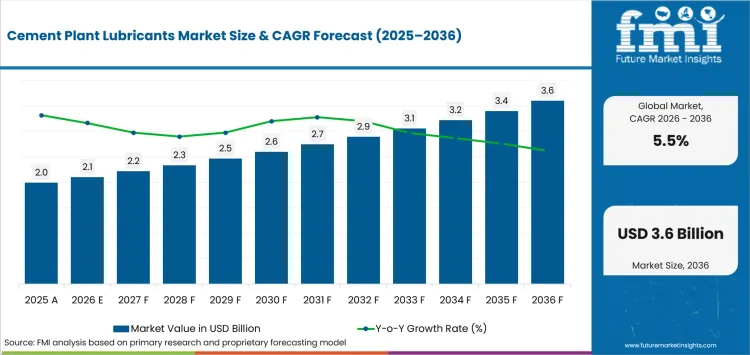
USD 2.1 billion in 2026 and USD 3.6 billion by 2036 at a 5.5% CAGR.
Demand for cement plant lubricants is projected to expand at 5.5% CAGR between 2026 and 2036, increasing valuation from USD 2.1 billion in 2026 to USD 3.6 billion by 2036. The installed cement plant base anchors recurring replacement demand for industrial lubricants across gearboxes and bearings between major overhauls. USA Geological Survey data published in February 2026 recorded cement production at 97 plants across 34 states and Puerto Rico during 2025. That operating footprint ties lubricant orders to plant service schedules instead of finished cement pricing.
Country growth conditions separate maintenance-led replacement from project-linked demand across the five profiled markets. Japan follows the installed-base route because the Japan Cement Association reported in July 2025 that 26 plants operated with about 47 million tons of clinker capacity. Japan’s 4.0% CAGR therefore depends more on maintenance discipline across an established cement operating base. Kingdom of Saudi Arabia’s 5.4% CAGR includes commissioning demand that rewards local stock and condition monitoring support during tightly scheduled service.
Key Takeaways of Cement Plant Lubricants Market
- Recurring cement production sustains lubricant demand as kilns and mills require wear protection across continuous operating cycles.
- By lubricant type, gear oils are estimated to hold 24.0% in 2026 owing to repeated use across high-load drive systems.
- In 2026, mineral oil is expected to lead base oil with 54.0% share because familiar specifications reduce changeover work.
- Kilns are projected to hold 21.0% share in 2026 owing to lubrication-critical rollers and drives across clinker production.
- Qualification work restrains conversion as compatibility checks and planned trials can delay changes on critical rotating equipment.
- Shell, ExxonMobil, FUCHS, TotalEnergies, Klüber Lubrication, Castrol, Petro-Canada Lubricants and SKF form the competitive company set.
Analyst Perspective
“Cement plants should qualify each lubricant against the actual gear or bearing duty before unit price carries decisive weight. The stronger commercial case combines verified wear control with local stock and service that fit planned shutdowns without adding changeover risk.”
- Nikhil Kaitwade, Principal Consultant, Future Market Insights
How is the Cement Plant Lubricants Market segmented?
The cement plant lubricants market is segmented by lubricant type, base oil, equipment, sales model, demand type and region.
Lubricant types are gear oils, greases, hydraulic oils, compressor oils, open gear lubricants and kiln tyre lubricants. Base oils are mineral oil, synthetic, semi-synthetic and bio-based or specialty. Equipment covers kilns, mills, crushers, conveyors/elevators, fans/compressors and packing equipment. Sales models are bulk supply, drums/pails and lubrication service programs. Demand types are routine consumption, shutdown maintenance and commissioning fill.
How do cement plant maintenance teams evaluate mineral oil within the base oil category?
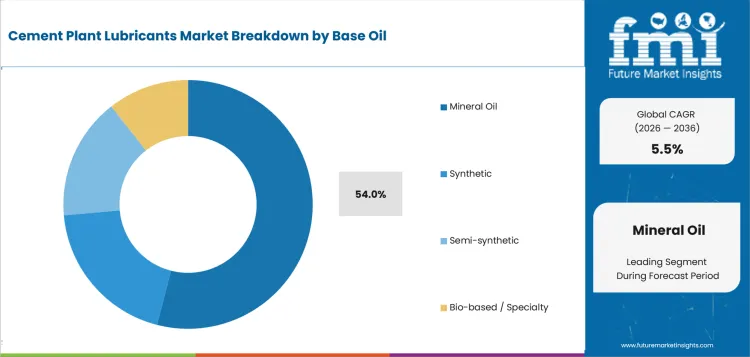
Mineral oil remains the familiar baseline for routine industrial oils used in duties that do not require premium thermal performance. Cement plants reserve synthetic fluids for severe duties and retain conventional formulations when seals and change procedures remain compatible.
- In 2026, mineral oil is expected to lead base oil with 54.0% share because familiar specifications reduce changeover work.
- Alternative hydraulic fluid systems earn approval selectively under severe operating conditions. TotalEnergies reported in January 2025 that its Fluid Competence acquisition added mineral-oil-free fire-resistant lines for demanding industrial service.
What makes gear oils central to the lubricant type category?
Gear oils protect industrial gearboxes across kilns and mills under sustained mechanical load during continuous clinker production. Regional formulation supply also matters for maintenance planning. ExxonMobil reported in September 2025 that its Singapore startup added Group II base stocks used in industrial gear oils and greases.
- By lubricant type, gear oils are estimated to hold 24.0% in 2026 owing to repeated use across high-load drive systems.
- Maintenance teams compare viscosity stability and wear control before approving replacement fluids for planned operating intervals across critical cement equipment.
What role do kilns play within the equipment category?
Kilns expose high-temperature greases to continuous rotation and thermal stress across support rollers and drive components. Heidelberg Materials added new first-fill lubrication points in May 2026 by commissioning its Airvault dry kiln line in France with annual clinker capacity of 1.25 million tonnes.
- Kilns are set to lead equipment with 21.0% share in 2026 due to concentrated lubrication needs across critical rotating components.
- Plant teams evaluate grease applications by dosing stability and wear protection across rollers and drives that operate during long critical clinker-production runs between shutdowns.
What supports bulk supply within the sales model category?
Bulk lubricant supply suits cement plants that consume several grades across large equipment populations and scheduled maintenance cycles. Consolidated delivery reduces packaging handling and gives maintenance teams steadier inventory for routine gearbox and hydraulic service.
- Based on sales model, bulk supply is projected to account for 42.0% in 2026 due to recurring plant volumes that support consolidated deliveries.
- Supply continuity depends on mixed grades arriving before maintenance windows. HF Sinclair’s January 2026 acquisition of Industrial Oils Unlimited added regional manufacturing and distribution capacity for industrial lubricants in the USA.
What are the drivers, restraints and opportunities in the Cement Plant Lubricants Market?
Reliability pressure sustains recurring demand, qualification work slows switching and managed lubrication services shift revenue toward recurring technical support.
- Driver: Heavy rotating equipment and contamination exposure make lubricant performance a direct input to plant uptime and planned maintenance.
- Restraint: Compatibility checks and controlled trials delay product conversion on critical assets with limited maintenance windows.
- Opportunity: Automatic dosing and condition-led service can convert formulation performance into measurable maintenance savings and repeat purchasing.
Operating Reliability Sustains Recurring Lubricant Demand
Cement plants cannot bypass many kiln and mill drives, so lubricant additives and base-oil performance shape wear exposure during long operating cycles. Holcim reported in February 2026 that it commissioned a vertical roller mill in Mexico during 2025, adding another heavy rotating asset that requires first-fill lubricant approval and recurring gearbox service. The same reliability burden keeps lubricant selection tied to equipment duty and planned maintenance instead of finished cement pricing.
Qualification Work Slows Product Conversion
Critical gearboxes require compatibility review and controlled trials before a plant approves a replacement lubricant for routine service. Castrol India stated in April 2025 that industrial conversions can take four weeks to six months and average roughly eight to twelve weeks. The qualification period delays challenger revenue and protects incumbent positions until maintenance teams validate changeover risk on the actual equipment.
Managed Lubrication Converts Dosing Control into Service Revenue
Automatic lubrication becomes a service revenue route as dosing data improves maintenance decisions and reduces avoidable lubricant use. Klüber Lubrication acquired TriboServ in September 2025 and added automatic lubricators plus dosing systems for gears and bearings. Klüber can pair predictive maintenance support with specialty formulations as measured application control reduces lubricant waste or inspection effort.
Which country CAGRs are profiled in the Cement Plant Lubricants Market?
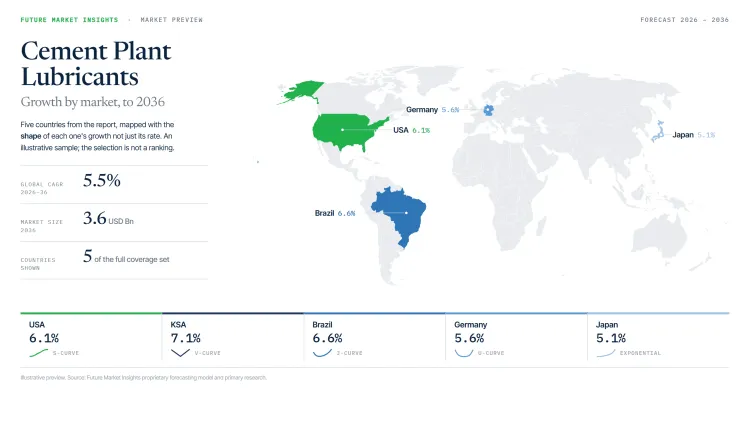
| Country | CAGR |
|---|---|
| KSA | 5.4% |
| Brazil | 5.2% |
| USA | 4.7% |
| Germany | 4.3% |
| Japan | 4.0% |
How do country-level CAGRs compare in the Cement Plant Lubricants Market?
A 1.4 percentage-point range separates the forecasts into a narrow upper pair and a mature lower group. KSA and Brazil occupy the upper band because commissioning matters more in KSA while utilization shapes Brazil. The USA, Germany and Japan cluster lower as mature assets make service access and qualification timing more influential.
- KSA adds clinker capacity under severe heat, raising first-fill demand and local service needs.
- Brazil’s long production routes make specialty-lubricant inventory coverage a commercial requirement.
- The USA’s mature plants concentrate lubricant purchasing around planned maintenance and reliability programs.
- Germany’s weak construction demand raises scrutiny of premium formulations despite strong engineering support.
- Japan’s compact plant network rewards technical continuity and long-life maintenance.
Comparable CAGRs represent different order-conversion routes rather than equivalent installed volume or revenue.
The full report provides country-level CAGR analysis across North America, Latin America, Europe, East Asia, South Asia, Oceania and the Middle East and Africa.
Country-wise Analysis
- Kingdom of Saudi Arabia (Saudi Arabia) cement plants are adding clinker capacity under severe heat, increasing first-fill needs and the value of local technical support during closely scheduled commissioning and maintenance work on rotating equipment and critical bearings. Saudi Exchange reported in April 2026 that Eastern Province Cement had completed installation of its 10,000-ton-per-day clinker line and started trial production at Khursaniyah across newly installed plant equipment and first-fill lubricant points. The KSA cement plant lubricants sector is projected to record 5.4% CAGR during the assessment period, supported by commissioning demand as premium grades require proven temperature performance and dependable local stock during short service windows.
- Brazilian cement plants operate across long regional supply corridors, making regional distributor coverage important for routine replenishment and urgent specialty-grade deliveries during planned shutdown work across a geographically dispersed production base. Cement plant lubricant sales in Brazil are forecast to expand at a 5.2% CAGR by 2036, reinforced by recurring throughput that sustains gearbox oil and grease replacement across established equipment during planned service. SNIC reported in July 2026 that first-half cement sales reached 32.9 million tonnes and rose 2.3% from 2025, while long delivery routes leave specialty industrial grades exposed to inventory planning gaps between major cement production centers.
- USA cement plants rely on a mature installed base, concentrating lubricant demand around planned outages that allow gearbox service and product qualification without extending interruptions across long equipment lives on kilns and mills. Titan America’s July 2025 results tied lower quarterly performance to planned major maintenance at Pennsuco, confirming that annual service windows concentrate lubricant purchasing and qualification work on critical gearboxes and bearings during shutdown work. Cement plant lubricant demand in the USA is forecast to rise at 4.7% CAGR over the forecast period, supported by maintenance-led replacement as formulation changes must fit shutdown timing and established specifications before routine approval.
- German cement plants operate in a mature specification-led market, so lubricant changes compete for approval during planned outages and must justify added cost across long-lived rotating equipment on kilns and mills. Germany is estimated to post 4.3% CAGR over the forecast period, shaped by recurring maintenance across remaining assets as weak construction demand raises scrutiny of premium formulations and switching decisions at each plant. Heidelberg Materials said in March 2026 that weak German cement sales led it to close Paderborn permanently, increasing pressure on lubricant companies to prove compatibility and measurable maintenance value across the remaining production network in Germany.
- Japan’s compact cement manufacturing network concentrates lubricant demand in established plants, making technical continuity and dependable local response more important than rapid expansion during scheduled maintenance work on kilns and mills. Japan Cement Association said in January 2026 that achieving its 32 million-ton fiscal 2025 domestic demand outlook would be very difficult, reinforcing a maintenance-led purchasing case across existing production assets throughout the national plant base. Adoption of cement plant lubricants in Japan is estimated to expand at a 4.0% CAGR through 2036, while limited volume growth raises the proof threshold for premium formulations and product changes on long-life equipment at established sites.
Who are the notable companies in the Cement Plant Lubricants Market?
Shell, ExxonMobil, FUCHS, TotalEnergies, Klüber Lubrication, Castrol, Petro-Canada Lubricants and SKF are the notable companies serving this market.
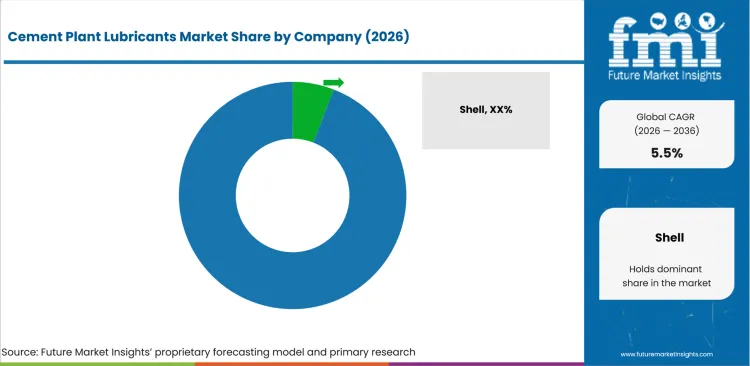
The competitive field is moderately fragmented across integrated lubricant groups, specialty formulators and bearing-led reliability providers. Cement accounts are hard to displace because approved products must suit severe gear and bearing duties. New entrants also need dependable local stock plus application support during short maintenance windows.
- Shell, ExxonMobil and TotalEnergies combine broad industrial lubricant portfolios with international manufacturing and distribution networks.
- FUCHS and Klüber Lubrication pair specialty formulations with application engineering for severe-duty cement equipment.
- Castrol, Petro-Canada Lubricants and SKF add condition monitoring, regional supply or lubrication-system support around the lubricant purchase.
Competitive Benchmarking: Cement Plant Lubricants Market
| Company | Industrial Lubricant Breadth | Supply / Service Infrastructure | Cement / Heavy-Plant Evidence | Geographic Reach |
|---|---|---|---|---|
| Shell | High | High | Medium | Global |
| ExxonMobil | High | Medium | Medium | Asia-Pacific manufacturing hub |
| FUCHS | High | High | High | Global |
| TotalEnergies | Medium | High | Medium | 160 countries |
| Klüber Lubrication | High | High | High | Nearly 100 countries |
| Castrol | High | High | Medium | Global |
| Petro-Canada Lubricants | High | High | Medium | 80+ countries |
| SKF | Medium | High | High | 130+ countries |
Key Developments in the Cement Plant Lubricants Market
- In March 2026, Klüber Lubrication enabled Benelux customers to order OKS products directly from its local teams. The change combines MRO access with application-engineered lubrication support for operations that include cement and building materials.
- In February 2026, FUCHS completed installation and commissioning of two industrial filling lines at Stoke-on-Trent. The company also implemented Siemens MES to increase manufacturing flexibility and real-time production control for lubricant supply.
- In June 2025, Castrol introduced Intelligent Lubrication Solutions for industrial customers using advanced lubricants alongside predictive analysis. The initial offer combines sensor-based technology and IoT platforms with maintenance intelligence intended to reduce unplanned downtime.
Key Players in the Cement Plant Lubricants Market
Integrated Industrial Lubricant Platforms
- Shell
- ExxonMobil
- TotalEnergies
- Petro-Canada Lubricants
Specialty Lubrication and Application Engineering
- FUCHS
- Klüber Lubrication
Reliability and Lubrication-System Providers
- Castrol
- SKF
Cement Plant Lubricants Market - Report Scope
| Coverage field | Report scope |
|---|---|
| Market breakdown | By lubricant type, base oil, equipment, sales model, demand type and region. |
| Quantitative Units | Revenue in USD million and CAGR in %. |
| Market Definition | Industrial lubricants and lubrication-service demand used across cement production equipment for routine operation, shutdown maintenance and commissioning fill. |
| Regions Covered | North America, Latin America, Europe, East Asia, South Asia and Pacific, and Middle East and Africa. |
| Countries Covered | KSA, Brazil, USA, Germany, Japan, and 20+ countries included in the full report. |
| Key Companies Profiled | Shell, ExxonMobil, FUCHS, TotalEnergies, Klüber Lubrication, Castrol, Petro-Canada Lubricants, SKF. |
| Forecast Period | 2026 to 2036. |
| Approach | Primary and secondary research with market triangulation. |
Cement Plant Lubricants Market - Research Methodology
| Method | Approach |
|---|---|
| Primary Research | FMI analysts gathered input from manufacturers, service providers, technology developers, distributors, end users, procurement teams, and subject-matter experts. Interviews examined purchasing decisions, product or service evaluation, adoption barriers, approval requirements, pricing considerations, and expectations for technical or commercial support. Respondents were also asked what evidence is required before a trial, pilot, or initial order develops into regular purchasing. |
| Desk Research | Desk research covered government statistics, regulatory publications, trade data, industry associations, technical literature, standards, company filings, product information, and official corporate announcements. Sources were reviewed for relevance, publication date, geographic coverage, and consistency with the defined market scope. Claims relating to performance, applications, approvals, capacity, investment, and commercial activity were retained only when supported by credible public evidence. |
| Market Sizing and Forecasting | The market model combined the baseline value with historical performance, segment structure, pricing and volume indicators, adoption levels, company participation, and country-level demand conditions. Forecast assumptions considered economic activity, investment trends, regulatory developments, technology adoption, purchasing cycles, supply availability, and barriers to wider market use. Segment and regional estimates were reconciled before the final market total was calculated. |
| Data Validation | Estimates were checked against multiple independent indicators, including public data, company activity, trade patterns, industry developments, and findings from primary interviews. Validation also tested whether products, services, applications, and company revenues fell within the defined market boundaries. Adjacent categories, unsupported claims, overlapping revenues, and activities without direct market relevance were excluded to reduce double counting and maintain consistency across segments and countries. |
Cement Plant Lubricants Market by Segments
Cement Plant Lubricants Market segmented by Lubricant Type:
- Gear Oils
- Greases
- Hydraulic Oils
- Compressor Oils
- Open Gear Lubricants
- Kiln Tyre Lubricants
Cement Plant Lubricants Market segmented by Base Oil:
- Mineral Oil
- Synthetic
- Semi-synthetic
- Bio-based / Specialty
Cement Plant Lubricants Market segmented by Equipment:
- Kilns
- Mills
- Crushers
- Conveyors / Elevators
- Fans / Compressors
- Packing Equipment
Cement Plant Lubricants Market segmented by Sales Model:
- Bulk Supply
- Drums / Pails
- Lubrication Service Program
Cement Plant Lubricants Market segmented by Demand Type:
- Routine Consumption
- Shutdown Maintenance
- Commissioning Fill
Cement Plant Lubricants Market by Region
- North America
- United States
- Canada
- Latin America
- Brazil
- Mexico
- Chile
- Rest of Latin America
- Western Europe
- Germany
- United Kingdom
- Italy
- Spain
- France
- Nordics
- Benelux
- Rest of Western Europe
- Eastern Europe
- Russia
- Poland
- Hungary
- Balkan and Baltic States
- Rest of Eastern Europe
- East Asia
- China
- Japan
- South Korea
- South Asia and Pacific
- India
- ASEAN
- Australia and New Zealand
- Rest of South Asia and Pacific
- Middle East and Africa
- Kingdom of Saudi Arabia
- Other GCC Countries
- Türkiye
- South Africa
- Other African Union Countries
- Rest of Middle East and Africa
Research Sources and Bibliography
- USA Geological Survey. (2026, February 6). Mineral Commodity Summaries 2026.
- Japan Cement Association. (2025, July). Statistics.
- ExxonMobil. (2025, September 23). ExxonMobil starts first-of-its-kind technology in Singapore.
- TotalEnergies Lubrifiants. (2025, February 12). TotalEnergies Lubrifiants acquires low VOC (Volatil Organic Compounds) -emission hydraulic fluid product lines.
- Heidelberg Materials. (2026, May 5). Step change in efficiency and decarbonisation: Heidelberg Materials opens state-of-the-art kiln line at its Airvault cement plant in France.
- HF Sinclair Corporation. (2026, January 8). HF Sinclair Corporation’s Lubricants & Specialties Business Closes Previously Announced Acquisition of Industrial Oils Unlimited.
- Holcim. (2026, February 27). Excellent 2025 results, double-digit recurring EBIT growth with industry-leading margin of 18.3%.
- Castrol India Limited. (2025, April 29). 1Q 2025 Earnings Conference Call Transcript.
- Klüber Lubrication. (2025, September 1). Klüber Lubrication acquires TriboServ.
- Saudi Exchange. (2026, April 27). Eastern Province Cement Company announces the completion of supply and installation works for the project to establish a new production line at the company's plant with a production capacity of 10,000 tons/day.
- Sindicato Nacional da Indústria do Cimento. (2026, July). Resultados Preliminares Junho 2026.
- Titan America SA. (2025, July 29). Titan America Announces Second Quarter 2025 Results.
- Heidelberg Materials. (2026, March 6). Heidelberg Materials to close Paderborn cement plant in Germany.
- Japan Cement Association. (2026, January 7). 年頭ご挨拶.
- Shell. (2025, November 4). Shell tops global lubricants market for 19th consecutive year.
- FUCHS SE. (2026, March 20). Annual Report 2025.
- SKF. (2025). How to keep machines alive in mining and cement.
- Klüber Lubrication. (2026, March 2). Klüber Benelux launches OKS integration for reliable maintenance and repair in the region.
- FUCHS Lubricants (UK) plc. (2026, February 17). FUCHS UK Invests in Expanded Production Capacity to Meet Growing Market Demand.
- Castrol. (2025, June 19). Castrol Intelligent Lubrication Solutions.
- BECHEM. (2025, August 8). BECHEM acquires CLC Lubricants.
- SKF. (2026, March 9). SKF makes acquisition to strengthen its Condition Monitoring portfolio.
- FUCHS SE. (2025, February 26). FUCHS opens expanded plant in South Africa to meet growing demand.
- FUCHS LUBRICANTS (INDIA) PVT. LTD. (n.d.). Cement. Retrieved August 11, 2026.
- Klüber Lubrication. (n.d.). Lubricants for the cement industry. Retrieved August 11, 2026.
- Shell. (2025, September 30). Specialist Open Gear Grease for Mining and Cement.
- ExxonMobil. (n.d.). Mobil Industrial Lubricants | Mobilux EP2 | Mobil™ India. Retrieved August 11, 2026.
- TotalEnergies Lubrifiants. (n.d.). TotalEnergies Lubricants for the Cement Industry. Retrieved August 11, 2026.
- Chevron Lubricants. (n.d.). Industrial Oils: Cement Mixers & Equipment | Chevron Lubricants (US). Retrieved August 11, 2026.
- BECHEM. (n.d.). BECHEM - Lubricants for the Cement Industry. Retrieved August 11, 2026.
This bibliography is provided for reader reference and is not exhaustive. The full report contains the complete reference list and detailed citations.
This Report Answers
- What operating conditions sustain recurring demand for cement plant lubricants?
- Why do gear oils lead the lubricant type category?
- How does mineral oil retain its base oil position?
- Why do kilns require concentrated lubrication attention?
- What delays lubricant qualification on critical cement equipment?
- Where do managed lubrication programs generate recurring service revenue?
- Why do country growth rates translate into different sales routes?
- Which capabilities distinguish the eight profiled companies beyond price?
Frequently Asked Questions
How big is the Cement Plant Lubricants Market in 2026?
The cement plant lubricants market is expected to be valued at USD 2.1 billion in 2026 and reach USD 3.6 billion by 2036. Recurring maintenance demand comes from protecting high-load rotating equipment across continuous cement production.
What is the CAGR of the Cement Plant Lubricants Market from 2026 to 2036?
The cement plant lubricants market is projected to grow at a CAGR of 5.5% between 2026 and 2036. Expansion depends on recurring maintenance consumption plus higher-value formulations and service programs around critical equipment.
Which lubricant type is projected to lead the Cement Plant Lubricants Market?
The gear oils segment accounts for 24.0% of the cement plant lubricants market's lubricant type category in 2026. Its leading position reflects repeated use across enclosed gearboxes that transmit power across kiln, mill and crusher drives.
Which base oil segment could gain adoption in severe-duty cement plant applications through 2036?
The cement plant lubricants market can support wider synthetic base oil use in high-heat duties if longer drain intervals justify higher formulation costs. Adoption depends on compatibility checks and evidence that lower maintenance effort offsets the added product expense.
Which companies are active in the Cement Plant Lubricants Market?
Key companies in the cement plant lubricants market include Shell, ExxonMobil, FUCHS, TotalEnergies, Klüber Lubrication, Castrol, Petro-Canada Lubricants and SKF. Competition centers on industrial formulation breadth, supply access and support for severe-duty rotating equipment.
Preview the report firsthand - request a free sample
Get SampleGet the brochure for pricing and purchase details.
Get PDFTable of Content
- Key Takeaways
- Market Size and CAGR
- Top Growth Driver
- Fastest Growing Segment
- Leading Region
- Key Companies
- Emerging Opportunities
- Executive Summary
- Global Market Outlook
- Demand-side Trends
- Supply-side Trends
- Technology Roadmap Analysis
- Analysis and Recommendations
- Analyst Perspective (What is happening? Why now? What should investors know?)
- Key Questions Answered
- How large is the market?
- What is the CAGR?
- What are key trends?
- Which region dominates?
- Who are the leaders?
- Market Overview
- Market Coverage / Taxonomy
- Market Definition / Scope / Limitations
- Research Methodology
- Chapter Orientation
- Analytical Lens and Working Hypotheses
- Market Structure, Signals, and Trend Drivers
- Benchmarking and Cross-market Comparability
- Market Sizing, Forecasting, and Opportunity Mapping
- Research Design and Evidence Framework
- Desk Research Programme (Secondary Evidence)
- Expert Input and Fieldwork (Primary Evidence)
- Tooling, Models, and Reference Databases
- Data Engineering and Model Build
- Quality Assurance and Audit Trail
- Market Background
- Market Dynamics (Drivers, Restraints, Opportunity, Trends)
- Scenario Forecast (Optimistic, Likely, Conservative)
- Impact Analysis
- AI Impact
- Sustainability Impact
- Regulatory Impact
- Technology Impact
- Consumer / Buyer Analysis
- Purchase Drivers
- Adoption Barriers
- Buyer Journey
- Opportunity Map Analysis
- Product Life Cycle Analysis
- Supply Chain Analysis
- Investment Feasibility Matrix
- Value Chain Analysis
- PESTLE and Porter's Analysis
- Regulatory Landscape
- Regional Parent Market Outlook
- Production and Consumption Statistics
- Import and Export Statistics
- Global Market Analysis and Forecast, 2021 to 2036
- Historical Market Size Value (USD Billion) Analysis, 2021 to 2025
- Current and Future Market Size Value (USD Billion) Projections, 2026 to 2036
- Y-o-Y Growth Trend Analysis
- Absolute $ Opportunity Analysis
- Global Market Pricing Analysis, 2021 to 2036
- Global Market Analysis and Forecast, By Lubricant Type, 2021 to 2036
- Introduction / Key Findings
- Historical Market Size Value (USD Billion) Analysis By Lubricant Type, 2021 to 2025
- Current and Future Market Size Value (USD Billion) Analysis and Forecast By Lubricant Type, 2026 to 2036
- Gear Oils
- Greases
- Hydraulic Oils
- Compressor Oils
- Open Gear Lubricants
- Kiln Tyre Lubricants
- Gear Oils
- Y-o-Y Growth Trend Analysis By Lubricant Type, 2021 to 2025
- Absolute $ Opportunity Analysis By Lubricant Type, 2026 to 2036
- Global Market Analysis and Forecast, By Base Oil, 2021 to 2036
- Introduction / Key Findings
- Historical Market Size Value (USD Billion) Analysis By Base Oil, 2021 to 2025
- Current and Future Market Size Value (USD Billion) Analysis and Forecast By Base Oil, 2026 to 2036
- Mineral Oil
- Synthetic
- Semi-synthetic
- Bio-based / Specialty
- Mineral Oil
- Y-o-Y Growth Trend Analysis By Base Oil, 2021 to 2025
- Absolute $ Opportunity Analysis By Base Oil, 2026 to 2036
- Global Market Analysis and Forecast, By Equipment, 2021 to 2036
- Introduction / Key Findings
- Historical Market Size Value (USD Billion) Analysis By Equipment, 2021 to 2025
- Current and Future Market Size Value (USD Billion) Analysis and Forecast By Equipment, 2026 to 2036
- Mills
- Kilns
- Crushers
- Conveyors / Elevators
- Fans / Compressors
- Packing Equipment
- Mills
- Y-o-Y Growth Trend Analysis By Equipment, 2021 to 2025
- Absolute $ Opportunity Analysis By Equipment, 2026 to 2036
- Global Market Analysis and Forecast, By Sales Model, 2021 to 2036
- Introduction / Key Findings
- Historical Market Size Value (USD Billion) Analysis By Sales Model, 2021 to 2025
- Current and Future Market Size Value (USD Billion) Analysis and Forecast By Sales Model, 2026 to 2036
- Bulk Supply
- Drums / Pails
- Lubrication Service Program
- Bulk Supply
- Y-o-Y Growth Trend Analysis By Sales Model, 2021 to 2025
- Absolute $ Opportunity Analysis By Sales Model, 2026 to 2036
- Global Market Analysis and Forecast, By Demand Type, 2021 to 2036
- Introduction / Key Findings
- Historical Market Size Value (USD Billion) Analysis By Demand Type, 2021 to 2025
- Current and Future Market Size Value (USD Billion) Analysis and Forecast By Demand Type, 2026 to 2036
- Routine Consumption
- Shutdown Maintenance
- Commissioning Fill
- Routine Consumption
- Y-o-Y Growth Trend Analysis By Demand Type, 2021 to 2025
- Absolute $ Opportunity Analysis By Demand Type, 2026 to 2036
- Global Market Analysis and Forecast, By Region, 2021 to 2036
- Introduction
- Historical Market Size Value (USD Billion) Analysis By Region, 2021 to 2025
- Current Market Size Value (USD Billion) Analysis and Forecast By Region, 2026 to 2036
- North America
- Latin America
- Western Europe
- Eastern Europe
- East Asia
- South Asia and Pacific
- Middle East & Africa
- Market Attractiveness Analysis By Region
- North America Market Analysis and Forecast, By Country, 2021 to 2036
- Historical Market Size Value (USD Billion) Trend Analysis By Market Taxonomy, 2021 to 2025
- Market Size Value (USD Billion) Forecast By Market Taxonomy, 2026 to 2036
- By Country
- USA
- Canada
- By Lubricant Type
- By Base Oil
- By Equipment
- By Sales Model
- By Demand Type
- By Country
- Market Attractiveness Analysis
- By Country
- By Lubricant Type
- By Base Oil
- By Equipment
- By Sales Model
- By Demand Type
- Key Takeaways
- Latin America Market Analysis and Forecast, By Country
- Historical Market Size Value (USD Billion) Trend Analysis By Market Taxonomy, 2021 to 2025
- Market Size Value (USD Billion) Forecast By Market Taxonomy, 2026 to 2036
- By Country
- Brazil
- Mexico
- Chile
- Rest of Latin America
- By Lubricant Type
- By Base Oil
- By Equipment
- By Sales Model
- By Demand Type
- By Country
- Market Attractiveness Analysis
- By Country
- By Lubricant Type
- By Base Oil
- By Equipment
- By Sales Model
- By Demand Type
- Key Takeaways
- Western Europe Market Analysis and Forecast, By Country
- Historical Market Size Value (USD Billion) Trend Analysis By Market Taxonomy, 2021 to 2025
- Market Size Value (USD Billion) Forecast By Market Taxonomy, 2026 to 2036
- By Country
- Germany
- UK
- Italy
- Spain
- France
- Nordic
- BENELUX
- Rest of Western Europe
- By Lubricant Type
- By Base Oil
- By Equipment
- By Sales Model
- By Demand Type
- By Country
- Market Attractiveness Analysis
- By Country
- By Lubricant Type
- By Base Oil
- By Equipment
- By Sales Model
- By Demand Type
- Key Takeaways
- Eastern Europe Market Analysis and Forecast, By Country
- Historical Market Size Value (USD Billion) Trend Analysis By Market Taxonomy, 2021 to 2025
- Market Size Value (USD Billion) Forecast By Market Taxonomy, 2026 to 2036
- By Country
- Russia
- Poland
- Hungary
- Balkan & Baltic
- Rest of Eastern Europe
- By Lubricant Type
- By Base Oil
- By Equipment
- By Sales Model
- By Demand Type
- By Country
- Market Attractiveness Analysis
- By Country
- By Lubricant Type
- By Base Oil
- By Equipment
- By Sales Model
- By Demand Type
- Key Takeaways
- East Asia Market Analysis and Forecast, By Country
- Historical Market Size Value (USD Billion) Trend Analysis By Market Taxonomy, 2021 to 2025
- Market Size Value (USD Billion) Forecast By Market Taxonomy, 2026 to 2036
- By Country
- China
- Japan
- South Korea
- By Lubricant Type
- By Base Oil
- By Equipment
- By Sales Model
- By Demand Type
- By Country
- Market Attractiveness Analysis
- By Country
- By Lubricant Type
- By Base Oil
- By Equipment
- By Sales Model
- By Demand Type
- Key Takeaways
- South Asia and Pacific Market Analysis and Forecast, By Country
- Historical Market Size Value (USD Billion) Trend Analysis By Market Taxonomy, 2021 to 2025
- Market Size Value (USD Billion) Forecast By Market Taxonomy, 2026 to 2036
- By Country
- India
- ASEAN
- Australia & New Zealand
- Rest of South Asia and Pacific
- By Lubricant Type
- By Base Oil
- By Equipment
- By Sales Model
- By Demand Type
- By Country
- Market Attractiveness Analysis
- By Country
- By Lubricant Type
- By Base Oil
- By Equipment
- By Sales Model
- By Demand Type
- Key Takeaways
- Middle East & Africa Market Analysis and Forecast, By Country
- Historical Market Size Value (USD Billion) Trend Analysis By Market Taxonomy, 2021 to 2025
- Market Size Value (USD Billion) Forecast By Market Taxonomy, 2026 to 2036
- By Country
- Kingdom of Saudi Arabia
- Other GCC Countries
- Türkiye
- South Africa
- Other African Union
- Rest of Middle East & Africa
- By Lubricant Type
- By Base Oil
- By Equipment
- By Sales Model
- By Demand Type
- By Country
- Market Attractiveness Analysis
- By Country
- By Lubricant Type
- By Base Oil
- By Equipment
- By Sales Model
- By Demand Type
- Key Takeaways
- Key Countries Market Analysis
- USA
- Pricing Analysis
- Market Share Analysis, 2025
- By Lubricant Type
- By Base Oil
- By Equipment
- By Sales Model
- By Demand Type
- Canada
- Pricing Analysis
- Market Share Analysis, 2025
- By Lubricant Type
- By Base Oil
- By Equipment
- By Sales Model
- By Demand Type
- Mexico
- Pricing Analysis
- Market Share Analysis, 2025
- By Lubricant Type
- By Base Oil
- By Equipment
- By Sales Model
- By Demand Type
- Brazil
- Pricing Analysis
- Market Share Analysis, 2025
- By Lubricant Type
- By Base Oil
- By Equipment
- By Sales Model
- By Demand Type
- Chile
- Pricing Analysis
- Market Share Analysis, 2025
- By Lubricant Type
- By Base Oil
- By Equipment
- By Sales Model
- By Demand Type
- Germany
- Pricing Analysis
- Market Share Analysis, 2025
- By Lubricant Type
- By Base Oil
- By Equipment
- By Sales Model
- By Demand Type
- UK
- Pricing Analysis
- Market Share Analysis, 2025
- By Lubricant Type
- By Base Oil
- By Equipment
- By Sales Model
- By Demand Type
- Italy
- Pricing Analysis
- Market Share Analysis, 2025
- By Lubricant Type
- By Base Oil
- By Equipment
- By Sales Model
- By Demand Type
- Spain
- Pricing Analysis
- Market Share Analysis, 2025
- By Lubricant Type
- By Base Oil
- By Equipment
- By Sales Model
- By Demand Type
- France
- Pricing Analysis
- Market Share Analysis, 2025
- By Lubricant Type
- By Base Oil
- By Equipment
- By Sales Model
- By Demand Type
- India
- Pricing Analysis
- Market Share Analysis, 2025
- By Lubricant Type
- By Base Oil
- By Equipment
- By Sales Model
- By Demand Type
- ASEAN
- Pricing Analysis
- Market Share Analysis, 2025
- By Lubricant Type
- By Base Oil
- By Equipment
- By Sales Model
- By Demand Type
- Australia & New Zealand
- Pricing Analysis
- Market Share Analysis, 2025
- By Lubricant Type
- By Base Oil
- By Equipment
- By Sales Model
- By Demand Type
- China
- Pricing Analysis
- Market Share Analysis, 2025
- By Lubricant Type
- By Base Oil
- By Equipment
- By Sales Model
- By Demand Type
- Japan
- Pricing Analysis
- Market Share Analysis, 2025
- By Lubricant Type
- By Base Oil
- By Equipment
- By Sales Model
- By Demand Type
- South Korea
- Pricing Analysis
- Market Share Analysis, 2025
- By Lubricant Type
- By Base Oil
- By Equipment
- By Sales Model
- By Demand Type
- Russia
- Pricing Analysis
- Market Share Analysis, 2025
- By Lubricant Type
- By Base Oil
- By Equipment
- By Sales Model
- By Demand Type
- Poland
- Pricing Analysis
- Market Share Analysis, 2025
- By Lubricant Type
- By Base Oil
- By Equipment
- By Sales Model
- By Demand Type
- Hungary
- Pricing Analysis
- Market Share Analysis, 2025
- By Lubricant Type
- By Base Oil
- By Equipment
- By Sales Model
- By Demand Type
- Kingdom of Saudi Arabia
- Pricing Analysis
- Market Share Analysis, 2025
- By Lubricant Type
- By Base Oil
- By Equipment
- By Sales Model
- By Demand Type
- Türkiye
- Pricing Analysis
- Market Share Analysis, 2025
- By Lubricant Type
- By Base Oil
- By Equipment
- By Sales Model
- By Demand Type
- South Africa
- Pricing Analysis
- Market Share Analysis, 2025
- By Lubricant Type
- By Base Oil
- By Equipment
- By Sales Model
- By Demand Type
- USA
- Market Structure Analysis
- Competition Dashboard
- Competition Benchmarking
- Market Share Analysis of Top Players
- By Regional
- By Lubricant Type
- By Base Oil
- By Equipment
- By Sales Model
- By Demand Type
- Emerging Startups
- Innovation Benchmarking
- Competition Analysis
- Competition Deep Dive
- Shell
- Overview
- Product Portfolio
- Profitability by Market Segments
- Sales Footprint
- Strategy Overview
- Marketing Strategy
- Product Strategy
- Channel Strategy
- ExxonMobil
- Fuchs
- TotalEnergies
- Klüber Lubrication
- Chevron
- Castrol
- Petro-Canada Lubricants
- SKF
- Bechem
- Shell
- Case Studies
- Success Stories
- Recent Developments
- Competition Deep Dive
- Assumptions & Acronyms Used


