

- Market Size (2026)
- USD 5.0 Bn
- Forecast (2036)
- USD 15.0 Bn
- CAGR (2026 to 2036)
- 11.6%
How big is Plant-Based & Bioharvested Sweetener Innovation Market in 2026?
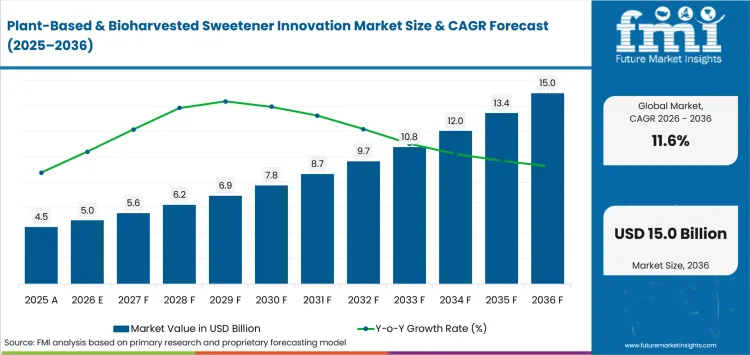
USD 5.0 billion in 2026 and USD 15.0 billion by 2036 at an 11.6% CAGR.
Demand for plant-based and bioharvested sweetener innovation is projected to expand at an 11.6% CAGR between 2026 and 2036. Industry valuation is estimated to increase from USD 5.0 billion in 2026 to USD 15.0 billion by 2036. Commercial-scale production advances are improving the viability of next-generation sweeteners and supporting broader adoption by food and beverage manufacturers. Tate & Lyle reported in October 2025 that its Manus partnership brought all-Americas Reb M to commercial scale at a competitive cost. The regional production route improves access to a scarce glycoside and gives food manufacturers local formulation support. Investment in next-generation sweeteners therefore depends on stable taste performance and dependable output across several product lines.
United States commercialization uses notifier-specific GRAS routes and European sales depend on production-method specifications under the E 960 framework. BioHarvest reported in May 2025 that tissue-culture work had started under its Tate & Lyle sweetener program. The project demonstrates a plant-cell development route that differs from the United States notification process for new sweetener molecules. Teams evaluating low-calorie sweeteners need matching process records and application data to support regional approvals and commercial supply.
Key Takeaways of Plant-Based & Bioharvested Sweetener Innovation Market
- Demand for plant-based and bioharvested sweetener innovation is driven by expanding access to minor glycosides that occur in small concentrations within conventional stevia leaves, supported by production routes that reduce regional supply exposure.
- By source, stevia holds the leading share at 59.0% in 2026, attributable to its established role in commercial sugar-reduction programs.
- Plant cell culture is the dominant technology segment, holding 69.7% share in 2026, owing to controlled biomass and molecule production across repeated batches.
- Beverages lead the application category at 47.5% share in 2026, due to frequent reformulation and measurable taste comparisons that liquid formats reveal more clearly than solid foods.
- Regional production routes and documented control over every production step remain critical for regulatory review, as investment decisions require reproducible sensory results across scale-up.
- China and Israel record CAGRs of 10.2% and 9.8% respectively through 2036, while the United States and European markets require production-specific dossiers that influence launch timing and customer qualification.
- Competition centers on Tate & Lyle, Ingredion, Cargill, dsm-firmenich (Avansya), BioHarvest Sciences, and Sweegen, with vendors differentiating through broad sweetening portfolios, fermentation-derived stevia commercialization, and controlled biological production routes for scarce plant molecules.
Analyst Perspective
Stevia's dominant share rests less on any single glycoside than on labeling familiarity, since formulation teams can swap enzymatic conversion for extraction without rebuilding the product concept a customer already recognizes on the ingredient panel. Plant cell culture's real commercial test happens after the lab proves molecule output, when developers have to separate biological variation from equipment performance in bioreactor scale-up, since a cell line that performs consistently in a pilot run can still drift once production volume increases. Beverages will likely keep leading application demand not because formulators prefer liquid systems, but because water and other clear matrices expose bitterness and lingering aftertaste faster than solid foods can mask them, making it the format where a sweetener's real sensory weaknesses show up first.
-Nandini Roy Choudhury, Principal Analyst at Future Market Insights
Source: FMI's proprietary forecasting model and primary research
How is the Plant-Based & Bioharvested Sweetener Innovation Market segmented?
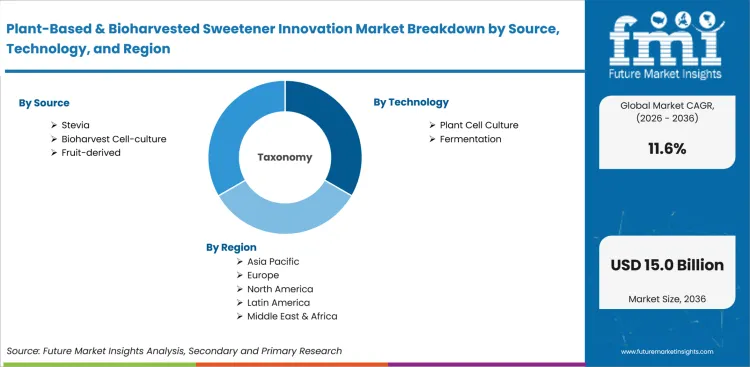
The plant-based & bioharvested sweetener innovation industry is segmented by source, technology, application, and region.
The segmentation framework separates molecule origin from the technology used to produce commercial sweeteners within the defined market. Source analysis covers stevia and bioharvest cell-culture alongside fruit-derived ingredients within the defined revenue boundary. Technology analysis compares plant cell culture with fermentation according to process control and scale requirements. Application analysis separates beverages from bakery and dairy according to sensory testing and processing conditions. Each category addresses a different commercial decision involving molecule identity and manufacturing control or final formulation performance. Regional analysis compares approval routes and supply models that influence commercial availability across different countries. The framework prevents revenue overlap between naturally derived sweeteners and the technologies or applications that use them.
What supports demand for stevia within the source category?
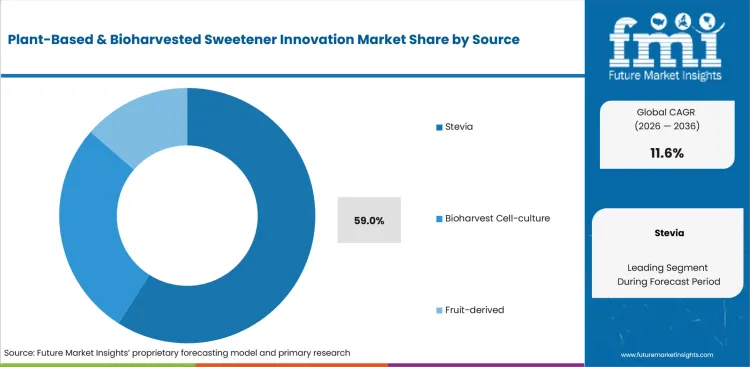
Stevia gives formulation teams a familiar plant origin and several high-intensity glycosides for beverages and foods. The FDA closed GRN 1260 without questions in November 2025 for enzymatically produced Reb M used as a general-purpose sweetener. The response gives global stevia manufacturers a documented United States safety-notification route with defined purity and intended-use controls. Developers can compare enzymatic conversion with extraction and maintain a recognizable ingredient identity during customer qualification.
- The stevia segment is likely to capture 59.0% share in 2026 attributable to its established role in commercial sugar-reduction programs. Familiar ingredient labeling helps formulation teams adopt newer production routes without rebuilding the full product concept. The share reflects broad application experience rather than automatic approval for every manufacturing method across regulated markets.
- Small inclusion levels give food and beverage laboratories substantial sweetness across many reformulated product categories. Application teams expand adoption through sensory testing that controls bitterness and confirms stability during processing and storage. Recurring orders depend on matching each glycoside profile with product acidity and intended shelf-life conditions. Stable results across pilot and factory batches reduce reformulation risk for established beverage and food brands.
How do ingredient developers evaluate plant cell culture within the technology category?
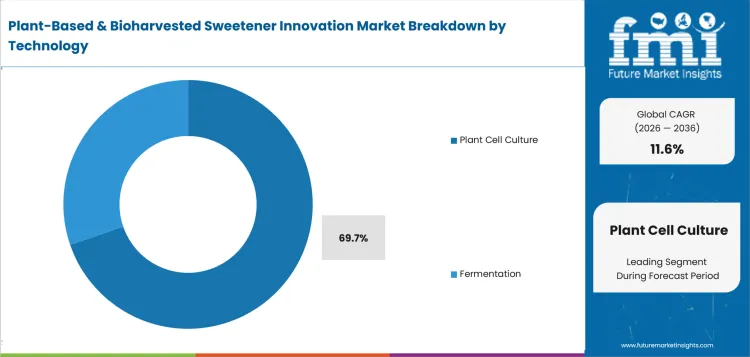
Plant cell culture gives developers a controlled route for producing plant molecules without field-harvest variability. Repeated cultivation can shorten development work if selected cells maintain target molecule output across several batches. BioHarvest received a USD 1.4 million Israel Innovation Authority grant in July 2026 for AI-driven plant-cell synthesis. The program supports faster cell-line selection and process optimization across commercial molecule projects with defined scale targets.
- Plant cell culture is projected to hold 69.7% share in 2026 owing to controlled biomass and molecule production across repeated batches. The method supports consistent specifications across repeated manufacturing campaigns within diversified sugar substitute portfolios and customer programs. Its commercial position depends on stable bioreactor productivity and efficient downstream recovery beyond laboratory trials.
- Ingredient developers use plant cell culture to test production conditions prior to committing larger bioreactor and purification resources. The method reduces agricultural exposure but transfers production risk toward cell stability and process control. Manufacturers require batch records that separate biological variation from equipment performance during routine production and customer qualification. Reliable scale data helps finance teams compare expansion costs with alternative fermentation or extraction routes.
Why do beverages account for the largest application share?
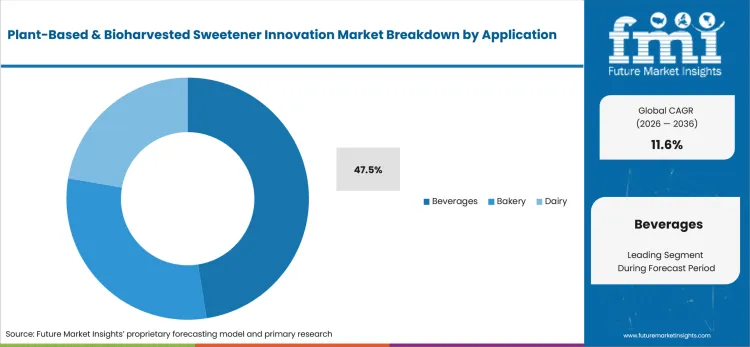
Liquid products reveal sweetness timing and lingering notes more clearly than many solid food formats during sensory review. Tate & Lyle reported in July 2025 that its all-Americas Reb M launch supported a beverage prototype and marked large-scale regional commercialization. The launch gives beverage teams a dated option among sweetener systems for testing taste and supply resilience together. Laboratories can compare solubility and flavor balance across carbonated drinks and dairy beverages or powdered mixes.
- In 2026, beverages are expected to lead the application category with 47.5% share due to frequent reformulation and measurable taste comparisons. Liquid processing gives development teams a direct test of solubility and flavor balance during pilot work. The segment gains commercial weight through repeated line extensions across established brands rather than isolated ingredient substitutions.
- Drink manufacturers use bioharvested sweeteners to reduce sugar without accepting a pronounced bitter or metallic finish. Wider adoption requires stable performance across acidity and temperature conditions that differ between beverage categories. Formulation teams need pilot results covering processing losses and shelf-life changes throughout the intended distribution period. Consistent results support faster commercial expansion across related flavors and package formats within established beverage brands.
What are the drivers, restraints, and opportunities in the Plant-Based & Bioharvested Sweetener Innovation Market?
Controlled biological production expands access to rare glycosides and supports deeper sugar reduction across familiar applications. Production-specific approvals and scale economics slow broader use, yet new enzymatic routes create additional supply options.
- Driver: Commercial access to minor steviol glycosides supports deeper sugar reduction across established food and beverage formulations.
- Restraint: Production-specific specifications increase documentation work and delay approvals across several jurisdictions and customer product categories.
- Opportunity: New enzymatic routes create additional supply choices for rare steviol glycosides with defined commercial uses.
Commercial access to fermentation-derived Reb M and Reb D supports deeper sugar reduction in products that need a clean sweetness profile. Cargill reported in September 2025 that EverSweet had regulatory approvals in the United States and European Union. The same announcement listed Canada and Mexico and noted use by major food and beverage brands. The documented approvals confirm commercial availability beyond laboratory development for fermentation-derived minor glycosides across regulated markets. Manufacturers comparing high-intensity sweetener systems can assess sensory performance alongside production scale and regional ingredient access. Demand strengthens across product portfolios that need consistent glycosides for several coordinated reformulation programs and categories.
A new manufacturing method can require separate technical specifications and safety evidence across regulated sweetener applications. The final molecule may remain familiar but its production route changes the documentation required for regulatory review. EFSA assessed a proposed E 960c specification amendment in May 2025 for Reb M made with a different enzyme-production strain. Ingredient companies need jurisdiction-specific dossiers covering every regulated food category and the intended commercial use. The added review work delays commercial expansion across several applications and increases coordination with national authorities.
New enzymatic routes create an opportunity to widen supply without relying on one conversion platform. The FDA closed GRN 1294 without questions in April 2026 for enzymatically produced Reb M intended as a general-purpose sweetener. The notice gives ingredient manufacturers another defined route for producing a scarce glycoside under specified use conditions. Organic stevia sourcing remains relevant for companies that prefer leaf-linked supply and documented agricultural origin. Commercial value depends on scalable purification and application evidence that meets each intended food category. The strongest route broadens molecule access without weakening purity control or sensory performance across commercial formulations.
Which country CAGRs are profiled in the Plant-Based & Bioharvested Sweetener Innovation Market?
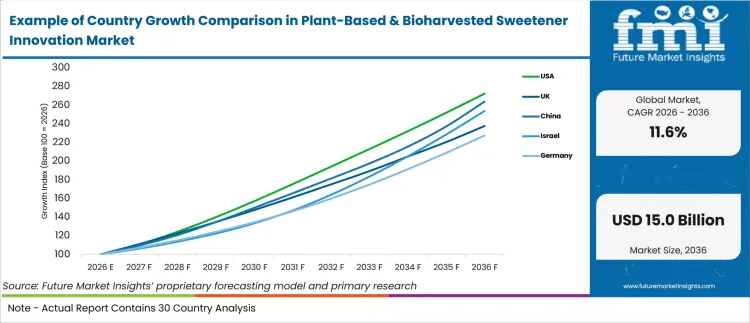
| Country | CAGR |
|---|---|
| USA | 9.4% |
| UK | 9.0% |
| China | 10.2% |
| Israel | 9.8% |
| Germany | 8.6% |
How do country-level CAGRs compare in the plant-based & bioharvested sweetener innovation market?
The profiled markets span a measured 1.6 percentage-point range between China and Germany during the forecast period. China and Israel form the upper cluster through stronger local production or development capability in this comparison. Different approval routes place the United States and United Kingdom within a narrower middle band. Germany records a rate 0.4 percentage points below the United Kingdom under the European additive framework. The spacing indicates gradual commercialization differences rather than a sharp separation in addressable demand across the profiled countries.
- China combines expanded authorization for enzymatically converted steviol glycosides with local cultivation and domestic food-additive controls.
- Israel links plant-cell research with public innovation funding that supports export development despite a smaller domestic customer base.
- The United States provides several GRAS notification routes and each notifier must support a defined production process and intended use.
- The United Kingdom combines Great Britain’s E 960b register with European Union rules for Northern Ireland.
- Germany benefits from European authorization but formulation teams must verify additive conditions across each intended food category.
Comparable country CAGRs can produce different entry costs due to regulatory work and local application support. Ingredient manufacturers can use nutritive sweetener benchmarks to separate established ingredient economics from newer biological production routes. The full report provides country-level CAGR analysis across North America, Latin America, Europe, East Asia, South Asia, Oceania and the Middle East and Africa.
Country-wise Analysis
- United States ingredient commercialization relies on notifier-specific GRAS notices that define each production process and intended food use. Adoption of bioharvested sweeteners in the United States is estimated to expand at 9.4% CAGR through 2036, supported by active GRAS pathways and extensive formulation capability. A large formulation base supports beverage and dairy trials through regional application laboratories and established ingredient distributors. The FDA closed GRN 1203 without questions in February 2025 for enzymatically produced rebaudioside M2 used as a general-purpose sweetener. Separate customer qualification raises testing costs for smaller brands and prevents one notice from covering unrelated production routes. Ingredient developers should prepare category-specific application data and labeling support prior to recurring commercial supply.
- United Kingdom sales follow two regulatory routes: Great Britain uses the Food Standards Agency register and Northern Ireland follows European Union food-additive rules. The Food Standards Agency updated the Great Britain E 960b authorization in February 2026 to include a Saccharomyces cerevisiae route for Reb M. Plant-based and bioharvested sweetener innovation in the United Kingdom is estimated to post 9.0% CAGR over the forecast period, reinforced by separate regulatory routes and strong beverage formulation capacity. Established beverage laboratories support sensory testing and regulatory work for imported ingredients across commercial product categories. The dual route creates a material friction as manufacturers must align specifications with the destination market. Companies should separate Great Britain and Northern Ireland documentation prior to contracting recurring commercial volume.
- China’s food-additive route distinguishes enzymatically converted steviol glycosides from conventional leaf extracts across permitted food categories. China's plant-based and bioharvested sweetener innovation outlook is anticipated to advance at 10.2% CAGR over the assessment period, linked to local processing capability and expanded authorized uses. The National Health Commission reported in February 2025 that enzymatically converted steviol glycosides received expanded use across additional food categories. Domestic stevia cultivation and local processing capability support ingredient availability for large food manufacturing programs. New production methods face local documentation and labeling review that foreign regulatory dossiers cannot replace. Manufacturers need Chinese regulatory support and application service to convert permitted uses into repeat customer orders.
- Israel combines specialist plant-cell research with export-oriented biological production programs that target global ingredient companies. By 2036, bioharvested sweetener innovation in Israel is projected to grow at 9.8% CAGR supported by specialized plant-cell research and export-focused development partnerships. BioHarvest received a USD 1.6 million Israel Innovation Authority grant in December 2025 for its second-generation Botanical Synthesis platform. The funded program covers process optimization and larger bioreactors that can strengthen production consistency for export projects. A smaller domestic customer base and long service distances increase the cost of trials across major food manufacturing regions. Developers need export partnerships and validated scale economics prior to dedicating additional capacity to sweetener production.
- Germany applies the European Union additive list directly across industrial food and beverage formulation programs. Fermentation-derived sweetener sales in Germany are forecast to expand at 8.6% CAGR by 2036, shaped by direct application of the European additive framework. Commission Regulation 2025/652 authorized fermentation-derived rebaudioside M under E 960b across the European Union in April 2025. Established application laboratories and distributors support local commercial reformulation across beverages and dairy product portfolios. Production-specific limits create a material friction as every formulation must match the authorized category and maximum-use condition. Ingredient companies should pair regulatory files with local sensory and stability evidence for each intended application.
Who are the notable companies in the Plant-Based & Bioharvested Sweetener Innovation Market?
Tate & Lyle, BioHarvest Sciences, Sweegen, Cargill, Ingredion, and dsm-firmenich are the notable companies shaping this market.
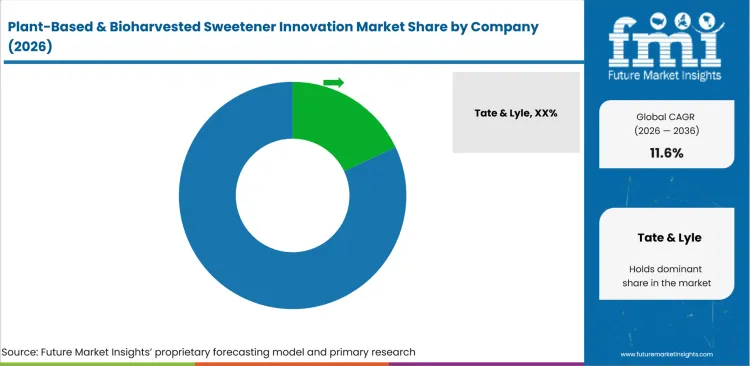
The competitive field combines global ingredient groups with specialist biological production companies and experienced formulation partners. PureCircle by Ingredion announced in April 2025 that an external audit verified FSA Silver performance across its entire contracted stevia supply. The audit strengthens traceability for leaf-derived stevia across Ingredion’s wider sweetener portfolio and international customer programs. Tate & Lyle develops bio-converted and plant-cell sweeteners through strategic partnerships serving several commercial food and beverage categories. Cargill and dsm-firmenich commercialize fermentation-derived stevia through Avansya across approved markets and manufacturer application programs. BioHarvest provides a plant-cell route that gives formulation teams an alternative to artificial sweeteners during reformulation and supply diversification.
- Tate & Lyle and Ingredion combine broad sweetening portfolios with application laboratories and international customer networks. Their commercial strength comes from regulatory support and formulation work across several commercial food categories. Production-method choices remain specific to each ingredient platform and cannot be transferred across unrelated molecules.
- BioHarvest Sciences and Sweegen compete through controlled biological production routes that broaden access to scarce plant molecules. Sweegen described Asia-Pacific formulation work in January 2025 for reduced-sugar sauces and noodles using its sweetness systems. Their commercial position depends on stable yields and regulatory coverage alongside dependable scale-up support for customer qualification.
- Cargill and dsm-firmenich use the Avansya joint venture to commercialize fermentation-derived EverSweet across approved regional markets. The model connects production technology with formulation support for food manufacturers comparing fermentation-derived molecules against established stevia systems. Commercial selection depends on verified regional approval and dependable supply across customer manufacturing volumes and schedules.
Competitive Benchmarking: Plant-Based & Bioharvested Sweetener Innovation Market
| Company | Plant-Derived Portfolio | Bioharvest or Fermentation Technology | Application and Scale Integration | Geographic Reach |
|---|---|---|---|---|
| Tate & Lyle | High | Medium | High | Global |
| BioHarvest Sciences | Medium | High | Medium | North America and Israel |
| Sweegen | High | High | Medium | Global |
| Cargill | High | High | High | Global |
| Ingredion | High | Medium | High | Global |
| dsm-firmenich | Medium | High | High | Global |
Key Developments in the Plant-Based & Bioharvested Sweetener Innovation Market
- In February 2026, Tate & Lyle and Manus launched Yume™ M Stevia Sweetener through an all-Americas supply chain. Large-scale bioconversion at the Manus BioFacility in Georgia supports regional Reb M availability and Tate & Lyle application work. The launch gives food and beverage manufacturers one supported route for testing taste performance and supply resilience across commercial formulations. The program connects a dated ingredient launch with regional production and customer formulation support across commercial applications.
- In May 2026, BioHarvest Sciences and Tate & Lyle expanded their collaboration from one sweetener project to several plant-based molecules. They reported technical progress under the original agreement and a wider formulation toolkit for food and beverage categories. The expansion increases the commercial relevance of plant-cell production for ingredient developers seeking distinct sweetness profiles and reduced dependence on agricultural extraction.
- In February 2026, dsm-firmenich reported that EverSweet received European Union and United Kingdom approval during 2025. The precision-fermented sweetener uses Avansya production to supply Reb M and Reb D with a rounded taste profile. The approvals widen commercial access for manufacturers that require fermentation-derived sweetness under defined regional specifications and documented use conditions. Commercial supply runs through the joint venture’s production and application network across several food and beverage categories.
- In June 2026, Ingredion announced a recommended all-cash acquisition of Tate & Lyle with expected completion during the second half of 2027. Shareholder approval and court sanction remain required prior to formal completion under the proposed transaction structure. Antitrust conditions also remain outstanding under the announced timetable and scheme arrangement required for completion. Both companies remain separate competitors at the July 2026 cutoff and the benchmarking assesses their capabilities independently.
Key Players in the Plant-Based & Bioharvested Sweetener Innovation Market
Integrated Sweetening and Formulation Groups
- Tate & Lyle
- Ingredion
Fermentation and Commercial Scale Groups
- Cargill
- dsm-firmenich
Bioharvest and Bioconversion Specialists
- BioHarvest Sciences
- Sweegen
Plant-Based & Bioharvested Sweetener Innovation Market - Report Scope
| Coverage field | Report scope |
|---|---|
| Market breakdown | Source, technology, application, and region. |
| Quantitative Units | Revenue in USD billion and CAGR in %. |
| Market Definition | Revenue from plant-based sweetener ingredients and controlled biological production technologies used to create commercial sweetening molecules. The scope excludes finished foods and unrelated flavor systems without a direct sweetening function. |
| Regions Covered | North America, Latin America, Western Europe, Eastern Europe, East Asia, South Asia and Pacific, and Middle East and Africa. |
| Countries Covered | USA, UK, China, Israel, Germany, plus more than twenty-five additional countries across the covered regions. |
| Key Companies Profiled | Tate & Lyle, BioHarvest Sciences, Sweegen, Cargill, Ingredion, and dsm-firmenich. |
| Forecast Period | 2026 to 2036. |
| Approach | Hybrid bottom-up and top-down market sizing supported by primary interviews and official regulatory records across company disclosures and technical evidence. |
Plant-Based & Bioharvested Sweetener Innovation Market - Research Methodology
| Method | Approach |
|---|---|
| Primary Research | FMI analysts gathered input from manufacturers, service providers, technology developers, distributors, end users, procurement teams, and subject-matter experts. Interviews examined purchasing decisions, product or service evaluation, adoption barriers, approval requirements, pricing considerations, and expectations for technical or commercial support. Respondents were also asked what evidence is required before a trial, pilot, or initial order develops into regular purchasing. |
| Desk Research | Desk research covered government statistics, regulatory publications, trade data, industry associations, technical literature, standards, company filings, product information, and official corporate announcements. Sources were reviewed for relevance, publication date, geographic coverage, and consistency with the defined market scope. Claims relating to performance, applications, approvals, capacity, investment, and commercial activity were retained only when supported by credible public evidence. |
| Market Sizing and Forecasting | The market model combined the baseline value with historical performance, segment structure, pricing and volume indicators, adoption levels, company participation, and country-level demand conditions. Forecast assumptions considered economic activity, investment trends, regulatory developments, technology adoption, purchasing cycles, supply availability, and barriers to wider market use. Segment and regional estimates were reconciled before the final market total was calculated. |
| Data Validation | Estimates were checked against multiple independent indicators, including public data, company activity, trade patterns, industry developments, and findings from primary interviews. Validation also tested whether products, services, applications, and company revenues fell within the defined market boundaries. Adjacent categories, unsupported claims, overlapping revenues, and activities without direct market relevance were excluded to reduce double counting and maintain consistency across segments and countries. |
Plant-Based & Bioharvested Sweetener Innovation Market by Segments
Plant-Based & Bioharvested Sweetener Innovation Market segmented by Source:
- Stevia
- Bioharvest Cell-culture
- Fruit-derived
Plant-Based & Bioharvested Sweetener Innovation Market segmented by Technology:
- Plant Cell Culture
- Fermentation
Plant-Based & Bioharvested Sweetener Innovation Market segmented by Application:
- Beverages
- Bakery
- Dairy
Plant-Based & Bioharvested Sweetener Innovation Market by Region:
- North America
- United States
- Canada
- Latin America
- Brazil
- Mexico
- Argentina
- Chile
- Western Europe
- Germany
- France
- United Kingdom
- Italy
- Spain
- Benelux
- Nordics
- Eastern Europe
- Poland
- Czech Republic
- Romania
- Hungary
- East Asia
- China
- Japan
- South Korea
- South Asia and Pacific
- India
- ASEAN
- Australia and New Zealand
- Middle East and Africa
- GCC Countries
- South Africa
- Türkiye
- Israel
Research Sources and Bibliography
- Tate & Lyle PLC. (2025, October 31). One year on: How our stevia Reb M partnership with Manus is benefiting customers.
- BioHarvest Sciences Inc. (2025, May 16). BioHarvest Sciences Reports First Quarter 2025 Financial Results.
- USA Food and Drug Administration. (2025, November 18). GRN No. 1260: Rebaudioside M produced by enzymatic treatment of steviol glycosides purified from the leaves of Stevia rebaudiana (Bertoni) Bertoni.
- BioHarvest Sciences Inc. (2026, July 15). BioHarvest Awarded $1.4M Grant from the Israel Innovation Authority to Pioneer AI-Driven Plant-Cell Synthesis.
- Tate & Lyle PLC. (2025, July 7). Tate & Lyle debuts expanded portfolio and mouthfeel leadership at IFT FIRST 2025.
- Cargill. (2025, September 26). Cargill’s EverSweet® stevia sweetener named a finalist in the 2025 Global Good Awards Game Changing Innovation of the Year.
- EFSA Panel on Food Additives and Flavourings. (2025, May 14). Safety of the proposed amendment of the specifications of the food additive E960c(i) or E960c(ii). EFSA Journal, 23(5), e9396.
- USA Food and Drug Administration. (2026, April 16). GRN No. 1294: Rebaudioside M produced by enzymatic treatment of steviol glycosides purified from the leaves of Stevia rebaudiana (Bertoni) Bertoni.
- USA Food and Drug Administration. (2025, February 12). GRN No. 1203: Rebaudioside M2 obtained by enzymatic treatment of steviol glycosides purified from the leaves of Stevia rebaudiana (Bertoni) Bertoni.
- Food Standards Agency. (2026, February 19). Steviol glycosides from fermentation.
- National Health Commission of the People’s Republic of China. (2025, February 10). 解读《关于甜叶菊多酚等20种“三新食品”的公告》(2025年第1号) [Interpretation of the announcement on 20 new food ingredients including stevia polyphenols].
- BioHarvest Sciences Inc. (2025, December 18). BioHarvest Sciences Awarded $1.6 Million USD Grant from the Israeli Innovation Authority to Advance Second-Generation Botanical Synthesis Platform.
- European Commission. (2025, April 3). Commission Regulation (EU) 2025/652 of 2 April 2025 amending Regulation (EC) No 1333/2008 of the European Parliament and the Council and Commission Regulation (EU) No 231/2012 as regards the use of Steviol glycosides produced by fermentation using Yarrowia lipolytica.
- Ingredion Incorporated. (2025, April 29). PureCircle by Ingredion First to Achieve Farm Sustainability Assessment Silver Performance Level for 100% of Stevia Supply.
- Sweegen. (2025, January 29). How Sweegen is Pioneering Delicious Better-For-You Product Innovation in the Asia Pacific Region.
- Tate & Lyle PLC. (2026, February 23). Introducing Yume™: A new standard for sweetness.
- BioHarvest Sciences Inc. (2026, May 18). TATE & LYLE EXPANDS COLLABORATION WITH BIOHARVEST SCIENCES TO ACCELERATE NEXT-GENERATION SWEETENER INNOVATION.
- dsm-firmenich. (2026, February 20). Sustainability, innovation, and partnerships. Integrated Annual Report 2025.
- Ingredion Incorporated. (2026, June 8). Ingredion Announces Recommended All-Cash Acquisition of Tate & Lyle.
This bibliography is provided for reader reference and is not exhaustive. The full report contains the complete reference list and detailed citations.
This Report Answers
- How large is the plant-based and bioharvested sweetener innovation market in 2026 and 2036?
- Which production and formulation pressures support investment in bioharvested sweetener technologies?
- Why does stevia account for the largest source share in 2026?
- How does plant cell culture influence production consistency and molecule access?
- Why do beverages represent the largest application share in 2026?
- How do country growth rates differ across China, Israel, the United States, the United Kingdom, and Germany?
- Which companies combine ingredient portfolios with bioharvest or fermentation capabilities?
- What regulatory conditions limit commercialization across different production methods?
- Which evidence should formulation teams review before approving broader commercial supply?
Frequently Asked Questions
How big is the Plant-Based & Bioharvested Sweetener Innovation Market in 2026?
The plant-based and bioharvested sweetener innovation market is valued at USD 5.0 billion in 2026 and is forecast to reach USD 15.0 billion by 2036. Growth reflects commercial-scale production advances improving the viability of next-generation sweeteners for broader adoption by food and beverage manufacturers.
What is the CAGR of the Plant-Based & Bioharvested Sweetener Innovation Market from 2026 to 2036?
The plant-based and bioharvested sweetener innovation market grows at a CAGR of 11.6% between 2026 and 2036, supported by commercial access to minor steviol glycosides that enable deeper sugar reduction across established food and beverage formulations.
Which technology leads the Plant-Based & Bioharvested Sweetener Innovation Market?
Plant cell culture accounts for 69.7% of the plant-based and bioharvested sweetener innovation market by technology in 2026, owing to controlled biomass and molecule production across repeated batches that support consistent specifications for customer programs.
How much will the Plant-Based & Bioharvested Sweetener Innovation Market add between 2026 and 2036?
The plant-based and bioharvested sweetener innovation market is set to add USD 10.0 billion between 2026 and 2036, growing from USD 5.0 billion to USD 15.0 billion as controlled biological production extends across a widening base of beverage and food reformulation programs.
Who are the leading companies in the Plant-Based & Bioharvested Sweetener Innovation Market?
Five companies lead the plant-based and bioharvested sweetener innovation market, including Tate & Lyle, BioHarvest Sciences, Sweegen, Cargill, and Ingredion, competing through molecule access, biological production scale, and practical customer qualification capability.
Preview the report firsthand - request a free sample
Get SampleGet the brochure for pricing and purchase details.
Get PDFTable of Content
- Key Takeaways
- Market Size and CAGR
- Top Growth Driver
- Fastest Growing Segment
- Leading Region
- Key Companies
- Emerging Opportunities
- Executive Summary
- Global Market Outlook
- Demand-side Trends
- Supply-side Trends
- Technology Roadmap Analysis
- Analysis and Recommendations
- Analyst Perspective (What is happening? Why now? What should investors know?)
- Key Questions Answered
- How large is the market?
- What is the CAGR?
- What are key trends?
- Which region dominates?
- Who are the leaders?
- Market Overview
- Market Coverage / Taxonomy
- Market Definition / Scope / Limitations
- Research Methodology
- Chapter Orientation
- Analytical Lens and Working Hypotheses
- Market Structure, Signals, and Trend Drivers
- Benchmarking and Cross-market Comparability
- Market Sizing, Forecasting, and Opportunity Mapping
- Research Design and Evidence Framework
- Desk Research Programme (Secondary Evidence)
- Expert Input and Fieldwork (Primary Evidence)
- Tooling, Models, and Reference Databases
- Data Engineering and Model Build
- Quality Assurance and Audit Trail
- Market Background
- Market Dynamics (Drivers, Restraints, Opportunity, Trends)
- Scenario Forecast (Optimistic, Likely, Conservative)
- Impact Analysis
- AI Impact
- Sustainability Impact
- Regulatory Impact
- Technology Impact
- Consumer / Buyer Analysis
- Purchase Drivers
- Adoption Barriers
- Buyer Journey
- Opportunity Map Analysis
- Product Life Cycle Analysis
- Supply Chain Analysis
- Investment Feasibility Matrix
- Value Chain Analysis
- PESTLE and Porter's Analysis
- Regulatory Landscape
- Regional Parent Market Outlook
- Production and Consumption Statistics
- Import and Export Statistics
- Global Market Analysis and Forecast, 2021 to 2036
- Historical Market Size Value (USD Billion) Analysis, 2021 to 2025
- Current and Future Market Size Value (USD Billion) Projections, 2026 to 2036
- Y-o-Y Growth Trend Analysis
- Absolute $ Opportunity Analysis
- Global Market Pricing Analysis, 2021 to 2036
- Global Market Analysis and Forecast, By Source, 2021 to 2036
- Introduction / Key Findings
- Historical Market Size Value (USD Billion) Analysis By Source, 2021 to 2025
- Current and Future Market Size Value (USD Billion) Analysis and Forecast By Source, 2026 to 2036
- Stevia
- Bioharvest Cell-culture
- Fruit-derived
- Stevia
- Y-o-Y Growth Trend Analysis By Source, 2021 to 2025
- Absolute $ Opportunity Analysis By Source, 2026 to 2036
- Global Market Analysis and Forecast, By Technology, 2021 to 2036
- Introduction / Key Findings
- Historical Market Size Value (USD Billion) Analysis By Technology, 2021 to 2025
- Current and Future Market Size Value (USD Billion) Analysis and Forecast By Technology, 2026 to 2036
- Plant Cell Culture
- Fermentation
- Plant Cell Culture
- Y-o-Y Growth Trend Analysis By Technology, 2021 to 2025
- Absolute $ Opportunity Analysis By Technology, 2026 to 2036
- Global Market Analysis and Forecast, By Application, 2021 to 2036
- Introduction / Key Findings
- Historical Market Size Value (USD Billion) Analysis By Application, 2021 to 2025
- Current and Future Market Size Value (USD Billion) Analysis and Forecast By Application, 2026 to 2036
- Beverages
- Bakery
- Dairy
- Beverages
- Y-o-Y Growth Trend Analysis By Application, 2021 to 2025
- Absolute $ Opportunity Analysis By Application, 2026 to 2036
- Global Market Analysis and Forecast, By Region, 2021 to 2036
- Introduction
- Historical Market Size Value (USD Billion) Analysis By Region, 2021 to 2025
- Current Market Size Value (USD Billion) Analysis and Forecast By Region, 2026 to 2036
- North America
- Latin America
- Western Europe
- Eastern Europe
- East Asia
- South Asia and Pacific
- Middle East & Africa
- Market Attractiveness Analysis By Region
- North America Market Analysis and Forecast, By Country, 2021 to 2036
- Historical Market Size Value (USD Billion) Trend Analysis By Market Taxonomy, 2021 to 2025
- Market Size Value (USD Billion) Forecast By Market Taxonomy, 2026 to 2036
- By Country
- USA
- Canada
- By Source
- By Technology
- By Application
- By Country
- Market Attractiveness Analysis
- By Country
- By Source
- By Technology
- By Application
- Key Takeaways
- Latin America Market Analysis and Forecast, By Country
- Historical Market Size Value (USD Billion) Trend Analysis By Market Taxonomy, 2021 to 2025
- Market Size Value (USD Billion) Forecast By Market Taxonomy, 2026 to 2036
- By Country
- Brazil
- Mexico
- Chile
- Rest of Latin America
- By Source
- By Technology
- By Application
- By Country
- Market Attractiveness Analysis
- By Country
- By Source
- By Technology
- By Application
- Key Takeaways
- Western Europe Market Analysis and Forecast, By Country
- Historical Market Size Value (USD Billion) Trend Analysis By Market Taxonomy, 2021 to 2025
- Market Size Value (USD Billion) Forecast By Market Taxonomy, 2026 to 2036
- By Country
- Germany
- UK
- Italy
- Spain
- France
- Nordic
- BENELUX
- Rest of Western Europe
- By Source
- By Technology
- By Application
- By Country
- Market Attractiveness Analysis
- By Country
- By Source
- By Technology
- By Application
- Key Takeaways
- Eastern Europe Market Analysis and Forecast, By Country
- Historical Market Size Value (USD Billion) Trend Analysis By Market Taxonomy, 2021 to 2025
- Market Size Value (USD Billion) Forecast By Market Taxonomy, 2026 to 2036
- By Country
- Russia
- Poland
- Hungary
- Balkan & Baltic
- Rest of Eastern Europe
- By Source
- By Technology
- By Application
- By Country
- Market Attractiveness Analysis
- By Country
- By Source
- By Technology
- By Application
- Key Takeaways
- East Asia Market Analysis and Forecast, By Country
- Historical Market Size Value (USD Billion) Trend Analysis By Market Taxonomy, 2021 to 2025
- Market Size Value (USD Billion) Forecast By Market Taxonomy, 2026 to 2036
- By Country
- China
- Japan
- South Korea
- By Source
- By Technology
- By Application
- By Country
- Market Attractiveness Analysis
- By Country
- By Source
- By Technology
- By Application
- Key Takeaways
- South Asia and Pacific Market Analysis and Forecast, By Country
- Historical Market Size Value (USD Billion) Trend Analysis By Market Taxonomy, 2021 to 2025
- Market Size Value (USD Billion) Forecast By Market Taxonomy, 2026 to 2036
- By Country
- India
- ASEAN
- Australia & New Zealand
- Rest of South Asia and Pacific
- By Source
- By Technology
- By Application
- By Country
- Market Attractiveness Analysis
- By Country
- By Source
- By Technology
- By Application
- Key Takeaways
- Middle East & Africa Market Analysis and Forecast, By Country
- Historical Market Size Value (USD Billion) Trend Analysis By Market Taxonomy, 2021 to 2025
- Market Size Value (USD Billion) Forecast By Market Taxonomy, 2026 to 2036
- By Country
- Kingdom of Saudi Arabia
- Other GCC Countries
- Türkiye
- South Africa
- Other African Union
- Rest of Middle East & Africa
- By Source
- By Technology
- By Application
- By Country
- Market Attractiveness Analysis
- By Country
- By Source
- By Technology
- By Application
- Key Takeaways
- Key Countries Market Analysis
- USA
- Pricing Analysis
- Market Share Analysis, 2025
- By Source
- By Technology
- By Application
- Canada
- Pricing Analysis
- Market Share Analysis, 2025
- By Source
- By Technology
- By Application
- Mexico
- Pricing Analysis
- Market Share Analysis, 2025
- By Source
- By Technology
- By Application
- Brazil
- Pricing Analysis
- Market Share Analysis, 2025
- By Source
- By Technology
- By Application
- Chile
- Pricing Analysis
- Market Share Analysis, 2025
- By Source
- By Technology
- By Application
- Germany
- Pricing Analysis
- Market Share Analysis, 2025
- By Source
- By Technology
- By Application
- UK
- Pricing Analysis
- Market Share Analysis, 2025
- By Source
- By Technology
- By Application
- Italy
- Pricing Analysis
- Market Share Analysis, 2025
- By Source
- By Technology
- By Application
- Spain
- Pricing Analysis
- Market Share Analysis, 2025
- By Source
- By Technology
- By Application
- France
- Pricing Analysis
- Market Share Analysis, 2025
- By Source
- By Technology
- By Application
- India
- Pricing Analysis
- Market Share Analysis, 2025
- By Source
- By Technology
- By Application
- ASEAN
- Pricing Analysis
- Market Share Analysis, 2025
- By Source
- By Technology
- By Application
- Australia & New Zealand
- Pricing Analysis
- Market Share Analysis, 2025
- By Source
- By Technology
- By Application
- China
- Pricing Analysis
- Market Share Analysis, 2025
- By Source
- By Technology
- By Application
- Japan
- Pricing Analysis
- Market Share Analysis, 2025
- By Source
- By Technology
- By Application
- South Korea
- Pricing Analysis
- Market Share Analysis, 2025
- By Source
- By Technology
- By Application
- Russia
- Pricing Analysis
- Market Share Analysis, 2025
- By Source
- By Technology
- By Application
- Poland
- Pricing Analysis
- Market Share Analysis, 2025
- By Source
- By Technology
- By Application
- Hungary
- Pricing Analysis
- Market Share Analysis, 2025
- By Source
- By Technology
- By Application
- Kingdom of Saudi Arabia
- Pricing Analysis
- Market Share Analysis, 2025
- By Source
- By Technology
- By Application
- Türkiye
- Pricing Analysis
- Market Share Analysis, 2025
- By Source
- By Technology
- By Application
- South Africa
- Pricing Analysis
- Market Share Analysis, 2025
- By Source
- By Technology
- By Application
- USA
- Market Structure Analysis
- Competition Dashboard
- Competition Benchmarking
- Market Share Analysis of Top Players
- By Regional
- By Source
- By Technology
- By Application
- Emerging Startups
- Innovation Benchmarking
- Competition Analysis
- Competition Deep Dive
- Tate & Lyle
- Overview
- Product Portfolio
- Profitability by Market Segments
- Sales Footprint
- Strategy Overview
- Marketing Strategy
- Product Strategy
- Channel Strategy
- BioHarvest Sciences
- Sweegen
- Cargill
- Ingredion
- dsm-firmenich
- Tate & Lyle
- Case Studies
- Success Stories
- Recent Developments
- Competition Deep Dive
- Assumptions & Acronyms Used


