

- 2025 (base history)
- USD 360.4 Mn
- 2026 (current)
- USD 390.0 Mn
- 2036 (forecast)
- USD 857.7 Mn
- CAGR (2026–2036)
- 8.2%
How big is the plant-based deli slices market in 2026?
USD 390.0 million in 2026 and USD 857.7 million by 2036 at an 8.2% CAGR.
The plant-based deli slices industry value is expected to scale from USD 360.4 million in 2025 to USD 857.7 million by 2036 at 8.2% CAGR, influenced by retailers testing chilled meat-free sandwich packs and foodservice buyers adding portion-controlled plant-based slices. Pre-packed chilled slices are anticipated to represent 58.4% share in 2026, driven by grocery chains preferring shelf-ready packs with controlled pricing. Retail households are likely to secure 54.7% share in 2026, led by weekly sandwich preparation and familiar pack handling.
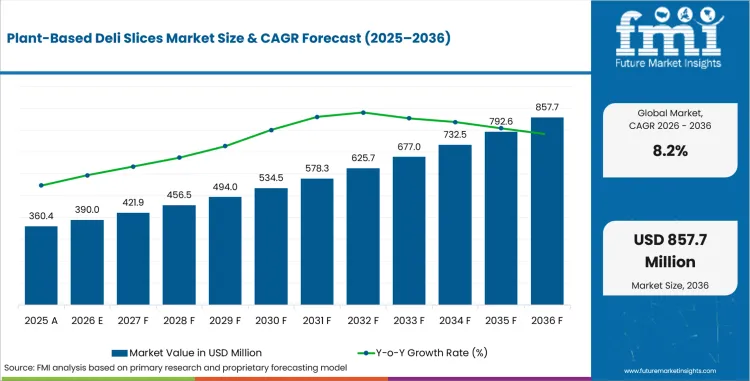
Plant-Based Deli Slices Market Overview: Size and Forecast
- 2025 (base history): USD 360.4 million
- 2026 (current): USD 390.0 million
- 2036 (forecast): USD 857.7 million
- CAGR (2026–2036): 8.2%
- Leading Format: Pre-packed Chilled Slices
- Pre-packed Chilled Slices Share in 2026: 58.4%
- Leading End-use Buyer: Retail Households
- Retail Households Share in 2026: 54.7%
- Fastest-growing Country: Saudi Arabia
- Saudi Arabia CAGR: 9.8% by 2036
Summary of Plant-Based Deli Slices Market
- Demand and Growth Drivers
- Sandwich-led use gives plant-based deli slices a clear eating occasion inside lunchboxes and office meals.
- Retailers can test chilled plant-based slices beside conventional deli meat packs, which makes price and pack comparison simpler.
- Foodservice buyers use sliced formats for sandwich shops and cafés needing controlled portions without extra kitchen work.
- Product and Segment View
- Pre-packed chilled slices are forecast to represent 58.4% share in 2026, led by shelf-ready retail packs and simpler stock control.
- Retail households are projected to hold 54.7% share in 2026, influenced by weekly sandwich preparation and small pack affordability.
- Supermarkets and hypermarkets are expected to secure 46.2% share in 2026, reflected by chilled aisle access and grocery trip frequency.
- Geography and Competitive Outlook
- Saudi Arabia is projected to record 9.8% CAGR by 2036, backed by specialized foodservice imports and café sandwich testing.
- South Korea is expected to expand at 9.4% CAGR by 2036 through convenience retail and food-tech investment.
- Prime Roots and Unreal Deli compete based on deli-style plant-based meats and counter-service placement.
- La Vie and Project Eaden focus on European ham-style slices, while Tofurky and Lightlife support North American retail availability.
- Analyst Opinion
- Nandini Roy Choudhury, Principal Consultant for Food and Beverage at FMI, observes, “Plant-based deli slices have a clearer purchase cue than many meat alternatives. Shoppers already know the sandwich use case. Brands delivering clean aroma and dependable chilled texture are expected to secure frequent repeat listings.”
Cold sandwich buyers want plant-based deli slices delivering enough protein and work consistently in cafés and foodservice lines. Tofurky’s May 2024 foodservice sheet listed 52g servings with 13g to 14g protein across its Next-Gen Turk’y and Ham slices. This gives operators a clear protein claim for wraps and sandwich menus. Kellanova’s December 2024 patent filing focused on sliced deli-style meat analogues made through controlled emulsion and extrusion. Reflecting on how the competition is moving toward better slice structure along with new flavors. Suppliers combining foodservice-ready packs and tested taste claims are likely to gain stronger interest from grocery and distributor buyers.
What supports value in the plant-based deli slices market?
Finished chilled slice SKU revenue and foodservice portion packs support value across retail and sandwich-led channels.
- Market value is supported by finished plant-based deli slice revenue before retailer margin and foodservice markups add incremental sales.
- Supplier pricing reflects protein input cost and chilled distribution requirements.
- Revenue improves as brands convert plant-based meat trial into routine lunch and sandwich use.
- Retail confidence rises as pack labels make flavor type and serving count easier to compare.
Why is the plant-based deli slices market growing?
Adult and family buyers are testing chilled meat-free slices through familiar sandwich routines and smaller grocery packs.
Growth outlook is shifting toward products performing in cold sandwiches and foodservice prep. A 2025 Current Research in Food Science study compared four plant-based deli meats with four animal deli meats. Sample stiffness ranged from 378.0 kPa for plant-based turkey to 49.0 kPa for animal prosciutto. Such gap shows why chilled slice suppliers need softer bite and better slice separation before broader retail approval. Brands serving the meat substitutes market are expected to strengthen listings by improving cold-eating texture along with flavor variety.
Product development is expected to focus on tighter protein structuring and more consistent refrigerated handling. A 2025 Food Research International study compared five plant-based meats with 3 animal meats and reported plant-based turkey stiffness at 418.9 kPa while tofu stood at 56.7 kPa. Such variation indicates, plant-based deli slice quality depends on formulation control and protein network design. Suppliers aligned to the plant-based protein market are likely to improve repeat purchase by aligning texture targets with sandwich use.
How is the plant-based deli slices market segmented?
The plant-based deli slices industry is segmented by product type, source protein, format, sales channel and end-use buyer.
- Pre-packed chilled slices are projected to secure 58.4% share in 2026, led by barcode-ready retail packs and lower handling needs across grocery chilled aisles.
- Retail households are anticipated to hold 54.7% share in 2026 since smaller pack sizes support sandwich trial inside routine grocery trips.
- Supermarkets and hypermarkets are forecast to represent 46.2% share in 2026, guided by chilled meat-free shelves and weekly household shopping behavior.
- Plant-based ham slices are expected to capture 42.8% share in 2026 due to mild flavor and stronger fit with cold sandwiches.
- Soy-and-wheat blends are projected to account for 37.6% share in 2026, reflected by slice elasticity and established processing experience.
Why do pre-packed chilled slices lead the plant-based deli slices market?
Pre-packed chilled slices hold 58.4% share in 2026 due to shelf-ready packs and simple household storage.
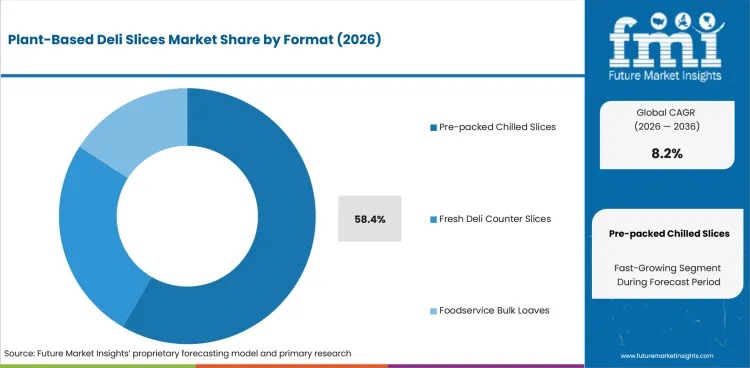
- Pre-packed chilled slices are projected to account for 58.4% share in 2026, influenced by retail pack control and clear use in sandwiches.
- Fresh deli counter slices gain selective use as service counters help shoppers judge aroma and meat-like handling before purchase.
Which end-use buyer leads the plant-based deli slices market?
Retail households hold 54.7% share in 2026, led by routine lunch preparation and familiar grocery buying.
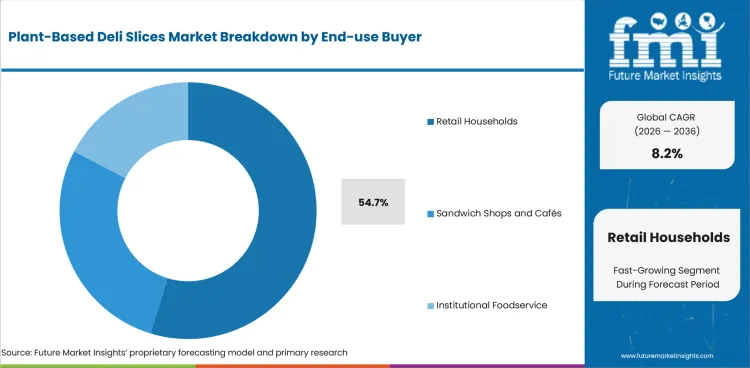
- Retail households are anticipated to hold 54.7% share in 2026 through repeat sandwich occasions and small-pack affordability.
- Sandwich shops and cafés gain value through controlled slice counts and meat-free menu options requiring minimal preparation.
Which sales channel leads the plant-based deli slices market?
Supermarkets and hypermarkets hold 46.2% share in 2026 through chilled aisle access and weekly grocery trips.
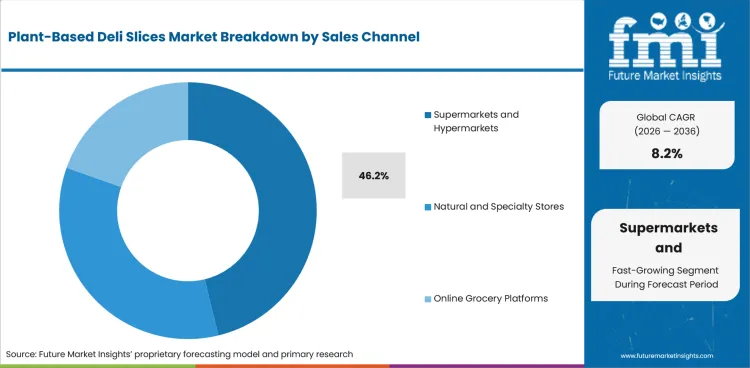
- Supermarkets and hypermarkets are forecast to secure 46.2% share in 2026, shaped by chilled meat-free merchandising and pack comparison.
- Online grocery platforms gain value among repeat buyers who already know product texture and flavor.
Which product type leads the plant-based deli slices market?
Plant-based ham slices lead at 42.8% share in 2026, influenced by mild flavor and sandwich compatibility.
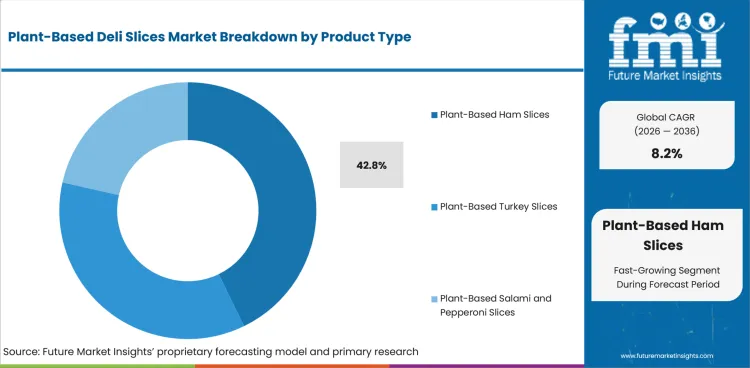
- Plant-based ham slices are expected to account for 42.8% share in 2026, driven by mild taste and cold sandwich use.
- Plant-based salami and pepperoni slices gain selective value in panini and café snack programs.
Which source protein leads the plant-based deli slices market?
Soy-and-wheat blends lead at 37.6% share in 2026, reflected by texture strength and cost control.
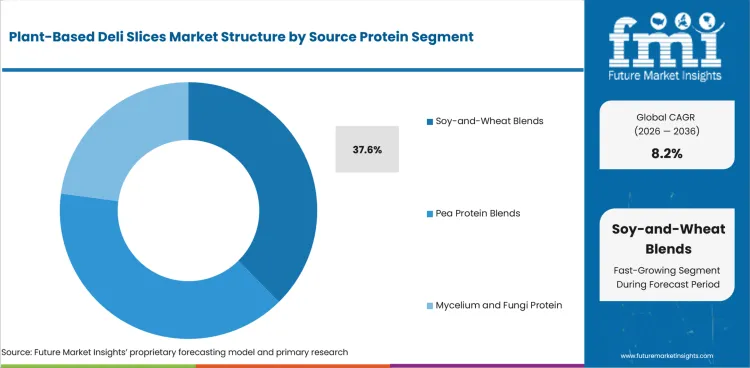
- Soy-and-wheat blends are projected to hold 37.6% share in 2026, led by elasticity and thin-slice durability.
- Mycelium and fungi protein products gain attention among brands seeking whole-cut cues and cleaner aroma profiles.
What are the drivers, restraints and opportunities in the plant-based deli slices market?
Sandwich use supports growth and taste scrutiny limit conversion, and deli-counter testing creates openings for better chilled formats.
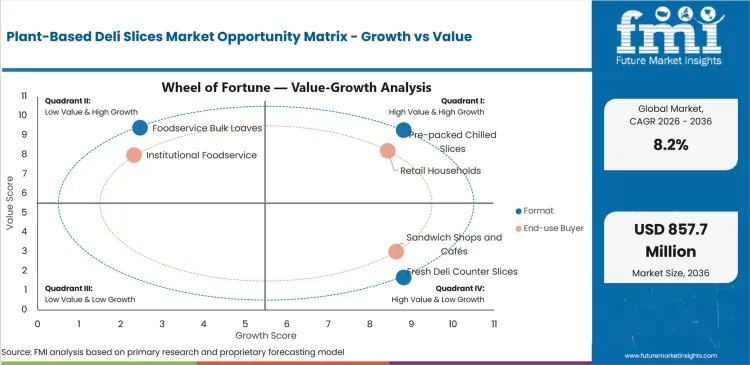
- Driver: Chilled sandwich routines keep plant-based deli slices useful for buyers seeking familiar meat-free lunch options.
- Restraint: Higher shelf prices and inconsistent taste can slow repeat purchase among shoppers comparing ham and salami packs.
- Opportunity: Deli counters and café menus can help brands prove slice texture before wider grocery expansion.
Demand is moving toward plant-based deli slices combining clean-label formulation with better cold handling. A 2025 Foods study developed a clean-label meat-free deli ham and found the pilot-scale version was 17.0% more cohesive and 50.0% less adhesive than the benchmark product. It is important for suppliers since deli slices need to separate cleanly inside packs and hold texture in cold sandwiches. Brands focusing on plant-based ingredients can use protein blends and moisture systems to improve slice quality before wider retail rollout.
Who buys plant-based deli slices?
Retail households and foodservice operators form the main buyer base for chilled plant-based deli slices.
Buyer targeting should reflect both grocery and food-away-from-home channels. USDA ERS reported in June 2026, USA food-away-from-home spending reached USD 1.41 trillion in 2025, while food-at-home spending reached USD 1.10 trillion. It gives plant-based deli slice suppliers two practical routes. Retail packs need clear lunchbox positioning and simple storage cues. Foodservice packs need repeatable slice count and sandwich-line consistency. Suppliers aligned to the cold cuts market can position plant-based slices as a direct meat-free option for familiar deli occasions.
What influences plant-based deli slices purchase decisions?
Portion clarity and chilled texture shape repeat purchase across retail and foodservice channels.
Purchase decisions are expected to track how closely plant-based slices match conventional deli meat use. USDA’s May 2024 deli meat fact sheet stated, 1 ounce of turkey deli meat equals about 2 to 3 slices and can be stored after opening for 3 to 5 days in the refrigerator. Plant-based deli slice brands need similar clarity on serving count and storage timing. USDA ERS also forecast 2026 food-at-home prices to rise 3.2% and food-away-from-home prices to rise 3.5%, which keeps price-per-pack and portion cost important for buyers. Producers serving the mycoprotein market can use texture and protein positioning to support better cold-sandwich performance.
Which countries are growing fastest in the plant-based deli slices market?
Saudi Arabia reaches 9.8% CAGR followed by South Korea at 9.4% through 2036.
.webp "Top Country Growth Comparison Plant Based Deli Slices Market Cagr (2026 2036)")
| Country | CAGR |
| Saudi Arabia | 9.8% |
| South Korea | 9.4% |
| Australia | 8.8% |
| United States | 8.3% |
| European Union | 7.9% |
| Canada | 7.5% |
| United Kingdom | 7.1% |
| Japan | 6.6% |
Source: Future Market Insights, 2026.
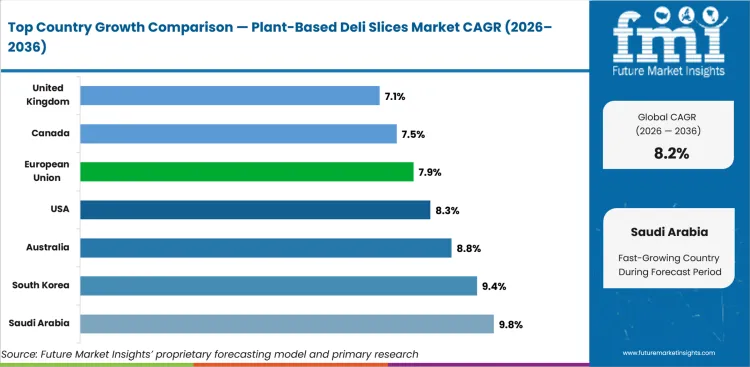
How do country-level CAGRs compare in the plant-based deli slices market?
Saudi Arabia leads country growth while Japan records the most cautious expansion outlook among profiled markets.
- Saudi Arabia is forecast to record 9.8% CAGR by 2036, driven by established café menus and imported chilled foods support meat-free sandwich trials.
- South Korea is expected to expand at 9.4% CAGR from 2026 to 2036 due to compact convenience retail and younger consumer testing.
- Australia is projected to grow at 8.8% CAGR through 2036 since café sandwich use and clearer label rules support chilled products.
- United States is estimated to rise at 8.3% CAGR by 2036 through household plant-based purchasing and deli-counter testing.
- European Union is expected to advance at 7.9% CAGR over the forecast period, led by Germany and France supporting multi-country chilled slice placement.
- Canada is forecast to grow at 7.5% CAGR through 2036, influenced by foodservice expansion and ingredient supply depth support retail packs.
- United Kingdom is projected to post 7.1% CAGR by 2036, backed by lunch retail and meat-free shelves promoting sandwich-led sales.
- Japan is expected to increase at 6.6% CAGR by 2036, owing to convenience meal formats sustaining measured plant-based trial.
How fast is the plant-based deli slices market growing in Saudi Arabia?
Industry in Saudi Arabia is set to record 9.8% CAGR by 2036 as foodservice distributors test meat-free sandwich ingredients with halal documentation.
Country Market Snapshot Table
| Parameter | Value |
|---|---|
| Market Size in 2025 (Value) | USD 13.8 million |
| Market Size in 2026 (Value) | USD 15.2 million |
| Market Forecast in 2036 (Value) | USD 38.7 million |
| CAGR (2026 to 2036) | 9.8% |
| Years Considered | 2021 to 2036 |
| Base Year | 2025 |
| Forecast Period | 2026 to 2036 |
| Units Considered | Value (USD million) |
| Leading Sub-Region | Riyadh and Jeddah premium retail corridors |
Saudi Arabia Plant-Based Deli Slices Market Outlook
Saudi Arabia plant-based deli slice sector is influenced by established cafés and imported chilled foods. Riyadh and Jeddah provide the strongest launch base for meat-free sandwich packs.
Retailers are expected to support products with halal documentation and dependable chilled distribution. Brands with foodservice packs and mild flavor profiles should gain stronger trial in cafés and hotel menus.
Key Growth Drivers
- Hotel and restaurant buyers are testing meat-free sandwich fillings through imported chilled menus. USDA FAS reported Saudi foodservice sales of USD 29.0 billion in 2024.
- Tourism traffic gives premium cafés and hotels a larger customer pool for differentiated sandwich products. Vision 2030 reported nearly 116.0 million tourists in 2024.
- Modern grocery chains can position plant-based deli slices near bakery and cheese fixtures to support sandwich assembly.
- Established cafés can add ham-style and turkey-style alternatives in wraps without adding complex preparation steps.
Key Restraints
- Imported chilled items can carry higher freight and listing costs, limiting mainstream grocery trial beyond established stores.
- Halal documents and Arabic pack claims can slow product approval before retailer onboarding.
- Retail pricing remains sensitive for imported chilled foods. GASTAT reported food and beverage prices rose 1.1% in the annual average CPI for 2025.
What makes Saudi Arabia unique
Saudi Arabia differs through hotel-led menu testing and specialized imported chilled-food routes before mass grocery rollout.
Key Companies
- Prime Roots through premium deli concepts
- La Vie through European ham-style plant-based slices
- Quorn through meat-free retail and foodservice options
- Regional distributors serving hotels and established grocery
Sales & Marketing Channels
- Modern grocery chilled aisles
- Hotel and restaurant distributors
- Café and sandwich-chain suppliers
- Online premium grocery platforms
- Specialty food importers
- Foodservice wholesalers
Country Segment Breakdown Table
| Segment | Sub-Segments |
|---|---|
| By Product Type | Plant-Based Ham Slices, Plant-Based Turkey Slices, Plant-Based Salami and Pepperoni Slices, Plant-Based Bologna Slices, Sandwich Fillings and Shaved Cuts |
| By Source Protein | Soy-and-Wheat Blends, Pea Protein Blends, Mycelium and Fungi Protein, Fava Bean and Pulse Blends, Mixed Plant Protein Systems |
| By Format | Pre-packed Chilled Slices, Fresh Deli Counter Slices, Foodservice Bulk Loaves, Frozen Sliced Packs, Sandwich-ready Fillings |
| By Sales Channel | Supermarkets and Hypermarkets, Natural and Specialty Stores, Online Grocery Platforms, Foodservice Distributors, Deli Counters and Sandwich Chains |
| By End-use Buyer | Retail Households, Sandwich Shops and Cafés, Institutional Foodservice, Quick-service Operators, Catering and Meal-kit Providers |
| Key Sub-Regions Covered, Premium Retail Corridors | Riyadh, Jeddah, Dammam, Khobar, Makkah, Madinah |
Frequently Asked Questions
How fast is Saudi Arabia plant-based deli slices market growing?
Sales in Saudi Arabia are forecast to scale at 9.8% CAGR from 2026 to 2036, guided by premium foodservice imports.
Who leads Saudi Arabia plant-based deli slices market?
Prime Roots, La Vie, Quorn and premium chilled food importers compete led by foodservice and grocery access.
What is driving adoption in Saudi Arabia plant-based deli slices market?
Specialized café menus and imported chilled food distribution are moving buyers toward meat-free sandwich slices.
What is the plant-based deli slices market outlook in South Korea?
Sector in South Korea is anticipated to rise at 9.4% CAGR by 2036, supported by convenience retail testing and domestic food-tech investment.
Country Market Snapshot Table
| Parameter | Value |
|---|---|
| Market Size in 2025 (Value) | USD 16.4 million |
| Market Size in 2026 (Value) | USD 17.9 million |
| Market Forecast in 2036 (Value) | USD 44.0 million |
| CAGR (2026 to 2036) | 9.4% |
| Years Considered | 2021 to 2036 |
| Base Year | 2025 |
| Forecast Period | 2026 to 2036 |
| Units Considered | Value (USD million) |
| Leading Sub-Region | Seoul Capital Area |
South Korea Plant-Based Deli Slices Market Outlook
Industry in South Korea is shaped by compact convenience retail and café lunch formats. Seoul-based retailers can test small packs and ready sandwiches before wider grocery expansion.
Food-tech activity gives suppliers better access to texture systems and domestic processing partners. Brands with Korean flavor adaptation and stable chilled packs should gain stronger buyer review.
Key Growth Drivers
- Convenience retail gives chilled sandwich formats a dense testing network. Korean Culture and Information Service stated that four major convenience chains reached 53,266.0 stores at end-2025.
- Younger buyers show clear openness to meat alternatives. Korean Society for Food Science of Animal Resources reported 49.0% of Korean Millennials had experience consuming plant-based meat.
- Lunchbox formats and café sandwiches can introduce plant-based deli slices through single-serve products.
- Korean seasoning can separate ham-style, spicy sausage-style and chicken-style slices across grocery and café menus.
Key Restraints
- Conventional processed meats retain strong taste familiarity, keeping first-time chilled slice trial selective.
- Retailers may restrict range expansion until repeat sales develop beyond Seoul test stores.
- Packaged-food competition is intense. USA International Trade Administration reported South Korea introduces about 5,000.0 new health functional food products each year.
What makes South Korea unique
South Korea’s distinction comes from dense convenience retail and fast metro-level product testing.
Key Companies
- Unlimeat
- CJ CheilJedang
- Shinsegae Food
- Pulmuone
- Imported chilled plant-based brands
- Foodservice distributors serving cafés
Sales & Marketing Channels
- Convenience store sandwiches
- Online grocery platforms
- Supermarket chilled aisles
- Natural food stores
- Café distributors
- Meal-kit platforms
Country Segment Breakdown Table
| Segment | Sub-Segments |
|---|---|
| By Product Type | Plant-Based Ham Slices, Plant-Based Turkey Slices, Plant-Based Salami and Pepperoni Slices, Plant-Based Bologna Slices, Sandwich Fillings and Shaved Cuts |
| By Source Protein | Soy-and-Wheat Blends, Pea Protein Blends, Mycelium and Fungi Protein, Fava Bean and Pulse Blends, Mixed Plant Protein Systems |
| By Format | Pre-packed Chilled Slices, Fresh Deli Counter Slices, Foodservice Bulk Loaves, Frozen Sliced Packs, Sandwich-ready Fillings |
| By Sales Channel | Supermarkets and Hypermarkets, Natural and Specialty Stores, Online Grocery Platforms, Foodservice Distributors, Deli Counters and Sandwich Chains |
| By End-use Buyer | Retail Households, Sandwich Shops and Cafés, Institutional Foodservice, Quick-service Operators, Catering and Meal-kit Providers |
| Key Sub-Regions Covered, Convenience Retail Areas | Seoul, Incheon, Busan, Daegu, Daejeon, Gwangju |
Frequently Asked Questions
How fast is South Korea plant-based deli slices market growing?
South Korea is expected to expand at 9.4% CAGR from 2026 to 2036, supported by convenience retail tests.
Who leads South Korea plant-based deli slices market?
Unlimeat, CJ CheilJedang, Shinsegae Food and Pulmuone compete through domestic plant-based food activity.
What is driving adoption in South Korea plant-based deli slices market?
Convenience retail and younger consumer trial are supporting chilled meat-free sandwich formats.
What is driving plant-based deli slices growth in Australia?
Australia is projected to grow at 8.8% CAGR by 2036, backed by cafés using meat-free slices in toasties and wraps.
Country Market Snapshot Table
| Parameter | Value |
|---|---|
| Market Size in 2025 (Value) | USD 19.1 million |
| Market Size in 2026 (Value) | USD 20.8 million |
| Market Forecast in 2036 (Value) | USD 48.3 million |
| CAGR (2026 to 2036) | 8.8% |
| Years Considered | 2021 to 2036 |
| Base Year | 2025 |
| Forecast Period | 2026 to 2036 |
| Units Considered | Value (USD million) |
| Leading Sub-Region | New South Wales and Victoria café corridors |
Australia Plant-Based Deli Slices Market Outlook
The market in Australia is influenced by café sandwiches and label clarity work. Chilled slices can enter toasties and wraps before full household repeat develops.
Government labelling review improves the route for clearer product names and pack claims. Suppliers with café pack formats and reliable chilled shelf life should gain better access.
Key Growth Drivers
- Café and restaurant channels support sandwich-led product testing. Australian Bureau of Statistics reported cafés, restaurants and takeaway food services turnover at AUD 5.58 billion in June 2025, showing a large current channel for chilled sandwich and ready-meal trials.
- Label clarity work supports easier product explanation. Australia’s agriculture department reported a plant-based alternative product labelling working group spanning 5.0 sectors.
- Cafés can use plant-based deli slices in toasties and wraps without adding new cooking equipment.
- Retailers can test small chilled packs to reduce entry price for households comparing conventional sliced meats.
Key Restraints
- Retail sales pressure has made supermarket buyers more cautious about meat-free chilled space.
- Local supplier exits can reduce product choice for smaller grocery and foodservice distributors.
- Repeat purchase barriers remain high. Food Frontier’s 2024 consumer survey found poor taste at 46.0% among barriers to buying plant-based meats again.
What makes Australia unique
Australia stands apart through café-led sandwich testing and formal review of plant-based labelling.
Key Companies
- v2food
- Made With Plants
- Fable Food Co
- Eaty
- Foodservice importers
- Chilled meal producers
Sales & Marketing Channels
- Supermarket chilled meat-free shelves
- Independent grocery stores
- Café and sandwich distributors
- Online grocery platforms
- Meal delivery platforms
- Foodservice wholesalers
Country Segment Breakdown Table
| Segment | Sub-Segments |
|---|---|
| By Product Type | Plant-Based Ham Slices, Plant-Based Turkey Slices, Plant-Based Salami and Pepperoni Slices, Plant-Based Bologna Slices, Sandwich Fillings and Shaved Cuts |
| By Source Protein | Soy-and-Wheat Blends, Pea Protein Blends, Mycelium and Fungi Protein, Fava Bean and Pulse Blends, Mixed Plant Protein Systems |
| By Format | Pre-packed Chilled Slices, Fresh Deli Counter Slices, Foodservice Bulk Loaves, Frozen Sliced Packs, Sandwich-ready Fillings |
| By Sales Channel | Supermarkets and Hypermarkets, Natural and Specialty Stores, Online Grocery Platforms, Foodservice Distributors, Deli Counters and Sandwich Chains |
| By End-use Buyer | Retail Households, Sandwich Shops and Cafés, Institutional Foodservice, Quick-service Operators, Catering and Meal-kit Providers |
| Key Sub-Regions Covered, Café Retail Corridors | Sydney, Melbourne, Brisbane, Perth, Adelaide, Canberra |
Frequently Asked Questions
How fast is Australia plant-based deli slices market growing?
Australia is projected to grow at 8.8% CAGR from 2026 to 2036, guided by café and grocery testing.
Who leads Australia plant-based deli slices market?
v2food, Made With Plants, Fable Food Co and local chilled food producers compete fueled by retail and café access.
What is driving adoption in Australia plant-based deli slices market?
Café sandwich use and clearer plant-based labels are supporting meat-free chilled slice placement.
How is the plant-based deli slices market performing in the United States?
The market in United States is estimated to rise at 8.3% CAGR by 2036, driven by chilled retail placement and deli-counter service allowing shoppers to compare meat-free slices with conventional packs.
Country Market Snapshot Table
| Parameter | Value |
|---|---|
| Market Size in 2025 (Value) | USD 122.3 million |
| Market Size in 2026 (Value) | USD 132.5 million |
| Market Forecast in 2036 (Value) | USD 294.1 million |
| CAGR (2026 to 2036) | 8.3% |
| Years Considered | 2021 to 2036 |
| Base Year | 2025 |
| Forecast Period | 2026 to 2036 |
| Units Considered | Value (USD million) |
| Leading Sub-Region | California and Northeast grocery corridors |
United States Plant-Based Deli Slices Market Outlook
Demand in the United States is promoted by household plant-based participation and national grocery access. Shoppers compare plant-based deli slices against turkey and salami packs during weekly trips.
Retailers need evidence of repeat purchase before adding more chilled meat-free facings. Brands with dependable slice separation and strong deli-counter handling should gain better placement.
Key Growth Drivers
- Household reach keeps the United States central for chilled plant-based deli packs. Plant Based Foods Association reported 60.0% of USA households bought plant-based foods in 2025.
- Foodservice can add sliced formats through broadline distributor sales. Good Food Institute reported plant-based protein broadline distributor dollar sales totaled USD 291.0 million in 2025.
- Deli counters can make plant-based cold cuts feel familiar through service-case slicing and sandwich preparation.
- Institutional cafés can use plant-based slices as portion-controlled menu items for lunch programs.
Key Restraints
- Plant-based meat volume pressure has made grocery buyers stricter on velocity targets.
- First-time buyers can reject products lacking clean aroma or smooth slice separation after refrigeration.
- Sensory gaps remain a commercial limit. Nectar’s 2025 benchmarking covered 2,684.0 consumers and found plant-based products still trailed animal benchmarks at group average level.
What makes the United States unique
United States conditions are distinct for national grocery scale and large foodservice distribution.
Key Companies
- Prime Roots
- Turtle Island Foods / Tofurky
- Lightlife Foods
- Mrs. Goldfarb’s Unreal Deli
- Whole Foods Market deli suppliers
- Natural retail distributors
Sales & Marketing Channels
- Supermarket chilled meat-free shelves
- Deli-counter service cases
- Natural food stores
- Foodservice distributors
- Online grocery platforms
- Club and regional grocery chains
Country Segment Breakdown Table
| Segment | Sub-Segments |
|---|---|
| By Product Type | Plant-Based Ham Slices, Plant-Based Turkey Slices, Plant-Based Salami and Pepperoni Slices, Plant-Based Bologna Slices, Sandwich Fillings and Shaved Cuts |
| By Source Protein | Soy-and-Wheat Blends, Pea Protein Blends, Mycelium and Fungi Protein, Fava Bean and Pulse Blends, Mixed Plant Protein Systems |
| By Format | Pre-packed Chilled Slices, Fresh Deli Counter Slices, Foodservice Bulk Loaves, Frozen Sliced Packs, Sandwich-ready Fillings |
| By Sales Channel | Supermarkets and Hypermarkets, Natural and Specialty Stores, Online Grocery Platforms, Foodservice Distributors, Deli Counters and Sandwich Chains |
| By End-use Buyer | Retail Households, Sandwich Shops and Cafés, Institutional Foodservice, Quick-service Operators, Catering and Meal-kit Providers |
| Key Sub-Regions Covered, Grocery Retail Networks | California, Northeast Corridor, Pacific Northwest, Texas, Midwest, South Atlantic |
Frequently Asked Questions
How fast is United States plant-based deli slices market growing?
Sector in the United States is anticipated to grow at 8.3% CAGR from 2026 to 2036, reflecting chilled retail access.
Who leads United States plant-based deli slices market?
Prime Roots, Tofurky, Lightlife and Unreal Deli compete through deli formats and retail distribution.
What is driving adoption in United States plant-based deli slices market?
Household plant-based purchasing and deli-counter trials are moving shoppers toward chilled slice formats.
What is the plant-based deli slices market forecast for the European Union?
Sector in the European Union is expected to scale at 7.9% CAGR by 2036, backed by Germany and France testing chilled meat-free slices across mainstream grocery channels.
Country Market Snapshot Table
| Parameter | Value |
|---|---|
| Market Size in 2025 (Value) | USD 85.0 million |
| Market Size in 2026 (Value) | USD 91.7 million |
| Market Forecast in 2036 (Value) | USD 196.1 million |
| CAGR (2026 to 2036) | 7.9% |
| Years Considered | 2021 to 2036 |
| Base Year | 2025 |
| Forecast Period | 2026 to 2036 |
| Units Considered | Value (USD million) |
| Leading Sub-Region | Germany and France retail networks |
European Union Plant-Based Deli Slices Market Outlook
Industry in the European Union reflects large plant-based food volume pools and differing national tastes. Germany and France offer stronger retail scale for chilled ham-style and salami-style slices.
Price competitiveness remains important as shoppers compare meat-free and conventional sliced meats. Suppliers need country-specific recipes and chilled production discipline.
Key Growth Drivers
- Germany provides the largest plant-based food base in the region. GFI Europe reported German plant-based food sales across six groups reached EUR 1.71 billion in 2025.
- France supports added chilled-slice potential through plant-based meat progress. GFI Europe reported in June 2026 that French plant-based meat sales value increased 13.5% in 2025, making meat the fastest-growing plant-based category in France.
- Supermarkets can extend meat-free shelves with ham-style and salami-style slices suited to sandwiches and snack boards.
- European producers can adapt smoked and peppered profiles for national deli traditions.
Key Restraints
- Country performance remains uneven, raising costs for brands entering multiple EU markets.
- Recipe expectations differ across all European Union countries, requiring separate flavor and pack planning.
- Retail pressure remains visible in selected European markets. GFI Europe reported in June 2025, plant-based meat volume sales in the Netherlands fell by 6.2% in 2024, reflecting how chilled meat-free suppliers still need stronger price and format execution.
What makes the European Union unique
European Union conditions differ through multi-country retail scale and localized deli flavor expectations.
Key Companies
- La Vie Foods
- Project Eaden through LEKKA
- Rügenwalder Mühle
- Heura Foods
- Quorn Foods
- Foodservice chilled suppliers
Sales & Marketing Channels
- Supermarket chilled ranges
- Discounters
- Online grocery platforms
- Foodservice distributors
- Convenience stores
- Specialty food retailers
Country Segment Breakdown Table
| Segment | Sub-Segments |
|---|---|
| By Product Type | Plant-Based Ham Slices, Plant-Based Turkey Slices, Plant-Based Salami and Pepperoni Slices, Plant-Based Bologna Slices, Sandwich Fillings and Shaved Cuts |
| By Source Protein | Soy-and-Wheat Blends, Pea Protein Blends, Mycelium and Fungi Protein, Fava Bean and Pulse Blends, Mixed Plant Protein Systems |
| By Format | Pre-packed Chilled Slices, Fresh Deli Counter Slices, Foodservice Bulk Loaves, Frozen Sliced Packs, Sandwich-ready Fillings |
| By Sales Channel | Supermarkets and Hypermarkets, Natural and Specialty Stores, Online Grocery Platforms, Foodservice Distributors, Deli Counters and Sandwich Chains |
| By End-use Buyer | Retail Households, Sandwich Shops and Cafés, Institutional Foodservice, Quick-service Operators, Catering and Meal-kit Providers |
| Key Sub-Regions Covered, Chilled Grocery Corridors | Germany, France, Netherlands, Spain, Italy, Austria |
Frequently Asked Questions
How fast is European Union plant-based deli slices market growing?
Demand in European Union is ready to rise at 7.9% CAGR from 2026 to 2036 with chilled retail support.
Who leads European Union plant-based deli slices market?
La Vie, Project Eaden, Rügenwalder Mühle, Heura and Quorn compete through chilled grocery access.
What is driving adoption in European Union plant-based deli slices market?
Germany and France retail volumes are supporting sliced meat-free products for sandwiches and snack occasions.
What is the plant-based deli slices market outlook in Canada?
Industry in Canada is likely to grow at 7.5% CAGR by 2036, helped by café and retail chains testing chilled slices across Ontario and British Columbia.
Country Market Snapshot Table
| Parameter | Value |
|---|---|
| Market Size in 2025 (Value) | USD 22.7 million |
| Market Size in 2026 (Value) | USD 24.4 million |
| Market Forecast in 2036 (Value) | USD 50.3 million |
| CAGR (2026 to 2036) | 7.5% |
| Years Considered | 2021 to 2036 |
| Base Year | 2025 |
| Forecast Period | 2026 to 2036 |
| Units Considered | Value (USD million) |
| Leading Sub-Region | Ontario and British Columbia grocery corridors |
Canada Plant-Based Deli Slices Market Outlook
Canada combines foodservice expansion with domestic protein processing depth. Ontario and British Columbia provide the strongest early retail and café channels.
Bilingual labels and long-distance chilled logistics shape buyer approval. Brands with reliable cold-chain coverage and sandwich-focused packs should gain stronger grocery access.
Key Growth Drivers
- Restaurant and limited-service channels create a route for meat-free sandwich ingredients. Statistics Canada reported annual foodservice and drinking-place sales of CAD 101.4 billion in 2025.
- Ingredient development supports plant-based product work. Protein Industries Canada reported USD 5.8 million in total project value across two approved projects in fiscal 2023 to 2024.
- Retailers can position chilled slices as bilingual lunch products for English and French shelf communication.
- Cafés can test plant-based deli slices before institutional catering and meal-kit expansion.
Key Restraints
- Long-distance refrigerated logistics can raise landed costs for brands serving Western and Atlantic Canada.
- Mid-size grocery stores may restrict slower-moving chilled meat-free SKUs.
- Sales coverage remains demanding. Innovation, Science and Economic Development Canada listed 105,169.0 foodservice and drinking-place establishments in 2025.
What makes Canada unique
Canada’s route is shaped by dispersed foodservice accounts and long refrigerated distribution lanes.
Key Companies
- Greenleaf Foods through Lightlife
- Yves Veggie Cuisine
- Tofurky
- Sol Cuisine legacy plant-based retail
- Canadian co-packers
- Regional chilled food distributors
Sales & Marketing Channels
- National supermarket chains
- Natural and specialty stores
- Foodservice distributors
- Online grocery platforms
- Café suppliers
- Meal-kit providers
Country Segment Breakdown Table
| Segment | Sub-Segments |
|---|---|
| By Product Type | Plant-Based Ham Slices, Plant-Based Turkey Slices, Plant-Based Salami and Pepperoni Slices, Plant-Based Bologna Slices, Sandwich Fillings and Shaved Cuts |
| By Source Protein | Soy-and-Wheat Blends, Pea Protein Blends, Mycelium and Fungi Protein, Fava Bean and Pulse Blends, Mixed Plant Protein Systems |
| By Format | Pre-packed Chilled Slices, Fresh Deli Counter Slices, Foodservice Bulk Loaves, Frozen Sliced Packs, Sandwich-ready Fillings |
| By Sales Channel | Supermarkets and Hypermarkets, Natural and Specialty Stores, Online Grocery Platforms, Foodservice Distributors, Deli Counters and Sandwich Chains |
| By End-use Buyer | Retail Households, Sandwich Shops and Cafés, Institutional Foodservice, Quick-service Operators, Catering and Meal-kit Providers |
| Key Sub-Regions Covered, Grocery and Café Areas | Ontario, Quebec, British Columbia, Alberta, Manitoba, Saskatchewan |
Frequently Asked Questions
How fast is Canada plant-based deli slices market growing?
Sector in Canada is forecast at 7.5% CAGR from 2026 to 2036 with foodservice and grocery support.
Who leads Canada plant-based deli slices market?
Lightlife, Yves Veggie Cuisine, Tofurky and regional chilled co-packers compete based on retail and foodservice access.
What is driving adoption in Canada plant-based deli slices market?
Foodservice growth and ingredient supply depth are moving chilled plant-based slices into sandwiches and café menus.
How is the plant-based deli slices market performing in the United Kingdom?
The market in United Kingdom is projected to post 7.1% CAGR by 2036, supported by meal-deal sandwiches and established meat-free shelves.
Country Market Snapshot Table
| Parameter | Value |
|---|---|
| Market Size in 2025 (Value) | USD 29.5 million |
| Market Size in 2026 (Value) | USD 31.6 million |
| Market Forecast in 2036 (Value) | USD 62.7 million |
| CAGR (2026 to 2036) | 7.1% |
| Years Considered | 2021 to 2036 |
| Base Year | 2025 |
| Forecast Period | 2026 to 2036 |
| Units Considered | Value (USD million) |
| Leading Sub-Region | London and Southeast England |
United Kingdom Plant-Based Deli Slices Market Outlook
United Kingdom plant-based deli slice sales are centered on chilled grocery and sandwich occasions. Discounters and mainstream supermarkets shape price expectations for meat-free sliced packs.
Retail buyers need stronger repeat purchase evidence after recent plant-based meat volume pressure. Brands with affordable packs and clear lunch use should gain stronger listings.
Key Growth Drivers
- Household meat-free trial remains meaningful. GFI India reported 31.6% of British households bought plant-based meat alternatives in 2024.
- Chilled meat-free retail has a sizeable value base. GFI Europe reported UK plant-based foods across six groups were worth about GBP 848.0 million in 2025.
- Lunch retail can use plant-based deli slices inside baguettes and supermarket meal-deal sandwiches.
- UK brands can test smoked ham and chicken-style slices through private label and branded chilled facings.
Key Restraints
- Plant-based meat volumes declined in 2025, making retailers stricter on shelf productivity.
- Conventional ham and chicken packs keep strong price pressure during weekly grocery trips.
- Processed new-generation plant-based meat alternatives still carry a price barrier. Food Foundation reported a 73.0% premium per 100 grams versus meat.
What makes the United Kingdom unique
United Kingdom stands out through chilled sandwich infrastructure and established meat-free grocery shelves.
Key Companies
- Squeaky Bean
- Quorn Foods
- La Vie Foods
- Rügenwalder Mühle through European chilled products
- Moving Mountains
- Supermarket private labels
Sales & Marketing Channels
- Supermarket chilled aisles
- Discounters
- Convenience meal-deal shelves
- Online grocery platforms
- Foodservice distributors
- Café suppliers
Country Segment Breakdown Table
| Segment | Sub-Segments |
|---|---|
| By Product Type | Plant-Based Ham Slices, Plant-Based Turkey Slices, Plant-Based Salami and Pepperoni Slices, Plant-Based Bologna Slices, Sandwich Fillings and Shaved Cuts |
| By Source Protein | Soy-and-Wheat Blends, Pea Protein Blends, Mycelium and Fungi Protein, Fava Bean and Pulse Blends, Mixed Plant Protein Systems |
| By Format | Pre-packed Chilled Slices, Fresh Deli Counter Slices, Foodservice Bulk Loaves, Frozen Sliced Packs, Sandwich-ready Fillings |
| By Sales Channel | Supermarkets and Hypermarkets, Natural and Specialty Stores, Online Grocery Platforms, Foodservice Distributors, Deli Counters and Sandwich Chains |
| By End-use Buyer | Retail Households, Sandwich Shops and Cafés, Institutional Foodservice, Quick-service Operators, Catering and Meal-kit Providers |
| Key Sub-Regions Covered, Chilled Sandwich Retail Areas | London, Manchester, Birmingham, Leeds, Glasgow, Bristol |
Frequently Asked Questions
How fast is United Kingdom plant-based deli slices market growing?
Industry in the United Kingdom is projected to increase at 7.1% CAGR from 2026 to 2036 through chilled sandwich retail.
Who leads United Kingdom plant-based deli slices market?
Squeaky Bean, Quorn, La Vie and supermarket private labels compete depending on chilled meat-free packs.
What is driving adoption in United Kingdom plant-based deli slices market?
Chilled sandwich use and established grocery meat-free shelves are supporting plant-based deli slice demand.
What is the plant-based deli slices market forecast for Japan?
Sector in Japan is expected to rise at 6.6% CAGR by 2036, guided by small packs and mild flavor profiles suited to metro trial.
Country Market Snapshot Table
| Parameter | Value |
|---|---|
| Market Size in 2025 (Value) | USD 18.4 million |
| Market Size in 2026 (Value) | USD 19.6 million |
| Market Forecast in 2036 (Value) | USD 37.1 million |
| CAGR (2026 to 2036) | 6.6% |
| Years Considered | 2021 to 2036 |
| Base Year | 2025 |
| Forecast Period | 2026 to 2036 |
| Units Considered | Value (USD million) |
| Leading Sub-Region | Kanto and Kansai convenience corridors |
Japan Plant-Based Deli Slices Market Outlook
Demand in Japan is influenced by convenience meals and careful product testing. Buyers compare mild flavor and texture against familiar processed meats before repeat purchase.
Small pack size and clear preparation cues can support early adoption. Suppliers need portion control and packaging suited to compact household storage.
Key Growth Drivers
- Processed meat and meat alternative channels provide a large comparison base. Agriculture and Agri-Food Canada reported Japan processed meat and alternatives to meat reached USD 33.9 billion in 2024.
- Plant-based meat alternatives have recognition in sustainable food discussion. Yano Research reported 74.1% recognition for plant-based meat alternatives in its May 2024 consumer survey.
- Convenience meals can introduce plant-based deli slices through bento items and café lunch sets.
- Domestic soy processing experience can help refine ham-style and chicken-style sliced products.
Key Restraints
- Consumer testing remains cautious for products lacking familiar mouthfeel or clean aroma.
- Retailers may limit shelf trials to metropolitan outlets before national expansion.
- Public discussion can complicate positioning. Humanities and Social Sciences Communications research in 2024 found meat-alternative debate involved 2.0 language datasets across English and Japanese social posts.
What makes Japan unique
Japan’s distinct path comes from small-pack discipline and mild-flavor expectations.
Key Companies
- DAIZ
- Next Meats
- Otsuka Foods
- Marukome
- Imported premium grocery brands
- Convenience meal suppliers
Sales & Marketing Channels
- Convenience store meal programs
- Supermarket chilled shelves
- Department store grocery halls
- Online grocery platforms
- Café distributors
- Meal-kit platforms
Country Segment Breakdown Table
| Segment | Sub-Segments |
|---|---|
| By Product Type | Plant-Based Ham Slices, Plant-Based Turkey Slices, Plant-Based Salami and Pepperoni Slices, Plant-Based Bologna Slices, Sandwich Fillings and Shaved Cuts |
| By Source Protein | Soy-and-Wheat Blends, Pea Protein Blends, Mycelium and Fungi Protein, Fava Bean and Pulse Blends, Mixed Plant Protein Systems |
| By Format | Pre-packed Chilled Slices, Fresh Deli Counter Slices, Foodservice Bulk Loaves, Frozen Sliced Packs, Sandwich-ready Fillings |
| By Sales Channel | Supermarkets and Hypermarkets, Natural and Specialty Stores, Online Grocery Platforms, Foodservice Distributors, Deli Counters and Sandwich Chains |
| By End-use Buyer | Retail Households, Sandwich Shops and Cafés, Institutional Foodservice, Quick-service Operators, Catering and Meal-kit Providers |
| Key Sub-Regions Covered, Convenience Retail Areas | Tokyo, Osaka, Yokohama, Nagoya, Fukuoka, Sapporo |
Frequently Asked Questions
How fast is Japan plant-based deli slices market growing?
Industry in Japan is projected at 6.6% CAGR from 2026 to 2036 as convenience retail tests chilled meat-free options.
Who leads Japan plant-based deli slices market?
DAIZ, Next Meats, Otsuka Foods and imported premium grocery brands compete led by plant-based food activity.
What is driving adoption in Japan plant-based deli slices market?
Convenience meals and soy processing familiarity are supporting measured plant-based deli slice trial.
Who are the leading companies in the plant-based deli slices market?
Prime Roots, Tofurky, Lightlife, Unreal Deli and La Vie are listed with Project Eaden, Quorn, Squeaky Bean, Rügenwalder Mühle and Heura Foods.
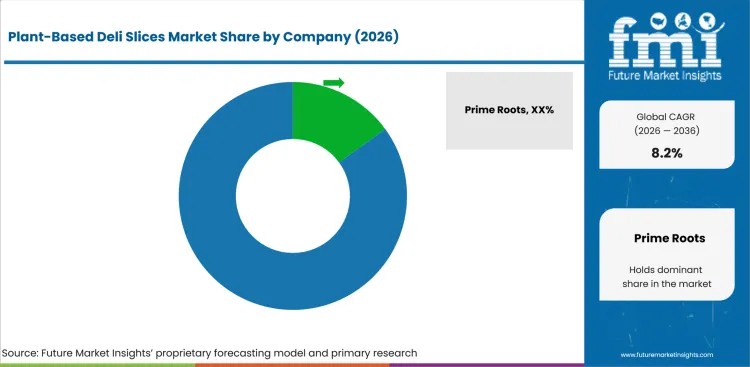
- Deli-focused brands hold an advantage due to aroma control and chilled handling.
- Established plant-based meat companies gain access through grocery relationships and repeat production capacity.
- European chilled specialists build placement based on ham-style and sandwich-ready packs.
- Foodservice suppliers gain acceptance by providing consistent slice count and portion cost control.
Plant-based deli slice companies compete by combining meat-like texture with familiar sandwich use. Retailers assess pack price and repeat purchase evidence before assigning more shelf space. Foodservice buyers review slice count and kitchen handling. Brands making product use simple are likely to move beyond one-time trial.
Manufacturing depth has become a competitive separator as thin slicing requires moisture control and stable protein structure. Prime Roots and Project Eaden compete depending on whole-cut style processing. Tofurky, Lightlife and Unreal Deli use established North American retail access. La Vie, Quorn, Squeaky Bean, Rügenwalder Mühle and Heura Foods compete based on chilled European grocery familiarity.
Smaller and regional players can win through independent grocery and established online platforms. Larger suppliers gain advantage through chilled logistics and retailer relationships. Companies with clean flavor and defendable pack pricing should gain stronger listing decisions. Brands relying only on novelty flavors are expected to face weaker acceptance in mainstream grocery.
How do top plant-based deli slices companies compare?
Prime Roots and La Vie score strongest on deli slice fit, while Tofurky and Lightlife lead North American retail familiarity.
| Company | Alignment to Market Title | Deli Slice Portfolio Depth | Protein and Texture Capability | Clean-label and Allergen Positioning | Channel Reach | Geographic Footprint |
|---|---|---|---|---|---|---|
| Prime Roots | Very High | Very Strong | Very Strong | Strong | Moderate | United States |
| Turtle Island Foods / Tofurky | Very High | Very Strong | Strong | Strong | Strong | North America |
| Lightlife Foods | Very High | Strong | Strong | Moderate | Very Strong | United States and Canada |
| Mrs. Goldfarb’s Unreal Deli | Very High | Strong | Moderate | Strong | Moderate | United States |
| La Vie Foods | Very High | Strong | Strong | Strong | Strong | Europe and United Kingdom |
| Project Eaden | High | Moderate | Very Strong | Moderate | Strong | Germany and Europe |
| Quorn Foods | High | Moderate | Very Strong | Moderate | Very Strong | United Kingdom and international |
| Squeaky Bean | High | Strong | Moderate | Moderate | Strong | United Kingdom |
| Rügenwalder Mühle | High | Strong | Strong | Moderate | Strong | Germany and Europe |
| Heura Foods | High | Moderate | Strong | Strong | Moderate | Spain, France and selected Europe |
Source: Future Market Insights competitive analysis, 2026.
Who are the key players in the plant-based deli slices market?
Prime Roots, Turtle Island Foods and Lightlife are listed with Unreal Deli, La Vie and Project Eaden among other suppliers.
Key global companies leading the plant-based deli slices market include:
- Prime Roots
- Turtle Island Foods / Tofurky
- Lightlife Foods
- Mrs. Goldfarb’s Unreal Deli
- La Vie Foods
- Project Eaden
- Quorn Foods
- Squeaky Bean
- Rügenwalder Mühle
- Heura Foods
Key Developments in Plant-Based Deli Slices Market
- In May 2024, La Vie expanded its Plant-Based Ham in the United Kingdom through Tesco along with Ocado and Waitrose availability.
- In January 2025, Project Eaden closed an oversubscribed EUR 15.0 million Series A round to support its European retail launch of ultra-realistic plant-based hams.
- In July 2025, Prime Roots refreshed its plant-based deli meats with improved taste and packaging.
Key Players in the Plant-Based Deli Slices Market
Deli-focused Producers
- Prime Roots
- Mrs. Goldfarb’s Unreal Deli
- Project Eaden
- La Vie Foods
- Heura Foods
Established Plant-based Meat Brands
- Turtle Island Foods / Tofurky
- Lightlife Foods
- Quorn Foods
- Rügenwalder Mühle
Chilled Retail and Foodservice Specialists
- Squeaky Bean
- Regional co-packers
- Café and sandwich-chain suppliers
- Established chilled grocery importers
Plant-Based Deli Slices Market - Scope & Definition
| Attribute | Detail |
|---|---|
| Market Definition | Finished plant-based deli meat alternatives sold as sliced, shaved or sandwich-ready products for retail and foodservice use |
| Functions Covered | Sandwich filling, deli-counter slicing, chilled retail packing, foodservice portioning and ready-meal integration |
| Applications Covered | Household sandwiches, café sandwiches, wraps, baguettes, catering platters, institutional meals and quick-service menu items |
| End-Use Industries | Retail grocery, foodservice, cafés, sandwich chains, institutional catering and meal-kit providers |
| Grades Covered | Chilled slices, fresh deli-counter loaves, frozen sliced packs and sandwich-ready fillings |
| Inclusions | Plant-based ham, turkey, salami, pepperoni, bologna, chicken-style slices and sandwich fillings made from plant, fungi or fermentation-derived proteins |
| Exclusions | Conventional meat deli slices, frozen burgers, nuggets, raw-format mince, sausages and non-sliced plant-based meats unless sold in sandwich-ready form |
Plant-Based Deli Slices Market - Research Methodology
| Method | Description |
|---|---|
| Primary Research | FMI analyst interviews with plant-based meat brands, chilled food distributors, foodservice buyers, retail category managers and ingredient suppliers across key markets |
| Desk Research | Review of company announcements, retail association data, government statistics, academic papers and food industry publications |
| Market Sizing & Forecasting | Bottom-up product-boundary approach using eligible SKU revenue, retail pricing, channel presence, product form segmentation and country-level adoption trends |
| Data Validation | Cross-verification using plant-based food retail data, foodservice indicators, supplier product availability and chilled channel activity checks |
Plant-Based Deli Slices Market - Report Scope
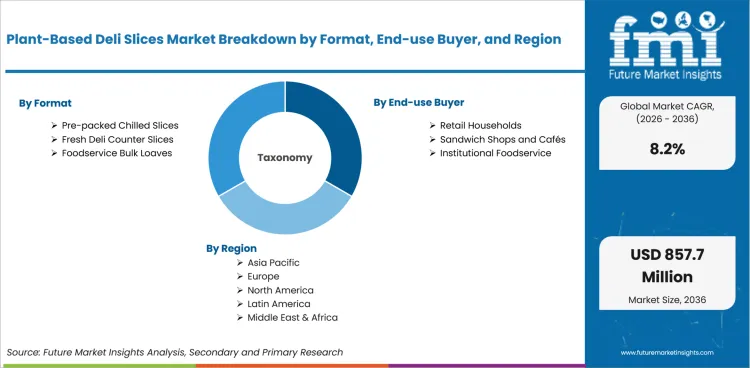
| Parameter | Details |
|---|---|
| Forecast period | 2026 to 2036 |
| By product type | Plant-based ham slices, plant-based turkey slices, plant-based salami and pepperoni slices, plant-based bologna slices, sandwich fillings and shaved cuts |
| By source protein | Soy-and-wheat blends, pea protein blends, mycelium and fungi protein, fava bean and pulse blends, mixed plant protein systems |
| By format | Pre-packed chilled slices, fresh deli counter slices, foodservice bulk loaves, frozen sliced packs, sandwich-ready fillings |
| By sales channel | Supermarkets and hypermarkets, natural and specialty stores, online grocery platforms, foodservice distributors, deli counters and sandwich chains |
| By end-use buyer | Retail households, sandwich shops and cafés, institutional foodservice, quick-service operators, catering and meal-kit providers |
| Regions covered | North America, Europe, GCC, East Asia, South Asia and Pacific, Middle East and Africa |
| Countries covered | United States, Canada, European Union, United Kingdom, Saudi Arabia, South Korea, Japan, Australia |
| Key companies profiled | Prime Roots, Tofurky, Lightlife, Unreal Deli, La Vie, Project Eaden, Quorn, Squeaky Bean |
| Approach | Bottom-up product-boundary approach using eligible SKU revenue, channel presence, retail pricing, product positioning and country-level adoption |
Source: Future Market Insights, 2026.
Plant-Based Deli Slices Market Breakdown by Product Type, Source Protein, Format, Sales Channel, End-use Buyer, and Region
Plant-Based Deli Slices Market Segmented by Product Type
- Plant-Based Ham Slices
- Plant-Based Turkey Slices
- Plant-Based Salami and Pepperoni Slices
- Plant-Based Bologna Slices
- Sandwich Fillings and Shaved Cuts
Plant-Based Deli Slices Market Segmented by Source Protein
- Soy-and-Wheat Blends
- Pea Protein Blends
- Mycelium and Fungi Protein
- Fava Bean and Pulse Blends
- Mixed Plant Protein Systems
Plant-Based Deli Slices Market Segmented by Format
- Pre-packed Chilled Slices
- Fresh Deli Counter Slices
- Foodservice Bulk Loaves
- Frozen Sliced Packs
- Sandwich-ready Fillings
Plant-Based Deli Slices Market Segmented by Sales Channel
- Supermarkets and Hypermarkets
- Natural and Specialty Stores
- Online Grocery Platforms
- Foodservice Distributors
- Deli Counters and Sandwich Chains
Plant-Based Deli Slices Market Segmented by End-use Buyer
- Retail Households
- Sandwich Shops and Cafés
- Institutional Foodservice
- Quick-service Operators
- Catering and Meal-kit Providers
Plant-Based Deli Slices Market by Region
- North America
- Latin America
- Europe
- East Asia
- South Asia and Pacific
- Middle East and Africa
Research Sources and Bibliography
- Agriculture and Agri-Food Canada. (2025, July 2). Plant-based protein food and drink trends in Japan. Government of Canada.
- Australian Department of Agriculture, Fisheries and Forestry. (2026, January 30). Plant-based alternative product labelling. Australian Government.
- Carvalho, L., Caetano, B., Godinot, C., Komora, N., Ferreira, A., Rocha, C., Barbosa, B., Raymundo, A., & Sousa, I. (2025, July 8). Development of a clean-label meat-free alternative to deli ham. Foods, 14(14), Article 2416.
- Dunne, R. A., Darwin, E. C., Perez Medina, V. A., Levenston, M. E., St. Pierre, S. R., & Kuhl, E. (2025, March). Texture profile analysis and rheology of plant-based and animal meat. Food Research International, 205, Article 115876.
- Food Foundation. (2024, August 28). Rethinking plant-based meat alternatives. Food Foundation.
- Food Frontier. (2024, May 2). Latest State of the Industry report shows plant-based meat charts its own course in Australia. Food Frontier.
- Good Food Institute. (2026). Analyzing plant-based meat and seafood sales. Good Food Institute.
- Good Food Institute. (2026). USA foodservice market insights for plant-based foods. Good Food Institute.
- Good Food Institute Europe. (2026, June). European plant-based sales data. Good Food Institute Europe.
- Kellanova. (2024, December 11). Sliced meat analogues and production thereof (European Patent Application No. EP4472434A1). Google Patents.
- Korean Culture and Information Service. (2026, April). Beyond the corner store: How Korea transformed convenience retail. Ministry of Culture, Sports and Tourism.
- Korean Society for Food Science of Animal Resources. (2025). Consumer preferences for conventional meat and plant-based meat alternatives. Korean Society for Food Science of Animal Resources.
- La Vie Foods. (2024, May 17). La Vie Plant-Based Ham is painting the London Underground pink. La Vie Foods.
- Plant Based Foods Association. (2026, June 3). Plant-based foods are a staple in American households: Regional data highlights opportunity. Plant Based Foods Association.
- Prime Roots. (2025, July 8). Prime Roots: No more dirty deli. Prime Roots.
- Project Eaden. (2025, January 22). Project Eaden raises EUR 15.0 million oversubscribed Series A for launch of ultra-realistic meat made via breakthrough fiber technology. DeepTech & Climate Fonds.
- Rügenwalder Mühle. (2024, January 17). Rügenwalder Mühle makes more room for plant-based products. Rügenwalder Mühle.
- St. Pierre, S. R., Sibley, L. S., Tran, S., Tran, V., Darwin, E. C., & Kuhl, E. (2025, June). Biaxial testing and sensory texture evaluation of plant-based and animal deli meat. Current Research in Food Science, 10, Article 101080.
- Statistics Canada. (2026, February 25). Food services and drinking places, December 2025. Statistics Canada.
- The Tofurky Company. (2024, May 21). Next-gen plant-based deli slices: Food service product sheet. Tofurky.
- USA Department of Agriculture, Economic Research Service. (2026, June 1). Total food spending reached $2.51 trillion in 2025. USA Department of Agriculture.
- USA Department of Agriculture, Economic Research Service. (2026, May). Food price outlook: Summary findings. USA Department of Agriculture.
- USA Department of Agriculture, Food and Nutrition Service. (2024, May). Turkey, frozen deli breast, sliced: Household food fact sheet. USA Department of Agriculture.
- USA Department of Agriculture Foreign Agricultural Service. (2025, September 24). Retail Foods Annual: Saudi Arabia. USDA Foreign Agricultural Service.
- USA Food and Drug Administration. (2025, July 24). Outbreak investigation of Listeria monocytogenes: Ready-to-eat foods, May 2025. USA Food and Drug Administration.
- USA International Trade Administration. (2025, July 21). South Korea health functional food. USA Department of Commerce.
- Unilever IP Holdings B.V. (2025, May 28). Plant-based meat analogue (European Patent Application No. EP4559321A1). Google Patents.
- Vision 2030. (2026, January 11). A national journey shaped by opportunity and enduring impact. Government of Saudi Arabia.
- Yano Research Institute. (2024, May 27). Consumer survey revealed plant-based meat alternatives as a most recognized category of sustainable food. Yano Research Institute.
- Australian Bureau of Statistics. (2025, July 31). Retail trade, Australia, June 2025. Australian Bureau of Statistics.
- Good Food Institute Europe. (2025, June 11). The state of plant-based in the Netherlands: Retail sales decline despite consumer openness and foodservice growth. Good Food Institute Europe.
This bibliography is provided for reader reference and is not exhaustive. The full report contains the complete reference list and detailed citations.
This Report Answers
- What is the 2026 value and 2036 forecast for plant-based deli slices market?
- What format is projected to hold the leading share during the forecast period?
- What end-use buyer is expected to account for the leading 2026 share?
- How do chilled shelf placement and sandwich routines affect adoption?
- What companies compete in plant-based deli slices?
Frequently Asked Questions
What is the plant-based deli slices market size in 2026?
The plant-based deli slices market size is anticipated to cross USD 390.0 million in 2026.
What is the plant-based deli slices market forecast for 2036?
The plant-based deli slices industry revenue is predicted to reach USD 857.7 million by 2036 as chilled sandwich formats expand.
What is the plant-based deli slices market CAGR?
The plant-based deli slices sector is projected to expand at 8.2% CAGR from 2026 to 2036.
What segment leads the plant-based deli slices market?
Pre-packed chilled slices are likely to capture 58.4% share in 2026 due to retail shelf control and household storage convenience.
What country grows fastest in the plant-based deli slices market?
Saudi Arabia is forecast to record 9.8% CAGR by 2036, driven by established foodservice imports and chilled grocery trials.
Preview the report firsthand - request a free sample
Get SampleGet the brochure for pricing and purchase details.
Get PDFTable of Content
- Executive Summary
- Global Market Outlook
- Demand to side Trends
- Supply to side Trends
- Technology Roadmap Analysis
- Analysis and Recommendations
- Market Overview
- Market Coverage / Taxonomy
- Market Definition / Scope / Limitations
- Research Methodology
- Chapter Orientation
- Analytical Lens and Working Hypotheses
- Market Structure, Signals, and Trend Drivers
- Benchmarking and Cross-market Comparability
- Market Sizing, Forecasting, and Opportunity Mapping
- Research Design and Evidence Framework
- Desk Research Programme (Secondary Evidence)
- Company Annual and Sustainability Reports
- Peer-reviewed Journals and Academic Literature
- Corporate Websites, Product Literature, and Technical Notes
- Earnings Decks and Investor Briefings
- Statutory Filings and Regulatory Disclosures
- Technical White Papers and Standards Notes
- Trade Journals, Industry Magazines, and Analyst Briefs
- Conference Proceedings, Webinars, and Seminar Materials
- Government Statistics Portals and Public Data Releases
- Press Releases and Reputable Media Coverage
- Specialist Newsletters and Curated Briefings
- Sector Databases and Reference Repositories
- FMI Internal Proprietary Databases and Historical Market Datasets
- Subscription Datasets and Paid Sources
- Social Channels, Communities, and Digital Listening Inputs
- Additional Desk Sources
- Expert Input and Fieldwork (Primary Evidence)
- Primary Modes
- Qualitative Interviews and Expert Elicitation
- Quantitative Surveys and Structured Data Capture
- Blended Approach
- Why Primary Evidence is Used
- Field Techniques
- Interviews
- Surveys
- Focus Groups
- Observational and In-context Research
- Social and Community Interactions
- Stakeholder Universe Engaged
- C-suite Leaders
- Board Members
- Presidents and Vice Presidents
- R&D and Innovation Heads
- Technical Specialists
- Domain Subject-matter Experts
- Scientists
- Physicians and Other Healthcare Professionals
- Governance, Ethics, and Data Stewardship
- Research Ethics
- Data Integrity and Handling
- Primary Modes
- Tooling, Models, and Reference Databases
- Desk Research Programme (Secondary Evidence)
- Data Engineering and Model Build
- Data Acquisition and Ingestion
- Cleaning, Normalisation, and Verification
- Synthesis, Triangulation, and Analysis
- Quality Assurance and Audit Trail
- Market Background
- Market Dynamics
- Drivers
- Restraints
- Opportunity
- Trends
- Scenario Forecast
- Demand in Optimistic Scenario
- Demand in Likely Scenario
- Demand in Conservative Scenario
- Opportunity Map Analysis
- Product Life Cycle Analysis
- Supply Chain Analysis
- Investment Feasibility Matrix
- Value Chain Analysis
- PESTLE and Porter’s Analysis
- Regulatory Landscape
- Regional Parent Market Outlook
- Production and Consumption Statistics
- Import and Export Statistics
- Market Dynamics
- Global Market Analysis 2021 to 2025 and Forecast, 2026 to 2036
- Historical Market Size Value (USD Million) Analysis, 2021 to 2025
- Current and Future Market Size Value (USD Million) Projections, 2026 to 2036
- Y to o to Y Growth Trend Analysis
- Absolute $ Opportunity Analysis
- Global Market Pricing Analysis 2021 to 2025 and Forecast 2026 to 2036
- Global Market Analysis 2021 to 2025 and Forecast 2026 to 2036, By Format
- Introduction / Key Findings
- Historical Market Size Value (USD Million) Analysis By Format , 2021 to 2025
- Current and Future Market Size Value (USD Million) Analysis and Forecast By Format , 2026 to 2036
- Pre-packed Chilled Slices
- Fresh Deli Counter Slices
- Foodservice Bulk Loaves
- Pre-packed Chilled Slices
- Y to o to Y Growth Trend Analysis By Format , 2021 to 2025
- Absolute $ Opportunity Analysis By Format , 2026 to 2036
- Global Market Analysis 2021 to 2025 and Forecast 2026 to 2036, By End-use Buyer
- Introduction / Key Findings
- Historical Market Size Value (USD Million) Analysis By End-use Buyer, 2021 to 2025
- Current and Future Market Size Value (USD Million) Analysis and Forecast By End-use Buyer, 2026 to 2036
- Retail Households
- Sandwich Shops and Cafés
- Institutional Foodservice
- Retail Households
- Y to o to Y Growth Trend Analysis By End-use Buyer, 2021 to 2025
- Absolute $ Opportunity Analysis By End-use Buyer, 2026 to 2036
- Global Market Analysis 2021 to 2025 and Forecast 2026 to 2036, By Sales Channel
- Introduction / Key Findings
- Historical Market Size Value (USD Million) Analysis By Sales Channel, 2021 to 2025
- Current and Future Market Size Value (USD Million) Analysis and Forecast By Sales Channel, 2026 to 2036
- Supermarkets and Hypermarkets
- Natural and Specialty Stores
- Online Grocery Platforms
- Supermarkets and Hypermarkets
- Y to o to Y Growth Trend Analysis By Sales Channel, 2021 to 2025
- Absolute $ Opportunity Analysis By Sales Channel, 2026 to 2036
- Global Market Analysis 2021 to 2025 and Forecast 2026 to 2036, By Product Type
- Introduction / Key Findings
- Historical Market Size Value (USD Million) Analysis By Product Type, 2021 to 2025
- Current and Future Market Size Value (USD Million) Analysis and Forecast By Product Type, 2026 to 2036
- Plant-Based Ham Slices
- Plant-Based Turkey Slices
- Plant-Based Salami and Pepperoni Slices
- Plant-Based Ham Slices
- Y to o to Y Growth Trend Analysis By Product Type, 2021 to 2025
- Absolute $ Opportunity Analysis By Product Type, 2026 to 2036
- Global Market Analysis 2021 to 2025 and Forecast 2026 to 2036, By Source Protein
- Introduction / Key Findings
- Historical Market Size Value (USD Million) Analysis By Source Protein, 2021 to 2025
- Current and Future Market Size Value (USD Million) Analysis and Forecast By Source Protein, 2026 to 2036
- Soy-and-Wheat Blends
- Pea Protein Blends
- Mycelium and Fungi Protein
- Soy-and-Wheat Blends
- Y to o to Y Growth Trend Analysis By Source Protein, 2021 to 2025
- Absolute $ Opportunity Analysis By Source Protein, 2026 to 2036
- Global Market Analysis 2021 to 2025 and Forecast 2026 to 2036, By Region
- Introduction
- Historical Market Size Value (USD Million) Analysis By Region, 2021 to 2025
- Current Market Size Value (USD Million) Analysis and Forecast By Region, 2026 to 2036
- North America
- Latin America
- Western Europe
- Eastern Europe
- East Asia
- South Asia and Pacific
- Middle East & Africa
- Market Attractiveness Analysis By Region
- North America Market Analysis 2021 to 2025 and Forecast 2026 to 2036, By Country
- Historical Market Size Value (USD Million) Trend Analysis By Market Taxonomy, 2021 to 2025
- Market Size Value (USD Million) Forecast By Market Taxonomy, 2026 to 2036
- By Country
- USA
- Canada
- Mexico
- By Format
- By End-use Buyer
- By Sales Channel
- By Product Type
- By Source Protein
- By Country
- Market Attractiveness Analysis
- By Country
- By Format
- By End-use Buyer
- By Sales Channel
- By Product Type
- By Source Protein
- Key Takeaways
- Latin America Market Analysis 2021 to 2025 and Forecast 2026 to 2036, By Country
- Historical Market Size Value (USD Million) Trend Analysis By Market Taxonomy, 2021 to 2025
- Market Size Value (USD Million) Forecast By Market Taxonomy, 2026 to 2036
- By Country
- Brazil
- Chile
- Rest of Latin America
- By Format
- By End-use Buyer
- By Sales Channel
- By Product Type
- By Source Protein
- By Country
- Market Attractiveness Analysis
- By Country
- By Format
- By End-use Buyer
- By Sales Channel
- By Product Type
- By Source Protein
- Key Takeaways
- Western Europe Market Analysis 2021 to 2025 and Forecast 2026 to 2036, By Country
- Historical Market Size Value (USD Million) Trend Analysis By Market Taxonomy, 2021 to 2025
- Market Size Value (USD Million) Forecast By Market Taxonomy, 2026 to 2036
- By Country
- Germany
- UK
- Italy
- Spain
- France
- Nordic
- BENELUX
- Rest of Western Europe
- By Format
- By End-use Buyer
- By Sales Channel
- By Product Type
- By Source Protein
- By Country
- Market Attractiveness Analysis
- By Country
- By Format
- By End-use Buyer
- By Sales Channel
- By Product Type
- By Source Protein
- Key Takeaways
- Eastern Europe Market Analysis 2021 to 2025 and Forecast 2026 to 2036, By Country
- Historical Market Size Value (USD Million) Trend Analysis By Market Taxonomy, 2021 to 2025
- Market Size Value (USD Million) Forecast By Market Taxonomy, 2026 to 2036
- By Country
- Russia
- Poland
- Hungary
- Balkan & Baltic
- Rest of Eastern Europe
- By Format
- By End-use Buyer
- By Sales Channel
- By Product Type
- By Source Protein
- By Country
- Market Attractiveness Analysis
- By Country
- By Format
- By End-use Buyer
- By Sales Channel
- By Product Type
- By Source Protein
- Key Takeaways
- East Asia Market Analysis 2021 to 2025 and Forecast 2026 to 2036, By Country
- Historical Market Size Value (USD Million) Trend Analysis By Market Taxonomy, 2021 to 2025
- Market Size Value (USD Million) Forecast By Market Taxonomy, 2026 to 2036
- By Country
- China
- Japan
- South Korea
- By Format
- By End-use Buyer
- By Sales Channel
- By Product Type
- By Source Protein
- By Country
- Market Attractiveness Analysis
- By Country
- By Format
- By End-use Buyer
- By Sales Channel
- By Product Type
- By Source Protein
- Key Takeaways
- South Asia and Pacific Market Analysis 2021 to 2025 and Forecast 2026 to 2036, By Country
- Historical Market Size Value (USD Million) Trend Analysis By Market Taxonomy, 2021 to 2025
- Market Size Value (USD Million) Forecast By Market Taxonomy, 2026 to 2036
- By Country
- India
- ASEAN
- Australia & New Zealand
- Rest of South Asia and Pacific
- By Format
- By End-use Buyer
- By Sales Channel
- By Product Type
- By Source Protein
- By Country
- Market Attractiveness Analysis
- By Country
- By Format
- By End-use Buyer
- By Sales Channel
- By Product Type
- By Source Protein
- Key Takeaways
- Middle East & Africa Market Analysis 2021 to 2025 and Forecast 2026 to 2036, By Country
- Historical Market Size Value (USD Million) Trend Analysis By Market Taxonomy, 2021 to 2025
- Market Size Value (USD Million) Forecast By Market Taxonomy, 2026 to 2036
- By Country
- Kingdom of Saudi Arabia
- Other GCC Countries
- Turkiye
- South Africa
- Other African Union
- Rest of Middle East & Africa
- By Format
- By End-use Buyer
- By Sales Channel
- By Product Type
- By Source Protein
- By Country
- Market Attractiveness Analysis
- By Country
- By Format
- By End-use Buyer
- By Sales Channel
- By Product Type
- By Source Protein
- Key Takeaways
- Key Countries Market Analysis
- USA
- Pricing Analysis
- Market Share Analysis, 2025
- By Format
- By End-use Buyer
- By Sales Channel
- By Product Type
- By Source Protein
- Canada
- Pricing Analysis
- Market Share Analysis, 2025
- By Format
- By End-use Buyer
- By Sales Channel
- By Product Type
- By Source Protein
- Mexico
- Pricing Analysis
- Market Share Analysis, 2025
- By Format
- By End-use Buyer
- By Sales Channel
- By Product Type
- By Source Protein
- Brazil
- Pricing Analysis
- Market Share Analysis, 2025
- By Format
- By End-use Buyer
- By Sales Channel
- By Product Type
- By Source Protein
- Chile
- Pricing Analysis
- Market Share Analysis, 2025
- By Format
- By End-use Buyer
- By Sales Channel
- By Product Type
- By Source Protein
- Germany
- Pricing Analysis
- Market Share Analysis, 2025
- By Format
- By End-use Buyer
- By Sales Channel
- By Product Type
- By Source Protein
- UK
- Pricing Analysis
- Market Share Analysis, 2025
- By Format
- By End-use Buyer
- By Sales Channel
- By Product Type
- By Source Protein
- Italy
- Pricing Analysis
- Market Share Analysis, 2025
- By Format
- By End-use Buyer
- By Sales Channel
- By Product Type
- By Source Protein
- Spain
- Pricing Analysis
- Market Share Analysis, 2025
- By Format
- By End-use Buyer
- By Sales Channel
- By Product Type
- By Source Protein
- France
- Pricing Analysis
- Market Share Analysis, 2025
- By Format
- By End-use Buyer
- By Sales Channel
- By Product Type
- By Source Protein
- India
- Pricing Analysis
- Market Share Analysis, 2025
- By Format
- By End-use Buyer
- By Sales Channel
- By Product Type
- By Source Protein
- ASEAN
- Pricing Analysis
- Market Share Analysis, 2025
- By Format
- By End-use Buyer
- By Sales Channel
- By Product Type
- By Source Protein
- Australia & New Zealand
- Pricing Analysis
- Market Share Analysis, 2025
- By Format
- By End-use Buyer
- By Sales Channel
- By Product Type
- By Source Protein
- China
- Pricing Analysis
- Market Share Analysis, 2025
- By Format
- By End-use Buyer
- By Sales Channel
- By Product Type
- By Source Protein
- Japan
- Pricing Analysis
- Market Share Analysis, 2025
- By Format
- By End-use Buyer
- By Sales Channel
- By Product Type
- By Source Protein
- South Korea
- Pricing Analysis
- Market Share Analysis, 2025
- By Format
- By End-use Buyer
- By Sales Channel
- By Product Type
- By Source Protein
- Russia
- Pricing Analysis
- Market Share Analysis, 2025
- By Format
- By End-use Buyer
- By Sales Channel
- By Product Type
- By Source Protein
- Poland
- Pricing Analysis
- Market Share Analysis, 2025
- By Format
- By End-use Buyer
- By Sales Channel
- By Product Type
- By Source Protein
- Hungary
- Pricing Analysis
- Market Share Analysis, 2025
- By Format
- By End-use Buyer
- By Sales Channel
- By Product Type
- By Source Protein
- Kingdom of Saudi Arabia
- Pricing Analysis
- Market Share Analysis, 2025
- By Format
- By End-use Buyer
- By Sales Channel
- By Product Type
- By Source Protein
- Turkiye
- Pricing Analysis
- Market Share Analysis, 2025
- By Format
- By End-use Buyer
- By Sales Channel
- By Product Type
- By Source Protein
- South Africa
- Pricing Analysis
- Market Share Analysis, 2025
- By Format
- By End-use Buyer
- By Sales Channel
- By Product Type
- By Source Protein
- USA
- Market Structure Analysis
- Competition Dashboard
- Competition Benchmarking
- Market Share Analysis of Top Players
- By Regional
- By Format
- By End-use Buyer
- By Sales Channel
- By Product Type
- By Source Protein
- Competition Analysis
- Competition Deep Dive
- Prime Roots
- Overview
- Product Portfolio
- Profitability by Market Segments (Product/Age /Sales Channel/Region)
- Sales Footprint
- Strategy Overview
- Marketing Strategy
- Product Strategy
- Channel Strategy
- Turtle Island Foods / Tofurky
- Lightlife Foods
- Mrs. Goldfarb’s Unreal Deli
- La Vie Foods
- Project Eaden
- Prime Roots
- Competition Deep Dive
- Assumptions & Acronyms Used
"


