

- Market Size (2026)
- USD 2.2 Bn
- Forecast (2036)
- USD 5.0 Bn
- CAGR (2026 to 2036)
- 8.5%
How big is Plant-Based Meat & Dairy Texturization Systems Market in 2026?
USD 2.2 billion in 2026 and USD 5.0 billion by 2036 at an 8.5% CAGR.
Sales of plant-based meat and dairy texturization systems are projected to expand at 8.5% CAGR from 2026 to 2036, increasing revenue from USD 2.2 billion in 2026 to USD 5.0 billion 2036. The Government Chemist reported in June 2025 that United Kingdom alternative-protein commercialization was accelerating alongside technical and regulatory challenges. Those constraints create direct demand for integrated food texturing agents capabilities that define bite and moisture retention together with emulsion stability. Extrusion and emulsion trials must show that a formulation remains stable as protein quality and equipment settings change. Ingredient groups earn repeat business by documenting acceptable processing limits and correcting failures without forcing a complete recipe redesign.
United States formulation programs often use application laboratories to compare texture across several ingredient combinations. Tate & Lyle reported in July 2025 that its Chicago IFT FIRST program paired specialty starches with gums and pectins across texture-focused prototypes. The event showed how local application teams can shorten sensory iteration ahead of pilot production. Chinese programs follow a different commercial route under national raw-material and labeling requirements for new protein inputs. The contrast explains why plant-based meat adoption does not create uniform demand for every texturization system. American projects may emphasize rapid prototype adjustment whereas Chinese projects must coordinate formula testing with ingredient-status review. Repeat orders depend on technical support that works across processing conditions and country authorization requirements.
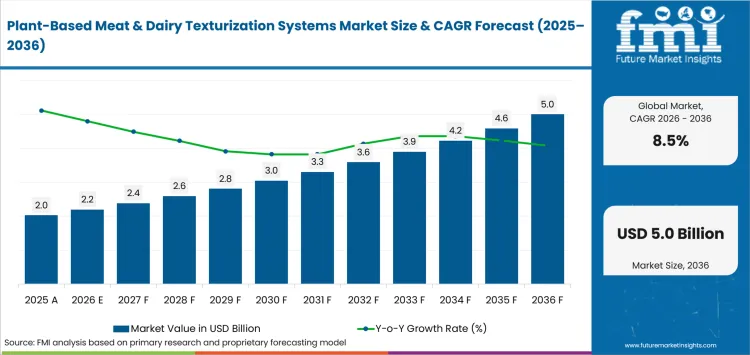
Key Takeaways of Plant-Based Meat & Dairy Texturization Systems Market
- Food processors expand formulation programs as changing protein inputs require repeatable bite and stability across commercial production lines.
- Structuring is expected to account for 36.2% of function demand in 2026 due to its control over fibrous bite and moisture retention.
- Hydrocolloids are projected to hold 37.4% in 2026 owing to their roles in suspension and water management.
- By application, meat alt is anticipated to capture 54.7% in 2026, attributable to extrusion and protein-network requirements during commercial production.
- Ingredient variability and country-specific authorization requirements can lengthen scale-up programs across plant-based meat and dairy production lines.
- Competition includes broad platforms from IFF and Cargill alongside ingredient systems from Ingredion and Kerry. Tate & Lyle and Roquette offer deeper texture capabilities across selected applications and regional formulation programs. ADM and Palsgaard provide focused protein or emulsifier support through regional application resources for selected commercial categories.
Analyst Perspective
"The decisive metric is the share of reformulations that preserve bite and juiciness at full commercial throughput. Processors also need emulsion stability that remains consistent across heat and shear conditions for each protein base. Clear moisture tolerances and ingredient-substitution rules reduce failed trials during raw-material changes or equipment adjustments. Providers that combine pilot support with country-ready authorization records can protect yield during plant-based portfolio expansion."
- Nandini Roy Choudhury, Principal Analyst, Future Market Insights
How is the Plant-Based Meat & Dairy Texturization Systems Market segmented?
The plant-based meat & dairy texturization systems industry is segmented by function, ingredient, application, and region.
The market is segmented by function, ingredient, application, and region to distinguish technical roles and commercial adoption conditions. Function comprises structuring, fat mimetics, gelling, and binding according to the physical result created in the finished product. Ingredient analysis covers hydrocolloids, proteins, starches, and fibers based on their contribution to network formation, moisture control, or process tolerance. Application compares meat alt with dairy alt as each category requires different bite, suspension, melt, and storage performance. Regional analysis examines authorization status, local technical support, and operating conditions that influence commercial formulation programs.
Why does structuring lead the function category?
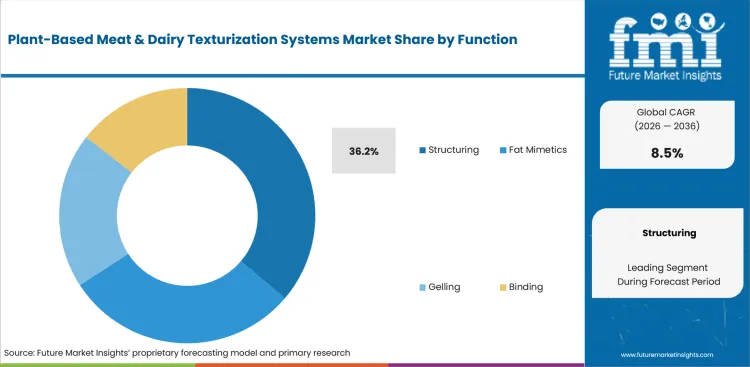
Structuring systems create directional fibers and control moisture during extrusion or fermentation across commercial product lines. The European Commission reported in October 2025 that the MEATLOW project produced reproducible pre-commercial batches through an integrated oat-mycelium process. The project combined fiber alignment with forming and packaging steps and linked the workflow to a planned commercial line. Formulators must test bite and juiciness together to prevent stronger networks from becoming dry or brittle during commercial heating.
- Structuring is projected to hold 36.2% share in 2026 owing to its direct control over fibrous bite and moisture retention. Processors combine proteins with binders and lipids to maintain shape during cooking without creating a dry texture. Textured vegetable protein adoption increases the need for systems that preserve structure across storage and reheating.
- Meat-alternative manufacturers adopt structuring systems through staged trials that compare pilot output with full-line performance. Technical teams set acceptable limits for protein variation and moisture ahead of commercial recipe approval. Successful programs document cooking loss and bite consistency across the intended shelf life and expected distribution conditions. Application support creates value through focused troubleshooting that protects yield during raw-material changes or equipment adjustments.
How do hydrocolloids shape the ingredient category?
Hydrocolloids control suspension in plant-based beverages and limit water release inside meat alternatives during processing or storage. Tate & Lyle launched its Sensation formulation tool in Asia-Pacific during September 2025 to translate mouthfeel targets into tailored ingredient solutions. The tool uses the combined starch and gum portfolio created through the CP Kelco combination. Commercial trials must confirm dosage tolerance and protein interaction under the intended heating and shear conditions.
- In 2026, hydrocolloids are expected to lead the ingredient category with 37.4% share because they manage suspension and water retention across both applications. Dairy and meat alternatives require distinct recipes even though both categories depend on controlled moisture during commercial processing and distribution. Product developers favor systems that preserve texture through heating and the expected shelf life across each intended product format.
- Plant-based dairy processors use hydrocolloids to limit separation and preserve creaminess throughout commercial processing and regional distribution. Meat-alternative producers apply them more selectively to control water release during heating and refrigerated storage. Modified starch development expands blending options for formulas requiring greater body or process tolerance. Each blend needs compatibility testing with the selected proteins and emulsifiers under realistic production conditions.
What supports meat alt within the application category?
Meat alternatives require directional structure and controlled moisture release to reproduce muscle-like bite during cooking. The Food Standards Agency and Food Standards Scotland published a January 2026 assessment for fermented pea and rice protein. The assessment covered meat alternatives and dairy analogues and identified allergen-labeling considerations for the intended uses. Processors therefore need ingredient documentation that matches the exact formulation and intended country of sale throughout commercial development.
- Based on the application category, meat alt is projected to account for 54.7% in 2026 due to its heavier reliance on extrusion and protein-network formation. Structuring systems create directional fibers and retain moisture across burgers or whole-cut formats during cooking. Related meat alternatives market activity supports demand for process control that can accommodate several protein inputs.
- Processors evaluate meat-alt systems through cooking loss and bite consistency alongside throughput during full commercial runs. Modular recipes accommodate soy or pea proteins without rebuilding the complete process or equipment setup. Related food emulsifiers market activity expands options for stable fat distribution but every emulsifier requires testing with the selected protein matrix under representative heat and shear conditions.
What are the drivers, restraints, and opportunities in the Plant-Based Meat & Dairy Texturization Systems Market?
Recurring reformulation supports demand, variable ingredient behavior constrains scale-up and application support creates a route to shorter commercialization cycles.
- Driver: Reformulation programs increase demand as food processors change protein sources or pursue stronger sensory performance in established products.
- Restraint: Protein networks can become dry or unstable as moisture levels and processing intensity change during commercial production.
- Opportunity: New protein authorizations create openings for application support that combines stable recipes with precise use and labeling conditions.
Reformulation programs create demand as brands change protein sources or seek better sensory performance in established products. Roquette launched NUTRALYS Pea 850F in February 2026 with a cleaner taste profile and functional emulsion or gelling performance. The development reduces the need for complex flavor masking in dairy alternatives and other high-protein formats. Demand for plant-based food adds more product concepts that require stable texture during scale-up. Texturization providers must prove that each ingredient change preserves processing stability and finished-product quality on commercial equipment.
Variable ingredient behavior creates a material restraint through inconsistent protein responses to moisture and processing intensity. Wageningen University & Research announced a texture-focused research grant in May 2025 for plant-based meat and dairy alternatives. The project targets dry or rubbery eating qualities through better understanding of molecular and structural interactions. Commercial scale-up remains difficult without controlled trials that isolate each ingredient’s effect under realistic processing conditions. Development costs rise sharply if several functional components change during the same commercial production run.
New protein approvals create an opportunity for providers that connect formulation work with precise use conditions. China’s National Health Commission approved Fusarium venenatum protein as a new food raw material in November 2025. The authorization expands the available protein base but retains restrictions for selected consumer groups and intended uses. Texturization companies can support commercialization through recipes that define stable process windows and compliant labels. Focused application support reduces scale-up uncertainty and gives ingredient developers a clearer route into meat or dairy alternatives.
Which country CAGRs are profiled in the Plant-Based Meat & Dairy Texturization Systems Market?
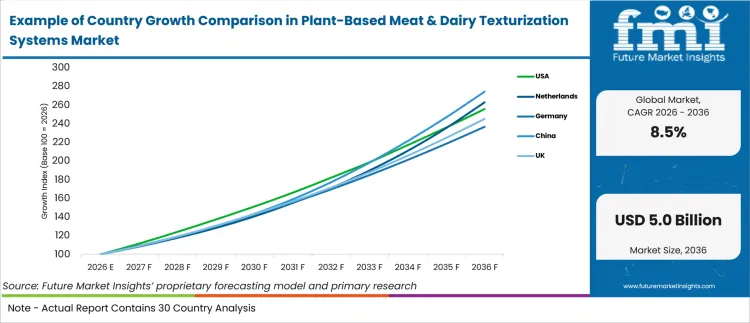
| Country | CAGR |
|---|---|
| USA | 9.8% |
| Netherlands | 10.2% |
| Germany | 9.0% |
| China | 10.6% |
| UK | 9.4% |
How do country-level CAGRs compare in the Plant-Based Meat & Dairy Texturization Systems Market?
The country forecasts are grouped within a relatively narrow band, suggesting broadly similar momentum across the plant-based meat & dairy texturization systems market. China, the Netherlands and the USA remain closely aligned, with only limited separation between their projected growth rates. The UK follows within a short distance of this group, while Germany represents a more measured outlook without creating a substantial break in the comparison. The progression between countries is gradual rather than segmented into sharply distinct tiers. This pattern reflects a common industry focus on improving texture, mouthfeel and product performance as manufacturers seek to enhance consumer acceptance of plant-based meat and dairy alternatives.
- China shows a notable position within the comparison as manufacturers continue to invest in advanced processing technologies and texturization systems that improve the sensory characteristics of plant-based products.
- The Netherlands remains an important market due to its strong food technology ecosystem and continued development of ingredient and processing solutions for alternative proteins.
- The USA reflects sustained demand for higher-quality plant-based foods, encouraging investment in texturization technologies that deliver more meat-like and dairy-like eating experiences.
- The UK continues to support market expansion through growing consumer interest in plant-based diets and increasing attention to product quality and formulation performance.
- Germany maintains steady momentum as producers focus on ingredient functionality and processing innovation to improve product texture, consistency and overall appeal.
Comparable CAGRs do not create identical market conditions across countries. Differences in manufacturing capabilities, product formulation strategies, consumer expectations and alternative protein development priorities can influence how texturization systems are adopted. The full report provides country-level CAGR analysis across North America, Latin America, Europe, East Asia, South Asia, Oceania and the Middle East and Africa.
Country-wise Analysis
- United States formulation teams have broad ingredient access and several application laboratories but face strict cost comparisons with conventional products. Adoption of plant-based meat and dairy texturization systems in the USA is estimated to expand at 9.8% CAGR through 2036, supported by established product-development infrastructure. Ingredion reported in July 2025 that its Chicago IFT FIRST program connected texture design with tailored ingredient systems and sensory testing. Domestic application centers enable controlled pilot trials across different protein bases and commercial processing conditions. Every texture improvement must justify added formulation cost across high-volume retail formats and established conventional products. Commercial reviews should separate sensory gains from yield improvements across each recipe and intended processing route. The plant milk market also requires distinct stability testing across processing and regional distribution conditions.
- Dutch product developers work within a concentrated food-science network that supports extrusion trials and structured sensory research across pilot facilities. In the Netherlands plant-based meat and dairy texturization demand is predicted to advance at 10.2% CAGR through 2036, underpinned by strong research capacity and ingredient expertise. Wageningen University & Research reported in March 2026 that plant proteins represented 39% of Dutch protein consumption during 2025. The unchanged share from 2024 shows that technical capability has not accelerated consumer conversion across everyday eating patterns. Research partnerships provide a direct enabler for disciplined formulation trials across emerging proteins and alternative dairy matrices. Substitutes continue to compete with established meat and dairy habits across major retail channels and everyday meal occasions. Launch plans should prioritize formats with verified sensory acceptance rather than assume broad switching across product categories.
- German processors operate within established food-manufacturing networks that apply formal labeling and additive requirements to commercial products. Destatis reported in May 2026 that Germany produced 124,900 tonnes of meat substitutes during 2025. Germany’s plant-based meat and dairy texturization systems outlook is anticipated to advance at 9.0% CAGR over the assessment period, shaped by local production capacity and technical ingredient access. Production declined 1.2% from 2024 despite remaining more than double the documented 2019 volume. The installed manufacturing base enables texture-system upgrades across existing lines and provides a direct route for commercial formulation trials. Processors require measurable yield or quality gains ahead of approving reformulation spending during a period of category softness. Providers should document heating stability and raw-material tolerance through trials that reproduce the intended production conditions.
- Chinese manufacturers must reconcile national food standards with new raw-material approvals and digital-label requirements for commercial products. China’s plant-based meat and dairy texturization systems sector is projected to record 10.6% CAGR during the assessment period, reinforced by large food-processing capacity and active ingredient development. The National Health Commission issued GB 7718-2025 with forty-nine additional food-safety standards in March 2025. The revised framework provides a defined route for prepackaged products and related digital food information across commercial channels. Domestic processing scale enables broad formulation testing across meat and dairy alternatives using several protein inputs. Approval status cannot transfer across organisms or intended ingredient uses under the current regulatory framework. Market entry plans should connect texture trials with ingredient identity and label review for every intended application.
- British product launches must follow Great Britain regulated-product pathways alongside current nutrition and labeling requirements for commercial foods. The Food Standards Agency implemented authorization reforms in April 2025 and moved approved novel foods into an online register. The UK plant-based meat and dairy texturization systems market is projected to grow at 9.4% CAGR by 2036, aided by established retail access and active alternative-protein development. The defined route enables unfamiliar protein inputs to progress through commercial product development with clearer status records. Nutrition and allergen declarations remain a material friction across plant-based drinks and meat alternatives under development. Formulation partners should align texture claims with compliant composition evidence ahead of commercial scale-up and retail release.
Who are the notable companies in the Plant-Based Meat & Dairy Texturization Systems Market?
IFF, Cargill, Ingredion, Kerry, Tate & Lyle, Roquette, ADM and Palsgaard are the notable companies shaping this market.
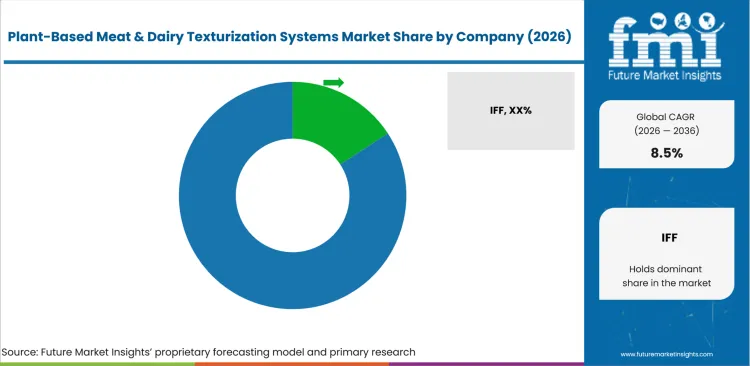
Competition spans integrated ingredient groups and specialists with different strengths in proteins and hydrocolloids together with application support. IFF announced in May 2026 that it agreed to sell its Food Ingredients business to CVC while retaining a minority interest. Closing was scheduled for second-quarter 2027, so IFF remained the current owner at the July 2026 cutoff. Tate & Lyle reported in April 2025 that CP Kelco operated within its combined specialty-ingredients business. The completed transaction supports Tate & Lyle’s parent-company treatment in the company list and current competitive benchmark. The pea protein demand analysis provides input context, but this comparison evaluates broader texturization support across several ingredient families.
- IFF and Cargill together with Ingredion provide broad platforms that combine texturants with proteins or starches for meat and dairy alternatives. Application laboratories help adjust recipes during scale-up and support comparable texture across separate plants with changing regional ingredient supplies.
- Kerry and Tate & Lyle together with Roquette add deeper capability in plant proteins or hydrocolloid systems. Their value comes from linking functional ingredients with clear sensory targets and repeatable processing conditions. Pilot support can isolate ingredient effects and reduce avoidable reformulation cycles throughout commercial production programs.
- ADM and Palsgaard compete through protein systems or emulsifier support for selected food categories and regional development programs. Local pilot facilities reduce formulation risk as manufacturers transfer laboratory recipes to full commercial equipment and regional production lines. Regional application teams can shorten troubleshooting for new proteins and changing production conditions during commercial scale-up programs.
Competitive Benchmarking: Plant-Based Meat & Dairy Texturization Systems Market
| Company | Integrated Texture Systems | Hydrocolloid and Emulsion Depth | Plant Protein Structuring | Geographic Reach |
|---|---|---|---|---|
| IFF | High | High | High | Global |
| Cargill | High | High | High | Global |
| Ingredion | High | High | Medium | Global |
| Kerry | High | Medium | High | Global |
| Tate & Lyle | High | High | Low | Global |
| Roquette | Medium | Low | High | Global |
| ADM | High | Medium | High | Global |
| Palsgaard | Medium | High | Low | Global |
Key Developments in the Plant-Based Meat & Dairy Texturization Systems Market
- In June 2025, Roquette launched NUTRALYS T WHEAT 600L and NUTRALYS T PEA 700XC as textured plant proteins. The wheat ingredient marked its entry into textured wheat protein and the pea format added large-chunk structure for prepared dishes. The launch gives meat-alternative developers more options for fibrous bite and thermal stability across products that require efficient commercial processing and consistent finished texture.
- In July 2025, Palsgaard opened an application center in Navi Mumbai with industrial-scale pilot plants for dairy and other food categories. The facility lets manufacturers test recipes under conditions that resemble commercial production at regional scale. Regional pilot capacity can shorten troubleshooting for plant-based dairy emulsions and reduce dependence on distant laboratories during product development across India and nearby markets.
- In May 2026, ADM launched eight soy and pea protein products across North America and Europe. The portfolio included a soy isolate for dairy alternatives plus concentrates and textured proteins for extrusion or other meat-alternative processing. The release expands the protein formats that texturization systems must accommodate across beverages and structured foods. Formulation teams also gain additional options for nutrition and finished texture during commercial product development.
- In July 2026, Ingredion announced a pea and rice protein for plant-based yogurt alongside an AI formulation assistant for IFT FIRST 2026. The program connects technical data with application development across protein fortification and commercial texture design. Dairy-alternative developers gain another input option but must test suspension and mouthfeel under intended processing and storage conditions ahead of full commercial production.
Key Players in the Plant-Based Meat & Dairy Texturization Systems Market
Core Ingredient and Processing Platforms
- IFF
- Cargill
- Ingredion
Application and Delivery Specialists
- Kerry
- Tate & Lyle
- Roquette
Regional Protein and Emulsifier Specialists
- ADM
- Palsgaard
Plant-Based Meat & Dairy Texturization Systems Market - Report Scope
| Coverage field | Report scope |
|---|---|
| Market breakdown | Function, ingredient, application, and region. |
| Quantitative Units | Revenue in USD Million, CAGR in %. |
| Market Definition | Ingredient and process systems used to create or maintain structure, juiciness, gelation, suspension, melt behavior, binding, and fat mimicry in plant-based meat and dairy alternatives. |
| Regions Covered | North America, Latin America, Western Europe, Eastern Europe, East Asia, South Asia and Pacific, Middle East and Africa. |
| Countries Covered | USA, Netherlands, Germany, China, UK, and more than twenty-five additional countries in the full report. |
| Key Companies Profiled | IFF, Cargill, Ingredion, Kerry, Tate & Lyle, Roquette, ADM and Palsgaard. |
| Forecast Period | 2026 to 2036. |
| Approach | Hybrid bottom-up and top-down market sizing supported by primary interviews and official desk research. |
Plant-Based Meat & Dairy Texturization Systems Market - Research Methodology
| Method | Approach |
|---|---|
| Primary Research | FMI analysts gathered input from manufacturers, service providers, technology developers, distributors, end users, procurement teams, and subject-matter experts. Interviews examined purchasing decisions, product or service evaluation, adoption barriers, approval requirements, pricing considerations, and expectations for technical or commercial support. Respondents were also asked what evidence is required before a trial, pilot, or initial order develops into regular purchasing. |
| Desk Research | Desk research covered government statistics, regulatory publications, trade data, industry associations, technical literature, standards, company filings, product information, and official corporate announcements. Sources were reviewed for relevance, publication date, geographic coverage, and consistency with the defined market scope. Claims relating to performance, applications, approvals, capacity, investment, and commercial activity were retained only when supported by credible public evidence. |
| Market Sizing and Forecasting | The market model combined the baseline value with historical performance, segment structure, pricing and volume indicators, adoption levels, company participation, and country-level demand conditions. Forecast assumptions considered economic activity, investment trends, regulatory developments, technology adoption, purchasing cycles, supply availability, and barriers to wider market use. Segment and regional estimates were reconciled before the final market total was calculated. |
| Data Validation | Estimates were checked against multiple independent indicators, including public data, company activity, trade patterns, industry developments, and findings from primary interviews. Validation also tested whether products, services, applications, and company revenues fell within the defined market boundaries. Adjacent categories, unsupported claims, overlapping revenues, and activities without direct market relevance were excluded to reduce double counting and maintain consistency across segments and countries. |
Plant-Based Meat & Dairy Texturization Systems Market by Segments
Plant-Based Meat & Dairy Texturization Systems Market segmented by Function:
- Structuring
- Fat Mimetics
- Gelling
- Binding
Plant-Based Meat & Dairy Texturization Systems Market segmented by Ingredient:
- Hydrocolloids
- Proteins
- Starches
- Fibers
Plant-Based Meat & Dairy Texturization Systems Market segmented by Application:
- Meat Alt
- Dairy Alt
Plant-Based Meat & Dairy Texturization Systems Market by Region:
- North America
- United States
- Canada
- Latin America
- Brazil
- Mexico
- Argentina
- Chile
- Western Europe
- Germany
- France
- United Kingdom
- Italy
- Spain
- Benelux
- Nordics
- Eastern Europe
- Poland
- Czech Republic
- Romania
- Hungary
- East Asia
- China
- Japan
- South Korea
- South Asia and Pacific
- India
- ASEAN
- Australia and New Zealand
- Middle East and Africa
- GCC Countries
- South Africa
- Türkiye
- Israel
Research Sources and Bibliography
- Government Chemist. (2025, June 16). Quantitative review of sustainable novel food production.
- Tate & Lyle. (2025, July 7). Tate & Lyle debuts expanded portfolio and mouthfeel leadership at IFT FIRST 2025.
- European Commission. (2025, October 28). Innovative patented dry fermentation technology for cost-effective and highly nutritious production of hybrid mycelium-plant meat analogues.
- Tate & Lyle. (2025, September 4). Tate & Lyle launches breakthrough formulation tool In Asia-Pacific to unlock full potential of mouthfeel.
- Food Standards Agency & Food Standards Scotland. (2026, January 6). Assessment of Pea and Rice Protein Fermented by Shiitake (Lentinula edodes) Mycelia as Novel Food for Use in Food (RP1437).
- Roquette. (2026, February 23). Launch of Breakthrough Clean-Tasting Pea Protein Isolate.
- Wageningen University & Research. (2025, May 23). Grant for AI research to progress tastier plant-based products.
- National Health Commission of the People’s Republic of China. (2025, November 27). 解读《关于威尼斯镰刀菌蛋白等14种“三新食品”的公告》(2025年第7号).
- Ingredion. (2025, July 22). Ingredion at IFT FIRST 2025-Connecting texture, health and innovation.
- Wageningen University & Research. (2026, March 2). Protein transition stalls - or does it?
- Federal Statistical Office of Germany. (2026, May 18). Nach jahrelangem Anstieg: Fleischersatz-Produktion sinkt 2025 um 1,2 % gegenüber dem Vorjahr.
- National Health Commission of the People’s Republic of China. (2025, March 27). 关于发布《食品安全国家标准 预包装食品标签通则》(GB 7718-2025)等50项食品安全国家标准和9项修改单的公告(2025年 第2号).
- Food Standards Agency. (2025, April 1). Reforms to the market authorisation process for regulated products come into force.
- International Flavors & Fragrances Inc. (2026, May 29). IFF Enters Into Agreement to Sell Its Food Ingredients Business to CVC.
- Tate & Lyle. (2025, April 15). Integration update and Pre-close statement.
- Roquette. (2025, June 17). NUTRALYS® Portfolio: New Textured Wheat and Pea Proteins.
- Palsgaard. (2025, July 8). Palsgaard Inaugurates State-of-the-Art Application Centre in Navi Mumbai to Strengthen Regional Customer Support.
- ADM. (2026, May 20). ADM Advances Protein Innovation with New Ingredient Solutions.
- Ingredion. (2026, July 6). Ingredion to Spotlight Next-Generation Solutions for Texture, Clean Labels and Positive Nutrition at IFT FIRST 2026.
- International Flavors & Fragrances Inc. (n.d.). Protein Fortification Solutions for Food & Beverage | IFF.
- Cargill. (n.d.). Functional systems for Meat Alternatives | INFUSE by Cargill™ | Cargill.
- Ingredion. (n.d.). Ingredient Solutions for Food & Beverage Manufacturers | Ingredion USCA.
- Roquette. (n.d.). NUTRALYS® Plant Proteins - Textured.
- ADM. (n.d.). Food & Beverage Texturants | Emulsifiers and Hydrocolloid Ingredients | ADM.
This bibliography is provided for reader reference and is not exhaustive. The full report contains the complete reference list and detailed citations.
This Report Answers
- How large is the plant-based meat & dairy texturization systems market in 2026 and 2036?
- Which formulation and regulatory conditions convert interest into repeat purchasing?
- Why does structuring account for the leading function share in 2026?
- How do hydrocolloids influence stability across meat and dairy alternatives?
- Why does meat alt capture the largest application share in 2026?
- How do country growth rates compare across the USA, Netherlands, Germany, China and the UK?
- Which companies provide integrated systems or specialist ingredient capabilities?
- What limits repeatable scale-up across changing protein and process conditions?
- How should decision-makers compare application support and geographic reach?
Frequently Asked Questions
How big is the Plant-Based Meat & Dairy Texturization Systems Market in 2026?
The plant-based meat & dairy texturization systems market is valued at USD 2.2 billion in 2026 and is forecast to reach USD 5.0 billion by 2036, supported by food processors expanding formulation programs as changing protein inputs require repeatable bite, moisture retention, and emulsion stability across commercial meat and dairy alternative production lines.
What is the CAGR of the Plant-Based Meat & Dairy Texturization Systems Market from 2026 to 2036?
The plant-based meat & dairy texturization systems market is projected to grow at a CAGR of 8.5% between 2026 and 2036, supported by recurring protein reformulation programs, new ingredient authorizations across major markets, and growing demand for integrated texturization systems that preserve processing stability and sensory performance across commercial production lines.
Which ingredient leads the Plant-Based Meat & Dairy Texturization Systems Market?
Hydrocolloids account for 37.4% of the plant-based meat & dairy texturization systems market by ingredient in 2026, driven by their essential role in managing suspension and water retention across both meat and dairy alternative applications, controlling moisture release during heating and preserving texture stability through commercial processing and distribution.
How much will the Plant-Based Meat & Dairy Texturization Systems Market add between 2026 and 2036?
The plant-based meat & dairy texturization systems market is set to add USD 2.8 billion between 2026 and 2036, growing from USD 2.2 billion to USD 5.0 billion as new protein authorizations, expanding application laboratory networks, and growing processor demand for stable recipe documentation across changing raw-material conditions accelerate texturization system adoption globally.
Who are the leading companies in the Plant-Based Meat & Dairy Texturization Systems Market?
Leading companies in the plant-based meat & dairy texturization systems market include IFF, Cargill, Ingredion, Kerry, Tate & Lyle, Roquette, ADM, and Palsgaard, competing across integrated texture and processing platforms, hydrocolloid and emulsion depth, and regional protein and emulsifier specialist capabilities with global application and manufacturing reach.
Preview the report firsthand - request a free sample
Get SampleGet the brochure for pricing and purchase details.
Get PDFTable of Content
- Key Takeaways
- Market Size and CAGR
- Top Growth Driver
- Fastest Growing Segment
- Leading Region
- Key Companies
- Emerging Opportunities
- Executive Summary
- Global Market Outlook
- Demand-side Trends
- Supply-side Trends
- Technology Roadmap Analysis
- Analysis and Recommendations
- Analyst Perspective (What is happening? Why now? What should investors know?)
- Key Questions Answered
- How large is the market?
- What is the CAGR?
- What are key trends?
- Which region dominates?
- Who are the leaders?
- Market Overview
- Market Coverage / Taxonomy
- Market Definition / Scope / Limitations
- Research Methodology
- Chapter Orientation
- Analytical Lens and Working Hypotheses
- Market Structure, Signals, and Trend Drivers
- Benchmarking and Cross-market Comparability
- Market Sizing, Forecasting, and Opportunity Mapping
- Research Design and Evidence Framework
- Desk Research Programme (Secondary Evidence)
- Expert Input and Fieldwork (Primary Evidence)
- Tooling, Models, and Reference Databases
- Data Engineering and Model Build
- Quality Assurance and Audit Trail
- Market Background
- Market Dynamics (Drivers, Restraints, Opportunity, Trends)
- Scenario Forecast (Optimistic, Likely, Conservative)
- Impact Analysis
- AI Impact
- Sustainability Impact
- Regulatory Impact
- Technology Impact
- Consumer / Buyer Analysis
- Purchase Drivers
- Adoption Barriers
- Buyer Journey
- Opportunity Map Analysis
- Product Life Cycle Analysis
- Supply Chain Analysis
- Investment Feasibility Matrix
- Value Chain Analysis
- PESTLE and Porter's Analysis
- Regulatory Landscape
- Regional Parent Market Outlook
- Production and Consumption Statistics
- Import and Export Statistics
- Global Market Analysis and Forecast, 2021 to 2036
- Historical Market Size Value (USD Billion) Analysis, 2021 to 2025
- Current and Future Market Size Value (USD Billion) Projections, 2026 to 2036
- Y-o-Y Growth Trend Analysis
- Absolute $ Opportunity Analysis
- Global Market Pricing Analysis, 2021 to 2036
- Global Market Analysis and Forecast, By Function, 2021 to 2036
- Introduction / Key Findings
- Historical Market Size Value (USD Billion) Analysis By Function, 2021 to 2025
- Current and Future Market Size Value (USD Billion) Analysis and Forecast By Function, 2026 to 2036
- Structuring
- Fat Mimetics
- Gelling
- Binding
- Structuring
- Y-o-Y Growth Trend Analysis By Function, 2021 to 2025
- Absolute $ Opportunity Analysis By Function, 2026 to 2036
- Global Market Analysis and Forecast, By Ingredient, 2021 to 2036
- Introduction / Key Findings
- Historical Market Size Value (USD Billion) Analysis By Ingredient, 2021 to 2025
- Current and Future Market Size Value (USD Billion) Analysis and Forecast By Ingredient, 2026 to 2036
- Hydrocolloids
- Proteins
- Starches
- Fibers
- Hydrocolloids
- Y-o-Y Growth Trend Analysis By Ingredient, 2021 to 2025
- Absolute $ Opportunity Analysis By Ingredient, 2026 to 2036
- Global Market Analysis and Forecast, By Application, 2021 to 2036
- Introduction / Key Findings
- Historical Market Size Value (USD Billion) Analysis By Application, 2021 to 2025
- Current and Future Market Size Value (USD Billion) Analysis and Forecast By Application, 2026 to 2036
- Meat Alt
- Dairy Alt
- Meat Alt
- Y-o-Y Growth Trend Analysis By Application, 2021 to 2025
- Absolute $ Opportunity Analysis By Application, 2026 to 2036
- Global Market Analysis and Forecast, By Region, 2021 to 2036
- Introduction
- Historical Market Size Value (USD Billion) Analysis By Region, 2021 to 2025
- Current Market Size Value (USD Billion) Analysis and Forecast By Region, 2026 to 2036
- North America
- Latin America
- Western Europe
- Eastern Europe
- East Asia
- South Asia and Pacific
- Middle East & Africa
- Market Attractiveness Analysis By Region
- North America Market Analysis and Forecast, By Country, 2021 to 2036
- Historical Market Size Value (USD Billion) Trend Analysis By Market Taxonomy, 2021 to 2025
- Market Size Value (USD Billion) Forecast By Market Taxonomy, 2026 to 2036
- By Country
- USA
- Canada
- By Function
- By Ingredient
- By Application
- By Country
- Market Attractiveness Analysis
- By Country
- By Function
- By Ingredient
- By Application
- Key Takeaways
- Latin America Market Analysis and Forecast, By Country
- Historical Market Size Value (USD Billion) Trend Analysis By Market Taxonomy, 2021 to 2025
- Market Size Value (USD Billion) Forecast By Market Taxonomy, 2026 to 2036
- By Country
- Brazil
- Mexico
- Chile
- Rest of Latin America
- By Function
- By Ingredient
- By Application
- By Country
- Market Attractiveness Analysis
- By Country
- By Function
- By Ingredient
- By Application
- Key Takeaways
- Western Europe Market Analysis and Forecast, By Country
- Historical Market Size Value (USD Billion) Trend Analysis By Market Taxonomy, 2021 to 2025
- Market Size Value (USD Billion) Forecast By Market Taxonomy, 2026 to 2036
- By Country
- Germany
- UK
- Italy
- Spain
- France
- Nordic
- BENELUX
- Rest of Western Europe
- By Function
- By Ingredient
- By Application
- By Country
- Market Attractiveness Analysis
- By Country
- By Function
- By Ingredient
- By Application
- Key Takeaways
- Eastern Europe Market Analysis and Forecast, By Country
- Historical Market Size Value (USD Billion) Trend Analysis By Market Taxonomy, 2021 to 2025
- Market Size Value (USD Billion) Forecast By Market Taxonomy, 2026 to 2036
- By Country
- Russia
- Poland
- Hungary
- Balkan & Baltic
- Rest of Eastern Europe
- By Function
- By Ingredient
- By Application
- By Country
- Market Attractiveness Analysis
- By Country
- By Function
- By Ingredient
- By Application
- Key Takeaways
- East Asia Market Analysis and Forecast, By Country
- Historical Market Size Value (USD Billion) Trend Analysis By Market Taxonomy, 2021 to 2025
- Market Size Value (USD Billion) Forecast By Market Taxonomy, 2026 to 2036
- By Country
- China
- Japan
- South Korea
- By Function
- By Ingredient
- By Application
- By Country
- Market Attractiveness Analysis
- By Country
- By Function
- By Ingredient
- By Application
- Key Takeaways
- South Asia and Pacific Market Analysis and Forecast, By Country
- Historical Market Size Value (USD Billion) Trend Analysis By Market Taxonomy, 2021 to 2025
- Market Size Value (USD Billion) Forecast By Market Taxonomy, 2026 to 2036
- By Country
- India
- ASEAN
- Australia & New Zealand
- Rest of South Asia and Pacific
- By Function
- By Ingredient
- By Application
- By Country
- Market Attractiveness Analysis
- By Country
- By Function
- By Ingredient
- By Application
- Key Takeaways
- Middle East & Africa Market Analysis and Forecast, By Country
- Historical Market Size Value (USD Billion) Trend Analysis By Market Taxonomy, 2021 to 2025
- Market Size Value (USD Billion) Forecast By Market Taxonomy, 2026 to 2036
- By Country
- Kingdom of Saudi Arabia
- Other GCC Countries
- Türkiye
- South Africa
- Other African Union
- Rest of Middle East & Africa
- By Function
- By Ingredient
- By Application
- By Country
- Market Attractiveness Analysis
- By Country
- By Function
- By Ingredient
- By Application
- Key Takeaways
- Key Countries Market Analysis
- USA
- Pricing Analysis
- Market Share Analysis, 2025
- By Function
- By Ingredient
- By Application
- Canada
- Pricing Analysis
- Market Share Analysis, 2025
- By Function
- By Ingredient
- By Application
- Mexico
- Pricing Analysis
- Market Share Analysis, 2025
- By Function
- By Ingredient
- By Application
- Brazil
- Pricing Analysis
- Market Share Analysis, 2025
- By Function
- By Ingredient
- By Application
- Chile
- Pricing Analysis
- Market Share Analysis, 2025
- By Function
- By Ingredient
- By Application
- Germany
- Pricing Analysis
- Market Share Analysis, 2025
- By Function
- By Ingredient
- By Application
- UK
- Pricing Analysis
- Market Share Analysis, 2025
- By Function
- By Ingredient
- By Application
- Italy
- Pricing Analysis
- Market Share Analysis, 2025
- By Function
- By Ingredient
- By Application
- Spain
- Pricing Analysis
- Market Share Analysis, 2025
- By Function
- By Ingredient
- By Application
- France
- Pricing Analysis
- Market Share Analysis, 2025
- By Function
- By Ingredient
- By Application
- India
- Pricing Analysis
- Market Share Analysis, 2025
- By Function
- By Ingredient
- By Application
- ASEAN
- Pricing Analysis
- Market Share Analysis, 2025
- By Function
- By Ingredient
- By Application
- Australia & New Zealand
- Pricing Analysis
- Market Share Analysis, 2025
- By Function
- By Ingredient
- By Application
- China
- Pricing Analysis
- Market Share Analysis, 2025
- By Function
- By Ingredient
- By Application
- Japan
- Pricing Analysis
- Market Share Analysis, 2025
- By Function
- By Ingredient
- By Application
- South Korea
- Pricing Analysis
- Market Share Analysis, 2025
- By Function
- By Ingredient
- By Application
- Russia
- Pricing Analysis
- Market Share Analysis, 2025
- By Function
- By Ingredient
- By Application
- Poland
- Pricing Analysis
- Market Share Analysis, 2025
- By Function
- By Ingredient
- By Application
- Hungary
- Pricing Analysis
- Market Share Analysis, 2025
- By Function
- By Ingredient
- By Application
- Kingdom of Saudi Arabia
- Pricing Analysis
- Market Share Analysis, 2025
- By Function
- By Ingredient
- By Application
- Türkiye
- Pricing Analysis
- Market Share Analysis, 2025
- By Function
- By Ingredient
- By Application
- South Africa
- Pricing Analysis
- Market Share Analysis, 2025
- By Function
- By Ingredient
- By Application
- USA
- Market Structure Analysis
- Competition Dashboard
- Competition Benchmarking
- Market Share Analysis of Top Players
- By Regional
- By Function
- By Ingredient
- By Application
- Emerging Startups
- Innovation Benchmarking
- Competition Analysis
- Competition Deep Dive
- IFF
- Overview
- Product Portfolio
- Profitability by Market Segments
- Sales Footprint
- Strategy Overview
- Marketing Strategy
- Product Strategy
- Channel Strategy
- Cargill
- Ingredion
- Kerry
- CP Kelco
- Roquette
- ADM
- Palsgaard
- IFF
- Case Studies
- Success Stories
- Recent Developments
- Competition Deep Dive
- Assumptions & Acronyms Used


