

- 2025 (base history)
- USD 0.56 Bn
- 2026 (current)
- USD 0.62 Bn
- 2036 (forecast)
- USD 1.68 Bn
- CAGR (2026–2036)
- 10.5%
How big is the hybrid plant meat market in 2026?
USD 0.62 billion in 2026 and USD 1.68 billion by 2036 at a 10.5% CAGR.
The hybrid plant meat market is projected to expand from USD 0.56 billion in 2025 to USD 1.68 billion by 2036 at 10.5% CAGR as meat processors, retailers, and institutions test partial meat-reduction formats. Burgers are projected to represent 28.0% share in 2026 because ground patties accept mushrooms, pea protein, and soy protein without changing the core meal format. Mushrooms are expected to hold 34.0% share of plant ingredient demand in 2026 due to their moisture and umami fit in meat blends.
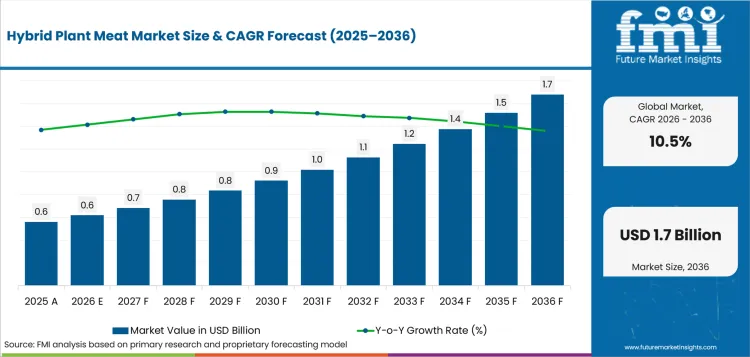
Hybrid Plant Meat Market Overview: Size and Forecast
- 2025 (base history): USD 0.56 billion
- 2026 (current): USD 0.62 billion
- 2036 (forecast): USD 1.68 billion
- CAGR (2026–2036): 10.5%
- Leading Product Format: Burgers
- Burgers Share in 2026: 28.0%
- Leading Plant Ingredient: Mushrooms
- Mushrooms Share in 2026: 34.0%
- Fastest-growing Country: China
- China CAGR: 12.5% by 2036
Summary of the Hybrid Plant Meat Market
- Demand and Growth Drivers
- Meat-reduction buyers support the category as they seek less animal meat without shifting fully to vegan products.
- Retailers use blends to lower beef content and support price parity with standard ground meat.
- Institutional buyers test hybrid formats as they need menu compliance without high plant-only rejection risk.
- Processors favor ground formats since burgers and mince tolerate plant inclusions better than whole cuts.
- Product and Segment View
- Burgers are projected to lead product format demand with 28.0% share as patty structure hides blend variation.
- Mushrooms are estimated to lead plant ingredient demand with 34.0% share given their moisture and umami fit.
- Beef is expected to account for 38.0% meat base share in 2026 as beef blends deliver the clearest cost reduction.
- Retail is projected to lead channel demand with 45.0% share as supermarket trials shape consumer education.
- Geography and Competitive Outlook
- China is forecast at 12.5% CAGR through 2036 with large meat output and strong food manufacturing scale.
- India is expected to expand at 12.0% CAGR through 2036 with poultry-led meat production supporting lower-cost blends.
- The United States is projected at 10.2% CAGR through 2036 with active foodservice and school meal pilots.
- Perdue Foods, Lidl, Quorn Foods, Joyn Foods, 50/50 Foods, DUO, and The Spare Food Co. shape the current evidence base.
- Analyst Opinion
- Nandini Roy Choudhury, Principal Consultant at FMI says, “I see hybrid plant meat as a correction to the first wave of plant-based meat. The first wave asked meat eaters to switch identity. This category asks them to cut animal meat without giving up familiar meals. That is a smaller promise, but it is easier to sell. The commercial test is not whether the product sounds sustainable. The test is whether a burger, nugget, or mince blend cooks on current equipment and clears the taste threshold. Suppliers with meat processing know-how have an advantage here. Retailers and institutions will keep testing blends only when label wording is clear, allergen control is strong, and the plant ingredient lowers cost or improves nutrition.”
Hybrid plant meat is gaining a clearer commercial role as a bridge between full-meat products and plant-based alternatives. In August 2025, USDA Economic Research Service reported that 226 pounds of red meat and poultry were available per U.S. consumer in 2025. Chicken alone was projected at 102.7 pounds per person. That matters because hybrid formats can target mainstream meat buyers rather than only vegan shoppers. Perdue’s February 2025 company profile lists Chicken Plus as a blended chicken-and-vegetable line with 1/4 cup of vegetable nutrition and 9 grams of protein per serving. This type of product gives retailers a lower-risk way to test plant inclusion because taste, protein and familiar meat identity remain visible on pack. Supplier selection is therefore likely to favor blends that improve nutrition or cost without asking shoppers to leave the meat aisle.
Country-wise CAGR Projections (2026–2036)
China leads growth at 12.5% CAGR through 2036, followed by India at 12.0% and the USA at 10.2%, as meat processors test partial meat-reduction blends across retail and foodservice channels.
- China: 12.5% CAGR
- India: 12.0% CAGR
- USA: 10.2% CAGR
Which factors support expansion in the hybrid plant meat market?
Meat-reduction demand, retail price testing, and familiar cooking behavior support market value across retail, foodservice, and institutional channels.
- Market value is supported by finished animal meat products blended with mushrooms, pea protein, soy protein, legumes, or mycoprotein.
- Supplier pricing reflects meat base, plant inclusion cost, blend ratio, processing behavior, and cold-chain handling before sustainability claims affect trial.
- Revenue improves when retailers convert pilot blended mince, burger, and nugget products into repeat private-label shelf programs.
- Foodservice adoption improves when hybrid products cook on existing grills, fryers, ovens, and kitchen lines without new preparation steps.
- Institutional demand rises when schools, hospitals, and contract caterers can reduce meat volume without shifting menus fully to plant-only products.
Why is the Hybrid Plant Meat Market Growing?
Meat eaters are more open to partial reduction than full replacement when taste and price stay close to meat.
- Retailers can use pea protein or mushrooms to reduce beef content while keeping a familiar cooking format.
- Schools and hospitals test blended products as they need nutrition gains without full menu disruption.
- Meat processors see blends as a way to extend product lines without abandoning existing plants.
- Label rules create friction for fully plant-based meat while hybrid products can use meat identity more clearly.
Mainstream buyers are testing hybrid products as a practical compromise between meat eating and meat reduction. In August 2025, the USDA projected 227 pounds of red meat and poultry availability per U.S. consumer in 2026. That level shows why the category must meet meat eaters inside familiar meal formats. A blended burger does not ask buyers to abandon meat. It lets sellers reduce beef content while keeping the same grill, bun, and menu language. This supports a forecast in which adoption grows fastest in processed formats. Retailers are using hybrid products to solve a price and taste problem that slowed pure plant-based meat. The GFI 2024 State of the Industry report says global plant-based meat and seafood retail sales reached USD 6.1 billion in 2024. It also states that many products still miss consumer expectations on taste and price. Hybrid meat addresses that gap by keeping animal meat as the main sensory anchor. This makes the category more useful for private labels and foodservice buyers than premium vegan-only products.
How is the hybrid plant meat market segmented?
The hybrid plant meat industry is segmented by product format, plant ingredient, meat base, sales channel, blend ratio, and region.
- Burgers are expected to lead product format demand with 28.0% share in 2026 as patties tolerate plant inclusions.
- Mushrooms are estimated to account for 34.0% plant ingredient demand in 2026 with moisture and umami supporting beef blends.
- Beef-based blends are anticipated to hold 38.0% of meat base demand in 2026 as beef has the largest cost-reduction case.
- Retail channels are projected to direct 45.0% of 2026 demand toward supermarket and club-store products.
- Meat-forward blends are expected to represent 54.0% share in 2026 as consumers prefer meat-first sensory cues.
The segmentation structure reflects how buyers specify hybrid meat. Product format matters first because ground products accept mushrooms, pea protein, and soy protein without forcing a whole-cut texture claim. Perdue’s Chicken Plus line lists chickpeas and cauliflower per serving with 9 grams of protein, showing how processors frame the product as familiar chicken with added nutrition. This is important for buyers that need simple shelf language. Burgers and nuggets hold the strongest share, while whole cuts stay small due to texture and label constraints.
Why do burgers lead the hybrid plant meat market?
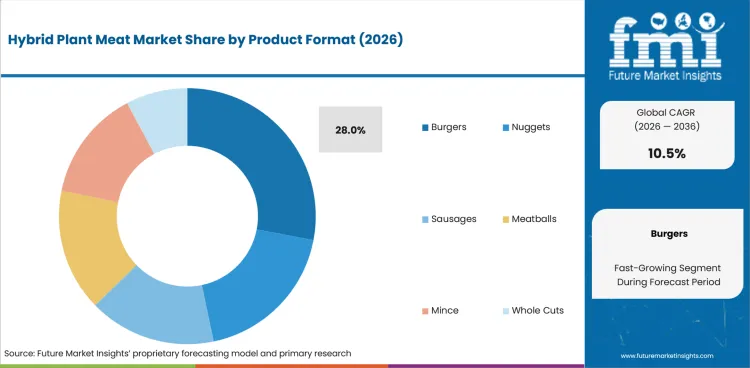
- Burgers are projected to account for 28.0% of product format demand in 2026 as ground beef patties accept mushrooms, legumes, and pea protein without exposing texture gaps.
- Burger buyers compare grill behavior and juiciness before sustainability claims, giving mushroom blends an edge over dry protein isolates in foodservice trials.
Why do mushrooms lead plant ingredient demand in the hybrid plant meat market?
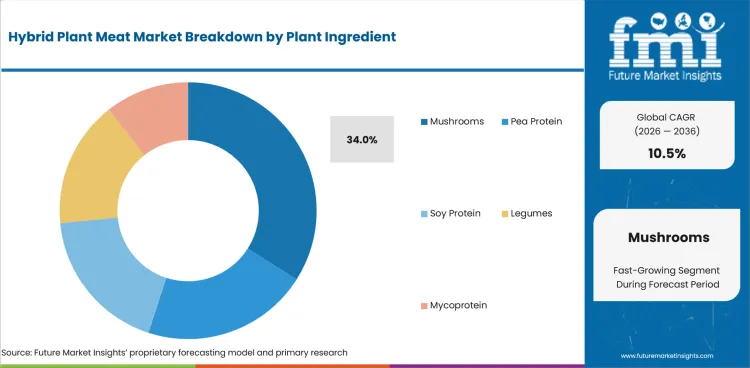
- Mushrooms are estimated to hold 34.0% of plant ingredient demand in 2026 since they add moisture and savory flavor to beef blends.
- DUO sells a 50/50 ground beef and mushroom blend, which shows how brands use mushrooms to keep meat identity while reducing animal content.
Why does beef lead the meat base segment in the hybrid plant meat market?
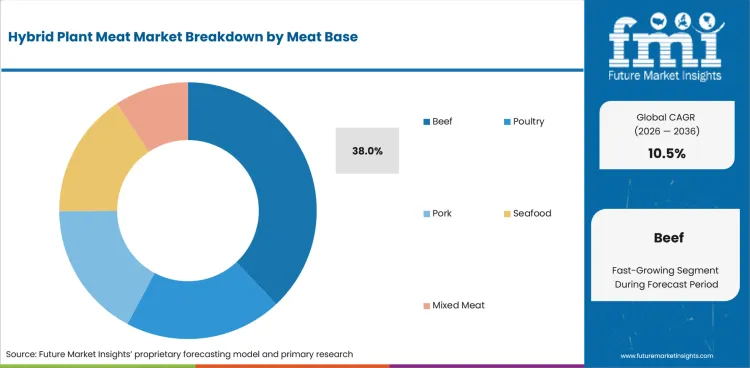
- Beef is anticipated to represent 38.0% of meat base demand in 2026 as beef blends offer the strongest cost and carbon-reduction message.
- Both Burger presents a 50% beef and 50% vegetable product, which shows the category’s strongest retail signal sits in beef patties.
Why does retail lead sales channel demand in the hybrid plant meat market?
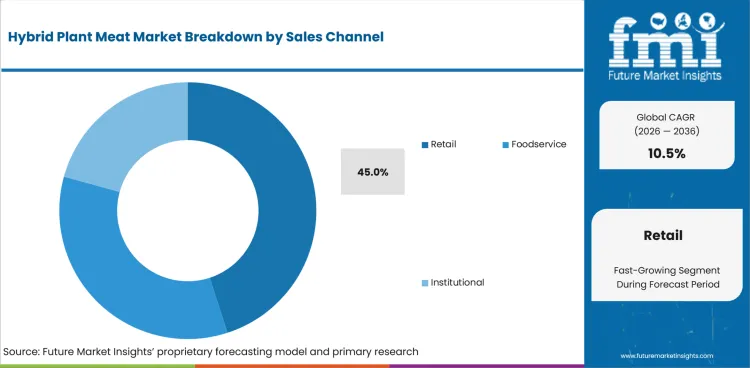
- Retail is expected to account for 45.0% of sales channel demand in 2026 as supermarkets use private-label shelves to test blended mince.
- Lidl’s 2024 blended mince used 60% beef and 40% pea protein, with a claimed 33% lower cost than ground beef.
Why do meat-forward blends lead the hybrid plant meat market?
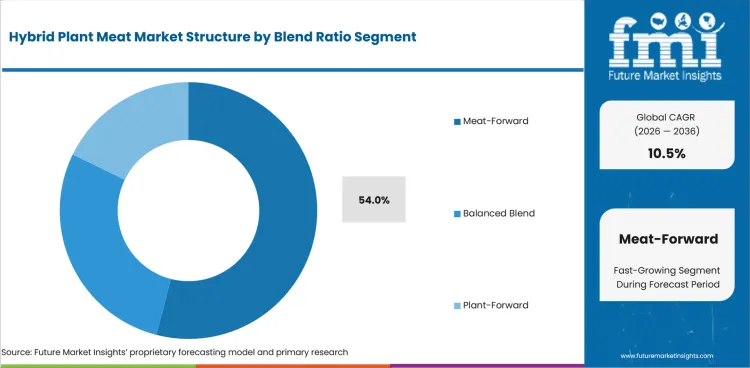
- Meat-forward blends are projected to hold 54.0% of blend ratio demand in 2026 as buyers want reduction without a vegan message.
- The Spare Food Co. positions its burger as a direct beef replacement with no special cooking steps, fitting operator needs.
What are the drivers, restraints, and opportunities in the hybrid plant meat market?
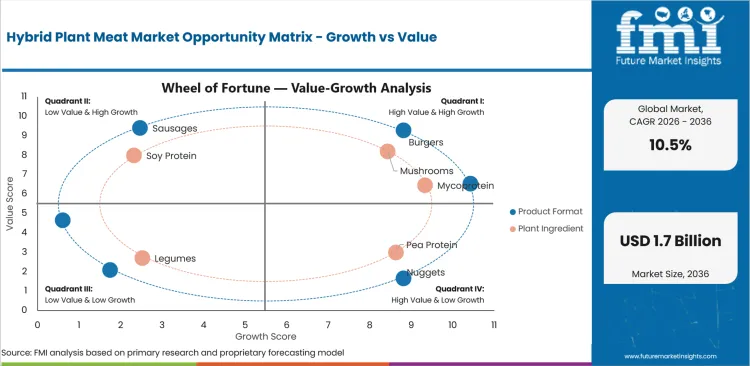
Meat-first sensory performance supports adoption while label clarity and ingredient cost determine whether blended products move beyond pilots.
- Driver: Meat reduction supports adoption when the product keeps a meat-first taste and lowers perceived sacrifice.
- Driver: Retailer private-label testing creates scale opportunities as blended mince can sit beside conventional ground meat.
- Restraint: Label clarity remains a barrier since buyers need to understand whether the product is meat, plant-based, or both.
- Restraint: Ingredient supply creates risk when mushroom, pea, or mycoprotein costs remove the price benefit.
- Opportunity: Institutional menus create room for hybrid products as hospitals and schools need practical ways to reduce meat volume.
Meat-First Sensory Fit
Hybrid plant meat grows when the product behaves like meat during cooking. This is why burgers, mince, nuggets, and sausages are the leading use cases. The Good Food Institute’s blended meat update states that blended products can be offered in many ratios and combinations, including conventional meat with vegetables or plant proteins. That matters for product design because processors can tune the ratio around taste. The best near-term products should sell as familiar meat products with lower animal meat content rather than sacrifice products.
Retail Price Parity
The retail opportunity is strongest when plant ingredients reduce meat cost without hurting flavor. Lidl’s 2024 blended mince example shows the mechanism clearly because the product used 40% pea protein and claimed a lower price than standard ground beef. This shifts hybrid meat from a premium sustainability idea toward a value tool. The same logic can work in private-label programs where shoppers compare price per pack. Suppliers need ingredient systems that lower cost after processing, not only in raw formulation.
Label and Trust Friction
The key restraint is consumer understanding at the label and shelf level. USDA ERS reported 228.8 pounds of beef, pork, broilers, and turkey available per U.S. consumer in 2026. That conventional protein availability raises the standard for hybrid products at retail. Hybrid products must explain meat content, plant content, allergens, nutrition, and origin claims without confusing buyers. Companies that fail this label test will face slow repeat purchases even when the product tastes acceptable.
Which countries are growing fastest in the hybrid plant meat market?
China 12.5% CAGR, India 12.0% CAGR, Japan 11.2% CAGR, Germany 10.8% CAGR, South Korea 10.7% CAGR, United States 10.2% CAGR, United Kingdom 9.4% CAGR, and France 8.9% CAGR through 2036.
.webp "Top Country Growth Comparison Hybrid Plant Meat Market Cagr (2026 2036)")
| Country | CAGR |
| China | 12.5% |
| India | 12.0% |
| Japan | 11.2% |
| Germany | 10.8% |
| South Korea | 10.7% |
| United States | 10.2% |
| United Kingdom | 9.4% |
| France | 8.9% |
Source: Future Market Insights, 2026.
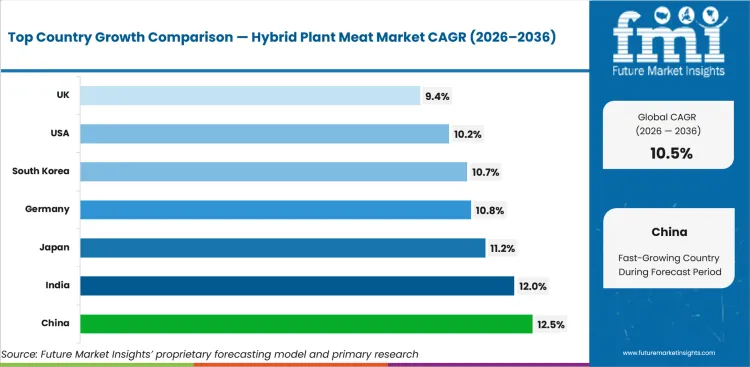
How does country-level CAGR compare in the hybrid plant meat market?
China leads country growth while France records the most cautious expansion outlook among profiled markets.
- China is forecast to record 12.5% CAGR by 2036 as local product routes align with processed meat, retail, and foodservice demand.
- India is forecast to record 12.0% CAGR by 2036 as local product routes align with processed meat, retail, and foodservice demand.
- Japan is forecast to record 11.2% CAGR by 2036 as local product routes align with processed meat, retail, and foodservice demand.
- Germany is forecast to record 10.8% CAGR by 2036 as local product routes align with processed meat, retail, and foodservice demand.
- South Korea is forecast to record 10.7% CAGR by 2036 as local product routes align with processed meat, retail, and foodservice demand.
- United States is forecast to record 10.2% CAGR by 2036 as local product routes align with processed meat, retail, and foodservice demand.
- United Kingdom is forecast to record 9.4% CAGR by 2036 as local product routes align with processed meat, retail, and foodservice demand.
- France is forecast to record 8.9% CAGR by 2036 as local product routes align with processed meat, retail, and foodservice demand.
How fast is the hybrid plant meat market growing in China?
A 12.5% CAGR through 2036 reflects large meat production and processed food manufacturing scale.
Country Market Snapshot Table
| Parameter | Value |
|---|---|
| Market Size in 2025 (Value) | USD 97.8 million |
| Market Size in 2026 (Value) | USD 110.0 million |
| Market Forecast in 2036 (Value) | USD 357.2 million |
| CAGR (2026 to 2036) | 12.5% |
| Years Considered | 2021 to 2036 |
| Base Year | 2025 |
| Forecast Period | 2026 to 2036 |
| Units Considered | Value (USD million) |
| Leading Sub-Region | Shanghai, Beijing, Shenzhen, Guangzhou, and Chengdu processed food corridors |
China Hybrid Plant Meat Market Outlook
China hybrid plant meat demand is expected to move through pork mince, dumpling fillings, prepared meals, and quick-service supply chains. The category works best when it improves processing efficiency rather than asking shoppers to buy a niche protein product.
Domestic soy, pea, and mushroom ingredient systems give processors a route to blended recipes that preserve familiar flavors. Suppliers with clear recipe performance and reliable cold-chain execution should gain better access to urban foodservice buyers.
Key Growth Drivers
- China has the largest meat production base among profiled countries. The National Bureau of Statistics reported pork, beef, mutton, and poultry output at 96.63 million tonnes in 2024.
- Processed chicken exports give suppliers a model for standardized blended products. USDA FAS reported China chicken meat exports at USD 2.59 billion in 2025.
- Prepared-food manufacturers can standardize plant inclusions inside dumplings, pork mince, and chilled meal components without changing the meal occasion.
- Domestic soy and pea protein suppliers can support cost control for formulated meat products that need stable ingredient availability.
Key Restraints
- Pork remains a strong price benchmark for hybrid blends. USDA FAS placed China pork consumption at 43 kg per capita in 2025.
- Consumers may read plant inclusion as lower meat quality if the label does not explain taste, juiciness, or recipe performance.
- Provincial foodservice routes can slow consistent launch execution outside top-tier cities when distributor coverage is uneven.
What makes China unique
China can turn hybrid plant meat into a processing-efficiency category rather than a niche sustainability product.
Key Companies
- Shuanghui Development
- New Hope Liuhe
- Jinluo Group
- Zhenmeat
- Qishan Foods
- Starfield Food Science
Sales & Marketing Channels
- Quick-service supply chains
- Frozen dumpling makers
- Supermarket prepared foods
- Meat processors
- Ingredient distributors
- Online grocery platforms
Country Segment Breakdown Table
| Segment | Sub-Segments |
|---|---|
| By Product Format | Burgers · Nuggets · Sausages · Meatballs · Mince · Whole Cuts |
| By Plant Ingredient | Mushrooms · Pea Protein · Soy Protein · Legumes · Mycoprotein |
| By Meat Base | Beef · Poultry · Pork · Seafood · Mixed Meat |
| By Sales Channel | Retail · Foodservice · Institutional |
| By Blend Ratio | Meat-Forward · Balanced Blend · Plant-Forward |
| Key Sub-Regions Covered | Shanghai · Beijing · Shenzhen · Guangzhou · Chengdu · Hangzhou |
Frequently Asked Questions
How fast is China hybrid plant meat market growing?
Sales in China are projected to grow at 12.5% CAGR from 2026 to 2036, supported by processed food scale.
Who leads China hybrid plant meat market?
Shuanghui Development, New Hope Liuhe, Jinluo Group, Zhenmeat, Qishan Foods, and Starfield Food Science compete through local processing and ingredient access.
What is driving adoption in China hybrid plant meat market?
Large meat output and standardized prepared-food production are moving hybrid products into mince, dumpling, and meal applications.
How fast is the hybrid plant meat market growing in India?
A 12.0% CAGR through 2036 reflects poultry snack formats and strict dietary identity management.
Country Market Snapshot Table
| Parameter | Value |
|---|---|
| Market Size in 2025 (Value) | USD 28.6 million |
| Market Size in 2026 (Value) | USD 32.0 million |
| Market Forecast in 2036 (Value) | USD 99.4 million |
| CAGR (2026 to 2036) | 12.0% |
| Years Considered | 2021 to 2036 |
| Base Year | 2025 |
| Forecast Period | 2026 to 2036 |
| Units Considered | Value (USD million) |
| Leading Sub-Region | Delhi NCR, Maharashtra, Karnataka, Tamil Nadu, Telangana, and West Bengal frozen snack corridors |
India Hybrid Plant Meat Market Outlook
India hybrid plant meat demand is expected to develop through poultry snacks, quick-service items, kebabs, and frozen products. Beef reduction is not the main category route because poultry and mutton formats offer clearer commercial access.
Frozen snack makers and cloud kitchens can test blends where texture, cost, and spice systems matter more than a vegan message. Label clarity and cross-contact controls remain important for mixed dietary households.
Key Growth Drivers
- India has a poultry-heavy meat base for hybrid nuggets and kebabs. PIB reported total meat production of 10.50 million tonnes in 2024-25.
- Poultry is the practical base for early hybrid products. PIB reported poultry meat production of 5.18 million tonnes in 2024-25.
- Quick-service chains can test blends through limited-time menu items before moving successful products into national freezer placement.
- Frozen snack makers can use plant proteins to manage texture and cost in chicken-based formats without changing familiar spice profiles.
Key Restraints
- Conventional protein supply is still expanding. DAHD reported 2.46% growth in India meat production during 2024-25.
- Vegetarian identity rules make shelf placement and cross-contact controls sensitive for mixed protein products.
- Cold-chain reach can slow premium frozen hybrid products outside modern retail and quick-service distribution networks.
What makes India unique
India’s hybrid market is shaped by poultry snacks and dietary identity management more than beef reduction.
Key Companies
- Godrej Tyson Foods
- Suguna Foods
- Venky’s India
- Licious
- ITC Foods
- Tata Simply Better channel partners
Sales & Marketing Channels
- Quick-service chains
- Frozen snack distributors
- Modern retail freezers
- Cloud kitchen brands
- Foodservice wholesalers
- Poultry processor partnerships
Country Segment Breakdown Table
| Segment | Sub-Segments |
|---|---|
| By Product Format | Burgers · Nuggets · Sausages · Meatballs · Mince · Whole Cuts |
| By Plant Ingredient | Mushrooms · Pea Protein · Soy Protein · Legumes · Mycoprotein |
| By Meat Base | Beef · Poultry · Pork · Seafood · Mixed Meat |
| By Sales Channel | Retail · Foodservice · Institutional |
| By Blend Ratio | Meat-Forward · Balanced Blend · Plant-Forward |
| Key Sub-Regions Covered | Delhi NCR · Maharashtra · Karnataka · Tamil Nadu · Telangana · West Bengal |
Frequently Asked Questions
How fast is India hybrid plant meat market growing?
Sales in India are projected to grow at 12.0% CAGR from 2026 to 2036, led by poultry-based snacks.
Who leads India hybrid plant meat market?
Godrej Tyson Foods, Suguna Foods, Venky’s India, Licious, ITC Foods, and Tata Simply Better channel partners are relevant to local hybrid product development.
What is driving adoption in India hybrid plant meat market?
Poultry output and frozen snack manufacturing are moving hybrid products into nuggets, kebabs, and quick-service items.
What is the hybrid plant meat market forecast for Japan?
An 11.2% CAGR through 2036 reflects convenience meal design and processed food reformulation.
Country Market Snapshot Table
| Parameter | Value |
|---|---|
| Market Size in 2025 (Value) | USD 32.4 million |
| Market Size in 2026 (Value) | USD 36.0 million |
| Market Forecast in 2036 (Value) | USD 104.1 million |
| CAGR (2026 to 2036) | 11.2% |
| Years Considered | 2021 to 2036 |
| Base Year | 2025 |
| Forecast Period | 2026 to 2036 |
| Units Considered | Value (USD million) |
| Leading Sub-Region | Tokyo, Osaka, Yokohama, Nagoya, Fukuoka, and Sapporo convenience meal corridors |
Japan Hybrid Plant Meat Market Outlook
Japan hybrid plant meat demand is expected to develop through convenience meals, bento fillings, and hamburger steak formats. Smaller portion sizes lower rejection risk when texture and clean taste are controlled.
Soy and mushroom ingredients are already familiar in Japanese cooking, which helps hybrid recipes avoid a foreign product image. Convenience-store buyers should favor formats with predictable reheating and simple pack communication.
Key Growth Drivers
- Japan’s processed meal base supports portion-controlled reformulation. USDA FAS reported Japan beef production rose 1% in the first half of 2024.
- Convenience meal developers have a poultry route for blended products. USDA FAS reported Japan chicken production expanded 3% in the first half of 2024.
- Convenience stores can test blended fillings in bento and lunch formats with less education than a stand-alone meat alternative shelf requires.
- Soy and mushroom ingredients fit familiar Japanese recipe systems, making hybrid hamburger steak and prepared meals easier to explain.
Key Restraints
- Japan remains sensitive to meat-quality cues. USDA FAS reported total cattle slaughter was unchanged in the first half of 2024.
- Imported plant protein costs can limit mass-market pricing in ready meals when yen weakness affects ingredient procurement.
- Ingredient labels must align with clean taste expectations before hybrid products move beyond controlled convenience trials.
What makes Japan unique
Japan’s strongest hybrid route is convenience food design rather than a Western-style burger shelf.
Key Companies
- Itoham Yonekyu Holdings
- NH Foods
- Marudai Food
- Ajinomoto Frozen Foods
- Nippon Ham prepared food partners
Sales & Marketing Channels
- Convenience store chains
- Ready meal manufacturers
- Foodservice wholesalers
- Bento suppliers
- Retail chilled meal aisles
- Ingredient distributors
Country Segment Breakdown Table
| Segment | Sub-Segments |
|---|---|
| By Product Format | Burgers · Nuggets · Sausages · Meatballs · Mince · Whole Cuts |
| By Plant Ingredient | Mushrooms · Pea Protein · Soy Protein · Legumes · Mycoprotein |
| By Meat Base | Beef · Poultry · Pork · Seafood · Mixed Meat |
| By Sales Channel | Retail · Foodservice · Institutional |
| By Blend Ratio | Meat-Forward · Balanced Blend · Plant-Forward |
| Key Sub-Regions Covered | Tokyo · Osaka · Yokohama · Nagoya · Fukuoka · Sapporo |
Frequently Asked Questions
How fast is Japan hybrid plant meat market growing?
Sales in Japan are projected to grow at 11.2% CAGR from 2026 to 2036 through convenience meal reformulation.
Who leads Japan hybrid plant meat market?
Itoham Yonekyu, NH Foods, Marudai Food, Ajinomoto Frozen Foods, and Nippon Ham partners compete through prepared food systems.
What is driving adoption in Japan hybrid plant meat market?
Convenience retail and familiar soy or mushroom ingredients are moving hybrid products into bento, hamburger steak, and ready meal formats.
How is the hybrid plant meat market performing in Germany?
A 10.8% CAGR through 2036 reflects discount retail testing, processed meat capacity, and price-led reformulation.
Country Market Snapshot Table
| Parameter | Value |
|---|---|
| Market Size in 2025 (Value) | USD 49.6 million |
| Market Size in 2026 (Value) | USD 55.0 million |
| Market Forecast in 2036 (Value) | USD 153.4 million |
| CAGR (2026 to 2036) | 10.8% |
| Years Considered | 2021 to 2036 |
| Base Year | 2025 |
| Forecast Period | 2026 to 2036 |
| Units Considered | Value (USD million) |
| Leading Sub-Region | North Rhine-Westphalia, Bavaria, Baden-Wurttemberg, Berlin, Hamburg, and Hesse grocery corridors |
Germany Hybrid Plant Meat Market Outlook
Germany hybrid plant meat demand is expected to grow through discounters and private label meat suppliers. Mince and burger patties are the easiest routes because pea protein and mushrooms can be blended without whole-cut texture claims.
Discount grocery structure gives suppliers a fast price-parity test. Products must explain whether the pack is a meat product with plant inclusion rather than a vegan alternative.
Key Growth Drivers
- Germany has the meat processing scale needed for blended mince. Eurostat reported Germany produced 4.3 million tonnes of pigmeat in 2024.
- Beef blends have a manufacturing base in Germany. Eurostat reported Germany accounted for 16.9% of EU beef production in 2024.
- Discounters can move blended mince through weekly meat shopping missions where shoppers already compare price per pack.
- German meat processors can use pea protein and mushroom inclusions to manage input cost volatility in ground products.
Key Restraints
- Conventional poultry remains a strong price anchor. Eurostat reported Germany accounted for 10.9% of EU poultrymeat output in 2024.
- Clear naming is required because buyers can resist products that feel unclear between meat and plant-based shelves.
- Low-cost pork and poultry can make premium hybrid products harder to justify in discount channels.
What makes Germany unique
Germany’s discount grocery structure gives hybrid products a faster price-parity test than most European markets.
Key Companies
- Lidl
- Rügenwalder Mühle
- Tönnies Group
- PHW Group
- Endori channel partners
Sales & Marketing Channels
- Discount grocery chains
- Private label meat suppliers
- Chilled mince fixtures
- Foodservice wholesalers
- Contract manufacturing partners
- Retail sustainability ranges
Country Segment Breakdown Table
| Segment | Sub-Segments |
|---|---|
| By Product Format | Burgers · Nuggets · Sausages · Meatballs · Mince · Whole Cuts |
| By Plant Ingredient | Mushrooms · Pea Protein · Soy Protein · Legumes · Mycoprotein |
| By Meat Base | Beef · Poultry · Pork · Seafood · Mixed Meat |
| By Sales Channel | Retail · Foodservice · Institutional |
| By Blend Ratio | Meat-Forward · Balanced Blend · Plant-Forward |
| Key Sub-Regions Covered | North Rhine-Westphalia · Bavaria · Baden-Wurttemberg · Berlin · Hamburg · Hesse |
Frequently Asked Questions
How fast is Germany hybrid plant meat market growing?
Sales in Germany are projected to grow at 10.8% CAGR from 2026 to 2036, guided by discount retail testing.
Who leads Germany hybrid plant meat market?
Lidl, Rügenwalder Mühle, Tönnies Group, PHW Group, and Endori channel partners shape the local evidence base.
What is driving adoption in Germany hybrid plant meat market?
Discounters and processed meat suppliers are moving blended mince and patties toward price-parity testing.
How fast is the hybrid plant meat market growing in South Korea?
A 10.7% CAGR through 2036 reflects premium meat culture and convenience meal reformulation.
Country Market Snapshot Table
| Parameter | Value |
|---|---|
| Market Size in 2025 (Value) | USD 25.3 million |
| Market Size in 2026 (Value) | USD 28.0 million |
| Market Forecast in 2036 (Value) | USD 77.4 million |
| CAGR (2026 to 2036) | 10.7% |
| Years Considered | 2021 to 2036 |
| Base Year | 2025 |
| Forecast Period | 2026 to 2036 |
| Units Considered | Value (USD million) |
| Leading Sub-Region | Seoul, Busan, Incheon, Daegu, Daejeon, and Gyeonggi convenience meal corridors |
South Korea Hybrid Plant Meat Market Outlook
South Korea hybrid plant meat demand is expected to depend on quality positioning rather than low-price meat extension. Blends must improve juiciness, nutrition, or portion control instead of appearing as filler.
Convenience meal makers and restaurant suppliers can test mushroom-beef blends when the product protects taste expectations. Clear label discipline is needed because premium meat culture makes dilution claims risky.
Key Growth Drivers
- South Korea has a high-value beef setting for premium blended formats. A 2026 climate policy analysis placed South Korea beef consumption at 15 kg per capita in 2024.
- Supply pressure can support meat-extension trials. USDA FAS reported Korean beef cattle inventory dropped by 210,000 head from June 2024 to June 2025.
- Convenience meal makers can use blended patties in lunchbox and snack formats where portion control and reheating performance matter.
- Restaurant suppliers can test mushroom-beef blends in casual dining where juiciness is a direct selling point.
Key Restraints
- Premium meat supply remains tighter. USDA FAS reported Korean beef cattle inventory declined 5.8% from June 2024 to June 2025.
- Premium beef culture makes dilution claims risky unless product language emphasizes quality, juiciness, and recipe performance.
- Imported plant protein and allergen controls can add cost for processors serving refrigerated ready meals.
What makes South Korea unique
South Korea’s hybrid opportunity depends on quality positioning more than low-price meat extension.
Key Companies
- CJ CheilJedang
- Pulmuone
- Lotte Wellfood
- Dongwon F&B
- Shinsegae Food
- Ourhome
Sales & Marketing Channels
- Convenience meal makers
- Restaurant distributors
- Chilled retail aisles
- Burger chains
- Food ingredient suppliers
- Online grocery channels
Country Segment Breakdown Table
| Segment | Sub-Segments |
|---|---|
| By Product Format | Burgers · Nuggets · Sausages · Meatballs · Mince · Whole Cuts |
| By Plant Ingredient | Mushrooms · Pea Protein · Soy Protein · Legumes · Mycoprotein |
| By Meat Base | Beef · Poultry · Pork · Seafood · Mixed Meat |
| By Sales Channel | Retail · Foodservice · Institutional |
| By Blend Ratio | Meat-Forward · Balanced Blend · Plant-Forward |
Frequently Asked Questions
How fast is South Korea hybrid plant meat market growing?
Sales in South Korea are projected to grow at 10.7% CAGR from 2026 to 2036 through premium convenience meal reformulation.
Who leads South Korea hybrid plant meat market?
CJ CheilJedang, Pulmuone, Lotte Wellfood, Dongwon F&B, Shinsegae Food, and Ourhome compete through ready meal and foodservice routes.
What is driving adoption in South Korea hybrid plant meat market?
Premium beef culture and convenience meal systems are moving hybrid products toward quality-led patty and lunchbox formats.
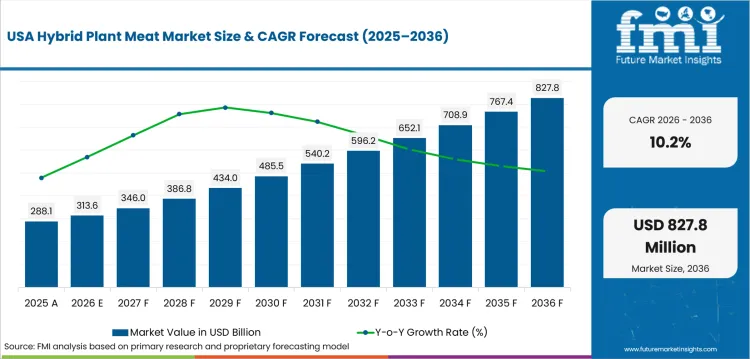
How fast is the hybrid plant meat market growing in the United States?
A 10.2% CAGR through 2036 reflects foodservice testing, school meal scale, and meat-counter access.
Country Market Snapshot Table
| Parameter | Value |
|---|---|
| Market Size in 2025 (Value) | USD 145.2 million |
| Market Size in 2026 (Value) | USD 160.0 million |
| Market Forecast in 2036 (Value) | USD 422.6 million |
| CAGR (2026 to 2036) | 10.2% |
| Years Considered | 2021 to 2036 |
| Base Year | 2025 |
| Forecast Period | 2026 to 2036 |
| Units Considered | Value (USD million) |
| Leading Sub-Region | California, Texas, Midwest, Northeast, Pacific Northwest, and national school foodservice networks |
United States Hybrid Plant Meat Market Outlook
United States hybrid plant meat demand is expected to build around burgers, nuggets, and blended beef patties. Meat reducers remain close to conventional meals, so products must work on existing grills and in frozen retail formats.
Foodservice and institutional buyers are expected to test products when cooking behavior is predictable. Retailers should favor products that explain plant inclusion as taste, cost, or nutrition support rather than identity switching.
Key Growth Drivers
- U.S. meat occasions give blended products a large addressable base. USDA ERS projected 227 pounds of red meat and poultry availability per consumer in 2026.
- School meal operators give blended nuggets a controlled trial setting. USDA ERS reported more than 4.8 billion National School Lunch Program lunches in FY 2024.
- Retail meat departments can place blended patties beside beef, which reduces the aisle-switching barrier for mainstream shoppers.
- Foodservice distributors can sell hybrid products as cost, nutrition, and handling tools for high-volume menus.
Key Restraints
- Label scrutiny remains a launch restraint. The Federal Register identified 98,374 meat, poultry, and egg product retail labels in its 2024 origin-claims analysis.
- Plant-based meat sales pressure can make retailers cautious about adding hybrid SKUs before repeat purchase is proven.
- Hybrid products can be rejected if shoppers see them as diluted meat rather than a better-performing burger or nugget.
What makes United States unique
The United States is the clearest test market for whether hybrid meat can move from novelty into institutional volume.
Key Companies
- Perdue Foods
- Pat LaFrieda Meat Purveyors
- Mush Foods
- Joyn Foods
- 50/50 Foods
- DUO
- The Spare Food Co.
Sales & Marketing Channels
- Retail meat departments
- Frozen grocery aisles
- School foodservice distributors
- Hospital catering contracts
- Quick-service restaurant pilots
- Direct brand sampling
Country Segment Breakdown Table
| Segment | Sub-Segments |
|---|---|
| By Product Format | Burgers · Nuggets · Sausages · Meatballs · Mince · Whole Cuts |
| By Plant Ingredient | Mushrooms · Pea Protein · Soy Protein · Legumes · Mycoprotein |
| By Meat Base | Beef · Poultry · Pork · Seafood · Mixed Meat |
| By Sales Channel | Retail · Foodservice · Institutional |
| By Blend Ratio | Meat-Forward · Balanced Blend · Plant-Forward |
Frequently Asked Questions
How fast is United States hybrid plant meat market growing?
Sales in the United States are projected to grow at 10.2% CAGR from 2026 to 2036, led by institutional testing.
Who leads United States hybrid plant meat market?
Perdue Foods, Pat LaFrieda Meat Purveyors, Mush Foods, Joyn Foods, 50/50 Foods, DUO, and The Spare Food Co. shape public product evidence.
What is driving adoption in United States hybrid plant meat market?
Foodservice testing and meat-counter access are moving blended burgers, nuggets, and patties toward mainstream buyers.
What is driving hybrid plant meat growth in the United Kingdom?
A 9.4% CAGR through 2036 reflects public catering trials and mycoprotein familiarity across managed foodservice.
Country Market Snapshot Table
| Parameter | Value |
|---|---|
| Market Size in 2025 (Value) | USD 40.2 million |
| Market Size in 2026 (Value) | USD 44.0 million |
| Market Forecast in 2036 (Value) | USD 108.1 million |
| CAGR (2026 to 2036) | 9.4% |
| Years Considered | 2021 to 2036 |
| Base Year | 2025 |
| Forecast Period | 2026 to 2036 |
| Units Considered | Value (USD million) |
| Leading Sub-Region | London, Manchester, Birmingham, Leeds, Glasgow, and Bristol public catering corridors |
United Kingdom Hybrid Plant Meat Market Outlook
United Kingdom hybrid plant meat demand is expected to advance through NHS catering, contract caterers, and retailer chilled-meat tests. The market needs careful wording because consumers already associate several brands with vegetarian or vegan products.
Public procurement and foodservice settings can test hybrid products before broad retail rollout. Products that manage allergens, menu wording, and cost per serving should move faster than premium retail-only launches.
Key Growth Drivers
- Public catering gives hybrid products a route beyond retail launches. DEFRA reported total UK meat production of 4,166 thousand tonnes in 2024.
- The food system gives suppliers a large buyer base. GOV.UK reported 4.1 million people employed in the agri-food sector in 2025.
- Contract caterers can test hybrid sausages and burgers across controlled menus before expanding into retail shelves.
- Retailers can use hybrid products in value ranges where shoppers want familiar meals with lower meat content.
Key Restraints
- Cost pressure can limit premium blended meat trials. The Food Standards Agency reported 22% of consumers were worried about affording food in June 2025.
- Vegetarian brand trust can weaken if meat blends use equity built through meat-free positioning.
- Foodservice buyers need allergen and dietary-status clarity before listing hybrid products on managed menus.
What makes United Kingdom unique
The United Kingdom is distinct because mycoprotein familiarity creates a bridge from vegetarian protein into meat reduction.
Key Companies
- Quorn Foods
- Marlow Ingredients
- Finnebrogue
- The Meatless Farm channel partners
- Hilton Food Group private label partners
Sales & Marketing Channels
- NHS catering buyers
- Contract caterers
- Retail chilled meat aisles
- Foodservice wholesalers
- University dining programs
- Brand-led sampling
Country Segment Breakdown Table
| Segment | Sub-Segments |
|---|---|
| By Product Format | Burgers · Nuggets · Sausages · Meatballs · Mince · Whole Cuts |
| By Plant Ingredient | Mushrooms · Pea Protein · Soy Protein · Legumes · Mycoprotein |
| By Meat Base | Beef · Poultry · Pork · Seafood · Mixed Meat |
| By Sales Channel | Retail · Foodservice · Institutional |
| By Blend Ratio | Meat-Forward · Balanced Blend · Plant-Forward |
| Key Sub-Regions Covered | London · Manchester · Birmingham · Leeds · Glasgow · Bristol |
Frequently Asked Questions
How fast is United Kingdom hybrid plant meat market growing?
Demand in the United Kingdom is projected to rise at 9.4% CAGR from 2026 to 2036 through public catering and retail tests.
Who leads United Kingdom hybrid plant meat market?
Quorn Foods, Marlow Ingredients, Finnebrogue, The Meatless Farm channel partners, and Hilton Food Group partners shape the local route.
What is driving adoption in United Kingdom hybrid plant meat market?
Mycoprotein familiarity and public catering tests are moving hybrid products into managed foodservice and chilled retail formats.
How is the hybrid plant meat market performing in France?
An 8.9% CAGR through 2036 reflects cautious retail progress under close meat terminology scrutiny.
Country Market Snapshot Table
| Parameter | Value |
|---|---|
| Market Size in 2025 (Value) | USD 34.9 million |
| Market Size in 2026 (Value) | USD 38.0 million |
| Market Forecast in 2036 (Value) | USD 89.1 million |
| CAGR (2026 to 2036) | 8.9% |
| Years Considered | 2021 to 2036 |
| Base Year | 2025 |
| Forecast Period | 2026 to 2036 |
| Units Considered | Value (USD million) |
| Leading Sub-Region | Paris, Lyon, Hauts-de-France, Brittany, Normandy, and Occitanie prepared food corridors |
France Hybrid Plant Meat Market Outlook
France hybrid plant meat demand is expected to develop through prepared foods, burgers, and meat products with declared plant additions. Clear quality and origin language is expected to matter more than broad sustainability claims.
The market is cautious because meat terminology remains closely reviewed. Hybrid products should perform better when they are presented as prepared meat recipes with defined plant ingredients.
Key Growth Drivers
- France has a large beef base for careful hybrid product development. Eurostat reported France accounted for 20.0% of EU beef production in 2024.
- Poultry processors have a route into blended prepared foods. Eurostat reported France accounted for 12.2% of EU poultrymeat output in 2024.
- Retail prepared foods can use hybrid recipes without forcing a vegan identity shift at the shelf.
- French meat processors can use plant additions within existing prepared meat systems when naming and composition rules are checked early.
Key Restraints
- Regulatory review remains a restraint. Légifrance published Decree No. 2024-144 on plant-protein naming for foods containing plant proteins in 2024.
- Consumer trust can fall if blends appear to dilute traditional meat products rather than improve prepared recipes.
- Local legal review adds launch cost for brands without French labeling and composition support.
What makes France unique
France is the country where regulatory wording may make hybrid products more practical than plant-only meat alternatives in selected contexts.
Key Companies
- Fleury Michon
- LDC Group
- Charal
- Herta France
- Sodebo supplier partners
Sales & Marketing Channels
- Supermarket prepared foods
- Chilled meat counters
- Regional meat processors
- Institutional caterers
- Food-law compliant private labels
- Restaurant supplier networks
Country Segment Breakdown Table
| Segment | Sub-Segments |
|---|---|
| By Product Format | Burgers · Nuggets · Sausages · Meatballs · Mince · Whole Cuts |
| By Plant Ingredient | Mushrooms · Pea Protein · Soy Protein · Legumes · Mycoprotein |
| By Meat Base | Beef · Poultry · Pork · Seafood · Mixed Meat |
| By Sales Channel | Retail · Foodservice · Institutional |
| By Blend Ratio | Meat-Forward · Balanced Blend · Plant-Forward |
| Key Sub-Regions Covered | Paris · Lyon · Hauts-de-France · Brittany · Normandy · Occitanie |
Frequently Asked Questions
How fast is France hybrid plant meat market growing?
Industry in France is projected to grow at 8.9% CAGR from 2026 to 2036, shaped by careful prepared-food rollout.
Who leads France hybrid plant meat market?
Fleury Michon, LDC Group, Charal, Herta France, and Sodebo supplier partners are relevant local processors.
What is driving adoption in France hybrid plant meat market?
Beef and poultry production depth is supporting blended prepared foods, although terminology rules keep rollout cautious.
Who are the leading companies in the hybrid plant meat market?
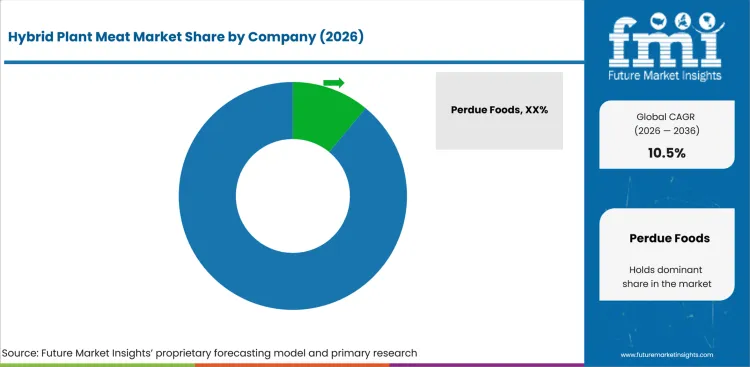
Perdue Foods, Lidl, Quorn Foods, Joyn Foods, Pat LaFrieda Meat Purveyors, 50/50 Foods, DUO, and The Spare Food Co. are key companies in the hybrid plant meat market.
- Meat processors compete through existing meat-processing assets, cold-chain access, and product handling familiarity.
- Retailers and foodservice innovators gain relevance by testing blended mince, burgers, nuggets, and managed menu formats.
- Specialist hybrid brands compete through clear blend ratios, familiar cooking behavior, and consumer-friendly product language.
- Suppliers with mushroom, pea protein, soy protein, and mycoprotein systems are better placed when they lower meat content without hurting taste.
Competition in the hybrid plant meat market is shaped by meat-processing knowledge, blend-ratio clarity, and channel testing. Meat processors have an advantage because hybrid formats must cook, hold, and taste like familiar meat products. Retailers and institutional buyers are expected to support products that reduce meat content without forcing consumers into a full plant-based switch.
Perdue Foods and Pat LaFrieda Meat Purveyors are relevant through public product evidence in blended poultry and beef formats. Lidl, Quorn Foods, Joyn Foods, 50/50 Foods, DUO, and The Spare Food Co. represent retail, foodservice, and specialist hybrid routes. Companies that explain meat content, plant inclusion, allergens, and cooking behavior clearly should gain stronger repeat purchase.
How do top hybrid plant meat companies compare?
Perdue Foods and Pat LaFrieda Meat Purveyors score strongest on meat-processing credibility, while Lidl and Quorn Foods improve category visibility through retail and managed foodservice testing.
| Company | Relevance to Market Title | Meat Processing Fit | Plant Ingredient Integration | Channel Testing Strength | Consumer Communication | Geographic Footprint |
|---|---|---|---|---|---|---|
| Perdue Foods | Very High | Very Strong | Strong | Strong | Strong | United States |
| Lidl | Very High | Moderate | Strong | Very Strong | Strong | Europe |
| Quorn Foods | High | Moderate | Very Strong | Strong | Strong | United Kingdom, Europe |
| Joyn Foods | High | Strong | Strong | Medium | Strong | United States |
| Pat LaFrieda Meat Purveyors | High | Very Strong | Strong | Medium | Medium | United States |
| 50/50 Foods | High | Strong | Strong | Medium | Very Strong | United States |
| DUO | High | Strong | Strong | Medium | Strong | United States |
| The Spare Food Co. | Moderate to High | Medium | Strong | Medium | Strong | United States |
Source: Future Market Insights competitive analysis, 2026.
Who are the key players in the hybrid plant meat market?
Key companies participating in the hybrid plant meat market include:
Meat Processors
- Perdue Foods
- Pat LaFrieda Meat Purveyors
Retail and Foodservice Innovators
- Lidl
- Quorn Foods
- The Spare Food Co.
Specialist Hybrid Brands
- Joyn Foods
- 50/50 Foods
- DUO
Key Developments in Hybrid Plant Meat Market
- In June 2024, Quorn announced a move toward blended meat products for NHS settings. The development matters because public catering can validate hybrid menus at scale.
- In August 2024, Lidl introduced a blended mince product with 60% beef and 40% pea protein. The launch matters because it used price as a selling point.
- In April 2024, Pat LaFrieda and Mush Foods commercialized a beef and mushroom burger concept. The launch matters because butcher-led validation reduces buyer risk.
Hybrid Plant Meat Market - Report Scope
| Item | Value |
|---|---|
| Market size by 2036 | USD 1.68 billion |
| Growth rate | 10.5% CAGR from 2026 to 2036 |
| Forecast period | 2026 to 2036 |
| Base year value (2025) | USD 0.56 billion |
| By product format | Burgers, nuggets, sausages, meatballs, mince, whole cuts |
| By plant ingredient | Mushrooms, pea protein, soy protein, legumes, mycoprotein |
| By meat base | Beef, poultry, pork, seafood, mixed meat |
| By sales channel | Retail, foodservice, institutional |
| By blend ratio | Meat-forward, balanced blend, plant-forward |
| Regions covered | North America, Latin America, Europe, East Asia, South Asia and Pacific, Middle East and Africa |
| Countries covered | China, India, Japan, Germany, South Korea, United States, United Kingdom, France |
| Key companies profiled | Perdue Foods, Lidl, Quorn Foods, Joyn Foods, Pat LaFrieda Meat Purveyors, 50/50 Foods, DUO, The Spare Food Co. |
| Approach | Hybrid bottom-up and top-down approach using product evidence, meat production data, channel presence, blend ratios, country-level adoption, and buyer interviews |
Source: Future Market Insights, 2026.
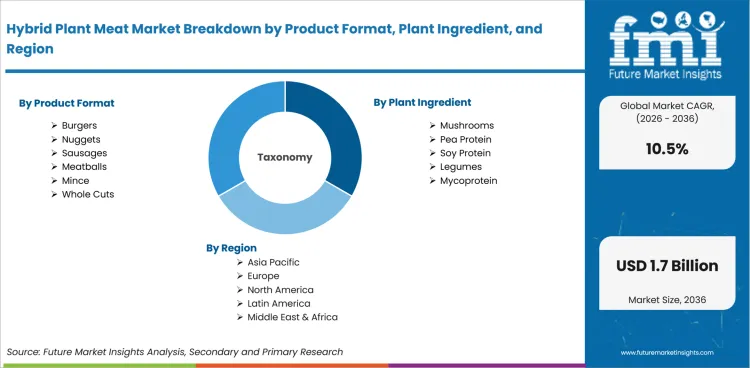
Hybrid Plant Meat Market Breakdown by Product Format, Plant Ingredient, Meat Base, Sales Channel, Blend Ratio, and Region
Hybrid Plant Meat Market Segmented by Product Format:
- Burgers
- Nuggets
- Sausages
- Meatballs
- Mince
- Whole Cuts
Hybrid Plant Meat Market Segmented by Plant Ingredient:
- Mushrooms
- Pea Protein
- Soy Protein
- Legumes
- Mycoprotein
Hybrid Plant Meat Market Segmented by Meat Base:
- Beef
- Poultry
- Pork
- Seafood
- Mixed Meat
Hybrid Plant Meat Market Segmented by Sales Channel:
- Retail
- Foodservice
- Institutional
Hybrid Plant Meat Market Segmented by Blend Ratio:
- Meat-Forward
- Balanced Blend
- Plant-Forward
Hybrid Plant Meat Market by Region:
- North America
- Latin America
- Europe
- East Asia
- South Asia and Pacific
- Middle East and Africa
Research Sources and Bibliography
- Good Food Institute. (2024, November). Category update on blended meat.
- Good Food Institute. (2025, May). 2024 state of the industry: Plant-based meat, seafood, eggs, dairy, and ingredients.
- Organisation for Economic Co-operation and Development & Food and Agriculture Organization. (2025, July 15). OECD-FAO Agricultural Outlook 2025-2034: Meat.
- United States Department of Agriculture Economic Research Service. (2025, August 21). Per capita availability of red meat and poultry projected higher in 2025 and 2026.
- United States Department of Agriculture Economic Research Service. (2025, August 5). National School Lunch Program.
- United States Department of Agriculture Economic Research Service. (2026, June 4). Animal protein continues to be plentiful for U.S. consumers.
- Food Standards Agency. (2025, July 30). Consumer Insights Tracker: April 2025-June 2025.
- Department for Environment, Food & Rural Affairs. (2025, July 10). Agriculture in the United Kingdom 2024: Chapter 8 Livestock.
- Department for Environment, Food & Rural Affairs. (2026, February 25). Food statistics in your pocket.
- QuornPro. (2024, June). Quorn & NHS partner on the Let’s Meat Halfway initiative.
- Eurostat. (2025, October 23). Agricultural production - livestock and meat.
- Eurostat. (2025, October 23). Poultry statistics.
- Legifrance. (2024, February 26). Décret n° 2024-144 relatif à l’utilisation de certaines dénominations employées pour désigner des denrées comportant des protéines végétales.
- Conseil d’État. (2024, April 10). Ordonnance n° 492844: Suspension du décret n° 2024-144.
- Ministry of Agriculture, Forestry and Fisheries of Japan. (2025). The 99th statistical yearbook of Ministry of Agriculture, Forestry and Fisheries.
- United States Department of Agriculture Foreign Agricultural Service. (2024, September 12). Livestock and products annual: Japan.
- National Bureau of Statistics of China. (2025, January 28). China’s production of cattle, sheep, poultry remains stable in 2024.
- United States Department of Agriculture Foreign Agricultural Service. (2026, April 9). Livestock and poultry: World markets and trade.
- For Our Climate. (2026, May 14). South Korea’s beef consumption has increased 3.3 times from 1990 to 2024.
- United States Department of Agriculture Foreign Agricultural Service. (2025, November 20). Livestock and products annual: Korea.
- Press Information Bureau. (2025, November 26). Release of Basic Animal Husbandry Statistics 2025.
- Department of Animal Husbandry and Dairying. (2025, November). Basic Animal Husbandry Statistics 2025.
- ProVeg International. (2024, June 27). ProVeg responds to Quorn move to introduce blended meat products into hospitals.
- ProVeg International. (2024, August 22). Dutch Lidl cuts cost of plant-based foods, makes minced meat partly plant-based.
- Prepared Foods. (2025, November 25). Upcycled veg brings better beef to foodservice.
This bibliography is provided for reader reference and draws on government, regulatory, official company, association, and trade sources used for verification.
Hybrid Plant Meat Market - Scope & Definition
| Attribute | Detail |
|---|---|
| Market Definition | Finished meat products that combine animal meat with plant ingredients or alternative plant-derived proteins |
| Functions Covered | Meat reduction, cost control, texture improvement, nutrition repositioning, and menu reformulation |
| Applications Covered | Burgers, nuggets, sausages, meatballs, mince, whole cuts, prepared meals, and institutional menu products |
| End-Use Industries | Retail meat, foodservice, institutional catering, prepared foods, frozen snacks, and meat processing |
| Blend Ratios Covered | Meat-forward, balanced blend, and plant-forward hybrid meat formats |
| Inclusions | Commercially traded hybrid meat products across product format, plant ingredient, meat base, sales channel, blend ratio, and region |
| Exclusions | Fully vegan meat analogs, cultivated meat without animal meat, conventional unblended meat cuts, tofu blocks, tempeh, seitan, and flavor extracts sold as ingredients |
Hybrid Plant Meat Market - Research Methodology
| Method | Description |
|---|---|
| Primary Research | FMI analyst interviews with meat processors, plant protein suppliers, mushroom ingredient producers, retailers, foodservice operators, institutional caterers, and distributors |
| Desk Research | Review of food safety rules, official meat output data, trade body reports, product pages, company disclosures, public product launches, and scientific literature related to blended meat formats |
| Market Sizing & Forecasting | Hybrid bottom-up and top-down approach using meat production volumes, blend ratios, product evidence, retail trials, foodservice pilots, and country-level adoption trends |
| Data Validation | Cross-verification using government data, official company evidence, ingredient availability, country meat consumption patterns, and buyer adoption signals |
This Report Answers
- What is the projected global value of the Hybrid Plant Meat Market in 2026 and 2036?
- What CAGR is expected for hybrid plant meat products during the 2026 to 2036 forecast period?
- Which product format is projected to lead demand in hybrid plant meat during 2026?
- Which plant ingredient is expected to hold the leading share in hybrid meat formulations?
- Why are meat processors and retailers testing hybrid plant meat products now?
- How do labeling rules and consumer trust affect hybrid plant meat adoption?
- Which selected countries are forecast to grow fastest in the hybrid plant meat category?
- Which companies have the strongest public evidence of activity in hybrid plant meat?
- What products are included and excluded from the hybrid plant meat market scope?
- How did FMI derive the forecast without using commercial market research figures?
Frequently Asked Questions
What is the global market demand for Hybrid Plant Meat Market in 2026?
In 2026, the global Hybrid Plant Meat Market is expected to be worth USD 0.62 billion as blended formats expand.
What will the Hybrid Plant Meat Market be worth by 2036?
By 2036, the Hybrid Plant Meat Market is projected to reach USD 1.68 billion with wider retail and foodservice use.
What CAGR is projected for the Hybrid Plant Meat Market from 2026 to 2036?
The Hybrid Plant Meat Market is forecast to expand at a 10.5% CAGR during the 2026 to 2036 period.
Which product format is projected to lead the Hybrid Plant Meat Market?
Burgers are projected to lead product format demand with 28.0% share in 2026 due to easy ground meat blending.
Which sales channel is expected to lead hybrid plant meat demand?
Retail is expected to lead with 45.0% channel share in 2026 as supermarkets test blended private-label products.
Which country is forecast to grow fastest in the Hybrid Plant Meat Market?
China is forecast to grow fastest at 12.5% CAGR through 2036 due to large meat output and processing scale.
What does hybrid plant meat mean?
Hybrid plant meat means a meat product that blends animal meat with plant ingredients such as mushrooms, peas, soy, or legumes.
How was the Hybrid Plant Meat Market forecast built?
The forecast uses a hybrid model combining meat output, product evidence, blend ratios, channel readiness, and country-level demand behavior.
Which hybrid meat product is best for first-time buyers?
Burgers are usually the best starting point because ground meat hides texture differences and cooks in a familiar way.
Is hybrid plant meat cheaper than fully plant-based meat?
Hybrid plant meat can be cheaper when the plant ingredient lowers meat content without adding high processing cost.
What is the difference between hybrid plant meat and plant-based meat?
Hybrid plant meat contains animal meat and plant ingredients. Plant-based meat is made only from plant or non-animal ingredients.
How does hybrid plant meat work in cooking?
Hybrid plant meat cooks like its meat base when the blend is designed for the same grill, oven, fryer, or pan process.
What are the main disadvantages of hybrid plant meat?
The main drawbacks are label confusion, allergen risk, possible taste compromise, and rejection by both strict vegetarians and meat purists.
Preview the report firsthand - request a free sample
Get SampleGet the brochure for pricing and purchase details.
Get PDFTable of Content
- Executive Summary
- Global Market Outlook
- Demand to side Trends
- Supply to side Trends
- Technology Roadmap Analysis
- Analysis and Recommendations
- Market Overview
- Market Coverage / Taxonomy
- Market Definition / Scope / Limitations
- Research Methodology
- Chapter Orientation
- Analytical Lens and Working Hypotheses
- Market Structure, Signals, and Trend Drivers
- Benchmarking and Cross-market Comparability
- Market Sizing, Forecasting, and Opportunity Mapping
- Research Design and Evidence Framework
- Desk Research Programme (Secondary Evidence)
- Company Annual and Sustainability Reports
- Peer-reviewed Journals and Academic Literature
- Corporate Websites, Product Literature, and Technical Notes
- Earnings Decks and Investor Briefings
- Statutory Filings and Regulatory Disclosures
- Technical White Papers and Standards Notes
- Trade Journals, Industry Magazines, and Analyst Briefs
- Conference Proceedings, Webinars, and Seminar Materials
- Government Statistics Portals and Public Data Releases
- Press Releases and Reputable Media Coverage
- Specialist Newsletters and Curated Briefings
- Sector Databases and Reference Repositories
- FMI Internal Proprietary Databases and Historical Market Datasets
- Subscription Datasets and Paid Sources
- Social Channels, Communities, and Digital Listening Inputs
- Additional Desk Sources
- Expert Input and Fieldwork (Primary Evidence)
- Primary Modes
- Qualitative Interviews and Expert Elicitation
- Quantitative Surveys and Structured Data Capture
- Blended Approach
- Why Primary Evidence is Used
- Field Techniques
- Interviews
- Surveys
- Focus Groups
- Observational and In-context Research
- Social and Community Interactions
- Stakeholder Universe Engaged
- C-suite Leaders
- Board Members
- Presidents and Vice Presidents
- R&D and Innovation Heads
- Technical Specialists
- Domain Subject-matter Experts
- Scientists
- Physicians and Other Healthcare Professionals
- Governance, Ethics, and Data Stewardship
- Research Ethics
- Data Integrity and Handling
- Primary Modes
- Tooling, Models, and Reference Databases
- Desk Research Programme (Secondary Evidence)
- Data Engineering and Model Build
- Data Acquisition and Ingestion
- Cleaning, Normalisation, and Verification
- Synthesis, Triangulation, and Analysis
- Quality Assurance and Audit Trail
- Market Background
- Market Dynamics
- Drivers
- Restraints
- Opportunity
- Trends
- Scenario Forecast
- Demand in Optimistic Scenario
- Demand in Likely Scenario
- Demand in Conservative Scenario
- Opportunity Map Analysis
- Product Life Cycle Analysis
- Supply Chain Analysis
- Investment Feasibility Matrix
- Value Chain Analysis
- PESTLE and Porter’s Analysis
- Regulatory Landscape
- Regional Parent Market Outlook
- Production and Consumption Statistics
- Import and Export Statistics
- Market Dynamics
- Global Market Analysis 2021 to 2025 and Forecast, 2026 to 2036
- Historical Market Size Value (USD Million) Analysis, 2021 to 2025
- Current and Future Market Size Value (USD Million) Projections, 2026 to 2036
- Y to o to Y Growth Trend Analysis
- Absolute $ Opportunity Analysis
- Global Market Pricing Analysis 2021 to 2025 and Forecast 2026 to 2036
- Global Market Analysis 2021 to 2025 and Forecast 2026 to 2036, By Product Format
- Introduction / Key Findings
- Historical Market Size Value (USD Million) Analysis By Product Format , 2021 to 2025
- Current and Future Market Size Value (USD Million) Analysis and Forecast By Product Format , 2026 to 2036
- Burgers
- Nuggets
- Sausages
- Meatballs
- Mince
- Whole Cuts
- Burgers
- Y to o to Y Growth Trend Analysis By Product Format , 2021 to 2025
- Absolute $ Opportunity Analysis By Product Format , 2026 to 2036
- Global Market Analysis 2021 to 2025 and Forecast 2026 to 2036, By Plant Ingredient
- Introduction / Key Findings
- Historical Market Size Value (USD Million) Analysis By Plant Ingredient, 2021 to 2025
- Current and Future Market Size Value (USD Million) Analysis and Forecast By Plant Ingredient, 2026 to 2036
- Mushrooms
- Pea Protein
- Soy Protein
- Legumes
- Mycoprotein
- Mushrooms
- Y to o to Y Growth Trend Analysis By Plant Ingredient, 2021 to 2025
- Absolute $ Opportunity Analysis By Plant Ingredient, 2026 to 2036
- Global Market Analysis 2021 to 2025 and Forecast 2026 to 2036, By Meat Base
- Introduction / Key Findings
- Historical Market Size Value (USD Million) Analysis By Meat Base, 2021 to 2025
- Current and Future Market Size Value (USD Million) Analysis and Forecast By Meat Base, 2026 to 2036
- Beef
- Poultry
- Pork
- Seafood
- Mixed Meat
- Beef
- Y to o to Y Growth Trend Analysis By Meat Base, 2021 to 2025
- Absolute $ Opportunity Analysis By Meat Base, 2026 to 2036
- Global Market Analysis 2021 to 2025 and Forecast 2026 to 2036, By Sales Channel
- Introduction / Key Findings
- Historical Market Size Value (USD Million) Analysis By Sales Channel, 2021 to 2025
- Current and Future Market Size Value (USD Million) Analysis and Forecast By Sales Channel, 2026 to 2036
- Retail
- Foodservice
- Institutional
- Retail
- Y to o to Y Growth Trend Analysis By Sales Channel, 2021 to 2025
- Absolute $ Opportunity Analysis By Sales Channel, 2026 to 2036
- Global Market Analysis 2021 to 2025 and Forecast 2026 to 2036, By Blend Ratio
- Introduction / Key Findings
- Historical Market Size Value (USD Million) Analysis By Blend Ratio, 2021 to 2025
- Current and Future Market Size Value (USD Million) Analysis and Forecast By Blend Ratio, 2026 to 2036
- Meat-Forward
- Balanced Blend
- Plant-Forward
- Meat-Forward
- Y to o to Y Growth Trend Analysis By Blend Ratio, 2021 to 2025
- Absolute $ Opportunity Analysis By Blend Ratio, 2026 to 2036
- Global Market Analysis 2021 to 2025 and Forecast 2026 to 2036, By Region
- Introduction
- Historical Market Size Value (USD Million) Analysis By Region, 2021 to 2025
- Current Market Size Value (USD Million) Analysis and Forecast By Region, 2026 to 2036
- North America
- Latin America
- Western Europe
- Eastern Europe
- East Asia
- South Asia and Pacific
- Middle East & Africa
- Market Attractiveness Analysis By Region
- North America Market Analysis 2021 to 2025 and Forecast 2026 to 2036, By Country
- Historical Market Size Value (USD Million) Trend Analysis By Market Taxonomy, 2021 to 2025
- Market Size Value (USD Million) Forecast By Market Taxonomy, 2026 to 2036
- By Country
- USA
- Canada
- Mexico
- By Product Format
- By Plant Ingredient
- By Meat Base
- By Sales Channel
- By Blend Ratio
- By Country
- Market Attractiveness Analysis
- By Country
- By Product Format
- By Plant Ingredient
- By Meat Base
- By Sales Channel
- By Blend Ratio
- Key Takeaways
- Latin America Market Analysis 2021 to 2025 and Forecast 2026 to 2036, By Country
- Historical Market Size Value (USD Million) Trend Analysis By Market Taxonomy, 2021 to 2025
- Market Size Value (USD Million) Forecast By Market Taxonomy, 2026 to 2036
- By Country
- Brazil
- Chile
- Rest of Latin America
- By Product Format
- By Plant Ingredient
- By Meat Base
- By Sales Channel
- By Blend Ratio
- By Country
- Market Attractiveness Analysis
- By Country
- By Product Format
- By Plant Ingredient
- By Meat Base
- By Sales Channel
- By Blend Ratio
- Key Takeaways
- Western Europe Market Analysis 2021 to 2025 and Forecast 2026 to 2036, By Country
- Historical Market Size Value (USD Million) Trend Analysis By Market Taxonomy, 2021 to 2025
- Market Size Value (USD Million) Forecast By Market Taxonomy, 2026 to 2036
- By Country
- Germany
- UK
- Italy
- Spain
- France
- Nordic
- BENELUX
- Rest of Western Europe
- By Product Format
- By Plant Ingredient
- By Meat Base
- By Sales Channel
- By Blend Ratio
- By Country
- Market Attractiveness Analysis
- By Country
- By Product Format
- By Plant Ingredient
- By Meat Base
- By Sales Channel
- By Blend Ratio
- Key Takeaways
- Eastern Europe Market Analysis 2021 to 2025 and Forecast 2026 to 2036, By Country
- Historical Market Size Value (USD Million) Trend Analysis By Market Taxonomy, 2021 to 2025
- Market Size Value (USD Million) Forecast By Market Taxonomy, 2026 to 2036
- By Country
- Russia
- Poland
- Hungary
- Balkan & Baltic
- Rest of Eastern Europe
- By Product Format
- By Plant Ingredient
- By Meat Base
- By Sales Channel
- By Blend Ratio
- By Country
- Market Attractiveness Analysis
- By Country
- By Product Format
- By Plant Ingredient
- By Meat Base
- By Sales Channel
- By Blend Ratio
- Key Takeaways
- East Asia Market Analysis 2021 to 2025 and Forecast 2026 to 2036, By Country
- Historical Market Size Value (USD Million) Trend Analysis By Market Taxonomy, 2021 to 2025
- Market Size Value (USD Million) Forecast By Market Taxonomy, 2026 to 2036
- By Country
- China
- Japan
- South Korea
- By Product Format
- By Plant Ingredient
- By Meat Base
- By Sales Channel
- By Blend Ratio
- By Country
- Market Attractiveness Analysis
- By Country
- By Product Format
- By Plant Ingredient
- By Meat Base
- By Sales Channel
- By Blend Ratio
- Key Takeaways
- South Asia and Pacific Market Analysis 2021 to 2025 and Forecast 2026 to 2036, By Country
- Historical Market Size Value (USD Million) Trend Analysis By Market Taxonomy, 2021 to 2025
- Market Size Value (USD Million) Forecast By Market Taxonomy, 2026 to 2036
- By Country
- India
- ASEAN
- Australia & New Zealand
- Rest of South Asia and Pacific
- By Product Format
- By Plant Ingredient
- By Meat Base
- By Sales Channel
- By Blend Ratio
- By Country
- Market Attractiveness Analysis
- By Country
- By Product Format
- By Plant Ingredient
- By Meat Base
- By Sales Channel
- By Blend Ratio
- Key Takeaways
- Middle East & Africa Market Analysis 2021 to 2025 and Forecast 2026 to 2036, By Country
- Historical Market Size Value (USD Million) Trend Analysis By Market Taxonomy, 2021 to 2025
- Market Size Value (USD Million) Forecast By Market Taxonomy, 2026 to 2036
- By Country
- Kingdom of Saudi Arabia
- Other GCC Countries
- Turkiye
- South Africa
- Other African Union
- Rest of Middle East & Africa
- By Product Format
- By Plant Ingredient
- By Meat Base
- By Sales Channel
- By Blend Ratio
- By Country
- Market Attractiveness Analysis
- By Country
- By Product Format
- By Plant Ingredient
- By Meat Base
- By Sales Channel
- By Blend Ratio
- Key Takeaways
- Key Countries Market Analysis
- USA
- Pricing Analysis
- Market Share Analysis, 2025
- By Product Format
- By Plant Ingredient
- By Meat Base
- By Sales Channel
- By Blend Ratio
- Canada
- Pricing Analysis
- Market Share Analysis, 2025
- By Product Format
- By Plant Ingredient
- By Meat Base
- By Sales Channel
- By Blend Ratio
- Mexico
- Pricing Analysis
- Market Share Analysis, 2025
- By Product Format
- By Plant Ingredient
- By Meat Base
- By Sales Channel
- By Blend Ratio
- Brazil
- Pricing Analysis
- Market Share Analysis, 2025
- By Product Format
- By Plant Ingredient
- By Meat Base
- By Sales Channel
- By Blend Ratio
- Chile
- Pricing Analysis
- Market Share Analysis, 2025
- By Product Format
- By Plant Ingredient
- By Meat Base
- By Sales Channel
- By Blend Ratio
- Germany
- Pricing Analysis
- Market Share Analysis, 2025
- By Product Format
- By Plant Ingredient
- By Meat Base
- By Sales Channel
- By Blend Ratio
- UK
- Pricing Analysis
- Market Share Analysis, 2025
- By Product Format
- By Plant Ingredient
- By Meat Base
- By Sales Channel
- By Blend Ratio
- Italy
- Pricing Analysis
- Market Share Analysis, 2025
- By Product Format
- By Plant Ingredient
- By Meat Base
- By Sales Channel
- By Blend Ratio
- Spain
- Pricing Analysis
- Market Share Analysis, 2025
- By Product Format
- By Plant Ingredient
- By Meat Base
- By Sales Channel
- By Blend Ratio
- France
- Pricing Analysis
- Market Share Analysis, 2025
- By Product Format
- By Plant Ingredient
- By Meat Base
- By Sales Channel
- By Blend Ratio
- India
- Pricing Analysis
- Market Share Analysis, 2025
- By Product Format
- By Plant Ingredient
- By Meat Base
- By Sales Channel
- By Blend Ratio
- ASEAN
- Pricing Analysis
- Market Share Analysis, 2025
- By Product Format
- By Plant Ingredient
- By Meat Base
- By Sales Channel
- By Blend Ratio
- Australia & New Zealand
- Pricing Analysis
- Market Share Analysis, 2025
- By Product Format
- By Plant Ingredient
- By Meat Base
- By Sales Channel
- By Blend Ratio
- China
- Pricing Analysis
- Market Share Analysis, 2025
- By Product Format
- By Plant Ingredient
- By Meat Base
- By Sales Channel
- By Blend Ratio
- Japan
- Pricing Analysis
- Market Share Analysis, 2025
- By Product Format
- By Plant Ingredient
- By Meat Base
- By Sales Channel
- By Blend Ratio
- South Korea
- Pricing Analysis
- Market Share Analysis, 2025
- By Product Format
- By Plant Ingredient
- By Meat Base
- By Sales Channel
- By Blend Ratio
- Russia
- Pricing Analysis
- Market Share Analysis, 2025
- By Product Format
- By Plant Ingredient
- By Meat Base
- By Sales Channel
- By Blend Ratio
- Poland
- Pricing Analysis
- Market Share Analysis, 2025
- By Product Format
- By Plant Ingredient
- By Meat Base
- By Sales Channel
- By Blend Ratio
- Hungary
- Pricing Analysis
- Market Share Analysis, 2025
- By Product Format
- By Plant Ingredient
- By Meat Base
- By Sales Channel
- By Blend Ratio
- Kingdom of Saudi Arabia
- Pricing Analysis
- Market Share Analysis, 2025
- By Product Format
- By Plant Ingredient
- By Meat Base
- By Sales Channel
- By Blend Ratio
- Turkiye
- Pricing Analysis
- Market Share Analysis, 2025
- By Product Format
- By Plant Ingredient
- By Meat Base
- By Sales Channel
- By Blend Ratio
- South Africa
- Pricing Analysis
- Market Share Analysis, 2025
- By Product Format
- By Plant Ingredient
- By Meat Base
- By Sales Channel
- By Blend Ratio
- USA
- Market Structure Analysis
- Competition Dashboard
- Competition Benchmarking
- Market Share Analysis of Top Players
- By Regional
- By Product Format
- By Plant Ingredient
- By Meat Base
- By Sales Channel
- By Blend Ratio
- Competition Analysis
- Competition Deep Dive
- Perdue Foods
- Overview
- Product Portfolio
- Profitability by Market Segments (Product/Age /Sales Channel/Region)
- Sales Footprint
- Strategy Overview
- Marketing Strategy
- Product Strategy
- Channel Strategy
- Lidl
- Quorn Foods
- Joyn Foods
- Pat LaFrieda Meat Purveyors
- 50/50 Foods
- DUO
- The Spare Food Co.
- Perdue Foods
- Competition Deep Dive
- Assumptions & Acronyms Used


