

- Market Size (2026)
- USD 9.8 Bn
- Forecast (2036)
- USD 14.2 Bn
- CAGR (2026 to 2036)
- 3.8%
Modified Starch Market Size, Market Forecast and Outlook By FMI
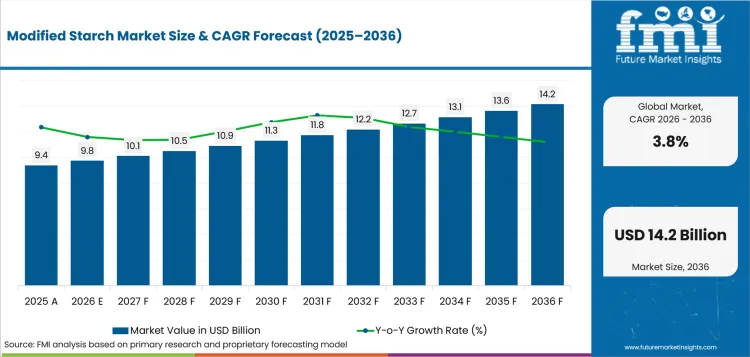
The modified starch market is expected to grow from USD 9.4 billion in 2025 to USD 14.2 billion by 2036 at 3.8% CAGR, driven by packaged food texture systems and paper bonding applications. Dry form is projected to hold 66.8% share in 2026 due to storage ease and long-distance ingredient trade. Physically modified starch is forecast to secure 52.1% share in 2026 as food makers seek texture control with cleaner label wording.
Key Takeaways, Market Size, and Forecast
| Metric | Value |
|---|---|
| Market Size (2026) | USD 9.8 Billion |
| Market Size (2036) | USD 14.2 Billion |
| Forecast CAGR | 3.8% from 2026 to 2036 |
| Leading Form | Dry |
| Dry Form Share In 2026 | 66.8% |
| Leading Modification Type | Physically Modified |
| Physically Modified Share In 2026 | 52.1% |
| Fastest-Growing Country | China |
| China CAGR | 5.1% by 2036 |
Summary of Modified Starch Market
- Demand and Growth Drivers
- Processed food manufacturers are using modified starch to control texture across sauces and ready meals.
- Paper converters are buying cationic and oxidized starch grades for fiber bonding, surface sizing, and corrugated board strength.
- Clean-label recipe work is shifting more trials toward physical and enzyme-based modification methods.
- Product and Segment View
- Dry form is projected to represent 66.8% share in 2026, supported by easier storage and warehouse handling.
- Physically modified starch is expected to secure 52.1% share in 2026, influenced by thermal and mechanical processing routes.
- Corn is forecast to hold 46.4% source share in 2026, backed by wet-milling scale and reliable co-product economics.
- Geography and Competitive Outlook
- China is projected to record 5.1% CAGR by 2036, supported by corn output and processed food manufacturing.
- India is expected to grow at 4.8% CAGR by 2036, helped by maize availability and regional food processing corridors.
- Ingredion and Cargill compete on wet-milling scale and application lab coverage.
- Roquette and Tate & Lyle compete through specialty texture systems and label-friendly starch ranges.
- Analyst Opinion
- Nandini Roy Choudhury, Principal Consultant for Food and Beverage at FMI, observes, “Modified starch has moved from a basic thickener into a performance ingredient. Food processors compare heat stability and texture return after chilled or frozen storage. Suppliers pairing raw material control with application support are better placed to defend repeat contracts.”
- Modified Starch Market Value Analysis
- Market value is predicted to be supported by starch ingredient revenue after sweeteners, finished foods and packaging goods are excluded.
- Supplier pricing reflects corn and wheat costs before modification intensity shapes margin.
- Revenue improves as food and paper buyers shift from native starch toward grades built for heat and storage stress.
- Buyer trust improves as technical sheets make viscosity and binding strength easier to compare.
Food companies need modified starch to keep sauces and chilled foods stable during processing and storage. In April 2024, the EU requested technical data on 11 approved modified starch additives. European suppliers need stronger product files before they can defend sales across starch derivatives. Cargill’s Indonesia blending facility shows another shift in Asia. Confectionery buyers want starch-based texture blends made closer to their factories. Cargill also has eight starches and texturizer plants across Indonesia and China. Better reaction control can support more reliable specialty grades for food texturing agents. A 2024 study found double-modified waxy-corn starch had 206.3% water-binding capacity. Native waxy-corn starch reached 161.4% in the same test. Such performance proof helps suppliers defend pricing in sauces and chilled foods using food thickeners.
Modified Starch Market Definition
Modified Starch Market covers starches altered through physical, chemical, or enzymatic treatment to improve texture, viscosity, stability, binding, and process tolerance. Scope includes corn, cassava, potato, wheat, and waxy maize grades. Revenue includes ingredient sales into food, paper, textiles, pharmaceuticals, and animal feed. Native starch is covered only as a comparison input unless altered for defined performance.
Modified Starch Market Inclusions
Market scope covers all commercially traded modified starch products categorized by modification type such as physically modified, chemically modified, enzymatically modified, crosslinked starch, and cationic starch. Source coverage includes corn, cassava, potato, wheat, and waxy maize across dry, liquid, granular, instant, and paste forms.
End-use scope covers food, paper, textiles, pharmaceuticals, and animal feed applications. Functional scope covers thickening, stabilizing, binding, emulsifying, and film forming across food thickeners and food texturing agents. Revenue scope covers 2026 to 2036. The key stakeholders include modified starch manufacturers, starch derivatives suppliers, crop processors, food formulators, paper mills, textile processors, pharmaceutical excipient buyers, distributors, and regulatory bodies. Demand comparison also covers food starch, native starch, paper packaging, and corrugated board applications.
Modified Starch Market Exclusions
Scope excludes unmodified native starch sold without performance alteration. Glucose syrup, maltodextrin, dextrose, and high-fructose syrup are excluded unless sold inside a defined modified starch blend. Finished food products, corrugated board, and textile goods are excluded. Bioplastic compounds are counted only at starch input level, not as finished packaging revenue.
Modified Starch Market Research Methodology
- Primary Research: FMI analysts reviewed modified starch supplier portfolios, application sheets, buyer specifications, and country-level ingredient channels.
- Desk Research: Public data from USDA ERS, Starch Europe, NBS China, APEDA, PIB, USDA FAS, TTSA, FDA, and company releases were reviewed.
- Market Sizing and Forecasting: Estimated using a bottom-up product-boundary approach. Eligible SKU revenue, channel presence, retail pricing, product positioning, and country-level adoption were used to construct the 2026 market estimate.
- Data Validation: Forecast checks compared raw material output, wet-milling activity, modified starch applications, supplier portfolios, and country-level food processing signals.
Why is the Modified Starch Market Growing?
- Packaged food makers are specifying starch systems that keep texture consistent during heating and storage.
- Paper and industrial buyers are using starch grades to improve bonding and process performance.
- Ingredient suppliers are moving formulation work toward texture systems backed by application labs and plant investment.
Modified starch demand is supported by modified starch suppliers connect food texture needs with industrial starch performance. Ingredion stated in its 2024 Form 10-K, starch products represented about 49% of its net sales in 2024, and starches serve processed food functions such as mouthfeel and gelling. The filing also states that, paper producers use starches for strength and printability, which links modified starch demand to paper packaging and corrugated board use. Ingredion also reported in February 2025, its Texture & Healthful Solutions unit delivered double-digit sales volume growth in the fourth quarter. The company also cited more than USD 100 million of investment in its Indianapolis facility. Tate & Lyle stated in July 2025, IFT FIRST 2025 featured four prototypes and a Mouthfeel Lab, showing why food texturing agents are being sold through tested formulation systems.
Market Segmentation Analysis
- Physically modified starch is expected to hold 52.1% share in 2026, shaped by food processors seeking texture stability without stronger chemical treatment.
- Corn is forecast to account for 46.4% source share in 2026, backed by wet-milling scale and established cost structures in major producing countries.
- Dry form is projected to secure 66.8% share in 2026, supported by shelf stability and easier movement through ingredient distribution networks.
- Thickening is anticipated to represent 34.6% function share in 2026, supported by viscosity control across soups and dairy systems.
- Food is projected to capture 38.7% end-use share in 2026, influenced by packaged food texture and bakery filling performance.
The modified starch sector is divided by modification type and source. Form, function and end use complete the structure. Modification type includes physically modified starch and chemically modified starch. Enzymatically modified starch, crosslinked starch and cationic starch complete the range. Source covers corn and cassava. Potato, wheat and waxy maize complete the range. Form covers dry and liquid formats. Granular, instant and paste formats complete the range. Function analysis covers thickening and stabilizing. Binding, emulsifying and film forming complete the functional range. End-use analysis covers food and paper. Textiles, pharmaceuticals and animal feed complete the end-use range.
Insights into Modified Starch Market by Modification Type
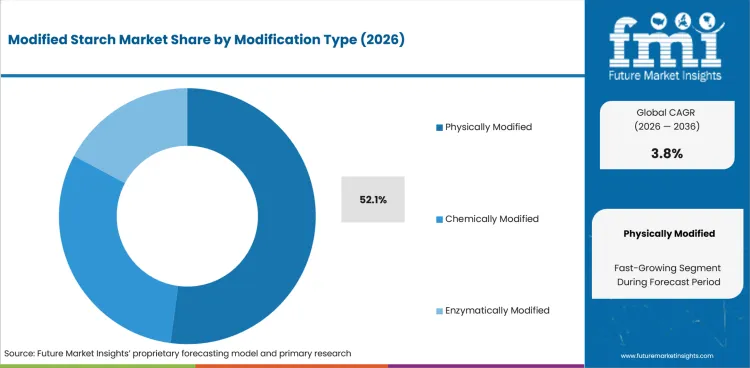
- Physically modified starch is projected to account for 52.1% share in 2026, influenced by heat-based processing and cleaner label acceptance.
- Chemically modified starch keeps industrial value as paper and adhesive buyers need bond strength and moisture tolerance.
Insights into Modified Starch Market by Source
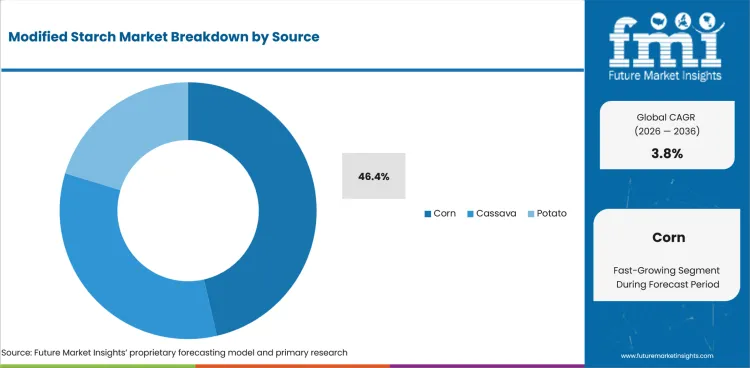
- Corn is expected to hold 46.4% source share in 2026, backed by wet-milling scale and feedstock availability in large grain markets.
- Cassava gains use in Asia as neutral taste and high paste clarity support tapioca-based food textures.
Insights into Modified Starch Market by Form
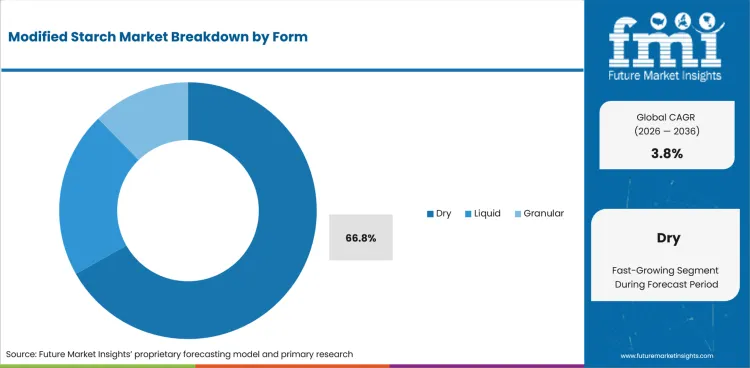
- Dry form is projected to secure 66.8% share in 2026, through storage stability and lower handling complexity.
- Liquid starch remains useful in paper mills requiring direct dosing into coating and sizing systems.
Insights into Modified Starch Market by Function
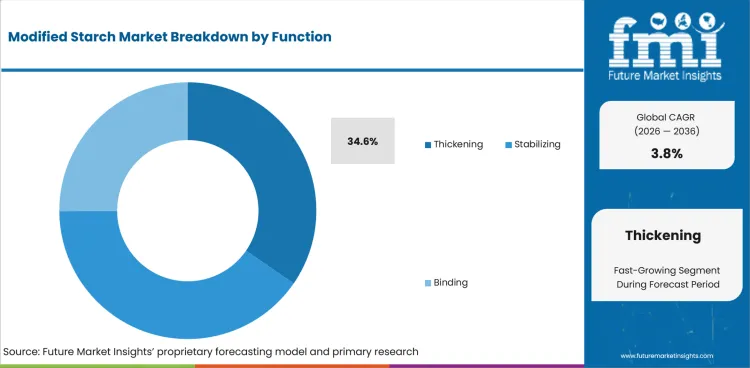
- Thickening is anticipated to hold 34.6% function share in 2026, supported by viscosity control in heat-processed food systems.
- Film forming gains attention as starch coatings are used in film-forming starch and fiber-based packaging formats.
Insights into Modified Starch Market by End Use
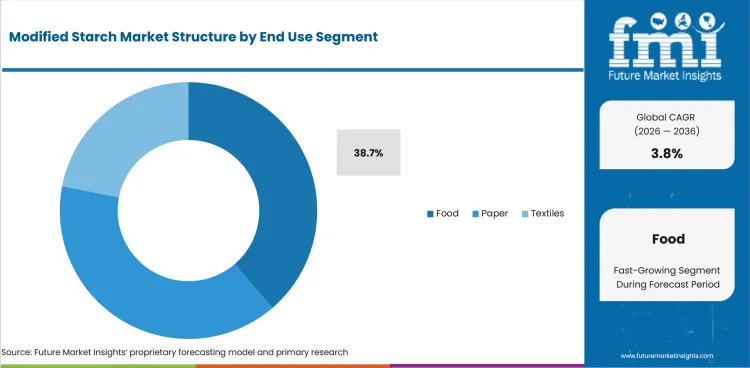
- Food is forecast to represent 38.7% share in 2026, led by texture stability across sauces and convenience meals.
- Paper demand stays material for cationic starch grades as corrugated board producers use starch in bonding and surface strength.
Modified Starch Market Drivers, Restraints, and Opportunities
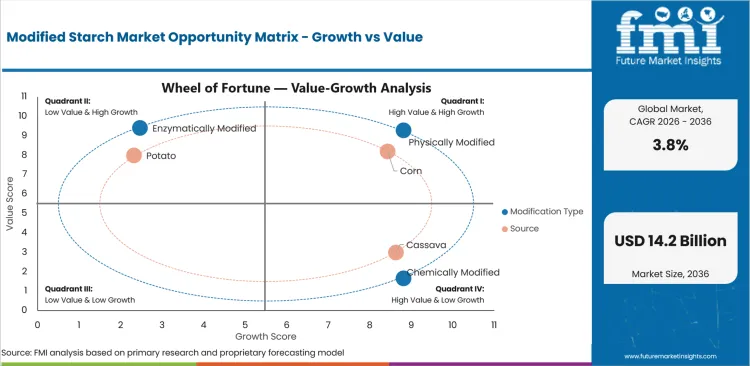
- Driver: Food texture standardization is turning modified starch into a repeat input for packaged food formulation.
- Restraint: Crop price movement can pressure starch processors using corn and wheat.
- Opportunity: Label-friendly starch grades are creating premium positions for physical and enzyme-based modification systems.
Demand is moving toward performance-tested starch grades. Roquette introduced AMYSTA™ L 123 in October 2025 as a thermally soluble pea starch made through a patented process without enzymes or chemicals. Thai Tapioca Starch Association listed FOB Bangkok tapioca starch export price at USD 685.0 per metric ton on June 9, 2026. The same price listed USD 480.0 per metric ton on January 6, 2026. Such price movement makes source choice and formulation efficiency more important for suppliers selling into plant-based thickener systems.
Raw Material Price and Formulation Cost Analysis
Modified starch pricing is more sensitive to crop flows and source switching. USDA ERS states that food, seed, and industrial uses make up close to 60.0% of U.S. domestic corn use. APEDA lists India’s maize output at 43.41 million tonnes in 2024-25 and maize exports at 556,416.94 metric tons. Corn-based grades benefit from wet-milling scale, while cassava and potato grades defend value through texture and label needs. Buyers using roll-dried starch keep comparing dose rate against starch functionality.
Consumer Segmentation and Purchase Behavior Analysis
Food manufacturers are choosing modified starch based on process stress, ingredient label, and final texture. Roquette states that AMYSTA™ L 123 supports dry soups and ready-to-mix beverage formats. Ingredion describes modified food starch as a thickening and texturizing ingredient used across food products. Food teams prioritize mouthfeel and label wording, while paper buyers prioritize bond strength and film quality across paper packaging.
Analysis of Modified Starch Market by Key Countries
.webp "Top Country Growth Comparison Modified Starch Market Cagr (2026 2036)")
| Country | CAGR |
|---|---|
| China | 5.1% |
| India | 4.8% |
| Thailand | 4.5% |
| Brazil | 4.2% |
| United States | 3.6% |
| Germany | 3.2% |
| Japan | 2.7% |
Source: Future Market Insights, 2026.
Sales Outlook for Modified Starch Market in China
Food processing scale and corn milling center · 2026 to 2036
Country Market Snapshot Table
| Parameter | Value |
|---|---|
| Market Size in 2025 | USD 2.3 billion |
| Market Size in 2026 | USD 2.4 billion |
| Market Forecast in 2036 | USD 3.9 billion |
| CAGR 2026 to 2036 | 5.1% |
| Years Considered | 2021 to 2036 |
| Base Year | 2025 |
| Forecast Period | 2026 to 2036 |
| Units Considered | Value in USD billion |
| Leading Sub-Region | Shandong and Northeast corn processing belt |
China Modified Starch Market Outlook
China modified starch demand is shaped by food processing depth and corn availability. Ingredient buyers use modified starch in sauces and textile sizing.
Corn processing depth supports local supply, while coastal food factories keep demand concentrated among suppliers with quality systems and stable logistics. Shandong and Heilongjiang support corn-based grade availability. Suppliers able to serve food and paper buyers should retain stronger customer positions.
Key Growth Drivers
- Shandong food processors use modified starch for sauces and frozen meals as factory recipe systems need stronger heat and storage tolerance.
- China produced 706.50 million tonnes of grain in 2024, and cereals accounted for 652.29 million tonnes of that total.
- China’s food service sector grew by 3.2% to USD 812.0 billion in 2025, supporting starch use in prepared food supply chains.
- Northeast corn provinces improve starch plant access to raw material streams for corn-based modified grades.
Key Restraints
- Corn price swings can raise conversion cost for Shandong and Jilin starch processors.
- Cassava-based imports face freight and currency pressure across ports serving South China.
- USDA FAS forecast China corn imports at 6.0 million tonnes in 2026-27, far below larger recent import years.
What makes China unique
China stands apart because corn output depth and dense processed food manufacturing support coastal and inland industrial zones.
Key Companies
- Ingredion
- Cargill
- Roquette
- COFCO
- Global Bio-Chem
- SMS Corporation
- Tate & Lyle
Sales and Marketing Channels
- Direct food processor contracts
- Industrial ingredient distributors
- Paper mill supply channels
- Textile chemical distributors
- Pharma excipient channels
- Regional starch traders
Country Segment Breakdown Table
| Segment | Sub-Segments |
|---|---|
| By Modification Type | Physically Modified · Chemically Modified · Enzymatically Modified · Crosslinked Starch · Cationic Starch |
| By Source | Corn · Cassava · Potato · Wheat · Waxy Maize |
| By Form | Dry · Liquid · Granular · Instant · Paste |
| By Function | Thickening · Stabilizing · Binding · Emulsifying · Film Forming |
| By End Use | Food · Paper · Textiles · Pharmaceuticals · Animal Feed |
| Key Sub-Regions Covered, Processing Areas | Shandong · Jilin · Heilongjiang · Guangdong · Jiangsu · Shanghai |
Market Taxonomy and Sub-Regions Covered
Frequently Asked Questions
How fast is China modified starch market growing?
China modified starch sales are projected to grow at 5.1% CAGR from 2026 to 2036, supported by corn processing and packaged food production.
Who leads China modified starch market?
Domestic corn processors and global ingredient companies compete on feedstock access, food-grade quality systems, and application support.
What is driving adoption in China modified starch market?
Packaged food, paper bonding, and textile sizing use are moving Chinese buyers toward performance-specific starch grades.
Demand Outlook for Modified Starch Market in India
Maize supply and packaged food center · 2026 to 2036
Country Market Snapshot Table
| Parameter | Value |
|---|---|
| Market Size in 2025 | USD 1.0 billion |
| Market Size in 2026 | USD 1.1 billion |
| Market Forecast in 2036 | USD 1.8 billion |
| CAGR 2026 to 2036 | 4.8% |
| Years Considered | 2021 to 2036 |
| Base Year | 2025 |
| Forecast Period | 2026 to 2036 |
| Units Considered | Value in USD billion |
| Leading Sub-Region | Maharashtra and Gujarat food processing corridors |
India Modified Starch Market Outlook
India modified starch demand is guided by maize processing and packaged food manufacturing. Local starch processors serve confectionery and textile sizing. Food brands need cost-effective texture systems withstanding heat and storage across humid regions.
Maize availability in Karnataka and Bihar supports local supply. Suppliers with low-dose food grades and distributor coverage should gain share among mid-sized processors.
Key Growth Drivers
- Maharashtra snack and bakery producers use modified starch for crispness and moisture control.
- India’s maize output is estimated at 43.41 million tonnes in 2024-25, supporting corn-based starch conversion.
- Processed food exports reached 23.4% of India’s agri-food exports in 2023-24, supporting demand for texture and stabilizer inputs.
- Gujarat paper converters create steady demand for starch binders in corrugated packaging chains.
Key Restraints
- Seasonal maize price swings can pressure small starch processors serving western food clusters.
- Cassava starch availability varies across southern states and can affect tapioca-based grades.
- India’s processed food imports formed 17.0% of agricultural food imports in fiscal year 2023-24, showing pressure from imported value-added ingredients.
What makes India unique
India differs through maize output and snack production corridors across western and southern states.
Key Companies
- Ingredion
- Cargill
- Gujarat Ambuja Exports
- Roquette
- Universal Starch-Chem Allied
- Gulshan Polyols
- Sukhjit Starch
Sales and Marketing Channels
- Direct food processor sales
- Regional ingredient distributors
- Paper mill supply networks
- Textile processing agents
- Pharma excipient distributors
- Export trading houses
Country Segment Breakdown Table
| Segment | Sub-Segments |
|---|---|
| By Modification Type | Physically Modified · Chemically Modified · Enzymatically Modified · Crosslinked Starch · Cationic Starch |
| By Source | Corn · Cassava · Potato · Wheat · Waxy Maize |
| By Form | Dry · Liquid · Granular · Instant · Paste |
| By Function | Thickening · Stabilizing · Binding · Emulsifying · Film Forming |
| By End Use | Food · Paper · Textiles · Pharmaceuticals · Animal Feed |
| Key Sub-Regions Covered, Processing Areas | Maharashtra · Gujarat · Karnataka · Madhya Pradesh · Telangana · Tamil Nadu |
Market Taxonomy and Sub-Regions Covered
Frequently Asked Questions
How fast is India modified starch market growing?
India modified starch demand is expected to rise at 4.8% CAGR from 2026 to 2036, helped by maize availability and packaged food production.
Who leads India modified starch market?
Local corn processors and global ingredient suppliers lead by price access, grade consistency, and distributor reach.
What is driving adoption in India modified starch market?
Snack foods, paper packaging, dairy desserts, and textile sizing are pushing buyers toward modified starch grades.
Sales Analysis of Modified Starch Market in Thailand
Tapioca export and specialty cassava center · 2026 to 2036
Country Market Snapshot Table
| Parameter | Value |
|---|---|
| Market Size in 2025 | USD 0.7 billion |
| Market Size in 2026 | USD 0.8 billion |
| Market Forecast in 2036 | USD 1.2 billion |
| CAGR 2026 to 2036 | 4.5% |
| Years Considered | 2021 to 2036 |
| Base Year | 2025 |
| Forecast Period | 2026 to 2036 |
| Units Considered | Value in USD billion |
| Leading Sub-Region | Nakhon Ratchasima and eastern cassava belt |
Thailand Modified Starch Market Outlook
Thailand modified starch demand is built around tapioca processing and export-grade cassava starch. Local suppliers sell into food and bioplastic uses across Asia.
Bangkok trading networks connect cassava processors with buyers in East Asia and Southeast Asia. Price movement affects export margins, but specialty modified tapioca grades can defend premiums through paste clarity and neutral taste. Suppliers with product development and export documentation strength should perform better than simple commodity starch sellers.
Key Growth Drivers
- Nakhon Ratchasima cassava processors support tapioca starch supply for food and pharma applications.
- Thailand’s food and beverage industry accounts for about one-fourth of national GDP, supporting ingredient demand across processed foods.
- TTSA listed FOB Bangkok tapioca starch export price at USD 685.0 per metric ton on June 9, 2026, showing an active export reference.
- Bangkok export channels support modified tapioca starch movement into ASEAN and Northeast Asian food plants.
Key Restraints
- Export price jumps can narrow margins for buyers using tapioca starch as a corn starch substitute.
- Cassava root supply can vary across northeast provinces after rainfall shifts and disease pressure.
- Cassava Hub cited OAE data showing cassava-derived output declined to 33.54 million tonnes in 2024.
What makes Thailand unique
Thailand is anticipated to witness demand for cassava starch export depth and specialty tapioca modification capability.
Key Companies
- SMS Corporation
- Ingredion
- Cargill
- Thai Wah
- Roquette
- Tate & Lyle
- Chaiyaphum Plant Products
Sales and Marketing Channels
- Export traders
- Direct food processors
- Paper mill channels
- Pharma ingredient distributors
- Bioplastic compounders
- Regional starch brokers
Country Segment Breakdown Table
| Segment | Sub-Segments |
|---|---|
| By Modification Type | Physically Modified · Chemically Modified · Enzymatically Modified · Crosslinked Starch · Cationic Starch |
| By Source | Corn · Cassava · Potato · Wheat · Waxy Maize |
| By Form | Dry · Liquid · Granular · Instant · Paste |
| By Function | Thickening · Stabilizing · Binding · Emulsifying · Film Forming |
| By End Use | Food · Paper · Textiles · Pharmaceuticals · Animal Feed |
| Key Sub-Regions Covered, Processing Areas | Nakhon Ratchasima · Chonburi · Bangkok · Rayong · Udon Thani · Khon Kaen |
Market Taxonomy and Sub-Regions Covered
Frequently Asked Questions
How fast is Thailand modified starch market growing?
Thailand modified starch sales are projected to grow at 4.5% CAGR from 2026 to 2036, led by tapioca export channels.
Who leads Thailand modified starch market?
Thai cassava starch companies and global ingredient suppliers compete on export pricing, purity, and modified tapioca grade depth.
Nakhon Ratchasima · Chonburi · Bangkok · Rayong · Udon Thani · Khon Kaen
Food texture, paper packaging, pharma, and bioplastic applications are supporting higher-value modified tapioca starch use.
Demand Analysis of Modified Starch Market in Brazil
Corn supply and paper packaging center · 2026 to 2036
Country Market Snapshot Table
| Parameter | Value |
|---|---|
| Market Size in 2025 | USD 0.8 billion |
| Market Size in 2026 | USD 0.9 billion |
| Market Forecast in 2036 | USD 1.4 billion |
| CAGR 2026 to 2036 | 4.2% |
| Years Considered | 2021 to 2036 |
| Base Year | 2025 |
| Forecast Period | 2026 to 2036 |
| Units Considered | Value in USD billion |
| Leading Sub-Region | São Paulo and Paraná industrial food corridors |
Brazil Modified Starch Market Outlook
Brazil modified starch demand is supported by corn processing and packaged food manufacturing. Starch buyers in São Paulo and Santa Catarina use modified grades in meat processing and adhesives. Local corn supply supports industrial starch conversion, while cassava grades serve regional food and paper demand.
Food processors need moisture retention and texture stability across refrigerated products. Suppliers able to connect crop sourcing with industrial application service should keep a durable position.
Key Growth Drivers
- São Paulo food processors use modified starch in meats and chilled meals.
- Brazil’s food processing sector revenue reached about USD 248.0 billion in 2025, growing 8.0% from 2024.
- USDA FAS forecast Brazil corn output at 136.0 million tonnes for 2026-27, up from 134.0 million tonnes in 2025-26.
- Paraná paper converters use starch binders across corrugated board and packaging shipments.
Key Restraints
- Corn ethanol demand competes for grain flows that could support starch processors.
- Cassava supply can tighten in southern and central states after weather stress.
- FAS reported 2024 Brazilian food processing revenue at USD 233.0 billion, with ingredient import needs tied to high-value inputs.
What makes Brazil unique
Brazil differs through corn and cassava crop depth across large food and paper manufacturing states.
Key Companies
- Cargill
- Ingredion
- Tate & Lyle
- Roquette
- Tereos
- Amidos Paranaense
- National Starch Brazil
Sales and Marketing Channels
- Food processor contracts
- Paper mill supply chains
- Regional ingredient distributors
- Meat processing buyers
- Adhesive formulators
- Export ingredient traders
Country Segment Breakdown Table
| Segment | Sub-Segments |
|---|---|
| By Modification Type | Physically Modified · Chemically Modified · Enzymatically Modified · Crosslinked Starch · Cationic Starch |
| By Source | Corn · Cassava · Potato · Wheat · Waxy Maize |
| By Form | Dry · Liquid · Granular · Instant · Paste |
| By Function | Thickening · Stabilizing · Binding · Emulsifying · Film Forming |
| By End Use | Food · Paper · Textiles · Pharmaceuticals · Animal Feed |
| Key Sub-Regions Covered, Processing Areas | São Paulo · Paraná · Santa Catarina · Mato Grosso · Goiás · Minas Gerais |
Market Taxonomy and Sub-Regions Covered
Frequently Asked Questions
How fast is Brazil modified starch market growing?
Brazil modified starch sales are forecast to increase at 4.2% CAGR from 2026 to 2036, supported by food and paper applications.
Who leads Brazil modified starch market?
Global starch processors and local crop-based producers compete on raw material access and application support.
What is driving adoption in Brazil modified starch market?
Meat processing, sauces and adhesive applications are supporting higher-value modified starch use.
Opportunity Analysis of Modified Starch Market in the United States
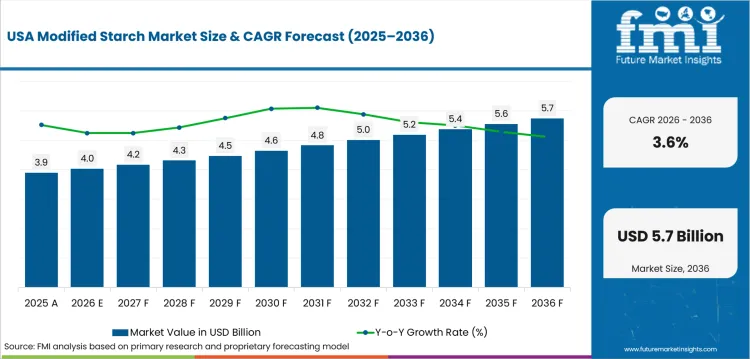
Wet milling and clean-label food center · 2026 to 2036
Country Market Snapshot Table
| Parameter | Value |
|---|---|
| Market Size in 2025 | USD 1.9 billion |
| Market Size in 2026 | USD 2.0 billion |
| Market Forecast in 2036 | USD 2.8 billion |
| CAGR 2026 to 2036 | 3.6% |
| Years Considered | 2021 to 2036 |
| Base Year | 2025 |
| Forecast Period | 2026 to 2036 |
| Units Considered | Value in USD billion |
| Leading Sub-Region | Midwest corn wet-milling corridor |
United States Modified Starch Market Outlook
United States modified starch sales are shaped by corn wet milling and high-spec food formulation. Midwest plants support reliable corn starch supply into food and industrial uses.
Food manufacturers compare modified starch with gums and hydrocolloids during reformulation. Established applications reduce growth speed, but specialty clean-label and resistant starch uses keep value moving upward. Suppliers with application labs near large food brands can defend repeat ingredient positions.
Key Growth Drivers
- Iowa and Illinois wet-milling plants support corn starch output for food and industrial buyers.
- USDA ERS states that food, seed, and industrial use makes up close to 60.0% of domestic corn use.
- FDA lists modified food starch for stabilizer or thickener use in its food ingredient and packaging inventories.
- USA food brands use modified starch in shelf-stable soups and frozen meals.
Key Restraints
- Established food formulations limit fast substitution unless buyers gain a label or cost benefit.
- Corn demand from ethanol and feed can affect starch plant input cost.
- USDA ERS lowered corn food, seed, and industrial use by 10.0 million bushels in January 2026 based on wet milling data.
What makes United States unique
United States is witnessing growth due to corn wet-milling scale and application support across major ingredient companies.
Key Companies
- Ingredion
- Cargill
- ADM
- Tate & Lyle
- Roquette
- Grain Processing Corporation
- Tereos
Sales and Marketing Channels
- Direct food manufacturer contracts
- Industrial distributor networks
- Paper chemical channels
- Pharma excipient distributors
- Foodservice ingredient brokers
- Technical application labs
Country Segment Breakdown Table
| Segment | Sub-Segments |
|---|---|
| By Modification Type | Physically Modified · Chemically Modified · Enzymatically Modified · Crosslinked Starch · Cationic Starch |
| By Source | Corn · Cassava · Potato · Wheat · Waxy Maize |
| By Form | Dry · Liquid · Granular · Instant · Paste |
| By Function | Thickening · Stabilizing · Binding · Emulsifying · Film Forming |
| By End Use | Food · Paper · Textiles · Pharmaceuticals · Animal Feed |
| Key Sub-Regions Covered, Processing Areas | Iowa · Illinois · Indiana · Nebraska · Minnesota · Ohio |
Market Taxonomy and Sub-Regions Covered
Frequently Asked Questions
How fast is United States modified starch market growing?
United States modified starch demand is expected to expand at 3.6% CAGR from 2026 to 2036, led by specialty food uses.
Who leads United States modified starch market?
Corn wet millers and specialty ingredient companies lead by grade depth, application support, and national supply coverage.
What is driving adoption in United States modified starch market?
Clean-label food formulation, paper bonding, and pharma excipient use are sustaining demand for modified starch grades.
Future Outlook for Modified Starch Market in Germany
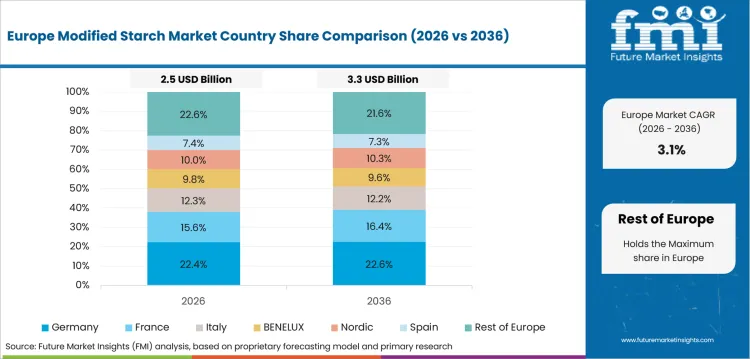
EU starch processing and paper application center · 2026 to 2036
Country Market Snapshot Table
| Parameter | Value |
|---|---|
| Market Size in 2025 | USD 0.4 billion |
| Market Size in 2026 | USD 0.5 billion |
| Market Forecast in 2036 | USD 0.7 billion |
| CAGR 2026 to 2036 | 3.2% |
| Years Considered | 2021 to 2036 |
| Base Year | 2025 |
| Forecast Period | 2026 to 2036 |
| Units Considered | Value in USD billion |
| Leading Sub-Region | North Rhine-Westphalia and Lower Saxony |
Germany Modified Starch Market Outlook
Germany modified starch demand is tied to EU starch processing and high-spec industrial applications. Paper and technical textile buyers need tight quality documentation. Germany benefits from the EU starch network, but established food processing limits faster gains.
Packaging converters and specialty food plants create stable demand for cationic and physically modified grades. Suppliers with EU compliance files and application support should retain better customer retention.
Key Growth Drivers
- Lower Saxony starch potato activity supports potato-based grades used in food and industrial systems.
- Starch Europe reports 70 starch production facilities across 18 EU member states.
- Germany’s food processing industry is described by USDA FAS as the fourth-largest industrial sector in the country.
- North Rhine-Westphalia paper and packaging converters use starch binders in corrugated and surface-sizing applications.
Key Restraints
- High energy and labor costs can pressure German conversion economics for specialty starch grades.
- Established food systems reduce fast switching from existing stabilizers to new starch grades.
- Destatis reported German industrial production fell 2.5% month on month in September 2024.
What makes Germany unique
Germany differs through EU compliance depth and industrial applications in pharma and technical textiles.
Key Companies
- Roquette
- Ingredion
- Cargill
- Tate & Lyle
- Avebe
- Emsland Group
- Südstärke
Sales and Marketing Channels
- Direct industrial contracts
- Food ingredient distributors
- Paper chemical suppliers
- Pharma excipient channels
- Textile chemical distributors
- EU technical sales teams
Country Segment Breakdown Table
| Segment | Sub-Segments |
|---|---|
| By Modification Type | Physically Modified · Chemically Modified · Enzymatically Modified · Crosslinked Starch · Cationic Starch |
| By Source | Corn · Cassava · Potato · Wheat · Waxy Maize |
| By Form | Dry · Liquid · Granular · Instant · Paste |
| By Function | Thickening · Stabilizing · Binding · Emulsifying · Film Forming |
| By End Use | Food · Paper · Textiles · Pharmaceuticals · Animal Feed |
| Key Sub-Regions Covered, Processing Areas | Lower Saxony · North Rhine-Westphalia · Bavaria · Hamburg · Hesse · Saxony-Anhalt |
Market Taxonomy and Sub-Regions Covered
Frequently Asked Questions
How fast is Germany modified starch market growing?
Germany modified starch demand is projected to grow at 3.2% CAGR from 2026 to 2036, shaped by food and paper use.
Who leads Germany modified starch market?
EU starch processors and global ingredient companies lead by technical files, industrial grades, and application support.
What is driving adoption in Germany modified starch market?
Paper bonding and textile finishing keep German buyers using modified starch grades across industrial applications.
In-depth Analysis of Modified Starch Market in Japan
Premium food formulation and import-sensitive starch center · 2026 to 2036
Country Market Snapshot Table
| Parameter | Value |
|---|---|
| Market Size in 2025 | USD 0.1 billion |
| Market Size in 2026 | USD 0.2 billion |
| Market Forecast in 2036 | USD 0.3 billion |
| CAGR 2026 to 2036 | 2.7% |
| Years Considered | 2021 to 2036 |
| Base Year | 2025 |
| Forecast Period | 2026 to 2036 |
| Units Considered | Value in USD billion |
| Leading Sub-Region | Kanto and Kansai food processing corridors |
Japan Modified Starch Market Outlook
Japan modified starch demand is shaped by premium food processing and strict ingredient consistency. Kanto and Kansai food manufacturers use modified starch in sauces and desserts.
Packaged food demand keeps growth measured, but texture-sensitive applications support value. Import sensitivity for corn and tapioca starch makes currency and freight planning important. Suppliers with consistent documentation and smaller-lot specialty grades should outperform commodity sellers.
Key Growth Drivers
- Kanto food processors use modified starch to control texture in chilled meals, sauces, and premium desserts.
- Japan’s food processing sector increased 3.9% in 2024, reaching USD 174.0 billion in produced food value.
- Japan’s MY2025-26 corn imports are forecast at 15.7 million tonnes, supporting raw material availability for corn-based ingredient systems.
- Kansai confectionery and bakery makers use clean-label starch systems for filling and mouthfeel control.
Key Restraints
- Import sensitivity can expose modified starch buyers to freight and currency shifts.
- Established food consumption keeps volume growth slower than larger Asian processors.
- Japan’s food processing sector contracted by 3.0% in 2025 to USD 174.0 billion, limiting faster ingredient volume expansion.
What makes Japan unique
Japan is unique due to smaller-lot specialty food manufacturing and strict product documentation.
Key Companies
- Japan Corn Starch
- Ingredion
- Roquette
- Cargill
- Tate & Lyle
- Matsutani Chemical
- Nihon Shokuhin Kako
Sales and Marketing Channels
- Direct food processor supply
- Specialty ingredient distributors
- Pharma excipient channels
- Paper chemical distributors
- Import trading houses
- Technical application centers
Country Segment Breakdown Table
| Segment | Sub-Segments |
|---|---|
| By Modification Type | Physically Modified · Chemically Modified · Enzymatically Modified · Crosslinked Starch · Cationic Starch |
| By Source | Corn · Cassava · Potato · Wheat · Waxy Maize |
| By Form | Dry · Liquid · Granular · Instant · Paste |
| By Function | Thickening · Stabilizing · Binding · Emulsifying · Film Forming |
| By End Use | Food · Paper · Textiles · Pharmaceuticals · Animal Feed |
| Key Sub-Regions Covered, Processing Areas | Kanto · Kansai · Chubu · Kyushu · Hokkaido · Tohoku |
Market Taxonomy and Sub-Regions Covered
Frequently Asked Questions
How fast is Japan modified starch market growing?
Japan modified starch demand is anticipated to rise at 2.7% CAGR from 2026 to 2036, led by premium food applications.
Who leads Japan modified starch market?
Domestic starch processors and global ingredient suppliers compete on consistency, documentation, and specialty food grade depth.
What is driving adoption in Japan modified starch market?
Texture control in chilled foods and pharma excipient use supports modified starch buying.
Competitive Landscape and Strategic Positioning
- Established modified starch suppliers hold an advantage based on source coverage and application-tested food grades.
- Regional starch processors gain customer access by matching local crop supply with paper and food-grade needs.
- Specialty starch developers support recipe work through viscosity control and cleaner label formulation support.
- Dry starch formats support bulk buying led by easier storage and lower handling complexity.
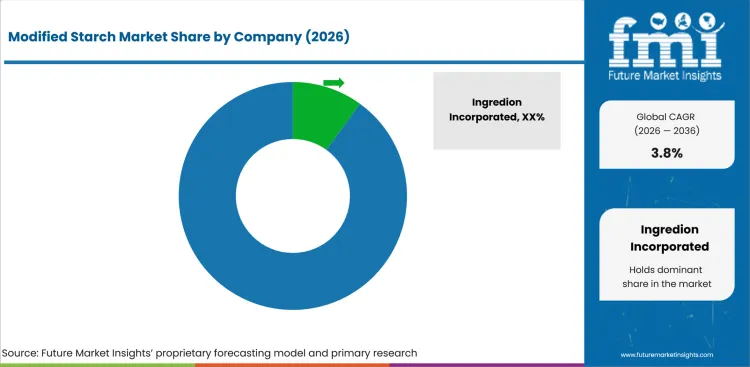
Modified starch competition is concentrated among ingredient companies with crop sourcing and application support. Food manufacturers assess suppliers based on texture repeatability and batch consistency before approving long-term supply. Industrial buyers compare viscosity control and bonding strength before expanding starch use in paper and adhesives.
Competitive structure is led by global ingredient suppliers and regional crop-linked processors. Ingredion competes through modified food starches used as thickening, emulsifying, and texturizing ingredients. Cargill offers modified starches derived from maize and tapioca for thickening and emulsifying. Roquette offers over 300 native and modified starches from corn and peas. Tate & Lyle competes through a portfolio of more than 250 specialty starches for texture and cleaner label needs. ADM supports modified tapioca starches for heat and shear stability.
Supplier advantage will come from raw material flexibility and consistent technical support. Larger companies are better placed to secure multinational food accounts led by application labs and grade depth. Regional companies can protect local positions if crop access and price service match buyer needs. Companies with modification depth and dry-grade distribution are best placed to secure repeat business across food starch and paper packaging comparison channels.
Key Companies in the Modified Starch Market
Competitive structure is grouped by global ingredient suppliers, source-specialist starch companies, and regional processors.
- Global Ingredient Suppliers: Ingredion Incorporated, Cargill Incorporated, Roquette Frères, Tate & Lyle PLC, and ADM compete through food formulation support and global account coverage.
- Source-Specialist Starch Companies: Royal Avebe, Emsland Group, and SMS Corporation compete with potato and tapioca starch specialization.
- Regional Processors: Gujarat Ambuja Exports Limited and Japan Corn Starch Co. Ltd. compete based on domestic crop access and country-level customer coverage.
Competitive Benchmarking: Modified Starch Market
| Company | Source Coverage | Modification Depth | Food Application Support | Industrial Grade Coverage | Geographic Footprint |
|---|---|---|---|---|---|
| Ingredion Incorporated | High | High | High | High | Global |
| Cargill Incorporated | High | High | High | High | Global |
| Roquette Frères | High | High | High | Medium | Europe and Asia |
| Tate & Lyle PLC | Medium | High | High | Medium | North America and Europe |
| ADM | Medium | Medium | High | Medium | North America and Europe |
| Royal Avebe | Potato focused | High | Medium | High | Europe |
| Emsland Group | Potato and pea focused | High | Medium | High | Europe |
| SMS Corporation | Tapioca focused | High | Medium | High | Thailand and exports |
| Gujarat Ambuja Exports Limited | Corn focused | Medium | Medium | Medium | India |
| Japan Corn Starch Co. Ltd. | Corn focused | Medium | High | Medium | Japan |
Source: Future Market Insights competitive analysis, 2026.
Key Developments in Modified Starch Market
- In August 2024, Roquette expanded its texturizing solutions range with four tapioca-based cook-up starches under the CLEARAM® TR range.
- In July 2025, SMS Corporation showcased modified tapioca starch solutions at World Tapioca Conference 2025 in Bangkok.
- In August 2024, Emsland Group announced Emvision 2030 and described a new ROxy reaction tank for starch modification. Investment was stated at around EUR 15 million.
Key Players in the Modified Starch Market
- Ingredion Incorporated
- Cargill Incorporated
- Roquette Frères
- Tate & Lyle PLC
- ADM
- Royal Avebe
- Emsland Group
- SMS Corporation Company Limited
- Gujarat Ambuja Exports Limited
- Japan Corn Starch Co. Ltd.
Modified Starch Market - Report Scope
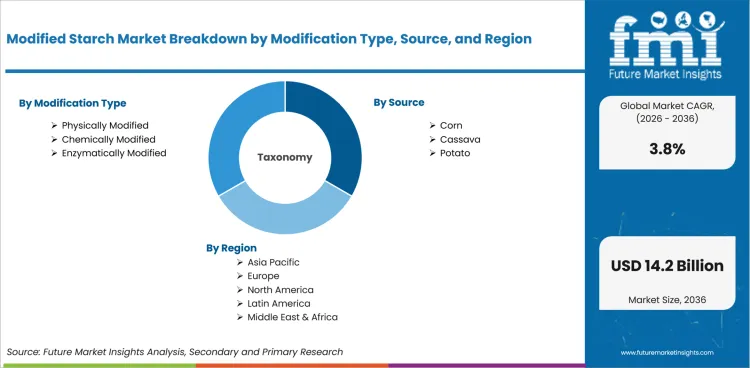
| Parameter | Details |
|---|---|
| Market size by 2036 | USD 14.2 billion |
| Growth rate | 3.8% CAGR from 2026 to 2036 |
| Forecast period | 2026 to 2036 |
| Base year value (2025) | USD 9.4 billion |
| By modification type | Physically modified, chemically modified, enzymatically modified, crosslinked starch, cationic starch |
| By source | Corn, cassava, potato, wheat, waxy maize |
| By form | Dry, liquid, granular, instant, paste |
| By function | Thickening, stabilizing, binding, emulsifying, film forming |
| By end use | Food, paper, textiles, pharmaceuticals, animal feed |
| Regions covered | North America, Latin America, Europe, East Asia, South Asia, ASEAN, Oceania |
| Countries covered | China, India, Thailand, Brazil, United States, Germany, Japan |
| Key companies profiled | Ingredion Incorporated, Cargill Incorporated, Roquette Frères, Tate & Lyle PLC, ADM, Royal Avebe, Emsland Group, SMS Corporation, Gujarat Ambuja Exports Limited, Japan Corn Starch Co. Ltd. |
| Approach | Bottom-up product-boundary approach using eligible SKU revenue, channel presence, retail pricing, product positioning, and country-level adoption |
Source: Future Market Insights, 2026.This Report Answers
Modified Starch Market Breakdown by Modification Type, Source, Form, Function, End Use, and Region
By Modification Type
- Physically Modified
- Chemically Modified
- Enzymatically Modified
- Crosslinked Starch
- Cationic Starch
By Source
- Corn
- Cassava
- Potato
- Wheat
- Waxy Maize
By Form
- Dry
- Liquid
- Granular
- Instant
- Paste
By Function
- Thickening
- Stabilizing
- Binding
- Emulsifying
- Film Forming
By End Use
- Food
- Paper
- Textiles
- Pharmaceuticals
- Animal Feed
By Region
- North America
- Latin America
- Europe
- East Asia
- South Asia
- ASEAN
- Oceania
Research Sources and Bibliography
- Agricultural and Processed Food Products Export Development Authority. (2025, October 30). Monthly dashboard: Maize. Ministry of Commerce and Industry, Government of India.
- Cargill. (2024, August 29). Cargill opens blending facility in Indonesia to delight Asian consumers through sweet confectionery.
- Electronic Code of Federal Regulations. (2026, June 10). 21 CFR § 172.892: Food starch-modified.
- Emsland Group. (2024, August 7). Emvision 2030: Meeting customer needs through advanced modified starch production.
- Ingredion Incorporated. (2025, February 4). Ingredion Incorporated reports strong 2024 fourth quarter and full-year results.
- Ingredion Incorporated. (2025, February 20). Form 10-K for the fiscal year ended December 31, 2024. USA Securities and Exchange Commission.
- Konował, E., Lewandowicz, G., Szymańska-Chargot, M., & Walkowiak, K. (2024). New derivatives of modified starch for food technology. Molecules, 29(14), Article 3292.
- National Bureau of Statistics of China. (2024, December 14). Bulletin on the national grain production in 2024.
- Press Information Bureau. (2024, December 27). Achievements and initiatives of Ministry of Food Processing Industries.
- Roquette. (2024, August 6). CLEARAM® TR hydroxypropylated botanical tapioca starch range.
- Roquette. (2025, October 30). AMYSTA™ L 123, the new label-friendly soluble pea starch.
- SMS Corporation Company Limited. (2025, July 30). Innovative modified tapioca starch solutions from SMS featured at World Tapioca Conference 2025.
- Starch Europe. (2026, January 6). The European starch industry.
- Tate & Lyle PLC. (2025, July 7). Tate & Lyle debuts expanded portfolio and mouthfeel leadership at IFT FIRST 2025.
- Thai Tapioca Starch Association. (2026, June 9). Weekly tapioca starch price.
- USA Department of Agriculture, Economic Research Service. (2026, January 14). Feed outlook: January 2026.
- USA Department of Agriculture, Foreign Agricultural Service. (2026, April 1). China: Food processing ingredients annual.
- USA Department of Agriculture, Foreign Agricultural Service. (2026, March 27). India: Food processing ingredients annual.
- USA Department of Agriculture, Foreign Agricultural Service. (2026, March 31). Brazil: Food processing ingredients annual.
- USA Department of Agriculture, Foreign Agricultural Service. (2026, April 6). Brazil: Grain and feed annual.
- USA Department of Agriculture, Foreign Agricultural Service. (2026, March 31). Germany: Food processing ingredients annual.
- USA Department of Agriculture, Foreign Agricultural Service. (2025, April 1). Japan: Food processing ingredients annual.
- USA Department of Agriculture, Foreign Agricultural Service. (2026, April 1). Japan: Food processing ingredients annual.
- USA Department of Agriculture, Foreign Agricultural Service. (2026, March 18). Japan: Grain and feed annual.
- USA Department of Agriculture, Foreign Agricultural Service. (2025, March 19). Japan: Grain and feed annual.
This bibliography is provided for reader reference and is not exhaustive. The full report contains the complete reference list and detailed citations.
This Report Answers
- How large is modified starch market in 2026?
- What value is expected for modified starch market by 2036?
- Which form is expected to lead in 2026?
- Which modification type is expected to hold the second leading share in 2026?
- Which source is expected to hold the third leading parent-segment share in 2026?
- Which countries are expected to grow faster than the global average?
- Which companies are most active across modified starch supply?
- Which raw materials shape modified starch cost and supply planning?
- Which applications create repeat demand for modified starch grades?
Frequently Asked Questions
How big is modified starch market in 2026?
The modified starch market value is expected to cross USD 9.8 billion in 2026 across food and industrial ingredient channels.
What will be the size of modified starch market in 2036?
The modified starch industry revenue is projected to reach USD 14.2 billion by 2036 as texture and binding applications expand.
How much will modified starch market grow between 2026 and 2036?
The modified starch sector is forecast to expand at 3.8% CAGR from 2026 to 2036 across food and industrial uses.
Which parent segment holds the largest share in 2026?
Dry form is projected to hold 66.8% share in 2026 due to storage ease and bulk ingredient distribution.
Which source will lead in 2026?
Corn is expected to account for 46.4% share in 2026.
Which country will record the fastest growth?
China is projected to record 5.1% CAGR by 2036.
Preview the report firsthand - request a free sample
Get SampleGet the brochure for pricing and purchase details.
Get PDFTable of Content
- Key Takeaways
- Market Size and CAGR
- Top Growth Driver
- Fastest Growing Segment
- Leading Region
- Key Companies
- Emerging Opportunities
- Executive Summary
- Global Market Outlook
- Demand-side Trends
- Supply-side Trends
- Technology Roadmap Analysis
- Analysis and Recommendations
- Analyst Perspective (What is happening? Why now? What should investors know?)
- Key Questions Answered
- How large is the market?
- What is the CAGR?
- What are key trends?
- Which region dominates?
- Who are the leaders?
- Market Overview
- Market Coverage / Taxonomy
- Market Definition / Scope / Limitations
- Research Methodology
- Chapter Orientation
- Analytical Lens and Working Hypotheses
- Market Structure, Signals, and Trend Drivers
- Benchmarking and Cross-market Comparability
- Market Sizing, Forecasting, and Opportunity Mapping
- Research Design and Evidence Framework
- Desk Research Programme (Secondary Evidence)
- Expert Input and Fieldwork (Primary Evidence)
- Tooling, Models, and Reference Databases
- Data Engineering and Model Build
- Quality Assurance and Audit Trail
- Market Background
- Market Dynamics (Drivers, Restraints, Opportunity, Trends)
- Scenario Forecast (Optimistic, Likely, Conservative)
- Impact Analysis
- AI Impact
- Sustainability Impact
- Regulatory Impact
- Technology Impact
- Consumer / Buyer Analysis
- Purchase Drivers
- Adoption Barriers
- Buyer Journey
- Opportunity Map Analysis
- Product Life Cycle Analysis
- Supply Chain Analysis
- Investment Feasibility Matrix
- Value Chain Analysis
- PESTLE and Porter's Analysis
- Regulatory Landscape
- Regional Parent Market Outlook
- Production and Consumption Statistics
- Import and Export Statistics
- Global Market Analysis and Forecast, 2021 to 2036
- Historical Market Size Value (USD Billion) Analysis, 2021 to 2025
- Current and Future Market Size Value (USD Billion) Projections, 2026 to 2036
- Y-o-Y Growth Trend Analysis
- Absolute $ Opportunity Analysis
- Global Market Pricing Analysis, 2021 to 2036
- Global Market Analysis and Forecast, By Modification Type, 2021 to 2036
- Introduction / Key Findings
- Historical Market Size Value (USD Billion) Analysis By Modification Type, 2021 to 2025
- Current and Future Market Size Value (USD Billion) Analysis and Forecast By Modification Type, 2026 to 2036
- Physically Modified
- Chemically Modified
- Enzymatically Modified
- Crosslinked Starch
- Cationic Starch
- Physically Modified
- Y-o-Y Growth Trend Analysis By Modification Type, 2021 to 2025
- Absolute $ Opportunity Analysis By Modification Type, 2026 to 2036
- Global Market Analysis and Forecast, By Source, 2021 to 2036
- Introduction / Key Findings
- Historical Market Size Value (USD Billion) Analysis By Source, 2021 to 2025
- Current and Future Market Size Value (USD Billion) Analysis and Forecast By Source, 2026 to 2036
- Corn
- Cassava
- Potato
- Wheat
- Waxy Maize
- Corn
- Y-o-Y Growth Trend Analysis By Source, 2021 to 2025
- Absolute $ Opportunity Analysis By Source, 2026 to 2036
- Global Market Analysis and Forecast, By Form, 2021 to 2036
- Introduction / Key Findings
- Historical Market Size Value (USD Billion) Analysis By Form, 2021 to 2025
- Current and Future Market Size Value (USD Billion) Analysis and Forecast By Form, 2026 to 2036
- Dry
- Liquid
- Granular
- Instant
- Paste
- Dry
- Y-o-Y Growth Trend Analysis By Form, 2021 to 2025
- Absolute $ Opportunity Analysis By Form, 2026 to 2036
- Global Market Analysis and Forecast, By Function, 2021 to 2036
- Introduction / Key Findings
- Historical Market Size Value (USD Billion) Analysis By Function, 2021 to 2025
- Current and Future Market Size Value (USD Billion) Analysis and Forecast By Function, 2026 to 2036
- Thickening
- Stabilizing
- Binding
- Emulsifying
- Film Forming
- Thickening
- Y-o-Y Growth Trend Analysis By Function, 2021 to 2025
- Absolute $ Opportunity Analysis By Function, 2026 to 2036
- Global Market Analysis and Forecast, By End Use, 2021 to 2036
- Introduction / Key Findings
- Historical Market Size Value (USD Billion) Analysis By End Use, 2021 to 2025
- Current and Future Market Size Value (USD Billion) Analysis and Forecast By End Use, 2026 to 2036
- Food
- Paper
- Textiles
- Pharmaceuticals
- Animal Feed
- Food
- Y-o-Y Growth Trend Analysis By End Use, 2021 to 2025
- Absolute $ Opportunity Analysis By End Use, 2026 to 2036
- Global Market Analysis and Forecast, By Region, 2021 to 2036
- Introduction
- Historical Market Size Value (USD Billion) Analysis By Region, 2021 to 2025
- Current Market Size Value (USD Billion) Analysis and Forecast By Region, 2026 to 2036
- North America
- Latin America
- Western Europe
- Eastern Europe
- East Asia
- South Asia and Pacific
- Middle East & Africa
- Market Attractiveness Analysis By Region
- North America Market Analysis and Forecast, By Country, 2021 to 2036
- Historical Market Size Value (USD Billion) Trend Analysis By Market Taxonomy, 2021 to 2025
- Market Size Value (USD Billion) Forecast By Market Taxonomy, 2026 to 2036
- By Country
- USA
- Canada
- By Modification Type
- By Source
- By Form
- By Function
- By End Use
- By Country
- Market Attractiveness Analysis
- By Country
- By Modification Type
- By Source
- By Form
- By Function
- By End Use
- Key Takeaways
- Latin America Market Analysis and Forecast, By Country
- Historical Market Size Value (USD Billion) Trend Analysis By Market Taxonomy, 2021 to 2025
- Market Size Value (USD Billion) Forecast By Market Taxonomy, 2026 to 2036
- By Country
- Brazil
- Mexico
- Chile
- Rest of Latin America
- By Modification Type
- By Source
- By Form
- By Function
- By End Use
- By Country
- Market Attractiveness Analysis
- By Country
- By Modification Type
- By Source
- By Form
- By Function
- By End Use
- Key Takeaways
- Western Europe Market Analysis and Forecast, By Country
- Historical Market Size Value (USD Billion) Trend Analysis By Market Taxonomy, 2021 to 2025
- Market Size Value (USD Billion) Forecast By Market Taxonomy, 2026 to 2036
- By Country
- Germany
- UK
- Italy
- Spain
- France
- Nordic
- BENELUX
- Rest of Western Europe
- By Modification Type
- By Source
- By Form
- By Function
- By End Use
- By Country
- Market Attractiveness Analysis
- By Country
- By Modification Type
- By Source
- By Form
- By Function
- By End Use
- Key Takeaways
- Eastern Europe Market Analysis and Forecast, By Country
- Historical Market Size Value (USD Billion) Trend Analysis By Market Taxonomy, 2021 to 2025
- Market Size Value (USD Billion) Forecast By Market Taxonomy, 2026 to 2036
- By Country
- Russia
- Poland
- Hungary
- Balkan & Baltic
- Rest of Eastern Europe
- By Modification Type
- By Source
- By Form
- By Function
- By End Use
- By Country
- Market Attractiveness Analysis
- By Country
- By Modification Type
- By Source
- By Form
- By Function
- By End Use
- Key Takeaways
- East Asia Market Analysis and Forecast, By Country
- Historical Market Size Value (USD Billion) Trend Analysis By Market Taxonomy, 2021 to 2025
- Market Size Value (USD Billion) Forecast By Market Taxonomy, 2026 to 2036
- By Country
- China
- Japan
- South Korea
- By Modification Type
- By Source
- By Form
- By Function
- By End Use
- By Country
- Market Attractiveness Analysis
- By Country
- By Modification Type
- By Source
- By Form
- By Function
- By End Use
- Key Takeaways
- South Asia and Pacific Market Analysis and Forecast, By Country
- Historical Market Size Value (USD Billion) Trend Analysis By Market Taxonomy, 2021 to 2025
- Market Size Value (USD Billion) Forecast By Market Taxonomy, 2026 to 2036
- By Country
- India
- ASEAN
- Australia & New Zealand
- Rest of South Asia and Pacific
- By Modification Type
- By Source
- By Form
- By Function
- By End Use
- By Country
- Market Attractiveness Analysis
- By Country
- By Modification Type
- By Source
- By Form
- By Function
- By End Use
- Key Takeaways
- Middle East & Africa Market Analysis and Forecast, By Country
- Historical Market Size Value (USD Billion) Trend Analysis By Market Taxonomy, 2021 to 2025
- Market Size Value (USD Billion) Forecast By Market Taxonomy, 2026 to 2036
- By Country
- Kingdom of Saudi Arabia
- Other GCC Countries
- Türkiye
- South Africa
- Other African Union
- Rest of Middle East & Africa
- By Modification Type
- By Source
- By Form
- By Function
- By End Use
- By Country
- Market Attractiveness Analysis
- By Country
- By Modification Type
- By Source
- By Form
- By Function
- By End Use
- Key Takeaways
- Key Countries Market Analysis
- USA
- Pricing Analysis
- Market Share Analysis, 2025
- By Modification Type
- By Source
- By Form
- By Function
- By End Use
- Canada
- Pricing Analysis
- Market Share Analysis, 2025
- By Modification Type
- By Source
- By Form
- By Function
- By End Use
- Mexico
- Pricing Analysis
- Market Share Analysis, 2025
- By Modification Type
- By Source
- By Form
- By Function
- By End Use
- Brazil
- Pricing Analysis
- Market Share Analysis, 2025
- By Modification Type
- By Source
- By Form
- By Function
- By End Use
- Chile
- Pricing Analysis
- Market Share Analysis, 2025
- By Modification Type
- By Source
- By Form
- By Function
- By End Use
- Germany
- Pricing Analysis
- Market Share Analysis, 2025
- By Modification Type
- By Source
- By Form
- By Function
- By End Use
- UK
- Pricing Analysis
- Market Share Analysis, 2025
- By Modification Type
- By Source
- By Form
- By Function
- By End Use
- Italy
- Pricing Analysis
- Market Share Analysis, 2025
- By Modification Type
- By Source
- By Form
- By Function
- By End Use
- Spain
- Pricing Analysis
- Market Share Analysis, 2025
- By Modification Type
- By Source
- By Form
- By Function
- By End Use
- France
- Pricing Analysis
- Market Share Analysis, 2025
- By Modification Type
- By Source
- By Form
- By Function
- By End Use
- India
- Pricing Analysis
- Market Share Analysis, 2025
- By Modification Type
- By Source
- By Form
- By Function
- By End Use
- ASEAN
- Pricing Analysis
- Market Share Analysis, 2025
- By Modification Type
- By Source
- By Form
- By Function
- By End Use
- Australia & New Zealand
- Pricing Analysis
- Market Share Analysis, 2025
- By Modification Type
- By Source
- By Form
- By Function
- By End Use
- China
- Pricing Analysis
- Market Share Analysis, 2025
- By Modification Type
- By Source
- By Form
- By Function
- By End Use
- Japan
- Pricing Analysis
- Market Share Analysis, 2025
- By Modification Type
- By Source
- By Form
- By Function
- By End Use
- South Korea
- Pricing Analysis
- Market Share Analysis, 2025
- By Modification Type
- By Source
- By Form
- By Function
- By End Use
- Russia
- Pricing Analysis
- Market Share Analysis, 2025
- By Modification Type
- By Source
- By Form
- By Function
- By End Use
- Poland
- Pricing Analysis
- Market Share Analysis, 2025
- By Modification Type
- By Source
- By Form
- By Function
- By End Use
- Hungary
- Pricing Analysis
- Market Share Analysis, 2025
- By Modification Type
- By Source
- By Form
- By Function
- By End Use
- Kingdom of Saudi Arabia
- Pricing Analysis
- Market Share Analysis, 2025
- By Modification Type
- By Source
- By Form
- By Function
- By End Use
- Türkiye
- Pricing Analysis
- Market Share Analysis, 2025
- By Modification Type
- By Source
- By Form
- By Function
- By End Use
- South Africa
- Pricing Analysis
- Market Share Analysis, 2025
- By Modification Type
- By Source
- By Form
- By Function
- By End Use
- USA
- Market Structure Analysis
- Competition Dashboard
- Competition Benchmarking
- Market Share Analysis of Top Players
- By Regional
- By Modification Type
- By Source
- By Form
- By Function
- By End Use
- Emerging Startups
- Innovation Benchmarking
- Competition Analysis
- Competition Deep Dive
- Ingredion Incorporated
- Overview
- Product Portfolio
- Profitability by Market Segments
- Sales Footprint
- Strategy Overview
- Marketing Strategy
- Product Strategy
- Channel Strategy
- Cargill Incorporated
- Roquette Frères
- Tate & Lyle PLC
- ADM
- Royal Avebe
- Emsland Group
- SMS Corporation Company Limited
- Gujarat Ambuja Exports Limited
- Japan Corn Starch Co. Ltd.
- Ingredion Incorporated
- Case Studies
- Success Stories
- Recent Developments
- Competition Deep Dive
- Assumptions & Acronyms Used


