

- Industry Size (2026)
- USD 6.16 Bn
- Forecast (2036)
- USD 8.01 Bn
- CAGR (2026 to 2036)
- 2.7%
High Temperature Grease Market Forecast and Outlook By FMI
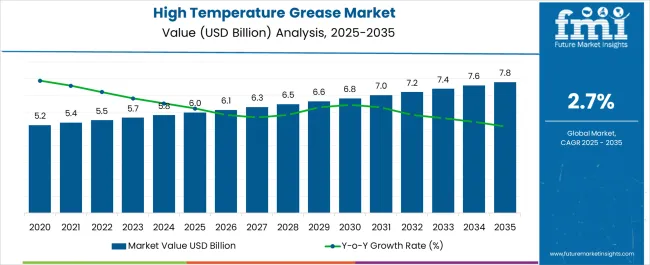
In 2025, the High Temperature Grease Market secured a value of USD 6.0 billion. Based on Future Market Insights' analysis, demand is estimated to grow to USD 6.16 billion in 2026 and USD 8.01 billion by 2036. FMI projects a CAGR of 2.7% during the forecast period.
The sector is undergoing a structural evolution driven by the modernization of global industrial infrastructure. The first half of the decade (2026-2030) will witness steady growth fueled by the recovery of the automotive manufacturing sector and the expansion of steel and cement production in developing economies. The latter half (2031-2036) will see sustained demand driven by the integration of automated machinery that requires long-life lubricants to minimize maintenance downtime. The transition toward synthetic and bio-based greases is effectively creating a premium tier in the market, distinguishing high-performance solutions from conventional mineral-oil-based products.
Summary of High Temperature Grease Market
- Market Definition:
- The industry covers lubricants engineered to maintain viscosity and structural integrity in environments exceeding standard operating temperatures.
- Demand Drivers:
- Industrial Automation: High-speed machinery generates significant heat, requiring robust lubrication to prevent failure.
- Automotive Performance: Electric vehicle motors and modern braking systems operate at higher temperatures, necessitating specialized grease.
- Operational Efficiency: Industries are seeking to extend maintenance intervals, driving demand for long-life, high-temp products.
- Key Segments Analyzed:
- Type: Soap Thickeners (55.3% share) dominate due to their cost-effectiveness and versatility in standard industrial applications.
- Application: Industrial (62.1% share) leads as heavy machinery in steel and cement sectors requires constant high-heat lubrication.
- Geography: Asia Pacific leads volume growth, supported by the massive industrial output of China and India.
- Analyst Opinion:
- Nikhil Kaitwade, Principal Consultant at Future Market Insights, opines, "In the updated High Temperature Grease Market Report for 2026 to 2036, CXOs will find that value capture is moving from commodity greases to 'Application-Specific Solutions.' My findings point at a 'Performance Premium' where greases offering extended re-lubrication intervals command higher margins."
- Strategic Implications:
- Invest in R&D for polyurea and calcium sulfonate complex thickeners to offer superior thermal stability.
- Expand distribution networks in emerging industrial hubs in Southeast Asia and Latin America.
- Develop bio-based high-temperature greases to align with increasing environmental regulations in Europe and North America.
- Methodology:
- Validated through primary interviews with lubrication engineers and plant managers.
- Zero reliance on speculative third-party market research reports.
- Based on verifiable industrial consumption patterns and vehicle production data.
Dr. Stefan Fuchs, Chairman of the Executive Board at FUCHS PETROLUB SE, noted regarding the industry's trajectory, "We are seeing a clear trend towards high-performance lubricants that not only withstand extreme conditions but also contribute to energy efficiency and sustainability goals. The future lies in specialized solutions that reduce friction losses and extend the service life of machinery" [1]. This focus on efficiency underscores the industry's pivot toward advanced chemical formulations.
China (3.6% CAGR), India (3.4% CAGR), Germany (3.1% CAGR), Brazil (2.8% CAGR), and the USA (2.6% CAGR) are driving global expansion, with growth weighted heavily toward regions with robust heavy industrial and manufacturing bases.
High Temperature Grease Market Definition
The high temperature grease market comprises the global development, manufacturing, and trade of semi-solid lubricants designed to provide effective lubrication at temperatures typically exceeding 150°C (302°F). These greases consist of a base oil, a thickener (soap or non-soap), and performance additives, engineered to resist melting, oxidation, and structural breakdown under extreme thermal stress in industrial and automotive applications.
Market Inclusions
The report includes a comprehensive analysis of market dynamics, featuring Global and Regional Market Sizes (Volume and Value) and a 10-year Forecast (2026-2036). It covers segmental breakdowns by Type (Soap Thickener, Non-Soap Thickener), Application (Industrial, Automotive), and Region. It specifically tracks the adoption of specialized greases in high-heat environments like steel mills, kilns, and automotive braking systems.
Market Exclusions
The scope excludes standard multi-purpose greases not rated for high-temperature performance (typically below 120°C). It also omits liquid lubricants (oils) unless they are part of a specific high-temperature paste formulation, and consumer-grade lubricants not intended for industrial or commercial automotive use.
Research Methodology
- Primary Research: Interviews were conducted with R&D chemists at major lubricant manufacturers, maintenance managers in heavy industries (steel, mining), and procurement heads at automotive OEMs.
- Desk Research: Production data from the National Lubricating Grease Institute (NLGI), corporate annual reports of key players (ExxonMobil, Shell), and industrial output statistics supported volume benchmarking.
- Market-Sizing and Forecasting: A hybrid top-down and bottom-up model was developed, reconstructing demand from industrial machinery maintenance schedules and automotive production volumes.
- Data Validation and Update Cycle: Outputs undergo anomaly screening against crude oil price trends and structured peer review prior to release.
Segmental Analysis
High Temperature Grease Market Analysis by Type
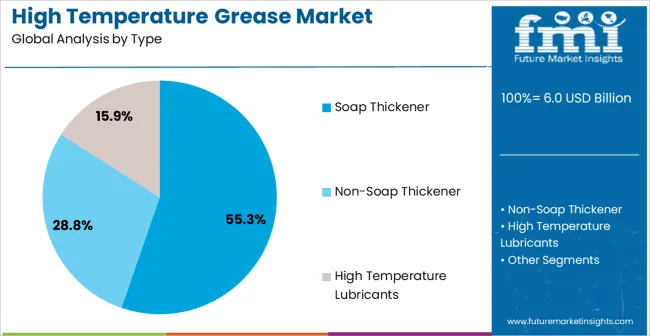
Based on FMI’s analysis, Soap Thickener greases are estimated to hold a 55.3% market share in 2026. This dominance is driven by the widespread use of lithium complex, calcium sulfonate, and aluminum complex soaps, which offer an optimal balance of performance properties including mechanical stability, water resistance, and high dropping points at a cost-effective price point for general industrial use.
- Lithium Complex Standard: Lithium complex greases remain the workhorse of the industry, offering versatility across a wide range of temperatures and applications.
- Calcium Sulfonate Growth: This sub-segment is gaining traction due to its inherent rust-inhibiting properties and extreme pressure capability without additives.
- Cost Efficiency: Soap-based thickeners are generally less expensive to manufacture than non-soap alternatives, ensuring their continued volume leadership.
High Temperature Grease Market Analysis by Application
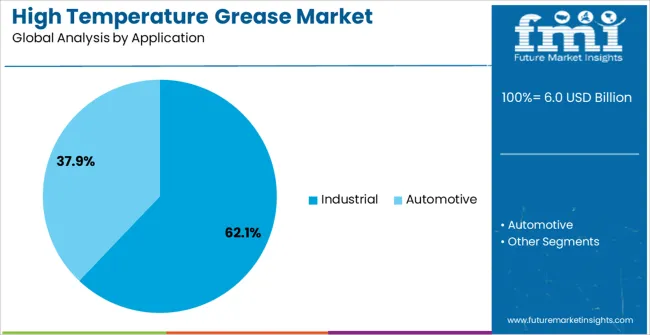
The Industrial segment accounts for 62.1% of the market share in 2026. This segment leads because processes in steel mills, paper mills, cement kilns, and power generation facilities inherently involve extreme heat, friction, and heavy loads, creating a non-negotiable requirement for high-temperature grease to prevent catastrophic equipment failure and costly production stoppages.
- Heavy Machinery: Equipment in mining and construction operates under severe stress and heat, necessitating frequent re-lubrication with high-grade grease.
- Manufacturing Plants: Automated assembly lines and robotics generate significant friction heat, requiring specialized lubrication to maintain precision.
- Energy Sector: Wind turbines and thermal power plants utilize high-temperature grease in generators and bearings to ensure continuous energy production.
High Temperature Grease Drivers, Restraints, Opportunities
Future Market Insights analysis observes that the expansion of heavy industry in emerging markets is the primary accelerator. As nations like India and Indonesia invest heavily in infrastructure, steel production, and mining, the demand for lubricants capable of surviving harsh operating environments is rising. Furthermore, the automotive shift toward electrification presents a nuanced driver; while internal combustion engines decrease, EV components such as wheel bearings and electric motor bearings operate at higher speeds and temperatures, creating a new niche for specialized greases [2].
However, growth is restrained by fluctuating raw material costs. The prices of base oils and lithium (a key thickener component) are subject to volatility, impacting profit margins. The opportunity lies in synthetic and bio-based formulations. As industries face stricter environmental scrutiny, there is a growing market for biodegradable high-temperature greases that offer high performance without the ecological footprint of mineral-based alternatives. For instance, Total Energies has actively expanded its bio-lubricant range to meet these dual needs [3].
- Manufacturing Resilience: The push for 24/7 manufacturing operations demands lubricants that prevent unscheduled downtime due to overheating.
- Aerospace & Aviation: Growing air travel demand requires ultra-high-performance greases for aircraft components subjected to extreme temperature fluctuations.
- Food Grade Lubricants: Strict safety standards in food processing require high-temperature greases that are safe for incidental contact, driving innovation in non-toxic formulations.
Regional Analysis
Based on the regional analysis, the High Temperature Grease market is segmented into North America, Latin America, Western Europe, Eastern Europe, East Asia, South Asia & Pacific, and Middle East & Africa across 42+ countries. The full report offers market attractiveness analysis based on industrial output and automotive production.
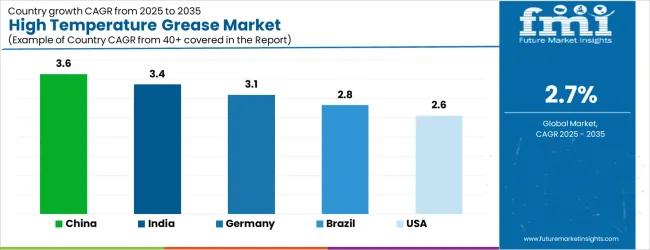
| Country | CAGR (2026 to 2036) |
|---|---|
| China | 3.6% |
| India | 3.4% |
| Germany | 3.1% |
| Brazil | 2.8% |
| USA | 2.6% |
| UK | 2.3% |
| Japan | 2.0% |
Source: Future Market Insights (FMI) analysis, based on proprietary forecasting model and primary research.
East Asia High Temperature Grease Market Analysis
East Asia commands the largest market volume, serving as the global hub for heavy manufacturing, steel production, and automotive assembly. The region is characterized by high consumption of industrial lubricants.
- China: Demand is projected to escalate at a 3.6% CAGR through 2036. The market is propelled by China's status as the world's largest steel producer and the rapid modernization of its manufacturing sector, which increasingly demands higher quality lubricants to protect expensive machinery assets.
- Japan: A 2.0% CAGR is anticipated. While a mature market, growth is supported by a focus on high-tech manufacturing and the production of premium automotive components requiring advanced lubrication.
FMI’s report includes a detailed analysis of growth in the East Asia region, along with a country-wise assessment that includes China, Japan, and South Korea.
South Asia & Pacific High Temperature Grease Market Analysis
South Asia is the second fastest-growing region, driven by rapid industrialization, infrastructure development, and a booming automotive sector.
- India: A 3.4% CAGR is projected. Growth is supported by government initiatives like "Make in India" which are boosting domestic manufacturing, along with significant investments in the cement and mining sectors that are heavy consumers of industrial grease [4].
- ASEAN: The region is emerging as a key manufacturing alternative, driving demand for industrial lubricants in countries like Vietnam and Indonesia.
FMI’s report includes a detailed analysis of growth in the South Asia & Pacific region, covering India, ASEAN, and Australia.
North America High Temperature Grease Market Analysis
North America is a mature but high-value market, characterized by demand for premium, synthetic, and environmentally compliant grease products.
- USA: The market is forecast to expand at a 2.6% CAGR through 2036. Growth is bolstered by the resurgence of domestic manufacturing, a strong aerospace sector, and the robust oil and gas industry which operates in extreme thermal conditions.
FMI’s report includes a detailed analysis of growth in the North America region, along with a country-wise assessment that includes the USA, Canada, and Mexico.
Competitive Aligners for Market Players
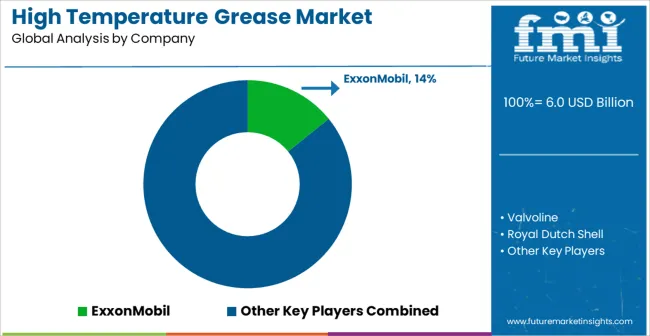
The High Temperature Grease Market presents a moderately fragmented competitive landscape, characterized by a dynamic mix of multinational oil and gas giants and agile, specialized lubricant manufacturers. Leading the sector are ExxonMobil Corporation, Shell plc, Chevron Corporation, TotalEnergies SE, and BP p.l.c. (Castrol), whose vast resources allow for broad market penetration. These are complemented by specialized contenders such as Valvoline Inc., FUCHS PETROLUB SE, Petro-Canada Lubricants Inc., and MOL Group, who focus on niche applications.
As industrial machinery and automotive sectors demand higher performance under extreme conditions, the competitive paradigm is decisively shifting. Market leaders are moving away from traditional volume-based strategies, prioritizing value-added services and proprietary formulations. Consolidation is a key lever, with majors acquiring niche firms to expand portfolios, while partnerships with automotive OEMs remain critical for securing long-term factory-fill contracts. Success now hinges on maintaining robust innovation capabilities while forging deep integration with end-users to secure resilient supply chains.
Recent Developments
- In 2024, ExxonMobil expanded its Mobil Polyrex™ EM series, specifically marketing it for electric motor bearings. The grease uses advanced polyurea thickener technology to withstand the high temperatures (up to 170°C) and shear forces of modern EV drivetrains [5].
- In 2023, FUCHS PETROLUB SE officially rebranded to FUCHS SE to reflect its broader focus on advanced industrial solutions beyond just "petroleum." They simultaneously scaled up their "Advanced Circular Technologies" (ACT) portfolio, offering high-temperature greases with lower carbon footprints [6].
Key Players in High Temperature Grease Market
- ExxonMobil Corporation
- Valvoline Inc.
- Shell plc
- Chevron Corporation
- TotalEnergies SE
- BP p.l.c. (Castrol)
- FUCHS PETROLUB SE
- Petro-Canada Lubricants Inc.
- MOL Group
Scope of the Report
| Metric | Value |
|---|---|
| Quantitative Units | USD 6.16 billion (2026) to USD 8.01 billion (2036), at a CAGR of 2.7% |
| Market Definition | The high temperature grease market comprises semi-solid lubricants formulated to provide protection and reduce friction in machinery operating at elevated temperatures, typically utilizing specialized thickeners and additives. |
| Type Segmentation | Soap Thickener (Lithium, Calcium, Aluminum), Non-Soap Thickener (Polyurea, Clay), High Temperature Lubricants |
| Application Segmentation | Industrial (Metal Production, Mining, Manufacturing), Automotive (Passenger, Commercial) |
| Regions Covered | North America, Latin America, Western Europe, Eastern Europe, East Asia, South Asia & Pacific, Middle East & Africa |
| Countries Covered | USA, Canada, Brazil, Germany, UK, France, China, India, Japan, South Korea, Saudi Arabia, South Africa |
| Key Companies Profiled | ExxonMobil, Valvoline, Shell, Chevron, TotalEnergies, Castrol, FUCHS, Petro-Canada Lubricants, MOL |
| Forecast Period | 2026 to 2036 |
| Approach | Hybrid top-down and bottom-up market modeling validated through primary interviews with lubrication engineers and industrial plant managers, supported by NLGI production data and industrial output benchmarks. |
High Temperature Grease Market Analysis by Segments
Type
- Soap Thickener
- Non-Soap Thickener
- High Temperature Lubricants
Application
- Industrial
- Automotive
Region
- North America
- Latin America
- Western Europe
- Eastern Europe
- East Asia
- South Asia & Pacific
- Middle East & Africa
Bibliography
- [1] FUCHS PETROLUB SE. (2024). Annual Report 2023: Moving Your World.
- [2] National Lubricating Grease Institute (NLGI). (2024). Global Grease Production Survey Report.
- [3] TotalEnergies SE. (2023). Lubricants Sustainability Report.
- [4] IBEF. (2025). Manufacturing Sector in India: Industry Report.
- [5] ExxonMobil. (2024). Mobil Polyrex™ EM Series Product Guide. (Confirmed Polyurea formulation for electric motors).
- [6] FUCHS SE. (2024). Annual Report 2023: Moving Your World. (Confirmed rebranding and ACT strategy).
This bibliography is provided for reader reference and is not exhaustive. The full report contains the complete reference list and detailed citations.
This Report Addresses
- Market intelligence to enable structured strategic decision making across mature and emerging industrial manufacturing hubs.
- Market size estimation and 10 year revenue forecasts from 2026 to 2036, supported by validated industrial output benchmarks and machinery maintenance schedules.
- Growth opportunity mapping across soap and non-soap thickener segments with emphasis on synthetic and bio-based transitions.
- Segment and regional revenue forecasts covering heavy industries like steel, cement, mining, and automotive manufacturing.
- Competition strategy assessment including M&A trends, partnership models, and global supply chain positioning.
- Product innovation tracking including high-performance synthetic formulations and environmentally compliant bio-greases.
- Regulatory impact analysis covering chemical safety standards (REACH) and industrial environmental compliance.
- Market report delivery in PDF, Excel, PPT, and interactive dashboard formats for executive and operational use.
Frequently Asked Questions
How big is the High Temperature Grease Market in 2026?
The global market is estimated to be valued at USD 6.16 billion in 2026.
What will be the market size of the High Temperature Grease Market by 2036?
The market size for high temperature grease is projected to reach USD 8.01 billion by 2036.
What is the expected demand growth for High Temperature Grease in the global market between 2026 and 2036?
The market is expected to grow at a CAGR of 2.7% between 2026 and 2036.
Which Type segment is poised to lead global sales in 2026?
Soap Thickener greases are expected to be the dominant form, capturing approximately 55.3% of the global market share.
Which Application segment contributes the significant share in 2026?
The Industrial segment commands a 62.1% share in the high temperature grease market in 2026 due to extensive use in heavy machinery.
What is the primary driver for market growth in China?
Growth in China is driven by its massive steel and manufacturing industries, which require large volumes of lubricant for high-heat processes.
Why is the Automotive segment growing?
The automotive segment is growing due to the need for specialized greases in electric vehicle motors and high-performance braking systems.
What are the key advantages of soap thickeners?
Soap thickeners like lithium complex offer excellent mechanical stability, water resistance, and cost-effectiveness.
Are non-soap thickeners gaining popularity?
Yes, non-soap thickeners like polyurea are gaining share for their superior oxidation stability and long life in sealed-for-life applications.
Who are the key players in the market?
Key players include ExxonMobil, Shell, Chevron, Valvoline, and FUCHS.
What is the impact of EV adoption on this market?
EVs require less engine oil but demand specialized high-temperature greases for bearings and motors operating at high speeds.
Is bio-based grease a trend?
Yes, environmental regulations are driving interest in biodegradable high-temperature greases, especially in Europe and North America.
What industries use high temp grease the most?
The steel, cement, mining, and automotive industries are the largest consumers.
What is the growth outlook for the USA market?
The USA market is projected to grow at a CAGR of 2.6%, supported by industrial modernization and aerospace demand.
Why is India a high-growth market?
India's rapid infrastructure development and industrial expansion are driving significant demand for heavy-duty lubricants.
Preview the report firsthand - request a free sample
Get SampleGet the brochure for pricing and purchase details.
Get PDFTable of Content
- Executive Summary
- Global Market Outlook
- Demand-side Trends
- Supply-side Trends
- Technology Roadmap Analysis
- Analysis and Recommendations
- Market Overview
- Market Coverage / Taxonomy
- Market Definition / Scope / Limitations
- Research Methodology
- Chapter Orientation
- Analytical Lens and Working Hypotheses
- Market Structure, Signals, and Trend Drivers
- Benchmarking and Cross-market Comparability
- Market Sizing, Forecasting, and Opportunity Mapping
- Research Design and Evidence Framework
- Desk Research Programme (Secondary Evidence)
- Company Annual and Sustainability Reports
- Peer-reviewed Journals and Academic Literature
- Corporate Websites, Product Literature, and Technical Notes
- Earnings Decks and Investor Briefings
- Statutory Filings and Regulatory Disclosures
- Technical White Papers and Standards Notes
- Trade Journals, Industry Magazines, and Analyst Briefs
- Conference Proceedings, Webinars, and Seminar Materials
- Government Statistics Portals and Public Data Releases
- Press Releases and Reputable Media Coverage
- Specialist Newsletters and Curated Briefings
- Sector Databases and Reference Repositories
- FMI Internal Proprietary Databases and Historical Market Datasets
- Subscription Datasets and Paid Sources
- Social Channels, Communities, and Digital Listening Inputs
- Additional Desk Sources
- Expert Input and Fieldwork (Primary Evidence)
- Primary Modes
- Qualitative Interviews and Expert Elicitation
- Quantitative Surveys and Structured Data Capture
- Blended Approach
- Why Primary Evidence is Used
- Field Techniques
- Interviews
- Surveys
- Focus Groups
- Observational and In-context Research
- Social and Community Interactions
- Stakeholder Universe Engaged
- C-suite Leaders
- Board Members
- Presidents and Vice Presidents
- R&D and Innovation Heads
- Technical Specialists
- Domain Subject-matter Experts
- Scientists
- Physicians and Other Healthcare Professionals
- Governance, Ethics, and Data Stewardship
- Research Ethics
- Data Integrity and Handling
- Primary Modes
- Tooling, Models, and Reference Databases
- Desk Research Programme (Secondary Evidence)
- Data Engineering and Model Build
- Data Acquisition and Ingestion
- Cleaning, Normalisation, and Verification
- Synthesis, Triangulation, and Analysis
- Quality Assurance and Audit Trail
- Market Background
- Market Dynamics
- Drivers
- Restraints
- Opportunity
- Trends
- Scenario Forecast
- Demand in Optimistic Scenario
- Demand in Likely Scenario
- Demand in Conservative Scenario
- Opportunity Map Analysis
- Product Life Cycle Analysis
- Supply Chain Analysis
- Investment Feasibility Matrix
- Value Chain Analysis
- PESTLE and Porter’s Analysis
- Regulatory Landscape
- Regional Parent Market Outlook
- Production and Consumption Statistics
- Import and Export Statistics
- Market Dynamics
- Global Market Analysis 2021 to 2025 and Forecast, 2026 to 2036
- Historical Market Size Value (USD Million) Analysis, 2021 to 2025
- Current and Future Market Size Value (USD Million) Projections, 2026 to 2036
- Y-o-Y Growth Trend Analysis
- Absolute $ Opportunity Analysis
- Global Market Pricing Analysis 2021 to 2025 and Forecast 2026 to 2036
- Global Market Analysis 2021 to 2025 and Forecast 2026 to 2036, By Type
- Introduction / Key Findings
- Historical Market Size Value (USD Million) Analysis By Type , 2021 to 2025
- Current and Future Market Size Value (USD Million) Analysis and Forecast By Type , 2026 to 2036
- Soap Thickeners
- Non-Soap Thickener
- High Temperature Lubricants
- Soap Thickeners
- Y-o-Y Growth Trend Analysis By Type , 2021 to 2025
- Absolute $ Opportunity Analysis By Type , 2026 to 2036
- Global Market Analysis 2021 to 2025 and Forecast 2026 to 2036, By Application
- Introduction / Key Findings
- Historical Market Size Value (USD Million) Analysis By Application, 2021 to 2025
- Current and Future Market Size Value (USD Million) Analysis and Forecast By Application, 2026 to 2036
- Industrial
- Automotive
- Industrial
- Y-o-Y Growth Trend Analysis By Application, 2021 to 2025
- Absolute $ Opportunity Analysis By Application, 2026 to 2036
- Global Market Analysis 2021 to 2025 and Forecast 2026 to 2036, By Region
- Introduction
- Historical Market Size Value (USD Million) Analysis By Region, 2021 to 2025
- Current Market Size Value (USD Million) Analysis and Forecast By Region, 2026 to 2036
- North America
- Latin America
- Western Europe
- Eastern Europe
- East Asia
- South Asia and Pacific
- Middle East & Africa
- Market Attractiveness Analysis By Region
- North America Market Analysis 2021 to 2025 and Forecast 2026 to 2036, By Country
- Historical Market Size Value (USD Million) Trend Analysis By Market Taxonomy, 2021 to 2025
- Market Size Value (USD Million) Forecast By Market Taxonomy, 2026 to 2036
- By Country
- USA
- Canada
- Mexico
- By Type
- By Application
- By Country
- Market Attractiveness Analysis
- By Country
- By Type
- By Application
- Key Takeaways
- Latin America Market Analysis 2021 to 2025 and Forecast 2026 to 2036, By Country
- Historical Market Size Value (USD Million) Trend Analysis By Market Taxonomy, 2021 to 2025
- Market Size Value (USD Million) Forecast By Market Taxonomy, 2026 to 2036
- By Country
- Brazil
- Chile
- Rest of Latin America
- By Type
- By Application
- By Country
- Market Attractiveness Analysis
- By Country
- By Type
- By Application
- Key Takeaways
- Western Europe Market Analysis 2021 to 2025 and Forecast 2026 to 2036, By Country
- Historical Market Size Value (USD Million) Trend Analysis By Market Taxonomy, 2021 to 2025
- Market Size Value (USD Million) Forecast By Market Taxonomy, 2026 to 2036
- By Country
- Germany
- UK
- Italy
- Spain
- France
- Nordic
- BENELUX
- Rest of Western Europe
- By Type
- By Application
- By Country
- Market Attractiveness Analysis
- By Country
- By Type
- By Application
- Key Takeaways
- Eastern Europe Market Analysis 2021 to 2025 and Forecast 2026 to 2036, By Country
- Historical Market Size Value (USD Million) Trend Analysis By Market Taxonomy, 2021 to 2025
- Market Size Value (USD Million) Forecast By Market Taxonomy, 2026 to 2036
- By Country
- Russia
- Poland
- Hungary
- Balkan & Baltic
- Rest of Eastern Europe
- By Type
- By Application
- By Country
- Market Attractiveness Analysis
- By Country
- By Type
- By Application
- Key Takeaways
- East Asia Market Analysis 2021 to 2025 and Forecast 2026 to 2036, By Country
- Historical Market Size Value (USD Million) Trend Analysis By Market Taxonomy, 2021 to 2025
- Market Size Value (USD Million) Forecast By Market Taxonomy, 2026 to 2036
- By Country
- China
- Japan
- South Korea
- By Type
- By Application
- By Country
- Market Attractiveness Analysis
- By Country
- By Type
- By Application
- Key Takeaways
- South Asia and Pacific Market Analysis 2021 to 2025 and Forecast 2026 to 2036, By Country
- Historical Market Size Value (USD Million) Trend Analysis By Market Taxonomy, 2021 to 2025
- Market Size Value (USD Million) Forecast By Market Taxonomy, 2026 to 2036
- By Country
- India
- ASEAN
- Australia & New Zealand
- Rest of South Asia and Pacific
- By Type
- By Application
- By Country
- Market Attractiveness Analysis
- By Country
- By Type
- By Application
- Key Takeaways
- Middle East & Africa Market Analysis 2021 to 2025 and Forecast 2026 to 2036, By Country
- Historical Market Size Value (USD Million) Trend Analysis By Market Taxonomy, 2021 to 2025
- Market Size Value (USD Million) Forecast By Market Taxonomy, 2026 to 2036
- By Country
- Kingdom of Saudi Arabia
- Other GCC Countries
- Turkiye
- South Africa
- Other African Union
- Rest of Middle East & Africa
- By Type
- By Application
- By Country
- Market Attractiveness Analysis
- By Country
- By Type
- By Application
- Key Takeaways
- Key Countries Market Analysis
- USA
- Pricing Analysis
- Market Share Analysis, 2025
- By Type
- By Application
- Canada
- Pricing Analysis
- Market Share Analysis, 2025
- By Type
- By Application
- Mexico
- Pricing Analysis
- Market Share Analysis, 2025
- By Type
- By Application
- Brazil
- Pricing Analysis
- Market Share Analysis, 2025
- By Type
- By Application
- Chile
- Pricing Analysis
- Market Share Analysis, 2025
- By Type
- By Application
- Germany
- Pricing Analysis
- Market Share Analysis, 2025
- By Type
- By Application
- UK
- Pricing Analysis
- Market Share Analysis, 2025
- By Type
- By Application
- Italy
- Pricing Analysis
- Market Share Analysis, 2025
- By Type
- By Application
- Spain
- Pricing Analysis
- Market Share Analysis, 2025
- By Type
- By Application
- France
- Pricing Analysis
- Market Share Analysis, 2025
- By Type
- By Application
- India
- Pricing Analysis
- Market Share Analysis, 2025
- By Type
- By Application
- ASEAN
- Pricing Analysis
- Market Share Analysis, 2025
- By Type
- By Application
- Australia & New Zealand
- Pricing Analysis
- Market Share Analysis, 2025
- By Type
- By Application
- China
- Pricing Analysis
- Market Share Analysis, 2025
- By Type
- By Application
- Japan
- Pricing Analysis
- Market Share Analysis, 2025
- By Type
- By Application
- South Korea
- Pricing Analysis
- Market Share Analysis, 2025
- By Type
- By Application
- Russia
- Pricing Analysis
- Market Share Analysis, 2025
- By Type
- By Application
- Poland
- Pricing Analysis
- Market Share Analysis, 2025
- By Type
- By Application
- Hungary
- Pricing Analysis
- Market Share Analysis, 2025
- By Type
- By Application
- Kingdom of Saudi Arabia
- Pricing Analysis
- Market Share Analysis, 2025
- By Type
- By Application
- Turkiye
- Pricing Analysis
- Market Share Analysis, 2025
- By Type
- By Application
- South Africa
- Pricing Analysis
- Market Share Analysis, 2025
- By Type
- By Application
- USA
- Market Structure Analysis
- Competition Dashboard
- Competition Benchmarking
- Market Share Analysis of Top Players
- By Regional
- By Type
- By Application
- Competition Analysis
- Competition Deep Dive
- ExxonMobil Corporation
- Overview
- Product Portfolio
- Profitability by Market Segments (Product/Age /Sales Channel/Region)
- Sales Footprint
- Strategy Overview
- Marketing Strategy
- Product Strategy
- Channel Strategy
- Valvoline Inc.
- Shell plc
- Chevron Corporation
- TotalEnergies SE
- BP p.l.c. (Castrol)
- FUCHS PETROLUB SE
- ExxonMobil Corporation
- Competition Deep Dive
- Assumptions & Acronyms Used


