

- Industry Size (2026)
- USD 939.8 Mn
- Forecast (2036)
- USD 939.8 Mn
- CAGR (2026 to 2036)
- 6.80%
High-Temperature Polyimide Varnishes Market Forecast and Outlook 2026 to 2036
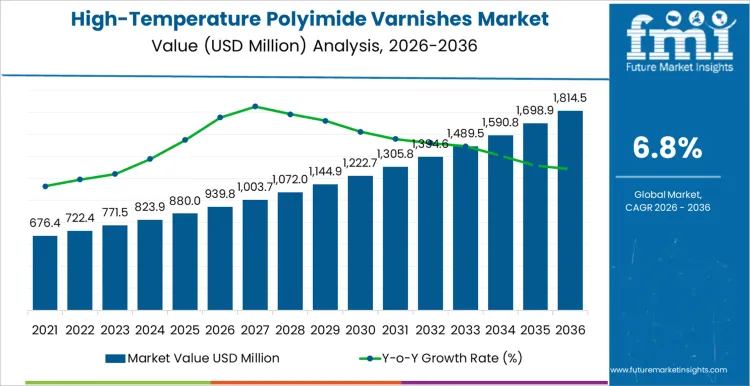
The high-temperature polyimide varnishes market stands at USD 939.8 million in 2026 and is projected to reach USD 1,814.5 million by 2036, at a CAGR of 6.8%. Pricing power in this market is anchored in qualification depth rather than volume scale. Once varnishes are approved within motor, aerospace, or electrical insulation systems, switching costs become structurally high due to requalification timelines, reliability testing, and system-level certifications. Leading suppliers defend margins through proprietary polyimide chemistries, long-term thermal aging datasets, and integration know-how tied to specific impregnation and curing processes. Entry barriers remain elevated because new entrants must demonstrate multi-year performance stability, dielectric reliability, and compliance with stringent industry standards. At the same time, fragmentation persists at the regional and application level, where local suppliers compete on cost, customization, or proximity for industrial motors and power equipment. This balance between global incumbents and regional specialists keeps competitive intensity disciplined while limiting rapid price erosion across the value chain.
Quick Stats for High-Temperature Polyimide Varnishes Market
- High-Temperature Polyimide Varnishes Market Value (2026): USD 939.8 Million
- High-Temperature Polyimide Varnishes Market Forecast Value (2036): USD 1,814.5 Million
- High-Temperature Polyimide Varnishes Market Forecast CAGR 2026 to 2036: 6.80%
- Leading Polyimide Type in High-Temperature Polyimide Varnishes Market: Aromatic Polyimides (44% share)
- Key Growth Regions in High-Temperature Polyimide Varnishes Market: Asia Pacific, Europe, North America, Latin America, Middle East & Africa
- Top Key Players in High-Temperature Polyimide Varnishes Market: DuPont, UBE Corporation, Mitsubishi Gas Chemical, Kaneka Corporation, Saint-Gobain Performance Plastics, Toray Industries, Sumitomo Bakelite Co., Shin-Etsu Chemical, Danyang Dayangchem, Changchun Gaoqi Polyimide
High-Temperature Polyimide Varnishes Market Key Takeaways
| Metric | Value |
|---|---|
| High-Temperature Polyimide Varnishes Market Value (2026) | USD 939.8 Million |
| High-Temperature Polyimide Varnishes Market Forecast Value (2036) | USD 1,814.5 Million |
| High-Temperature Polyimide Varnishes Market Forecast CAGR 2026 to 2036 | 6.80% |
How are Thermal Endurance Requirements and Electrification Trends Driving the High-Temperature Polyimide Varnishes Market?
The high-temperature polyimide varnishes market is expanding as electrical and electronic systems operate under increasingly severe thermal and mechanical stress. These varnishes are widely used for wire enameling, coil impregnation, slot insulation, and protective coatings in motors, generators, transformers, and electronic components. Their ability to maintain dielectric strength, adhesion, and mechanical integrity at temperatures exceeding 200 °C makes them essential in applications where conventional insulation systems fail.
Supplier selection is strongly influenced by reliability validation and processing compatibility. Equipment manufacturers and insulation system designers evaluate polyimide varnishes based on thermal class rating, dielectric breakdown strength, chemical resistance, and long-term aging behavior. Compatibility with vacuum pressure impregnation (VPI), dip-and-bake processes, and automated coating lines is critical to maintaining production efficiency. Suppliers that provide well-documented thermal aging data and system-level insulation approvals gain preference during qualification.
Electrification and miniaturization are reinforcing market momentum. Growth in electric vehicles, aerospace electronics, high-efficiency industrial motors, and compact power electronics is increasing demand for insulation materials that support higher power density and longer service life. As OEMs push for lighter, smaller, and hotter-running designs, polyimide varnishes are increasingly specified as baseline materials rather than premium options. For producers, competitive advantage depends on consistent quality, application engineering support, and the ability to meet stringent reliability standards-positioning high-temperature polyimide varnishes as a steady, performance-critical segment within advanced electrical insulation materials.
How is the High-Temperature Polyimide Varnishes Market Structured by Polyimide Type and Application?
The high-temperature polyimide varnishes market is structured by polyimide type and application, reflecting how thermal endurance, dielectric performance, and processing requirements guide material selection. By polyimide type, aromatic polyimides represent the leading segment, supported by their superior heat resistance and electrical insulation stability. Other types include semi-aromatic polyimides and other high-temperature polyimide systems formulated for specific flexibility or processing needs. By application, wire enamels and magnet wire form the largest demand segment, followed by flexible circuits and films, motors, generators and insulation, and other uses where long-term thermal reliability is essential.
Why Do Aromatic Polyimides Lead Polyimide Type Adoption in the High-Temperature Polyimide Varnishes Market?
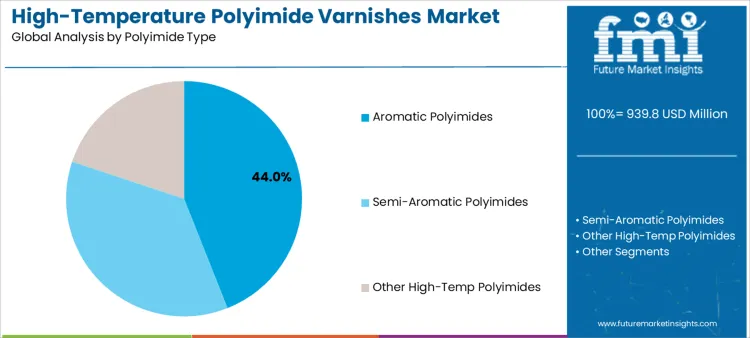
Aromatic polyimides account for 44% share of the high-temperature polyimide varnishes market because they deliver exceptional thermal stability, dielectric strength, and chemical resistance under continuous high-temperature operation. These materials maintain insulation integrity at elevated temperatures, making them ideal for demanding electrical and electronic applications. Manufacturers favor aromatic polyimides for their proven performance in harsh thermal environments and predictable curing behavior. Their strong adhesion to copper and other conductive substrates supports reliable coating of wires and components. Long service life and consistent insulation performance explain why aromatic polyimides remain the most widely adopted polyimide type.
Why Do Wire Enamels And Magnet Wire Dominate Application Demand In The High-Temperature Polyimide Varnishes Market?

Wire enamels and magnet wire hold 38% share of the high-temperature polyimide varnishes market because electrical windings require insulation that can withstand sustained heat, mechanical stress, and electrical load. Polyimide varnishes provide thin, uniform coatings that enable compact winding designs while maintaining dielectric reliability. Motors, transformers, and generators rely on magnet wire insulation to prevent failure during continuous operation. High production volumes of electrical equipment drive steady consumption of varnishes. These performance-critical requirements and volume-driven demand patterns explain why wire enamels and magnet wire remain the leading application segment.
What are the Key Dynamics of the High-Temperature Polyimide Varnishes Market?
The high-temperature polyimide varnishes market is driven by demand for advanced insulation solutions in electrical, electronics, aerospace, automotive, and industrial applications where performance at elevated temperatures is critical. Polyimide varnishes provide excellent thermal stability, chemical resistance, mechanical strength, and dielectric properties at temperatures often exceeding 200 °C, making them suitable for insulating coils, motors, generators, transformers, wire coatings, and flexible circuits. For resin suppliers, compounders, and equipment manufacturers, consistency in varnish chemistry, low viscosity for impregnation, robust cure behavior, and long-term reliability under thermal cycling are central factors that influence material selection and qualification.
How do Application and Industry Trends Shape This Market?
Application and industry trends shape the high-temperature polyimide varnishes market through increased electrification, higher power densities, and miniaturization in key sectors. In electric vehicles and industrial electric machines, motors and inverters operate at higher temperatures, creating demand for varnishes that maintain insulation integrity and reduce failure risk. Aerospace systems require varnishes that withstand extreme thermal cycling and chemical exposure while providing long-term dielectric performance. Growth in renewable energy systems such as wind turbine generators and high-speed industrial machinery also expands use cases. Suppliers that align varnish formulations with application-specific thermal profiles and processing conditions strengthen competitiveness and shorten qualification cycles.
Why do Cost, Processing, and Qualification Challenges Restrain Market Growth?
Cost, processing, and qualification challenges restrain growth in the high-temperature polyimide varnishes market because these systems often require specialized resin chemistries and controlled cure conditions that elevate material and manufacturing expense relative to general-purpose varnishes. Achieving optimal wetting, penetration, and void-free impregnation in complex coil and stator geometries demands precise process control, which can lengthen production time and require skilled operators. Qualification for critical applications involves extensive reliability testing under thermal, mechanical, and electrical stress, increasing time to production readiness. Regulatory and safety standards in aerospace, automotive, and power sectors also mandate rigorous documentation and performance evidence before adoption at scale.
How is the High-Temperature Polyimide Varnishes Market Growing across Key Countries?
The high-temperature polyimide varnishes market is expanding steadily as industries demand materials capable of maintaining electrical insulation, mechanical integrity, and thermal stability under extreme operating conditions. These varnishes are widely used in motors, generators, transformers, aerospace components, electronics, and advanced industrial equipment where continuous exposure to high temperatures is common. Country-wise growth varies based on expansion of electrical equipment manufacturing, aerospace and electronics production, and adoption of high-performance insulation systems. High-growth markets benefit from industrial expansion and electrification, while mature regions focus on reliability, material qualification, and long service life in critical applications.

| Country | CAGR (%) |
|---|---|
| China | 8.0 |
| Brazil | 7.6 |
| United States | 6.5 |
| Germany | 6.4 |
| South Korea | 6.0 |
Why Is China Leading the High-Temperature Polyimide Varnishes Market?
Demand for high-temperature polyimide varnishes in China is expanding at a CAGR of 8.0% during 2026 to 2036, driven by rapid growth in electrical equipment manufacturing, industrial motors, and electronics production. Polyimide varnishes are increasingly used for insulating windings, coils, and components exposed to sustained high temperatures in power generation, rail traction, and industrial machinery. Expansion of renewable energy systems and electric mobility further supports demand for advanced insulation materials. Chinese manufacturers prioritize varnishes that offer strong thermal endurance, good dielectric strength, and compatibility with automated impregnation processes. Domestic chemical producers benefit from large-scale production capabilities and improving quality standards, enabling cost-effective supply for high-volume applications. Procurement decisions emphasize performance consistency, supply reliability, and compliance with electrical insulation standards. As Chinese equipment manufacturers increasingly serve global markets, demand is rising for polyimide varnishes that meet international certification requirements.
Why is Brazil Experiencing Strong Growth in High-Temperature Polyimide Varnishes?
Brazil’s high-temperature polyimide varnishes market is growing at a CAGR of 7.6% during 2026 to 2036, supported by expansion of power generation, industrial motors, and electrical infrastructure. Polyimide varnishes are increasingly used in generators, transformers, and heavy-duty motors operating under demanding thermal conditions. Growth is also supported by rising investment in renewable energy and industrial modernization. Brazilian buyers value varnishes that provide reliable insulation performance, moisture resistance, and durability in high-temperature environments. Adoption is strongest in industrial equipment and power-related applications where operational reliability is critical. Procurement decisions often favor suppliers offering technical support, regional availability, and products compatible with existing impregnation and curing systems. As infrastructure projects and industrial activity increase, demand for high-temperature insulation varnishes is expected to rise steadily across Brazil’s electrical equipment sector.
What Is Driving Demand for High-Temperature Polyimide Varnishes in the United States?
The United States high-temperature polyimide varnishes market is expanding at a CAGR of 6.5% during 2026 to 2036, driven by demand from aerospace, defense, industrial motors, and advanced electronics. Polyimide varnishes are widely used in applications requiring stable insulation under extreme thermal and mechanical stress, including aircraft systems, military equipment, and high-performance industrial machinery. USA buyers emphasize long-term thermal stability, dielectric reliability, and compliance with stringent industry standards. Demand is strongest in high-value applications where performance and safety are prioritized over cost considerations. Procurement decisions prioritize supplier reliability, detailed technical documentation, and proven performance history. Market growth is shaped by ongoing defense programs, aerospace manufacturing activity, and continued investment in advanced electrical and electronic systems.
How Is Germany Supporting Growth in the High-Temperature Polyimide Varnishes Market?
Germany’s high-temperature polyimide varnishes market is growing at a CAGR of 6.4% during 2026 to 2036, supported by demand from industrial machinery, automotive electrification, and advanced electrical equipment manufacturing. German manufacturers emphasize precision engineering, durability, and long service life, making polyimide varnishes a preferred choice for high-temperature insulation. Buyers prioritize varnishes with consistent curing behavior, strong adhesion, and reliable dielectric properties. Applications include traction motors, industrial drives, and specialty electrical components. Adoption is driven by performance optimization rather than volume growth. Procurement decisions favor suppliers with robust quality systems, certification capabilities, and the ability to support customized insulation requirements. Market growth is reinforced by Germany’s focus on engineering excellence and advanced industrial applications.
How is South Korea Expanding Use of High-Temperature Polyimide Varnishes?
South Korea’s high-temperature polyimide varnishes market is expanding at a CAGR of 6.0% during 2026 to 2036, driven by demand from electronics manufacturing, electric motors, and advanced industrial equipment. Polyimide varnishes are increasingly used where compact designs and high thermal endurance are required. Buyers emphasize compatibility with automated manufacturing, stable insulation performance, and suitability for export-oriented products. Adoption is strongest in electronics-related equipment and precision industrial applications. Procurement decisions are influenced by supplier technical capability, consistent product quality, and alignment with global electrical insulation standards. Market growth is supported by steady industrial development and increasing demand for high-reliability insulation materials.
How are Manufacturers Competing in the High-Temperature Polyimide Varnishes Market?

Competition in the high-temperature polyimide varnishes market is shaped by thermal stability, dielectric performance, and process compatibility that matter to electrical insulation engineers, motor and transformer OEMs, and aerospace specifiers. DuPont positions its Kapton and Pyre-ML varnishes around broad thermal endurance and proven dielectric performance in demanding insulation systems. Its product literature emphasizes consistent polyimide chemistry, high glass transition temperature, and multi-substrate wetting that support continuous operation at elevated temperatures. UBE Corporation competes by offering tailored polyimide varnish formulations designed for use in high-speed motors and aerospace components, with documentation underscoring low volatiles and robust adhesion.
Japanese and global chemical groups differentiate through materials purity and application breadth. Mitsubishi Gas Chemical and Kaneka Corporation emphasize high-performance polyimide varnishes engineered for precision winding and thermal cycling resistance. Saint Gobain Performance Plastics competes by aligning varnishes with its broader insulation systems, highlighting film and coating integration for demanding electrical applications. Toray Industries and Sumitomo Bakelite Co. focus on varnish formulations that balance processability with long-term reliability in high-temperature environments.
Regional producers and specialty formulators add competitive depth through cost-effective and niche variants. Shin Etsu Chemical brings high-purity polyimide coatings tailored for electronics and thin-film insulation. Danyang Dayangchem and Changchun Gaoqi Polyimide compete on localized supply and application support for industrial motors and power electronics. Across suppliers, competitive advantage is defined by verified thermal and dielectric performance, varnish processability, and specialized technical support rather than material cost alone.
Key Players in High-Temperature Polyimide Varnishes Market
- DuPont (Kapton, Pyre-Ml)
- UBE Corporation
- Mitsubishi Gas Chemical
- Kaneka Corporation
- Saint-Gobain Performance Plastics
- Toray Industries
- Sumitomo Bakelite Co.
- Shin-Etsu Chemical
- Danyang Dayangchem
- Changchun Gaoqi Polyimide
Scope of Report
| Attribute | Details |
|---|---|
| Market Size Unit | USD Million |
| Polyimide Type Covered | Aromatic Polyimides, Semi-Aromatic Polyimides, Other High-Temperature Polyimide Varnishes |
| Application Covered | Wire Enamels & Magnet Wire, Flexible Circuits & Films, Motors, Generators & Electrical Insulation, Other High-Temperature Electrical and Industrial Uses |
| Countries Covered | China, Japan, South Korea, India, Australia & New Zealand, ASEAN, Rest of Asia Pacific, Germany, United Kingdom, France, Italy, Spain, Nordic, BENELUX, Rest of Europe, United States, Canada, Mexico, Brazil, Chile, Rest of Latin America, Kingdom of Saudi Arabia, Other GCC Countries, Turkey, South Africa, Other African Union, Rest of Middle East & Africa |
| Regions Covered | Asia Pacific, Europe, North America, Latin America, Middle East & Africa |
| Key Companies Profiled | DuPont, UBE Corporation, Mitsubishi Gas Chemical, Kaneka Corporation, Saint-Gobain Performance Plastics, Toray Industries, Sumitomo Bakelite, Shin-Etsu Chemical, Danyang Dayangchem, Changchun Gaoqi Polyimide |
| Additional Attributes | Dollar sales by polyimide type and application are evaluated across electrical insulation and electronics manufacturing value chains. The scope analyzes thermal endurance, dielectric strength, solvent systems, curing behavior, and compatibility with wire enameling and flexible electronics processes. Country-level analysis reflects motor electrification trends, electronics miniaturization, and demand for high-temperature insulation materials in industrial and automotive applications. |
High-Temperature Polyimide Varnishes Market by Key Segments
Polyimide Type:
- Aromatic Polyimides
- Semi-Aromatic Polyimides
- Other High-Temp Polyimides
Application:
- Wire Enamels & Magnet Wire
- Flexible Circuits & Films
- Motors, Generators & Insulation
- Other Uses
Region:
- Asia Pacific
- China
- Japan
- South Korea
- India
- Australia & New Zealand
- ASEAN
- Rest of Asia Pacific
- Europe
- Germany
- United Kingdom
- France
- Italy
- Spain
- Nordic
- BENELUX
- Rest of Europe
- North America
- United States
- Canada
- Mexico
- Latin America
- Brazil
- Chile
- Rest of Latin America
- Middle East & Africa
- Kingdom of Saudi Arabia
- Other GCC Countries
- Turkey
- South Africa
- Other African Union
- Rest of Middle East & Africa
Bibliography
- European Chemicals Agency. (2024). Polymer safety, thermal stability, and electrical insulation requirements for high‑temperature applications. European Union Publications Office.
- International Energy Agency. (2024). Electrification trends and material requirements for high‑temperature electrical systems. IEA Publications.
- USA Department of Energy, Office of Electricity. (2024). Advanced insulation materials for electric motors, generators, and power electronics.
- Zhang, Y., Liu, Q., & Chen, H. (2024). High‑temperature polyimide materials for electrical insulation: Thermal endurance and dielectric performance.
- Li, X., Wang, J., & Sun, Z. (2024). Aging behavior and dielectric reliability of polyimide insulation under extreme thermal conditions.
Frequently Asked Questions
How big is the high-temperature polyimide varnishes market in 2026?
The global high-temperature polyimide varnishes market is estimated to be valued at USD 939.8 million in 2026.
What will be the size of high-temperature polyimide varnishes market in 2036?
The market size for the high-temperature polyimide varnishes market is projected to reach USD 1,814.5 million by 2036.
How much will be the high-temperature polyimide varnishes market growth between 2026 and 2036?
The high-temperature polyimide varnishes market is expected to grow at a 6.8% CAGR between 2026 and 2036.
What are the key product types in the high-temperature polyimide varnishes market?
The key product types in high-temperature polyimide varnishes market are aromatic polyimides, semi-aromatic polyimides and other high-temp polyimides.
Which application segment to contribute significant share in the high-temperature polyimide varnishes market in 2026?
In terms of application, wire enamels & magnet wire segment to command 38.0% share in the high-temperature polyimide varnishes market in 2026.
Preview the report firsthand - request a free sample
Get SampleGet the brochure for pricing and purchase details.
Get PDFTable of Content
- Executive Summary
- Global Market Outlook
- Demand-side Trends
- Supply-side Trends
- Technology Roadmap Analysis
- Analysis and Recommendations
- Market Overview
- Market Coverage / Taxonomy
- Market Definition / Scope / Limitations
- Market Background
- Market Dynamics
- Drivers
- Restraints
- Opportunity
- Trends
- Scenario Forecast
- Demand in Optimistic Scenario
- Demand in Likely Scenario
- Demand in Conservative Scenario
- Opportunity Map Analysis
- Product Life Cycle Analysis
- Supply Chain Analysis
- Investment Feasibility Matrix
- Value Chain Analysis
- PESTLE and Porter’s Analysis
- Regulatory Landscape
- Regional Parent Market Outlook
- Production and Consumption Statistics
- Import and Export Statistics
- Market Dynamics
- Global Market Analysis 2021 to 2025 and Forecast, 2026 to 2036
- Historical Market Size Value (USD Million) Analysis, 2021 to 2025
- Current and Future Market Size Value (USD Million) Projections, 2026 to 2036
- Y-o-Y Growth Trend Analysis
- Absolute $ Opportunity Analysis
- Global Market Pricing Analysis 2021 to 2025 and Forecast 2026 to 2036
- Global Market Analysis 2021 to 2025 and Forecast 2026 to 2036, By Polyimide Type
- Introduction / Key Findings
- Historical Market Size Value (USD Million) Analysis By Polyimide Type , 2021 to 2025
- Current and Future Market Size Value (USD Million) Analysis and Forecast By Polyimide Type , 2026 to 2036
- Aromatic Polyimides
- Semi-Aromatic Polyimides
- Other High-Temp Polyimides
- Aromatic Polyimides
- Y-o-Y Growth Trend Analysis By Polyimide Type , 2021 to 2025
- Absolute $ Opportunity Analysis By Polyimide Type , 2026 to 2036
- Global Market Analysis 2021 to 2025 and Forecast 2026 to 2036, By Application
- Introduction / Key Findings
- Historical Market Size Value (USD Million) Analysis By Application, 2021 to 2025
- Current and Future Market Size Value (USD Million) Analysis and Forecast By Application, 2026 to 2036
- Wire Enamels & Magnet Wire
- Flexible Circuits & Films
- Motors, Generators & Insulation
- Other Uses
- Wire Enamels & Magnet Wire
- Y-o-Y Growth Trend Analysis By Application, 2021 to 2025
- Absolute $ Opportunity Analysis By Application, 2026 to 2036
- Global Market Analysis 2021 to 2025 and Forecast 2026 to 2036, By Region
- Introduction
- Historical Market Size Value (USD Million) Analysis By Region, 2021 to 2025
- Current Market Size Value (USD Million) Analysis and Forecast By Region, 2026 to 2036
- North America
- Latin America
- Western Europe
- Eastern Europe
- East Asia
- South Asia and Pacific
- Middle East & Africa
- Market Attractiveness Analysis By Region
- North America Market Analysis 2021 to 2025 and Forecast 2026 to 2036, By Country
- Historical Market Size Value (USD Million) Trend Analysis By Market Taxonomy, 2021 to 2025
- Market Size Value (USD Million) Forecast By Market Taxonomy, 2026 to 2036
- By Country
- USA
- Canada
- Mexico
- By Polyimide Type
- By Application
- By Country
- Market Attractiveness Analysis
- By Country
- By Polyimide Type
- By Application
- Key Takeaways
- Latin America Market Analysis 2021 to 2025 and Forecast 2026 to 2036, By Country
- Historical Market Size Value (USD Million) Trend Analysis By Market Taxonomy, 2021 to 2025
- Market Size Value (USD Million) Forecast By Market Taxonomy, 2026 to 2036
- By Country
- Brazil
- Chile
- Rest of Latin America
- By Polyimide Type
- By Application
- By Country
- Market Attractiveness Analysis
- By Country
- By Polyimide Type
- By Application
- Key Takeaways
- Western Europe Market Analysis 2021 to 2025 and Forecast 2026 to 2036, By Country
- Historical Market Size Value (USD Million) Trend Analysis By Market Taxonomy, 2021 to 2025
- Market Size Value (USD Million) Forecast By Market Taxonomy, 2026 to 2036
- By Country
- Germany
- UK
- Italy
- Spain
- France
- Nordic
- BENELUX
- Rest of Western Europe
- By Polyimide Type
- By Application
- By Country
- Market Attractiveness Analysis
- By Country
- By Polyimide Type
- By Application
- Key Takeaways
- Eastern Europe Market Analysis 2021 to 2025 and Forecast 2026 to 2036, By Country
- Historical Market Size Value (USD Million) Trend Analysis By Market Taxonomy, 2021 to 2025
- Market Size Value (USD Million) Forecast By Market Taxonomy, 2026 to 2036
- By Country
- Russia
- Poland
- Hungary
- Balkan & Baltic
- Rest of Eastern Europe
- By Polyimide Type
- By Application
- By Country
- Market Attractiveness Analysis
- By Country
- By Polyimide Type
- By Application
- Key Takeaways
- East Asia Market Analysis 2021 to 2025 and Forecast 2026 to 2036, By Country
- Historical Market Size Value (USD Million) Trend Analysis By Market Taxonomy, 2021 to 2025
- Market Size Value (USD Million) Forecast By Market Taxonomy, 2026 to 2036
- By Country
- China
- Japan
- South Korea
- By Polyimide Type
- By Application
- By Country
- Market Attractiveness Analysis
- By Country
- By Polyimide Type
- By Application
- Key Takeaways
- South Asia and Pacific Market Analysis 2021 to 2025 and Forecast 2026 to 2036, By Country
- Historical Market Size Value (USD Million) Trend Analysis By Market Taxonomy, 2021 to 2025
- Market Size Value (USD Million) Forecast By Market Taxonomy, 2026 to 2036
- By Country
- India
- ASEAN
- Australia & New Zealand
- Rest of South Asia and Pacific
- By Polyimide Type
- By Application
- By Country
- Market Attractiveness Analysis
- By Country
- By Polyimide Type
- By Application
- Key Takeaways
- Middle East & Africa Market Analysis 2021 to 2025 and Forecast 2026 to 2036, By Country
- Historical Market Size Value (USD Million) Trend Analysis By Market Taxonomy, 2021 to 2025
- Market Size Value (USD Million) Forecast By Market Taxonomy, 2026 to 2036
- By Country
- Kingdom of Saudi Arabia
- Other GCC Countries
- Turkiye
- South Africa
- Other African Union
- Rest of Middle East & Africa
- By Polyimide Type
- By Application
- By Country
- Market Attractiveness Analysis
- By Country
- By Polyimide Type
- By Application
- Key Takeaways
- Key Countries Market Analysis
- USA
- Pricing Analysis
- Market Share Analysis, 2025
- By Polyimide Type
- By Application
- Canada
- Pricing Analysis
- Market Share Analysis, 2025
- By Polyimide Type
- By Application
- Mexico
- Pricing Analysis
- Market Share Analysis, 2025
- By Polyimide Type
- By Application
- Brazil
- Pricing Analysis
- Market Share Analysis, 2025
- By Polyimide Type
- By Application
- Chile
- Pricing Analysis
- Market Share Analysis, 2025
- By Polyimide Type
- By Application
- Germany
- Pricing Analysis
- Market Share Analysis, 2025
- By Polyimide Type
- By Application
- UK
- Pricing Analysis
- Market Share Analysis, 2025
- By Polyimide Type
- By Application
- Italy
- Pricing Analysis
- Market Share Analysis, 2025
- By Polyimide Type
- By Application
- Spain
- Pricing Analysis
- Market Share Analysis, 2025
- By Polyimide Type
- By Application
- France
- Pricing Analysis
- Market Share Analysis, 2025
- By Polyimide Type
- By Application
- India
- Pricing Analysis
- Market Share Analysis, 2025
- By Polyimide Type
- By Application
- ASEAN
- Pricing Analysis
- Market Share Analysis, 2025
- By Polyimide Type
- By Application
- Australia & New Zealand
- Pricing Analysis
- Market Share Analysis, 2025
- By Polyimide Type
- By Application
- China
- Pricing Analysis
- Market Share Analysis, 2025
- By Polyimide Type
- By Application
- Japan
- Pricing Analysis
- Market Share Analysis, 2025
- By Polyimide Type
- By Application
- South Korea
- Pricing Analysis
- Market Share Analysis, 2025
- By Polyimide Type
- By Application
- Russia
- Pricing Analysis
- Market Share Analysis, 2025
- By Polyimide Type
- By Application
- Poland
- Pricing Analysis
- Market Share Analysis, 2025
- By Polyimide Type
- By Application
- Hungary
- Pricing Analysis
- Market Share Analysis, 2025
- By Polyimide Type
- By Application
- Kingdom of Saudi Arabia
- Pricing Analysis
- Market Share Analysis, 2025
- By Polyimide Type
- By Application
- Turkiye
- Pricing Analysis
- Market Share Analysis, 2025
- By Polyimide Type
- By Application
- South Africa
- Pricing Analysis
- Market Share Analysis, 2025
- By Polyimide Type
- By Application
- USA
- Market Structure Analysis
- Competition Dashboard
- Competition Benchmarking
- Market Share Analysis of Top Players
- By Regional
- By Polyimide Type
- By Application
- Competition Analysis
- Competition Deep Dive
- DuPont (Kapton, Pyre-Ml)
- Overview
- Product Portfolio
- Profitability by Market Segments (Product/Age /Sales Channel/Region)
- Sales Footprint
- Strategy Overview
- Marketing Strategy
- Product Strategy
- Channel Strategy
- UBE Corporation
- Mitsubishi Gas Chemical
- Kaneka Corporation
- Saint-Gobain Performance Plastics
- Toray Industries
- Sumitomo Bakelite Co.
- Shin-Etsu Chemical
- Danyang Dayangchem
- Changchun Gaoqi Polyimide
- DuPont (Kapton, Pyre-Ml)
- Competition Deep Dive
- Assumptions & Acronyms Used
- Research Methodology


