

- Industry Size (2026)
- USD 2.3 Bn
- Forecast (2036)
- USD 5.7 Bn
- CAGR (2026 to 2036)
- 9.5%
E-Motor Assisted Braking Systems Market Forecast and Outlook 2026 to 2036
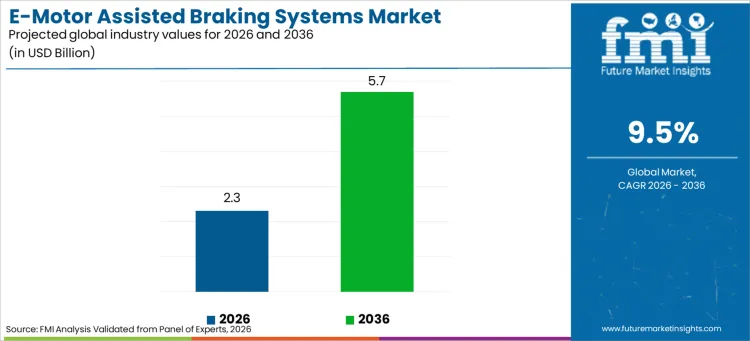
Spending on e-motor assisted braking systems amounts to USD 2.3 billion in 2026 and is projected to reach USD 5.7 billion by 2036 at a 9.5% CAGR. Demand is created by vehicle programs that require coordinated torque generation, energy recovery, and fail-safe braking under a single control strategy. Architecture teams define boost levels, response curves, and fallback modes during platform development. System choice fixes interactions among electric motors, hydraulic circuits, and control software. Once a vehicle platform reaches production release, later changes require renewed safety assessment and vehicle-level validation. Volume growth follows expansion of electrified powertrains and the shift toward integrated chassis control architectures.
Program inclusion in the e-motor assisted braking systems market is governed by platform roadmaps, homologation schedules, and ownership of safety cases. Access depends on placement within approved vehicle architectures rather than substitution of individual components. Evaluation focuses on response consistency, energy recovery coordination, and behavior under degraded operating conditions. Approved systems remain in service across full model cycles because calibration sets and compliance files attach to specific implementations. Supplier changes occur during platform transitions rather than mid-cycle sourcing actions. Revenue development reflects the number of vehicle programs adopting electrically assisted braking layouts. Competitive standing depends on early participation in system architecture definition and sustained acceptance within OEM engineering governance frameworks.
E-Motor Assisted Braking Systems Market Quick Stats
- E-Motor Assisted Braking Systems Market Value (2026): USD 2.3 billion
- E-Motor Assisted Braking Systems Market Forecast Value (2036): USD 5.7 billion
- E-Motor Assisted Braking Systems Market Forecast CAGR (2026 to 2036): 9.5%
- Leading Assist Type in E-Motor Assisted Braking Systems Market: eBooster systems
- Key Growth Regions in E-Motor Assisted Braking Systems Market: China, Brazil, USA, Germany, UK
- Top Players in E-Motor Assisted Braking Systems Market: ZF Friedrichshafen, Bosch, Continental, Hitachi Astemo, Aptiv, Brembo, Hyundai Mobis, Nidec, Valeo, Denso
What is the Growth Forecast for the E Motor Assisted Braking Systems Market through 2036?
Vehicle braking architectures now place electric assist at the center of deceleration control, not as a secondary aid. The e motor assisted braking systems market in 2026 stands near USD 2.3 billion, rising from USD 1.5 billion in 2021 as electrified platforms replace vacuum based assistance. Engineering teams select these systems for response time, boost consistency, packaging efficiency, and behavior during power loss. Validation work focuses on pedal feel repeatability, thermal stability, and interaction with stability control. Program awards attach to vehicle architectures and safety cases. The climb to USD 5.7 billion by 2036 reflects a 9.5% growth path supported by broader electrification of brake actuation and higher content per vehicle across passenger and commercial segments.
Platform planning sets the commercial rhythm of the e motor assisted braking systems market. Volumes move under multiyear supply agreements aligned with homologation schedules. Inventory exposure stays limited since value concentrates in actuators, controllers, and calibration sets. Cost structure reflects motor and electronics content, redundancy design, test mileage, and certification effort. OEM teams monitor response consistency, fallback behavior, and fault rates rather than unit system price. Annual values pass through USD 3.3 billion in 2030 and USD 4.8 billion in 2034 as more nameplates migrate to electric assist architectures. The move to USD 5.7 billion in 2036 comes from wider deployment in mass market vehicles, tighter integration with brake by wire stacks, and longer platform lifetimes that fix these systems into core chassis control designs.
E-Motor Assisted Braking Systems Market Key Takeaways
| Metric | Value |
|---|---|
| Market Value (2026) | USD 2.3 billion |
| Forecast Value (2036) | USD 5.7 billion |
| Forecast CAGR (2026 to 2036) | 9.5% |
Source: FMI analysis based on primary research and proprietary forecasting model
How Is the E Motor Assisted Braking Systems Market Changing Pedal Force Management and System Packaging in Electric Vehicles?
Electric motor assisted braking replaces part of the hydraulic force generation with electromechanical actuation, which changes both how brakes are sized and how they are controlled. Vehicle programs adopt these systems to reduce reliance on vacuum sources and to gain finer control over pressure buildup. Engineers focus on pedal feel synthesis, response time, and fallback behavior because drivers must not notice when assistance sources change. Packaging teams evaluate motor placement, noise isolation, and thermal paths since these units operate in confined spaces near heat sensitive components. Validation work concentrates on low speed modulation, hill hold behavior, and emergency braking support because these expose most control and mechanical weaknesses. Qualification depends on consistent force delivery across temperatures, voltage levels, and duty cycles rather than on peak assist capability alone.
Planning for these systems centers on platform flexibility, serviceability, and long term reliability rather than on feature differentiation. Automakers measure success through stable pedal maps, low warranty claims, and predictable behavior across vehicle variants. A system that requires frequent recalibration or shows sensitivity to manufacturing tolerances increases integration cost and slows program schedules. Production teams track actuator alignment, wiring integrity, and software version control because small deviations change response characteristics. Service organizations pay attention to diagnostics and update procedures since faults often appear after electrical or software changes. Supplier selection favors groups that can support combined mechanical and control responsibility. Contracts define ownership of safety cases, update impact assessment, and component life targets because braking performance affects certification, customer confidence, and fleet wide risk exposure.
How Do Redundancy Planning and Packaging Constraints Shape Demand in the E-Motor Assisted Braking Systems Market by Assist Type and Vehicle Segment in 2026?
In the E-Motor Assisted Braking Systems Market, platform decisions start from boost availability under all power states, pedal consistency, and integration with regenerative braking rather than from actuator unit cost. Programs serving passenger electric vehicle platforms, premium vehicle architectures, and light commercial electric fleets require assist systems that deliver predictable pressure build without dependence on engine vacuum. By assist type, usage spans eBooster systems, integrated motor-generator assist, electric vacuum pump assist, and other solutions. By vehicle segment, demand covers passenger EVs, premium and luxury vehicles, LCV EVs, and other categories. Portfolio structure reflects safety case scope, packaging space, and reuse potential across model lines.
Why Do eBooster Systems Dominate Current Assisted Braking Architectures?
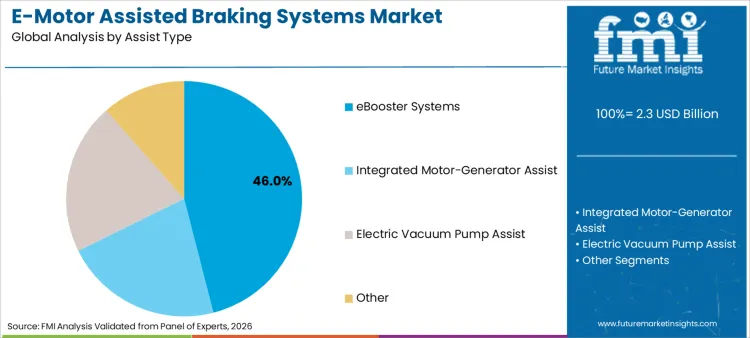
eBooster systems represent about 46% share, reflecting their ability to provide rapid, controllable boost independent of powertrain operating state. In passenger electric vehicle platforms, this supports consistent pedal feel during regeneration blending and at low speeds. Integrated motor generator assist concepts server architectures that already centralize powertrain and chassis functions, though they increase coordination complexity. electric vacuum pump assist remains relevant in transitional platforms that retain conventional hydraulic layouts. Other assist types remain niche. Engineering teams assess assist concepts through pressure build rate, fallback behavior, and thermal margins. Manufacturing teams assess through assembly complexity and supplier readiness. Software teams assess through calibration effort and diagnostics coverage.
After an assist architecture is selected, pedal modules, hydraulic layouts, and control strategies are frozen around that choice. Any change introduces new safety cases, endurance testing, and integration cycles. Program planning then protects long validation windows to avoid requalification loops. Supply chains align to the chosen actuation stack. Service documentation and dealer tooling also follow that structure. Volume growth comes from deploying the same assist concept across multiple models rather than switching architectures. The operating result favors eBooster solutions that balance innovation with certification stability and predictable pedal behavior across high-volume platforms.
Why Do Passenger EVs Concentrate Most Assisted Braking Volume?
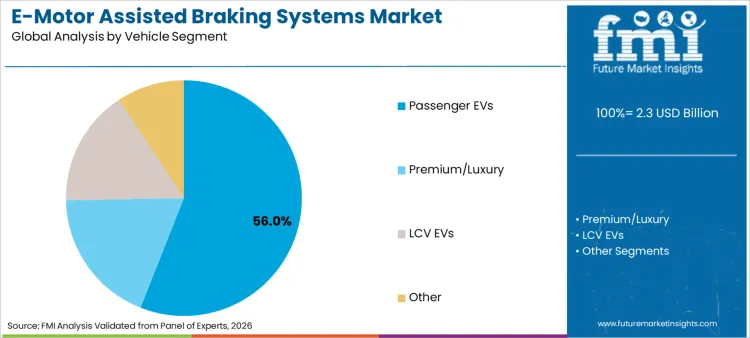
Passenger EVs account for about 56% share, driven by production scale and strong sensitivity to brake feel smoothness and response time. In this segment, assisted braking behavior directly influences perceived refinement and driver confidence. Premium and luxury vehicles follow, with tighter requirements for noise, vibration, and seamless transitions between assist and regenerative braking. LCV EVs prioritize durability and consistent response under varying payloads. Other segments remain limited. Vehicle teams evaluate segments through stopping distance, pedal effort curves, and assist availability under fault conditions. Validation teams evaluate through duty cycles and thermal exposure. Manufacturing teams evaluate through variant control.
Segment focus then defines the calibration and validation workload. Test programs, pedal maps, and endurance cycles are written around the dominant use case. Shifting segment priority introduces new mass distributions, customer expectations, and regulatory checks. Program schedules and budgets align to that center of gravity. Supplier tooling and test benches follow. Training materials and service procedures also assume the same duty profile. Expansion occurs by adding models within the same segment rather than shifting segment focus. Demand therefore concentrates in passenger EV programs where scale, integration with regeneration, and software reuse converge.
Why Are Vehicle Efficiency and Braking Performance Demands Supporting the E-Motor Assisted Braking Systems Market?
E-Motor Assisted Braking Systems Market demand is shaped by vehicle programs that seek improved energy recapture and smoother transition between electric and friction braking. E-motor assisted braking systems use electric machine torque to supplement conventional brake force, which can decrease wear on pads and discs and improve recovery of kinetic energy. Automotive engineers evaluate these systems for responsiveness, integration with antilock and stability control units, and consistent performance across varying speeds and loads. Buyers prioritize solutions that support predictable brake feel, improved deceleration control, and measurable contributions to vehicle energy balance. Suppliers that deliver systems with documented behavior maps and integration support increase confidence in design adoption.
What Constraints Are Affecting Adoption and Integration in the E-Motor Assisted Braking Systems Market?
E-Motor Assisted Braking Systems Market growth is influenced by control calibration demands, model-specific integration requirements, and validation workload within vehicle programs. Systems must coordinate electric torque with hydraulic friction braking under differing vehicle conditions to meet safety criteria and expected deceleration characteristics. Variations in vehicle mass, tire grip, and battery state affect how control strategies must be tuned, leading to extended calibration cycles. Cost pressures in competitive market segments impact supplier selection and architectural choices. Integration with existing vehicle networks and fault management systems adds engineering effort. Procurement teams must plan for early inclusion in development cycles to ensure sufficient integration and testing time.
How Are Product Architectures and Supply Practices Shaping the E-Motor Assisted Braking Systems Market?
E-Motor Assisted Braking Systems Market offerings are organized around defined control logic modules, interaction standards, and documented system behavior to help vehicle programs match systems to design targets. Suppliers provide integration guides detailing torque blending strategies, interface protocols with vehicle controllers, and test results across operating profiles. Portfolio segmentation by vehicle class and expected usage helps OEMs align module choice with performance, packaging, and cost targets. Commercial models increasingly include calibration support services and multi-year supply agreements that secure planned production volumes and responsiveness to change requests. Technical support focuses on control strategy alignment, integration checklists, and verification sequences to help manufacturers maintain consistent braking performance and system reliability across program variants.
What is the Demand for E Motor Assisted Braking Systems by Country?
| Country | CAGR (%) |
|---|---|
| USA | 9.1% |
| Germany | 8.9% |
| China | 11.2% |
| UK | 8.8% |
| Brazil | 11.0% |
Source: FMI analysis based on primary research and proprietary forecasting model
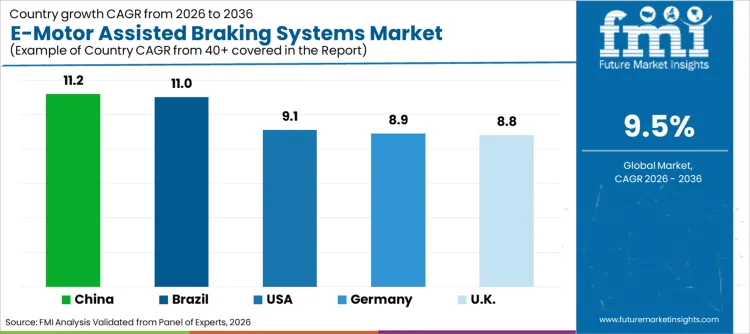
The demand for e motor assisted braking systems is increasing across electric and hybrid vehicles where energy recovery, braking efficiency, and driver safety are critical. China leads at 11.2% CAGR, supported by rapid EV adoption, government incentives, and OEM integration of assisted braking systems to optimize energy use. Brazil follows at 11.0%, reflecting growth in EV and hybrid vehicle production and adoption of advanced braking technologies. The USA grows at 9.1%, driven by expanding EV platforms and energy efficiency requirements. Germany records 8.9%, shaped by stringent automotive safety and performance standards. The UK advances at 8.8%, within a developing EV market emphasizing reliable and integrated brake assistance systems.
How EV Fleet Expansion Shapes the E-Motor Assisted Braking Systems Market in the USA
The e-motor assisted braking systems market in the United States is growing at a 9.1% CAGR as automakers integrate electric braking components into expanding EV fleets. Adoption focuses on verified torque assistance, seamless interaction with hydraulic brakes, and stability under variable load conditions. Engineering teams evaluate system responsiveness, energy recovery efficiency, thermal performance, and integration with traction control and battery management systems. Once approved, systems are deployed across multiple vehicle lines, reducing the need for repeated validation. Volume growth follows new model launches, fleet scaling, and performance-focused vehicle programs. Supplier participation depends on technical documentation, audit compliance, and integration support. Commercial success relies on consistent multi-platform performance, system reliability, and technical support for assembly operations.
How Vehicle Safety Audits and Performance Testing Influence the E-Motor Assisted Braking Systems Market in Germany
In Germany, the e-motor assisted braking systems market is advancing at an 8.9% CAGR, guided by stringent safety audits and high-cycle performance testing. System selection emphasizes braking torque consistency, pedal feel, and integration with both regenerative and conventional brake subsystems. Engineers assess thermal stability, response latency, and energy recovery under repeated operation. Once validated, systems are implemented across multiple EV models and assembly lines. Supplier access depends on audit compliance, documentation quality, and technical support capabilities. Volume growth tracks fleet expansion, platform upgrades, and new EV introductions rather than ad hoc installations. Commercial outcomes rely on predictable multi-platform performance, verified safety compliance, and support for ongoing integration.
How Production Capacity and Platform Integration Drive the E-Motor Assisted Braking Systems Market in China
China’s e-motor assisted braking systems market is expanding at an 11.2% CAGR as manufacturers scale production and integrate systems into multiple EV platforms. Approval focuses on torque assistance reliability, energy recovery performance, and seamless coordination with electronic stability and traction control systems. Technical teams evaluate system durability, braking response, thermal management, and battery interaction. Once validated, deployment spans multiple production lines and vehicle platforms. Domestic suppliers benefit from rapid integration capabilities, while imported systems are concentrated in high-specification or premium vehicles. Volume growth follows platform expansion, fleet growth, and large-scale EV production programs. Commercial success depends on consistent performance, operational reliability, and technical support across multiple assembly facilities.
How Safety Performance and Integration Testing Shape the E-Motor Assisted Braking Systems Market in the UK
In the United Kingdom, the e-motor assisted braking systems market is developing at an 8.8% CAGR, driven by testing requirements that ensure safety, braking consistency, and compatibility with hybrid and EV platforms. Systems are evaluated for torque modulation, pedal response, thermal performance, and interaction with regenerative subsystems. Once approved, deployment occurs across multiple vehicle lines without repeated recalibration. Supplier participation requires technical documentation, successful validation, and integration support. Volume growth tracks fleet expansion and platform adoption rather than isolated model updates. Commercial success relies on reproducible performance, verified integration, and technical support for production operations.
How Fleet Electrification and Production Expansion Influence the E-Motor Assisted Braking Systems Market in Brazil
Fleet electrification and vehicle platform growth are driving the e-motor assisted braking systems market in Brazil at an 11% CAGR. System approval depends on verified torque assistance, energy recovery efficiency, and stability across varying vehicle loads. Technical teams assess braking responsiveness, pedal modulation, thermal management, and compatibility with traction and battery control systems. Once validated, deployment occurs across multiple EV lines and assembly facilities. Supplier access relies on audit compliance, documentation integrity, and integration support. Volume growth is linked to fleet expansion, new EV model introductions, and large-scale production programs. Commercial success depends on consistent multi-platform performance, operational reliability, and technical assistance across production lines.
What Approaches Are Companies Taking in the E-Motor Assisted Braking Systems Market?
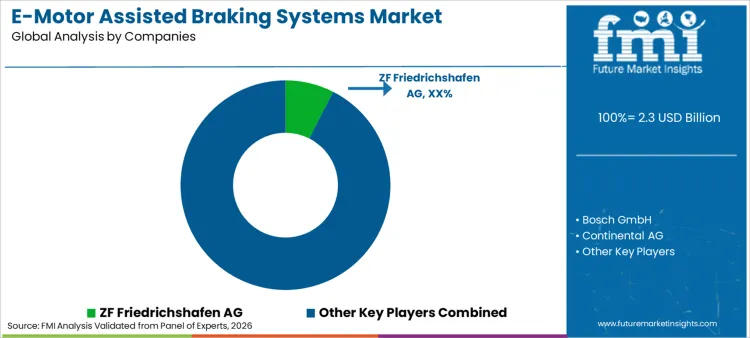
Integration reliability, regenerative efficiency, and electronic control precision shape adoption in the E-Motor Assisted Braking Systems Market. ZF Friedrichshafen, Bosch, Continental, Hitachi Astemo, Aptiv, Brembo, Hyundai Mobis, Nidec, Valeo, and Denso compete through component testing, vehicle-level validation, and software calibration. Once integrated into EVs or hybrid platforms, braking modulation, torque recovery efficiency, and system responsiveness anchor supplier selection. ZF Friedrichshafen focuses on modular e-motor-assisted solutions for passenger and commercial EVs. Bosch delivers precise control algorithms and scalable system modules. Continental provides energy-efficient integration for regenerative braking. Hitachi Astemo targets multi-platform vehicle compatibility. Aptiv emphasizes embedded electronic control coordination. Brembo supplies performance-oriented e-motor braking systems. Hyundai Mobis and Valeo provide fully integrated modules. Nidec and Denso offer motor-integrated systems with high reliability.
System robustness, calibration repeatability, and integration support define competitive positioning in the E-Motor Assisted Braking Systems Market. Engineers evaluate torque consistency, regenerative energy capture, thermal tolerance, and fail-safe performance during validation. Suppliers capable of reproducible production, scalable deployment, and vehicle integration guidance gain preference. ZF Friedrichshafen secures adoption through OEM partnerships and module validation. Bosch maintains share in precision braking applications. Continental competes in high-volume EV programs. Hitachi Astemo supports diverse vehicle architectures. Aptiv gains adoption in electronic control units. Brembo targets performance and sport applications. Hyundai Mobis and Valeo capture placements in integrated modules. Nidec and Denso maintain positions in motor-integrated systems. Market positions vary by vehicle type, system architecture, production volume, and regional automotive standards.
Key Players in E-Motor Assisted Braking Systems Market
- ZF Friedrichshafen AG
- Bosch GmbH
- Continental AG
- Hitachi Astemo, Ltd.
- Aptiv PLC
- Brembo S.p.A.
- Hyundai Mobis Co., Ltd.
- Nidec Corporation
- Valeo SA
- Denso Corporation
Scope of the Report
| Items | Values |
|---|---|
| Quantitative Units (2026) | USD billion |
| Assist Type | eBooster systems, integrated motor-generator assist, electric vacuum pump assist, other |
| Vehicle Segment | Passenger EVs, premium and luxury vehicles, LCV EVs, other |
| Integration | Brake-by-wire ready, ABS/ESC integrated, chassis domain integrated, other |
| Sales Channel | OEM line-fit, service and replacement, aftermarket, other |
| Regions Covered | Asia Pacific, Europe, North America, Latin America, Middle East & Africa |
| Countries Covered | United States, Canada, Mexico, Germany, United Kingdom, France, Italy, Spain, Nordics, BENELUX, China, Japan, South Korea, India, Australia & New Zealand, ASEAN, Brazil, Chile, Saudi Arabia, Turkey, South Africa, and other regional markets |
| Key Companies Profiled | ZF Friedrichshafen, Bosch, Continental, Hitachi Astemo, Aptiv, Brembo, Hyundai Mobis, Nidec, Valeo, Denso |
| Additional Attributes | Dollar sales by assist type, vehicle segment, integration, and sales channel, electric motor assisted brake force generation and boost control, coordination with regenerative and friction braking, response consistency and fallback behavior under degraded conditions, calibration workload and safety validation cycles, packaging and thermal management considerations, integration with ABS, ESC, and chassis control systems, multi-year platform adoption and homologation alignment, and regional adoption patterns across passenger, premium, and light commercial electric vehicle programs |
E-Motor Assisted Braking Systems Market Segmentation
Assist Type:
- eBooster Systems
- Integrated Motor-Generator Assist
- Electric Vacuum Pump Assist
- Other
Vehicle Segment:
- Passenger EVs
- Premium/Luxury
- LCV EVs
- Other
Integration:
- Brake-by-Wire Ready
- ABS/ESC Integrated
- Chassis Domain Integrated
- Other
Sales Channel:
- OEM Line-Fit
- Service/Replacement
- Aftermarket
- Other
Region
- Asia Pacific
- China
- Japan
- South Korea
- India
- Australia & New Zealand
- ASEAN
- Rest of Asia Pacific
- Europe
- Germany
- United Kingdom
- France
- Italy
- Spain
- Nordic
- BENELUX
- Rest of Europe
- North America
- United States
- Canada
- Mexico
- Latin America
- Brazil
- Chile
- Rest of Latin America
- Middle East & Africa
- Kingdom of Saudi Arabia
- Other GCC Countries
- Turkey
- South Africa
- Other African Union
- Rest of Middle East & Africa
Bibliography
- United Nations Economic Commission for Europe. (2023). UN Regulation No. 13-H: Uniform provisions concerning the approval of passenger cars with regard to braking. UNECE.
- United Nations Economic Commission for Europe. (2023). UN Regulation No. 140: Electronic stability control systems. UNECE.
- United Nations Economic Commission for Europe. (2023). UN Regulation No. 79: Uniform provisions concerning the approval of vehicles with regard to steering equipment. UNECE.
- National Highway Traffic Safety Administration. (2024). Federal Motor Vehicle Safety Standard No. 135: Light vehicle brake systems. USA Department of Transportation.
- National Highway Traffic Safety Administration. (2024). Federal Motor Vehicle Safety Standard No. 126: Electronic stability control systems. USA Department of Transportation.
Frequently Asked Questions
How big is the e-motor assisted braking systems market in 2026?
The e-motor assisted braking systems market is projected to be valued at USD 2.3 billion in 2026.
What will be the size of the e-motor assisted braking systems market in 2036?
The market size for e-motor assisted braking systems is projected to reach USD 5.7 billion by 2036.
How much will the demand for e-motor assisted braking systems grow between 2026 and 2036?
Demand for e-motor assisted braking systems is projected to grow at a 9.5% CAGR between 2026 and 2036.
Which assist type holds a significant share in the e-motor assisted braking systems market in 2026?
In terms of assist type, eBooster systems are expected to account for a 46% share in 2026.
Which vehicle segment contributes a major share in the e-motor assisted braking systems market in 2026?
The passenger EVs segment is expected to command a 56% share in the e-motor assisted braking systems market in 2026.
Preview the report firsthand - request a free sample
Get SampleGet the brochure for pricing and purchase details.
Get PDFTable of Content
- Executive Summary
- Global Market Outlook
- Demand-side Trends
- Supply-side Trends
- Technology Roadmap Analysis
- Analysis and Recommendations
- Market Overview
- Market Coverage / Taxonomy
- Market Definition / Scope / Limitations
- Market Background
- Market Dynamics
- Drivers
- Restraints
- Opportunity
- Trends
- Scenario Forecast
- Demand in Optimistic Scenario
- Demand in Likely Scenario
- Demand in Conservative Scenario
- Opportunity Map Analysis
- Product Life Cycle Analysis
- Supply Chain Analysis
- Investment Feasibility Matrix
- Value Chain Analysis
- PESTLE and Porter’s Analysis
- Regulatory Landscape
- Regional Parent Market Outlook
- Production and Consumption Statistics
- Import and Export Statistics
- Market Dynamics
- Global Market Analysis 2021 to 2025 and Forecast, 2026 to 2036
- Historical Market Size Value (USD Million) Analysis, 2021 to 2025
- Current and Future Market Size Value (USD Million) Projections, 2026 to 2036
- Y-o-Y Growth Trend Analysis
- Absolute $ Opportunity Analysis
- Global Market Pricing Analysis 2021 to 2025 and Forecast 2026 to 2036
- Global Market Analysis 2021 to 2025 and Forecast 2026 to 2036, By Assist Type
- Introduction / Key Findings
- Historical Market Size Value (USD Million) Analysis By Assist Type , 2021 to 2025
- Current and Future Market Size Value (USD Million) Analysis and Forecast By Assist Type , 2026 to 2036
- eBooster Systems
- Integrated Motor-Generator Assist
- Electric Vacuum Pump Assist
- Other
- eBooster Systems
- Y-o-Y Growth Trend Analysis By Assist Type , 2021 to 2025
- Absolute $ Opportunity Analysis By Assist Type , 2026 to 2036
- Global Market Analysis 2021 to 2025 and Forecast 2026 to 2036, By Vehicle Segment
- Introduction / Key Findings
- Historical Market Size Value (USD Million) Analysis By Vehicle Segment, 2021 to 2025
- Current and Future Market Size Value (USD Million) Analysis and Forecast By Vehicle Segment, 2026 to 2036
- Passenger EVs
- Premium/Luxury
- LCV EVs
- Other
- Passenger EVs
- Y-o-Y Growth Trend Analysis By Vehicle Segment, 2021 to 2025
- Absolute $ Opportunity Analysis By Vehicle Segment, 2026 to 2036
- Global Market Analysis 2021 to 2025 and Forecast 2026 to 2036, By Integration
- Introduction / Key Findings
- Historical Market Size Value (USD Million) Analysis By Integration, 2021 to 2025
- Current and Future Market Size Value (USD Million) Analysis and Forecast By Integration, 2026 to 2036
- Brake-by-Wire Ready
- ABS/ESC Integrated
- Chassis Domain Integrated
- Other
- Brake-by-Wire Ready
- Y-o-Y Growth Trend Analysis By Integration, 2021 to 2025
- Absolute $ Opportunity Analysis By Integration, 2026 to 2036
- Global Market Analysis 2021 to 2025 and Forecast 2026 to 2036, By Sales Channel
- Introduction / Key Findings
- Historical Market Size Value (USD Million) Analysis By Sales Channel, 2021 to 2025
- Current and Future Market Size Value (USD Million) Analysis and Forecast By Sales Channel, 2026 to 2036
- OEM Line-Fit
- Service/Replacement
- Aftermarket
- Other
- OEM Line-Fit
- Y-o-Y Growth Trend Analysis By Sales Channel, 2021 to 2025
- Absolute $ Opportunity Analysis By Sales Channel, 2026 to 2036
- Global Market Analysis 2021 to 2025 and Forecast 2026 to 2036, By Region
- Introduction
- Historical Market Size Value (USD Million) Analysis By Region, 2021 to 2025
- Current Market Size Value (USD Million) Analysis and Forecast By Region, 2026 to 2036
- North America
- Latin America
- Western Europe
- Eastern Europe
- East Asia
- South Asia and Pacific
- Middle East & Africa
- Market Attractiveness Analysis By Region
- North America Market Analysis 2021 to 2025 and Forecast 2026 to 2036, By Country
- Historical Market Size Value (USD Million) Trend Analysis By Market Taxonomy, 2021 to 2025
- Market Size Value (USD Million) Forecast By Market Taxonomy, 2026 to 2036
- By Country
- USA
- Canada
- Mexico
- By Assist Type
- By Vehicle Segment
- By Integration
- By Sales Channel
- By Country
- Market Attractiveness Analysis
- By Country
- By Assist Type
- By Vehicle Segment
- By Integration
- By Sales Channel
- Key Takeaways
- Latin America Market Analysis 2021 to 2025 and Forecast 2026 to 2036, By Country
- Historical Market Size Value (USD Million) Trend Analysis By Market Taxonomy, 2021 to 2025
- Market Size Value (USD Million) Forecast By Market Taxonomy, 2026 to 2036
- By Country
- Brazil
- Chile
- Rest of Latin America
- By Assist Type
- By Vehicle Segment
- By Integration
- By Sales Channel
- By Country
- Market Attractiveness Analysis
- By Country
- By Assist Type
- By Vehicle Segment
- By Integration
- By Sales Channel
- Key Takeaways
- Western Europe Market Analysis 2021 to 2025 and Forecast 2026 to 2036, By Country
- Historical Market Size Value (USD Million) Trend Analysis By Market Taxonomy, 2021 to 2025
- Market Size Value (USD Million) Forecast By Market Taxonomy, 2026 to 2036
- By Country
- Germany
- UK
- Italy
- Spain
- France
- Nordic
- BENELUX
- Rest of Western Europe
- By Assist Type
- By Vehicle Segment
- By Integration
- By Sales Channel
- By Country
- Market Attractiveness Analysis
- By Country
- By Assist Type
- By Vehicle Segment
- By Integration
- By Sales Channel
- Key Takeaways
- Eastern Europe Market Analysis 2021 to 2025 and Forecast 2026 to 2036, By Country
- Historical Market Size Value (USD Million) Trend Analysis By Market Taxonomy, 2021 to 2025
- Market Size Value (USD Million) Forecast By Market Taxonomy, 2026 to 2036
- By Country
- Russia
- Poland
- Hungary
- Balkan & Baltic
- Rest of Eastern Europe
- By Assist Type
- By Vehicle Segment
- By Integration
- By Sales Channel
- By Country
- Market Attractiveness Analysis
- By Country
- By Assist Type
- By Vehicle Segment
- By Integration
- By Sales Channel
- Key Takeaways
- East Asia Market Analysis 2021 to 2025 and Forecast 2026 to 2036, By Country
- Historical Market Size Value (USD Million) Trend Analysis By Market Taxonomy, 2021 to 2025
- Market Size Value (USD Million) Forecast By Market Taxonomy, 2026 to 2036
- By Country
- China
- Japan
- South Korea
- By Assist Type
- By Vehicle Segment
- By Integration
- By Sales Channel
- By Country
- Market Attractiveness Analysis
- By Country
- By Assist Type
- By Vehicle Segment
- By Integration
- By Sales Channel
- Key Takeaways
- South Asia and Pacific Market Analysis 2021 to 2025 and Forecast 2026 to 2036, By Country
- Historical Market Size Value (USD Million) Trend Analysis By Market Taxonomy, 2021 to 2025
- Market Size Value (USD Million) Forecast By Market Taxonomy, 2026 to 2036
- By Country
- India
- ASEAN
- Australia & New Zealand
- Rest of South Asia and Pacific
- By Assist Type
- By Vehicle Segment
- By Integration
- By Sales Channel
- By Country
- Market Attractiveness Analysis
- By Country
- By Assist Type
- By Vehicle Segment
- By Integration
- By Sales Channel
- Key Takeaways
- Middle East & Africa Market Analysis 2021 to 2025 and Forecast 2026 to 2036, By Country
- Historical Market Size Value (USD Million) Trend Analysis By Market Taxonomy, 2021 to 2025
- Market Size Value (USD Million) Forecast By Market Taxonomy, 2026 to 2036
- By Country
- Kingdom of Saudi Arabia
- Other GCC Countries
- Turkiye
- South Africa
- Other African Union
- Rest of Middle East & Africa
- By Assist Type
- By Vehicle Segment
- By Integration
- By Sales Channel
- By Country
- Market Attractiveness Analysis
- By Country
- By Assist Type
- By Vehicle Segment
- By Integration
- By Sales Channel
- Key Takeaways
- Key Countries Market Analysis
- USA
- Pricing Analysis
- Market Share Analysis, 2025
- By Assist Type
- By Vehicle Segment
- By Integration
- By Sales Channel
- Canada
- Pricing Analysis
- Market Share Analysis, 2025
- By Assist Type
- By Vehicle Segment
- By Integration
- By Sales Channel
- Mexico
- Pricing Analysis
- Market Share Analysis, 2025
- By Assist Type
- By Vehicle Segment
- By Integration
- By Sales Channel
- Brazil
- Pricing Analysis
- Market Share Analysis, 2025
- By Assist Type
- By Vehicle Segment
- By Integration
- By Sales Channel
- Chile
- Pricing Analysis
- Market Share Analysis, 2025
- By Assist Type
- By Vehicle Segment
- By Integration
- By Sales Channel
- Germany
- Pricing Analysis
- Market Share Analysis, 2025
- By Assist Type
- By Vehicle Segment
- By Integration
- By Sales Channel
- UK
- Pricing Analysis
- Market Share Analysis, 2025
- By Assist Type
- By Vehicle Segment
- By Integration
- By Sales Channel
- Italy
- Pricing Analysis
- Market Share Analysis, 2025
- By Assist Type
- By Vehicle Segment
- By Integration
- By Sales Channel
- Spain
- Pricing Analysis
- Market Share Analysis, 2025
- By Assist Type
- By Vehicle Segment
- By Integration
- By Sales Channel
- France
- Pricing Analysis
- Market Share Analysis, 2025
- By Assist Type
- By Vehicle Segment
- By Integration
- By Sales Channel
- India
- Pricing Analysis
- Market Share Analysis, 2025
- By Assist Type
- By Vehicle Segment
- By Integration
- By Sales Channel
- ASEAN
- Pricing Analysis
- Market Share Analysis, 2025
- By Assist Type
- By Vehicle Segment
- By Integration
- By Sales Channel
- Australia & New Zealand
- Pricing Analysis
- Market Share Analysis, 2025
- By Assist Type
- By Vehicle Segment
- By Integration
- By Sales Channel
- China
- Pricing Analysis
- Market Share Analysis, 2025
- By Assist Type
- By Vehicle Segment
- By Integration
- By Sales Channel
- Japan
- Pricing Analysis
- Market Share Analysis, 2025
- By Assist Type
- By Vehicle Segment
- By Integration
- By Sales Channel
- South Korea
- Pricing Analysis
- Market Share Analysis, 2025
- By Assist Type
- By Vehicle Segment
- By Integration
- By Sales Channel
- Russia
- Pricing Analysis
- Market Share Analysis, 2025
- By Assist Type
- By Vehicle Segment
- By Integration
- By Sales Channel
- Poland
- Pricing Analysis
- Market Share Analysis, 2025
- By Assist Type
- By Vehicle Segment
- By Integration
- By Sales Channel
- Hungary
- Pricing Analysis
- Market Share Analysis, 2025
- By Assist Type
- By Vehicle Segment
- By Integration
- By Sales Channel
- Kingdom of Saudi Arabia
- Pricing Analysis
- Market Share Analysis, 2025
- By Assist Type
- By Vehicle Segment
- By Integration
- By Sales Channel
- Turkiye
- Pricing Analysis
- Market Share Analysis, 2025
- By Assist Type
- By Vehicle Segment
- By Integration
- By Sales Channel
- South Africa
- Pricing Analysis
- Market Share Analysis, 2025
- By Assist Type
- By Vehicle Segment
- By Integration
- By Sales Channel
- USA
- Market Structure Analysis
- Competition Dashboard
- Competition Benchmarking
- Market Share Analysis of Top Players
- By Regional
- By Assist Type
- By Vehicle Segment
- By Integration
- By Sales Channel
- Competition Analysis
- Competition Deep Dive
- ZF Friedrichshafen AG
- Overview
- Product Portfolio
- Profitability by Market Segments (Product/Age /Sales Channel/Region)
- Sales Footprint
- Strategy Overview
- Marketing Strategy
- Product Strategy
- Channel Strategy
- Bosch GmbH
- Continental AG
- Hitachi Astemo, Ltd.
- Aptiv PLC
- Brembo S.p.A.
- Hyundai Mobis Co., Ltd.
- Nidec Corporation
- Valeo SA
- Denso Corporation
- ZF Friedrichshafen AG
- Competition Deep Dive
- Assumptions & Acronyms Used
- Research Methodology


