

- Industry Size (2026)
- USD 63.8 Mn
- Forecast (2036)
- USD 276.6 Mn
- CAGR (2026 to 2036)
- 15.8%
High-Temperature Adhesives for SiC/GaN Power Module Packaging Market Size, Market Forecast and Outlook By FMI
The High-Temperature Adhesives for SiC/GaN Power Module Packaging market surpassed a valuation of USD 55.1 million in 2025. Revenue is expected to reach USD 63.8 million in 2026 at a CAGR of 15.8% during this forecast period. Sustained investment in wide-bandgap hardware forces a complete transition away from traditional solder alloys, taking the market to USD 276.6 million by 2036 as power module designers increasingly specify specialized formulations for junction temperatures exceeding 175 degrees Celsius.
Tier-1 automotive suppliers are under pressure to secure SiC and GaN packaging adhesives that can replace lead-based solders while handling higher thermal loads to eliminate lead-based solders while accommodating extreme heat densities. Continuing with legacy attach methods raises reliability risks during rapid thermal and load cycling. A major constraint in this transition is tooling cost, because advanced bonding materials often require changes to bonding, curing, and inspection lines, switching to advanced electronic packaging adhesives requires a complete overhaul of bonding lines. FMI observes that companies failing to qualify new sintering materials this year will miss design-in windows for next-generation platforms requiring specialized traction inverter packaging materials for 800V EVs.
Summary of High-Temperature Adhesives for SiC/GaN Power Module Packaging Market
- High-Temperature Adhesives for SiC/GaN Power Module Packaging Market Definition
- This sector comprises engineered bonding materials that withstand extreme thermal cycling inherent to wide-bandgap semiconductors. These advanced formulations ensure mechanical stability and heat dissipation when traditional solders would fail.
- Demand Drivers in the Market
- Thermal cycling requirements force packaging engineers to specify thermal cycling resistant adhesive for power modules to replace conventional solders.
- Automotive OEM mandates compel Tier-1 suppliers to eliminate lead-based materials from power switching assemblies.
- Miniaturization pressures push design teams to adopt materials offering superior thermal conductivity within smaller footprints.
- Key Segments Analyzed in the FMI Report
- Adhesive Chemistry: Silver sinter paste is expected to hold 46.0% share in 2026, driven by unmatched thermal conductivity and established qualification protocols.
- Packaging Function: Die attach is poised to hold 51.0% share in 2026, as direct chip bonding represents a highly critical thermal chokepoint.
- Device Material: SiC power modules is anticipated to record 68.0% share in 2026, stemming from rapid adoption across automotive inverter platforms.
- End-use Application: Electric vehicles and e-mobility is estimated to garner 54.0% share in 2026, forced by an industry-wide shift toward high-voltage platforms.
- Cure / bonding Route: Pressure-assisted sintering is set to capture 42.0% share in 2026, owing to superior void reduction during curing.
- India: 18.2% compound growth, propelled by aggressive domestic localization of power electronics supply chains.
- Analyst Opinion at FMI
- Nikhil Kaitwade, Principal Analyst, Chemicals & Materials, at FMI, points out, "What standard metrics capture accurately is sheer volume of semiconductor packaging materials consumed annually. What they miss entirely is how material qualification has become a primary bottleneck for silicon carbide commercialization. R&D directors at major fabs evaluating the silver sinter vs solder for SiC power modules debate know that a superior switch design means nothing if baseplate bonding fails under thermal cycling. Incentive misalignment occurs when purchasing teams optimize for price per gram on sinter pastes while engineering teams bear warranty costs of field failures. This dynamic forces integrated device manufacturers to essentially co-develop custom formulations with chemical suppliers, turning adhesive selection into a strategic lock-in mechanism rather than a commodity procurement decision."
- Strategic Implications / Executive Takeaways
- Formulation chemists must prioritize lowering curing temperatures to accommodate temperature-sensitive components within hybrid modules.
- Manufacturing directors face immense pressure to secure reliable supplies of copper sintering pastes as silver costs escalate.
- Quality assurance teams require new non-destructive testing protocols specifically calibrated for detecting voids in sintered interconnects.
- Methodology
- FMI leverages primary interviews with advanced packaging engineers to map actual commercialization timelines.
- Patent analysis regarding novel copper nanoparticle formulations provides leading indicators for future technological shifts.
- Capital expenditure tracking at major automotive OEMs grounds consumption forecasts in concrete manufacturing realities.
- Independent validation occurs through correlating adhesive sales with actual electric vehicle production outputs.
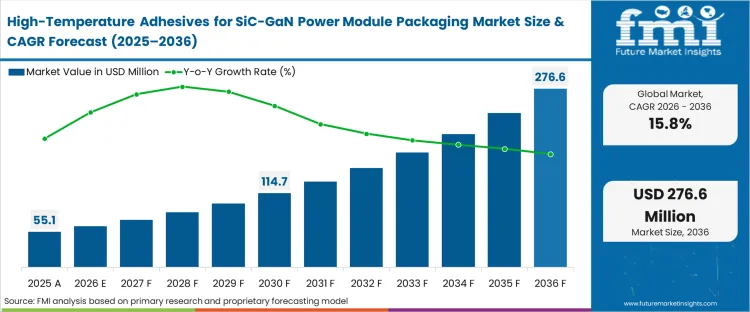
High-Temperature Adhesives for SiC/GaN Power Module Packaging Market Key Takeaways
| Metric | Details |
|---|---|
| Industry Size (2026) | USD 63.8 million |
| Industry Value (2036) | USD 276.6 million |
| CAGR (2026-2036) | 15.8% |
Source: Future Market Insights (FMI) analysis, based on proprietary forecasting model and primary research
When tier-1 module makers successfully validate pressureless silver sintering for power modules on standard production equipment, technical barriers for mass adoption drop significantly. Removing requirements for specialized hydraulic presses allows contract manufacturers to scale capacity rapidly. Once this equipment compatibility threshold is crossed, qualification cycles compress from years to months.
India is projected to grow at a CAGR of 18.2% through 2036 as domestic automotive manufacturers localize inverter supply chains. China expands at 17.4% driven by massive state subsidies targeting domestic China SiC power module adhesive manufacturing scale. South Korea is projected to grow at 15.0% because domestic battery conglomerates require high-reliability switches for energy storage systems. United States accelerates at 14.6% as defense contractors upgrade radar power supplies. Germany follows at 14.1% relying on established automotive ecosystem transitions. France and Japan advance at 13.7% and 13.5% respectively, anchored by heavy rail and industrial drive modernization. Structural divergence across these regions stems entirely from local cleanroom capacity and advanced packaging equipment availability.
High-Temperature Adhesives for SiC/GaN Power Module Packaging Market Definition
This market covers bonding materials engineered to maintain structural and electrical integrity at operating temperatures above 175°C. Any functional wide-bandgap power module adhesive must replace traditional solder alloys in semiconductor assemblies. Chemical compositions prioritize thermal conductivity, sheer strength retention, and precise coefficient of thermal expansion matching to prevent delamination during rapid power cycling.
High-Temperature Adhesives for SiC/GaN Power Module Packaging Market Inclusions
Scope includes silver and copper sinter pastes, transient liquid phase bonding materials, and highly filled epoxies formulated specifically for high-power density electronics. Revenue tracking captures sales of power module die attach adhesives alongside semiconductor IC materials used directly in attaching active dies to direct bonded copper substrates. Analysis encompasses products requiring pressure-assisted curing alongside pressureless alternatives utilized across automotive and industrial power conversion applications.
High-Temperature Adhesives for SiC/GaN Power Module Packaging Market Exclusions
Standard printed circuit board assembly solders fall completely outside this tracking boundary. Conventional thermal interface materials applied between finished modules and external heatsinks are excluded because they do not bond internal active components. General-purpose industrial epoxies lacking specific thermal conductivity ratings for power semiconductor packaging are omitted to ensure analytical focus remains strictly on high-performance interconnection materials.
High-Temperature Adhesives for SiC/GaN Power Module Packaging Market Research Methodology
- Primary Research: Procurement directors, advanced packaging engineers, and formulation chemists actively working within wide-bandgap semiconductor fabrication facilities provide real-time material qualification timelines.
- Desk Research: Technical datasheets from chemical suppliers, reliability test reports from automotive OEMs, and patent registries for advanced sintering formulations establish baseline technological capabilities.
- Market-Sizing and Forecasting: Production volume metrics for 800-volt electric vehicle traction inverters serve as a primary baseline for calculating material consumption rates per module.
- Data Validation and Update Cycle: Independent capital expenditure announcements for new silicon carbide fabrication plants cross-validate long-term adhesive demand projections.
Segmental Analysis
High-Temperature Adhesives for SiC/GaN Power Module Packaging Market Analysis by Adhesive chemistry
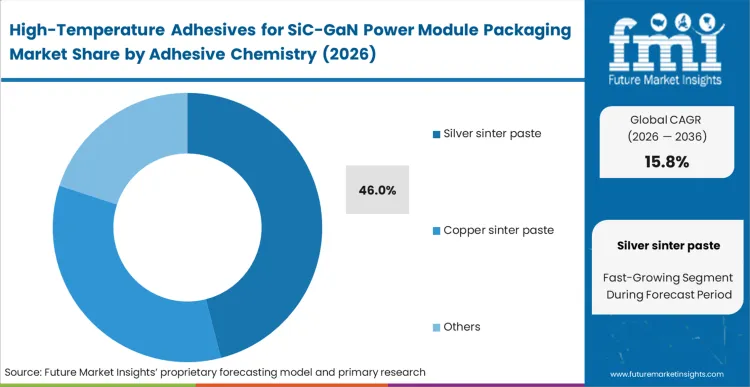
Why this sub-segment holds its position stems from an absolute requirement for thermal stability at temperatures where traditional solders melt. Analysts tracking the silver sinter paste for SiC modules market note this chemistry holds 46.0% share in 2026, and FMI's analysis indicates this dominance is locked in by automotive reliability standards. Packaging engineers specify these formulations because silver nanoparticles fuse well below their melting point, creating a joint that subsequently withstands extreme operating heat. Transitioning to these electronics adhesives requires manufacturers to implement costly controlled-atmosphere curing ovens. Volume figures alone do not show the supply-chain exposure created by dependence on silver, heavy reliance on silver exposes module costs directly to precious metal market volatility. Procurement directors delaying qualification of alternative materials face severe margin compression as silver prices climb.
- Qualification Protocols: Silver paste commands trust because automotive reliability standards were largely written around its performance characteristics. Packaging engineers avoid switching materials to bypass grueling three-year re-qualification processes.
- Thermal Conductivity: Pure silver joints deliver heat dissipation rates nearly three times higher than advanced solder alloys. Thermal designers rely on this property to shrink overall module footprints safely.
- Substitution Benchmarking: Engineering teams evaluating copper sinter vs silver sinter for power electronics discover that while copper reduces raw material costs, it introduces severe oxidation risks during curing. Manufacturers must constantly balance performance gains against escalating precious metal expenses.
High-Temperature Adhesives for SiC/GaN Power Module Packaging Market Analysis by Packaging function
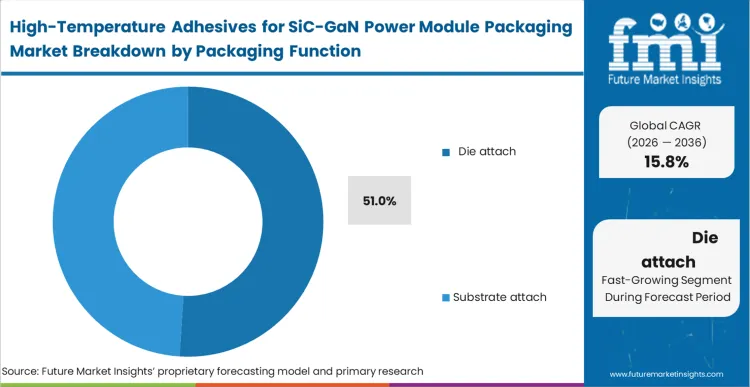
A categorical improvement in heat transfer explains why direct chip bonding dominates material consumption. Companies targeting the high temperature die attach market for power semiconductors see this function account for 51.0% share in 2026, as FMI observes that maximum heat generation occurs exactly at this junction. Thermal engineers focus intense scrutiny here because any void directly beneath an active switch causes immediate catastrophic failure. Applying advanced conductive adhesives at this layer ensures heat moves rapidly into substrate layers without creating localized hot spots. Share figures alone do not capture how dispensing precision dictates material choice; viscosity must remain perfectly stable during high-speed automated application. Process engineers utilizing inferior pastes suffer from uneven bond lines, resulting in massive yield losses during final testing.
- Void Prevention: Applying pressure during die attach curing forces trapped gases outward before nanoparticles fuse completely. Process engineers utilize this technique to ensure maximum contact area beneath high-power chips.
- Thermal Threshold Requirements: Design teams sourcing high junction temperature die attach materials require pastes that flow smoothly but hold shape instantly upon placement. Equipment operators face constant calibration challenges if adhesive rheology fluctuates between batches.
- Yield Impact: Imperfect die attachment remains a leading cause for module rejection during end-of-line electrical testing. Quality managers mandate premium materials here because rework is physically impossible once sintered.
High-Temperature Adhesives for SiC/GaN Power Module Packaging Market Analysis by Device material
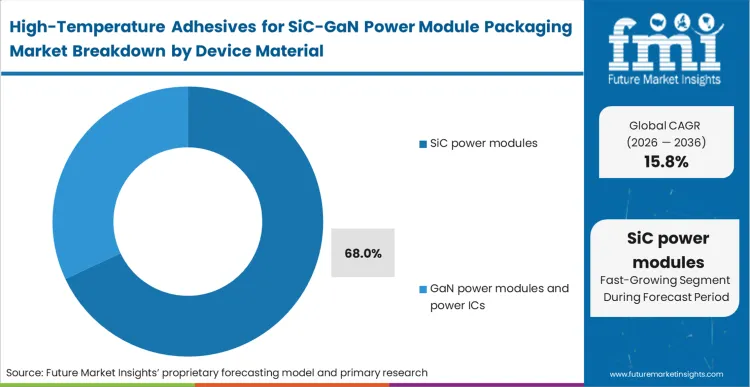
A specific choice driven by operating voltage dictates material selection across this dimension. SiC power modules hold 68.0% share in 2026, and according to FMI's estimates, this lead relates directly to traction inverter requirements. Automotive system architects select silicon carbide specifically to run hotter and faster than silicon equivalents. Engineers researching what adhesive is used in SiC power modules discover that implementing specialized thermal interface materials enables designers to reduce cooling system size and vehicle weight. This distinction matters because that GaN devices operate at lower current densities and therefore face less aggressive thermal mechanical stress compared to heavy-duty SiC counterparts. R&D directors ignoring this discrepancy over-engineer GaN packaging, wasting expensive materials on applications that could utilize standard high-temperature epoxies.
- High-voltage Switching: Silicon carbide handles 800-volt architectures efficiently but generates concentrated thermal spikes during operation. Thermal designers utilize sintered joints to pull heat rapidly away from active areas.
- Substrate Mismatch: Bonding rigid silicon carbide to direct bonded copper creates massive stress during temperature fluctuations. Packaging engineers specify adhesives with precise modulus characteristics to absorb structural tension.
- Maximum Operating Thresholds: Product architects searching for the best die attach material for 200C power modules achieve higher power density ratings solely because advanced adhesives prevent thermal crosstalk between bare dies.
High-Temperature Adhesives for SiC/GaN Power Module Packaging Market Drivers, Restraints, and Opportunities
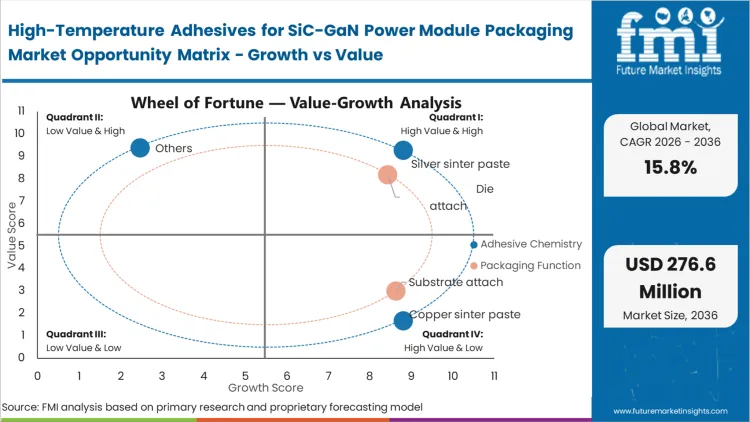
Automotive OEM transition toward 800-volt battery architectures forces Tier-1 powertrain suppliers to source specific automotive power module packaging materials and abandon legacy soldering processes immediately. Sticking with traditional alloys risks catastrophic failure as silicon carbide components routinely push junction temperatures beyond 200 degrees Celsius during rapid charging cycles. Powertrain directors face intense commercial pressure; delaying qualification of advanced sintering materials directly jeopardizes their ability to bid on next-generation electric vehicle platforms. This urgency overrides historical reluctance regarding higher material costs, as reliable thermal management becomes a non-negotiable requirement for securing high-volume automotive contracts.
Qualification cycle length acts as a severe structural friction slowing mass adoption of novel copper-based alternatives. R&D directors at major semiconductor fabs require extensive reliability testing data before approving new formulations from automotive-qualified sinter paste vendors for high-stress use. Because liquid encapsulation and sintering processes are highly interdependent, changing one material forces a complete re-evaluation of an entire module's structural integrity. This rigid validation requirement effectively locks incumbents into place, preventing rapid scaling of cheaper materials even when laboratory performance appears promising.
Opportunities in the High-Temperature Adhesives for SiC/GaN Power Module Packaging Market
- Copper Nanoparticle Commercialization: Formulation chemists mastering oxidation prevention during copper sintering will unlock massive cost savings for high-volume automotive suppliers. Procurement directors actively seek these alternatives to escape silver market volatility.
- Pressureless Paste Formulations: Developing pastes that achieve maximum densification without hydraulic presses removes a major manufacturing bottleneck. Operations managers gain ability to transition from slow batch processing to continuous inline production.
- Procurement Acceleration: Supplying a direct RFQ for silver sinter paste for SiC module die attach allows chemical companies to capture immediate volume from integrated device manufacturers desperate to secure reliable electronic materials ahead of looming capacity crunches.
Regional Analysis
Based on regional analysis, high-temperature adhesives for SiC/GaN power module packaging market is segmented into Asia Pacific, North America, and Europe across 40 plus countries.
.webp "Top Country Growth Comparison High Temperature Adhesives For Sic Gan Power Module Packaging Market Cagr (2026 2036)")
| Country | CAGR (2026 to 2036) |
|---|---|
| India | 18.2% |
| China | 17.4% |
| South Korea | 15.0% |
| United States | 14.6% |
| Germany | 14.1% |
| France | 13.7% |
| Japan | 13.5% |
Source: Future Market Insights (FMI) analysis, based on proprietary forecasting model and primary research
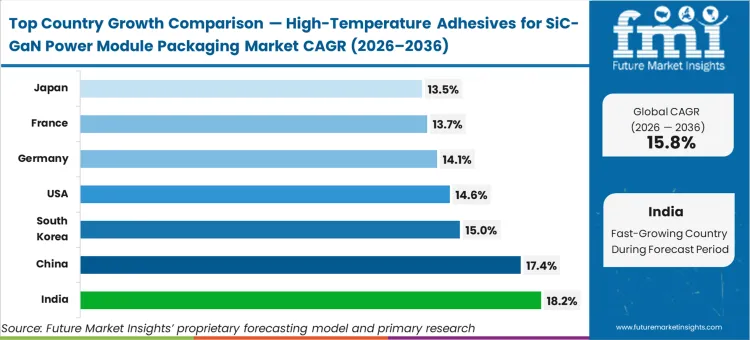
Asia Pacific High-Temperature Adhesives for SiC/GaN Power Module Packaging Market Analysis
Aggressive state-backed localization of semiconductor fabrication defines material consumption patterns across this region. Manufacturing directors face immense pressure to build domestic supply chains capable of supporting massive electric vehicle production targets without relying on imported components. FMI observes that proximity to major battery conglomerates and electronics assemblers allows chemical suppliers to co-develop customized formulations rapidly. As regional fabs scale production of wide-bandgap wafers, demand for high-reliability die-attach pastes rises proportionally. Utilizing advanced semiconductor bonding equipment locally accelerates qualification timelines for new materials compared to western counterparts.
- India: Expansion of domestic traction inverter assembly is being shaped by India’s policy-linked push to localize EV power electronics alongside broader transport and grid infrastructure buildout. For procurement heads and sourcing managers, that raises the importance of securing in-country supplies of sintering pastes that can support qualification, cost control, and shorter replenishment cycles without depending on imported module inputs. India is projected to advance at a 18.2% CAGR through 2036. Buyers that lock in reliable domestic material partnerships early can widen their cost and supply-assurance advantage as local module production scales.
- China: China’s opening condition is its state-directed effort to build end-to-end leadership in wide-bandgap semiconductor manufacturing, rather than merely expanding downstream module assembly. For R&D leaders and packaging development teams, that means faster iteration with domestic chemical suppliers and tighter integration between formulation changes and packaging validation cycles. Through 2036, the market in China is set to expand at 17.4% CAGR. This leaves local buyers operating from a stronger development-speed position than many counterparts competing from imported-material ecosystems.
- South Korea: South Korea’s demand base is uniquely tied to the country’s concentration of battery conglomerates whose storage and mobility programs require highly reliable power conversion architectures. For packaging engineers and module design teams, the implication is a stronger bias toward premium silver pastes that reduce reliability risk in applications where warranty exposure can be costly. South Korea is expected to post a 15.0% compound annual growth rate over 2026 to 2036. Successful adoption translates into more stable field performance and fewer downstream quality interventions inside the organization.
- Japan: Japan remains distinct because established robotics, factory automation, and industrial drive sectors continue to enforce conservative qualification pathways before any material transition is accepted. For operations managers and technical approval teams, that means proven silver pastes retain preference where long validation histories matter more than rapid substitution into newer copper-based systems. Japan is forecast to grow at 13.5% CAGR through the assessment period. That points to a market that should remain steady and reliability-led rather than abruptly shifting toward unproven alternatives.
North America High-Temperature Adhesives for SiC/GaN Power Module Packaging Market Analysis
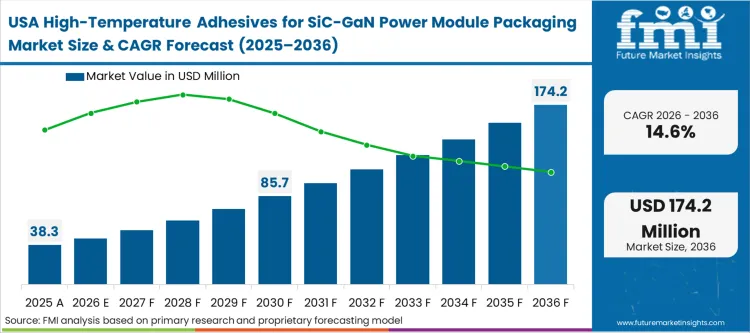
Defense contractor requirements for extreme reliability in radar and aerospace power conversion drive specific material demands here. Engineering directors within these sectors prioritize thermal stability and vibration resistance above pure unit cost, creating a strong baseline for premium silver sintering pastes. FMI's analysis indicates that a recent surge in domestic automotive semiconductor fabrication, spurred by federal incentive programs, is rapidly shifting consumption toward high-volume automotive grades. As facilities scale SIC and GaN components production, local high-temperature die attach material suppliers must expand capacity to prevent critical supply chain bottlenecks.
- United States: The United States is being shaped by a dual-demand structure in which defense-grade power electronics and federally supported automotive semiconductor fabrication are advancing at the same time. For chemical suppliers and strategic account teams, the operational implication is clear: local manufacturing presence matters more because buyers want assured delivery, domestic qualification support, and reduced geopolitical supply exposure. The United States market is anticipated to rise at 14.6% CAGR from 2026 to 2036. In practice, contract wins will depend not just on material performance but on whether suppliers can meet domestic sourcing expectations at production scale.
Europe High-Temperature Adhesives for SiC/GaN Power Module Packaging Market Analysis
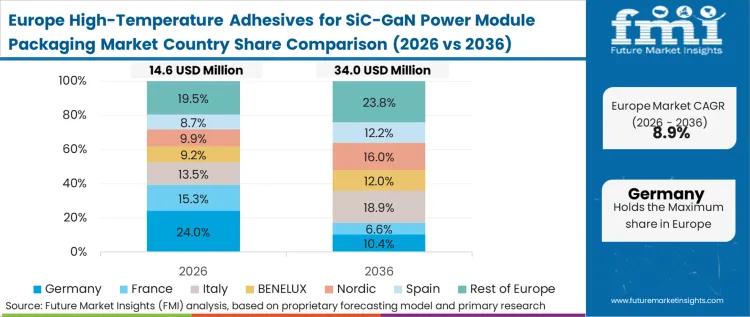
Stringent automotive safety and reliability standards dictate virtually all packaging material innovations within this territory. Powertrain directors at major automotive groups actively dictate exact chemical specifications to their global tier-1 suppliers, ensuring consistency across vehicle platforms. FMI analysts note that a strong regional push toward sustainable transportation accelerates deployment of 800-volt charging infrastructure, directly expanding requirements for heavy-duty silicon carbide parts. Chemical formulators operating here focus heavily on developing low-temperature curing pastes to accommodate heat-sensitive components within highly integrated hybrid modules.
- Germany: Germany stands apart through its dense cluster of premium automotive OEMs, where next-generation traction inverter requirements are closely linked to vehicle platform roadmaps and tier-1 validation programs. For packaging engineers and supplier development teams, this creates pressure to validate pressureless copper and other next-stage sintering processes without disrupting qualification discipline. Germany is likely to record a 14.1% CAGR over the forecast horizon. Buyers that move early in validated next-generation material pathways can strengthen their position against automotive programs competing elsewhere in Europe.
- France: France’s structural condition is tied less to passenger vehicle concentration and more to the durability demands emerging from rail modernization and long-life traction power applications. For procurement teams and reliability-focused buyers, that shifts attention toward epoxy and sintering systems that can withstand extended service intervals, harsh environments, and repeated thermal cycling over asset lifetimes. France is expected to expand at 13.7% CAGR through 2036. The practical reality is that material selection here is often influenced as much by lifecycle endurance requirements as by headline growth rates alone.
FMI's report includes detailed tracking for additional countries across Southeast Asia and Latin America. Emerging electronics assembly hubs in Vietnam and Mexico are increasingly adopting advanced dispensing equipment to capture overflow production from established manufacturing centers.
Competitive Aligners for Market Players
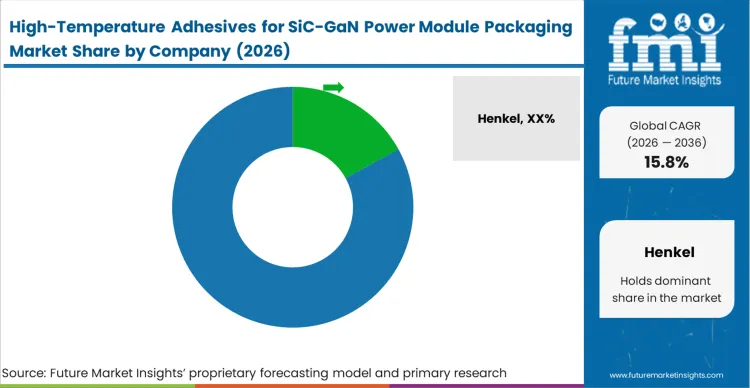
Competition in the market is shaped by qualification history, process compatibility, and application support as much as by chemistry, application engineering support determines which suppliers secure major automotive contracts. Buyers select partners based on their ability to integrate semiconductor packaging adhesives for high temperature applications seamlessly with specific dispensing equipment and curing ovens. Companies like Heraeus Electronics and NAMICS Corporation invest heavily in dedicated application laboratories, allowing customers to simulate full production runs before committing to purchases. Supplying advanced compound semiconductor materials requires a deep understanding of how adhesives interact with direct bonded copper substrates under extreme thermal stress.
Incumbents retain a strong advantage because they already hold long-cycle reliability data that newer suppliers cannot build quickly. New entrants cannot mathematically accelerate these testing requirements, giving established players a structural moat protecting their premium pricing. Suppliers such as MacDermid Alpha Electronics Solutions leverage vast proprietary databases detailing how their specific silver formulations behave across different power discrete packages. Challengers must demonstrate absolute superiority in either cost or processing speed to convince risk-averse packaging engineers to restart arduous qualification procedures.
Large integrated device manufacturers resist vendor lock-in by forcing chemical suppliers to conform to standardized processing windows. Procurement directors mandate that new adhesives must cure utilizing existing oven profiles to avoid stranding massive capital equipment investments. As manufacturing scales toward high-volume integrated modules, suppliers who successfully commercialize alternatives to silver sinter in GaN packaging will fundamentally disrupt current competitive dynamics, breaking established reliance on volatile silver pricing.
Key Players in High-Temperature Adhesives for SiC/GaN Power Module Packaging Market
- Henkel
- Heraeus Electronics
- Indium Corporation
- MacDermid Alpha Electronics Solutions
- NAMICS Corporation
- Shin-Etsu Chemical Co., Ltd.
- DuPont
Scope of the Report
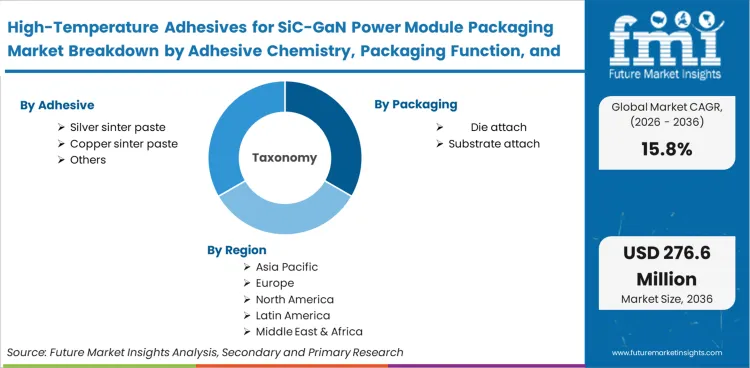
| Metric | Value |
|---|---|
| Quantitative Units | USD 63.8 million to USD 276.6 million, at a CAGR of 15.8% |
| Market Definition | This sector comprises engineered bonding materials that withstand extreme thermal cycling inherent to wide-bandgap semiconductors. These advanced formulations ensure mechanical stability and heat dissipation when traditional solders would fail. |
| Segmentation | By Adhesive chemistry, Packaging function, Device material, End-use application, Cure / bonding route, and Region |
| Regions Covered | North America, Latin America, Europe, Asia Pacific, Middle East and Africa |
| Countries Covered | United States, Canada, Brazil, Mexico, Germany, United Kingdom, France, Spain, Italy, China, Japan, South Korea, India, ASEAN |
| Key Companies Profiled | Henkel, Heraeus Electronics, Indium Corporation, MacDermid Alpha Electronics Solutions, NAMICS Corporation, Shin-Etsu Chemical Co., Ltd., DuPont |
| Forecast Period | 2026 to 2036 |
| Approach | Production volume metrics for 800-volt electric vehicle traction inverters serve as a primary baseline for calculating material consumption rates per module. |
Source: Future Market Insights (FMI) analysis, based on proprietary forecasting model and primary research
High-Temperature Adhesives for SiC/GaN Power Module Packaging Market Analysis by Segments
Adhesive Chemistry
- Silver sinter paste
- Copper sinter paste
- High-temperature epoxy die attach
- Silicone-based high-temperature adhesive
- Hybrid metal-polymer die attach
Packaging Function
- Die attach
- Substrate attach
- Baseplate / heat-spreader attach
- Encapsulation and potting
- Top-side attach / clip-bond support
Device Material
- SiC power modules
- GaN power modules and power ICs
End-use Application
- Electric vehicles and e-mobility
- Industrial drives and automation
- Renewable energy inverters and storage
- Rail traction
- Aerospace and defense power conversion
Cure / bonding Route
- Pressure-assisted sintering
- Pressureless sintering
- Thermal cure
- Dual-stage / hybrid bonding
Region
- North America
- United States
- Canada
- Latin America
- Brazil
- Mexico
- Europe
- Germany
- United Kingdom
- France
- Spain
- Italy
- Asia Pacific
- China
- Japan
- South Korea
- India
- ASEAN
- Middle East and Africa
- GCC Countries
- South Africa
Bibliography
- International Energy Agency. (2025, May 14). Global EV Outlook 2025. IEA.
- USA Department of Energy, Advanced Materials and Manufacturing Technologies Office. (2025, January). Wide Bandgap Power Electronics Strategic Framework. Energy.gov.
- Organisation for Economic Co-operation and Development. (2025, June). Mapping the semiconductor value chain. OECD Publishing.
- ROHM Co., Ltd. (2025, July). ROHM Integrated Report 2025. ROHM.
- Infineon Technologies AG. (2025, November). Annual Report 2025. Infineon.
This bibliography is provided for reader reference. The full FMI report contains the complete reference list with primary source documentation.
This Report Addresses
- Production volume metrics for 800-volt electric vehicle traction inverters affecting material consumption.
- Tooling cost complications when replacing legacy solders with advanced sintered formulations.
- Thermal shock validation requirements mandated by major automotive OEMs for wide-bandgap modules.
- Manufacturing capacity limitations caused by heavy reliance on specialized hydraulic presses.
- Strategic tension between purchasing departments optimizing price and engineers mitigating warranty risks.
- Structural differences in heat dissipation needs between silicon carbide and gallium nitride architectures.
- Commercialization timelines for pressureless copper nanoparticle pastes.
- Regional divergence in cleanroom capacity and advanced packaging equipment availability.
Frequently Asked Questions
How large is this sector currently?
Sales are projected to reach USD 63.8 million in 2026. This figure signals a critical transition point where automotive requirements force advanced packaging techniques out of niche aerospace applications and into high-volume commercial production.
What valuation will this sector reach by 2036?
Cumulative revenue is expected to hit USD 276.6 million by 2036. Sustained deployment of 800-volt electric vehicle architectures guarantees massive long-term demand for high-reliability thermal interconnects.
What is the projected compound annual growth rate?
Demand expands at a 15.8% CAGR over this forecast period. Rapid localization of power electronics fabrication facilities globally ensures continuous volume increases for specialized chemical suppliers.
What materials are replacing solder in SiC and GaN power module packaging?
Packaging engineers specify silver nanoparticles because they fuse at low temperatures but subsequently withstand extreme operating heat. This unique property satisfies grueling automotive reliability standards that traditional solders fail to meet.
Why is silver sintering preferred for SiC modules?
Pure silver joints deliver heat dissipation rates nearly three times higher than advanced solder alloys. Thermal designers rely on this specific property to shrink overall module footprints safely without risking catastrophic failure under load.
Compare silver sinter, copper sinter, and epoxy for power module die attach.
Silver delivers unmatched thermal conductivity but exposes buyers to severe precious metal price volatility. Copper provides a cheaper conductive alternative but introduces extreme oxidation risks during manufacturing. Epoxy serves well for low-power GaN applications but structurally fails under heavy SiC thermal loads.
What drives die attach segment leadership?
Direct chip bonding represents an absolute thermal chokepoint within any ev module. Applying premium conductive pastes here ensures heat moves rapidly into substrate layers without creating catastrophic localized hot spots.
Why do SiC power modules consume more materials?
Silicon carbide switches operate at higher voltages and generate intensely concentrated thermal spikes compared to gallium nitride equivalents. Thermal designers utilize sintered joints specifically to pull heat rapidly away from these active areas.
What friction slows mass adoption?
Extensive reliability testing cycles severely delay implementation of novel copper alternatives. Automotive OEMs require thousands of hours of thermal shock data before approving any deviation from established silver paste formulations.
Why does India show fastest regional growth?
Massive state-backed infrastructure investments force local automotive manufacturers to build domestic traction inverter assembly lines rapidly. Procurement teams securing local adhesive supplies gain immediate cost advantages over competitors relying on imported finished modules.
How does China compare to India structurally?
While India focuses heavily on localizing automotive assembly, China utilizes massive state subsidies specifically targeting wide-bandgap semiconductor fabrication. Both regions require immense volumes of die-attach materials, but their underlying capital expenditure drivers differ fundamentally.
What happens if companies delay qualification?
Manufacturers failing to validate advanced sintering materials will miss critical design-in windows for next-generation traction hardware platforms. Attempting to substitute cheaper adhesives risks immediate disqualification from lucrative automotive contracts.
Why is pressure-assisted curing dominant?
Applying physical force during thermal processing eliminates microscopic air pockets within bonding layers. Process engineers mandate this route when automotive reliability specifications allow absolute zero margin for error regarding void formation.
What advantage do incumbent suppliers hold?
Established chemical firms possess massive proprietary databases detailing exactly how their formulations behave across thousands of thermal shock cycles. New entrants cannot mathematically accelerate these testing requirements to catch up quickly.
How do buyers resist vendor lock-in?
Large integrated device manufacturers mandate that new adhesives must cure utilizing existing oven profiles. Procurement directors utilize this strategy to avoid stranding massive capital equipment investments when switching chemical suppliers.
Why are copper nanoparticles considered a breakthrough?
Formulation chemists mastering oxidation prevention during copper sintering will unlock massive cost savings for high-volume automotive suppliers. This development directly breaks established reliance on volatile silver pricing.
What role does dispensing equipment play?
High-speed automated assembly lines require pastes that flow smoothly but hold shape instantly upon placement. Equipment operators face constant calibration challenges if adhesive rheology fluctuates between production batches.
Why are low-temperature curing pastes necessary?
Chemical formulators operating in Europe focus heavily on developing low-temperature variants to accommodate heat-sensitive components within highly integrated hybrid modules. This prevents thermal damage to adjacent silicon components during traction module assembly.
How does miniaturization impact material selection?
Superior heat dissipation allows designers to pack bare dies closer together within a single module footprint. Product architects achieve higher power density ratings solely because advanced adhesives prevent thermal crosstalk between active switches.
What risks do contract manufacturers face?
Automotive OEMs increasingly dictate exact chemical formulations to their tier-1 suppliers, demanding full traceability. Contract manufacturers lose negotiating leverage as material specifications become rigidly locked by top-level buyers.
Why is pressureless sintering an opportunity?
Developing pastes that achieve maximum densification without specialized hydraulic presses removes a major manufacturing bottleneck. Operations managers gain ability to transition from slow batch processing to continuous inline production.
How do defense applications differ from automotive?
Engineering directors within aerospace sectors prioritize thermal stability and vibration resistance above pure unit cost. This creates a strong baseline demand for premium silver sintering pastes independent of commercial electric vehicle volumes.
What role does substrate mismatch play?
Bonding rigid semiconductor dies to direct bonded copper creates massive stress during temperature fluctuations. Packaging engineers specify adhesives with precise modulus characteristics to absorb structural tension and prevent delamination.
How do 800-v modules influence design?
Efficient power conversion at higher voltages translates directly into longer driving distances per charge cycle. Powertrain engineers specify premium packaging materials precisely to minimize energy lost as waste heat.
Preview the report firsthand - request a free sample
Get SampleGet the brochure for pricing and purchase details.
Get PDFTable of Content
- Executive Summary
- Global Market Outlook
- Demand-side Trends
- Supply-side Trends
- Technology Roadmap Analysis
- Analysis and Recommendations
- Market Overview
- Market Coverage / Taxonomy
- Market Definition / Scope / Limitations
- Research Methodology
- Chapter Orientation
- Analytical Lens and Working Hypotheses
- Market Structure, Signals, and Trend Drivers
- Benchmarking and Cross-market Comparability
- Market Sizing, Forecasting, and Opportunity Mapping
- Research Design and Evidence Framework
- Desk Research Programme (Secondary Evidence)
- Company Annual and Sustainability Reports
- Peer-reviewed Journals and Academic Literature
- Corporate Websites, Product Literature, and Technical Notes
- Earnings Decks and Investor Briefings
- Statutory Filings and Regulatory Disclosures
- Technical White Papers and Standards Notes
- Trade Journals, Industry Magazines, and Analyst Briefs
- Conference Proceedings, Webinars, and Seminar Materials
- Government Statistics Portals and Public Data Releases
- Press Releases and Reputable Media Coverage
- Specialist Newsletters and Curated Briefings
- Sector Databases and Reference Repositories
- FMI Internal Proprietary Databases and Historical Market Datasets
- Subscription Datasets and Paid Sources
- Social Channels, Communities, and Digital Listening Inputs
- Additional Desk Sources
- Expert Input and Fieldwork (Primary Evidence)
- Primary Modes
- Qualitative Interviews and Expert Elicitation
- Quantitative Surveys and Structured Data Capture
- Blended Approach
- Why Primary Evidence is Used
- Field Techniques
- Interviews
- Surveys
- Focus Groups
- Observational and In-context Research
- Social and Community Interactions
- Stakeholder Universe Engaged
- C-suite Leaders
- Board Members
- Presidents and Vice Presidents
- R&D and Innovation Heads
- Technical Specialists
- Domain Subject-matter Experts
- Scientists
- Physicians and Other Healthcare Professionals
- Governance, Ethics, and Data Stewardship
- Research Ethics
- Data Integrity and Handling
- Primary Modes
- Tooling, Models, and Reference Databases
- Desk Research Programme (Secondary Evidence)
- Data Engineering and Model Build
- Data Acquisition and Ingestion
- Cleaning, Normalisation, and Verification
- Synthesis, Triangulation, and Analysis
- Quality Assurance and Audit Trail
- Market Background
- Market Dynamics
- Drivers
- Restraints
- Opportunity
- Trends
- Scenario Forecast
- Demand in Optimistic Scenario
- Demand in Likely Scenario
- Demand in Conservative Scenario
- Opportunity Map Analysis
- Product Life Cycle Analysis
- Supply Chain Analysis
- Investment Feasibility Matrix
- Value Chain Analysis
- PESTLE and Porter’s Analysis
- Regulatory Landscape
- Regional Parent Market Outlook
- Production and Consumption Statistics
- Import and Export Statistics
- Market Dynamics
- Global Market Analysis 2021 to 2025 and Forecast, 2026 to 2036
- Historical Market Size Value (USD Million) Analysis, 2021 to 2025
- Current and Future Market Size Value (USD Million) Projections, 2026 to 2036
- Y-o-Y Growth Trend Analysis
- Absolute $ Opportunity Analysis
- Global Market Pricing Analysis 2021 to 2025 and Forecast 2026 to 2036
- Global Market Analysis 2021 to 2025 and Forecast 2026 to 2036, By Adhesive Chemistry
- Introduction / Key Findings
- Historical Market Size Value (USD Million) Analysis By Adhesive Chemistry , 2021 to 2025
- Current and Future Market Size Value (USD Million) Analysis and Forecast By Adhesive Chemistry , 2026 to 2036
- Silver sinter paste
- Copper sinter paste
- Others
- Silver sinter paste
- Y-o-Y Growth Trend Analysis By Adhesive Chemistry , 2021 to 2025
- Absolute $ Opportunity Analysis By Adhesive Chemistry , 2026 to 2036
- Global Market Analysis 2021 to 2025 and Forecast 2026 to 2036, By Packaging Function
- Introduction / Key Findings
- Historical Market Size Value (USD Million) Analysis By Packaging Function, 2021 to 2025
- Current and Future Market Size Value (USD Million) Analysis and Forecast By Packaging Function, 2026 to 2036
- Die attach
- Substrate attach
- Die attach
- Y-o-Y Growth Trend Analysis By Packaging Function, 2021 to 2025
- Absolute $ Opportunity Analysis By Packaging Function, 2026 to 2036
- Global Market Analysis 2021 to 2025 and Forecast 2026 to 2036, By Device Material
- Introduction / Key Findings
- Historical Market Size Value (USD Million) Analysis By Device Material, 2021 to 2025
- Current and Future Market Size Value (USD Million) Analysis and Forecast By Device Material, 2026 to 2036
- SiC power modules
- GaN power modules and power ICs
- SiC power modules
- Y-o-Y Growth Trend Analysis By Device Material, 2021 to 2025
- Absolute $ Opportunity Analysis By Device Material, 2026 to 2036
- Global Market Analysis 2021 to 2025 and Forecast 2026 to 2036, By End-Use Application
- Introduction / Key Findings
- Historical Market Size Value (USD Million) Analysis By End-Use Application, 2021 to 2025
- Current and Future Market Size Value (USD Million) Analysis and Forecast By End-Use Application, 2026 to 2036
- Electric vehicles and e-mobility
- Industrial drives and automation
- Others
- Electric vehicles and e-mobility
- Y-o-Y Growth Trend Analysis By End-Use Application, 2021 to 2025
- Absolute $ Opportunity Analysis By End-Use Application, 2026 to 2036
- Global Market Analysis 2021 to 2025 and Forecast 2026 to 2036, By Cure -Bonding Route
- Introduction / Key Findings
- Historical Market Size Value (USD Million) Analysis By Cure -Bonding Route, 2021 to 2025
- Current and Future Market Size Value (USD Million) Analysis and Forecast By Cure -Bonding Route, 2026 to 2036
- Pressure-assisted sintering
- Pressureless sintering
- Others
- Pressure-assisted sintering
- Y-o-Y Growth Trend Analysis By Cure -Bonding Route, 2021 to 2025
- Absolute $ Opportunity Analysis By Cure -Bonding Route, 2026 to 2036
- Global Market Analysis 2021 to 2025 and Forecast 2026 to 2036, By Region
- Introduction
- Historical Market Size Value (USD Million) Analysis By Region, 2021 to 2025
- Current Market Size Value (USD Million) Analysis and Forecast By Region, 2026 to 2036
- North America
- Latin America
- Western Europe
- Eastern Europe
- East Asia
- South Asia and Pacific
- Middle East & Africa
- Market Attractiveness Analysis By Region
- North America Market Analysis 2021 to 2025 and Forecast 2026 to 2036, By Country
- Historical Market Size Value (USD Million) Trend Analysis By Market Taxonomy, 2021 to 2025
- Market Size Value (USD Million) Forecast By Market Taxonomy, 2026 to 2036
- By Country
- USA
- Canada
- Mexico
- By Adhesive Chemistry
- By Packaging Function
- By Device Material
- By End-Use Application
- By Cure -Bonding Route
- By Country
- Market Attractiveness Analysis
- By Country
- By Adhesive Chemistry
- By Packaging Function
- By Device Material
- By End-Use Application
- By Cure -Bonding Route
- Key Takeaways
- Latin America Market Analysis 2021 to 2025 and Forecast 2026 to 2036, By Country
- Historical Market Size Value (USD Million) Trend Analysis By Market Taxonomy, 2021 to 2025
- Market Size Value (USD Million) Forecast By Market Taxonomy, 2026 to 2036
- By Country
- Brazil
- Chile
- Rest of Latin America
- By Adhesive Chemistry
- By Packaging Function
- By Device Material
- By End-Use Application
- By Cure -Bonding Route
- By Country
- Market Attractiveness Analysis
- By Country
- By Adhesive Chemistry
- By Packaging Function
- By Device Material
- By End-Use Application
- By Cure -Bonding Route
- Key Takeaways
- Western Europe Market Analysis 2021 to 2025 and Forecast 2026 to 2036, By Country
- Historical Market Size Value (USD Million) Trend Analysis By Market Taxonomy, 2021 to 2025
- Market Size Value (USD Million) Forecast By Market Taxonomy, 2026 to 2036
- By Country
- Germany
- UK
- Italy
- Spain
- France
- Nordic
- BENELUX
- Rest of Western Europe
- By Adhesive Chemistry
- By Packaging Function
- By Device Material
- By End-Use Application
- By Cure -Bonding Route
- By Country
- Market Attractiveness Analysis
- By Country
- By Adhesive Chemistry
- By Packaging Function
- By Device Material
- By End-Use Application
- By Cure -Bonding Route
- Key Takeaways
- Eastern Europe Market Analysis 2021 to 2025 and Forecast 2026 to 2036, By Country
- Historical Market Size Value (USD Million) Trend Analysis By Market Taxonomy, 2021 to 2025
- Market Size Value (USD Million) Forecast By Market Taxonomy, 2026 to 2036
- By Country
- Russia
- Poland
- Hungary
- Balkan & Baltic
- Rest of Eastern Europe
- By Adhesive Chemistry
- By Packaging Function
- By Device Material
- By End-Use Application
- By Cure -Bonding Route
- By Country
- Market Attractiveness Analysis
- By Country
- By Adhesive Chemistry
- By Packaging Function
- By Device Material
- By End-Use Application
- By Cure -Bonding Route
- Key Takeaways
- East Asia Market Analysis 2021 to 2025 and Forecast 2026 to 2036, By Country
- Historical Market Size Value (USD Million) Trend Analysis By Market Taxonomy, 2021 to 2025
- Market Size Value (USD Million) Forecast By Market Taxonomy, 2026 to 2036
- By Country
- China
- Japan
- South Korea
- By Adhesive Chemistry
- By Packaging Function
- By Device Material
- By End-Use Application
- By Cure -Bonding Route
- By Country
- Market Attractiveness Analysis
- By Country
- By Adhesive Chemistry
- By Packaging Function
- By Device Material
- By End-Use Application
- By Cure -Bonding Route
- Key Takeaways
- South Asia and Pacific Market Analysis 2021 to 2025 and Forecast 2026 to 2036, By Country
- Historical Market Size Value (USD Million) Trend Analysis By Market Taxonomy, 2021 to 2025
- Market Size Value (USD Million) Forecast By Market Taxonomy, 2026 to 2036
- By Country
- India
- ASEAN
- Australia & New Zealand
- Rest of South Asia and Pacific
- By Adhesive Chemistry
- By Packaging Function
- By Device Material
- By End-Use Application
- By Cure -Bonding Route
- By Country
- Market Attractiveness Analysis
- By Country
- By Adhesive Chemistry
- By Packaging Function
- By Device Material
- By End-Use Application
- By Cure -Bonding Route
- Key Takeaways
- Middle East & Africa Market Analysis 2021 to 2025 and Forecast 2026 to 2036, By Country
- Historical Market Size Value (USD Million) Trend Analysis By Market Taxonomy, 2021 to 2025
- Market Size Value (USD Million) Forecast By Market Taxonomy, 2026 to 2036
- By Country
- Kingdom of Saudi Arabia
- Other GCC Countries
- Turkiye
- South Africa
- Other African Union
- Rest of Middle East & Africa
- By Adhesive Chemistry
- By Packaging Function
- By Device Material
- By End-Use Application
- By Cure -Bonding Route
- By Country
- Market Attractiveness Analysis
- By Country
- By Adhesive Chemistry
- By Packaging Function
- By Device Material
- By End-Use Application
- By Cure -Bonding Route
- Key Takeaways
- Key Countries Market Analysis
- USA
- Pricing Analysis
- Market Share Analysis, 2025
- By Adhesive Chemistry
- By Packaging Function
- By Device Material
- By End-Use Application
- By Cure -Bonding Route
- Canada
- Pricing Analysis
- Market Share Analysis, 2025
- By Adhesive Chemistry
- By Packaging Function
- By Device Material
- By End-Use Application
- By Cure -Bonding Route
- Mexico
- Pricing Analysis
- Market Share Analysis, 2025
- By Adhesive Chemistry
- By Packaging Function
- By Device Material
- By End-Use Application
- By Cure -Bonding Route
- Brazil
- Pricing Analysis
- Market Share Analysis, 2025
- By Adhesive Chemistry
- By Packaging Function
- By Device Material
- By End-Use Application
- By Cure -Bonding Route
- Chile
- Pricing Analysis
- Market Share Analysis, 2025
- By Adhesive Chemistry
- By Packaging Function
- By Device Material
- By End-Use Application
- By Cure -Bonding Route
- Germany
- Pricing Analysis
- Market Share Analysis, 2025
- By Adhesive Chemistry
- By Packaging Function
- By Device Material
- By End-Use Application
- By Cure -Bonding Route
- UK
- Pricing Analysis
- Market Share Analysis, 2025
- By Adhesive Chemistry
- By Packaging Function
- By Device Material
- By End-Use Application
- By Cure -Bonding Route
- Italy
- Pricing Analysis
- Market Share Analysis, 2025
- By Adhesive Chemistry
- By Packaging Function
- By Device Material
- By End-Use Application
- By Cure -Bonding Route
- Spain
- Pricing Analysis
- Market Share Analysis, 2025
- By Adhesive Chemistry
- By Packaging Function
- By Device Material
- By End-Use Application
- By Cure -Bonding Route
- France
- Pricing Analysis
- Market Share Analysis, 2025
- By Adhesive Chemistry
- By Packaging Function
- By Device Material
- By End-Use Application
- By Cure -Bonding Route
- India
- Pricing Analysis
- Market Share Analysis, 2025
- By Adhesive Chemistry
- By Packaging Function
- By Device Material
- By End-Use Application
- By Cure -Bonding Route
- ASEAN
- Pricing Analysis
- Market Share Analysis, 2025
- By Adhesive Chemistry
- By Packaging Function
- By Device Material
- By End-Use Application
- By Cure -Bonding Route
- Australia & New Zealand
- Pricing Analysis
- Market Share Analysis, 2025
- By Adhesive Chemistry
- By Packaging Function
- By Device Material
- By End-Use Application
- By Cure -Bonding Route
- China
- Pricing Analysis
- Market Share Analysis, 2025
- By Adhesive Chemistry
- By Packaging Function
- By Device Material
- By End-Use Application
- By Cure -Bonding Route
- Japan
- Pricing Analysis
- Market Share Analysis, 2025
- By Adhesive Chemistry
- By Packaging Function
- By Device Material
- By End-Use Application
- By Cure -Bonding Route
- South Korea
- Pricing Analysis
- Market Share Analysis, 2025
- By Adhesive Chemistry
- By Packaging Function
- By Device Material
- By End-Use Application
- By Cure -Bonding Route
- Russia
- Pricing Analysis
- Market Share Analysis, 2025
- By Adhesive Chemistry
- By Packaging Function
- By Device Material
- By End-Use Application
- By Cure -Bonding Route
- Poland
- Pricing Analysis
- Market Share Analysis, 2025
- By Adhesive Chemistry
- By Packaging Function
- By Device Material
- By End-Use Application
- By Cure -Bonding Route
- Hungary
- Pricing Analysis
- Market Share Analysis, 2025
- By Adhesive Chemistry
- By Packaging Function
- By Device Material
- By End-Use Application
- By Cure -Bonding Route
- Kingdom of Saudi Arabia
- Pricing Analysis
- Market Share Analysis, 2025
- By Adhesive Chemistry
- By Packaging Function
- By Device Material
- By End-Use Application
- By Cure -Bonding Route
- Turkiye
- Pricing Analysis
- Market Share Analysis, 2025
- By Adhesive Chemistry
- By Packaging Function
- By Device Material
- By End-Use Application
- By Cure -Bonding Route
- South Africa
- Pricing Analysis
- Market Share Analysis, 2025
- By Adhesive Chemistry
- By Packaging Function
- By Device Material
- By End-Use Application
- By Cure -Bonding Route
- USA
- Market Structure Analysis
- Competition Dashboard
- Competition Benchmarking
- Market Share Analysis of Top Players
- By Regional
- By Adhesive Chemistry
- By Packaging Function
- By Device Material
- By End-Use Application
- By Cure -Bonding Route
- Competition Analysis
- Competition Deep Dive
- Henkel
- Overview
- Product Portfolio
- Profitability by Market Segments (Product/Age /Sales Channel/Region)
- Sales Footprint
- Strategy Overview
- Marketing Strategy
- Product Strategy
- Channel Strategy
- Heraeus Electronics
- Indium Corporation
- MacDermid Alpha Electronics Solutions
- NAMICS Corporation
- Shin-Etsu Chemical Co., Ltd.
- Henkel
- Competition Deep Dive
- Assumptions & Acronyms Used


