

- Market Size (2026)
- USD 374.9 Mn
- Forecast (2036)
- USD 847.6 Mn
- CAGR (2026 to 2036)
- 8.5%
Wash-Off Label Adhesives for Cosmetic Packaging Market Size, Market Forecast and Outlook By FMI
The wash-off label adhesives for cosmetic packaging market surpassed a value of USD 345.5 million in 2025. Industry is expected to reach USD 374.9 million in 2026 at a CAGR of 8.5% during the forecast period. Demand outlook carries the market valuation to USD 847.6 million by 2036 as global cosmetic brands adopt recyclable packaging systems and deploy adhesive formulations that detach cleanly during standardized recycling processes.
The shift from permanent adhesives to wash-off formulations is reshaping how personal care brands approach container design. Packaging engineers facing mandatory recycled content quotas require labels that detach completely during standard alkaline washing cycles without leaving sticky residues. Delaying this transition may increase compliance risk and reduce alignment with retailer sustainability expectations. This structural pivot forces chemical suppliers to engineer solutions that withstand high humidity in consumer bathrooms while yielding instantly in commercial recycling facilities.
Summary of Wash-Off Label Adhesives for Cosmetic Packaging Market
- Wash-Off Label Adhesives for Cosmetic Packaging Market Definition:
- Wash-Off Label Adhesives for Cosmetic Packaging encompass engineered chemical solutions that bind labels to beauty containers under high humidity conditions but release entirely during standardized recycling processes. This structural dependency on end-of-life recovery protocols defines the precise functional boundary of the sector.
- Demand Drivers in the Market:
- Strict European plastic tax implementations force packaging procurement leads to specify adhesives that guarantee clean material separation to avoid severe financial penalties.
- Ambitious corporate sustainability pledges compel luxury cosmetic brands to replace permanent bonding agents with compliant wash-off chemistry to meet public recycled content targets.
- Advancements in high-speed bottling lines require operational directors to deploy quick-setting adhesives that maintain process efficiency while satisfying downstream recyclability criteria.
- Key Segments Analyzed in the FMI Report:
- Water-based Acrylics: 54.5% share in 2026, reflecting the dominant preference for cost-efficient adhesive systems that combine humidity resistance with clean release in recycling baths.
- PET Bottles: 42.3% share in 2026, as cosmetic brands increasingly standardize on clear recyclable plastic formats that require residue-free label detachment.
- Warm Water (65°C-80°C): 48.0% share in 2026, driven by the broad use of municipal recycling lines operating within standard temperature ranges for adhesive removal.
- Skincare Packaging: 38.5% share in 2026, owing to rising demand for adhesives that can withstand oil-rich formulas while preserving label appearance and wash-off functionality.
- France: 10.5% compound growth, driven by aggressive national eco-contributions and eco-modulation fees penalizing non-recyclable cosmetic packaging configurations.
- Analyst Opinion at FMI:
- Ismail Sutaria, Principal Consultant for Packaging Materials, opines, "In my analysis, I have observed a critical tension between premium shelf appeal and end-of-life recovery. Brands prioritizing high-end aesthetic finishes often deploy permanent adhesives that ruin entire PET recycling batches. European regulatory pressure is expected to increase demand for validated wash-off adhesive systems, particularly in recyclable packaging applications.
- Strategic Implications / Executive Takeaways:
- Adhesive formulators must secure third-party recyclability certification to qualify for impending tier-1 cosmetic packaging retooling contracts.
- Packaging procurement directors should phase out permanent acrylic dependency and mandate specific thermal release properties in all new label supply agreements.
- Material testing laboratories must develop specialized validation competencies to prove zero-residue detachment during the supplier qualification phase.
- Methodology:
- Primary Research: FMI conducted detailed technical interviews with principal chemical engineers, beauty packaging directors, and recycling facility operators across 40 countries to validate formulation adoption timelines.
- Desk Research: Analysts aggregated public standards documentation from plastic recycling associations, corporate sustainability reports, and national eco-tax frameworks.
- Market-Sizing and Forecasting: The model applies a bottom-up methodology starting with global installed base metrics for cosmetic filling lines and projecting the conversion rate to wash-off standards.
- Data Validation and Update Cycle: Segment forecasts undergo cross-validation against quarterly specialty chemical shipment volumes for the packaging sector.
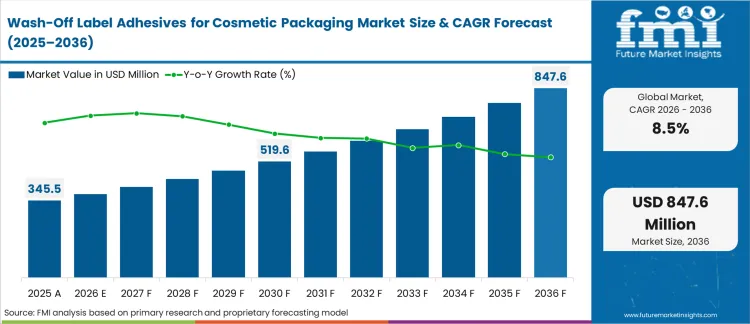
The definitive inflection point occurs when municipal recovery operations begin rejecting mixed-plastic cosmetic bales containing non-yielding bonding agents. Sustainability officers at tier-1 cosmetic firms must overhaul their entire packaging portfolios before stringent legislative deadlines take effect. Facilities operating without optimized release chemistry face systemic contamination issues that degrade the value of reclaimed plastic flakes.
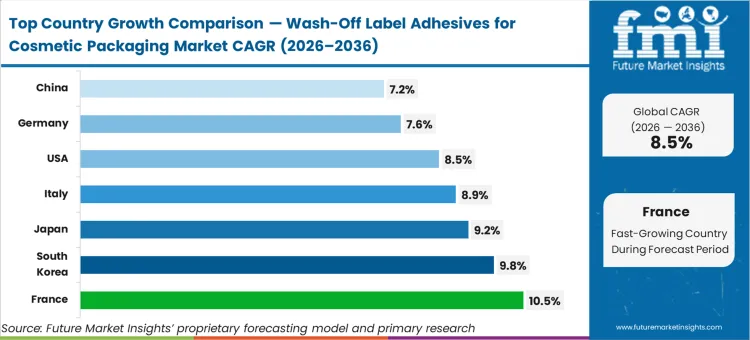
France advances at a 10.5% rate driven by rigid national eco-contributions forcing immediate packaging redesigns. South Korea records a 9.8% expansion reflecting intense producer responsibility frameworks dictating strict mono-material separation. Japan tracks at 9.2% anchored by highly standardized municipal sorting protocols. Italy grows at 8.9% as luxury fragrance manufacturers align with regional circularity directives. The United States follows at 8.5% supported by state-level recycling mandates. Germany registers a 7.6% trajectory tied to its comprehensive deposit-return scheme integration. China reaches a 7.2% pace reflecting rapid domestic beauty brand scaling. This geographic dispersion reflects direct correlations between local environmental legislation and the operational urgency of cosmetic manufacturers.
Wash-Off Label Adhesives for Cosmetic Packaging Market Definition
Wash-Off Label Adhesives for Cosmetic Packaging represent specialized chemical formulations engineered to secure branding materials to personal care containers during consumer use while detaching cleanly during commercial recycling processes. The architecture mandates precise thermal or chemical triggers that dissolve the bond without leaving residual tackiness on the underlying plastic or glass substrate. This distinct performance profile separates these solutions from traditional permanent adhesives that contaminate recovery streams.
Wash-Off Label Adhesives for Cosmetic Packaging Market Inclusions
The market scope includes water-based acrylic polymers, specialized hot-melt formulations, and bio-based resins explicitly designed for temporary bonding on cosmetic vessels. Adhesives formulated for specific alkaline bath temperatures and friction-wash environments fall within the analytical boundaries. Products engineered to meet global cosmetic packaging standards for recyclability and material recovery are fully incorporated into the baseline valuation.
Wash-Off Label Adhesives for Cosmetic Packaging Market Exclusions
Standard permanent pressure-sensitive adhesives lacking engineered wash-off mechanisms are excluded. Pure industrial labeling solutions designed for heavy chemical drums and bulk transport containers fall outside the defined parameters. Standalone face stock materials, unformulated raw acrylic monomers, and decorative shrink sleeves without underlying adhesive coatings are explicitly omitted from the quantitative assessment.
Wash-Off Label Adhesives for Cosmetic Packaging Market Research Methodology
- Primary Research: Analysts engaged with cosmetic packaging engineers, sustainability directors at tier-1 personal care brands, and material science leads at major adhesive formulators to map the specific decision gates triggering formulation upgrades.
- Desk Research: The data collection phase aggregated compliance roadmaps from European plastic tax registries, industry recycling association guidelines, and regional extended producer responsibility frameworks.
- Market-Sizing and Forecasting: The baseline value derives from a bottom-up aggregation of specialty adhesive shipment volumes, applying region-specific cosmetic production curves to project the future adoption velocity.
- Data Validation and Update Cycle: Projections are rigorously tested against publicly reported capital expenditure guidance from the leading specialty chemical conglomerates and global beauty corporations.
Segmental Analysis
Wash-Off Label Adhesives for Cosmetic Packaging Market Analysis by Adhesive Formulation
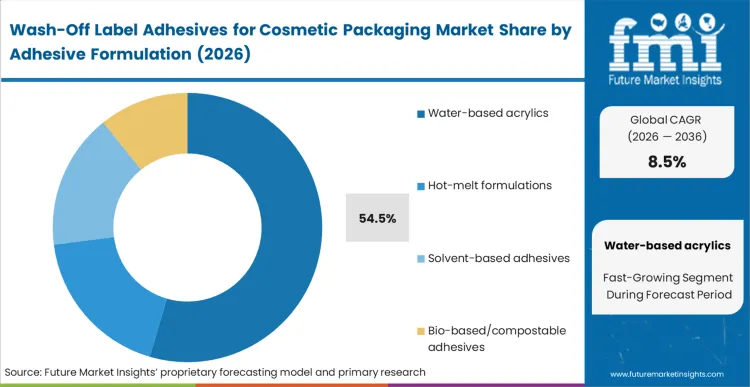
Commanding a dominant 54.5% share in 2026, water-based acrylics establish the industry baseline due to their superior balance of cost efficiency and reliable release characteristics. Chemical engineers optimizing wash-off label formulations rely heavily on these specific polymers to pass stringent European recyclability audits. This chemical architecture allows labels to withstand prolonged exposure to bathroom moisture but dissolve completely when subjected to the mechanical friction of a recycling bath. FMI analysts opine that optimizing this exact dual-performance profile separates qualified tier-1 suppliers from generic chemical vendors. Manufacturers failing to refine their water-based acrylics risk immediate disqualification from major corporate sustainability programs. Packaging procurement leads enforcing corporate green mandates require certified zero-residue performance to authorize final material purchase orders.
- Humidity resistance: Cross-linking polymer chains maintain structural integrity in damp environments, preventing premature label detachment during normal consumer use.
- Caustic solubility: Carefully engineered molecular bonds break down instantly upon contact with standard alkaline washing solutions, ensuring clean separation from the container.
- Application velocity: Optimized viscosity profiles allow high-speed rotary labeling equipment to operate at maximum efficiency without causing adhesive stringing.
Wash-Off Label Adhesives for Cosmetic Packaging Market Analysis by Substrate Compatibility
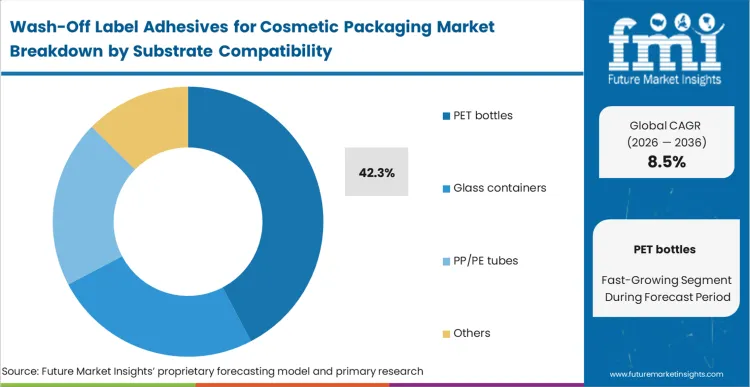
Regulatory mandates requiring higher percentages of post-consumer recycled plastic force packaging engineers to adopt solutions tailored for specific material surfaces. According to FMI's estimates, PET bottles secure a 42.3% share in 2026 as global beauty brands transition away from complex mixed plastics. Formulating adhesives that grip the low surface energy of PET without permanently cross-linking requires advanced chemical engineering. This precise material compatibility prevents the costly contamination of high-value clear plastic flakes during the recovery phase. Adhesives that perform perfectly on glass often fail catastrophic wash-tests on PET, creating a strict technical barrier for chemical suppliers. Sustainability officers implementing circular economy frameworks demand substrate-specific validation data to approve full-scale production runs.
- Surface tension adaptation: Tailored wetting agents ensure the adhesive flows evenly across low-energy plastic surfaces, creating a strong initial tack.
- Flake purity preservation: Complete detachment guarantees that no residual glue enters the extrusion process, maintaining the optical clarity of recycled PET.
- Thermal expansion matching: Flexible polymer matrices accommodate the slight dimensional changes of plastic containers under varying temperature conditions.
Wash-Off Label Adhesives for Cosmetic Packaging Market Analysis by Wash-Off Temperature
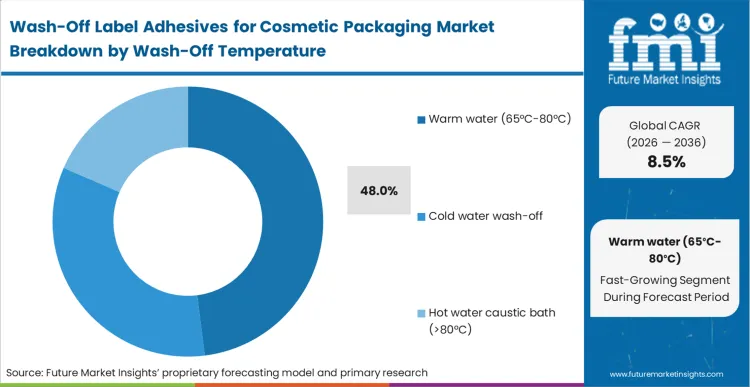
Legacy room-temperature adhesives fail modern industrial recycling requirements, prompting an organized shift toward thermally triggered formulations. Warm water (65°C-80°C) solutions command 48.0% of the market share in 2026 by perfectly matching the operational parameters of standard municipal recovery facilities. Facility operators running continuous washing lines reject packaging designs that demand specialized, energy-intensive high-temperature baths. Based on FMI's assessment, aligning adhesive release properties with existing facility infrastructure eliminates a major bottleneck in the cosmetic circular economy. Chemical suppliers must engineer their products to yield exactly within this narrow thermal window to remain relevant. Material testing directors conducting simulated recycling trials immediately fail formulations that require extreme temperatures to achieve complete detachment.
- Thermal activation: Specific polymer blends remain stable at ambient temperatures but lose all cohesive strength once the 65°C threshold is crossed.
- Energy conservation: Formulations designed for the warm water range allow recycling plants to minimize fuel consumption while maintaining high throughput rates.
- Process standardization: Aligning with universal washing temperatures ensures cosmetic packaging can be successfully recycled across diverse global geographic locations.
Wash-Off Label Adhesives for Cosmetic Packaging Market Analysis by Cosmetic Application
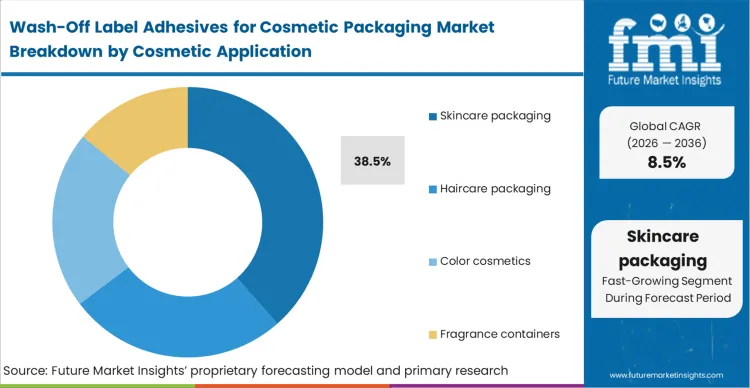
The chronic failure of traditional labels to survive oily cosmetic formulas created the specific demand for advanced adhesive engineering in personal care. Skincare packaging holds a 38.5% share in 2026 as manufacturers struggle to balance product resistance with end-of-life removability. Essential oils and complex emulsion bases frequently penetrate paper labels, dissolving conventional glues and causing catastrophic brand degradation on the retail shelf. As per FMI's projection, creating barriers that resist aggressive chemical migration while retaining wash-off capability represents the highest technical achievement in this sector. Formulators bridging this specific capability gap secure long-term contracts with premium beauty conglomerates. Brand managers launching high-value serums mandate absolute adhesive reliability to protect premium aesthetic positioning.
- Oil barrier defense: Specialized resin architectures block the migration of aggressive skincare ingredients that typically compromise standard adhesive bonds.
- Aesthetic preservation: Maintaining a flawless label appearance throughout the entire product lifecycle protects brand equity in the highly competitive luxury beauty sector.
- Curved surface adhesion: High-tack formulations ensure rigid labels conform perfectly to the complex, irregular shapes common in premium fragrance and serum containers.
Wash-Off Label Adhesives for Cosmetic Packaging Market Drivers, Restraints, and Opportunities
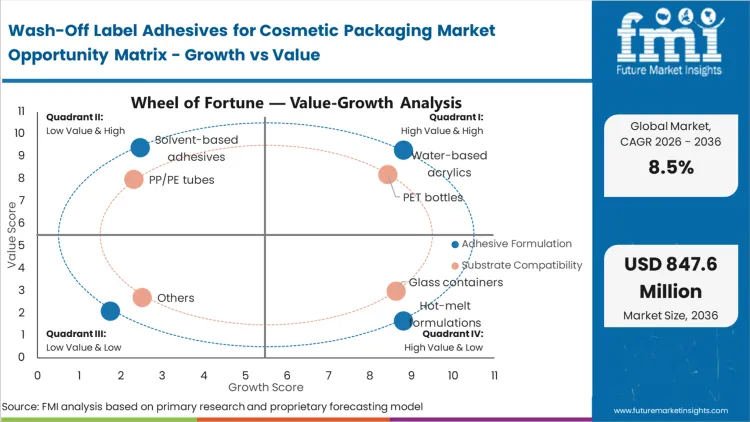
Strict extended producer responsibility frameworks force packaging procurement leads to completely overhauling their material sourcing strategies. Tier-1 cosmetic brands facing impending European plastic taxes must deploy certified wash-off labeling systems to achieve compliance and avoid punitive financial levies. This immediate regulatory pressure transforms niche recycling technologies into mandatory baseline specifications for the entire beauty industry. Formulators lacking verified packaging adhesive platforms lose access to lucrative global supply contracts entirely.
The intricate chemical balance required to ensure labels stick in wet bathrooms but release in warm recycling baths creates severe formulation friction. Chemical engineers face significant technical hurdles when attempting to scale laboratory successes to consistent, high-volume production batches. Refining these complex polymer blends demands specialized material science expertise that smaller regional adhesive suppliers lack internally. To bypass this capability limitation, agile converting companies increasingly rely on pre-certified adhesive systems provided by major global chemical conglomerates.
Opportunities in the Wash-Off Label Adhesives for Cosmetic Packaging Market
- Luxury Glass Refill Systems: Premium fragrance brands expanding their refillable portfolios require ultra-durable wash-off solutions. Adhesive chemists who formulate high-tack glues that withstand multiple consumer washings capture premium margin contracts.
- Bio-Based Raw Material Integration: Shifting corporate mandates demand fully compostable packaging architectures. Chemical suppliers synthesizing wash-off adhesives from renewable plant-based resins secure exclusive partnerships with eco-conscious indie beauty brands.
- Smart Label Integration: The adoption of NFC tracking in cosmetic packaging necessitates protective adhesive layers. Formulators engineering conductive, wash-off compatible coatings enable brand protection managers to deploy traceable packaging without compromising recyclability.
Regional Analysis
Based on the regional analysis, the Wash-Off Label Adhesives for Cosmetic Packaging market is segmented into North America, Latin America, Europe, East Asia, South Asia, Oceania and Middle East & Africa across 40+ countries.
.webp "Top Country Growth Comparison Wash Off Label Adhesives For Cosmetic Packaging Market Cagr (2026 2036)")
| Country | CAGR (2026 to 2036) |
|---|---|
| France | 10.5% |
| South Korea | 9.8% |
| Japan | 9.2% |
| Italy | 8.9% |
| USA | 8.5% |
| Germany | 7.6% |
| China | 7.2% |
Source: Future Market Insights (FMI) analysis, based on proprietary forecasting model and primary research
Asia Pacific Wash-Off Label Adhesives for Cosmetic Packaging Market Analysis
Stringent mono-material separation mandates across the Asia Pacific region structurally alter how domestic beauty brands package their products. In FMI's view, national recycling frameworks prioritizing clear, uncontaminated PET flakes force regional cosmetic conglomerates to abandon legacy permanent adhesives entirely. The rapid expansion of localized chemical production capacity allows packaging converters to source advanced wash-off formulations without relying on expensive European imports. This regional self-sufficiency accelerates the transition toward fully recyclable cosmetic architecture.
- South Korea: South Korea's cosmetic packaging demand is rising at a CAGR of 9.8% as producer responsibility frameworks dictate strict mono-material separation. The national emphasis on maximizing domestic recycling yields requires cosmetic manufacturers to prove complete label detachment during standardized auditing procedures. Formulators explicitly design their adhesive matrices to dissolve rapidly in the specific caustic concentrations used by South Korean municipal recovery centers. Regulatory compliance directors navigating these continuous audits demand robust certification data before authorizing vendor payments.
- Japan: Japan advances at a 9.2% compound rate as stringent municipal sorting protocols force brands to adopt easily removable label solutions. Consumer-driven separation requirements place immense pressure on packaging engineers to deploy adhesives that release them cleanly under moderate friction. Chemical companies supplying the domestic beauty market integrate specialized thermal triggers to align with Japan's precise waste management infrastructure. Quality assurance managers mandate flawless wash-off performance to maintain their preferred status on retailer compliance scorecards.
- China: Rapid domestic beauty brand scaling drives China's 7.2% compound trajectory to the 2036 horizon. Supply chain directors modernizing vast contract manufacturing networks recognize that adopting globally compliant adhesives prevents bottlenecks in European markets. Massive investments in advanced chemical synthesis capabilities allow local formulators to produce high-performance wash-off solutions at highly competitive price points. Export compliance officers enforcing international standards reject labeling components that threaten cross-border trade flow.
FMI's report includes extensive coverage of the broader Asia Pacific packaging landscape. The integration of advanced recycling infrastructure across emerging ASEAN economies forces local contract packagers to upgrade their material specifications to meet shifting global brand requirements.
Europe Wash-Off Label Adhesives for Cosmetic Packaging Market Analysis
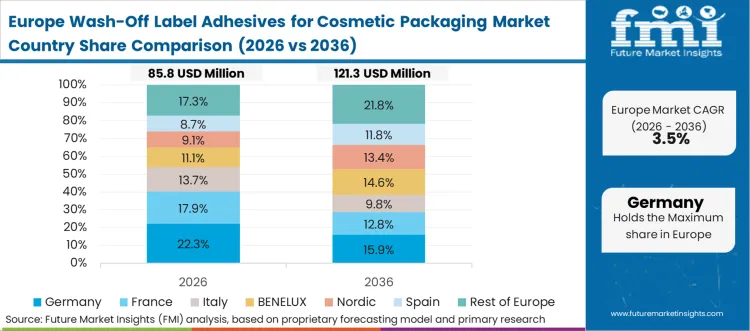
Aggressive European plastic tax implementation creates an existential threat for cosmetic brands relying on non-recyclable packaging architectures. FMI's research confirms that stringent eco-modulation fees explicitly penalize manufacturers utilizing adhesives that contaminate the regional PET recovery stream. This punitive regulatory environment forces a rapid, continent-wide transition toward verified wash-off chemistries. Chemical suppliers operating within this jurisdiction must provide absolute transparency regarding their formulation ingredients to satisfy rigorous continental safety and environmental directives.
- France: Mandated eco-contributions anchor France's 10.5% compound expansion to 2036. The national beauty industry faces immediate financial penalties for deploying packaging that disrupts domestic recycling operations. Material scientists working within the French luxury cosmetic sector prioritize adhesives that maintain premium aesthetic finishes while guaranteeing zero-residue detachment. Sustainability directors calculating the long-term cost of eco-taxes mandate full compliance across every new product launch to protect corporate profit margins.
- Italy: Italy's adhesive market expands at an 8.9% CAGR as luxury fragrance manufacturers align with European circularity directives. High-end glass bottle decorators require specialized formulations that secure heavy metallic labels but wash off cleanly during the glass cullet recovery phase. Formulators engineering solutions specifically for complex glass geometries capture substantial share in the premium Italian packaging sector. Procurement leads to managing high-value container sourcing enforce strict wash-off standards to retain their premium sustainability credentials.
- Germany: The rigid deposit-return scheme expansion drives a 7.6% annual expansion rate as cosmetic containers enter the formal recovery stream. Plant managers running centralized recycling hubs demand absolute adhesive compliance to prevent costly machine downtime caused by sticky residue accumulation. Chemical suppliers testing their products against standard German recycling parameters ensure their formulations meet the strict criteria of the national packaging registry. Facility operations directors reject non-yielding packaging formats to maintain continuous, high-speed material processing.
FMI's report includes detailed analysis of the Nordic and Benelux packaging sectors. Early adoption of advanced chemical recycling technologies across these nations requires adhesive suppliers to continually refine their products to ensure compatibility with next-generation plastic recovery methods.
North America Wash-Off Label Adhesives for Cosmetic Packaging Market Analysis
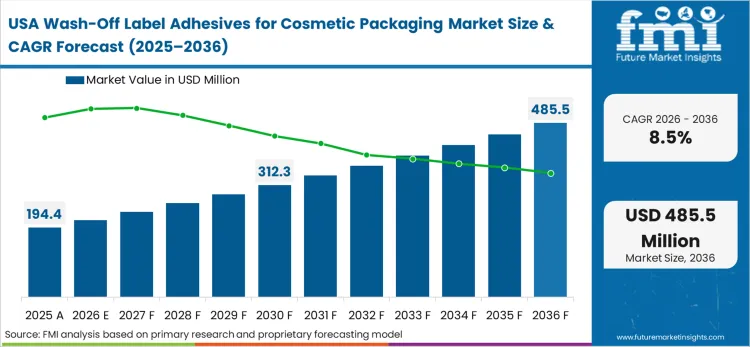
The fragmentation of state-level recycling legislation across North America forces national beauty brands to adopt the strictest available packaging standards uniformly. Supply chain directors managing continental distribution networks cannot afford to maintain separate inventory streams for different regional compliance jurisdictions. This logistical reality accelerates the adoption of universal wash-off adhesive solutions capable of satisfying the most rigorous state mandates. Consequently, the transition toward fully recyclable cosmetic containers happens simultaneously across the entire regional manufacturing base.
- USA: State-level recycling mandates drive an 8.5% CAGR for wash-off label formulations in the United States. Aggressive legislative frameworks in key coastal markets compel national personal care brands to eliminate permanent adhesives from their entire supply chains. Adhesive formulators collaborate directly with major material recovery facilities to prove their chemical solutions do not disrupt domestic sorting and washing operations. Packaging engineers drafting universal corporate material standards require comprehensive wash-off validation to authorize long-term vendor contracts.
FMI's report includes comprehensive evaluation of the Canadian cosmetic packaging sector. Cross-border harmonization of environmental claims and recycling guidelines forces North American chemical suppliers to standardize their high-performance wash-off portfolios across the entire geographic bloc.
Competitive Aligners for Market Players
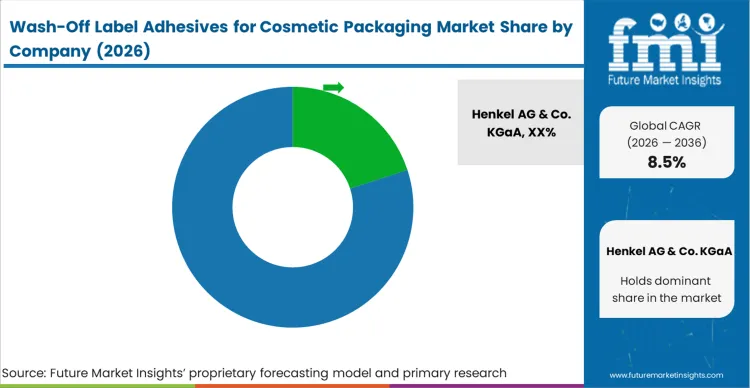
The global market for wash-off label adhesives remains highly concentrated among specialized chemical conglomerates possessing deep polymer science capabilities. This distinct consolidation exists because engineering is a formulation that balances extreme moisture resistance with instant caustic solubility requires massive upfront research and development capital. Leading companies including Henkel AG & Co. KGaA, Avery Dennison Corporation, and Bostik hold dominant positions by leveraging their extensive proprietary resin libraries. Buyers evaluating potential suppliers use independent recyclability certification as the primary competitive variable to distinguish qualified technical partners from generic chemical blenders.
Structural advantages for leading players stem directly from their established integration with global recycling associations. Companies producing verified sustainable label materials maintain dedicated testing facilities that perfectly replicate commercial washing environments. Replicating this specialized testing infrastructure represents a massive financial barrier for emerging regional formulators attempting to enter the premium cosmetic sector. Challengers aiming to capture market share must prioritize securing regional compliance certifications to prove their alternative formulations perform reliably.
Large cosmetic brand owners actively prevent supplier lock-in by mandating open-source performance standards across their procurement networks. By specifying exact thermal release temperatures rather than proprietary chemical brands, sustainability officers maintain leverage over adhesive pricing. This structural tension between the bespoke chemistry offered by dominant vendors and the universal standards demanded by buyers limits uncontrolled price escalation. Moving across the forecast period, competitive advantage will shift toward formulators who can deliver bespoke bio-based wash-off solutions without demanding premium pricing tiers.
Key Players in Wash-Off Label Adhesives for Cosmetic Packaging Market
- Henkel AG & Co. KGaA
- H.B. Fuller Company
- Avery Dennison Corporation
- UPM Raflatac
- Bostik SA (Arkema company)
- Dow Inc.
- 3M
- Lintec Corporation
Scope of the Report
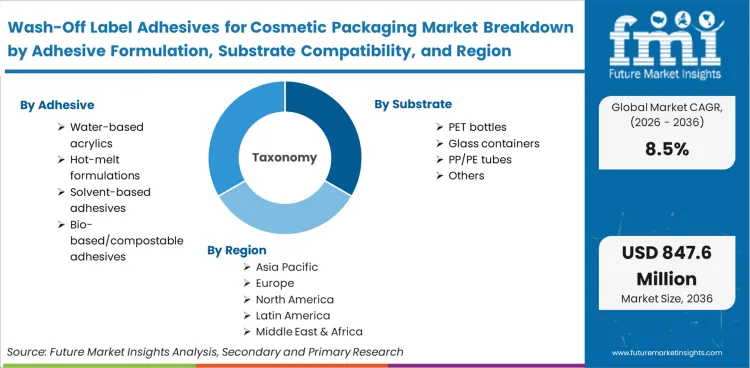
| Metric | Value |
|---|---|
| Quantitative Units | USD 374.9 million to USD 847.6 million, at a CAGR of 8.50% |
| Market Definition | Wash-Off Label Adhesives for Cosmetic Packaging encompasses engineered chemical solutions that bind labels to beauty containers under high humidity conditions but release them entirely during standardized recycling processes. |
| Adhesive Formulation Segmentation | Water-based acrylics, Hot-melt formulations, Solvent-based adhesives, Bio-based/compostable adhesives |
| Substrate Compatibility Segmentation | PET bottles, Glass containers, PP/PE tubes, Others |
| Wash-Off Temperature Segmentation | Cold water wash-off, Warm water (65°C-80°C), Hot water caustic bath (>80°C) |
| Cosmetic Application Segmentation | Skincare packaging, Haircare packaging, Color cosmetics, Fragrance containers |
| Regions Covered | North America, Latin America, Europe, East Asia, South Asia, Oceania, Middle East & Africa |
| Countries Covered | France, South Korea, Japan, Italy, USA, Germany, China, and 40 plus countries |
| Key Companies Profiled | Henkel AG & Co. KGaA, H.B. Fuller Company, Avery Dennison Corporation, UPM Raflatac, Bostik (Arkema), Dow Chemical Company, 3M Company, Lintec Corporation |
| Forecast Period | 2026 to 2036 |
| Approach | The baseline value derives from a bottom-up aggregation of specialty adhesive shipment volumes, utilizing historical polymer production data. Analysts apply region-specific cosmetic production curves to project future adoption velocity across key global markets. |
Source: Future Market Insights (FMI) analysis, based on proprietary forecasting model and primary research
Wash-Off Label Adhesives for Cosmetic Packaging Market Analysis by Segments
Adhesive Formulation:
- Water-based acrylics
- Hot-melt formulations
- Solvent-based adhesives
- Bio-based/compostable adhesives
Substrate Compatibility:
- PET bottles
- Glass containers
- PP/PE tubes
- Others
Wash-Off Temperature:
- Cold water wash-off
- Warm water (65°C-80°C)
- Hot water caustic bath (>80°C)
Cosmetic Application:
- Skincare packaging
- Haircare packaging
- Color cosmetics
- Fragrance containers
Region:
- Asia Pacific
- India
- China
- Japan
- South Korea
- Indonesia
- Australia & New Zealand
- ASEAN
- Rest of Asia Pacific
- Europe
- Germany
- Italy
- France
- United Kingdom
- Spain
- Benelux
- Nordics
- Central & Eastern Europe
- Rest of Europe
- North America
- United States
- Canada
- Mexico
- Latin America
- Brazil
- Argentina
- Chile
- Rest of Latin America
- Middle East & Africa
- Kingdom of Saudi Arabia
- United Arab Emirates
- South Africa
- Turkey
- Rest of Middle East & Africa
Bibliography
- Association of Plastic Recyclers. (2025, June 26). Benchmark test for clear PET articles with labels and closures.
- Association of Plastic Recyclers & RecyClass. (2025, April). APR-RecyClass cooperation report.
- European Parliament and Council of the European Union. (2025, January 22). Regulation (EU) 2025/40 of the European Parliament and of the Council of 19 December 2024 on packaging and packaging waste, amending Regulation (EU) 2019/1020 and Directive (EU) 2019/904, and repealing Directive 94/62/EC. Official Journal of the European Union, L, 2025/40.
- OECD. (2024, October). Policy scenarios for eliminating plastic pollution by 2040. OECD Publishing.
- USA Environmental Protection Agency. (2024, November). National strategy to prevent plastic pollution.
- European Commission, Joint Research Centre. (2025, March 13). Revision of the EU Ecolabel criteria for detergent and stain remover products: Ad hoc working group document.
This bibliography is provided for reader reference. The full FMI report contains the complete reference list with primary source documentation.
This Report Addresses
- Market sizing and forecast evaluation quantifying the global revenue trajectory for wash-off label adhesives used in cosmetic packaging through 2036, including shipment volumes of specialty adhesive formulations across major beauty manufacturing hubs.
- Segmentation intelligence analyzing adoption patterns across adhesive formulation types, substrate compatibility categories, wash-off temperature thresholds, and cosmetic application formats influencing procurement specifications.
- Regulatory and sustainability framework assessment evaluating how extended producer responsibility mandates, plastic taxation policies, and recyclability certification standards accelerate the transition from permanent adhesives to engineered wash-off chemistry.
- Regional deployment insights comparing regulatory-driven packaging redesign initiatives in Europe with recycling infrastructure modernization and beauty manufacturing expansion across Asia Pacific and North America.
- Material science and formulation analysis examining the polymer engineering requirements enabling adhesives to maintain humidity resistance during product use while ensuring complete detachment in industrial recycling systems.
- Competitive landscape evaluation tracking innovation strategies among major chemical manufacturers focusing on proprietary resin technologies, recyclability certification capabilities, and packaging compliance validation.
- Packaging supply chain transformation analysis identifying the operational adjustments cosmetic brands must implement to meet circular economy objectives and avoid contamination in recycled PET recovery streams.
- Strategic decision support tools including detailed datasets, market models, and structured narrative analysis delivered through comprehensive research documentation and quantitative forecasting frameworks.
Frequently Asked Questions
How large is the Wash-Off Label Adhesives for Cosmetic Packaging market in 2026?
The market size is valued at USD 374.9 million in 2026, driven by strict extended producer responsibility mandates.
What will the Wash-Off Label Adhesives for Cosmetic Packaging market be valued at by 2036?
Industry valuation is projected to reach USD 847.6 million by 2036 as global brands standardize their supply chains.
What CAGR is projected for the Wash-Off Label Adhesives for Cosmetic Packaging market from 2026 to 2036?
Compound expansion is projected at 8.50% through the forecast period, sustained by the ten-year transition timeline for cosmetic supply chains.
Which Adhesive Formulation segment leads the market?
Water-based acrylics capture 54.5% in 2026. This chemical architecture effectively balances high humidity resistance with instant caustic solubility.
Which Substrate Compatibility category secures the highest share?
PET bottles command 42.3% share in 2026. Packaging engineers formulate adhesives specifically for this low-energy plastic to prevent contamination in recovery streams.
How does the Warm water (65°C-80°C) segment perform?
This thermal segment holds 48.0% share in 2026. Aligning adhesive release properties with standard municipal washing temperatures eliminates severe processing bottlenecks.
Which Cosmetic Application dominates demand?
Skincare packaging secures 38.5% share in 2026. Complex emulsion bases require specialized adhesive barriers that resist chemical migration while retaining wash-off capability.
Why do PET bottles command the highest substrate share?
Global beauty brands are transitioning away from complex mixed plastics toward clear PET, requiring zero-contamination label detachment.
What regulatory dynamic forces the adoption of engineered release chemistry?
Strict European plastic tax implementations explicitly penalize manufacturers utilizing adhesives that contaminate the regional recovery stream.
What is the primary operational challenge for adhesive formulators?
Chemical engineers must scale intricate polymer blends that stick securely in wet consumer bathrooms but yield instantly in commercial recycling facilities.
How does the transition from permanent acrylics create structural market growth?
Delaying this specific shift exposes manufacturers to immediate product delisting across major retail networks prioritizing circular economy metrics.
What distinguishes France's rapid growth from South Korea's expansion?
France responds to rigid national eco-contributions forcing immediate redesigns, while South Korea navigates intense producer responsibility frameworks dictating mono-material separation.
What specific policy framework accelerates the French market?
Aggressive national eco-modulation fees penalize non-recyclable cosmetic packaging configurations, driving a 10.5% compound expansion.
How do strict municipal sorting protocols influence Japan's trajectory?
Consumer-driven separation requirements place immense pressure on packaging engineers to deploy adhesives that release them cleanly under moderate friction.
What structural driver supports Italy's luxury packaging transition?
High-end glass bottle decorators require specialized formulations that secure heavy metallic labels but wash off cleanly during the glass cullet recovery phase.
Why are state-level recycling mandates critical for the United States?
The fragmentation of recycling legislation forces national beauty brands to uniformly adopt the strictest available packaging standards across all distribution networks.
How does the comprehensive deposit-return scheme affect Germany?
Plant managers running centralized recycling hubs demand absolute adhesive compliance to prevent costly machine downtime caused by sticky residue accumulation.
What mechanism anchors China's compound expansion?
Rapid domestic beauty brand scaling and massive investments in advanced chemical synthesis capabilities allow local formulators to produce high-performance solutions.
Why do Asian cosmetic brands prioritize mono-material separation frameworks?
National recycling policies prioritizing clear, uncontaminated PET flakes force regional cosmetic conglomerates to abandon legacy permanent adhesives entirely.
What functional scope defines this adhesive market?
The scope encompasses engineered chemical solutions that bind labels under high humidity conditions but release entirely during standardized recycling processes.
Which packaging formats are explicitly excluded from this analysis?
Pure industrial labeling solutions designed for heavy chemical drums and bulk transport containers fall completely outside the defined parameters.
How does the methodology validate compliance roadmaps?
Analysts aggregate public standards documentation from plastic recycling associations and cross-validate projections against corporate sustainability capex data.
What strategic action must tier-1 cosmetic firms take immediately?
Packaging procurement directors must phase out permanent acrylic dependency and mandate specific thermal release properties in all new label supply agreements.
Why is certification of non-contamination critical for buyers?
Buyers evaluating potential suppliers use independent recyclability certification to prevent the costly contamination of high-value clear plastic flakes.
Preview the report firsthand - request a free sample
Get SampleGet the brochure for pricing and purchase details.
Get PDFTable of Content
- Key Takeaways
- Market Size and CAGR
- Top Growth Driver
- Fastest Growing Segment
- Leading Region
- Key Companies
- Emerging Opportunities
- Executive Summary
- Global Market Outlook
- Demand-side Trends
- Supply-side Trends
- Technology Roadmap Analysis
- Analysis and Recommendations
- Analyst Perspective (What is happening? Why now? What should investors know?)
- Key Questions Answered
- How large is the market?
- What is the CAGR?
- What are key trends?
- Which region dominates?
- Who are the leaders?
- Market Overview
- Market Coverage / Taxonomy
- Market Definition / Scope / Limitations
- Research Methodology
- Chapter Orientation
- Analytical Lens and Working Hypotheses
- Market Structure, Signals, and Trend Drivers
- Benchmarking and Cross-market Comparability
- Market Sizing, Forecasting, and Opportunity Mapping
- Research Design and Evidence Framework
- Desk Research Programme (Secondary Evidence)
- Expert Input and Fieldwork (Primary Evidence)
- Tooling, Models, and Reference Databases
- Data Engineering and Model Build
- Quality Assurance and Audit Trail
- Market Background
- Market Dynamics (Drivers, Restraints, Opportunity, Trends)
- Scenario Forecast (Optimistic, Likely, Conservative)
- Impact Analysis
- AI Impact
- Sustainability Impact
- Regulatory Impact
- Technology Impact
- Consumer / Buyer Analysis
- Purchase Drivers
- Adoption Barriers
- Buyer Journey
- Opportunity Map Analysis
- Product Life Cycle Analysis
- Supply Chain Analysis
- Investment Feasibility Matrix
- Value Chain Analysis
- PESTLE and Porter's Analysis
- Regulatory Landscape
- Regional Parent Market Outlook
- Production and Consumption Statistics
- Import and Export Statistics
- Global Market Analysis and Forecast, 2021 to 2036
- Historical Market Size Value (USD Billion) & Volume (Unit) Analysis, 2021 to 2025
- Current and Future Market Size Value (USD Billion) & Volume (Unit) Projections, 2026 to 2036
- Y-o-Y Growth Trend Analysis
- Absolute $ Opportunity Analysis
- Global Market Pricing Analysis, 2021 to 2036
- Global Market Analysis and Forecast, By Adhesive Formulation, 2021 to 2036
- Introduction / Key Findings
- Historical Market Size Value (USD Billion) & Volume (Unit) Analysis By Adhesive Formulation, 2021 to 2025
- Current and Future Market Size Value (USD Billion) & Volume (Unit) Analysis and Forecast By Adhesive Formulation, 2026 to 2036
- Water-based acrylics
- Hot-melt formulations
- Solvent-based adhesives
- Bio-based/compostable adhesives
- Water-based acrylics
- Y-o-Y Growth Trend Analysis By Adhesive Formulation, 2021 to 2025
- Absolute $ Opportunity Analysis By Adhesive Formulation, 2026 to 2036
- Global Market Analysis and Forecast, By Substrate Compatibility, 2021 to 2036
- Introduction / Key Findings
- Historical Market Size Value (USD Billion) & Volume (Unit) Analysis By Substrate Compatibility, 2021 to 2025
- Current and Future Market Size Value (USD Billion) & Volume (Unit) Analysis and Forecast By Substrate Compatibility, 2026 to 2036
- PET bottles
- Glass containers
- PP/PE tubes
- Others
- PET bottles
- Y-o-Y Growth Trend Analysis By Substrate Compatibility, 2021 to 2025
- Absolute $ Opportunity Analysis By Substrate Compatibility, 2026 to 2036
- Global Market Analysis and Forecast, By Wash-Off Temperature, 2021 to 2036
- Introduction / Key Findings
- Historical Market Size Value (USD Billion) & Volume (Unit) Analysis By Wash-Off Temperature, 2021 to 2025
- Current and Future Market Size Value (USD Billion) & Volume (Unit) Analysis and Forecast By Wash-Off Temperature, 2026 to 2036
- Warm water (65°C-80°C)
- Cold water wash-off
- Hot water caustic bath (>80°C)
- Warm water (65°C-80°C)
- Y-o-Y Growth Trend Analysis By Wash-Off Temperature, 2021 to 2025
- Absolute $ Opportunity Analysis By Wash-Off Temperature, 2026 to 2036
- Global Market Analysis and Forecast, By Cosmetic Application, 2021 to 2036
- Introduction / Key Findings
- Historical Market Size Value (USD Billion) & Volume (Unit) Analysis By Cosmetic Application, 2021 to 2025
- Current and Future Market Size Value (USD Billion) & Volume (Unit) Analysis and Forecast By Cosmetic Application, 2026 to 2036
- Skincare packaging
- Haircare packaging
- Color cosmetics
- Fragrance containers
- Skincare packaging
- Y-o-Y Growth Trend Analysis By Cosmetic Application, 2021 to 2025
- Absolute $ Opportunity Analysis By Cosmetic Application, 2026 to 2036
- Global Market Analysis and Forecast, By Region, 2021 to 2036
- Introduction
- Historical Market Size Value (USD Billion) & Volume (Unit) Analysis By Region, 2021 to 2025
- Current Market Size Value (USD Billion) & Volume (Unit) Analysis and Forecast By Region, 2026 to 2036
- North America
- Latin America
- Western Europe
- Eastern Europe
- East Asia
- South Asia and Pacific
- Middle East & Africa
- Market Attractiveness Analysis By Region
- North America Market Analysis and Forecast, By Country, 2021 to 2036
- Historical Market Size Value (USD Billion) & Volume (Unit) Trend Analysis By Market Taxonomy, 2021 to 2025
- Market Size Value (USD Billion) & Volume (Unit) Forecast By Market Taxonomy, 2026 to 2036
- By Country
- USA
- Canada
- Mexico
- By Adhesive Formulation
- By Substrate Compatibility
- By Wash-Off Temperature
- By Cosmetic Application
- By Country
- Market Attractiveness Analysis
- By Country
- By Adhesive Formulation
- By Substrate Compatibility
- By Wash-Off Temperature
- By Cosmetic Application
- Key Takeaways
- Latin America Market Analysis and Forecast, By Country
- Historical Market Size Value (USD Billion) & Volume (Unit) Trend Analysis By Market Taxonomy, 2021 to 2025
- Market Size Value (USD Billion) & Volume (Unit) Forecast By Market Taxonomy, 2026 to 2036
- By Country
- Brazil
- Chile
- Rest of Latin America
- By Adhesive Formulation
- By Substrate Compatibility
- By Wash-Off Temperature
- By Cosmetic Application
- By Country
- Market Attractiveness Analysis
- By Country
- By Adhesive Formulation
- By Substrate Compatibility
- By Wash-Off Temperature
- By Cosmetic Application
- Key Takeaways
- Western Europe Market Analysis and Forecast, By Country
- Historical Market Size Value (USD Billion) & Volume (Unit) Trend Analysis By Market Taxonomy, 2021 to 2025
- Market Size Value (USD Billion) & Volume (Unit) Forecast By Market Taxonomy, 2026 to 2036
- By Country
- Germany
- UK
- Italy
- Spain
- France
- Nordic
- BENELUX
- Rest of Western Europe
- By Adhesive Formulation
- By Substrate Compatibility
- By Wash-Off Temperature
- By Cosmetic Application
- By Country
- Market Attractiveness Analysis
- By Country
- By Adhesive Formulation
- By Substrate Compatibility
- By Wash-Off Temperature
- By Cosmetic Application
- Key Takeaways
- Eastern Europe Market Analysis and Forecast, By Country
- Historical Market Size Value (USD Billion) & Volume (Unit) Trend Analysis By Market Taxonomy, 2021 to 2025
- Market Size Value (USD Billion) & Volume (Unit) Forecast By Market Taxonomy, 2026 to 2036
- By Country
- Russia
- Poland
- Hungary
- Balkan & Baltic
- Rest of Eastern Europe
- By Adhesive Formulation
- By Substrate Compatibility
- By Wash-Off Temperature
- By Cosmetic Application
- By Country
- Market Attractiveness Analysis
- By Country
- By Adhesive Formulation
- By Substrate Compatibility
- By Wash-Off Temperature
- By Cosmetic Application
- Key Takeaways
- East Asia Market Analysis and Forecast, By Country
- Historical Market Size Value (USD Billion) & Volume (Unit) Trend Analysis By Market Taxonomy, 2021 to 2025
- Market Size Value (USD Billion) & Volume (Unit) Forecast By Market Taxonomy, 2026 to 2036
- By Country
- China
- Japan
- South Korea
- By Adhesive Formulation
- By Substrate Compatibility
- By Wash-Off Temperature
- By Cosmetic Application
- By Country
- Market Attractiveness Analysis
- By Country
- By Adhesive Formulation
- By Substrate Compatibility
- By Wash-Off Temperature
- By Cosmetic Application
- Key Takeaways
- South Asia and Pacific Market Analysis and Forecast, By Country
- Historical Market Size Value (USD Billion) & Volume (Unit) Trend Analysis By Market Taxonomy, 2021 to 2025
- Market Size Value (USD Billion) & Volume (Unit) Forecast By Market Taxonomy, 2026 to 2036
- By Country
- India
- ASEAN
- Australia & New Zealand
- Rest of South Asia and Pacific
- By Adhesive Formulation
- By Substrate Compatibility
- By Wash-Off Temperature
- By Cosmetic Application
- By Country
- Market Attractiveness Analysis
- By Country
- By Adhesive Formulation
- By Substrate Compatibility
- By Wash-Off Temperature
- By Cosmetic Application
- Key Takeaways
- Middle East & Africa Market Analysis and Forecast, By Country
- Historical Market Size Value (USD Billion) & Volume (Unit) Trend Analysis By Market Taxonomy, 2021 to 2025
- Market Size Value (USD Billion) & Volume (Unit) Forecast By Market Taxonomy, 2026 to 2036
- By Country
- Kingdom of Saudi Arabia
- Other GCC Countries
- Türkiye
- South Africa
- Other African Union
- Rest of Middle East & Africa
- By Adhesive Formulation
- By Substrate Compatibility
- By Wash-Off Temperature
- By Cosmetic Application
- By Country
- Market Attractiveness Analysis
- By Country
- By Adhesive Formulation
- By Substrate Compatibility
- By Wash-Off Temperature
- By Cosmetic Application
- Key Takeaways
- Key Countries Market Analysis
- USA
- Pricing Analysis
- Market Share Analysis, 2025
- By Adhesive Formulation
- By Substrate Compatibility
- By Wash-Off Temperature
- By Cosmetic Application
- Canada
- Pricing Analysis
- Market Share Analysis, 2025
- By Adhesive Formulation
- By Substrate Compatibility
- By Wash-Off Temperature
- By Cosmetic Application
- Mexico
- Pricing Analysis
- Market Share Analysis, 2025
- By Adhesive Formulation
- By Substrate Compatibility
- By Wash-Off Temperature
- By Cosmetic Application
- Brazil
- Pricing Analysis
- Market Share Analysis, 2025
- By Adhesive Formulation
- By Substrate Compatibility
- By Wash-Off Temperature
- By Cosmetic Application
- Chile
- Pricing Analysis
- Market Share Analysis, 2025
- By Adhesive Formulation
- By Substrate Compatibility
- By Wash-Off Temperature
- By Cosmetic Application
- Germany
- Pricing Analysis
- Market Share Analysis, 2025
- By Adhesive Formulation
- By Substrate Compatibility
- By Wash-Off Temperature
- By Cosmetic Application
- UK
- Pricing Analysis
- Market Share Analysis, 2025
- By Adhesive Formulation
- By Substrate Compatibility
- By Wash-Off Temperature
- By Cosmetic Application
- Italy
- Pricing Analysis
- Market Share Analysis, 2025
- By Adhesive Formulation
- By Substrate Compatibility
- By Wash-Off Temperature
- By Cosmetic Application
- Spain
- Pricing Analysis
- Market Share Analysis, 2025
- By Adhesive Formulation
- By Substrate Compatibility
- By Wash-Off Temperature
- By Cosmetic Application
- France
- Pricing Analysis
- Market Share Analysis, 2025
- By Adhesive Formulation
- By Substrate Compatibility
- By Wash-Off Temperature
- By Cosmetic Application
- India
- Pricing Analysis
- Market Share Analysis, 2025
- By Adhesive Formulation
- By Substrate Compatibility
- By Wash-Off Temperature
- By Cosmetic Application
- ASEAN
- Pricing Analysis
- Market Share Analysis, 2025
- By Adhesive Formulation
- By Substrate Compatibility
- By Wash-Off Temperature
- By Cosmetic Application
- Australia & New Zealand
- Pricing Analysis
- Market Share Analysis, 2025
- By Adhesive Formulation
- By Substrate Compatibility
- By Wash-Off Temperature
- By Cosmetic Application
- China
- Pricing Analysis
- Market Share Analysis, 2025
- By Adhesive Formulation
- By Substrate Compatibility
- By Wash-Off Temperature
- By Cosmetic Application
- Japan
- Pricing Analysis
- Market Share Analysis, 2025
- By Adhesive Formulation
- By Substrate Compatibility
- By Wash-Off Temperature
- By Cosmetic Application
- South Korea
- Pricing Analysis
- Market Share Analysis, 2025
- By Adhesive Formulation
- By Substrate Compatibility
- By Wash-Off Temperature
- By Cosmetic Application
- Russia
- Pricing Analysis
- Market Share Analysis, 2025
- By Adhesive Formulation
- By Substrate Compatibility
- By Wash-Off Temperature
- By Cosmetic Application
- Poland
- Pricing Analysis
- Market Share Analysis, 2025
- By Adhesive Formulation
- By Substrate Compatibility
- By Wash-Off Temperature
- By Cosmetic Application
- Hungary
- Pricing Analysis
- Market Share Analysis, 2025
- By Adhesive Formulation
- By Substrate Compatibility
- By Wash-Off Temperature
- By Cosmetic Application
- Kingdom of Saudi Arabia
- Pricing Analysis
- Market Share Analysis, 2025
- By Adhesive Formulation
- By Substrate Compatibility
- By Wash-Off Temperature
- By Cosmetic Application
- Türkiye
- Pricing Analysis
- Market Share Analysis, 2025
- By Adhesive Formulation
- By Substrate Compatibility
- By Wash-Off Temperature
- By Cosmetic Application
- South Africa
- Pricing Analysis
- Market Share Analysis, 2025
- By Adhesive Formulation
- By Substrate Compatibility
- By Wash-Off Temperature
- By Cosmetic Application
- USA
- Market Structure Analysis
- Competition Dashboard
- Competition Benchmarking
- Market Share Analysis of Top Players
- By Regional
- By Adhesive Formulation
- By Substrate Compatibility
- By Wash-Off Temperature
- By Cosmetic Application
- Emerging Startups
- Innovation Benchmarking
- Competition Analysis
- Competition Deep Dive
- Henkel AG & Co. KGaA
- Overview
- Product Portfolio
- Profitability by Market Segments (Product/Region/Sales Channel)
- Sales Footprint
- Strategy Overview
- Marketing Strategy
- Product Strategy
- Channel Strategy
- H.B. Fuller Company
- Avery Dennison Corporation
- UPM Raflatac
- Bostik SA (Arkema company)
- Dow Inc.
- 3M
- Lintec Corporation
- Henkel AG & Co. KGaA
- Case Studies
- Success Stories
- Recent Developments
- Competition Deep Dive
- Assumptions & Acronyms Used


