

- Industry Size (2026)
- USD 102.0 Mn
- Forecast (2036)
- USD 566.4 Mn
- CAGR (2026 to 2036)
- 18.7%
Debonding-on-Demand Adhesives for EV Battery Modules Market Size, Market Forecast and Outlook By FMI
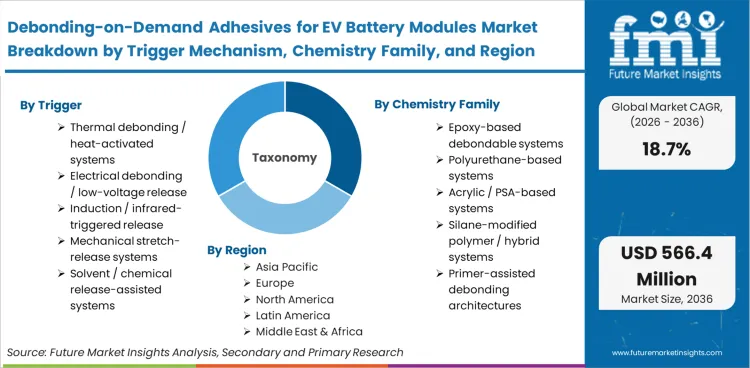
The debonding-on-demand adhesives for EV battery modules market was valued at USD 85.9 million in 2025. Cumulative output is poised to reach USD 102.0 million in 2026 at a CAGR of 18.7% during the forecast period. High investment propels the debonding-on-demand adhesives for EV battery modules market to a total valuation of USD 566.4 million through 2036, as regional battery passports and extended producer responsibility mandates force original equipment manufacturers to engineer profitable teardown pathways instead of permanent structural bonds.
Original equipment manufacturer procurement directors face an immediate compliance countdown regarding end-of-life recycling regulations in key jurisdictions. Analyzing the EV battery module debonding adhesive market reveals that specifying these materials acts as a mandatory risk mitigation requirement against uninsurable warranty liabilities. Failing to validate these reversible formulations today guarantees catastrophic disassembly costs a decade later when packs reach secondary streams. Our assessment shows that what legacy suppliers interpret as a slight modification to existing photo activated debondable structural compounds actually functions as a complete teardown of traditional bonding assumptions.
Once European and North American regulators lock in exact manual disassembly time limits for automotive battery packs, permanent potting becomes financially prohibitive. Tier-1 suppliers who cross this standard first dictate the battery debonding adhesive market forecast trajectory for the next decade. Competitors lacking compliant release technologies must either license these architectures or abandon whole regional segments entirely.
Summary of Debonding-on-Demand Adhesives for EV Battery Modules Market
- Debonding-on-Demand Adhesives for EV Battery Modules Market Definition
- Engineered polymer systems that maintain structural integrity during active service but rapidly release their bond upon application of a specific thermal, electrical, or mechanical trigger to enable pack repair and recycling.
- Demand Drivers in the Market
- Imminent passport regulations compel design chiefs to specify reversible joints to meet mandated dismantling timeframes.
- Warranty repair costs push pack engineering teams to abandon permanent potting in favor of reworkable module seals.
- Secondary-use economics force teardown facility managers to demand automated separation mechanisms over destructive shredding.
- Key Segments Analyzed in the FMI Report
- Thermal debonding / heat-activated systems: This segment is anticipated to account for 39.0% share in 2026, leveraging existing thermal management infrastructure during dismantling.
- Epoxy-based debondable systems: This segment is set to hold 34.0% share, maintaining required torsional rigidity while accommodating triggered chain cleavage.
- Module-to-pack / structural housing bonding: This segment is projected to garner 36.0% share, driven by critical requirements to extract intact units from damaged chassis.
- Passenger battery electric vehicles: This segment is estimated to capture 71.0% share, reflecting high production volumes and strict consumer warranty requirements.
- End-of-life disassembly and recycling: This segment is poised to grab 42.0% share, answering immediate legislative pressures surrounding urban mining operations.
- India: India exhibits 21.4% compound growth, answering aggressive domestic recycling infrastructure build-outs and local manufacturing targets.
- Analyst Opinion at FMI
- Sudip Saha, Principal Analyst, Automotive and Chemicals, at FMI, points out, "Generalist assumptions suggest automakers adopt circular battery adhesives market innovations purely to make end-of-life recycling easier for third parties. In reality, procurement directors aggressively secure these formulations to protect their own warranty reserves. Replacing a single defective cell inside a permanently potted pack often costs thousands in scrapped adjacent modules. Triggered debonding changes this math entirely. What appears externally as an environmental compliance play actually functions internally as a massive warranty risk mitigation strategy, dictating why adoption curves accelerate years ahead of formal regulatory deadlines."
- Strategic Implications / Executive Takeaways
- Polymer chemists face immediate pressure to eliminate latent triggering risks, ensuring formulations do not release during thermal runaway events.
- Teardown facility operators secure early access to low-voltage release systems, drastically reducing labor costs associated with manual breaking.
- Automotive tier-1 suppliers must transition away from legacy structural glues, risking total exclusion from next-generation cell-to-pack architectures.
- Methodology
- Primary input from sourcing directors and polymer formulation chemists.
- Desk analysis of passport technical requirements and patent registries.
- Baseline anchored to production forecasts for repair-friendly pack architectures.
- Cross-validation via yield data from secondary-use electric vehicle power batteries dismantlers.
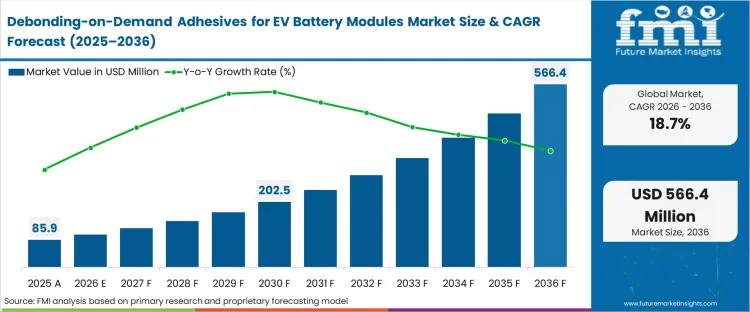
Debonding-on-Demand Adhesives for EV Battery Modules Market Key Takeaways
| Metric | Details |
|---|---|
| Industry Size (2026) | USD 102.0 million |
| Industry Value (2036) | USD 566.4 million |
| CAGR (2026 to 2036) | 18.7% |
Source: Future Market Insights (FMI) analysis, based on proprietary forecasting model and primary research
India leads global adoption at 21.4% as aggressive localized manufacturing pushes immediate design-for-recycling integration, while China tracks closely at 19.8% on state-backed secondary-use ecosystems. Germany scales at 18.9% due to strict EU passport deadlines, outpacing France at 17.8% and US operations at 17.1%. South Korea advances at 16.8% through chaebol-led material standardization, edging past Japan at 15.9%. Structural divergence across this range stems directly from whether national policy treats dead batteries as hazardous waste or high-value urban mines requiring solutions sourced from the debondable adhesives for EV batteries market.
Debonding-on-Demand Adhesives for EV Battery Modules Market Definition
Engineered polymer systems that maintain structural crash-worthiness during active service but rapidly release their internal bond upon application of a specific trigger define this category. Formulations balance permanent integrity during active vehicle operation with rapid separation capabilities during repair phases. Utilizing products from the reversible adhesives for EV battery modules market ensures that technicians can extract individual cells without destroying surrounding enclosures. Performance metrics hinge on precise trigger types, separating these specific silane modified polymer binders from conventional thermal interface materials lacking commanded release mechanisms.
Debonding-on-Demand Adhesives for EV Battery Modules Market Inclusions
Scope incorporates heat-activated, low-voltage electrical, targeted induction, and chemical-release structural bonding formulations used exclusively within automotive power assemblies. Formulations designed for cell-to-cell, cell-to-module, and module-to-pack fixation carrying an active trigger mechanism fall strictly within measurement parameters. Specialized repairable structural adhesives for EV batteries engineered specifically for reworkable lid seals and busbar fixation interfaces are fully evaluated. The analysis also covers corresponding adhesive tapes for electronics designed for teardown environments.
Debonding-on-Demand Adhesives for EV Battery Modules Market Exclusions
Standard potting compounds, permanent conformal coatings, and traditional polyurethane glues lacking a specific engineered release mechanism remain excluded. Conventional mechanical fasteners and non-structural thermal gap pads fall outside functional boundaries because they do not rely on reversible chemical bonding. Solutions designed for general chassis assembly rather than high-voltage enclosures, alongside basic sealants lacking load-bearing structural properties, sit beyond current evaluation parameters.
Debonding-on-Demand Adhesives for EV Battery Modules Market Research Methodology
- Primary Research: Sourcing directors at major battery manufacturers, teardown facility operations managers, and polymer chemists specializing in reversible bonding architectures
- Desk Research: European Battery Alliance certification registries, published teardown protocols for end-of-life pack management, and patent filings for electrically triggered formulations
- Market-Sizing and Forecasting: Automotive production volumes for electric vehicle platforms requiring reworkable designs, serving as our baseline adoption metric
- Data Validation and Update Cycle: Independent teardown yield reports from prominent secondary-use dismantling facilities cross-validate expected penetration rates
Segmental Analysis
Debonding-on-Demand Adhesives for EV Battery Modules Market Analysis by Trigger Mechanism
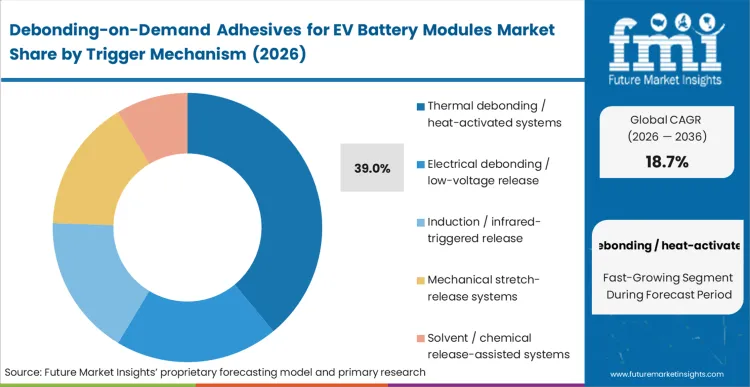
Thermal activation approaches currently offer the lowest barriers to entry because disassembly facilities already utilize heat chambers to manage residual charge. Thermal debonding / heat-activated systems commands 39.0% share by trigger mechanism, with factors supporting compound growth including reliable separation without requiring complex wiring harnesses inside individual packs. Teardown engineers favor thermal debonding adhesives for EV battery modules because they integrate smoothly into existing thermal management protocols during end-of-life processing. FMI's assessment indicates that structural adhesives lacking commanded release mechanisms face rapid displacement. What safety compliance officers rarely disclose is that calibrating exact release temperatures creates a dangerous engineering paradox: setting triggers too low risks catastrophic structural failure during fast-charging heat spikes, while setting them too high requires energy-intensive dismantling ovens that damage surrounding cells. Procurement directors who misjudge this thermal window face total pack redesigns midway through production lifecycles.
- Qualification thresholds: Dismantling engineers rely on precise thermal curves to ensure rapid separation without compromising reusable adjacent cells. Setting optimal activation points validates laboratory performance.
- Edge condition vulnerability: Fleet managers operating in arid climates face increased risks of premature bond degradation if cooling systems fail during sustained high-speed driving. Extreme environmental operating conditions occasionally push internal temperatures perilously close to release thresholds.
- Standardization requirements: Recycling technicians must precisely calibrate oven times to achieve optimal separation. Slight deviations result in incomplete debonding or irreversible damage to underlying housings, forcing electrical debonding adhesives for EV batteries into consideration for future platforms.
Debonding-on-Demand Adhesives for EV Battery Modules Market Analysis by Chemistry Family
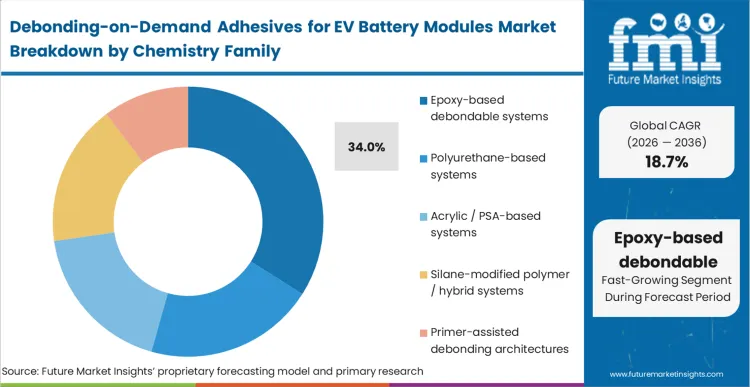
Rigorous crash-test mandates dictate the underlying material science for structural vehicle components. Epoxy-based debondable systems dominates with 34.0% share by Chemistry Family, with factors supporting CAGR rooted in maintaining exceptional shear strength required for chassis integration while incorporating cleavable links that break down only under targeted stimuli. FMI highlights that R&D chemists at major tier-1 suppliers select modified epoxies because they mimic the handling characteristics of traditional temporary bonding adhesives during automated dispensing. Integrating an advanced compound allows production line managers to utilize existing robotic application equipment without costly retooling. Formulation experts know that modifying epoxy backbones to enable on-demand release inherently compromises long-term resistance to leaked electrolytes, forcing difficult trade-offs between recyclability and chemical shielding. Sourcing executives delaying transitions to hybrid formulations risk failing upcoming circularity audits, immediately jeopardizing supplier status for next-generation European vehicle platforms.
- Procurement savings origin: Category managers negotiate bulk pricing based on established epoxy resin indices. Isolating premium costs purely to proprietary triggering additives allows procurement teams to avoid entirely novel material sourcing networks.
- Hidden operational costs: Plant operations directors absorb significant hidden expenses related to climate-controlled storage and shortened material pot-lives. Dispensing these specialized reactive formulations requires stringent environmental controls on factory floors to prevent premature cross-linking.
- Total lifecycle comparison: Warranty managers recover premiums entirely during first module replacements by avoiding destructive extraction techniques. Initial unit costs of cleavable epoxies greatly exceed standard glues, but lifecycle modeling reveals massive downstream savings.
Debonding-on-Demand Adhesives for EV Battery Modules Market Analysis by Battery Integration Point
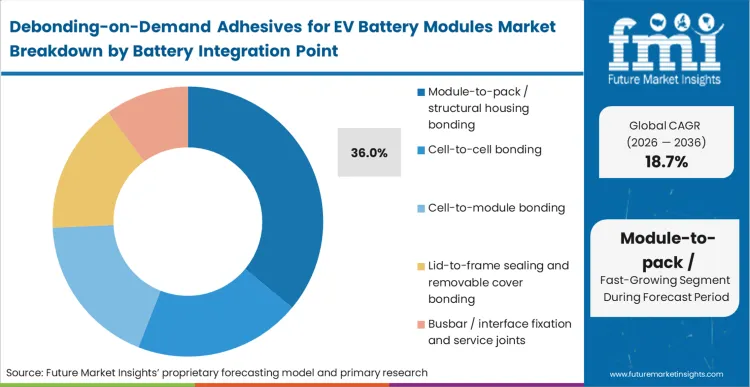
Extracting compromised cell clusters without destroying entire power units represents the primary engineering bottleneck in modern electric vehicles. Module-to-pack / structural housing bonding holds 36.0% share by Battery Integration Point, with factors supporting compound growth tied to addressing massive warranty costs associated with scrapping entire enclosures due to single-point failures. According to FMI's estimates, repair technicians rely heavily on module-to-pack removable adhesive systems and specific electrically conductive adhesives to guide debonding processes during structural disassembly. Designing critical interfaces with reversible chemistry transforms destructive three-day manual teardowns into two-hour automated releases. An overlooked reality among structural engineers is that while reworkable housing bonds simplify extraction, they fundamentally alter acoustic dampening profiles, often introducing high-frequency vibrations that traditional permanent potting previously absorbed. Design chiefs who ignore this acoustic penalty must subsequently add heavy sound-deadening materials, entirely negating weight savings achieved by modern cell-to-pack architectures.
- Structural separation failure: Crash safety engineers mandate intense shear testing to ensure debonding mechanisms remain completely dormant under extreme dynamic impact loads. Premature release along module interfaces during collisions compromises entire vehicle safety cages.
- Residual extraction risks: Rework technicians face significant friction pulling modules free if adhesive layers lack complete cohesive failure. Residual webbing often clings to cooling plates, occasionally bending fragile thermal interfaces.
- Capture of full benefit: Recycling operations directors must upgrade facility tooling to realize the true value from a lid-to-frame debonding adhesive for EV battery packs. Manual extraction negates the precise time savings these automated systems provide.
Debonding-on-Demand Adhesives for EV Battery Modules Market Analysis by Vehicle Class
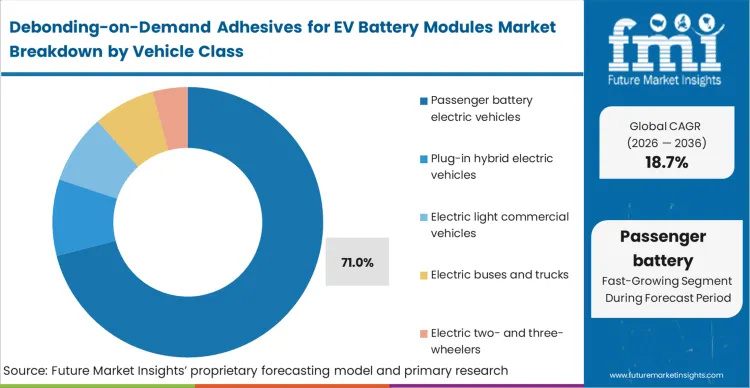
Consumer expectations regarding long-term ownership costs directly shape how vehicle manufacturers approach serviceability. Passenger battery electric vehicles accounts for 71.0% share by Vehicle Class, with factors supporting CAGR reflecting intense pressure warranty departments face from buyers demanding affordable out-of-warranty repairs. FMI observes that engineers previously relying on conventional ev battery pack thermal management geometries are pivoting rapidly to triggered formulations to avoid catastrophic public relations failures over unrepairable vehicles. Designing passenger vehicles for module-level serviceability drastically lowers insurance premiums, creating distinct competitive advantages on dealership lots. What financial analysts miss entirely is that reversible adhesives in passenger vehicles primarily protect captive leasing arms; capturing residual value at lease-end requires pristine, easily refurbished packs, not shredded waste. Brands failing to implement these systems face massive asset write-downs as leased fleets return with permanently degraded power units.
- Early premium adoption: Lead engineering directors at premium marques utilize lid-to-frame sealing adhesives with debonding capability to ensure flagship models undergo rapid upgrades without chassis damage. Luxury manufacturers integrate advanced chemistry first to protect extensive warranty promises.
- Mainstream follower shifts: Procurement managers at high-volume brands only transition from standard potting once legislation mandates strict design-for-recycling metrics. Mass-market brands eventually follow as triggering additive costs drop through scale production.
- Final commercial conversion: Fleet operations managers finally convert when irreversible pack damage from minor collisions sidelines delivery vans for unacceptable durations. Light commercial fleets resist adoption until the total costs of downtime prove too expensive under legacy repair models.
Debonding-on-Demand Adhesives for EV Battery Modules Market Analysis by Primary Service Objective
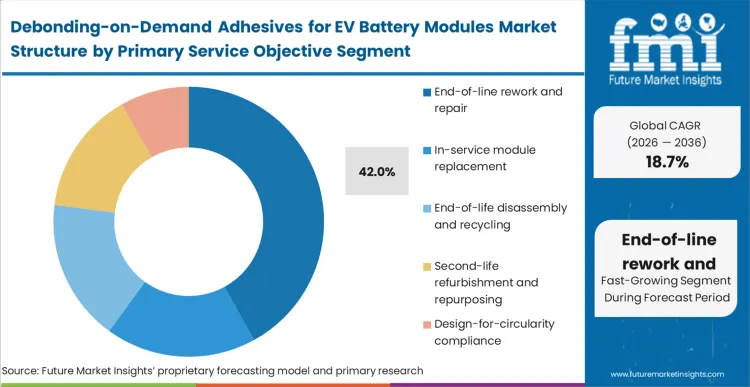
Legislative frameworks strictly governing how power units end useful lives dictate immediate priorities for pack designers. End-of-life disassembly and recycling secures 42.0% share by Primary Service Objective, with factors supporting compound growth answering European directives that penalize destructive shredding processes. Based on FMI's assessment, facility operators demand end-of-life battery disassembly adhesives to isolate valuable active materials without cross-contamination from legacy battery pack sealants. Implementing triggered release systems allows recyclers to automate dismantling lines, vastly improving the purity of recovered lithium and cobalt. Structural irony defines this adoption curve: chemistry optimized for end-of-life recycling often lacks the rapid, localized release needed for mid-life dealership repairs, forcing engineering teams to prioritize one operational outcome over another. Supply chain directors who attempt to satisfy both recycling mandates and dealership repair requests with single hybrid formulations ultimately discover that compromised chemistries fail spectacularly in both environments.
- Initial purchase triggers: Recycling compliance officers force initial integration of dismountable adhesive systems for EV batteries to satisfy incoming passport mandates. Immediate threats of market exclusion compel sourcing teams to abandon legacy permanent bonds despite favorable baseline pricing.
- Qualification validations: Engineering leads must prove formulations drop shear strength below specified limits purely through intended trigger mechanisms. Demonstrating successful, automated separation within mandated timeframes validates selection for compliance auditors.
- Renewal cycle drivers: Financial directors at recycling subsidiaries aggressively expand procurement contracts once the profitability of refurbished modules surpasses traditional shredded material sales. Favorable secondary-market valuations for cleanly extracted units drive ongoing formulation renewals.
Debonding-on-Demand Adhesives for EV Battery Modules Market Drivers, Restraints, and Opportunities
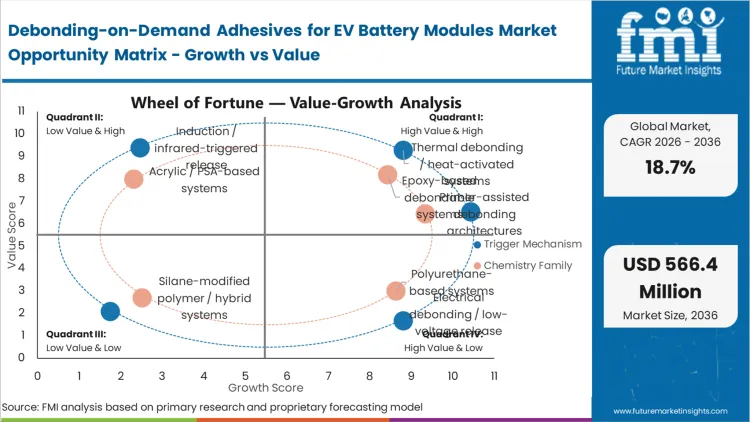
Catastrophic warranty claims tied to minor module defects force pack engineering teams to abandon permanent structural potting immediately. When single faulty cells necessitate scrapping entire enclosures, the financial liability destroys vehicle profitability margins. Sourcing directors face an undeniable commercial reality: engaging the EV battery disassembly adhesive market operates as a fundamental requirement for risk mitigation. FMI analysts point out that engineers evaluating industrial adhesives alongside debonding technologies recognize manual disassembly speed directly dictates secondary value. Delaying transitions to reversible chemistries exposes manufacturers to massive end-of-life penalties under incoming extended producer responsibility mandates. Urgency stems from ten-year lags between production and recycling; vehicles built today with permanent glues become unmanageable toxic liabilities a decade later.
Latent trigger activation during extreme operating conditions persists as the primary structural friction slowing widespread commercial implementation. Battery management system engineers struggle to guarantee high-speed driving or fast-charging heat spikes will not accidentally initiate thermal release mechanisms. This underlying vulnerability forces crash safety teams to demand extensive validation protocols that drastically stall deployment schedules. Dual-trigger formulations requiring both heat and specific electrical voltages attempt to solve stability issues, but embedding specialized epoxy curing agents into conductive layers increases costs prohibitively. Friction remains firmly rooted in conflicting demands: maintaining absolute structural rigidity under impact loads while guaranteeing effortless separation on teardown benches.
Opportunities in the Debonding-on-Demand Adhesives for EV Battery Modules Market
- Low-voltage electrical triggering: Integrating conductive networks directly into adhesive matrices allows instantaneous release via simple DC voltage application. Teardown operators utilize EV battery design for disassembly materials to achieve precise, localized module extraction without subjecting adjacent cells to damaging thermal oven cycles.
- Primer-assisted release layers: Developing distinct primer coatings that contain active trigger mechanisms enables automakers to use standard structural resins on top. Procurement teams avoid high costs of bulk specialty intumescent sealants while still achieving complete end-of-life separation.
- Automated dismantling integration: Aligning release profiles precisely with robotic teardown gantries creates fully touchless recycling lines. Facility operations managers slash labor costs dramatically while increasing the throughput of undamaged secondary-use modules.
Regional Analysis
.webp "Top Country Growth Comparison Debonding On Demand Adhesives For Ev Battery Modules Market Cagr (2026 2036)")
Based on regional analysis, the debonding-on-demand adhesives for EV battery modules market is segmented into North America, Europe, Asia Pacific, Latin America, and Middle East & Africa across 40 plus countries.
| Country | CAGR (2026 to 2036) |
|---|---|
| India | 21.4% |
| China | 19.8% |
| Germany | 18.9% |
| France | 17.8% |
| United States | 17.1% |
| South Korea | 16.8% |
| Japan | 15.9% |
Source: Future Market Insights (FMI) analysis, based on proprietary forecasting model and primary research
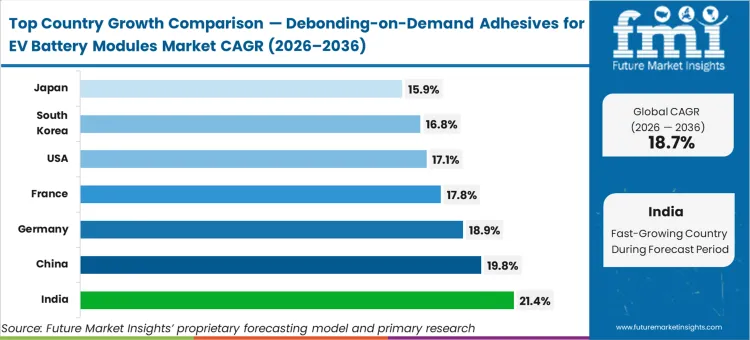
Asia Pacific Debonding-on-Demand Adhesives for EV Battery Modules Market Analysis
Aggressive localized manufacturing targets and state-backed secondary-use ecosystems fundamentally alter how manufacturers design pack enclosures across the region. Supply chain directors facing high logistical costs for shipping defective packs back to origin facilities demand localized module replacement capabilities. This dynamic forces rapid adoption of reversible chemistries that allow domestic technicians to service vehicles without destroying expensive imported enclosures. FMI observes that unlike legacy hubs burdened by existing automation lines built around permanent hot melt adhesive tapes, emerging production centers install reworkable dispensing equipment natively. Explosive volume across two- and three-wheeler electric mobility solutions accelerates testing cycles, proving the viability of low-temperature thermal triggers in high-vibration environments.
- India: Strict domestic recycling infrastructure requirements push major assemblers to eliminate irreversible potting compounds entirely. Plant operations managers leverage 21.4% CAGR, with factors supporting compound growth including the need to drastically reduce scrap rates of complex module assemblies. Formulators capturing these early-stage manufacturing contracts secure deep entrenchment before global standards fully solidify.
- China: Chaebol-style integration between cell manufacturers and state recycling grids accelerates the standardization of specific thermal release profiles. Recording 19.8% CAGR, factors supporting compound growth reflect intense pressure on procurement heads evaluating the China debonding adhesives for EV battery modules market to secure proprietary formulations. Domestic suppliers successfully demonstrating rapid electrical release architectures immediately capture massive scale.
- South Korea: Strict material recovery quotas drive engineers to specify highly specialized cleavable epoxies. Warranty directors rely on 16.8% CAGR, with factors supporting compound growth focused on streamlining in-field module replacements across premium export fleets, ensuring packs remain competitive within European compliance frameworks.
- Japan: Focus on solid-state commercialization forces R&D teams to develop adhesives that release without utilizing volatile solvent washes. Advancing at 15.9% CAGR, factors supporting compound growth for regional adoption curves hinge on maximizing the purity of recovered advanced materials.
Europe Debonding-on-Demand Adhesives for EV Battery Modules Market Analysis
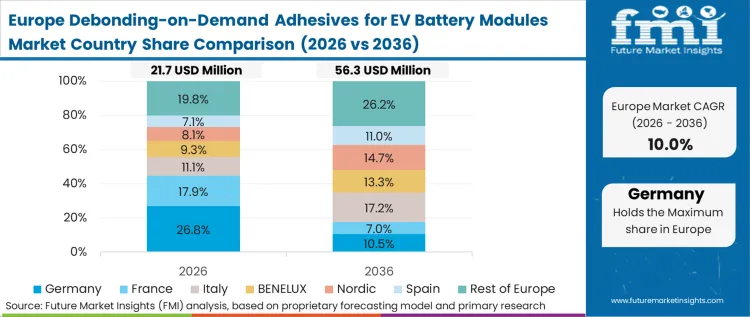
Imminent passport regulations transform the continent's automotive supply chain into strictly regulated circular economies. Compliance officers demand complete traceability regarding how every pack will be dismantled, effectively banning permanent structural adhesives from next-generation platforms. Teardown engineers require formulations that yield cleanly under precise triggers to avoid cross-contaminating highly regulated black mass outputs. FMI analysts highlight that sourcing teams previously focused purely on adhesive transfer tape shear strength now scrutinize exact time-to-release metrics under thermal soaking.
- Germany: Dense concentration of premium marques accelerates shifts toward reversible module bonding to protect high-value brand warranties. Expanding at 18.9% CAGR, factors supporting compound growth in this legislative environment force tier-1 chemical suppliers to co-develop proprietary triggering mechanisms directly with design centers.
- France: Aggressive urban mining directives push local teardown facilities to demand low-voltage release systems that eliminate labor-intensive manual breaking. Category managers tracking 17.8% CAGR realize factors supporting compound growth dictate that achieving automated disassembly directly ensures the profitability of domestic recycling hubs.
North America Debonding-on-Demand Adhesives for EV Battery Modules Market Analysis
Extended producer responsibility legislation advancing at state levels fundamentally shifts how domestic automotive giants approach end-of-life pack management. Financial risk officers recognize permanently potted units represent uninsurable liabilities once vehicles enter secondary markets. Design chiefs actively transition toward mechanically stretch-release systems and targeted induction triggers to ensure dealerships can service individual modules safely using specialized fast curing epoxy adhesive technologies.
- United States: Warranty cost containment strategies drive major automakers to implement reworkable pack seals across high-volume electric truck platforms. Tracking at 17.1% CAGR, factors supporting compound growth include fleet operations managers requiring these systems to minimize vehicle downtime during routine service, eliminating the need to scrap entire power units over minor localized defects.
FMI's report includes Canada, Mexico, Brazil, Italy, Spain, Russia, and ASEAN nations. Transitioning toward highly specific 2k epoxy adhesives with engineered failure modes allows smaller regional teardown facilities to process packs safely without requiring specialized crushing infrastructure.
Competitive Aligners for Market Players
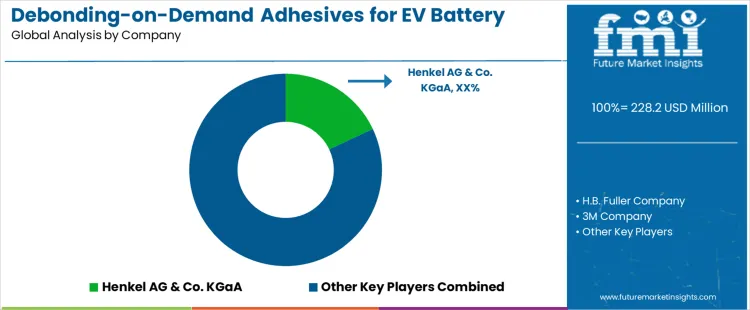
Competition within this highly specialized chemical sector diverges completely from traditional structural bonding, focusing entirely on trigger mechanism reliability rather than absolute peak shear strength. Formulators such as Henkel AG & Co. KGaA and Sika AG do not compete on how permanently their adhesives bind; they compete on how predictably those bonds fail when commanded. Procurement directors evaluating debonding adhesive suppliers for EV battery modules run extensive validation matrices assessing latency windows, the exact margin between typical operating extremes and precise thresholds required for release. Chemical suppliers who cannot guarantee zero accidental debonding during high-speed vehicle operation are immediately disqualified from tier-1 sourcing panels, regardless of how elegantly their product separates on teardown benches.
Incumbent chemical giants rely heavily on established dispensing equipment compatibility to defend share against aggressive specialized start-ups. EV battery module debondable adhesive manufacturers like tesa SE and DuPont de Nemours, Inc. formulate reversible systems that viscosity-match legacy ultra high bond tape and standard polyurethanes. Viscosity matching represents a massive barrier to entry; plant operations managers outright refuse to implement novel cleavable adhesives if adoption requires replacing multi-million dollar automated dispensing lines. Challengers attempting disruption must build formulations that flow, cure, and off-gas identically to traditional glues while hiding complex thermal or electrical triggers deep within polymer matrices.
Large automakers aggressively resist vendor lock-in by demanding standardized release protocols across multiple chemical suppliers. While specific epoxy-based systems might utilize proprietary molecular cleavage triggers, recycling facility operators mandate external stimuli remain uniform across vehicle platforms. Sourcing executives analyzing an EV battery adhesive supplier comparison for serviceable packs actively split contracts between companies like H.B. Fuller Company and Arkema S.A. to ensure competitive pricing. To execute the best adhesive strategy for repairable EV battery modules, automotive purchasing departments force chemical manufacturers to differentiate through application speed, integrating uv tapes and multifunctional adhesive tape formats, rather than hoarding proprietary teardown procedures.
Key Players in Debonding-on-Demand Adhesives for EV Battery Modules Market
- Henkel AG & Co. KGaA
- Arkema S.A. (Bostik)
- H.B. Fuller Company
- Sika AG
- tesa SE
- DuPont de Nemours, Inc.
- Avery Dennison Corporation
Scope of the Report
| Metric | Value |
|---|---|
| Quantitative Units | USD 102.0 million to USD 566.4 million, at a CAGR of 18.7% |
| Market Definition | Engineered polymer systems that maintain structural crash-worthiness during active service but rapidly release their bond upon application of a specific thermal, electrical, or mechanical trigger to enable battery repair and recycling. |
| Segmentation | Trigger Mechanism, Chemistry Family, Battery Integration Point, Vehicle Class, Primary Service Objective, and Region |
| Regions Covered | North America, Latin America, Europe, Asia Pacific, Middle East & Africa |
| Countries Covered | United States, Canada, Germany, United Kingdom, France, Italy, Spain, Russia, China, Japan, South Korea, India, ASEAN, Brazil, Mexico |
| Key Companies Profiled | Henkel AG & Co. KGaA; Arkema S.A. (Bostik); H.B. Fuller Company; Sika AG; tesa SE; DuPont de Nemours, Inc.; Avery Dennison Corporation |
| Forecast Period | 2026 to 2036 |
| Approach | Baseline anchored to OEM production forecasts for repair-friendly battery architectures. |
Source: Future Market Insights (FMI) analysis, based on proprietary forecasting model and primary research
Debonding-on-Demand Adhesives for EV Battery Modules Market by Key Segments
Trigger Mechanism
- Thermal debonding / heat-activated systems
- Electrical debonding / low-voltage release
- Induction / infrared-triggered release
- Mechanical stretch-release systems
- Solvent / chemical release-assisted systems
Chemistry Family
- Epoxy-based debondable systems
- Polyurethane-based systems
- Acrylic / PSA-based systems
- Silane-modified polymer / hybrid systems
- Primer-assisted debonding architectures
Battery Integration Point
- Cell-to-cell bonding
- Cell-to-module bonding
- Module-to-pack / structural housing bonding
- Lid-to-frame sealing and removable cover bonding
- Busbar / interface fixation and service joints
Vehicle Class
- Passenger battery electric vehicles
- Plug-in hybrid electric vehicles
- Electric light commercial vehicles
- Electric buses and trucks
- Electric two- and three-wheelers
Primary Service Objective
- End-of-line rework and repair
- In-service module replacement
- End-of-life disassembly and recycling
- Second-life refurbishment and repurposing
- Design-for-circularity compliance
Region
- North America
- United States
- Canada
- Europe
- Germany
- United Kingdom
- France
- Italy
- Spain
- Asia Pacific
- China
- India
- Japan
- South Korea
- Australia
- Latin America
- Brazil
- Mexico
- Argentina
- Middle East & Africa
- GCC Countries
- South Africa
- Israel
- Rest of Middle East & Africa
Bibliography
- Rodrigues, V. C. M. B., et al. (2025, June). Adhesive bonding in automotive battery pack manufacturing and dismantling: A review. Springer Nature.
- H.B. Fuller Company. (2025, March). Debonding-on-demand in electric vehicle batteries.
- Henkel Adhesive Technologies. (2025, November). Debonding-on-demand: Enabling repairable and recyclable EV battery systems.
- Li, Y., et al. (2025, September). Polyimide-based composite coatings for high-temperature and debondable electronics applications. Nanoscale (RSC Publishing).
- Durairaj, L., et al. (2025, June). Recent innovations in EMI shielding materials and multifunctional coatings for electronic systems. Composites Science and Technology (Elsevier).
This bibliography is provided for reader reference. The full FMI report contains the complete reference list with primary source documentation.
This Report Addresses
- Precise warranty cost implications driving procurement directors toward reworkable battery adhesives over permanent potting
- Specific thermal and electrical trigger mechanisms required to satisfy incoming European battery passport dismantling deadlines
- Critical workflow shifts for teardown facilities transitioning from destructive shredding to automated module extraction
- Supply chain constraints facing tier-1 chemical formulators scaling cleavable epoxy and polyurethane architectures
- Hidden acoustic and structural trade-offs resulting from reversible module-to-pack bonding implementations
- Qualification parameters crash safety engineers mandate to ensure debonding mechanisms remain dormant during high-speed collisions
- Distinct regional adoption trajectories across India, China, and Germany dictated by localized manufacturing and recycling policies
- Strategic vendor lock-in tactics utilized by established material suppliers regarding proprietary thermal soak release profiles
Frequently Asked Questions
What are debonding-on-demand adhesives in EV batteries?
These represent a specialized class of structural bonding agents engineered to lose internal adhesive strength reliably upon exposure to a specific external trigger. Formulations balance permanent structural integrity during active vehicle operation with rapid separation capabilities during repair phases, enabling technicians to extract individual cells safely.
Why are debondable adhesives important for EV battery recycling?
Traditional destructive shredding contaminates valuable black mass outputs with cured structural glues. Clean triggered separation isolates high-value active materials efficiently, allowing recycling operators to automate dismantling lines and vastly improve the purity of recovered lithium and cobalt from end-of-life packs.
Can debonding adhesives reduce EV battery repair costs?
Replacing a single defective cell inside a permanently potted pack often costs thousands in scrapped adjacent modules. Triggered debonding allows service centers to extract only the failed components, slashing labor times and preventing massive warranty payouts associated with entirely destroyed enclosures.
Are debondable adhesives strong enough for EV battery safety?
Crash safety mandates require massive shear strength to maintain vehicle structural integrity during collisions. Modifying existing epoxy backbones allows structural engineers to meet rigorous impact requirements while introducing targeted cleavable links, satisfying both dynamic safety testing and end-of-life separation goals.
Compare thermal and electrical debonding adhesives for EV batteries?
Thermal activation leverages existing heat chambers at teardown facilities, avoiding complex in-pack wiring but risking accidental release during fast-charging heat spikes. Electrical systems offer instant localized module separation without thermal degradation, but embedding conductive wiring networks directly into adhesive layers increases assembly costs significantly.
Explain the market outlook for debonding-on-demand adhesives in EV battery modules?
Valued at USD 85.9 million in 2025, cumulative output is poised to reach USD 566.4 million through 2036. This 18.7% compound growth stems directly from incoming regional battery passports forcing automakers to engineer profitable teardown pathways instead of relying on permanent structural bonds.
What regulations support debondable battery adhesives in Europe?
Imminent passport regulations transform the continent's automotive supply chain into strictly regulated circular economies. Compliance officers demand complete traceability regarding how every pack will be dismantled, effectively banning permanent structural adhesives from next-generation platforms to ensure clean material recovery.
Who are the leading suppliers of reversible adhesives for EV battery modules?
Companies like Henkel AG & Co. KGaA, Sika AG, Arkema S.A., and H.B. Fuller Company lead commercialization. These formulators compete heavily on trigger mechanism reliability and dispensing equipment compatibility, ensuring novel cleavable systems viscosity-match legacy structural glues on factory floors.
What drives the 39.0% share for thermal debonding systems?
Dismantling facilities already utilize heavy-duty thermal chambers to manage residual battery charge before teardown. Leveraging existing infrastructure allows teardown engineers to trigger adhesive release without investing in entirely new low-voltage induction networks, drastically reducing capital expenditure required for compliance.
Why do epoxy-based debondable systems lead the chemistry segment?
Crash safety mandates require massive shear strength to maintain vehicle structural integrity during collisions. Modifying existing epoxy backbones allows structural engineers to meet rigorous impact requirements while introducing targeted cleavable links, satisfying both dynamic safety testing and end-of-life separation goals.
What underlying tension limits electrical low-voltage release systems?
While electrical triggers offer instant localized module separation without thermal degradation, embedding complex conductive wiring networks directly into adhesive layers increases assembly costs prohibitively. Assembly line managers resist this complexity because it introduces new potential failure points during automated dispensing.
How does South Korea's structural adoption differ from Japan's trajectory?
South Korean expansion relies on chaebol-led standardization of specific cleavable epoxies to ensure premium export fleets meet strict European repair directives. Conversely, Japanese adoption hinges on maximizing material purity for solid-state commercialization, prioritizing formulations that release without requiring volatile solvent washes.
What dictates the aggressive 21.4% growth rate in India?
Strict domestic recycling infrastructure requirements push local battery assemblers to eliminate irreversible potting completely. Plant operations managers leverage reworkable chemistries to drastically reduce scrap rates of complex module assemblies during massive scale-ups of localized manufacturing lines.
Why do premium marques act as first commercial adopters?
Luxury manufacturers integrate advanced reversible bonding to protect extensive consumer warranty promises. Lead engineering directors utilize these expensive specialty adhesives to ensure flagship models can undergo rapid battery upgrades and service without inflicting irreversible chassis damage.
What qualification threshold matters most to crash safety officers?
Latency windows remain the most intensely scrutinized metric. Safety engineers run exhaustive shear tests to guarantee debonding mechanisms remain completely dormant under extreme dynamic impact loads and peak operating temperatures, ensuring triggers never activate accidentally during highway driving.
How does module extraction alter vehicle acoustic performance?
While debonding simplifies extraction, it fundamentally alters acoustic dampening profiles. Reversible adhesives often lack vibration-absorbing density found in traditional permanent potting, forcing design chiefs to add heavy sound-deadening materials that negate initial weight savings.
Why is primer-assisted release gaining traction among category managers?
Applying distinct primer coatings containing active trigger mechanisms enables automakers to use standard inexpensive structural resins for main bonds. Procurement teams bypass high costs associated with bulk specialty adhesives while still achieving compliance with automated separation mandates.
What structural reality defines the competitive landscape for suppliers?
Chemical formulators do not compete on absolute peak shear strength; they compete entirely on trigger reliability. Suppliers who cannot guarantee zero accidental debonding during high-speed vehicle operation face immediate disqualification from tier-1 sourcing panels.
How does the secondary-use market influence adhesive selection?
Grid-storage projects require pristine undamaged battery modules to function efficiently. Favorable secondary-market valuations for cleanly extracted modules drive financial directors to aggressively procure debondable systems, ensuring retired packs remain highly profitable rather than becoming toxic waste.
What role does viscosity matching play in factory adoption?
Plant operations managers outright refuse to implement novel cleavable adhesives if adoption requires replacing multi-million dollar automated dispensing lines. Challengers must build formulations that flow, cure, and off-gas exactly like traditional glues to secure production contracts.
Preview the report firsthand - request a free sample
Get SampleGet the brochure for pricing and purchase details.
Get PDFTable of Content
- Executive Summary
- Global Market Outlook
- Demand-side Trends
- Supply-side Trends
- Technology Roadmap Analysis
- Analysis and Recommendations
- Market Overview
- Market Coverage / Taxonomy
- Market Definition / Scope / Limitations
- Research Methodology
- Chapter Orientation
- Analytical Lens and Working Hypotheses
- Market Structure, Signals, and Trend Drivers
- Benchmarking and Cross-market Comparability
- Market Sizing, Forecasting, and Opportunity Mapping
- Research Design and Evidence Framework
- Desk Research Programme (Secondary Evidence)
- Company Annual and Sustainability Reports
- Peer-reviewed Journals and Academic Literature
- Corporate Websites, Product Literature, and Technical Notes
- Earnings Decks and Investor Briefings
- Statutory Filings and Regulatory Disclosures
- Technical White Papers and Standards Notes
- Trade Journals, Industry Magazines, and Analyst Briefs
- Conference Proceedings, Webinars, and Seminar Materials
- Government Statistics Portals and Public Data Releases
- Press Releases and Reputable Media Coverage
- Specialist Newsletters and Curated Briefings
- Sector Databases and Reference Repositories
- FMI Internal Proprietary Databases and Historical Market Datasets
- Subscription Datasets and Paid Sources
- Social Channels, Communities, and Digital Listening Inputs
- Additional Desk Sources
- Expert Input and Fieldwork (Primary Evidence)
- Primary Modes
- Qualitative Interviews and Expert Elicitation
- Quantitative Surveys and Structured Data Capture
- Blended Approach
- Why Primary Evidence is Used
- Field Techniques
- Interviews
- Surveys
- Focus Groups
- Observational and In-context Research
- Social and Community Interactions
- Stakeholder Universe Engaged
- C-suite Leaders
- Board Members
- Presidents and Vice Presidents
- R&D and Innovation Heads
- Technical Specialists
- Domain Subject-matter Experts
- Scientists
- Physicians and Other Healthcare Professionals
- Governance, Ethics, and Data Stewardship
- Research Ethics
- Data Integrity and Handling
- Primary Modes
- Tooling, Models, and Reference Databases
- Desk Research Programme (Secondary Evidence)
- Data Engineering and Model Build
- Data Acquisition and Ingestion
- Cleaning, Normalisation, and Verification
- Synthesis, Triangulation, and Analysis
- Quality Assurance and Audit Trail
- Market Background
- Market Dynamics
- Drivers
- Restraints
- Opportunity
- Trends
- Scenario Forecast
- Demand in Optimistic Scenario
- Demand in Likely Scenario
- Demand in Conservative Scenario
- Opportunity Map Analysis
- Product Life Cycle Analysis
- Supply Chain Analysis
- Investment Feasibility Matrix
- Value Chain Analysis
- PESTLE and Porter’s Analysis
- Regulatory Landscape
- Regional Parent Market Outlook
- Production and Consumption Statistics
- Import and Export Statistics
- Market Dynamics
- Global Market Analysis 2021 to 2025 and Forecast, 2026 to 2036
- Historical Market Size Value (USD Million) Analysis, 2021 to 2025
- Current and Future Market Size Value (USD Million) Projections, 2026 to 2036
- Y-o-Y Growth Trend Analysis
- Absolute $ Opportunity Analysis
- Global Market Pricing Analysis 2021 to 2025 and Forecast 2026 to 2036
- Global Market Analysis 2021 to 2025 and Forecast 2026 to 2036, By Trigger Mechanism
- Introduction / Key Findings
- Historical Market Size Value (USD Million) Analysis By Trigger Mechanism , 2021 to 2025
- Current and Future Market Size Value (USD Million) Analysis and Forecast By Trigger Mechanism , 2026 to 2036
- Thermal debonding / heat-activated systems
- Electrical debonding / low-voltage release
- Induction / infrared-triggered release
- Mechanical stretch-release systems
- Solvent / chemical release-assisted systems
- Thermal debonding / heat-activated systems
- Y-o-Y Growth Trend Analysis By Trigger Mechanism , 2021 to 2025
- Absolute $ Opportunity Analysis By Trigger Mechanism , 2026 to 2036
- Global Market Analysis 2021 to 2025 and Forecast 2026 to 2036, By Chemistry Family
- Introduction / Key Findings
- Historical Market Size Value (USD Million) Analysis By Chemistry Family, 2021 to 2025
- Current and Future Market Size Value (USD Million) Analysis and Forecast By Chemistry Family, 2026 to 2036
- Epoxy-based debondable systems
- Polyurethane-based systems
- Acrylic / PSA-based systems
- Silane-modified polymer / hybrid systems
- Primer-assisted debonding architectures
- Epoxy-based debondable systems
- Y-o-Y Growth Trend Analysis By Chemistry Family, 2021 to 2025
- Absolute $ Opportunity Analysis By Chemistry Family, 2026 to 2036
- Global Market Analysis 2021 to 2025 and Forecast 2026 to 2036, By Battery Integration Point
- Introduction / Key Findings
- Historical Market Size Value (USD Million) Analysis By Battery Integration Point, 2021 to 2025
- Current and Future Market Size Value (USD Million) Analysis and Forecast By Battery Integration Point, 2026 to 2036
- Module-to-pack / structural housing bonding
- Cell-to-cell bonding
- Cell-to-module bonding
- Lid-to-frame sealing and removable cover bonding
- Busbar / interface fixation and service joints
- Module-to-pack / structural housing bonding
- Y-o-Y Growth Trend Analysis By Battery Integration Point, 2021 to 2025
- Absolute $ Opportunity Analysis By Battery Integration Point, 2026 to 2036
- Global Market Analysis 2021 to 2025 and Forecast 2026 to 2036, By Vehicle Class
- Introduction / Key Findings
- Historical Market Size Value (USD Million) Analysis By Vehicle Class, 2021 to 2025
- Current and Future Market Size Value (USD Million) Analysis and Forecast By Vehicle Class, 2026 to 2036
- Passenger battery electric vehicles
- Plug-in hybrid electric vehicles
- Electric light commercial vehicles
- Electric buses and trucks
- Electric two- and three-wheelers
- Passenger battery electric vehicles
- Y-o-Y Growth Trend Analysis By Vehicle Class, 2021 to 2025
- Absolute $ Opportunity Analysis By Vehicle Class, 2026 to 2036
- Global Market Analysis 2021 to 2025 and Forecast 2026 to 2036, By Primary Service Objective
- Introduction / Key Findings
- Historical Market Size Value (USD Million) Analysis By Primary Service Objective, 2021 to 2025
- Current and Future Market Size Value (USD Million) Analysis and Forecast By Primary Service Objective, 2026 to 2036
- End-of-line rework and repair
- In-service module replacement
- End-of-life disassembly and recycling
- Second-life refurbishment and repurposing
- Design-for-circularity compliance
- End-of-line rework and repair
- Y-o-Y Growth Trend Analysis By Primary Service Objective, 2021 to 2025
- Absolute $ Opportunity Analysis By Primary Service Objective, 2026 to 2036
- Global Market Analysis 2021 to 2025 and Forecast 2026 to 2036, By Region
- Introduction
- Historical Market Size Value (USD Million) Analysis By Region, 2021 to 2025
- Current Market Size Value (USD Million) Analysis and Forecast By Region, 2026 to 2036
- North America
- Latin America
- Western Europe
- Eastern Europe
- East Asia
- South Asia and Pacific
- Middle East & Africa
- Market Attractiveness Analysis By Region
- North America Market Analysis 2021 to 2025 and Forecast 2026 to 2036, By Country
- Historical Market Size Value (USD Million) Trend Analysis By Market Taxonomy, 2021 to 2025
- Market Size Value (USD Million) Forecast By Market Taxonomy, 2026 to 2036
- By Country
- USA
- Canada
- Mexico
- By Trigger Mechanism
- By Chemistry Family
- By Battery Integration Point
- By Vehicle Class
- By Primary Service Objective
- By Country
- Market Attractiveness Analysis
- By Country
- By Trigger Mechanism
- By Chemistry Family
- By Battery Integration Point
- By Vehicle Class
- By Primary Service Objective
- Key Takeaways
- Latin America Market Analysis 2021 to 2025 and Forecast 2026 to 2036, By Country
- Historical Market Size Value (USD Million) Trend Analysis By Market Taxonomy, 2021 to 2025
- Market Size Value (USD Million) Forecast By Market Taxonomy, 2026 to 2036
- By Country
- Brazil
- Chile
- Rest of Latin America
- By Trigger Mechanism
- By Chemistry Family
- By Battery Integration Point
- By Vehicle Class
- By Primary Service Objective
- By Country
- Market Attractiveness Analysis
- By Country
- By Trigger Mechanism
- By Chemistry Family
- By Battery Integration Point
- By Vehicle Class
- By Primary Service Objective
- Key Takeaways
- Western Europe Market Analysis 2021 to 2025 and Forecast 2026 to 2036, By Country
- Historical Market Size Value (USD Million) Trend Analysis By Market Taxonomy, 2021 to 2025
- Market Size Value (USD Million) Forecast By Market Taxonomy, 2026 to 2036
- By Country
- Germany
- UK
- Italy
- Spain
- France
- Nordic
- BENELUX
- Rest of Western Europe
- By Trigger Mechanism
- By Chemistry Family
- By Battery Integration Point
- By Vehicle Class
- By Primary Service Objective
- By Country
- Market Attractiveness Analysis
- By Country
- By Trigger Mechanism
- By Chemistry Family
- By Battery Integration Point
- By Vehicle Class
- By Primary Service Objective
- Key Takeaways
- Eastern Europe Market Analysis 2021 to 2025 and Forecast 2026 to 2036, By Country
- Historical Market Size Value (USD Million) Trend Analysis By Market Taxonomy, 2021 to 2025
- Market Size Value (USD Million) Forecast By Market Taxonomy, 2026 to 2036
- By Country
- Russia
- Poland
- Hungary
- Balkan & Baltic
- Rest of Eastern Europe
- By Trigger Mechanism
- By Chemistry Family
- By Battery Integration Point
- By Vehicle Class
- By Primary Service Objective
- By Country
- Market Attractiveness Analysis
- By Country
- By Trigger Mechanism
- By Chemistry Family
- By Battery Integration Point
- By Vehicle Class
- By Primary Service Objective
- Key Takeaways
- East Asia Market Analysis 2021 to 2025 and Forecast 2026 to 2036, By Country
- Historical Market Size Value (USD Million) Trend Analysis By Market Taxonomy, 2021 to 2025
- Market Size Value (USD Million) Forecast By Market Taxonomy, 2026 to 2036
- By Country
- China
- Japan
- South Korea
- By Trigger Mechanism
- By Chemistry Family
- By Battery Integration Point
- By Vehicle Class
- By Primary Service Objective
- By Country
- Market Attractiveness Analysis
- By Country
- By Trigger Mechanism
- By Chemistry Family
- By Battery Integration Point
- By Vehicle Class
- By Primary Service Objective
- Key Takeaways
- South Asia and Pacific Market Analysis 2021 to 2025 and Forecast 2026 to 2036, By Country
- Historical Market Size Value (USD Million) Trend Analysis By Market Taxonomy, 2021 to 2025
- Market Size Value (USD Million) Forecast By Market Taxonomy, 2026 to 2036
- By Country
- India
- ASEAN
- Australia & New Zealand
- Rest of South Asia and Pacific
- By Trigger Mechanism
- By Chemistry Family
- By Battery Integration Point
- By Vehicle Class
- By Primary Service Objective
- By Country
- Market Attractiveness Analysis
- By Country
- By Trigger Mechanism
- By Chemistry Family
- By Battery Integration Point
- By Vehicle Class
- By Primary Service Objective
- Key Takeaways
- Middle East & Africa Market Analysis 2021 to 2025 and Forecast 2026 to 2036, By Country
- Historical Market Size Value (USD Million) Trend Analysis By Market Taxonomy, 2021 to 2025
- Market Size Value (USD Million) Forecast By Market Taxonomy, 2026 to 2036
- By Country
- Kingdom of Saudi Arabia
- Other GCC Countries
- Turkiye
- South Africa
- Other African Union
- Rest of Middle East & Africa
- By Trigger Mechanism
- By Chemistry Family
- By Battery Integration Point
- By Vehicle Class
- By Primary Service Objective
- By Country
- Market Attractiveness Analysis
- By Country
- By Trigger Mechanism
- By Chemistry Family
- By Battery Integration Point
- By Vehicle Class
- By Primary Service Objective
- Key Takeaways
- Key Countries Market Analysis
- USA
- Pricing Analysis
- Market Share Analysis, 2025
- By Trigger Mechanism
- By Chemistry Family
- By Battery Integration Point
- By Vehicle Class
- By Primary Service Objective
- Canada
- Pricing Analysis
- Market Share Analysis, 2025
- By Trigger Mechanism
- By Chemistry Family
- By Battery Integration Point
- By Vehicle Class
- By Primary Service Objective
- Mexico
- Pricing Analysis
- Market Share Analysis, 2025
- By Trigger Mechanism
- By Chemistry Family
- By Battery Integration Point
- By Vehicle Class
- By Primary Service Objective
- Brazil
- Pricing Analysis
- Market Share Analysis, 2025
- By Trigger Mechanism
- By Chemistry Family
- By Battery Integration Point
- By Vehicle Class
- By Primary Service Objective
- Chile
- Pricing Analysis
- Market Share Analysis, 2025
- By Trigger Mechanism
- By Chemistry Family
- By Battery Integration Point
- By Vehicle Class
- By Primary Service Objective
- Germany
- Pricing Analysis
- Market Share Analysis, 2025
- By Trigger Mechanism
- By Chemistry Family
- By Battery Integration Point
- By Vehicle Class
- By Primary Service Objective
- UK
- Pricing Analysis
- Market Share Analysis, 2025
- By Trigger Mechanism
- By Chemistry Family
- By Battery Integration Point
- By Vehicle Class
- By Primary Service Objective
- Italy
- Pricing Analysis
- Market Share Analysis, 2025
- By Trigger Mechanism
- By Chemistry Family
- By Battery Integration Point
- By Vehicle Class
- By Primary Service Objective
- Spain
- Pricing Analysis
- Market Share Analysis, 2025
- By Trigger Mechanism
- By Chemistry Family
- By Battery Integration Point
- By Vehicle Class
- By Primary Service Objective
- France
- Pricing Analysis
- Market Share Analysis, 2025
- By Trigger Mechanism
- By Chemistry Family
- By Battery Integration Point
- By Vehicle Class
- By Primary Service Objective
- India
- Pricing Analysis
- Market Share Analysis, 2025
- By Trigger Mechanism
- By Chemistry Family
- By Battery Integration Point
- By Vehicle Class
- By Primary Service Objective
- ASEAN
- Pricing Analysis
- Market Share Analysis, 2025
- By Trigger Mechanism
- By Chemistry Family
- By Battery Integration Point
- By Vehicle Class
- By Primary Service Objective
- Australia & New Zealand
- Pricing Analysis
- Market Share Analysis, 2025
- By Trigger Mechanism
- By Chemistry Family
- By Battery Integration Point
- By Vehicle Class
- By Primary Service Objective
- China
- Pricing Analysis
- Market Share Analysis, 2025
- By Trigger Mechanism
- By Chemistry Family
- By Battery Integration Point
- By Vehicle Class
- By Primary Service Objective
- Japan
- Pricing Analysis
- Market Share Analysis, 2025
- By Trigger Mechanism
- By Chemistry Family
- By Battery Integration Point
- By Vehicle Class
- By Primary Service Objective
- South Korea
- Pricing Analysis
- Market Share Analysis, 2025
- By Trigger Mechanism
- By Chemistry Family
- By Battery Integration Point
- By Vehicle Class
- By Primary Service Objective
- Russia
- Pricing Analysis
- Market Share Analysis, 2025
- By Trigger Mechanism
- By Chemistry Family
- By Battery Integration Point
- By Vehicle Class
- By Primary Service Objective
- Poland
- Pricing Analysis
- Market Share Analysis, 2025
- By Trigger Mechanism
- By Chemistry Family
- By Battery Integration Point
- By Vehicle Class
- By Primary Service Objective
- Hungary
- Pricing Analysis
- Market Share Analysis, 2025
- By Trigger Mechanism
- By Chemistry Family
- By Battery Integration Point
- By Vehicle Class
- By Primary Service Objective
- Kingdom of Saudi Arabia
- Pricing Analysis
- Market Share Analysis, 2025
- By Trigger Mechanism
- By Chemistry Family
- By Battery Integration Point
- By Vehicle Class
- By Primary Service Objective
- Turkiye
- Pricing Analysis
- Market Share Analysis, 2025
- By Trigger Mechanism
- By Chemistry Family
- By Battery Integration Point
- By Vehicle Class
- By Primary Service Objective
- South Africa
- Pricing Analysis
- Market Share Analysis, 2025
- By Trigger Mechanism
- By Chemistry Family
- By Battery Integration Point
- By Vehicle Class
- By Primary Service Objective
- USA
- Market Structure Analysis
- Competition Dashboard
- Competition Benchmarking
- Market Share Analysis of Top Players
- By Regional
- By Trigger Mechanism
- By Chemistry Family
- By Battery Integration Point
- By Vehicle Class
- By Primary Service Objective
- Competition Analysis
- Competition Deep Dive
- Henkel AG & Co. KGaA
- Overview
- Product Portfolio
- Profitability by Market Segments (Product/Age /Sales Channel/Region)
- Sales Footprint
- Strategy Overview
- Marketing Strategy
- Product Strategy
- Channel Strategy
- Arkema S.A. (Bostik)
- H.B. Fuller Company
- Sika AG
- tesa SE
- DuPont de Nemours, Inc.
- Avery Dennison Corporation
- Henkel AG & Co. KGaA
- Competition Deep Dive
- Assumptions & Acronyms Used


