

- Industry Size (2026)
- USD 0.9 Bn
- Forecast (2036)
- USD 3.1 Bn
- CAGR (2026 to 2036)
- 13.4%
Debonding-on-Demand Adhesive Tapes for Electronics Dismantling Market Size, Market Forecast and Outlook By FMI
The debonding-on-demand adhesive tapes for electronics dismantling market was valued at USD 0.8 billion in 2025. Revenue is poised to surpass USD 0.9 billion in 2026 at a CAGR of 13.4% during the forecast period. The market valuation reached to USD 3.1 billion through 2036 as extended producer responsibility mandates force original equipment manufacturers to internalize end-of-life processing costs.
Assembly engineers face an immediate structural conflict between building rigid structural enclosures for device durability and satisfying imminent regulatory requirements for rapid component separation. Permanent structural bonding guarantees impact resistance but guarantees destruction during battery extraction. Procurement directors evaluating debonding-on-demand adhesives who delay qualifying reversible photo activated debondable structural adhesives risk entire product lines failing compliance audits in jurisdictions enforcing right-to-repair standards. FMI's assessment indicates a non-obvious reality: early adopters of these electronics dismantling adhesive tapes actually report lower total assembly costs because rework during initial manufacturing yields fewer scrapped units.
Once Tier-1 battery pack manufacturers validate a ten-second separation cycle without chemical solvents, mass adoption across secondary electronics manufacturing follows immediately. Process engineers prioritize throughput above all other metrics during assembly. A proven trigger mechanism changes reverse logistics from a specialized manual teardown process into an automated workflow, positively impacting the electronics adhesive CAGR forecast.
Summary of Debonding-on-Demand Adhesive Tapes for Electronics Dismantling Market
- Debonding-on-Demand Adhesive Tapes for Electronics Dismantling Market Definition
- Engineered fastening systems provide structural permanence during device operation but release cleanly upon targeted external stimulation. These materials eliminate destructive teardown processes during end-of-life recycling or component rework.
- Demand Drivers in the Market
- Circular economy legislation forces consumer electronics compliance officers to mandate reversible battery installation methods.
- Critical mineral scarcity compels EV battery recyclers to extract intact cells without thermal or mechanical damage.
- Rising warranty repair costs push device assembly managers to implement non-destructive screen replacement workflows.
- Key Segments Analyzed in the FMI Report
- Heat-triggered tapes: This segment is projected to capture 42.5% share in 2026, driven by existing thermal management infrastructure within recycling facilities.
- Battery module dismantling: This segment is anticipated to record 38.2% share in 2026, as high-value cell recovery dictates non-destructive separation.
- Consumer electronics recycling: This segment is set to account for 46.7% share in 2026, forced by mass-volume smartphone and laptop turnover rates.
- Metal substrates: This segment is estimated to hold 40.1% share in 2026, reflecting predominant enclosure materials in high-value electronic assemblies.
- Vietnam: Vietnam registers 17.2% compound growth, propelled by local establishment of formal OEM-partnered e-waste processing hubs.
- Analyst Opinion at FMI
- Nikhil Kaitwade, Principal Analyst, Technology, at FMI, points out, "Product designers assume implementing reversible adhesives introduces structural weakness during everyday device drops. Real-world qualification data from Tier-1 smartphone assembly lines shows the exact opposite. Because these formulations require specific thermal or ultraviolet triggers to initiate polymer chain cleavage, their room-temperature shear strength often exceeds conventional double-sided tapes. Device architects focused purely on drop-test survival routinely miss the operational yield improvements. When a display panel alignment fails on the factory floor, process engineers can trigger the release mechanism, save the thousand-dollar OLED component, and reapply the bond. That zero-damage rework capability pays for the adhesive premium before the device ever reaches a consumer."
- Strategic Implications / Executive Takeaways
- R&D directors at consumer electronics brands face critical redesign windows to replace permanent adhesives before right-to-repair mandates block market access.
- Recycling facility operators gain immediate throughput advantages by automating separation lines equipped for specific thermal or optical triggers.
- Materials procurement officers tracking debonding adhesive trends 2026 who secure high-volume supply agreements for reversible formats insulate their manufacturing lines from future regulatory shocks.
- Methodology
- Primary Research: Conversations with e-waste facility operators and consumer brand procurement teams.
- Desk Research: Right-to-repair legislative tracking and polymer chemistry patent reviews.
- Market-Sizing and Forecasting: Global formal e-waste volumes dictate baseline material requirements.
- Data Validation and Update Cycle: Regional recycling recovery rates validate material penetration assumptions.
Debonding-on-Demand Adhesive Tapes for Electronics Dismantling Market Key Takeaways
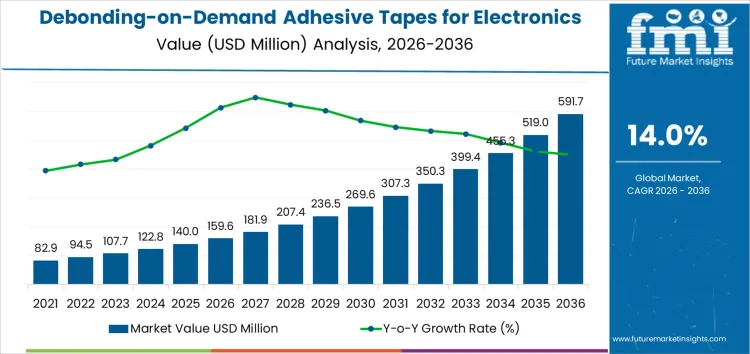
| Metric | Details |
|---|---|
| Industry Size (2026) | USD 0.9 billion |
| Industry Value (2036) | USD 3.1 billion |
| CAGR (2026–2036) | 13.4% |
Source: Future Market Insights (FMI) analysis, based on proprietary forecasting model and primary research
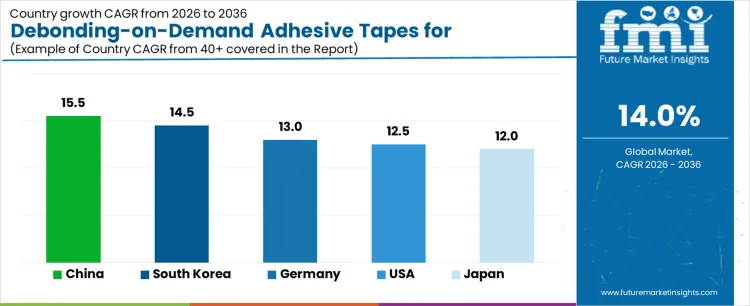
Vietnam leads at 17.2% with rapid formalization of original equipment manufacturer recycling facilities, while India tracks at 16.4% on the back of expanding e-waste processing infrastructure. China registers 15.8% as domestic electronics brands integrate end-of-life recovery mandates. South Korea is estimated to advance at 14.2% driven by battery module recovery initiatives. Japan is forecast to record 13.6% growth via advanced material recovery automation. Germany is likely to progress at 12.1% under strict circular economy legislation. The US is positioned to grow at 11.7% with established dismantling technologies. Regulatory maturity separates rapidly industrializing Asian manufacturing hubs from mature Western recycling ecosystems.
Debonding-on-Demand Adhesive Tapes for Electronics Dismantling Market Definition
Functional boundaries distinguish this category strictly around adhesives engineered to lose their cohesive or adhesive strength completely upon exposure to a specific external stimulus. Formulations must maintain structural integrity equivalent to permanent temporary bonding adhesives during daily operation. Activation parameters must actuate without damaging adjacent sensitive electronic components. For practitioners questioning what are debonding adhesives, they represent the critical boundary between permanent durability and required end-of-life separation within the debonding-on-demand adhesive tapes for electronics dismantling market.
Debonding-on-Demand Adhesive Tapes for Electronics Dismantling Market Inclusions
Scope contains single-sided and double-sided tapes featuring stimulus-responsive polymer architectures. Heat-release films, light-activated bonding sheets, and voltage-responsive interface materials fall within these boundaries. FMI includes carrier-based electronics adhesives designed specifically for controlled disassembly workflows, alongside emerging smart adhesive technologies electronics that react to specific frequencies.
Debonding-on-Demand Adhesive Tapes for Electronics Dismantling Market Exclusions
Conventional pressure-sensitive tapes lacking an engineered release mechanism sit outside this analysis. Solvent-based liquid removers and mechanical scraping tools are excluded because they represent manual rework rather than engineered material properties. Standard thermal interface materials without a distinct structural debonding phase remain excluded from the core adhesive tapes electronics market size.
Debonding-on-Demand Adhesive Tapes for Electronics Dismantling Market Research Methodology
- Primary Research: Procurement directors at consumer electronics brands, battery pack operations managers, and e-waste recycling facility engineers.
- Desk Research: European Right-to-Repair regulatory filings, patent registries for reversible polymer architectures, and sustainability compliance reports.
- Market-Sizing and Forecasting: Annual volume of global e-waste processed through formal dismantling channels anchors baseline volume estimates.
- Data Validation and Update Cycle: Manufacturer sustainability reports and recycling yield metrics cross-validate adoption rates.
Segmental Analysis
Debonding-on-Demand Adhesive Tapes for Electronics Dismantling Market Analysis by Trigger Mechanism
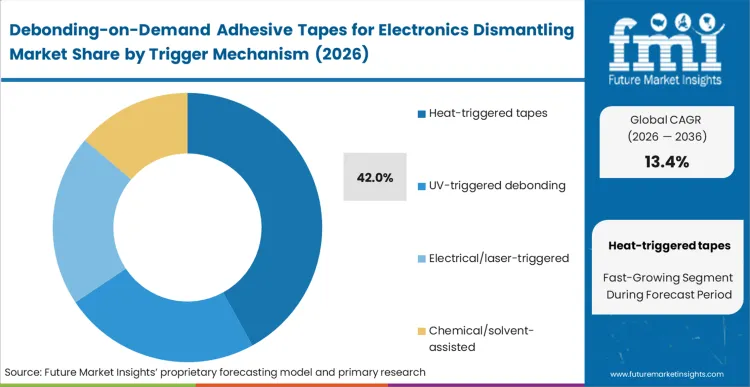
Standard thermal infrastructure exists in nearly every formal e-waste facility globally. Heat-triggered tapes segment holds 42.5% share in 2026, supporting steady compound growth as facility operators avoid investing in specialized laser or ultraviolet exposure equipment for basic disassembly tasks. FMI's assessment indicates that recycling plant managers evaluate electronic packaging adhesives purely on integration speed with existing conveyor ovens. What procurement directors at smartphone brands rarely realize is that thermal release tapes inadvertently complicate reverse logistics for composite plastics that warp at identical trigger temperatures. Heat remains the default choice for metal chassis separation. Original equipment manufacturers who select inappropriate activation thresholds guarantee manual labor intervention when automated ovens fail to release stubborn components.
- Facility equipment baseline: Existing thermal processing ovens accommodate heat-release mechanisms without capital expenditure. When asking how do thermal release tapes work, recycling plant managers point to immediate throughput improvements without retrofitting disassembly lines.
- Thermal threshold risks: Component release temperatures must not exceed the melting point of adjacent structural plastics. Packaging engineers face total unit destruction if trigger profiles overlap with substrate limits, forcing careful selection of thermal release adhesive tapes.
- Volume throughput scaling: Conveyor-driven heat tunnels allow continuous rather than batch processing. Operations directors achieve massive cost reductions when manual pry-tools are eliminated from factory floors using specialized UV debonding adhesive tapes or heat alternatives.
Debonding-on-Demand Adhesive Tapes for Electronics Dismantling Market Analysis by Application
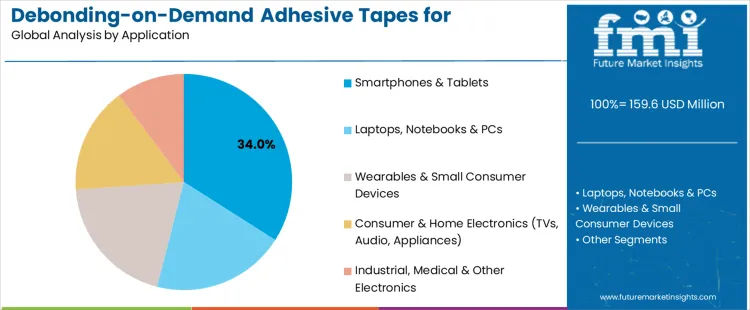
High-voltage battery packs contain immense recovered material value locked behind structural potting and permanent tapes. FMI analysts note that EV pack designers face immense pressure to secure modules against vibration while ensuring end-of-life accessibility. A practitioner reality often ignored in broader sustainability metrics is that forced manual separation of traditional UV tapes or permanent glues accounts for more chemical fires in recycling centers than electrical shorts. Battery module dismantling segment holds 38.2% share in 2026, driving accelerated CAGR as recycling profitability hinges entirely on extracting individual lithium-ion cells without puncturing their casings. Operations managers who adopt precision debonding formulations eliminate this fire hazard entirely. Disassembly teams lacking stimulus-responsive tapes destroy up to thirty percent of recoverable battery value through mechanical force damage.
- Cell integrity preservation: Individual lithium cells require extraction without casing distortion. Battery module operations managers avoid catastrophic thermal runaway events during the dismantling phase by integrating adhesives for battery dismantling.
- Rework yield protection: Faulty module alignment during initial pack assembly requires immediate correction. Process engineers avoid scrapping entire module housings by triggering a clean release rapidly using specialized EV battery dismantling adhesives.
- Lifecycle recovery economics: Undamaged cells command premium pricing in secondary energy storage markets. Recycling facility directors capture higher margins when raw material extraction begins with intact components, shifting focus toward adhesive tapes for PCB removal and similar precision targets.
Debonding-on-Demand Adhesive Tapes for Electronics Dismantling Market Analysis by End Use
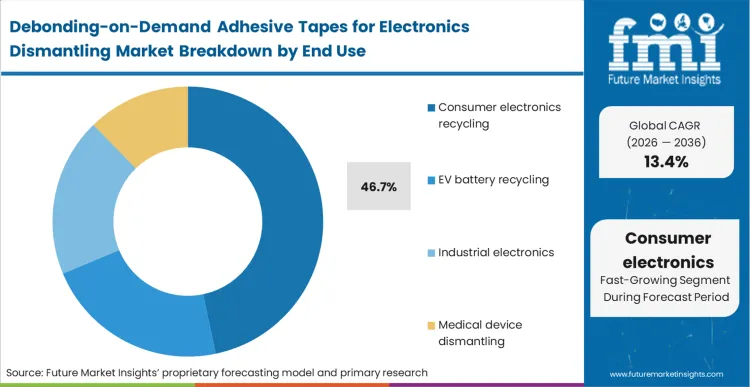
Massive product turnover volumes define smartphone and laptop lifecycles. FMI observes that sustainability directors at these brands demand reversible multifunctional adhesive tape to meet strict European circular economy quotas. Generalists assume this adoption stems entirely from environmental goodwill rather than harsh economic realities. In truth, warranty repair centers lose millions annually replacing shattered display panels that were permanently bonded to device frames. Consumer electronics recycling segment represents 46.7% share in 2026, fueling sustained compound growth because brands must process millions of returned units efficiently. Repair depot managers who demand reversible fastening systems turn unprofitable screen replacements into high-margin service events. Brands continuing to specify destructive permanent adhesives face outright bans in jurisdictions enforcing repairability scores.
- Repairability score compliance: European mandates assign strict numerical grades based on disassembly speed. Consumer electronics compliance officers secure market access by engineering products for rapid component replacement using specific electronics recycling adhesives.
- Warranty labor reduction: Screen replacements consume extensive technician hours when mechanical scraping is required. Repair depot managers drastically lower service costs by actuating a clean release stimulus and analyzing current electronics recycling technology trends.
- Refurbishment velocity: Secondary market value degrades rapidly for current-generation electronics. Reverse logistics directors maximize resale profits by turning around repaired devices in minutes rather than hours through advanced electronics disassembly adhesives.
Debonding-on-Demand Adhesive Tapes for Electronics Dismantling Market Analysis by Substrate Compatibility
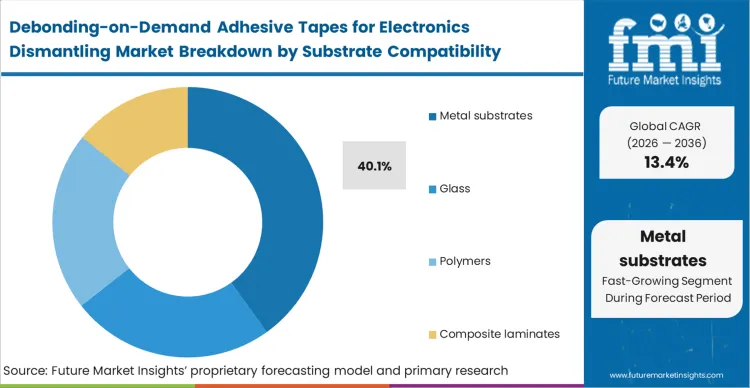
Rigid chassis designs rely heavily on aluminum and magnesium alloys for heat dissipation. According to FMI's estimates, material scientists prioritize adhesive transfer tape formulations that interact predictably with common device metals. An overlooked structural reality is that metallic thermal conductivity allows heat-triggered tapes to activate in seconds, whereas identical tapes behind an insulating polymer cover might take minutes to release. Metal substrates segment command 40.1% share in 2026, sustaining long-term compound growth because these surfaces conduct thermal and electrical release triggers exceptionally well. Enclosure design engineers must map heat flow pathways meticulously to ensure activation reaches every adhesive layer. Incorrect substrate pairings leave isolated bonding zones permanently attached, forcing manual destruction of entire enclosures.
- Conductive trigger acceleration: Aluminum frames transfer heat rapidly to the adhesive interface. Disassembly line technicians achieve component separation in a fraction of the time required for plastic enclosures, proving the value of high performance adhesive tapes electronics.
- Interfacial shear failure: Improperly matched formulations leave adhesive residue on bare metal upon release. Material procurement officers must specify clean-peel properties to avoid secondary solvent cleaning steps when utilizing reusable adhesive tapes electronics.
- Composite transition challenges: Brands shifting from metal to carbon-reinforced polymers alter thermal transmission profiles significantly. Packaging engineers must reformulate debonding parameters to prevent structural damage during recycling while exploring eco-friendly adhesive tapes electronics.
Debonding-on-Demand Adhesive Tapes for Electronics Dismantling Market Drivers, Restraints, and Opportunities
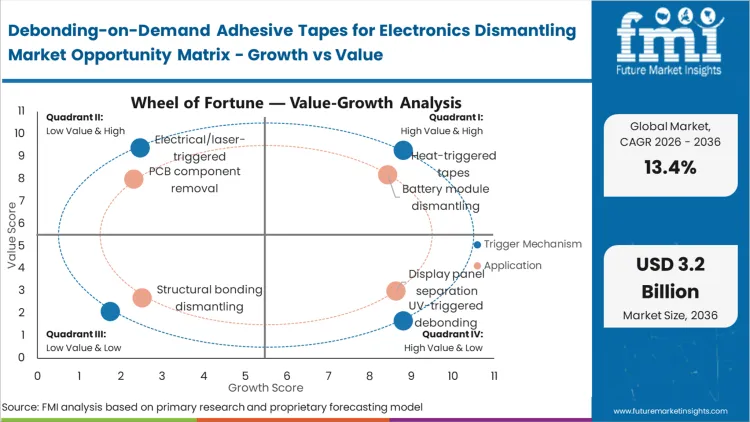
Failure to comply with new device repairability indexes immediately blocks consumer brands from massive regional markets. Compliance officers at Tier-1 electronics manufacturers cannot wait for incremental recycling improvements; they must engineer irreversible bonds out of their product architectures today. Evaluating debonding adhesives vs permanent adhesives becomes critical. Banning permanent glues in smartphone batteries and display panels forces a complete redesign of assembly workflows. Commercial penalties for non-compliance extend beyond fines into total sales embargos in European jurisdictions. Process engineers must implement reversible fastening systems that maintain drop-test survival rates while guaranteeing a five-minute disassembly time using standard tools.
Hardware architectures built around ultra-thin bezels leave virtually no physical space for complex reversible tape geometries. Design engineers face intense friction when attempting to replace micro-dispensed liquid glues with precisely die-cut debonding tapes. Liquid adhesives conform to microscopic gaps in waterproof devices, whereas responsive tapes require distinct dimensional tolerances that bulk up device profiles. Current hot melt adhesive tapes offering trigger release cannot match sheer waterproofing capabilities of permanent liquid epoxies. Formulators are developing hybrid phase-change materials to bridge this gap, but qualification cycles for IP68-rated consumer devices stretch over eighteen months.
Opportunities in the Debonding-on-Demand Adhesive Tapes for Electronics Dismantling Market
- Localized stimulus triggers: Laser-activated architectures allow pinpoint release without heating the entire electronic assembly. Repair technicians gain the ability to detach a single faulty sensor while leaving adjacent waterproof seals intact via specialized adhesive tapes for display separation.
- Voltage-responsive formulations: Electrically triggered structural adhesives release instantly upon application of a direct current. Battery recycling operators achieve instantaneous cell separation without introducing thermal stress to degraded lithium components, marking a shift toward thermal debonding adhesive systems.
- Medical device recovery: Reusable diagnostic equipment requires rigorous sterilization and battery replacement. Procurement directors at medical technology firms secure massive lifecycle savings by implementing clean-release tapes for sensitive instrument housings, often alongside emerging AI dismantling electronics adhesives protocols.
Regional Analysis
.webp "Top Country Growth Comparison Debonding On Demand Adhesive Tapes For Electronics Dismantling Market Cagr (2026 2036)")
Based on regional analysis, the debonding-on-demand adhesive tapes for electronics dismantling market is segmented into North America, Europe, Asia Pacific, Latin America, and Middle East & Africa across 40 plus countries.
| Country | CAGR (2026 to 2036) |
|---|---|
| Vietnam | 17.2% |
| India | 16.4% |
| China | 15.8% |
| South Korea | 14.2% |
| Japan | 13.6% |
| Germany | 12.1% |
| USA | 11.7% |
Source: Future Market Insights (FMI) analysis, based on proprietary forecasting model and primary research
Asia Pacific Debonding-on-Demand Adhesive Tapes for Electronics Dismantling Market Analysis
Massive concentration of global electronics assembly and the rapid formalization of e-waste processing networks dictate material adoption timelines across this manufacturing hub. Operations directors at massive contract manufacturing firms integrate reversible fastening systems directly into original assembly lines rather than treating them as aftermarket recycling tools. FMI's analysis indicates that extreme device volumes processed daily force process engineers to optimize rework yields on factory floors. When a battery alignment fails during initial production, permanent glues require scrapping entire chassis components, whereas trigger-responsive formats allow instant correction.
- Vietnam: Rapid migration of original equipment manufacturer assembly facilities brings strict corporate sustainability mandates to local operations. Factory floor process engineers in the country demand debonding capabilities and achieve an aggressive 17.2% growth rate. Securing early qualification for reversible tapes opens massive long-term supply contracts with incoming global tech giants.
- India: Government mandates strictly regulate how imported electronic waste is processed. Sustainability officers at formal processing hubs adopt stimulus-triggered industrial adhesives to fuel a 16.4% trajectory. Formalizing this workflow eliminates massive toxic emissions previously associated with crude teardown methods.
- China: Domestic electronics brands face mounting pressure to internalize end-of-life recovery costs. Local supply chain dominance creates a distinct competitive advantage for regional tape manufacturers. Recycling facility managers deploy stimulus-responsive tapes to process massive domestic e-waste volumes rapidly, driving a 15.8% compound growth rate.
- South Korea: High-density battery manufacturing dominates industrial landscapes here. Pack design engineers implement reversible formats to secure a 14.2% expansion pace, ensuring defective cells detach safely without sparking chemical fires. This protects massive capital investments in automated cell manufacturing lines.
- Japan: Advanced material recovery automation sets regional standards for electronic circularity. Disassembly robotics engineers program precise laser triggers to isolate precious metals, supporting 13.6% CAGR. A practitioner reality is that Japanese precision allows component harvesting at speeds impossible in manual teardown facilities.
Europe Debonding-on-Demand Adhesive Tapes for Electronics Dismantling Market Analysis
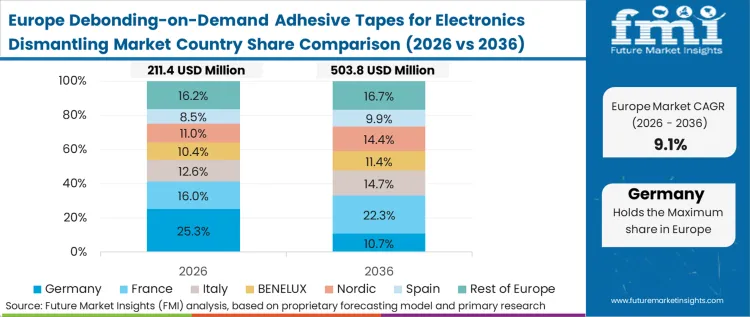
Stringent eco-design directives fundamentally rewrite how electronic goods are constructed for this jurisdiction. Compliance directors cannot sell products that require destructive force for basic battery replacement. Based on FMI's assessment, these legislative barriers force global tech brands to conform to European standards universally rather than designing separate regional product variants. Reversible fastening ceases to be an optional sustainability feature and becomes a baseline market access requirement.
- Germany: Strict circular economy legislation dictates aggressive material recovery targets. E-waste recycling plant operators use standardized thermal triggers to record 12.1% CAGR. Early compliance with right-to-repair metrics guarantees sustained market access for consumer brands operating within strict European frameworks.
FMI's report includes detailed analysis for North America, Latin America, and Middle East & Africa, featuring markets like the USA, Brazil, and the GCC. Market maturity in North America means adoption curves rely on electrically conductive adhesives optimization rather than initial baseline implementation.
Competitive Aligners for Market Players
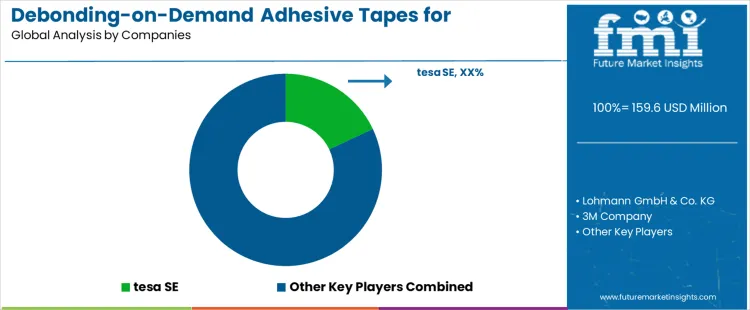
Tier-1 adhesive conglomerates dominate qualification pathways for global smartphone and automotive battery manufacturers. 3M Company and Nitto Denko Corporation rely on decades of proprietary polymer chemistry to pass grueling drop-test and thermal cycling requirements. Formulation engineers at challenger firms struggle to break into these supply chains because consumer tech brands refuse to risk catastrophic device failure on unproven mounting tapes. Competition centers entirely on balancing high-impact shear strength during a product's life with instant clean-peel release upon activation, driving operators to identify the best adhesive for electronics dismantling.
Incumbents possess immense libraries of validated environmental testing data that cannot be replicated quickly. tesa SE and Henkel AG & Co. KGaA maintain dedicated testing facilities that mirror exact automated assembly lines of their largest clients. A material scientist at a rising specialty tape manufacturer must not only invent a better ultraviolet-release mechanism but also prove it survives five years of simulated humidity and temperature swings. FMI observes that successful bonding sheet suppliers embed their application engineers directly inside customer design studios to tailor trigger parameters for specific enclosure geometries within the broader advanced electronics adhesives market.
Procurement directors at massive contract manufacturing firms actively resist single-source dependency for mission-critical debonding materials. Purchasing managers evaluate multiple debonding tapes suppliers to ensure that multiple sources develop tapes reacting to identical thermal or electrical trigger thresholds, preventing production halts if one supplier faces chemical shortages. Custom laser-release architectures push tighter supplier integration, as brands tune disassembly robots to specific proprietary light absorption frequencies that only one tape manufacturer provides.
Key Players in Debonding-on-Demand Adhesive Tapes for Electronics Dismantling Market
- 3M Company
- Nitto Denko Corporation
- tesa SE
- LINTEC Corporation
- Avery Dennison Corporation
- Henkel AG & Co. KGaA
- Lohmann GmbH & Co. KG
Scope of the Report
| Metric | Value |
|---|---|
| Quantitative Units | USD 0.9 billion to USD 3.1 billion, at a CAGR of 13.4% |
| Market Definition | Engineered fastening systems provide structural permanence during device operation but release cleanly upon targeted external stimulation. |
| Segmentation | Trigger Mechanism, Application, End Use, Substrate Compatibility, and Region |
| Regions Covered | North America, Europe, Asia Pacific, Latin America, Middle East & Africa |
| Countries Covered | USA, Germany, Japan, South Korea, China, India, Vietnam |
| Key Companies Profiled | 3M Company, Nitto Denko Corporation, tesa SE, LINTEC Corporation, Avery Dennison Corporation, Henkel AG & Co. KGaA, Lohmann GmbH & Co. KG |
| Forecast Period | 2026 to 2036 |
| Approach | Annual volume of global e-waste processed through formal dismantling channels anchors baseline material demand estimates. |
Source: Future Market Insights (FMI) analysis, based on proprietary forecasting model and primary research
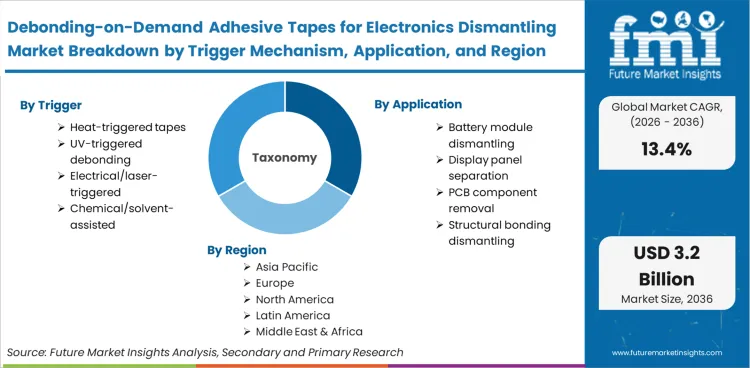
Debonding-on-Demand Adhesive Tapes for Electronics Dismantling Market by Key Segments
Trigger Mechanism
- Heat-triggered tapes
- UV-triggered debonding
- Electrical/laser-triggered
- Chemical/solvent-assisted
Application
- Battery module dismantling
- Display panel separation
- PCB component removal
- Structural bonding dismantling
End Use
- Consumer electronics recycling
- EV battery recycling
- Industrial electronics
- Medical device dismantling
Substrate Compatibility
- Metal substrates
- Glass
- Polymers
- Composite laminates
- Region
North America
◦ United States
◦ Canada
- • Europe
- ◦ Germany
- ◦ United Kingdom
- ◦ France
- ◦ Italy
- ◦ Spain
- • Asia Pacific
- ◦ China
- ◦ Japan
- ◦ South Korea
- ◦ Taiwan
- ◦ Singapore
- • Latin America
- ◦ Brazil
- ◦ Mexico
- ◦ Argentina
- • Middle East & Africa
- ◦ GCC Countries
- ◦ South Africa
- ◦ Israel
- ◦ Rest of Middle East & Africa
Bibliography
- Kim, D., Park, Y., & Kwon, M. S. (2025, May). Debonding-on-demand adhesives for recycling and reusing of electronic devices. Materials Horizons (RSC Publishing).
- Zhang, Y., et al. (2025, November). Research progress on controlled disassembly adhesives. Progress in Organic Coatings (Elsevier).
- Stamp, C. H., Stumpp, J., & Calvino, C. (2025, March). Adhesives with debonding-on-demand capability: Leveraging responsive microcapsules. Advanced Materials (Wiley).
- Ji, Y., et al. (2025, June). Controlling debond-on-demand performance in adhesive systems using expandable graphite fillers. Journal of Advanced Joining Processes (Elsevier).
- Matsuo, K., et al. (2025, July). Controlled pulsed discharge debonding of epoxy adhesives with conductive spots for enhanced recyclability. The Journal of Adhesion (Taylor & Francis).
This bibliography is provided for reader reference. The full FMI report contains the complete reference list with primary source documentation.
This Report Addresses
- How heat-triggered tapes capture specific market share by utilizing existing thermal ovens in recycling facilities.
- Why battery module operations managers demand reversible formulations to prevent chemical fires during dismantling.
- Which strict European right-to-repair mandates force original equipment manufacturers to rethink permanent bonding completely.
- How metal substrates accelerate debonding processes through rapid thermal and electrical conductivity.
- Why formalization of e-waste infrastructure positions Vietnam and India as the fastest-growing adoption environments.
- What prevents specialty tape startups from disrupting established smartphone supply chains without extensive qualification data.
- How process engineers use debonding tapes to save expensive OLED displays during factory floor rework.
- Why procurement officers resist single-source dependency for critical laser-release material architectures.
Frequently Asked Questions
What are debonding adhesives?
These materials represent engineered fastening systems that provide structural permanence during device operation but release cleanly upon targeted external stimulation. They eliminate destructive teardown processes during end-of-life recycling or component rework.
How do thermal release tapes work?
Thermal release tapes actuate by losing their cohesive or adhesive strength completely upon exposure to a specific external heat stimulus. Facility operators use existing thermal processing ovens to accommodate these heat-release mechanisms without extensive capital expenditure.
What structural condition sustains the 13.4% growth rate through 2036?
Extended producer responsibility mandates force original equipment manufacturers to internalize the cost of end-of-life device processing. This legislative pressure requires immediate adoption of reversible fastening materials to minimize manual labor costs during required battery and display panel extraction.
What is the expected valuation of this sector by 2036?
Demand outlook carries total cumulative revenue to USD 3.1 billion by 2036. This scale reflects total replacement of permanent liquid epoxies with stimulus-responsive tapes across billions of consumer electronic devices globally.
Why do heat-triggered tapes hold a 42.5% share in 2026?
Thermal processing ovens already exist in nearly every formal e-waste facility worldwide. Recycling plant managers avoid capital expenditures on new laser or ultraviolet exposure tools by using existing heat infrastructure to actuate component release.
What operational consequence does battery module dismantling face without these materials?
Forced manual separation of permanent glues frequently punctures lithium-ion cell casings, causing catastrophic chemical fires. Precision debonding eliminates this hazard entirely and preserves structural integrity of valuable cells for secondary energy markets.
How do metal substrates affect the debonding process?
Aluminum and magnesium enclosures transfer heat and electrical triggers rapidly to the adhesive interface. High conductivity allows for near-instantaneous release, drastically reducing time components must spend inside thermal tunnels or under electrical charge.
Why is Vietnam growing at a rapid 17.2% pace?
Rapid migration of global electronics assembly brings strict corporate sustainability mandates to local Vietnamese factory floors. Process engineers require debonding capabilities immediately to optimize rework yields and secure long-term supply agreements with tech giants.
What structural difference explains India's faster growth compared to Germany?
India is actively transitioning massive informal e-waste networks into state-sanctioned, formalized processing hubs requiring immediate technological upgrades. Germany possesses a mature, already-established recycling ecosystem, leading to steadier but mathematically slower baseline expansion.
What hidden operational advantage do early adopters report?
Device architects assume reversible tapes only benefit end-of-life recycling. Early adopters actually achieve massive cost savings during initial manufacturing because factory line misalignments can be corrected instantly without scrapping entire chassis units.
Why do procurement directors resist single-source supply agreements?
Purchasing managers require multiple tape suppliers to match exact thermal or electrical release thresholds. Redundancy prevents catastrophic production halts if a single vendor experiences raw material shortages or shipping delays.
What barrier prevents challengers from disrupting incumbent suppliers?
Top-tier consumer brands demand years of validated environmental testing data before trusting a new adhesive. Startup manufacturers struggle to provide five-year simulated humidity and drop-test survival data for novel light-activated polymer formulations.
How do right-to-repair laws change warranty service operations?
Repair depot managers lose extensive technician hours mechanically scraping permanent glues from shattered displays. Actuating a clean release stimulus drastically lowers warranty labor costs and turns unprofitable screen replacements into high-margin service events.
How do composite laminates react to these adhesives?
Carbon-reinforced polymers alter thermal transmission profiles significantly compared to bare metal. Materials scientists must reformulate activation thresholds to ensure heat spreads evenly across composite bonding surfaces to avoid partial debonding.
How does Japan's approach differ from broader Asian hubs?
Japan facilities deploy advanced robotic disassembly lines using precise laser targeting. Automated environments allow for component harvesting speeds that are structurally impossible in facilities relying on manual teardown and conveyor ovens.
What is the final structural end state by 2036?
Permanent glues will vanish entirely from consumer electronics. Product architects will design devices around specific automated disassembly triggers, transforming reverse logistics from a specialized waste problem into a high-margin component harvesting operation.
Preview the report firsthand - request a free sample
Get SampleGet the brochure for pricing and purchase details.
Get PDFTable of Content
- Executive Summary
- Global Market Outlook
- Demand-side Trends
- Supply-side Trends
- Technology Roadmap Analysis
- Analysis and Recommendations
- Market Overview
- Market Coverage / Taxonomy
- Market Definition / Scope / Limitations
- Research Methodology
- Chapter Orientation
- Analytical Lens and Working Hypotheses
- Market Structure, Signals, and Trend Drivers
- Benchmarking and Cross-market Comparability
- Research Design and Evidence Framework
- Desk Research Programme (Secondary Evidence)
- Company Annual and Sustainability Reports
- Peer-reviewed Journals and Academic Literature
- Corporate Websites, Product Literature, and Technical Notes
- Earnings Decks and Investor Briefings
- Statutory Filings and Regulatory Disclosures
- Technical White Papers and Standards Notes
- Trade Journals, Industry Magazines, and Analyst Briefs
- Conference Proceedings, Webinars, and Seminar Materials
- Government Statistics Portals and Public Data Releases
- Press Releases and Reputable Media Coverage
- Specialist Newsletters and Curated Briefings
- Sector Databases and Reference Repositories
- FMI Internal Proprietary Databases and Historical Market Datasets
- Subscription Datasets and Paid Sources
- Social Channels, Communities, and Digital Listening Inputs
- Additional Desk Sources
- Expert Input and Fieldwork (Primary Evidence)
- Primary Modes
- Qualitative Interviews and Expert Elicitation
- Quantitative Surveys and Structured Data Capture
- Blended Approach
- Why Primary Evidence is Used
- Field Techniques
- Interviews
- Surveys
- Scientists
- Physicians and Other Healthcare Professionals
- Governance, Ethics, and Data Stewardship
- Research Ethics
- Data Integrity and Handling
- Primary Modes
- Tooling, Models, and Reference Databases
- Desk Research Programme (Secondary Evidence)
- Data Engineering and Model Build
- Data Acquisition and Ingestion
- Cleaning, Normalisation, and Verification
- Synthesis, Triangulation, and Analysis
- Quality Assurance and Audit Trail
- Market Background
- Market Dynamics
- Drivers
- Restraints
- Opportunity
- Trends
- Scenario Forecast
- Demand in Optimistic Scenario
- Demand in Likely Scenario
- Demand in Conservative Scenario
- Opportunity Map Analysis
- Product Life Cycle Analysis
- Supply Chain Analysis
- Investment Feasibility Matrix
- Value Chain Analysis
- PESTLE and Porter’s Analysis
- Regulatory Landscape
- Regional Parent Market Outlook
- Production and Consumption Statistics
- Import and Export Statistics
- Market Dynamics
- Global Market Analysis 2021 to 2025 and Forecast, 2026 to 2036
- Historical Market Size Value (USD Million) Analysis, 2021 to 2025
- Current and Future Market Size Value (USD Million) Projections, 2026 to 2036
- Y-o-Y Growth Trend Analysis
- Absolute $ Opportunity Analysis
- Global Market Pricing Analysis 2021 to 2025 and Forecast 2026 to 2036
- Global Market Analysis 2021 to 2025 and Forecast 2026 to 2036, By Trigger Mechanism
- Introduction / Key Findings
- Historical Market Size Value (USD Million) Analysis By Trigger Mechanism , 2021 to 2025
- Current and Future Market Size Value (USD Million) Analysis and Forecast By Trigger Mechanism , 2026 to 2036
- Heat-triggered tapes
- UV-triggered debonding
- Electrical/laser-triggered
- Chemical/solvent-assisted
- Heat-triggered tapes
- Y-o-Y Growth Trend Analysis By Trigger Mechanism , 2021 to 2025
- Absolute $ Opportunity Analysis By Trigger Mechanism , 2026 to 2036
- Global Market Analysis 2021 to 2025 and Forecast 2026 to 2036, By Application
- Introduction / Key Findings
- Historical Market Size Value (USD Million) Analysis By Application, 2021 to 2025
- Current and Future Market Size Value (USD Million) Analysis and Forecast By Application, 2026 to 2036
- Battery module dismantling
- Display panel separation
- PCB component removal
- Structural bonding dismantling
- Battery module dismantling
- Y-o-Y Growth Trend Analysis By Application, 2021 to 2025
- Absolute $ Opportunity Analysis By Application, 2026 to 2036
- Global Market Analysis 2021 to 2025 and Forecast 2026 to 2036, By End Use
- Introduction / Key Findings
- Historical Market Size Value (USD Million) Analysis By End Use, 2021 to 2025
- Current and Future Market Size Value (USD Million) Analysis and Forecast By End Use, 2026 to 2036
- Consumer electronics recycling
- EV battery recycling
- Industrial electronics
- Medical device dismantling
- Consumer electronics recycling
- Y-o-Y Growth Trend Analysis By End Use, 2021 to 2025
- Absolute $ Opportunity Analysis By End Use, 2026 to 2036
- Global Market Analysis 2021 to 2025 and Forecast 2026 to 2036, By Substrate Compatibility
- Introduction / Key Findings
- Historical Market Size Value (USD Million) Analysis By Substrate Compatibility, 2021 to 2025
- Current and Future Market Size Value (USD Million) Analysis and Forecast By Substrate Compatibility, 2026 to 2036
- Metal substrates
- Glass
- Polymers
- Composite laminates
- Metal substrates
- Y-o-Y Growth Trend Analysis By Substrate Compatibility, 2021 to 2025
- Absolute $ Opportunity Analysis By Substrate Compatibility, 2026 to 2036
- Global Market Analysis 2021 to 2025 and Forecast 2026 to 2036, By Region
- Introduction
- Historical Market Size Value (USD Million) Analysis By Region, 2021 to 2025
- Current Market Size Value (USD Million) Analysis and Forecast By Region, 2026 to 2036
- North America
- Latin America
- Western Europe
- Eastern Europe
- East Asia
- South Asia and Pacific
- Middle East & Africa
- Market Attractiveness Analysis By Region
- North America Market Analysis 2021 to 2025 and Forecast 2026 to 2036, By Country
- Historical Market Size Value (USD Million) Trend Analysis By Market Taxonomy, 2021 to 2025
- Market Size Value (USD Million) Forecast By Market Taxonomy, 2026 to 2036
- By Country
- USA
- Canada
- Mexico
- By Trigger Mechanism
- By Application
- By End Use
- By Substrate Compatibility
- By Country
- Market Attractiveness Analysis
- By Country
- By Trigger Mechanism
- By Application
- By End Use
- By Substrate Compatibility
- Key Takeaways
- Latin America Market Analysis 2021 to 2025 and Forecast 2026 to 2036, By Country
- Historical Market Size Value (USD Million) Trend Analysis By Market Taxonomy, 2021 to 2025
- Market Size Value (USD Million) Forecast By Market Taxonomy, 2026 to 2036
- By Country
- Brazil
- Chile
- Rest of Latin America
- By Trigger Mechanism
- By Application
- By End Use
- By Substrate Compatibility
- By Country
- Market Attractiveness Analysis
- By Country
- By Trigger Mechanism
- By Application
- By End Use
- By Substrate Compatibility
- Key Takeaways
- Western Europe Market Analysis 2021 to 2025 and Forecast 2026 to 2036, By Country
- Historical Market Size Value (USD Million) Trend Analysis By Market Taxonomy, 2021 to 2025
- Market Size Value (USD Million) Forecast By Market Taxonomy, 2026 to 2036
- By Country
- Germany
- UK
- Italy
- Spain
- France
- Nordic
- BENELUX
- Rest of Western Europe
- By Trigger Mechanism
- By Application
- By End Use
- By Substrate Compatibility
- By Country
- Market Attractiveness Analysis
- By Country
- By Trigger Mechanism
- By Application
- By End Use
- By Substrate Compatibility
- Key Takeaways
- Eastern Europe Market Analysis 2021 to 2025 and Forecast 2026 to 2036, By Country
- Historical Market Size Value (USD Million) Trend Analysis By Market Taxonomy, 2021 to 2025
- Market Size Value (USD Million) Forecast By Market Taxonomy, 2026 to 2036
- By Country
- Russia
- Poland
- Hungary
- Balkan & Baltic
- Rest of Eastern Europe
- By Trigger Mechanism
- By Application
- By End Use
- By Substrate Compatibility
- By Country
- Market Attractiveness Analysis
- By Country
- By Trigger Mechanism
- By Application
- By End Use
- By Substrate Compatibility
- Key Takeaways
- East Asia Market Analysis 2021 to 2025 and Forecast 2026 to 2036, By Country
- Historical Market Size Value (USD Million) Trend Analysis By Market Taxonomy, 2021 to 2025
- Market Size Value (USD Million) Forecast By Market Taxonomy, 2026 to 2036
- By Country
- China
- Japan
- South Korea
- By Trigger Mechanism
- By Application
- By End Use
- By Substrate Compatibility
- By Country
- Market Attractiveness Analysis
- By Country
- By Trigger Mechanism
- By Application
- By End Use
- By Substrate Compatibility
- Key Takeaways
- South Asia and Pacific Market Analysis 2021 to 2025 and Forecast 2026 to 2036, By Country
- Historical Market Size Value (USD Million) Trend Analysis By Market Taxonomy, 2021 to 2025
- Market Size Value (USD Million) Forecast By Market Taxonomy, 2026 to 2036
- By Country
- India
- ASEAN
- Australia & New Zealand
- Rest of South Asia and Pacific
- By Trigger Mechanism
- By Application
- By End Use
- By Substrate Compatibility
- By Country
- Market Attractiveness Analysis
- By Country
- By Trigger Mechanism
- By Application
- By End Use
- By Substrate Compatibility
- Key Takeaways
- Middle East & Africa Market Analysis 2021 to 2025 and Forecast 2026 to 2036, By Country
- Historical Market Size Value (USD Million) Trend Analysis By Market Taxonomy, 2021 to 2025
- Market Size Value (USD Million) Forecast By Market Taxonomy, 2026 to 2036
- By Country
- Kingdom of Saudi Arabia
- Other GCC Countries
- Turkiye
- South Africa
- Other African Union
- Rest of Middle East & Africa
- By Trigger Mechanism
- By Application
- By End Use
- By Substrate Compatibility
- By Country
- Market Attractiveness Analysis
- By Country
- By Trigger Mechanism
- By Application
- By End Use
- By Substrate Compatibility
- Key Takeaways
- Key Countries Market Analysis
- USA
- Pricing Analysis
- Market Share Analysis, 2025
- By Trigger Mechanism
- By Application
- By End Use
- By Substrate Compatibility
- Canada
- Pricing Analysis
- Market Share Analysis, 2025
- By Trigger Mechanism
- By Application
- By End Use
- By Substrate Compatibility
- Mexico
- Pricing Analysis
- Market Share Analysis, 2025
- By Trigger Mechanism
- By Application
- By End Use
- By Substrate Compatibility
- Brazil
- Pricing Analysis
- Market Share Analysis, 2025
- By Trigger Mechanism
- By Application
- By End Use
- By Substrate Compatibility
- Chile
- Pricing Analysis
- Market Share Analysis, 2025
- By Trigger Mechanism
- By Application
- By End Use
- By Substrate Compatibility
- Germany
- Pricing Analysis
- Market Share Analysis, 2025
- By Trigger Mechanism
- By Application
- By End Use
- By Substrate Compatibility
- UK
- Pricing Analysis
- Market Share Analysis, 2025
- By Trigger Mechanism
- By Application
- By End Use
- By Substrate Compatibility
- Italy
- Pricing Analysis
- Market Share Analysis, 2025
- By Trigger Mechanism
- By Application
- By End Use
- By Substrate Compatibility
- Spain
- Pricing Analysis
- Market Share Analysis, 2025
- By Trigger Mechanism
- By Application
- By End Use
- By Substrate Compatibility
- France
- Pricing Analysis
- Market Share Analysis, 2025
- By Trigger Mechanism
- By Application
- By End Use
- By Substrate Compatibility
- India
- Pricing Analysis
- Market Share Analysis, 2025
- By Trigger Mechanism
- By Application
- By End Use
- By Substrate Compatibility
- ASEAN
- Pricing Analysis
- Market Share Analysis, 2025
- By Trigger Mechanism
- By Application
- By End Use
- By Substrate Compatibility
- Australia & New Zealand
- Pricing Analysis
- Market Share Analysis, 2025
- By Trigger Mechanism
- By Application
- By End Use
- By Substrate Compatibility
- China
- Pricing Analysis
- Market Share Analysis, 2025
- By Trigger Mechanism
- By Application
- By End Use
- By Substrate Compatibility
- Japan
- Pricing Analysis
- Market Share Analysis, 2025
- By Trigger Mechanism
- By Application
- By End Use
- By Substrate Compatibility
- South Korea
- Pricing Analysis
- Market Share Analysis, 2025
- By Trigger Mechanism
- By Application
- By End Use
- By Substrate Compatibility
- Russia
- Pricing Analysis
- Market Share Analysis, 2025
- By Trigger Mechanism
- By Application
- By End Use
- By Substrate Compatibility
- Poland
- Pricing Analysis
- Market Share Analysis, 2025
- By Trigger Mechanism
- By Application
- By End Use
- By Substrate Compatibility
- Hungary
- Pricing Analysis
- Market Share Analysis, 2025
- By Trigger Mechanism
- By Application
- By End Use
- By Substrate Compatibility
- Kingdom of Saudi Arabia
- Pricing Analysis
- Market Share Analysis, 2025
- By Trigger Mechanism
- By Application
- By End Use
- By Substrate Compatibility
- Turkiye
- Pricing Analysis
- Market Share Analysis, 2025
- By Trigger Mechanism
- By Application
- By End Use
- By Substrate Compatibility
- South Africa
- Pricing Analysis
- Market Share Analysis, 2025
- By Trigger Mechanism
- By Application
- By End Use
- By Substrate Compatibility
- USA
- Market Structure Analysis
- Competition Dashboard
- Competition Benchmarking
- Market Share Analysis of Top Players
- By Regional
- By Trigger Mechanism
- By Application
- By End Use
- By Substrate Compatibility
- Competition Analysis
- Competition Deep Dive
- 3M Company
- Overview
- Product Portfolio
- Profitability by Market Segments (Product/Age /Sales Channel/Region)
- Sales Footprint
- Strategy Overview
- Marketing Strategy
- Product Strategy
- Channel Strategy
- Nitto Denko Corporation
- tesa SE
- LINTEC Corporation
- Avery Dennison Corporation
- Henkel AG & Co. KGaA
- Lohmann GmbH & Co. KG
- 3M Company
- Competition Deep Dive
- Assumptions & Acronyms Used


