

- Industry Size (2026)
- USD 1.4 Bn
- Forecast (2036)
- USD 2.5 Bn
- CAGR (2026 to 2036)
- 6.0%
Silane-Modified Polymer Binders for Adhesives & Sealants Market Forecast and Outlook 2026 to 2036
The silane-modified polymer binders for adhesives & sealants market stands at USD 1.4 billion in 2026 and is projected to reach USD 2.5 billion by 2036, expanding at a CAGR of 6.0%. Leading suppliers defend pricing power through proprietary polymer backbones, controlled silane functionalization, and validated performance data across construction, automotive, and industrial use cases. Entry barriers are reinforced by the need for long qualification cycles, application testing across diverse substrates, and compliance with tightening VOC and isocyanate regulations.
These requirements raise switching costs for formulators once a binder is specified into sealant or adhesive platforms. Fragmentation persists because regional players compete effectively in localized construction and industrial markets, while global majors dominate OEM-driven and specification-led segments. At the same time, consolidation pressure increases as customers favor suppliers capable of delivering consistent quality, technical support, and global availability. As a result, market control gradually concentrates around firms that combine chemistry depth with application credibility rather than volume leadership alone.
Quick Stats for Silane-Modified Polymer Binders for Adhesives & Sealants Market
- Silane-Modified Polymer Binders for Adhesives & Sealants Market Value (2026): USD 1.4 Billion
- Silane-Modified Polymer Binders for Adhesives & Sealants Market Forecast Value (2036): USD 2.5 Billion
- Silane-Modified Polymer Binders for Adhesives & Sealants Market Forecast CAGR 2026 to 2036: 6.0%
- Leading Polymer Backbone in Silane-Modified Polymer Binders for Adhesives & Sealants Market: Polyether-Based SMP (40% share)
- Key Growth Regions in Silane-Modified Polymer Binders for Adhesives & Sealants Market: Asia Pacific, Europe, North America, Latin America, Middle East & Africa
- Top Key Players in Silane-Modified Polymer Binders for Adhesives & Sealants Market: BASF SE, Wacker Chemie AG, Evonik Industries AG, Henkel AG & Co. KGaA, Sika AG, Dow, Arkema (Bostik), 3M Company, H.B. Fuller, Momentive Performance Materials
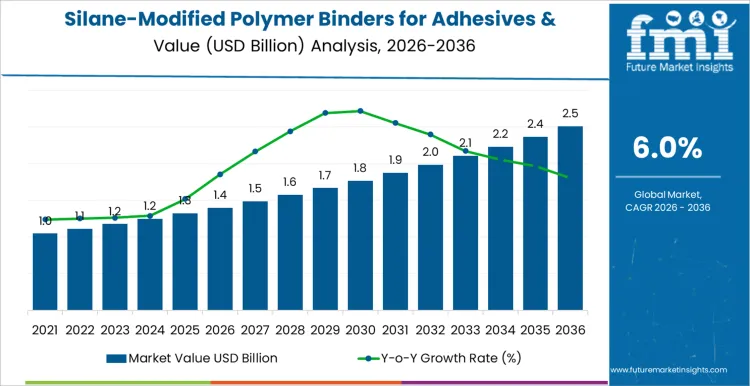
Silane-Modified Polymer Binders for Adhesives & Sealants Market Key Takeaways
| Metric | Value |
|---|---|
| Silane-Modified Polymer Binders Market Value (2026) | USD 1.4 Billion |
| Silane-Modified Polymer Binders Market Forecast Value (2036) | USD 2.5 Billion |
| Silane-Modified Polymer Binders Market Forecast CAGR 2026 to 2036 | 6.0% |
How are Application Flexibility and Regulatory Simplicity Driving the Silane-Modified Polymer Binders Market?
The silane-modified polymer (SMP) binders market is expanding as adhesive and sealant manufacturers seek versatile chemistries that bridge the gap between polyurethanes and silicones. SMP binders offer moisture curing, strong adhesion to diverse substrates, and elastic performance without the use of isocyanates or solvents. For formulators, this combination simplifies regulatory compliance while delivering performance suitable for construction, automotive assembly, industrial sealing, and consumer applications.
Formulation efficiency and customer conversion economics are central to adoption. SMP binders enable one-component systems with broad substrate compatibility, reducing formulation complexity and inventory burden for manufacturers. Their balanced mechanical properties good tensile strength, elongation, and weather resistance allow formulators to serve multiple end uses with a limited binder portfolio. Suppliers that offer tunable SMP grades for hardness, cure speed, and adhesion profiles are enabling faster product line extensions and shorter development cycles for downstream customers.
Regulatory alignment and market standardization are reinforcing steady growth. As VOC limits tighten and restrictions on isocyanates increase across Europe and other regions, SMP-based systems are being positioned as future-proof alternatives in professional and DIY markets alike. Construction renovation, prefabrication, and industrial maintenance activities are sustaining baseline demand. For binder producers, competitive advantage increasingly depends on application support, consistent quality, and global supply capability positioning silane-modified polymer binders as a stable, compliance-friendly backbone of next-generation adhesives and sealants.
How is The Silane-Modified Polymer Binders for Adhesives & Sealants Market Structured by Polymer Backbone and Application?
The silane-modified polymer binders for adhesives & sealants market is segmented by polymer backbone and application, reflecting how flexibility, curing behavior, and adhesion performance guide formulation choices. By polymer backbone, polyether-based SMP systems lead adoption, supported by their balanced elasticity and moisture-curing characteristics. Other backbones include polyurethane-based SMPs, acrylic and other chemistries, and hybrid systems developed for tailored strength and setting profiles. By application, construction sealants and adhesives form the largest demand segment, followed by automotive and transport uses, industrial assembly and general-purpose bonding, and other niche applications where durable, elastic bonding is required.
Why Do Polyether-Based SMPs Lead Polymer Backbone Adoption in the Silane-Modified Polymer Binders for Adhesives & Sealants Market?
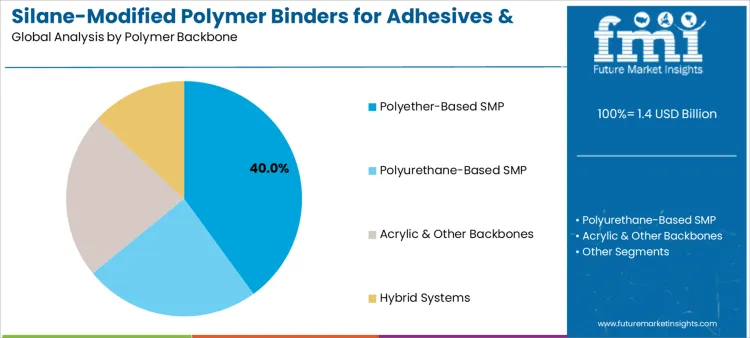
Polyether-based SMPs account for 40% share of the silane-modified polymer binders for adhesives & sealants market because they deliver a strong balance of flexibility, adhesion, and weather resistance. These binders cure through moisture exposure, forming elastic joints with low modulus and long-term durability. Formulators favor polyether backbones for their neutral cure profile and broad compatibility with fillers and additives. Stable performance across temperature variations supports use in both indoor and outdoor applications. Ease of formulation and consistent curing behavior simplify manufacturing. These processing reliability and performance advantages explain why polyether-based SMPs remain the leading polymer backbone.
Why Do Construction Sealants And Adhesives Dominate Application Demand In The Silane-Modified Polymer Binders For Adhesives & Sealants Market?
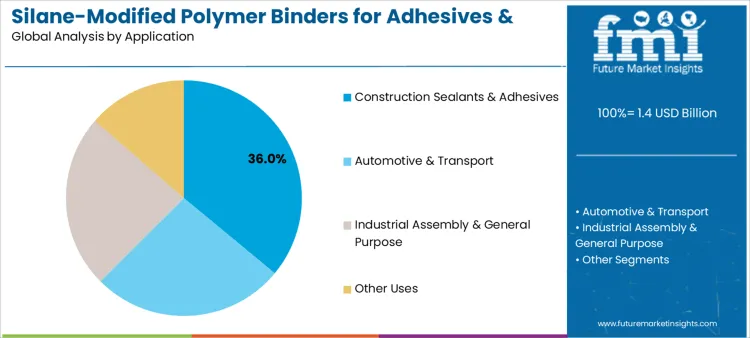
Construction sealants and adhesives hold 36% share of the silane-modified polymer binders for adhesives & sealants market because building applications require durable, flexible joints that accommodate movement and environmental exposure. SMP-based formulations are widely used for façade sealing, flooring, glazing, and general construction bonding. These applications demand strong adhesion to diverse substrates such as concrete, metal, glass, and wood. High construction activity and frequent repair cycles sustain steady material demand. Contractors value sealants that cure reliably under ambient conditions without complex mixing. These application-critical requirements explain why construction sealants and adhesives remain the dominant end-use segment.
What Are The Key Dynamics Of The Silane-Modified Polymer Binders For Adhesives & Sealants Market?
The silane-modified polymer binders market for adhesives and sealants is driven by demand for high-performance binders that deliver strong adhesion, toughness, and durability across diverse substrates including metals, glass, plastics, composites, and wood. Silane-modified polymers (SMPs) combine the flexibility of elastomers with enhanced crosslinking via silane functionality, enabling moisture cure at ambient conditions, improved weathering resistance, and reduced reliance on solvent systems. For binder producers, compounders, and formulating partners, molecular architecture, reactivity control, processability, and compatibility with fillers and additives are key selection criteria that affect adhesive performance and manufacturing efficiency.
How Are Application And Industry Trends Shaping This Market?
Application and industry trends are shaping the silane-modified polymer binders market through growth in construction, automotive assembly, industrial fabrication, and general manufacturing where durable, low-VOC adhesive and sealant systems are specified. SMP binders are increasingly used in window and facade sealants, panel bonding, flooring adhesives, and automotive body closures because they balance strength, flexibility, and environmental tolerance.
Trends toward simplified formulation (reduced component count), ambient curing, and systems that bond dissimilar materials without primers expand use cases. For suppliers, offering binder grades with tailored cure profiles and predictable performance supports faster formulation development and shorter customer time-to-market.
Why Do Technical, Cost, And Performance Integration Challenges Restrain Market Growth?
Technical, cost, and performance integration challenges restrain growth in the silane-modified polymer binders market because achieving optimized properties often requires trade-offs. SMP systems must balance workability (open time, tooling window), cure speed, adhesion strength, flexibility, and long-term durability, and this optimization can be formulation-specific. Silane chemistry is sensitive to moisture levels and catalyst systems, which complicates consistent performance in varied production environments.
Advanced SMP binders with superior mechanical or environmental performance often carry higher raw material costs than generic acrylic or polyurethane binders, which can limit adoption in price-sensitive segments. Compatibility with existing processing equipment and substrate pre-treatment practices also influences uptake and increases qualification cycles.
How is the Silane-Modified Polymer Binders for Adhesives & Sealants Market Growing across Key Countries?
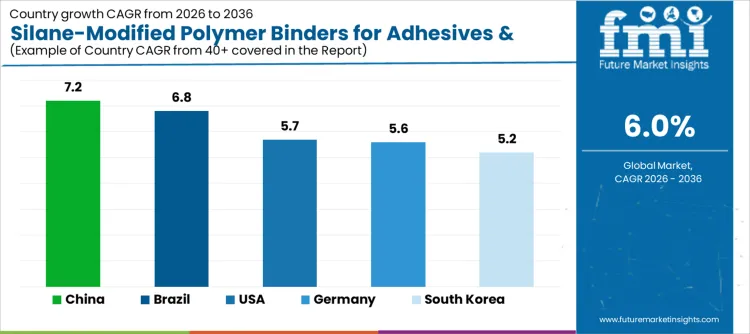
| Country | CAGR (%) |
|---|---|
| China | 7.2 |
| Brazil | 6.8 |
| United States | 5.7 |
| Germany | 5.6 |
| South Korea | 5.2 |
Silane-modified polymer (SMP) binders are gaining wider acceptance in adhesives and sealants due to their strong adhesion, flexibility, weather resistance, and compatibility with multiple substrates. These binders are increasingly used in construction, automotive assembly, industrial bonding, and infrastructure sealing, where durability and application versatility are critical. Country-wise growth varies based on construction activity, automotive production, and adoption of advanced bonding technologies. High-growth markets are supported by infrastructure expansion and industrial development, while mature economies emphasize performance consistency, regulatory compliance, and long-term reliability in demanding applications.
Why is China Leading the Silane-Modified Polymer Binders Market?
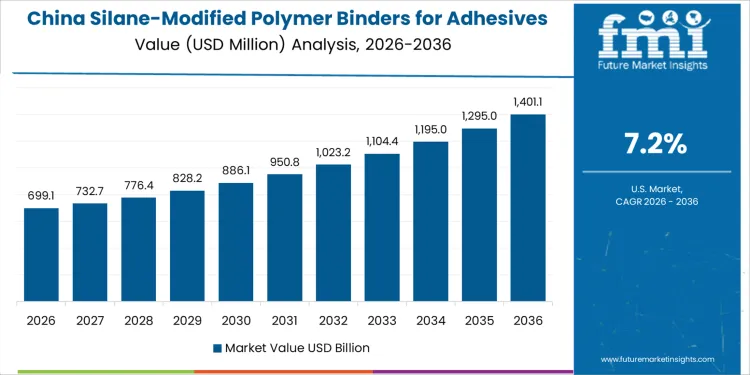
Sale of silane-modified polymer binders in China is expanding at a CAGR of 7.2% during 2026 to 2036, driven by strong demand from construction, infrastructure development, and automotive manufacturing. SMP binders are increasingly used in building sealants, flooring adhesives, façade bonding, and industrial assembly due to their excellent adhesion to concrete, metals, plastics, and glass. Rapid urbanization and large-scale infrastructure projects are sustaining demand for high-performance bonding solutions.
Chinese manufacturers value SMP binders for their moisture-curing capability, elastic properties, and ability to replace traditional polyurethane and silicone systems in many applications. Compatibility with automated dispensing systems and stable curing under varied environmental conditions are key selection criteria. Domestic chemical producers benefit from integrated supply chains and the ability to scale production for high-volume applications. Procurement decisions focus on cost efficiency, supply reliability, and compliance with construction and automotive standards.
Why is Brazil Seeing Rising Adoption of Silane-Modified Polymer Binders?
Demand for silane-modified polymer binders in Brazil is growing at a CAGR of 6.8% during 2026 to 2036, supported by expansion in construction activity, infrastructure rehabilitation, and industrial maintenance. SMP binders are increasingly used in sealants for joints, flooring systems, glazing, and general-purpose construction adhesives due to their durability and ease of application. Growth is also supported by rising automotive assembly and aftermarket repair activity.
Brazilian buyers prioritize cost-performance balance, flexibility, and resistance to heat and humidity. SMP binders are valued for maintaining adhesion and elasticity in tropical conditions, making them suitable for outdoor and structural applications. Adoption is gradual, reflecting price sensitivity and the need for contractor familiarity with newer adhesive chemistries. Procurement decisions often favor suppliers offering technical guidance, local distribution, and compatibility with commonly used substrates.
What is Driving Demand for Silane-Modified Polymer Binders in the United States?
The United States silane-modified polymer binders market is expanding at a CAGR of 5.7% during 2026 to 2036, driven by demand from construction, automotive assembly, and industrial manufacturing. SMP binders are widely used in commercial buildings, residential construction, transportation infrastructure, and specialty industrial sealants due to their strong adhesion and flexibility across temperature ranges. U.S. buyers emphasize consistent performance, application versatility, and compliance with building and automotive standards. SMP binders are increasingly selected to replace solvent-based or multi-component systems, simplifying application and reducing installation time.
Demand is strongest in flooring adhesives, façade sealants, and transportation-related applications. Procurement decisions prioritize supplier reliability, technical documentation, and long-term availability. Market growth is shaped by renovation activity, infrastructure investment, and increasing adoption of advanced bonding solutions that support faster installation and durable performance in demanding environments.
How is Germany Supporting Demand for Silane-Modified Polymer Binders?
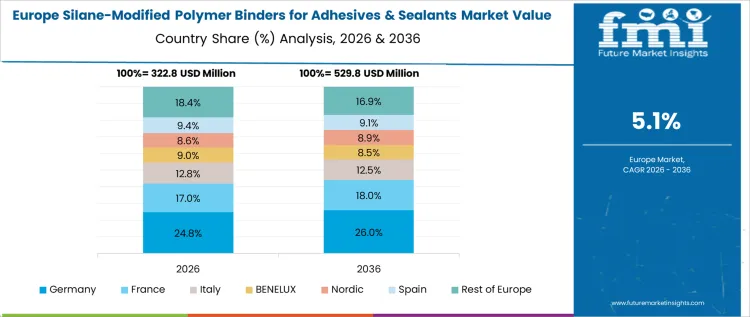
Germany’s silane-modified polymer binders market is growing at a CAGR of 5.6% during 2026 to 2036, supported by strong demand from construction engineering, automotive manufacturing, and industrial assembly. German manufacturers use SMP binders in high-specification sealants and adhesives where precision, durability, and predictable curing behavior are essential. Buyers prioritize formulation consistency, controlled elasticity, and long-term adhesion performance. SMP binders are applied in automotive body sealing, industrial equipment assembly, and building envelope systems.
Adoption is driven by performance requirements rather than cost considerations. Procurement decisions favor suppliers with certified quality systems, detailed technical data, and the ability to support customized formulations. Market growth is reinforced by Germany’s focus on engineering quality, advanced construction methods, and continuous improvement in adhesive and sealant technologies.
How is South Korea Expanding Use of Silane-Modified Polymer Binders?
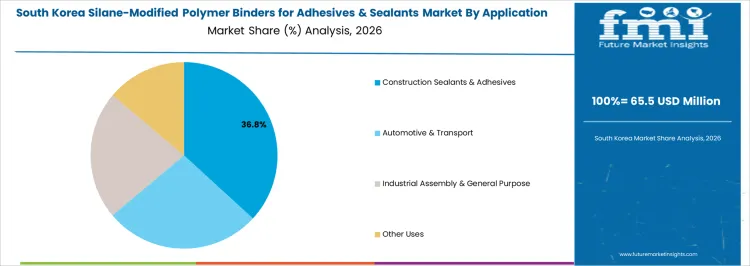
South Korea’s silane-modified polymer binders market is expanding at a CAGR of 5.2% during 2026 to 2036, driven by demand from construction, electronics assembly, and automotive manufacturing. SMP binders are increasingly used in building sealants, industrial bonding, and transportation-related applications due to their flexibility and reliable adhesion. Buyers emphasize compatibility with automated application systems, stable curing behavior, and performance in compact and high-precision assemblies.
Adoption is strongest in export-oriented manufacturing and modern construction projects requiring high-quality finishing. Procurement decisions are influenced by supplier technical capability, product consistency, and alignment with global application standards. Market growth is supported by continued industrial development, investment in advanced manufacturing, and increasing use of high-performance adhesive and sealant systems.
How Are Suppliers Competing in the Silane-Modified Polymer Binders for Adhesives & Sealants Market?
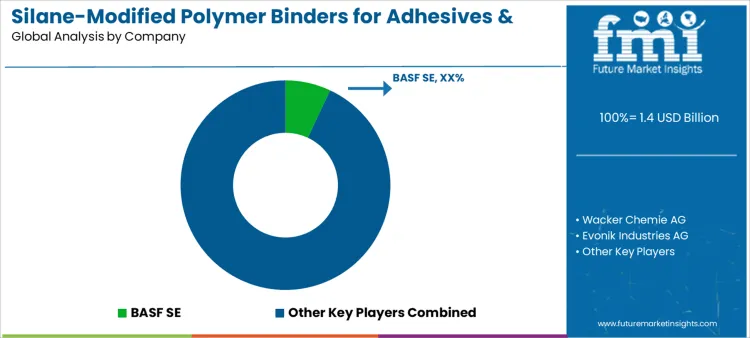
Competition in the silane-modified polymer (SMP) binders market is driven by curing reliability, adhesion versatility, and performance balance between flexibility and mechanical strength. As formulators seek alternatives to traditional PU and silicone systems, suppliers are differentiating through moisture-curing efficiency, low VOC profiles, and compatibility with diverse substrates used in construction, automotive, industrial assembly, and consumer applications. BASF SE positions its SMP binders around controlled silane chemistry that delivers stable curing, low odor, and strong adhesion to metals, plastics, and mineral surfaces. Wacker Chemie AG anchors the market with silane-based polymer platforms emphasizing elasticity retention, weather resistance, and long-term durability in exterior sealant applications.
Specialty chemicals leaders compete through formulation depth and performance tuning. Evonik Industries AG differentiates via silane-functional polymers engineered for tailored modulus and improved adhesion to challenging substrates. Momentive Performance Materials focuses on hybrid polymer binders that bridge silicone and organic chemistries, highlighting flexibility, low shrinkage, and resistance to environmental aging. Dow leverages its polymer science scale to offer SMP binders with consistent processing behavior and global supply reliability.
Adhesive specialists strengthen competitive positioning through system-level solutions. Henkel AG & Co. KGaA and Sika AG integrate SMP binders into complete adhesive and sealant portfolios, emphasizing ease of application, fast skin formation, and compatibility with automated dispensing. Arkema, via Bostik, competes with SMP systems optimized for construction and assembly markets. 3M Company and H.B. Fuller add value through application-specific formulations and rapid processing profiles. Across the market, competitive advantage is defined by curing consistency, adhesion breadth, and durability under real-world conditions rather than binder cost alone.
Key Players in Silane-Modified Polymer Binders for Adhesives & Sealants Market
- BASF SE
- Wacker Chemie AG
- Evonik Industries AG
- Henkel AG & Co. KGaA
- Sika AG
- Dow
- Arkema (Bostik)
- 3M Company
- H.B. Fuller
- Momentive Performance Materials
Scope of Report
| Attribute | Details |
|---|---|
| Market Size Unit | USD Million |
| Polymer Backbone Covered | Polyether-Based Silane-Modified Polymers, Polyurethane-Based Silane-Modified Polymers, Acrylic & Other Polymer Backbones, Hybrid Silane-Modified Systems |
| Application Covered | Construction Sealants & Adhesives, Automotive & Transport Applications, Industrial Assembly & General-Purpose Adhesives, Other Specialty Uses |
| Countries Covered | China, Japan, South Korea, India, Australia & New Zealand, ASEAN, Rest of Asia Pacific, Germany, United Kingdom, France, Italy, Spain, Nordic, BENELUX, Rest of Europe, United States, Canada, Mexico, Brazil, Chile, Rest of Latin America, Kingdom of Saudi Arabia, Other GCC Countries, Turkey, South Africa, Other African Union, Rest of Middle East & Africa |
| Regions Covered | Asia Pacific, Europe, North America, Latin America, Middle East & Africa |
| Key Companies Profiled | BASF SE, Wacker Chemie AG, Evonik Industries AG, Henkel AG & Co. KGaA, Sika AG, Dow, Arkema (Bostik), 3M Company, H.B. Fuller, Momentive Performance Materials |
| Additional Attributes | Dollar sales by polymer backbone and application are assessed across construction, automotive, and industrial adhesive value chains. The scope evaluates curing mechanisms, moisture resistance, adhesion strength, and VOC compliance. Country-level analysis reflects infrastructure spending, automotive lightweighting trends, and regulatory shifts favoring solvent-free and low-emission adhesive and sealant technologies. |
Silane-Modified Polymer Binders for Adhesives & Sealants Market by Key Segments
Polymer Backbone:
- Polyether-Based SMP
- Polyurethane-Based SMP
- Acrylic & Other Backbones
- Hybrid Systems
Application:
- Construction Sealants & Adhesives
- Automotive & Transport
- Industrial Assembly & General Purpose
- Other Uses
Region:
- Asia Pacific
- China
- Japan
- South Korea
- India
- Australia & New Zealand
- ASEAN
- Rest of Asia Pacific
- Europe
- Germany
- United Kingdom
- France
- Italy
- Spain
- Nordic
- BENELUX
- Rest of Europe
- North America
- United States
- Canada
- Mexico
- Latin America
- Brazil
- Chile
- Rest of Latin America
- Middle East & Africa
- Kingdom of Saudi Arabia
- Other GCC Countries
- Turkey
- South Africa
- Other African Union
- Rest of Middle East & Africa
Bibliography
- Patil, V. D., Mohite, S., Patil, P. P., Madhale, M., Latthe, S. S., & Patil, P. S. (2023). UV curable coating materials: A review. Journal of Composites Science, 7(12), 513.
- Quan, Q., Wu, X., Li, B., Gu, Z., Zhou, W., & Liu, J. (2024). Research progress of UV-curable polyurethane acrylate-based hardening coatings. Polymers, 16(11), 1588.
- Tong, J., Xie, S., Miao, J.-T., Luo, J., & Liu, R. (2024). Preparation of UV-cured polyurethane-urea acrylate coatings with high hardness and toughness. Progress in Organic Coatings, 186, 107969.
- Choi, S., Gao, H., Chen, G., & Lee, M. (2023). UV-curable polyurethane acrylate coatings with reactive diluents for improved press-formability and properties.
- Wang, K., Zhang, Y., Tang, Z., Chen, J., Zhang, Z., Zhang, H., Shao, L., Liu, C., He, H., Zhou, L., & Jiang, D. (2023). Development of multiple hydrogen-bonding waterborne polyurethane acrylate coating with UV-LED curing.
Frequently Asked Questions
How big is the silane-modified polymer binders for adhesives & sealants market in 2026?
The global silane-modified polymer binders for adhesives & sealants market is estimated to be valued at USD 1.4 billion in 2026.
What will be the size of silane-modified polymer binders for adhesives & sealants market in 2036?
The market size for the silane-modified polymer binders for adhesives & sealants market is projected to reach USD 2.5 billion by 2036.
How much will be the silane-modified polymer binders for adhesives & sealants market growth between 2026 and 2036?
The silane-modified polymer binders for adhesives & sealants market is expected to grow at a 6.0% CAGR between 2026 and 2036.
What are the key product types in the silane-modified polymer binders for adhesives & sealants market?
The key product types in silane-modified polymer binders for adhesives & sealants market are polyether-based smp, polyurethane-based smp, acrylic & other backbones and hybrid systems.
Which application segment to contribute significant share in the silane-modified polymer binders for adhesives & sealants market in 2026?
In terms of application, construction sealants & adhesives segment to command 36.0% share in the silane-modified polymer binders for adhesives & sealants market in 2026.
Preview the report firsthand - request a free sample
Get SampleGet the brochure for pricing and purchase details.
Get PDFTable of Content
- Executive Summary
- Global Market Outlook
- Demand-side Trends
- Supply-side Trends
- Technology Roadmap Analysis
- Analysis and Recommendations
- Market Overview
- Market Coverage / Taxonomy
- Market Definition / Scope / Limitations
- Market Background
- Market Dynamics
- Drivers
- Restraints
- Opportunity
- Trends
- Scenario Forecast
- Demand in Optimistic Scenario
- Demand in Likely Scenario
- Demand in Conservative Scenario
- Opportunity Map Analysis
- Product Life Cycle Analysis
- Supply Chain Analysis
- Investment Feasibility Matrix
- Value Chain Analysis
- PESTLE and Porter’s Analysis
- Regulatory Landscape
- Regional Parent Market Outlook
- Production and Consumption Statistics
- Import and Export Statistics
- Market Dynamics
- Global Market Analysis 2021 to 2025 and Forecast, 2026 to 2036
- Historical Market Size Value (USD Million) Analysis, 2021 to 2025
- Current and Future Market Size Value (USD Million) Projections, 2026 to 2036
- Y-o-Y Growth Trend Analysis
- Absolute $ Opportunity Analysis
- Global Market Pricing Analysis 2021 to 2025 and Forecast 2026 to 2036
- Global Market Analysis 2021 to 2025 and Forecast 2026 to 2036, By Polymer Backbone
- Introduction / Key Findings
- Historical Market Size Value (USD Million) Analysis By Polymer Backbone , 2021 to 2025
- Current and Future Market Size Value (USD Million) Analysis and Forecast By Polymer Backbone , 2026 to 2036
- Polyether-Based SMP
- Polyurethane-Based SMP
- Acrylic & Other Backbones
- Hybrid Systems
- Polyether-Based SMP
- Y-o-Y Growth Trend Analysis By Polymer Backbone , 2021 to 2025
- Absolute $ Opportunity Analysis By Polymer Backbone , 2026 to 2036
- Global Market Analysis 2021 to 2025 and Forecast 2026 to 2036, By Application
- Introduction / Key Findings
- Historical Market Size Value (USD Million) Analysis By Application, 2021 to 2025
- Current and Future Market Size Value (USD Million) Analysis and Forecast By Application, 2026 to 2036
- Construction Sealants & Adhesives
- Automotive & Transport
- Industrial Assembly & General Purpose
- Other Uses
- Construction Sealants & Adhesives
- Y-o-Y Growth Trend Analysis By Application, 2021 to 2025
- Absolute $ Opportunity Analysis By Application, 2026 to 2036
- Global Market Analysis 2021 to 2025 and Forecast 2026 to 2036, By Region
- Introduction
- Historical Market Size Value (USD Million) Analysis By Region, 2021 to 2025
- Current Market Size Value (USD Million) Analysis and Forecast By Region, 2026 to 2036
- North America
- Latin America
- Western Europe
- Eastern Europe
- East Asia
- South Asia and Pacific
- Middle East & Africa
- Market Attractiveness Analysis By Region
- North America Market Analysis 2021 to 2025 and Forecast 2026 to 2036, By Country
- Historical Market Size Value (USD Million) Trend Analysis By Market Taxonomy, 2021 to 2025
- Market Size Value (USD Million) Forecast By Market Taxonomy, 2026 to 2036
- By Country
- USA
- Canada
- Mexico
- By Polymer Backbone
- By Application
- By Country
- Market Attractiveness Analysis
- By Country
- By Polymer Backbone
- By Application
- Key Takeaways
- Latin America Market Analysis 2021 to 2025 and Forecast 2026 to 2036, By Country
- Historical Market Size Value (USD Million) Trend Analysis By Market Taxonomy, 2021 to 2025
- Market Size Value (USD Million) Forecast By Market Taxonomy, 2026 to 2036
- By Country
- Brazil
- Chile
- Rest of Latin America
- By Polymer Backbone
- By Application
- By Country
- Market Attractiveness Analysis
- By Country
- By Polymer Backbone
- By Application
- Key Takeaways
- Western Europe Market Analysis 2021 to 2025 and Forecast 2026 to 2036, By Country
- Historical Market Size Value (USD Million) Trend Analysis By Market Taxonomy, 2021 to 2025
- Market Size Value (USD Million) Forecast By Market Taxonomy, 2026 to 2036
- By Country
- Germany
- UK
- Italy
- Spain
- France
- Nordic
- BENELUX
- Rest of Western Europe
- By Polymer Backbone
- By Application
- By Country
- Market Attractiveness Analysis
- By Country
- By Polymer Backbone
- By Application
- Key Takeaways
- Eastern Europe Market Analysis 2021 to 2025 and Forecast 2026 to 2036, By Country
- Historical Market Size Value (USD Million) Trend Analysis By Market Taxonomy, 2021 to 2025
- Market Size Value (USD Million) Forecast By Market Taxonomy, 2026 to 2036
- By Country
- Russia
- Poland
- Hungary
- Balkan & Baltic
- Rest of Eastern Europe
- By Polymer Backbone
- By Application
- By Country
- Market Attractiveness Analysis
- By Country
- By Polymer Backbone
- By Application
- Key Takeaways
- East Asia Market Analysis 2021 to 2025 and Forecast 2026 to 2036, By Country
- Historical Market Size Value (USD Million) Trend Analysis By Market Taxonomy, 2021 to 2025
- Market Size Value (USD Million) Forecast By Market Taxonomy, 2026 to 2036
- By Country
- China
- Japan
- South Korea
- By Polymer Backbone
- By Application
- By Country
- Market Attractiveness Analysis
- By Country
- By Polymer Backbone
- By Application
- Key Takeaways
- South Asia and Pacific Market Analysis 2021 to 2025 and Forecast 2026 to 2036, By Country
- Historical Market Size Value (USD Million) Trend Analysis By Market Taxonomy, 2021 to 2025
- Market Size Value (USD Million) Forecast By Market Taxonomy, 2026 to 2036
- By Country
- India
- ASEAN
- Australia & New Zealand
- Rest of South Asia and Pacific
- By Polymer Backbone
- By Application
- By Country
- Market Attractiveness Analysis
- By Country
- By Polymer Backbone
- By Application
- Key Takeaways
- Middle East & Africa Market Analysis 2021 to 2025 and Forecast 2026 to 2036, By Country
- Historical Market Size Value (USD Million) Trend Analysis By Market Taxonomy, 2021 to 2025
- Market Size Value (USD Million) Forecast By Market Taxonomy, 2026 to 2036
- By Country
- Kingdom of Saudi Arabia
- Other GCC Countries
- Turkiye
- South Africa
- Other African Union
- Rest of Middle East & Africa
- By Polymer Backbone
- By Application
- By Country
- Market Attractiveness Analysis
- By Country
- By Polymer Backbone
- By Application
- Key Takeaways
- Key Countries Market Analysis
- USA
- Pricing Analysis
- Market Share Analysis, 2025
- By Polymer Backbone
- By Application
- Canada
- Pricing Analysis
- Market Share Analysis, 2025
- By Polymer Backbone
- By Application
- Mexico
- Pricing Analysis
- Market Share Analysis, 2025
- By Polymer Backbone
- By Application
- Brazil
- Pricing Analysis
- Market Share Analysis, 2025
- By Polymer Backbone
- By Application
- Chile
- Pricing Analysis
- Market Share Analysis, 2025
- By Polymer Backbone
- By Application
- Germany
- Pricing Analysis
- Market Share Analysis, 2025
- By Polymer Backbone
- By Application
- UK
- Pricing Analysis
- Market Share Analysis, 2025
- By Polymer Backbone
- By Application
- Italy
- Pricing Analysis
- Market Share Analysis, 2025
- By Polymer Backbone
- By Application
- Spain
- Pricing Analysis
- Market Share Analysis, 2025
- By Polymer Backbone
- By Application
- France
- Pricing Analysis
- Market Share Analysis, 2025
- By Polymer Backbone
- By Application
- India
- Pricing Analysis
- Market Share Analysis, 2025
- By Polymer Backbone
- By Application
- ASEAN
- Pricing Analysis
- Market Share Analysis, 2025
- By Polymer Backbone
- By Application
- Australia & New Zealand
- Pricing Analysis
- Market Share Analysis, 2025
- By Polymer Backbone
- By Application
- China
- Pricing Analysis
- Market Share Analysis, 2025
- By Polymer Backbone
- By Application
- Japan
- Pricing Analysis
- Market Share Analysis, 2025
- By Polymer Backbone
- By Application
- South Korea
- Pricing Analysis
- Market Share Analysis, 2025
- By Polymer Backbone
- By Application
- Russia
- Pricing Analysis
- Market Share Analysis, 2025
- By Polymer Backbone
- By Application
- Poland
- Pricing Analysis
- Market Share Analysis, 2025
- By Polymer Backbone
- By Application
- Hungary
- Pricing Analysis
- Market Share Analysis, 2025
- By Polymer Backbone
- By Application
- Kingdom of Saudi Arabia
- Pricing Analysis
- Market Share Analysis, 2025
- By Polymer Backbone
- By Application
- Turkiye
- Pricing Analysis
- Market Share Analysis, 2025
- By Polymer Backbone
- By Application
- South Africa
- Pricing Analysis
- Market Share Analysis, 2025
- By Polymer Backbone
- By Application
- USA
- Market Structure Analysis
- Competition Dashboard
- Competition Benchmarking
- Market Share Analysis of Top Players
- By Regional
- By Polymer Backbone
- By Application
- Competition Analysis
- Competition Deep Dive
- BASF SE
- Overview
- Product Portfolio
- Profitability by Market Segments (Product/Age /Sales Channel/Region)
- Sales Footprint
- Strategy Overview
- Marketing Strategy
- Product Strategy
- Channel Strategy
- Wacker Chemie AG
- Evonik Industries AG
- Henkel AG & Co. KGaA
- Sika AG
- Dow
- Arkema (Bostik)
- 3M Company
- H.B. Fuller
- Momentive Performance Materials
- BASF SE
- Competition Deep Dive
- Assumptions & Acronyms Used
- Research Methodology


