

- Market Size (2026)
- USD 920.6 Mn
- Forecast (2036)
- USD 1543.0 Mn
- CAGR (2026 to 2036)
- 5.3%
How big is Cement Strength Enhancers Market in 2026?
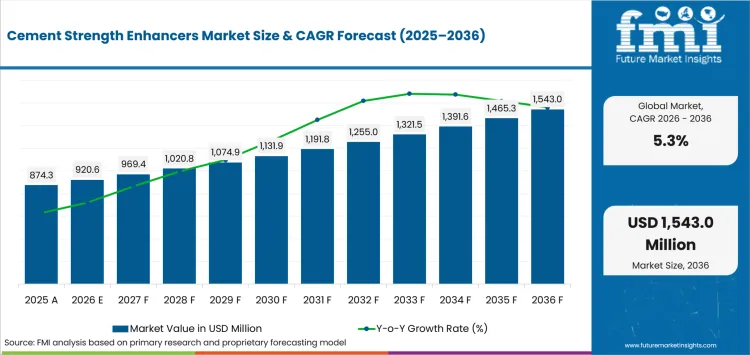
USD 920.6 million in 2026 and USD 1543.0 million by 2036 at a 5.3% CAGR.
Demand for cement strength enhancers is projected to expand at 5.3% CAGR between 2026 and 2036, increasing valuation from USD 920.6 million in 2026 to USD 1543.0 million by 2036. Strength-enhancing chemistry therefore follows well-construction cadence more closely than bulk cement volumes, which also shapes adjacent oilfield chemicals demand. Shell awarded SLB three-year deepwater contracts in January 2025 with cementing included, placing repeat slurry qualification inside a multi-well service program. Repeated wells can reuse established slurry designs after each interval meets its own pressure and temperature checks.
Production efficiency changes how the forecast lands in mature basins because fewer wells can carry greater barrier exposure. In March 2026, the USA Energy Information Administration reported 2025 crude output at 13.6 million barrels per day. Its data also showed Lower 48 rig counts down 5% and drilled wells down 1%. Higher production from fewer wells raises the cost of barrier failure and increases the value of repeatable cement placement.
Key Takeaways
- The demand for cement strength enhancers is rising as demanding wells require stronger long-life cement barriers.
- Based on chemistry, silica flour is projected to account for 29.0% in 2026 due to its use in thermally demanding cement formulations.
- In 2026, compressive strength is expected to lead function with 34.0% share because laboratories use it as a direct mechanical acceptance measure.
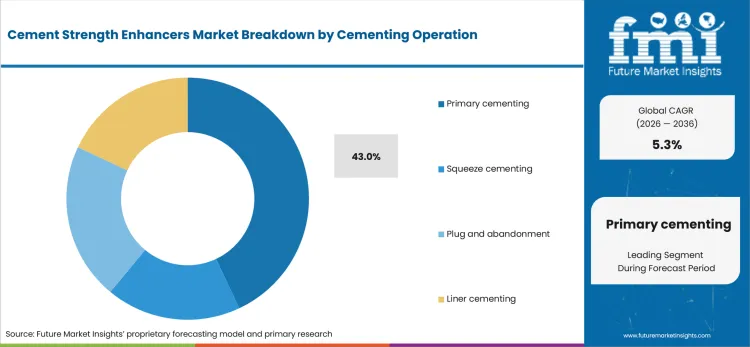
- By cementing operation, primary cementing is forecast to represent 43.0% in 2026 driven by the initial barrier required in every new cased well.
- Qualification is the main adoption restraint because cement mineralogy/ mix water, and companion additives can change field performance.
- Some of the key players in this market include SLB, Halliburton, Baker Hughes, Weatherford International plc, BASF, Clariant, Nouryon, SNF Group, Elkem, and National Energy Services Reunited Corp. (NESR).
Analyst Perspective
"A lower additive price loses value if a formulation forces repeated slurry qualification before each cement job. Operators protect more value by reproducing strength under local water, pressure, temperature, and pumping conditions without restarting laboratory work."
- Nikhil Kaitwade,, Principal Consultant, Future Market Insights
How is the cement strength enhancers market segmented?
The cement strength enhancers market is segmented by chemistry, function, cementing operation, well environment, sales channel, and region.
Chemistry covers silica flour, latex additives, pozzolanic enhancers, polymer strength additives, and nanomaterial blends. Function includes compressive strength, tensile bond strength, thermal durability, early strength, and permeability reduction. Cementing operation covers primary cementing, squeeze cementing, plug and abandonment, and liner cementing. Well environment includes conventional, HPHT, gas wells, geothermal, and deepwater conditions. Sales channels comprise service company supply, specialty additive suppliers, direct project supply, and regional blending plants.
How does primary cementing shape the cementing operation category?
Primary cementing establishes the first engineered barrier behind casing and reaches most new wells. In March 2025, SLB received the Trion contract covering 18 ultra-deepwater wells over three years with cementing included. Repeated wells can reuse qualified slurry systems after each interval passes its own pressure, temperature, placement, and compatibility checks.
- Primary cementing is set to lead the cementing operation with 43.0% share in 2026 due to the initial barrier required in each new cased well.
- Large offshore programs reward formulations that can be blended consistently and verified against the same laboratory controls before successive cement jobs.
What makes silica flour central to the chemistry category?
Silica flour becomes important once elevated temperature threatens long-term cement strength. A July 2025 Geothermics study listed by Sandia National Laboratories tested geothermal cements through thermal shocks at 100°C and 200°C. Those cycles give laboratories a direct basis for checking whether a high-temperature formulation retains strength. Related cement bonding additives face the same interface-performance test.
- By chemistry, silica flour is estimated to hold 29.0% in 2026 owing to its established role in high-temperature cement design.
- Adoption depends on complete slurry testing because silica loading, cement composition, and companion additives alter rheology and strength after thermal cycling.
Why does compressive strength lead the function category?
Post-cementing work cannot proceed safely until the cement reaches an acceptable mechanical threshold. In fiscal 2025, the USA Department of Energy selected a Brookhaven-led project for cement blends that set at 25-50°C and withstand thermal shocks near 200°C. Qualification therefore requires compressive performance through the intended temperature cycle, not just an early laboratory target.
- In 2026, compressive strength is expected to lead function with 34.0% share because it gives laboratories a direct mechanical acceptance measure.
- Technical acceptance increasingly pairs compressive testing with thermal cycling and long-duration integrity checks in geothermal and other severe-service wells.
What supports conventional as the leading well environment?
Conventional wells keep the widest installed base of cementing work because their pressure and temperature envelopes often fit previously qualified formulation families. This lowers the number of variables a laboratory must recheck for routine programs.
- The conventional segment is likely to capture 35.0% share in 2026 attributable to repeat well designs and lower requalification burden.
- Halliburton reported in January 2026 that fourth-quarter 2025 cementing activity improved in the Western Hemisphere and Africa. The operating proof is field continuity outside the narrowest extreme-well niches, though each operator still controls acceptance through its own slurry program.
What drives service company supply in the sales channel category?
Service companies control the handoff from additive selection to slurry design and field placement. The same contractor usually owns the laboratory checks that determine whether a new strength enhancer can enter a cement program.
- The sales channel is forecast to be led by service company supply at 46.0% share in 2026 due to integrated qualification and wellsite accountability.
- Halliburton and Aker BP reported 400 automated cementing jobs on four rigs in April 2025. Remote control kept mixing and pumping inside one operating system. Service company supply therefore retained responsibility for approved chemistry from laboratory qualification through field placement.
What are the drivers, restraints and opportunities in the Cement Strength Enhancers Market?
Multi-year well programs increase repeat cementing demand. Slurry-specific qualification slows substitution, and long-life geothermal, abandonment, and carbon-storage barriers widen the performance requirement.
- Driver: Multi-year drilling programs convert planned casing strings into repeated cement-design work with defined strength and integrity specifications.
- Restraint: A strength enhancer cannot move between slurry systems without compatibility, temperature, placement, and long-term barrier testing.
- Opportunity: Qualified chemistry can win higher-value work in long-life barriers if laboratory evidence and field support shorten approval work.
Multi-year development programs turn each planned casing string into another qualified cement design, which repeats additive demand under one drilling schedule. Weatherford disclosed in October 2025 that a major oilfield service company awarded a three-year Cementation Products contract for offshore Suriname. Such programs favor formulations with documented laboratory performance because replacing approved chemistry between wells can interrupt blending, testing, and field execution.
Qualification slows substitution even when a new enhancer offers lower unit cost or stronger early-age results. In August 2026, the USA Department of Energy stated that off-the-shelf cement and casing-evaluation methods are generally inadequate for hotter geothermal systems. Five funded high-temperature evaluation projects reinforce the same constraint: new formulations need material and evaluation data matched to the intended thermal environment before approval.
Long-life isolation widens the performance brief beyond routine hydrocarbon wells because carbon-storage barriers face different chemical exposure and service-life requirements. SLB launched Sequestri carbon-storage solutions in June 2025 with EverCRETE CO2-resistant cement included. Strength, bond durability, and permeability must be documented against project exposure before field approval. Qualified strength and set-control chemistry can then enter carbon-storage and geothermal programs through the same slurry-level qualification route. Related cement set control additives follow the same qualification logic.
Which country CAGRs are profiled in the Cement Strength Enhancers Market?
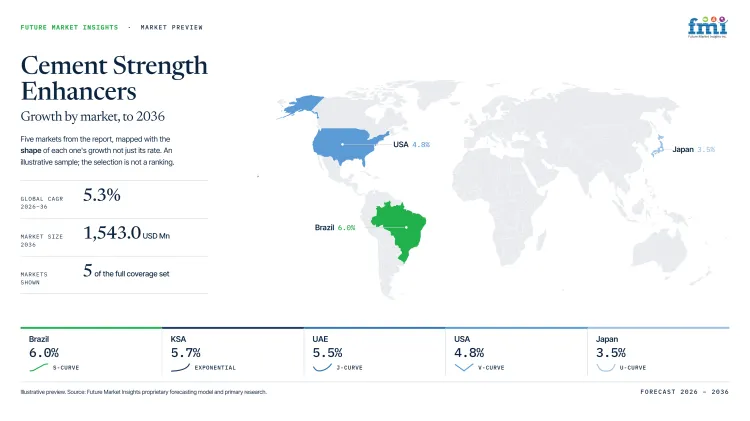
| Country | CAGR |
|---|---|
| Brazil | 6.0% |
| KSA | 5.7% |
| UAE | 5.5% |
| USA | 4.8% |
| Norway | 4.7% |
| Canada | 4.6% |
| Japan | 3.5% |
How do country-level CAGRs compare in the Cement Strength Enhancers Market?
The 2.5 percentage-point range separates three expansion markets from a compact mature-market group. Brazil, KSA, and the UAE exceed 5% as new offshore or unconventional programs generate fresh cementing work. The USA, Norway, and Canada cluster near 4.6-4.8% under mature-asset and abandonment requirements. Japan is lower because geothermal development advances one project at a time.
- Brazil turns pre-salt campaigns into repeat offshore slurry work.
- KSA keeps laboratories close to long drilling programs.
- UAE multi-well pads compress cement-job turnaround.
- USA super-laterals raise barrier exposure per well.
- Norway carries extensive future abandonment work.
- Canada ties alternative materials to regulator criteria.
- Japan advances geothermal drilling through staged grants.
Comparable CAGRs still produce different entry conditions because well portfolios and qualification routes differ by country. The full report covers country-level CAGR analysis for North America, Latin America, Western Europe, Eastern Europe, East Asia, South Asia and Pacific, and Middle East and Africa.
Country-wise Analysis
- Brazilian offshore cementing programs center on pre-salt wells, where long supply routes make late slurry changes costly. Brazil is projected to record 6.0% CAGR over the assessment period because repeated deepwater campaigns keep qualified formulations in active use. ANP reported in June 2026 that 2025 oil production averaged about 3.8 million barrels per day, up 12%, with pre-salt output near 3 million barrels per day. The production base keeps blending and laboratory support close to offshore campaigns. New chemistry still faces a high entry bar because operators need repeatable local blending and deepwater performance evidence before replacing formulations already accepted for successive wells.
- Saudi cementing programs run through long service contracts, so field laboratories need steady bulk supply and rapid turnaround between well sections. The General Authority for Statistics documented in August 2026 that crude production rose from 3,277.5 million barrels in 2024 to 3,461.8 million barrels in 2025. Cement strength enhancer sales in KSA are forecast to expand at 5.7% CAGR by 2036 given sustained conventional and unconventional work. Dense service infrastructure keeps approved chemistry near active fields, reducing replenishment risk during long drilling programs. Entry remains difficult for unfamiliar formulations because operators place heavy weight on batch consistency and documented field history before changing approved slurry systems.
- UAE unconventional programs use multi-well pads, leaving limited time for slurry redesign between scheduled cement jobs. ADNOC Drilling reported in July 2025 that more than 40% of its initial 144 unconventional wells had already been drilled. Campaign repetition lets approved formulations move quickly from one well to the next after local checks. The UAE cement strength enhancers outlook is anticipated to advance at 5.5% CAGR over the assessment period due to continuing drilling intensity. A single slurry problem can disrupt several planned wells, so new entrants need local technical support and fast laboratory response before operators widen use beyond an initial pad.
- Longer USA horizontal wells increase reservoir contact behind each primary cement job and raise the consequence of placement failure. The USA is estimated to post 4.8% CAGR over the forecast period because super-laterals demand longer pumping sequences and tighter density control. In August 2026, the USA Energy Information Administration documented that wells longer than 15,000 feet represented 15% of new Permian completions in 2025. Domestic chemical supply can shorten response time when a field adjustment is required. New entrants still need compatibility data and reliable mixing because extended jobs leave less tolerance for density drift or delayed strength development.
- Norwegian offshore programs face two cementing workloads: new wells need qualified barriers and a large legacy inventory still requires permanent plugging. The Norwegian Offshore Directorate stated in November 2025 that about 2,900 wellbores on the continental shelf still needed permanent plugging. The backlog raises demand for barrier systems designed for long service life and documented placement procedures. Adoption of cement strength enhancers in Norway is estimated to expand at 4.7% CAGR through 2036 tied to continued well construction and abandonment work. Offshore qualification limits rapid entry because operators require performance records and service capacity before materials enter permanent-abandonment programs.
- Western Canadian operators increasingly plan abandonment work under explicit regulator criteria, which gives material qualification a direct route into field programs. By 2036, Canada is projected to grow at 4.6% CAGR aided by continuing well service and abandonment activity in producing provinces. The Alberta Energy Regulator revised Directive 020 in May 2025 to allow alternative capping materials that meet defined performance criteria. The revision widens the material route but does not remove proof requirements. Commercial uptake depends on matching local field procedures and supplying documentation crews can use during abandonment planning, favoring companies with local technical support over distant material-only sellers.
- Japanese geothermal projects move through staged exploration grants, so cement demand develops in smaller programs than large hydrocarbon campaigns. JOGMEC announced in October 2025 that its third fiscal-year 2025 geothermal resource survey call selected one project for support. The grant route keeps exploration active but makes project timing uneven for additive sellers. In Japan, cement strength enhancer demand is predicted to advance at 3.5% CAGR through 2036 supported by continuing geothermal exploration. Each developer must still qualify cement strength against local temperature and fluid chemistry before repeat orders can form. Near-term demand will depend on project conversion from survey work into drilled wells instead of broad field-scale purchasing.
Who are the notable companies in the Cement Strength Enhancers Market?
SLB, Halliburton, Baker Hughes, Weatherford International plc, BASF, Clariant, Nouryon, SNF Group, Elkem, and National Energy Services Reunited Corp. (NESR) are the notable companies serving this market.
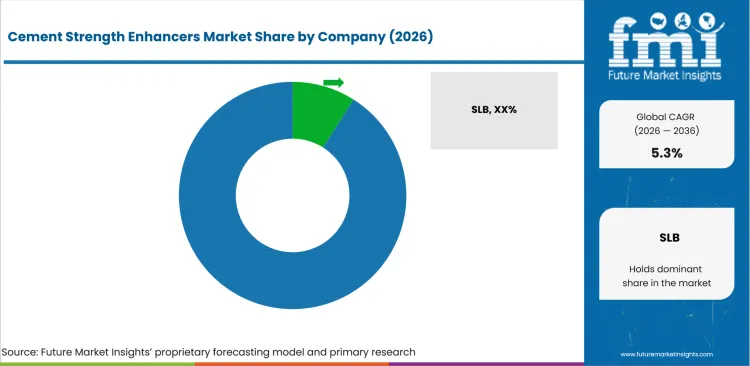
Integrated service companies control formulation design, laboratory qualification, mixing equipment, and wellsite execution. SLB, Halliburton, Baker Hughes, Weatherford International plc, and NESR therefore manage more of the laboratory-to-field handoff. BASF, Clariant, Nouryon, and SNF Group enter through specialty oilfield chemistry, whereas Elkem supplies microsilica-based materials. Entry depends on qualification evidence and local inventory because operators need the same slurry response repeated under field-specific cement programs.
- Integrated cementing and well construction: SLB, Halliburton, Baker Hughes, Weatherford International plc, and National Energy Services Reunited Corp. (NESR).
- Specialty formulation chemistry: BASF, Clariant, Nouryon, and SNF Group.
- Microsilica and oilfield mineral additives: Elkem.
Competitive Benchmarking: Cement Strength Enhancers Market
| Company | Oilwell Cement Formulation Depth | Extreme-Environment Strength Support | Field Delivery and Additive Integration | Geographic Reach |
|---|---|---|---|---|
| SLB | High | High | High | Global |
| Halliburton | High | High | High | Global |
| Baker Hughes | High | High | High | Global |
| Weatherford International plc | Medium | High | High | Global |
| BASF | High | Medium | Medium | Global specialty chemistry |
| Clariant | Medium | High | Medium | Global oil-services chemistry |
| Nouryon | Medium | Medium | Medium | Global specialty chemistry |
| SNF Group | High | Medium | Medium | Global polymer chemistry |
| Elkem | High | High | Medium | Global oilfield materials |
| National Energy Services Reunited Corp. (NESR) | High | High | High | Middle East, North Africa and Asia |
Scoring basis: High formulation depth requires several documented cement systems or additive families. Medium requires one defined family, and Low identifies one narrow route for the same criterion. High extreme-environment support requires several severe-condition routes, whereas Medium requires one documented route. High field integration includes laboratory design plus blending, equipment, or wellsite execution. Medium covers technical support with supply coverage, and Low indicates material supply without field integration. The ratings measure verified capability instead of company reputation in the defined market.
Key Developments in the Cement Strength Enhancers Market
- In November 2025, Halliburton launched LOGIX unit vitality for cementing equipment with real-time monitoring of more than 400 operating parameters. Field teams can use those records to identify equipment-condition changes before a cement job.
- In April 2025, Weatherford reported that PDO Oman awarded a five-year Integrated Completions contract containing Cementation Products, placing cement-barrier equipment inside a long-duration service package.
- In February 2025, Baker Hughes launched the Hummingbird all-electric land cementing unit, replacing diesel engines with electric motors and retaining slurry mixing, pumping, and density-control functions.
Key Players in the Cement Strength Enhancers Market
Integrated Cementing and Well Construction
- SLB
- Halliburton
- Baker Hughes
- Weatherford International plc
- National Energy Services Reunited Corp. (NESR)
Specialty Cementing Chemistry
- BASF
- Clariant
- Nouryon
- SNF Group
Microsilica and Mineral Additives
- Elkem
Cement Strength Enhancers Market - Report Scope
| Coverage field | Report scope |
|---|---|
| Market breakdown | By chemistry, function, cementing operation, well environment, sales channel and region. |
| Quantitative Units | USD million. |
| Market Definition | Additives and formulation components used in oilwell and geothermal cement systems to improve compressive strength, bond performance, thermal durability, early strength, or permeability control within qualified well-cement designs. |
| Regions Covered | North America, Latin America, Western Europe, Eastern Europe, East Asia, South Asia and Pacific, and Middle East and Africa. |
| Countries Covered | Brazil, KSA, UAE, USA, Norway, Canada, Japan, and more than twenty additional countries included in the full report. |
| Key Companies Profiled | SLB, Halliburton, Baker Hughes, Weatherford International plc, BASF, Clariant, Nouryon, SNF Group, Elkem, and National Energy Services Reunited Corp. (NESR). |
| Forecast Period | 2026 to 2036. |
| Approach | Primary and secondary research with market triangulation. |
Cement Strength Enhancers Market - Research Methodology
| Method | Approach |
|---|---|
| Primary Research | FMI analysts gathered input from manufacturers, service providers, technology developers, distributors, end users, procurement teams, and subject-matter experts. Interviews examined purchasing decisions, product or service evaluation, adoption barriers, approval requirements, pricing considerations, and expectations for technical or commercial support. Respondents were also asked what evidence is required before a trial, pilot, or initial order develops into regular purchasing. |
| Desk Research | Desk research covered government statistics, regulatory publications, trade data, industry associations, technical literature, standards, company filings, product information, and official corporate announcements. Sources were reviewed for relevance, publication date, geographic coverage, and consistency with the defined market scope. Claims relating to performance, applications, approvals, capacity, investment, and commercial activity were retained only when supported by credible public evidence. |
| Market Sizing and Forecasting | The market model combined the baseline value with historical performance, segment structure, pricing and volume indicators, adoption levels, company participation, and country-level demand conditions. Forecast assumptions considered economic activity, investment trends, regulatory developments, technology adoption, purchasing cycles, supply availability, and barriers to wider market use. Segment and regional estimates were reconciled before the final market total was calculated. |
| Data Validation | Estimates were checked against multiple independent indicators, including public data, company activity, trade patterns, industry developments, and findings from primary interviews. Validation also tested whether products, services, applications, and company revenues fell within the defined market boundaries. Adjacent categories, unsupported claims, overlapping revenues, and activities without direct market relevance were excluded to reduce double counting and maintain consistency across segments and countries. |
Cement Strength Enhancers Market by Segments
Cement Strength Enhancers Market segmented by Chemistry:
- Silica flour
- Latex additives
- Pozzolanic enhancers
- Polymer strength additives
- Nanomaterial blends
Cement Strength Enhancers Market segmented by Function:
- Compressive strength
- Tensile bond strength
- Thermal durability
- Early strength
- Permeability reduction
Cement Strength Enhancers Market segmented by Cementing Operation:
- Primary cementing
- Squeeze cementing
- Plug and abandonment
- Liner cementing
Cement Strength Enhancers Market segmented by Well Environment:
- Conventional
- HPHT
- Gas wells
- Geothermal
- Deepwater
Cement Strength Enhancers Market segmented by Sales Channel:
- Service company supply
- Specialty additive suppliers
- Direct project supply
- Regional blending plants
Cement Strength Enhancers Market by Region:
- North America
- United States
- Canada
- Latin America
- Brazil
- Mexico
- Argentina
- Chile
- Western Europe
- Germany
- France
- United Kingdom
- Italy
- Spain
- Benelux
- Nordics
- Eastern Europe
- Poland
- Czech Republic
- Romania
- Hungary
- East Asia
- China
- Japan
- South Korea
- South Asia and Pacific
- India
- ASEAN
- Australia and New Zealand
- Middle East and Africa
- GCC Countries
- South Africa
- Türkiye
- Israel
Research Sources and Bibliography
- SLB. (2025, January 8). SLB awarded multi-region deepwater contracts by Shell to support capital-efficient energy development.
- USA Energy Information Administration. (2026, March 31). USA crude oil production rose in 2025, setting new record.
- Sandia National Laboratories. (2025, July). Thermal shock resistance of lightweight cements developed for geothermal conditions.
- USA Department of Energy. (2025). Fiscal Year 2025 CLIMR Projects: Commercializing Energy Technologies.
- SLB. (2025, March 31). SLB Awarded Major Drilling Contract by Woodside Energy for Ultra-deepwater Trion Development, Offshore Mexico.
- Halliburton. (2026, January 21). Halliburton Announces Fourth Quarter 2025 Results.
- Halliburton. (2025, April 23). Halliburton and Aker BP achieve offshore automation milestone.
- Weatherford International plc. (2025, October 21). Weatherford Announces Third Quarter 2025 Results.
- USA Department of Energy. (2026, August 17). Wellbore Construction and Evaluation.
- SLB. (2025, June 16). SLB Introduces Sequestri Carbon Storage Solutions.
- Agência Nacional do Petróleo, Gás Natural e Biocombustíveis. (2026, June 30). ANP divulga dados consolidados do setor regulado em 2025.
- General Authority for Statistics. (2026, August 6). Oil and Gas Statistics 2025.
- ADNOC Drilling. (2025, July 30). ADNOC Drilling Delivers Record 1H 2025 Results, Revenue Grows +30% to $2.37bn, Upgrades Guidance.
- USA Energy Information Administration. (2026, August 19). Longer wells boost Permian crude oil and natural gas production.
- Norwegian Offshore Directorate. (2025, November 13). New technology is profitable when shutting down wells.
- Alberta Energy Regulator. (2025, May 22). Bulletin 2025-19: New Edition of Directive 020.
- Japan Organization for Metals and Energy Security. (2025, October 8).
- SLB. (2026, January 23). SLB 2025 Form 10-K.
- Halliburton. (2026, February 6). Halliburton 2025 Form 10-K.
- Baker Hughes. (2026, February 5). Baker Hughes 2025 Form 10-K.
- Weatherford International plc. (2026, April 21). 2025 Annual Report on Form 10-K.
- BASF. (2026, February 27). Industrial Solutions - BASF Report 2025.
- Clariant. (2026, February 27). Clariant publishes Integrated Report 2025.
- Nouryon. (2025, June 18). Nouryon launches Innovation Center for oilfield solutions in Texas, US.
- SNF Group. (2025, August 15). SNF to Acquire Obsidian Chemical Solutions LLC.
- Elkem ASA. (2026, March 19). Elkem ASA - Integrated annual report 2025.
- National Energy Services Reunited Corp.. (2026, August 10). National Energy Services Reunited Corp. Reports Second Quarter 2026 Financial Results.
- Halliburton. (2025, November 4). Halliburton launches LOGIX unit vitality to advance cementing operations.
- Weatherford International plc. (2025, April 22). Weatherford Announces First Quarter 2025 Results.
- Baker Hughes. (2025, February 4). Baker Hughes Launches Trio of Electrification Technologies for Onshore, Offshore Operations.
- SLB. (2026, July 24). SLB Announces Second-Quarter 2026 Results.
- Clariant. (2026, July 29). Clariant appoints Gapuma Group as Well Service Additives distributor across West Africa.
- Weatherford International plc. (2026, April 21). Weatherford Announces First Quarter 2026 Results.
- National Energy Services Reunited Corp.. (2026, March 16). NESR Awarded $300 Million in Cementing Contracts.
- SNF Group. (2026, January 2). SNF Group completes the acquisition of the Oil & Gas division of Syensqo.
- SLB. (2026, February 12). SLB Awarded Multiple Offshore Drilling Contracts by Mubadala Energy for Tangkulo Deepwater Development in Indonesia.
- Baker Hughes. (2026, May 26). Baker Hughes Extends and Expands Integrated Well Construction Contract with Petrobras.
- Weatherford International plc. (2025, July 22). Weatherford Announces Second Quarter 2025 Results.
- Clariant. (2025, September 8). Clariant Oil Services launches customer portal for seamless digital access.
- Elkem ASA. (2026, April 30). Elkem has sold majority of Silicones division to Bluestar.
This bibliography is provided for reader reference and is not exhaustive. The full report contains the complete reference list and detailed citations
This Report Answers
- How large is the cement strength enhancers market in 2026 and 2036?
- Which well-construction conditions convert drilling programs into repeat strength-enhancer demand?
- Why does silica flour hold 29.0% of chemistry demand in 2026?
- Why does compressive strength represent 34.0% of function demand in 2026?
- Why does primary cementing account for 43.0% of cementing-operation demand in 2026?
- How do the seven profiled country CAGRs differ and what explains the spread?
- Which companies participate in integrated cementing, specialty chemistry, polymers, and microsilica supply?
- What limits substitution of an approved cement-strength formulation?
- How are long-life geothermal, abandonment, and carbon-storage barriers changing qualification requirements?
Frequently Asked Questions
How big is the cement strength enhancers market in 2026?
The cement strength enhancers market is valued at USD 920.6 million in 2026 and is projected to reach USD 1,543.0 million by 2036. Growth follows technically demanding well construction and long-life barrier requirements.
What is the CAGR of the cement strength enhancers market from 2026 to 2036?
The cement strength enhancers market is projected to grow at a CAGR of 5.3% between 2026 and 2036. Expansion depends on qualified cement systems for deepwater, longer horizontal wells, abandonment, geothermal, and carbon-storage applications.
Which chemistry leads the cement strength enhancers market?
The silica flour segment is expected to hold 29.0% of the cement strength enhancers market in 2026, attributable to its use in thermally demanding formulations. High-temperature qualification keeps silica-bearing designs relevant where long-term strength loss must be controlled.
Which countries are projected to record the highest growth in the cement strength enhancers market?
Brazil is projected to grow at 6.0% CAGR, followed by KSA at 5.7% and the UAE at 5.5% through 2036. Deepwater and unconventional drilling programs place these three markets in the upper growth group.
Which companies are active in the cement strength enhancers market?
Key companies operating in the cement strength enhancers market include SLB, Halliburton, Baker Hughes, Weatherford International plc, BASF, Clariant, Nouryon, SNF Group, Elkem, and National Energy Services Reunited Corp. (NESR). Their positions span integrated cementing execution, specialty formulation chemistry, polymer additives, and microsilica-based oilfield materials.
Preview the report firsthand - request a free sample
Get SampleGet the brochure for pricing and purchase details.
Get PDFTable of Content
- Key Takeaways
- Market Size and CAGR
- Top Growth Driver
- Fastest Growing Segment
- Leading Region
- Key Companies
- Emerging Opportunities
- Executive Summary
- Global Market Outlook
- Demand-side Trends
- Supply-side Trends
- Technology Roadmap Analysis
- Analysis and Recommendations
- Analyst Perspective (What is happening? Why now? What should investors know?)
- Key Questions Answered
- How large is the market?
- What is the CAGR?
- What are key trends?
- Which region dominates?
- Who are the leaders?
- Market Overview
- Market Coverage / Taxonomy
- Market Definition / Scope / Limitations
- Research Methodology
- Chapter Orientation
- Analytical Lens and Working Hypotheses
- Market Structure, Signals, and Trend Drivers
- Benchmarking and Cross-market Comparability
- Market Sizing, Forecasting, and Opportunity Mapping
- Research Design and Evidence Framework
- Desk Research Programme (Secondary Evidence)
- Expert Input and Fieldwork (Primary Evidence)
- Tooling, Models, and Reference Databases
- Data Engineering and Model Build
- Quality Assurance and Audit Trail
- Market Background
- Market Dynamics (Drivers, Restraints, Opportunity, Trends)
- Scenario Forecast (Optimistic, Likely, Conservative)
- Impact Analysis
- AI Impact
- Sustainability Impact
- Regulatory Impact
- Technology Impact
- Consumer / Buyer Analysis
- Purchase Drivers
- Adoption Barriers
- Buyer Journey
- Opportunity Map Analysis
- Product Life Cycle Analysis
- Supply Chain Analysis
- Investment Feasibility Matrix
- Value Chain Analysis
- PESTLE and Porter's Analysis
- Regulatory Landscape
- Regional Parent Market Outlook
- Production and Consumption Statistics
- Import and Export Statistics
- Global Market Analysis and Forecast, 2021 to 2036
- Historical Market Size Value (USD Million) Analysis, 2021 to 2025
- Current and Future Market Size Value (USD Million) Projections, 2026 to 2036
- Y-o-Y Growth Trend Analysis
- Absolute $ Opportunity Analysis
- Global Market Pricing Analysis, 2021 to 2036
- Global Market Analysis and Forecast, By Chemistry, 2021 to 2036
- Introduction / Key Findings
- Historical Market Size Value (USD Million) Analysis By Chemistry, 2021 to 2025
- Current and Future Market Size Value (USD Million) Analysis and Forecast By Chemistry, 2026 to 2036
- Silica flour
- Latex additives
- Pozzolanic enhancers
- Polymer strength additives
- Nanomaterial blends
- Silica flour
- Y-o-Y Growth Trend Analysis By Chemistry, 2021 to 2025
- Absolute $ Opportunity Analysis By Chemistry, 2026 to 2036
- Global Market Analysis and Forecast, By Function, 2021 to 2036
- Introduction / Key Findings
- Historical Market Size Value (USD Million) Analysis By Function, 2021 to 2025
- Current and Future Market Size Value (USD Million) Analysis and Forecast By Function, 2026 to 2036
- Compressive strength
- Tensile bond strength
- Thermal durability
- Early strength
- Permeability reduction
- Compressive strength
- Y-o-Y Growth Trend Analysis By Function, 2021 to 2025
- Absolute $ Opportunity Analysis By Function, 2026 to 2036
- Global Market Analysis and Forecast, By Cementing Operation, 2021 to 2036
- Introduction / Key Findings
- Historical Market Size Value (USD Million) Analysis By Cementing Operation, 2021 to 2025
- Current and Future Market Size Value (USD Million) Analysis and Forecast By Cementing Operation, 2026 to 2036
- Primary cementing
- Squeeze cementing
- Plug and abandonment
- Liner cementing
- Primary cementing
- Y-o-Y Growth Trend Analysis By Cementing Operation, 2021 to 2025
- Absolute $ Opportunity Analysis By Cementing Operation, 2026 to 2036
- Global Market Analysis and Forecast, By Well Environment, 2021 to 2036
- Introduction / Key Findings
- Historical Market Size Value (USD Million) Analysis By Well Environment, 2021 to 2025
- Current and Future Market Size Value (USD Million) Analysis and Forecast By Well Environment, 2026 to 2036
- Conventional
- HPHT
- Gas wells
- Geothermal
- Deepwater
- Conventional
- Y-o-Y Growth Trend Analysis By Well Environment, 2021 to 2025
- Absolute $ Opportunity Analysis By Well Environment, 2026 to 2036
- Global Market Analysis and Forecast, By Sales Channel, 2021 to 2036
- Introduction / Key Findings
- Historical Market Size Value (USD Million) Analysis By Sales Channel, 2021 to 2025
- Current and Future Market Size Value (USD Million) Analysis and Forecast By Sales Channel, 2026 to 2036
- Service company supply
- Specialty additive suppliers
- Direct project supply
- Regional blending plants
- Service company supply
- Y-o-Y Growth Trend Analysis By Sales Channel, 2021 to 2025
- Absolute $ Opportunity Analysis By Sales Channel, 2026 to 2036
- Global Market Analysis and Forecast, By Region, 2021 to 2036
- Introduction
- Historical Market Size Value (USD Million) Analysis By Region, 2021 to 2025
- Current Market Size Value (USD Million) Analysis and Forecast By Region, 2026 to 2036
- North America
- Latin America
- Western Europe
- Eastern Europe
- East Asia
- South Asia and Pacific
- Middle East & Africa
- Market Attractiveness Analysis By Region
- North America Market Analysis and Forecast, By Country, 2021 to 2036
- Historical Market Size Value (USD Million) Trend Analysis By Market Taxonomy, 2021 to 2025
- Market Size Value (USD Million) Forecast By Market Taxonomy, 2026 to 2036
- By Country
- USA
- Canada
- By Chemistry
- By Function
- By Cementing Operation
- By Well Environment
- By Sales Channel
- By Country
- Market Attractiveness Analysis
- By Country
- By Chemistry
- By Function
- By Cementing Operation
- By Well Environment
- By Sales Channel
- Key Takeaways
- Latin America Market Analysis and Forecast, By Country
- Historical Market Size Value (USD Million) Trend Analysis By Market Taxonomy, 2021 to 2025
- Market Size Value (USD Million) Forecast By Market Taxonomy, 2026 to 2036
- By Country
- Brazil
- Mexico
- Chile
- Rest of Latin America
- By Chemistry
- By Function
- By Cementing Operation
- By Well Environment
- By Sales Channel
- By Country
- Market Attractiveness Analysis
- By Country
- By Chemistry
- By Function
- By Cementing Operation
- By Well Environment
- By Sales Channel
- Key Takeaways
- Western Europe Market Analysis and Forecast, By Country
- Historical Market Size Value (USD Million) Trend Analysis By Market Taxonomy, 2021 to 2025
- Market Size Value (USD Million) Forecast By Market Taxonomy, 2026 to 2036
- By Country
- Germany
- UK
- Italy
- Spain
- France
- Nordic
- BENELUX
- Rest of Western Europe
- By Chemistry
- By Function
- By Cementing Operation
- By Well Environment
- By Sales Channel
- By Country
- Market Attractiveness Analysis
- By Country
- By Chemistry
- By Function
- By Cementing Operation
- By Well Environment
- By Sales Channel
- Key Takeaways
- Eastern Europe Market Analysis and Forecast, By Country
- Historical Market Size Value (USD Million) Trend Analysis By Market Taxonomy, 2021 to 2025
- Market Size Value (USD Million) Forecast By Market Taxonomy, 2026 to 2036
- By Country
- Russia
- Poland
- Hungary
- Balkan & Baltic
- Rest of Eastern Europe
- By Chemistry
- By Function
- By Cementing Operation
- By Well Environment
- By Sales Channel
- By Country
- Market Attractiveness Analysis
- By Country
- By Chemistry
- By Function
- By Cementing Operation
- By Well Environment
- By Sales Channel
- Key Takeaways
- East Asia Market Analysis and Forecast, By Country
- Historical Market Size Value (USD Million) Trend Analysis By Market Taxonomy, 2021 to 2025
- Market Size Value (USD Million) Forecast By Market Taxonomy, 2026 to 2036
- By Country
- China
- Japan
- South Korea
- By Chemistry
- By Function
- By Cementing Operation
- By Well Environment
- By Sales Channel
- By Country
- Market Attractiveness Analysis
- By Country
- By Chemistry
- By Function
- By Cementing Operation
- By Well Environment
- By Sales Channel
- Key Takeaways
- South Asia and Pacific Market Analysis and Forecast, By Country
- Historical Market Size Value (USD Million) Trend Analysis By Market Taxonomy, 2021 to 2025
- Market Size Value (USD Million) Forecast By Market Taxonomy, 2026 to 2036
- By Country
- India
- ASEAN
- Australia & New Zealand
- Rest of South Asia and Pacific
- By Chemistry
- By Function
- By Cementing Operation
- By Well Environment
- By Sales Channel
- By Country
- Market Attractiveness Analysis
- By Country
- By Chemistry
- By Function
- By Cementing Operation
- By Well Environment
- By Sales Channel
- Key Takeaways
- Middle East & Africa Market Analysis and Forecast, By Country
- Historical Market Size Value (USD Million) Trend Analysis By Market Taxonomy, 2021 to 2025
- Market Size Value (USD Million) Forecast By Market Taxonomy, 2026 to 2036
- By Country
- Kingdom of Saudi Arabia
- Other GCC Countries
- Türkiye
- South Africa
- Other African Union
- Rest of Middle East & Africa
- By Chemistry
- By Function
- By Cementing Operation
- By Well Environment
- By Sales Channel
- By Country
- Market Attractiveness Analysis
- By Country
- By Chemistry
- By Function
- By Cementing Operation
- By Well Environment
- By Sales Channel
- Key Takeaways
- Key Countries Market Analysis
- USA
- Pricing Analysis
- Market Share Analysis, 2025
- By Chemistry
- By Function
- By Cementing Operation
- By Well Environment
- By Sales Channel
- Canada
- Pricing Analysis
- Market Share Analysis, 2025
- By Chemistry
- By Function
- By Cementing Operation
- By Well Environment
- By Sales Channel
- Mexico
- Pricing Analysis
- Market Share Analysis, 2025
- By Chemistry
- By Function
- By Cementing Operation
- By Well Environment
- By Sales Channel
- Brazil
- Pricing Analysis
- Market Share Analysis, 2025
- By Chemistry
- By Function
- By Cementing Operation
- By Well Environment
- By Sales Channel
- Chile
- Pricing Analysis
- Market Share Analysis, 2025
- By Chemistry
- By Function
- By Cementing Operation
- By Well Environment
- By Sales Channel
- Germany
- Pricing Analysis
- Market Share Analysis, 2025
- By Chemistry
- By Function
- By Cementing Operation
- By Well Environment
- By Sales Channel
- UK
- Pricing Analysis
- Market Share Analysis, 2025
- By Chemistry
- By Function
- By Cementing Operation
- By Well Environment
- By Sales Channel
- Italy
- Pricing Analysis
- Market Share Analysis, 2025
- By Chemistry
- By Function
- By Cementing Operation
- By Well Environment
- By Sales Channel
- Spain
- Pricing Analysis
- Market Share Analysis, 2025
- By Chemistry
- By Function
- By Cementing Operation
- By Well Environment
- By Sales Channel
- France
- Pricing Analysis
- Market Share Analysis, 2025
- By Chemistry
- By Function
- By Cementing Operation
- By Well Environment
- By Sales Channel
- India
- Pricing Analysis
- Market Share Analysis, 2025
- By Chemistry
- By Function
- By Cementing Operation
- By Well Environment
- By Sales Channel
- ASEAN
- Pricing Analysis
- Market Share Analysis, 2025
- By Chemistry
- By Function
- By Cementing Operation
- By Well Environment
- By Sales Channel
- Australia & New Zealand
- Pricing Analysis
- Market Share Analysis, 2025
- By Chemistry
- By Function
- By Cementing Operation
- By Well Environment
- By Sales Channel
- China
- Pricing Analysis
- Market Share Analysis, 2025
- By Chemistry
- By Function
- By Cementing Operation
- By Well Environment
- By Sales Channel
- Japan
- Pricing Analysis
- Market Share Analysis, 2025
- By Chemistry
- By Function
- By Cementing Operation
- By Well Environment
- By Sales Channel
- South Korea
- Pricing Analysis
- Market Share Analysis, 2025
- By Chemistry
- By Function
- By Cementing Operation
- By Well Environment
- By Sales Channel
- Russia
- Pricing Analysis
- Market Share Analysis, 2025
- By Chemistry
- By Function
- By Cementing Operation
- By Well Environment
- By Sales Channel
- Poland
- Pricing Analysis
- Market Share Analysis, 2025
- By Chemistry
- By Function
- By Cementing Operation
- By Well Environment
- By Sales Channel
- Hungary
- Pricing Analysis
- Market Share Analysis, 2025
- By Chemistry
- By Function
- By Cementing Operation
- By Well Environment
- By Sales Channel
- Kingdom of Saudi Arabia
- Pricing Analysis
- Market Share Analysis, 2025
- By Chemistry
- By Function
- By Cementing Operation
- By Well Environment
- By Sales Channel
- Türkiye
- Pricing Analysis
- Market Share Analysis, 2025
- By Chemistry
- By Function
- By Cementing Operation
- By Well Environment
- By Sales Channel
- South Africa
- Pricing Analysis
- Market Share Analysis, 2025
- By Chemistry
- By Function
- By Cementing Operation
- By Well Environment
- By Sales Channel
- USA
- Market Structure Analysis
- Competition Dashboard
- Competition Benchmarking
- Market Share Analysis of Top Players
- By Regional
- By Chemistry
- By Function
- By Cementing Operation
- By Well Environment
- By Sales Channel
- Emerging Startups
- Innovation Benchmarking
- Competition Analysis
- Competition Deep Dive
- SLB
- Overview
- Product Portfolio
- Profitability by Market Segments
- Sales Footprint
- Strategy Overview
- Marketing Strategy
- Product Strategy
- Channel Strategy
- Halliburton
- Baker Hughes
- BASF
- Sika
- Chryso / Saint-Gobain
- Clariant
- Ashland
- Nouryon
- TETRA Technologies
- SLB
- Case Studies
- Success Stories
- Recent Developments
- Competition Deep Dive
- Assumptions & Acronyms Used


