

- Market Size (2026)
- USD 680.6 Mn
- Forecast (2036)
- USD 1108.6 Mn
- CAGR (2026 to 2036)
- 5.0%
How big is Cement Expansion Additives Market in 2026?
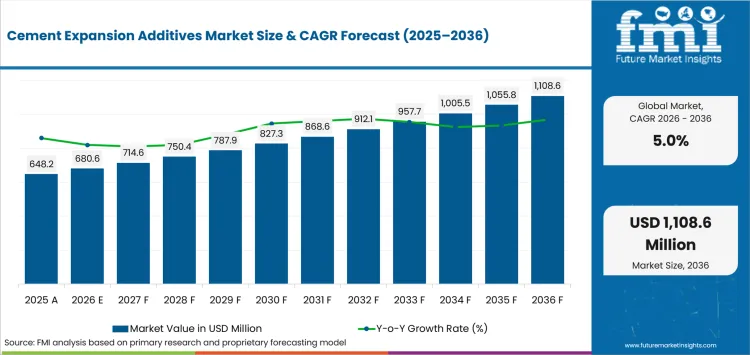
USD 680.6 million in 2026 and USD 1,108.6 million by 2036 at a 5.0% CAGR.
Demand in the cement expansion additives market is anticipated to push valuation from USD 680.6 million in 2026 to USD 1,108.6 million by 2036, expanding at a 5.0% CAGR over the forecast period. This is expected to increase annual market value by USD 428.0 million over the ten-year interval. Cement laboratories earn repeat orders once an expansion package preserves pumpability, strength and annular contact under intended well conditions. SPE’s May 2026 cementing review found void-free cement could raise casing-cement collapse resistance by up to 200%. Even small voids or micro-annuli quickly erode much of that structural gain. Annular contact ties expansion-additive demand to lifecycle barrier qualification within the oilfield chemicals market.
Country project mix changes the addressable cementing job base because Gulf gas programs concentrate drilling while US storage projects introduce separate barrier requirements. In July 2025, the USA Department of Energy approved Magnolia characterization work that includes drilling a subsurface well and material testing. The US route broadens expansion-system qualification into carbon capture and storage projects, while Gulf demand remains tied more closely to high-volume gas drilling.
Key Takeaways
- Demand is anchored in primary and remedial cement designs that must retain annular contact after hydration, pressure change and thermal cycling.
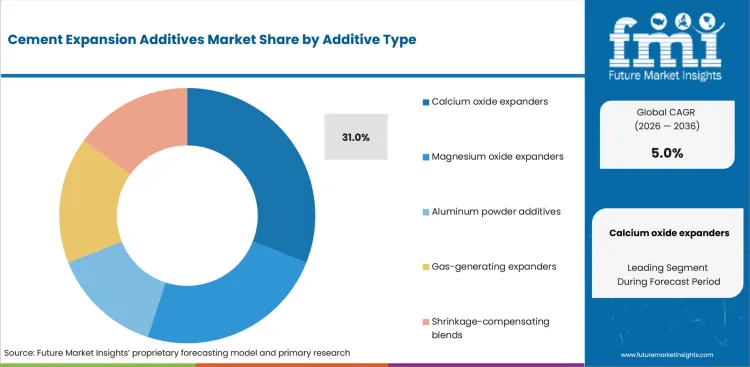
- By additive type, calcium oxide expanders are estimated to hold 31.0% in 2026 owing to controllable reaction behavior in qualified cement formulations.
- In 2026, primary cementing is expected to lead the cementing operation category with 36.0% share because the first annular barrier carries the broadest qualification base.
- By function, micro-annulus prevention is forecast to represent 33.0% in 2026 driven by the need to preserve casing-cement contact after hydration.
- Qualification is the main restraint because additive dosage and reactivity can improve expansion but weaken other slurry or set-cement properties.
- Some of the key players in this market include Halliburton, SLB, Baker Hughes, Weatherford, Nine Energy Service, National Energy Services Reunited (NESR), Sanjel Energy Services, and Calfrac Well Services.
Analyst Perspective
"Expansion chemistry earns repeat use only if its reaction fits the curing window and preserves bond performance inside the complete slurry design. Providers that carry the same laboratory evidence, batch control and field procedure into comparable well programs face less repeat qualification work."
- Nikhil Kaitwade, Principal Consultant, Future Market Insights
How is the cement expansion additives market segmented?
The cement expansion additives market is analyzed by additive type, cementing operation, function, well type, sales channel and region.
Additive type includes calcium oxide expanders, magnesium oxide expanders, aluminum powder additives, gas-generating expanders and shrinkage-compensating blends. Cementing operation covers primary, squeeze, plug and abandonment, remedial and liner cementing. Function includes micro-annulus prevention, shrinkage compensation, bond improvement and gas-migration resistance. Well type covers gas, onshore, offshore, HPHT and storage wells. Sales channels include cementing service companies, specialty chemical suppliers, direct project supply and regional formulators.
Why do calcium oxide expanders lead the additive type category?
Calcium oxide compensates for post-set volume loss, but useful expansion depends on reaction rate inside the curing window. SPE’s January 2025 review found lower CaO reactivity increased linear expansion, while the lowest-reactivity sample cracked and lost hydraulic bond. Reaction rate therefore becomes part of slurry qualification and dosage selection. The same laboratory discipline applies to cement accelerator additives, even though those products target set time.
- By additive type, calcium oxide expanders are estimated to hold 31.0% in 2026 owing to controllable reaction behavior in qualified cement formulations.
- Commercial use depends on matching CaO reactivity and dosage to curing temperature so expansion does not weaken strength or hydraulic bond.
Why does primary cementing lead the cementing operation category?
Primary cementing commits the longest continuous annular interval to one slurry design, so expansion must remain compatible with placement and early barrier formation. SLB’s January 2025 Shell awards put cementing inside integrated deepwater packages with drilling, fluids, completions and wireline. Integrated contracting keeps formulation approval tied to field execution and the full pumping program.
- In 2026, primary cementing is expected to lead the cementing operation category with 36.0% share because the first annular barrier carries the broadest qualification base.
- Repeat use is strongest in oil and gas field services market programs that carry the approved slurry through several wells under one execution system.
Why does micro-annulus prevention lead the function category?
Micro-annuli convert a narrow loss of casing-cement contact into a leakage path that can defeat zonal isolation after the cement has set. Laboratories test interface sealing under pressure or thermal change instead of treating bulk expansion as sufficient proof. SPE’s May 2025 cementing review listed active work on casing-to-cement debonding and full-scale microannulus treatment.
- By function, micro-annulus prevention is forecast to represent 33.0% in 2026 driven by the need to preserve contact after hydration and later well loading.
- Adoption rises where laboratory programs test bond retention during pressure cycling and verify that the expansion package does not introduce new matrix damage.
Why do cementing service companies lead the sales channel category?
Cementing service companies control the final handoff from laboratory approval to mixing and pumping because the contractor owns both procedure and execution. Halliburton’s January 2026 results recorded improved cementing activity in the Western Hemisphere and Africa. The channel gains value when equipment readiness and post-job records stay with the same service organization.
- Cementing service companies are set to lead the sales channel category with 43.0% share in 2026 due to their laboratory-to-field control of the approved design.
- Direct project supply competes where operators retain more formulation control, but integrated service contracts keep most qualification evidence inside cementing laboratories.
What are the drivers, restraints and opportunities in the Cement Expansion Additives Market?
Gas, HPHT and storage wells raise the value of durable annular contact. Qualification slows formulation changes, and lifecycle barrier work expands the addressable design base.
- Driver: Gas, HPHT and offshore wells increase the consequence of losing casing-cement contact during production or pressure cycling.
- Restraint: Each expansion package must be tested with the intended cement system, dosage and downhole curing conditions before field approval.
- Opportunity: Storage and abandonment programs need barrier materials that retain sealing performance over longer operating and monitoring periods.
High-consequence gas and deepwater wells raise the value of expansion chemistry when loss of annular contact threatens barrier integrity under pressure cycling. In May 2026, Baker Hughes extended a Petrobras deepwater well-construction contract that includes cementing expertise. Integrated projects pull the additive into the complete well-construction program, where qualification covers placement and barrier performance together.
Expansion agents can change rheology, strength and bond at the same dosage that improves post-set volume behavior, so formulation changes require new compatibility work. ISO initiated the DIS ballot for ISO 10426-1 in 2026, keeping well-cement material specification under formal review. Stable formulation records reduce repeat testing alongside drilling and completion fluids used in the same well program.
Storage wells extend barrier duties beyond initial construction because injection and monitoring keep integrity requirements active for longer periods. JOGMEC’s July 2025 results briefing covered nine advanced CCS projects with continuing value-chain and storage-potential work. carbon sequestration projects give expansion-additive developers a qualification route where long-duration sealing evidence can support later project tenders.
Which country CAGRs are profiled in the Cement Expansion Additives Market?
| Country | CAGR |
|---|---|
| UAE | 5.8% |
| KSA | 5.6% |
| Qatar | 5.4% |
| Brazil | 5.0% |
| USA | 4.6% |
| Norway | 4.4% |
| Japan | 3.3% |
How do country-level CAGRs compare in the Cement Expansion Additives Market?
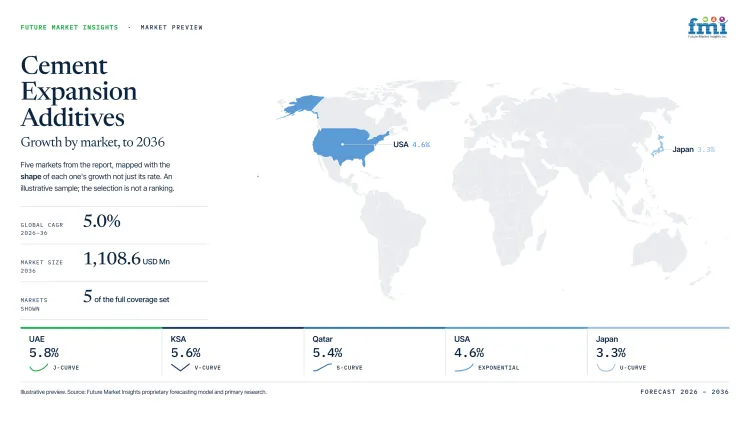
UAE leads the profiled set at 5.8%, while Japan records the lowest rate at 3.3%. The spread is 2.5 percentage points. UAE, KSA, and Qatar form a high-growth Gulf band between 5.4% and 5.8%. Brazil and the USA form a middle band at 5.0% and 4.6%. Norway sits near that middle group at 4.4%, while Japan follows a slower engineering-led path.
- UAE in-country value requirements raise the importance of technical staffing.
- KSA-content requirements make in-country service capacity part of contract access.
- Qatar centralized LNG procurement concentrates cementing demand among a small contractor group.
- Brazil shorebase distance makes inventory timing part of pre-salt formulation availability.
- USA mature land infrastructure shortens mobilization compared with offshore cementing markets.
- Japan’s near-term demand is shaped by consortium-led CCS engineering rather than a broad domestic drilling base.
- Adoption in Norway is driven by offshore barrier standards and a growing storage-well agenda.
Similar CAGRs can produce different order patterns because qualification routes and project concentration govern repeat work. The full report provides country-level CAGR analysis across North America, Latin America, Europe, East Asia, South Asia, Oceania and the Middle East and Africa.
Country-wise Analysis
- Jafurah puts high-temperature cement design inside centralized Aramco and service-company programs, with long approval cycles limiting rapid formulation substitution even as well activity expands. Aramco confirmed in February 2026 that Jafurah had started production and said sales-gas production capacity was targeted to rise about 80% by 2030 from 2021. The KSA cement expansion additives sector is projected to record 5.6% CAGR during the assessment period, tied to continued unconventional gas development and phased processing growth. Large programs reward stable material supply and HPHT test records, while local laboratory relationships determine whether a qualified blend can move cleanly into repeat field orders.
- UAE cementing programs cluster within ADNOC-linked unconventional and gas drilling, so expansion additives enter a small number of operator and service-company laboratories before local stocking affects conversion. Cement expansion additive demand in the UAE is forecast to rise at 5.8% CAGR over the forecast period, attributable to unconventional gas drilling and integrated well delivery. ADNOC Drilling said in October 2025 that its unconventional program could scale above 300 wells annually as additional rigs mobilize. High drilling volume can support repeat qualification, but new formulations still need reproducible expansion data, qualified local stock and technical support tied to each approved cement design and onshore drilling fluids.
- North Field cementing is concentrated in large offshore gas programs and multiple expansion trains, where contractor schedules and material-release timing leave little room for variation between qualified batches. Cement expansion additive sales in Qatar are forecast to expand at 5.4% CAGR by 2036, given continued North Field development and repeated offshore cementing campaigns. QatarEnergy’s November 2025 investor presentation shows planned LNG production capacity rising from 77 MTPA to 142 MTPA by 2030. Project concentration can support repeat qualification, though narrow approval routes and offshore logistics raise the cost of inconsistent material, late release or inadequate local stock during execution.
- Brazil’s pre-salt wells place expansion additives inside deepwater cement designs that must tolerate long offshore logistics, high placement stakes and coordination with casing and completion work. Petrobras approved its 2026-2030 business plan in November 2025 with eight new production systems scheduled by 2030 and seven already contracted. Brazil is estimated to post 5.0% CAGR over the forecast period, aided by a contracted production-system pipeline that keeps deepwater well construction active. The large project base supports advanced formulations, but failure costs keep qualification conservative and favor batch consistency, temperature-stable slurry behavior and Brazilian technical support for offshore execution.
- US purchasing is split among majors, independents and oil and gas CCS developers, so a formulation accepted in one basin or well class can face a separate technical route elsewhere. In the USA, cement expansion additive demand is predicted to advance at 4.6% CAGR through 2036, owing to a broad mix of production and storage wells. EPA issued final Class VI permits in April 2025 for three carbon-storage wells in Texas’s Ector County with specific integrity and monitoring requirements. Repeated site qualification raises selling cost, so modular test packages and basin-level technical support fit this fragmented approval structure better than one national specification.
- Norwegian demand is shaped by offshore barrier standards and a growing storage-well agenda. Demand for cement expansion additives in Norway is forecast to rise at a 4.4% CAGR from 2026 to 2036. Equinor announced in March 2025 that Northern Lights phase two would raise injection capacity to at least 5 million tonnes of CO2 per year and add injection wells. The buyer base is concentrated and documentation expectations are high. Suppliers must show traceability and lifecycle performance rather than only early expansion. Local offshore support and storage-well qualification will be more valuable than broad catalogue coverage.
- Japan’s near-term demand is shaped by consortium-led CCS engineering rather than a broad domestic drilling base. Adoption of cement expansion additives in Japan is forecast to expand at a 3.3% CAGR from 2026 to 2036. JOGMEC announced in July 2024 that it selected nine Advanced CCS Projects, including five domestic storage projects and four overseas storage projects. The program covers basic engineering and storage assessment, with exploratory drilling used to reduce subsurface uncertainty. The main constraint is the early project stage and the need to align imported well-cement practices with Japanese approval processes. Suppliers need to enter through engineering partners and support pilot-scale qualification before expecting recurring orders.
Who are the notable companies in the Cement Expansion Additives Market?
Halliburton, SLB, Baker Hughes, Weatherford, Nine Energy Service, National Energy Services Reunited (NESR), Sanjel Energy Services, and Calfrac Well Services are the notable companies profiled in this market.
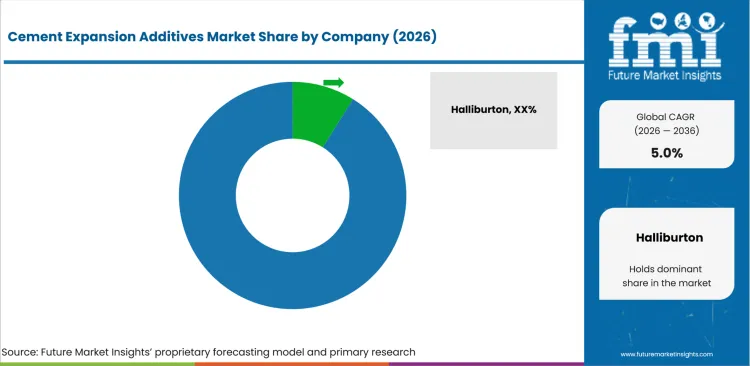
The competitive field separates global integrated cementing platforms from regional specialists with laboratory and wellsite execution. Halliburton, SLB, Baker Hughes and Weatherford operate multi-region systems. Nine Energy Service, NESR, Sanjel Energy Services and Calfrac Well Services compete from regional cementing networks. Entry depends on repeatable well-cement performance and local execution evidence rather than corporate scale or a broader specialty chemicals portfolio.
- Integrated cementing platforms: Halliburton, SLB, Baker Hughes and Weatherford control laboratory design, pumping equipment and field execution in multiple regions.
- Regional well-cement specialists: Nine Energy Service and NESR use local laboratories and field crews to support basin-specific cementing programs.
- Basin-focused cementing companies: Sanjel Energy Services and Calfrac Well Services concentrate cementing execution in Canada and Argentina respectively.
Competitive Benchmarking: Cement Expansion Additives Market
| Company | Expansion and Seal-Control Evidence | Well-Cement System Integration | Field Delivery and Validation | Geographic Reach |
|---|---|---|---|---|
| Halliburton | Medium | High | High | Global |
| SLB | Medium | High | High | Global |
| Baker Hughes | Medium | High | High | Global |
| Weatherford | Medium | High | High | Global |
| Nine Energy Service | Medium | High | Medium | North America |
| National Energy Services Reunited (NESR) | Low | Medium | Medium | Middle East and North Africa |
| Sanjel Energy Services | Low | Medium | Medium | Canada |
| Calfrac Well Services | Low | Medium | Medium | Argentina |
Scoring basis: High expansion evidence requires public documentation of expansive, self-sealing or micro-annulus control in well cement. Medium requires direct slurry or seal-control evidence with narrower expansion proof. Low denotes cementing participation without public expansion evidence. High integration requires laboratory design plus field cementing execution. Medium marks a narrower integrated role and Low indicates limited laboratory-to-field control. High field validation requires documented wellsite execution in several operating settings. Medium is regional and Low lacks direct field-delivery evidence.
Key Developments in the Cement Expansion Additives Market
- In November 2025, Halliburton launched LOGIX unit vitality for cementing operations, using real-time monitoring of more than 400 equipment parameters to improve cement-unit readiness and execution control.
- In February 2025, Baker Hughes launched the Hummingbird all-electric land cementing unit, replacing diesel engines with grid-connected or battery-powered motors for cementing operations.
- In October 2025, Weatherford documented deployment of a single-run completion and cementing system in a challenging horizontal Middle East well, reducing separate handling steps during the operation.
Key Players in the Cement Expansion Additives Market
Integrated Well-Cement System Providers
- Halliburton
- SLB
- Baker Hughes
- Weatherford
Regional Cementing Service Providers
- Nine Energy Service
- National Energy Services Reunited (NESR)
Basin-Focused Cementing Providers
- Sanjel Energy Services
- Calfrac Well Services
Cement Expansion Additives Market - Report Scope
| Coverage field | Report scope |
|---|---|
| Market breakdown | By additive type, cementing operation, function, well type, sales channel and region. |
| Quantitative Units | USD million. |
| Market Definition | Revenue from cement expansion additives and shrinkage-compensating blends used in oil and gas well-cement formulations. |
| Regions Covered | North America, Latin America, Western Europe, Eastern Europe, East Asia, South Asia and Pacific, and Middle East and Africa. |
| Countries Covered | UAE, KSA, Qatar, Brazil, USA, and 20+ countries included in the full report. |
| Key Companies Profiled | Halliburton, SLB, Baker Hughes, Weatherford, Nine Energy Service, National Energy Services Reunited (NESR), Sanjel Energy Services, and Calfrac Well Services. |
| Forecast Period | 2026 to 2036. |
| Approach | Primary and secondary research with market triangulation. |
Cement Expansion Additives Market - Research Methodology
| Method | Approach |
|---|---|
| Primary Research | FMI analysts gathered input from manufacturers, service providers, technology developers, distributors, end users, procurement teams, and subject-matter experts. Interviews examined purchasing decisions, product or service evaluation, adoption barriers, approval requirements, pricing considerations, and expectations for technical or commercial support. Respondents were also asked what evidence is required before a trial, pilot, or initial order develops into regular purchasing. |
| Desk Research | Desk research covered government statistics, regulatory publications, trade data, industry associations, technical literature, standards, company filings, product information, and official corporate announcements. Sources were reviewed for relevance, publication date, geographic coverage, and consistency with the defined market scope. Claims relating to performance, applications, approvals, capacity, investment, and commercial activity were retained only when supported by credible public evidence. |
| Market Sizing and Forecasting | The market model combined the baseline value with historical performance, segment structure, pricing and volume indicators, adoption levels, company participation, and country-level demand conditions. Forecast assumptions considered economic activity, investment trends, regulatory developments, technology adoption, purchasing cycles, supply availability, and barriers to wider market use. Segment and regional estimates were reconciled before the final market total was calculated. |
| Data Validation | Estimates were checked against multiple independent indicators, including public data, company activity, trade patterns, industry developments, and findings from primary interviews. Validation also tested whether products, services, applications, and company revenues fell within the defined market boundaries. Adjacent categories, unsupported claims, overlapping revenues, and activities without direct market relevance were excluded to reduce double counting and maintain consistency across segments and countries. |
Cement Expansion Additives Market by Segments
Cement Expansion Additives Market segmented by Additive Type:
- Calcium oxide expanders
- Magnesium oxide expanders
- Aluminum powder additives
- Gas-generating expanders
- Shrinkage-compensating blends
Cement Expansion Additives Market segmented by Cementing Operation:
- Primary cementing
- Squeeze cementing
- Plug and abandonment
- Remedial cementing
- Liner cementing
Cement Expansion Additives Market segmented by Function:
- Micro-annulus prevention
- Shrinkage compensation
- Bond improvement
- Gas migration resistance
Cement Expansion Additives Market segmented by Well Type:
- Gas wells
- Onshore wells
- Offshore wells
- HPHT wells
- Storage wells
Cement Expansion Additives Market segmented by Sales Channel:
- Cementing service companies
- Specialty chemical suppliers
- Direct project supply
- Regional formulators
Cement Expansion Additives Market by Region:
- North America
- United States
- Canada
- Latin America
- Brazil
- Mexico
- Chile
- Rest of Latin America
- Western Europe
- Germany
- United Kingdom
- Italy
- Spain
- France
- Nordics
- Benelux
- Rest of Western Europe
- Eastern Europe
- Russia
- Poland
- Hungary
- Balkan and Baltic States
- Rest of Eastern Europe
- East Asia
- China
- Japan
- South Korea
- South Asia and Pacific
- India
- ASEAN
- Australia and New Zealand
- Rest of South Asia and Pacific
- Middle East and Africa
- Kingdom of Saudi Arabia
- Other GCC Countries
- Türkiye
- South Africa
- Other African Union Countries
- Rest of Middle East and Africa
Research Sources and Bibliography
- Society of Petroleum Engineers. (2026, May 1). Cementing and Zonal Isolation.
- USA Department of Energy. (2025, July 14). CX-034306: Magnolia Sequestration Project.
- Society of Petroleum Engineers. (2025, January 9). Effect of Calcium Expansive Additives on the Performance of Granite-Based Geopolymers for Zonal Isolation in Oil and Gas Wells.
- SLB. (2025, January 8). SLB awarded multi-region deepwater contracts by Shell to support capital-efficient energy development.
- Society of Petroleum Engineers. (2025, May 1). Cementing and Zonal Isolation-2025.
- Halliburton. (2026, January 21). Halliburton announces fourth quarter 2025 results.
- Baker Hughes. (2026, May 26). Baker Hughes Extends and Expands Integrated Well Construction Contract with Petrobras.
- International Organization for Standardization. (2026). ISO/DIS 10426-1 - Oil and gas industries including lower carbon energy - Cements and materials for well cementing - Part 1: Specification.
- Japan Organization for Metals and Energy Security. (2025, July 18). 【開催報告】令和6年度先進的CCS事業成果報告会 ―CO2の分離回収・輸送・貯留に関する調査など、9案件の成果を報告―.
- ADNOC Drilling. (2025, October 28). ADNOC Drilling Delivers Record 3Q and 9M 2025 Results, Upgrades Guidance, Reinforces Transformational Growth.
- Aramco. (2026, February 26). Aramco’s gas strategy builds momentum with major progress towards growth target.
- QatarEnergy. (2025, November). QatarEnergy Presentation to Investors - November 2025.
- Petrobras. (2025, November 28). Petrobras approves Business Plan 2026-2030.
- USA Environmental Protection Agency. (2025, April 7). EPA Issues Final Permits for Geologic Sequestration of Carbon Dioxide in Texas.
- Halliburton. (2025, November 4). Halliburton launches LOGIX unit vitality to advance cementing operations.
- Baker Hughes. (2025, February 4). Baker Hughes Launches Trio of Electrification Technologies for Onshore, Offshore Operations.
- Weatherford. (2025, October 8). Single-Run Completion, Cementing System Delivers Efficiency and Reliability in Challenging Horizontal Middle East Well.
- Halliburton. (2025, April 23). Halliburton and Aker BP achieve offshore automation milestone.
- Weatherford. (2026, April 21). Weatherford International 1Q 2026 Earnings Presentation.
- Halliburton. (2026, February 22). Pertamina and Halliburton sign an integrated unconventional fracturing MOU in Indonesia.
- SLB. (2025, March 31). SLB Awarded Major Drilling Contract by Woodside Energy for Ultra-deepwater Trion Development, Offshore Mexico.
- Calfrac Well Services Ltd. (2026, August 6). Calfrac Reports Second Quarter 2026 Results.
- Halliburton. (2025, May 6). Halliburton expands international scope with three new projects.
- SLB. (2026, February 12). SLB Awarded Multiple Offshore Drilling Contracts by Mubadala Energy for Tangkulo Deepwater Development in Indonesia.
- Baker Hughes. (2025, September 3). Taking energy forward in Oman.
- Weatherford. (2025, July 22). Weatherford Announces Second Quarter 2025 Results.
- Nine Energy Service. (2025, October 30). Nine Energy Service Announces Third Quarter 2025 Results.
- National Energy Services Reunited. (2026, March 16). NESR Awarded $300 Million in Cementing Contracts.
- Sanjel Energy Services. (2026, March 9). Sanjel Energy and STEP Complete Transaction, Creating One of Canada’s Largest Oilfield Services Companies.
- Calfrac Well Services Ltd. (2025, August 8). Calfrac Reports Strong Second Quarter 2025 Results.
This bibliography is provided for reader reference and is not exhaustive. The full report contains the complete reference list and detailed citations
This Report Answers
- How large is the cement expansion additives market in 2026 and 2036?
- Which conditions make controlled cement expansion commercially relevant?
- Why do calcium oxide expanders hold 31.0% in 2026?
- Why does primary cementing hold 36.0% in 2026?
- How does micro-annulus prevention affect additive selection?
- How do country CAGRs differ among profiled markets?
- Which companies integrate cement design with field execution?
- What limits switching between expansion-additive formulations?
- Where do storage and abandonment projects expand demand?
Frequently Asked Questions
How big is the Cement Expansion Additives Market in 2026?
The cement expansion additives market is valued at USD 680.6 million in 2026 and is projected to reach USD 1,108.6 million by 2036. Growth comes from qualified well-cement designs that preserve annular contact under pressure and temperature change.
What is the CAGR of the Cement Expansion Additives Market from 2026 to 2036?
The cement expansion additives market is projected to grow at a CAGR of 5.0% between 2026 and 2036. Expansion follows gas, offshore and storage-well programs that require controlled cement behavior and repeatable barrier performance.
Which additive type leads the Cement Expansion Additives Market?
The calcium oxide expanders segment is expected to hold 31.0% of the cement expansion additives market in 2026, driven by controllable reaction behavior in qualified formulations. Laboratories must still match reactivity and dosage to each curing window.
Which cementing operation leads the Cement Expansion Additives Market?
The primary cementing segment is expected to hold 36.0% of the cement expansion additives market in 2026, supported by its broad qualification base. The first annular barrier also carries the longest continuous slurry interval in many wells.
Which companies are active in the Cement Expansion Additives Market?
Key companies operating in the market include Halliburton, SLB, Baker Hughes, Weatherford, Nine Energy Service, National Energy Services Reunited (NESR), Sanjel Energy Services, and Calfrac Well Services. Their positions differ by laboratory depth, field execution and regional service coverage.
Preview the report firsthand - request a free sample
Get SampleGet the brochure for pricing and purchase details.
Get PDFTable of Content
- Key Takeaways
- Market Size and CAGR
- Top Growth Driver
- Fastest Growing Segment
- Leading Region
- Key Companies
- Emerging Opportunities
- Executive Summary
- Global Market Outlook
- Demand-side Trends
- Supply-side Trends
- Technology Roadmap Analysis
- Analysis and Recommendations
- Analyst Perspective (What is happening? Why now? What should investors know?)
- Key Questions Answered
- How large is the market?
- What is the CAGR?
- What are key trends?
- Which region dominates?
- Who are the leaders?
- Market Overview
- Market Coverage / Taxonomy
- Market Definition / Scope / Limitations
- Research Methodology
- Chapter Orientation
- Analytical Lens and Working Hypotheses
- Market Structure, Signals, and Trend Drivers
- Benchmarking and Cross-market Comparability
- Market Sizing, Forecasting, and Opportunity Mapping
- Research Design and Evidence Framework
- Desk Research Programme (Secondary Evidence)
- Expert Input and Fieldwork (Primary Evidence)
- Tooling, Models, and Reference Databases
- Data Engineering and Model Build
- Quality Assurance and Audit Trail
- Market Background
- Market Dynamics (Drivers, Restraints, Opportunity, Trends)
- Scenario Forecast (Optimistic, Likely, Conservative)
- Impact Analysis
- AI Impact
- Sustainability Impact
- Regulatory Impact
- Technology Impact
- Consumer / Buyer Analysis
- Purchase Drivers
- Adoption Barriers
- Buyer Journey
- Opportunity Map Analysis
- Product Life Cycle Analysis
- Supply Chain Analysis
- Investment Feasibility Matrix
- Value Chain Analysis
- PESTLE and Porter's Analysis
- Regulatory Landscape
- Regional Parent Market Outlook
- Production and Consumption Statistics
- Import and Export Statistics
- Global Market Analysis and Forecast, 2021 to 2036
- Historical Market Size Value (USD Million) Analysis, 2021 to 2025
- Current and Future Market Size Value (USD Million) Projections, 2026 to 2036
- Y-o-Y Growth Trend Analysis
- Absolute $ Opportunity Analysis
- Global Market Pricing Analysis, 2021 to 2036
- Global Market Analysis and Forecast, By Additive Type, 2021 to 2036
- Introduction / Key Findings
- Historical Market Size Value (USD Million) Analysis By Additive Type, 2021 to 2025
- Current and Future Market Size Value (USD Million) Analysis and Forecast By Additive Type, 2026 to 2036
- Calcium oxide expanders
- Magnesium oxide expanders
- Aluminum powder additives
- Gas-generating expanders
- Shrinkage-compensating blends
- Calcium oxide expanders
- Y-o-Y Growth Trend Analysis By Additive Type, 2021 to 2025
- Absolute $ Opportunity Analysis By Additive Type, 2026 to 2036
- Global Market Analysis and Forecast, By Cementing Operation, 2021 to 2036
- Introduction / Key Findings
- Historical Market Size Value (USD Million) Analysis By Cementing Operation, 2021 to 2025
- Current and Future Market Size Value (USD Million) Analysis and Forecast By Cementing Operation, 2026 to 2036
- Primary cementing
- Squeeze cementing
- Plug and abandonment
- Remedial cementing
- Liner cementing
- Primary cementing
- Y-o-Y Growth Trend Analysis By Cementing Operation, 2021 to 2025
- Absolute $ Opportunity Analysis By Cementing Operation, 2026 to 2036
- Global Market Analysis and Forecast, By Function, 2021 to 2036
- Introduction / Key Findings
- Historical Market Size Value (USD Million) Analysis By Function, 2021 to 2025
- Current and Future Market Size Value (USD Million) Analysis and Forecast By Function, 2026 to 2036
- Micro-annulus prevention
- Shrinkage compensation
- Bond improvement
- Gas migration resistance
- Micro-annulus prevention
- Y-o-Y Growth Trend Analysis By Function, 2021 to 2025
- Absolute $ Opportunity Analysis By Function, 2026 to 2036
- Global Market Analysis and Forecast, By Well Type, 2021 to 2036
- Introduction / Key Findings
- Historical Market Size Value (USD Million) Analysis By Well Type, 2021 to 2025
- Current and Future Market Size Value (USD Million) Analysis and Forecast By Well Type, 2026 to 2036
- Gas wells
- Onshore wells
- Offshore wells
- HPHT wells
- Storage wells
- Gas wells
- Y-o-Y Growth Trend Analysis By Well Type, 2021 to 2025
- Absolute $ Opportunity Analysis By Well Type, 2026 to 2036
- Global Market Analysis and Forecast, By Sales Channel, 2021 to 2036
- Introduction / Key Findings
- Historical Market Size Value (USD Million) Analysis By Sales Channel, 2021 to 2025
- Current and Future Market Size Value (USD Million) Analysis and Forecast By Sales Channel, 2026 to 2036
- Cementing service companies
- Specialty chemical suppliers
- Direct project supply
- Regional formulators
- Cementing service companies
- Y-o-Y Growth Trend Analysis By Sales Channel, 2021 to 2025
- Absolute $ Opportunity Analysis By Sales Channel, 2026 to 2036
- Global Market Analysis and Forecast, By Region, 2021 to 2036
- Introduction
- Historical Market Size Value (USD Million) Analysis By Region, 2021 to 2025
- Current Market Size Value (USD Million) Analysis and Forecast By Region, 2026 to 2036
- North America
- Latin America
- Western Europe
- Eastern Europe
- East Asia
- South Asia and Pacific
- Middle East & Africa
- Market Attractiveness Analysis By Region
- North America Market Analysis and Forecast, By Country, 2021 to 2036
- Historical Market Size Value (USD Million) Trend Analysis By Market Taxonomy, 2021 to 2025
- Market Size Value (USD Million) Forecast By Market Taxonomy, 2026 to 2036
- By Country
- USA
- Canada
- By Additive Type
- By Cementing Operation
- By Function
- By Well Type
- By Sales Channel
- By Country
- Market Attractiveness Analysis
- By Country
- By Additive Type
- By Cementing Operation
- By Function
- By Well Type
- By Sales Channel
- Key Takeaways
- Latin America Market Analysis and Forecast, By Country
- Historical Market Size Value (USD Million) Trend Analysis By Market Taxonomy, 2021 to 2025
- Market Size Value (USD Million) Forecast By Market Taxonomy, 2026 to 2036
- By Country
- Brazil
- Mexico
- Chile
- Rest of Latin America
- By Additive Type
- By Cementing Operation
- By Function
- By Well Type
- By Sales Channel
- By Country
- Market Attractiveness Analysis
- By Country
- By Additive Type
- By Cementing Operation
- By Function
- By Well Type
- By Sales Channel
- Key Takeaways
- Western Europe Market Analysis and Forecast, By Country
- Historical Market Size Value (USD Million) Trend Analysis By Market Taxonomy, 2021 to 2025
- Market Size Value (USD Million) Forecast By Market Taxonomy, 2026 to 2036
- By Country
- Germany
- UK
- Italy
- Spain
- France
- Nordic
- BENELUX
- Rest of Western Europe
- By Additive Type
- By Cementing Operation
- By Function
- By Well Type
- By Sales Channel
- By Country
- Market Attractiveness Analysis
- By Country
- By Additive Type
- By Cementing Operation
- By Function
- By Well Type
- By Sales Channel
- Key Takeaways
- Eastern Europe Market Analysis and Forecast, By Country
- Historical Market Size Value (USD Million) Trend Analysis By Market Taxonomy, 2021 to 2025
- Market Size Value (USD Million) Forecast By Market Taxonomy, 2026 to 2036
- By Country
- Russia
- Poland
- Hungary
- Balkan & Baltic
- Rest of Eastern Europe
- By Additive Type
- By Cementing Operation
- By Function
- By Well Type
- By Sales Channel
- By Country
- Market Attractiveness Analysis
- By Country
- By Additive Type
- By Cementing Operation
- By Function
- By Well Type
- By Sales Channel
- Key Takeaways
- East Asia Market Analysis and Forecast, By Country
- Historical Market Size Value (USD Million) Trend Analysis By Market Taxonomy, 2021 to 2025
- Market Size Value (USD Million) Forecast By Market Taxonomy, 2026 to 2036
- By Country
- China
- Japan
- South Korea
- By Additive Type
- By Cementing Operation
- By Function
- By Well Type
- By Sales Channel
- By Country
- Market Attractiveness Analysis
- By Country
- By Additive Type
- By Cementing Operation
- By Function
- By Well Type
- By Sales Channel
- Key Takeaways
- South Asia and Pacific Market Analysis and Forecast, By Country
- Historical Market Size Value (USD Million) Trend Analysis By Market Taxonomy, 2021 to 2025
- Market Size Value (USD Million) Forecast By Market Taxonomy, 2026 to 2036
- By Country
- India
- ASEAN
- Australia & New Zealand
- Rest of South Asia and Pacific
- By Additive Type
- By Cementing Operation
- By Function
- By Well Type
- By Sales Channel
- By Country
- Market Attractiveness Analysis
- By Country
- By Additive Type
- By Cementing Operation
- By Function
- By Well Type
- By Sales Channel
- Key Takeaways
- Middle East & Africa Market Analysis and Forecast, By Country
- Historical Market Size Value (USD Million) Trend Analysis By Market Taxonomy, 2021 to 2025
- Market Size Value (USD Million) Forecast By Market Taxonomy, 2026 to 2036
- By Country
- Kingdom of Saudi Arabia
- Other GCC Countries
- Türkiye
- South Africa
- Other African Union
- Rest of Middle East & Africa
- By Additive Type
- By Cementing Operation
- By Function
- By Well Type
- By Sales Channel
- By Country
- Market Attractiveness Analysis
- By Country
- By Additive Type
- By Cementing Operation
- By Function
- By Well Type
- By Sales Channel
- Key Takeaways
- Key Countries Market Analysis
- USA
- Pricing Analysis
- Market Share Analysis, 2025
- By Additive Type
- By Cementing Operation
- By Function
- By Well Type
- By Sales Channel
- Canada
- Pricing Analysis
- Market Share Analysis, 2025
- By Additive Type
- By Cementing Operation
- By Function
- By Well Type
- By Sales Channel
- Mexico
- Pricing Analysis
- Market Share Analysis, 2025
- By Additive Type
- By Cementing Operation
- By Function
- By Well Type
- By Sales Channel
- Brazil
- Pricing Analysis
- Market Share Analysis, 2025
- By Additive Type
- By Cementing Operation
- By Function
- By Well Type
- By Sales Channel
- Chile
- Pricing Analysis
- Market Share Analysis, 2025
- By Additive Type
- By Cementing Operation
- By Function
- By Well Type
- By Sales Channel
- Germany
- Pricing Analysis
- Market Share Analysis, 2025
- By Additive Type
- By Cementing Operation
- By Function
- By Well Type
- By Sales Channel
- UK
- Pricing Analysis
- Market Share Analysis, 2025
- By Additive Type
- By Cementing Operation
- By Function
- By Well Type
- By Sales Channel
- Italy
- Pricing Analysis
- Market Share Analysis, 2025
- By Additive Type
- By Cementing Operation
- By Function
- By Well Type
- By Sales Channel
- Spain
- Pricing Analysis
- Market Share Analysis, 2025
- By Additive Type
- By Cementing Operation
- By Function
- By Well Type
- By Sales Channel
- France
- Pricing Analysis
- Market Share Analysis, 2025
- By Additive Type
- By Cementing Operation
- By Function
- By Well Type
- By Sales Channel
- India
- Pricing Analysis
- Market Share Analysis, 2025
- By Additive Type
- By Cementing Operation
- By Function
- By Well Type
- By Sales Channel
- ASEAN
- Pricing Analysis
- Market Share Analysis, 2025
- By Additive Type
- By Cementing Operation
- By Function
- By Well Type
- By Sales Channel
- Australia & New Zealand
- Pricing Analysis
- Market Share Analysis, 2025
- By Additive Type
- By Cementing Operation
- By Function
- By Well Type
- By Sales Channel
- China
- Pricing Analysis
- Market Share Analysis, 2025
- By Additive Type
- By Cementing Operation
- By Function
- By Well Type
- By Sales Channel
- Japan
- Pricing Analysis
- Market Share Analysis, 2025
- By Additive Type
- By Cementing Operation
- By Function
- By Well Type
- By Sales Channel
- South Korea
- Pricing Analysis
- Market Share Analysis, 2025
- By Additive Type
- By Cementing Operation
- By Function
- By Well Type
- By Sales Channel
- Russia
- Pricing Analysis
- Market Share Analysis, 2025
- By Additive Type
- By Cementing Operation
- By Function
- By Well Type
- By Sales Channel
- Poland
- Pricing Analysis
- Market Share Analysis, 2025
- By Additive Type
- By Cementing Operation
- By Function
- By Well Type
- By Sales Channel
- Hungary
- Pricing Analysis
- Market Share Analysis, 2025
- By Additive Type
- By Cementing Operation
- By Function
- By Well Type
- By Sales Channel
- Kingdom of Saudi Arabia
- Pricing Analysis
- Market Share Analysis, 2025
- By Additive Type
- By Cementing Operation
- By Function
- By Well Type
- By Sales Channel
- Türkiye
- Pricing Analysis
- Market Share Analysis, 2025
- By Additive Type
- By Cementing Operation
- By Function
- By Well Type
- By Sales Channel
- South Africa
- Pricing Analysis
- Market Share Analysis, 2025
- By Additive Type
- By Cementing Operation
- By Function
- By Well Type
- By Sales Channel
- USA
- Market Structure Analysis
- Competition Dashboard
- Competition Benchmarking
- Market Share Analysis of Top Players
- By Regional
- By Additive Type
- By Cementing Operation
- By Function
- By Well Type
- By Sales Channel
- Emerging Startups
- Innovation Benchmarking
- Competition Analysis
- Competition Deep Dive
- Halliburton
- Overview
- Product Portfolio
- Profitability by Market Segments
- Sales Footprint
- Strategy Overview
- Marketing Strategy
- Product Strategy
- Channel Strategy
- SLB
- Baker Hughes
- Sika
- BASF
- Chryso / Saint-Gobain
- Clariant
- Innospec
- TETRA Technologies
- GCP Applied Technologies / Saint-Gobain
- Halliburton
- Case Studies
- Success Stories
- Recent Developments
- Competition Deep Dive
- Assumptions & Acronyms Used


