

- Market Size (2026)
- USD 920.7 Mn
- Forecast (2036)
- USD 1514.1 Mn
- CAGR (2026 to 2036)
- 5.1%
How big is Cement Accelerator Additives Market in 2026?
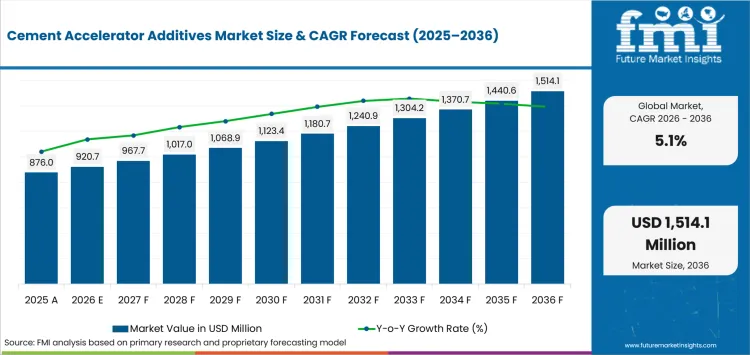
USD 920.7 million in 2026 and USD 1,514.1 million by 2036 at a 5.1% CAGR.
Demand for cement accelerator additives is projected to expand at 5.1% CAGR between 2026 and 2036. The market is expected to rise from USD 920.7 million in 2026 to USD 1,514.1 million by 2036. The commercial trigger is the interval between placement and usable compressive strength because rig charges continue until the next operation starts. Alberta Energy Regulator data released in June 2025 record 3,385 crude-oil wells placed on production during 2024. That well cadence keeps primary cementing events frequent enough to sustain repeated accelerator purchases during active drilling programs.
Country economics diverge once offshore exposure and service configuration alter qualification costs for the same accelerator chemistry. ANP’s August 2026 review recorded 19 exploration wells started in Brazil during 2025 with ten offshore and nine onshore. Canada rewards cold-weather strength data plus regional stocking because winter field conditions penalize formulations without nearby technical support. Large Gulf drilling campaigns prioritize qualification continuity so one approved formulation can serve repeated wells after local acceptance.
Key Takeaways
- Well construction sustains accelerator purchases as each qualified slurry enters a broader oilfield chemicals workflow with strict timing and compatibility requirements.
- By chemistry, calcium chloride accelerators are estimated to hold 27.0% in 2026 owing to familiar set-acceleration behavior in conventional Portland-cement systems.
- In 2026, primary cementing is expected to lead cementing operation with 39.0% share because new casing programs generate repeated slurry-placement requirements.
- Low temperature is projected to hold 31.0% share in 2026 owing to slower hydration that increases the value of controlled early strength.
- Faster hydration can delay adoption by shortening thickening time, so field services teams must qualify each formulation against the complete cement chemistry package.
- Some of the key players in this market include Baker Hughes, Halliburton, SLB, Weatherford International plc, Clariant, Innospec Inc., TETRA Technologies, Inc., and SNF Group.
Analyst Perspective
"Cement accelerator value depends on the placement window plus the rig time saved until the next operation begins. Service companies pay for earlier usable strength only if the formulation preserves pumpability, meters consistently and clears local qualification without repeated laboratory work."
- Nikhil Kaitwade, Principal Consultant, Future Market Insights
How is the Cement Accelerator Additives Market segmented?
The market is segmented by chemistry, cementing operation, temperature, well type, sales channel and region.
Chemistry includes calcium chloride, calcium nitrate, sodium silicate, organic and non-chloride accelerators. Cementing operation covers primary, plug, remedial, low-temperature and shallow-well cementing. Temperature covers low, moderate and high temperature plus cold-region wells. Well type includes onshore, offshore, gas, coalbed methane and workover wells. Sales channels include cementing service companies, oilfield chemical distributors, direct project supply and regional blending plants.
Why do Calcium chloride accelerators lead the Chemistry category?
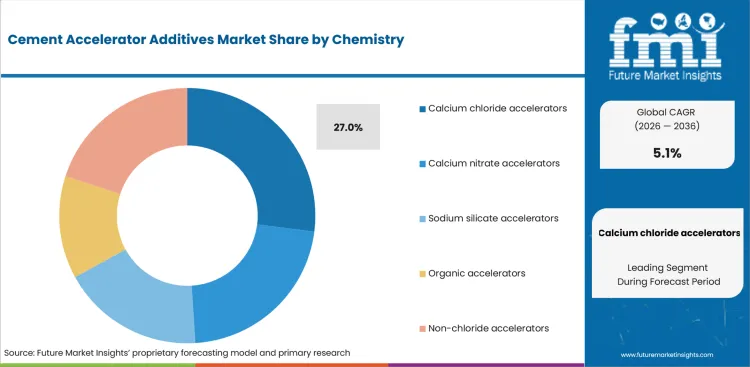
Calcium chloride is a reference chemistry for Portland-cement systems because chloride ions bring forward early hydration without redesigning the complete slurry package. TETRA’s September 2025 Investor Day identified a strong calcium chloride position in the United States and Europe, giving formulators a current mineral-supply route for chloride-based systems.
- By chemistry, calcium chloride accelerators are estimated to hold 27.0% in 2026 owing to familiar dose-response behavior in conventional Portland-cement systems.
- Formulators still check corrosion limits plus interactions with dispersants and fluid-loss agents under the job temperature. Shared mineral channels with adjacent production chemicals do not remove the need for cement-specific laboratory testing before approval.
Why does Primary cementing lead the Cementing operation category?
Primary cementing repeats through casing programs on new wells and therefore produces more accelerator purchase occasions than isolated remedial work. Cementing crews compare early-strength gain with thickening time during qualification for repeated casing intervals and standardized land-well programs.
- In 2026, primary cementing is expected to lead cementing operation with 39.0% share because new casing programs generate repeated slurry-placement requirements.
- Weatherford disclosed in July 2025 that bp UK awarded a one-year contract covering cementation products and related services for the Northern Endurance Partnership. The award places cementing inputs inside broader completion tools programs and qualification governs repeat field use.
How does Low Temperature shape the Temperature category?
Low temperature slows cement hydration and makes early compressive-strength development more time-sensitive in cold formations. Alberta Energy Regulator data published in June 2025 record 810 natural-gas wells placed on production during 2024, with 98% drilled horizontally.
- Low temperature is set to lead the temperature category with 31.0% share in 2026 due to slower hydration under cold operating conditions.
- Accelerators earn value on these jobs if strength develops early enough to release rig time without cutting the safe pumping window. Field teams test dose response against cement source and mix-water chemistry beside onshore drilling fluids requirements under the expected downhole temperature.
What supports Onshore wells as the leading Well type?
Land programs can repeat casing designs over many wells and replenish cementing materials through regional service bases near active fields. Offshore jobs carry higher rig-time penalties and usually require project-specific logistics plus longer qualification cycles during campaign planning.
- The onshore wells segment is likely to capture 42.0% share in 2026 attributable to repeat land-well programs and shorter distribution routes to regional cementing bases.
- The Alberta Energy Regulator counted 3,370 horizontal crude-oil wells entering production in 2024 within its June 2025 outlook. Repeat land activity provides a practical accelerator consumption base beside fracking fluids used in unconventional development programs.
What are the drivers, restraints and opportunities in the Cement Accelerator Additives Market?
Well construction raises demand for faster early strength. Qualification risk limits indiscriminate use. Automated cementing and deeper offshore programs reward formulations that preserve pumpability under tighter operating windows.
- Driver: Exploration and development wells generate repeated cement-placement events where shorter waiting-on-cement time can release rig hours sooner.
- Restraint: Faster hydration can narrow placement time and forces laboratory qualification against the actual cement source, water chemistry and additive package.
- Opportunity: Digital cementing equipment and complex offshore wells increase the value of formulations that meter accurately and retain predictable early-strength response.
Well activity converts into accelerator demand once a slurry is accepted for a defined temperature and casing program. The Norwegian Offshore Directorate documented 49 exploration wells completed in 2025, maintaining a visible offshore workload for cementing teams. Each well still needs its own strength and pumpability balance, so operators do not use acceleration automatically even with attractive rig-time savings.
Qualification is the main adoption brake because small chemistry changes can alter thickening time or early strength under field conditions. Clariant launched its ClariHub portal in September 2025 with continuous access to technical and safety data for Oil Services customers. Easier documentation does not replace slurry testing, so service companies still qualify each accelerator against the actual cement and companion stimulation chemicals.
Automated cementing equipment raises the commercial value of additives that meter predictably during repeat field programs. Weatherford disclosed a three-year Suriname cementation-products contract in October 2025, placing qualified inputs inside a multi-well offshore campaign. One accepted chemistry can stay specified on later wells if dose response stays stable beside offshore drilling risers and related well-construction hardware.
Which country CAGRs are profiled in the Cement Accelerator Additives Market?
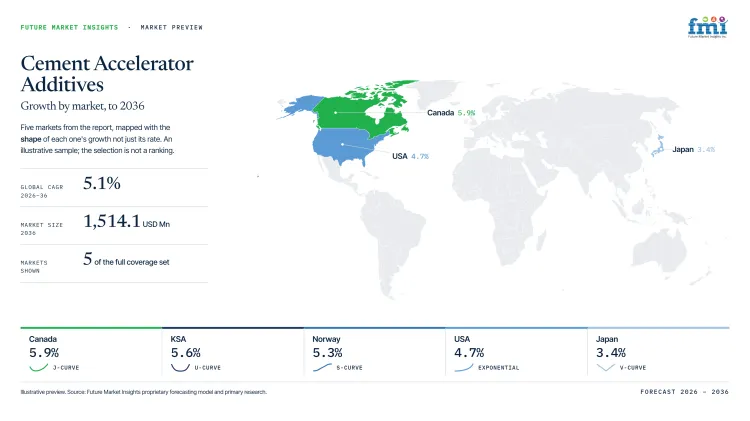
| Country | CAGR |
|---|---|
| Canada | 5.9% |
| KSA | 5.6% |
| Norway | 5.3% |
| USA | 4.7% |
| Japan | 3.4% |
How do country-level CAGRs compare in the Cement Accelerator Additives Market?
A 0.9-point spread separates Canada at 5.9% from Brazil at 5.0%, keeping all five forecasts in one compact range. Canada and KSA occupy the high end with UAE and Norway close behind. Similar growth rates hide different qualification economics because winter land programs, Gulf campaigns and offshore projects require different service coverage.
- Canada’s horizontal land programs favor fast replenishment through western service bases.
- KSA’s unconventional gas work broadens cementing demand beyond conventional oil developments.
- Norway places cementing beside inflow control devices in complex offshore completions.
- USA integrates cementing with broader well-completion activities across offshore and unconventional projects.
- Japan offshower wells link cementine with perforating guns and completion work.
Similar CAGRs mask different sales models because service access and technical approval routes vary materially between these countries.
The full report provides country-level CAGR analysis across North America, Latin America, Europe, East Asia, South Asia, Oceania and the Middle East and Africa.
Country-wise Analysis
- Canada’s western basins run large land programs through service centers that must position accelerator inventory ahead of winter weather and low temperatures complicate field delivery. Canada is projected to grow at 5.9% CAGR through 2036, attributable to repeat land-well activity and the commercial value of reliable cold-temperature strength development. The Alberta Energy Regulator’s June 2025 capital outlook placed 2025 oil and gas spending 7.4% above 2024, giving local laboratories a stronger qualification workload. Cement-source variation can force job-specific testing, so companies with stocked western bases can respond faster than exporters supplying projects from distant inventories without nearby laboratory support during seasonal operations.
- Saudi well programs concentrate purchasing inside large operator-led developments where approved formulations can follow repeated drilling sequences after technical qualification and service-company acceptance. GASTAT’s August 2026 Oil and Gas Statistics 2025 recorded crude-oil production at about 3,461.8 million barrels in 2025 and a 5.6% increase from 2024 without proving automatic accelerator consumption. KSA’s cement accelerator additives outlook is anticipated to advance at 5.6% CAGR over the assessment period, driven by integrated contracting and repeated development activity. National-content expectations and approval cycles can delay unfamiliar formulations, giving companies with in-country technical response a practical advantage after initial laboratory acceptance during repeated field programs.
- Offshore logistics set Norway’s commercial conditions because rig time is expensive and chemistry switching becomes difficult after slurry qualification starts. Long lead times and strict field testing limit opportunistic formulation changes during scheduled development work for offshore operators. The cement accelerator additives sector is projected to record 5.3% CAGR during the assessment period, tied to continuing exploration and development on the Norwegian continental shelf. The Norwegian Offshore Directorate recorded 91 discoveries awaiting possible development decisions at the end of 2025. The project inventory can sustain cementing work if individual discoveries advance toward sanction over the coming development cycle this decade.
- USA well construction conditions are shaped by offshore development, unconventional drilling, and established service infrastructure, where rig time and operational efficiency influence cementing decisions. Complex well designs and strict field-performance requirements limit formulation changes once cementing programs enter execution. The cement accelerator additives sector in the USA is projected to record a 4.7% CAGR during the assessment period, supported by continued drilling and well-development activity. Extensive shale, offshore, and mature-field operations sustain demand for cementing additives across varied completion environments. Established oilfield service networks provide a reliable route for qualified cement chemistries to move from testing into repeat project procurement, particularly where operators prioritize consistent performance and operational reliability.
- Japan’s well construction activity is concentrated around offshore exploration, domestic energy development, and specialized drilling projects that require reliable cementing capabilities. Limited domestic hydrocarbon resources and challenging offshore conditions place greater emphasis on technical qualification, service reliability, and efficient project execution. The cement accelerator additives sector in Japan is projected to record a 3.4% CAGR during the assessment period, supported by ongoing offshore and energy-development requirements. Established technical standards and controlled project procurement favor qualified cement formulations with demonstrated field performance. Specialized service relationships can support the adoption of proven accelerator chemistries, while stringent technical requirements continue to shape purchasing decisions across Japan’s cementing activities.
Who are the notable companies in the Cement Accelerator Additives Market?
Baker Hughes, Halliburton, SLB, Weatherford International plc, Clariant, Innospec Inc., TETRA Technologies, Inc., and SNF Group are the notable companies serving this market.
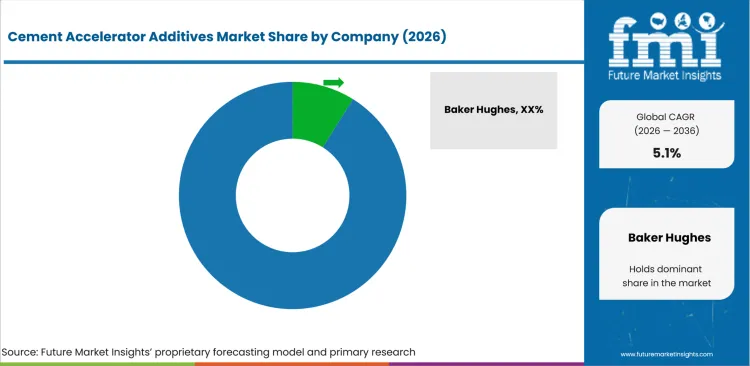
Competition separates integrated cementing execution from specialty chemistry manufacturing because oilfield service companies qualify both slurry performance and the route that carries chemistry into field inventory. Large service groups control more of the execution chain, whereas chemistry specialists compete through formulation breadth and regional technical access once job-specific testing confirms exact-market fit.
- Baker Hughes, Halliburton, SLB and Weatherford International plc compete through integrated well-construction or cementing execution with equipment and field-service coverage.
- Clariant and Innospec Inc. compete through oilfield additive formulation plus technical support for service companies and regional channel partners.
- TETRA Technologies, Inc. and SNF Group bring mineral or polymer chemistry that can enter cementing formulations where qualification establishes exact-market fit.
Competitive Benchmarking: Cement Accelerator Additives Market
| Company | Cementing Route Evidence | Chemistry Depth | Field Delivery Integration | Geographic Reach |
|---|---|---|---|---|
| Baker Hughes | High | High | High | Global |
| Halliburton | High | High | High | Global |
| SLB | High | High | High | Global |
| Weatherford International plc | High | Medium | High | Global |
| Clariant | Medium | High | Medium | Global |
| Innospec Inc. | Medium | Medium | Medium | Americas, Europe, Middle East, Asia-Pacific |
| TETRA Technologies, Inc. | Low | High | Medium | North America, Europe, Middle East |
| SNF Group | Low | High | Medium | Global |
Scoring basis: High cementing-route evidence requires direct cementing systems or field execution in multiple operating settings with current official documentation. Medium marks documented cementing additives or cementation products, and Low marks one adjacent oilfield-chemistry route with limited direct evidence. High chemistry depth requires multiple documented formulation families or owned mineral chemistry with current official evidence of active oilfield use. Medium and Low ratings identify progressively narrower verified chemistry coverage that stays relevant to the exact market boundary. High field integration requires direct job execution, Medium requires dedicated oilfield technical service or distribution and Low identifies manufacturing supply without documented field execution.
Key Developments in the Cement Accelerator Additives Market
- In February 2025, Baker Hughes launched the Hummingbird all-electric land cementing unit with real-time monitoring and control for onshore cementing operations.
- In November 2025, Halliburton released LOGIX unit vitality to monitor more than 400 cement-unit parameters and improve equipment readiness before field jobs.
- In March 2025, SLB won Woodside Energy’s Trion contract for 18 ultra-deepwater wells with cementing included in the integrated service scope.
Key Players in the Cement Accelerator Additives Market
Integrated cementing service platforms
- Baker Hughes
- Halliburton
- SLB
- Weatherford International plc
Specialty oilfield chemistry companies
- Clariant
- Innospec Inc.
Mineral and polymer chemistry companies
- TETRA Technologies, Inc.
- SNF Group
Cement Accelerator Additives Market - Report Scope
| Coverage field | Report scope |
|---|---|
| Market breakdown | By chemistry, cementing operation, temperature, well type, sales channel and region. |
| Quantitative Units | USD million. |
| Market Definition | Revenue from cement accelerator additives sold for oil and gas well-cement slurry formulations. The scope excludes cement, complete cementing-service revenue, construction admixtures and unrelated binder systems. |
| Regions Covered | North America; Latin America; Western Europe; Eastern Europe; East Asia; South Asia and Pacific; Middle East and Africa. |
| Countries Covered | Canada, KSA, UAE, Norway, Brazil, and 20+ countries included in the full report. |
| Key Companies Profiled | Baker Hughes, Halliburton, SLB, Weatherford International plc, Clariant, Innospec Inc., TETRA Technologies, Inc., and SNF Group. |
| Forecast Period | 2026 to 2036. |
| Approach | Primary and secondary research with market triangulation. |
Cement Accelerator Additives Market - Research Methodology
| Method | Approach |
|---|---|
| Primary Research | FMI analysts gathered input from manufacturers, service providers, technology developers, distributors, end users, procurement teams, and subject-matter experts. Interviews examined purchasing decisions, product or service evaluation, adoption barriers, approval requirements, pricing considerations, and expectations for technical or commercial support. Respondents were also asked what evidence is required before a trial, pilot, or initial order develops into regular purchasing. |
| Desk Research | Desk research covered government statistics, regulatory publications, trade data, industry associations, technical literature, standards, company filings, product information, and official corporate announcements. Sources were reviewed for relevance, publication date, geographic coverage, and consistency with the defined market scope. Claims relating to performance, applications, approvals, capacity, investment, and commercial activity were retained only when supported by credible public evidence. |
| Market Sizing and Forecasting | The market model combined the baseline value with historical performance, segment structure, pricing and volume indicators, adoption levels, company participation, and country-level demand conditions. Forecast assumptions considered economic activity, investment trends, regulatory developments, technology adoption, purchasing cycles, supply availability, and barriers to wider market use. Segment and regional estimates were reconciled before the final market total was calculated. |
| Data Validation | Estimates were checked against multiple independent indicators, including public data, company activity, trade patterns, industry developments, and findings from primary interviews. Validation also tested whether products, services, applications, and company revenues fell within the defined market boundaries. Adjacent categories, unsupported claims, overlapping revenues, and activities without direct market relevance were excluded to reduce double counting and maintain consistency across segments and countries. |
Cement Accelerator Additives Market by Segments
Cement Accelerator Additives Market segmented by Chemistry:
- Calcium chloride accelerators
- Calcium nitrate accelerators
- Sodium silicate accelerators
- Organic accelerators
- Non-chloride accelerators
Cement Accelerator Additives Market segmented by Cementing Operation:
- Primary cementing
- Plug cementing
- Remedial cementing
- Low-temperature cementing
- Shallow well cementing
Cement Accelerator Additives Market segmented by Temperature:
- Low temperature
- Moderate temperature
- High temperature
- Cold-region wells
Cement Accelerator Additives Market segmented by Well Type:
- Onshore wells
- Offshore wells
- Gas wells
- Coalbed methane wells
- Workover wells
Cement Accelerator Additives Market segmented by Sales Channel:
- Cementing service companies
- Oilfield chemical distributors
- Direct project supply
- Regional blending plants
Cement Accelerator Additives Market by Region:
- North America
- United States
- Canada
- Latin America
- Brazil
- Mexico
- Argentina
- Chile
- Western Europe
- Germany
- France
- United Kingdom
- Italy
- Spain
- Benelux
- Nordics
- Eastern Europe
- Poland
- Czech Republic
- Romania
- Hungary
- East Asia
- China
- Japan
- South Korea
- South Asia and Pacific
- India
- ASEAN
- Australia and New Zealand
- Middle East and Africa
- GCC Countries
- South Africa
- Türkiye
- Israel
Research Sources and Bibliography
- Alberta Energy Regulator. (2025, June). Crude Oil Well Activity.
- Agência Nacional do Petróleo, Gás Natural e Biocombustíveis. (2026, August 12). Seminário da ANP apresenta resultados da atividade de exploração em 2025.
- TETRA Technologies, Inc. (2025, September 25). TETRA Technologies, Inc. outlines ONE TETRA 2030 growth strategy for enhanced shareholder value at NYSE Investor Day.
- Weatherford International plc. (2025, July 22). Weatherford Announces Second Quarter 2025 Results.
- Alberta Energy Regulator. (2025, June). Natural Gas Well Activity.
- Norwegian Offshore Directorate. (2026, January 8). Oil and gas on the NCS moving forward.
- Innospec Inc. (2025, April 9). Innospec Oilfield Services’ OKC manufacturing center has earned ISO 9001 certification!
- Weatherford International plc. (2025, October 21). Weatherford Announces Third Quarter 2025 Results.
- Alberta Energy Regulator. (2025, June). Capital Expenditures.
- General Authority for Statistics. (2026, August 6). Oil and Gas Statistics 2025.
- ADNOC Drilling. (2026). Non-Financial Measures.
- Norwegian Offshore Directorate. (2026). Discovered resources: Resource Accounts 2025.
- Agência Nacional do Petróleo, Gás Natural e Biocombustíveis. (2025, December 19). Número de blocos sob contrato cresce em 2025 e é o maior pelo segundo ano consecutivo.
- Baker Hughes. (2025, February 4). Baker Hughes Launches Trio of Electrification Technologies for Onshore, Offshore Operations.
- Halliburton. (2025, November 4). Halliburton launches LOGIX unit vitality to advance cementing operations.
- SLB. (2025, March 31). SLB Awarded Major Drilling Contract by Woodside Energy for Ultra-deepwater Trion Development, Offshore Mexico.
- Baker Hughes. (2026, May 26). Baker Hughes Extends and Expands Integrated Well Construction Contract with Petrobras.
- Halliburton. (2026, February 22). Pertamina and Halliburton sign an integrated unconventional fracturing MOU in Indonesia.
- SLB. (2026, February 12). SLB Awarded Multiple Offshore Drilling Contracts by Mubadala Energy for Tangkulo Deepwater Development in Indonesia.
- Weatherford International plc. (2026, April 21). Weatherford Announces First Quarter 2026 Results.
- Clariant. (2026, July 29). Clariant appoints Gapuma Group as Well Service Additives distributor across West Africa.
- TETRA Technologies, Inc. (2025, October 28). TETRA Technologies, Inc. announces strong third quarter 2025 results.
- SNF Group. (2026, January 2). SNF Group completes the acquisition of the Oil & Gas division of Syensqo.
- Clariant. (2025, September 8). Clariant Oil Services launches customer portal for seamless digital access.
- Innospec Inc. (2025, March 24). Innospec Announces LaZuli™ Product Line for Deepwater Subsea Production.
This bibliography is provided for reader reference and is not exhaustive. The full report contains the complete reference list and detailed citations.
This Report Answers
- What is the cement accelerator additives market size in 2026 and what value is forecast for 2036?
- Which well-construction conditions sustain demand for cement accelerator additives?
- Why do calcium chloride accelerators hold the leading chemistry share in 2026?
- Why does primary cementing account for the largest cementing-operation share?
- How does low temperature change the commercial value of earlier cement strength?
- How do Canada, KSA, UAE, Norway and Brazil compare by forecast CAGR?
- Which eight companies are active in integrated cementing or exact-market chemistry routes?
- What qualification and placement-window constraints can delay accelerator adoption?
- Which recent company actions are changing cementing execution and route-to-market access?
Frequently Asked Questions
How big is the cement accelerator additives market in 2026?
The cement accelerator additives market is valued at USD 920.7 million in 2026 and is projected to reach USD 1,514.1 million by 2036. Growth is tied to recurring well cementing and the economic value of reaching usable early strength sooner.
What is the CAGR of the cement accelerator additives market from 2026 to 2036?
The cement accelerator additives market is projected to grow at a CAGR of 5.1% between 2026 and 2036. Expansion is supported by continuing well construction plus demand for shorter waiting-on-cement periods in time-sensitive jobs.
Which chemistry leads the cement accelerator additives market?
The calcium chloride accelerators segment is expected to hold 27.0% of the cement accelerator additives market chemistry category in 2026, supported by familiar set-acceleration performance. Formulators retain non-chloride alternatives if chloride use conflicts with project specifications or the complete cement chemistry package.
Which cementing operation leads the cement accelerator additives market?
The primary cementing segment is expected to hold 39.0% of the cement accelerator additives market cementing-operation category in 2026, attributable to repeated casing programs. New wells generate more routine slurry-placement requirements than isolated remedial jobs because each casing interval needs a qualified cement design.
Which countries are projected to record the highest growth in the cement accelerator additives market?
Canada is projected to grow at 5.9% CAGR, followed by KSA at 5.6% and UAE at 5.4% through 2036. Their growth paths differ because cold-weather land activity and integrated Gulf drilling programs impose different qualification priorities.
Which temperature category holds an additional leading share in the cement accelerator additives market?
The low temperature segment is expected to hold 31.0% of the cement accelerator additives market temperature category in 2026, driven by slower hydration under cold conditions. Earlier compressive strength can reduce rig exposure if natural setting time extends after cement placement in colder formations.
Which companies are active in the cement accelerator additives market?
Key companies operating in the cement accelerator additives market include Baker Hughes, Halliburton, SLB, Weatherford International plc, Clariant, Innospec Inc., TETRA Technologies, Inc., and SNF Group. These companies compete through cementing execution and formulation depth plus regional technical support that affects qualification decisions.
Preview the report firsthand - request a free sample
Get SampleGet the brochure for pricing and purchase details.
Get PDFTable of Content
- Key Takeaways
- Market Size and CAGR
- Top Growth Driver
- Fastest Growing Segment
- Leading Region
- Key Companies
- Emerging Opportunities
- Executive Summary
- Global Market Outlook
- Demand-side Trends
- Supply-side Trends
- Technology Roadmap Analysis
- Analysis and Recommendations
- Analyst Perspective (What is happening? Why now? What should investors know?)
- Key Questions Answered
- How large is the market?
- What is the CAGR?
- What are key trends?
- Which region dominates?
- Who are the leaders?
- Market Overview
- Market Coverage / Taxonomy
- Market Definition / Scope / Limitations
- Research Methodology
- Chapter Orientation
- Analytical Lens and Working Hypotheses
- Market Structure, Signals, and Trend Drivers
- Benchmarking and Cross-market Comparability
- Market Sizing, Forecasting, and Opportunity Mapping
- Research Design and Evidence Framework
- Desk Research Programme (Secondary Evidence)
- Expert Input and Fieldwork (Primary Evidence)
- Tooling, Models, and Reference Databases
- Data Engineering and Model Build
- Quality Assurance and Audit Trail
- Market Background
- Market Dynamics (Drivers, Restraints, Opportunity, Trends)
- Scenario Forecast (Optimistic, Likely, Conservative)
- Impact Analysis
- AI Impact
- Sustainability Impact
- Regulatory Impact
- Technology Impact
- Consumer / Buyer Analysis
- Purchase Drivers
- Adoption Barriers
- Buyer Journey
- Opportunity Map Analysis
- Product Life Cycle Analysis
- Supply Chain Analysis
- Investment Feasibility Matrix
- Value Chain Analysis
- PESTLE and Porter's Analysis
- Regulatory Landscape
- Regional Parent Market Outlook
- Production and Consumption Statistics
- Import and Export Statistics
- Global Market Analysis and Forecast, 2021 to 2036
- Historical Market Size Value (USD Million) Analysis, 2021 to 2025
- Current and Future Market Size Value (USD Million) Projections, 2026 to 2036
- Y-o-Y Growth Trend Analysis
- Absolute $ Opportunity Analysis
- Global Market Pricing Analysis, 2021 to 2036
- Global Market Analysis and Forecast, By Chemistry, 2021 to 2036
- Introduction / Key Findings
- Historical Market Size Value (USD Million) Analysis By Chemistry, 2021 to 2025
- Current and Future Market Size Value (USD Million) Analysis and Forecast By Chemistry, 2026 to 2036
- Calcium chloride accelerators
- Calcium nitrate accelerators
- Sodium silicate accelerators
- Organic accelerators
- Non-chloride accelerators
- Calcium chloride accelerators
- Y-o-Y Growth Trend Analysis By Chemistry, 2021 to 2025
- Absolute $ Opportunity Analysis By Chemistry, 2026 to 2036
- Global Market Analysis and Forecast, By Cementing Operation, 2021 to 2036
- Introduction / Key Findings
- Historical Market Size Value (USD Million) Analysis By Cementing Operation, 2021 to 2025
- Current and Future Market Size Value (USD Million) Analysis and Forecast By Cementing Operation, 2026 to 2036
- Primary cementing
- Plug cementing
- Remedial cementing
- Low-temperature cementing
- Shallow well cementing
- Primary cementing
- Y-o-Y Growth Trend Analysis By Cementing Operation, 2021 to 2025
- Absolute $ Opportunity Analysis By Cementing Operation, 2026 to 2036
- Global Market Analysis and Forecast, By Temperature, 2021 to 2036
- Introduction / Key Findings
- Historical Market Size Value (USD Million) Analysis By Temperature, 2021 to 2025
- Current and Future Market Size Value (USD Million) Analysis and Forecast By Temperature, 2026 to 2036
- Low temperature
- Moderate temperature
- High temperature
- Cold-region wells
- Low temperature
- Y-o-Y Growth Trend Analysis By Temperature, 2021 to 2025
- Absolute $ Opportunity Analysis By Temperature, 2026 to 2036
- Global Market Analysis and Forecast, By Well Type, 2021 to 2036
- Introduction / Key Findings
- Historical Market Size Value (USD Million) Analysis By Well Type, 2021 to 2025
- Current and Future Market Size Value (USD Million) Analysis and Forecast By Well Type, 2026 to 2036
- Onshore wells
- Offshore wells
- Gas wells
- Coalbed methane wells
- Workover wells
- Onshore wells
- Y-o-Y Growth Trend Analysis By Well Type, 2021 to 2025
- Absolute $ Opportunity Analysis By Well Type, 2026 to 2036
- Global Market Analysis and Forecast, By Sales Channel, 2021 to 2036
- Introduction / Key Findings
- Historical Market Size Value (USD Million) Analysis By Sales Channel, 2021 to 2025
- Current and Future Market Size Value (USD Million) Analysis and Forecast By Sales Channel, 2026 to 2036
- Cementing service companies
- Oilfield chemical distributors
- Direct project supply
- Regional blending plants
- Cementing service companies
- Y-o-Y Growth Trend Analysis By Sales Channel, 2021 to 2025
- Absolute $ Opportunity Analysis By Sales Channel, 2026 to 2036
- Global Market Analysis and Forecast, By Region, 2021 to 2036
- Introduction
- Historical Market Size Value (USD Million) Analysis By Region, 2021 to 2025
- Current Market Size Value (USD Million) Analysis and Forecast By Region, 2026 to 2036
- North America
- Latin America
- Western Europe
- Eastern Europe
- East Asia
- South Asia and Pacific
- Middle East & Africa
- Market Attractiveness Analysis By Region
- North America Market Analysis and Forecast, By Country, 2021 to 2036
- Historical Market Size Value (USD Million) Trend Analysis By Market Taxonomy, 2021 to 2025
- Market Size Value (USD Million) Forecast By Market Taxonomy, 2026 to 2036
- By Country
- USA
- Canada
- By Chemistry
- By Cementing Operation
- By Temperature
- By Well Type
- By Sales Channel
- By Country
- Market Attractiveness Analysis
- By Country
- By Chemistry
- By Cementing Operation
- By Temperature
- By Well Type
- By Sales Channel
- Key Takeaways
- Latin America Market Analysis and Forecast, By Country
- Historical Market Size Value (USD Million) Trend Analysis By Market Taxonomy, 2021 to 2025
- Market Size Value (USD Million) Forecast By Market Taxonomy, 2026 to 2036
- By Country
- Brazil
- Mexico
- Chile
- Rest of Latin America
- By Chemistry
- By Cementing Operation
- By Temperature
- By Well Type
- By Sales Channel
- By Country
- Market Attractiveness Analysis
- By Country
- By Chemistry
- By Cementing Operation
- By Temperature
- By Well Type
- By Sales Channel
- Key Takeaways
- Western Europe Market Analysis and Forecast, By Country
- Historical Market Size Value (USD Million) Trend Analysis By Market Taxonomy, 2021 to 2025
- Market Size Value (USD Million) Forecast By Market Taxonomy, 2026 to 2036
- By Country
- Germany
- UK
- Italy
- Spain
- France
- Nordic
- BENELUX
- Rest of Western Europe
- By Chemistry
- By Cementing Operation
- By Temperature
- By Well Type
- By Sales Channel
- By Country
- Market Attractiveness Analysis
- By Country
- By Chemistry
- By Cementing Operation
- By Temperature
- By Well Type
- By Sales Channel
- Key Takeaways
- Eastern Europe Market Analysis and Forecast, By Country
- Historical Market Size Value (USD Million) Trend Analysis By Market Taxonomy, 2021 to 2025
- Market Size Value (USD Million) Forecast By Market Taxonomy, 2026 to 2036
- By Country
- Russia
- Poland
- Hungary
- Balkan & Baltic
- Rest of Eastern Europe
- By Chemistry
- By Cementing Operation
- By Temperature
- By Well Type
- By Sales Channel
- By Country
- Market Attractiveness Analysis
- By Country
- By Chemistry
- By Cementing Operation
- By Temperature
- By Well Type
- By Sales Channel
- Key Takeaways
- East Asia Market Analysis and Forecast, By Country
- Historical Market Size Value (USD Million) Trend Analysis By Market Taxonomy, 2021 to 2025
- Market Size Value (USD Million) Forecast By Market Taxonomy, 2026 to 2036
- By Country
- China
- Japan
- South Korea
- By Chemistry
- By Cementing Operation
- By Temperature
- By Well Type
- By Sales Channel
- By Country
- Market Attractiveness Analysis
- By Country
- By Chemistry
- By Cementing Operation
- By Temperature
- By Well Type
- By Sales Channel
- Key Takeaways
- South Asia and Pacific Market Analysis and Forecast, By Country
- Historical Market Size Value (USD Million) Trend Analysis By Market Taxonomy, 2021 to 2025
- Market Size Value (USD Million) Forecast By Market Taxonomy, 2026 to 2036
- By Country
- India
- ASEAN
- Australia & New Zealand
- Rest of South Asia and Pacific
- By Chemistry
- By Cementing Operation
- By Temperature
- By Well Type
- By Sales Channel
- By Country
- Market Attractiveness Analysis
- By Country
- By Chemistry
- By Cementing Operation
- By Temperature
- By Well Type
- By Sales Channel
- Key Takeaways
- Middle East & Africa Market Analysis and Forecast, By Country
- Historical Market Size Value (USD Million) Trend Analysis By Market Taxonomy, 2021 to 2025
- Market Size Value (USD Million) Forecast By Market Taxonomy, 2026 to 2036
- By Country
- Kingdom of Saudi Arabia
- Other GCC Countries
- Türkiye
- South Africa
- Other African Union
- Rest of Middle East & Africa
- By Chemistry
- By Cementing Operation
- By Temperature
- By Well Type
- By Sales Channel
- By Country
- Market Attractiveness Analysis
- By Country
- By Chemistry
- By Cementing Operation
- By Temperature
- By Well Type
- By Sales Channel
- Key Takeaways
- Key Countries Market Analysis
- USA
- Pricing Analysis
- Market Share Analysis, 2025
- By Chemistry
- By Cementing Operation
- By Temperature
- By Well Type
- By Sales Channel
- Canada
- Pricing Analysis
- Market Share Analysis, 2025
- By Chemistry
- By Cementing Operation
- By Temperature
- By Well Type
- By Sales Channel
- Mexico
- Pricing Analysis
- Market Share Analysis, 2025
- By Chemistry
- By Cementing Operation
- By Temperature
- By Well Type
- By Sales Channel
- Brazil
- Pricing Analysis
- Market Share Analysis, 2025
- By Chemistry
- By Cementing Operation
- By Temperature
- By Well Type
- By Sales Channel
- Chile
- Pricing Analysis
- Market Share Analysis, 2025
- By Chemistry
- By Cementing Operation
- By Temperature
- By Well Type
- By Sales Channel
- Germany
- Pricing Analysis
- Market Share Analysis, 2025
- By Chemistry
- By Cementing Operation
- By Temperature
- By Well Type
- By Sales Channel
- UK
- Pricing Analysis
- Market Share Analysis, 2025
- By Chemistry
- By Cementing Operation
- By Temperature
- By Well Type
- By Sales Channel
- Italy
- Pricing Analysis
- Market Share Analysis, 2025
- By Chemistry
- By Cementing Operation
- By Temperature
- By Well Type
- By Sales Channel
- Spain
- Pricing Analysis
- Market Share Analysis, 2025
- By Chemistry
- By Cementing Operation
- By Temperature
- By Well Type
- By Sales Channel
- France
- Pricing Analysis
- Market Share Analysis, 2025
- By Chemistry
- By Cementing Operation
- By Temperature
- By Well Type
- By Sales Channel
- India
- Pricing Analysis
- Market Share Analysis, 2025
- By Chemistry
- By Cementing Operation
- By Temperature
- By Well Type
- By Sales Channel
- ASEAN
- Pricing Analysis
- Market Share Analysis, 2025
- By Chemistry
- By Cementing Operation
- By Temperature
- By Well Type
- By Sales Channel
- Australia & New Zealand
- Pricing Analysis
- Market Share Analysis, 2025
- By Chemistry
- By Cementing Operation
- By Temperature
- By Well Type
- By Sales Channel
- China
- Pricing Analysis
- Market Share Analysis, 2025
- By Chemistry
- By Cementing Operation
- By Temperature
- By Well Type
- By Sales Channel
- Japan
- Pricing Analysis
- Market Share Analysis, 2025
- By Chemistry
- By Cementing Operation
- By Temperature
- By Well Type
- By Sales Channel
- South Korea
- Pricing Analysis
- Market Share Analysis, 2025
- By Chemistry
- By Cementing Operation
- By Temperature
- By Well Type
- By Sales Channel
- Russia
- Pricing Analysis
- Market Share Analysis, 2025
- By Chemistry
- By Cementing Operation
- By Temperature
- By Well Type
- By Sales Channel
- Poland
- Pricing Analysis
- Market Share Analysis, 2025
- By Chemistry
- By Cementing Operation
- By Temperature
- By Well Type
- By Sales Channel
- Hungary
- Pricing Analysis
- Market Share Analysis, 2025
- By Chemistry
- By Cementing Operation
- By Temperature
- By Well Type
- By Sales Channel
- Kingdom of Saudi Arabia
- Pricing Analysis
- Market Share Analysis, 2025
- By Chemistry
- By Cementing Operation
- By Temperature
- By Well Type
- By Sales Channel
- Türkiye
- Pricing Analysis
- Market Share Analysis, 2025
- By Chemistry
- By Cementing Operation
- By Temperature
- By Well Type
- By Sales Channel
- South Africa
- Pricing Analysis
- Market Share Analysis, 2025
- By Chemistry
- By Cementing Operation
- By Temperature
- By Well Type
- By Sales Channel
- USA
- Market Structure Analysis
- Competition Dashboard
- Competition Benchmarking
- Market Share Analysis of Top Players
- By Regional
- By Chemistry
- By Cementing Operation
- By Temperature
- By Well Type
- By Sales Channel
- Emerging Startups
- Innovation Benchmarking
- Competition Analysis
- Competition Deep Dive
- Baker Hughes
- Overview
- Product Portfolio
- Profitability by Market Segments
- Sales Footprint
- Strategy Overview
- Marketing Strategy
- Product Strategy
- Channel Strategy
- Halliburton
- SLB
- Sika
- BASF
- Chryso / Saint-Gobain
- Clariant
- Innospec
- TETRA Technologies
- GCP Applied Technologies / Saint-Gobain
- Baker Hughes
- Case Studies
- Success Stories
- Recent Developments
- Competition Deep Dive
- Assumptions & Acronyms Used


