

- Market Size (2026)
- USD 1.5 Bn
- Forecast (2036)
- USD 2.3 Bn
- CAGR (2026 to 2036)
- 4.8%
How big is Mineral Grinding Aids Market in 2026?
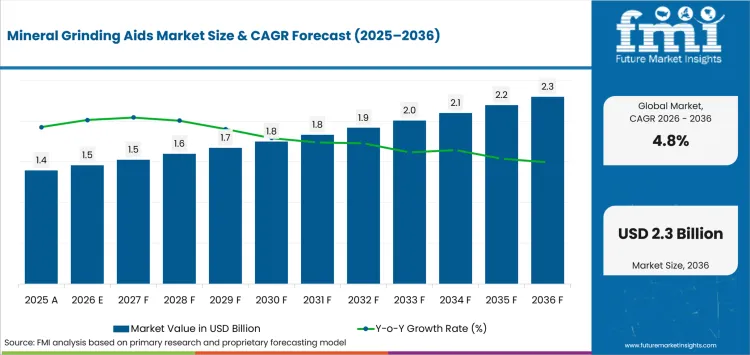
USD 1.5 Billion in 2026 and USD 2.3 Billion by 2036 at a 4.8% CAGR.
FMI forecasts USD 2.3 Billion in mineral grinding aid revenue by 2036, compared with USD 1.5 Billion in 2026 and USD 1.4 Billion in 2025. Growth over 2026 to 2036 is projected at a 4.8% CAGR. Operators use these additives to reduce agglomeration and improve material flow through a mill. A September 2020 review in Powder Technology identifies higher output and lower specific energy use as key industrial objectives. A successful trial must show that those gains cover dosage cost while keeping fineness, strength and downstream processing within specification.
Brazil’s cement market and new USA grinding capacity provide opportunities for plant trials. Chile and Peru require close attention to ore variability in copper and polymetallic processing. Japanese cement producers place more emphasis on reliable quality and cost control across existing plants. In Mexico and Canada, project timing and service logistics affect adoption. Suppliers need a dosing plan that works at normal production conditions and can be supported locally.
Key Takeaways of Mineral Grinding Aids Market
- Glycol-based aids hold 31.0% of chemistry demand in 2026. Established handling practices and dispersion behavior make them familiar candidates for mill trials.
- Cement minerals account for 38.0% of mineral demand in 2026. Grinding additives can be evaluated within routine cement-quality and mill-performance checks.
- Throughput improvement represents 33.0% of functional demand in 2026. Extra saleable output from an existing mill provides a measurable basis for the purchase.
- Cement plants hold 48.0% of end-use demand in 2026. Their continuous grinding operations support repeated dosing once a formulation has been qualified.
- Direct plant supply accounts for 45.0% of sales in 2026. Working with the site helps the supplier adjust dosage and investigate changes in performance.
- Opportunity: Multifunctional dispersant systems can combine grinding efficiency with particle-size, rheology, or low-clinker performance benefits.
- Companies include Sika, Saint-Gobain Construction Chemicals, Mapei, Master Builders Solutions.
Analyst Perspective
"The mill trial has to show a benefit after dosage cost is included. Laboratory screening is useful, but the result needs to hold at normal feed conditions and commercial production rates."
- Nikhil Kaitwade, Principal Consultant, Future Market Insights
How is the Mineral Grinding Aids Market segmented?
The market is segmented by Chemistry, Mineral, Function, End Use, and Sales Channel.
By Chemistry: Glycol-based aids, Amine-based aids, Polycarboxylate aids, Surfactant blends, Specialty dispersants; By Mineral: Cement minerals, Limestone, Copper ores, Iron ore, Phosphate/industrial minerals; By Function: Throughput improvement, Energy reduction, Particle size control, Slurry dispersion, Mill coating reduction; By End Use: Cement plants, Mineral processors, Mining concentrators, Industrial mineral plants; By Sales Channel: Direct plant supply, Chemical distributors, Technical service packages, Regional blenders.
Why do cement minerals lead demand within the mineral category?
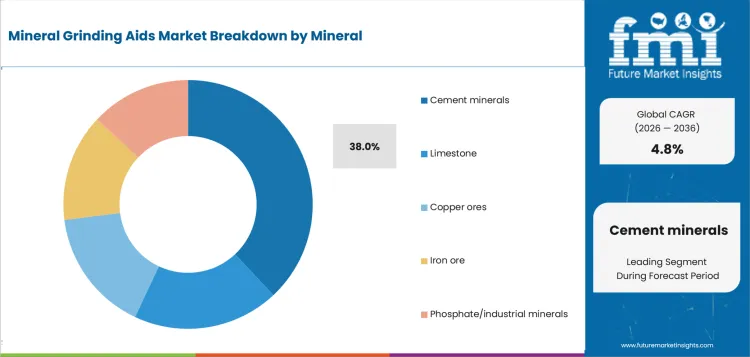
Cement minerals lead because the value of a grinding aid is easy to connect to high-volume continuous milling. Clinker and blended-cement circuits repeatedly confront agglomeration and separator loading. Pack set and energy intensity add further operating pressure. A small chemical dose can therefore influence plant output across a large tonnage base. Cement producers also have established quality-control routines that compare treated and untreated production against fineness and strength targets. Handling performance is checked as well. Limestone and metallic ores create meaningful demand. Phosphate and other industrial minerals also require grinding support. Their technical requirements vary more widely by ore or product specification and can require different dispersant or slurry-control approaches. Grinding decisions can interact with cement strength enhancers when a plant changes clinker content or target quality.
- Cement minerals hold 38.0% of Mineral demand in 2026 because grinding additives are embedded in cement-mill optimization and quality-control workflows.
- In November 2024, Mapei described cement additives that reduce particle agglomeration during grinding and support higher mill production, while stressing that additive selection depends on the performance goals of the cement producer.
Why do glycol-based aids lead demand within the chemistry category?
Glycol-based formulations remain central because they fit the core mechanical job of a grinding aid: limiting agglomeration so newly created particle surfaces stay mobile through the mill and separator. Their established use in cement gives plant teams a familiar baseline for dose-response testing and pack-set control. That lowers the technical burden when the purchase objective is a direct productivity improvement rather than a broader change in cement or slurry behavior. Newer amine and polycarboxylate systems expand the performance envelope. Surfactant and specialty dispersant systems do the same. These alternatives usually require a more deliberate match between surface chemistry and the targeted downstream property. Glycol formulations are familiar in cement grinding aids, where dosage is qualified against mill behavior.
- Glycol-based aids account for 31.0% of Chemistry demand in 2026 because their established dispersion function supports routine mill-efficiency programs with familiar plant handling.
- In November 2024, Mapei described polycarboxylate-based MCH C-C products that combine grinding support with cement workability and strength benefits, illustrating how newer chemistries compete by adding functions beyond conventional grinding assistance.
Why does throughput improvement lead demand within the function category?
Throughput improvement leads because it can be measured against the plant constraint that usually has the clearest financial value: tons per hour. When an additive reduces coating and agglomeration, material moves more freely through the grinding and classification stages. The operator can either raise production at the same fineness or preserve output at a lower specific-energy load. Energy reduction and particle-size control remain important. Slurry dispersion and mill-coating reduction can matter as well. These outcomes are often evaluated as supporting mechanisms or secondary benefits. The gain must be repeatable after accounting for dosage cost and any operating changes. A throughput gain should remain compatible with downstream beneficiation reagents and recovery requirements.
- Throughput improvement represents 33.0% of Function demand in 2026 because a measured increase in mill output creates a direct operating-cost and capacity benefit.
- In December 2025, Mapei reported that 2024 industrial trials with Arabian Cement Company improved mill efficiency while testing Enhanced Grinding Aid formulations for lower-clinker cement production.
Why do cement plants lead demand within the end use category?
Cement plants lead End Use because they combine continuous grinding with standardized product testing at high annual throughput. Those conditions make incremental improvements financially visible and create repeat demand once a formulation is qualified. Plant laboratories can screen a chemistry before operations teams validate it at industrial scale, which gives suppliers a defined route from technical trial to procurement. Mineral processors and mining concentrators often face more variable ore bodies and campaign conditions. Industrial mineral plants can be highly specialized by product. Cement plants therefore offer the broadest repeatable buying unit for formulations that reduce agglomeration while protecting fineness and cement-performance targets. For integrated mineral-processing sites, residual grinding chemistry must not impair flotation reagents used later in the circuit.
- Cement plants account for 48.0% of End Use demand in 2026 because grinding-aid qualification can be integrated into routine cement quality and mill-performance control.
- In February 2025, Saint-Gobain completed the acquisition of Fosroc. Fosroc's portfolio includes additives for cement and plant-trial support, adding another cement-additive platform to Saint-Gobain's construction-chemicals operations.
Why does direct plant supply lead demand within the sales channel category?
Direct supply lets the chemical supplier and plant team work on the same mill, feed and production target. They can screen formulations, establish a dosing range and observe the industrial trial before agreeing to continued use. This is useful when clinker composition or ore mineralogy changes. Distributors and regional blenders provide local stock, while service packages may include mill audits and dosing equipment. At sites using mining flotation chemicals, direct technical work can also check compatibility with the later process stages.
- Direct plant supply holds 45.0% of Sales Channel demand in 2026 because qualification, dosage optimization, and troubleshooting are most effective when the supplier works with the operating site.
- In September 2025, Mapei described a program with Arabian Cement Company that moved from laboratory work to industrial trials, showing how direct technical collaboration can translate formulation work into a plant purchasing decision.
What are the drivers, restraints and opportunities in the Mineral Grinding Aids Market?
Demand is supported by pressure to raise mill output and lower specific energy; plant-specific qualification restrains switching, while multifunctional formulations for low-clinker cement and mineral slurries expand the addressable opportunity.
- Driver: Grinding circuits need more output and lower energy intensity without sacrificing fineness or downstream performance.
- Restraint: Formulation and dosage must be requalified when mineralogy, mill conditions, or product specifications change.
- Opportunity: Multifunctional dispersant systems can combine grinding efficiency with particle-size, rheology, or low-clinker performance benefits.
Grinding is an energy-intensive unit operation and often a capacity bottleneck. The September 2020 Powder Technology review found that industrial grinding aids are used to increase production capacity or decrease specific energy consumption. They can also help reach finer products. That makes the chemistry attractive when operators need more tonnage from installed mills or when energy cost per ton rises. A stable improvement in the circuit provides the reason to buy. Suppliers can quantify tons per hour and specific energy. They can then check classifier behavior and finished-product quality before tying the chemical dose to a plant-level economic result.
Qualification risk is the main brake on easy substitution. The same review notes that grinding-aid selection remains largely empirical because material type and mill design alter the response. Target fineness and process conditions can change it further. This can lengthen the sales cycle. A cheaper formulation can still lose if a plant cannot prove that it preserves quality across normal feed variability and operating changes.
Some formulations offer benefits beyond easier grinding. A September 2022 Polymers study examined how polycarboxylic grinding-aid chemistry affects cement particle size and fluidity, and Mapei positions MCH C-C products for low-clinker and blended cements. Related dispersion effects can help industrial-mineral slurries where viscosity limits solids loading or pumping. Material characterization and plant trials need to define these additional benefits before a higher-priced formulation is approved.
Which country CAGRs are profiled in the Mineral Grinding Aids Market?
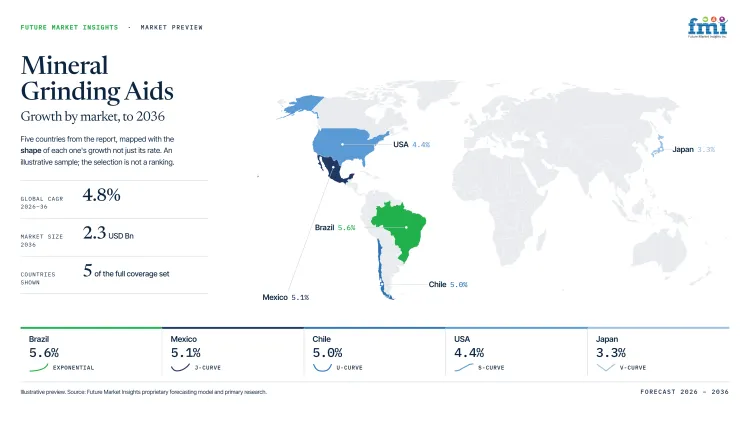
| Country | CAGR (2026 to 2036) |
|---|---|
| Brazil | 5.6% |
| USA | 4.4% |
| Japan | 3.3% |
| Mexico | 5.1% |
| Chile | 5.0% |
| Peru | 4.9% |
| Canada | 4.5% |
How do country-level CAGRs compare in the Mineral Grinding Aids Market?
Brazil leads at a 5.6% forecast CAGR, compared with Japan at 3.3%, a spread of 2.3 percentage points over 2026 to 2036. Mexico is also near the upper end, followed by mining-led demand in Chile and Peru. Canada and the USA grow more steadily, while Japan’s mature cement base faces weaker domestic volume. Installed mills, ore or clinker mix and project timing determine the demand behind each rate.
- Brazil: SNIC reported higher cement sales for 2025. Plant trials must show that an additive improves output or energy use with local raw materials while retaining the required cement quality.
- USA: Çimsa completed a Houston grey-cement grinding plant in October 2025. New capacity creates a qualification opportunity, but the additive still needs to meet the plant’s quality controls and cost-per-ton target.
- Japan: The Japan Cement Association’s July 2025 plant data describe a concentrated production base. With softer domestic demand, consistent quality and lower operating cost matter more than a claim of higher output alone.
- Mexico: The February 2026 USA-Mexico critical-minerals action plan includes project identification and technical cooperation. Chemical demand follows only when projects advance to testwork and operation, requiring support through those stages.
- Chile: COCHILCO’s August 2025 outlook described a large copper-production base. Changing ore hardness and slurry conditions require grinding-aid trials that reflect the actual concentrator campaign.
- Peru: MINEM reported higher 2025 copper production in March 2026. As ore blends and treated volumes change, operators need to check that the approved dosage continues to produce a useful result.
- Canada: Natural Resources Canada’s May 2026 review recorded growth in mineral exports. The dispersed processing base calls for dependable supply and technical support at individual sites, where grinding benefits must be demonstrated.
Regional coverage includes North America; Latin America; Western Europe; Eastern Europe; East Asia; South Asia and Pacific; Middle East and Africa.
Country-wise Analysis
- Brazil: Brazil's market is projected to expand at 5.6% CAGR over 2026 to 2036. SNIC reported in December 2025 that national cement sales reached 67 million tons in 2025 and rose 3.7% year over year. High interest rates and variable construction activity can delay investment. Local trials need to quantify energy, output and cement quality using Brazilian raw materials, with stock available after approval.
- USA: A 4.4% CAGR is forecast for the USA between 2026 and 2036. On October 14, 2025, Çimsa announced completion of a new grey cement grinding plant in Houston with 600 thousand tons of annual grinding capacity. Qualification remains conservative because new chemistry must fit existing quality controls and mill constraints. Documented trials and responsive technical service must establish a credible cost-per-ton benefit.
- Japan: The outlook for Japan implies 3.3% annual growth through 2036. The Japan Cement Association reported 15 companies and 26 cement plants as of July 1, 2025, with clinker capacity of 47.1 million tons per year. Domestic demand has been declining, which limits volume-led growth. Efficiency gains need consistent dosage behavior and compatibility with the established cement specifications.
- Mexico: Sales in Mexico are expected to grow at 5.1% CAGR during the forecast period. On February 4, 2026, the Secretaría de Economía published a United States-Mexico action plan on critical minerals. The plan includes technical cooperation and project identification. It also covers investment evaluation. Project timing and policy implementation can delay chemical demand. Local technical support must be available through trials and scale-up as the projects advance.
- Chile: Chile is expected to post 5.0% CAGR from 2026 to 2036. On August 13, 2025, COCHILCO projected Chilean mined-copper output of 5.58 million metric tons in 2025 and 5.75 million tons in 2026. Variable mineralogy and water-management constraints raise the qualification burden. Onsite trials and rheology expertise are needed to show a stable response as ore characteristics change.
- Peru: Peru's market is projected to expand at 4.9% CAGR over 2026 to 2036. MINEM reported on March 11, 2026 that 2025 copper production reached about 2.8 million metric tons of fine copper. The agency said production exceeded 2023 and 2024 levels. Technical interruptions and variable processed tonnage can change the operating baseline. Field support must revalidate dosage when the ore blend, throughput or other circuit conditions change.
- Canada: A 4.5% CAGR is forecast for Canada between 2026 and 2036. Long project lead times and capital discipline can slow adoption at individual sites. Trials should establish energy, throughput or slurry-handling benefits before wider deployment, with regional inventory supporting approved sites.
Who are the notable companies in the mineral grinding aids market?
Sika, Saint-Gobain Construction Chemicals, Mapei, Master Builders Solutions.
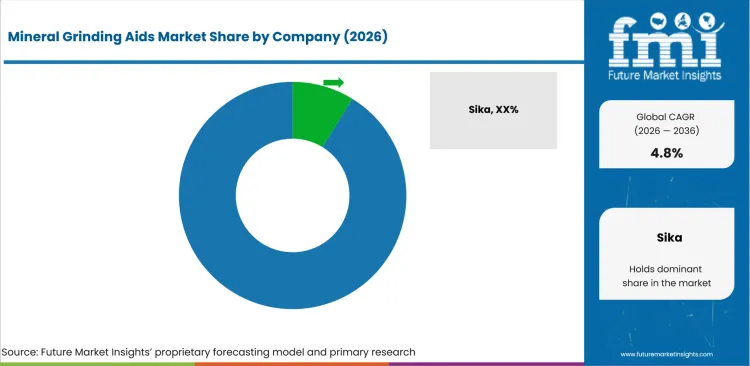
The company set is limited to current suppliers with a documented grinding-aid or cement-additive offer. Corporate subsidiaries are grouped under their current parent rather than counted as separate competitors.
- Sika and Mapei market dedicated grinding-aid and performance-enhancer ranges with plant support.
- Saint-Gobain Construction Chemicals brings together the Chryso, GCP and Fosroc platforms under one corporate owner. Master Builders Solutions supplies the MasterCem grinding-aid and cement-additive range.
Competitive Benchmarking: Mineral Grinding Aids Market
| Company | Grinding-aid range | Mineral-process chemistry | Plant application support | Geographic reach |
|---|---|---|---|---|
| Sika | High | High | High | International cement and construction markets |
| Saint-Gobain Construction Chemicals | High | High | High | International construction-chemicals markets |
| Mapei | High | High | High | International cement and construction markets |
| Master Builders Solutions | High | High | High | International cement and construction markets |
Scoring basis: High for Grinding-aid range denotes several documented grinding-aid or cement-additive grades. High for Mineral-process chemistry denotes formulations designed for grinding efficiency or cement performance. High for Plant application support denotes laboratory work, plant trials or dosing guidance. Ratings compare documented capabilities, not company sales shares.
Chryso, GCP Applied Technologies and Fosroc are represented once through Saint-Gobain Construction Chemicals. Suppliers whose public portfolios cover only adjacent mining reagents or general chemical inputs are excluded from the company table.
Key Developments in the Mineral Grinding Aids Market
- In February 2025, Saint-Gobain completed its acquisition of Fosroc, placing another cement-additive platform within the same group as Chryso and GCP Applied Technologies.
- Mapei's published cement-grinding program demonstrates the role of plant trials in matching dosage, throughput and cement performance before commercial use.
- Master Builders Solutions' current MasterCem portfolio includes grinding aids, performance enhancers and plant implementation support for cement producers.
Key Players in the Mineral Grinding Aids Market
Direct Grinding-Aid and Cement-Additive Suppliers
- Sika
- Saint-Gobain Construction Chemicals
- Mapei
- Master Builders Solutions
Mineral Grinding Aids Market - Report Scope
| Coverage field | Report scope |
|---|---|
| Market breakdown | Chemistry, Mineral, Function, End Use, Sales Channel |
| Quantitative Units | Revenue in USD Billion and CAGR in %. |
| Market Definition | Revenue includes mineral grinding aid formulations sold for use during cement and mineral grinding or comminution across the named market segments. It excludes mill equipment and grinding media, downstream cement or mineral product revenue, and adjacent process reagents not sold for the grinding function. |
| Regions Covered | North America; Latin America; Western Europe; Eastern Europe; East Asia; South Asia and Pacific; Middle East and Africa |
| Countries Covered | Brazil, USA, Japan, Mexico, Chile, Peru, Canada |
| Key Companies Profiled | Sika, Saint-Gobain Construction Chemicals, Mapei, Master Builders Solutions |
| Forecast Period | 2026 to 2036 |
| Approach | A hybrid bottom-up and top-down approach reconciles supplier category exposure with cement and mineral-processing demand indicators, plant operating patterns, pricing structures, and country benchmarks. Cross-checks exclude downstream finished-product value and adjacent reagents. |
Mineral Grinding Aids Market - Research Methodology
| Method | Approach |
|---|---|
| Primary Research | Primary research focuses on grinding-aid formulators and mineral-processing chemical suppliers. It also covers distributors, plant technical teams, procurement personnel, and subject-matter experts. Discussion topics include product-use conditions and qualification criteria as well as pricing behavior, route to market, and adoption difficulty. |
| Desk Research | Review of government and industry statistics, company filings and official product literature, trade and mining information, technical standards, and peer-reviewed grinding research. |
| Market Sizing and Forecasting | The sizing framework reconciles supplier-side category exposure with end-use activity in cement plants, mineral processors, mining concentrators, and industrial mineral plants. Forecast assumptions consider operating throughput, grinding intensity, chemistry mix, pricing structure, plant additions, technical substitution, and country-specific investment conditions. |
| Data Validation | Cross-checks compare value and volume logic across suppliers, end uses, countries, and technical applications. Validation excludes double counting, downstream finished-product value, grinding equipment and media, and adjacent process chemicals that are not sold for the grinding function. |
Mineral Grinding Aids Market by Segments
Mineral Grinding Aids Market segmented by Chemistry:
- Glycol-based aids
- Amine-based aids
- Polycarboxylate aids
- Surfactant blends
- Specialty dispersants
Mineral Grinding Aids Market segmented by Mineral:
- Cement minerals
- Limestone
- Copper ores
- Iron ore
- Phosphate/industrial minerals
Mineral Grinding Aids Market segmented by Function:
- Throughput improvement
- Energy reduction
- Particle size control
- Slurry dispersion
- Mill coating reduction
Mineral Grinding Aids Market segmented by End Use:
- Cement plants
- Mineral processors
- Mining concentrators
- Industrial mineral plants
Mineral Grinding Aids Market segmented by Sales Channel:
- Direct plant supply
- Chemical distributors
- Technical service packages
- Regional blenders
Mineral Grinding Aids Market by Region:
- North America
- United States
- Canada
- Latin America
- Brazil
- Mexico
- Argentina
- Chile
- Western Europe
- Germany
- France
- United Kingdom
- Italy
- Spain
- Benelux
- Nordics
- Eastern Europe
- Poland
- Czech Republic
- Romania
- Hungary
- East Asia
- China
- Japan
- South Korea
- South Asia and Pacific
- India
- ASEAN
- Australia and New Zealand
- Middle East and Africa
- GCC Countries
- South Africa
- Türkiye
- Israel
Research Sources and Bibliography
- Paul Prziwara and Arno Kwade (2020, September 20). Grinding aids for dry fine grinding processes - Part I: Mechanism of action and lab-scale grinding. Powder Technology.
- Jianyu Yang, Guanglin Li, Weijun Yang, and Junfeng Guan (2022, September 19). Effect of Polycarboxylic Grinding Aid on Cement Chemistry and Properties. Polymers 14(18), 3905.
- Mapei (2024, November 26). C-ADD: What are cement additives?
- Saint-Gobain (2025, February 10). Saint-Gobain completes the acquisition of Fosroc.
- Sika (2023, May 2). Sika successfully closes MBCC acquisition.
- Saint-Gobain (2022, September 22). Saint-Gobain’s acquisition of GCP Applied Technologies to close on September 27, 2022.
- Mapei (2025, December 9). The projects transforming Egypt.
- Sindicato Nacional da Indústria do Cimento (2025, December). Preliminary Results for December 2025.
- Çimsa (2025, October 14). Çimsa expands its grey cement production to three continents with its new investment in the USA
- Japan Cement Association (2025, July 1 data; accessed 2026, August 20). Cement industry overview.
- Secretaría de Economía, Mexico (2026, February 4). Plan de Acción Estados Unidos - México sobre Minerales Críticos.
- Comisión Chilena del Cobre (2025, August 13). Cochilco maintains copper price projection for 2025 and 2026.
- Ministerio de Energía y Minas, Peru (2026, March 11). Producción minera mostró resultados positivos en varios metales claves al cierre de 2025.
- Natural Resources Canada (2025, September). Mineral Trade: 2024 information bulletin.
- Chryso (accessed 2026, August 20). Cement additives: TAVERO grinding aids for cement and DARAGRIND grinding aids for minerals.
- Sika (n.d.; accessed September 9, 2026). SikaGrind-270 and Cement Grinding Aids.
- Mapei (n.d.; accessed September 9, 2026). MA.G.A. Cement Additives.
- Chryso (n.d.; accessed September 9, 2026). Tavero Grinding Aids for Cement.
- GCP Applied Technologies (n.d.; accessed September 9, 2026). DARAGRIND Mineral Grinding Aid.
- Master Builders Solutions (accessed September 9, 2026). MasterCem solutions for the cement industry.
This bibliography is provided for reader reference and is not exhaustive. The full report contains the complete reference list and detailed citations.
This Report Answers
- Which operating pressures in cement and mineral grinding support demand for mineral grinding aids?
- Why do Glycol-based aids hold the leading position in the Chemistry category?
- How does the leadership of Cement minerals influence demand across grinding applications?
- Why is Throughput improvement the leading Function in the Mineral Grinding Aids Market?
- Which companies have direct products and market-relevant capabilities in this market?
- What plant-qualification and performance risks limit adoption or switching between grinding-aid formulations?
- What should cement plant and mineral-processing decision-makers evaluate before approving a grinding-aid purchase?
Frequently Asked Questions
How big is the mineral grinding aids market in 2026?
The market is estimated at USD 1.5 Billion in 2026 and is projected to reach USD 2.3 Billion by 2036.
What is the CAGR of the mineral grinding aids market from 2026 to 2036?
The market is forecast to expand at a 4.8% CAGR from 2026 to 2036.
Which segment leads the chemistry category?
Glycol-based aids are expected to lead with a 31.0% share in 2026.
How much value is the mineral grinding aids market expected to add by 2036?
The projected increase between 2026 and 2036 is USD 0.8 Billion.
Which companies participate in the mineral grinding aids market?
Sika, Saint-Gobain Construction Chemicals, Mapei, Master Builders Solutions.
What is a notable restraint in the Mineral Grinding Aids Market?
Grinding-aid performance is sensitive to feed mineralogy and mill configuration, while target fineness or dosage can change the result. Buyers therefore require plant trials that confirm throughput and flow gains without creating unacceptable changes in strength and rheology or in downstream quality and product consistency.
Preview the report firsthand - request a free sample
Get SampleGet the brochure for pricing and purchase details.
Get PDFTable of Content
- Key Takeaways
- Market Size and CAGR
- Top Growth Driver
- Fastest Growing Segment
- Leading Region
- Key Companies
- Emerging Opportunities
- Executive Summary
- Global Market Outlook
- Demand-side Trends
- Supply-side Trends
- Technology Roadmap Analysis
- Analysis and Recommendations
- Analyst Perspective (What is happening? Why now? What should investors know?)
- Key Questions Answered
- How large is the market?
- What is the CAGR?
- What are key trends?
- Which region dominates?
- Who are the leaders?
- Market Overview
- Market Coverage / Taxonomy
- Market Definition / Scope / Limitations
- Research Methodology
- Chapter Orientation
- Analytical Lens and Working Hypotheses
- Market Structure, Signals, and Trend Drivers
- Benchmarking and Cross-market Comparability
- Market Sizing, Forecasting, and Opportunity Mapping
- Research Design and Evidence Framework
- Desk Research Programme (Secondary Evidence)
- Expert Input and Fieldwork (Primary Evidence)
- Tooling, Models, and Reference Databases
- Data Engineering and Model Build
- Quality Assurance and Audit Trail
- Market Background
- Market Dynamics (Drivers, Restraints, Opportunity, Trends)
- Scenario Forecast (Optimistic, Likely, Conservative)
- Impact Analysis
- AI Impact
- Sustainability Impact
- Regulatory Impact
- Technology Impact
- Consumer / Buyer Analysis
- Purchase Drivers
- Adoption Barriers
- Buyer Journey
- Opportunity Map Analysis
- Product Life Cycle Analysis
- Supply Chain Analysis
- Investment Feasibility Matrix
- Value Chain Analysis
- PESTLE and Porter's Analysis
- Regulatory Landscape
- Regional Parent Market Outlook
- Production and Consumption Statistics
- Import and Export Statistics
- Global Market Analysis and Forecast, 2021 to 2036
- Historical Market Size Value (USD Billion) Analysis, 2021 to 2025
- Current and Future Market Size Value (USD Billion) Projections, 2026 to 2036
- Y-o-Y Growth Trend Analysis
- Absolute $ Opportunity Analysis
- Global Market Pricing Analysis, 2021 to 2036
- Global Market Analysis and Forecast, By Chemistry, 2021 to 2036
- Introduction / Key Findings
- Historical Market Size Value (USD Billion) Analysis By Chemistry, 2021 to 2025
- Current and Future Market Size Value (USD Billion) Analysis and Forecast By Chemistry, 2026 to 2036
- Glycol-based aids
- Amine-based aids
- Polycarboxylate aids
- Surfactant blends
- Specialty dispersants
- Glycol-based aids
- Y-o-Y Growth Trend Analysis By Chemistry, 2021 to 2025
- Absolute $ Opportunity Analysis By Chemistry, 2026 to 2036
- Global Market Analysis and Forecast, By Mineral, 2021 to 2036
- Introduction / Key Findings
- Historical Market Size Value (USD Billion) Analysis By Mineral, 2021 to 2025
- Current and Future Market Size Value (USD Billion) Analysis and Forecast By Mineral, 2026 to 2036
- Cement minerals
- Limestone
- Copper ores
- Iron ore
- Phosphate/industrial minerals
- Cement minerals
- Y-o-Y Growth Trend Analysis By Mineral, 2021 to 2025
- Absolute $ Opportunity Analysis By Mineral, 2026 to 2036
- Global Market Analysis and Forecast, By Function, 2021 to 2036
- Introduction / Key Findings
- Historical Market Size Value (USD Billion) Analysis By Function, 2021 to 2025
- Current and Future Market Size Value (USD Billion) Analysis and Forecast By Function, 2026 to 2036
- Throughput improvement
- Energy reduction
- Particle size control
- Slurry dispersion
- Mill coating reduction
- Throughput improvement
- Y-o-Y Growth Trend Analysis By Function, 2021 to 2025
- Absolute $ Opportunity Analysis By Function, 2026 to 2036
- Global Market Analysis and Forecast, By End Use, 2021 to 2036
- Introduction / Key Findings
- Historical Market Size Value (USD Billion) Analysis By End Use, 2021 to 2025
- Current and Future Market Size Value (USD Billion) Analysis and Forecast By End Use, 2026 to 2036
- Cement plants
- Mineral processors
- Mining concentrators
- Industrial mineral plants
- Cement plants
- Y-o-Y Growth Trend Analysis By End Use, 2021 to 2025
- Absolute $ Opportunity Analysis By End Use, 2026 to 2036
- Global Market Analysis and Forecast, By Sales Channel, 2021 to 2036
- Introduction / Key Findings
- Historical Market Size Value (USD Billion) Analysis By Sales Channel, 2021 to 2025
- Current and Future Market Size Value (USD Billion) Analysis and Forecast By Sales Channel, 2026 to 2036
- Direct plant supply
- Chemical distributors
- Technical service packages
- Regional blenders
- Direct plant supply
- Y-o-Y Growth Trend Analysis By Sales Channel, 2021 to 2025
- Absolute $ Opportunity Analysis By Sales Channel, 2026 to 2036
- Global Market Analysis and Forecast, By Region, 2021 to 2036
- Introduction
- Historical Market Size Value (USD Billion) Analysis By Region, 2021 to 2025
- Current Market Size Value (USD Billion) Analysis and Forecast By Region, 2026 to 2036
- North America
- Latin America
- Western Europe
- Eastern Europe
- East Asia
- South Asia and Pacific
- Middle East & Africa
- Market Attractiveness Analysis By Region
- North America Market Analysis and Forecast, By Country, 2021 to 2036
- Historical Market Size Value (USD Billion) Trend Analysis By Market Taxonomy, 2021 to 2025
- Market Size Value (USD Billion) Forecast By Market Taxonomy, 2026 to 2036
- By Country
- USA
- Canada
- By Chemistry
- By Mineral
- By Function
- By End Use
- By Sales Channel
- By Country
- Market Attractiveness Analysis
- By Country
- By Chemistry
- By Mineral
- By Function
- By End Use
- By Sales Channel
- Key Takeaways
- Latin America Market Analysis and Forecast, By Country
- Historical Market Size Value (USD Billion) Trend Analysis By Market Taxonomy, 2021 to 2025
- Market Size Value (USD Billion) Forecast By Market Taxonomy, 2026 to 2036
- By Country
- Brazil
- Mexico
- Chile
- Rest of Latin America
- By Chemistry
- By Mineral
- By Function
- By End Use
- By Sales Channel
- By Country
- Market Attractiveness Analysis
- By Country
- By Chemistry
- By Mineral
- By Function
- By End Use
- By Sales Channel
- Key Takeaways
- Western Europe Market Analysis and Forecast, By Country
- Historical Market Size Value (USD Billion) Trend Analysis By Market Taxonomy, 2021 to 2025
- Market Size Value (USD Billion) Forecast By Market Taxonomy, 2026 to 2036
- By Country
- Germany
- UK
- Italy
- Spain
- France
- Nordic
- BENELUX
- Rest of Western Europe
- By Chemistry
- By Mineral
- By Function
- By End Use
- By Sales Channel
- By Country
- Market Attractiveness Analysis
- By Country
- By Chemistry
- By Mineral
- By Function
- By End Use
- By Sales Channel
- Key Takeaways
- Eastern Europe Market Analysis and Forecast, By Country
- Historical Market Size Value (USD Billion) Trend Analysis By Market Taxonomy, 2021 to 2025
- Market Size Value (USD Billion) Forecast By Market Taxonomy, 2026 to 2036
- By Country
- Russia
- Poland
- Hungary
- Balkan & Baltic
- Rest of Eastern Europe
- By Chemistry
- By Mineral
- By Function
- By End Use
- By Sales Channel
- By Country
- Market Attractiveness Analysis
- By Country
- By Chemistry
- By Mineral
- By Function
- By End Use
- By Sales Channel
- Key Takeaways
- East Asia Market Analysis and Forecast, By Country
- Historical Market Size Value (USD Billion) Trend Analysis By Market Taxonomy, 2021 to 2025
- Market Size Value (USD Billion) Forecast By Market Taxonomy, 2026 to 2036
- By Country
- China
- Japan
- South Korea
- By Chemistry
- By Mineral
- By Function
- By End Use
- By Sales Channel
- By Country
- Market Attractiveness Analysis
- By Country
- By Chemistry
- By Mineral
- By Function
- By End Use
- By Sales Channel
- Key Takeaways
- South Asia and Pacific Market Analysis and Forecast, By Country
- Historical Market Size Value (USD Billion) Trend Analysis By Market Taxonomy, 2021 to 2025
- Market Size Value (USD Billion) Forecast By Market Taxonomy, 2026 to 2036
- By Country
- India
- ASEAN
- Australia & New Zealand
- Rest of South Asia and Pacific
- By Chemistry
- By Mineral
- By Function
- By End Use
- By Sales Channel
- By Country
- Market Attractiveness Analysis
- By Country
- By Chemistry
- By Mineral
- By Function
- By End Use
- By Sales Channel
- Key Takeaways
- Middle East & Africa Market Analysis and Forecast, By Country
- Historical Market Size Value (USD Billion) Trend Analysis By Market Taxonomy, 2021 to 2025
- Market Size Value (USD Billion) Forecast By Market Taxonomy, 2026 to 2036
- By Country
- Kingdom of Saudi Arabia
- Other GCC Countries
- Türkiye
- South Africa
- Other African Union
- Rest of Middle East & Africa
- By Chemistry
- By Mineral
- By Function
- By End Use
- By Sales Channel
- By Country
- Market Attractiveness Analysis
- By Country
- By Chemistry
- By Mineral
- By Function
- By End Use
- By Sales Channel
- Key Takeaways
- Key Countries Market Analysis
- USA
- Pricing Analysis
- Market Share Analysis, 2025
- By Chemistry
- By Mineral
- By Function
- By End Use
- By Sales Channel
- Canada
- Pricing Analysis
- Market Share Analysis, 2025
- By Chemistry
- By Mineral
- By Function
- By End Use
- By Sales Channel
- Mexico
- Pricing Analysis
- Market Share Analysis, 2025
- By Chemistry
- By Mineral
- By Function
- By End Use
- By Sales Channel
- Brazil
- Pricing Analysis
- Market Share Analysis, 2025
- By Chemistry
- By Mineral
- By Function
- By End Use
- By Sales Channel
- Chile
- Pricing Analysis
- Market Share Analysis, 2025
- By Chemistry
- By Mineral
- By Function
- By End Use
- By Sales Channel
- Germany
- Pricing Analysis
- Market Share Analysis, 2025
- By Chemistry
- By Mineral
- By Function
- By End Use
- By Sales Channel
- UK
- Pricing Analysis
- Market Share Analysis, 2025
- By Chemistry
- By Mineral
- By Function
- By End Use
- By Sales Channel
- Italy
- Pricing Analysis
- Market Share Analysis, 2025
- By Chemistry
- By Mineral
- By Function
- By End Use
- By Sales Channel
- Spain
- Pricing Analysis
- Market Share Analysis, 2025
- By Chemistry
- By Mineral
- By Function
- By End Use
- By Sales Channel
- France
- Pricing Analysis
- Market Share Analysis, 2025
- By Chemistry
- By Mineral
- By Function
- By End Use
- By Sales Channel
- India
- Pricing Analysis
- Market Share Analysis, 2025
- By Chemistry
- By Mineral
- By Function
- By End Use
- By Sales Channel
- ASEAN
- Pricing Analysis
- Market Share Analysis, 2025
- By Chemistry
- By Mineral
- By Function
- By End Use
- By Sales Channel
- Australia & New Zealand
- Pricing Analysis
- Market Share Analysis, 2025
- By Chemistry
- By Mineral
- By Function
- By End Use
- By Sales Channel
- China
- Pricing Analysis
- Market Share Analysis, 2025
- By Chemistry
- By Mineral
- By Function
- By End Use
- By Sales Channel
- Japan
- Pricing Analysis
- Market Share Analysis, 2025
- By Chemistry
- By Mineral
- By Function
- By End Use
- By Sales Channel
- South Korea
- Pricing Analysis
- Market Share Analysis, 2025
- By Chemistry
- By Mineral
- By Function
- By End Use
- By Sales Channel
- Russia
- Pricing Analysis
- Market Share Analysis, 2025
- By Chemistry
- By Mineral
- By Function
- By End Use
- By Sales Channel
- Poland
- Pricing Analysis
- Market Share Analysis, 2025
- By Chemistry
- By Mineral
- By Function
- By End Use
- By Sales Channel
- Hungary
- Pricing Analysis
- Market Share Analysis, 2025
- By Chemistry
- By Mineral
- By Function
- By End Use
- By Sales Channel
- Kingdom of Saudi Arabia
- Pricing Analysis
- Market Share Analysis, 2025
- By Chemistry
- By Mineral
- By Function
- By End Use
- By Sales Channel
- Türkiye
- Pricing Analysis
- Market Share Analysis, 2025
- By Chemistry
- By Mineral
- By Function
- By End Use
- By Sales Channel
- South Africa
- Pricing Analysis
- Market Share Analysis, 2025
- By Chemistry
- By Mineral
- By Function
- By End Use
- By Sales Channel
- USA
- Market Structure Analysis
- Competition Dashboard
- Competition Benchmarking
- Market Share Analysis of Top Players
- By Regional
- By Chemistry
- By Mineral
- By Function
- By End Use
- By Sales Channel
- Emerging Startups
- Innovation Benchmarking
- Competition Analysis
- Competition Deep Dive
- Sika
- Overview
- Product Portfolio
- Profitability by Market Segments
- Sales Footprint
- Strategy Overview
- Marketing Strategy
- Product Strategy
- Channel Strategy
- BASF
- Chryso / Saint-Gobain
- Mapei
- GCP Applied Technologies / Saint-Gobain
- Fosroc
- Solvay
- Nouryon
- Clariant
- Dow
- Sika
- Case Studies
- Success Stories
- Recent Developments
- Competition Deep Dive
- Assumptions & Acronyms Used


