

- Market Size (2026)
- USD 1.8 Bn
- Forecast (2036)
- USD 3.8 Bn
- CAGR (2026 to 2036)
- 7.6%
How big is the Back Grinding System market in 2026?
USD 1.8 billion in 2026 and USD 3.8 billion by 2036 at a 7.6% CAGR.
Back grinding system industry value is predicted to rise from USD 1.7 billion in 2025 to USD 3.8 billion by 2036 at 7.6% CAGR, driven by semiconductor buyers adding wafer-thinning control before advanced package assembly. Direct OEM is expected to hold 81.0% share in 2026, supported by equipment qualification and service access. Fully Automatic Systems are projected to secure 72.0% share in 2026, influenced by fragile wafer handling needs after thinning.
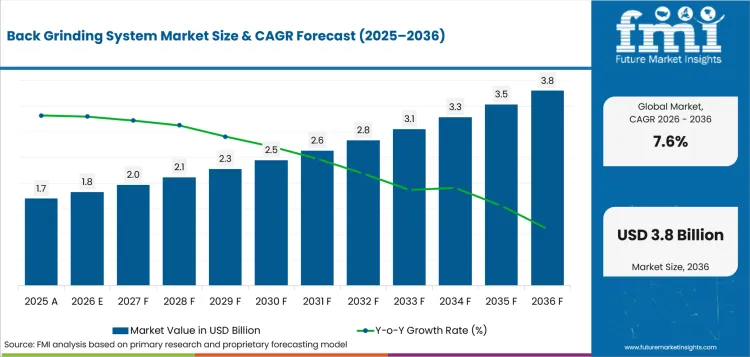
| Metric | Value |
|---|---|
| 2026 Market Size | USD 1.8 billion |
| 2036 Market Size | USD 3.8 billion |
| Forecast CAGR | 7.6% from 2026 to 2036 |
| Leading Sales Channel | Direct OEM |
| Direct OEM Share in 2026 | 81.0% |
| Leading Automation | Fully Automatic Systems |
| Fully Automatic Systems Share in 2026 | 72.0% |
| Fastest-growing Country | India |
| India CAGR | 9.0% by 2036 |
Summary of the Back Grinding System Market
| Market Signal | Commercial Impact |
|---|---|
| Demand and Growth Drivers | Demand for back grinding systems is increasing with advanced semiconductor packaging and thin-wafer manufacturing.
|
| Product and Segment View | Large-wafer, fully automatic, and OEM-supported systems dominate the market.
|
| Geography and Growth Outlook | India and China are expected to remain the fastest-growing regional markets.
|
| Competitive Landscape | Competition centers on grinding expertise, process capability, and service support.
|
| Analyst Perspective | Back grinding systems have become yield-critical equipment in advanced semiconductor manufacturing.
Nikhil Kaitwade, Principal Consultant, Industrial Automation, Future Market Insights |
Semiconductor equipment demand is pushing wafer thinning deeper into package yield planning. SEMI reported that global semiconductor manufacturing equipment sales rose 15% to USD 135.1 billion in 2025 from USD 117.1 billion in 2024, increasing the installed base requiring back-end preparation.
United States advanced packaging funding announced in January 2025 included USD 1.4 billion in final awards, reinforcing demand for wafer-level process equipment. European Chips Act project reporting in 2026 listed 13 approved state-aid decisions for first-of-a-kind facilities, representing over EUR 32 billion in public and private investment. Back grinding system suppliers gain value as thin-wafer handling and grind-polish process stability shape final package output.
Which factors support expansion in the Back Grinding System market?
Finished wafer thinning cells and direct OEM support programs support market value across semiconductor back-end and package-integration projects.
- Market value rises as high-density package flows require thinner die and tighter backside quality before bonding or stacking.
- Grind-polish integration raises equipment value as customers link removal and wafer cleaning inside one process route.
- Power semiconductor buyers influence demand through SiC and specialty substrate thinning requirements that need harder-material process control.
- Memory and HBM package lines require repeatable wafer transfer as breakage risk rises after material removal.
Why is the Back Grinding System market growing?
Thin-wafer processing is growing as package integration raises the commercial cost of backside defects.
Back grinding demand rises as wafer thinning affects die strength and package yield. SEMI’s December 2025 equipment forecast projected assembly and packaging equipment sales to rise 19.6% to USD 6.0 billion in 2025, showing how back-end investment is supporting more advanced package preparation. Wafer thinning sits between front-end processing and assembly, so poor grinding quality can damage value already created upstream. Suppliers that combine grinding and local service gain stronger positions as customers reduce qualification risk.
How is the Back Grinding System Market segmented?
Back Grinding System Market is segmented by system type, wafer size, application, automation, and sales channel.
- Wafer back grinders are projected to account for 48.5% share in 2026, influenced by primary thinning demand before polish and dicing steps.
- 300 mm wafer systems are expected to hold 62.0% share in 2026, shaped by high-volume fabs and automated cassette handling across large wafer lots.
- Foundry and advanced device manufacturing is anticipated to account for 38.0% share in 2026, led by backside processing needs before high-value package assembly.
- Fully automatic systems are projected to hold 72.0% share by Automation in 2026, guided by fragile wafer transfer requirements after thinning.
- Direct OEM is expected to represent 81.0% share by Sales Channel in 2026, supported by tool qualification and process recipe control.
Why do wafer back grinders dominate the Back Grinding System market by system type?
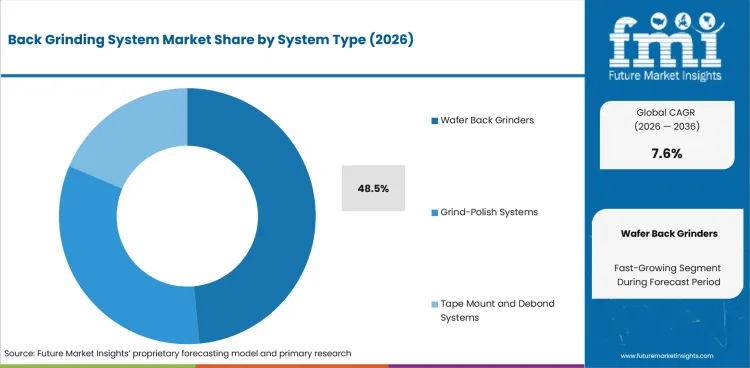
- Wafer back grinders are projected to account for 48.5% share in 2026, driven by primary silicon removal needs before polish and dicing preparation.
- Grind-polish systems gain demand as advanced package buyers want lower subsurface damage and smoother backside surfaces before bonding or stacking.
Which wafer size leads the Back Grinding System market?
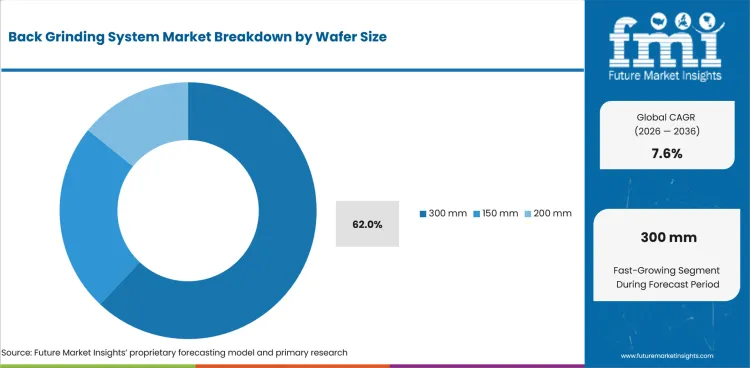
- 300 mm wafer systems are expected to hold 62.0% share in 2026, shaped by high-value wafer lots and automated material movement across major fabs.
- 200 mm systems remain active in power devices and specialty substrates, supported by compound semiconductor lines and mature device production.
Which application leads the Back Grinding System Market?
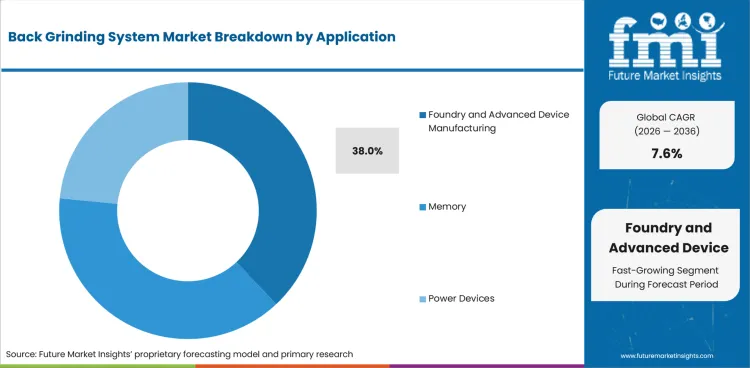
- Foundry and advanced device manufacturing is anticipated to account for 38.0% share in 2026, led by backside processing needs before dicing, stacking, and assembly.
- Memory applications gain demand as HBM and 3D package flows require repeatable handling and better stress control.
Which automation level leads the Back Grinding System Market?
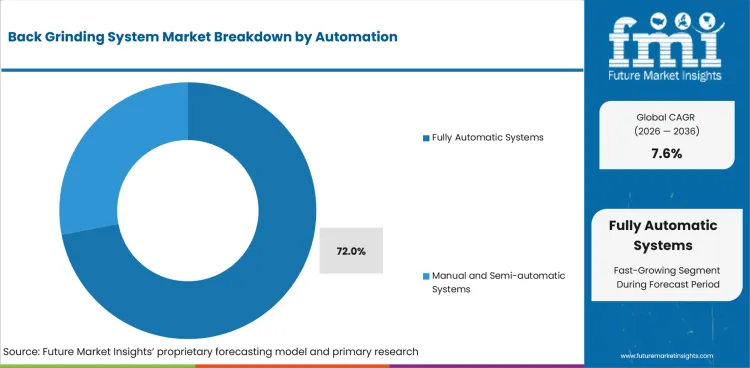
- Fully Automatic Systems are projected to hold 72.0% share in 2026, reflected by thin-wafer fragility and lower tolerance for manual loading errors.
- Manual and Semi-automatic Systems retain use in research and specialty production settings with lower volume needs.
Which sales channel leads the Back Grinding System Market?
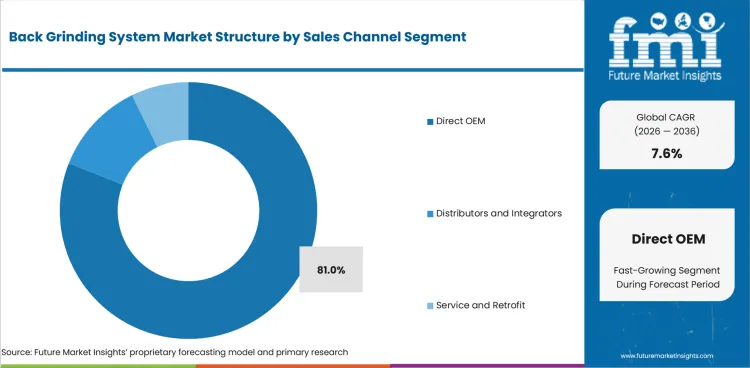
- Direct OEM is expected to represent 81.0% share in 2026, guided by buyer preference for approved configurations and process support.
- Distributors and integrators remain active in retrofit and specialty accounts that need localized equipment access and support coordination.
What are the drivers, restraints, and opportunities in the Back Grinding System Market?
Thin-wafer handling, process qualification, and package integration are shaping back grinding system buying decisions.
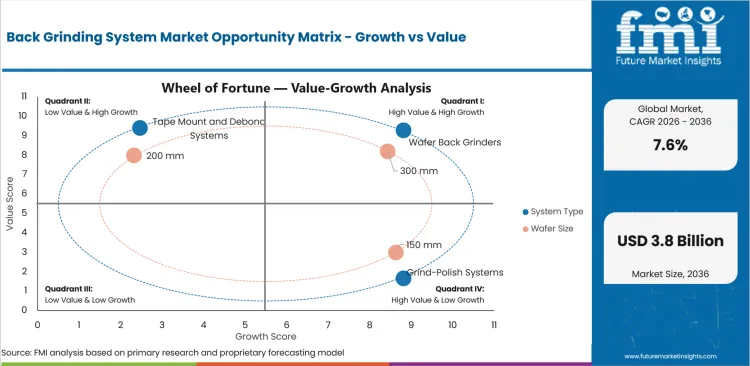
- Driver: HBM and package-integration flows require tighter thinning control before assembly.
- Restraint: Tool qualification and recipe approval can delay switching once a grinder is validated on a production line.
- Opportunity: Integrated grind-polish and debond systems can raise supplier value in advanced package workflows.
Advanced Packaging Pull Strengthens Tool Demand
Advanced package investment increases demand for equipment that can thin wafers without weakening downstream yield. SEMI projected wafer fab equipment sales to grow 9.0% in 2026 and 7.3% in 2027, reaching USD 135.2 billion as leading-edge and mature-node capacity expands. Wafer thinning suppliers benefit as fabs and OSATs coordinate front-end output with package preparation. Back grinding systems gain priority as package value rises before final assembly.
Qualification Cost Slows Supplier Switching
Back grinding systems can be difficult to replace after a process recipe is approved. National Institute of Standards and Technology packaging funding guidance in 2024 set award ranges from USD 10 million to USD 150 million across multi-year research activities, showing how advanced packaging validation requires large technical budgets. Equipment buyers therefore avoid switching unless a new system proves thickness control and low breakage under production conditions. Smaller buyers can delay upgrades if approval resources remain limited.
Integrated Thin-Wafer Lines Create Upside
Integrated thinning cells can improve buyer confidence by linking grind, polish, tape handling, and debond support inside one qualified flow. National Institute of Standards and Technology launched an advanced packaging competition in 2024 with up to USD 1.6 billion across 5 research and development areas, including equipment and process capabilities. Funding signals support higher demand for wafer-level preparation tools. Suppliers offering integrated cells and recipe support can capture more account value than stand-alone grinder vendors.
Which countries are growing fastest in the Back Grinding System market?
India 9.0% CAGR, China 8.4% CAGR, South Korea 8.1% CAGR, United States 7.5% CAGR, Japan 7.2% CAGR, Germany 6.9% CAGR, France 6.6% CAGR, and United Kingdom 5.3% CAGR through 2036.
.webp "Top Country Growth Comparison Back Grinding System Market Cagr (2026 2036)")
| Country | CAGR |
|---|---|
| India | 9.0% |
| China | 8.4% |
| South Korea | 8.1% |
| United States | 7.5% |
| Japan | 7.2% |
| Germany | 6.9% |
| France | 6.6% |
| United Kingdom | 5.3% |
Source: Future Market Insights, 2026.
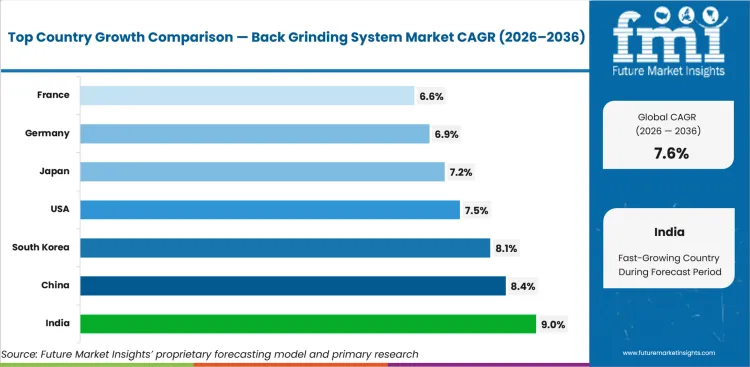
How do country-level CAGRs compare in the Back Grinding System Market?
India leads country expansion while the United Kingdom records the most cautious pace among profiled markets.
- India is forecast to record 9.0% CAGR by 2036 through OSAT and package project approvals.
- China is expected to expand at 8.4% CAGR from 2026 to 2036, led by mature-node capacity and packaging equipment needs.
- South Korea is projected to grow at 8.1% CAGR through 2036, supported by HB and advanced package preparation.
- United States is estimated to rise at 7.5% CAGR by 2036, linked to advanced packaging funding and pilot-line development.
- Japan is expected to advance at 7.2% CAGR over the forecast period, backed by precision equipment buyers and domestic chip policy.
- Germany is forecast to grow at 6.9% CAGR by 2036, supported by automotive semiconductor and SiC manufacturing activity.
- France is projected to post 6.6% CAGR by 2036, guided by 300 mm capacity investment and FD-SOI production.
- United Kingdom is expected to record 5.3% CAGR by 2036, supported by compound semiconductor clusters and specialty wafer processing.
How fast is the Back Grinding System market growing in India?
A 9.0% CAGR through 2036 reflects compound semiconductor and package pilot-line investment.
Country Market Snapshot Table
| Parameter | Value |
|---|---|
| Market Size in 2025 (Value) | USD 108.3 million |
| Market Size in 2026 (Value) | USD 118.0 million |
| Market Forecast in 2036 (Value) | USD 279.5 million |
| CAGR (2026 to 2036) | 9.0% |
| Years Considered | 2021 to 2036 |
| Base Year | 2025 |
| Forecast Period | 2026 to 2036 |
| Units Considered | Value (USD million) |
| Leading Sub-Region | Gujarat, Karnataka, Assam, and Tamil Nadu semiconductor corridors |
India Back Grinding System Market Outlook
- India’s back grinding system outlook is tied to new semiconductor assembly and packaging projects. Local buyers need grinder suppliers that can provide installation support and maintenance access.
- Equipment adoption is expected to build step by step as approved projects move from construction into qualification. Service depth will decide supplier acceptance among early fabs and OSAT facilities.
Key Growth Drivers
- Approved semiconductor projects create a new equipment buyer base, supported by 10 approved projects across 6 states and total investment of about INR 1.60 lakh crore by December 2025.
- New assembly and component projects deepen local tool demand, shown by 2 approved projects in May 2026 and cumulative investment near INR 3,936 crore.
- Local DISCO sales and maintenance presence improves buyer confidence for grinder installation and post-sale field response.
- Compound semiconductor and OSAT lines need back grinding cells that can support recipe trials before volume output begins.
Key Restraints
- Early-stage fab construction can delay repeat equipment orders until facilities complete utility setup and process qualification.
- Skilled maintenance capacity remains limited for advanced thinning cells that need wheel selection and process measurement discipline.
- Design-side activity can move faster than equipment localization, reflected by 24 approved semiconductor chip and system-on-chip projects in 2026 under official design support.
What makes India unique
India stands apart through new OSAT projects and local service formation for first-generation chip facilities.
Key Companies
- Micromatic Grinding Technologies
- HMT Machine Tools
- Ace Micromatic Group
Sales & Marketing Channels
- Direct OEM sales to approved semiconductor projects
- Local sales and maintenance subsidiaries
- EPC and facility contractor relationships
- Package pilot-line demonstrations
- Equipment service agreements
- Training-led technical selling
Country Segment Breakdown Table
| Segment | Sub-Segments |
|---|---|
| By System Type | Wafer Back Grinders · Grind-Polish Systems · Tape Mount and Debond Systems · Integrated Thin-wafer Lines |
| By Wafer Size | 150 mm · 200 mm · 300 mm · Specialty and Other |
| By Application | Foundry and Advanced Device Manufacturing · Memory · Power Devices · Package Integration |
| By Automation | Manual and Semi-automatic Systems · Fully Automatic Systems |
| By Sales Channel | Direct OEM · Distributors and Integrators · Service and Retrofit |
| Key Sub-Regions Covered, Industrial Corridors | Gujarat · Karnataka · Assam · Tamil Nadu · Telangana · Uttar Pradesh |
Frequently Asked Questions
How fast is India Back Grinding System market growing?
Industry in India is projected to rise at 9.0% CAGR from 2026 to 2036, supported by approved chip projects and package-line setup.
Who leads India Back Grinding System market?
DISCO Corporation leads India through wafer-thinning tool access and service support, while Micromatic Grinding Technologies supports local precision-grinding capacity.
What is driving adoption in India Back Grinding System market?
New OSAT lines and training-led service requirements are supporting direct OEM tool purchases.
What is the Back Grinding System market outlook in China?
An 8.4% CAGR through 2036 reflects mature-node fabs and package capacity.
Country Market Snapshot Table
| Parameter | Value |
|---|---|
| Market Size in 2025 (Value) | USD 381.9 million |
| Market Size in 2026 (Value) | USD 414.0 million |
| Market Forecast in 2036 (Value) | USD 928.4 million |
| CAGR (2026 to 2036) | 8.4% |
| Years Considered | 2021 to 2036 |
| Base Year | 2025 |
| Forecast Period | 2026 to 2036 |
| Units Considered | Value (USD million) |
| Leading Sub-Region | Yangtze River Delta and Pearl River Delta semiconductor corridors |
China Back Grinding System Market Outlook
- China’s back grinding system outlook reflects mature-node expansion and package capacity. Buyers evaluate tool performance and local service reliability before qualification.
- Regional support networks help imported and local equipment channels maintain installed systems. Packaging demand keeps purchases active for grinders and thin-wafer transfer tools.
Key Growth Drivers
- Large 300 mm equipment plans support wafer tool demand, shown by China’s projected investment of over USD 100 billion in 300 mm fab equipment across 2025 to 2027.
- Equipment spending remains large despite cycle normalization, as China recorded USD 49.3 billion in semiconductor equipment sales during 2025.
- Mature-node fabs and power device lines need grinder capacity that can support silicon and harder substrate preparation.
- Local service teams remain important as customers compare imported tool quality against repair speed and parts availability.
Key Restraints
- Export controls can limit access to advanced tool configurations and software support for selected manufacturing nodes.
- Qualification timelines can slow supplier changes after a grinder platform enters production recipes.
- Trade controls added pressure to advanced equipment access, illustrated by 24 semiconductor manufacturing equipment types and 3 software tools placed under additional restrictions in December 2024.
What makes China unique
China differs from other markets through large 300 mm spending and broad package assembly demand.
Key Companies
- Beijing Wannianqing Instrument
- Jiangsu JingChuang Advanced
- Precision Surfacing Solutions Nanjing
- Qingdao Lapping & Polishing Equipment
Sales & Marketing Channels
- Direct sales to fabs and OSAT groups
- Regional equipment distributors
- Local maintenance and spare-part channels
- Demonstration-based qualification
- Integrated package-line partnerships
- Service contracts for installed grinder fleets
Country Segment Breakdown Table
| Segment | Sub-Segments |
|---|---|
| By System Type | Wafer Back Grinders · Grind-Polish Systems · Tape Mount and Debond Systems · Integrated Thin-wafer Lines |
| By Wafer Size | 150 mm · 200 mm · 300 mm · Specialty and Other |
| By Application | Foundry and Advanced Device Manufacturing · Memory · Power Devices · Package Integration |
| By Automation | Manual and Semi-automatic Systems · Fully Automatic Systems |
| By Sales Channel | Direct OEM · Distributors and Integrators · Service and Retrofit |
| Key Sub-Regions Covered, Industrial Corridors | Yangtze River Delta · Pearl River Delta · Beijing-Tianjin-Hebei · Sichuan · Hubei · Fujian |
Frequently Asked Questions
How fast is China Back Grinding System market growing?
Industry in China is projected to rise at 8.4% CAGR from 2026 to 2036, aligned to mature-node and package capacity additions.
Who leads China Back Grinding System market?
DISCO Corporation leads high-end China wafer thinning demand, while Beijing Wannianqing Instrument and Precision Surfacing Solutions Nanjing support local supply.
What is driving adoption in China Back Grinding System market?
Package assembly and power device production are increasing demand for service-backed wafer thinning tools.
What is the Back Grinding System Market outlook in South Korea?
An 8.1% CAGR through 2036 reflects memory and package capacity requirements.
Country Market Snapshot Table
| Parameter | Value |
|---|---|
| Market Size in 2025 (Value) | USD 297.9 million |
| Market Size in 2026 (Value) | USD 322.0 million |
| Market Forecast in 2036 (Value) | USD 701.8 million |
| CAGR (2026 to 2036) | 8.1% |
| Years Considered | 2021 to 2036 |
| Base Year | 2025 |
| Forecast Period | 2026 to 2036 |
| Units Considered | Value (USD million) |
| Leading Sub-Region | Gyeonggi and Chungcheong memory corridors |
South Korea Back Grinding System Market Outlook
- South Korean buyers link back grinding purchases to HBM package stacks and thin-wafer repeatability. Process teams require stable thickness control and rapid service response across high-value wafer lots.
- Equipment suppliers must prove low breakage and integration across polish or tape steps. Field response carries strong weight once tools enter production.
Key Growth Drivers
- Memory and HBM activity supports grinder demand, reflected by Korean semiconductor output rising 13.2% year over year in 2025.
- Heavy equipment investment reinforces tool purchases, as Korea’s semiconductor equipment sales rose 26% to USD 25.8 billion in 2025.
- HBM and 3D NAND flows require repeatable thinning before die stacking and package assembly.
- Supplier engineering access remains central as downtime can disrupt high-value memory production.
Key Restraints
- High qualification standards can slow adoption of unfamiliar grinder platforms inside memory production lines.
- Customers may require extended trials before approving grinder changes for HBM-related process routes.
- Advanced technology controls can influence HBM-linked tool flows, evidenced by 140 additional parties added to restricted export lists in December 2024.
What makes South Korea unique
South Korea has a distinct profile built around HBM intensity and strict repeatability across production tools.
Key Companies
- NTS
- AM Technology
- Kornic Semitech
- YDI
- DISCO Corporation
- Tokyo Seimitsu
- Okamoto Machine Tool Works
Sales & Marketing Channels
- Direct OEM engagement with memory fabs
- Local engineering teams
- Process recipe demonstrations
- Tool uptime agreements
- Wheel and process support
- Package-line qualification programs
Country Segment Breakdown Table
| Segment | Sub-Segments |
|---|---|
| By System Type | Wafer Back Grinders · Grind-Polish Systems · Tape Mount and Debond Systems · Integrated Thin-wafer Lines |
| By Wafer Size | 150 mm · 200 mm · 300 mm · Specialty and Other |
| By Application | Foundry and Advanced Device Manufacturing · Memory · Power Devices · Package Integration |
| By Automation | Manual and Semi-automatic Systems · Fully Automatic Systems |
| By Sales Channel | Direct OEM · Distributors and Integrators · Service and Retrofit |
| Key Sub-Regions Covered, Industrial Corridors | Gyeonggi · Chungcheong · Gumi · Incheon · Daejeon · Busan |
Frequently Asked Questions
How fast is South Korea Back Grinding System market growing?
Industry in South Korea is projected to rise at 8.1% CAGR from 2026 to 2036, supported by memory and HBM package flows.
Who leads South Korea Back Grinding System market?
DISCO Corporation leads premium South Korea wafer thinning demand, while NTS and AM Technology lead local grinder-system supply.
What is driving adoption in South Korea Back Grinding System market?
HBM production and high-value wafer handling requirements support fully automatic thinning systems.
What is the Back Grinding System Market outlook in the United States?
A 7.5% CAGR through 2036 reflects advanced packaging programs and domestic semiconductor investment.
Country Market Snapshot Table
| Parameter | Value |
|---|---|
| Market Size in 2025 (Value) | USD 288.4 million |
| Market Size in 2026 (Value) | USD 310.0 million |
| Market Forecast in 2036 (Value) | USD 639.2 million |
| CAGR (2026 to 2036) | 7.5% |
| Years Considered | 2021 to 2036 |
| Base Year | 2025 |
| Forecast Period | 2026 to 2036 |
| Units Considered | Value (USD million) |
| Leading Sub-Region | Arizona, Texas, New York, and Oregon semiconductor corridors |
United States Back Grinding System Market Outlook
- United States adoption is built around advanced packaging research and domestic semiconductor capacity. Buyers need tool suppliers that can support process validation across fabs and research centers.
- Package development programs increase attention on wafer-level thinning and stress relief. Equipment purchases depend on proof of breakage reduction and service coverage.
Key Growth Drivers
- Advanced packaging infrastructure strengthens tool demand, supported by a USD 100 million award for 300 mm wafer-level and 600 mm panel-level prototyping in 2025.
- Domestic packaging research supports future tool qualification, marked by up to USD 1.6 billion announced across 5 research and development areas in 2024.
- Foundry and package development centers need grinders that support pilot recipes before production approval.
- Power devices and compound substrates promote demand for systems able to handle hard-material thinning.
Key Restraints
- Tool purchases can be delayed as fabs prioritize process integration and workforce readiness before back-end equipment ramp-up.
- Buyers may extend qualified systems rather than approve new platforms during early capacity stabilization.
- Regional equipment sales pressure can affect near-term purchasing, as North America semiconductor equipment sales fell 20% to USD 10.9 billion in 2025.
What makes the United States unique
United States stands out through advanced packaging funding and research-to-production pilot lines.
Key Companies
- Revasum
- Engis Corporation
- Axus Technology
- Entrepix
- Strasbaugh
Sales & Marketing Channels
- Direct OEM sales to fabs and research centers
- Advanced packaging program relationships
- University and national-lab demonstrations
- Service and retrofit agreements
- Application engineering support
- Distributor support for specialty users
Country Segment Breakdown Table
| Segment | Sub-Segments |
|---|---|
| By System Type | Wafer Back Grinders · Grind-Polish Systems · Tape Mount and Debond Systems · Integrated Thin-wafer Lines |
| By Wafer Size | 150 mm · 200 mm · 300 mm · Specialty and Other |
| By Application | Foundry and Advanced Device Manufacturing · Memory · Power Devices · Package Integration |
| By Automation | Manual and Semi-automatic Systems · Fully Automatic Systems |
| By Sales Channel | Direct OEM · Distributors and Integrators · Service and Retrofit |
| Key Sub-Regions Covered, Industrial Corridors | Arizona · Texas · New York · Oregon · California · Idaho |
Frequently Asked Questions
How fast is United States Back Grinding System market growing?
Industry in the United States is projected to rise at 7.5% CAGR from 2026 to 2036, backed by packaging funds and domestic fab activity.
Who leads United States Back Grinding System market?
Revasum leads local United States substrate-grinding systems, while DISCO Corporation leads high-end imported wafer thinning tools.
What is driving adoption in United States Back Grinding System market?
Advanced packaging pilots and domestic tool qualification are supporting grinder purchases.
What is the Back Grinding System market forecast for Japan?
A 7.2% CAGR through 2036 reflects precision equipment use and advanced manufacturing discipline.
Country Market Snapshot Table
| Parameter | Value |
|---|---|
| Market Size in 2025 (Value) | USD 276.1 million |
| Market Size in 2026 (Value) | USD 296.0 million |
| Market Forecast in 2036 (Value) | USD 593.1 million |
| CAGR (2026 to 2036) | 7.2% |
| Years Considered | 2021 to 2036 |
| Base Year | 2025 |
| Forecast Period | 2026 to 2036 |
| Units Considered | Value (USD million) |
| Leading Sub-Region | Kyushu, Chubu, and Kanto semiconductor corridors |
Japan Back Grinding System Market Outlook
- Japan’s market outlook is anchored in precision equipment culture and semiconductor materials expertise. Customers require stable grinders and careful process documentation before approval.
- Domestic toolmakers retain strong positions through process know-how and installed-base service. Buyers often prioritize reliability and maintenance quality over lower equipment pricing.
Key Growth Drivers
- Precision-equipment demand benefits from stronger domestic capital spending, shown by Japan semiconductor equipment sales rising 22% to USD 9.5 billion in 2025.
- Advanced domestic chip policy adds process tool demand, as METI stated JPY 100 billion from the fiscal 2025 initial budget would be invested in Rapidus through IPA.
- Precision manufacturing needs favor suppliers with grinder and wafer handling expertise.
- Local equipment vendors benefit from proximity to high-end materials and device manufacturers.
Key Restraints
- Conservative approval culture can extend evaluation cycles for new grinder platforms and wheel combinations.
- Aging workforce pressure can restrict service staffing for complex wafer tools, indicated by Japan’s 36.243 million residents aged 65 and above representing 29.3% of the population in 2024.
- Aging industrial assets can limit floor space for integrated thinning cells and added automation.
What makes Japan unique
Japan’s distinct profile comes from precision tool suppliers and conservative qualification standards.
Key Companies
- DISCO Corporation
- Tokyo Seimitsu
- Okamoto Machine Tool Works
- Koyo Machinery
- Ebara Corporation
- Komatsu NTC
Sales & Marketing Channels
- Direct OEM relationships
- Domestic application laboratories
- Process recipe trials
- Maintenance contracts
- Tool upgrade programs
- Specialty substrate demonstrations
Country Segment Breakdown Table
| Segment | Sub-Segments |
|---|---|
| By System Type | Wafer Back Grinders · Grind-Polish Systems · Tape Mount and Debond Systems · Integrated Thin-wafer Lines |
| By Wafer Size | 150 mm · 200 mm · 300 mm · Specialty and Other |
| By Application | Foundry and Advanced Device Manufacturing · Memory · Power Devices · Package Integration |
| By Automation | Manual and Semi-automatic Systems · Fully Automatic Systems |
| By Sales Channel | Direct OEM · Distributors and Integrators · Service and Retrofit |
| Key Sub-Regions Covered, Industrial Corridors | Kyushu · Chubu · Kanto · Kansai · Tohoku · Hokuriku |
Frequently Asked Questions
How fast is Japan Back Grinding System market growing?
Industry in Japan is projected to rise at 7.2% CAGR from 2026 to 2036, supported by precision process control and domestic chip policy.
Who leads Japan Back Grinding System market?
DISCO Corporation leads Japan Back Grinding System demand through domestic grinder depth, while Tokyo Seimitsu and Okamoto Machine Tool Works follow across precision systems.
What is driving adoption in Japan Back Grinding System market?
Advanced-node funding and specialty substrate processing support back grinding purchases.
What is the Back Grinding System Market outlook in Germany?
A 6.9% CAGR through 2036 reflects SiC devices and European chip investment.
Country Market Snapshot Table
| Parameter | Value |
|---|---|
| Market Size in 2025 (Value) | USD 112.3 million |
| Market Size in 2026 (Value) | USD 120.0 million |
| Market Forecast in 2036 (Value) | USD 233.9 million |
| CAGR (2026 to 2036) | 6.9% |
| Years Considered | 2021 to 2036 |
| Base Year | 2025 |
| Forecast Period | 2026 to 2036 |
| Units Considered | Value (USD million) |
| Leading Sub-Region | Saxony, Bavaria, and Baden-Württemberg semiconductor corridors |
Germany Back Grinding System Market Outlook
- Germany’s market outlook is connected to automotive semiconductors and power device manufacturing. Buyers need thinning systems that support SiC and package integration.
- European chip projects are increasing attention on domestic tool qualification. Suppliers with strong service coverage and process demonstrations can gain preference across automotive-linked accounts.
Key Growth Drivers
- Automotive semiconductor investment supports equipment demand, reflected by European Semiconductor Manufacturing Company’s Dresden project receiving EUR 5 billion in approved state aid.
- Wafer capacity plans strengthen back-end preparation needs, as the Dresden facility is designed for up to 480,000 wafer starts per year by 2029.
- SiC and power devices require grinder recipes able to manage hard-material stress and surface finish.
- Automotive qualification standards favor tool vendors with documented uptime and repeatable process control.
Key Restraints
- High energy and construction costs can slow equipment timing for new fab and package facilities.
- Automotive semiconductor qualification can extend approval cycles for new grinding and polish recipes.
- European equipment purchases weakened recently, as regional semiconductor equipment sales declined 41% to USD 2.9 billion in 2025.
What makes Germany unique
Germany is set apart by SiC manufacturing and Dresden-centered semiconductor investment.
Key Companies
- G&N Genauigkeits Maschinenbau Nürnberg
- Lapmaster Wolters GmbH
- Peter Wolters
Sales & Marketing Channels
- Direct OEM sales to fabs
- Automotive semiconductor account support
- European service hubs
- Application trials for SiC thinning
- Equipment integrator relationships
- Retrofit and maintenance programs
Country Segment Breakdown Table
| Segment | Sub-Segments |
|---|---|
| By System Type | Wafer Back Grinders · Grind-Polish Systems · Tape Mount and Debond Systems · Integrated Thin-wafer Lines |
| By Wafer Size | 150 mm · 200 mm · 300 mm · Specialty and Other |
| By Application | Foundry and Advanced Device Manufacturing · Memory · Power Devices · Package Integration |
| By Automation | Manual and Semi-automatic Systems · Fully Automatic Systems |
| By Sales Channel | Direct OEM · Distributors and Integrators · Service and Retrofit |
| Key Sub-Regions Covered, Industrial Corridors | Saxony · Bavaria · Baden-Württemberg · North Rhine-Westphalia · Hesse · Thuringia |
Frequently Asked Questions
How fast is Germany Back Grinding System market growing?
Industry in Germany is projected to rise at 6.9% CAGR from 2026 to 2036, supported by automotive chips and SiC device manufacturing.
Who leads Germany Back Grinding System market?
G&N Genauigkeits Maschinenbau Nürnberg and Lapmaster Wolters GmbH lead local Germany precision-grinding supply, while DISCO Corporation leads high-end wafer thinning demand.
What is driving adoption in Germany Back Grinding System market?
Automotive qualification and 300 mm fab investment support equipment demand.
What is the Back Grinding System Market outlook in France?
A 6.6% CAGR through 2036 reflects FD-SOI and European semiconductor investment.
Country Market Snapshot Table
| Parameter | Value |
|---|---|
| Market Size in 2025 (Value) | USD 79.7 million |
| Market Size in 2026 (Value) | USD 85.0 million |
| Market Forecast in 2036 (Value) | USD 161.1 million |
| CAGR (2026 to 2036) | 6.6% |
| Years Considered | 2021 to 2036 |
| Base Year | 2025 |
| Forecast Period | 2026 to 2036 |
| Units Considered | Value (USD million) |
| Leading Sub-Region | Auvergne-Rhône-Alpes and Provence semiconductor corridors |
France Back Grinding System Market Outlook
- French demand is centered on 300 mm semiconductor investment and FD-SOI activity. Buyers need grinders that can support wafer thinning before advanced packaging and device assembly.
- Crolles-centered capacity strengthens demand for process equipment and service access. Suppliers with European support teams can improve acceptance in fab and research-linked accounts.
Key Growth Drivers
- Major wafer capacity investment supports tool demand, marked by a Crolles expansion plan designed to reach up to 360,000 300 mm wafer starts per year.
- European chip approval activity supports France-based investment, including a Crolles project listed at about EUR 7.5 billion for 300 mm FD-SOI capacity.
- Research and pilot-line activity creates demand for grinders that can support smaller batches and recipe development.
- Automotive and communications devices support thinning demand across advanced device manufacturing.
Key Restraints
- Site capital intensity can slow grinder purchase timing if fab expansions face construction or utility delays.
- Buyers may prioritize proven European service coverage before adopting new grinder suppliers.
- Regional demand can limit near-term equipment urgency for French accounts, as European semiconductor sales reached USD 54.46 billion in 2025 and rose only 6.2% against global growth of 26.1%.
What makes France unique
France differs through Crolles 300 mm capacity and research links around advanced device manufacturing.
Key Companies
- LAM PLAN
- PRESI
- SEMCO Technologies
Sales & Marketing Channels
- Direct OEM sales to fab accounts
- European field service teams
- Research-center demonstrations
- Package process trials
- Integrator partnerships
- Retrofit and maintenance contracts
Country Segment Breakdown Table
| Segment | Sub-Segments |
|---|---|
| By System Type | Wafer Back Grinders · Grind-Polish Systems · Tape Mount and Debond Systems · Integrated Thin-wafer Lines |
| By Wafer Size | 150 mm · 200 mm · 300 mm · Specialty and Other |
| By Application | Foundry and Advanced Device Manufacturing · Memory · Power Devices · Package Integration |
| By Automation | Manual and Semi-automatic Systems · Fully Automatic Systems |
| By Sales Channel | Direct OEM · Distributors and Integrators · Service and Retrofit |
| Key Sub-Regions Covered, Industrial Corridors | Auvergne-Rhône-Alpes · Provence-Alpes-Côte d’Azur · Île-de-France · Occitanie · Grand Est · Normandy |
Frequently Asked Questions
How fast is France Back Grinding System market growing?
Industry in France is projected to rise at 6.6% CAGR from 2026 to 2036, backed by FD-SOI capacity and Crolles-linked investment.
Who leads France Back Grinding System market?
LAM PLAN leads local France lapping and polishing equipment supply, while DISCO Corporation leads high-end wafer thinning demand.
What is driving adoption in France Back Grinding System market?
FD-SOI production and research-linked package work support wafer thinning equipment demand.
What is the Back Grinding System Market outlook in the United Kingdom?
A 5.3% CAGR through 2036 reflects compound semiconductors, research assets, and specialty wafer processing.
Country Market Snapshot Table
| Parameter | Value |
|---|---|
| Market Size in 2025 (Value) | USD 61.7 million |
| Market Size in 2026 (Value) | USD 65.0 million |
| Market Forecast in 2036 (Value) | USD 108.9 million |
| CAGR (2026 to 2036) | 5.3% |
| Years Considered | 2021 to 2036 |
| Base Year | 2025 |
| Forecast Period | 2026 to 2036 |
| Units Considered | Value (USD million) |
| Leading Sub-Region | South Wales, Scotland, and England semiconductor corridors |
United Kingdom Back Grinding System Market Outlook
- United Kingdom demand is concentrated in compound semiconductors and research-driven wafer processing. Buyers need flexible grinders and finishing systems for lower-volume, high-specification work.
- Specialty substrate activity supports demand for equipment that can handle varied material behavior. Supplier success depends on local application support and service access for research and production users.
Key Growth Drivers
- Semiconductor business formation supports a specialty buyer base, shown by 705 semiconductor companies recorded in 2024 compared with 623 a year earlier.
- Dedicated and diversified semiconductor activity strengthens equipment touchpoints, as 295 dedicated semiconductor firms and 408 diversified firms were recorded in 2024.
- Compound semiconductor clusters need grinding and polish systems suited for specialty substrates and pilot-line volumes.
- University and catapult-linked facilities support tool demonstrations before commercial adoption.
Key Restraints
- Smaller production scale can limit demand for high-volume fully automatic systems.
- Buyers may prefer retrofit or specialty finishing tools before committing to full integrated thinning lines.
- Company structure remains SME-heavy, as 89% of semiconductor companies were classified as small or medium-sized in 2024.
What makes the United Kingdom unique
United Kingdom has a distinct demand base built on compound semiconductor clusters and research-led pilot lines.
Key Companies
- Logitech Limited
- Kemet International
- Cranfield Precision
Sales & Marketing Channels
- Direct OEM sales to specialty users
- Research-center demonstrations
- Distributor-led equipment access
- Retrofit and service programs
- Compound semiconductor cluster relationships
- Pilot-line qualification support
Country Segment Breakdown Table
| Segment | Sub-Segments |
|---|---|
| By System Type | Wafer Back Grinders · Grind-Polish Systems · Tape Mount and Debond Systems · Integrated Thin-wafer Lines |
| By Wafer Size | 150 mm · 200 mm · 300 mm · Specialty and Other |
| By Application | Foundry and Advanced Device Manufacturing · Memory · Power Devices · Package Integration |
| By Automation | Manual and Semi-automatic Systems · Fully Automatic Systems |
| By Sales Channel | Direct OEM · Distributors and Integrators · Service and Retrofit |
| Key Sub-Regions Covered, Industrial Corridors | South Wales · Scotland · Cambridge · Manchester · Bristol · Southampton |
Frequently Asked Questions
How fast is United Kingdom Back Grinding System market growing?
Industry in the United Kingdom is projected to rise at 5.3% CAGR from 2026 to 2036, supported by compound semiconductor processing.
Who leads United Kingdom Back Grinding System market?
Logitech Limited leads United Kingdom specialty wafer processing equipment, while DISCO Corporation and Lapmaster Wolters support high-end imported systems.
What is driving adoption in United Kingdom Back Grinding System market?
Compound substrate processing and research-center demonstrations support equipment purchases.
Who are the leading companies in the Back Grinding System Market?
DISCO Corporation, Tokyo Seimitsu, Okamoto Machine Tool Works, Revasum, and Lapmaster Wolters.
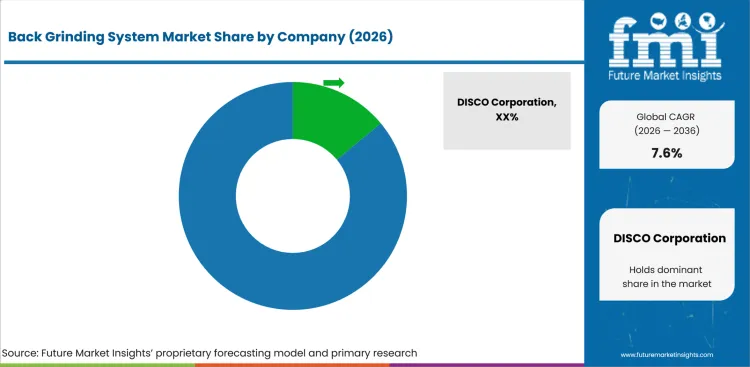
- Integrated thin-wafer equipment suppliers hold an advantage based on grinder and process support capability.
- Precision grinding specialists gain acceptance by proving thickness control and hard-material recipe strength.
- Specialty finishing suppliers compete depending on abrasive process knowledge and polishing capability.
- Regional service teams improve supplier selection chances through faster maintenance access and application troubleshooting.
Back grinding system suppliers compete by combining primary thinning capability with process control. DISCO Corporation has a strong position through precision processing tool and grinder-polisher depth. Tokyo Seimitsu competes across semiconductor production equipment and metrology-linked process knowledge. Okamoto Machine Tool Works supports high-precision grinding needs across semiconductor and specialty substrate customers.
Manufacturing capacity and field service depth have become stronger competitive separators as wafer thinning moves closer to advanced package yield. Revasum competes in compound semiconductor and substrate grinding. Lapmaster Wolters, Logitech Limited, and Engis Corporation support finishing, polishing, and abrasive process work. Buyers compare suppliers through backside damage control and service response.
Smaller and regional suppliers can profit through application knowledge and faster local support. India and the United Kingdom create opportunities for suppliers serving pilot lines and specialty substrate users. South Korea and Japan create stronger demand for highly repeatable thinning systems. Companies proving tool performance across grinding and thin-wafer transfer should gain more durable production-line approvals.
How do top Back Grinding System companies compare?
DISCO Corporation and Tokyo Seimitsu score strongest on thin-wafer handling while Okamoto Machine Tool Works and Revasum hold strength in precision grinding and specialty substrates.
| Company | Relevance to Market Title | Thin-wafer Handling Depth | Grind-polish Integration | Hard-material Recipe Support | Geographic Footprint |
|---|---|---|---|---|---|
| DISCO Corporation | Very High | Very Strong | Very Strong | Strong | Global |
| Tokyo Seimitsu | Very High | Very Strong | Very Strong | Moderate to Strong | Global |
| Okamoto Machine Tool Works | High | Strong | Strong | Strong | Japan, United States, Europe, and China |
| Revasum | High | Moderate | Strong | Very Strong | United States and specialized global accounts |
| Lapmaster Wolters | High | Moderate | Strong | Strong | Europe and North America |
| Logitech Limited | Moderate to High | Moderate | Strong | Strong | United Kingdom and export markets |
| Engis Corporation | Moderate to High | Moderate | Moderate | Strong | North America and Asia |
| Koyo Machinery | Moderate | Moderate | Moderate | Moderate | Asia-focused |
Source: Future Market Insights competitive analysis, 2026.
Who are the key players in the Back Grinding System Market?
DISCO Corporation, Tokyo Seimitsu, and Okamoto Machine Tool Works are listed with Revasum and Lapmaster Wolters among other suppliers.
Key global companies leading the Back Grinding System Market include:
- DISCO Corporation
- Tokyo Seimitsu
- Okamoto Machine Tool Works
- Revasum
- Lapmaster Wolters
- Logitech Limited
- Engis Corporation
- Koyo Machinery
Key Developments in Back Grinding System Market
- In September 2024, DISCO established DISCO HI-TEC India in Bengaluru for sale and maintenance of DISCO-manufactured semiconductor manufacturing equipment.
- In April 2025, DISCO announced plans to construct the Gohara Plant in Hiroshima, including JPY 33 billion in building investment for precision processing tool capacity.
- In August 2025, Tokyo Seimitsu completed the Nagoya Plant to strengthen production capacity in its semiconductor production equipment business.
Key Players in the Back Grinding System Market
Integrated Thin-Wafer Equipment Leaders
- DISCO Corporation
- Tokyo Seimitsu
- Okamoto Machine Tool Works
Specialty Grinding and Substrate Tool Companies
- Revasum
- Koyo Machinery
- Selected regional precision equipment suppliers
Polishing and Process Finishing Specialists
- Lapmaster Wolters
- Logitech Limited
- Engis Corporation
Service, Retrofit, and Application Support Channels
- Direct OEM service teams
- Local maintenance affiliates
- Semiconductor equipment distributors
Back Grinding System Market - Scope & Definition
| Attribute | Detail |
|---|---|
| Market Definition | Semiconductor wafer thinning equipment used after front-side processing and before dicing, bonding, stacking, or package assembly |
| Functions Covered | Wafer thinning, backside stress reduction, grind-polish preparation, tape handling, debond support, thickness control, and thin-wafer transfer |
| Applications Covered | Foundry and Advanced Device Manufacturing, Memory, Power Devices, and Package Integration |
| End-Use Industries | Semiconductor fabs, OSAT companies, memory producers, power device manufacturers, compound semiconductor lines, and packaging development centers |
| Grades Covered | Standard production tools, high-precision grinder systems, integrated grind-polish lines, specialty substrate systems, and service-linked equipment configurations |
| Inclusions | All commercially traded back grinding systems across system type, wafer size, application, automation, sales channel, and country-level semiconductor equipment use |
| Exclusions | Lithography, etch, deposition, front-end planarization CMP, wafer slicing, general machine-tool grinding, standalone consumables not bundled with equipment upgrades, and non-semiconductor surface grinding systems |
Back Grinding System Market - Research Methodology
| Method | Description |
|---|---|
| Primary Research | FMI analyst interviews with semiconductor fabs, OSAT operators, equipment integrators, wafer process engineers, service teams, and application engineers across selected markets |
| Desk Research | Review of semiconductor equipment data, government chip programs, standards references, official equipment company material, product literature, and regional capacity evidence |
| Market Sizing & Forecasting | Bottom-up equipment revenue approach using system volume, average tool pricing, wafer-size mix, application use rates, automation level, service-linked revenue, and country-level capacity signals |
| Data Validation | Cross-verification using supplier portfolios, back-end equipment cycles, 300 mm fab investment plans, thin-wafer technology needs, and semiconductor package investment patterns |
Back Grinding System Market - Report Scope
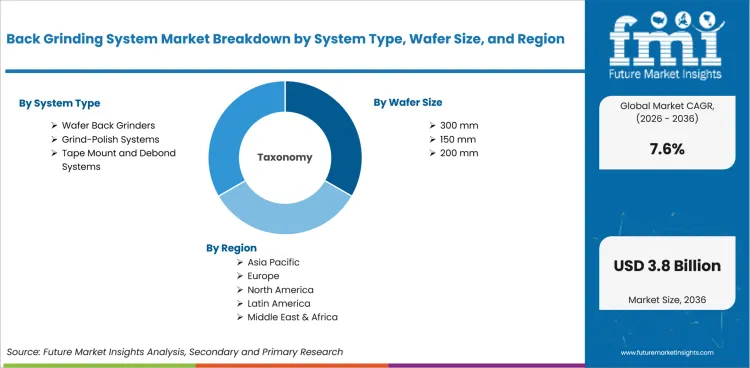
| Parameter | Details |
|---|---|
| Forecast period | 2026 to 2036 |
| Historical period | 2021 to 2025 |
| Quantitative unit | Revenue in USD billion |
| By system type | Wafer Back Grinders, Grind-Polish Systems, Tape Mount and Debond Systems, Integrated Thin-wafer Lines |
| By wafer size | 150 mm, 200 mm, 300 mm, Specialty and Other |
| By application | Foundry and Advanced Device Manufacturing, Memory, Power Devices, Package Integration |
| By automation | Manual and Semi-automatic Systems, Fully Automatic Systems |
| By sales channel | Direct OEM, Distributors and Integrators, Service and Retrofit |
| Regions covered | North America, Latin America, Europe, East Asia, South Asia and Pacific, Middle East and Africa |
| Countries covered | India, China, South Korea, United States, Japan, Germany, France, United Kingdom |
| Key companies profiled | DISCO Corporation, Tokyo Seimitsu, Okamoto Machine Tool Works, Revasum, Lapmaster Wolters, Logitech Limited, Engis Corporation, Koyo Machinery |
| Approach | Bottom-up equipment revenue approach using wafer-size mix, system type, application demand, automation level, sales channel, and country-level semiconductor capacity signals |
Source: Future Market Insights competitive analysis, 2026.
Back Grinding System Market Breakdown by System Type, Wafer Size, Application, Automation, Sales Channel, and Region
Back Grinding System Market Segmented by System Type
- Wafer Back Grinders
- Grind-Polish Systems
- Tape Mount and Debond Systems
- Integrated Thin-wafer Lines
Back Grinding System Market Segmented by Wafer Size
- 150 mm
- 200 mm
- 300 mm
- Specialty and Other
Back Grinding System Market Segmented by Application
- Foundry and Advanced Device Manufacturing
- Memory
- Power Devices
- Package Integration
Back Grinding System Market Segmented by Automation
- Manual and Semi-automatic Systems
- Fully Automatic Systems
Back Grinding System Market Segmented by Sales Channel
- Direct OEM
- Distributors and Integrators
- Service and Retrofit
Back Grinding System Market by Region
- North America
- Latin America
- Europe
- East Asia
- South Asia and Pacific
- Middle East and Africa
Research Sources and Bibliography
- Department for Science, Innovation and Technology. (2026, May). UK semiconductor sector study: 2025 update.
- DISCO Corporation. (2024, September). Overseas local affiliate established in India.
- DISCO Corporation. (2025, April). Plans to construct Gohara Plant as part of Hiroshima Works.
- European Commission. (2025, February). Commission approves French state aid measure to support STMicroelectronics and GlobalFoundries semiconductor facility.
- European Commission. (2025, June). European Commission approves German measure to support ESMC semiconductor manufacturing facility.
- European Semiconductor Industry Association. (2026, February). Global chips market hitting record high sales figures in 2025.
- India Ministry of Electronics and Information Technology. (2026, February). Semiconductor manufacturing projects approved under India Semiconductor Mission.
- India Prime Minister’s Office. (2026, May). Union Cabinet approves two semiconductor projects.
- Japan Ministry of Economy, Trade and Industry. (2025, November). Press conference by Minister Akazawa: Rapidus investment from fiscal 2025 initial budget.
- National Institute of Standards and Technology. (2024, October). CHIPS for America launches advanced packaging research and development competition.
- National Institute of Standards and Technology. (2025, January). CHIPS National Advanced Packaging Manufacturing Program announces final awards.
- SEMI. (2026, April). SEMI reports global semiconductor equipment billings reached USD 135 billion in 2025.
- SEMI. (2025, December). Global semiconductor equipment sales projected to reach a record of USD 156 billion in 2027.
- Statistics Bureau of Japan. (2025). Current population estimates as of October 1, 2024.
- Tokyo Seimitsu Co., Ltd. (2025, August). Completion of Nagoya Plant, a new plant aimed at strengthening production capacity in the semiconductor production equipment business.
- United States Bureau of Industry and Security. (2024, December). Export administration regulations: Semiconductor manufacturing equipment and advanced computing controls.
This bibliography is provided for reader reference and is not exhaustive. The full report contains the complete reference list and detailed citations.
This Report Answers
- Market size estimates for 2026 and forecasts through 2036 for the Back Grinding System Market.
- Insights across regional and country-level semiconductor wafer-thinning equipment markets.
- Analysis of system type, wafer size, application, automation, and sales channel demand.
- Assessment of thin-wafer processing and power device adoption effects.
- Identification of opportunities across integrated grind-polish and fully automatic systems.
- Evaluation of direct OEM channels and service-led equipment selection.
- Country-level analysis covering India, China, South Korea, United States, Japan, Germany, France, and United Kingdom.
- Assessment of competition, including integrated equipment suppliers and specialty finishing companies.
- Analysis of tool qualification and process recipe decision factors.
- Regional outlooks across North America, Europe, East Asia, South Asia and Pacific, Latin America, and Middle East and Africa.
- Evaluation of key company developments shaping production capacity and customer support.
- Delivery of market data, forecasts, and supporting analysis in report-ready format.
Frequently Asked Questions
What is the growth prospect for Back Grinding System?
Demand for Back Grinding System is expected to rise as wafer thinning becomes a process-control step before advanced packaging and thin die assembly.
Which companies are expected to shape the Back Grinding System market?
DISCO Corporation, Tokyo Seimitsu, Okamoto Machine Tool Works, Revasum, and Lapmaster Wolters are expected to shape competition through equipment capability and service support.
Why are semiconductor equipment companies investing in back grinding systems?
Semiconductor equipment companies are investing in back grinding systems to support lower backside damage and more stable package preparation.
Why are direct OEM sales channels important in the Back Grinding System market?
Direct OEM sales channels support recipe approval and tool qualification across high-value wafer lines.
Which system formats are gaining attention in Back Grinding System?
Grind-Polish Systems and Integrated Thin-wafer Lines are gaining attention as package buyers link thinning and handling steps.
How do advanced packages influence Back Grinding System demand?
Advanced packages influence demand by raising the need for controlled backside surfaces and lower breakage during transfer.
Why is automation important for Back Grinding System?
Automation is important as thin wafers become more fragile after material removal and manual handling can increase breakage risk.
What role does 300 mm wafer processing play in Back Grinding System adoption?
300 mm wafer processing supports adoption by increasing the value of cassette handling and repeatable thickness control.
Preview the report firsthand - request a free sample
Get SampleGet the brochure for pricing and purchase details.
Get PDFTable of Content
- Key Takeaways
- Market Size and CAGR
- Top Growth Driver
- Fastest Growing Segment
- Leading Region
- Key Companies
- Emerging Opportunities
- Executive Summary
- Global Market Outlook
- Demand-side Trends
- Supply-side Trends
- Technology Roadmap Analysis
- Analysis and Recommendations
- Analyst Perspective (What is happening? Why now? What should investors know?)
- Key Questions Answered
- How large is the market?
- What is the CAGR?
- What are key trends?
- Which region dominates?
- Who are the leaders?
- Market Overview
- Market Coverage / Taxonomy
- Market Definition / Scope / Limitations
- Research Methodology
- Chapter Orientation
- Analytical Lens and Working Hypotheses
- Market Structure, Signals, and Trend Drivers
- Benchmarking and Cross-market Comparability
- Market Sizing, Forecasting, and Opportunity Mapping
- Research Design and Evidence Framework
- Desk Research Programme (Secondary Evidence)
- Expert Input and Fieldwork (Primary Evidence)
- Tooling, Models, and Reference Databases
- Data Engineering and Model Build
- Quality Assurance and Audit Trail
- Market Background
- Market Dynamics (Drivers, Restraints, Opportunity, Trends)
- Scenario Forecast (Optimistic, Likely, Conservative)
- Impact Analysis
- AI Impact
- Sustainability Impact
- Regulatory Impact
- Technology Impact
- Consumer / Buyer Analysis
- Purchase Drivers
- Adoption Barriers
- Buyer Journey
- Opportunity Map Analysis
- Product Life Cycle Analysis
- Supply Chain Analysis
- Investment Feasibility Matrix
- Value Chain Analysis
- PESTLE and Porter's Analysis
- Regulatory Landscape
- Regional Parent Market Outlook
- Production and Consumption Statistics
- Import and Export Statistics
- Global Market Analysis and Forecast, 2021 to 2036
- Historical Market Size Value (USD Billion) Analysis, 2021 to 2025
- Current and Future Market Size Value (USD Billion) Projections, 2026 to 2036
- Y-o-Y Growth Trend Analysis
- Absolute $ Opportunity Analysis
- Global Market Pricing Analysis, 2021 to 2036
- Global Market Analysis and Forecast, By System Type, 2021 to 2036
- Introduction / Key Findings
- Historical Market Size Value (USD Billion) Analysis By System Type, 2021 to 2025
- Current and Future Market Size Value (USD Billion) Analysis and Forecast By System Type, 2026 to 2036
- Wafer Back Grinders
- Grind-Polish Systems
- Tape Mount and Debond Systems
- Wafer Back Grinders
- Y-o-Y Growth Trend Analysis By System Type, 2021 to 2025
- Absolute $ Opportunity Analysis By System Type, 2026 to 2036
- Global Market Analysis and Forecast, By Wafer Size, 2021 to 2036
- Introduction / Key Findings
- Historical Market Size Value (USD Billion) Analysis By Wafer Size, 2021 to 2025
- Current and Future Market Size Value (USD Billion) Analysis and Forecast By Wafer Size, 2026 to 2036
- 300 mm
- 150 mm
- 200 mm
- 300 mm
- Y-o-Y Growth Trend Analysis By Wafer Size, 2021 to 2025
- Absolute $ Opportunity Analysis By Wafer Size, 2026 to 2036
- Global Market Analysis and Forecast, By Application, 2021 to 2036
- Introduction / Key Findings
- Historical Market Size Value (USD Billion) Analysis By Application, 2021 to 2025
- Current and Future Market Size Value (USD Billion) Analysis and Forecast By Application, 2026 to 2036
- Foundry and Advanced Device Manufacturing
- Memory
- Power Devices
- Foundry and Advanced Device Manufacturing
- Y-o-Y Growth Trend Analysis By Application, 2021 to 2025
- Absolute $ Opportunity Analysis By Application, 2026 to 2036
- Global Market Analysis and Forecast, By Automation, 2021 to 2036
- Introduction / Key Findings
- Historical Market Size Value (USD Billion) Analysis By Automation, 2021 to 2025
- Current and Future Market Size Value (USD Billion) Analysis and Forecast By Automation, 2026 to 2036
- Fully Automatic Systems
- Manual and Semi-automatic Systems
- Fully Automatic Systems
- Y-o-Y Growth Trend Analysis By Automation, 2021 to 2025
- Absolute $ Opportunity Analysis By Automation, 2026 to 2036
- Global Market Analysis and Forecast, By Sales Channel, 2021 to 2036
- Introduction / Key Findings
- Historical Market Size Value (USD Billion) Analysis By Sales Channel, 2021 to 2025
- Current and Future Market Size Value (USD Billion) Analysis and Forecast By Sales Channel, 2026 to 2036
- Direct OEM
- Distributors and Integrators
- Service and Retrofit
- Direct OEM
- Y-o-Y Growth Trend Analysis By Sales Channel, 2021 to 2025
- Absolute $ Opportunity Analysis By Sales Channel, 2026 to 2036
- Global Market Analysis and Forecast, By Region, 2021 to 2036
- Introduction
- Historical Market Size Value (USD Billion) Analysis By Region, 2021 to 2025
- Current Market Size Value (USD Billion) Analysis and Forecast By Region, 2026 to 2036
- North America
- Latin America
- Western Europe
- Eastern Europe
- East Asia
- South Asia and Pacific
- Middle East & Africa
- Market Attractiveness Analysis By Region
- North America Market Analysis and Forecast, By Country, 2021 to 2036
- Historical Market Size Value (USD Billion) Trend Analysis By Market Taxonomy, 2021 to 2025
- Market Size Value (USD Billion) Forecast By Market Taxonomy, 2026 to 2036
- By Country
- USA
- Canada
- Mexico
- By System Type
- By Wafer Size
- By Application
- By Automation
- By Sales Channel
- By Country
- Market Attractiveness Analysis
- By Country
- By System Type
- By Wafer Size
- By Application
- By Automation
- By Sales Channel
- Key Takeaways
- Latin America Market Analysis and Forecast, By Country
- Historical Market Size Value (USD Billion) Trend Analysis By Market Taxonomy, 2021 to 2025
- Market Size Value (USD Billion) Forecast By Market Taxonomy, 2026 to 2036
- By Country
- Brazil
- Chile
- Rest of Latin America
- By System Type
- By Wafer Size
- By Application
- By Automation
- By Sales Channel
- By Country
- Market Attractiveness Analysis
- By Country
- By System Type
- By Wafer Size
- By Application
- By Automation
- By Sales Channel
- Key Takeaways
- Western Europe Market Analysis and Forecast, By Country
- Historical Market Size Value (USD Billion) Trend Analysis By Market Taxonomy, 2021 to 2025
- Market Size Value (USD Billion) Forecast By Market Taxonomy, 2026 to 2036
- By Country
- Germany
- UK
- Italy
- Spain
- France
- Nordic
- BENELUX
- Rest of Western Europe
- By System Type
- By Wafer Size
- By Application
- By Automation
- By Sales Channel
- By Country
- Market Attractiveness Analysis
- By Country
- By System Type
- By Wafer Size
- By Application
- By Automation
- By Sales Channel
- Key Takeaways
- Eastern Europe Market Analysis and Forecast, By Country
- Historical Market Size Value (USD Billion) Trend Analysis By Market Taxonomy, 2021 to 2025
- Market Size Value (USD Billion) Forecast By Market Taxonomy, 2026 to 2036
- By Country
- Russia
- Poland
- Hungary
- Balkan & Baltic
- Rest of Eastern Europe
- By System Type
- By Wafer Size
- By Application
- By Automation
- By Sales Channel
- By Country
- Market Attractiveness Analysis
- By Country
- By System Type
- By Wafer Size
- By Application
- By Automation
- By Sales Channel
- Key Takeaways
- East Asia Market Analysis and Forecast, By Country
- Historical Market Size Value (USD Billion) Trend Analysis By Market Taxonomy, 2021 to 2025
- Market Size Value (USD Billion) Forecast By Market Taxonomy, 2026 to 2036
- By Country
- China
- Japan
- South Korea
- By System Type
- By Wafer Size
- By Application
- By Automation
- By Sales Channel
- By Country
- Market Attractiveness Analysis
- By Country
- By System Type
- By Wafer Size
- By Application
- By Automation
- By Sales Channel
- Key Takeaways
- South Asia and Pacific Market Analysis and Forecast, By Country
- Historical Market Size Value (USD Billion) Trend Analysis By Market Taxonomy, 2021 to 2025
- Market Size Value (USD Billion) Forecast By Market Taxonomy, 2026 to 2036
- By Country
- India
- ASEAN
- Australia & New Zealand
- Rest of South Asia and Pacific
- By System Type
- By Wafer Size
- By Application
- By Automation
- By Sales Channel
- By Country
- Market Attractiveness Analysis
- By Country
- By System Type
- By Wafer Size
- By Application
- By Automation
- By Sales Channel
- Key Takeaways
- Middle East & Africa Market Analysis and Forecast, By Country
- Historical Market Size Value (USD Billion) Trend Analysis By Market Taxonomy, 2021 to 2025
- Market Size Value (USD Billion) Forecast By Market Taxonomy, 2026 to 2036
- By Country
- Kingdom of Saudi Arabia
- Other GCC Countries
- Türkiye
- South Africa
- Other African Union
- Rest of Middle East & Africa
- By System Type
- By Wafer Size
- By Application
- By Automation
- By Sales Channel
- By Country
- Market Attractiveness Analysis
- By Country
- By System Type
- By Wafer Size
- By Application
- By Automation
- By Sales Channel
- Key Takeaways
- Key Countries Market Analysis
- USA
- Pricing Analysis
- Market Share Analysis, 2025
- By System Type
- By Wafer Size
- By Application
- By Automation
- By Sales Channel
- Canada
- Pricing Analysis
- Market Share Analysis, 2025
- By System Type
- By Wafer Size
- By Application
- By Automation
- By Sales Channel
- Mexico
- Pricing Analysis
- Market Share Analysis, 2025
- By System Type
- By Wafer Size
- By Application
- By Automation
- By Sales Channel
- Brazil
- Pricing Analysis
- Market Share Analysis, 2025
- By System Type
- By Wafer Size
- By Application
- By Automation
- By Sales Channel
- Chile
- Pricing Analysis
- Market Share Analysis, 2025
- By System Type
- By Wafer Size
- By Application
- By Automation
- By Sales Channel
- Germany
- Pricing Analysis
- Market Share Analysis, 2025
- By System Type
- By Wafer Size
- By Application
- By Automation
- By Sales Channel
- UK
- Pricing Analysis
- Market Share Analysis, 2025
- By System Type
- By Wafer Size
- By Application
- By Automation
- By Sales Channel
- Italy
- Pricing Analysis
- Market Share Analysis, 2025
- By System Type
- By Wafer Size
- By Application
- By Automation
- By Sales Channel
- Spain
- Pricing Analysis
- Market Share Analysis, 2025
- By System Type
- By Wafer Size
- By Application
- By Automation
- By Sales Channel
- France
- Pricing Analysis
- Market Share Analysis, 2025
- By System Type
- By Wafer Size
- By Application
- By Automation
- By Sales Channel
- India
- Pricing Analysis
- Market Share Analysis, 2025
- By System Type
- By Wafer Size
- By Application
- By Automation
- By Sales Channel
- ASEAN
- Pricing Analysis
- Market Share Analysis, 2025
- By System Type
- By Wafer Size
- By Application
- By Automation
- By Sales Channel
- Australia & New Zealand
- Pricing Analysis
- Market Share Analysis, 2025
- By System Type
- By Wafer Size
- By Application
- By Automation
- By Sales Channel
- China
- Pricing Analysis
- Market Share Analysis, 2025
- By System Type
- By Wafer Size
- By Application
- By Automation
- By Sales Channel
- Japan
- Pricing Analysis
- Market Share Analysis, 2025
- By System Type
- By Wafer Size
- By Application
- By Automation
- By Sales Channel
- South Korea
- Pricing Analysis
- Market Share Analysis, 2025
- By System Type
- By Wafer Size
- By Application
- By Automation
- By Sales Channel
- Russia
- Pricing Analysis
- Market Share Analysis, 2025
- By System Type
- By Wafer Size
- By Application
- By Automation
- By Sales Channel
- Poland
- Pricing Analysis
- Market Share Analysis, 2025
- By System Type
- By Wafer Size
- By Application
- By Automation
- By Sales Channel
- Hungary
- Pricing Analysis
- Market Share Analysis, 2025
- By System Type
- By Wafer Size
- By Application
- By Automation
- By Sales Channel
- Kingdom of Saudi Arabia
- Pricing Analysis
- Market Share Analysis, 2025
- By System Type
- By Wafer Size
- By Application
- By Automation
- By Sales Channel
- Türkiye
- Pricing Analysis
- Market Share Analysis, 2025
- By System Type
- By Wafer Size
- By Application
- By Automation
- By Sales Channel
- South Africa
- Pricing Analysis
- Market Share Analysis, 2025
- By System Type
- By Wafer Size
- By Application
- By Automation
- By Sales Channel
- USA
- Market Structure Analysis
- Competition Dashboard
- Competition Benchmarking
- Market Share Analysis of Top Players
- By Regional
- By System Type
- By Wafer Size
- By Application
- By Automation
- By Sales Channel
- Emerging Startups
- Innovation Benchmarking
- Competition Analysis
- Competition Deep Dive
- DISCO Corporation
- Overview
- Product Portfolio
- Profitability by Market Segments (Product/Region/Sales Channel)
- Sales Footprint
- Strategy Overview
- Marketing Strategy
- Product Strategy
- Channel Strategy
- Tokyo Seimitsu
- Okamoto Machine Tool Works
- Revasum
- Lapmaster Wolters
- Logitech Limited
- Engis Corporation
- Koyo Machinery
- DISCO Corporation
- Case Studies
- Success Stories
- Recent Developments
- Competition Deep Dive
- Assumptions & Acronyms Used


