

- Market Size (2026)
- USD 4.54 Bn
- Forecast (2036)
- USD 11.12 Bn
- CAGR (2026 to 2036)
- 5.4%
Grinding Machinery Market Size, Market Forecast and Outlook By FMI
Summary of the Grinding Machinery Market
- Market Snapshot
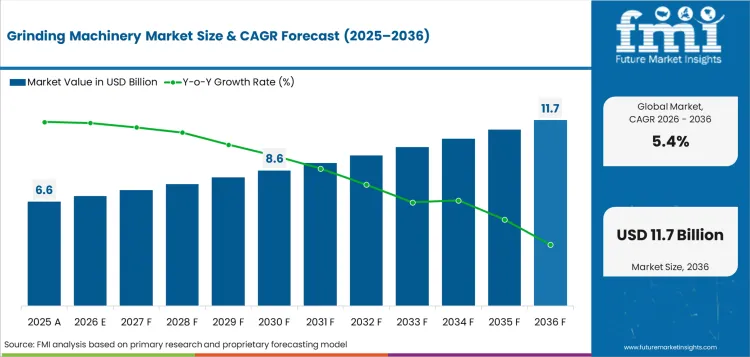
- The Grinding Machinery Market is valued at USD 6.25 billion in 2025 and is expected to reach USD 6.58 billion in 2026.
- Industry value is projected to reach USD 11.12 billion by 2036 with a 5.4% CAGR over the assessment period.
- The market is forecast to add USD 4.54 billion in value between 2026 and 2036.
- FMI opines that grinding machinery remains a precision-led capital equipment category with demand concentrated in finished-part quality.
- Demand and Growth Drivers
- Automotive components are projected to represent 34.0% share in 2026 as shafts and transmission parts need tight tolerances.
- Aerospace and defense are expected to account for 18.0% share in 2026 as turbine and landing gear parts need stable finishing.
- India is forecast above the global pace at 8.2% CAGR through 2036 as domestic machine tool consumption rises.
- CNC grinding systems are expected to gain demand as factories reduce operator-dependent finishing variation.
- Product and Segment View
- Surface grinding machines are expected to account for 31.0% of Product Type demand in 2026 as flat components need controlled finish.
- CNC grinding machines are projected to hold 64.0% of Control Type demand in 2026 due to batch repeatability.
- Automotive components are anticipated to lead Application demand with 34.0% share in 2026.
- Direct sales are expected to represent 46.0% of Sales Channel demand in 2026 as buyers need installation support.
- Geography and Competitive Outlook
- China is expected to remain the largest volume market due to broad machine tool consumption and factory scale.
- India is projected to grow faster than the global average as domestic manufacturing investment lifts machine tool demand.
- Japan and Germany remain important technology centers due to high-precision grinding suppliers and mature user industries.
- United Grinding, ANCA, JUNKER, Okuma, and Amada hold visible positions across precision grinding categories.
- Analyst Opinion
- Nikhil Kaitwade, Associate Vice President at FMI says, "I see grinding machinery demand shifting toward process reliability. Buyers do not evaluate a grinder only by spindle power or machine footprint. They look at surface finish, thermal stability, automation fit, and service response after installation. The pressure comes from skilled operator scarcity and tighter part tolerances. Automotive buyers need repeatable shaft and gear finishing. Aerospace buyers need documentation and stable quality across smaller batches. Suppliers gain an edge when they combine machine rigidity with software and wheel-dressing support. Clients should watch service depth carefully because a high-end grinder loses value quickly if uptime and process support are weak."
- Grinding Machinery Market Value Analysis
- The market is projected to rise from USD 6.58 billion in 2026 to USD 11.12 billion by 2036.
- Surface grinding leads product demand as die and mold work keeps flatness requirements central.
- CNC grinding shapes value growth because buyers need repeatable output with fewer manual corrections.
- Automotive applications remain the main demand pool as precision shafts and bearing components need finishing.
- Price sensitivity stays high for smaller workshops since CNC grinders require skilled setup and maintenance support.
Key Takeaways
- The Grinding Machinery Market was valued at USD 6.25 billion in 2025.
- The industry is expected to reach USD 11.12 billion by 2036 as precision components need tighter surface finishing.
- With a projected 5.4% CAGR from 2026 to 2036, grinding machinery remains a steady high-accuracy machine tool category.
- Incremental opportunity is forecast at USD 4.54 billion between 2026 and 2036.
- Surface grinding machines are expected to hold 31.0% share in 2026 as die and mold work needs flatness control.
- CNC grinding machines are projected to account for 64.0% share in 2026 due to repeatability in batch production.
- Automotive components are expected to represent 34.0% share in 2026 as shafts and bearing parts need precision finishing.
- India is projected to record 8.2% CAGR through 2036 as machine tool consumption and local manufacturing expand.
Grinding Machinery Market Definition
The grinding machinery market covers machine tools used to remove material through abrasive wheels or belts. Included products are surface grinders, cylindrical grinders, centerless grinders, tool grinders, gear grinders, and internal grinders. These machines are used to achieve dimensional accuracy and surface finish in metalworking. The scope excludes hand-held grinders, polishing-only tools, abrasive consumables, and fully integrated production lines where the grinder is not sold as a distinct machine.
Grinding Machinery Market Inclusions
Market scope covers CNC and conventional grinding machines used in automotive, aerospace, general engineering, toolmaking, medical device manufacturing, and precision component production. Revenue scope covers new machine sales from 2026 to 2036 across major regions.
Grinding Machinery Market Exclusions
The scope excludes hand-held angle grinders, bench grinders for retail use, abrasive wheels, polishing compounds, cutting tools, and maintenance services sold without a machine.
Grinding Machinery Market Research Methodology
- Primary Research: FMI analysts reviewed inputs from machine tool builders and grinding machine distributors. Discussions also covered precision component makers and toolroom buyers. The review focused on replacement timing and machine selection.
- Desk Research: Desk research assessed machine tool production data and industry association publications. Company product information was reviewed to confirm grinding participation. Trade show launches were used to identify technology movement.
- Market Sizing and Forecasting: The model combined machine shipments and average selling price bands. Application demand and control type mix were used to adjust product-level value. Country forecasts were checked against machine tool consumption patterns.
- Data Validation: Forecasts were checked against machine tool production trends and company portfolio depth. Country demand was tested against manufacturing output and investment cycles. Supplier activity was reviewed to confirm competitive positioning.
Why is the Grinding Machinery Market Growing?
- Automotive part makers need grinding machines for shafts and bearing surfaces.
- Aerospace suppliers use grinding for hard alloys and safety-critical components.
- Toolmakers need CNC tool grinders as cutting tool geometry becomes tighter.
- Medical device suppliers use precision grinding for implants and small machined parts.
The market is growing because precision finishing has become harder to manage with manual process control. Grinding is used after turning or milling when the final surface and size cannot drift. Japan’s machine tool production data show 2024 production value of JPY 901.3 billion. The same source states that NC machine tools accounted for 93.5% of production value in 2024. That level of numerical control penetration shows why grinding buyers now expect software-driven accuracy.
A second demand layer comes from the wider machine tool replacement cycle. AMT reported that USA manufacturing technology orders reached USD 5.74 billion in 2025. That was 22.5% above the 2024 total. The rebound matters for grinding machinery because many buyers delayed capital equipment orders during the weaker 2024 cycle. Replacement demand can return quickly when shops need accuracy gains or new automation.
Market Segmentation Analysis
- Surface grinding machines are expected to account for 31.0% share in 2026 as flatness control supports die and mold work.
- With an estimated 64.0% share in 2026, CNC grinding machines are expected to lead Control Type demand.
- Automotive component applications are projected to represent 34.0% of Application demand in 2026.
- General engineering is expected to hold 29.0% of End Use demand in 2026 as machine shops need flexible finishing capacity.
- Direct sales are anticipated to direct 46.0% of Sales Channel demand in 2026 with buyers requiring installation support.
Segment demand is shaped by part geometry and accuracy need. Surface grinders serve flat parts and die work. Cylindrical grinders serve shafts and rotating components. Centerless grinders serve high-volume round parts. Tool grinders serve cutting tool production. CNC control carries the value premium because repeatability matters more as skilled setup labor becomes scarce.
Grinding Machinery Market Analysis By Product Type
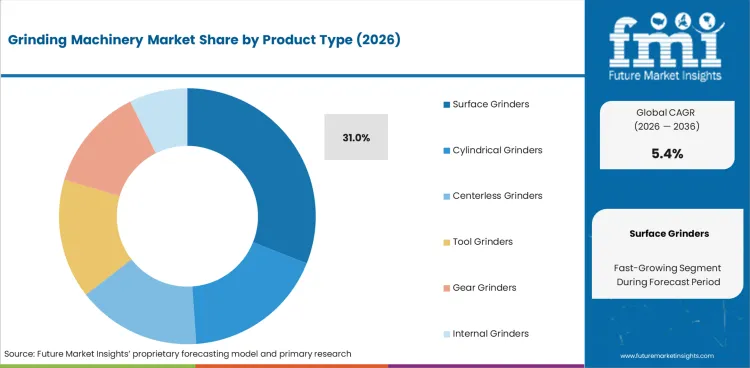
- Surface grinding machines are expected to account for 31.0% of Product Type demand in 2026 as die and mold users need flatness and controlled finish.
- Buyers in this segment often compare magnetic chuck quality and thermal stability before price. Poor heat control can distort the final part and raise scrap.
Grinding Machinery Market Analysis By Control Type
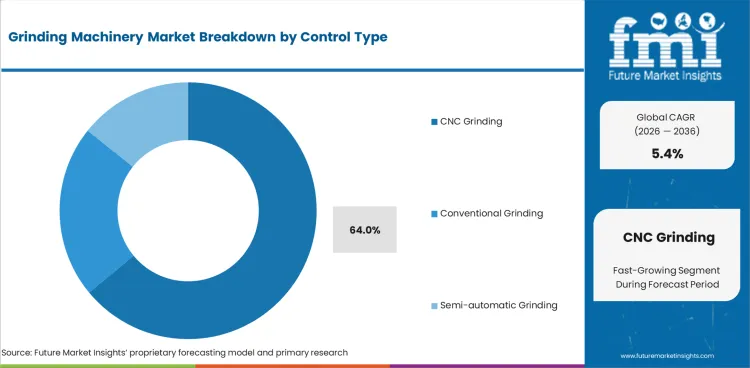
- CNC grinding machines are projected to represent 64.0% of Control Type demand in 2026 as repeatable programs reduce operator-dependent variation.
- CNC adoption is strongest where the same part runs in batches. The payback comes from lower rework and faster setup between jobs.
Grinding Machinery Market Analysis By Application
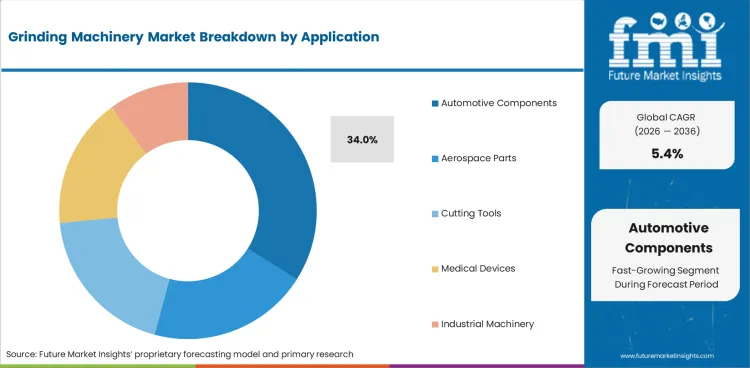
- Automotive components are anticipated to account for 34.0% of Application demand in 2026 as shafts and bearing surfaces need stable finishing.
- EVs reduce some engine-related grinding demand but add precision needs in gears and electric drivetrain parts. This keeps automotive exposure important.
Grinding Machinery Market Analysis By End Use
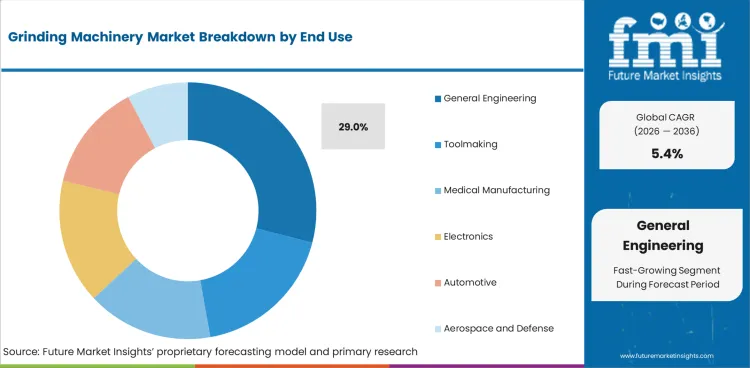
- General engineering is expected to hold 29.0% of End Use demand in 2026 as job shops need flexible grinding capacity.
- Small and mid-sized machine shops often choose versatile machines over specialized systems. Their buying decision is shaped by uptime and service reach.
Grinding Machinery Market Analysis By Sales Channel
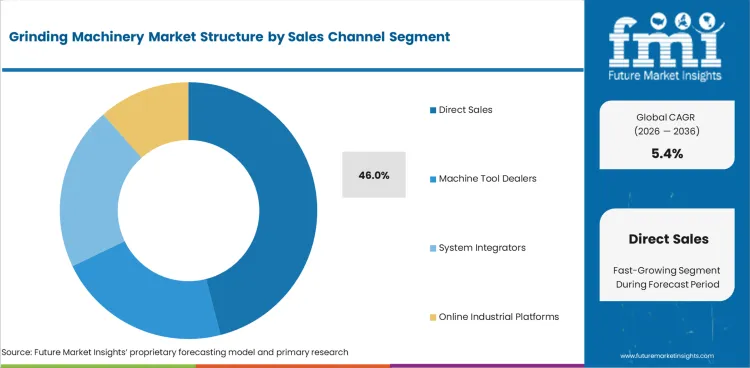
- Direct sales are expected to account for 46.0% of Sales Channel demand in 2026 as grinding machines need installation and process support.
- Dealer-led sales remain relevant for standard machines. High-end CNC systems usually move through direct engagement due to application trials and training needs.
Grinding Machinery Market Drivers, Restraints, and Opportunities
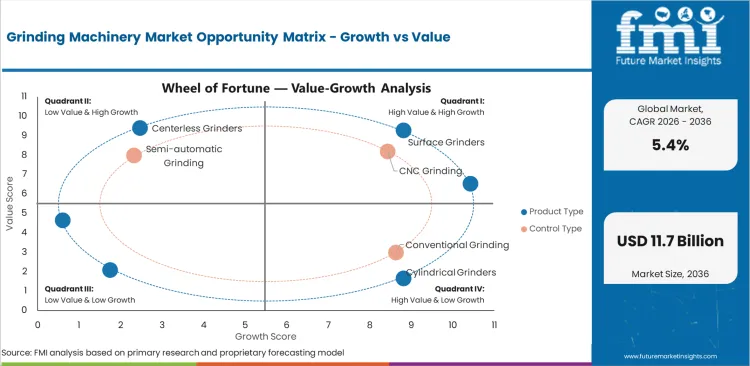
- CNC process control drives demand where part tolerances leave little room for manual variation.
- Skilled operator scarcity restrains adoption when shops cannot staff setup and wheel-dressing work.
- Automation creates opportunity in tool grinding and high-volume cylindrical grinding.
- Aerospace finishing demand supports premium systems where part rejection cost is high.
CNC accuracy demand
CNC accuracy is the strongest demand mechanism in grinding machinery. Buyers need repeatable geometry and lower scrap because many grinding operations sit near the end of production. ANCA said its MicroX ULTRA grinder supports tools down to 0.03 mm and uses nanometer control in a six-axis unit. That type of capability shows where premium demand is moving in micro tool production. The practical implication is clear. Suppliers win when they combine machine control with in-process measurement and stable automation.
Capital cycle restraint
The main restraint is the uneven capital spending cycle in machine tools. Gardner Intelligence reported that production, imports, exports, and consumption all fell globally in 2024. That weakness affects grinding machinery because buyers can delay replacement when utilization is uncertain. It does not erase the long-term need for precision equipment. It shifts orders toward buyers with active aerospace, automotive, or medical component work. Suppliers therefore need financing support and application proof to move purchases forward.
Precision service opportunity
Service support is becoming a stronger opportunity in grinding machinery. A grinder is rarely productive on hardware alone because wheel selection and dressing affect output. United Grinding highlighted remote service and machine monitoring capabilities at IMTS 2024. The value is practical. Remote monitoring can reduce downtime and help shops diagnose process problems faster. Suppliers with service software can defend premium pricing more easily than machine-only sellers.
Analysis of Grinding Machinery Market By Key Countries
.webp "Top Country Growth Comparison Grinding Machinery Market Cagr (2026 2036)")
| Country | CAGR |
|---|---|
| India | 8.2% |
| China | 6.4% |
| United States | 5.6% |
| South Korea | 4.9% |
| Germany | 4.4% |
| Japan | 4.1% |
| Italy | 3.9% |
Source: FMI analysis based on primary research and proprietary forecasting model.
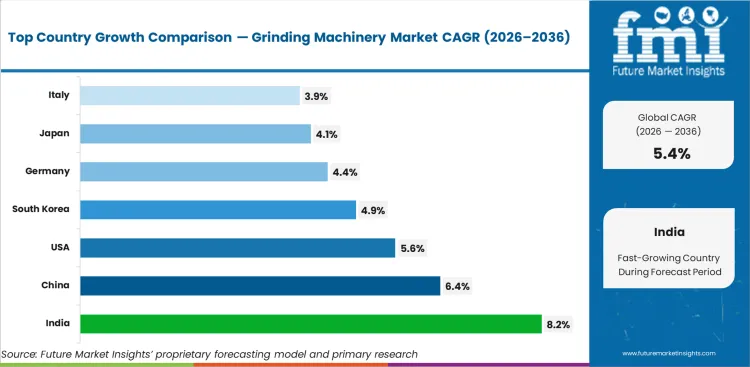
Grinding Machinery Market CAGR Analysis By Country
- India is projected to record an 8.2% CAGR through 2036 as domestic machine tool consumption and aerospace work expand.
- China is expected to expand at 6.4% CAGR through 2036 as factory scale and local equipment policy support demand.
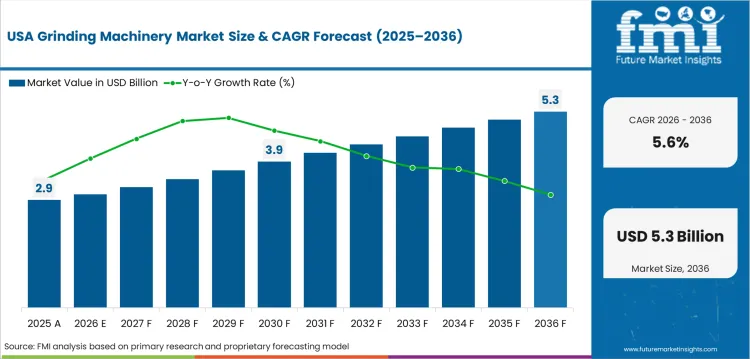
- The United States is forecast to grow at 5.6% CAGR through 2036 as manufacturing technology orders recover.
- South Korea is expected to advance at 4.9% CAGR through 2036 given precision demand in automotive and electronics supply chains.
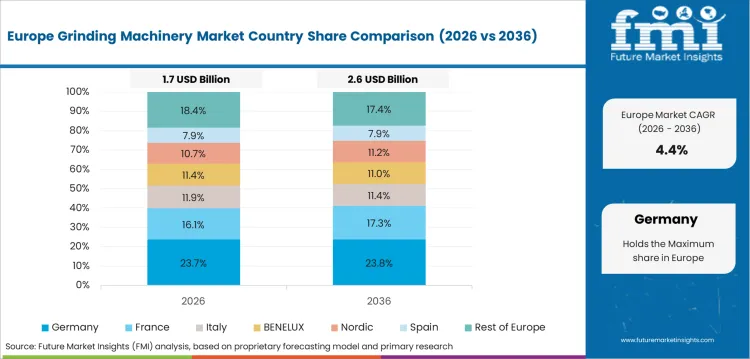
- Germany is projected to rise at 4.4% CAGR through 2036 as high-end manufacturing supports replacement demand.
- Japan is forecast at 4.1% CAGR through 2036 as mature production shifts toward higher-control replacement machines.
- Italy is expected to post 3.9% CAGR through 2036 as specialized machinery clusters sustain steady purchases.
The global average of 5.4% shows a split between high-growth manufacturing markets and mature technology centers. India and China are forecast above the global pace due to industrial investment and capacity needs. Germany and Japan track below the average because their installed machine base is mature. Their demand is more replacement-led.
Demand Outlook for Grinding Machinery in India
Grinding Machinery Market Country Value Analysis
India is moving from import-heavy machine tool buying toward stronger local production. Indian Machine Tool Manufacturers’ Association reported FY 2024 to 2025 domestic machine tool production of INR 317.81 billion. It also said India ranked ninth in production and fourth in consumption according to Gardner’s survey. This supports the growth case for grinding machinery because component makers need finishing capacity as local manufacturing scales. India is projected to record 8.2% CAGR through 2036.
- Bengaluru supports demand through aerospace and precision engineering clusters.
- Pune and Chennai create automotive component demand for cylindrical and surface grinding.
- Rajkot and Ludhiana support smaller machine shop demand for conventional and CNC grinders.
Sales Analysis of Grinding Machinery in China
Grinding Machinery Market Country Value Analysis
China remains the largest manufacturing market for machine tools and precision equipment. China accounted for 32.5% of global machine tool consumption and 32.1% of global production in 2023 according to figures cited by CIMT. This scale creates strong demand for grinding machinery across automotive and electronics factories. China is expected to expand at 6.4% CAGR through 2036 as local equipment supply deepens. High-end precision remains the key challenge.
- Jiangsu and Zhejiang support demand through machinery and component manufacturing.
- Guangdong creates grinding demand from electronics and mold-making activity.
- Local CNC substitution policy supports domestic grinder makers in standard machine categories.
Demand Analysis of Grinding Machinery in the United States
Grinding Machinery Market Country Value Analysis
The United States is a high-value replacement market with strong aerospace and medical manufacturing demand. AMT reported 2025 USA manufacturing technology orders of USD 5.74 billion. That total was 22.5% above 2024. This rebound supports grinding machinery demand because shops that delayed equipment purchases are returning to capital spending. The United States is forecast to grow at 5.6% CAGR through 2036.
- Ohio and Michigan support demand through automotive and precision machining clusters.
- Connecticut and Washington create aerospace-linked demand for high-accuracy grinding systems.
- Medical device hubs in Minnesota support demand for small part finishing and tool grinding.
Opportunity Analysis of Grinding Machinery in South Korea
Grinding Machinery Market Country Value Analysis
South Korea has a compact but technology-intensive grinding machinery market. Demand is linked to automotive suppliers and electronics component makers. KOMMA’s 2024 industry report noted weaker global machine tool market growth in 2023. This is relevant because Korean buyers remain exposed to export cycles and equipment investment timing. South Korea is expected to advance at 4.9% CAGR through 2036 as high-spec component work supports selective demand.
- Gyeonggi Province supports demand through electronics and precision component suppliers.
- Ulsan creates automotive and shipbuilding-related machining demand.
- Daegu supports machine tool and component manufacturing clusters.
Future Outlook for Grinding Machinery in Germany
Grinding Machinery Market Country Value Analysis
Germany remains a high-end grinding technology center. Demand is shaped by automotive suppliers and precision engineering firms that require stable machine accuracy. VDW reported that German machine tool orders in the fourth quarter of 2024 were 7% below the prior year. The same release points to a muted market cycle. Germany is projected to rise at 4.4% CAGR through 2036 as replacement demand supports precision systems.
- Baden-Württemberg supports demand through automotive and mechanical engineering clusters.
- Bavaria creates high-value demand from aerospace and precision machinery firms.
- North Rhine Westphalia supports grinding demand through toolmaking and industrial suppliers.
Demand Outlook for Grinding Machinery in Japan
Grinding Machinery Market Country Value Analysis
Japan is a mature grinding machinery market with strong CNC discipline. Japanese machine tool production value reached JPY 901.3 billion in 2024. NC machine tools accounted for 93.5% of production value that year. This shows the depth of controlled machine tool production in Japan. Japan is forecast at 4.1% CAGR through 2036 as replacement demand shifts toward higher automation and tighter process control.
- Aichi supports demand through automotive and machine tool production networks.
- Osaka and Hyogo support toolmaking and precision component demand.
- Japanese buyers often prefer proven suppliers with strong service discipline.
In-depth Analysis of Grinding Machinery in Italy
Grinding Machinery Market Country Value Analysis
Italy remains relevant through machinery production and precision manufacturing clusters. Demand is linked to automotive suppliers and toolrooms serving industrial customers. CECIMO’s 2024 magazine placed European machine tool production within a global production pool of EUR 83.8 billion in 2023. Italy benefits from that European manufacturing base. It is expected to post 3.9% CAGR through 2036 as specialized machine users continue replacement purchases.
- Lombardy supports demand through machinery and metalworking clusters.
- Emilia-Romagna creates precision demand from automotive and packaging machinery suppliers.
- Piedmont supports automotive-linked component grinding demand.
Competitive Landscape and Strategic Positioning
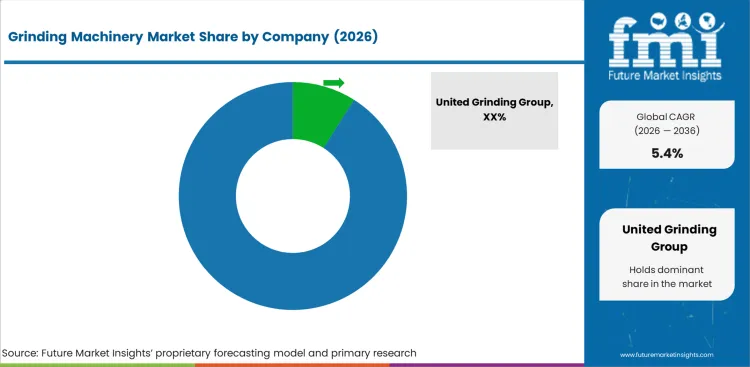
- The market is moderately fragmented across Japanese, German, Swiss, and Asian suppliers.
- Established suppliers win through process know-how and service depth.
- Specialist tool grinder makers compete on software and automation fit.
- Entry barriers include thermal stability, spindle precision, and application support.
Competition in grinding machinery is shaped by process control. Buyers are usually solving a part-quality problem rather than adding generic capacity. ANCA’s 2024 IMTS positioning around MicroX ULTRA shows this clearly. The machine is designed for micro tools down to 0.03 mm and uses nanometer control. That points to the premium end of demand where software and measurement matter as much as machine rigidity.
Supplier strength is also tied to application breadth. JUNKER showed its Platform 3 grinding machines at IMTS 2024 and highlighted modular design for plunge grinding and peel grinding. This matters because buyers want a system that can handle several part families without a full process rebuild. Modular capability can protect machine utilization after the first project is complete.
Service technology is becoming a competitive marker. United Grinding showcased remote service and machine monitoring capabilities at IMTS 2024. For buyers, this reduces the fear of downtime after installation. It also helps smaller shops that lack deep internal grinding expertise. Suppliers with remote diagnostics can defend value in markets where lower-cost machines are available.
Key Companies in the Grinding Machinery Market
Competition includes global precision grinding groups and regional machine tool specialists.
Global Precision Grinding Leaders
United Grinding Group, JTEKT, Okuma, Amada Machinery, and JUNKER compete through advanced machine portfolios and global service support. Their strength lies in machine rigidity, software integration, and proven use in demanding industries.
Tool Grinding and Automation Specialists
ANCA, Rollomatic, Schneeberger, and Walter serve toolmaking and precision component buyers. Their advantage comes from CNC software, integrated measurement, and automation modules that reduce setup dependence.
Regional and Cost-focused Suppliers
Palmary, Jainnher, Micromatic Grinding, and Chevalier compete through regional access and practical machine coverage. These companies gain buyers where service proximity and machine price shape the purchase decision.
Competitive Benchmarking: Grinding Machinery Market
| Company | CNC Grinding Depth | Automation Integration | Precision Service Reach | Geographic Footprint |
|---|---|---|---|---|
| United Grinding Group | High | Strong | Strong | Global |
| JTEKT | High | Strong | Strong | Global |
| Okuma | Medium | Strong | Strong | Global |
| JUNKER Group | High | Strong | Strong | Global |
| ANCA | High | High | Strong | Global |
| Amada Machinery | Medium | Medium | Strong | Global |
| Rollomatic | High | Strong | Medium | Global |
| Palmary | Medium | Medium | Medium | Asia and exports |
| Micromatic Grinding | Medium | Medium | Strong | India and exports |
| Jainnher | Medium | Medium | Medium | Asia and exports |
Source: Future Market Insights competitive analysis, 2026. Ratings reflect relative positioning based on CNC grinding depth, automation integration, and precision service reach.
Key Developments in Grinding Machinery Market
- In May 2024, Palmary announced its IMTS 2024 showcase for precision grinding machines in Chicago. The event supported North American buyer engagement.
- In September 2024, ANCA presented MicroX ULTRA for micro tool grinding with capability down to 0.03 mm tools. This strengthens ultra-precision toolmaking demand.
- In December 2024, JUNKER highlighted its Platform 3 grinding machines at IMTS 2024. The modular design supports multiple grinding processes.
- In December 2024, United Grinding showcased remote service and machine monitoring capabilities at IMTS 2024. This reinforces service-led differentiation in precision grinding.
Key Players in the Grinding Machinery Market
Global Precision Grinding Leaders
- United Grinding Group
- JTEKT Corporation
- Okuma Corporation
- Amada Machinery
- JUNKER Group
Tool Grinding and Automation Specialists
- ANCA
- Rollomatic
- Schneeberger
- Walter
Regional and Cost-focused Suppliers
- Palmary Machinery
- Jainnher Machine
- Micromatic Grinding
- Chevalier Machinery
Report Scope and Coverage
| Parameter | Details |
|---|---|
| Quantitative Units | USD 6.58 billion in 2026 to USD 11.12 billion by 2036 at a CAGR of 5.4% |
| Market Definition | Machine tools that remove material through abrasive grinding for surface finish and dimensional accuracy |
| Regions Covered | North America, Latin America, Western Europe, Eastern Europe, East Asia, South Asia and Pacific, Middle East and Africa |
| Countries Covered | India, China, United States, South Korea, Germany, Japan, Italy |
| Key Companies Profiled | United Grinding Group, JTEKT, Okuma, JUNKER, ANCA, Amada Machinery, Rollomatic, Palmary, Micromatic Grinding, Jainnher |
| Forecast Period | 2026 to 2036 |
| Approach | Hybrid bottom-up and top-down methodology starting with verified machine tool indicators |
Grinding Machinery Market by Segments
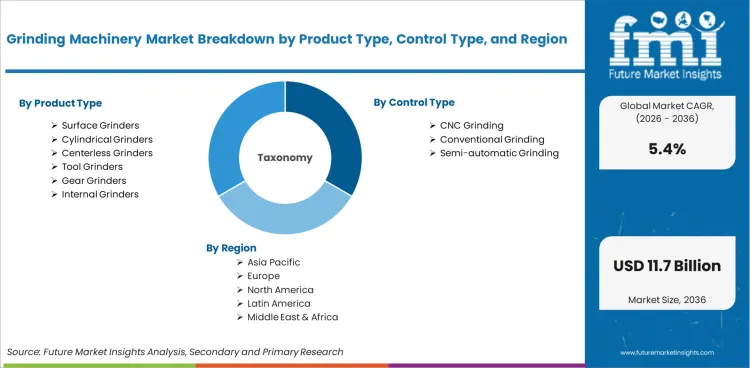
Grinding Machinery Market Segmented by Product Type
- Surface Grinders
- Cylindrical Grinders
- Centerless Grinders
- Tool Grinders
- Gear Grinders
- Internal Grinders
Grinding Machinery Market Segmented by Control Type
- CNC Grinding
- Conventional Grinding
- Semi-automatic Grinding
Grinding Machinery Market Segmented by Application
- Automotive Components
- Aerospace Parts
- Cutting Tools
- Medical Devices
- Industrial Machinery
Grinding Machinery Market Segmented by End Use
- Automotive
- Aerospace and Defense
- General Engineering
- Toolmaking
- Medical Manufacturing
- Electronics
Grinding Machinery Market Segmented by Sales Channel
- Direct Sales
- Machine Tool Dealers
- System Integrators
- Online Industrial Platforms
Grinding Machinery Market by Region
- North America
- United States
- Canada
- Mexico
- Latin America
- Brazil
- Chile
- Rest of Latin America
- Western Europe
- Germany
- United Kingdom
- France
- Italy
- Spain
- Nordic
- BENELUX
- Rest of Western Europe
- Eastern Europe
- Russia
- Poland
- Balkan and Baltic
- Rest of Eastern Europe
- East Asia
- China
- Japan
- South Korea
- South Asia and Pacific
- India
- ASEAN
- Australia and New Zealand
- Rest of South Asia and Pacific
- Middle East and Africa
- Kingdom of Saudi Arabia
- Other GCC Countries
- Turkiye
- South Africa
- Other African Union
- Rest of Middle East and Africa
Research Sources and Bibliography
- CECIMO. (2024, December). CECIMO Magazine 2024. CECIMO.
- Gardner Intelligence. (2025, July 18). World Machine Tool Survey. Gardner Intelligence.
- Japan Machine Tool Builders’ Association. (2025, September). Machine Tool Production. JMTBA.
- AMT. (2026, February 9). Manufacturing Technology Orders Set Record in December 2025. AMT.
- Indian Machine Tool Manufacturers’ Association. (2025, September). Indian machine tool industry expected to grow 10% in FY26. IMTMA.
- VDW. (2025, February). German Machine Tool Industry Key Figures. VDW.
- ANCA. (2024). ANCA MicroX ULTRA Grinding Machine and AIMS Connect at IMTS 2024. ANCA.
- JUNKER Group. (2024, December). New Platform 3 grinding machines live at IMTS 2024. JUNKER Group.
- United Grinding. (2024, December). United Grinding Showcases Remote Service Capabilities at IMTS 2024. United Grinding.
- Palmary Machinery. (2024, May). IMTS 2024 Precision Grinding Machine. Palmary Machinery.
The bibliography is provided for reader reference and uses primary industry, association, company, and trade body sources.
This Report Answers
- What is the current and future size of the Grinding Machinery Market?
- How fast is the Grinding Machinery Market expected to grow from 2026 to 2036?
- Which product type is expected to lead grinding machinery demand in 2026?
- Why are CNC grinding machines gaining share in precision manufacturing?
- Which applications create the strongest demand for grinding machinery?
- How do operator skill gaps affect grinding machinery purchases?
- Which countries are expected to shape grinding machinery demand during the forecast period?
- Which companies are active in grinding machinery production and supply?
- How does FMI define the Grinding Machinery Market scope?
- How does the forecast account for machine tool cycles and country-level demand?
Frequently Asked Questions
What is the Grinding Machinery Market value in 2026?
The Grinding Machinery Market is expected to reach USD 6.58 billion in 2026 based on FMI analysis and forecast modelling.
What is the Grinding Machinery Market forecast value by 2036?
The Grinding Machinery Market is projected to reach USD 11.12 billion by 2036 as precision manufacturing demand expands.
What CAGR is projected for the Grinding Machinery Market from 2026 to 2036?
The Grinding Machinery Market is projected to grow at 5.4% CAGR from 2026 to 2036.
Which product type leads the Grinding Machinery Market in 2026?
Surface grinding machines are expected to lead the Product Type segment with 31.0% share in 2026.
Which control type leads the Grinding Machinery Market in 2026?
CNC grinding machines are projected to lead Control Type demand with 64.0% share in 2026.
Which country records the fastest Grinding Machinery Market growth?
India is projected to record the fastest growth at 8.2% CAGR through 2036 due to rising machine tool consumption.
Which country records the fastest Grinding Machinery Market growth?
The market includes surface grinders, cylindrical grinders, centerless grinders, tool grinders, gear grinders, and internal grinders.
How is the Grinding Machinery Market forecast prepared?
The forecast uses machine shipment indicators, pricing bands, application demand, country manufacturing activity, and machine tool investment cycles.
Which grinding machine is best for flat parts?
Surface grinding machines are best suited for flat parts because they control flatness and finish across wide contact surfaces.
Why do manufacturers use CNC grinding machines?
Manufacturers use CNC grinding machines to reduce manual variation and repeat the same part geometry across production batches.
What is the difference between cylindrical and centerless grinding?
Cylindrical grinding holds the workpiece between centers or a chuck. Centerless grinding supports round parts without a central holding point.
What limits grinding machinery adoption?
The main limits are capital cost, skilled setup labor, wheel-dressing knowledge, and service availability after installation.
Preview the report firsthand - request a free sample
Get SampleGet the brochure for pricing and purchase details.
Get PDFTable of Content
- Executive Summary
- Global Market Outlook
- Demand-side Trends
- Supply-side Trends
- Technology Roadmap Analysis
- Analysis and Recommendations
- Market Overview
- Market Coverage / Taxonomy
- Market Definition / Scope / Limitations
- Research Methodology
- Chapter Orientation
- Analytical Lens and Working Hypotheses
- Market Structure, Signals, and Trend Drivers
- Benchmarking and Cross-market Comparability
- Market Sizing, Forecasting, and Opportunity Mapping
- Research Design and Evidence Framework
- Desk Research Programme (Secondary Evidence)
- Company Annual and Sustainability Reports
- Peer-reviewed Journals and Academic Literature
- Corporate Websites, Product Literature, and Technical Notes
- Earnings Decks and Investor Briefings
- Statutory Filings and Regulatory Disclosures
- Technical White Papers and Standards Notes
- Trade Journals, Industry Magazines, and Analyst Briefs
- Conference Proceedings, Webinars, and Seminar Materials
- Government Statistics Portals and Public Data Releases
- Press Releases and Reputable Media Coverage
- Specialist Newsletters and Curated Briefings
- Sector Databases and Reference Repositories
- FMI Internal Proprietary Databases and Historical Market Datasets
- Subscription Datasets and Paid Sources
- Social Channels, Communities, and Digital Listening Inputs
- Additional Desk Sources
- Expert Input and Fieldwork (Primary Evidence)
- Primary Modes
- Qualitative Interviews and Expert Elicitation
- Quantitative Surveys and Structured Data Capture
- Blended Approach
- Why Primary Evidence is Used
- Field Techniques
- Interviews
- Surveys
- Focus Groups
- Observational and In-context Research
- Social and Community Interactions
- Stakeholder Universe Engaged
- C-suite Leaders
- Board Members
- Presidents and Vice Presidents
- R&D and Innovation Heads
- Technical Specialists
- Domain Subject-matter Experts
- Scientists
- Physicians and Other Healthcare Professionals
- Governance, Ethics, and Data Stewardship
- Research Ethics
- Data Integrity and Handling
- Primary Modes
- Tooling, Models, and Reference Databases
- Desk Research Programme (Secondary Evidence)
- Data Engineering and Model Build
- Data Acquisition and Ingestion
- Cleaning, Normalisation, and Verification
- Synthesis, Triangulation, and Analysis
- Quality Assurance and Audit Trail
- Market Background
- Market Dynamics
- Drivers
- Restraints
- Opportunity
- Trends
- Scenario Forecast
- Demand in Optimistic Scenario
- Demand in Likely Scenario
- Demand in Conservative Scenario
- Opportunity Map Analysis
- Product Life Cycle Analysis
- Supply Chain Analysis
- Investment Feasibility Matrix
- Value Chain Analysis
- PESTLE and Porter’s Analysis
- Regulatory Landscape
- Regional Parent Market Outlook
- Production and Consumption Statistics
- Import and Export Statistics
- Market Dynamics
- Global Market Analysis 2021 to 2025 and Forecast, 2026 to 2036
- Historical Market Size Value (USD Million) Analysis, 2021 to 2025
- Current and Future Market Size Value (USD Million) Projections, 2026 to 2036
- Y-o-Y Growth Trend Analysis
- Absolute $ Opportunity Analysis
- Global Market Pricing Analysis 2021 to 2025 and Forecast 2026 to 2036
- Global Market Analysis 2021 to 2025 and Forecast 2026 to 2036, By Product Type
- Introduction / Key Findings
- Historical Market Size Value (USD Million) Analysis By Product Type , 2021 to 2025
- Current and Future Market Size Value (USD Million) Analysis and Forecast By Product Type , 2026 to 2036
- Surface Grinders
- Cylindrical Grinders
- Centerless Grinders
- Tool Grinders
- Gear Grinders
- Internal Grinders
- Surface Grinders
- Y-o-Y Growth Trend Analysis By Product Type , 2021 to 2025
- Absolute $ Opportunity Analysis By Product Type , 2026 to 2036
- Global Market Analysis 2021 to 2025 and Forecast 2026 to 2036, By Control Type
- Introduction / Key Findings
- Historical Market Size Value (USD Million) Analysis By Control Type, 2021 to 2025
- Current and Future Market Size Value (USD Million) Analysis and Forecast By Control Type, 2026 to 2036
- CNC Grinding
- Conventional Grinding
- Semi-automatic Grinding
- CNC Grinding
- Y-o-Y Growth Trend Analysis By Control Type, 2021 to 2025
- Absolute $ Opportunity Analysis By Control Type, 2026 to 2036
- Global Market Analysis 2021 to 2025 and Forecast 2026 to 2036, By Application
- Introduction / Key Findings
- Historical Market Size Value (USD Million) Analysis By Application, 2021 to 2025
- Current and Future Market Size Value (USD Million) Analysis and Forecast By Application, 2026 to 2036
- Automotive Components
- Aerospace Parts
- Cutting Tools
- Medical Devices
- Industrial Machinery
- Automotive Components
- Y-o-Y Growth Trend Analysis By Application, 2021 to 2025
- Absolute $ Opportunity Analysis By Application, 2026 to 2036
- Global Market Analysis 2021 to 2025 and Forecast 2026 to 2036, By End Use
- Introduction / Key Findings
- Historical Market Size Value (USD Million) Analysis By End Use, 2021 to 2025
- Current and Future Market Size Value (USD Million) Analysis and Forecast By End Use, 2026 to 2036
- General Engineering
- Toolmaking
- Medical Manufacturing
- Electronics
- Automotive
- Aerospace and Defense
- General Engineering
- Y-o-Y Growth Trend Analysis By End Use, 2021 to 2025
- Absolute $ Opportunity Analysis By End Use, 2026 to 2036
- Global Market Analysis 2021 to 2025 and Forecast 2026 to 2036, By Sales Channel
- Introduction / Key Findings
- Historical Market Size Value (USD Million) Analysis By Sales Channel, 2021 to 2025
- Current and Future Market Size Value (USD Million) Analysis and Forecast By Sales Channel, 2026 to 2036
- Direct Sales
- Machine Tool Dealers
- System Integrators
- Online Industrial Platforms
- Direct Sales
- Y-o-Y Growth Trend Analysis By Sales Channel, 2021 to 2025
- Absolute $ Opportunity Analysis By Sales Channel, 2026 to 2036
- Global Market Analysis 2021 to 2025 and Forecast 2026 to 2036, By Region
- Introduction
- Historical Market Size Value (USD Million) Analysis By Region, 2021 to 2025
- Current Market Size Value (USD Million) Analysis and Forecast By Region, 2026 to 2036
- North America
- Latin America
- Western Europe
- Eastern Europe
- East Asia
- South Asia and Pacific
- Middle East & Africa
- Market Attractiveness Analysis By Region
- North America Market Analysis 2021 to 2025 and Forecast 2026 to 2036, By Country
- Historical Market Size Value (USD Million) Trend Analysis By Market Taxonomy, 2021 to 2025
- Market Size Value (USD Million) Forecast By Market Taxonomy, 2026 to 2036
- By Country
- USA
- Canada
- Mexico
- By Product Type
- By Control Type
- By Application
- By End Use
- By Sales Channel
- By Country
- Market Attractiveness Analysis
- By Country
- By Product Type
- By Control Type
- By Application
- By End Use
- By Sales Channel
- Key Takeaways
- Latin America Market Analysis 2021 to 2025 and Forecast 2026 to 2036, By Country
- Historical Market Size Value (USD Million) Trend Analysis By Market Taxonomy, 2021 to 2025
- Market Size Value (USD Million) Forecast By Market Taxonomy, 2026 to 2036
- By Country
- Brazil
- Chile
- Rest of Latin America
- By Product Type
- By Control Type
- By Application
- By End Use
- By Sales Channel
- By Country
- Market Attractiveness Analysis
- By Country
- By Product Type
- By Control Type
- By Application
- By End Use
- By Sales Channel
- Key Takeaways
- Western Europe Market Analysis 2021 to 2025 and Forecast 2026 to 2036, By Country
- Historical Market Size Value (USD Million) Trend Analysis By Market Taxonomy, 2021 to 2025
- Market Size Value (USD Million) Forecast By Market Taxonomy, 2026 to 2036
- By Country
- Germany
- UK
- Italy
- Spain
- France
- Nordic
- BENELUX
- Rest of Western Europe
- By Product Type
- By Control Type
- By Application
- By End Use
- By Sales Channel
- By Country
- Market Attractiveness Analysis
- By Country
- By Product Type
- By Control Type
- By Application
- By End Use
- By Sales Channel
- Key Takeaways
- Eastern Europe Market Analysis 2021 to 2025 and Forecast 2026 to 2036, By Country
- Historical Market Size Value (USD Million) Trend Analysis By Market Taxonomy, 2021 to 2025
- Market Size Value (USD Million) Forecast By Market Taxonomy, 2026 to 2036
- By Country
- Russia
- Poland
- Hungary
- Balkan & Baltic
- Rest of Eastern Europe
- By Product Type
- By Control Type
- By Application
- By End Use
- By Sales Channel
- By Country
- Market Attractiveness Analysis
- By Country
- By Product Type
- By Control Type
- By Application
- By End Use
- By Sales Channel
- Key Takeaways
- East Asia Market Analysis 2021 to 2025 and Forecast 2026 to 2036, By Country
- Historical Market Size Value (USD Million) Trend Analysis By Market Taxonomy, 2021 to 2025
- Market Size Value (USD Million) Forecast By Market Taxonomy, 2026 to 2036
- By Country
- China
- Japan
- South Korea
- By Product Type
- By Control Type
- By Application
- By End Use
- By Sales Channel
- By Country
- Market Attractiveness Analysis
- By Country
- By Product Type
- By Control Type
- By Application
- By End Use
- By Sales Channel
- Key Takeaways
- South Asia and Pacific Market Analysis 2021 to 2025 and Forecast 2026 to 2036, By Country
- Historical Market Size Value (USD Million) Trend Analysis By Market Taxonomy, 2021 to 2025
- Market Size Value (USD Million) Forecast By Market Taxonomy, 2026 to 2036
- By Country
- India
- ASEAN
- Australia & New Zealand
- Rest of South Asia and Pacific
- By Product Type
- By Control Type
- By Application
- By End Use
- By Sales Channel
- By Country
- Market Attractiveness Analysis
- By Country
- By Product Type
- By Control Type
- By Application
- By End Use
- By Sales Channel
- Key Takeaways
- Middle East & Africa Market Analysis 2021 to 2025 and Forecast 2026 to 2036, By Country
- Historical Market Size Value (USD Million) Trend Analysis By Market Taxonomy, 2021 to 2025
- Market Size Value (USD Million) Forecast By Market Taxonomy, 2026 to 2036
- By Country
- Kingdom of Saudi Arabia
- Other GCC Countries
- Turkiye
- South Africa
- Other African Union
- Rest of Middle East & Africa
- By Product Type
- By Control Type
- By Application
- By End Use
- By Sales Channel
- By Country
- Market Attractiveness Analysis
- By Country
- By Product Type
- By Control Type
- By Application
- By End Use
- By Sales Channel
- Key Takeaways
- Key Countries Market Analysis
- USA
- Pricing Analysis
- Market Share Analysis, 2025
- By Product Type
- By Control Type
- By Application
- By End Use
- By Sales Channel
- Canada
- Pricing Analysis
- Market Share Analysis, 2025
- By Product Type
- By Control Type
- By Application
- By End Use
- By Sales Channel
- Mexico
- Pricing Analysis
- Market Share Analysis, 2025
- By Product Type
- By Control Type
- By Application
- By End Use
- By Sales Channel
- Brazil
- Pricing Analysis
- Market Share Analysis, 2025
- By Product Type
- By Control Type
- By Application
- By End Use
- By Sales Channel
- Chile
- Pricing Analysis
- Market Share Analysis, 2025
- By Product Type
- By Control Type
- By Application
- By End Use
- By Sales Channel
- Germany
- Pricing Analysis
- Market Share Analysis, 2025
- By Product Type
- By Control Type
- By Application
- By End Use
- By Sales Channel
- UK
- Pricing Analysis
- Market Share Analysis, 2025
- By Product Type
- By Control Type
- By Application
- By End Use
- By Sales Channel
- Italy
- Pricing Analysis
- Market Share Analysis, 2025
- By Product Type
- By Control Type
- By Application
- By End Use
- By Sales Channel
- Spain
- Pricing Analysis
- Market Share Analysis, 2025
- By Product Type
- By Control Type
- By Application
- By End Use
- By Sales Channel
- France
- Pricing Analysis
- Market Share Analysis, 2025
- By Product Type
- By Control Type
- By Application
- By End Use
- By Sales Channel
- India
- Pricing Analysis
- Market Share Analysis, 2025
- By Product Type
- By Control Type
- By Application
- By End Use
- By Sales Channel
- ASEAN
- Pricing Analysis
- Market Share Analysis, 2025
- By Product Type
- By Control Type
- By Application
- By End Use
- By Sales Channel
- Australia & New Zealand
- Pricing Analysis
- Market Share Analysis, 2025
- By Product Type
- By Control Type
- By Application
- By End Use
- By Sales Channel
- China
- Pricing Analysis
- Market Share Analysis, 2025
- By Product Type
- By Control Type
- By Application
- By End Use
- By Sales Channel
- Japan
- Pricing Analysis
- Market Share Analysis, 2025
- By Product Type
- By Control Type
- By Application
- By End Use
- By Sales Channel
- South Korea
- Pricing Analysis
- Market Share Analysis, 2025
- By Product Type
- By Control Type
- By Application
- By End Use
- By Sales Channel
- Russia
- Pricing Analysis
- Market Share Analysis, 2025
- By Product Type
- By Control Type
- By Application
- By End Use
- By Sales Channel
- Poland
- Pricing Analysis
- Market Share Analysis, 2025
- By Product Type
- By Control Type
- By Application
- By End Use
- By Sales Channel
- Hungary
- Pricing Analysis
- Market Share Analysis, 2025
- By Product Type
- By Control Type
- By Application
- By End Use
- By Sales Channel
- Kingdom of Saudi Arabia
- Pricing Analysis
- Market Share Analysis, 2025
- By Product Type
- By Control Type
- By Application
- By End Use
- By Sales Channel
- Turkiye
- Pricing Analysis
- Market Share Analysis, 2025
- By Product Type
- By Control Type
- By Application
- By End Use
- By Sales Channel
- South Africa
- Pricing Analysis
- Market Share Analysis, 2025
- By Product Type
- By Control Type
- By Application
- By End Use
- By Sales Channel
- USA
- Market Structure Analysis
- Competition Dashboard
- Competition Benchmarking
- Market Share Analysis of Top Players
- By Regional
- By Product Type
- By Control Type
- By Application
- By End Use
- By Sales Channel
- Competition Analysis
- Competition Deep Dive
- Value (USD Million)ed Grinding Group
- Overview
- Product Portfolio
- Profitability by Market Segments (Product/Age /Sales Channel/Region)
- Sales Footprint
- Strategy Overview
- Marketing Strategy
- Product Strategy
- Channel Strategy
- JTEKT
- Okuma
- JUNKER Group
- ANCA
- Amada Machinery
- Rollomatic
- Palmary
- Micromatic Grinding
- Jainnher
- Value (USD Million)ed Grinding Group
- Competition Deep Dive
- Assumptions & Acronyms Used


