

- Industry Size (2026)
- USD 610 Mn
- Forecast (2036)
- USD 774.8 Mn
- CAGR (2026 to 2036)
- 2.4%
Demand for Turbomachinery Control System in United Kingdom Forecast and Outlook 2026 to 2036
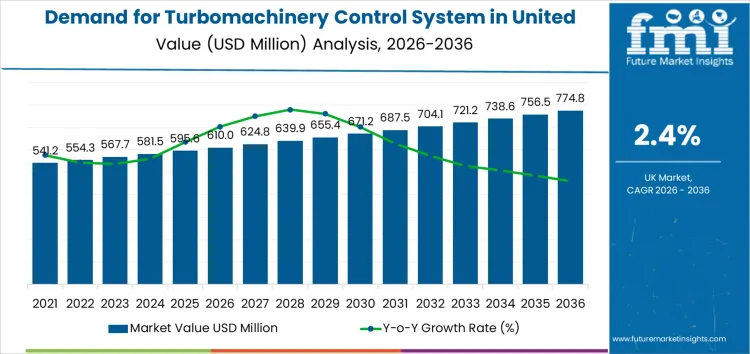
The turbomachinery control system market in the United Kingdom is projected to grow from USD 610 million in 2026 to USD 774.8 million by 2036, at a CAGR of 2.4%. A key driver for this growth will be the concentration of production within specific regions, where many suppliers are based. This geographical aggregation nurtures specialized expertise in turbomachinery, but it also raises concerns regarding supply chain vulnerabilities.
The reliance on concentrated manufacturing hubs creates dependencies on certain suppliers or regions, which can lead to potential disruptions. Companies that prioritize regional manufacturing capabilities will likely see improved operational efficiency, enabling them to optimize costs and shorten lead times. However, this strategy does carry inherent risks, particularly in the face of shifting regional economic climates or geopolitical tensions.
The reliability of supply is paramount as consistent availability of products is essential for firms to meet project schedules and fulfill customer demands. To navigate these challenges effectively, industry players must consider diversifying their supply chains and developing comprehensive contingency plans to safeguard against unforeseen disruptions. This proactive approach will help companies minimize risks and maintain competitiveness in the evolving market landscape.
Quick Stats for the Demand for Turbomachinery Control System in United Kingdom:
- Turbomachinery Control System in United Kingdom Value (2026): USD 610 million
- Turbomachinery Control System in United Kingdom Forecast Value (2036): USD 774.8 million
- Turbomachinery Control System in United Kingdom Forecast CAGR (2026 to 2036): 2.4%
- Turbomachinery Control System in United Kingdom Leading Segment: Oil & Gas (40% share)
- Key Growth Regions of Turbomachinery Control System in United Kingdom: England
- Top Players of Turbomachinery Control System in United Kingdom: Honeywell Technology Solutions, Schneider Electric SE, Rockwell Automation Inc., Woodward Inc., ABB Group
What is the Growth Forecast for Turbomachinery Control System in United Kingdom through 2036?
The demand for turbomachinery control systems in the United Kingdom is expected to rise from USD 610 million in 2026 to USD 774.8 million by 2036, reflecting a compound annual growth rate (CAGR) of 2.4%. Between 2026 and 2031, the industry will experience gradual growth, with values increasing from USD 610 million to USD 687.5 million. From 2031 to 2036, growth will continue, reaching USD 774.8 million by the end of the forecast period.
The seasonality or cyclicality detection indicates that while the turbomachinery control system market shows steady, continuous growth, it may be subject to cyclic patterns driven by economic conditions, industrial investments, and energy sector fluctuations. Demand could experience fluctuations tied to capital expenditure cycles in energy and industrial infrastructure, especially during periods of economic uncertainty or shifts in government energy policies. However, the long-term growth trend remains positive, supported by the ongoing adoption of advanced control systems and the need for greater operational efficiency and environmental compliance in critical industries.
Key Takeaways for Demand for Turbomachinery Control System in United Kingdom
| Metric | Value |
|---|---|
| Industry Sales Value (2026) | USD 610 million |
| Industry Forecast Value (2036) | USD 774.8 million |
| Industry Forecast CAGR (2026 to 2036) | 2.4% |
Why is Demand for Turbomachinery Control System in United Kingdom Growing?
Demand for turbomachinery control system in the United Kingdom has grown as industrial users and power producers upgraded operational performance and reliability of rotating equipment. Historically, basic mechanical governors and analogue control units were common in gas turbines, steam turbines, compressors, and centrifugal equipment. Over time, operators shifted toward digital control systems that enable precise regulation of speed, load sharing, and combustion parameters. In the UK energy sector, power plants integrating combined cycle gas turbines and distributed generation assets required advanced control systems to meet tighter operational tolerances and grid code requirements. Petrochemical and process industries adopted digital controllers for compressors and pumps to improve stability in continuous operations and reduce unplanned downtime. Maintenance teams benefited from enhanced diagnostics and condition monitoring functions embedded in modern turbomachinery control systems, which support early detection of anomalies and reduce reactive interventions. These factors drove capital expenditure on control upgrades in industrial facilities seeking to align equipment performance with reliability targets.
Looking ahead, demand for turbomachinery control system in the United Kingdom is expected to continue rising as asset owners focus on performance optimisation and lifecycle cost reduction. Power generation stakeholders will prioritise control systems that support flexible operation, quick load response, and integration with plant automation platforms. Industrial users in sectors such as chemicals, oil and gas, and manufacturing will value systems offering improved data visibility and predictive maintenance capabilities to lower operational risk. Suppliers that provide scalable and interoperable control solutions stand to benefit as UK facilities modernise legacy systems and pursue digital transformation initiatives. Stringent regulatory expectations around emissions, energy efficiency, and safety will reinforce the need for robust control architectures that deliver precision and compliance. Service providers offering commissioning, calibration, and long term support may gain traction among customers seeking to maximise uptime and ensure control system performance aligns with evolving process requirements. Continued focus on operational excellence and system integration will sustain demand for advanced turbomachinery control systems across the UK industrial landscape.
What Are the Key Segments in the Demand for Turbomachinery Control Systems in the United Kingdom?
Demand for turbomachinery control systems in the United Kingdom is driven by application and end-use industry. Generator controls lead the application segment with 35%, while the oil & gas industry dominates the end-use sector with 40%. Other applications such as compressor controls, turbine controls, and various industries like chemical & petrochemical, transportation, power generation, and food & beverages also contribute to the industry. These segments reflect the broad adoption of turbomachinery control systems in critical sectors that require high-performance machinery for efficient and safe operations.
What Is the Application Segment of Demand for Turbomachinery Control Systems in the United Kingdom?
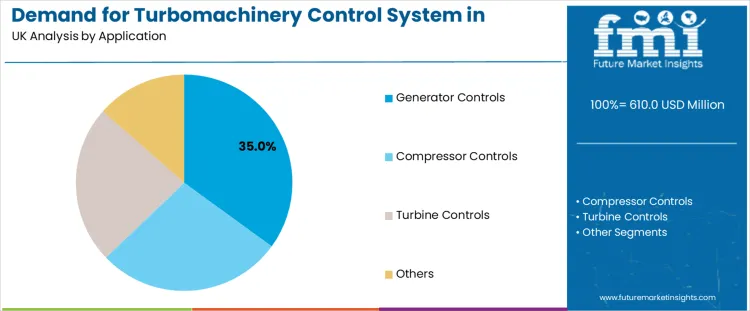
The application segment for turbomachinery control systems in the United Kingdom is predominantly led by generator controls, which account for 35% of the industry share. Turbomachinery control systems are crucial for maintaining the stability and performance of generators, which are integral to power generation processes. The ability to regulate the speed, load, and operation of a generator ensures the continuous supply of electricity, making control systems essential for both industrial and utility-scale power plants. The oil & gas industry follows as a significant application, where compressor and turbine control systems are critical for the safe and efficient operation of machinery that handles the extraction, transportation, and refinement of oil and gas.
Compressor controls ensure the proper functioning of gas compression systems, which are essential for natural gas processing and pipeline transportation. Turbine controls, while a distinct category, also play a key role in regulating the performance of turbines used in power plants, oil refineries, and offshore rigs. The need for advanced control systems is amplified in environments that demand high reliability and operational safety. Other applications, including those in chemical & petrochemical industries, ensure the stable operation of turbines and compressors used in refining and chemical production processes. The increasing need for energy-efficient, safe, and reliable turbomachinery in various sectors continues to drive demand for control systems, particularly in industries where machinery operates under heavy loads or in challenging environments.
What Is the End-Use Industry Segment of Demand for Turbomachinery Control Systems in the United Kingdom?
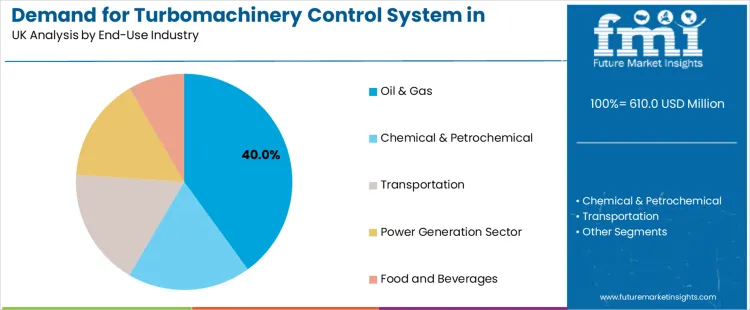
The end-use industry segment for turbomachinery control systems in the United Kingdom is led by the oil & gas industry, which accounts for 40% of the industry share. The oil & gas sector relies heavily on turbomachinery control systems to maintain the efficient operation of turbines, compressors, and pumps used in exploration, production, and transportation. These control systems ensure that equipment operates within optimal parameters, preventing failures and maximizing energy efficiency. The oil & gas sector’s need for reliable and robust turbomachinery control solutions has driven significant technological advancements in the field. The chemical & petrochemical industry follows as a key sector, where turbomachinery is used in various refining and chemical production processes. In this industry, control systems are essential for regulating compressors and turbines that handle high-pressure and high-temperature gases and liquids, ensuring safety, efficiency, and product quality.
The transportation sector, while smaller, also relies on turbomachinery control systems for applications in aircraft engines, marine vessels, and railways, where turbines and compressors play a central role in propulsion and power generation. The power generation sector contributes significantly to the industry, with control systems used to manage turbines and generators in power plants, ensuring stable and efficient electricity production. The food and beverages industry, though a smaller segment, also uses turbomachinery control systems in food processing plants, particularly in machinery that handles air, gases, or steam. As industries across the United Kingdom continue to prioritize efficiency, safety, and sustainability, the demand for advanced turbomachinery control systems is expected to grow, especially in energy-intensive sectors like oil & gas, power generation, and chemical processing.
What are the Key Dynamics in the Demand for Turbomachinery Control Systems in the United Kingdom?
Demand for turbomachinery control systems in the United Kingdom is shaped by the integration of advanced control technologies in power generation, oil and gas, marine propulsion, and industrial processing sectors. These systems regulate operation of turbines, compressors, pumps, and other rotating equipment to ensure stability, efficiency, and safety. Procurement patterns are influenced by capital investment cycles in energy infrastructure, maintenance and reliability strategies, and compliance with industry performance standards. Digital transformation in industrial operations and the need for enhanced monitoring and automation also affect demand for control systems that support real time performance management and diagnostic capability.
What are the Key Drivers for Turbomachinery Control System Demand in the United Kingdom?
Several factors drive demand for turbomachinery control systems in the United Kingdom. Regulatory emphasis on operational safety and emissions compliance in power and hydrocarbon processing installations necessitates precise control and monitoring solutions. Expansion and upgrade of combined cycle gas turbine (CCGT) plants, distributed generation assets, and industrial utilities require scalable and robust control platforms. Operators prioritise systems that improve fuel efficiency and reduce unplanned downtime through condition based monitoring. Adoption of digital control interfaces that integrate with enterprise asset management and SCADA infrastructure reinforces demand. Marine and off shore sectors seek control solutions that enhance propulsion efficiency and support automation in harsh environments.
What are the Restraints on Turbomachinery Control System Demand in the United Kingdom?
Despite the demand drivers, several restraints affect the industry for turbomachinery control systems in the United Kingdom. High procurement and customisation costs for advanced control platforms can deter investment, especially for smaller operators or brownfield upgrade projects. Integration of new control systems with legacy hardware and software may require extensive engineering effort, prolonging deployment schedules and increasing project risk. Skills shortages in control systems engineering and automation can limit effective adoption, as operators may lack in house expertise to configure, optimise, and maintain sophisticated systems. Regulatory uncertainty tied to energy transition policy can also delay capital expenditures in traditional power and hydrocarbon sectors.
What are the Key Trends in Turbomachinery Control System Demand in the United Kingdom?
Key trends influencing demand for turbomachinery control systems in the United Kingdom include the shift toward digitalised and model based control solutions that enable predictive diagnostics and advanced automation. There is growing interest in integrated control platforms that combine safety instrumented functions with process control to streamline architecture and reduce engineering complexity. Condition monitoring analytics and machine learning driven performance optimisation are being embedded into control systems to support reliability centred maintenance. Vendors are offering modular hardware and scalable software suites that facilitate phased upgrades and reduce total cost of ownership. Collaboration between control system suppliers and original equipment manufacturers (OEMs) to co develop tailored solutions for specific turbomachinery applications is increasingly prevalent.
What is the Country-Wise Demand for Turbomachinery Control Systems in the United Kingdom?
The country-wise demand for turbomachinery control systems in the United Kingdom exhibits varying levels of adoption across its regions, with England leading the industry. The demand is primarily driven by England’s large industrial sectors, including energy, manufacturing, and power generation, where turbomachinery plays a critical role in operational efficiency. Scotland, Wales, and Northern Ireland follow with steady growth, supported by their respective industries in energy production, aerospace, and manufacturing. As the demand for more efficient, reliable, and high-performance machinery continues to rise, turbomachinery control systems are becoming increasingly crucial for optimizing operations. The adoption of automation, digitalization, and regulatory compliance across all regions is expected to fuel growth. While England remains the dominant market, all regions are likely to see gradual growth due to the expanding need for advanced turbomachinery control solutions.
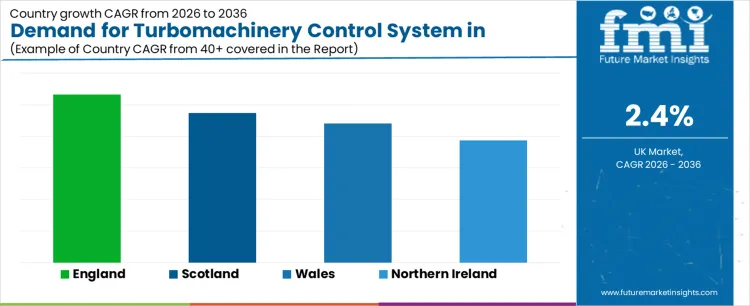
| Country | CAGR (2026 to 2036) |
|---|---|
| England | 2.7% |
| Scotland | 2.4% |
| Wales | 2.2% |
| Northern Ireland | 1.9% |
What is Driving the Demand for Turbomachinery Control Systems in England?
The demand for turbomachinery control systems in England is projected to grow at a CAGR of 2.7% from 2026 to 2036. England’s industrial base, including the power generation, aerospace, and oil & gas sectors, is the primary driver for this demand. Turbomachinery control systems are crucial for optimizing performance and ensuring the reliability of turbines, compressors, and pumps used in these industries. As industries in England increasingly focus on automation, digitalization, and reducing operational costs, the adoption of advanced turbomachinery control systems becomes essential. Furthermore, stricter environmental regulations and the need for energy efficiency are pushing businesses to adopt more sophisticated control systems. With England’s ongoing push toward decarbonization, increased demand for renewable energy, and the continuous evolution of manufacturing technologies, the industry for turbomachinery control systems is expected to grow steadily over the next decade.
How is the Demand for Turbomachinery Control Systems Performing in Scotland?
In Scotland, the demand for turbomachinery control systems is expected to grow at a CAGR of 2.4% from 2026 to 2036. The key driver of this demand in Scotland is the energy sector, particularly in renewable energy production, such as wind and hydropower, where turbomachinery is crucial for efficient energy generation. Additionally, the aerospace and manufacturing industries in Scotland also contribute to the demand for reliable turbomachinery systems to ensure optimized performance and safety in operations. As Scotland continues to invest in sustainable energy solutions and aims to meet carbon reduction targets, turbomachinery control systems will be critical in enhancing energy efficiency and operational effectiveness. Furthermore, Scotland’s focus on advancing technology and automation in its industrial base will drive continued adoption of these systems across its power generation and manufacturing sectors.
What Are the Growth Drivers for Turbomachinery Control Systems in Wales?
The demand for turbomachinery control systems in Wales is projected to grow at a CAGR of 2.2% through 2036. Wales’ industrial sectors, particularly in power generation and manufacturing, are key drivers of this demand. As industries continue to emphasize operational efficiency and sustainability, the need for advanced turbomachinery control systems is increasing. In Wales, control systems are used to optimize the performance of turbines, compressors, and pumps, particularly in energy production and manufacturing facilities. With Wales’ continued push towards renewable energy, particularly in wind power, turbomachinery control systems will play an integral role in ensuring reliable, efficient energy generation. The increasing trend toward automation in Wales’ manufacturing processes, coupled with regulatory pressures for better performance and lower emissions, will drive demand for these advanced control systems.
What is the Outlook for Turbomachinery Control Systems Demand in Northern Ireland?
Northern Ireland’s demand for turbomachinery control systems is expected to grow at a CAGR of 1.9% from 2026 to 2036. While Northern Ireland represents a smaller market compared to England, Scotland, and Wales, steady growth is expected, particularly within the power generation and manufacturing sectors. As industries in Northern Ireland continue to adopt modernized processes to enhance efficiency, the need for turbomachinery control systems to improve performance and reduce downtime is becoming increasingly important. In addition to traditional energy sectors, the ongoing transition toward renewable energy sources will further contribute to the demand for these systems. Although the rate of adoption is slower in Northern Ireland, the industry for turbomachinery control systems is expected to see steady growth driven by continued investments in industrial innovation and sustainability.
What is the Competitive Landscape for Demand for Turbomachinery Control Systems in the United Kingdom?
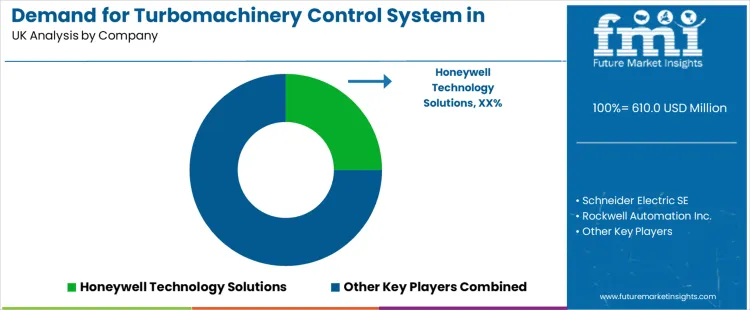
Demand for turbomachinery control systems in the United Kingdom is driven by operational needs in power generation, oil and gas processing, and large scale industrial compression facilities. Procurement teams assess suppliers against documented control architecture, compatibility with distributed control systems, and documented performance under defined process conditions. Honeywell Technology Solutions is positioned as a leading supplier, with technical brochures that list documented controller capabilities, engine tuning parameters, and system integration guidelines. These documents are referenced by control engineers when aligning system selection with plant level performance objectives. Schneider Electric SE competes with control solutions documented for scalable performance, system interoperability, and documented safety compliance, and these attributes are reviewed by automation teams in tender evaluations. Rockwell Automation Inc. provides documented control platforms that include hardware specifications, documented redundancy options, and documented diagnostic features. Specification sheets from Rockwell are consulted by procurement professionals to match system profiles with site needs and existing automation frameworks.
Woodward Inc. participates with control systems documented for precision regulation of speed, fuel flow, and vibration management. Technical literature from Woodward lists documented tuning parameters, documented environmental ratings, and documented interface protocols that are used to guide specification alignment. ABB Group offers turbomachinery control solutions supported by brochures that outline documented control logic, documented connectivity options, and documented service support terms. Buyers in the United Kingdom compare documented performance metrics and documented integration capabilities from these suppliers to ensure alignment with reliability targets and maintenance strategies. Supply agreements are shaped by documented lead times, documented service commitments, and documented compliance notes supplied by manufacturers. Demand patterns reflect scheduled asset upgrades and compliance with evolving industry standards that require documented control performance. Decisions are anchored in measurable specifications and documented technical attributes rather than subjective criteria, informing formal procurement cycles in power, process, and industrial sectors. Technical teams review documented hardware and software compatibility to ensure selected systems integrate with existing infrastructure and meet operational benchmarks consistently.
Key Players of the Demand for Turbomachinery Control System in United Kingdom
- Honeywell Technology Solutions
- Schneider Electric SE
- Rockwell Automation Inc.
- Woodward Inc.
- ABB Group
Scope of the Report
| Items | Values |
|---|---|
| Quantitative Units (2026) | USD Million |
| Application | Generator Controls, Compressor Controls, Turbine Controls, Others |
| End-Use Industry | Oil & Gas, Chemical & Petrochemical, Transportation, Power Generation Sector, Food and Beverages |
| Companies | Honeywell Technology Solutions, Schneider Electric SE, Rockwell Automation Inc., Woodward Inc., ABB Group |
| Regions Covered | United Kingdom |
| Countries Covered | England, Scotland, Wales, Northern Ireland |
| Additional Attributes | Dollar by sales by application, end-use industry, and region. Includes market trends towards energy efficiency, automation, and the role of turbomachinery control systems in optimizing performance across industries. |
Key Segments of Demand for Turbomachinery Control System in United Kingdom
Application:
- Generator Controls
- Compressor Controls
- Turbine Controls
- Others
End-Use Industry:
- Oil & Gas
- Chemical & Petrochemical
- Transportation
- Power Generation Sector
- Food and Beverages
Countries:
- England
- Scotland
- Wales
- Northern Ireland
Bibliography
- Department for Energy Security and Net Zero. (2024). Energy security strategy update. UK Government.
- Energy Systems Catapult. (2024). Digitalisation and control systems in UK energy infrastructure. Energy Systems Catapult.
- International Electrotechnical Commission. (2024). Functional safety—Safety instrumented systems for the process industry sector (IEC 61511). IEC.
- International Organization for Standardization. (2024). Mechanical vibration—Measurement and evaluation of machine vibration (ISO 20816-1). ISO.
- Organisation for Economic Co-operation and Development. (2024). Industrial automation, digital control and productivity in energy-intensive sectors. OECD Publishing.
Frequently Asked Questions
How big is the demand for turbomachinery control system in united kingdom in 2026?
The demand for turbomachinery control system in united kingdom is estimated to be valued at USD 610.0 million in 2026.
What will be the size of turbomachinery control system in united kingdom in 2036?
The market size for the turbomachinery control system in united kingdom is projected to reach USD 774.8 million by 2036.
How much will be the demand for turbomachinery control system in united kingdom growth between 2026 and 2036?
The demand for turbomachinery control system in united kingdom is expected to grow at a 2.4% CAGR between 2026 and 2036.
What are the key product types in the turbomachinery control system in united kingdom?
The key product types in turbomachinery control system in united kingdom are generator controls, compressor controls, turbine controls and others.
Which end-use industry segment is expected to contribute significant share in the turbomachinery control system in united kingdom in 2026?
In terms of end-use industry, oil & gas segment is expected to command 40.0% share in the turbomachinery control system in united kingdom in 2026.
Preview the report firsthand - request a free sample
Get SampleGet the brochure for pricing and purchase details.
Get PDFTable of Content
- Executive Summary
- UK Market Outlook
- Demand-side Trends
- Supply-side Trends
- Technology Roadmap Analysis
- Analysis and Recommendations
- Market Overview
- Market Coverage / Taxonomy
- Market Definition / Scope / Limitations
- Market Background
- Market Dynamics
- Drivers
- Restraints
- Opportunity
- Trends
- Scenario Forecast
- Demand in Optimistic Scenario
- Demand in Likely Scenario
- Demand in Conservative Scenario
- Opportunity Map Analysis
- Product Life Cycle Analysis
- Supply Chain Analysis
- Investment Feasibility Matrix
- Value Chain Analysis
- PESTLE and Porter’s Analysis
- Regulatory Landscape
- Regional Parent Market Outlook
- Production and Consumption Statistics
- Import and Export Statistics
- Market Dynamics
- UK Market Analysis 2021 to 2025 and Forecast, 2026 to 2036
- Historical Market Size Value (USD Million) Analysis, 2021 to 2025
- Current and Future Market Size Value (USD Million) Projections, 2026 to 2036
- Y-o-Y Growth Trend Analysis
- Absolute $ Opportunity Analysis
- UK Market Pricing Analysis 2021 to 2025 and Forecast 2026 to 2036
- UK Market Analysis 2021 to 2025 and Forecast 2026 to 2036, By Application
- Introduction / Key Findings
- Historical Market Size Value (USD Million) Analysis By Application , 2021 to 2025
- Current and Future Market Size Value (USD Million) Analysis and Forecast By Application , 2026 to 2036
- Generator Controls
- Compressor Controls
- Turbine Controls
- Others
- Generator Controls
- Y-o-Y Growth Trend Analysis By Application , 2021 to 2025
- Absolute $ Opportunity Analysis By Application , 2026 to 2036
- UK Market Analysis 2021 to 2025 and Forecast 2026 to 2036, By End-Use Industry
- Introduction / Key Findings
- Historical Market Size Value (USD Million) Analysis By End-Use Industry, 2021 to 2025
- Current and Future Market Size Value (USD Million) Analysis and Forecast By End-Use Industry, 2026 to 2036
- Oil & Gas
- Chemical & Petrochemical
- Transportation
- Power Generation Sector
- Food and Beverages
- Oil & Gas
- Y-o-Y Growth Trend Analysis By End-Use Industry, 2021 to 2025
- Absolute $ Opportunity Analysis By End-Use Industry, 2026 to 2036
- Market Structure Analysis
- Competition Dashboard
- Competition Benchmarking
- Market Share Analysis of Top Players
- By Regional
- By Application
- By End-Use Industry
- Competition Analysis
- Competition Deep Dive
- Honeywell Technology Solutions
- Overview
- Product Portfolio
- Profitability by Market Segments (Product/Age /Sales Channel/Region)
- Sales Footprint
- Strategy Overview
- Marketing Strategy
- Product Strategy
- Channel Strategy
- Schneider Electric SE
- Rockwell Automation Inc.
- Woodward Inc.
- ABB Group
- Honeywell Technology Solutions
- Competition Deep Dive
- Assumptions & Acronyms Used
- Research Methodology


