

- Industry Size (2026)
- USD 199 Mn
- Forecast (2036)
- USD 247 Mn
- CAGR (2026 to 2036)
- 2.2%
Demand for Turbomachinery Control System in South Korea Forecast and Outlook 2026 to 2036
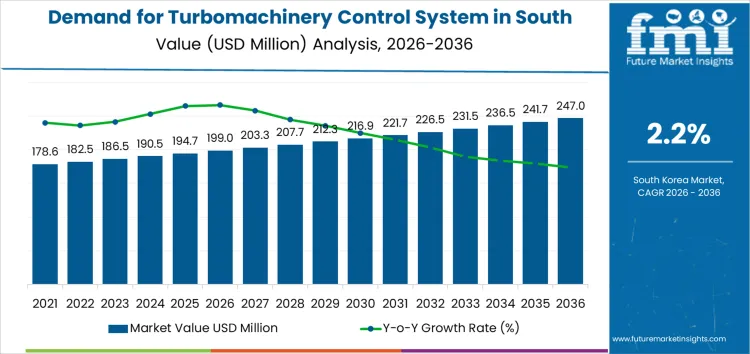
The demand for turbomachinery control systems in South Korea is projected to reach USD 247 million by 2036, growing at a CAGR of 2.2% from USD 199 million in 2026. Production concentration within this market is significant, with a limited number of suppliers dominating manufacturing capabilities. Regional control over production is critical, as many suppliers rely on local facilities to meet demand and manage logistics effectively. This also creates dependencies that can lead to vulnerabilities in the supply chain.
Interruptions caused by regional disruptions or material shortages are predicted to have a considerable impact on production timelines and costs. Supply reliability remains a key performance driver, with manufacturers facing increasing pressure to mitigate risks from global supply chain fluctuations. Constraints such as limited access to critical components and the rising cost of raw materials are estimated to further hinder production flexibility, making supply chain management a vital area for future focus.
Quick Stats for the Demand for Turbomachinery Control System in South Korea
- Turbomachinery Control System in South Korea Value (2026): USD 199 million
- Turbomachinery Control System in South Korea Forecast Value (2036): USD 247 million
- Turbomachinery Control System in South Korea Global Forecast CAGR (2026 to 2036): 2.2%
- Turbomachinery Control System in South Korea Leading Segment: Compressor Controls (40%)
- Key Growth Regions of Turbomachinery Control System in South Korea: Jeju (leading CAGR ~2.6%)
- Top Players of Turbomachinery Control System in South Korea: Honeywell Technology Solutions, Schneider Electric SE, Rockwell Automation Inc., Woodward Inc., ABB Group
What is the Growth Forecast for the Turbomachinery Control System Market in South Korea through 2036?
The turbomachinery control system market in South Korea is expected to see steady growth over the forecast period. The market will start at USD 199 million in 2026 and gradually increase to USD 203.3 million in 2027. By 2028, the market value will rise to USD 207.7 million, followed by USD 212.3 million in 2029. The market will continue to grow, reaching USD 216.9 million in 2030 and USD 221.7 million in 2031.
The demand for turbomachinery control systems will remain strong, with the market value projected to reach USD 226.5 million in 2032 and USD 231.5 million in 2033. By 2034, the market will reach USD 236.5 million, followed by USD 241.7 million in 2035. By 2036, the market is expected to reach USD 247 million, reflecting steady growth driven by increased industrial automation and a focus on energy-efficient solutions in South Korea’s key sectors.
Key Takeaways of Turbomachinery Control System in South Korea
| Metric | Value |
|---|---|
| Industry Sales Value (2026) | USD 199 million |
| Industry Forecast Value (2036) | USD 247 million |
| Industry Forecast CAGR (2026 to 2036) | 2.2% |
Why is the Demand for Turbomachinery Control System Growing in South Korea?
Demand for turbomachinery control systems in South Korea expanded over recent years in response to industrial automation and energy sector requirements. Historically, growth was influenced by needs in power generation, oil and gas, and manufacturing sectors where precise control of compressors, turbines, and pumps improved operational reliability and equipment uptime. South Korean energy companies adopted control systems to support gas turbines and other rotating equipment that require stable performance under varying load conditions, driven by policies encouraging shifts from coal to cleaner energy sources. Turbomachinery control technologies also became relevant in manufacturing environments where digital control reduced manual oversight and supported quality standards. Control systems provided real time monitoring and basic fault detection capabilities that helped operators maintain performance and reduce unplanned stoppages across production facilities, aligning with efficiency targets in national industrial plans. Industrial control frameworks in South Korea have shown sustained investment as part of wider automation strategies that integrate programmable logic controllers and supervisory control systems into critical equipment.
Future demand for turbomachinery control systems in South Korea is expected to grow as energy infrastructure and industrial processes evolve toward higher complexity and automation. The country’s renewable energy initiatives, particularly offshore wind and hybrid renewable projects, will require adaptable control solutions capable of integrating variable generation inputs and managing grid interactions. This transition expands requirements beyond traditional fossil fuel systems to control logic that supports intermittent energy sources. Advancements in digital technologies such as predictive analytics and condition based monitoring are anticipated to drive upgrades of legacy turbomachinery control systems, enabling remote diagnostics and reduced maintenance costs. Firms involved in gas turbine operation are also projected to invest in advanced control platforms to support gas turbine market growth forecast through the next decade. The broader automation and industrial controls market in South Korea is projected to continue increasing as firms seek improved operational performance that aligns with national industrial efficiency and energy transition objectives.
What Are the Key Segments in Demand for Turbomachinery Control Systems in South Korea?
Demand for turbomachinery control systems in South Korea is driven by various applications and end-use industries. The key applications include compressor controls, generator controls, turbine controls, and others, with compressor controls holding the largest share at 40%. The end-use industries for these systems include oil and gas, chemical and petrochemical, transportation, power generation, and food and beverages, with the oil and gas sector leading at 30%. Regional demand is shaped by the need for high-efficiency and precise control mechanisms in sectors requiring reliable machinery performance.
What Is the Demand Pattern for Turbomachinery Control Systems in South Korea by Application?
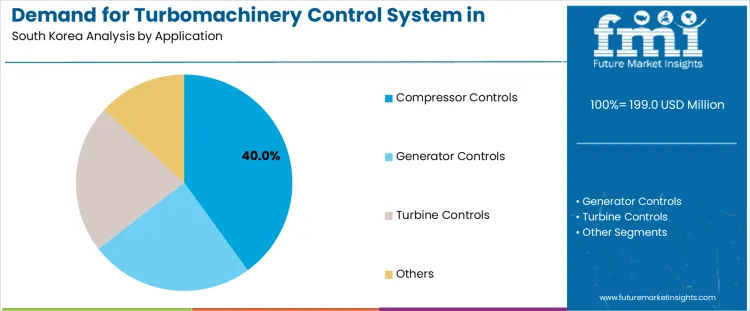
The demand for turbomachinery control systems in South Korea is predominantly driven by compressor controls, which account for 40% of the application segment. Compressor controls are essential in ensuring efficient operation in various industries, particularly in oil and gas, chemical, and power generation sectors. Compressors are integral components in these industries, used for gas and air compression processes that require precise control to maintain safety, efficiency, and reliability. The increasing complexity of industrial processes and the need for energy efficiency have made advanced control systems a necessity for optimizing compressor performance. These systems help prevent mechanical failures, reduce energy consumption, and ensure smooth operation even under demanding conditions. Generator controls follow as a key application, particularly in power generation and transportation industries.
The role of generator controls is vital for maintaining consistent electrical output and protecting generators from faults that could disrupt energy supply. Turbine controls are also crucial in power generation, oil and gas, and transportation, where turbines operate as critical power-producing equipment. As demand for clean energy solutions grows, the need for optimized turbine controls continues to rise, ensuring reliable power generation and transportation efficiency. The 'Others' category includes applications for industries such as food and beverages, where turbomachinery control systems are used to regulate various processing equipment, maintaining product consistency and quality.
What Is the Demand Pattern for Turbomachinery Control Systems in South Korea by End-Use Industry?
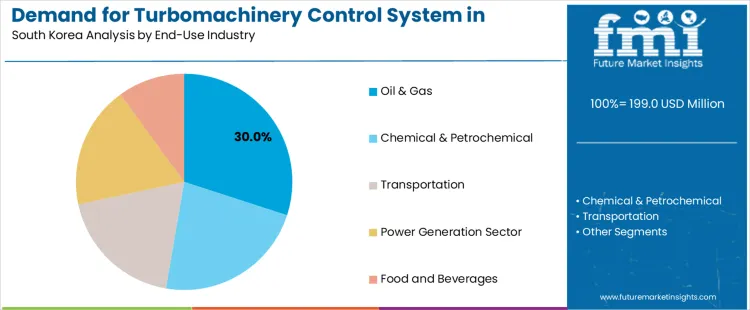
Demand for turbomachinery control systems in South Korea by end-use industry shows that oil and gas hold the largest market share at 30%. The oil and gas industry is a major consumer of turbomachinery control systems, as these systems are crucial for ensuring the safe and efficient operation of compressors, turbines, and other equipment in oil refineries, gas pipelines, and offshore platforms. In the oil and gas sector, control systems optimize operational efficiency, reduce downtime, and enhance safety in the transportation and processing of hydrocarbons. The chemical and petrochemical industry also contributes to the demand, where turbomachinery is used in various processes such as chemical production and refining. In these industries, control systems ensure that equipment runs smoothly under stringent conditions, maintaining high throughput and minimizing risks associated with process disruptions.
The transportation sector, particularly in aviation and maritime, relies on turbomachinery control systems to ensure the proper functioning of engines and turbines, vital for efficiency and safety. The power generation sector, where turbines and compressors are integral, also sees steady demand for these systems to enhance plant operations and power reliability. As South Korea continues to prioritize infrastructure growth and industrial modernization, turbomachinery control systems are increasingly essential across these diverse industries, providing the necessary precision and efficiency to meet growing demands. The food and beverages industry, while a smaller consumer of these systems, requires them to maintain processing equipment, ensuring the consistency and safety of food products.
What are the Key Dynamics in the Demand for Turbomachinery Control Systems in South Korea?
Demand for turbomachinery control systems in South Korea is shaped by industrial automation, energy sector expansion, and rising requirements for precision control in critical infrastructure. Growth in power generation, petrochemical facilities, and manufacturing plants supports procurement of control systems for turbines, compressors, and related turbomachinery. Industrial segments that rely on heavy machinery require reliable control solutions to manage performance, stability, and process optimization. South Korea’s participation in Asia Pacific industrial growth is reflected in market projections that show a moderate compound annual growth trajectory for turbomachinery control systems within the national industrial controls landscape. These systems are integral to operational efficiency and contribute to broader automation adoption among energy and industrial operators.
What are the Drivers of Demand for Turbomachinery Control Systems in South Korea?
Demand is driven by investments in energy infrastructure, particularly in conventional power generation and industrial gas turbine control projects that require advanced monitoring and actuation capabilities. Expansion of petrochemical and chemical processing plants creates need for compressor and turbine control technologies that deliver steady process regulation. Industrial automation strategies among manufacturers and energy operators elevate interest in control architectures that can interface with digital systems, sensors, and predictive maintenance platforms. South Korea’s export-oriented heavy machinery and fabrication sectors seek performance and compliance with regulatory standards for safety and emissions, which supports uptake of sophisticated turbomachinery control solutions. Demand is also influenced by the requirement to improve energy efficiency and reduce downtime within key industrial clusters.
What are the Restraints on Demand for Turbomachinery Control Systems in South Korea?
Restraints to adoption include high initial expenditure for advanced control units and integration costs with existing industrial infrastructure. Complex implementation projects often require skilled engineering resources, which can be scarce in specialized automation and control disciplines. Smaller industrial operators may defer investment in control systems until capital budgets allow, especially when legacy equipment remains functional. Regulatory complexity around industrial control standards and safety codes can extend project timelines and increase compliance costs. Global supply chain pressures and geopolitical uncertainties influence delivery schedules for imported components, which can slow deployment in energy and manufacturing sectors. These factors constrain broader adoption, particularly among mid-tier firms with limited technical capacity.
What Key Trends Affect Demand for Turbomachinery Control Systems in South Korea?
A trend toward digitalization of control infrastructure is emerging, with operators exploring integration of Internet of Things nodes, data analytics, and real-time monitoring to enhance system performance. Smart sensor integration and condition-based monitoring are being applied to turbine and compressor fleets to anticipate maintenance needs and reduce unplanned outages. Industrial automation frameworks increasingly incorporate control systems that can interface with plant-wide networks and enterprise software, enabling centralized oversight and process tuning. Sector-level initiatives to modernize energy and manufacturing capabilities continue to elevate interest in control architectures that support reliability, precision, and interoperability across industrial assets, reinforcing demand for evolved turbomachinery control solutions.
What is the Regional Analysis of Demand for Turbomachinery Control Systems in South Korea?
The demand for turbomachinery control systems in South Korea varies across its regions, reflecting local industrial sectors and economic activities. South Gyeongsang, with a demand growth rate of 2.3%, benefits from its strong industrial base, including energy, petrochemical, and shipbuilding sectors. North Jeolla, with a growth rate of 1.7%, shows a slower pace, largely due to its focus on smaller-scale manufacturing and agriculture. South Jeolla and Jeju, with projected growth rates of 2.1% and 2.6%, respectively, also show demand driven by local manufacturing, energy, and tourism-related industries. These regional differences highlight the impact of industrial diversification and infrastructure investments on the adoption of advanced control systems across various sectors.
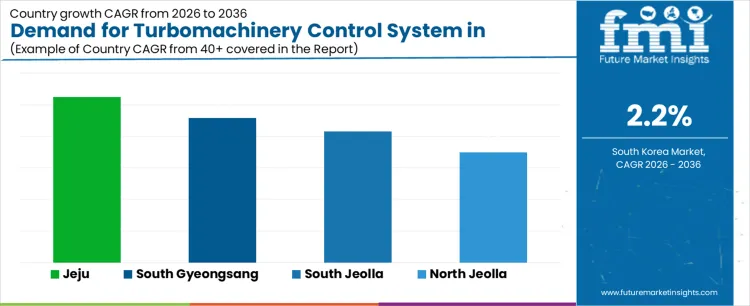
| Region | CAGR (2026 to 2036) |
|---|---|
| South Gyeongsang | 2.3% |
| North Jeolla | 1.7% |
| South Jeolla | 2.1% |
| Jeju | 2.6% |
What is the Demand for Turbomachinery Control Systems in South Gyeongsang?
South Gyeongsang, with a projected CAGR of 2.3%, demonstrates a steady demand for turbomachinery control systems. The region is home to major industrial sectors such as energy production, petrochemicals, and shipbuilding, all of which rely on high-performance turbomachinery. These industries require sophisticated control systems to optimize operational efficiency, maintain system reliability, and ensure safety standards. As South Gyeongsang continues to enhance its industrial infrastructure, the demand for advanced turbomachinery control systems is expected to grow at a moderate pace, in line with the region’s ongoing industrial development and technological advancements.
What is the Demand for Turbomachinery Control Systems in North Jeolla?
North Jeolla, with a CAGR of 1.7%, is expected to see slower growth in the demand for turbomachinery control systems. The region’s economy is focused on agriculture and smaller-scale manufacturing, with fewer industries relying heavily on turbomachinery. However, as the region diversifies and modernizes its industrial base, including advancements in manufacturing processes, there is potential for gradual adoption of more sophisticated control systems. Despite a lower rate of demand growth, North Jeolla’s ongoing development in energy production and machinery manufacturing may drive incremental demand for turbomachinery control systems in the coming years.
What Drives Demand for Turbomachinery Control Systems in South Jeolla?
South Jeolla, with a projected CAGR of 2.1%, is experiencing a moderate demand for turbomachinery control systems. The region’s key industries, such as shipbuilding, petrochemicals, and energy production, rely on advanced machinery and automation. Turbomachinery plays a critical role in the efficiency and reliability of operations in these sectors. As South Jeolla continues to invest in high-tech manufacturing capabilities and energy infrastructure, the demand for control systems that enhance operational performance is expected to rise. This steady growth reflects the increasing complexity and sophistication of South Jeolla’s industrial activities, which rely on advanced control systems for optimization.
What is the Demand for Turbomachinery Control Systems in Jeju?
Jeju, with the highest CAGR of 2.6%, is showing robust growth in the demand for turbomachinery control systems. The region’s focus on modernizing its energy and manufacturing sectors has led to an increased reliance on advanced control systems. Turbomachinery is integral to the region’s energy production, particularly in areas like renewable energy and power generation. Jeju’s push towards industrial modernization and its expanding energy infrastructure are key factors driving the demand for turbomachinery control systems. The growth in demand is expected to accelerate as Jeju continues to develop its energy capabilities and manufacturing processes, positioning the region for long-term demand growth in this sector.
What is the Demand for Turbomachinery Control Systems in South Korea?
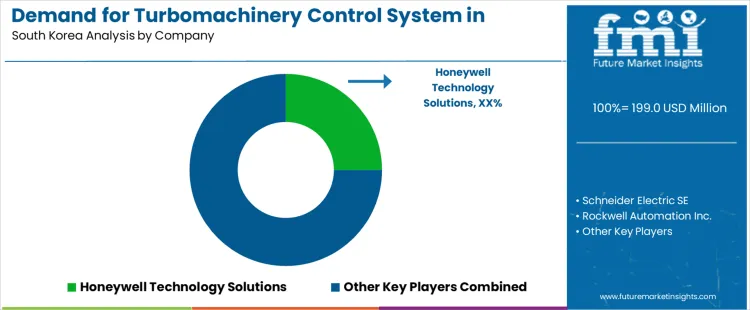
Demand for turbomachinery control systems in South Korea is influenced by growth in energy infrastructure, industrial manufacturing, and automation requirements. Turbomachinery control solutions are applied to steam turbines, gas turbines, compressors, and related rotating equipment used in power generation, petrochemical processing, and large scale manufacturing facilities. Rising emphasis on operational efficiency and precision control has expanded requirements for systems that regulate speed, pressure, and output of turbomachinery. The expansion of power projects, including thermal plants and industrial turbine installations, has contributed to steady increases in system procurement and integration.
South Korea’s focus on manufacturing modernization and enhanced automation in core industries supports demand for advanced control platforms that deliver reliable performance and data visibility. The market is estimated to account for a significant share of regional turbomachinery control spending, driven by upgrades to existing assets and new capacity deployments requiring integrated control solutions. Reliability and compliance with sector specific safety standards remain key factors shaping purchasing decisions by local system integrators and industrial end users.
Leading suppliers position their offerings to address these needs with diverse hardware and software portfolios. Honeywell Technology Solutions is recognised as a leading provider, with brochures detailing control modules, logic architectures, and compatibility with industrial networks. Materials highlight system performance metrics such as response time, controller precision, and environmental tolerance. Schneider Electric SE documentation focuses on scalable control platforms and integration with supervisory systems, presenting specifications for communication protocols and redundancy features. Rockwell Automation Inc.
literature outlines programmable automation controllers and human machine interfaces tuned to turbomachinery operation. Woodward Inc. brochures describe turbine governor systems and digital engine control solutions, with details on interface standards and diagnostic capabilities. ABB Group product materials specify distributed control systems, sensor arrays, and power management interfaces suited for complex industrial plants. Technical brochures from these companies typically include performance curves, compliance with industry standards, and module interoperability to inform engineering procurement evaluations.
Key Players of the Demand for Turbomachinery Control System in South Korea
- Honeywell Technology Solutions
- Schneider Electric SE
- Rockwell Automation Inc.
- Woodward Inc.
- ABB Group
Scope of the Report
| Items | Values |
|---|---|
| Quantitative Units (2026) | USD Million |
| Application | Generator Controls, Compressor Controls, Turbine Controls, Others |
| End-Use Industry | Oil & Gas, Chemical & Petrochemical, Transportation, Power Generation Sector, Food and Beverages |
| Companies | Honeywell Technology Solutions, Schneider Electric SE, Rockwell Automation Inc., Woodward Inc., ABB Group |
| Region Covered | South Korea |
| Provinces Covered | South Gyeongsang, North Jeolla, South Jeolla, Jeju |
| Additional Attributes | Dollar sales by application and end-use industry. Demand is supported by South Korea’s expanding power generation capacity, modernization of petrochemical facilities, and adoption of advanced turbine and compressor control systems to improve efficiency, safety, and operational reliability across industrial sectors. |
Key Segments of Demand for Turbomachinery Control System in South Korea
Application
- Generator Controls
- Compressor Controls
- Turbine Controls
- Other
End-Use Industry
- Oil & Gas
- Chemical & Petrochemical
- Transportation
- Power Generation Sector
- Food and Beverages
- Other
Provinces
- South Gyeongsang
- North Jeolla
- South Jeolla
- Jeju
Bibliography
- International Energy Agency. (2024). Korea energy profile. International Energy Agency.
- National Institute of Standards and Technology. (2024). Guide to Operational Technology (OT) Security (Special Publication 800-82 Rev. 3). U.S. Department of Commerce.
- American Petroleum Institute. (2024). Machinery Protection Systems (API Standard 670, 7th ed.). American Petroleum Institute.
- International Electrotechnical Commission. (2024). Industrial communication networks – Network and system security – Security program requirements for IACS (IEC 62443-2-1, Edition 2.1). International Electrotechnical Commission.
- International Organization for Standardization. (2024). Condition monitoring and diagnostics of machines — General guidelines (ISO 17359:2024). International Organization for Standardization.
Frequently Asked Questions
How big is the demand for turbomachinery control system in south korea in 2026?
The demand for turbomachinery control system in south korea is estimated to be valued at USD 199.0 million in 2026.
What will be the size of turbomachinery control system in south korea in 2036?
The market size for the turbomachinery control system in south korea is projected to reach USD 247.0 million by 2036.
How much will be the demand for turbomachinery control system in south korea growth between 2026 and 2036?
The demand for turbomachinery control system in south korea is expected to grow at a 2.2% CAGR between 2026 and 2036.
What are the key product types in the turbomachinery control system in south korea?
The key product types in turbomachinery control system in south korea are compressor controls, generator controls, turbine controls and others.
Which end-use industry segment is expected to contribute significant share in the turbomachinery control system in south korea in 2026?
In terms of end-use industry, oil & gas segment is expected to command 30.0% share in the turbomachinery control system in south korea in 2026.
Preview the report firsthand - request a free sample
Get SampleGet the brochure for pricing and purchase details.
Get PDFTable of Content
- Executive Summary
- South Korea Market Outlook
- Demand-side Trends
- Supply-side Trends
- Technology Roadmap Analysis
- Analysis and Recommendations
- Market Overview
- Market Coverage / Taxonomy
- Market Definition / Scope / Limitations
- Market Background
- Market Dynamics
- Drivers
- Restraints
- Opportunity
- Trends
- Scenario Forecast
- Demand in Optimistic Scenario
- Demand in Likely Scenario
- Demand in Conservative Scenario
- Opportunity Map Analysis
- Product Life Cycle Analysis
- Supply Chain Analysis
- Investment Feasibility Matrix
- Value Chain Analysis
- PESTLE and Porter’s Analysis
- Regulatory Landscape
- Regional Parent Market Outlook
- Production and Consumption Statistics
- Import and Export Statistics
- Market Dynamics
- South Korea Market Analysis 2021 to 2025 and Forecast, 2026 to 2036
- Historical Market Size Value (USD Million) Analysis, 2021 to 2025
- Current and Future Market Size Value (USD Million) Projections, 2026 to 2036
- Y-o-Y Growth Trend Analysis
- Absolute $ Opportunity Analysis
- South Korea Market Pricing Analysis 2021 to 2025 and Forecast 2026 to 2036
- South Korea Market Analysis 2021 to 2025 and Forecast 2026 to 2036, By Application
- Introduction / Key Findings
- Historical Market Size Value (USD Million) Analysis By Application, 2021 to 2025
- Current and Future Market Size Value (USD Million) Analysis and Forecast By Application, 2026 to 2036
- Compressor Controls
- Generator Controls
- Turbine Controls
- Others
- Compressor Controls
- Y-o-Y Growth Trend Analysis By Application, 2021 to 2025
- Absolute $ Opportunity Analysis By Application, 2026 to 2036
- South Korea Market Analysis 2021 to 2025 and Forecast 2026 to 2036, By End-Use Industry
- Introduction / Key Findings
- Historical Market Size Value (USD Million) Analysis By End-Use Industry, 2021 to 2025
- Current and Future Market Size Value (USD Million) Analysis and Forecast By End-Use Industry, 2026 to 2036
- Oil & Gas
- Chemical & Petrochemical
- Transportation
- Power Generation Sector
- Food and Beverages
- Oil & Gas
- Y-o-Y Growth Trend Analysis By End-Use Industry, 2021 to 2025
- Absolute $ Opportunity Analysis By End-Use Industry, 2026 to 2036
- Market Structure Analysis
- Competition Dashboard
- Competition Benchmarking
- Market Share Analysis of Top Players
- By Regional
- By Application
- By End-Use Industry
- Competition Analysis
- Competition Deep Dive
- Honeywell Technology Solutions
- Overview
- Product Portfolio
- Profitability by Market Segments (Product/Age /Sales Channel/Region)
- Sales Footprint
- Strategy Overview
- Marketing Strategy
- Product Strategy
- Channel Strategy
- Schneider Electric SE
- Rockwell Automation Inc.
- Woodward Inc.
- ABB Group
- Honeywell Technology Solutions
- Competition Deep Dive
- Assumptions & Acronyms Used
- Research Methodology


