

- Industry Size (2026)
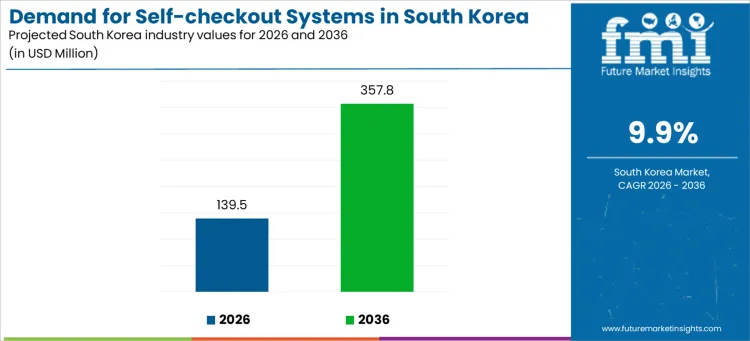
- USD 139.5 Mn
- Forecast (2036)
- USD 357.8 Mn
- CAGR (2026 to 2036)
- 9.88%
Demand for Self-checkout Systems in South Korea Forecast and Outlook 2026 to 2036
Sales of self-checkout systems in South Korea are projected to be valued at USD 139.5 million in 2026. The industry is anticipated to reach USD 357.8 million by 2036, advancing at a compound annual growth rate of 9.88%. The nation's retail landscape is undergoing a profound transformation driven by the "untact" (contactless) culture that took root during the pandemic and has since become a permanent consumer preference. From major hypermarkets like E-Mart and Lotte Mart to neighborhood convenience stores, the deployment of automated checkout lanes is shifting from a novelty to a standard operational requirement.
The expansion is fundamentally anchored in South Korea's unique labor market dynamics. With one of the steepest minimum wage hikes in the OECD over the last decade, retailers face immense pressure to reduce operating costs. This economic imperative, combined with a shrinking working-age population due to demographic shifts, compels store owners to adopt automation as a survival strategy. Consequently, the proliferation of unmanned ice cream shops, 24-hour ramyeon libraries, and hybrid convenience stores, which operate with staff during the day and run autonomously at night, is fueling consistent demand for robust self-checkout hardware.
Quick Stats for Demand for Self-checkout Systems in South Korea
- Industry Value (2026): USD 139.5 million
- Industry Forecast Value (2036): USD 357.8 million
- Industry Forecast CAGR: 9.88%
- Leading Company Share: Diebold Nixdorf, Inc. (35.0%)
- Key Growth Regions: Jeju, South Gyeongsang, South Jeolla, North Jeolla
- Key Players: Diebold Nixdorf, Inc., NCR Voyix Corporation, Fujitsu Ltd., Toshiba Global Commerce Solutions, ITAB Group
Technological integration is moving beyond simple barcode scanning to advanced computer vision and biometric authentication. South Korean tech giants and retailers are experimenting with "scan-free" systems that use AI cameras to identify products automatically, minimizing friction for the shopper. Furthermore, the country's near-universal credit card penetration rate and the ubiquity of mobile wallets like Samsung Pay and Kakao Pay have created an ideal ecosystem for wireless POS terminal integration, allowing for streamlined, cashless checkout experiences that align with the nation's "ppalli-ppalli" (hurry-hurry) culture of speed and efficiency.
The sector is characterized by a mix of global hardware providers and nimble domestic integrators. While international players like Diebold Nixdorf and NCR provide the heavy-duty infrastructure for large retail chains, local firms are capturing the micro-retail segment with compact, cost-effective mini POS terminals tailored for smaller franchise footprints. This duality ensures that automation technologies are accessible across the entire retail spectrum, from flagship department stores in Seoul to independent kiosks in provincial towns, sustaining long-term growth through 2036.
Demand for Self-checkout Systems in South Korea Key Takeaways
| Metric | Value |
|---|---|
| Industry Size (2026) | USD 139.5 million |
| Industry Value (2036) | USD 357.8 million |
| CAGR (2026 to 2036) | 9.88% |
Why is the
The primary catalyst for growth is the deep-seated consumer preference for non-face-to-face ("untact") interactions, a trend that solidifies South Korea's position as a global leader in retail innovation. Shoppers, particularly the digital-native generations, increasingly view human interaction at checkout as an unnecessary friction point. This behavioral shift is supported by government initiatives like the Smart Shop Support Project, which provides subsidies to small business owners for installing smart technology. Additionally, the intense density of retail outlets in urban centers creates fierce competition, driving franchises to adopt intelligent touch screen cash register systems to differentiate themselves through speed and 24/7 accessibility.
How is the Sector Structured Across Key Segments?
The sector is segmented to address the varying spatial and operational needs of South Korean retailers. It is primarily categorized by product type, reflecting the physical footprint of the hardware. The payment method segment distinguishes between traditional cash handling and digital-only interfaces, while the end use (sourcing) segment highlights how retailers procure these technologies. Each segment plays a vital role, where convenience stores drive the volume for compact units and hypermarkets drive the value for full-service stations.
Why Do Stationary Kiosks Dominate Big Retail?
The stationary self-checkout kiosks segment commands a 62.0% share of the industry. This dominance is driven by the extensive footprint of hypermarkets and supermarkets that require robust, full-featured stations capable of handling large basket sizes and security scales. These units are the standard for chains like E-Mart and Homeplus, offering a familiar interface for families doing weekly grocery runs. While portable options are growing, the stability and comprehensive feature set of stationary units ensure their continued prevalence in high-volume retail environments.
Why Is the Cashless Revolution Defining Payment Methodologies?
The cashless self-checkout systems segment holds the overwhelming majority share of 88.0%. South Korea has one of the lowest cash usage rates in the world, making expensive cash-recycling modules unnecessary for many retailers. This transition significantly lowers the hardware cost of self-checkout units, accelerating ROI for store owners. The integration of biometric payment options, such as palm vein scanning found in some convenience stores, further entrenches the cashless model, making the physical wallet obsolete for the modern Korean shopper.
How Do Product Manufacturers Influence Direct Adoption?
The product manufacturers (direct) segment accounts for 55.0% of the end use sourcing. Major retail conglomerates often bypass intermediaries to negotiate directly with global OEMs like Diebold and NCR for large-scale fleet deployments. This direct relationship ensures that the hardware is customized to the specific loyalty program and backend ERP integrations of the retailer. Meanwhile, the leasing or rental model is gaining traction among independent store owners who prefer a growing OpEx model over heavy upfront CapEx, supported by local integration partners who provide maintenance and software localization.
How Are Space Constraints Driving Portable Innovation?
While stationary units dominate value, the handheld point of sale and portable segment is critical for small-format stores. Given the high real estate costs in cities like Seoul and Busan, retailers are prioritizing compact solutions that do not sacrifice sales floor space. Tablet-based kiosks are becoming standard in smaller franchise outlets and cafes. These versatile units allow for queue busting during peak hours and can be easily reconfigured, offering a flexibility that rigid stationary units lack.
Will AI Vision Replace Barcode Scanning?
A major trend reshaping the landscape is the integration of computer vision and smart touch screen scale technology. Retailers are trialing systems where AI cameras automatically recognize fresh produce and bakery items without the need for barcodes. This trend is driven by the desire to reduce "sweethearting" (theft) and speed up the checkout process for non-packaged goods. By eliminating the manual search menu for produce, these systems address one of the biggest pain points of traditional self-checkout, enhancing user accuracy and satisfaction.
Does the "Digital Divide" Exclude Elderly Shoppers?
The most significant restraint is the technological exclusion of the elderly population. As traditional cashier lanes disappear, older consumers who are less familiar with digital interfaces face difficulties navigating complex touchscreens. This issue creates social friction and potential loss of revenue from a key demographic segment. Overcoming this requires the development of "senior-friendly" interfaces with larger text, voice guidance, and simplified patient self-service kiosks logic that mimics human interaction to bridge the gap.
How Will Unmanned Stores Expand Into New Verticals?
The emerging field of specialized unmanned retail presents a frontier of opportunity. Beyond convenience stores, sectors like pet supplies, meal kits, and even decentralized packaging kiosks are adopting unmanned models. Suppliers who can provide specialized self-checkout modules equipped with verification systems for age-restricted items or specific restaurant POS terminals for automated canteens stand to capture significant revenue. This transitional landscape allows for 24/7 commerce in residential areas where staffing would otherwise be unprofitable.
How is the Self-checkout Landscape Evolving Across South Korea's Regions?
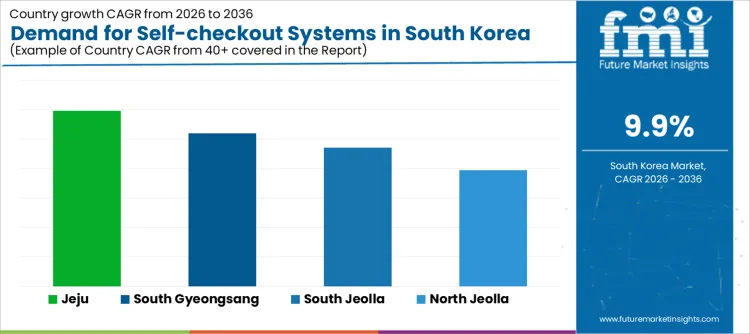
The regional sphere shows a distinct pattern where tourist hotspots lead in automation to manage seasonal influxes, while industrial regions focus on efficiency for worker populations. High-growth areas are characterizing their modernization by adopting hybrid store formats. As distinct provinces digitize their local retail infrastructure, the utilization of checkout solutions is becoming tailored to specific regional demographics.
| Region | CAGR (2026 to 2036) |
|---|---|
| Jeju | 11.85% |
| South Gyeongsang | 10.37% |
| South Jeolla | 9.38% |
| North Jeolla | 7.90% |
Why is Tourism Driving Automation in Jeju?
Adoption of self-checkout systems in Jeju is projected to expand at a CAGR of 11.85%. As the nation's premier tourist destination, Jeju faces extreme seasonal fluctuations in foot traffic. Retailers here are adopting automation to manage surges in visitors without over-hiring permanent staff. The demand is particularly strong for multilingual kiosks that can serve international tourists in duty-free shops and souvenir outlets. Additionally, the proliferation of unmanned cafes along the scenic coastlines drives the need for reliable, remote-monitored payment terminals.
How is Industrial Demand Shaping South Gyeongsang?
Sales of checkout solutions in South Gyeongsang are likely to reach a CAGR of 10.37%. Home to major industrial complexes and shipyards, this region sees a high demand for efficiency-driven retail solutions that cater to shift workers. Convenience stores and automated canteens within industrial parks are adopting high-speed self-checkout units to minimize queue times during short break periods. The focus is on ruggedized, high-throughput systems that can handle peak loads efficiently, leveraging data-driven retail solution analytics to optimize inventory stocking.
What Role Does Rural Modernization Play in South Jeolla?
The self-checkout sector in South Jeolla is anticipated to rise at a CAGR of 9.38%. While traditionally rural, the region is modernizing its retail infrastructure through government-supported innovation hubs. The demand is driven by the conversion of aging village shops into smart convenience stores that provide essential services to aging populations while reducing the physical burden on elderly store owners. Automation here often takes the form of simple, large-interface kiosks that allow for basic transactions, ensuring essential commerce remains viable in depopulating areas.
How is Urban Development Influencing North Jeolla?
Deployment of retail automation in North Jeolla is expected to increase at a CAGR of 7.90%. The region's gradual urbanization, centered around cities like Jeonju, is attracting major retail franchises that bring standardized automation models. The demand is fueled by the expansion of new residential districts where unmanned stores serve as primary quick-commerce points. Retailers are utilizing real-time store monitoring platform tools to manage these distributed networks of automated stores efficiently from a central hub.
How Are Companies Competing and Strengthening Their Positions in the South Korean Self-checkout Industry?
The competitive landscape is defined by the capability to offer end-to-end integration with South Korea's specific payment ecosystem. Industry leaders like Diebold Nixdorf and NCR Voyix are strengthening their positions by partnering with local VAN (Value Added Network) companies to ensure seamless processing of Korean credit cards and mobile points. There is also a marked trend toward hardware customization, where vendors are designing slimmer, aesthetically pleasing kiosks that fit the compact and design-conscious interiors of Korean retail spaces.
Mergers and acquisitions are targeted at local software integrators, as global hardware firms seek to acquire the software stacks needed to run retail analytics and inventory management on their machines. Leading companies are actively investing in remote maintenance capabilities to minimize downtime for unmanned stores. Furthermore, competitive intensity is driving a shift toward providing "Retail-as-a-Service," bundling hardware, software, and retail printers and consumables into a single subscription fee for franchise owners.
Key Companies
- Diebold Nixdorf, Inc.
- NCR Voyix Corporation
- Fujitsu Ltd.
- Toshiba Global Commerce Solutions
- ITAB Group
- Samsung Electronics (Kiosk Division)
- Shinsegae I&C
- NICE Information & Telecommunication
Scope of Report
| Items | Values |
|---|---|
| Quantitative Units | USD Million |
| Product Type | Portable Self-Checkout Devices, Stationary Self-Checkout Kiosks |
| Payment Method | Cash-based Self-Checkout Systems, Cashless Self-Checkout Systems |
| End Use (Sourcing) | Product Manufacturers (Direct), Leasing or Rental, Integration Partners, Others |
| Regions Covered | Jeju, South Gyeongsang, South Jeolla, North Jeolla |
| Key Companies Profiled | Diebold Nixdorf, NCR Voyix, Fujitsu, Toshiba, ITAB Group, and others. |
Demand for Self-checkout Systems in South Korea by Segments
By Product Type:
- Portable Self-Checkout Devices
- Stationary Self-Checkout Kiosks
By Payment Method:
- Cash-based Self-Checkout Systems
- Cashless Self-Checkout Systems
By End Use (Sourcing):
- Product Manufacturers (Direct)
- Leasing or Rental
- Integration Partners
- Others
By Region:
- Jeju
- South Gyeongsang
- South Jeolla
- North Jeolla
Bibliography
- Statistics Korea (KOSTAT). (2025, February 3). Online Shopping in December 2024.
- Financial Services Commission (FSC). (2025, January 7). Annual Work Plan for 2025.
- Ministry of SMEs and Startups (MSS). (2025, February 27). 2025 Smart Shop Technology Supply Program Call for Participation (press release).
- Korea Consumer Agency (KCA). (2024, April). Convenience store consumer satisfaction and usage behavior survey (reported in KCA Monthly Consumer magazine content).
- Ministry of Science and ICT (MSIT). (2025, March 27). Results of the 2024 Digital Information Divide Survey.
Frequently Asked Questions
How big is the demand for self-checkout systems in south korea in 2026?
The demand for self-checkout systems in south korea is estimated to be valued at USD 139.5 million in 2026.
What will be the size of self-checkout systems in south korea in 2036?
The market size for the self-checkout systems in south korea is projected to reach USD 358.6 million by 2036.
How much will be the demand for self-checkout systems in south korea growth between 2026 and 2036?
The demand for self-checkout systems in south korea is expected to grow at a 9.9% CAGR between 2026 and 2036.
What are the key product types in the self-checkout systems in south korea?
The key product types in self-checkout systems in south korea are 0.38.
Which 0.88 segment is expected to contribute significant share in the self-checkout systems in south korea in 2026?
In terms of 0.88, 0.12 segment is expected to command 0.0% share in the self-checkout systems in south korea in 2026.
Preview the report firsthand - request a free sample
Get SampleGet the brochure for pricing and purchase details.
Get PDFTable of Content
- Executive Summary
- South Korea Market Outlook
- Demand-side Trends
- Supply-side Trends
- Technology Roadmap Analysis
- Analysis and Recommendations
- Market Overview
- Market Coverage / Taxonomy
- Market Definition / Scope / Limitations
- Market Background
- Market Dynamics
- Drivers
- Restraints
- Opportunity
- Trends
- Scenario Forecast
- Demand in Optimistic Scenario
- Demand in Likely Scenario
- Demand in Conservative Scenario
- Opportunity Map Analysis
- Product Life Cycle Analysis
- Supply Chain Analysis
- Investment Feasibility Matrix
- Value Chain Analysis
- PESTLE and Porter’s Analysis
- Regulatory Landscape
- Regional Parent Market Outlook
- Production and Consumption Statistics
- Import and Export Statistics
- Market Dynamics
- South Korea Market Analysis 2021 to 2025 and Forecast, 2026 to 2036
- Historical Market Size Value (USD Million) Analysis, 2021 to 2025
- Current and Future Market Size Value (USD Million) Projections, 2026 to 2036
- Y-o-Y Growth Trend Analysis
- Absolute $ Opportunity Analysis
- South Korea Market Pricing Analysis 2021 to 2025 and Forecast 2026 to 2036
- South Korea Market Analysis 2021 to 2025 and Forecast 2026 to 2036, By 0.62
- Introduction / Key Findings
- Historical Market Size Value (USD Million) Analysis By 0.62 , 2021 to 2025
- Current and Future Market Size Value (USD Million) Analysis and Forecast By 0.62 , 2026 to 2036
- 0.38
- 0.38
- Y-o-Y Growth Trend Analysis By 0.62 , 2021 to 2025
- Absolute $ Opportunity Analysis By 0.62 , 2026 to 2036
- South Korea Market Analysis 2021 to 2025 and Forecast 2026 to 2036, By 0.88
- Introduction / Key Findings
- Historical Market Size Value (USD Million) Analysis By 0.88, 2021 to 2025
- Current and Future Market Size Value (USD Million) Analysis and Forecast By 0.88, 2026 to 2036
- 0.12
- 0.12
- Y-o-Y Growth Trend Analysis By 0.88, 2021 to 2025
- Absolute $ Opportunity Analysis By 0.88, 2026 to 2036
- South Korea Market Analysis 2021 to 2025 and Forecast 2026 to 2036, By 0.55
- Introduction / Key Findings
- Historical Market Size Value (USD Million) Analysis By 0.55, 2021 to 2025
- Current and Future Market Size Value (USD Million) Analysis and Forecast By 0.55, 2026 to 2036
- 0.25
- 0.15
- 0.05
- 0.25
- Y-o-Y Growth Trend Analysis By 0.55, 2021 to 2025
- Absolute $ Opportunity Analysis By 0.55, 2026 to 2036
- Market Structure Analysis
- Competition Dashboard
- Competition Benchmarking
- Market Share Analysis of Top Players
- By Regional
- By 0.62
- By 0.88
- By 0.55
- Competition Analysis
- Competition Deep Dive
- Competition Deep Dive
- Assumptions & Acronyms Used
- Research Methodology


