

- Industry Size (2026)
- USD 233.9 Mn
- Forecast (2036)
- USD 871.7 Mn
- CAGR (2026 to 2036)
- 14.1%
Demand for Conversational Commerce in South Korea Forecast and Outlook 2026 to 2036
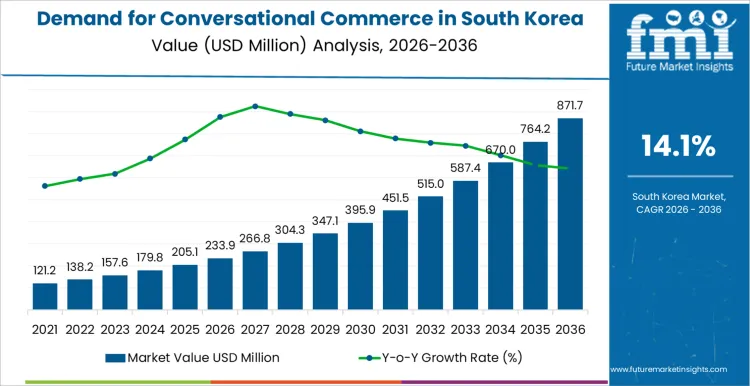
Expenditure on conversational commerce solutions in South Korea is poised to reach USD 233.9 million by 2026. Financial volume within this interactive trading sphere is likely to ascend to USD 871.7 million by 2036, progressing at a compound annual growth rate of 14.1%. South Korea boasts one of the highest smartphone penetration rates globally, creating a fertile ground for mobile-first shopping experiences. Consumers are increasingly favoring direct engagement with brands through messaging apps rather than navigating traditional websites. This behavioral shift drives retailers to integrate chat-based sales channels, ensuring seamless transitions from product discovery to final transaction. High-speed 5G infrastructure further supports complex interactions, including real-time video consultations and rich media sharing, enhancing user engagement significantly.
Government initiatives aimed at fostering a digital economy are actively accelerating industry expansion. Policymakers are incentivizing small businesses to adopt digital tools, offering grants for integrating AI-driven customer service solutions. Such support enables traditional brick-and-mortar stores to establish a digital presence without heavy capital investment. Regulatory frameworks are also evolving to ensure secure payment processing within chat interfaces, building consumer trust. Consequently, public administration efforts to modernize the retail landscape are synchronizing with private sector innovation. This collaboration ensures that businesses of all sizes can leverage automated messaging to streamline operations and boost sales efficiency.
Quick Stats for Demand for Conversational Commerce in South Korea
- Demand for Conversational Commerce in South Korea Value (2026): USD 233.9 million
- Demand for Conversational Commerce in South Korea Forecast Value (2036): USD 871.7 million
- Demand for Conversational Commerce in South Korea Forecast CAGR: 14.1%
- Leading Solution Segment for Conversational Commerce Industry in South Korea: Software (60.0%)
- Leading Enterprise Size Segment for Conversational Commerce Industry in South Korea: Large Enterprises (55.8%)
- Leading Industry Segment for Conversational Commerce Industry in South Korea: Finance (21.9%)
- Key Growth Regions for Conversational Commerce Industry in South Korea: Jeju, South Gyeongsang, South Jeolla, North Jeolla
- Conversational Commerce Industry in South Korea Key Players: Meta, Google, Amazon, Microsoft, Apple
Conversational commerce aligns perfectly with this expectation by providing immediate responses and 24/7 availability. Busy professionals utilize these platforms to make purchases during commutes or short breaks, valuing the efficiency of text-based transactions over voice calls or physical store visits. Social commerce is also gaining traction, where influencers leverage chat capabilities to sell directly to followers. This integration of social interaction and transaction capability satisfies the modern consumer's desire for personalized and convenient shopping experiences.
Technological advancements are revolutionizing how brands interact with consumers. Integration of conversational AI allows systems to understand nuance and context, moving beyond simple script-based responses. Retailers are deploying sophisticated chatbot agents capable of handling complex queries regarding product availability and shipping. Adoption of conversational marketing software enables personalized product recommendations based on past purchase history. Emerging trends also include the use of voice assistance application interfaces, allowing users to shop hands-free. These innovations collectively enhance the customer experience platforms landscape, making digital interactions as intuitive as human conversation.
Demand for Conversational Commerce in South Korea Key Takeaways
| Metric | Value |
|---|---|
| Industry Size (2026) | USD 233.9 million |
| Industry Value (2036) | USD 871.7 million |
| CAGR (2026 to 2036) | 14.1% |
What Factors Are Fueling Conversational Commerce Adoption?
Rising expectations for personalized digital customer experience and engagement solutions drive the uptake of interactive tools. Consumers demand instant support, which human agents cannot scale to provide cost-effectively. Automated bot services bridge this gap, offering round-the-clock assistance. Proliferation of mobile messaging apps as the primary mode of communication makes them the natural channel for commerce. Businesses are also utilizing a2p messaging to send transactional updates and promotional content directly to user inboxes. Efficiency gains in customer service operations, reduced churn rates, and higher conversion rates from personalized interactions act as powerful financial catalysts for corporate investment.
How is the Sector Structured Across Key Segments?
Structure of this domain spans across solution types, enterprise sizes, and industrial verticals. Solution segmentation differentiates between the underlying software platforms and the associated professional services. Enterprise size categorization highlights the disparity in adoption rates between massive conglomerates and smaller agile entities. Industry segmentation reveals which sectors are prioritizing conversational interfaces, with finance, manufacturing, and distribution services leading the charge. Understanding this segmentation is vital for vendors to tailor their offerings, whether it be robust enterprise-grade suites or modular, easy-to-deploy tools for smaller businesses.
Why Does Software Dominate Solutions?
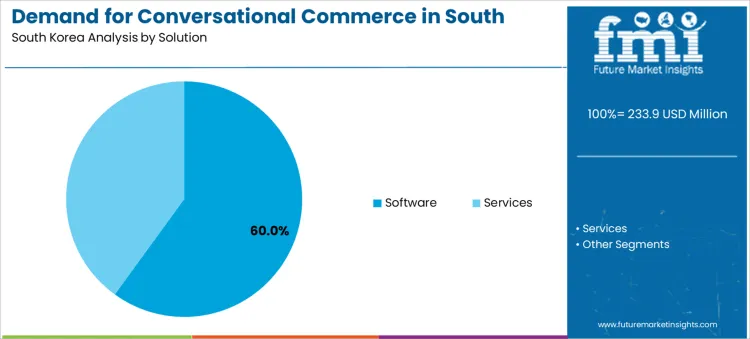
Software commands a 60.0% share of the industry. This dominance stems from the critical need for scalable platforms to manage high volumes of customer interactions. Companies prioritize investing in omni-channel messaging software that unifies conversations across various apps into a single interface. Constant updates and feature enhancements required to keep pace with AI advancements necessitate subscription-based software models. Hardware requirements are minimal since these solutions are largely cloud-based. Consequently, the recurring revenue from software licenses constitutes the majority of sector value, as businesses view the platform as the foundational element of their conversational strategy.
Why Do Large Enterprises Lead Adoption?
Large Enterprises account for 55.8% of the usage share. These organizations possess the substantial capital required to develop and deploy custom digital commerce platform integrations. Complex organizational structures demand sophisticated solutions that can handle data security, privacy compliance, and integration with legacy ERP systems. Big tech companies and financial giants in South Korea are aggressive in automating their vast customer service operations to reduce labor costs. Their ability to invest in R&D allows them to pilot advanced features like generative AI, maintaining their leadership position in adopting cutting-edge commerce technologies.
Why is Finance the Leading Industry?
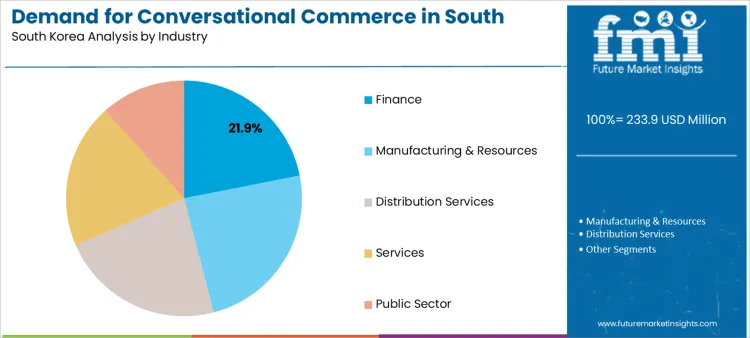
Finance captures a 21.9% share of the sector. Banks and insurance companies deal with a massive influx of routine queries regarding balances, transactions, and policy details. Automating these interactions through customer service software significantly reduces operational strain. Security features within conversational apps have matured, allowing for safe fund transfers and authentication directly within the chat. Fintech startups are also disrupting the traditional banking model by offering "chat-first" banking experiences. High customer lifetime value in the financial sector justifies the investment in premium conversational tools to enhance retention and trust.
Will Voice Commerce Expand?
Adoption of voice commerce services is poised for growth as smart speakers and voice-activated assistants become household staples. Consumers are becoming comfortable with issuing voice commands for reordering recurring household items. This trend is particularly relevant for the elderly population in South Korea, who may find typing on small screens cumbersome. Integration of voice biometrics improves security, addressing a major barrier to adoption. As natural language processing improves, voice interactions will become less robotic and more conversational, opening new avenues for hands-free shopping in automotive and home environments.
Is Omnichannel Integration Essential?
Seamless connectivity across channels is no longer optional but mandatory. Consumers expect to start a conversation on a mobile app and continue it on a desktop web interface without losing context. Digital commerce strategies now hinge on creating a unified profile of the customer. Disjointed experiences lead to frustration and cart abandonment. Retailers are investing heavily in backend integration to ensure that inventory data, user preferences, and chat history are synchronized in real-time. This holistic view enables more accurate targeting and a smoother customer journey, reinforcing brand loyalty.
Does Data Privacy Hinder Growth?
Concerns regarding data privacy remain a significant restraint. South Korean consumers are tech-savvy and highly aware of digital footprints. Collection of conversational data for training AI models raises ethical and legal questions. Stringent regulations like the Personal Information Protection Act (PIPA) impose heavy penalties for mishandling user data. Companies must navigate these compliance requirements carefully, ensuring transparent consent mechanisms. Building trust through end-to-end encryption and clear data usage policies is essential. Failure to address privacy concerns can lead to reputational damage and consumer backlash, stalling adoption rates.
How is the Landscape Evolving Across South Korea's Regions?
Regional adoption patterns reflect the diverse economic activities across the peninsula. Metropolitan areas drive innovation in finance and retail applications, while industrial provinces focus on B2B conversational tools. Tourism-heavy regions utilize these technologies to assist international visitors. Local governments in various provinces are supporting digital transformation initiatives to boost local economies.
| Region | CAGR (2026 to 2036) |
|---|---|
| Jeju | 16.9% |
| South Gyeongsang | 14.8% |
| South Jeolla | 13.4% |
| North Jeolla | 11.2% |
Why is Jeju Seeing High Growth?
Adoption of conversational tools in Jeju is projected to expand at a CAGR of 16.9%. As a premier tourist destination, Jeju relies heavily on hospitality and service industries. Hotels, rental agencies, and attractions use chatbots to provide multilingual support to international tourists. Instant booking confirmations and itinerary recommendations via chat enhance the visitor experience. Local businesses are adopting these tools to manage peak season influxes efficiently. Smart city initiatives on the island also promote digital connectivity, creating a robust infrastructure for advanced commerce solutions.
How is Industry Shaping South Gyeongsang?
Sales of commerce solutions in South Gyeongsang are likely to reach a CAGR of 14.8%. This region, known for its heavy industry and manufacturing base, is digitizing its supply chain interactions. B2B conversational commerce is gaining traction here, allowing suppliers and manufacturers to automate order placements and status updates. Large shipyards and automotive plants are integrating chatbots into their internal procurement systems. Efficiency gains in logistics and resource management drive the investment in these technologies, supporting the region's industrial competitiveness.
What Drives Demand in South Jeolla?
Expansion in South Jeolla is anticipated to rise at a CAGR of 13.4%. Agriculture and fisheries are significant sectors here, and producers are increasingly selling directly to consumers via social messaging platforms. "Live commerce" broadcasts hosted on chat apps allow farmers to showcase fresh produce and take orders instantly. This direct-to-consumer model eliminates intermediaries and boosts local incomes. Elderly populations in rural areas benefit from simplified voice-activated purchasing tools, bridging the digital divide and ensuring access to essential goods.
How is North Jeolla Modernizing?
Deployment of digital tools in North Jeolla is expected to increase at a CAGR of 11.2%. The region is focusing on modernizing its traditional sectors through digital innovation. Small and medium enterprises are the primary growth drivers, adopting cost-effective chatbot solutions to expand their customer reach beyond local boundaries. Government-funded digital literacy programs are helping business owners implement these tools. While growth is steady, it reflects a sustainable transition towards a digital-first local economy, supported by improvements in broadband connectivity.
What Strategies Define Leadership?
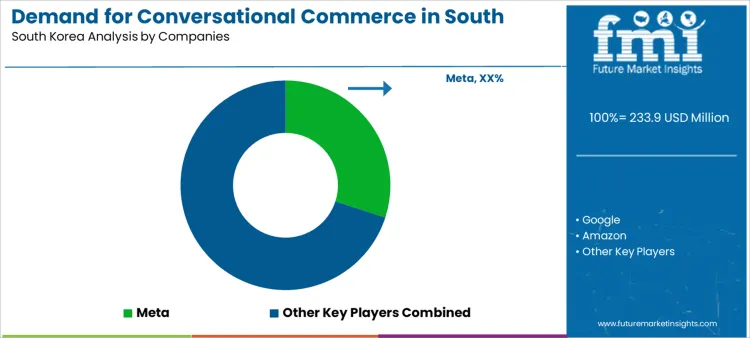
Meta commands a dominant position with a 30.0% share, leveraging the ubiquitous presence of Instagram and Facebook. Its strategy revolves around integrating shopping features directly into social feeds and messaging, reducing friction. Meta invests heavily in AI to improve ad targeting and automated customer responses for merchants. Competitors like Google are countering by enhancing search-based shopping and integrating commerce into YouTube and Maps. Amazon focuses on voice commerce through its Echo ecosystem, while Microsoft targets the enterprise segment with robust Azure-based bot frameworks. Strategies are increasingly centering on retaining user attention within a single "super-app" ecosystem.
How Are Tech Giants Competing?
Global tech giants are vying for dominance by building comprehensive ecosystems. Apple is emphasizing privacy and seamless payment integration through Apple Business Chat and Apple Pay. Innovation in augmented reality features allows users to "try on" products within a chat interface, a tactic heavily explored by beauty and fashion retailers. Partnerships with local logistics and payment providers are crucial for foreign players to succeed in the specific context of the Korean market. Competition is fierce, driving continuous improvements in AI capabilities and user interface design to capture market share.
Key Companies
- Meta
- Amazon
- Microsoft
- Apple
Scope of Report
| Items | Values |
|---|---|
| Quantitative Units | USD Million |
| Solution | Software, Services |
| Enterprise Size | Small & Medium Enterprises (SMEs), Large Enterprises |
| Industry | Finance, Manufacturing & Resources, Distribution Services, Services, Public Sector |
| Regions Covered | Jeju, South Gyeongsang, South Jeolla, North Jeolla |
| Key Companies Profiled | Meta, Google, Amazon, Microsoft, Apple |
Demand for Conversational Commerce in South Korea by Segments
By Solution
- Software
- Services
By Enterprise Size
- Small & Medium Enterprises (SMEs)
- Large Enterprises
By Industry
- Finance
- Manufacturing & Resources
- Distribution Services
- Services
- Public Sector
Bibliography
- Ministry of Science and ICT. (2024, December). Digital New Deal Implementation Report. Ministry of Science and ICT, Republic of Korea.
- Statistics Korea. (2024, November). Online Shopping Trends Survey. Statistics Korea.
- Bank of Korea. (2025, January). Electronic Payment Services Statistics. Bank of Korea.
- Korea Internet & Security Agency. (2024, October). Internet Usage Survey 2024. KISA.
- Korea Association of Cloud Industry. (2024, September). Cloud Industry Outlook 2025. KACI.
Frequently Asked Questions
How big is the demand for Conversational Commerce in South Korea in 2026?
The demand for Conversational Commerce in South Korea is estimated to be valued at USD 233.9 million in 2026.
What will be the size of Conversational Commerce in South Korea in 2036?
The industry size for the Conversational Commerce in South Korea is projected to reach USD 871.7 million by 2036.
How much will be the demand for Conversational Commerce in South Korea growth between 2026 and 2036?
The demand for Conversational Commerce in South Korea is expected to grow at a 14.1% CAGR between 2026 and 2036.
What are the key product types in the Conversational Commerce in South Korea?
The key product types in Conversational Commerce in South Korea are Software and Services.
Which end user segment is expected to contribute significant share in the Conversational Commerce in South Korea in 2026?
By end user, Finance segment is expected to command 21.9% share in the Conversational Commerce in South Korea in 2026.
Preview the report firsthand - request a free sample
Get SampleGet the brochure for pricing and purchase details.
Get PDFTable of Content
- Executive Summary
- South Korea Market Outlook
- Demand-side Trends
- Supply-side Trends
- Technology Roadmap Analysis
- Analysis and Recommendations
- Market Overview
- Market Coverage / Taxonomy
- Market Definition / Scope / Limitations
- Market Background
- Market Dynamics
- Drivers
- Restraints
- Opportunity
- Trends
- Scenario Forecast
- Demand in Optimistic Scenario
- Demand in Likely Scenario
- Demand in Conservative Scenario
- Opportunity Map Analysis
- Product Life Cycle Analysis
- Supply Chain Analysis
- Investment Feasibility Matrix
- Value Chain Analysis
- PESTLE and Porter’s Analysis
- Regulatory Landscape
- Regional Parent Market Outlook
- Production and Consumption Statistics
- Import and Export Statistics
- Market Dynamics
- South Korea Market Analysis 2021 to 2025 and Forecast, 2026 to 2036
- Historical Market Size Value (USD Million) Analysis, 2021 to 2025
- Current and Future Market Size Value (USD Million) Projections, 2026 to 2036
- Y-o-Y Growth Trend Analysis
- Absolute $ Opportunity Analysis
- South Korea Market Pricing Analysis 2021 to 2025 and Forecast 2026 to 2036
- South Korea Market Analysis 2021 to 2025 and Forecast 2026 to 2036, By Solution
- Introduction / Key Findings
- Historical Market Size Value (USD Million) Analysis By Solution , 2021 to 2025
- Current and Future Market Size Value (USD Million) Analysis and Forecast By Solution , 2026 to 2036
- Software
- Services
- Software
- Y-o-Y Growth Trend Analysis By Solution , 2021 to 2025
- Absolute $ Opportunity Analysis By Solution , 2026 to 2036
- South Korea Market Analysis 2021 to 2025 and Forecast 2026 to 2036, By Enterprise Size
- Introduction / Key Findings
- Historical Market Size Value (USD Million) Analysis By Enterprise Size, 2021 to 2025
- Current and Future Market Size Value (USD Million) Analysis and Forecast By Enterprise Size, 2026 to 2036
- Small & Medium Enterprises (SMEs)
- Large Enterprises
- Small & Medium Enterprises (SMEs)
- Y-o-Y Growth Trend Analysis By Enterprise Size, 2021 to 2025
- Absolute $ Opportunity Analysis By Enterprise Size, 2026 to 2036
- South Korea Market Analysis 2021 to 2025 and Forecast 2026 to 2036, By Industry
- Introduction / Key Findings
- Historical Market Size Value (USD Million) Analysis By Industry, 2021 to 2025
- Current and Future Market Size Value (USD Million) Analysis and Forecast By Industry, 2026 to 2036
- Finance
- Manufacturing & Resources
- Distribution Services
- Services
- Public Sector
- Finance
- Y-o-Y Growth Trend Analysis By Industry, 2021 to 2025
- Absolute $ Opportunity Analysis By Industry, 2026 to 2036
- Market Structure Analysis
- Competition Dashboard
- Competition Benchmarking
- Market Share Analysis of Top Players
- By Regional
- By Solution
- By Enterprise Size
- By Industry
- Competition Analysis
- Competition Deep Dive
- Meta
- Overview
- Product Portfolio
- Profitability by Market Segments (Product/Age /Sales Channel/Region)
- Sales Footprint
- Strategy Overview
- Marketing Strategy
- Product Strategy
- Channel Strategy
- Amazon
- Microsoft
- Apple
- Meta
- Competition Deep Dive
- Assumptions & Acronyms Used
- Research Methodology


