

- Industry Size (2026)
- USD 374.8 Mn
- Forecast (2036)
- USD 646.6 Mn/li>
- CAGR (2026 to 2036)
- 5.6%
Demand for Calcite in South Korea Forecast and Outlook 2026 to 2036
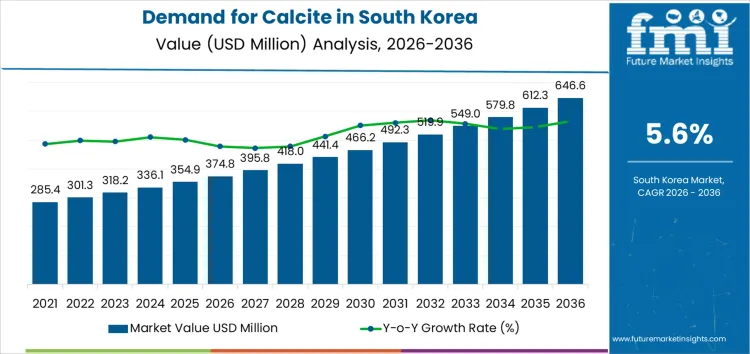
The demand for calcite in South Korea is likely to reach USD 374.8 million in 2026 and is expected to reach USD 646.6 million by 2036, registering a CAGR of 5.6%. Commercial relevance will strengthen through the forecast period as calcite remains tied to sectors where volume decisions directly influence operating costs, particularly construction materials, plastics, and industrial fillers. Buyer intent will be shaped by the need to balance material performance with predictable pricing, which positions calcite as a stable input in cost-sensitive manufacturing portfolios.
Procurement teams will treat this category as a strategic spend area because fluctuations in feedstock availability or pricing ripple quickly through production budgets. Decisions around supplier diversification, logistics exposure, and contracted volumes will gain weight as companies seek to protect margins in an environment of rising energy and transportation costs. In this context, calcite’s role becomes less about material specification and more about sustaining reliable, economically defensible supply over the decade ahead.
Quick Stats for the Demand for Calcite in South Korea
- Calcite in South Korea Value (2026): USD 374.8 million
- Calcite in South Korea Forecast Value (2036): USD 646.6 million
- Calcite in South Korea Global Forecast CAGR (2026 to 2036): 5.6%
- Calcite in South Korea Leading Segment: Ground Calcium Carbonate (GCC) (55%)
- Key Growth Regions of Calcite in South Korea: Jeju (leading CAGR ~6.7%)
- Top Players of Calcite in South Korea: Imerys S.A., Omya AG, Minerals Technologies Inc., Huber Engineered Materials, Nordkalk Corporation
What is the Growth Forecast for the Demand for Calcite in South Korea through 2036?
Rolling CAGR patterns for calcite in South Korea show a consistent growth rhythm from 2026 through 2036. Early-period rolling CAGR readings between 2026 and 2030 remain stable as the construction and polymers sectors lift annual consumption. This stage reflects modest acceleration linked to increased use of calcite in rigid packaging, engineered plastics, and coatings formulations. The rise in demand across paper and adhesives applications further contributes to the incline. Each rolling window in the early years presents narrow variations, indicating a smooth demand curve supported by well-established industrial applications.
In later rolling cycles extending toward 2036, the CAGR trajectory maintains its firmness without sharp deviations. The curve edges higher as calcite consumption expands across higher-purity grades for specialized coatings and plastics compounding. Structural industries maintain dependable intake volumes, while incremental capacity additions in downstream manufacturing lift multi-year averages. By the final rolling window, the accumulated effect of steady monthly and annual increases forms a reinforced CAGR pattern aligned with the final valuation of USD 646.6 million. This sustained movement demonstrates stable industrial reliance rather than episodic spikes, creating a predictable growth profile suitable for producers and long-term buyers.
Key Takeaways for Demand for Calcite in South Korea
| Metric | Value |
|---|---|
| Industry Sales Value (2026) | USD 374.8 million |
| Industry Forecast Value (2036) | USD 646.6 million |
| Industry Forecast CAGR (2026 to 2036) | 5.6% |
Why is the Demand for Calcite Growing in South Korea?
Demand for calcite in South Korea is linked to its widespread use as a functional mineral in industries that require material properties such as high whiteness, chemical inertness, and cost efficiency. Calcite serves as a filler and pigment in paper manufacturing, improving brightness, opacity, and surface smoothness. South Korea’s paper and packaging industry, which produces a range of consumer and industrial products, relies on calcite to meet performance standards while keeping production costs competitive.
In plastics and rubber processing, calcite contributes to dimensional stability and hardness, making it a common additive in molded goods, piping, and compound formulations. Paint and coatings manufacturers also use ground calcite to achieve desired opacity and rheological control. The mineral’s affordability relative to some engineered fillers positions it as an effective choice where performance and cost balance is critical. These application needs, along with established supply chains that link domestic and imported calcite sources to local processors, form the basis for ongoing procurement in South Korea’s industrial sectors.
Looking ahead, several factors are expected to support continued demand for calcite in South Korea. Expansion in construction activity and infrastructure projects increases demand for materials such as paints, coatings, and cementitious products, all of which may incorporate calcite as a functional component. Growth in plastics usage across consumer electronics and automotive parts also sustains need for fillers that enhance mechanical properties and reduce formulation costs.
Environmental and regulatory pressures to improve product sustainability may influence material choices, with manufacturers exploring grades of calcite that align with recyclability and lower embodied carbon. Advances in material processing, such as surface-treated calcite grades, enable better dispersion and compatibility in advanced composites, broadening application potential. Additionally, global trade dynamics that affect the cost and availability of mineral feedstocks could shape procurement strategies and pricing in the South Korean market. Taken together, these factors underpin persistent demand for calcite across multiple manufacturing and industrial applications in the country.
What Shapes the Demand for Calcite in South Korea?
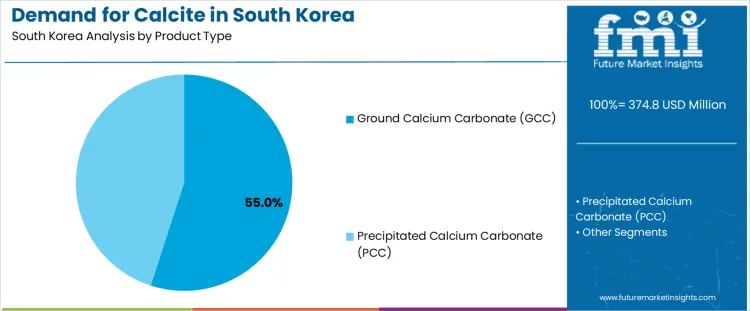
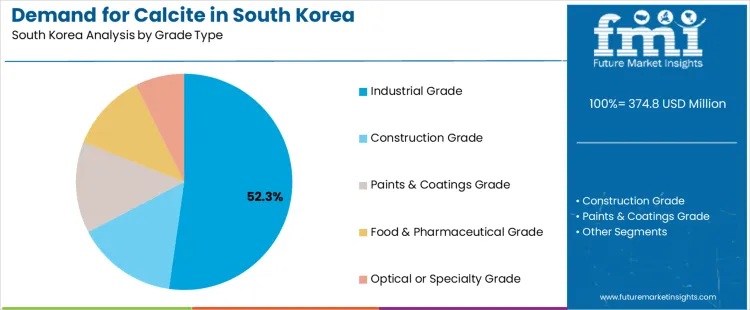
Demand for calcite in South Korea is defined by two primary segments: product type and grade type. Ground calcium carbonate (GCC) holds a 55% share, while industrial grade leads the grade category at 52.3%. These segments reflect how paper manufacturing, plastics compounding, construction materials, and coatings rely on consistent mineral inputs. Their dominance is tied to processing compatibility, cost efficiency, and the scale of downstream industries that depend on steady supplies of calcite aligned with established production systems across the country.
Why Does Ground Calcium Carbonate (GCC) Hold the Largest Share?
Ground calcium carbonate (GCC) maintains a 55% share because it fits the needs of South Korea’s paper, plastics, coatings, adhesives, and construction sectors. GCC supports high-volume production lines by providing stable brightness, predictable particle distribution, and a favorable cost-to-performance balance. Paper mills use GCC to enhance opacity and surface smoothness, while plastic processors incorporate it to improve rigidity, thermal behavior, and dimensional stability in PVC, polyethylene, and polypropylene applications. Construction materials such as mortars, sealants, flooring compounds, and cement-based mixes depend on GCC for reinforcement and consistent rheology. Domestic quarrying and grinding operations ensure reliable availability, controlled particle sizes, and cost stability, which strengthens its presence across industrial applications. These characteristics position GCC as the preferred option where large-scale manufacturing, continuous processing, and material uniformity influence product quality and operating economics throughout South Korea’s industrial base.
Why Does Industrial Grade Calcite Lead the Grade Type Segment?
Industrial grade calcite holds a 52.3% share due to its suitability for high-output applications across paper production, polymer processing, rubber goods, ceramic components, and construction materials. This grade provides controlled impurities, uniform brightness, and consistent particle morphology required in coating, filling, and compounding operations. Paper producers rely on industrial grade calcite to achieve stable coating performance and reliable print behavior, while plastics and rubber manufacturers use it to optimize mechanical strength, reduce resin loadings, and support dimensional accuracy. Construction products such as adhesives, grouts, mortars, and composite panels integrate industrial grade calcite to improve workability and setting characteristics. South Korea’s manufacturing environment depends on materials that deliver predictable performance and steady supply, and industrial grade calcite aligns with these operational requirements. Its balance of cost efficiency and functional reliability keeps it central to sectors that prioritize throughput, uniformity, and dependable mineral inputs for continuous production.
What Is the Current Demand for Calcite in South Korea?
Demand for calcite in South Korea is sustained by its broad use across industrial and manufacturing sectors. Calcite, a mineral form of calcium carbonate, is procured by producers of paper, plastics, paints, coatings, and rubber as a filler and functional additive. The construction sector also absorbs significant quantities for cementitious products and building materials. Consumption levels are shaped by activity in downstream industries and infrastructure projects. As industrial output has rebounded, procurement of ground and precipitated calcite has remained stable, supporting formulation needs where performance and cost-efficiency are balanced.
What Factors Are Driving Demand for Calcite in South Korea?
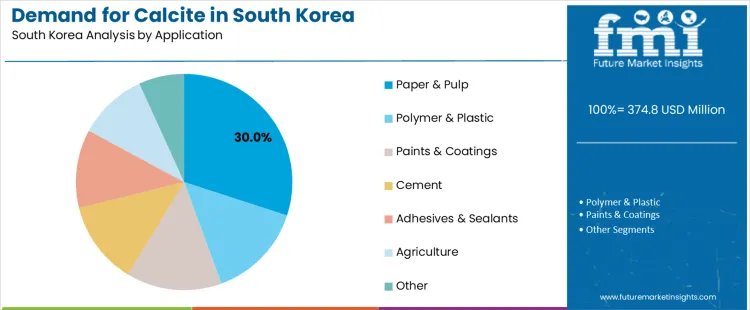
Several drivers support the demand for calcite in South Korea. Growth in the construction and infrastructure sector underpins usage in cement, mortar, and wallboard, where calcite contributes to strength and bulk. Expansion of paper and packaging production increases demand for calcite as a filler and coating pigment that enhances opacity and print quality. The plastics industry uses calcite to improve stiffness and reduce material costs in compounds and rigid products. Regulatory emphasis on environmental performance and reduced VOC emissions encourages formulators to select mineral additives that improve processability and reduce reliance on synthetic materials. Activity in automotive and consumer goods manufacturing also stimulates calcite uptake for coatings and polymer composites.
What Are the Constraints on Demand for Calcite in South Korea?
Despite its wide usage, demand for calcite in South Korea faces certain constraints. Cost pressures in raw material procurement can affect purchasing decisions, especially when alternative fillers or extenders offer competitive pricing or performance advantages. Competition from engineered mineral products and synthetic fillers may limit calcite’s share in specialized applications requiring precise performance attributes. Supply chain fluctuations, including transport logistics and import dependency for specific grades, can influence availability and inventory strategies for downstream manufacturers. Environmental regulations governing mining, processing, and material disposal also shape cost structures, leading some users to evaluate alternative solutions or recycling strategies.
What Trends Are Emerging in South Korea’s Calcite Market?
Emerging trends in South Korea’s calcite market reflect shifts in material usage and formulation priorities. There is a growing preference for high-purity and tailored particle size distributions that meet specific performance criteria in coatings, plastics, and paper applications. Manufacturers are increasingly adopting functionalized mineral additives that offer enhanced dispersion and compatibility with polymer matrices. Sustainability considerations are influencing procurement, with a focus on materials that enable lower energy usage in processing and contribute to product recyclability. In construction, integration of mineral fillers that support lightweight and high-strength composites is advancing, driven by demands for durable yet efficient materials. Collaboration between domestic processors and international suppliers is shaping the availability of advanced calcite grades tailored to technical specifications.
What is the Regional Outlook for the Demand for Calcite in South Korea?
The demand for calcite across South Korea reflects the regional distribution of construction activity, manufacturing operations, and mineral-processing requirements. Provinces with stronger cement, paints, plastics, and paper industries display higher growth. Jeju registers the fastest rise, shaped by expanding construction and infrastructure needs. South Gyeongsang and South Jeolla follow, supported by diverse industrial bases and sustained demand from coatings, polymers, and fillers. North Jeolla shows moderate growth linked to smaller but steady manufacturing clusters. As the country continues adopting higher-grade fillers and advanced material formulations, the use of calcite in construction, industrial additives, and polymer applications is expected to maintain its upward trajectory.
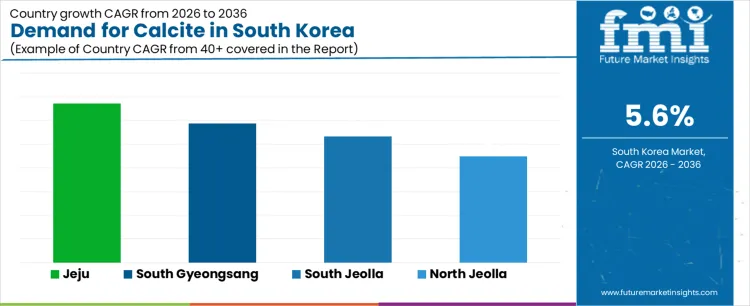
| Province | CAGR (2026–2036) |
|---|---|
| South Gyeongsang | 5.9% |
| North Jeolla | 4.5% |
| South Jeolla | 5.3% |
| Jeju | 6.7% |
What drives the demand for Calcite in South Gyeongsang?
South Gyeongsang is projected to record a CAGR of 5.9% in calcite demand from 2026 to 2036. The province has a diversified industrial base that relies on calcite as a key filler and processing mineral. Cement, ceramics, plastics, rubber, and coatings facilities across the region require stable supplies of finely ground calcite to enhance material strength, opacity, and cost efficiency. Expansion of local construction activity, paired with steady output from polymer and composite manufacturers, supports higher consumption. Several industrial parks in the province continue upgrading their production lines to use finer-grade mineral fillers, driving incremental demand. As export-oriented manufacturers increase output of plastics and engineered materials, usage of calcite in masterbatches, paints, and sealants becomes more prominent. The province’s strong logistics network ensures reliable material flow, reinforcing its above-average growth profile.
What influences the demand for Calcite in North Jeolla?
North Jeolla is expected to grow at a moderate CAGR of 4.5% through 2036. The province’s manufacturing ecosystem is smaller compared to coastal industrial hubs, but it maintains active clusters in paper, textiles, ceramics, and basic consumer goods. These industries use calcite for brightness, reinforcement, and filler applications. Local construction projects, including public infrastructure upgrades, also support calcite demand. North Jeolla’s environmental and industrial policies encourage greater use of mineral-based fillers that reduce dependence on synthetic additives in plastics and coatings. As the region gradually transitions toward more specialized manufacturing, its consumption of calcite rises to meet the needs of improved product formulations. Growth remains steady rather than rapid, reflecting the scale of the province’s industrial activity.
What drives the demand for Calcite in South Jeolla?
South Jeolla is projected to see a CAGR of 5.3% in calcite demand between 2026 and 2036. The province is home to important petrochemical, polymer, and coatings industries that rely on calcite to enhance product performance and reduce production costs. Its strong presence in agricultural processing and food-packaging materials also contributes to calcite consumption, as mineral fillers are commonly used in flexible packaging films, laminates, and paperboard. Ongoing construction and infrastructure development create further demand from cement and plaster manufacturers. The region’s industrial modernization efforts, including upgrades in plastics compounding and paint manufacturing, support rising use of higher-purity and micronized calcite grades. Coastal logistics hubs facilitate material imports and distribution, strengthening South Jeolla’s position as a key growth area.
Why is Jeju projected to have the highest demand growth for Calcite?
Jeju leads with a projected CAGR of 6.7% from 2026 to 2036. The island’s construction and tourism-linked development projects are central to its rising calcite consumption. New hotels, commercial complexes, transport facilities, and residential expansions require cement, coatings, and composite materials that incorporate calcite as a key filler. Jeju’s growing interest in sustainable building materials also encourages the use of mineral fillers that enhance strength while reducing reliance on synthetic additives. Local manufacturing activities, though smaller in scale, increasingly use calcite in plastics, paints, and paper products consumed by the island’s retail and hospitality sectors. With continuous infrastructure upgrades and limited local mineral extraction, Jeju relies heavily on imported calcite supplies, making demand both consistent and fast-growing.
How are Competitors Differentiating in the Calcite Market in South Korea?
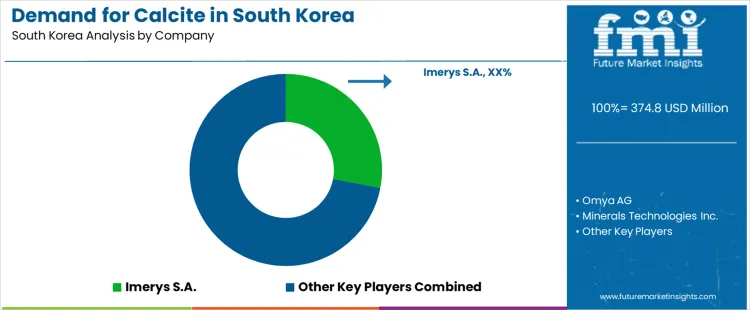
Competitive positioning in South Korea’s calcite market is shaped by product purity, particle-size control, and alignment with industrial processing needs. Imerys S.A., the leading supplier, maintains an advantage through engineered calcite grades tailored for plastics, paints, rubber, adhesives, and construction materials. Their strategy centers on controlled particle morphology, consistent brightness, and surface-treated variants designed to improve dispersion and mechanical performance. Omya AG competes with a broad portfolio of ground and precipitated calcium carbonate, focusing on high-whiteness grades and application-specific formulations used across paper, polymers, and sealants. Minerals Technologies Inc. strengthens its position by supplying precipitated calcium carbonate designed for specialty applications where uniform crystal structure and reliable rheology are essential.
Competition widens as Huber Engineered Materials and Nordkalk Corporation emphasize functional additives and industrial-grade performance. Huber differentiates through refined calcite grades that support controlled opacity, improved binding characteristics, and consistent thermal stability, catering to South Korean manufacturers in coatings and engineered materials. Nordkalk positions its calcite products around purity and predictable reactivity profiles suitable for environmental applications, construction materials, and selected chemical processes. Across all competitors, product brochures are used to highlight particle-size distributions, surface treatments, optical properties, and application guidance. These documents support procurement teams in evaluating technical suitability, ensuring that the selected calcite grades align with processing conditions and quality requirements across South Korea’s industrial sectors.
Key Players of the Demand for Calcite in South Korea
- Imerys S.A.
- Omya AG
- Minerals Technologies Inc.
- Huber Engineered Materials
- Nordkalk Corporation
Scope of the Report
| Items | Values |
|---|---|
| Quantitative Units (2026) | USD Million |
| Product Type | Ground Calcium Carbonate (GCC), Precipitated Calcium Carbonate (PCC) |
| Grade Type | Industrial Grade, Construction Grade, Paints & Coatings Grade, Food & Pharmaceutical Grade, Optical or Specialty Grade |
| Application | Paper & Pulp, Polymer & Plastic, Paints & Coatings, Cement, Adhesives & Sealants, Agriculture, Other |
| Companies | Imerys S.A., Omya AG, Minerals Technologies Inc., Huber Engineered Materials, Nordkalk Corporation |
| Region Covered | South Korea |
| Provinces Covered | South Gyeongsang, North Jeolla, South Jeolla, Jeju |
| Additional Attributes | Dollar sales by product type, grade type, and application. Demand is influenced by rising use of GCC and PCC in paper manufacturing, plastics compounding, and construction materials. Functional benefits such as brightness, dispersion, and reinforcement support adoption across industrial segments. |
Demand for Calcite in South Korea
Product Type:
- Ground Calcium Carbonate (GCC)
- Precipitated Calcium Carbonate (PCC)
- Other
Grade Type:
- Industrial Grade
- Construction Grade
- Paints & Coatings Grade
- Food & Pharmaceutical Grade
- Optical or Specialty Grade
- Other
Application:
- Paper & Pulp
- Polymer & Plastic
- Paints & Coatings
- Cement
- Adhesives & Sealants
- Agriculture
- Other
Provinces:
- South Gyeongsang
- North Jeolla
- South Jeolla
- Jeju
Bibliography
- Korea Institute of Geoscience and Mineral Resources (KIGAM). (2023). Mineral resource supply, industrial mineral use, and calcium carbonate materials in South Korea. Korea Institute of Geoscience and Mineral Resources.
- Korea Ministry of Environment (MOE). (2023). Environmental standards and industrial mineral guidelines affecting fillers, coatings, and construction materials in South Korea. Ministry of Environment, Republic of Korea.
- Korea Plastics Industry Association (KMPIA). (2023). Polymer compounding trends, filler usage, and mineral additive adoption for plastics in South Korea. Korea Plastic Industry Association.
- Korea Statistical Information Service (KOSIS). (2023). Manufacturing output, construction sector growth, and mineral-material consumption trends in South Korea.
- International Mineralogical Association (IMA). (2023). Mineralogical classification, characteristics, and industrial importance of calcite and calcium carbonate minerals. International Mineralogical Association.
Frequently Asked Questions
How big is the demand for calcite in south korea in 2026?
The demand for calcite in south korea is estimated to be valued at USD 374.8 million in 2026.
What will be the size of calcite in south korea in 2036?
The market size for the calcite in south korea is projected to reach USD 646.6 million by 2036.
How much will be the demand for calcite in south korea growth between 2026 and 2036?
The demand for calcite in south korea is expected to grow at a 5.6% CAGR between 2026 and 2036.
What are the key product types in the calcite in south korea?
The key product types in calcite in south korea are ground calcium carbonate (gcc) and precipitated calcium carbonate (pcc).
Which grade type segment is expected to contribute significant share in the calcite in south korea in 2026?
In terms of grade type, industrial grade segment is expected to command 52.3% share in the calcite in south korea in 2026.
Preview the report firsthand - request a free sample
Get SampleGet the brochure for pricing and purchase details.
Get PDFTable of Content
- Executive Summary
- South Korea Market Outlook
- Demand-side Trends
- Supply-side Trends
- Technology Roadmap Analysis
- Analysis and Recommendations
- Market Overview
- Market Coverage / Taxonomy
- Market Definition / Scope / Limitations
- Market Background
- Market Dynamics
- Drivers
- Restraints
- Opportunity
- Trends
- Scenario Forecast
- Demand in Optimistic Scenario
- Demand in Likely Scenario
- Demand in Conservative Scenario
- Opportunity Map Analysis
- Product Life Cycle Analysis
- Supply Chain Analysis
- Investment Feasibility Matrix
- Value Chain Analysis
- PESTLE and Porter’s Analysis
- Regulatory Landscape
- Regional Parent Market Outlook
- Production and Consumption Statistics
- Import and Export Statistics
- Market Dynamics
- South Korea Market Analysis 2021 to 2025 and Forecast, 2026 to 2036
- Historical Market Size Value (USD Million) Analysis, 2021 to 2025
- Current and Future Market Size Value (USD Million) Projections, 2026 to 2036
- Y-o-Y Growth Trend Analysis
- Absolute $ Opportunity Analysis
- South Korea Market Pricing Analysis 2021 to 2025 and Forecast 2026 to 2036
- South Korea Market Analysis 2021 to 2025 and Forecast 2026 to 2036, By Product Type
- Introduction / Key Findings
- Historical Market Size Value (USD Million) Analysis By Product Type , 2021 to 2025
- Current and Future Market Size Value (USD Million) Analysis and Forecast By Product Type , 2026 to 2036
- Ground Calcium Carbonate (GCC)
- Precipitated Calcium Carbonate (PCC)
- Ground Calcium Carbonate (GCC)
- Y-o-Y Growth Trend Analysis By Product Type , 2021 to 2025
- Absolute $ Opportunity Analysis By Product Type , 2026 to 2036
- South Korea Market Analysis 2021 to 2025 and Forecast 2026 to 2036, By Grade Type
- Introduction / Key Findings
- Historical Market Size Value (USD Million) Analysis By Grade Type, 2021 to 2025
- Current and Future Market Size Value (USD Million) Analysis and Forecast By Grade Type, 2026 to 2036
- Industrial Grade
- Construction Grade
- Paints & Coatings Grade
- Food & Pharmaceutical Grade
- Optical or Specialty Grade
- Industrial Grade
- Y-o-Y Growth Trend Analysis By Grade Type, 2021 to 2025
- Absolute $ Opportunity Analysis By Grade Type, 2026 to 2036
- South Korea Market Analysis 2021 to 2025 and Forecast 2026 to 2036, By Application
- Introduction / Key Findings
- Historical Market Size Value (USD Million) Analysis By Application, 2021 to 2025
- Current and Future Market Size Value (USD Million) Analysis and Forecast By Application, 2026 to 2036
- Paper & Pulp
- Polymer & Plastic
- Paints & Coatings
- Cement
- Adhesives & Sealants
- Agriculture
- Other
- Paper & Pulp
- Y-o-Y Growth Trend Analysis By Application, 2021 to 2025
- Absolute $ Opportunity Analysis By Application, 2026 to 2036
- Market Structure Analysis
- Competition Dashboard
- Competition Benchmarking
- Market Share Analysis of Top Players
- By Regional
- By Product Type
- By Grade Type
- By Application
- Competition Analysis
- Competition Deep Dive
- Imerys S.A.
- Overview
- Product Portfolio
- Profitability by Market Segments (Product/Age /Sales Channel/Region)
- Sales Footprint
- Strategy Overview
- Marketing Strategy
- Product Strategy
- Channel Strategy
- Omya AG
- Minerals Technologies Inc.
- Huber Engineered Materials
- Nordkalk Corporation
- Imerys S.A.
- Competition Deep Dive
- Assumptions & Acronyms Used
- Research Methodology


