

- Industry Size (2026)
- USD 344.9 Mn
- Forecast (2036)
- USD 756.3 Mn
- CAGR (2026 to 2036)
- 8.2%
Demand for Battery Management System in South Korea Forecast and Outlook 2026 to 2036
Sales of battery management system units in South Korea are projected to be valued at USD 344.9 million in 2026. The sector is set to reach USD 756.3 million by 2036, advancing at a compound annual growth rate of 8.2%. South Korea stands as a global powerhouse in the secondary battery industry, hosting major cell manufacturers like LG Energy Solution, SK On, and Samsung SDI. Consequently, the local ecosystem for controlling and monitoring these power units is evolving rapidly to meet the stringent safety and efficiency demands of next-generation electric vehicles (EVs) and grid-scale energy storage.
Growth is heavily influenced by the government's "K-Battery" strategy, which aims to secure global leadership in advanced battery technologies. Strict safety regulations implemented following high-profile Energy Storage System (ESS) fires have necessitated the adoption of high-precision battery testing inspection and certification protocols. BMS units are now required to possess advanced thermal management and fault detection capabilities to prevent thermal runaway, driving value growth in the hardware and software segments alike.
Quick Stats for Demand for Battery Management System in South Korea
- Industry Value (2026): USD 344.9 million
- Industry Forecast Value (2036): USD 756.3 million
- Industry Forecast CAGR: 8.2%
- Leading Type: Lithium-Ion BMS (42.0%)
- Leading Topology: Centralized (45.0%)
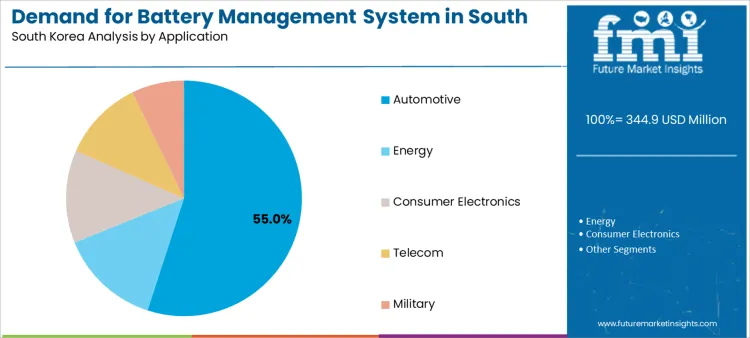
- Leading Application: Automotive (55.0%)
- Key Growth Regions: Jeju, South Gyeongsang, South Jeolla, North Jeolla
- Key Players: Texas Instruments, Toshiba Corporation, Infineon Technologies, STMicroelectronics, NXP Semiconductors
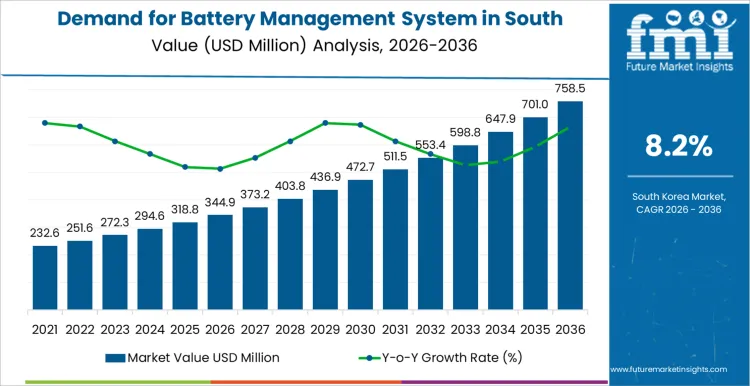
Technological adoption is pivoting toward wireless architectures and artificial intelligence. Manufacturers are integrating wireless battery monitoring system solutions to eliminate heavy cabling harness in EVs, thereby improving energy density and reducing manufacturing complexity. Research institutes are collaborating with private enterprises to develop AI-based state-of-health (SOH) estimation algorithms that extend battery life and facilitate predictive maintenance, a critical feature for fleet operators.
Demand for Battery Management System in South Korea Key Takeaways
| Metric | Value |
|---|---|
| Industry Size (2026) | USD 344.9 million |
| Industry Value (2036) | USD 756.3 million |
| CAGR (2026 to 2036) | 8.2% |
What Factors Are Energizing the Control Systems Sector?
A primary catalyst for growth is the relentless electrification of the automotive sector. South Korea's major automakers are aggressively transitioning to dedicated EV platforms, which require sophisticated automotive battery management system architectures to manage high-voltage packs. Beyond mobility, the "Renewable Energy 3020" plan drives the installation of battery energy storage system infrastructure to stabilize the grid against intermittent wind and solar outputs. Safety concerns regarding lithium-ion volatility compel operators to invest in premium BMS solutions capable of real-time cell balancing and granular thermal monitoring. The push for carbon neutrality creates a guaranteed demand baseline for efficient power management technologies across industrial and residential applications.
How is the Sector Structured Across Key Segments?
The sector is segmented to address the varying voltage and chemistry requirements of modern energy storage. It is primarily categorized by type, reflecting the underlying battery chemistry. The topology segment distinguishes between architecture designs for different scales. The application segment highlights the end-use sectors driving consumption. Each segment plays a vital role, where Lithium-Ion drives technological sophistication and Automotive drives volume.
Why Does Lithium-Ion Technology Lead the Pack?
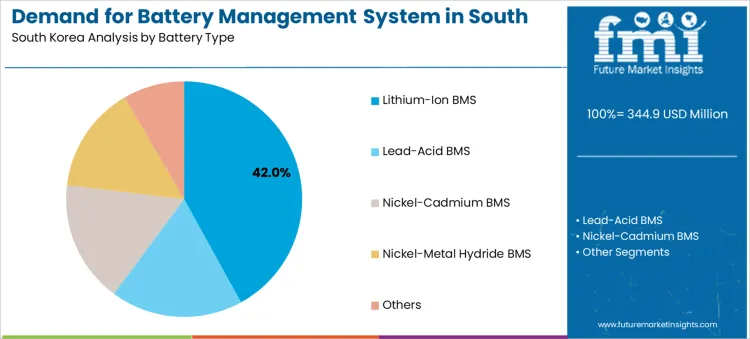
Lithium-Ion BMS units command a 42.0% share of the industry. This prevalence is attributed to the overwhelming adoption of lithium ion battery packs in electric vehicles and consumer electronics due to their high energy density. Managing these cells requires precise voltage monitoring to prevent overcharging and deep discharging, tasks that define the core function of modern BMS. South Korea's massive production capacity for Li-ion cells ensures that the domestic control systems sector remains tightly coupled with this chemistry.
How are Topologies Adapting to System Scale?
Centralized topologies hold a significant share of 45.0% due to their cost-effectiveness in compact applications like e-bikes and small home appliances. However, Modular and Distributed topologies are gaining traction in the stationary lithium ion battery storage and EV sectors. Large-scale battery packs require modular systems where slave units monitor cell groups and communicate with a master controller, offering better scalability and fault isolation. This shift is driven by the increasing size of battery packs in long-range EVs and industrial ESS.
Why is Automotive the Primary Engine of Growth?
Automotive application segment accounts for approximately 55.0% of the industry demand. South Korea is a global hub for EV production, with Hyundai and Kia spearheading the shift to electric mobility. Every electric vehicle requires a robust BMS to ensure range accuracy, safety, and longevity. The integration of BMS with vehicle thermal management and powertrain controllers is becoming standard, creating high-value opportunities for suppliers.
Is the Data Center Segment Expanding?
The telecom and data center battery segment is witnessing steady growth. As South Korea solidifies its position as a digital hub with the expansion of 5G networks and cloud services, the need for reliable Uninterruptible Power Supply (UPS) systems increases. BMS plays a critical role in monitoring the backup batteries of these facilities, ensuring business continuity and preventing data loss during power outages.
Sector Dynamics Will Wireless BMS Revolutionize EV Architecture?
A significant trend is the development of wireless battery management systems. Eliminating the communication wiring harness within the battery pack reduces weight and manufacturing complexity while improving reliability by removing potential failure points at connectors. South Korean battery makers are actively piloting these technologies in next-generation EV platforms. This innovation allows for greater flexibility in pack design and simplifies the process of battery swap hardware integration.
Do Semiconductor Shortages Pose a Risk?
The most significant restraint is the industry's reliance on specific automotive-grade microcontrollers and analog front-end (AFE) chips. Global supply chain disruptions can lead to bottlenecks in BMS production, delaying vehicle rollouts. South Korean manufacturers face the challenge of securing stable inventory of these critical components. Overcoming this requires diversification of supply chains and increased investment in domestic semiconductor fabrication capabilities tailored for power electronics.
How Can Second-Life Batteries Create Value?
The emerging field of repurposing used EV batteries presents a frontier of opportunity. As the first generation of EVs retires, there is a growing volume of batteries suitable for behind the meter stationary battery storage applications. BMS solutions capable of assessing the remaining useful life (RUL) and managing mixed-health cells are essential for this circular economy. Suppliers who can provide adaptive BMS algorithms for second-life applications stand to capture significant revenue from the recycling and repurposing sector.
How is the BMS Landscape Evolving Across South Korea's Regions?
The regional sphere shows a distinct pattern where innovation hubs drive R&D, while industrial zones focus on mass production and integration. High-growth areas are characterizing their development by establishing specialized battery clusters. As distinct provinces implement local energy policies, the utilization of management systems is becoming tailored to regional industrial strengths.
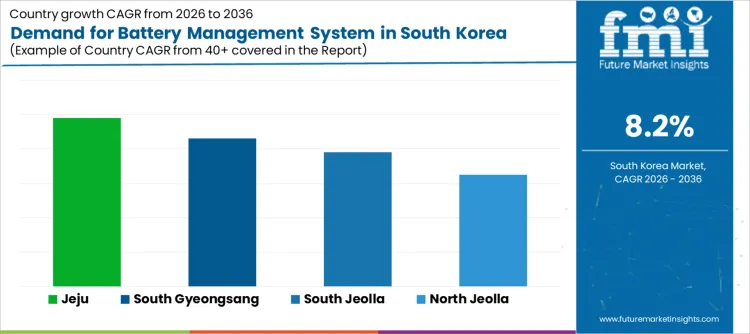
| Region | CAGR (2026 to 2036) |
|---|---|
| Jeju | 9.8% |
| South Gyeongsang | 8.6% |
| South Jeolla | 7.8% |
| North Jeolla | 6.5% |
Why is the "Carbon-Free Island" Policy Driving Demand in Jeju?
Adoption of BMS technologies in Jeju is projected to expand at a CAGR of 9.8%. As the nation's premier testbed for smart grids and electric vehicles, Jeju aims to become carbon-free by 2030. The demand is driven by the high penetration of EVs and the integration of renewable energy storage systems to stabilize the island's microgrid. Jeju serves as a living laboratory for Vehicle-to-Grid (V2G) technologies, which require advanced bidirectional BMS capabilities, fostering a high-growth environment for intelligent control solutions.
How is Manufacturing Density Influencing South Gyeongsang?
Sales of battery control units in South Gyeongsang are likely to reach a CAGR of 8.6%. This region is the heart of South Korea's manufacturing industry, hosting major automotive plants and shipbuilding yards. The demand is fueled by the electrification of industrial machinery, marine vessels, and automotive components. Local suppliers are focusing on ruggedized BMS for heavy-duty applications, ensuring reliability in harsh operating environments typical of the shipbuilding and machinery sectors.
What Role Does Energy Infrastructure Play in South Jeolla?
The BMS sector in South Jeolla is anticipated to rise at a CAGR of 7.8%. Anchored by the Energy Valley project, this region focuses on renewable energy integration. Large-scale solar farms and wind power projects require massive ESS installations, driving demand for industrial-grade BMS. The focus here is on high-voltage systems capable of managing megawatt-scale storage banks, ensuring grid stability and efficient energy dispatch.
How is Commercial Mobility Shaping North Jeolla?
Deployment of management systems in North Jeolla is expected to increase at a CAGR of 6.5%. The region is developing as a hub for commercial electric vehicles, including buses and agricultural machinery. The demand is driven by the need for BMS solutions tailored to commercial fleet operations, prioritizing longevity and rapid charging capabilities. Innovation centers in the region are exploring BMS applications for electric agricultural equipment, opening new niches beyond passenger cars.
How Are Companies Addressing the Integration Challenge?
Companies are moving beyond component supply to offer complete system-level solutions. STMicroelectronics and Toshiba are developing reference designs that combine microcontrollers, power management ICs, and software drivers to reduce development time for battery pack manufacturers. Strategic collaboration is a key trend, with chipmakers working directly with South Korean battery giants like LG Energy Solution to co-develop custom ASICs (Application-Specific Integrated Circuits) optimized for specific cell chemistries. This deep integration allows for superior performance and locks in long-term supply relationships in a high-stakes industry.
What Defines the Competitive Hierarchy in Battery Management?
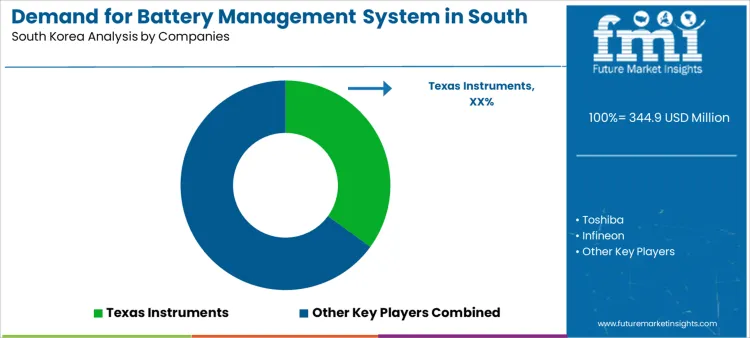
The competitive landscape is heavily influenced by semiconductor capability, with Texas Instruments commanding a dominant 35.0% share of the sector. TI’s strategy focuses on delivering high-accuracy battery monitors and balancers that maximize range and safety, making them the preferred partner for major OEMs. They are aggressively expanding their portfolio of wireless BMS protocols to stay ahead of the curve. Infineon Technologies and NXP Semiconductors are close competitors, leveraging their strong automotive heritage to offer functionally safe (ISO 26262 compliant) chipsets that integrate seamlessly with the broader vehicle electronic architecture.
Key Companies
- Texas Instruments
- Toshiba Corporation
- Infineon Technologies
- STMicroelectronics
- NXP Semiconductors
- Analog Devices, Inc.
- Renesas Electronics Corporation
- LG Innotek
- Hyundai Kefico
- PowerLogics
Scope of Report
| Items | Values |
|---|---|
| Quantitative Units | USD Million |
| Type | Lithium-Ion BMS, Lead-Acid BMS, Nickel-Cadmium BMS, Nickel-Metal Hydride BMS, Others |
| Topologies | Centralized, Modular, Distributed |
| Application | Automotive, Military, Consumer Electronics, Telecom, Energy |
| Regions Covered | Jeju, South Gyeongsang, South Jeolla, North Jeolla |
| Key Companies Profiled | Texas Instruments, Toshiba, Infineon, STMicro, NXP, and others. |
Demand for Battery Management System in South Korea by Segments
By Type
- Lithium-Ion BMS
- Lead-Acid BMS
- Nickel-Cadmium BMS
- Nickel-Metal Hydride BMS
- Others
By Topologies
- Centralized
- Modular
- Distributed
By Application
- Automotive
- Military
- Consumer Electronics
- Telecom
- Energy
Bibliography
- Ministry of Trade, Industry and Energy. (2025, June 29). 2025 lithium-based battery manufacturing and storage handling facility safety management support project announcement. Ministry of Trade, Industry and Energy, Republic of Korea.
- Ministry of Trade, Industry and Energy. (2025, November 27). Investing KRW 280 billion through 2029 to develop next-generation battery technologies. Ministry of Trade, Industry and Energy, Republic of Korea.
- Korea Automotive Technology Institute. (2025, March 11). 2024 automobile parts industry survey report. Korea Automotive Technology Institute, Republic of Korea.
- Korea Automotive Technology Institute. (2025). Domestic and global automotive industry status and outlook for 2025. Korea Automotive Technology Institute, Republic of Korea.
Frequently Asked Questions
How big is the demand for battery management system in south korea in 2026?
The demand for battery management system in south korea is estimated to be valued at USD 344.9 million in 2026.
What will be the size of battery management system in south korea in 2036?
The market size for the battery management system in south korea is projected to reach USD 758.5 million by 2036.
How much will be the demand for battery management system in south korea growth between 2026 and 2036?
The demand for battery management system in south korea is expected to grow at a 8.2% CAGR between 2026 and 2036.
What are the key product types in the battery management system in south korea?
The key product types in battery management system in south korea are 0.21, 0.12, 0.1 and 0.15.
Which 0.45 segment is expected to contribute significant share in the battery management system in south korea in 2026?
In terms of 0.45, 0.35 segment is expected to command 0.0% share in the battery management system in south korea in 2026.
Preview the report firsthand - request a free sample
Get SampleGet the brochure for pricing and purchase details.
Get PDFTable of Content
- Executive Summary
- South Korea Market Outlook
- Demand-side Trends
- Supply-side Trends
- Technology Roadmap Analysis
- Analysis and Recommendations
- Market Overview
- Market Coverage / Taxonomy
- Market Definition / Scope / Limitations
- Market Background
- Market Dynamics
- Drivers
- Restraints
- Opportunity
- Trends
- Scenario Forecast
- Demand in Optimistic Scenario
- Demand in Likely Scenario
- Demand in Conservative Scenario
- Opportunity Map Analysis
- Product Life Cycle Analysis
- Supply Chain Analysis
- Investment Feasibility Matrix
- Value Chain Analysis
- PESTLE and Porter’s Analysis
- Regulatory Landscape
- Regional Parent Market Outlook
- Production and Consumption Statistics
- Import and Export Statistics
- Market Dynamics
- South Korea Market Analysis 2021 to 2025 and Forecast, 2026 to 2036
- Historical Market Size Value (USD Million) Analysis, 2021 to 2025
- Current and Future Market Size Value (USD Million) Projections, 2026 to 2036
- Y-o-Y Growth Trend Analysis
- Absolute $ Opportunity Analysis
- South Korea Market Pricing Analysis 2021 to 2025 and Forecast 2026 to 2036
- South Korea Market Analysis 2021 to 2025 and Forecast 2026 to 2036, By 0.42
- Introduction / Key Findings
- Historical Market Size Value (USD Million) Analysis By 0.42 , 2021 to 2025
- Current and Future Market Size Value (USD Million) Analysis and Forecast By 0.42 , 2026 to 2036
- 0.21
- 0.12
- 0.1
- 0.15
- 0.21
- Y-o-Y Growth Trend Analysis By 0.42 , 2021 to 2025
- Absolute $ Opportunity Analysis By 0.42 , 2026 to 2036
- South Korea Market Analysis 2021 to 2025 and Forecast 2026 to 2036, By 0.45
- Introduction / Key Findings
- Historical Market Size Value (USD Million) Analysis By 0.45, 2021 to 2025
- Current and Future Market Size Value (USD Million) Analysis and Forecast By 0.45, 2026 to 2036
- 0.35
- 0.2
- 0.35
- Y-o-Y Growth Trend Analysis By 0.45, 2021 to 2025
- Absolute $ Opportunity Analysis By 0.45, 2026 to 2036
- South Korea Market Analysis 2021 to 2025 and Forecast 2026 to 2036, By 0.55
- Introduction / Key Findings
- Historical Market Size Value (USD Million) Analysis By 0.55, 2021 to 2025
- Current and Future Market Size Value (USD Million) Analysis and Forecast By 0.55, 2026 to 2036
- 0.2
- 0.15
- 0.07
- 0.03
- 0.2
- Y-o-Y Growth Trend Analysis By 0.55, 2021 to 2025
- Absolute $ Opportunity Analysis By 0.55, 2026 to 2036
- Market Structure Analysis
- Competition Dashboard
- Competition Benchmarking
- Market Share Analysis of Top Players
- By Regional
- By 0.42
- By 0.45
- By 0.55
- Competition Analysis
- Competition Deep Dive
- Competition Deep Dive
- Assumptions & Acronyms Used
- Research Methodology


