

- Industry Size (2026)
- USD 14 Mn
- Forecast (2036)
- USD 22.5 Mn
- CAGR (2026 to 2036)
- 4.8%
Demand for Patient-Controlled Analgesia Pumps in South Korea Forecast and Outlook 2026 to 2036
The demand for patient-controlled analgesia pumps in South Korea is projected to reach USD 22.5 million by 2036, growing at a CAGR of 4.8% from USD 14 million in 2026. Commercial realities in this market reflect a balancing act between pricing discipline and buyer leverage. Hospitals and healthcare providers, who are the primary buyers, hold significant power, often demanding cost-effective solutions without compromising on quality or reliability. This buyer leverage pressures suppliers to maintain competitive pricing while navigating increasing operational costs. Volume predictability remains a challenge, as fluctuations in healthcare budgets, patient care protocols, and regional preferences can lead to unpredictable demand patterns.
The adoption of newer, more advanced pain management technologies may limit growth in established products like analgesia pumps. Suppliers must therefore focus on efficient production, solidifying long-term relationships with healthcare institutions, and continuously aligning offerings with evolving clinical needs to stay competitive in this steady but constrained market.
Quick Stats for the Demand for Patient-Controlled Analgesia Pumps in South Korea
- Patient-Controlled Analgesia Pumps in South Korea Value (2026): USD 14 million
- Patient-Controlled Analgesia Pumps in South Korea Forecast Value (2036): USD 22.5 million
- Patient-Controlled Analgesia Pumps in South Korea Forecast CAGR (2026 to 2036): 4.8%
- Patient-Controlled Analgesia Pumps in South Korea Leading Segment: PCA Pumps (70%)
- Key Growth Regions of Patient-Controlled Analgesia Pumps in South Korea: Jeju (leading CAGR ~5.81%)
- Top Players of Patient-Controlled Analgesia Pumps in South Korea: Becton Dickinson and Company, B.Braun Melsungen AG, Moog Inc., Smiths Group/ICU Medical, Fresenius SE & Co. KGaA
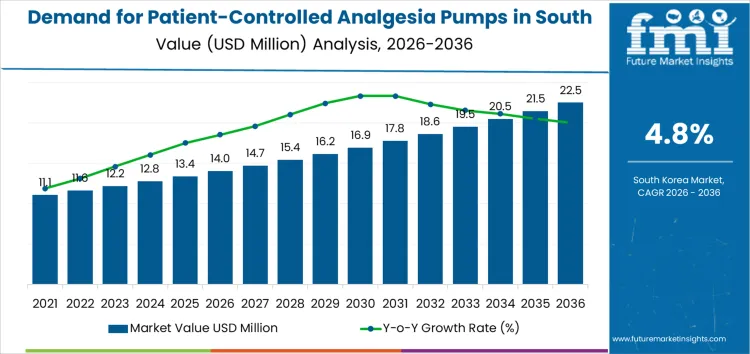
What is the Growth Forecast for the Patient-Controlled Analgesia Pump Market in South Korea through 2036?
Demand for patient-controlled analgesia (PCA) pump in South Korea is expected to grow steadily through the forecast period, supported by rising procedure volumes and increasing adoption of structured pain-management protocols in hospitals and surgical centers. As healthcare providers place greater emphasis on improving post-operative recovery and patient comfort, PCA pumps continue to gain preference for enabling controlled, safe, and timely delivery of analgesics while reducing reliance on continuous manual dosing by clinical staff.
Growth is also supported by South Korea’s strong hospital infrastructure, expanding surgical care capacity, and increasing focus on patient autonomy in clinical treatment. Demand is expected to remain consistent as providers adopt more standardized approaches to pain control in areas such as orthopedic, abdominal, and oncology-related procedures. Over time, wider use in multi-specialty hospitals and improvements in pump design, safety features, and monitoring capabilities will support sustained expansion. Overall, the outlook remains positive, with PCA pumps becoming an increasingly important component of modern pain management across South Korea’s healthcare system.
Key Takeaways for Demand for Patient-Controlled Analgesia Pumps in South Korea
| Metric | Value |
|---|---|
| Industry Sales Value (2026) | USD 14 million |
| Industry Forecast Value (2036) | USD 22.5 million |
| Industry Forecast CAGR (2026 to 2036) | 4.8% |
Why is the Demand for Patient-Controlled Analgesia Pumps Growing in South Korea?
Demand for patient controlled analgesia (PCA) pumps in South Korea has increased as hospitals and surgical centres intensify efforts to improve postoperative pain management and patient experience. PCA pumps allow patients to self administer controlled doses of analgesics, which can reduce reliance on nurse administered dosing and improve satisfaction with pain control. South Korea’s expanding surgical volumes across orthopaedics, oncology, and general surgery have driven interest in technologies that support efficient pain protocols and reduce length of stay. Clinical teams are adopting PCA systems to standardise pain management workflows, minimise dosing errors, and reduce staff workload associated with frequent manual administration.
Healthcare administrators also recognise that effective pain control contributes to reduced complications and enhanced recovery pathways, aligning with broader quality and safety targets in acute care settings. Procurement departments in tertiary hospitals prioritise PCA pump solutions that integrate with electronic medical records and support accurate documentation of analgesic usage and alerts, improving both patient safety and clinical oversight.
Looking ahead, demand for PCA pumps in South Korea is expected to grow as healthcare providers refine pain management strategies and as technology evolves. Manufacturers that offer intuitive user interfaces, robust safety features, and compatibility with a range of analgesic drugs will appeal to clinical buyers seeking flexible solutions. Integration with telemetry and remote monitoring capabilities will support broader hospital initiatives in digital health and real time patient monitoring.
Suppliers with strong service networks and training programmes can differentiate by helping hospital staff optimise pump use and reduce device related issues. Opportunities also exist for companies that can demonstrate cost effectiveness through reduced opioid use and shorter postoperative stays, which are key metrics in value based care discussions. As regulatory expectations and reimbursement frameworks in South Korea evolve, products that meet stringent safety standards while offering scalability across departments-including acute care, oncology, and ambulatory surgery-are positioned to capture a larger share of the PCA pump market.
What Are the Key Segments in Demand for Patient-Controlled Analgesia (PCA) Pumps in South Korea?
The demand for patient-controlled analgesia (PCA) pumps in South Korea is driven by both product type and end-user sector. The key products include PCA pumps, which dominate the market with a 70% share, followed by pump accessories. In terms of end users, hospitals lead the market, accounting for 60%, with ambulatory surgical centers, home care settings, and long-term care centers also contributing to the demand. As the need for effective pain management solutions increases, PCA pumps are becoming more integral in various healthcare settings.
How Does Product Type Influence Demand for PCA Pumps in South Korea?
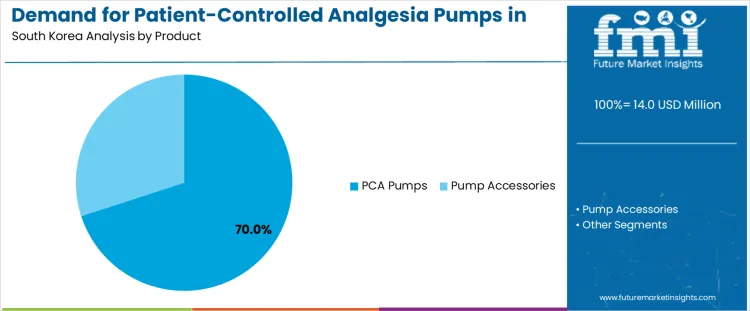
The demand for PCA pumps in South Korea is primarily driven by the PCA pumps themselves, which account for 70% of the market share. PCA pumps are widely used in hospitals to provide patients with the ability to self-administer pain relief within a controlled setting, offering them greater autonomy in managing their pain post-surgery or for chronic conditions. These pumps are essential in improving patient satisfaction by allowing for precise, controlled dosages of analgesic medications, which helps in reducing the risk of overuse and complications. The integration of PCA pumps into patient care protocols has been a key factor in improving pain management outcomes in hospitals.
On the other hand, pump accessories, although a smaller segment, play an important role in the market. These accessories include disposable parts, tubing, syringes, and catheters, all of which are critical to the ongoing functionality and maintenance of PCA pumps. As the use of PCA pumps increases across healthcare settings, the demand for these accessories is expected to grow, driven by the need for replacement parts and sanitary practices.
What Is the Demand for PCA Pumps by End-User Industry in South Korea?
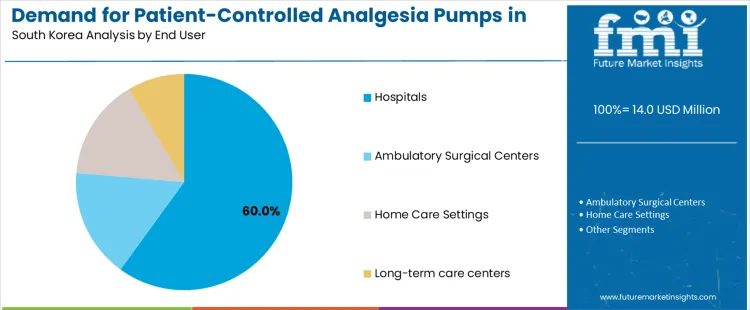
The demand for PCA pumps in South Korea is heavily influenced by end-user industries, with hospitals accounting for 60% of the market share. Hospitals remain the largest users of PCA pumps due to their critical role in providing post-operative pain relief for patients undergoing major surgeries. PCA pumps are integral to patient care in hospital settings, allowing for continuous and controlled pain management in a way that is both effective and patient-centered. As the prevalence of surgeries and medical procedures requiring pain management continues to rise, the demand for PCA pumps in hospitals is expected to remain robust. Ambulatory surgical centers, home care settings, and long-term care centers also contribute to the demand for PCA pumps. Ambulatory surgical centers, where minor to moderate procedures are performed, increasingly rely on PCA pumps to manage pain efficiently during recovery.
Home care settings are becoming an important segment for PCA pumps, as more patients prefer to manage their pain at home following surgery or injury. This trend is further fueled by the increasing emphasis on patient-centered care and cost-effective treatment. Long-term care centers also use PCA pumps for managing chronic pain in elderly or critically ill patients, improving their quality of life by allowing for more flexible and controlled pain management solutions. As the demand for more personalized and effective pain management solutions grows, PCA pumps will continue to be an essential tool across these diverse healthcare settings in South Korea.
What are the Key Dynamics in the Demand for Patient-Controlled Analgesia Pumps in South Korea?
Demand for patient controlled analgesia (PCA) pumps in South Korea is shaped by clinical pain management needs across acute care, post operative recovery, and oncology settings. Hospitals and surgical centers procure PCA systems to support individualized analgesia delivery while reducing nursing workload and enhancing patient comfort. Demographic shifts toward an aging population increase surgical caseloads and chronic pain profiles, which amplify utilization of controlled analgesia technologies. Institutional purchasing decisions for PCA pumps are influenced by device reliability, integration with hospital infusion protocols, and alignment with national clinical practice guidelines. Strong emphasis on quality of care and safety metrics in acute care facilities elevates specification requirements for PCA systems.
What are the Drivers of Demand for Patient Controlled Analgesia Pumps in South Korea?
Key drivers include growth in elective and minimally invasive surgeries where effective pain control is critical for recovery and patient satisfaction. Performance expectations for enhanced recovery after surgery (ERAS) frameworks encourage adoption of PCA pumps that allow titrated dosing and reduced systemic opioid use. Expansion of cancer care facilities and palliative care programs increases need for customizable analgesia delivery. Clinical guidelines that recognize PCA benefits for patient autonomy and consistent pain control support hospital investment. Healthcare facility modernization programs, including replacement of legacy infusion devices, spur procurement cycles. Suppliers that provide training, clinician support, and service agreements strengthen their value proposition to institutional buyers.
What are the Restraints on Demand for Patient Controlled Analgesia Pumps in South Korea?
Restraints include upfront capital expenditure for advanced PCA systems and budget constraints within smaller regional hospitals. Cost considerations for consumables such as dedicated PCA cartridges and proprietary software updates add to total cost of ownership assessments. Perceptions among some clinicians that PCA systems require extensive training can slow adoption in facilities with limited staff availability. Compliance with safety and medical device regulation, including post market vigilance requirements, influences product selection and can extend procurement lead times. Competition from alternative pain management strategies, such as regional nerve blocks or oral controlled release formulations, may limit demand where multidisciplinary pain protocols are already established.
What Key Trends Affect Demand for Patient Controlled Analgesia Pumps in South Korea?
A key trend is integration of smart infusion technologies with electronic health records and automated dosing safeguards, which enhances documentation and reduces medication error risk. Demand is increasing for PCA pumps with modular interfaces that support multi modal pain management protocols and biometric monitoring integration. Telemetry capabilities that allow remote monitoring of pump status and patient reports are gaining interest in large hospital networks. Suppliers are introducing training platforms and simulation tools to shorten clinician onboarding and improve confidence in PCA use. Growth in ambulatory surgical centers and outpatient procedures is creating niche demand for portable PCA solutions that support early discharge while maintaining robust analgesia control. Manufacturers that align product development with clinician workflow and regulatory expectations are better positioned to engage institutional purchasers and integrated delivery networks.
What is the Regional Demand Outlook for Patient-Controlled Analgesia (PCA) Pumps in South Korea?
The demand for patient-controlled analgesia (PCA) pumps in South Korea is increasing across various regions, driven by advancements in pain management technology and the growing need for effective post-operative care. South Gyeongsang, with a projected CAGR of 5.1%, leads the market, supported by the region's advanced healthcare infrastructure and increasing use of PCA pumps in hospitals and surgical centers. North Jeolla, with a growth rate of 3.88%, reflects moderate demand, as the region continues to improve its healthcare facilities and expand its pain management services. South Jeolla, with a projected CAGR of 4.6%, is also witnessing steady demand, driven by increasing awareness and adoption of PCA pumps in medical facilities. Jeju, with the highest growth rate of 5.81%, stands out for its expanding healthcare sector and focus on patient-centered care. These regional trends provide strong opportunities for suppliers of PCA pumps to meet the growing demand for advanced pain management solutions.
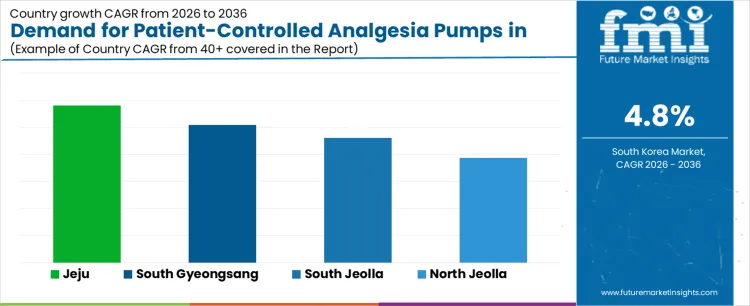
| Region | CAGR (2026 to 2036) |
|---|---|
| South Gyeongsang | 5.1% |
| North Jeolla | 3.88% |
| South Jeolla | 4.6% |
| Jeju | 5.81% |
How Can Manufacturers Target the Market in South Gyeongsang for PCA Pumps?
South Gyeongsang, with a projected CAGR of 5.1%, presents a strong market for patient-controlled analgesia pumps. The region’s advanced medical infrastructure and high utilization of PCA pumps in post-operative care create substantial demand for these devices. Manufacturers looking to enter the South Gyeongsang market should focus on providing reliable, user-friendly, and clinically advanced PCA pumps that cater to the specific needs of hospitals and surgical centers. To effectively capture this growing demand, companies should consider forming partnerships with local hospitals and healthcare providers, ensuring that their products meet regional standards for patient care and pain management. As the region continues to expand its healthcare capabilities, the demand for PCA pumps will likely rise, creating significant opportunities for manufacturers.
What Drives PCA Pump Demand in North Jeolla?
North Jeolla, with a CAGR of 3.88%, is experiencing moderate growth in demand for PCA pumps. The region’s healthcare sector is expanding, with a rising focus on pain management technologies and improved post-operative care. As awareness of the benefits of PCA pumps grows, there is an increasing shift toward adopting these systems in both public and private healthcare facilities. Manufacturers targeting North Jeolla should focus on providing affordable and efficient PCA pump solutions that can meet the needs of local healthcare providers. Educating medical professionals and healthcare organizations about the advantages of PCA pumps, such as reduced reliance on healthcare staff and improved pain control for patients, can help drive demand in this region.
How is South Jeolla’s Market for PCA Pumps Expected to Grow?
South Jeolla, with a projected CAGR of 4.6%, is witnessing steady growth in demand for PCA pumps, driven by an increasing awareness of pain management technologies and the region’s expanding healthcare services. The region's growing investment in medical technologies and the rising number of surgical procedures are key factors contributing to this growth. Manufacturers targeting South Jeolla should emphasize the long-term benefits of PCA pumps, such as enhanced patient satisfaction and improved clinical outcomes. Offering customizable solutions to meet the specific needs of South Jeolla's healthcare facilities will help companies tap into this growing market. As the region continues to develop its healthcare sector, demand for PCA pumps will likely rise steadily.
Why is Jeju Leading the Growth in PCA Pump Demand?
Jeju, with the highest projected CAGR of 5.81%, is experiencing rapid growth in the demand for patient-controlled analgesia pumps. This growth is largely driven by Jeju’s focus on patient-centered care and the expansion of its healthcare services, particularly in surgical and post-operative care settings. The region’s growing reputation for high-quality medical tourism is also contributing to increased demand for advanced pain management technologies like PCA pumps. Manufacturers looking to enter Jeju’s market should focus on offering reliable, easy-to-use, and portable PCA pumps that align with the region’s medical tourism needs and emphasis on patient comfort. As Jeju continues to expand its healthcare infrastructure and attract more patients, the demand for PCA pumps is expected to increase significantly, presenting a key growth opportunity for suppliers in the region.
What is the Competitive Landscape for Patient Controlled Analgesia (PCA) Pumps Demand in South Korea?
Demand for patient controlled analgesia (PCA) pumps in South Korea is influenced by hospital pain management protocols, surgical procedure volumes, and expanding acute care services. Hospitals, surgical centres, and pain clinics prioritise devices that support precise opioid delivery, reduce nurse workload, and enhance patient comfort. Clinical procurement teams evaluate PCA systems for safety features such as lock out mechanisms, dosage accuracy, and alarm responsiveness. Requirements often include interoperability with electronic medical record (EMR) systems and infusion management infrastructure already deployed within healthcare facilities.
Regulatory compliance with Korean medical device standards and post market surveillance records are considered essential in tender evaluations. Demand patterns reflect ongoing investments in perioperative care and postoperative pain management solutions that aim to reduce complications and support recovery benchmarks. Facility budgets take into account total cost of ownership, including maintenance contracts, consumable costs, and staff training provisions.
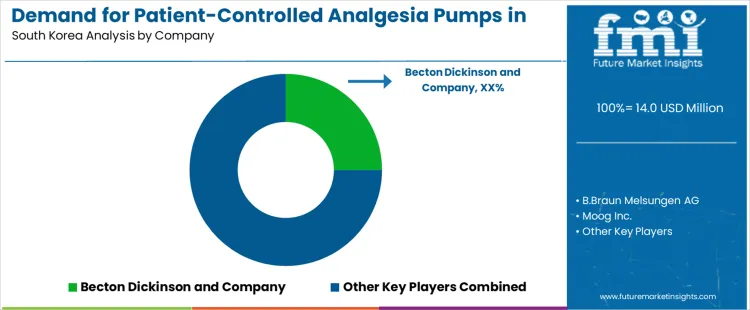
Competition among PCA pump suppliers in South Korea centres on product capability, documented clinical evidence, and technical support ecosystems. Becton Dickinson and Company is positioned as a leading supplier with detailed product brochures that specify infusion parameters, safety controls, user interface features, and integration protocols relevant to biomedical engineering and procurement teams. B.Braun Melsungen AG materials describe PCA systems with data on precision delivery ranges, ergonomic design considerations, and serviceability that inform hospital formulary committees and clinical specialists.
Moog Inc. documentation focuses on control system robustness, engineering tolerances, and system reliability tables that support effectiveness assessments in high use environments. Smiths Group/ICU Medical brochures outline PCA solutions with specification charts on anti free flow mechanisms, alarm systems, and modular add ons that assist acute care planners. Fresenius SE & Co. KGaA product literature presents PCA pumps with performance metrics, calibration details, and software compatibility guides used by procurement and IT integration teams. Supplier materials typically include technical data sheets, operational parameters, and quality certifications that aid South Korean healthcare purchasers in comparing offerings based on safety, performance, and support infrastructure.
Key Players of the Demand for Patient-Controlled Analgesia Pumps in South Korea
- Becton Dickinson and Company
- B.Braun Melsungen AG
- Moog Inc.
- Smiths Group/ ICU Medical
- Fresenius SE & Co. KGaA
Scope of the Report
| Items | Values |
|---|---|
| Quantitative Units (2026) | USD Million |
| Product | PCA Pumps, Pump Accessories |
| Application | Pain Management, Antibiotic/Antiviral Therapy, Chemotherapy, Others |
| End User | Hospitals, Ambulatory Surgical Centers, Home Care Settings, Long-term Care Centers |
| Companies | Becton Dickinson and Company, B. Braun Melsungen AG, Moog Inc., Smiths Group / ICU Medical, Fresenius SE & Co. KGaA |
| Region Covered | South Korea |
| Provinces Covered | South Gyeongsang, North Jeolla, South Jeolla, Jeju |
| Additional Attributes | Dollar sales by product type, application, and end user. Demand increases with rising surgical volumes, expanded use of opioid-sparing pain therapies, and adoption of programmable PCA devices across hospitals, ambulatory centers, and home-care settings. |
Key Segments of Demand for Patient-Controlled Analgesia Pumps in South Korea
Product
- PCA Pumps
- Pump Accessories
- Other
Application
- Pain Management
- Antibiotic/Antiviral Therapy
- Chemotherapy
- Others
End User
- Hospitals
- Ambulatory Surgical Centers
- Home Care Settings
- Long-term Care Centers
- Other
Provinces
- South Gyeongsang
- North Jeolla
- South Jeolla
- Jeju
Bibliography
- Health Insurance Review and Assessment Service. (2024). Post-operative pain management and infusion device usage statistics in South Korea. Government of the Republic of Korea.
- Korea Ministry of Food and Drug Safety. (2025). Medical device regulation and compliance requirements for infusion and analgesia pumps. Government of the Republic of Korea.
- World Health Organization. (2024). WHO guidance on the safe use of medical infusion devices and opioid-sparing pain management protocols. World Health Organization.
Frequently Asked Questions
How big is the demand for patient-controlled analgesia pumps in south korea in 2026?
The demand for patient-controlled analgesia pumps in south korea is estimated to be valued at USD 14.0 million in 2026.
What will be the size of patient-controlled analgesia pumps in south korea in 2036?
The market size for the patient-controlled analgesia pumps in south korea is projected to reach USD 22.5 million by 2036.
How much will be the demand for patient-controlled analgesia pumps in south korea growth between 2026 and 2036?
The demand for patient-controlled analgesia pumps in south korea is expected to grow at a 4.8% CAGR between 2026 and 2036.
What are the key product types in the patient-controlled analgesia pumps in south korea?
The key product types in patient-controlled analgesia pumps in south korea are pca pumps and pump accessories.
Which application segment is expected to contribute significant share in the patient-controlled analgesia pumps in south korea in 2026?
In terms of application, pain management segment is expected to command 55.0% share in the patient-controlled analgesia pumps in south korea in 2026.
Preview the report firsthand - request a free sample
Get SampleGet the brochure for pricing and purchase details.
Get PDFTable of Content
- Executive Summary
- South Korea Market Outlook
- Demand-side Trends
- Supply-side Trends
- Technology Roadmap Analysis
- Analysis and Recommendations
- Market Overview
- Market Coverage / Taxonomy
- Market Definition / Scope / Limitations
- Market Background
- Market Dynamics
- Drivers
- Restraints
- Opportunity
- Trends
- Scenario Forecast
- Demand in Optimistic Scenario
- Demand in Likely Scenario
- Demand in Conservative Scenario
- Opportunity Map Analysis
- Product Life Cycle Analysis
- Supply Chain Analysis
- Investment Feasibility Matrix
- Value Chain Analysis
- PESTLE and Porter’s Analysis
- Regulatory Landscape
- Regional Parent Market Outlook
- Production and Consumption Statistics
- Import and Export Statistics
- Market Dynamics
- South Korea Market Analysis 2021 to 2025 and Forecast, 2026 to 2036
- Historical Market Size Value (USD Million) Analysis, 2021 to 2025
- Current and Future Market Size Value (USD Million) Projections, 2026 to 2036
- Y-o-Y Growth Trend Analysis
- Absolute $ Opportunity Analysis
- South Korea Market Pricing Analysis 2021 to 2025 and Forecast 2026 to 2036
- South Korea Market Analysis 2021 to 2025 and Forecast 2026 to 2036, By Product
- Introduction / Key Findings
- Historical Market Size Value (USD Million) Analysis By Product, 2021 to 2025
- Current and Future Market Size Value (USD Million) Analysis and Forecast By Product, 2026 to 2036
- PCA Pumps
- Pump Accessories
- PCA Pumps
- Y-o-Y Growth Trend Analysis By Product, 2021 to 2025
- Absolute $ Opportunity Analysis By Product, 2026 to 2036
- South Korea Market Analysis 2021 to 2025 and Forecast 2026 to 2036, By Application
- Introduction / Key Findings
- Historical Market Size Value (USD Million) Analysis By Application, 2021 to 2025
- Current and Future Market Size Value (USD Million) Analysis and Forecast By Application, 2026 to 2036
- Pain Management
- Antibiotic/Antiviral Therapy
- Chemotherapy
- Others
- Pain Management
- Y-o-Y Growth Trend Analysis By Application, 2021 to 2025
- Absolute $ Opportunity Analysis By Application, 2026 to 2036
- South Korea Market Analysis 2021 to 2025 and Forecast 2026 to 2036, By End User
- Introduction / Key Findings
- Historical Market Size Value (USD Million) Analysis By End User, 2021 to 2025
- Current and Future Market Size Value (USD Million) Analysis and Forecast By End User, 2026 to 2036
- Hospitals
- Ambulatory Surgical Centers
- Home Care Settings
- Long-term care centers
- Hospitals
- Y-o-Y Growth Trend Analysis By End User, 2021 to 2025
- Absolute $ Opportunity Analysis By End User, 2026 to 2036
- Market Structure Analysis
- Competition Dashboard
- Competition Benchmarking
- Market Share Analysis of Top Players
- By Regional
- By Product
- By Application
- By End User
- Competition Analysis
- Competition Deep Dive
- Becton Dickinson and Company
- Overview
- Product Portfolio
- Profitability by Market Segments (Product/Age /Sales Channel/Region)
- Sales Footprint
- Strategy Overview
- Marketing Strategy
- Product Strategy
- Channel Strategy
- B.Braun Melsungen AG
- Moog Inc.
- Smiths Group/ ICU Medical
- Fresenius SE & Co. KGaA
- Becton Dickinson and Company
- Competition Deep Dive
- Assumptions & Acronyms Used
- Research Methodology


