

- Industry Size (2026)
- USD 58.9 Mn
- Forecast (2036)
- USD 115.2 Mn
- CAGR (2026 to 2036)
- 6.9%
Demand for Hearing Implant in South Korea Forecast and Outlook 2026 to 2036
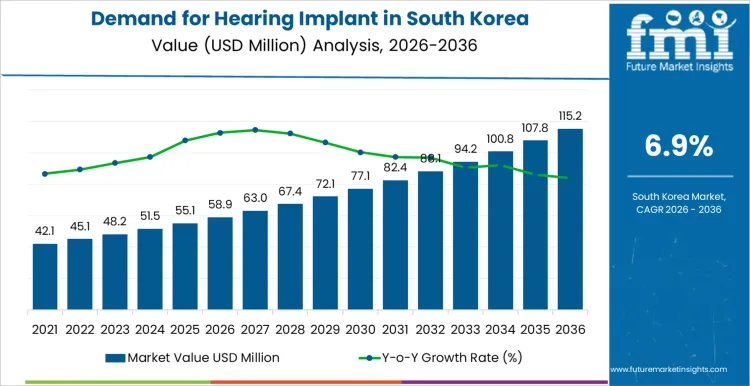
Sales regarding hearing implant devices in South Korea are likely to be valued at USD 58.9 million in 2026. Financial volume within this audiology sector is set to ascend to USD 115.2 million by 2036, advancing at a compound annual growth rate of 6.9%. South Korea faces a rapidly aging society, which significantly correlates with age-related hearing loss, or presbycusis. As the population demographic shifts towards older age brackets, the incidence of severe-to-profound hearing impairment is rising, necessitating advanced auditory solutions beyond standard amplification. Senior citizens are increasingly seeking medical interventions to maintain social connections and cognitive health, driving the uptake of implantable devices.
Government initiatives aimed at disability support are playing a crucial role in expanding access to these technologies. National health insurance schemes in South Korea have progressively widened coverage criteria for cochlear implantation, reducing the financial burden on patients. This policy shift encourages earlier intervention, particularly for pediatric patients born with congenital deafness, ensuring better language development outcomes. Screening programs for newborns are universally implemented, ensuring early detection and immediate referral to specialized centers. Consequently, public awareness regarding the benefits of surgically implanted auditory aids is growing, fostering a supportive environment for industry expansion.
Quick Stats for Demand for Hearing Implant in South Korea
- Demand for Hearing Implant in South Korea Value (2026): USD 58.9 million
- Demand for Hearing Implant in South Korea Forecast Value (2036): USD 115.2 million
- Demand for Hearing Implant in South Korea Forecast CAGR: 6.9%
- Leading Product Type Segment for Hearing Implant Industry in South Korea: Cochlear Implants (45.0%)
- Leading End User Segment for Hearing Implant Industry in South Korea: Hospitals (53.9%)
- Key Growth Regions for Hearing Implant Industry in South Korea: Jeju, South Gyeongsang, South Jeolla, North Jeolla
- Hearing Implant Industry in South Korea Key Players: Cochlear Limited, Sonova Holding AG (Advanced Bionics), MED-EL Medical Electronics, Oticon Medical (Demant A/S), WS Audiology (Signia, Widex)
Manufacturers are integrating bluetooth hearing aid connectivity features into implant sound processors, allowing direct streaming from smartphones and televisions. Innovation in medical bionic implant and artificial organs design is leading to smaller, more discreet external components, addressing aesthetic concerns that often deter potential users. Advancements in neuroprosthetics are improving the interface between the electrode array and the auditory nerve, resulting in clearer sound perception. Such innovations are crucial for convincing candidates who struggle with speech discrimination in noisy environments to opt for implantation.
Demand for Hearing Implant in South Korea Key Takeaways
South Korea's audiology domain is characterized by a strong preference for high-tech, clinically proven solutions. Cochlear implants remain the gold standard for profound deafness, commanding the largest portion of expenditure. Hospitals serve as the primary hubs for implantation surgery, reflecting the need for specialized surgical teams and post-operative rehabilitation. Regional growth is fueled by the decentralization of advanced medical services to provinces with high elderly populations. Competitive dynamics are led by global pioneers who maintain strong relationships with university hospitals and key opinion leaders. Ultimately, the sector is evolving towards personalized, connected hearing solutions that integrate seamlessly into the user's digital life.
| Metric | Value |
|---|---|
| Industry Size (2026) | USD 58.9 million |
| Industry Value (2036) | USD 115.2 million |
| CAGR (2026 to 2036) | 6.9% |
What Specific Healthcare Trends Are Fueling Hearing Implant Adoption?
Growing emphasis on cognitive health in the elderly population acts as a significant catalyst. Studies linking untreated hearing loss to accelerated dementia and social isolation are prompting families to seek effective treatments like bionic ears. Integration of hearing care into broader ear health initiatives ensures that candidates are identified during routine check-ups. Furthermore, the rising availability of custom hearing aids has raised patient expectations for sound quality; when these external devices fail to provide benefit, the transition to implants is the logical next step. Expansion of rehabilitation infrastructure also supports adoption, as patients are more confident in achieving successful outcomes with proper speech therapy support.
How is the Sector Structured Across Key Segments?
Structure of this domain is categorized by device technology and the facility where the procedure is performed. Product segmentation distinguishes between inner ear stimulators like cochlear implants and mechanical vibration devices like bone conduction systems. End-user classification highlights the dominance of tertiary medical centers where complex surgeries are routine. Understanding this segmentation helps manufacturers target their educational efforts, focusing technical training on surgeons in hospitals while directing awareness campaigns towards audiology clinics that serve as referral points. This division underscores the specialized nature of hearing implantation compared to general hearing aid dispensing.
Why Does the Cochlear Implants Category Maintain Dominance?
Cochlear Implants command a 45.0% share of the industry. This leadership stems from their unique ability to restore sound perception in individuals with severe sensorineural hearing loss where hair cells are damaged. South Korea's robust reimbursement policy specifically targets this category, covering the substantial cost of the device and surgery for eligible candidates. High prevalence of age-related hearing loss that progresses beyond the help of amplification ensures a steady stream of adult candidates. Pediatric implantation programs are also well-established, with doctors advocating for early surgery to maximize neuroplasticity. Consequently, the proven clinical efficacy of cochlear systems secures their position as the primary revenue generator.
How is the Middle Ear Implants Segment Contributing to Sector Growth?
Middle Ear Implants account for 22.0% of the usage share. Use of these devices is growing among patients who have moderate-to-severe sensorineural hearing loss but are dissatisfied with hearing aids due to occlusion effects or feedback. Active middle ear implants mechanically stimulate the ossicles, providing clearer sound quality without blocking the ear canal. This technology appeals to active individuals who require a stable solution that allows for natural ear function. Surgeons are increasingly recommending them for patients who cannot tolerate conventional aids or have specific anatomical challenges. Niche applications for mixed hearing loss further support steady adoption rates in specialized otology centers.
Why Do Hospitals Lead Consumption?
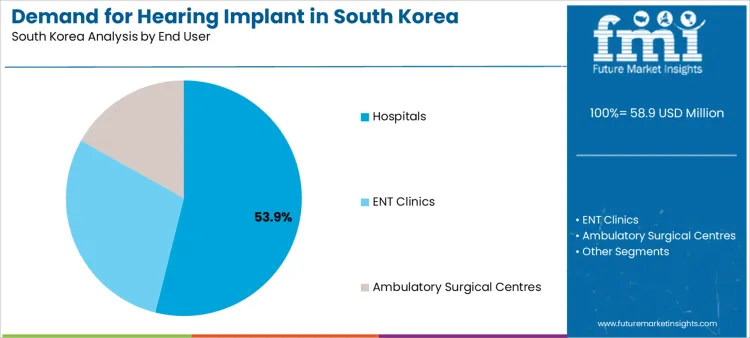
Hospitals capture a 53.9% share of the sector. Implantation procedures are complex microsurgeries requiring general anesthesia and sterile operating environments available in hospital settings. Pre-operative assessment involves comprehensive imaging like CT and MRI, which are standard in large medical centers. Post-surgical care, including wound management and initial device activation, necessitates a multidisciplinary team of surgeons, audiologists, and speech therapists found in these institutions. Trust in university hospitals is high among Korean patients, who prefer to undergo major medical procedures at reputable academic centers. Therefore, the hospital segment remains the central channel for device procurement and patient management.
Will the Integration of AI Redefine Future Sales?
Usage of artificial intelligence in sound processing is becoming a key differentiator. smart behind the ear hearing aid technologies are migrating to implants, where AI algorithms analyze the acoustic environment to automatically adjust settings for speech clarity. This reduces the cognitive load on the user, making listening effortless in noisy places like restaurants. Integration with voice assistance application platforms allows users to control their sound processors via voice commands. As AI capabilities improve, the performance gap between normal hearing and implant-assisted hearing narrows, driving higher acceptance rates among candidates who previously hesitated due to performance concerns.
How Do Aesthetic Preferences Impact Design?
Korean consumers place high value on aesthetics and discretion. Large, bulky external processors can be a barrier to adoption due to stigma associated with disability. Manufacturers are responding by utilizing hearing devices 3d printing techniques to create custom-fit, low-profile covers. Development of single-unit processors that sit off the ear and are hidden under hair is gaining traction. Research into fully implantable cochlear implants, which eliminate external components entirely, represents the ultimate goal. Until then, miniaturization remains a critical competitive factor, with companies vying to produce the smallest, lightest processors to appeal to image-conscious users.
Is the Trend Towards Remote Care Affecting Demand?
Telehealth capabilities are transforming post-operative care. Remote programming allows audiologists to fine-tune implant settings without the patient visiting the clinic physically. This is particularly beneficial for elderly patients in rural areas or busy professionals. medical bionic implants and exoskeletons sectors are seeing similar trends where connectivity enables remote diagnostics. South Korea's high-speed internet infrastructure supports seamless video consultations and data logging. Availability of remote care options reduces the burden of follow-up appointments, making implantation a more convenient option and thereby encouraging more individuals to proceed with surgery.
How is the Audiology Landscape Evolving Across South Korea's Regions?
Regional adoption patterns regarding hearing implants across South Korea are displaying a distinct shift towards decentralization, moving away from a purely capital-centric model. While Seoul remains a primary hub for highly complex revision surgeries, provincial medical centers are rapidly upgrading their capabilities to handle primary implantations. This evolution is driven by specific government mandates aiming to equalize healthcare access for the aging population residing in rural provinces. Local university hospitals are establishing specialized otology departments, equipped with advanced diagnostic tools, to serve these communities directly. Consequently, patients in southern regions are increasingly opting for local treatment, reducing the logistical burden of traveling to metropolitan areas and fostering a more balanced national distribution of medical technology utilization.
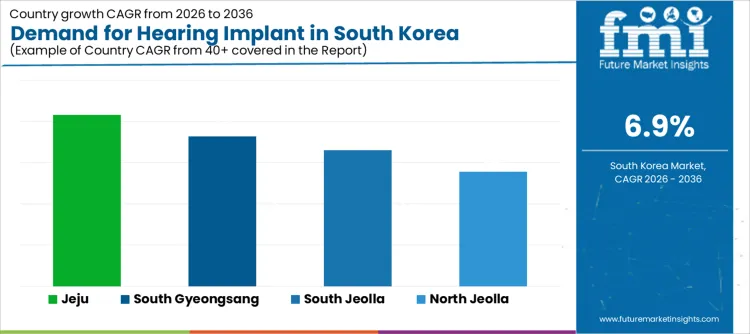
| Region | CAGR (2026 to 2036) |
|---|---|
| Jeju | 8.3% |
| South Gyeongsang | 7.3% |
| South Jeolla | 6.6% |
| North Jeolla | 5.5% |
Why is the Aging Population in Jeju Driving Rapid Growth?
Adoption of hearing implants in Jeju is projected to expand at a CAGR of 8.3%. Jeju Island has a rapidly aging population, with many retirees moving there for a relaxed lifestyle. Local healthcare providers are expanding their audiology departments to cater to this demographic. Isolation from the mainland necessitates self-sufficient medical services, including implant surgery capabilities. Demand is further driven by the active lifestyle of Jeju's seniors, who require effective hearing solutions to participate in community activities. Availability of advanced medical facilities on the island ensures that residents can access top-tier care without traveling to Seoul.
How is Industrial Demographics in South Gyeongsang Influencing Sales?
Sales of auditory devices in South Gyeongsang are likely to reach a CAGR of 7.3%. This region's history as an industrial hub means a significant portion of the elderly male population may suffer from noise-induced hearing loss in addition to presbycusis. Workers retiring from shipyards and factories often have severe hearing impairment requiring intervention. Corporate health benefits and industrial accident compensation insurance sometimes supplement national coverage, facilitating access to implants. Regional university hospitals are well-equipped to handle these cases, supporting steady growth in procedural volumes.
What Specific Factors Drive Demand in South Jeolla?
Expansion in South Jeolla is anticipated to rise at a CAGR of 6.6%. South Jeolla has the highest proportion of elderly residents in the country. This demographic reality creates a substantial base of potential candidates for hearing restoration. Public health initiatives focus heavily on geriatric care, including sensory health screenings. Local government subsidies often assist low-income seniors with medical copayments. Efforts to reduce social isolation among the rural elderly involve promoting communication abilities, directly linking to the adoption of hearing implants as a tool for social reintegration.
Why is North Jeolla Modernizing its Audiology Services?
Deployment of implant technology in North Jeolla is expected to increase at a CAGR of 5.5%. Medical centers in cities like Jeonju are upgrading their ENT departments to offer comprehensive implant programs. Collaboration with major manufacturers to host patient awareness seminars is increasing local knowledge about implantable solutions. While growth is moderate, it reflects a steady modernization of healthcare services in the region. Focus on improving quality of life for the aging population ensures that hearing health remains a priority for local health administrators.
What Strategic Initiatives Define Market Leadership?
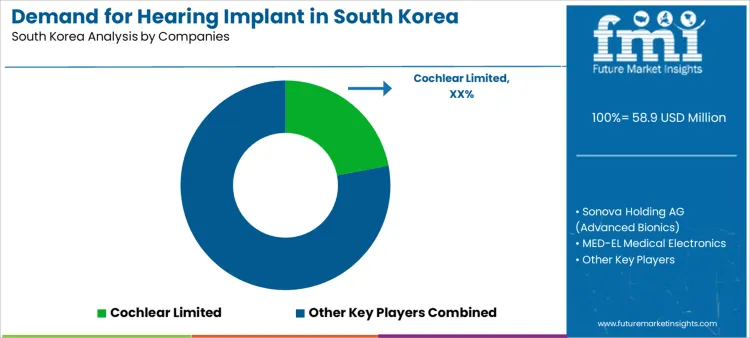
Cochlear Limited commands a dominant position with a 22.0% share, leveraging its long-standing presence and brand reliability. Its strategy focuses on a "recipient-first" approach, offering extensive rehabilitation support and upgrade pathways for older implants. Cochlear invests heavily in direct-to-patient marketing and partnerships with leading ENT surgeons. Competitors like MED-EL and Advanced Bionics differentiate through technological features like MRI safety without magnet removal and sophisticated sound coding strategies. Strategic alliances with hearing aid manufacturers allow for bimodal solutions, where a patient uses an implant in one ear and a compatible hearing aid in the other.
How Are Global Players Adapting to Local Needs?
International firms are tailoring their services to the Korean context. Providing Korean-language support in apps and customer service is essential. Manufacturers organize community events for recipients to share experiences, fostering a sense of community that is culturally important. Collaborating with local universities on clinical research helps generate data specific to Korean patients, building trust with the medical community. Offering diverse design options and accessories that cater to Asian anatomical features and aesthetic preferences also plays a role in gaining competitive advantage.
Key Companies
- Cochlear Limited
- Sonova Holding AG (Advanced Bionics)
- MED-EL Medical Electronics
- Oticon Medical (Demant A/S)
- WS Audiology (Signia, Widex)
Scope of Report
| Items | Values |
|---|---|
| Quantitative Units | USD Million |
| Product Type | Cochlear Implants, Middle Ear Implants, Bone Conduction Implants, Auditory Brainstem Implant |
| End User | Hospitals, ENT Clinics, Ambulatory Surgical Centres |
| Regions Covered | Jeju, South Gyeongsang, South Jeolla, North Jeolla |
| Key Companies Profiled | Cochlear, Sonova, MED-EL, Oticon Medical, WS Audiology |
Demand for Hearing Implant in South Korea by Segments
By Product Type
- Cochlear Implants
- Middle Ear Implants
- Bone Conduction Implants
- Auditory Brainstem Implant
By End User
- Hospitals
- ENT Clinics
- Ambulatory Surgical Centres
Bibliography
- Ministry of Health and Welfare. (2025, April 16). Registered persons with disabilities status (as of end of December 2024). Ministry of Health and Welfare, Republic of Korea.
- Ministry of Health and Welfare. (2025, April 16). Press release: Registered persons with disabilities in 2024 (2.631 million, 5.1% of the population). Ministry of Health and Welfare, Republic of Korea.
- Statistics Korea. (2024, April 10). Population prospects of Koreans and foreigners based on 2022 population projections (2022-2042). Statistics Korea, Republic of Korea.
- Korea Health Industry Development Institute. (2024, December 10). Domestic medical device market size status (statistical tables and trend summary). Korea Health Industry Development Institute, Republic of Korea.
Frequently Asked Questions
How big is the demand for Hearing Implant in South Korea in 2026?
The demand for Hearing Implant in South Korea is estimated to be valued at USD 58.9 million in 2026.
What will be the size of Hearing Implant in South Korea in 2036?
The industry size for the Hearing Implant in South Korea is projected to reach USD 115.2 million by 2036.
How much will be the demand for Hearing Implant in South Korea growth between 2026 and 2036?
The demand for Hearing Implant in South Korea is expected to grow at a 6.9% CAGR between 2026 and 2036.
What are the key product types in the Hearing Implant in South Korea?
The key product types in Hearing Implant in South Korea are Cochlear Implants and Middle Ear Implants.
Which end user segment is expected to contribute significant share in the Hearing Implant in South Korea in 2026?
By end user, Hospitals segment is expected to command 53.9% share in the Hearing Implant in South Korea in 2026.
Preview the report firsthand - request a free sample
Get SampleGet the brochure for pricing and purchase details.
Get PDFTable of Content
- Executive Summary
- South Korea Market Outlook
- Demand-side Trends
- Supply-side Trends
- Technology Roadmap Analysis
- Analysis and Recommendations
- Market Overview
- Market Coverage / Taxonomy
- Market Definition / Scope / Limitations
- Market Background
- Market Dynamics
- Drivers
- Restraints
- Opportunity
- Trends
- Scenario Forecast
- Demand in Optimistic Scenario
- Demand in Likely Scenario
- Demand in Conservative Scenario
- Opportunity Map Analysis
- Product Life Cycle Analysis
- Supply Chain Analysis
- Investment Feasibility Matrix
- Value Chain Analysis
- PESTLE and Porter’s Analysis
- Regulatory Landscape
- Regional Parent Market Outlook
- Production and Consumption Statistics
- Import and Export Statistics
- Market Dynamics
- South Korea Market Analysis 2021 to 2025 and Forecast, 2026 to 2036
- Historical Market Size Value (USD Million) Analysis, 2021 to 2025
- Current and Future Market Size Value (USD Million) Projections, 2026 to 2036
- Y-o-Y Growth Trend Analysis
- Absolute $ Opportunity Analysis
- South Korea Market Pricing Analysis 2021 to 2025 and Forecast 2026 to 2036
- South Korea Market Analysis 2021 to 2025 and Forecast 2026 to 2036, By Product Type
- Introduction / Key Findings
- Historical Market Size Value (USD Million) Analysis By Product Type , 2021 to 2025
- Current and Future Market Size Value (USD Million) Analysis and Forecast By Product Type , 2026 to 2036
- Cochlear Implants
- Middle Ear Implants
- Bone Conduction Implants
- Auditory Brainstem Implant
- Cochlear Implants
- Y-o-Y Growth Trend Analysis By Product Type , 2021 to 2025
- Absolute $ Opportunity Analysis By Product Type , 2026 to 2036
- South Korea Market Analysis 2021 to 2025 and Forecast 2026 to 2036, By End User
- Introduction / Key Findings
- Historical Market Size Value (USD Million) Analysis By End User, 2021 to 2025
- Current and Future Market Size Value (USD Million) Analysis and Forecast By End User, 2026 to 2036
- Hospitals
- ENT Clinics
- Ambulatory Surgical Centres
- Hospitals
- Y-o-Y Growth Trend Analysis By End User, 2021 to 2025
- Absolute $ Opportunity Analysis By End User, 2026 to 2036
- Market Structure Analysis
- Competition Dashboard
- Competition Benchmarking
- Market Share Analysis of Top Players
- By Regional
- By Product Type
- By End User
- Competition Analysis
- Competition Deep Dive
- Cochlear Limited
- Overview
- Product Portfolio
- Profitability by Market Segments (Product/Age /Sales Channel/Region)
- Sales Footprint
- Strategy Overview
- Marketing Strategy
- Product Strategy
- Channel Strategy
- Sonova Holding AG (Advanced Bionics)
- MED-EL Medical Electronics
- Oticon Medical (Demant A/S)
- WS Audiology (Signia, Widex)
- Cochlear Limited
- Competition Deep Dive
- Assumptions & Acronyms Used
- Research Methodology


