

- Industry Size (2026)
- USD 1.2 Bn
- Forecast (2036)
- USD 2.9 Bn
- CAGR (2026 to 2036)
- 9.6%
Machinery Retrofit Modules Market Forecast and Outlook 2026 to 2036
The machinery retrofit modules market is projected to experience steady growth from 2026 to 2036. In 2026, the market value is expected to be USD 1.2 billion, with significant growth anticipated, reaching USD 2.9 billion by 2036. The compound annual growth rate (CAGR) for this market is forecasted at 9.6%, driven by increasing demand for retrofitting solutions that help extend the lifespan and improve the efficiency of existing machinery in industries such as manufacturing, automotive, and energy. The market's growth will be influenced by the rising need to modernize machinery while reducing capital expenditures on new equipment.
The market will experience a gradual upward trend throughout the forecast period, supported by ongoing industrial digitalization, the growing focus on sustainability, and the need to enhance machinery performance. Retrofit solutions will continue to be sought after by companies looking to optimize operations, comply with regulations, and reduce downtime. The machinery retrofit modules market will benefit from increasing awareness of the cost-effectiveness and environmental benefits of retrofitting existing machinery instead of investing in new systems.
Quick Stats of the Machinery Retrofit Modules Market
- Machinery Retrofit Modules Market Value (2026): USD 1.2 billion
- Machinery Retrofit Modules Market Forecast Value (2036): USD 2.9 billion
- Machinery Retrofit Modules Market Global Forecast CAGR (2026-2036): 9.6%
- Machinery Retrofit Modules Market Leading Segment: Technology (PLC/drive upgrades, energy optimization) 55%
- Key Growth Regions in Machinery Retrofit Modules Market: China
- Top Players in Machinery Retrofit Modules Market: Rockwell Automation, Bosch Rexroth, Inovance, Delta India, Local integrators, Omron, Siemens, SEW-Eurodrive, Hollysys
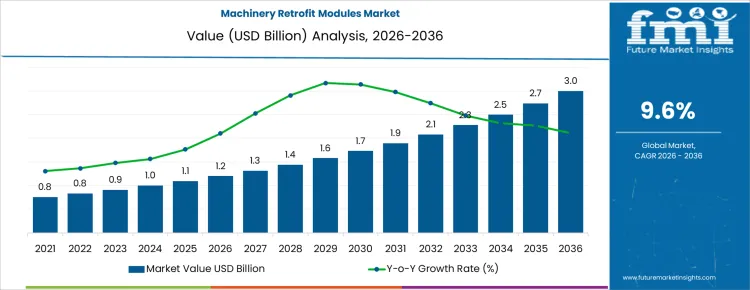
What is the Growth Forecast for the Machinery Retrofit Modules Market through 2036?
The growth forecast for the machinery retrofit modules market indicates a steady and stable expansion with a projected CAGR of 9.6%. Starting at USD 1.2 billion in 2026, the market will increase gradually, reaching USD 1.3 billion in 2027, USD 1.4 billion in 2028, and USD 1.6 billion in 2029. By 2030, the market value will reach USD 1.7 billion, continuing to grow steadily in the following years.
From 2031 to 2036, the market will experience continued expansion, with values rising to USD 1.9 billion in 2031, USD 2.1 billion in 2032, and USD 2.3 billion in 2033. In 2034, the market will reach USD 2.5 billion, followed by USD 2.7 billion in 2035. By 2036, the market will achieve USD 2.9 billion, demonstrating a consistent and stable growth pattern throughout the forecast period. The growth rate volatility index will reflect relatively low fluctuations, indicating a predictable and steady market trajectory.
Machinery Retrofit Modules Market Key Takeaways
| Metric | Value |
|---|---|
| Industry Sales Value (2026) | USD 1.2 billion |
| Industry Forecast Value (2036) | USD 2.9 billion |
| Industry Forecast CAGR (2026-2036) | 9.6% |
What Is Driving the Demand for the Machinery Retrofit Modules Market Globally?
The global demand for machinery retrofit modules is being driven by the need to extend the life, improve the performance, and enhance the efficiency of existing industrial assets without full equipment replacement. Many manufacturers and industrial operators face increasing pressure to reduce capital expenditure while meeting rising productivity, safety, and regulatory requirements. Retrofit modules - which may include automation upgrades, IoT sensors, control system enhancements, energy-efficiency components, and safety features - allow older machinery to integrate with modern production systems, support predictive maintenance, and improve data visibility across operations.
In industries such as automotive, food and beverage, packaging, pharmaceuticals, and heavy equipment manufacturing, production lines that were designed decades ago often lack connectivity, real-time monitoring, and compliance with current efficiency standards. Retrofit solutions offer a cost-effective path to modernisation, enabling companies to optimise throughput, reduce downtime, and improve equipment reliability without the disruption and expense of complete replacement.
Future demand for machinery retrofit modules is expected to grow as digital transformation and sustainability goals further shape industrial investment strategies. Advancements in sensor technology, edge computing, automation, and AI-driven analytics will expand the value of retrofit modules, making it easier to deploy upgrades that deliver measurable improvements in efficiency, quality, and uptime. Industries that prioritise flexible manufacturing and quick changeovers will adopt retrofit modules that support modular production and interoperability with existing enterprise systems.
Regulatory emphasis on energy efficiency, emissions control, and worker safety will also encourage operators to modernise legacy equipment with compliant technologies. As supply chains evolve and competition intensifies, retrofit modules that enable smarter, connected operations will help companies maintain competitiveness while managing total cost of ownership. Demand will be influenced by the availability of skilled integrators, clarity of ROI benefits, and the ability of retrofit solutions to scale across facilities and equipment types. Overall, the machinery retrofit modules market is positioned for continued expansion as industrial sectors seek to balance performance improvements with cost containment and sustainable operations.
What are the Leading Segments in the Global Machinery Retrofit Modules Market?
The global machinery retrofit modules market is segmented by end-use/application and retrofit module type. Among end-use applications, packaging & processing lines hold the largest share at 42%, followed by food & beverage plants, legacy industrial equipment, SME manufacturing, industrial processing, and precision machinery. Packaging & processing lines are critical in industries that require the upgrade of machinery to enhance efficiency, performance, and flexibility. On the retrofit module type side, servo drives, control retrofits dominate the market, accounting for 45% of the share, followed by motion & automation kits, electrical retrofit modules, and control & safety upgrades. Servo drives and control retrofits are preferred for their ability to enhance the precision, speed, and energy efficiency of industrial machinery.
What Drives the Growth of Packaging & Processing Lines in the Machinery Retrofit Modules Market?
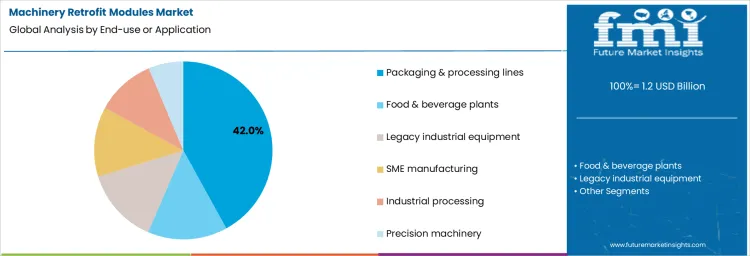
Packaging & processing lines are the leading application segment in the machinery retrofit modules market, capturing 42% of the share. This growth is driven by the increasing demand for upgraded machinery that can handle higher production volumes, meet stringent quality standards, and improve operational efficiency. Packaging & processing lines often include older equipment that needs retrofitting to remain competitive in terms of speed, precision, and flexibility. Machinery retrofits in this segment are essential for businesses that want to maintain their production capabilities while reducing downtime and improving the energy efficiency of their operations. Furthermore, the growing trend toward automation in manufacturing, driven by Industry 4.0, is spurring the need for more advanced retrofit modules that enhance the performance of packaging and processing machinery. As companies look to improve productivity and reduce operational costs, retrofitting packaging & processing lines with modern modules like servo drives and control systems is becoming increasingly common.
What is Driving the Demand for Servo Drives and Control Retrofits in the Machinery Retrofit Modules Market?
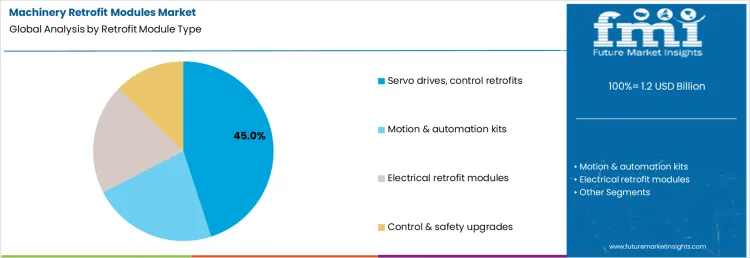
Servo drives and control retrofits are the leading retrofit module type in the machinery retrofit modules market, accounting for 45% of the share. These retrofits are highly sought after for their ability to significantly enhance the precision, speed, and energy efficiency of machinery. Servo drives allow for more accurate control of motors and mechanical systems, which is critical in applications where high precision and performance are essential, such as in packaging, processing lines, and industrial machinery. The growing emphasis on automation, combined with the need for more energy-efficient systems, is driving the demand for servo drives and control retrofits across various industries. Additionally, retrofitting older machinery with modern control systems and servo drives offers a cost-effective solution to extend the life of legacy equipment while improving its functionality, making it a popular choice among manufacturers. As industries continue to seek greater automation and operational efficiency, the demand for servo drives and control retrofits is expected to remain strong, securing its dominant position in the market.
What is the Key Dynamics of the Global Machinery Retrofit Modules Market?
The global machinery retrofit modules market is expanding as manufacturers and industrial operators seek to update existing equipment with new components that extend life, improve performance and enable digital connectivity. Retrofit modules include sensors, control systems, automation kits and energy-efficiency upgrades designed to modernize legacy machinery without full replacement. Growth reflects pressure to improve productivity, reduce unplanned downtime and support Industry 4.0 adoption. Demand spans sectors such as manufacturing, packaging, logistics, food and beverage processing, and heavy industry where cost-effective modernization strengthens competitiveness and adapts facilities to evolving operational needs.
What are the Key Drivers for the Global Machinery Retrofit Modules Market?
A key driver is the desire to enhance productivity and equipment availability without the capital expense of full machine replacement. Businesses seek retrofit solutions that improve monitoring, predictive maintenance and process automation using advanced sensors and control modules. Retrofitting enables integration with data systems, real-time analytics and digital twin platforms, supporting smarter decision making. Pressure to reduce energy use and carbon footprint motivates energy-efficiency upgrades. A shortage of skilled labor boosts interest in automation modules that simplify operation and reduce manual intervention. Expansion of industrial production and digital transformation initiatives supports retrofit investment across regions.
What are the Restraints for the Global Machinery Retrofit Modules Market?
One restraint is the complexity of integrating retrofit modules with diverse legacy systems that may lack standard interfaces or documentation. Retrofitting can require custom engineering, testing and validation to ensure compatibility, increasing project time and cost. Some operators may delay retrofit decisions due to uncertainty about return on investment or lack of in-house expertise. Concerns about maintaining warranties and support from original equipment manufacturers can influence retrofit adoption. Variability in regulatory and safety requirements across industries and regions may require additional compliance effort when modifying installed machinery.
What is the Key Trends in the Global Machinery Retrofit Modules Market?
A key trend is development of modular, plug-and-play retrofit solutions that simplify installation and reduce integration barriers with legacy equipment. Vendors are packaging sensors, IoT gateways, and control systems into standardized retrofit kits that support common machine types and protocols. Integration with cloud platforms and edge computing enhances remote monitoring and predictive maintenance capabilities. Growth of AI-enabled analytics that work with retrofit data accelerates identification of performance anomalies and optimisation opportunities. Partnerships between retrofit solution providers and original equipment manufacturers are increasing to validate compatibility and support service ecosystems. Focus on scalable, upgradeable retrofit modules that support phased modernization aligns with budget cycles and long-term digital roadmaps.
What is the Country-Wise Analysis of the Machinery Retrofit Modules Market?
The machinery retrofit modules market is expected to grow steadily, driven by the increasing demand for upgrading and improving existing machinery without the need for complete replacements. These retrofit modules enhance the performance, efficiency, and lifespan of industrial machinery, making them a cost-effective solution for businesses looking to modernize their equipment. High-growth markets like China and India are seeing strong demand due to rapid industrialization, expanding manufacturing sectors, and increasing awareness of energy efficiency. Developed markets such as the USA, Germany, and Brazil are also witnessing steady growth, driven by the need for more advanced, energy-efficient machinery and increasing focus on sustainability and cost reduction.
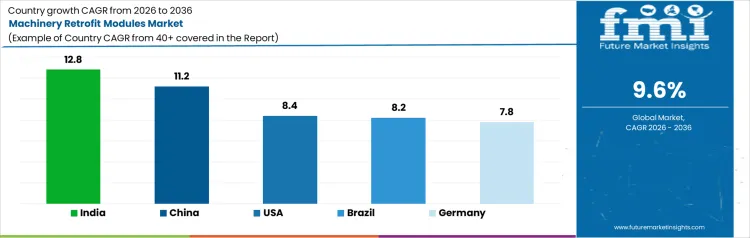
| Country | CAGR (%) |
|---|---|
| China | 11.2 |
| India | 12.8 |
| United States | 8.4 |
| Germany | 7.8 |
| Brazil | 8.2 |
What is the Growth Outlook for the Machinery Retrofit Modules Market in China?
The machinery retrofit modules market in China is expected to grow at the highest rate, with a projected CAGR of 11.2%. China’s rapid industrialization and ongoing efforts to modernize its manufacturing base are key drivers of this market growth. As the country looks to enhance energy efficiency, productivity, and sustainability, the adoption of retrofit solutions for machinery is rising. Chinese industries, particularly in sectors such as manufacturing, automotive, and heavy machinery, are increasingly opting for retrofit modules to improve performance and reduce operational costs. Additionally, China’s commitment to reducing environmental impact and increasing energy efficiency further supports the growth of the machinery retrofit modules market.
What is the Market Outlook for the Machinery Retrofit Modules Market in India?
The machinery retrofit modules market in India is projected to grow at a strong pace, with a projected CAGR of 12.8%. India’s expanding industrial sector, driven by rapid urbanization, growing manufacturing capabilities, and a focus on modernizing existing infrastructure, is fueling the demand for machinery retrofitting solutions. As Indian industries look to improve the efficiency and longevity of their equipment without investing in new machinery, retrofit modules are becoming an increasingly popular choice. The government’s initiatives to boost industrial growth and sustainability further contribute to the adoption of retrofit solutions. As India continues to prioritize energy efficiency and cost reduction, the market for machinery retrofit modules is expected to experience robust growth.
What is the Growth Forecast for the Machinery Retrofit Modules Market in the United States?
The machinery retrofit modules market in the United States is expected to grow steadily, with a projected CAGR of 8.4%. In the U.S., there is a strong demand for solutions that can enhance the performance and efficiency of existing machinery, particularly in industries such as manufacturing, automotive, and energy. U.S. businesses are increasingly looking to retrofit machinery as a cost-effective alternative to full replacements, particularly as the need to reduce downtime and improve productivity becomes more pressing. Additionally, the push for energy-efficient and sustainable manufacturing solutions is driving the adoption of machinery retrofit modules. The market is expected to continue growing steadily as companies embrace technological advancements and modernization efforts in the industrial sector.
What is the Market Outlook for the Machinery Retrofit Modules Market in Germany?
The machinery retrofit modules market in Germany is projected to grow at a steady pace, with a projected CAGR of 7.8%. Germany, known for its advanced manufacturing sector and emphasis on high efficiency and sustainability, is seeing increased demand for machinery retrofit solutions. As industries in Germany seek to modernize equipment to meet stricter energy regulations and improve operational efficiency, the adoption of retrofit modules is on the rise. Retrofit solutions are increasingly seen as a cost-effective way to enhance machinery performance without the significant investment required for new equipment. With Germany’s focus on environmental sustainability and energy efficiency, the demand for machinery retrofit modules is expected to continue growing steadily.
What are the Growth Prospects for the Machinery Retrofit Modules Market in Brazil?
The machinery retrofit modules market in Brazil is expected to grow at a moderate pace, with a projected CAGR of 8.2%. Brazil’s growing manufacturing sector, driven by industrial modernization efforts and the increasing need for energy-efficient solutions, is supporting the demand for machinery retrofit modules. As Brazilian industries focus on optimizing their machinery’s performance and extending its lifespan without incurring the high costs of new equipment, retrofit solutions are becoming more popular. The market is further supported by the country’s focus on sustainability and environmental regulations that encourage the adoption of energy-efficient technologies. With these factors at play, Brazil’s market for machinery retrofit modules is expected to continue expanding at a steady pace.
What is the Competitive Landscape for the Machinery Retrofit Modules Market?
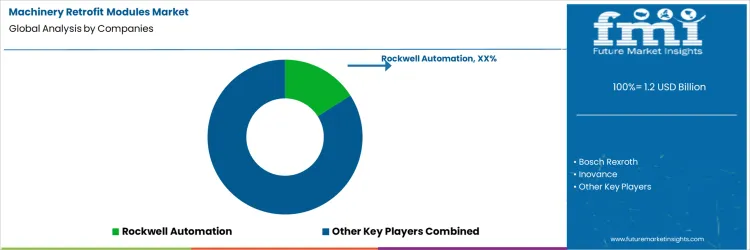
The machinery retrofit modules market is expanding as industries look to enhance the performance and efficiency of their existing machinery without the need for complete replacements. Rockwell Automation leads the market with its innovative retrofit solutions, offering advanced modules that improve machine control, automation, and performance while extending the lifecycle of existing equipment. Their focus on cutting-edge technology and system integration positions them as a dominant player. Bosch Rexroth, Inovance, and Delta India are key competitors, each providing specialized retrofit modules designed to optimize machine functionality. Bosch Rexroth offers high-performance modular systems, while Inovance and Delta India provide cost-effective, flexible solutions for machinery upgrades.
Local integrators, Omron, Siemens, SEW-Eurodrive, and Hollysys further contribute to the competitive landscape by offering a variety of retrofit modules for industrial applications. Omron focuses on providing automation solutions for machine control, while Siemens and SEW-Eurodrive offer advanced retrofit technologies that enhance machine performance and energy efficiency. Hollysys delivers system integration and retrofit solutions tailored to specific industry needs. These companies compete through product innovation, performance optimization, and their ability to provide flexible, efficient solutions that extend the life of machinery across a range of industries.
Key Players of the Machinery Retrofit Modules Market
- Rockwell Automation
- Bosch Rexroth
- Inovance
- Delta India
- Local integrators
- Omron
- Siemens
- SEW-Eurodrive
- Hollysys
Scope of the Report
| Items | Values |
|---|---|
| Quantitative Units (2026) | USD Billion |
| Application | Packaging & Processing Lines, Food & Beverage Plants, Legacy Industrial Equipment, SME Manufacturing, Industrial Processing, Precision Machinery |
| Equipment Type | Fill-Seal & Cartoning Machines, Bottling & Filling Lines, Packaging Machinery, Older Filling & Packing Lines |
| Retrofit Module Type | Servo Drives, Control Retrofits, Motion & Automation Kits, Electrical Retrofit Modules, Control & Safety Upgrades |
| Technology | PLC/Drive Upgrades, Energy Optimization, Industry 4.0 Retrofit Platforms, Cost-Optimized Automation, Modular PLC Retrofits |
| Companies | Rockwell Automation, Bosch Rexroth, Inovance, Delta India, Local Integrators, Omron, Siemens, SEW-Eurodrive, Hollysys |
| Regions Covered | North America, Latin America, Western Europe, Eastern Europe, South Asia and Pacific, East Asia, Middle East & Africa |
| Countries Covered | United States, Canada, Mexico, Brazil, Argentina, Germany, France, United Kingdom, Italy, Spain, Netherlands, China, India, Japan, South Korea, ANZ, GCC Countries, South Africa |
| Additional Attributes | Dollar by sales by application, equipment type, retrofit module type, technology, and region. Includes market trends in machinery retrofit modules, focusing on servo drives, motion automation kits, electrical retrofit modules, and PLC upgrades. Highlights the role of energy optimization, Industry 4.0 platforms, and cost-optimized automation in various industries like packaging, food & beverage, and industrial processing. Focus on performance, sustainability, regulatory compliance, and market share of key companies in the retrofit modules market. |
Machinery Retrofit Modules Market Segmentation
Application
- Packaging & processing lines
- Food & beverage plants
- Legacy industrial equipment
- SME manufacturing
- Industrial processing
- Precision machinery
Equipment Type
- Fill-seal & cartoning machines
- Bottling & filling lines
- Packaging machinery
- Older filling & packing lines
Retrofit Module Type
- Servo drives, control retrofits
- Motion & automation kits
- Electrical retrofit modules
- Control & safety upgrades
Technology
- PLC/drive upgrades, energy optimization
- Industry 4.0 retrofit platforms
- Cost-optimized automation
- Modular PLC retrofits
Region
- Asia Pacific
- China
- Japan
- South Korea
- India
- Australia & New Zealand
- ASEAN
- Rest of Asia Pacific
- Europe
- Germany
- United Kingdom
- France
- Italy
- Spain
- Nordic
- BENELUX
- Rest of Europe
- North America
- United States
- Canada
- Mexico
- Latin America
- Brazil
- Chile
- Rest of Latin America
- Middle East & Africa
- Kingdom of Saudi Arabia
- Other GCC Countries
- Turkey
- South Africa
- Other African Union
- Rest of Middle East & Africa
Frequently Asked Questions
How big is the machinery retrofit modules market in 2026?
The global machinery retrofit modules market is estimated to be valued at USD 1.2 billion in 2026.
What will be the size of machinery retrofit modules market in 2036?
The market size for the machinery retrofit modules market is projected to reach USD 3.0 billion by 2036.
How much will be the machinery retrofit modules market growth between 2026 and 2036?
The machinery retrofit modules market is expected to grow at a 9.6% CAGR between 2026 and 2036.
What are the key product types in the machinery retrofit modules market?
The key product types in machinery retrofit modules market are packaging & processing lines, food & beverage plants, legacy industrial equipment, sme manufacturing, industrial processing and precision machinery.
Which retrofit module type segment to contribute significant share in the machinery retrofit modules market in 2026?
In terms of retrofit module type, servo drives, control retrofits segment to command 45.0% share in the machinery retrofit modules market in 2026.
Preview the report firsthand - request a free sample
Get SampleGet the brochure for pricing and purchase details.
Get PDFTable of Content
- Executive Summary
- Global Market Outlook
- Demand-side Trends
- Supply-side Trends
- Technology Roadmap Analysis
- Analysis and Recommendations
- Market Overview
- Market Coverage / Taxonomy
- Market Definition / Scope / Limitations
- Market Background
- Market Dynamics
- Drivers
- Restraints
- Opportunity
- Trends
- Scenario Forecast
- Demand in Optimistic Scenario
- Demand in Likely Scenario
- Demand in Conservative Scenario
- Opportunity Map Analysis
- Product Life Cycle Analysis
- Supply Chain Analysis
- Investment Feasibility Matrix
- Value Chain Analysis
- PESTLE and Porter’s Analysis
- Regulatory Landscape
- Regional Parent Market Outlook
- Production and Consumption Statistics
- Import and Export Statistics
- Market Dynamics
- Global Market Analysis 2021 to 2025 and Forecast, 2026 to 2036
- Historical Market Size Value (USD Million) Analysis, 2021 to 2025
- Current and Future Market Size Value (USD Million) Projections, 2026 to 2036
- Y-o-Y Growth Trend Analysis
- Absolute $ Opportunity Analysis
- Global Market Pricing Analysis 2021 to 2025 and Forecast 2026 to 2036
- Global Market Analysis 2021 to 2025 and Forecast 2026 to 2036, By End-use or Application
- Introduction / Key Findings
- Historical Market Size Value (USD Million) Analysis By End-use or Application , 2021 to 2025
- Current and Future Market Size Value (USD Million) Analysis and Forecast By End-use or Application , 2026 to 2036
- Packaging & processing lines
- Food & beverage plants
- Legacy industrial equipment
- SME manufacturing
- Industrial processing
- Precision machinery
- Y-o-Y Growth Trend Analysis By End-use or Application , 2021 to 2025
- Absolute $ Opportunity Analysis By End-use or Application , 2026 to 2036
- Global Market Analysis 2021 to 2025 and Forecast 2026 to 2036, By Retrofit Module Type
- Introduction / Key Findings
- Historical Market Size Value (USD Million) Analysis By Retrofit Module Type, 2021 to 2025
- Current and Future Market Size Value (USD Million) Analysis and Forecast By Retrofit Module Type, 2026 to 2036
- Servo drives, control retrofits
- Motion & automation kits
- Electrical retrofit modules
- Control & safety upgrades
- Y-o-Y Growth Trend Analysis By Retrofit Module Type, 2021 to 2025
- Absolute $ Opportunity Analysis By Retrofit Module Type, 2026 to 2036
- Global Market Analysis 2021 to 2025 and Forecast 2026 to 2036, By Equipment Type
- Introduction / Key Findings
- Historical Market Size Value (USD Million) Analysis By Equipment Type, 2021 to 2025
- Current and Future Market Size Value (USD Million) Analysis and Forecast By Equipment Type, 2026 to 2036
- Fill-seal & cartoning machines
- Bottling & filling lines
- Packaging machinery
- Older filling & packing lines
- Y-o-Y Growth Trend Analysis By Equipment Type, 2021 to 2025
- Absolute $ Opportunity Analysis By Equipment Type, 2026 to 2036
- Global Market Analysis 2021 to 2025 and Forecast 2026 to 2036, By Technology
- Introduction / Key Findings
- Historical Market Size Value (USD Million) Analysis By Technology, 2021 to 2025
- Current and Future Market Size Value (USD Million) Analysis and Forecast By Technology, 2026 to 2036
- PLC/drive upgrades, energy optimisation
- Industry 4.0 retrofit platforms
- Cost-optimised automation
- Modular PLC retrofits
- Y-o-Y Growth Trend Analysis By Technology, 2021 to 2025
- Absolute $ Opportunity Analysis By Technology, 2026 to 2036
- Global Market Analysis 2021 to 2025 and Forecast 2026 to 2036, By Region
- Introduction
- Historical Market Size Value (USD Million) Analysis By Region, 2021 to 2025
- Current Market Size Value (USD Million) Analysis and Forecast By Region, 2026 to 2036
- North America
- Latin America
- Western Europe
- Eastern Europe
- East Asia
- South Asia and Pacific
- Middle East & Africa
- Market Attractiveness Analysis By Region
- North America Market Analysis 2021 to 2025 and Forecast 2026 to 2036, By Country
- Historical Market Size Value (USD Million) Trend Analysis By Market Taxonomy, 2021 to 2025
- Market Size Value (USD Million) Forecast By Market Taxonomy, 2026 to 2036
- By Country
- USA
- Canada
- Mexico
- By End-use or Application
- By Retrofit Module Type
- By Equipment Type
- By Technology
- By Country
- Market Attractiveness Analysis
- By Country
- By End-use or Application
- By Retrofit Module Type
- By Equipment Type
- By Technology
- Key Takeaways
- Latin America Market Analysis 2021 to 2025 and Forecast 2026 to 2036, By Country
- Historical Market Size Value (USD Million) Trend Analysis By Market Taxonomy, 2021 to 2025
- Market Size Value (USD Million) Forecast By Market Taxonomy, 2026 to 2036
- By Country
- Brazil
- Chile
- Rest of Latin America
- By End-use or Application
- By Retrofit Module Type
- By Equipment Type
- By Technology
- By Country
- Market Attractiveness Analysis
- By Country
- By End-use or Application
- By Retrofit Module Type
- By Equipment Type
- By Technology
- Key Takeaways
- Western Europe Market Analysis 2021 to 2025 and Forecast 2026 to 2036, By Country
- Historical Market Size Value (USD Million) Trend Analysis By Market Taxonomy, 2021 to 2025
- Market Size Value (USD Million) Forecast By Market Taxonomy, 2026 to 2036
- By Country
- Germany
- UK
- Italy
- Spain
- France
- Nordic
- BENELUX
- Rest of Western Europe
- By End-use or Application
- By Retrofit Module Type
- By Equipment Type
- By Technology
- By Country
- Market Attractiveness Analysis
- By Country
- By End-use or Application
- By Retrofit Module Type
- By Equipment Type
- By Technology
- Key Takeaways
- Eastern Europe Market Analysis 2021 to 2025 and Forecast 2026 to 2036, By Country
- Historical Market Size Value (USD Million) Trend Analysis By Market Taxonomy, 2021 to 2025
- Market Size Value (USD Million) Forecast By Market Taxonomy, 2026 to 2036
- By Country
- Russia
- Poland
- Hungary
- Balkan & Baltic
- Rest of Eastern Europe
- By End-use or Application
- By Retrofit Module Type
- By Equipment Type
- By Technology
- By Country
- Market Attractiveness Analysis
- By Country
- By End-use or Application
- By Retrofit Module Type
- By Equipment Type
- By Technology
- Key Takeaways
- East Asia Market Analysis 2021 to 2025 and Forecast 2026 to 2036, By Country
- Historical Market Size Value (USD Million) Trend Analysis By Market Taxonomy, 2021 to 2025
- Market Size Value (USD Million) Forecast By Market Taxonomy, 2026 to 2036
- By Country
- China
- Japan
- South Korea
- By End-use or Application
- By Retrofit Module Type
- By Equipment Type
- By Technology
- By Country
- Market Attractiveness Analysis
- By Country
- By End-use or Application
- By Retrofit Module Type
- By Equipment Type
- By Technology
- Key Takeaways
- South Asia and Pacific Market Analysis 2021 to 2025 and Forecast 2026 to 2036, By Country
- Historical Market Size Value (USD Million) Trend Analysis By Market Taxonomy, 2021 to 2025
- Market Size Value (USD Million) Forecast By Market Taxonomy, 2026 to 2036
- By Country
- India
- ASEAN
- Australia & New Zealand
- Rest of South Asia and Pacific
- By End-use or Application
- By Retrofit Module Type
- By Equipment Type
- By Technology
- By Country
- Market Attractiveness Analysis
- By Country
- By End-use or Application
- By Retrofit Module Type
- By Equipment Type
- By Technology
- Key Takeaways
- Middle East & Africa Market Analysis 2021 to 2025 and Forecast 2026 to 2036, By Country
- Historical Market Size Value (USD Million) Trend Analysis By Market Taxonomy, 2021 to 2025
- Market Size Value (USD Million) Forecast By Market Taxonomy, 2026 to 2036
- By Country
- Kingdom of Saudi Arabia
- Other GCC Countries
- Turkiye
- South Africa
- Other African Union
- Rest of Middle East & Africa
- By End-use or Application
- By Retrofit Module Type
- By Equipment Type
- By Technology
- By Country
- Market Attractiveness Analysis
- By Country
- By End-use or Application
- By Retrofit Module Type
- By Equipment Type
- By Technology
- Key Takeaways
- Key Countries Market Analysis
- USA
- Pricing Analysis
- Market Share Analysis, 2025
- By End-use or Application
- By Retrofit Module Type
- By Equipment Type
- By Technology
- Canada
- Pricing Analysis
- Market Share Analysis, 2025
- By End-use or Application
- By Retrofit Module Type
- By Equipment Type
- By Technology
- Mexico
- Pricing Analysis
- Market Share Analysis, 2025
- By End-use or Application
- By Retrofit Module Type
- By Equipment Type
- By Technology
- Brazil
- Pricing Analysis
- Market Share Analysis, 2025
- By End-use or Application
- By Retrofit Module Type
- By Equipment Type
- By Technology
- Chile
- Pricing Analysis
- Market Share Analysis, 2025
- By End-use or Application
- By Retrofit Module Type
- By Equipment Type
- By Technology
- Germany
- Pricing Analysis
- Market Share Analysis, 2025
- By End-use or Application
- By Retrofit Module Type
- By Equipment Type
- By Technology
- UK
- Pricing Analysis
- Market Share Analysis, 2025
- By End-use or Application
- By Retrofit Module Type
- By Equipment Type
- By Technology
- Italy
- Pricing Analysis
- Market Share Analysis, 2025
- By End-use or Application
- By Retrofit Module Type
- By Equipment Type
- By Technology
- Spain
- Pricing Analysis
- Market Share Analysis, 2025
- By End-use or Application
- By Retrofit Module Type
- By Equipment Type
- By Technology
- France
- Pricing Analysis
- Market Share Analysis, 2025
- By End-use or Application
- By Retrofit Module Type
- By Equipment Type
- By Technology
- India
- Pricing Analysis
- Market Share Analysis, 2025
- By End-use or Application
- By Retrofit Module Type
- By Equipment Type
- By Technology
- ASEAN
- Pricing Analysis
- Market Share Analysis, 2025
- By End-use or Application
- By Retrofit Module Type
- By Equipment Type
- By Technology
- Australia & New Zealand
- Pricing Analysis
- Market Share Analysis, 2025
- By End-use or Application
- By Retrofit Module Type
- By Equipment Type
- By Technology
- China
- Pricing Analysis
- Market Share Analysis, 2025
- By End-use or Application
- By Retrofit Module Type
- By Equipment Type
- By Technology
- Japan
- Pricing Analysis
- Market Share Analysis, 2025
- By End-use or Application
- By Retrofit Module Type
- By Equipment Type
- By Technology
- South Korea
- Pricing Analysis
- Market Share Analysis, 2025
- By End-use or Application
- By Retrofit Module Type
- By Equipment Type
- By Technology
- Russia
- Pricing Analysis
- Market Share Analysis, 2025
- By End-use or Application
- By Retrofit Module Type
- By Equipment Type
- By Technology
- Poland
- Pricing Analysis
- Market Share Analysis, 2025
- By End-use or Application
- By Retrofit Module Type
- By Equipment Type
- By Technology
- Hungary
- Pricing Analysis
- Market Share Analysis, 2025
- By End-use or Application
- By Retrofit Module Type
- By Equipment Type
- By Technology
- Kingdom of Saudi Arabia
- Pricing Analysis
- Market Share Analysis, 2025
- By End-use or Application
- By Retrofit Module Type
- By Equipment Type
- By Technology
- Turkiye
- Pricing Analysis
- Market Share Analysis, 2025
- By End-use or Application
- By Retrofit Module Type
- By Equipment Type
- By Technology
- South Africa
- Pricing Analysis
- Market Share Analysis, 2025
- By End-use or Application
- By Retrofit Module Type
- By Equipment Type
- By Technology
- USA
- Market Structure Analysis
- Competition Dashboard
- Competition Benchmarking
- Market Share Analysis of Top Players
- By Regional
- By End-use or Application
- By Retrofit Module Type
- By Equipment Type
- By Technology
- Competition Analysis
- Competition Deep Dive
- Rockwell Automation
- Overview
- Product Portfolio
- Profitability by Market Segments (Product/Age /Sales Channel/Region)
- Sales Footprint
- Strategy Overview
- Marketing Strategy
- Product Strategy
- Channel Strategy
- Bosch Rexroth
- Inovance
- Delta India
- Local integrators
- Omron
- Siemens
- SEW-Eurodrive
- Hollysys
- Rockwell Automation
- Competition Deep Dive
- Assumptions & Acronyms Used
- Research Methodology


