

- Market Size (2026)
- USD 1.2 Bn
- Forecast (2036)
- USD 2.1 Bn
- CAGR (2026 to 2036)
- 5.2%
How big is Grinding Cylpebs Market in 2026?
USD 1.2 billion in 2026 and USD 2.1 billion by 2036 at a 5.2% CAGR.
Demand for grinding cylpebs is projected to expand at 5.2% CAGR, rising from USD 1.2 billion in 2026 to USD 2.1 billion by 2036. Cement finish mills consume metallic media as clinker and blended-cement grinding removes charge mass during production. The American Cement Association reported in June 2026 that USA plants consumed about 65 million metric tons of blended cement during 2025. High blended-cement throughput ties media replenishment to wear performance and delivered cost across approved mill charges.
South Africa's 5.0% modelled CAGR exceeds the USA's 4.3% pace as hard-rock mining projects that deploy surface mining equipment feed more concentrator expansion than mature USA sites. The USA Geological Survey reported in April 2026 that 2025 portland and blended cement shipments fell 1.7% to about 101 million metric tons and clinker production fell 4.4% to 69.5 million tons. Mature USA sites therefore demand stronger wear evidence for recurring-volume transfers across existing mineral processing equipment and approved mill circuits.
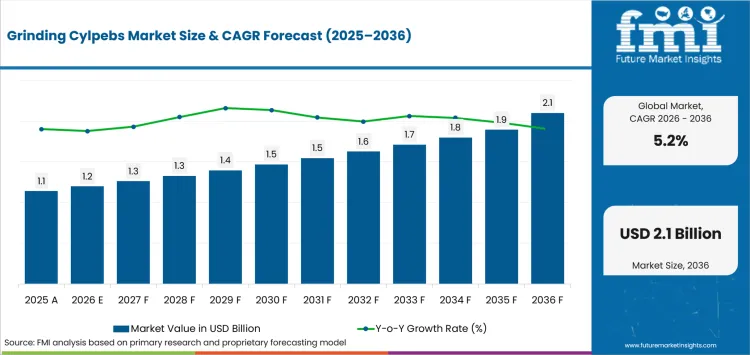
Key Takeaways of Grinding Cylpebs Market
- Recurring wear ties grinding cylpebs orders to mill throughput and grinding cost across cement and mineral circuits.
- By material, high chrome cast iron is estimated to hold 42.0% in 2026 owing to abrasion resistance.
- The <20 mm segment is likely to capture 18.0% share in 2026 attributable to frequent contacts during fine grinding.
- By application, cement grinding is forecast to represent 46.0% in 2026 driven by continuous finish-mill wear.
- Mill qualification slows switching because unsuitable media can increase breakage and disturb product-size control during production.
- Magotteaux, Molycop, Ningguo Dongfang, Anhui Ningguo Ninghu Steel Ball, Suhani Metacast, Shandong Jinchi Heavy Industry, Anhui Fengxing New Material Technology and Shandong Allstar Grinding Ball.
Analyst Perspective
"Plant teams should judge grinding cylpebs by measured wear performance without sacrificing throughput or product-size control. Commercial value depends on alloy consistency, replenishment distance and documented grinding cost between charge additions."
- Nikhil Kaitwade, Principal Consultant, Future Market Insights
How is the Grinding Cylpebs Market segmented?
The grinding cylpebs market is segmented by material, size, application, mill type, sales channel and region.
Material covers high chrome cast iron, low chrome cast iron, forged steel and alloy steel. Size includes <20 mm, 20-40 mm, 40-60 mm and >60 mm. Applications are cement grinding, raw material grinding, mining ore grinding and thermal power / other. Mill types are ball mills, tube mills and compartment mills. Sales channels are direct mill supply, grinding media distributors and plant MRO contracts. Within the sales channel category, direct mill supply is estimated to account for 48.0% in 2026 because bulk media orders often require direct qualification and delivery coordination.
Why does cement grinding lead demand within the application category?
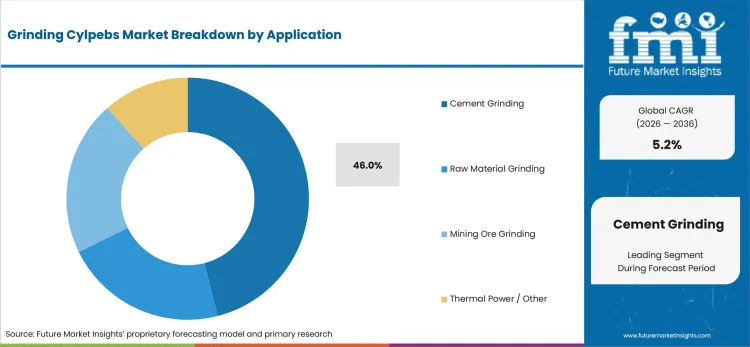
Cement finish mills replenish metallic media as abrasive grinding removes charge mass during production. Operators review cement grinding aids and charge grading as clinker blends or fineness targets change.
- By application, cement grinding is forecast to represent 46.0% in 2026 driven by continuous charge wear inside high-volume finish mills.
- China retains a cement-grinding workload despite lower output as finish mills process high volumes. The National Bureau of Statistics reported in July 2026 that cement output reached 735.85 million tons and fell 8.0% year over year. Plants handling blended cement formulations replenish approved media as finish mills operate against production and fineness targets.
Why does high chrome cast iron lead demand within the material category?
High chrome cast iron suits abrasive circuits that value wear resistance more than extreme impact toughness. Plant metallurgists compare specific consumption against carbon steel grades during an approved site charge review.
- Based on material, high chrome cast iron is projected to account for 42.0% in 2026 due to lower wear exposure in suitably matched abrasive circuits.
- Plant metallurgists need circuit evidence because high-chrome media does not suit every impact condition or ore chemistry. Molycop reported in February 2025 that its Cikande plant produces cast high-chrome balls and cylpebs, giving regional mills a local source with selectable sizes and compositions for approved grinding duties.
Why does the 20-40 mm size lead demand within the size category?
The 20-40 mm range balances impact energy and contact frequency across common grinding duties. Plant teams select this size range when feed conditions and mill speed require stable breakage without using a predominantly coarse media charge.
- By size, 20-40 mm cylpebs are estimated to hold 41.0% in 2026 because they suit widely used cement and mineral grinding applications.
- Operators validate media size against feed size, throughput and product fineness before a full charge conversion. Site testing helps confirm that the selected range provides acceptable wear and grinding performance.
Why do ball mills lead demand within the mill type category?
Ball mills accept freely moving charges and allow cylpebs trials without replacing the core mill platform. Molycop opened a mineral-processing optimization and research center in Banten during January 2026 with metallurgy testing and particle-size characterization for regional customers. Existing ball-mill fleets give that laboratory work a direct route into plant-level charge qualification programs at customer sites.
- Ball mills are set to lead the mill type category with 54.0% share in 2026 due to established tumbling-mill practices that accept charge adjustments.
- Plant engineers test a new media shape against throughput and product-size control since ball-mill compatibility does not guarantee acceptable wear economics at every site.
What are the drivers, restraints and opportunities in the Grinding Cylpebs Market?
Continuous media wear sustains replacement demand, qualification slows switching and regional supply improves conversion from trials into recurring orders.
- Driver: Operating cement and mineral mills replace cylpebs repeatedly as abrasion removes media mass during sustained throughput.
- Restraint: Mill teams delay switching until a new charge proves wear behavior and process stability against the approved media.
- Opportunity: Regional foundries can shorten replenishment routes once site trials confirm lower delivered grinding cost under normal operating conditions.
Recurring Media Wear Links Orders to Mill Throughput
Grinding-media replacement follows processed tonnage as abrasion steadily removes charge mass during an operating campaign. China’s National Bureau of Statistics reported in February 2026 that mining value added increased 5.6% during 2025. Active ore processing sustains media consumption alongside beneficiation reagents across concentrators and rewards manufacturers that lower consumption without sacrificing throughput or product-size control during sustained mill production.
Qualification Protects Approved Charges in Operating Mills
Media metallurgy can change wear rate and product-size stability inside an operating mill during qualification trials. A new cylpebs grade therefore needs measured consumption evidence plus a controlled conversion plan for recurring volume to transfer from an approved charge. Molycop described marked-ball wear tests and industrial trials in March 2025 as site methods for comparing optimized alloys against that qualification requirement.
Regional Supply Shortens the Replenishment Route
Regional manufacturing reduces emergency freight exposure for qualified mill accounts once plant teams approve the media grade and set a normal replenishment cycle around predictable charge consumption during operating campaigns. Magotteaux announced in January 2025 that its Brazilian plant would add 40,000 tons of annual high-chromium grinding-media capacity and shorten the supply route for qualified cement and mineral accounts.
Which country CAGRs are profiled in the Grinding Cylpebs Market?
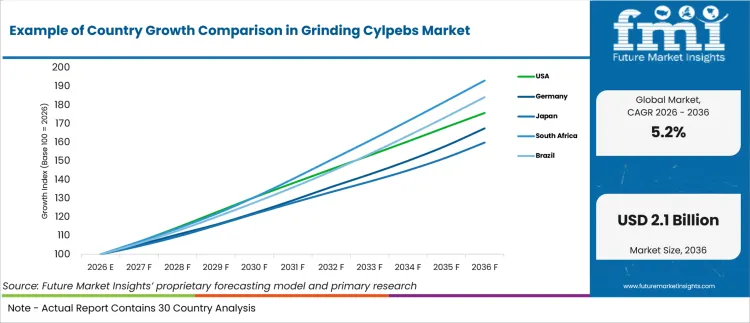
| Country | CAGR |
|---|---|
| South Africa | 5.0% |
| Brazil | 4.8% |
| USA | 4.3% |
| Germany | 3.9% |
| Japan | 3.6% |
How do country-level CAGRs compare in the Grinding Cylpebs Market?
A 1.4-percentage-point spread separates a mining-led upper pair from three mature replacement markets, with South Africa and Brazil carrying stronger mine-site logistics requirements. The USA marks a transition as its installed base raises the qualification hurdle while Germany and Japan depend more heavily on established cement and industrial mill networks for replacement volume.
- South African mine sites need local service across long underground mining equipment corridors.
- Brazil rewards nearby inventory across long inland mining routes.
- USA plants require wear evidence across mature aggregate processing equipment circuits.
- German mills align media changes with scheduled maintenance reviews.
- Japanese cement groups qualify metallurgy across a concentrated national plant network.
The spacing reflects different service and qualification burdens and does not represent a ranking of current market size.
The full report provides country-level CAGR analysis across North America, Latin America, Europe, East Asia, South Asia, Oceania and the Middle East and Africa.
Country-wise Analysis
- South African concentrators operate across hard-rock mining districts with variable ore and long mine-to-service distances that raise emergency replenishment costs, giving locally held grinding media a practical advantage during planned charge additions. Statistics South Africa reported in June 2026 that April mining production increased 8.2% year over year and chromium ore output rose 17.5%, keeping abrasive milling circuits active and raising the value of dependable mine-site service. Grinding cylpebs demand in South Africa is forecast to rise at 5.0% CAGR over the forecast period owing to recurring media consumption, but new grades need ore-specific wear records for mine metallurgists to approve recurring volume transfers.
- Brazilian mines and cement plants span long inland routes from southeastern foundries to remote operating districts, making heavy-media freight expensive and giving regional inventory a commercial advantage for scheduled and emergency replenishment. The Brazilian grinding cylpebs sector is projected to record 4.8% CAGR during the assessment period aided by regional foundry access, although distant sites require consistent batches and delivery plans aligned with mill consumption. Brazil’s National Mining Agency reported in January 2026 that royalty-paying mining titleholders increased 1.4% during 2025, expanding the number of active mining accounts while leaving site qualification and long-haul service as practical barriers for local manufacturers.
- USA cement and mineral mills already operate approved charges with reliable domestic replenishment, so plant teams demand documented wear savings and controlled site trials for recurring media transfers. The American Cement Association said in May 2025 that USA cement consumption was expected to decline 1.6% during 2025, raising the hurdle for discretionary media conversions as plants protect operating cost during softer volume conditions. Grinding cylpebs sales in the USA are forecast to expand at 4.3% CAGR by 2036 supported by recurring replacement, but manufacturers need responsive trial service and measured consumption gains to displace incumbent media without unsettling throughput or product fineness.
- German mills schedule consumable changes around planned maintenance windows, with energy cost and process stability carrying high weight in a mature industrial base served by established cement and mineral clusters with dependable regional logistics. Germany is estimated to post 3.9% CAGR over the forecast period supported mainly by replacement demand, although a new cylpebs grade must lower specific consumption without extending maintenance work or disturbing established mill settings. Destatis reported that German industrial production fell 1.9% month-on-month in December 2025, with construction output itself rising over the same month and making documented wear economics more persuasive than capacity expansion for manufacturers seeking recurring plant accounts.
- Japanese cement groups qualify grinding media across a concentrated plant network with planned shutdowns and long service records, making consistent metallurgy and dependable domestic technical response central to replacement decisions at established finish mills. The Japan Cement Association reported 26 plants owned by 15 companies with about 47 million tons of clinker capacity as of July 2025, anchoring recurring media demand in a mature installed base with limited greenfield additions. Adoption of grinding cylpebs in Japan is estimated to expand at 3.6% CAGR through 2036 supported by recurring replacement, but mature utilization limits conversion for manufacturers without wear records from comparable mill duties.
Who are the notable companies in the Grinding Cylpebs Market?
Magotteaux, Molycop, Ningguo Dongfang, Anhui Ningguo Ninghu Steel Ball, Suhani Metacast, Shandong Jinchi Heavy Industry, Anhui Fengxing New Material Technology and Shandong Allstar Grinding Ball are the notable companies profiled in this market.
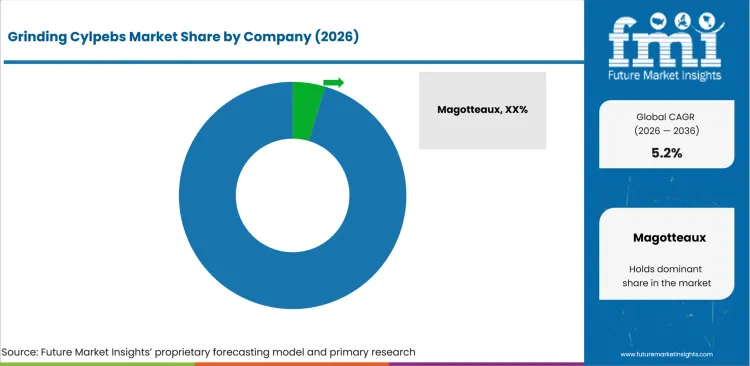
Competition is fragmented between global grinding-media groups and specialist foundries serving cement and mineral mills. Global groups emphasize testing depth and multi-region supply, whereas specialist foundries emphasize cast-media range and shorter regional routes for qualified plant accounts.
- Magotteaux and Molycop combine broad media portfolios with international technical service around large milling accounts.
- Ningguo Dongfang, Ninghu, Suhani Metacast, Jinchi, Fengxing and Allstar serve mineral and masonry cement producers from specialist foundry bases.
Competitive Benchmarking: Grinding Cylpebs Market
| Company | Grinding-Media Route Breadth | Mill-Test Support | Regional Supply Depth | Geographic Reach |
|---|---|---|---|---|
| Magotteaux | High | High | High | Global |
| Molycop | High | High | High | Global |
| Ningguo Dongfang | Medium | Medium | Medium | China and export markets |
| Anhui Ningguo Ninghu Steel Ball | Medium | Medium | Medium | China and international sales |
| Suhani Metacast | Medium | Medium | Medium | India and regional export markets |
| Shandong Jinchi Heavy Industry | High | Medium | Medium | China and international sales |
| Anhui Fengxing New Material Technology | Medium | Medium | Medium | China and export markets |
| Shandong Allstar Grinding Ball | High | Medium | Medium | 30+ countries across five continents |
Key Developments in the Grinding Cylpebs Market
- In June 2026, Tega Industries completed its Molycop acquisition and added the grinding-media manufacturer to its mining-consumables portfolio.
- In March 2026, Ningguo Dongfang announced national green-factory recognition for its wear-resistant casting operation that manufactures cast sections.
- In September 2025, Molycop deployed a scanning electron microscope at its Chile Wear Research Lab to accelerate grinding-media wear analysis for operating mines.
Key Players in the Grinding Cylpebs Market
Global Grinding-Media and Technical-Service Groups
- Magotteaux
- Molycop
China-Based Cast Cylpebs and Wear-Material Producers
- Ningguo Dongfang
- Anhui Ningguo Ninghu Steel Ball
- Shandong Jinchi Heavy Industry
- Anhui Fengxing New Material Technology
- Shandong Allstar Grinding Ball
India-Based Grinding-Media Specialist
- Suhani Metacast
Grinding Cylpebs Market - Report Scope
| Coverage field | Report scope |
|---|---|
| Market breakdown | By material, size, application, mill type, sales channel and region. |
| Quantitative Units | Revenue in USD million and CAGR in %. |
| Market Definition | Metallic cylindrical or cylpeb-shaped grinding media sold as consumable charge material for tumbling mills across cement, mineral-processing, power and related grinding operations. |
| Regions Covered | North America, Latin America, Europe, East Asia, South Asia and Pacific and Middle East and Africa. |
| Countries Covered | South Africa, Brazil, United States, Germany, Japan, and 20+ countries included in the full report. |
| Key Companies Profiled | Magotteaux, Molycop, Ningguo Dongfang, Anhui Ningguo Ninghu Steel Ball, Suhani Metacast, Shandong Jinchi Heavy Industry, Anhui Fengxing New Material Technology, Shandong Allstar Grinding Ball. |
| Forecast Period | 2026 to 2036. |
| Approach | Primary and secondary research with market triangulation. |
Grinding Cylpebs Market - Research Methodology
| Method | Approach |
|---|---|
| Primary Research | FMI analysts gathered input from manufacturers, service providers, technology developers, distributors, end users, procurement teams, and subject-matter experts. Interviews examined purchasing decisions, product or service evaluation, adoption barriers, approval requirements, pricing considerations, and expectations for technical or commercial support. Respondents were also asked what evidence is required before a trial, pilot, or initial order develops into regular purchasing. |
| Desk Research | Desk research covered government statistics, regulatory publications, trade data, industry associations, technical literature, standards, company filings, product information, and official corporate announcements. Sources were reviewed for relevance, publication date, geographic coverage, and consistency with the defined market scope. Claims relating to performance, applications, approvals, capacity, investment, and commercial activity were retained only when supported by credible public evidence. |
| Market Sizing and Forecasting | The market model combined the baseline value with historical performance, segment structure, pricing and volume indicators, adoption levels, company participation, and country-level demand conditions. Forecast assumptions considered economic activity, investment trends, regulatory developments, technology adoption, purchasing cycles, supply availability, and barriers to wider market use. Segment and regional estimates were reconciled before the final market total was calculated. |
| Data Validation | Estimates were checked against multiple independent indicators, including public data, company activity, trade patterns, industry developments, and findings from primary interviews. Validation also tested whether products, services, applications, and company revenues fell within the defined market boundaries. Adjacent categories, unsupported claims, overlapping revenues, and activities without direct market relevance were excluded to reduce double counting and maintain consistency across segments and countries. |
Grinding Cylpebs Market by Segments
Grinding Cylpebs Market segmented by Material:
- High Chrome Cast Iron
- Low Chrome Cast Iron
- Forged Steel
- Alloy Steel
Grinding Cylpebs Market segmented by Size:
- <20 mm
- 20-40 mm
- 40-60 mm
- >60 mm
Grinding Cylpebs Market segmented by Application:
- Cement Grinding
- Raw Material Grinding
- Mining Ore Grinding
- Thermal Power / Other
Grinding Cylpebs Market segmented by Mill Type:
- Ball Mills
- Tube Mills
- Compartment Mills
Grinding Cylpebs Market segmented by Sales Channel:
- Direct Mill Supply
- Grinding Media Distributors
- Plant MRO Contracts
Grinding Cylpebs Market by Region:
- North America
- United States
- Canada
- Latin America
- Brazil
- Mexico
- Chile
- Rest of Latin America
- Western Europe
- Germany
- United Kingdom
- Italy
- Spain
- France
- Nordics
- Benelux
- Rest of Western Europe
- Eastern Europe
- Russia
- Poland
- Hungary
- Balkan and Baltic States
- Rest of Eastern Europe
- East Asia
- China
- Japan
- South Korea
- South Asia and Pacific
- India
- ASEAN
- Australia and New Zealand
- Rest of South Asia and Pacific
- Middle East and Africa
- Kingdom of Saudi Arabia
- Other GCC Countries
- Türkiye
- South Africa
- Other African Union Countries
- Rest of Middle East and Africa
Research Sources and Bibliography
- American Cement Association. (2026, June 18). ACA Launches First-Ever Blended Cement Awards.
- USA Geological Survey. (2026, April). Cement in December 2025.
- Molycop. (2025, February 13). Game-changer: Molycop expands production capabilities in Indonesia.
- Molycop. (2026, May 27). Strengthening Molycop’s global BMAT capability in Chile and Indonesia.
- National Bureau of Statistics of China. (2026, July 16). Industrial Production Operation in June 2026.
- Molycop. (2026, January 7). Strengthening Regional Capability: Molycop in Banten, Indonesia.
- National Bureau of Statistics of China. (2026, February 28). STATISTICAL COMMUNIQUÉ OF THE PEOPLE'S REPUBLIC OF CHINA ON THE 2025 NATIONAL ECONOMIC AND SOCIAL DEVELOPMENT.
- Molycop. (2025, March 24). 5 ways Molycop is streamlining the grinding media supply chain.
- Magotteaux. (2025, January 23). Expanding horizons: our production plant in Brazil is growing!
- Statistics South Africa. (2026, June 11). Key findings: P2041 - Mining: Production and sales, April 2026.
- Agência Nacional de Mineração. (2026, January 20). Quase R$ 8 bilhões arrecadados com royalties da mineração em 2025.
- American Cement Association. (2025, May 19). USA Cement Consumption Expected to Dip; Recession Not a Foregone Conclusion in Cement Industry Association’s Spring Economic Forecast.
- Federal Statistical Office of Germany. (2026, February 6). Production in December 2025: -1.9% on the previous month.
- Japan Cement Association. (n.d.). Retrieved August 12, 2026, from Statistics
- Magotteaux. (n.d.). Retrieved August 12, 2026, from Solutions & efficiency for abrasive and impact applications
- Molycop. (n.d.). Retrieved August 12, 2026, from Molycop - Progress Together | Molycop
- Ningguo Dongfang Grinding Materials Co., Ltd. (n.d.). Retrieved August 12, 2026, from 宁国东方碾磨材料股份有限公司
- Anhui Ningguo Ninghu Steel Ball Co., Ltd. (n.d.). Retrieved August 12, 2026, from Company profile-ABOUT US-Anhui Ningguo Ninghu Steel Ball Co., Ltd
- Suhani Metacast Pvt. Ltd. (n.d.). Retrieved August 12, 2026, from About Us - suhanimetacast.com
- Shandong Jinchi Heavy Industry Joint-Stock Co., Ltd. (n.d.). Retrieved August 12, 2026, from Grinding Media Supplier | Forged steel ball, Grinding steel rods& ball- JinCHi Heavy Industry
- Anhui Fengxing New Material Technology Co., Ltd. (n.d.). Retrieved August 12, 2026, from Company Profile
- Shandong Allstar Grinding Ball Co., Ltd. (n.d.). Retrieved August 12, 2026, from ALLSTAR - Grinding Ball, Grinding Media Manufacturer
- Molycop. (2026, June 2). Tega Industries Ltd. strengthens global offer with Molycop acquisition.
- Ningguo Dongfang Grinding Materials Co., Ltd. (2026, March 26). 喜报!国家级绿色工厂,东方碾磨榜上有名!
- Molycop. (2025, September 1). Investing in the future: Molycop expands its lab capabilities in Chile.
This bibliography is provided for reader reference and is not exhaustive. The full report contains the complete reference list and detailed citations.
This Report Answers
- How large is the grinding cylpebs market in 2026 and what value is forecast for 2036?
- Which operating conditions sustain recurring grinding cylpebs replacement demand across cement and mineral mills?
- Why does high chrome cast iron hold the leading material share in 2026?
- How does the <20 mm size change contact behavior during fine-stage grinding?
- Why does cement grinding account for the leading application share in 2026?
- How do entry conditions differ across South Africa, Brazil, the USA, Germany and Japan?
- Which capabilities separate the eight profiled grinding-media manufacturers in competitive benchmarking?
- What qualification and logistics frictions delay switching between media manufacturers in recurring mill accounts?
Frequently Asked Questions
How big is the Grinding Cylpebs Market in 2026?
The Grinding Cylpebs Market is valued at USD 1.2 billion in 2026 and is projected to reach USD 2.1 billion by 2036. Cement and mineral mills require recurring media replacement as operating charges wear.
What is the CAGR of the Grinding Cylpebs Market from 2026 to 2036?
The Grinding Cylpebs Market is projected to grow at a CAGR of 5.2% between 2026 and 2036. Recurring charge replacement and grinding-cost optimization support market expansion.
Which material leads the Grinding Cylpebs Market?
High chrome cast iron is projected to account for 42.0% of the Grinding Cylpebs Market in 2026. Its wear resistance supports use in suitably matched abrasive grinding circuits.
Which application leads the Grinding Cylpebs Market?
Cement grinding is projected to account for 46.0% of the Grinding Cylpebs Market in 2026. Finish mills replenish media continuously to maintain throughput and required cement fineness.
Which companies are active in the Grinding Cylpebs Market?
Key companies include Magotteaux, Molycop, Ningguo Dongfang, Anhui Ningguo Ninghu Steel Ball, Suhani Metacast, Shandong Jinchi Heavy Industry, Anhui Fengxing New Material Technology and Shandong Allstar Grinding Ball. They compete through metallurgy, manufacturing reach and technical service.
Preview the report firsthand - request a free sample
Get SampleGet the brochure for pricing and purchase details.
Get PDFTable of Content
- Key Takeaways
- Market Size and CAGR
- Top Growth Driver
- Fastest Growing Segment
- Leading Region
- Key Companies
- Emerging Opportunities
- Executive Summary
- Global Market Outlook
- Demand-side Trends
- Supply-side Trends
- Technology Roadmap Analysis
- Analysis and Recommendations
- Analyst Perspective (What is happening? Why now? What should investors know?)
- Key Questions Answered
- How large is the market?
- What is the CAGR?
- What are key trends?
- Which region dominates?
- Who are the leaders?
- Market Overview
- Market Coverage / Taxonomy
- Market Definition / Scope / Limitations
- Research Methodology
- Chapter Orientation
- Analytical Lens and Working Hypotheses
- Market Structure, Signals, and Trend Drivers
- Benchmarking and Cross-market Comparability
- Market Sizing, Forecasting, and Opportunity Mapping
- Research Design and Evidence Framework
- Desk Research Programme (Secondary Evidence)
- Expert Input and Fieldwork (Primary Evidence)
- Tooling, Models, and Reference Databases
- Data Engineering and Model Build
- Quality Assurance and Audit Trail
- Market Background
- Market Dynamics (Drivers, Restraints, Opportunity, Trends)
- Scenario Forecast (Optimistic, Likely, Conservative)
- Impact Analysis
- AI Impact
- Sustainability Impact
- Regulatory Impact
- Technology Impact
- Consumer / Buyer Analysis
- Purchase Drivers
- Adoption Barriers
- Buyer Journey
- Opportunity Map Analysis
- Product Life Cycle Analysis
- Supply Chain Analysis
- Investment Feasibility Matrix
- Value Chain Analysis
- PESTLE and Porter's Analysis
- Regulatory Landscape
- Regional Parent Market Outlook
- Production and Consumption Statistics
- Import and Export Statistics
- Global Market Analysis and Forecast, 2021 to 2036
- Historical Market Size Value (USD Million) Analysis, 2021 to 2025
- Current and Future Market Size Value (USD Million) Projections, 2026 to 2036
- Y-o-Y Growth Trend Analysis
- Absolute $ Opportunity Analysis
- Global Market Pricing Analysis, 2021 to 2036
- Global Market Analysis and Forecast, By Material, 2021 to 2036
- Introduction / Key Findings
- Historical Market Size Value (USD Million) Analysis By Material, 2021 to 2025
- Current and Future Market Size Value (USD Million) Analysis and Forecast By Material, 2026 to 2036
- High Chrome Cast Iron
- Low Chrome Cast Iron
- Forged Steel
- Alloy Steel
- High Chrome Cast Iron
- Y-o-Y Growth Trend Analysis By Material, 2021 to 2025
- Absolute $ Opportunity Analysis By Material, 2026 to 2036
- Global Market Analysis and Forecast, By Size, 2021 to 2036
- Introduction / Key Findings
- Historical Market Size Value (USD Million) Analysis By Size, 2021 to 2025
- Current and Future Market Size Value (USD Million) Analysis and Forecast By Size, 2026 to 2036
- 20-40 mm
- <20 mm
- 40-60 mm
- >60 mm
- 20-40 mm
- Y-o-Y Growth Trend Analysis By Size, 2021 to 2025
- Absolute $ Opportunity Analysis By Size, 2026 to 2036
- Global Market Analysis and Forecast, By Application, 2021 to 2036
- Introduction / Key Findings
- Historical Market Size Value (USD Million) Analysis By Application, 2021 to 2025
- Current and Future Market Size Value (USD Million) Analysis and Forecast By Application, 2026 to 2036
- Cement Grinding
- Raw Material Grinding
- Mining Ore Grinding
- Thermal Power / Other
- Cement Grinding
- Y-o-Y Growth Trend Analysis By Application, 2021 to 2025
- Absolute $ Opportunity Analysis By Application, 2026 to 2036
- Global Market Analysis and Forecast, By Mill Type, 2021 to 2036
- Introduction / Key Findings
- Historical Market Size Value (USD Million) Analysis By Mill Type, 2021 to 2025
- Current and Future Market Size Value (USD Million) Analysis and Forecast By Mill Type, 2026 to 2036
- Ball Mills
- Tube Mills
- Compartment Mills
- Ball Mills
- Y-o-Y Growth Trend Analysis By Mill Type, 2021 to 2025
- Absolute $ Opportunity Analysis By Mill Type, 2026 to 2036
- Global Market Analysis and Forecast, By Sales Channel, 2021 to 2036
- Introduction / Key Findings
- Historical Market Size Value (USD Million) Analysis By Sales Channel, 2021 to 2025
- Current and Future Market Size Value (USD Million) Analysis and Forecast By Sales Channel, 2026 to 2036
- Direct Mill Supply
- Grinding Media Distributors
- Plant MRO Contracts
- Direct Mill Supply
- Y-o-Y Growth Trend Analysis By Sales Channel, 2021 to 2025
- Absolute $ Opportunity Analysis By Sales Channel, 2026 to 2036
- Global Market Analysis and Forecast, By Region, 2021 to 2036
- Introduction
- Historical Market Size Value (USD Million) Analysis By Region, 2021 to 2025
- Current Market Size Value (USD Million) Analysis and Forecast By Region, 2026 to 2036
- North America
- Latin America
- Western Europe
- Eastern Europe
- East Asia
- South Asia and Pacific
- Middle East & Africa
- Market Attractiveness Analysis By Region
- North America Market Analysis and Forecast, By Country, 2021 to 2036
- Historical Market Size Value (USD Million) Trend Analysis By Market Taxonomy, 2021 to 2025
- Market Size Value (USD Million) Forecast By Market Taxonomy, 2026 to 2036
- By Country
- USA
- Canada
- By Material
- By Size
- By Application
- By Mill Type
- By Sales Channel
- By Country
- Market Attractiveness Analysis
- By Country
- By Material
- By Size
- By Application
- By Mill Type
- By Sales Channel
- Key Takeaways
- Latin America Market Analysis and Forecast, By Country
- Historical Market Size Value (USD Million) Trend Analysis By Market Taxonomy, 2021 to 2025
- Market Size Value (USD Million) Forecast By Market Taxonomy, 2026 to 2036
- By Country
- Brazil
- Mexico
- Chile
- Rest of Latin America
- By Material
- By Size
- By Application
- By Mill Type
- By Sales Channel
- By Country
- Market Attractiveness Analysis
- By Country
- By Material
- By Size
- By Application
- By Mill Type
- By Sales Channel
- Key Takeaways
- Western Europe Market Analysis and Forecast, By Country
- Historical Market Size Value (USD Million) Trend Analysis By Market Taxonomy, 2021 to 2025
- Market Size Value (USD Million) Forecast By Market Taxonomy, 2026 to 2036
- By Country
- Germany
- UK
- Italy
- Spain
- France
- Nordic
- BENELUX
- Rest of Western Europe
- By Material
- By Size
- By Application
- By Mill Type
- By Sales Channel
- By Country
- Market Attractiveness Analysis
- By Country
- By Material
- By Size
- By Application
- By Mill Type
- By Sales Channel
- Key Takeaways
- Eastern Europe Market Analysis and Forecast, By Country
- Historical Market Size Value (USD Million) Trend Analysis By Market Taxonomy, 2021 to 2025
- Market Size Value (USD Million) Forecast By Market Taxonomy, 2026 to 2036
- By Country
- Russia
- Poland
- Hungary
- Balkan & Baltic
- Rest of Eastern Europe
- By Material
- By Size
- By Application
- By Mill Type
- By Sales Channel
- By Country
- Market Attractiveness Analysis
- By Country
- By Material
- By Size
- By Application
- By Mill Type
- By Sales Channel
- Key Takeaways
- East Asia Market Analysis and Forecast, By Country
- Historical Market Size Value (USD Million) Trend Analysis By Market Taxonomy, 2021 to 2025
- Market Size Value (USD Million) Forecast By Market Taxonomy, 2026 to 2036
- By Country
- China
- Japan
- South Korea
- By Material
- By Size
- By Application
- By Mill Type
- By Sales Channel
- By Country
- Market Attractiveness Analysis
- By Country
- By Material
- By Size
- By Application
- By Mill Type
- By Sales Channel
- Key Takeaways
- South Asia and Pacific Market Analysis and Forecast, By Country
- Historical Market Size Value (USD Million) Trend Analysis By Market Taxonomy, 2021 to 2025
- Market Size Value (USD Million) Forecast By Market Taxonomy, 2026 to 2036
- By Country
- India
- ASEAN
- Australia & New Zealand
- Rest of South Asia and Pacific
- By Material
- By Size
- By Application
- By Mill Type
- By Sales Channel
- By Country
- Market Attractiveness Analysis
- By Country
- By Material
- By Size
- By Application
- By Mill Type
- By Sales Channel
- Key Takeaways
- Middle East & Africa Market Analysis and Forecast, By Country
- Historical Market Size Value (USD Million) Trend Analysis By Market Taxonomy, 2021 to 2025
- Market Size Value (USD Million) Forecast By Market Taxonomy, 2026 to 2036
- By Country
- Kingdom of Saudi Arabia
- Other GCC Countries
- Türkiye
- South Africa
- Other African Union
- Rest of Middle East & Africa
- By Material
- By Size
- By Application
- By Mill Type
- By Sales Channel
- By Country
- Market Attractiveness Analysis
- By Country
- By Material
- By Size
- By Application
- By Mill Type
- By Sales Channel
- Key Takeaways
- Key Countries Market Analysis
- USA
- Pricing Analysis
- Market Share Analysis, 2025
- By Material
- By Size
- By Application
- By Mill Type
- By Sales Channel
- Canada
- Pricing Analysis
- Market Share Analysis, 2025
- By Material
- By Size
- By Application
- By Mill Type
- By Sales Channel
- Mexico
- Pricing Analysis
- Market Share Analysis, 2025
- By Material
- By Size
- By Application
- By Mill Type
- By Sales Channel
- Brazil
- Pricing Analysis
- Market Share Analysis, 2025
- By Material
- By Size
- By Application
- By Mill Type
- By Sales Channel
- Chile
- Pricing Analysis
- Market Share Analysis, 2025
- By Material
- By Size
- By Application
- By Mill Type
- By Sales Channel
- Germany
- Pricing Analysis
- Market Share Analysis, 2025
- By Material
- By Size
- By Application
- By Mill Type
- By Sales Channel
- UK
- Pricing Analysis
- Market Share Analysis, 2025
- By Material
- By Size
- By Application
- By Mill Type
- By Sales Channel
- Italy
- Pricing Analysis
- Market Share Analysis, 2025
- By Material
- By Size
- By Application
- By Mill Type
- By Sales Channel
- Spain
- Pricing Analysis
- Market Share Analysis, 2025
- By Material
- By Size
- By Application
- By Mill Type
- By Sales Channel
- France
- Pricing Analysis
- Market Share Analysis, 2025
- By Material
- By Size
- By Application
- By Mill Type
- By Sales Channel
- India
- Pricing Analysis
- Market Share Analysis, 2025
- By Material
- By Size
- By Application
- By Mill Type
- By Sales Channel
- ASEAN
- Pricing Analysis
- Market Share Analysis, 2025
- By Material
- By Size
- By Application
- By Mill Type
- By Sales Channel
- Australia & New Zealand
- Pricing Analysis
- Market Share Analysis, 2025
- By Material
- By Size
- By Application
- By Mill Type
- By Sales Channel
- China
- Pricing Analysis
- Market Share Analysis, 2025
- By Material
- By Size
- By Application
- By Mill Type
- By Sales Channel
- Japan
- Pricing Analysis
- Market Share Analysis, 2025
- By Material
- By Size
- By Application
- By Mill Type
- By Sales Channel
- South Korea
- Pricing Analysis
- Market Share Analysis, 2025
- By Material
- By Size
- By Application
- By Mill Type
- By Sales Channel
- Russia
- Pricing Analysis
- Market Share Analysis, 2025
- By Material
- By Size
- By Application
- By Mill Type
- By Sales Channel
- Poland
- Pricing Analysis
- Market Share Analysis, 2025
- By Material
- By Size
- By Application
- By Mill Type
- By Sales Channel
- Hungary
- Pricing Analysis
- Market Share Analysis, 2025
- By Material
- By Size
- By Application
- By Mill Type
- By Sales Channel
- Kingdom of Saudi Arabia
- Pricing Analysis
- Market Share Analysis, 2025
- By Material
- By Size
- By Application
- By Mill Type
- By Sales Channel
- Türkiye
- Pricing Analysis
- Market Share Analysis, 2025
- By Material
- By Size
- By Application
- By Mill Type
- By Sales Channel
- South Africa
- Pricing Analysis
- Market Share Analysis, 2025
- By Material
- By Size
- By Application
- By Mill Type
- By Sales Channel
- USA
- Market Structure Analysis
- Competition Dashboard
- Competition Benchmarking
- Market Share Analysis of Top Players
- By Regional
- By Material
- By Size
- By Application
- By Mill Type
- By Sales Channel
- Emerging Startups
- Innovation Benchmarking
- Competition Analysis
- Competition Deep Dive
- Magotteaux
- Overview
- Product Portfolio
- Profitability by Market Segments
- Sales Footprint
- Strategy Overview
- Marketing Strategy
- Product Strategy
- Channel Strategy
- AIA Engineering
- Molycop
- ME Elecmetal
- Scaw Metals
- TOYO Grinding Ball
- Fengxing Wear Resistant
- Ningguo Dongfang
- Shandong Huamin
- Anhui Ruitai
- Magotteaux
- Case Studies
- Success Stories
- Recent Developments
- Competition Deep Dive
- Assumptions & Acronyms Used


