

- Market Size (2026)
- USD 6.0 Bn
- Forecast (2036)
- USD 9.7 Bn
- CAGR (2026 to 2036)
- 4.9%
How big is Concrete Floor Coatings Market in 2026?
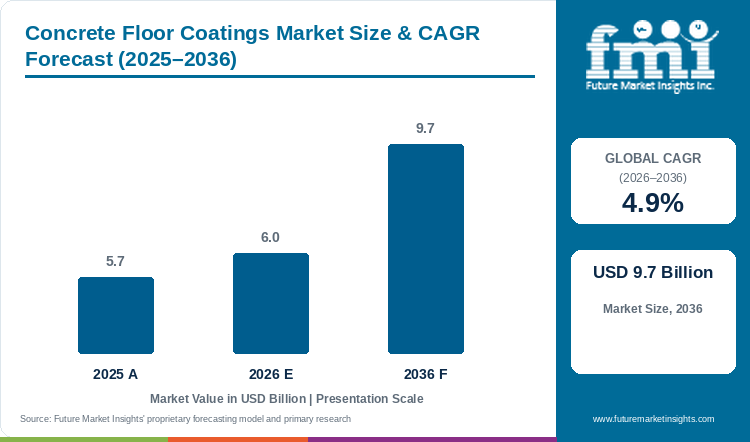
Between 2026 and 2036, concrete floor coatings grow at a 4.9% CAGR. Sales of USD 5.73 billion in 2025 reach an estimated USD 6.01 billion in 2026 and a projected USD 9.70 billion by 2036.
For 2026 to 2036, country demand for concrete floor coatings will rise fastest in South Korea, at a 5.2% CAGR, ahead of the USA at 5.1%. Concrete floor coatings market size stood at USD 5.73 billion in 2025, is estimated at USD 6.01 billion in 2026 and is projected to reach USD 9.70 billion by 2036, and analysts at FMI see a 4.9% CAGR from 2026 to 2036. Key trends in floor coatings point to data halls, cold stores and fulfilment sheds, which need dust-free, chemical-resistant slabs from day one. Sika reported double-digit growth from data center projects in the Americas in H1 2026.[1] Demand intensity is highest on industrial sites, which take 44% of 2026 application sales, because forklifts, spills and washdowns force recoating on fixed cycles.
Contractors apply floor coatings at fit-out, after admixtures go into the slab. The construction chemicals market is projected to grow at a 5.2% CAGR from 2026 to 2036, and floor coatings, at 4.9%, will stay just below that parent rate owing to the later stage in the build cycle. Resin and hardener kits make up 48% of 2026 component sales. Kit makers buy the same hardeners as other two-component coating lines, so prices carry across both buyer groups as the 2K coatings market expands at a 4.7% CAGR from 2026 to 2036. Garage and shop owners are choosing polyaspartic floors, about 14.6% of 2026 product sales (estimated), because the resin cures in hours, a sign of an industry at a turning point for epoxy at 39%. Key challenges in the concrete floor coatings market include a short supply of crews trained for multi-component systems. Suppliers are therefore bundling installer training with each resin system.
Key Market Trends & Insights
- Epoxy remains the default resin, with 39% of 2026 product sales, and polyurethane follows at an estimated 22.4%.
- Two-part resin and hardener kits hold 48% of component demand in 2026, and single-component products about 31.5% (estimated).
- Demand for floor coatings is heaviest on industrial sites, 44% of 2026 application sales. RPM said Construction Products Group sales rose 8.8% to $904.2 million in the fiscal 2026 fourth quarter, led by concrete admixtures.[2]
- Gloss finishes take 36% of finish sales in 2026, and buyers in wet process areas pick anti-slip textures.
- Buyer preference for direct supply on large jobs gives direct sales 47% of 2026 channel sales, against an estimated 41.6% for distributors.
Regional Highlights
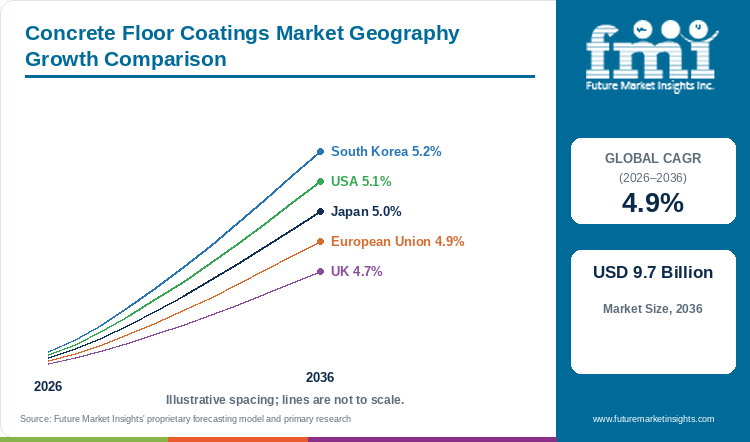
- South Korea records the strongest country rate in floor coatings, with a 5.2% CAGR from 2026 to 2036.
- US demand grows at 5.1% and Japanese demand at 5%, the European Union records 4.9%, and the UK comes last at 4.7%.
- US nonresidential construction reached $773.0 billion in August 2026 on a seasonally adjusted annual basis, the Census Bureau reported.[3]
Market Size & Forecast
Table 1: Market Size and Forecast for the Concrete Floor Coatings Market (USD billion and percentage), 2025 to 2036
| Metric | Value |
|---|---|
| 2025 Market Size | USD 5.73 billion |
| Estimated Market Size in 2026 | USD 6.01 billion |
| Projected Market Size by 2036 | USD 9.70 billion |
| CAGR, 2026 to 2036 | 4.9% |
| Added Revenue, 2026 to 2036 | USD 3.69 billion |
| Market Expansion Multiple | 1.6x |
Floor coating sales gain USD 3.69 billion over the forecast decade, FMI's report shows. Tile, wood, carpet and resilient products cover the other floor area, so coatings hold a small share of the wider flooring market. Owners of warehouses and plants choose a resin coating for bare concrete because forklifts, spills and cleaning chemicals wear down bare concrete.
Nonresidential Build Cycles Behind Floor Coating Orders
Floor coating orders follow the build cycle, because coatings go down after the slab cures and before equipment moves in. US nonresidential construction rose 1% in August 2026 over the revised July figure, the Census Bureau reported.[3] Sika named data center work as a double-digit growth driver in the Americas for H1 2026.[1] RPM Performance Coatings Group sales rose 5% to $562.8 million in the fiscal 2026 fourth quarter, with strength in fireproofing systems and infrastructure projects.[2] Protective and marine sales at the Sherwin-Williams Paint Stores Group grew by a double-digit percentage in Q2 2026.[4] PPG said protective and marine coatings posted a 13th straight quarter of volume growth.[5] Industrial floors hold 44% of application sales in 2026 in the FMI study, and the protective coating gains point to steady factory and infrastructure work.
Small floor contractors buy resin at dealer counters, and distributors handle an estimated 41.6% of 2026 channel sales. Brands with wide dealer stock will therefore reach more warehouse refit crews.
Table 2: Construction Cycle and Supplier Indicators for the Concrete Floor Coatings Market (USD, percentage and dates), 2026
| Indicator | Data Point | Relevance | Source |
|---|---|---|---|
| US nonresidential construction, August 2026 | $773.0 billion seasonally adjusted annual rate | New warehouse, plant and office floors to coat. | [3] |
| Sika Americas growth driver, H1 2026 | Double-digit growth in data center work | A new industrial floor type with strict dust rules. | [1] |
| Sika EMEA local-currency growth, H1 2026 | +7.7% | Infrastructure work in Eastern Europe and the Middle East. | [1] |
| RPM Construction Products Group sales, fiscal Q4 2026 | $904.2 million, up 8.8% | Concrete admixture and building demand at a floor system maker. | [2] |
| Sherwin-Williams Performance Coatings Group sales, Q2 2026 | $1,913.8 million, up 6.3% | Industrial coating demand at a major floor coating supplier. | [4] |
| PPG Performance Coatings organic sales, Q2 2026 | +3% | Protective and marine coatings among the leading lines. | [5] |
| UK construction output, three months to July 2026 | -0.5% | Slower British building activity. | [6] |
Analyst Perspective
“The risk I am watching is the shortage of trained applicators, because two-part epoxy and polyaspartic floors fail when crews mix or cure the resin badly. Data center, cold store and food plant owners will keep ordering through 2036, and I expect certified installer networks to decide which coating brands get those floors.”
- Nikhil Kaitwade, Principal Consultant, Future Market Insights.
How is the concrete floor coatings market segmented?
Five product and buyer axes plus region frame the concrete floor coatings market. Epoxy leads product at 39%, double-component kits lead component at 48%, industrial floors lead application at 44%, gloss leads finish at 36% and direct sales lead channel at 47% in 2026.
By product: epoxy, polyurethane, polyaspartic, acrylic, and polymethyl methacrylate (PMMA).
By component: double component, single component, triple component, and others.
By application: industrial, commercial, and residential.
By finish: gloss, matte, and anti slip.
By sales channel: direct sales, distributors, and online.
By region: floor coating coverage takes in North America and Latin America, the two European blocks, East Asia, the Pacific and South Asian markets, and the Middle East with Africa.
Why does epoxy lead product sales?
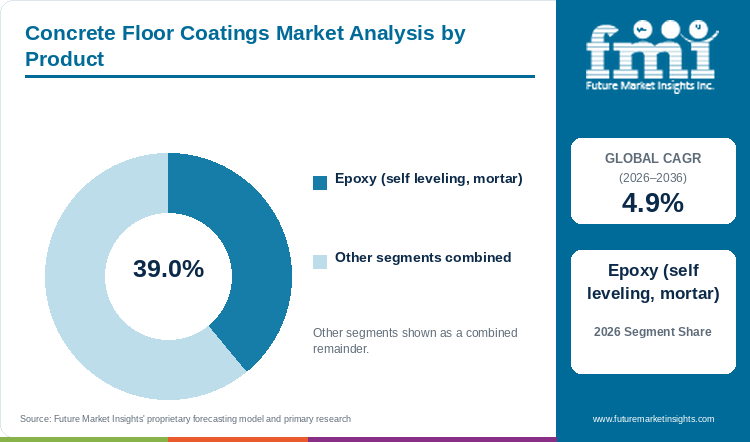
Epoxy leads the product mix with 39% in 2026, followed by polyurethane, polyaspartic, acrylic and PMMA.
Table 3: Product Share for the Concrete Floor Coatings Market (percentage share), 2026
| Product | Estimated Share (2026) |
|---|---|
| Epoxy | 39% |
| Polyurethane | 22.4% |
| Polyaspartic | 14.6% |
| Acrylic | 13.8% |
| Polymethyl Methacrylate (PMMA) | 10.2% |
| Total | 100.0% |
Table 4: Product Leadership and Market Growth for the Concrete Floor Coatings Market (segment and CAGR percentage), 2026 to 2036
| Metric | Value |
|---|---|
| Global CAGR (2026 to 2036) | 4.9% |
| Leading Segment | Epoxy |
Epoxy bonds hard to concrete and resists forklift wheels, oils and cleaning agents at a moderate price, and FMI sets the 2026 epoxy share at 39%. Polyurethane, an estimated 22.4%, costs more and earns a place mainly in food plants with hot washdowns. Polyaspartic, about 14.6% (estimated), cures in hours, but material cost and short pot life confine the segment to garages and retail refits. Acrylic, near 13.8%, lacks the chemical resistance factory floors need, and PMMA, about 10.2%, calls for specialist crews and odor control.
- AkzoNobel said Q2 2026 organic sales rose 2%, driven mainly by a 3% increase in pricing.[7]
Why do double-component systems lead component sales?
Resin and hardener systems mixed on site make up 48% of 2026 component demand.
Table 5: Component Share for the Concrete Floor Coatings Market (percentage share), 2026
| Component | Estimated Share (2026) |
|---|---|
| Double Component | 48% |
| Single Component | 31.5% |
| Triple Component | 13.2% |
| Others | 7.3% |
| Total | 100.0% |
Two-part kits will hold 48% of component sales in 2026, FMI predicts, as on-site mixing gives a harder and thicker film. Single-component products, an estimated 31.5%, skip mixing and serve light-duty commercial and home floors. Triple-component systems, about 13.2%, add application steps, and specialty blends near 7.3% (estimated) serve niche jobs. Sherwin-Williams said general industrial coatings net sales rose a high-single-digit percentage in Q2 2026.[4]
Why do industrial floors lead application sales?
Industrial floors lead the application split with 44% in 2026, and commercial and residential floors follow.
Table 6: Application Share for the Concrete Floor Coatings Market (percentage share), 2026
| Application | Estimated Share (2026) |
|---|---|
| Industrial | 44% |
| Commercial | 35.8% |
| Residential | 20.2% |
| Total | 100.0% |
Masco reported a 4% fall in Decorative Architectural Products net sales to $655 million in Q2 2026.[8] FMI places industrial floors at 44% of application sales, because factories and warehouses recoat on fixed audit cycles. Commercial floors, an estimated 35.8%, follow retail and office refits, which owners can delay. Residential floors, about 20.2% (estimated), move with home paint sales, and Masco figures point to weak home paint demand.
- Food processing and pharmaceutical plants buy chemical-resistant systems to meet safety rules.
- Shop and hotel owners pay more per square meter for flake and quartz floors that look like terrazzo or stone.
What puts gloss ahead in finish sales?
Gloss finishes hold 36% of concrete floor coating finish sales in 2026, ahead of matte at an estimated 33.7% and anti slip at 30.3%.
Table 7: Finish Share for the Concrete Floor Coatings Market (percentage share), 2026
| Finish | Estimated Share (2026) |
|---|---|
| Gloss | 36% |
| Matte | 33.7% |
| Anti Slip | 30.3% |
| Total | 100.0% |
Against matte and anti-slip surfaces, gloss holds the lead at 36% in 2026, because showrooms, warehouses and garages want a bright floor that wipes clean. Matte, an estimated 33.7%, suits offices and control rooms that need low glare. Anti-slip textures, about 30.3% (estimated), go mainly into wet production zones and ramps.
- Safety audits in food and drink plants will push anti-slip share up through 2036.
Why do direct sales lead channel sales?
Direct sales form the largest channel at 47% in 2026, and distributors and online stores share the balance.
Table 8: Sales Channel Share for the Concrete Floor Coatings Market (percentage share), 2026
| Sales Channel | Estimated Share (2026) |
|---|---|
| Direct Sales | 47% |
| Distributors | 41.6% |
| Online | 11.4% |
| Total | 100.0% |
Direct supply leads because buyers prefer one contract per site, and FMI's analysis gives direct manufacturer supply and bulk contracts 47% of channel sales. Regional and national dealers, an estimated 41.6%, serve small contractors unable to buy in bulk. Online stores, about 11.4% (estimated), sell mostly garage kits. Sherwin-Williams credited Paint Stores Group protective and marine sales with a double-digit percentage increase in Q2 2026.[4]
What are the drivers, restraints, and opportunities in the concrete floor coatings market?
Demand for concrete floor coatings rises with industrial and commercial building, renovation, and safety rules in food and pharmaceutical plants. Producers of concrete floor coatings face complex application steps and a short supply of skilled crews. New sales of concrete floor coatings are expected from decorative systems in shops and hotels.
- Driver: New warehouses, factories and data centers need durable, chemical-resistant floors.
- Restraint: Multi-component systems need trained applicators and controlled site conditions.
- Opportunity: Metallic, flake and quartz systems that command premium prices.
Warehouses, Plants and Data Halls Add Coated Floor Area
E-commerce logistics drives warehouse and fulfillment building, and each new shed needs a coated slab. Sika EMEA sales grew 7.7% in local currencies in H1 2026, with strong double-digit growth in the Middle East in Q2 on infrastructure investment projects.[1] New logistics and infrastructure floors in the Middle East and Eastern Europe will add coating volume for suppliers with plants nearby. Process plants already buy chemical resistant linings from resin suppliers. Growth of the chemical resistant coating market gives those suppliers a route to cross-sell floor systems to the same owners.
Crew Shortages Slow Multi-Component Jobs
Two- and three-part systems need exact mixing ratios, moisture checks and curing time. Total UK construction output fell 0.5% in the three months to July 2026, with six of nine sectors down, the ONS reported.[6] Slow building output in the UK reduces new floor area, and contractors lose skilled crews in quiet months. Labor gaps will push contractors toward single-component and fast-cure products that need fewer steps.
Decorative Flake and Quartz Systems Open Premium Sales
Retail, hospitality and office owners now ask for decorative floors that look like terrazzo or stone. Shop and hotel owners also price luxury vinyl tile for the same floors, so vinyl flooring market growth keeps pressure on decorative coating prices. AkzoNobel volumes were stable in Q2 2026, and pricing added 3%, the company said.[7] Metallic, flake and quartz aggregate systems allow higher prices per square meter. AkzoNobel volumes held flat, so suppliers will push metallic and quartz ranges into shop and hotel refits to raise revenue per square meter.
Which country CAGRs are profiled in the concrete floor coatings market?
Table 9: Country CAGR Comparison for the Concrete Floor Coatings Market (CAGR percentage), 2026 to 2036
| Country | CAGR (2026 to 2036) |
|---|---|
| South Korea | 5.2% |
| USA | 5.1% |
| Japan | 5% |
| European Union | 4.9% |
| UK | 4.7% |
How do country-level CAGRs compare in the concrete floor coatings market?
Electronics and battery plant building puts South Korea first among the countries setting the growth agenda, with a 5.2% CAGR from 2026 to 2036, FMI estimates. Data center and warehouse projects keep the USA close at 5.1%. Japan reaches 5%, and EU floor coating sales grow in step with the 4.9% global CAGR. British sales post the lowest rate, 4.7%.
- South Korea: new factories and logistics hubs add industrial floor area.
- USA: warehouse and data center projects add large coated areas.
- Japan: plant renovation and food safety rules support recoating.
- European Union: infrastructure work in the east offsets slow western building.
- UK: falling construction output holds growth to the lowest profiled rate.
Full report country CAGRs cover: floor coating demand across 30 plus countries, from the North American and Latin American blocks to the European pair, East Asia, Middle Eastern and African markets, and the Pacific and South Asian markets.
Country-wise Analysis
South Korea Concrete Floor Coatings Market Outlook (2026 to 2036)
Korean floor coating sales grow at a 5.2% CAGR, faster than any other profiled country. Electronics and battery plants in South Korea will need clean, static-controlled and chemical-resistant floors. Korean contractors will specify two-part epoxy and polyurethane for new process halls. Anti-slip finishes will go into wet process areas and loading bays.
Key takeaway: Korean electronics and battery halls will keep two-part epoxy and polyurethane orders growing at 5.2% a year to 2036.
USA Concrete Floor Coatings Market Outlook (2026 to 2036)
Total US construction put in place came to $2,203.1 billion in August 2026, seasonally adjusted at annual rates, the Census Bureau said.[3] RPM guided fiscal 2027 sales growth of 3% to 7% and expects strength in high-performance buildings and infrastructure to continue.[2] US demand grows at a 5.1% CAGR from 2026 to 2036. Data centers and distribution hubs will add the largest coated areas, and paint store networks will supply the small contractors on garage and retail jobs.
Key takeaway: Big-box nonresidential sites will deliver most US growth, and store-based supply will decide brand choice on small jobs.
Japan Concrete Floor Coatings Market Outlook (2026 to 2036)
Japanese demand for floor coatings posts a 5% CAGR for the decade to 2036. Older factories and warehouses in Japan will need recoating on fixed maintenance cycles. Food processors will replace tiled floors with joint-free polyurethane and epoxy during plant renovation, since tile joints trap dirt.
Key takeaway: Recoating of older plants will carry Japanese demand through 2036.
European Union Concrete Floor Coatings Market Outlook (2026 to 2036)
EU demand matches the 4.9% global CAGR. Sika said Eastern Europe grew strongly in H1 2026.[1] PPG described growth in Europe as modest in Q2 2026.[5] Eastern member states will add logistics and factory floors faster than the western markets. EU chemical rules on solvents will favor water-based acrylic and low-emission epoxy grades.
Key takeaway: Eastern Europe will supply most new EU floor area, and water-based grades will gain under solvent rules.
UK Concrete Floor Coatings Market Outlook (2026 to 2036)
British sales post the slowest profiled CAGR at 4.7%. Monthly construction output grew 0.1% in July 2026, and private housing new work fell 4.9%, the ONS said.[6] Repair and maintenance rose 0.8% in the month.[6] Refurbishment of existing warehouses and retail units will provide more coating work than new building. UK contractors will favor fast-cure systems that limit site closures.
Key takeaway: Repair and refurbishment will outweigh new build as the source of UK floor coating demand.
Who are the notable companies in the concrete floor coatings market?
Top companies operating in the concrete floor coatings market include AkzoNobel, BASF SE, PPG Industries, Sika Corporation and The Sherwin-Williams Company, with RPM International Inc., Axalta Coating Systems, Behr Process Corporation, Nippon Paint and Elite Crete Systems as emerging players.
A combination of AkzoNobel and Axalta is expected to close in late 2026 to early 2027.[7] AkzoNobel shareholders would own about 55% of the combined company.[7]
Sherwin-Williams added Suvinil in October 2025.[4] RPM posted record fiscal 2026 sales of $7.86 billion, up 6.7%.[2]
- Global coating groups: AkzoNobel, BASF SE, PPG Industries, Sika Corporation, and The Sherwin-Williams Company.
- Specialist and emerging suppliers: RPM International Inc., Axalta Coating Systems, Behr Process Corporation, Nippon Paint, and Elite Crete Systems.
Competitive Benchmarking: Concrete Floor Coatings Market
Table 10: Competitive Benchmarking for the Concrete Floor Coatings Market (qualitative documentation ratings), 2026
| Company | Product Breadth | Manufacturing Scale | Distribution Reach | Geographic Footprint |
|---|---|---|---|---|
| The Sherwin-Williams Company | High | High | High | High |
| PPG Industries | High | High | Medium | High |
| Sika Corporation | High | High | Medium | High |
| AkzoNobel | High | High | Medium | High |
| RPM International Inc. | Medium | Medium | Medium | Medium |
Grades follow dated filings and results for each company, scored High, Medium or Low.
Key Developments in the Concrete Floor Coatings Market
- In October 2026, the US Census Bureau put August nonresidential construction at $773.0 billion at a seasonally adjusted annual rate.[3]
- In September 2026, the ONS reported a 0.5% fall in UK construction output for the three months to July 2026.[6]
- In July 2026, Sika posted half-year sales growth of 4% in local currencies.[1]
- In July 2026, RPM reported record fiscal 2026 sales of $7.86 billion.[2]
- In July 2026, Sherwin-Williams posted a 7.5% rise in Q2 consolidated net sales to $6.79 billion.[4]
- In July 2026, PPG posted Q2 net sales of $4.5 billion, a 7% gain on the prior year.[5]
- In July 2026, AkzoNobel set an August 5 shareholder meeting on the Axalta combination.[7]
- In July 2026, Masco reported Q2 net sales of $1,992 million, down 3%.[8]
Key Players in the Concrete Floor Coatings Market
Major Global Players
- AkzoNobel
- BASF SE
- PPG Industries
- Sika Corporation
- The Sherwin-Williams Company
Emerging Players
- RPM International Inc.
- Axalta Coating Systems
- Behr Process Corporation
- Nippon Paint
- Elite Crete Systems
Concrete Floor Coatings Market - Report Scope
Table 11: Report Scope for the Concrete Floor Coatings Market (coverage fields and definitions), 2026 to 2036
| Coverage field | Report scope |
|---|---|
| Market breakdown | Product; component; application; finish; sales channel; region |
| Quantitative units | USD billion |
| Market definition | Epoxy, polyurethane, polyaspartic, acrylic and PMMA coatings applied to concrete floors in industrial, commercial and residential buildings. |
| Regions covered | North America; Latin America; Western Europe; Eastern Europe; East Asia; South Asia and Pacific; Middle East and Africa |
| Countries covered | South Korea; USA; Japan; European Union; UK; 30 plus countries in the full report |
| Key companies profiled | AkzoNobel, BASF SE, PPG Industries, Sika Corporation, The Sherwin-Williams Company, RPM International Inc., Axalta Coating Systems, Behr Process Corporation, Nippon Paint, Elite Crete Systems |
| Forecast period | 2026 to 2036 |
Concrete Floor Coatings Market - Research Methodology
Table 12: Research Methodology for the Concrete Floor Coatings Market (research methods and approach), 2026 edition
| Method | Approach |
|---|---|
| Data Sources | Coating company results, statistics office releases and filings dated from May 2025 onward. |
| Desk Research | Review of nonresidential building data, coating segment results, mergers and capacity moves. |
| Market Sizing and Forecasting | Sizing builds on the 2025 base of USD 5.73 billion and the 4.9% CAGR. |
| Data Validation | Segment trends were compared across coating company results for the same quarter. |
Concrete Floor Coatings Market by Segments
Concrete Floor Coatings Market segmented by Product:
- Epoxy (self leveling, mortar)
- Polyurethane (flexible, high performance)
- Polyaspartic (fast cure, UV resistant)
- Acrylic (water based, solvent based)
- Polymethyl Methacrylate, PMMA (rapid cure, heavy duty)
Concrete Floor Coatings Market segmented by Component:
- Double Component (resin and hardener system)
- Single Component (ready to apply system)
- Triple Component (multi layer system)
- Others (specialty blended systems)
Concrete Floor Coatings Market segmented by Application:
- Industrial (manufacturing facilities, warehouses)
- Commercial (retail spaces, office buildings)
- Residential (garages, living spaces)
Concrete Floor Coatings Market segmented by Finish:
- Gloss (high shine coating)
- Matte (low reflection surface)
- Anti Slip (textured safety surface)
Concrete Floor Coatings Market segmented by Sales Channel:
- Direct Sales (manufacturer supply, bulk contracts)
- Distributors (regional dealers, national dealers)
- Online
Concrete Floor Coatings Market by Region
- North America
- United States
- Canada
- Latin America
- Brazil
- Mexico
- Western Europe
- Germany
- France
- United Kingdom
- Italy
- Spain
- Eastern Europe
- Poland
- Czech Republic
- East Asia
- China
- Japan
- South Korea
- South Asia and Pacific
- India
- ASEAN
- Australia and New Zealand
- Middle East and Africa
- GCC Countries
- South Africa
Research Sources and Bibliography
- [1] Sika AG. (2026, July 28). Half-Year Report 2026. https://www.sika.com/en/media/media-releases/2026/half-year-report-2026.html
- [2] RPM International Inc. (2026, July 22). RPM Reports Record Fiscal 2026 Fourth-Quarter and Full-Year Results. https://www.sec.gov/Archives/edgar/data/0000110621/000119312526311276/d141573dex991.htm
- [3] U.S. Census Bureau. (2026, October 1). Monthly Construction Spending, August 2026. https://www.census.gov/construction/c30/current/index.html
- [4] The Sherwin-Williams Company. (2026, July 28). The Sherwin-Williams Company Reports 2026 Second Quarter Financial Results. https://www.sec.gov/Archives/edgar/data/0000089800/000008980026000046/shwearningsrelease2q2026.htm
- [5] PPG Industries, Inc. (2026, July 28). PPG reports second quarter 2026 financial results. https://www.sec.gov/Archives/edgar/data/79879/000007987926000246/exhibit99-2q2026earningsre.htm
- [6] Office for National Statistics. (2026, September 11). Construction output in Great Britain: July 2026. https://www.ons.gov.uk/businessindustryandtrade/constructionindustry/bulletins/constructionoutputingreatbritain/latest
- [7] Akzo Nobel N.V. (2026, July 21). AkzoNobel Q2 Report 2026. https://www.sec.gov/Archives/edgar/data/0000003124/000119312526311872/d10293dex991.htm
- [8] Masco Corporation. (2026, July 29). Masco Corporation Reports Second Quarter 2026 Results. https://www.sec.gov/Archives/edgar/data/62996/000006299626000026/a630268-kex99.htm
This bibliography is provided for reader reference. The full report contains the complete reference list and detailed citations.
This Report Answers
- What will concrete floor coating sales total in 2026 and 2036?
- What CAGR will the market post between 2026 and 2036?
- Which resin type will hold the largest product share?
- Will double-component kits keep the lead over one-pack products?
- Which countries will post the fastest growth?
- Which coating groups will shape competition through 2036?
Frequently Asked Questions
How large will the concrete floor coatings market be in 2026?
Coated floor sales will come in at USD 6.01 billion for 2026, and FMI expects USD 9.70 billion by 2036.
What CAGR will concrete floor coatings post?
The market will expand on a 4.9% CAGR from 2026 to 2036. Industrial floors, 44% of 2026 application sales, will add the most coated area.
Which product will lead in 2026?
Epoxy will keep the top product share at 39%, with polyurethane in second place.
Which application will buy the most floor coatings?
Factory and warehouse floors will absorb 44% of 2026 application demand.
Which country will grow fastest?
Korean demand, as FMI data indicate, will rise fastest on a 5.2% CAGR, with American demand next on 5.1%.
Who are the main suppliers?
AkzoNobel, BASF, PPG, Sika and Sherwin-Williams will form the major group, and RPM, Axalta, Behr, Nippon Paint and Elite Crete will compete as emerging players.
Preview the report firsthand - request a free sample
Get SampleGet the brochure for pricing and purchase details.
Get PDFTable of Content
- Key Takeaways
- Market Size and CAGR
- Top Growth Driver
- Fastest Growing Segment
- Leading Region
- Key Companies
- Emerging Opportunities
- Executive Summary
- Global Market Outlook
- Demand-side Trends
- Supply-side Trends
- Technology Roadmap Analysis
- Analysis and Recommendations
- Analyst Perspective (What is happening? Why now? What should investors know?)
- Key Questions Answered
- How large is the market?
- What is the CAGR?
- What are key trends?
- Which region dominates?
- Who are the leaders?
- Market Overview
- Market Coverage / Taxonomy
- Market Definition / Scope / Limitations
- Research Methodology
- Chapter Orientation
- Analytical Lens and Working Hypotheses
- Market Structure, Signals, and Trend Drivers
- Benchmarking and Cross-market Comparability
- Market Sizing, Forecasting, and Opportunity Mapping
- Research Design and Evidence Framework
- Desk Research Programme (Secondary Evidence)
- Expert Input and Fieldwork (Primary Evidence)
- Tooling, Models, and Reference Databases
- Data Engineering and Model Build
- Quality Assurance and Audit Trail
- Market Background
- Market Dynamics (Drivers, Restraints, Opportunity, Trends)
- Scenario Forecast (Optimistic, Likely, Conservative)
- Impact Analysis
- AI Impact
- Sustainability Impact
- Regulatory Impact
- Technology Impact
- Consumer / Buyer Analysis
- Purchase Drivers
- Adoption Barriers
- Buyer Journey
- Opportunity Map Analysis
- Product Life Cycle Analysis
- Supply Chain Analysis
- Investment Feasibility Matrix
- Value Chain Analysis
- PESTLE and Porter's Analysis
- Regulatory Landscape
- Regional Parent Market Outlook
- Production and Consumption Statistics
- Import and Export Statistics
- Global Market Analysis and Forecast, 2021 to 2036
- Historical Market Size Value (USD Billion) Analysis, 2021 to 2025
- Current and Future Market Size Value (USD Billion) Projections, 2026 to 2036
- Y-o-Y Growth Trend Analysis
- Absolute $ Opportunity Analysis
- Global Market Pricing Analysis, 2021 to 2036
- Global Market Analysis and Forecast, By Product, 2021 to 2036
- Introduction / Key Findings
- Historical Market Size Value (USD Billion) Analysis By Product, 2021 to 2025
- Current and Future Market Size Value (USD Billion) Analysis and Forecast By Product, 2026 to 2036
- Epoxy (self leveling, mortar)
- Polyurethane (flexible, high performance)
- Polyaspartic (fast cure, UV resistant)
- Acrylic (water based, solvent based)
- Polymethyl Methacrylate, PMMA (rapid cure, heavy duty)
- Y-o-Y Growth Trend Analysis By Product, 2021 to 2025
- Absolute $ Opportunity Analysis By Product, 2026 to 2036
- Global Market Analysis and Forecast, By Component, 2021 to 2036
- Introduction / Key Findings
- Historical Market Size Value (USD Billion) Analysis By Component, 2021 to 2025
- Current and Future Market Size Value (USD Billion) Analysis and Forecast By Component, 2026 to 2036
- Double Component (resin and hardener system)
- Single Component (ready to apply system)
- Triple Component (multi layer system)
- Others (specialty blended systems)
- Y-o-Y Growth Trend Analysis By Component, 2021 to 2025
- Absolute $ Opportunity Analysis By Component, 2026 to 2036
- Global Market Analysis and Forecast, By Application, 2021 to 2036
- Introduction / Key Findings
- Historical Market Size Value (USD Billion) Analysis By Application, 2021 to 2025
- Current and Future Market Size Value (USD Billion) Analysis and Forecast By Application, 2026 to 2036
- Industrial (manufacturing facilities, warehouses)
- Commercial (retail spaces, office buildings)
- Residential (garages, living spaces)
- Y-o-Y Growth Trend Analysis By Application, 2021 to 2025
- Absolute $ Opportunity Analysis By Application, 2026 to 2036
- Global Market Analysis and Forecast, By Finish, 2021 to 2036
- Introduction / Key Findings
- Historical Market Size Value (USD Billion) Analysis By Finish, 2021 to 2025
- Current and Future Market Size Value (USD Billion) Analysis and Forecast By Finish, 2026 to 2036
- Gloss (high shine coating)
- Matte (low reflection surface)
- Anti Slip (textured safety surface)
- Y-o-Y Growth Trend Analysis By Finish, 2021 to 2025
- Absolute $ Opportunity Analysis By Finish, 2026 to 2036
- Global Market Analysis and Forecast, By Sales Channel, 2021 to 2036
- Introduction / Key Findings
- Historical Market Size Value (USD Billion) Analysis By Sales Channel, 2021 to 2025
- Current and Future Market Size Value (USD Billion) Analysis and Forecast By Sales Channel, 2026 to 2036
- Direct Sales (manufacturer supply, bulk contracts)
- Distributors (regional dealers, national dealers)
- Online
- Y-o-Y Growth Trend Analysis By Sales Channel, 2021 to 2025
- Absolute $ Opportunity Analysis By Sales Channel, 2026 to 2036
- Global Market Analysis and Forecast, By Region, 2021 to 2036
- Introduction
- Historical Market Size Value (USD Billion) Analysis By Region, 2021 to 2025
- Current Market Size Value (USD Billion) Analysis and Forecast By Region, 2026 to 2036
- North America
- Latin America
- Western Europe
- Eastern Europe
- East Asia
- South Asia and Pacific
- Middle East and Africa
- Market Attractiveness Analysis By Region
- North America Market Analysis and Forecast, By Country, 2021 to 2036
- Historical Market Size Value (USD Billion) Trend Analysis By Market Taxonomy, 2021 to 2025
- Market Size Value (USD Billion) Forecast By Market Taxonomy, 2026 to 2036
- By Country
- United States
- Canada
- By Product
- By Component
- By Application
- By Finish
- By Sales Channel
- By Country
- Market Attractiveness Analysis
- By Country
- By Product
- By Component
- By Application
- By Finish
- By Sales Channel
- Key Takeaways
- Latin America Market Analysis and Forecast, By Country
- Historical Market Size Value (USD Billion) Trend Analysis By Market Taxonomy, 2021 to 2025
- Market Size Value (USD Billion) Forecast By Market Taxonomy, 2026 to 2036
- By Country
- Brazil
- Mexico
- By Product
- By Component
- By Application
- By Finish
- By Sales Channel
- By Country
- Market Attractiveness Analysis
- By Country
- By Product
- By Component
- By Application
- By Finish
- By Sales Channel
- Key Takeaways
- Western Europe Market Analysis and Forecast, By Country
- Historical Market Size Value (USD Billion) Trend Analysis By Market Taxonomy, 2021 to 2025
- Market Size Value (USD Billion) Forecast By Market Taxonomy, 2026 to 2036
- By Country
- Germany
- France
- United Kingdom
- Italy
- Spain
- By Product
- By Component
- By Application
- By Finish
- By Sales Channel
- By Country
- Market Attractiveness Analysis
- By Country
- By Product
- By Component
- By Application
- By Finish
- By Sales Channel
- Key Takeaways
- Eastern Europe Market Analysis and Forecast, By Country
- Historical Market Size Value (USD Billion) Trend Analysis By Market Taxonomy, 2021 to 2025
- Market Size Value (USD Billion) Forecast By Market Taxonomy, 2026 to 2036
- By Country
- Poland
- Czech Republic
- By Product
- By Component
- By Application
- By Finish
- By Sales Channel
- By Country
- Market Attractiveness Analysis
- By Country
- By Product
- By Component
- By Application
- By Finish
- By Sales Channel
- Key Takeaways
- East Asia Market Analysis and Forecast, By Country
- Historical Market Size Value (USD Billion) Trend Analysis By Market Taxonomy, 2021 to 2025
- Market Size Value (USD Billion) Forecast By Market Taxonomy, 2026 to 2036
- By Country
- China
- Japan
- South Korea
- By Product
- By Component
- By Application
- By Finish
- By Sales Channel
- By Country
- Market Attractiveness Analysis
- By Country
- By Product
- By Component
- By Application
- By Finish
- By Sales Channel
- Key Takeaways
- South Asia and Pacific Market Analysis and Forecast, By Country
- Historical Market Size Value (USD Billion) Trend Analysis By Market Taxonomy, 2021 to 2025
- Market Size Value (USD Billion) Forecast By Market Taxonomy, 2026 to 2036
- By Country
- India
- ASEAN
- Australia and New Zealand
- By Product
- By Component
- By Application
- By Finish
- By Sales Channel
- By Country
- Market Attractiveness Analysis
- By Country
- By Product
- By Component
- By Application
- By Finish
- By Sales Channel
- Key Takeaways
- Middle East and Africa Market Analysis and Forecast, By Country
- Historical Market Size Value (USD Billion) Trend Analysis By Market Taxonomy, 2021 to 2025
- Market Size Value (USD Billion) Forecast By Market Taxonomy, 2026 to 2036
- By Country
- GCC Countries
- South Africa
- By Product
- By Component
- By Application
- By Finish
- By Sales Channel
- By Country
- Market Attractiveness Analysis
- By Country
- By Product
- By Component
- By Application
- By Finish
- By Sales Channel
- Key Takeaways
- Key Countries Market Analysis
- United States
- Pricing Analysis
- Market Share Analysis, 2025
- By Product
- By Component
- By Application
- By Finish
- By Sales Channel
- Canada
- Pricing Analysis
- Market Share Analysis, 2025
- By Product
- By Component
- By Application
- By Finish
- By Sales Channel
- Mexico
- Pricing Analysis
- Market Share Analysis, 2025
- By Product
- By Component
- By Application
- By Finish
- By Sales Channel
- Brazil
- Pricing Analysis
- Market Share Analysis, 2025
- By Product
- By Component
- By Application
- By Finish
- By Sales Channel
- Germany
- Pricing Analysis
- Market Share Analysis, 2025
- By Product
- By Component
- By Application
- By Finish
- By Sales Channel
- United Kingdom
- Pricing Analysis
- Market Share Analysis, 2025
- By Product
- By Component
- By Application
- By Finish
- By Sales Channel
- Italy
- Pricing Analysis
- Market Share Analysis, 2025
- By Product
- By Component
- By Application
- By Finish
- By Sales Channel
- Spain
- Pricing Analysis
- Market Share Analysis, 2025
- By Product
- By Component
- By Application
- By Finish
- By Sales Channel
- France
- Pricing Analysis
- Market Share Analysis, 2025
- By Product
- By Component
- By Application
- By Finish
- By Sales Channel
- India
- Pricing Analysis
- Market Share Analysis, 2025
- By Product
- By Component
- By Application
- By Finish
- By Sales Channel
- ASEAN
- Pricing Analysis
- Market Share Analysis, 2025
- By Product
- By Component
- By Application
- By Finish
- By Sales Channel
- Australia and New Zealand
- Pricing Analysis
- Market Share Analysis, 2025
- By Product
- By Component
- By Application
- By Finish
- By Sales Channel
- China
- Pricing Analysis
- Market Share Analysis, 2025
- By Product
- By Component
- By Application
- By Finish
- By Sales Channel
- Japan
- Pricing Analysis
- Market Share Analysis, 2025
- By Product
- By Component
- By Application
- By Finish
- By Sales Channel
- South Korea
- Pricing Analysis
- Market Share Analysis, 2025
- By Product
- By Component
- By Application
- By Finish
- By Sales Channel
- Poland
- Pricing Analysis
- Market Share Analysis, 2025
- By Product
- By Component
- By Application
- By Finish
- By Sales Channel
- South Africa
- Pricing Analysis
- Market Share Analysis, 2025
- By Product
- By Component
- By Application
- By Finish
- By Sales Channel
- European Union
- Pricing Analysis
- Market Share Analysis, 2025
- By Product
- By Component
- By Application
- By Finish
- By Sales Channel
- United States
- Market Structure Analysis
- Competition Dashboard
- Competition Benchmarking
- Market Share Analysis of Top Players
- By Regional
- By Product
- By Component
- By Application
- By Finish
- By Sales Channel
- Emerging Startups
- Innovation Benchmarking
- Competition Analysis
- Competition Deep Dive
- The Sherwin-Williams Company
- Overview
- Product Portfolio
- Profitability by Market Segments
- Sales Footprint
- Strategy Overview
- Marketing Strategy
- Product Strategy
- Channel Strategy
- PPG Industries
- Sika Corporation
- AkzoNobel
- RPM International Inc.
- BASF SE
- Axalta Coating Systems
- Behr Process Corporation
- Nippon Paint
- Elite Crete Systems
- The Sherwin-Williams Company
- Case Studies
- Success Stories
- Recent Developments
- Competition Deep Dive
- Assumptions & Acronyms Used


