

- Market Size (2026)
- USD 4.4 Bn
- Forecast (2036)
- USD 8.3 Bn
- CAGR (2026 to 2036)
- 6.6%
Low-Viscosity Lubricant Compatible Driveline Components Market Size, Market Forecast and Outlook By FMI
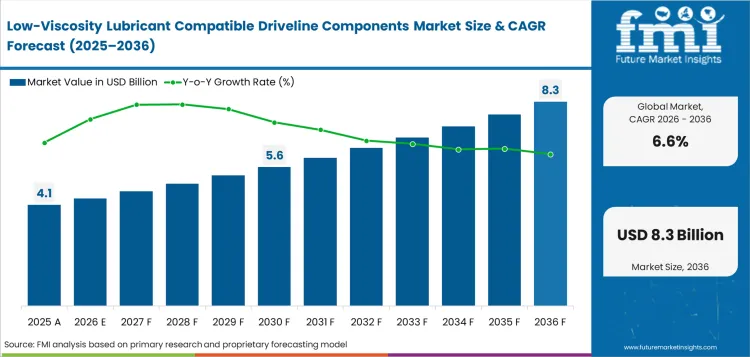
Low-viscosity lubricant compatible driveline components market was valued at USD 4.1 billion in 2025 and is estimated at USD 4.4 billion in 2026. Demand is projected to reach USD 8.3 billion by 2036 at 6.6% CAGR over the forecast decade. Bearings are expected to account for 38.0% share of component type demand in 2026. OEM fitment is expected to represent 72.0% share of sales channel demand in 2026.
Key Takeaways, Market Size and Forecast
- Low-viscosity lubricant compatible driveline components market stood at USD 4.1 billion in 2025.
- By 2036, the industry is projected to reach USD 8.3 billion.
- Market value is projected to expand at 6.6% CAGR during 2026 to 2036.
- Market revenue is projected to add USD 3.9 billion in incremental opportunity over the forecast period.
- Bearings are expected to account for 38.0% share of component type demand in 2026.
- In 2026, OEM fitment is expected to represent 72.0% share of sales channel demand.
- China at 7.8% CAGR and India at 7.5% CAGR are expected to stay ahead of the global pace.
Summary of the Low-Viscosity Lubricant Compatible Driveline Components Market
- Demand and Growth Drivers
- OEMs are focusing on lower energy loss inside transmissions and electric drive units. This creates demand for driveline parts that work well with low-viscosity fluids.
- E-axles are increasing the need for compact bearings and seals. These parts must handle speed and heat without causing early wear.
- Repair demand is expected to improve as more EVs and hybrid vehicles enter service. Workshops will need matched parts that suit the correct fluid type.
- Product and Segment View
- Bearings hold a key role because they directly affect friction inside moving driveline systems. Smooth bearing surfaces help thinner fluids protect the part.
- Seals are important because low-viscosity fluids can leak more easily under heat. Better seal design helps protect transmission and e-axle performance.
- OEM fitment stays important because parts and fluids must be tested together before vehicle production. Early approval gives suppliers a clearer route into vehicle programs.
- Geography and Competitive Outlook
- China and India are expected to support demand as EV and hybrid vehicle production expands. Local manufacturing gives suppliers more chances to qualify driveline parts.
- Germany and Japan stay important because they have strong experience in bearings and driveline engineering. Their suppliers can support complex testing needs.
- Competition depends on proof of friction control and fluid compatibility. Suppliers with clear test data can win stronger positions with automakers.
- Analyst Opinion
- Nikhil Kaitwade, Principal Consultant at FMI, says, “Low-viscosity lubricant compatibility is becoming important in driveline part design. Thinner fluids can reduce energy loss, but bearings and seals need better protection against wear. Suppliers with clear proof of low friction and durability will be preferred in transmission and e-axle programs.”
- Low-Viscosity Lubricant Compatible Driveline Components Market Value Analysis
- The low-viscosity lubricant compatible driveline components market is moving from standard part supply into a more specialized efficiency-focused component space.
- Industry value is supported by OEM efforts to reduce friction inside transmissions and electric drive units.
- Bearings and seals are gaining value as thinner fluids need smoother contact surfaces and better leakage control.
- The market is further supported by e-axle designs that need compact parts with stable lubrication performance.
- Aftermarket demand is expected to improve as older EVs and hybrid vehicles need matched replacement parts for driveline repair.
Regulation and repair activity are making low-viscosity lubricant compatible driveline components more important for electrified vehicles. EU Regulation 2025/1214 gives automakers added flexibility for CO₂ compliance calculations during 2025 to 2027. This keeps efficiency-focused driveline design important for transmissions and e-axles. Repair demand is also becoming clearer as more EVs enter service. In August 2024, ZF Aftermarket released 25 electric axle drive repair kits for cars and SUVs in the United States and Canada.
The kits help workshops fix faults without removing the electric drive. Schaeffler added E-Axle RepSystem-M in September 2024 for the 2016 to 2019 Hyundai Ioniq AE-EV. The kit helps garages replace damaged motor bearings instead of replacing the full motor or e-axle. These developments give component suppliers a stronger route into EV repair as service moves toward seal and bearing-level work.
Low-Viscosity Lubricant Compatible Driveline Components Market Definition
The low-viscosity lubricant compatible driveline components market refers to parts designed to work reliably with thinner transmission and e-drive fluids. These components are used inside driveline systems where moving parts need lower friction and steady protection during operation. Bearings and seals are important in this market because they directly affect energy loss and component life.
Low-Viscosity Lubricant Compatible Driveline Components Market Inclusions
Market scope covers low-viscosity lubricant compatible driveline components categorized by component type, including bearings and gears. It also includes seals, clutch packs and synchronizers. Driveline system covers automatic transmissions and e-axles. Differentials and transfer cases are included. Lubricant type covers low-viscosity ATF and e-drive fluids. Gear oils and hybrid fluids are included where they are used with compatible driveline parts. Vehicle type covers passenger cars and light commercial vehicles. Heavy trucks and battery electric vehicles complete the vehicle scope.
Sales channel covers OEM fitment, aftermarket kits and service parts. The scope also includes driveline parts used in systems where lubricant behavior, friction control and durability work together as part of one power transfer process. Revenue scope covers 2026 to 2036. The key stakeholders include driveline component suppliers, bearing manufacturers, seal producers, gear makers, automakers, e-axle suppliers, transmission system manufacturers, lubricant formulators, aftermarket distributors, service workshops and vehicle engineering departments.
Low-Viscosity Lubricant Compatible Driveline Components Market Exclusions
Scope excludes two-wheeler lubricants, engine oil components and standalone lubricant formulations. General fasteners and housings are excluded unless supplied as part of a qualified driveline component package. Industrial gear units and off-road hydraulic systems are outside scope unless tied to vehicle driveline use.
Low-Viscosity Lubricant Compatible Driveline Components Market Research Methodology
- Primary Research: FMI analysts reviewed automotive bearing and seal suppliers that work in low-friction driveline programs. The review focused on how suppliers qualify parts for thinner fluids used in transmissions and e-axles.
- Desk Research: Public data from OICA and IEA were used to check vehicle output and EV demand. ACEA data and national automotive sources were used to support regional market checks.
- Market Sizing and Forecasting: Market size was estimated by reviewing vehicle production and the average value of compatible driveline parts used per platform. Transmission mix and e-axle use were then checked to refine the forecast.
- Data Validation: Forecast results were checked against EV sales and transmission technology trends. Supplier product launches were used to confirm whether bearing and seal demand matched the expected market direction.
Why is the Low-Viscosity Lubricant Compatible Driveline Components Market Growing?
- Automakers need driveline parts that reduce friction inside transmissions and electric drive units.
- Thinner fluids can lower drag, but bearings and seals must protect parts under heat and speed.
- Compact electric drive units need smaller gears and bearings with stable lubrication.
- Suppliers with tested low-friction parts can support OEMs earlier in vehicle design.
Low-viscosity lubricant compatible driveline components are becoming more important because automakers want lower energy loss inside driveline systems. Bearings and gears need smoother contact surfaces so the lubricant can work well. In October 2025, BorgWarner secured a contract to supply a 7-in-1 Integrated Drive Module for a Chinese hybrid SUV. The compact unit shows how OEMs are moving toward tighter driveline designs that need efficient internal parts.
Hybrid and electric platforms are creating more need for parts tested around real driveline loads. A compact drive module places the motor and gearbox closer together, so heat and friction need better control. Low-viscosity fluids can support efficiency, but only if the related bearings and seals are designed for the same system.
Market Segmentation Analysis
- In 2026, bearings are expected to lead component type demand with 38.0% share.
- Within driveline system demand, automatic transmissions and CVT units are expected to account for 32.5% share in 2026.
- Low-viscosity ATF is estimated to hold 42.0% share of lubricant type demand in 2026.
- Passenger cars are expected to represent 61.0% share in 2026.
- OEM fitment is expected to keep the leading sales route in 2026 with 72.0% share.
The market is divided into five primary segment groups based on component type and driveline system. Lubricant type, vehicle type and sales channel complete the structure. Component type covers bearings and gears. Seals and clutch packs complete the group. Synchronizers are included. Driveline system covers automatic transmissions and e-axles. Differentials and transfer cases complete the driveline scope. Lubricant type covers low-viscosity ATF and e-drive fluids. Gear oils and hybrid fluids are included. Vehicle type covers passenger cars and light commercial vehicles. Heavy trucks and battery electric vehicles complete the vehicle scope. Sales channel covers OEM fitment and aftermarket kits. Service parts complete the channel scope.
Insights into Low-Viscosity Lubricant Compatible Driveline Components Market by Component Type
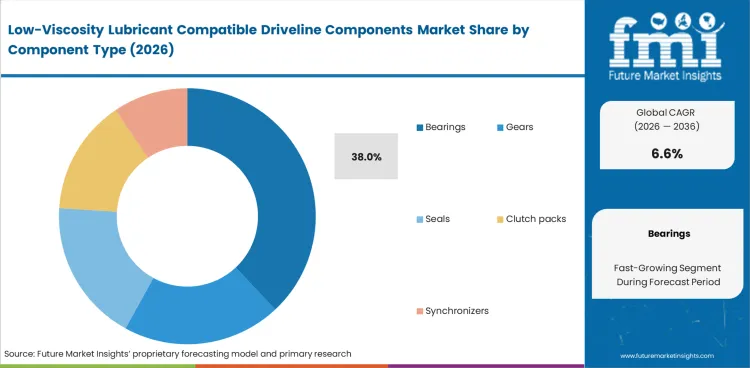
- Bearings are expected to hold 38.0% share in 2026 because they help reduce friction inside transmissions and e-axles. Smooth bearings help thin oil protect moving parts more easily.
- Gears and seals are expected to support steady demand in 2026 as compact driveline systems need better surface control. Seals are important because thin fluids can leak more easily under heat.
Insights into Low-Viscosity Lubricant Compatible Driveline Components Market by Driveline System
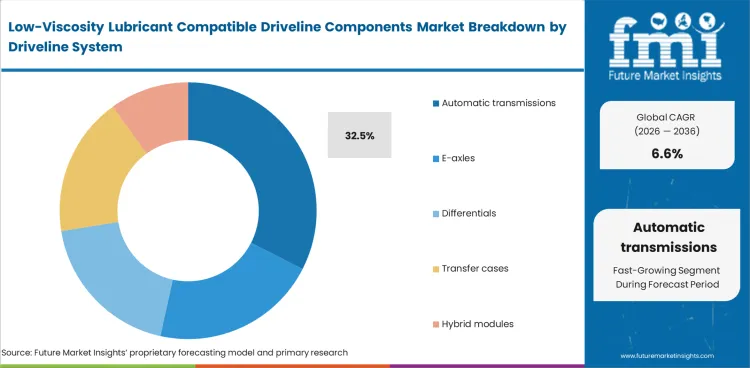
- Automatic transmissions and dual-clutch designs are expected to account for 32.5% share in 2026 as low-viscosity ATF works with clutch packs and bearings. These parts help reduce energy loss and support smoother shifting.
- E-axles are expected to create more demand in 2026 because compact reducers need parts that can handle higher motor speed. Electric vehicle reducer designs need bearings and gears tested with thinner e-drive fluids.
Insights into Low-Viscosity Lubricant Compatible Driveline Components Market by Lubricant Type
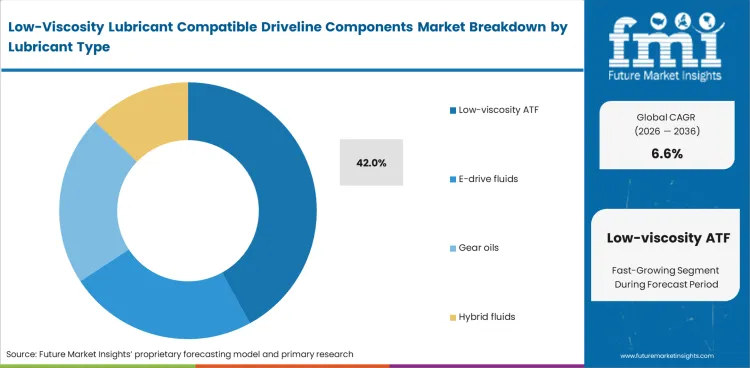
- Low-viscosity ATF is expected to hold 42.0% share in 2026 as automatic transmissions need thinner fluids to lower drag. Compatible seals and clutch parts help keep shifting smooth.
- E-drive fluids are expected to support more part testing in 2026 because electric drive units need cooling and lubrication in one compact system. Driveline lubricants must match the bearings and seals used in these units.
Insights into Low-Viscosity Lubricant Compatible Driveline Components Market by Vehicle Type
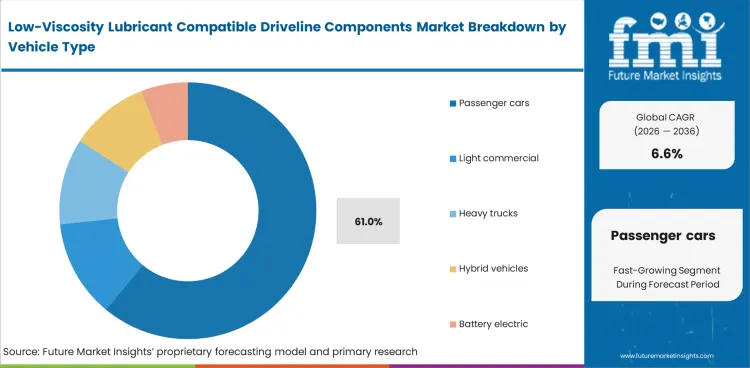
- Passenger cars are expected to represent 61.0% share in 2026 because they use high-volume driveline platforms. Small efficiency gains become useful when the same part is used across many vehicles.
- Light commercial vehicles are expected to add demand in 2026 as more delivery fleets use hybrid and electric driveline systems. These vehicles need durable bearings and seals for daily stop-start use.
Insights into Low-Viscosity Lubricant Compatible Driveline Components Market by Sales Channel
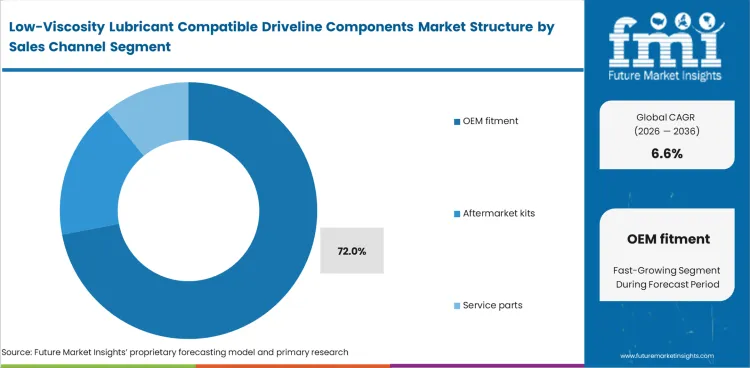
- OEM fitment is expected to account for 72.0% share in 2026 because lubricant and component testing must happen before vehicle production starts. Early approval gives suppliers access to long vehicle programs.
- Aftermarket kits are expected to become more important in 2026 as older EVs and hybrid vehicles enter repair cycles. Matched bearings, seals and fluids can help workshops repair electric vehicle motor parts without replacing the full drive unit.
Low-Viscosity Lubricant Compatible Driveline Components Market Drivers, Restraints and Opportunities
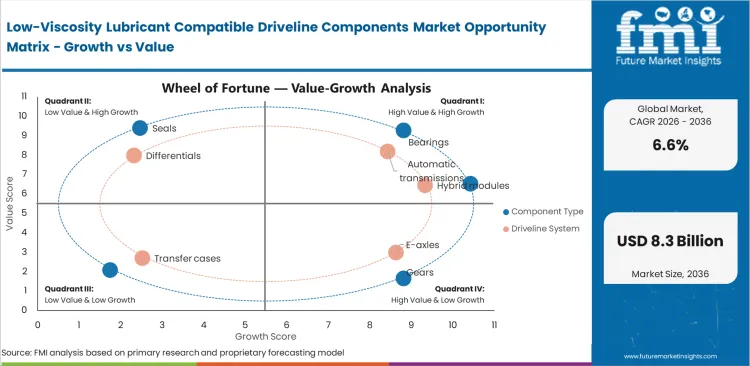
- OEMs need lower-friction bearings and gears because every small energy loss affects fuel use or EV range.
- Thin lubricant films can increase wear risk, so suppliers must prove durability before approval.
- Compact electric drive units create demand for parts that save space and reduce drag.
- Repair demand can improve as older EVs need matched bearings and seals during service.
Low-Loss Parts Need Proof
Low-viscosity driveline systems need parts that reduce drag without weakening durability. NTN developed a high-performance ball type sliding CVJ for EVs in May 2025. The company said the product uses newly developed grease and reduces torque loss ratio by 25.0% compared with the conventional product. This supports the same market need because driveline parts must reduce friction while keeping torque transfer stable. Suppliers with tested low-loss parts can support OEMs with better proof during design approval.
Transfer Case Programs Need Durable Parts
Low-viscosity compatible parts are not limited to e-axles and transmissions. Transfer cases also need smoother internal movement and lower drag. In October 2025, BorgWarner secured multiple contracts with Chery for advanced AWD products. The awards include a torque-on-demand transfer case and Gen VI XWD system. Such programs support demand for driveline components that can handle load changes while keeping efficiency under control.
Analysis of Low-Viscosity Lubricant Compatible Driveline Components Market by Key Countries
.webp "Top Country Growth Comparison Low Viscosity Lubricant Compatible Driveline Components Market Cagr (2026 2036)")
| Country | CAGR |
|---|---|
| United States | 6.3% CAGR |
| China | 7.8% CAGR |
| India | 7.5% CAGR |
| Germany | 5.9% CAGR |
| Japan | 5.6% CAGR |
| South Korea | 6.8% CAGR |
| France | 5.4% CAGR |
Source: Future Market Insights, 2026.
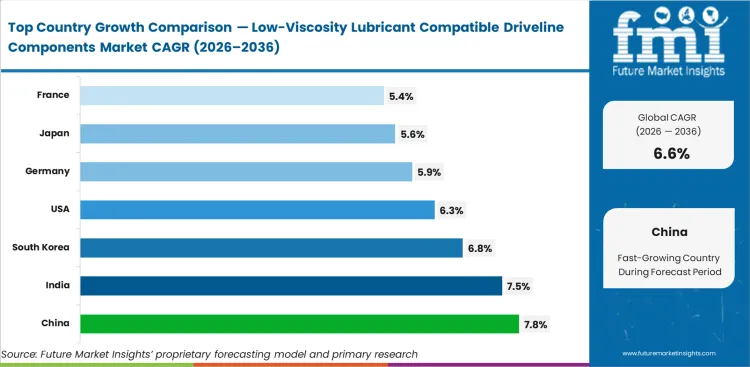
Low-Viscosity Lubricant Compatible Driveline Components Market CAGR Analysis by Country
- China is expected to lead country-level demand at 7.8% CAGR through 2036, as EV output and local e-axle sourcing lift compatible bearing needs.
- As passenger vehicle output and hybrid programs create scale for low-drag driveline parts, India is forecast to expand at 7.5% CAGR by 2036.
- South Korea’s industry outlook indicates 6.8% CAGR over the forecast period with EV programs deepening demand for high-speed reducer parts.
- The market in the United States is expected to move at 6.3% CAGR through 2036 due to automatic transmission service and EV axle repairs.
- Germany is anticipated to advance at 5.9% CAGR during 2026 to 2036 as premium transmission engineering keeps qualification needs high.
- In Japan, adoption is forecast to move at 5.6% CAGR by 2036 with bearing makers focusing on compact EV drive unit parts.
- France is expected to post 5.4% CAGR in the market over the forecast period as EV platform work sustains selective part demand.
Demand Outlook for Low-Viscosity Lubricant Compatible Driveline Components Market in the United States
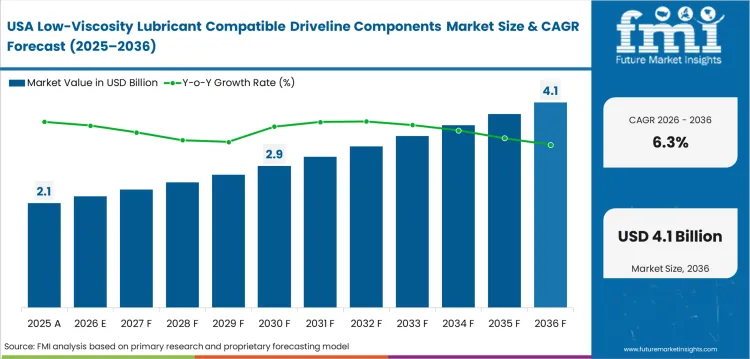
EV trucks and hybrid platforms are increasing the need for compact driveline parts in the United States. The market is projected to expand at 6.3% CAGR by 2036. BorgWarner secured a 2026 contract with a major North American OEM for an 800V integrated drive module and generator module. The integrated drive module includes an e-machine and gearbox for hybrid or electric vehicle use. This supports demand for compatible bearings and gears that can work with lower-friction driveline fluids.
- Electric truck platforms need drive modules with reliable gear and bearing operation.
- Hybrid systems create demand for parts that can handle torque and heat inside compact units.
- Service networks will need matched replacement parts as more electrified driveline units enter repair cycles.
Sales Analysis of Low-Viscosity Lubricant Compatible Driveline Components Market in China
At 7.8% CAGR over the forecast period, China is expected to stay ahead in this market due to its electric and hybrid platform scale. BorgWarner secured four electric motor projects with three Chinese OEMs in February 2025. One project includes 400V high-voltage hairpin motors for a 200 kW hybrid rear-drive platform. These programs support demand for drivetrain parts used in compact motor and gearbox layouts. Low-viscosity lubricant compatible bearings and seals become more important as OEMs work to reduce energy loss.
- Hybrid rear-drive platforms need driveline parts that carry load with lower internal drag.
- Local e-drive programs support faster testing between OEMs and component suppliers.
- Compact packaging makes lubricant compatibility more important for bearings and rotary seals.
Demand Outlook for Low-Viscosity Lubricant Compatible Driveline Components Market in India
Local EV manufacturing is expanding into passenger vehicle platforms in India. In January 2025, AISIN said the eAxle jointly developed by BluE Nexus, AISIN and DENSO would be used in Suzuki’s e VITARA. The eAxle is supplied by BluE Nexus Automotive India and manufactured in India. India is forecast to rise at 7.5% CAGR by 2036. Local e-axle production creates a clearer need for compatible reducer bearings and seals tested with thinner e-drive fluids.
- Local EV production supports demand for compact reducer parts used in e-axle systems.
- Indian suppliers can build stronger positions by meeting OEM lubricant compatibility needs.
- Passenger vehicle platforms give component makers a wider route for qualified low-friction parts.
Opportunity Analysis of Low-Viscosity Lubricant Compatible Driveline Components Market in Germany
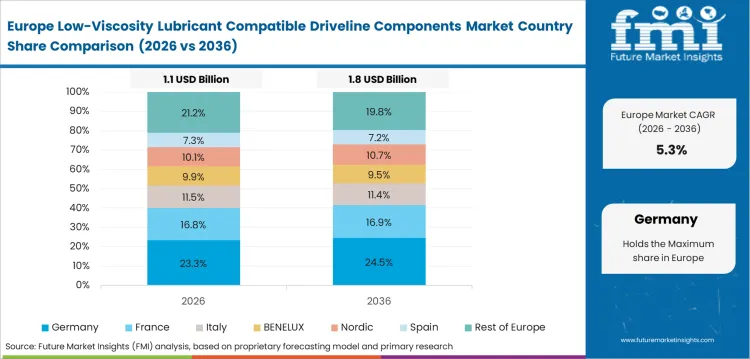
Premium driveline engineering keeps testing needs high in Germany, with the market anticipated to move at 5.9% CAGR during 2026 to 2036. Schaeffler’s April 2025 Auto Shanghai display included a co-axial gearbox with an integrated bevel gear differential. The company said the gearbox can reach up to 98.7% efficiency. German suppliers have a clear role in high-efficiency gearbox design. Such work is important for electric driveline systems that need tight friction control.
- Premium vehicles need gearbox components with low noise and stable lubrication behavior.
- Supplier testing depth supports part approval for low-viscosity ATF and e-drive fluids.
- Compact gearbox design favors component makers with bearing and gear engineering strength.
Future Outlook for Low-Viscosity Lubricant Compatible Driveline Components Market in Japan
Japan is expected to advance during the forecast decade as bearing and gear suppliers support compact electric driveline layouts. JTEKT developed JIGB in April 2025 by integrating gears and bearings into one product. The design targets smaller reduction gear units and lower torque loss. By 2036, Japan is forecast to reach 5.6% CAGR in this market. E-axle and hybrid gearbox programs will need smoother parts with stable contact behavior.
- Japanese suppliers can support compact reducer designs through bearing and gear integration.
- High-speed e-drive units need parts with controlled torque loss and surface durability.
- OEM approval favors suppliers with proof across friction and lubricant exposure.
Sales Analysis of Low-Viscosity Lubricant Compatible Driveline Components Market in South Korea
South Korea’s EV and hybrid platforms are raising demand for compact driveline systems. BorgWarner announced in April 2026 that it secured new stator assembly business for a South Korean electric B-segment SUV program. The program is expected to enter production in September 2027. South Korea is forecast to post 6.8% CAGR in the market over the forecast period. Electric SUV platforms need reducer and bearing systems that manage speed and lubricant performance together.
- Electric SUV programs support demand for compact drivetrain components.
- Local supplier support helps OEMs shorten validation work for electric drive parts.
- High-speed motor systems increase the need for compatible bearings and seals.
Future Outlook for Low-Viscosity Lubricant Compatible Driveline Components Market in France
France is expected to register 5.4% CAGR in this market during the forecast period. Electrified powertrain programs are supporting demand for efficient driveline parts. Valeo stated in September 2025 that its electrification range covers 48V systems and high-voltage e-motors. The same range covers transmission and thermal management systems. Low-viscosity lubricant compatible driveline components become important because transmission and e-drive systems need matched mechanical and thermal behavior.
- Electrified powertrain work supports demand for compatible transmission and e-drive parts.
- French component suppliers can support OEMs through system-level validation.
- Lower-drag driveline designs need seal and bearing packages matched with selected fluids.
Competitive Landscape and Strategic Positioning
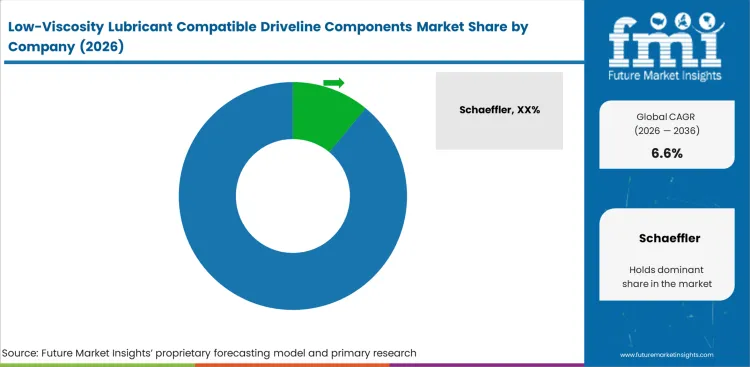
- Competition is centered on proof of low friction and durability under real driveline loads.
- Bearing suppliers need to prove lower torque without raising wear risk.
- Gear suppliers need to prove surface finish quality and heat behavior inside compact units.
- Seal suppliers need to prove leakage control with lower drag.
- Entry barriers include OEM approval time and access to lubricant compatibility testing.
Supplier selection is becoming more technical because OEMs test components with the actual fluid planned for production. Bearing suppliers need to prove torque reduction with wear control. Gear suppliers need to prove surface finish and heat behavior. Seal suppliers need to prove leakage control with lower drag. OEMs prefer partners that can test parts before platform release because late redesign can delay vehicle programs.
Service capability is becoming another important part of competition. Valeo said in October 2025 that it would showcase a remanufactured dual wet clutch for the DQ250 gearbox at EQUIP AUTO 2025. This development supports the service side of the market because clutch and transmission parts need correct fluid compatibility after repair. Suppliers with repair-ready parts can support workshops as electrified and hybrid driveline systems age.
Supplier strength will depend on test evidence more than broad product range. Companies with bearing and gear validation data can support low-viscosity lubricant programs earlier in the design cycle. Seal suppliers can add value by proving leakage control with thinner fluids. Smaller firms can win service parts if they offer matched repair kits and clear fluid compatibility proof.
Key Companies in the Low-Viscosity Lubricant Compatible Driveline Components Market
- Bearing and Motion Specialists: Schaeffler and NSK hold firm positions through low-friction bearing design. NTN and SKF add driveline platform experience. JTEKT supports Asian supply depth.
- Integrated Driveline Suppliers: ZF, AISIN and BorgWarner support transmission and e-axle programs with system-level know-how.
- Seal and Compatibility Specialists: Freudenberg Sealing Technologies and Trelleborg support the market through elastomer design and high-speed rotary sealing know-how.
Competitive Benchmarking: Low-Viscosity Lubricant Compatible Driveline Components Market
| Company | Low-Friction Bearing Depth | Lubricant Proof | E-Axle Exposure | Geographic Footprint |
|---|---|---|---|---|
| Schaeffler | High | High | High | Global with German engineering depth |
| NSK | High | Medium | High | Global with Japanese bearing strength |
| NTN | High | Medium | High | Japan-centered global supply |
| SKF | High | High | Medium | Global with European strength |
| JTEKT | High | Medium | Medium | Japan and Asia centered |
| ZF | Medium | High | High | Global with aftermarket reach |
| AISIN | Medium | Medium | High | Japan, China and Europe |
Source: Future Market Insights competitive analysis, 2026.
Key Developments in Low-Viscosity Lubricant Compatible Driveline Components Market
- In March 2025, NSK Ltd. developed a compact and lightweight deep groove ball bearing for EV drive units. NSK stated that the bearing delivers about 10.0% smaller outer diameter, 51.0% lower weight, 38.0% narrower width, 25.0% lower torque and supports high-speed rotation above 2.14 million dmn.
- In May 2025, NTN Corporation started mass production of its resin mold insulated bearing for e-axles. NTN said the product suppresses electrical pitting by using an insulating resin layer on the bearing outer diameter and width surface. It offers insulation resistance above 1,000.0 V and is designed for e-axles in EVs and HEVs.
Key Players in the Low-Viscosity Lubricant Compatible Driveline Components Market
Major Global Players
- Schaeffler AG
- NSK Ltd.
- NTN Corporation
- SKF Group
- JTEKT Corporation
- ZF Friedrichshafen AG
- AISIN Corporation
Specialist and Regional Players
- BorgWarner Inc.
- Freudenberg Sealing Technologies
- Trelleborg Sealing Solutions
- Dana Incorporated
Report Scope and Coverage
| Parameter | Details |
|---|---|
| Quantitative Units | USD 4.4 billion to USD 8.3 billion at 6.6% CAGR |
| Market Definition | Driveline parts designed to work with thinner transmission and e-drive fluids |
| Segments Covered | Component type, driveline system, lubricant type, vehicle type, sales channel, and region |
| Component Type | Bearings, gears, seals, clutch packs, and synchronizers |
| Driveline System | Automatic transmissions, e-axles, differentials, and transfer cases |
| Lubricant Type | Low-viscosity ATF, e-drive fluids, gear oils, and hybrid fluids |
| Vehicle Type | Passenger cars, light commercial vehicles, heavy trucks, and battery electric vehicles |
| Sales Channel | OEM fitment, aftermarket kits, and service parts |
| Regions Covered | North America, Latin America, Western Europe, Eastern Europe, East Asia, South Asia and Pacific, Middle East and Africa |
| Countries Covered | United States, China, India, Germany, Japan, South Korea, France, and more than 30.0 countries |
| Key Companies Profiled | Schaeffler AG, NSK Ltd., NTN Corporation, SKF Group, JTEKT Corporation, ZF Friedrichshafen AG, and AISIN Corporation |
| Forecast Period | 2026 to 2036 |
| Approach | Hybrid bottom-up and top-down method using vehicle output, driveline mix, e-axle use, lubricant needs, and supplier activity |
Source: Future Market Insights, 2026.
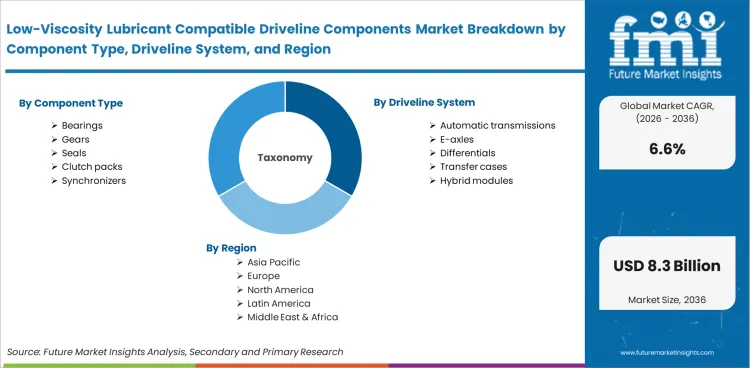
Low-Viscosity Lubricant Compatible Driveline Components Market Breakdown by Component Type and Driveline System
Low-Viscosity Lubricant Compatible Driveline Components Market Segmented by Component Type
- Bearings
- Gears
- Seals
- Clutch packs
- Synchronizers
Low-Viscosity Lubricant Compatible Driveline Components Market Segmented by Driveline System
- Automatic transmissions
- E-axles
- Differentials
- Transfer cases
- Hybrid modules
Low-Viscosity Lubricant Compatible Driveline Components Market Segmented by Lubricant Type
- Low-viscosity ATF
- E-drive fluids
- Gear oils
- Hybrid fluids
Low-Viscosity Lubricant Compatible Driveline Components Market Segmented by Vehicle Type
- Passenger cars
- Light commercial
- Heavy trucks
- Hybrid vehicles
- Battery electric
Low-Viscosity Lubricant Compatible Driveline Components Market Segmented by Sales Channel
- OEM fitment
- Aftermarket kits
- Service parts
Low-Viscosity Lubricant Compatible Driveline Components Market by Region
- North America
- Latin America
- Western Europe
- Eastern Europe
- East Asia
- South Asia and Pacific
- Middle East and Africa
Research Sources and Bibliography
- AISIN Corporation. (2025, January 20). Suzuki’s first BEV “e VITARA” adopts eAxle production in India will contribute to the rollout of Suzuki BEVs around the world in line with market needs. AISIN Corporation.
- BorgWarner Inc. (2025, February 6). BorgWarner secures four new electric motor projects with three major Chinese OEMs. BorgWarner Inc.
- BorgWarner Inc. (2025, October 30). BorgWarner expands collaboration with Chery to supply advanced AWD products for global growth. BorgWarner Inc.
- BorgWarner Inc. (2025, October 30). BorgWarner to supply leading Chinese OEM with 7-in-1 Integrated Drive Module. BorgWarner Inc.
- BorgWarner Inc. (2026, February 11). BorgWarner set to deliver power-packed integrated drive module and generator module with dual inverter to major North American OEM. BorgWarner Inc.
- BorgWarner Inc. (2026, April 30). BorgWarner secures three electric motor awards in China and South Korea. BorgWarner Inc.
- JTEKT Corporation. (2025, April 8). New development of the Integrated Gear Bearing “JIGB®”: A proposal for solutions towards further downsizing, weight reduction and high efficiency in mobilities. JTEKT Corporation.
- NTN Corporation. (2025, May 13). NTN develops high performance ball type sliding CVJ for EVs. NTN Corporation.
- Schaeffler AG. (2025, April 16). Schaeffler presents expanded electrification and intelligent solutions at Auto Shanghai 2025. Schaeffler AG.
- Schaeffler AG. (2025, September 3). Schaeffler at IAA MOBILITY 2025 in Hall B3, Booth B40: Shaping the future of mobility with electric axle drives, hybrid solutions, steer-by-wire technologies, and software. Schaeffler AG.
- Valeo. (2025, September 8). Valeo at the heart of tomorrow’s mobility | IAA Mobility 2025. Valeo.
- Valeo. (2025, October 9). Valeo wins the EQUIP AUTO Paris 2025 International Automotive Innovation Award for its remanufactured dual wet clutch. Valeo.
- European Parliament and Council of the European Union. (2025, June 17). Regulation (EU) 2025/1214 amending Regulation (EU) 2019/631 to include an additional flexibility as regards the calculation of manufacturers’ compliance with CO₂ emission performance standards for new passenger cars and new light commercial vehicles for the calendar years 2025 to 2027. Publications Office of the European Union.
- Schaeffler Automotive Aftermarket GmbH & Co. KG. (2024, September 6). Schaeffler Vehicle Lifetime Solutions presents first repair kit for electric motor for the Hyundai Ioniq. Schaeffler Group.
- ZF Friedrichshafen AG. (2024, August 8). ZF Aftermarket introduces Electric Axle Drive Repair Kits, extending portfolio for electric and hybrid vehicles in USA and Canada. ZF Press Center.
This bibliography is provided for reader reference and is not exhaustive. The full report contains the complete reference list and detailed citations.
This Report Answers
- What is the 2026 and 2036 size of the low-viscosity lubricant compatible driveline components market?
- How fast will demand expand during the forecast period?
- Which component type is forecast to lead demand in 2026?
- Which sales channel is expected to hold the leading position in 2026?
- Which countries are expected to move faster than the global market?
- How do low-viscosity ATF and e-drive fluids affect component design?
- Which companies are active in low-friction bearing and e-axle component supply?
- How does FMI estimate the market forecast?
Frequently Asked Questions
What is 2026 demand for Low-Viscosity Lubricant Compatible Driveline Components?
In 2026, global low-viscosity lubricant compatible driveline components demand is estimated at USD 4.4 billion as OEM validation expands.
How big will the Low-Viscosity Lubricant Compatible Driveline Components Market be in 2036?
By 2036, the market is projected to reach USD 8.3 billion as e-axle and transmission efficiency needs widen.
How much will demand expand during the forecast period?
Demand is projected to expand at 6.6% CAGR during 2026 to 2036.
Which component type is forecast to lead the market in 2026?
Bearings are expected to account for 38.0% share in 2026 due to their direct role in rolling loss and e-axle durability.
Which sales channel is forecast to lead demand?
OEM fitment is expected to account for 72.0% share in 2026 as lubricant compatibility must be qualified before vehicle launch.
Which country is forecast to move fastest?
China is forecast to advance at 7.8% CAGR through 2036 as EV output and local e-axle sourcing lift component demand.
What does the market include?
Scope includes bearings and gears engineered for low-viscosity driveline lubricants. Seals and synchronizers are included with clutch packs.
How does FMI estimate the forecast?
FMI uses vehicle output and EV sales to validate the forecast. Driveline mix and supplier activity support the final check.
Preview the report firsthand - request a free sample
Get SampleGet the brochure for pricing and purchase details.
Get PDFTable of Content
- Executive Summary
- Global Market Outlook
- Demand-side Trends
- Supply-side Trends
- Technology Roadmap Analysis
- Analysis and Recommendations
- Market Overview
- Market Coverage / Taxonomy
- Market Definition / Scope / Limitations
- Research Methodology
- Chapter Orientation
- Analytical Lens and Working Hypotheses
- Market Structure, Signals, and Trend Drivers
- Benchmarking and Cross-market Comparability
- Market Sizing, Forecasting, and Opportunity Mapping
- Research Design and Evidence Framework
- Desk Research Programme (Secondary Evidence)
- Company Annual and Sustainability Reports
- Peer-reviewed Journals and Academic Literature
- Corporate Websites, Product Literature, and Technical Notes
- Earnings Decks and Investor Briefings
- Statutory Filings and Regulatory Disclosures
- Technical White Papers and Standards Notes
- Trade Journals, Industry Magazines, and Analyst Briefs
- Conference Proceedings, Webinars, and Seminar Materials
- Government Statistics Portals and Public Data Releases
- Press Releases and Reputable Media Coverage
- Specialist Newsletters and Curated Briefings
- Sector Databases and Reference Repositories
- FMI Internal Proprietary Databases and Historical Market Datasets
- Subscription Datasets and Paid Sources
- Social Channels, Communities, and Digital Listening Inputs
- Additional Desk Sources
- Expert Input and Fieldwork (Primary Evidence)
- Primary Modes
- Qualitative Interviews and Expert Elicitation
- Quantitative Surveys and Structured Data Capture
- Blended Approach
- Why Primary Evidence is Used
- Field Techniques
- Interviews
- Surveys
- Focus Groups
- Observational and In-context Research
- Social and Community Interactions
- Stakeholder Universe Engaged
- C-suite Leaders
- Board Members
- Presidents and Vice Presidents
- R&D and Innovation Heads
- Technical Specialists
- Domain Subject-matter Experts
- Scientists
- Physicians and Other Healthcare Professionals
- Governance, Ethics, and Data Stewardship
- Research Ethics
- Data Integrity and Handling
- Primary Modes
- Tooling, Models, and Reference Databases
- Desk Research Programme (Secondary Evidence)
- Data Engineering and Model Build
- Data Acquisition and Ingestion
- Cleaning, Normalisation, and Verification
- Synthesis, Triangulation, and Analysis
- Quality Assurance and Audit Trail
- Market Background
- Market Dynamics
- Drivers
- Restraints
- Opportunity
- Trends
- Scenario Forecast
- Demand in Optimistic Scenario
- Demand in Likely Scenario
- Demand in Conservative Scenario
- Opportunity Map Analysis
- Product Life Cycle Analysis
- Supply Chain Analysis
- Investment Feasibility Matrix
- Value Chain Analysis
- PESTLE and Porter’s Analysis
- Regulatory Landscape
- Regional Parent Market Outlook
- Production and Consumption Statistics
- Import and Export Statistics
- Market Dynamics
- Global Market Analysis 2021 to 2025 and Forecast, 2026 to 2036
- Historical Market Size Value (USD Million) Analysis, 2021 to 2025
- Current and Future Market Size Value (USD Million) Projections, 2026 to 2036
- Y-o-Y Growth Trend Analysis
- Absolute $ Opportunity Analysis
- Global Market Pricing Analysis 2021 to 2025 and Forecast 2026 to 2036
- Global Market Analysis 2021 to 2025 and Forecast 2026 to 2036, By Component Type
- Introduction / Key Findings
- Historical Market Size Value (USD Million) Analysis By Component Type , 2021 to 2025
- Current and Future Market Size Value (USD Million) Analysis and Forecast By Component Type , 2026 to 2036
- Bearings
- Gears
- Seals
- Clutch packs
- Synchronizers
- Bearings
- Y-o-Y Growth Trend Analysis By Component Type , 2021 to 2025
- Absolute $ Opportunity Analysis By Component Type , 2026 to 2036
- Global Market Analysis 2021 to 2025 and Forecast 2026 to 2036, By Driveline System
- Introduction / Key Findings
- Historical Market Size Value (USD Million) Analysis By Driveline System, 2021 to 2025
- Current and Future Market Size Value (USD Million) Analysis and Forecast By Driveline System, 2026 to 2036
- Automatic transmissions
- E-axles
- Differentials
- Transfer cases
- Hybrid modules
- Automatic transmissions
- Y-o-Y Growth Trend Analysis By Driveline System, 2021 to 2025
- Absolute $ Opportunity Analysis By Driveline System, 2026 to 2036
- Global Market Analysis 2021 to 2025 and Forecast 2026 to 2036, By Lubricant Type
- Introduction / Key Findings
- Historical Market Size Value (USD Million) Analysis By Lubricant Type, 2021 to 2025
- Current and Future Market Size Value (USD Million) Analysis and Forecast By Lubricant Type, 2026 to 2036
- Low-viscosity ATF
- E-drive fluids
- Gear oils
- Hybrid fluids
- Low-viscosity ATF
- Y-o-Y Growth Trend Analysis By Lubricant Type, 2021 to 2025
- Absolute $ Opportunity Analysis By Lubricant Type, 2026 to 2036
- Global Market Analysis 2021 to 2025 and Forecast 2026 to 2036, By Vehicle Type
- Introduction / Key Findings
- Historical Market Size Value (USD Million) Analysis By Vehicle Type, 2021 to 2025
- Current and Future Market Size Value (USD Million) Analysis and Forecast By Vehicle Type, 2026 to 2036
- Passenger cars
- Light commercial
- Heavy trucks
- Hybrid vehicles
- Battery electric
- Passenger cars
- Y-o-Y Growth Trend Analysis By Vehicle Type, 2021 to 2025
- Absolute $ Opportunity Analysis By Vehicle Type, 2026 to 2036
- Global Market Analysis 2021 to 2025 and Forecast 2026 to 2036, By Sales Channel
- Introduction / Key Findings
- Historical Market Size Value (USD Million) Analysis By Sales Channel, 2021 to 2025
- Current and Future Market Size Value (USD Million) Analysis and Forecast By Sales Channel, 2026 to 2036
- OEM fitment
- Aftermarket kits
- Service parts
- OEM fitment
- Y-o-Y Growth Trend Analysis By Sales Channel, 2021 to 2025
- Absolute $ Opportunity Analysis By Sales Channel, 2026 to 2036
- Global Market Analysis 2021 to 2025 and Forecast 2026 to 2036, By Region
- Introduction
- Historical Market Size Value (USD Million) Analysis By Region, 2021 to 2025
- Current Market Size Value (USD Million) Analysis and Forecast By Region, 2026 to 2036
- North America
- Latin America
- Western Europe
- Eastern Europe
- East Asia
- South Asia and Pacific
- Middle East & Africa
- Market Attractiveness Analysis By Region
- North America Market Analysis 2021 to 2025 and Forecast 2026 to 2036, By Country
- Historical Market Size Value (USD Million) Trend Analysis By Market Taxonomy, 2021 to 2025
- Market Size Value (USD Million) Forecast By Market Taxonomy, 2026 to 2036
- By Country
- USA
- Canada
- Mexico
- By Component Type
- By Driveline System
- By Lubricant Type
- By Vehicle Type
- By Sales Channel
- By Country
- Market Attractiveness Analysis
- By Country
- By Component Type
- By Driveline System
- By Lubricant Type
- By Vehicle Type
- By Sales Channel
- Key Takeaways
- Latin America Market Analysis 2021 to 2025 and Forecast 2026 to 2036, By Country
- Historical Market Size Value (USD Million) Trend Analysis By Market Taxonomy, 2021 to 2025
- Market Size Value (USD Million) Forecast By Market Taxonomy, 2026 to 2036
- By Country
- Brazil
- Chile
- Rest of Latin America
- By Component Type
- By Driveline System
- By Lubricant Type
- By Vehicle Type
- By Sales Channel
- By Country
- Market Attractiveness Analysis
- By Country
- By Component Type
- By Driveline System
- By Lubricant Type
- By Vehicle Type
- By Sales Channel
- Key Takeaways
- Western Europe Market Analysis 2021 to 2025 and Forecast 2026 to 2036, By Country
- Historical Market Size Value (USD Million) Trend Analysis By Market Taxonomy, 2021 to 2025
- Market Size Value (USD Million) Forecast By Market Taxonomy, 2026 to 2036
- By Country
- Germany
- UK
- Italy
- Spain
- France
- Nordic
- BENELUX
- Rest of Western Europe
- By Component Type
- By Driveline System
- By Lubricant Type
- By Vehicle Type
- By Sales Channel
- By Country
- Market Attractiveness Analysis
- By Country
- By Component Type
- By Driveline System
- By Lubricant Type
- By Vehicle Type
- By Sales Channel
- Key Takeaways
- Eastern Europe Market Analysis 2021 to 2025 and Forecast 2026 to 2036, By Country
- Historical Market Size Value (USD Million) Trend Analysis By Market Taxonomy, 2021 to 2025
- Market Size Value (USD Million) Forecast By Market Taxonomy, 2026 to 2036
- By Country
- Russia
- Poland
- Hungary
- Balkan & Baltic
- Rest of Eastern Europe
- By Component Type
- By Driveline System
- By Lubricant Type
- By Vehicle Type
- By Sales Channel
- By Country
- Market Attractiveness Analysis
- By Country
- By Component Type
- By Driveline System
- By Lubricant Type
- By Vehicle Type
- By Sales Channel
- Key Takeaways
- East Asia Market Analysis 2021 to 2025 and Forecast 2026 to 2036, By Country
- Historical Market Size Value (USD Million) Trend Analysis By Market Taxonomy, 2021 to 2025
- Market Size Value (USD Million) Forecast By Market Taxonomy, 2026 to 2036
- By Country
- China
- Japan
- South Korea
- By Component Type
- By Driveline System
- By Lubricant Type
- By Vehicle Type
- By Sales Channel
- By Country
- Market Attractiveness Analysis
- By Country
- By Component Type
- By Driveline System
- By Lubricant Type
- By Vehicle Type
- By Sales Channel
- Key Takeaways
- South Asia and Pacific Market Analysis 2021 to 2025 and Forecast 2026 to 2036, By Country
- Historical Market Size Value (USD Million) Trend Analysis By Market Taxonomy, 2021 to 2025
- Market Size Value (USD Million) Forecast By Market Taxonomy, 2026 to 2036
- By Country
- India
- ASEAN
- Australia & New Zealand
- Rest of South Asia and Pacific
- By Component Type
- By Driveline System
- By Lubricant Type
- By Vehicle Type
- By Sales Channel
- By Country
- Market Attractiveness Analysis
- By Country
- By Component Type
- By Driveline System
- By Lubricant Type
- By Vehicle Type
- By Sales Channel
- Key Takeaways
- Middle East & Africa Market Analysis 2021 to 2025 and Forecast 2026 to 2036, By Country
- Historical Market Size Value (USD Million) Trend Analysis By Market Taxonomy, 2021 to 2025
- Market Size Value (USD Million) Forecast By Market Taxonomy, 2026 to 2036
- By Country
- Kingdom of Saudi Arabia
- Other GCC Countries
- Turkiye
- South Africa
- Other African Union
- Rest of Middle East & Africa
- By Component Type
- By Driveline System
- By Lubricant Type
- By Vehicle Type
- By Sales Channel
- By Country
- Market Attractiveness Analysis
- By Country
- By Component Type
- By Driveline System
- By Lubricant Type
- By Vehicle Type
- By Sales Channel
- Key Takeaways
- Key Countries Market Analysis
- USA
- Pricing Analysis
- Market Share Analysis, 2025
- By Component Type
- By Driveline System
- By Lubricant Type
- By Vehicle Type
- By Sales Channel
- Canada
- Pricing Analysis
- Market Share Analysis, 2025
- By Component Type
- By Driveline System
- By Lubricant Type
- By Vehicle Type
- By Sales Channel
- Mexico
- Pricing Analysis
- Market Share Analysis, 2025
- By Component Type
- By Driveline System
- By Lubricant Type
- By Vehicle Type
- By Sales Channel
- Brazil
- Pricing Analysis
- Market Share Analysis, 2025
- By Component Type
- By Driveline System
- By Lubricant Type
- By Vehicle Type
- By Sales Channel
- Chile
- Pricing Analysis
- Market Share Analysis, 2025
- By Component Type
- By Driveline System
- By Lubricant Type
- By Vehicle Type
- By Sales Channel
- Germany
- Pricing Analysis
- Market Share Analysis, 2025
- By Component Type
- By Driveline System
- By Lubricant Type
- By Vehicle Type
- By Sales Channel
- UK
- Pricing Analysis
- Market Share Analysis, 2025
- By Component Type
- By Driveline System
- By Lubricant Type
- By Vehicle Type
- By Sales Channel
- Italy
- Pricing Analysis
- Market Share Analysis, 2025
- By Component Type
- By Driveline System
- By Lubricant Type
- By Vehicle Type
- By Sales Channel
- Spain
- Pricing Analysis
- Market Share Analysis, 2025
- By Component Type
- By Driveline System
- By Lubricant Type
- By Vehicle Type
- By Sales Channel
- France
- Pricing Analysis
- Market Share Analysis, 2025
- By Component Type
- By Driveline System
- By Lubricant Type
- By Vehicle Type
- By Sales Channel
- India
- Pricing Analysis
- Market Share Analysis, 2025
- By Component Type
- By Driveline System
- By Lubricant Type
- By Vehicle Type
- By Sales Channel
- ASEAN
- Pricing Analysis
- Market Share Analysis, 2025
- By Component Type
- By Driveline System
- By Lubricant Type
- By Vehicle Type
- By Sales Channel
- Australia & New Zealand
- Pricing Analysis
- Market Share Analysis, 2025
- By Component Type
- By Driveline System
- By Lubricant Type
- By Vehicle Type
- By Sales Channel
- China
- Pricing Analysis
- Market Share Analysis, 2025
- By Component Type
- By Driveline System
- By Lubricant Type
- By Vehicle Type
- By Sales Channel
- Japan
- Pricing Analysis
- Market Share Analysis, 2025
- By Component Type
- By Driveline System
- By Lubricant Type
- By Vehicle Type
- By Sales Channel
- South Korea
- Pricing Analysis
- Market Share Analysis, 2025
- By Component Type
- By Driveline System
- By Lubricant Type
- By Vehicle Type
- By Sales Channel
- Russia
- Pricing Analysis
- Market Share Analysis, 2025
- By Component Type
- By Driveline System
- By Lubricant Type
- By Vehicle Type
- By Sales Channel
- Poland
- Pricing Analysis
- Market Share Analysis, 2025
- By Component Type
- By Driveline System
- By Lubricant Type
- By Vehicle Type
- By Sales Channel
- Hungary
- Pricing Analysis
- Market Share Analysis, 2025
- By Component Type
- By Driveline System
- By Lubricant Type
- By Vehicle Type
- By Sales Channel
- Kingdom of Saudi Arabia
- Pricing Analysis
- Market Share Analysis, 2025
- By Component Type
- By Driveline System
- By Lubricant Type
- By Vehicle Type
- By Sales Channel
- Turkiye
- Pricing Analysis
- Market Share Analysis, 2025
- By Component Type
- By Driveline System
- By Lubricant Type
- By Vehicle Type
- By Sales Channel
- South Africa
- Pricing Analysis
- Market Share Analysis, 2025
- By Component Type
- By Driveline System
- By Lubricant Type
- By Vehicle Type
- By Sales Channel
- USA
- Market Structure Analysis
- Competition Dashboard
- Competition Benchmarking
- Market Share Analysis of Top Players
- By Regional
- By Component Type
- By Driveline System
- By Lubricant Type
- By Vehicle Type
- By Sales Channel
- Competition Analysis
- Competition Deep Dive
- Schaeffler
- Overview
- Product Portfolio
- Profitability by Market Segments (Product/Age /Sales Channel/Region)
- Sales Footprint
- Strategy Overview
- Marketing Strategy
- Product Strategy
- Channel Strategy
- NSK
- NTN
- SKF
- JTEKT
- ZF
- AISIN
- Schaeffler
- Competition Deep Dive
- Assumptions & Acronyms Used


